Implications
Lupin grains of different origin show a wide range of rumen degradation characteristics of CP when analysed in situ, using standardised experimental conditions. This variation indicates the potential for an increase in the amount of ruminal undegraded CP as a function of genetic or agronomic practices. Thermal treatment reduces CP degradation in the rumen and substantially changes analysed protein fractions. The latter can be used to evaluate the changes in CP degradation by thermal treatment.
Introduction
Lupins (Lupinus spp.) have high genetic variation, and many different types and varieties of lupin grains are cultivated worldwide. The most cultivated lupin is L. angustifolius because of its resistance to anthracnose – a cropping disease that causes considerable shortfalls in the harvest. Lupin grains are used primarily for farm animal nutrition, owing to their valuable nutritional characteristics, especially the high energy and CP content. The wide range of lupin types and varieties that can be chosen as protein sources in dairy nutrition requires research to determine the variability in CP degradation characteristics in the rumen. Moss et al. (1997, Reference Moss, Deaville and Givens2001) evaluated two and four different lupin samples in an in situ approach using non-lactating cows fed with high forage rations for rumen incubation. Their studies showed that CP degradation was influenced by lupin variety, but both studies contained only seeds of L. albus. White et al. (Reference White, Young, Phillips and Rodehutscord2000) compared one sample of L. angustifolius with one sample of L. albus and found a greater ruminal effective degradation (ED) of CP for L. albus, which indicated differences in CP degradation between lupin species do exist. The expansion of crop rotation to promote sustainable agriculture is a primary goal in European Union agricultural policy, and cultivation of legumes has been encouraged strongly by public funding in recent years. Moreover, consumer demand for non-genetically modified and regional products has led to higher demand for domestic protein sources with subsequent implications to ruminant nutrition. However, information about the extent and variation in ruminal degradation of CP from L. angustifolius is scarce and therefore limits its application in practical feeding situations. Moreover, published in situ CP degradation characteristics vary widely between studies and White et al. (Reference White, Staines and Staines2007) showed that this variation was unexplained, even when methodological differences, like sieve size, were considered. Therefore, the first objective of this study was to characterise the extent and variation in ruminal CP degradation of different lupin grains using a standardised approach.
The generally fast degradation of CP from lupins in the rumen may limit their use in high-yielding dairy cows and a number of experiments have shown that thermal treatment can reduce CP degradation in the rumen (Kibelolaud et al., Reference Kibelolaud, Vernay, Bayourthe and Moncoulon1993; Robinson and McNiven, Reference Robinson and McNiven1993; Singh et al., Reference Singh, Robinson and McNiven1995). Changes to the protein fractions of lupins may be the reason for changes in CP degradation caused by thermal treatment. Hence, the second objective of this study was to evaluate if variation in CP degradation was reflected in the chemical protein fractions of the feedstuff and if changes in CP degradation, induced by technological processing, could be described by chemical protein fractionation. For a fast classification of CP degradation of lupin grains in the rumen, chemical protein fractions might be implemented as a screening tool in plant breeding and feed industries.
Material and methods
All animal studies reported herein were in accordance with animal welfare legislation and approved by the Regierungspräsidium Stuttgart, Germany (approval code V319/14 TE).
Sample characteristics, processing and chemical analyses
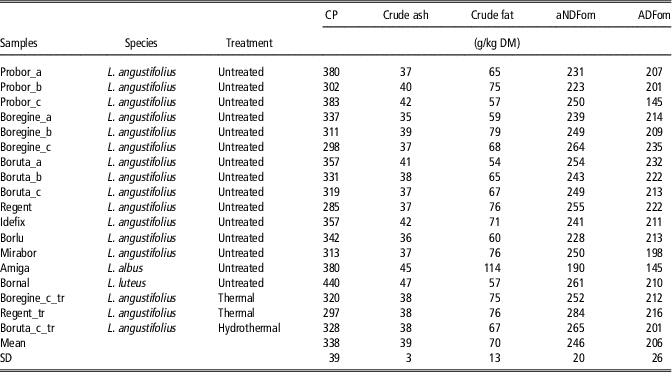
This study was performed using 15 untreated samples of lupin grains from different origins and harvest years to obtain a wide range in their chemical composition (Table 1). The L. angustifolius varieties ‘Probor’, ‘Boregine’ and ‘Boruta’ were harvested in three different years (‘Probor’: 2005 (a), 2012 (b) and 2014 (c); ‘Boregine’: 2005 (a), 2012 (b) and 2015 (c); ‘Boruta’: 2005 (a), 2013 (b) and 2015(c)) and from different locations, resulting in three samples of the same variety. The other L. angustifolius varieties were included once. ‘Bornal’ was a L. luteus variety and ‘Amiga’ was a L. albus variety. All samples were analysed according to the official methods in Germany (Verband Deutscher Landwirtschaftlicher Untersuchungs- und Forschungsanstalten (VDLUFA), 2006). Crude ash (CA) was determined by incineration at 550°C for 4 h (method 8.1), for CP content the N content was analysed using the Kjeldahl method comprising acid digestion with sulphuric acid, steam distillation of ammonium (method 4.1.1) and multiplied by the factor of 6.25. Crude fat (CF) was analysed by extraction with petroleum ether after treatment with hydrochloric acid (method 5.1.1). The NDF assayed with a heat stable amylase and expressed exclusive of residual ash (aNDFom) was analysed by pretreating the samples with thermally stable amylase and then determined by boiling the samples for 1 h in disodium tetraborate followed by incineration until weight constancy (method 6.5.1). The ADF expressed exclusive of residual ash (ADFom) was determined by boiling for 1 h in sulphuric acid detergent solution followed by incineration until weight constancy (method 6.5.2). All lupins were low-alkaloid varieties, also referred to as sweet lupins. Alkaloid contents were measured by using diethyl ether and chloroform as solvents (method 16.2.1) in 12 of the 15 samples and concentrations were consistently below 0.4 g/kg dry matter (DM) (values not shown). To study the influence of thermal treatment on rumen degradation and protein fractions, portions of two of the abovementioned L. angustifolius varieties were subjected to a thermal treatment and one was hydrothermally treated before ruminal incubation. Thermal treatment was executed with whole kernels of ‘Boregine_c’ and ‘Regent’ in a mobile toaster (Mecmar S.p.a, Minerbe, Italy) at 120°C for 60 s; thereafter, kernels were conditioned in the cooling tower for 30 min before cooling down to 20°C. The whole kernels of ‘Boruta_c’ were toasted in a rotary drum toaster with liquid gas operation on a commercial scale (Lupitherm; Börde-Kraftkorn GmbH, Gröningen, Germany). In detail, whole kernels were conditioned with saturated moisture followed by a high temperature short-time processing with dry heating to 130°C. Afterwards, the kernels were cooled down and brought to a defined residual moisture content of 6% by cold air counterflow.
Nutrient composition of untreated and thermal-treated lupin grains

DM=dry matter; aNDFom=NDF assayed with a heat stable amylase and expressed exclusive of residual ash; ADFom=ADF expressed exclusive of residual ash.
In situ procedure
In total, three lactating Jersey cows fitted with a ruminal cannula, and having an average BW of 553 kg and a mean milk production of 21 l/day, were used for in situ incubations in the rumen.
Cows were housed in groups and fed a total mixed ration composed of 35% mixed concentrate, 21% maize silage, 16% grass silage, 14% grass hay, 8% rapeseed meal, 4% barley straw and 2% of a mineral mixture on DM basis. The concentrate ingredients were 25% maize grain, 25% rapeseed cake, 20% barley grain, 20% field beans and 10% peas on DM basis. The diet had an energy content of 6.7 MJ net energy lactation per kg DM and a CP content of 149 g/kg DM. Feed and water were offered for ad libitum consumption. Mean DM intake averaged 16 kg/day during the experiment.
Rumen degradation was determined following the protocols of Madsen and Hvelplund (Reference Madsen and Hvelplund1994) with minor modifications. The grains were ground in a cutting mill with a 2-mm screen (type SM1; Retsch GmbH, Haan, Germany) and about 1.5 g DM of each sample were weighed into separate bags (Ankom Co, Macedon, NY, USA; pore size: 50±3 μm; internal dimensions: 5×10 cm). Bags were closed tightly and fixed to an incubation cylinder (900 g). Before incubation bags and incubation cylinder were conditioned in warm tap water (~39°C) for 1 min and introduced into the rumen for time spans of 2, 4, 8, 16, 24 and 48 h. All time points were incubated independently one after another with all 18 samples and replicates being fixed to the same weight for the specific incubation time. A minimum of six measurements (two repetitions × three cows) were carried out each time. After removal, the bags were immediately immersed in ice water and washed with cold tap water for 15 min without centrifugation using a commercial washing machine (type WM14A160; Siemens GmbH, Munich, Germany). Two bags per sample were used for the determination of the initial 0 h time point and rinsed as described before, without ruminal pre-incubation. Subsequently, all bags were dried at 60°C for 24 h and reweighed. To calculate DM disappearance, two bags per time point were dried at 103°C for 4 h. The average value from both bags was then used to determine the DM content of all residues. The residue of each bag was analysed for its CP concentration (method 4.1.1) (VDLUFA, 2006).
Chemical protein fractionation
Non-protein nitrogen and buffer-soluble nitrogen were determined according to the methods of Licitra et al. (Reference Licitra, Hernandez and Van Soest1996). Trichloroacetic acid was used as a precipitating agent for non-protein nitrogen determination. For neutral detergent insoluble nitrogen (NDIN), the CP content was determined in the residue of aNDF analysis (method 6.5.1 without incineration) (VDLUFA, 2006). Accordingly, acid detergent insoluble nitrogen (ADIN) was determined by analysing CP content in the residue of ADF analysis (method 6.5.2 without incineration) (VDLUFA, 2006). Chemical protein fractions were then calculated according to the Cornell Net Carbohydrate and Protein System (CNCPS) (Sniffen et al., Reference Sniffen, O’Connor, Van Soest, Fox and Russell1992). In brief, fraction A was equal to the non-protein nitrogen fraction and fraction C was equal to ADIN. Fraction B1 is defined as rapidly degradable true protein and calculated by subtracting non-protein nitrogen from buffer-soluble protein. Fraction B3 is true protein slowly degradable in the rumen and calculated as NDIN minus ADIN. Fraction B2 is calculated as 100−A−B1−B3−C and defined as true protein with an intermediate degradation rate. According to the CNCPS feed table, B1, B2 and B3 of lupin grains show ruminal degradation rates of 200, 10 and 0.2%/h, respectively (Fox et al., Reference de Jonge, Spek, van Laar and Dijkstra2003). These rates were used together with the analysed protein fractions to calculate the EDCNCPS for every individual sample at a ruminal outflow rate (k) of 8%/h as follows:
 $$\eqalign {{\rm ED}_{{{\rm CNCPS}}} {\equals}{\rm A}{\plus}{\rm B}1 \cdot {\rm }\left[ {\left( {200} \right)\,/\,\left( {200{\plus}8} \right)} \right]{\plus}{\rm B}2 \cdot \cr \hskip 15pt {\rm }\left[ {\left( {10} \right)\,/\,\left( {10{\plus}8} \right)} \right]{\plus}{\rm B}3 \cdot \left[ {\left( {0.2} \right)\,/\,\left( {0.2{\plus}8} \right)} \right]\hskip -28pt }$$
with EDCNCPS, A, B1, B2 and B3 are given in % of CP.
Calculations and statistical analysis
The CP degradation values (Deg, %) after t hours were fitted to an exponential equation to obtain the degradation parameters a (%; washout fraction defined as instantly disappearing), b (%; potentially degradable), a+b (%, maximal degradation or plateau) and c (%/h; degradation rate) as suggested by Ørskov and McDonald (Reference Ørskov and McDonald1979):
 $${\rm Deg}{\equals}a{\plus}b \cdot \left( {1{\minus}e^{{{\minus}{\rm c} \cdot 0.01 \cdot {\rm t}}} } \right)$$
Parameters were estimated using an iterative least squares procedure in the software GraphPad Prism (version 5.00 for Windows; GraphPad Software Inc., San Diego, CA, USA) and used in combination with k=8%/h, as recommended from the AFRC (1993) for high-yielding dairy cows, to calculate the ED (Ørskov and McDonald, Reference Ørskov and McDonald1979) as:
 $${\rm ED}{\equals}a{\plus}\left[ {\left( {b \cdot c} \right)\,/\,\left( {c{\plus}k} \right)} \right]$$
Descriptive statistics (mean and standard deviation) of rumen degradation characteristics and ED were calculated for all untreated samples using PROC UNIVARIATE in SAS® (version 9.3, 2011; SAS Institute Inc., Cary, NC, USA). The degradation characteristics of the treated samples were statistically compared with their untreated counterparts using PROC MIXED in SAS, with the main effects sample and treatment, and the interaction of sample × treatment. Cow was considered a random effect.
The influence of heat treatment on protein fractions of lupin grain samples was statistically analysed using one-way ANOVA with PROC GLM in SAS, with the main effect treatment. Sample was considered as random effect.
Results
Nutrient composition
Lupin grain samples showed considerable variation in their nutrient composition. The CP content ranged from 285 to 440 g/kg DM with a mean value of 338 g/kg DM. The highest CP content was found for the L. luteus variety whereas the highest CF content was found for the L. albus variety with 114 g/kg DM. There was also considerable variation in fibre fractions, and the L. albus variety showed the lowest aNDFom content with 190 g/kg DM, whereas the other samples ranged from 223 to 284 g/kg DM. The ADFom content averaged 206 (from 145 to 235) g/kg DM. The variation in nutrient composition was not only found between different cultivars but also within one cultivar as shown for the three samples of the L. angustifolius variety ‘Probor’ for which CP, CF, aNDFom and ADFom values ranged from 302 to 383, from 57 to 75, from 223 to 250 and from 145 to 207 g/kg DM, respectively.
In situ crude protein degradation of untreated lupins
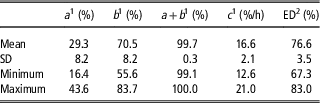
Mean and variation of the estimated degradation parameters and the ED of CP from all untreated lupin samples are shown in Table 2. The values of each single sample are given in the Supplementary Table S1. The CP degradation parameters varied widely among samples. The mean value for the a fraction was 29.3% with a range from 16.4% to 43.6%. The b fraction averaged 70.5% and showed a variation from 55.6% to 83.7%. In sum, the CP of all samples was nearly completely degradable in the rumen (a+b=99.7%). The mean degradation rate (c) was 16.6%/h with a range from 12.6 to 21.0%/h. Variation in degradation parameters induced differences in the ED that ranged from 67.3% to 83.0% with an average value of 76.6%.
Mean and variation of ruminal in situ CP degradation parameters and effective degradation for a ruminal outflow (k) of 8%/h (ED) of untreated lupins (n=15 samples)

a=instantly disappearing; b=potentially degradable; a+b=plateau maximal degradation; c=degradation rate.
1 From equation (1).
2 From equation (2).
Influence of thermal treatment on in situ degradation of lupins
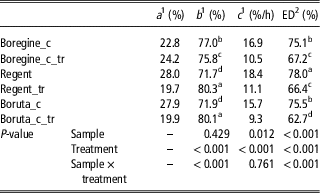
The influence of thermal treatments on the in situ degradation of three different lupin samples is shown in Table 3. A significant interaction was found between sample and treatment (P<0.001) for the b fraction and the ED. For ‘Boregine_c’ thermal treatment led to a somewhat lower b fraction, whereas for ‘Regent’ and ‘Boruta_c’ thermal treatment increased the b fraction by 10%. The treatment effect on the ED was different between samples with a reduction of 10%, 15% and 17% for ‘Boregine_c’, ‘Regent’ and ‘Boruta_c’, respectively. The degradation rate was significantly reduced from a mean value of 17.0%/h for untreated samples to 10.3%/h for thermal treated samples.
Ruminal in situ CP degradation parameters and effective degradation for a ruminal outflow (k) of 8%/h (ED) of treated lupins compared with their untreated counterparts

a=instantly disappearing; b=potentially degradable; c=degradation rate.
n=3 cows per sample.
a,b,c,dDifferent superscript letters in a column show significant differences between samples (P⩽0.05).
1 From equation (1).
2 From equation (2).
Chemical protein fractions of untreated lupins
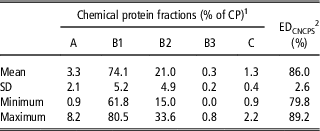
Mean and variation of protein fractions and EDCNCPS for untreated lupins are given in Table 4. The values of each single sample are given in the Supplementary Table S2. Most of the protein (74.1%) in untreated lupins belonged to the B1 fraction and varied from 61.8% to 80.5%. The remaining N was mostly found in the B2 fraction with a mean value of 21.0% and a variation from 15.0% to 33.6%. Untreated lupins had hardly any N associated with the B3 fraction, and the C fraction was small with values ranging from 0.9% to 2.2%, respectively. The A fraction was also small with a mean value of 3.3%, but showed considerable variation from 0.9% to 8.2%. The calculated EDCNCPS showed a mean value of 86.0% and ranged between 79.8% and 89.2%.
Protein fractions and ruminal effective degradation (EDCNCPS) calculated according to Cornell Net Carbohydrate and Protein System (CNCPS) for untreated lupins (n=15 samples)

1 According to CNCPS, A=non-protein nitrogen; B1=true protein rapidly degradable in the rumen; B2=true protein with intermediate degradation rate in the rumen; B3=true protein with slow degradation rate in the rumen, C=unavailable or cell-wall bound true protein.
2 Effective degradation for a ruminal outflow (k) of 8%/h calculated with degradation rates of 200 (B1), 10 (B2) and 0.2%/h (B3) as suggested by Fox et al. (Reference de Jonge, Spek, van Laar and Dijkstra2003).
Influence of thermal treatment on chemical protein fractions of lupins
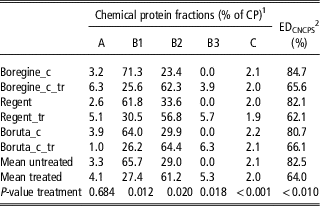
Thermal treatment led to a shift in chemical protein fractions of all samples (Table 5). The A fraction was not significantly influenced by thermal treatment. Significant changes were found for the C fraction, although the numerical differences were small. The biggest changes were seen for the B fraction. The B1 fraction was significantly reduced by up to 46 percentage points, whereas the B2 fraction was increased by up to 39 percentage points (‘Boregine_c’). There was no B3 fraction found for untreated lupins but for thermal treated samples B3 fraction made up 3.9%, 5.7% and 6.3% in ‘Boregine_c_tr’, ‘Regent_tr’ and ‘Boruta_c_tr’, respectively. The change in chemical protein fractions induced changes in the calculated EDCNCPS. The EDCNCPS was reduced from 84.7% to 65.6% for ‘Boregine_c’, from 82.1% to 62.1% for ‘Regent’ and from 80.7% to 66.1% for ‘Boruta_c’.
Protein fractions and ruminal effective degradation (EDCNCPS) calculated according to Cornell Net Carbohydrate and Protein System (CNCPS) for treated lupins compared with their untreated counterparts

1 According to CNCPS, A=non-protein nitrogen; B1=true protein rapidly degradable in the rumen; B2=true protein with intermediate degradation rate in the rumen; B3=true protein with slow degradation rate in the rumen, C=unavailable or cell-wall bound true protein.
2 Effective degradation for a ruminal outflow (k) of 8%/h calculated with degradation rates of 200 (B1), 10 (B2) and 0.2%/h (B3) as suggested by Fox et al. (Reference de Jonge, Spek, van Laar and Dijkstra2003).
Comparison of in situ results with chemical protein fractionation
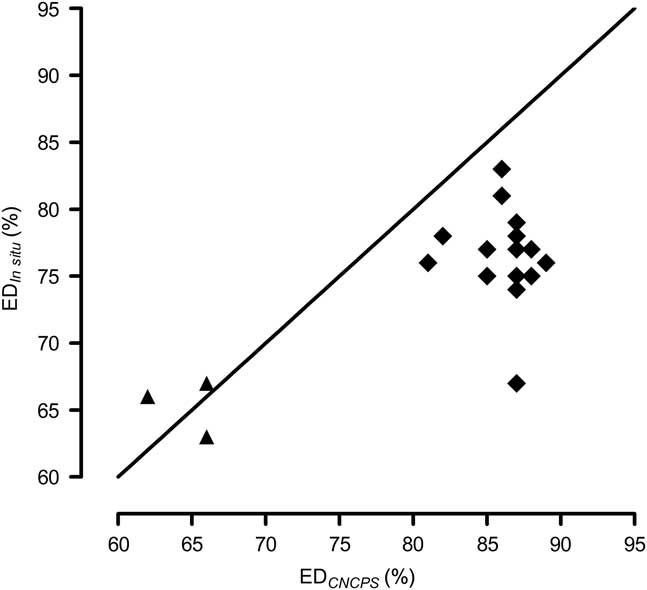
Figure 1 shows the comparison between the in situ ED of CP and the EDCNCPS for all untreated and thermal treated samples. Calculation of ED according to CNCPS led to on average 10 percentage points higher values for all untreated samples compared with the in situ ED values. Furthermore, comparison of untreated samples shows that the ranking was not consistent between both methods also indicated by the non-significant correlation coefficient between all untreated samples (r=−0.14; P>0.05). However, the correlation reached statistical significance when ED of treated samples were incorporated in the evaluation with r=0.74 and P⩽0.001. It can, therefore, be concluded that the effect of thermal treatment was reflected in the ED estimated with both methods and ED of in situ values and CNCPS matched closely for thermal treated samples.
Comparison of the ruminal effective degradation (ED) of CP for a ruminal outflow of 8%/h determined in situ (EDIn situ) or by protein fractionation according to Cornell Net Carbohydrate and Protein System (EDCNCPS) for untreated (♦) and treated (▲) lupins. The line is the angle bisector.

Discussion
Nutrient composition
The samples used in the present study showed a high variation in their chemical composition between and within cultivars. Sujak et al. (Reference Sujak, Kotlarz and Strobel2006) reported similar results for the mean value and variation of CP, CA and CF content of different lupin varieties from L. luteus, L. albus and L. angustifolius. The highest CP content for L. luteus and the highest CF content for L. albus of all varieties analysed in the present study was in accordance with previously reported results from comparisons between the three different lupin specifications (Gdala et al., Reference Fox, Tylutki, Tedeschi, van Amburgh, Chase, Pell, Overton and Russell1996; Sujak et al., Reference Sujak, Kotlarz and Strobel2006; Chiofalo et al., Reference Chiofalo, Presti, Chiofalo and Gresta2012). The variation in nutrient composition between the different varieties of L. angustifolius in the present study might be due to genetic factors. Chiofalo et al. (Reference Chiofalo, Presti, Chiofalo and Gresta2012) showed significant differences between three cultivars of L. angustifolius in productive traits, oil content and fatty acid profile grown in the same environment. However, variation in nutrient composition across genotypes and between samples of the same genotype in the present study might be due to differences in location or harvest year. Beyer et al. (Reference Beyer, Schmalenberg, Jansen, Jürgens, Uptmoor, Broer, Huckauf, Dietrich, Michel, Zenk and Ordon2015) evaluated the variability, heritability and environmental stability of seed quality and yield parameters of 50 genotypes of L. angustifolius including the cultivars ‘Probor’, ‘Boregine’, ‘Borlu’ and ‘Boruta’ that were also examined in the present study. They reported significant differences between genotypes for all analysed traits including CP and oil content of the seeds. Environment (location, year or location × year) showed the largest influence on total variance of CP and oil content, however, the genotype and environment interaction variance component was high for both variables suggesting that the ranking of genotypes is relatively constant across all environments (Beyer et al., Reference Beyer, Schmalenberg, Jansen, Jürgens, Uptmoor, Broer, Huckauf, Dietrich, Michel, Zenk and Ordon2015).
In situ crude protein degradation of untreated lupins
White et al. (Reference White, Staines and Staines2007) summarised 20 in situ studies of CP degradability of lupin grains and found ED (k=8%/h) values ranging from 53% to 96% and a range of 6 to 75%/h for the CP degradation rate. In order to assess whether these differences in CP degradation were caused by intrinsic sample characteristics or between-experiment variation, it is necessary to evaluate different samples in the same standardised approach. In this study, ranges of the ED (from 67.3% to 83.0%) and the degradation rate (from 12.6 to 21.0%/h) of untreated lupins were lower, but also remarkable especially under consideration of the standardised methodology. Studies evaluating more than one lupin sample in the same experiment are scarce. Moss et al. (Reference Moss, Givens, Grundy and Wheeler1997, Reference Moss, Deaville and Givens2001) evaluated two and four different cultivars of L. albus, respectively. Fractional rates of degradation of CP were considerable lower (from 5.1 to 8.8%/h) compared with the results of the present study. As a consequence, Moss et al. (Reference Moss, Givens, Grundy and Wheeler1997) calculated remarkable lower ED (k=8%/h) values and only a slight difference between both cultivars with values of 51.0 and 56.0%. In the study of Moss et al. (Reference Moss, Deaville and Givens2001), the ED (k=8%/h) of L. albus ranged from 55.1% to 69.1% and were therefore on average lower, but variation of the ED between samples was similar compared with the range in the present study for different samples of L. albus, L. luteus and L. angustifolius. White et al. (Reference White, Young, Phillips and Rodehutscord2000) found that L. albus had a higher A fraction (50% v. 34%), but a lower c value (11 v. 13%/h) compared with L. angustifolius and this led to a slightly greater ED (calculation from published degradation parameters for k=8%/h) for L. albus (80%) than that of L. angustifolius (75%). Niwinska (Reference Niwinska2001) studied the in situ ruminal CP degradation of one L. luteus, two L. albus and three L. angustifolius cultivars and found very high values of the A fraction (from 60% to 62%) perhaps because samples were milled through a 0.75-mm sieve. However, the degradation rate of the b fraction was low with a slight variation from 6.7% to 9.1%/h and also the ED (calculation from published degradation parameters for k=8%/h) varied only slightly with a trend to higher values for L. luteus and L. albus (79%) compared with L. angustifolius cultivars (77%). The CP degradation parameters and the ED of L. albus and L. luteus in the present study were not particularly noticeable as the values were within the range of the L. angustifolius cultivars and did not represent any extreme values. Compared to the aforementioned studies (Moss et al., Reference Moss, Givens, Grundy and Wheeler1997; Moss et al., Reference Moss, Deaville and Givens2001; Niwinska, Reference Niwinska2001) samples of the present study showed faster CP degradation in the rumen, which might be due to the feeding of the experimental cows. In the present study, lactating cows with a concentrate diet and a high feed intake were used whereas Moss et al. (Reference Moss, Givens, Grundy and Wheeler1997, Reference Moss, Deaville and Givens2001) used non-lactating cows fed at maintenance and Niwinska (Reference Niwinska2001) used bulls fed for 600 g/day BW gain. Vanzant et al. (Reference Vanzant, Cochran and Titgemeyer1998) summarised different studies and showed a clear influence of diet composition on in situ degradation characteristics. They, therefore, concluded that the goal should be to maximise the diversity of the microbial population and to generate data directly applicable to a particular production system by feeding diets that most closely approximate those production conditions. Therefore, results of the present study may better suit application in feed formulation for dairy cows as test animals represented the target conditions. Generally, the low proportion of undegradable CP (UDP) limits the inclusion of unprocessed lupins in rations for high-yielding dairy cows. Based on their literature review, White et al. (Reference White, Staines and Staines2007) suggested possible breeding objectives to improve the feeding value of lupin grains, and one was improving the protein quality by reducing ruminal degradability by 15% to 20%. In the present study, CP degradation among samples varied up to 15 percentage points. We are not aware of any study evaluating the effect of genotype or environment on CP degradation of lupin grains in the rumen. Calabrò et al. (Reference Calabrò, Cutrignelli, Lo Presti, Tudisco, Chiofalo, Grossi, Infascelli and Chiofalo2015) found significant but only slight effects of harvest year, genotype and their interactions on in vitro rumen fermentation characteristics for L. albus. However, gas production is no good indicator for CP fermentation in the rumen. As mentioned earlier, a significant effect of genotype was found on nutrient composition of L. angustifolius and was shown to be constant across environments (Cowling and Tarr, Reference Cowling and Tarr2004; Beyer et al., Reference Beyer, Schmalenberg, Jansen, Jürgens, Uptmoor, Broer, Huckauf, Dietrich, Michel, Zenk and Ordon2015). These results, together with the variation in CP degradation in the present study, indicate that there is genetic variation between genotypes of lupin grains. This variation might be used to increase the amount of UDP by plant breeding activities. Therefore, the effects of genetic factors and environment on ruminal CP degradation should be investigated in systematic studies in the future.
Influence of thermal treatment on in situ degradation of lupins
Thermal treatment is one possibility to increase the UDP content of lupins by decreasing the a fraction and the degradation rate (Kibelolaud et al., Reference Kibelolaud, Vernay, Bayourthe and Moncoulon1993; Goelema et al., Reference Gdala, Jansman, Van Leeuwen, Huisman and Verstegen1998; Aufrère et al., Reference Aufrère, Graviou, Melcion and Demarquilly2001). This was confirmed in the present study. However, most studies used seeds of L. albus (Kibelolaud et al., Reference Kibelolaud, Vernay, Bayourthe and Moncoulon1993; Robinson and McNiven, Reference Robinson and McNiven1993; Singh et al., Reference Singh, Robinson and McNiven1995; Zaman et al., Reference Zaman, McNiven, Grimmelt and MacLeod1995; Yu et al., Reference Yu, Egan and Leury1999; Aufrère et al., Reference Aufrère, Graviou, Melcion and Demarquilly2001; Rémond et al., Reference Rémond, Le Guen and Poncet2003) or did not specify the samples precisely (Murphy and McNiven, Reference Murphy and McNiven1994; Goelema et al., Reference Gdala, Jansman, Van Leeuwen, Huisman and Verstegen1998). The authors are not aware of any study that investigated the influence of thermal treatment on ruminal in situ degradation of CP for L. angustifolius. Roasting and extruding are often used in the literature and temperature and processing time vary considerably between studies. Using low temperature (110°C) or only short-processing times (1 min) were not effective in increasing the UDP content of lupins (Kibelolaud et al., Reference Kibelolaud, Vernay, Bayourthe and Moncoulon1993; Zaman et al., Reference Zaman, McNiven, Grimmelt and MacLeod1995; Yu et al., Reference Yu, Egan and Leury1999). In the present study, samples were heated at 120°C to 130°C and the decrease in ED (from 10% to 17%) was similar to data of L. albus extruded at 130°C (Kibelolaud et al., Reference Kibelolaud, Vernay, Bayourthe and Moncoulon1993) or roasted at 130°C for more than 15 min (Yu et al., Reference Yu, Egan and Leury1999). Cros et al. (Reference Cros, Moncoulon, Bayourthe and Vernay1992) found a decrease by 11.6% in ruminal degradation when seeds of L. albus were extruded at 120°C along with a higher intestinal digestibility compared with untreated feedstuffs. In addition, Schroeder et al. (Reference Schroeder, Erasmus, Leeuw and Meissner1996) found higher UDP values when lupin seeds were heated from 110°C to 170°C for various durations, but intestinal digestibility tended to increase only at 110°C and 130°C and tended to decrease with higher temperature. Correlation of the intestinal digestibility of UDP with ADIN content of the samples showed that UDP intestinal digestion was not decreased until ADIN levels above 7.5% were reached (Schroeder et al., Reference Schroeder, Erasmus, Leeuw and Meissner1996). In the present study, moderate heating increased the amount of UDP for L. angustifolius. Results of the chemical protein fractions indicate that the intestinal digestibility was not negatively affected, as the amount of ADIN was lower than 7.5% and similar between untreated and thermal treated samples.
Chemical protein fractions and comparison with in situ degradation results
Data on chemical protein fractions according to the CNCPS to determine the protein quality of lupin grains for ruminants and comparison with in situ data are scarce. Moreover, up to now, the influence of thermal treatment of lupin grains on protein fractions was not investigated. Hence, a comparison of protein fractions from untreated samples with their thermal treated counterparts can help to describe the changes in ruminal CP degradation occurring through thermal processing.
In this study, untreated samples showed high amounts of buffer-soluble protein indicated by the high B1 fraction. Similar values were also found by Chrenková et al. (Reference Chrenková, Čerešňáková, Weisbjerg, Formelová, Poláčiková and Vondráková2014) investigating one sample of L. angustifolius with 9.5% and 63.7% for the A and B1 fraction, respectively. The fact that more than 77% of CP consists of soluble protein and that on average 95% of CP is a true protein with fast and intermediate degradation rates fits well to the relatively fast degradation rate of CP from untreated lupins in the in situ trial of the present study. On the other hand, Cazzato et al. (Reference Cazzato, Laudadio, Stellacci, Ceci and Tufarelli2012) found soluble CP fractions (A and B1) of only 43% to 44% from which half of the CP was represented in the A fraction of L. albus grown under three different levels of sulphur fertilisation. For all fertiliser treatments, most of the CP was found in the B2 fraction (34%) and 17% in the B3 fraction. These differences can be due to the sample material or the experimental procedure. de Jonge et al. (Reference Goelema, Spreeuwenberg, Hof, van der Poel and Tamminga2009) showed that solubility of N for lupins was affected by pH and osmolality of the solvent and decreased from 57% to 10% when buffer pH was reduced from 6.8 to 5.0. In this study, soluble N was determined as prescribed in the CNCPS using a buffer solution of pH 6.8. However, in situ ED was determined in lactating dairy cows were pH was likely below 6.8. The probable overestimation of the soluble N fraction in vitro compared with the soluble fraction of the samples when incubated at lower pH in the rumen might be one reason why EDCNCPS was higher for all untreated samples compared with the ED determined in situ. Irrespective of that, ED of thermal treated samples was similar with both methods and de Jonge et al. (Reference Goelema, Spreeuwenberg, Hof, van der Poel and Tamminga2009) showed that the decrease in soluble N with decreasing pH of the buffer was mainly due to a decreasing proportion of storage globulins (11S). According to Aufrère et al. (Reference Aufrère, Graviou, Melcion and Demarquilly2001), these proteins are very sensitive to thermal denaturation and therefore, pH of the solvent, either as buffer solution or in the rumen, might have only minor influence on N solubility of thermal treated samples. From the present results, it seems that the estimation of ED by protein fractions of CNCPS is applicable for thermal-treated lupin samples. However, these results should be validated with more data and it would be interesting to evaluate the effects of thermal treatment on protein fractions of other legumes like peas or faba beans.
Conclusions
The ruminal CP degradation of L. angustifolius – the most cultivated lupin species worldwide – is now described comprehensively. Results of this study demonstrated that degradation parameters and ED of CP from lupin grains of different origins vary widely. This variation indicates a potential to increase the amount of UDP without additional chemical or physical treatment. However, the effect of genetic factors and agronomic practices on ED of lupin grains should be investigated in systematic studies in the future. The variability of CP degradation of untreated sample material was not explained by chemical protein fractions, which might be due to a discrepancy between buffer-soluble N determined according to the CNCPS and solubility of N in the rumen of concentrate fed cows in in situ studies. Nevertheless, thermal treatment significantly reduced degradation rates and ED of CP from lupin grains and was associated with a significant change in protein fractions. Therefore, it seems that the estimation of ED by protein fractions can be used to evaluate changes in CP degradation by thermal treatment.
Acknowledgements
The authors thank Thomas Engelhard from the Landesanstalt für Landwirtschaft und Gartenbau Sachsen-Anhalt for the supply of thermal treated lupin grains and the untreated raw materials.
Declaration of interest
The authors declare that they have no conflict of interest.
Ethics statement
All animal studies reported in the present paper were in accordance with animal welfare legislation and approved by the Regierungspräsidium Stuttgart, Germany (approval code V319/14 TE).
Software and data repository resources
None of the data were deposited in an official repository.
Supplementary material
To view supplementary material for this article, please visit https://doi.org/10.1017/S1751731118002124