Introduction
‘Keep moving forward Angolan, you have only one path’, Alberto Teta Lando (1948–2008) sang on his 1974 album Independência, recorded just as the war for independence from Portugal (1961–1975) was coming to an end. It made no difference if you were white, mulato or black, he proposed. Instead, what was important was a willingness to make Angola better: a ‘truly free’ and independent Angola. The song bore as a title the first four words of its lyrics, ‘Angolano segue em frente’, quoted above, and Independência was the first release of the Companhia de Discos de Angola (CDC). It reportedly reached gold record status (Fortunato Reference Fortunato2008), but it was to be Lando's last recording before leaving for exile in France. The Carnation Revolution ended the dictatorial Estado Novo government of Portugal that year and with it the war, paving the way for the independence of Angola, Mozambique, Cape Verde, São Tomé e Principe and Guinea-Bissau in Africa in 1975. In Angola, however, competing nationalist revolutionary parties immediately began to fight for control of the country. The United States had been offering modest support to the FNLA (National Front for the Liberation of Angola) through Zaire since the 1960s and now greatly increased its involvement with that faction. In the South of Angola UNITA (National Union for the Total Independence of Angola), led by Jonas Savimbi, received support from South Africa and the US. Both of these organisations were arrayed against the left-leaning MPLA (Popular Movement for the Liberation of Angola) for control of the capital, Luanda. Cuba, with tentative existing ties to that organisation, now sent troops to Angola, allowing the MPLA to weaken the FNLA and to hold UNITA to the south of Luanda. The ensuing civil war – mainly between Cuba-backed MPLA and US/South Africa-backed UNITA forces, but also fuelled by various nations with stakes in Cold War politics, crippled Angola's post-independence development for many years.Footnote 1 Although various accords in the late 1980s and the 1990s sought to establish the conditions for peace and democracy, fighting between UNITA and the MPLA continued. Then, in 2002, troops of the MPLA killed UNITA leader Jonas Savimbi, leading to a ceasefire and effectively ending the civil war.
A little later that year Sérgio Guerra, the Brazilian owner of the Maianga production company, invited Rio de Janeiro-based musician Maurício Pacheco to Luanda to help construct a recording studio for Maianga's Angolan branch. While there, Pacheco explored the holdings at the National Radio archives and came across Lando's ‘Angolano segue em frente’ (sometimes referred to as ‘Angolé’, a colloquialism for ‘Angolan’). He secured a digital copy of the master tape (the ‘L-R’, for left and right channels) and created a remix of it for a television program Maianga produced in Angola. Later, in Rio de Janeiro, he played this rendition for his friend Fernanda Abreu, a musician known for her mixtures of samba with funk, rock, disco and pop (see Moehn Reference Moehn2008). She identified intensely with it and felt that it spoke to Brazilian realities (Interview, 9 August 2007, Rio de Janeiro), so she altered the references to Angola in the lyrics and recorded her own version, renaming it ‘Brasileiro’ (Brazilian). Lando expressed his approval and allowed her to use a sample of his voice from the original version for her recording, which Abreu released on her Na Paz (At Peace) album of 2004.
The musical ‘moments’ just described raise a series of questions. In what ways might the lyrics to this song resonate in these different social contexts, separated not only by an ocean but by three decades? How do the later versions differ from Lando's original recording? What new forms of identification and collaboration between Brazilian and Angolan musicians have emerged since 2002? How do such projects build on earlier exchanges? Conversely, how do they play into contemporary world music markets? What do they suggest for theorising postcolonial Atlantic cultural flows, or for new ways of understanding mixture in Brazilian music? In this article I compare these three recordings of ‘Angolano segue em frente’ in light of recent thinking on the Lusophone Atlantic. I suggest that such collaborations reinforce existing notions in Brazil that Africa is always-already integral to the country's cultural identity, on the one hand, while they also signal a potentially more dynamic and emergent understanding of Brazil's relationship to this cultural legacy on the other. At the same time, I note that some of the discourse surrounding cultural and technical exchanges between the two countries implicates Brazil in an uneasily paternalistic relationship to the newly burgeoning African nation (Angola has significant oil reserves, among other resources).
My interest in this research began when Chico Neves, in Rio de Janeiro, gave me copies of two recordings he had produced of Angolan artists (described below). I liked the music and during a subsequent trip to Rio, where I have established ties to the music scene from earlier field research, I met with Maurício Pacheco to talk about his work in Angola. This article therefore considers primarily Brazilian initiatives and perspectives; I expect to be able to examine Angolan points of view on such exchanges in the future.
Foundational flows and oceans of sound
Without wishing to advance a historically determinist explanation of present-day exchanges, there are foundational Atlantic routes to consider. The Portuguese began to establish a presence in what would come to be known as Angola (from the Bantu N'gola) at the end of the 15th century, initially as a trade link between Europe and India/Southeast Asia. With the advent of the slave trade in the New World, however, Brazilian merchants, not metropolitan ones, grew increasingly powerful. Africans from Angola accounted for two-thirds of those taken to Brazil (Ferreira Reference Ferreira, Naro, Sansi-Roca and Treece2007, p. 100), while a large percentage of the slaves exported from Angola went to Rio de Janeiro (Rawley and Behrendt Reference Rawley and Behrendt2005, pp. 41–2). The Portuguese/Brazilian trade, representing the largest portion of the total traffic in slaves and largely between points south of the equator, was thus ‘a phenomenon of the South Atlantic Ocean’ (Rawley and Behrendt Reference Rawley and Behrendt2005, p. 44). The slave trade between Angola and Brazil occurred within ‘a bilateral framework’ that, Ferreira argues, undercut Portuguese influence and strengthened Angola's direct links with Brazil (Ferreira Reference Ferreira, Naro, Sansi-Roca and Treece2007, p. 100). Some scholars have gone so far as to describe Angola as a sub-colony of Brazil at the time (Rodrigues Reference Rodrigues1982).
These peculiarities have figured in recent discussions about cultures of the ‘Lusophone Black Atlantic’. This conceptual space is imagined partly in contradistinction to a dominant focus on the Anglophone North in studies of Atlantic history, and partly as offering a more mutually constitutive and relational paradigm than have either Euro-American-centric models of imperial expansion and creolisation in the New World or, conversely, Africa-centric models of modernity. Like Paul Gilroy and others (e.g. Linebaugh and Rediker Reference Linebaugh and Rediker2000), Naro, Sansi-Roca and Treece look to the ocean as a metaphor for thinking about flows that challenge or ignore more bounded concepts such as nation or region. Moreover, they draw a parallel between the ‘fluid, temporally dynamic, multidimensional fabric of oceanic space’ and musical experience, the latter of which, they note, is a central thread of Atlantic cultural history. In both music and the space of the sea, ‘a formless reservoir of possibilities, the energetic potential of waves, pulses and currents is harnessed by human initiative so as to set in motion complex patterns of continuity and change, networks of resonance and dissonance, dramas of conflict, dialogue, and transformation’ (Naro et al. Reference Naro, Sansi-Roca and Treece2007, p. 6). This ‘ocean of sound’, they propose, is a contingent space structured and rendered meaningful ‘only insofar as it is “performed” in real time, in the historical present, by those voices, bodies, and instruments that vibrate and move across it’. Colonial cultures are ‘distinct yet simultaneously resonating voices weaving a polyphonic texture’ in a kind of cultural counterpoint (Naro et al. Reference Naro, Sansi-Roca and Treece2007, p. 6).Footnote 2
While metaphors of counterpoint and polyphony may seem overly harmonious for describing some of the ruptures and violence of cultural contact, Naro, Sansi-Roca and Treece are taking a long view of the history of the Atlantic as constituting processes in which ‘cultures of relation, sometimes through identity, sometimes through confrontation’ have been constructed (Naro et al. Reference Naro, Sansi-Roca and Treece2007, p. 8; see also Sanches 2006). Ineke Phaf-Rheinberger and Tiago de Oliveira Pinto (2008, p. 8) call for ‘breaking through academic boundaries that hold the continents apart and [that] ignore the millions who have gone back and forth for centuries on this main route of the slave trade’. The Imperial Eyes (Pratt Reference Pratt2008) viewpoint of the coloniser, they reflect, has ‘neglected the cultural impact of this nomadic move and its “contact zones” on both sides of the ocean’ (Phaf-Rheinberger and Pinto 2008, p. 8). There was, rather, a continuous ‘flux and reflux’ (Verger Reference Verger1968) of Africans of Brazilian birth and of various goods across the Atlantic, contributing to a diversity of African-Brazilian musical influences and mixtures (Pinto 2008, p. 169). Pinto evokes the idea of ‘crossed rhythms’ as an ‘allegory of different cultural elements, which meet and produce new configurations, recreating symbolic values and historical knowledge in virtue of new social significations’ (Pinto 2008, p. 177). This notion of ‘crossing,’ I would add, also usefully implies the possibility of cultural influences not necessarily blending into each other.
Recent developments
If these long-ago currents are foundational in their sheer scale and lasting influence, recent history also includes instances of exchange between Angola and Brazil. For example, in the early 1970s Brazilian President Emílio Garrastazú Médici began actively to strengthen relations with Africa (see Dávila Reference Dávila2010, pp. 141–69). Brazil voted in favour of anti-colonialist measures in the United Nations (UN) in 1973 and subsequently signed bilateral trade agreements with African nations. Even though the Cuba-backed MPLA controlled Luanda after independence in 1975, Brazil (then ruled by right-wing general Ernesto Geisel) became the first Western nation to recognise the new state and to establish an embassy in the capital. Brazilian presidents Figueiredo and Sarney visited Angola and other African countries in the 1980s, partly out of economic interest.Footnote 3 In 1995 president Fernando Henrique Cardoso sent troops to Angola to participate in UN-led minesweeping and rebuilding efforts, and he visited Angola in the following year.
In the sphere of music, samba singer-songwriter Martinho da Vila, who had visited Angola in the early 1970s, initiated the Kalunga Project in 1980 in order to bring major stars of MPB (música popular brasileira) to Angola for a series of shows (samba is an umbrella term for a variety of related Afro-Brazilian genres in duple metre, typically featuring heavy syncopation). In Luanda with Kalunga, Chico Buarque met Angolan singer-songwriter Waldemar Bastos, who in 1982 defected to Germany and then moved to Brazil (Cidra Reference Cidra and Castelo-Branco2010a, p. 132). With Buarque's help Bastos recorded his first album, Estamos Juntos (We Are Together), in Brazil in 1983, and the mixture with Brazilian samba is clear on some songs from this recording. Also in 1983 Martinho da Vila established a series of shows called O canto livre de Angola (The Free Song of Angola) for which he invited dozens of Angolan artists to perform in Rio, São Paulo, and Salvador, including Elias Dia Kimuezo, often referred to as the ‘king’ of Angolan popular music (Figure 1).
Angolan popular music legend Elias Dia Kimuezo with Maurício Pacheco at Maianga Studios, Luanda, after listening to Pacheco's remix of Kimuezo's song ‘Zom Zom’, from the album Comfusões. Photograph by M. Pacheco, 27 July 2010; used by permission.

After the civil war ended in Angola, the MPLA left Marxism behind and approximated a social democratic platform, although parliamentary elections were delayed until 2008, and presidential elections until 2009.Footnote 4 Meanwhile, Brazilian president Lula da Silva appointed pop musician Gilberto Gil as minister of culture in 2003. Gil performed three shows in Luanda in May of that year and announced that he would seek to intensify bilateral cooperation in the arts. Brazil was ‘more developed than Angola’ in the cultural area, he reported after a meeting with his counterpart in Luanda, minister Boaventura Cardoso, and he would therefore try to help with the growth ‘of that sector so important to the development of the country’.Footnote 5 Although Gil invited Angolan musician Paulo Flores (an adept of the semba genre, described in more detail below) to sing with him at a celebration in Bahia in 2004, formal collaboration between the two culture ministries would only begin in 2008, after Gil had resigned from his cabinet post and Juca Ferreira took over the position. In 2008 minister Ferreira approved two projects for cooperation between Brazil and Angola pertaining to the audiovisual preservation of cultural artefacts and the management of cultural patrimony. In 2009 the programme was expanded to include intangible cultural heritage, and Angolan government employees trained with specialists from Brazil's Institute of National Historical and Artistic Patrimony (IPHAN).Footnote 6
Brazilian discourse on music production in post-civil war Angola: Maianga
To summarise, since the end of the civil war in 2002 there has been an intensification of official collaborations and exchanges between Brazil and Angola. Brazilian discourses about such exchanges suggest that the South American giant is in a favoured position to help Angola develop its cultural sector because of historical affinities and because of its technical capabilities. For example, music industry journalist Natalie Lima wrote in a Brazilian publication aimed at audio professionals that ‘over 20 years of civil war is enough to slow – if not undermine – a nation's potentials’ (Lima Reference Lima2005). In Lima's interpretation Angola, ‘lacking qualified workers’, is ‘open to receiving [Brazil's] audio professionals who, among other qualities, have a great understanding of percussion instruments and speak the same language’ (Lima Reference Lima2005). Indeed, industrial structures for the production and distribution of popular music were almost non-existent in Angola by the end of the war and remain limited today.Footnote 7 Among the audio professionals who have made the trip to Luanda is sound engineer Cláudio Girardi, invited to Angola in 2004 to help build a new studio at the Vial Radio Station in Luanda. He described percussion and ‘rhythm’ as points in common between Brazil and Angola, while adding that Angolan music uses distinct instruments such as the mikundu (or bate-bate, a hollowed-out bamboo struck like a large clave), the hungo (a musical bow with gourd resonator akin to the Brazilian berimbau), and the dikanza (also known as reco-reco), a long bamboo scraper (Interview, 13 May 2010, Rio de Janeiro). These instruments, especially the dikanza, are often heard in one of the most popular genres in Angola from the early 1960s through recent times: the semba, sometimes described as the ancestor of Brazil's samba, despite the fact that the semba consolidated as a popular music genre after samba and sounds rather closer to the Caribbean genre zouk.Footnote 8
Brazilian Sérgio Guerra saw an opportunity in the disparities between the two music industries. There was great music in Angola, he reflected in one interview, but it was poorly produced (quoted in Lima Reference Lima2005). He founded Maianga in the 1990s as a live show production company based in Salvador, Bahia, but operating also in Angola when Brazilian groups travelled there. Once the civil war ended, Guerra opened the Luanda branch of Maianga; he has utilised experienced producers from Brazil such as Pacheco, who produced the label's first Angolan album Quintal do Semba (a kind of Old Guard of the semba genre, reminiscent of the Buena Vista Social Club from Cuba), recorded in early 2003 in the studios of Angola National Radio and subsequently mixed and mastered in Rio de Janeiro. Pacheco also produced the Quintal do Semba live DVD for Maianga, the first DVD released in Angola. Chico Neves, another accomplished producer from Rio de Janeiro, recorded semba musician Paulo Flores's album Xé Povo and the corresponding live DVD for Maianga, bringing noted Brazilian musicians to Angola for the project, as well as musicians from Portugal and Cape Verde. Neves also produced Carlitos Vieira Dias's As Vozes de um Canto (The Voices of a Corner [or Song]), which he recorded at Maianga, mixed at his own studio in Rio de Janeiro, and mastered in São Paulo.Footnote 9 ‘With a foot in Brazil and another in Angola’, Maianga states on its website, the company continues ‘solidifying its international activities in publicity, promotion, and production on the two sides of the Atlantic, [and promoting] what was visible but had not been looked at with a more refined eye.’Footnote 10
Notwithstanding these developments, challenges remain, as many of the musicians that Maianga produces have parallel careers and are unable to devote the necessary time to their musical efforts (Guerra, quoted in Lima Reference Lima2005). The lack of a developed music industry in Angola, Guerra suggested, also means that there is not much competition and young industry professionals accrue too much responsibility too quickly, without sufficient experience (Lima Reference Lima2005). With a limited market for CDs in Angola, Maianga's main market for its recordings is Europe, where audiences have long shown enthusiasm for African music. In Europe, Maurício Pacheco reflected, both Africa and Brazil ‘have something that they want’. Europeans, he continued, ‘are very friendly to the Brazilian manner, [to] the happiness of the African, the thing of the sun, the rhythm, the Caribbean; the Europeans like to have contact with this’ (Interview, 12 July 2009, Rio de Janeiro). The United States, by contrast, ‘has all of this within [it] already’ and is not as strong of a market for African music. Although these are stereotyped generalisations, they reflect common perceptions.
Three recordings of ‘Angolano segue em frente’
The lyrics to Lando's song are as follows, in Portuguese and then in my English translation:
I believe that for the Independência album (now extremely rare) Lando was backed up by a group called Os Merengues (see Fortunato Reference Fortunato2008; Moorman Reference Moorman2008, p. 163), led by bassist and guitarist Carlitos Vieira Dias, whom Brazilian Chico Neves would later produce for Maianga. Other members of Os Merengues included Zé Keno (viola, a Portuguese steel-stringed, double course guitar), João L. Morgado (tumbas, conical drums akin to the Cuban congas), J. Joaquim Júnior (viola), Gregório Mulato (bongós, small, single-headed, paired drums popular in Spanish Caribbean music), Zeca Tirylene (electric guitar) e Vate Costa (dikanza, aka reco-reco). The track ‘Angolano segue em frente’ (from this album) opens with a brief exposition of the melody on an electric guitar which features both the wah wah and vibrato electronic effects popular in late 1960s and early 1970s rock, as well as plenty of reverb.Footnote 11 The guitar has the ‘bright’ and ‘thin’ (with limited medium-low frequencies), echoey sound favoured in many of the recordings from this period, known as the Golden Era of Angolan popular music (late 1960s through the early 1980s). In fact, for Angolan musicians and listeners, producer Maurício Pacheco suggested, the electric guitar was one of the defining sounds of much of this music (Interview, 12 July 2009, Rio de Janeiro). After the guitar introduction, an ostinato on electric bass (root to 5th scale degree below, stopping on the lowered 7th on the way down, and then back up to root), a scraper rhythm on the dikanza instrument introduced above, and drumming on tumbas and bongós structure the groove at a medium-fast tempo of about 114 beats per minute (bpm), as if to suggest an incremental and difficult march to the future. The harmony consists of a two-chord vamp between A-flat minor to G-flat major (repeated for the duration of the song).
Lando begins the vocal by chanting ‘Angolé, Angolé’ (“Angolan”), and a small female backup chorus joins him as he repeats it. He then slides into the verse on an arching melody in rhythmically free phrasing, as he stretches out the words ‘frente’ (forward), ‘difícil’ (difficult), ‘branco’ (white), ‘mulato’ (mixed-race), ‘negro’, ‘interesse’ (meaning, in this case, what is important) at the highest note, giving them added emphasis. After the verse, the electric guitar takes a meandering (and heavily reverberated) solo over the bass ostinato and the percussion before Lando comes back to repeat the entire vocal. The result is an almost dirge-like and insistent, somewhat melancholy – but not languorous – hymn calling for an independent and forward-looking Angola. It was recorded just as the country was about to gain its independence, but also shortly before the Alvor Agreement mandating power sharing between the MPLA, the FLNA and UNITA fell apart and the civil war commenced.
In Fernanda Abreu's version, references to Angola or to Angolans are changed to match the Brazilian context (Figure 2). Thus, for example, the title of her recording is ‘Brasileiro’, after the opening chant-like refrain, ‘Brasileiro, brasileiro’ (‘Angolé, angolé’ in the original).Footnote 12 The song is transposed up a half-step to A minor, slowed down to about 92 bpm, and reharmonised into a chord progression with two distinct sections. Guitarist Rodrigo Campello, also the producer for the album, gave the melody a new harmonisation that features cadences on the dominant chord (E major) at the ends of each phrase, thus rendering it no longer a repeating and comparatively inert two-chord vamp and instead attributing to the progression more of a sense of resolution, albeit momentary. This slight change in the harmony, from the more ‘static’ vamp to one that, in a sense, moves ‘forward’ toward brief cadences, while quite typical of pop music, might even – with a little interpretive license – be thought of as reflecting a sense that steps forward have been achieved since the war of independence and then the civil war in Angola, and also the dictatorship in Brazil (1964–1985), but the path forward (seguir em frente) toward a more egalitarian social order still required effort and solidarity. The introductory section and the verses move from A minor to D minor to E major (the I, IV and V chords) with either a descending bass line (A, G, F, E in the introduction) or ascending (A, C, D, E in the verses). On the refrain, ‘Se você é branco, isso não interessa a ninguém …’ (no one cares if you are white … black … mulato), however, the chord progression just alternates between D minor and A minor, allowing space for the words to resonate (and there is a long, ‘wet’ echo on the key words, ‘branco’, ‘negro’, ‘mulato’). In addition, a light orchestral arrangement with cellos and violins written by Eumir Deodato is added to the introduction. Ascending and descending sequences of scalar pizzicato figures on the strings clearly evoke the famous ‘Aria (Cantilena)’ movement from Brazilian composer Heitor Villa-Lobos's Bachianas Brasileiras no. 5 (1938/1945), a canonical work of musical hybridity that signals, in particular, the composer's mediation of the popular choro genre (a primarily instrumental music which grew out of the 19th-century fusion of Brazilian syncopations with European salon styles such as polka and waltz) with inspiration taken from the Baroque harmonies of J.S. Bach (see, e.g., Livingston-Isenhour and Garcia Reference Livingston-Isenhour and Garcia2005, pp. 190–3).Footnote 13
Fernanda Abreu in her recording studio, Pancadão. Photograph by F. Moehn, 9 August 2007, Rio de Janeiro.

At the same time, in the opening moments of the track, Carlos Negreiros, a Rio-based percussionist who has specialised in Afro-Brazilian and Afro-Cuban drumming, plays a slow, sparse rhythm on conga drums while singing a brief phrase in Kimbundu, a Bantu language (one of the major languages spoken in Angola, in the region extending East from Luanda). A long electronic echo added to Negreiros's vocalisation begins to blend with the faint sound of Teta Lando hypnotically intoning ‘Angolé, Angolé’, sampled from the original recording. Then, a little more foregrounded but altered to sound as if might be coming out of a small AM radio, Abreu sings – in a counterpoint to Lando's sampled voice, one might say – ‘brasileiro, brasileiro’. Now an electronic drum kit (programmed by Plínio Profeta) enters with a square 4/4 backbeat. In contrast to this rock influence, Abreu's co-producer Rodrigo Campello plays characteristic bass runs on the seven-string acoustic guitar used in the Brazilian choro and samba genres. Instantly recognisable to the local ear, this guitar, with an additional low string relative to the standard six-string classical guitar, evokes a kind of melancholy associated with Portuguese musical influences at least in Abreu's estimation. Brazilian samba, she said, typically regarded as a ‘happy’ genre, also has a melancholy side to it ‘through which a lot of suffering passes’, and the melodic bass runs of the seven-string guitar evoked this side for her (Interview, 9 Aug 2007, Rio de Janeiro).
Returning to the recording, Abreu then sings the verse, ‘Keep moving forward Brazilian, your path is one’. It is a difficult path, the lyrics concede, but it will bring happiness. Abreu can be considered a ‘child of the dictatorship’, as one expression in Brazil goes – referring to the fact that throughout her childhood and young adulthood the country was ruled by military dictators. With this in mind, it is interesting to note that Lando's theme of exhorting the nation to choose a progressive, forward-looking path as it seemed to be emerging out of a period of political oppression might have had a special resonance for Abreu. In fact, metaphors of walking the path to a brighter future were not unusual in protest song from the late 1960s and 1970s, as in Geraldo Vandré's famous 1968 ballad ‘Caminhando (Pra não dizer que eu não falei de flores)’, in which Vandré sang that the people, armed or not, were all soldiers, ‘walking and singing and following the song’, everyone equal (the lyrics earned him the ire of the censors and helped precipitate his exile to Chile). Another example is Spaniard Joan Manuel Serrat's 1969 ‘Caminante, no hay camino’, from a poem by Antonio Machado (1875–1939). ‘In turning to look behind,’ Serrat sang, ‘you see the path you never again need tread’. Serrat, eventually exiled in Mexico from Franco-ruled Spain, was well-known among left-leaning student youth in Latin America, and he performed at the 1969 International Festival of Song in Rio. Indeed, Machado's metaphor of two Spains – ‘one dying and one yawning’, and even the line ‘a Spain that wants to live, and is beginning to’ which Serrat utilised in the song ‘Españolito’, also on his 1969 album, circulated in Latin America. Abreu would have been very young at the time, but such themes and metaphors may have reached Teta Lando via the Cuban or Brazilian influences in Angola as revolutionary movements in the latter country fought for independence from the Salazar's Estado Novo.
Continuing, Abreu sings that being white, mulato or black is not important; rather, what matters is the will to make a better Brazil, a ‘truly independent’ Brazil. After Abreu sings the verses samba legend Martinho da Vila (whom I introduced above) joins her to contribute a spoken narrative in the middle of the song (where in Lando's version there was an electric guitar solo). Da Vila utilises some Angolan colloquialisms (e.g., ‘kamba’ for ‘friend’), reminding the poor kamba who toils to keep faith in the orixá Yemanjá (patron deity of women, especially when pregnant, and goddess of the waters), and imploring the rich friend to ‘humanize wealth’ and to liberate himself (or herself) from consumerism. The reference to Yemanjá, a popular deity in the Afro-Brazilian Umbanda and Candomblé religions (and also in Afro-Cuban Santeria), indexes the wider Atlantic context of the slave trade (for she is a West African Yorubá goddess, not Bantu) and of black struggle, while as a gendered reference it also specifically situates Abreu in the aquatic space of syncretic empathy. In Rio de Janeiro Yemanjá (alt. Iemanjá) is celebrated as rising out of the sea; on New Year's Eve, Brazilians offer her flowers and gifts in the waters of the shoreline (often sent to sea in toy boats).
Meanwhile, in the recording Lando is again cited in the background of the mix via a sampling of the line ‘se você é branco … ‘ [if you are white, etc.], serving a contrapuntal, transoceanic, and transhistorical utopian appeal for a society in which neither race nor income constrains one's cultural citizenship. This is particularly suggestive here as da Vila, with established ties to both the Afro-Brazilian communities of Rio de Janeiro and to Angola, can be understood as giving his stamp of approval to Fernanda Abreu's intervention into these exchanges. Finally, Abreu finishes out the song by repeating ‘Brasileiro, Brasileiro’ while da Vila continues interjecting short spoken phrases. São Paulo-based turntablist DJ Nuts (Rodrigo Teixeira Onutson) adds occasional scratch sounds, low in the mix. Now the orchestral arrangement returns to fill out the texture. Then, rather out of the blue, after all else has stopped, Campello plays a short, concluding solo chord-melody improvisation on the seven-string guitar, emphatically closing this recording of the song with this Brazilian touch.
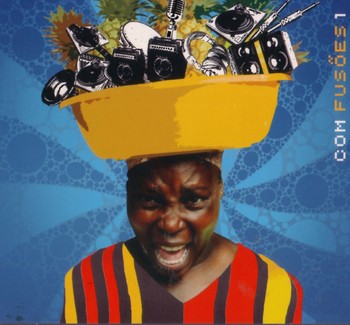
Mauríco Pacheco released his remix of ‘Angolano segue em frente’ in 2009 with the title ‘Angolé’ as a track on the album Comfusões (Figure 3). After originally making the remix for an Angolan television program, Pacheco proposed to Sérgio Guerra of Maianga that they release an entire album of Brazilian remixes of Angolan songs from the Golden Era, and Guerra accepted. A remix is of course a different kind of project from a re-recording, particularly a remix from a 2-track master on which the various different instruments and voices are already ‘mixed down’ to the left and right channels for stereo playback (the ‘L-R’) as opposed to working from a multi-track tape on which the distinct parts are generally separated, allowing greater freedom to manipulate the composite. ‘When you have a multi-track’, Pacheco noted, ‘you could put Happy Birthday on top of it’, but with an L-R, ‘you don't have as many options’ and must ‘follow the harmony, the line’ preserving the mood (onda) of the song (Interview, 12 July 2009, Rio de Janeiro). Generally, Pacheco explained, when working with such musical material, he uses electronic filters to take out the low frequencies and to bring out the voice on the middle-high frequencies. In this manner, he said, the producer creates a ‘space’ for adding a groove (batida) and the bass (Interview, 12 July 2009, Rio de Janeiro). The spatial metaphor is of interest because in effect Pacheco clears out ‘room’ in the low frequencies of the mix in order to insert grooves and sounds more associated with dub, drum ‘n’ bass, and hip hop, that is, (‘Anglophone’) Black Atlantic rhythms that we might think of as ‘crossed’ with Lusophone sounds here, to recall Phaf-Rheinberger and Pinto's metaphor. ‘You end up recreating the arrangement’ of the song, Pacheco observed. ‘Sometimes you take the original guitar, or you re-record it. You treat it with some reverb, a little echo or something, you go on treating it so it sounds – not as if it were of the period [in which it was originally recorded] – but … sympathetic to what is already there’ (Interview, 12 July 2009, Rio de Janeiro).
Album cover Comfusões. Used by permission.

On the back of the listening guide to Comfusões a brief text explains that in an electronic remix ‘a major hit of any period can get a new touch, become well-known through a global language and reinvent traditions’. The album represented ‘a big step in the consolidation of Angolan music in this scene’, it asserts, and ‘the union of Angolan and Brazilian musicians created a danceable album with varied rhythms that reveals an infectious sound to the world’. The forward-looking Angola of the post-civil war period no longer needs the dirge-like mood of the original, and the song's hopefulness is highlighted instead in a Brazilian remix that is informed by Pacheco's understanding of global sonic trends and languages. Like Abreu's version, this remix is slower than Lando's (about 96 bpm). For the introduction to the track Pacheco took a fragment of the original electric guitar introduction – a sketch of the verse melody – and looped it to repeat. The dikanza scraper is present but distorted, in addition to some vague vocal echoes of the syllable ‘ang-’ from ‘Angolé’, cut short digitally. Suddenly a booming, ‘fat’ and deep electric bass drops into the mix (played by Pacheco), signalling a dub influence. Soon the bass settles into an ostinato similar to the one on the original track, but in a much fuller tone. A kind of shuffling hip-hop drum beat enters, programmed electronically by Pacheco. Other miscellaneous snippets of sampled, modified, and/or looped sounds flit in and out as if switched on and off randomly. Occasional scratch sounds punctuate the groove. Lando's original verse is foregrounded in the mix, and the electric guitar, which also enters and exits the soundscape, is even thinner and brighter sounding than the original because of the filters Pacheco applied. Sparse orchestral strings fill out the texture. At about 2ʹ 45ʺ into the song, however, the texture suddenly thins out to just the drum beat, bass, a wah wah electric guitar (newly recorded by Pacheco) with intermittent cut-and-paste-like snippets of the original electric guitar. Lando's voice comes back in and gradually the texture builds up again. At the end, the drums and the bass drop out for the final repeats of ‘Angolé, Angolé’.
A berimbau-like sound, which evokes its ‘twin brother’ (Redinha 1984, p. 106) the Angolan hungo can be discerned in parts of the mix, especially in this ending part, while the violins and cellos (which are sampled, not live, in contrast to Abreu's version) thicken until everything drops out to leave only about a half-second of the strings before the track is over.Footnote 14 Pacheco's remix is informed by the kind of ‘fragmented soundscape’ that Michael Veal and others have shown owes so much to the Jamaican dub aesthetic in which music already recorded is ‘deconstructed into minimal gestures’ that are then ‘reconstructed according to the logics of the sound collage’ (Veal Reference Veal2007, pp. 245–6; see also Hebdige Reference Hebdige1987). The practices of dub, and the eventual emergence of digital sound technology which allows sound material to be easily reconfigured, Veal argues, inaugurated a ‘new conceptual epoch in black American dance music (and, ultimately, popular dance music in general), that might be considered a revolution of the songscape over the song.’ (Veal Reference Veal2007, p. 246). Interestingly, however, Pacheco did not intend Comfusões as a dance album for DJs to play in clubs. While obviously structured around grooves, the album could be better described as intended for informed (the word Pacheco used is antenado, lit. ‘antennaed’) aficionados of African diaspora grooves.
Conclusões/Conclusions
Teta Lando passed away in Paris in 2008 and there is hardly any published information about ‘Angolano segue em frente’, and indeed little about Lando himself (although the song and the artist are often mentioned nostalgically on Angolan weblogs and in the obituaries).Footnote 15 While the original context for the song was the struggle for independence from Portugal after 400 years of colonisation, it is not difficult to see how Lando's direct and humanist lyrics could appeal to a Brazilian. First, the poetically simple idea of moving forward along a single national path resonates with the popular expression that Brazil is the ‘country of the future’, that is, a country that has not yet realised its full potential (as shown above, it also echoes certain protest songs from the era of the dictatorship). Yet what Brazilian would not consider the paths of modernisation and development to be difficult (‘esse caminho é difícil’)? The idea that whites, mulatos and blacks can share the same goal as a national people, on the other hand, precisely mirrors dominant Brazilian discourses about the country's racial diversity and mixture. And the subjects of every nation aspire to independence and freedom; for Brazilians in the mid-2000s, when Abreu recorded her version, such lyrics might have evoked a desire for freedom from, for example, economic imperialism, or from social violence and inequality, or even from corrupt governance, to suggest a couple of possibilities (see Moehn Reference Moehn2009). Fernanda Abreu's identification with Lando's song, then, seems to reinforce the idea of a Global South postcolonial empathy between the two countries.
Pacheco and Guerra envisioned Comfusões as the first in a series of remix albums (it is referred to as Volume 1 on the cover). For Pacheco, the fusion of Brazilian and African sounds on the album is a wonderful ‘confusion’ (the word ‘comfusões’ means confusions, but was intended as a pun, too, on ‘com fusões’, or ‘with fusions’). Brazil and Angola ‘are always musically flirting with each other’, Pacheco reflected when we discussed the various tracks of the album (Interview, 12 July 2009, Rio de Janeiro). ‘You add a little instrument here and you are already going a little bit there [to Angola]’, he said. ‘Afterwards it comes back here’. Ultimately, what was interesting about the project, he observed, was that ‘even when not specifically thinking about Brazil, you end up bringing the two things together’ (Interview, 12 July 2009, Rio de Janeiro). Pacheco researched Angolan music for several years before visiting the country and before this project, so he is quite knowledgeable about the mixtures he is creating. When I asked him in our interview about the feasibility of an album of Angolan remixes, Pacheco responded that it was an interesting idea, but he did not know enough Angolan producers who were ‘plugged in’ (antenados) for creating the individual remixes (since Pacheco's idea is to have a different producer for each remix). Again, the opinion voiced is that Angola has a way to go before it is fully integrated into international circuits of cutting-edge music production.
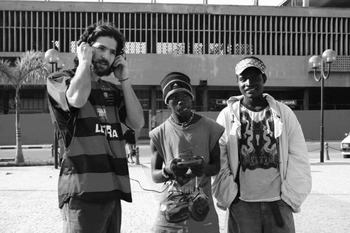
Pacheco has worked with other Angolan musicians, including some from a younger generation such as Angolan rapper Big Nelo, or kuduru artists Dog Murras and DJ Znobia (kuduru is an electronic-based dance genre with funk and Caribbean influences, popular in both Angola and Portugal; Figure 4).Footnote 16 For Maianga he has also produced recordings of Wyza, a younger musician who celebrates his Bakongo ethnicity (northeast of Angola), and the above-mentioned Elias Dia Kimuezo, legendary figure of the Golden Era. These kinds of exchanges and circulations, earlier advocated by Martinho da Vila and Waldemar Bastos in the fractured Angola of the 1980s, are multiplying. For example, Brazilian singer Jussara Silveira also recorded a Teta Lando song, ‘Carapinha dura’, on her album Nobreza, released on Maianga in 2006. Musically exciting, such oceans of sound emerge from and flow through a transatlantic postcolonial space that is still poorly understood in academia, and which has its own distinct dynamics of power and development, some of which may turn out to echo Brazil's earlier mercantile interests in Angola, or to draw on established, politically implicated Lusotropicalist discourses of racial tolerance and hybridity (see, e.g., Sanches 2006). For now, this African nation is surging: a sharp-looking high-rise condominium complex named after Lando has just opened in Luanda (Edifícios Teta Lando; http://www.edificiostetalando.com); it advertises a family-oriented upper-middle-class lifestyle that moves ‘to the rhythm of the new Luanda!’ Lando's song ‘Mumpiozo mé’ provides the soundtrack to the main page of the site, and more of the singer-songwriter's recordings can be heard on another page. Brazil, too, has earned an increasingly influential role on the global stage in the past decade as one of the BRIC nations (Brazil, Russia, India, China). Meanwhile, Brazilian musicians are perhaps more frequently seeing ‘Africa’ not merely as a fixed, essential element of the country's colonial heritage, of its storied ethnic mix, but rather as a place with which to dialogue.
Maurício Pacheco with kuduru dancers in Luanda, 9 July 2006. Photograph by Manuela Cavadas, used by permission.

The metaphor of the ocean of sound encourages thinking beyond nation or region in our analyses of popular music; as emergent transoceanic collaborations congeal out of a ‘reservoir of possibility’ (Naro et al. Reference Naro, Sansi-Roca and Treece2007, p. 6), initiating new dialogues along old routes, they bring into relief ‘patterns of continuity and change, networks of resonance and dissonance, [and] dramas of conflict, dialogue, and transformation’ (Naro et al. Reference Naro, Sansi-Roca and Treece2007, p. 6). My comparison of three versions of Lando's ‘Angolano segue em frente’ demonstrates the value of asking how, where and why specific exchanges and mixtures are effected and promoted, and the value of listening intently to the sounds of these dialogues.
Acknowledgements
Research for this article was funded by a Faculty of Arts, Humanities and Lettered Social Sciences (FAHSS) Individual Grant from Stony Brook University, and by the Fundação de Ciência e Tecnologia of Portugal, the latter through the Instituto de Etnomusicologia (INET-md) of the Universidade Nova de Lisboa. The author read drafts of it at the Instituto de Ciências Sociais of the Universidade de Lisboa and also at the Society for Ethnomusicology Annual Congress in Mexico in 2009. Thanks are due to Maurício Pacheco, Chico Neves, Fernanda Abreu, Claudio Girardi and Sérgio Guerra for being so generous with their time. Jan Fairley, Barbara Bradby, Salwa Castelo-Branco, Tiago de Oliveira Pinto, Charles Perrone, Derek Pardue and the anonymous readers provided helpful feedback. Any shortcomings are the author's own.