Introduction
Rapid ageing and urbanisation, as two historically significant demographic shifts, have exhibited global influence since the beginning of the 21st century. The World Health Organization (WHO) reported that approximately one million people turn 60 every month worldwide (WHO, 2019b). More than 20 per cent of the global population is predicted to be 60 years old or above by 2050 (United Nations et al., 2017). Thus, age-friendly cities and communities (AFCCs) with policies, services and structures that are designed to support senior citizens in their daily lives are increasingly needed. Given that major urban centres have social and economic resources to make cities more age-friendly and can set examples for other cities to follow, together with the fact that three-quarters of older persons live in cities in the developed world, making cities age-friendly is one of the most effective approaches in response to the rapid demographic ageing (WHO, 2019b).
The concept of AFCCs can be tracked to the WHO's Active Ageing Framework in 2002, which served as a model to guide the process of developing AFCCs (WHO, 2007a). In the academic field, Kendig (Reference Kendig2003) first mentioned that ‘advancing age-friendly societies’ is one of the objectives to develop environmental gerontology. In 2007, the WHO developed the Vancouver Protocol after hosting focus group discussions in 33 developed and developing cities across the world. Eight major areas, namely housing, transportation, outdoor spaces and buildings, community support and health services, communication and information, civic participation and employment, respect and social inclusion, and social participation (WHO, 2007a, 2007b), were outlined for municipalities to assess the age-friendliness of cities; initial checklists related to each area were also created in the Vancouver Protocol (WHO, 2007b).
Globally, numerous efforts have been exerted to promote AFCCs, which are consistent with important global strategic shifts, particularly in the past five years (Figure 1). Aiming at engaging as many cities as possible to make their communities more age-friendly, the Global Age-friendly Cities project focusing on ‘lived’ experience of senior citizens was carried out (WHO, 2019b). As a method to connect cities, communities and organisations worldwide, the WHO Global Network for Age-friendly Cities and Communities (Global Network for AFCCs) was established in 2010. A total of 847 cities and communities in 41 countries have already joined the network since the establishment (Warth, Reference Warth, Moulaert and Garon2016; WHO, 2019a).
The promotion of AFCCs.
Note: WHO: World Health Organization.

The practices of AFCCs worldwide have fostered relevant studies, whilst numerous contents have been formed, particularly during the past decade. To begin, scholars conceptualised AFCCs from an ecological perspective by drawing upon the WHO's eight areas and introducing the notion of social connectivity as the fundamental benefit of AFCCs (Scharlach, Reference Scharlach2009b; Menec et al., Reference Menec, Means, Keating, Parkhurst and Eales2011; Greenfield, Reference Greenfield2012). Community planning, and support-focused and cross-sector partnership approaches were used as the three general categories when promoting AFCC initiatives, and key questions regarding public policies remain valuable topics for discussion (Greenfield et al., Reference Greenfield, Oberlink, Scharlach, Neal and Stafford2015). The forthcoming generations of urban seniors are expected to be more actively involved in their community lives after retirement. Therefore, communities should to be changed so that senior citizens’ expectations may be satisfied (Fitzgerald and Caro, Reference Fitzgerald and Caro2014). Moreover, several scholars have presented tools to collect data and methods to recruit large-scale sample groups when discussing correlations between successful ageing and people's health conditions (Chaves et al., Reference Chaves, Camozzato, Eizirik and Kaye2009; Troutman Flood et al., Reference Troutman Flood, Nies and Seo2010; Hilgenkamp et al., Reference Hilgenkamp, Bastiaanse, Hermans, Penning, van Wijck and Evenhuis2011). Outdoor activities and potential barriers for senior citizens in the urban environment that would influence their physical health were also discussed (Paillard-Borg et al., Reference Paillard-Borg, Wang, Winblad and Fratiglioni2009; Rantakokko et al., Reference Rantakokko, Iwarsson, Kauppinen, Leinonen, Heikkinen and Rantanen2010). Moreover, researchers have mentioned that social inequalities, isolation and loneliness are factors that potentially affect people's psychological health (Schöllgen et al., Reference Schöllgen, Huxhold and Tesch-Römer2010; Shankar et al., Reference Shankar, McMunn, Banks and Steptoe2011). The aforementioned research results were subsequently selected by the WHO (2015a) when developing indicators that can be used to measure the age-friendliness of cities and communities.
In summary, the AFCCs-related questions in ‘who’, ‘where’, ‘what’, ‘how’ and ‘why’ dimensions have been explored based on the WHO framework and existing studies. From stakeholders (who) that should be involved, areas (where) that would be developed, to aspects (what) that would be targeted, methods (how) that may be adopted, and goals (why) that would be achieved. However, related research focuses on key characteristics that make cities and communities age-friendly (Lui et al., Reference Lui, Everingham, Warburton, Cuthill and Bartlett2009; Steels, Reference Steels2015), and a substantial number of studies have been required to obtain a systematic description of the broad picture and determine key areas and the evaluation trends. Trying to bridge this gap, this paper aims to provide a comprehensive review of existing literature pertaining to AFCCs. To reduce the bias that may be caused by a traditional literature review, the collected literature is analysed and visualised by CiteSpace during the scientometric analysis process. The foundation, hot topics and domains of AFCC research are summarised, emerging evolution trends and limitations of current studies are analysed and future directions are discussed. The findings can not only serve as useful references for scholars to enhance their understanding of the current research and guide future research on AFCCs, but also work as helpful guidance for service providers, practitioners and governments to develop fit policies.
Research method
Scientometric analysis
Scientometrics is related to bibliometrics and informetrics and is defined as ‘science about science’, which has covered the quantitative methods for analysing science and research processes and has been used in knowledge management (Mooghali et al., Reference Mooghali, Alijani, Karami and Khasseh2012; Mryglod et al., Reference Mryglod, Holovatch and Kenna2018). As an academic area, this concept is developed by prominent researchers, such as Merton (Reference Merton1973, Reference Merton1976), Garfield (Reference Garfield1972, Reference Garfield1979) and Price (Reference Price1986). Scientometric analysis is an important measure to assess scientific publications by identifying emerging study areas, figuring out development of research in certain time periods, regions or institutions (Mooghali et al., Reference Mooghali, Alijani, Karami and Khasseh2012). Normative and descriptive methods are the two general applied approaches for conducting a scientometric analysis. The former perspective aims to establish boundaries, rules and heuristics to ensure progress in certain disciplines, whereas the latter emphasises the accomplishment of researchers in specific areas (Neufeld et al., Reference Neufeld, Fang and Huff2007). This paper adopts the descriptive method, which is more suitable for identifying emerging evolution trends through a variety of publications regarding AFCC studies than other methods.
Numerous visualised tools, such as CitNetExplorer, VOSviewer and CiteSpace, are available for completing the scientometric analysis process. Compared with other software, CiteSpace is more powerful for visualising the patterns of scientific literature, which is beneficial to explain research trends and to discover research frontiers (Ekanayake et al., Reference Ekanayake, Shen and Kumaraswamy2019; Su et al., Reference Su, Li and Kang2019). Hence, CiteSpace as a tool for progressive knowledge domain visualisation (Chen, Reference Chen2004) was selected to conduct the co-citation analysis in this study and the latest version (CiteSpace 5.5.R2, 64-bit) was used for analysing and visualising.
Data collection
Web of Science (WoS) and Scopus are the main international databases for this type of study (Ekanayake et al., Reference Ekanayake, Shen and Kumaraswamy2019; Luo et al., Reference Luo, Tan, Langston and Xue2019; Wuni et al., Reference Wuni, Shen and Osei-Kyei2019). The terms used to search for literature are: ‘age-friendly’ or ‘elderly-friendly’ + ‘city’ or ‘community’. The ‘document type’ in WoS is limited to ‘article’, whilst the choices are ‘article’ and ‘review’ in Scopus; the ‘language’ section in the two databases are limited to ‘English’. Such settings aim to retrieve original and review articles on AFCCs. Although the concept of ‘age-friendly city’ was officially proposed by the WHO in 2007 and the Global Network for AFCCs was established in 2010, previous discussions have also contributed to the concept. Thus, the search for publications (executed on 17 September 2019) did not limit the publication year and the result shows the beginning of AFCC research can be tracked to 2003. After the duplicate results from WoS and Scopus were merged, a cross-contrast was conducted. The InCites Journal Citation Reports 2019 was referred to in order to identify the articles and reviews published in SCI-Expanded and Social Sciences Citation Index (SSCI) journals. If a certain review or article was published in SCI-Expanded or SSCI journals, then it would be selected for further process; otherwise, it would be excluded. Thus, the authors intended to ensure that the publications were retrieved from recognised journals. Furthermore, the bibliometric data exported from SCI-Expanded and SSCI database are the most compatible with CiteSpace when the scientometric analysis is processed.
To complete the scientometric analysis process, each bibliographic record of the retrieved article was downloaded. A bibliographic record contains a series of data: the authors, the title and abstract, several keywords, and a reference list cited by the article. Based on the aforementioned information, co-citation analysis provides a unique way to illustrate the structure and dynamics of the scientific paradigm. By showing the relationships of retrieved papers and corresponding reference records, a co-citation analysis provides an opportunity to measure the proximity of various publications.
Data analysis
Three analytic methods in CiteSpace were adopted in this study. Firstly, the keywords co-occurrence network was generated to determine critical topics in AFCCs-related publications, and the analysis result was considered as the foundation of AFCC research. Secondly, the document co-citation network was obtained, and frequently cited publications and references with citation bursts were also identified. The result of this step was used to describe the main concerns of scholars, which are regarded as the hot topics of AFCC research. Lastly, the co-citation network in CiteSpace can be divided into various clusters that reflect various domains of AFCC research, and publications in a certain cluster may reveal numerous similarities with one another.
Analysis results
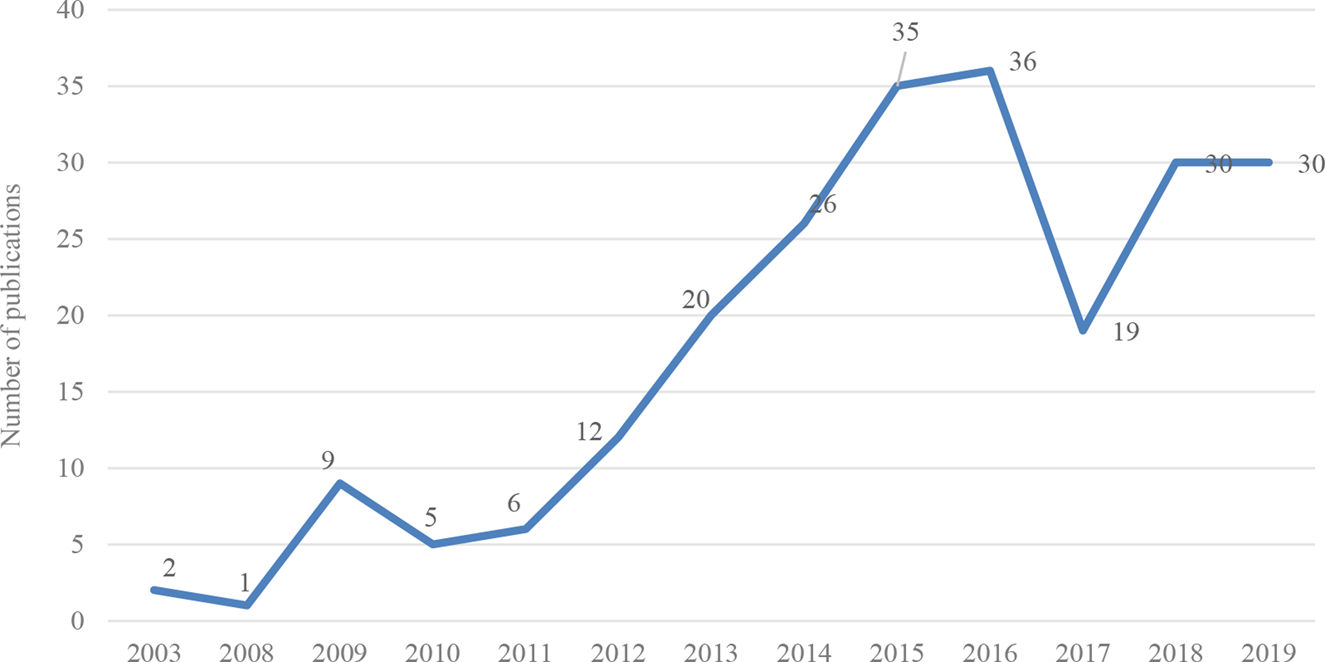
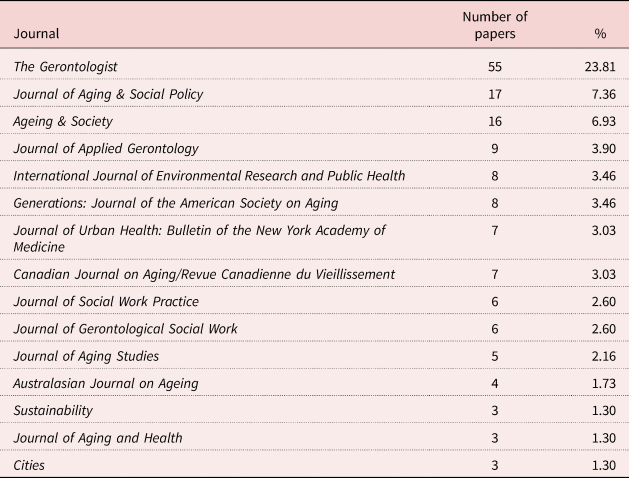
In this study, a total of 320 articles and reviews are identified after the duplicate results from WoS and Scopus were merged. Based on the aforementioned inclusion and exclusion criteria, 231 journal papers published in SCI-Expanded and SSCI journals (Figure 2) related to AFCCs were included. Table 1 summarises the distribution of retrieved publications in the top 15 journals. Each of the journals published no less than three relevant research papers. Most of the journals are related to gerontological and social studies, whereas some of them are related to environmental and health studies.
Distribution of retrieved results in different years

Distribution of selected papers

After the three analytic methods were applied in CiteSpace, the foundation, hot topics and domains are generated. Related results are discussed below.
Foundation of AFCC research: keywords co-occurrence network analysis
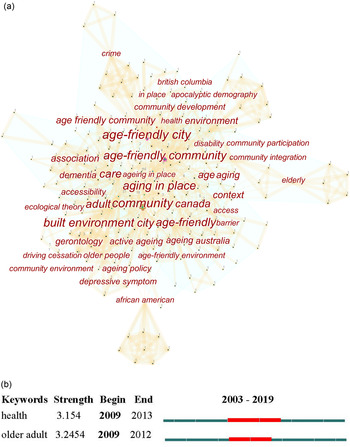
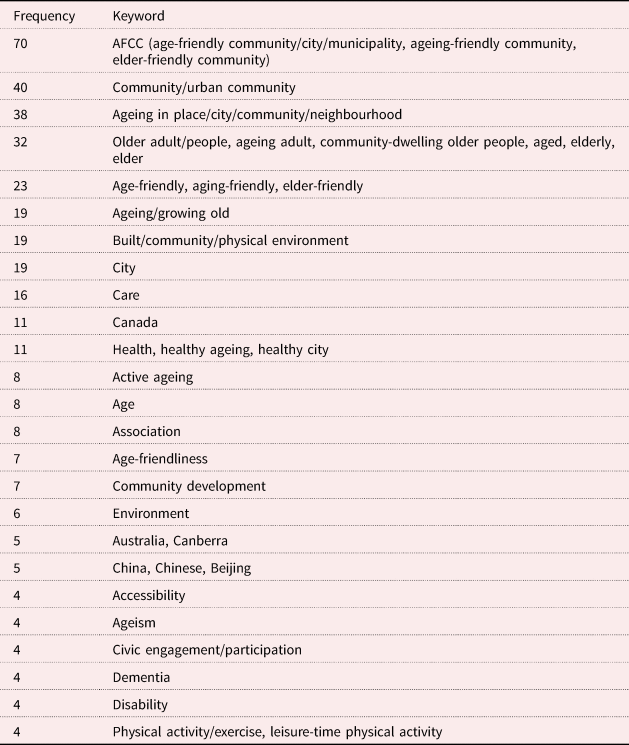
Keywords are generally selected by authors themselves to refine the content of publications. Therefore, the analysis of keywords is beneficial to identify the researchers’ key concerns with regard to AFCCs. According to the frequencies of AFCCs-related keywords, the co-occurrence network was generated by CiteSpace. Figure 3 indicates the visual description. A standardised process was conducted to classify the original terms generated by CiteSpace with similar meanings. For example, ‘age-friendly community’, ‘age friendly community’, ‘age-friendly city’ or ‘age friendly city’ are grouped as ‘AFCCs’. After the standardisation, the top 25 terms that were mentioned by scholars no less than four times were determined, with a total of 376 frequencies. Table 2 lists these items.
(a) Keywords co-occurrence network; (b) Top two keywords with the strongest citation bursts.

Top 25 items with their frequencies in AFCCs studies

Figure 3a and Table 2 reveal that AFCC has the highest frequencies, with 70 occurrences. In addition, if the frequencies of ‘age-friendly/ageing-friendly/elder-friendly’, ‘age-friendliness’, ‘city’, ‘community/urban community’ and ‘community development’ are also added, then the total frequencies of AFCC is 166. This finding is quite normal given that researchers tend to choose the main topic as one of the keywords, and such combinations of terms are also part of the selection criteria of this study. The United Nations proclaimed 1999 as The Year of Older Persons, and the ‘age-friendly’ concept was initiated since then (Rosochacka-Gmitrzak, Reference Rosochacka-Gmitrzak2016). The ‘Age-friendly City’ concept has gained attention worldwide since the WHO launched its Global Age-Friendly Cities Project in 2007, according to the Policy Framework on Active Ageing released in 2002. The establishment of the Global Network for AFCCs in 2010 indicated that not only cities may be age-friendly but also other areas. The main concept behind ‘age-friendliness’ is the recognition of the senior citizens’ abilities to contribute to the society by active participation and neighbourhood engagement, as long as their health conditions may allow (Chan and Cao, Reference Chan and Cao2015).
After the AFCCs-related items, ‘ageing in place’ ranks second in the highest frequencies. In particular, this term, including similar phases such as ‘ageing in neighbourhood/community/city’, was mentioned 38 times as keywords. Davey et al. (Reference Davey, de Joux, Nana and Arcus2004) define ‘ageing in place’ as ‘remaining living in the community, with some level of independence, rather than in residential care’. In numerous countries, the senior citizens’ sense of belongingness increases the popularity of ‘ageing in place’. Therefore, given the social and economic issues, a wide consensus has been formed by governments and international associations regarding setting ‘ageing in place’ as a policy goal (Pynoos et al., Reference Pynoos, Nishita, Cicero and Caraviello2008; Sixsmith and Sixsmith, Reference Sixsmith and Sixsmith2008; Lui et al., Reference Lui, Everingham, Warburton, Cuthill and Bartlett2009; Hillcoat-Nallétamby and Ogg, Reference Hillcoat-Nallétamby and Ogg2014; Organisation for Economic Co-operation and Development, 2015; Scharlach, Reference Scharlach, Moulaert and Garon2016; Xiang et al., Reference Xiang, Yu, Tan, Shan and Shen2020). Ensuring the level of senior citizens’ independence through providing them with essential facilities, including hazard-free streets and buildings, accessible stores, banks and professional services, is part of the AFCCs’ endeavours. Therefore, promoting AFCCs could be beneficial to achieve the goal of ‘ageing in place’.
The third-largest research item is related to ‘older adult’, and the total frequency of all the similar expressions, such as ‘older people’, ‘ageing adult’, ‘community-dwelling older people’ is 32. Older people can be seen as the most important ‘end-user’ of the AFCCs, and their satisfaction with the cities and communities they live in matters when AFCCs are promoted. This notion can explain the reason why ‘older adult’ has become one of the top two keywords with the strongest citation bursts (Figure 3b). For instance, senior citizens and organisations throughout the public, private, voluntary and community sectors in Manchester, United Kingdom (UK) were consulted, and five priorities were identified as strategic objectives of Age-friendly Manchester (Valuing Older People Partnership and Manchester City Council, 2009). Guided by older people's Board and Forum, Manchester formed its unique approach to transform the city into a great place to grow old (Manchester City Council, 2017; Strategic Lead Age-friendly Manchester, 2017). The aforementioned methods to promote AFCCs-related projects and studies are also consistent with the WHO (2019b). In particular, the WHO focuses on caring about what seniors would experience as age-friendly in their daily lives in the community and involving them as partners from the beginning to the end of a project. This notion can also explain why ‘civic engagement’ and ‘civic participation’ are selected by authors as keywords.
The keywords related to ‘environment’, including ‘built environment’, ‘community environment’, ‘physical environment’ and ‘accessibility’, appeared often, with a total frequency of 29. Over the past decades, the rising significance of environmental gerontology has fuelled discussions on dynamic relationships between senior citizens’ quality of life and the social and physical environments where they live (Phillipson, Reference Phillipson, Settersten and Angel2011; Wahl et al., Reference Wahl, Iwarsson and Oswald2012). Thus, issues related to ‘ageing’, ‘growing old’, ‘age’ and ‘ageism’ have obtained growing attention from researchers in gerontology, social science and built environment areas. Given the long period that senior citizens may spend at homes and communities, together with the fact that walking is the seniors’ most common form of physical activity, they are likely to be sensitive to changes in the built environment (Nagel et al., Reference Nagel, Carlson, Bosworth and Michael2008; Peace et al., Reference Peace, Holland and Kellaher2011; Kerr et al., Reference Kerr, Rosenberg and Frank2012), whilst the accessibility of the environment would affect their choices of physical activities. Age-friendly efforts under such circumstances may shift from focusing merely on individual outcomes to the environment where seniors live (Jeste et al., Reference Jeste, Blazer, Buckwalter, Cassidy, Fishman, Gwyther, Levin, Phillipson, Rao, Schmeding, Vega, Avanzino, Glorioso and Feather2016). Related approaches, such as promoting supportive neighbourhoods and developing connections with families and communities, have emerged as overarching themes that may help in dealing with the senior citizens’ social and physical issues (Buffel et al., Reference Buffel, Phillipson and Scharf2012; Glicksman et al., Reference Glicksman, Clark, Kleban, Ring and Hoffman2014; Biggs and Carr, Reference Biggs and Carr2015; Lowen et al., Reference Lowen, Davern, Mavoa and Brasher2015; Chan et al., Reference Chan, Chan, Chan, Cheung and Lee2016).
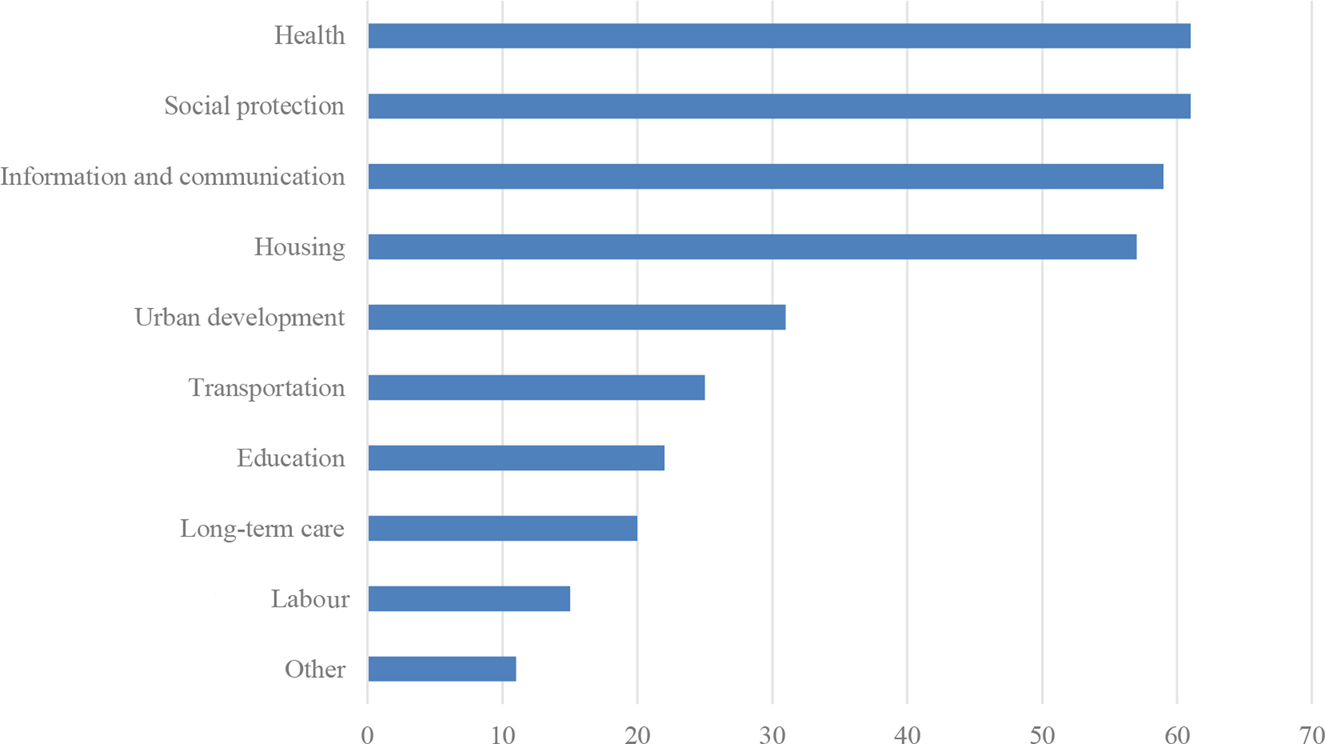
Evidently, health-related keywords such as ‘health’, ‘healthy ageing’ and ‘healthy city’ are selected 11 times. Healthy ageing, which is defined as ‘the process of developing and maintaining the functional ability that enables wellbeing in older age’, was built on the former ‘active ageing’ framework and was the focus of the WHO's work on ageing from 2005 to 2010. The top two keywords with strong citation bursts contain ‘health’ as an item from 2009 to 2013 (Figure 3b), which is also consistent with the trend. AFCCs are regarded as ‘cities and communities that foster healthy and active ageing and enable well-being throughout life’ (WHO, 2015b). AFCC practice records in the global database indicate that the health sector is involved in 61 out of 208 practices, which accounts for 29.3 per cent; the summary of AFCC practices by sector also illustrates that health and social protection sectors are the most frequently leading sectors for such practices (Figure 4). Given that the accumulation of improvements in modern medical levels enables people to maintain a healthy physical condition, senior citizens will be healthier, wealthier, better educated and more willing to acquire information and participate in social life near the places they live (Everingham et al., Reference Everingham, Petriwskyj, Warburton, Cuthill and Bartlett2009; Lehning et al., Reference Lehning, Scharlach and Dal Santo2009; Beard and Bloom, Reference Beard and Bloom2015; Chan and Cao, Reference Chan and Cao2015; Staube et al., Reference Staube, Leemeijer, Geipele, Kauskale, Geipele and Jansen2016). The ‘healthy ageing’ framework demonstrates that engaging in physical activity is considered a key behaviour and generates multiple benefits in old age, which can explain why ‘physical activity’, ‘physical exercise’ and ‘leisure-time physical activity’ are selected by authors as keywords. In addition, the care system, especially the long-term care system, is considered to ensure that people with limited activities of daily living levels, because of physical disability or cognitive disorders, maintain a level of functional ability. Thus, ‘care’, ‘dementia’ and ‘disability’ are also selected by the authors as keywords.
Breakdown of AFCC practices by sectors

Certain country-specific keywords such as ‘Canada’ (frequency = 11), ‘Australia’ and ‘Canberra’ (total frequency = 5), ‘China’, ‘Chinese’ and ‘Beijing’ (total frequency = 5) also appear several times. Therefore, the studies related to AFCCs under certain backgrounds have attracted more attention from these three countries compared with others. The keyword ‘association’ illustrates the efforts contributed by international groups apart from the WHO, such as the American Association of Retired Persons (AARP) in the United States of America (USA), the Super Seniors in New Zealand and the Department for Communities and Local Government in the UK.
Hot topics of AFCC research: document co-citation network analysis
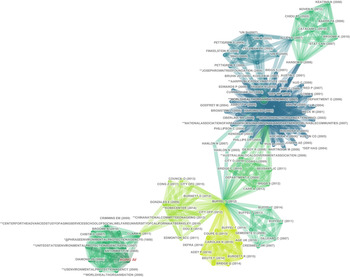
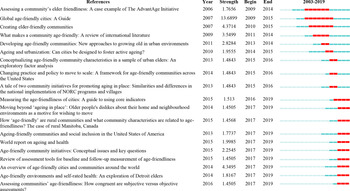
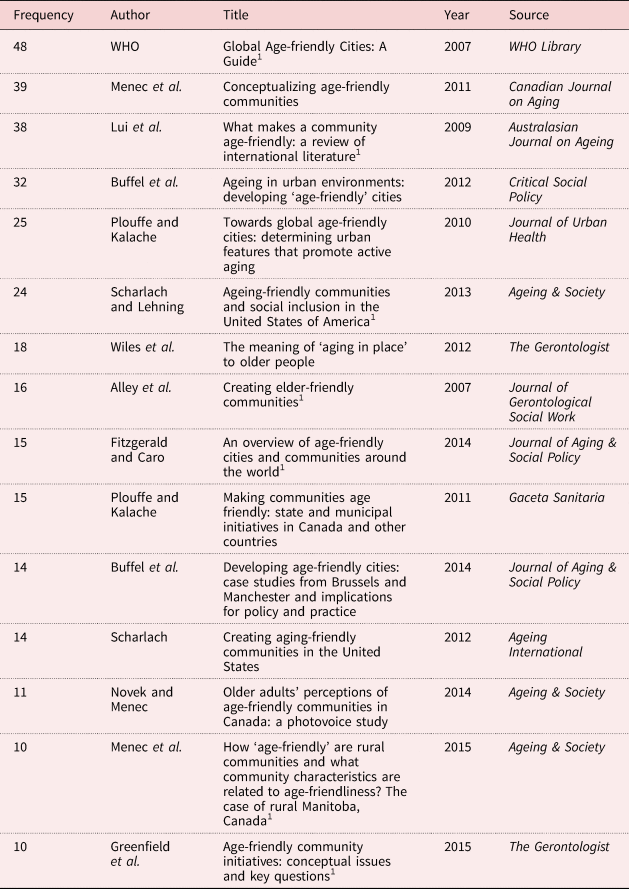
The joint citations by the subsequent publications indicate that document co-citation network analysis serves as a method to evaluate the hot topics and important publications (Ekanayake et al., Reference Ekanayake, Shen and Kumaraswamy2019; Luo et al., Reference Luo, Tan, Langston and Xue2019). Figure 5 illustrates the document co-citation network generated by CiteSpace, including 454 nodes and 1,410 links. Each node in the network represents a cited reference, whilst the connecting links between nodes indicate the relationships. The bibliographic records are imported into CiteSpace to complete the scientometric analysis process, and the co-citation network subsequently detects the frequently cited publications according to the reference lists of the retrieved articles. Thus, the top 15 critical publications with no less than ten citations (Table 3) and the top 19 references with strong citation bursts (Figure 6) contain a variety of publications, including reports from the WHO, book chapters and journal papers. Figure 6 and Table 3 reveal that seven publications are generated as critical publications and references with strong citation bursts. Among the 19 references with strong citation bursts, ten of the bursts started after 2016. Therefore, the researchers’ attentions on AFCCs have increased within the last four years. Citation burst during a time period indicate that researchers pay special attention towards the contributions of the cited ones. Evidently, the cited frequency calculated by CiteSpace is slightly different from WoS or Google Scholar. For example, Lui et al. (Reference Lui, Everingham, Warburton, Cuthill and Bartlett2009) conducted a comprehensive review on trends and models of building AFCCs, and their paper was cited 157 times according to WoS and 353 times from Google Scholar. However, Table 3 indicates that the paper was cited merely 38 times. This finding is because the strategy of retrieving papers in this study ensures meaningful citations in the area of AFCCs. Thus, certain papers cited by studies in other areas are excluded.
Document co-citation network of AFCCs research.

Top 19 references with strong citation bursts.

Top 15 critical publications of AFCCs research

Notes: WHO: World Health Organization. 1. The publication also has strong citation burst.
Characteristics of AFCCs
The publications discussed above reflect that the characteristics of AFCCs is an apparently important topic. Prior to the introduction of the AFCC concept, researchers started to discuss the process of how elder-friendly community models, including the AdvantAge Initiative, could be used to identify assets and areas for improvements (Hanson and Emlet, Reference Hanson and Emlet2006). After the WHO's model was released in 2007, Lui et al. (Reference Lui, Everingham, Warburton, Cuthill and Bartlett2009) compared the key features of AFCCs identified by various models and described the AFCCs discourse in two dimensions, namely the environment and governance dimensions. Plouffe and Kalache (Reference Plouffe and Kalache2010) discovered that in developed cities, the listing of age-friendly features tended to be long and characteristics such as physical accessibility, proximity, security, affordability and inclusiveness were considered important in all locations. This finding was also consistent with a former Delphi study conducted by Alley et al. (Reference Alley, Liebig, Pynoos, Banerjee and Choi2007). Fitzgerald and Caro (Reference Fitzgerald and Caro2014) further clarified age-friendly features as precondition elements (population density, climate and weather, topographic features, social and civic organisation, health and social services) that should be settled if communities plan to pursue meaningful age-friendly initiatives, core features (housing, mobility, outdoor spaces and buildings, participation of senior citizens) and secondary features (age-friendly business) that may later contribute to AFCCs. Building upon the WHO's framework, several researchers applied other theories to define AFCCs. For instance, Menec et al. (Reference Menec, Means, Keating, Parkhurst and Eales2011) borrowed ecological theory from biology, focused on five principles derived from literature and elucidated an ecological conceptualisation of AFCCs. The borrowed theory also guided Novek and Menec (Reference Novek and Menec2014) when they designed and completed the analysis process of their research following their view that senior citizens are an essential part within the community and the large policy environment. Buffel et al. (Reference Buffel, Phillipson and Scharf2012) provided a perspective with regard to the shift in AFCCs’ focus, from ‘What is an ideal city for older people?’ to ‘How age-friendly are cities?’ Wiles et al. (Reference Wiles, Leibing, Guberman, Reeve and Allen2012) conducted focus group discussions and interviews with senior citizens regarding the meaning of ageing in place and concluded this concept as a sense of attachment and feelings of security and familiarity. Greenfield et al. (Reference Greenfield, Oberlink, Scharlach, Neal and Stafford2015) identified that the definition of AFCCs shared criteria with the ‘who’, ‘where’, ‘what’, ‘how’ and ‘why’ dimensions.
Experiences from promoting AFCCs
Lessons learned from experiences of building AFCCs in various areas, particularly in Western countries, is another hot topic. For example, Canadian experiences indicated three activity axes, namely strategic engagements; policy actions; and knowledge development and exchange of federal, provincial and municipal government (Plouffe and Kalache, Reference Plouffe and Kalache2011). Menec et al. (Reference Menec, Bell, Novek, Minnigaleeva, Morales, Ouma, Parodi and Winterton2015a) claimed that existing partnerships and easy access to local leaders are strengths for promoting AFCCs in remote communities, according to a study conducted in Manitoba. The USA cases reflected the problem of limited political authority or economic resources, urged for creative destruction, such as challenging entrenched and stagnant bureaucracies, obsolete programmes, and acknowledged efforts that were made through AFCC initiatives to promote social inclusion among senior citizens (Scharlach, Reference Scharlach2012; Scharlach and Lehning, Reference Scharlach and Lehning2013; Ball and Lawler, Reference Ball and Lawler2014). Researchers have also investigated the leaders of other community-based models for ageing in place, including Villages and Naturally Occurring Retirement Community (NORC) Supportive Service Programs in the USA, which discussed the models’ inclusivity, sustainability expansion and effectiveness, and the process of benefiting other age-friendly initiatives (Greenfield et al., Reference Greenfield, Scharlach, Lehning, Davitt and Graham2013). With regard to the European cases, Buffel et al. (Reference Buffel, McGarry, Phillipson, De Donder, Dury, De Witte, Smetcoren and Verte2014) compared Brussels and Manchester, indicated the importance of multiple stakeholder collaborations and the involvement of senior citizens and proposed barriers of ageist attitudes, economic and political difficulties, as well as potential limitations in relation to the ‘age-friendliness’ concept.
Measurement of age-friendliness in cities and communities
Another notable research topic relates to the measurement of age-friendliness in cities and communities, and the mechanism of how age-friendliness is related to the senior citizens’ health. For example, apart from engaging seniors by improving walkability and accessibility of facilities in cities and communities, Beard and Petitot (Reference Beard and Petitot2010) proposed strategies such as reducing crime and promoting urban safety, improving housing design and strengthening neighbourhood resources as approaches for cities to foster active ageing. Smith et al. (Reference Smith, Lehning and Dunkle2013) applied an exploratory factor analysis method to an urban older Americans’ sample, including 1,376 participants, and identified access to business, leisure and health care, social interaction, neighbourhood problems, social support and community engagement as important factors of AFCCs that related to demographic and health features. Lehning et al. (Reference Lehning, Smith and Dunkle2014) further acknowledged a positive association between community engagement and self-rated health but claimed that neither the social interaction nor the access to business and leisure factors significantly influenced self-rated health according to their target sample in Detroit.
With regard to the assessment of age-friendliness in cities and communities, the WHO released a guide for measuring the age-friendly cities in 2015, and researchers conducted studies to discuss the assessment tools and processes. For example, Dellamora et al. (Reference Dellamora, Zecevic, Baxter, Cramp, Fitzsimmons and Kloseck2015) identified 25 assessment tools through literature reviews and personal communications; the Community Assessment Survey for Older Adults was claimed as the most comprehensive instrument with copyright protection and it was applied repeatedly in 12 different communities of the USA. Menec et al. (Reference Menec, Newall and Nowicki2016) compared subjective assessments by residents in communities and objective assessments by municipal officials, and recognised that the municipal assessment could over-estimate a community's age-friendliness based on the ratings provided by community-dwelling residents.
Domains of AFCC research: document co-citation network with the clustering analysis
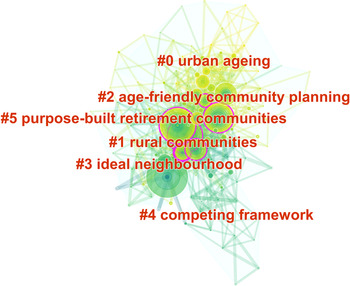
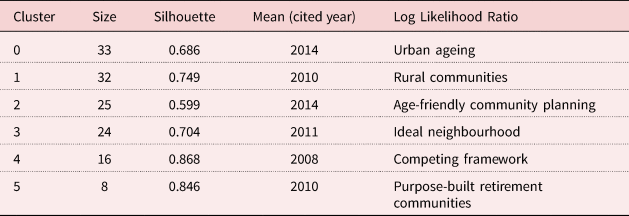
In CiteSpace, the document co-citation network can be viewed by clusters with none-phases as cluster labels. Each label of the automatically identified cluster was retrieved from titles, keywords and abstracts of the publications, which provides latent semantic themes within the textual data (Luo et al., Reference Luo, Tan, Langston and Xue2019). Three algorithms, namely the Latent Semantic Index (LSI), Log Likelihood Ratio (LLR) and Mutual Information (MI), are applied to identify the most significant clusters and related terms of AFCCs. In particular, the LSI test was used to determine the most salient term of a cluster, whilst the rest tend to represent the unique aspects of the clusters (Chen et al., Reference Chen, Ibekwe-SanJuan and Hou2010). Figure 7 and Table 4 illustrate the six labelled clusters in this study, along with their statistical importance generated by CiteSpace via an LLR test. The size of each cluster was determined by the containing number of publications, including research papers, book chapters and reports.
Cluster view of AFCCs research.

Top six clusters and related terms

Urban ageing and planning for AFCCs
From the clusters created by CiteSpace in Figure 7 and the description in Table 4, the largest and most important cluster was labelled as ‘#0 urban ageing’, which contains 33 publications. The publications that comprise this cluster tend to reveal the researchers’ concerns on whether the healthy cities and communities that foster active ageing can also be AFCCs, on the type of pressures that would affect the urban environment and on the process of how AFCC frameworks may promote changes in the urban areas (Scharlach, Reference Scharlach2009a; Boudiny, Reference Boudiny2013; Kendig and Phillipson, Reference Kendig, Phillipson, Newby and Denison2014; Jackisch et al., Reference Jackisch, Zamaro, Green and Huber2015). Some of the topics discussed above also appear in the third-largest cluster that is labelled as ‘#2 age-friendly community planning’. For example, Scharlach (Reference Scharlach2017) examined the environmental pathways for promoting active ageing and developed the constructive ageing concept to reflect the adaptation between individuals and environments. The implementation of the consultative mechanism can involve senior citizens in the decision-making process of urban policies or age-friendly initiatives, and the AFCC policies’ successes depend heavily on the evolution of powerful urban networks (Keyes et al., Reference Keyes, Phillips, Sterling, Manegdeg, Kelly, Trimble and Mayerik2014; Buffel and Phillipson, Reference Buffel and Phillipson2016; Rémillard-Boilard et al., Reference Rémillard-Boilard, Buffel and Phillipson2017; Buffel and Phillipson, Reference Buffel and Phillipson2018).
Consistent with the appearance of country-specific keywords and the hot topics, several publications in this cluster have discussed the lessons learned from experiences of building AFCCs, which is again the main concern of Cluster #2. Within the Western context, Canadian experiences from the Quebec cases illustrated the importance of collaborative partnerships for the success of implementation (Garon et al., Reference Garon, Paris, Beaulieu, Veil and Laliberte2014); from the Manitoba Initiative, the major barriers for communities to implement age-friendly projects were highlighted (Menec et al., Reference Menec, Novek, Veselyuk and McArthur2014); through an evidence-based, iterative consultation research, Orpana et al. (Reference Orpana, Chawla, Gallagher and Escaravage2016) listed 39 indicators to support AFCC evaluation activities. Experiences from the UK include Manchester's progress in tackling health and other inequalities in deprived urban areas (McGarry and Morris, Reference McGarry and Morris2011) and how senior citizens living in the low-income neighbourhoods of Manchester can be recruited and trained as co-researchers (Buffel, Reference Buffel2018). Neal et al. (Reference Neal, DeLaTorre and Carder2014) from Portland, Oregon, USA indicated the efforts in building relationships between universities and local government agencies, and developed a guidebook for community executives to evaluate the communities’ progress to become age-friendly (Neal and Wernher, Reference Neal and Wernher2014). Also in the USA, surveys conducted in the Great Bay Area, California have shown that the local and regional government have provided a number of age-friendly features, particularly alternative forms of mobility and features to strengthen the accessibility of public transit for seniors (Lehning, Reference Lehning2014); studies conducted in Detroit linked the environment features with the seniors’ self-rated health and compared the potential influence of age-friendly characteristics between low-income and high-income seniors’ expectation of ageing in place (Lehning et al., Reference Lehning, Smith and Dunkle2014, Reference Lehning, Smith and Dunkle2015). Experiences from the Asia-Pacific contain Australia's unique approaches to incorporating the WHO's age-friendly thinking into Melbourne, Sydney and Canberra's policy initiatives (Kendig et al., Reference Kendig, Elias, Matwijiw and Anstey2014); Korea's adoption of the WHO's AFCC indicators within the ‘person–environment fit’ perspective, which demonstrated that the age-friendly environment would be both beneficial and detrimental to the senior citizens’ wellbeing (Park and Lee, Reference Park and Lee2017); Japan's investigation on the constraints preventing seniors’ interaction with society using the results from the ‘questionnaire towards an age-friendly city’ conducted by Akita City (Kadoya, Reference Kadoya2013); China's analysis of a nationally representative survey within the WHO's framework, the identification of missing environmental aspects in mainland regions (Wang et al., Reference Wang, Gonzales and Morrow-Howell2017) and the promotion of Hong Kong as an age-friendly city via the local charity's contributions (CUHK Jockey Club Institute of Ageing, 2017).
During the promotion of AFCCs, the relationship between the built environment and social inclusion and isolation issues have drawn researchers’ attention, thus, several publications from Cluster #3 labelled as ‘ideal neighbourhood’ also show concerns on this topic. For example, Cramm et al. (Reference Cramm, Van Dijk and Nieboer2013) discussed how cities and communities can be retrofitted, in which the senior citizens’ physical and social needs would be satisfied; Gonyea and Hudson (Reference Gonyea and Hudson2015) proposed a framework that illustrates three continuum lines, namely population inclusion, environment inclusion and sector inclusion, to enhance understanding on the AFCCs. Beyond the economic effects of neighbourhood changes (Freedman et al., Reference Freedman, Grafova, Schoeni and Rogowski2008), the quality and quantity of people's social relationships and connections links the senior citizens’ mental health, mobility and mortality (Phillipson, Reference Phillipson2007; Holt-Lunstad et al., Reference Holt-Lunstad, Smith and Layton2010; Lehning et al., Reference Lehning, Scharlach and Wolf2012; Nicholson, Reference Nicholson2012), and affects the soon-to-be-retired adults’ life satisfaction and expectations (Emlet and Moceri, Reference Emlet and Moceri2012). Therefore, social spaces in AFCCs play an important role for developing social links, increasing visibility and the seniors’ feelings of inclusion (Burns et al., Reference Burns, Lavoie and Rose2012). Quantitative data provide evidence on people's mortality that is affected by social isolation (Holt-Lunstad et al., Reference Holt-Lunstad, Smith, Baker, Harris and Stephenson2015). Although limited evidence regarding the assumption that senior citizens’ health and functioning would be influenced primarily by the built environment and hypothesis-driven studies are still needed, strong links exist between seniors’ mobility and the physical environment in which they live (Yen et al., Reference Yen, Michael and Perdue2009; Rosso et al., Reference Rosso, Auchincloss and Michael2011; Cerin et al., Reference Cerin, Nathan, van Cauwenberg, Barnett and Barnett2017). For example, transportation disadvantages may lead to the social isolation of senior citizens, particularly older migrants who live in deprived urban areas (Mezuk and Rebok, Reference Mezuk and Rebok2008; Buffel et al., Reference Buffel, Phillipson and Scharf2013). Access to health-care facilities, green spaces, social support and community engagement were identified as having associations with improved self-rated health, whereas neighbourhood problems often resulted in poorer self-rated health (Michael et al., Reference Michael, Beard, Choi, Farquhar and Carlson2006; Arrif and Rioux, Reference Arrif and Rioux2011; Annear et al., Reference Annear, Keeling, Wilkinson, Cushman, Gidlow and Hopkins2014; Kim and Han, Reference Kim and Han2014; Lehning et al., Reference Lehning, Smith and Dunkle2014; Choi and DiNitto, Reference Choi and DiNitto2016).
Age-friendly initiatives in rural communities
The second-largest cluster is labelled ‘#1 rural communities’ and related discussions begin with the emergence of Canada's age-friendly rural and remote community idea that is built upon the AFCC work and the active ageing model (Federal/Provincial/Territorial Ministers Responsible for Seniors, 2007). Age-friendly studies in rural Canada can be summarised according to two lenses, namely the marginalisation lens and ageing-well lens. The former lens highlights rural seniors who suffered from health problems, whereas the latter focuses on the seniors’ contributions to families and communities (Keating et al., Reference Keating, Swindle and Fletcher2011). Case studies were mainly conducted by Canadian researchers to examine whether the differences between community characteristics, e.g. population size and relative affluence, would affect the communities’ age-friendliness, people's life satisfaction and self-perceived health (Lavergne and Kephart, Reference Lavergne and Kephart2012; Menec and Nowicki, Reference Menec and Nowicki2014; Menec et al., Reference Menec, Hutton, Newall, Nowicki, Spina and Veselyuk2015b; Spina and Menec, Reference Spina and Menec2015); whether social care patterns and the negotiation of responsibilities in work and welfare arrangements were different in the remote and resource-dependent community (Hanlon et al., Reference Hanlon, Halseth, Clasby and Pow2007); and how voluntarism may be transformed as a response to the challenges and opportunities of population ageing in rural communities (Joseph and Skinner, Reference Joseph and Skinner2012). Another age-friendly rural and remote community study, containing interviews with stakeholders from local government, social care, and health and community organisations around two rural communities in Australia, was carried out by Winterton (Reference Winterton2016), which raised questions on who should take the responsibility for implementing age-friendly initiatives. Focus group discussions with community stakeholders from Ireland and Northern Ireland have examined informal practices, particularly how private, voluntary, family and friend systems would help to address social isolation issues in the rural communities (Walsh et al., Reference Walsh, O'Shea, Scharf and Shucksmith2014). Burholt and Dobbs (Reference Burholt and Dobbs2012) conducted a review work regarding the social publications from 1999 to 2010 and determined the shortfalls of rural ageing studies in the European context. Given the fact that most studies were dominated by the biomedical perspective, research at the macro-level including policy, at the meso-level such as social networks and communities, and the interplay between these two levels should be promoted, to improve the development of the ageing environment in rural areas.
Age-friendly initiatives in rural areas have coped with more serious challenges than those in urban areas because of high-risk factors, such as the inequitable distribution of health-care resources, mobility constraints, and other social and economic disadvantages (Hanlon and Halseth, Reference Hanlon and Halseth2005; Wilson et al., Reference Wilson, Couper, De Vries, Reid, Fish and Marais2009; Ryser and Halseth, Reference Ryser and Halseth2012). Therefore, the age-friendly concept should incorporate the place, people and time, given the changes occurring to people and communities (Keating et al., Reference Keating, Eales and Phillips2013); such issues were also discussed in Cluster #3. Some researchers discussed the social isolation issues of unpaid older carers in rural areas, identified six important domains and suggested a two-stage process to design interventions that may increase the carers’ social participation (Winterton and Warburton, Reference Winterton and Warburton2011). Although the effect of urbanisation increases the number of people who would intend to move to urban areas, numerous older adults remain living in rural areas worldwide. Therefore, age-friendly research should be conducted and policy approaches should be promoted to deal with ageing-related issues in rural areas (Dandy and Bollman, Reference Dandy and Bollman2008; Keating, Reference Keating2008).
Multiple models for creating ideal neighbourhoods
Apart from the aforementioned publications, Clusters #3, #4 and #5 with the label of ‘ideal neighbourhood’, ‘competing framework’ and ‘purpose-built retirement communities’, respectively, comprised broad topics, such as the characteristics in urban and rural areas that can improve communities to cater growing needs from old individuals and several planning concepts in response to the ageing society. For example, the AARP Public Policy Institute (2009) proposed the Complete Streets initiatives in the USA, which aims to change streets primarily designed for the motorist so that people's travel options can be improved, regardless of age and ability. Gardner (Reference Gardner2011) used a friendly visiting methodology to collect data over an eight-month period and highlighted natural neighbourhood networks as a new informal social network type that was important to the seniors’ wellbeing and quality of life. Buffel and Phillipson (Reference Buffel and Phillipson2011) interviewed senior migrants from minority ethnic groups and reviewed the creation of ideas related to ‘home’, the pressures they experienced and the meaning of transnational ties. Bernard et al. (Reference Bernard, Liddle, Bartlam, Scharf and Sim2012) conducted a case study to examine the retirement communities in the UK and determine whether such communities help in promoting the people's lifestyle aspirations. Van Dijk et al. (Reference Van Dijk, Cramm, Van Exel and Nieboer2015) applied Q-methodology, which combines qualitative and quantitative approaches for viewpoints exploration, to discuss and compare frail and non-frail senior citizens’ perceptions on the characteristics of neighbourhood that would affect their decisions on ageing in place. Apart from the aforementioned clusters, Cluster #4 also contains publications discussing neighbourhood elements, physical activities and senior citizens’ health. Among the various types of activities, walking is particularly recommended as a way to improve and maintain senior citizens’ health (Berke et al., Reference Berke, Koepsell, Moudon, Hoskins and Larson2007; Nelson et al., Reference Nelson, Rejeski, Blair, Duncan, Judge, King, Macera and Castaneda-Sceppa2007; Satariano et al., Reference Satariano, Ivey, Kurtovich, Kealey, Hubbard, Bayles, Bryant, Hunter and Prohaska2010).
Discussions and implications
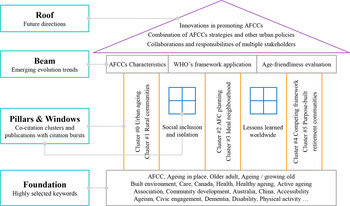
The results analysed above reflect that the current AFCC research can be summarised into three major themes based on the hot topics and domains of this research topic. These three major themes are the characteristics of AFCCs, the application of the WHO's framework in urban and rural areas worldwide, and the measurement of the cities’ and communities’ age-friendliness. If a house is used to depict the roadmap of AFCC research, then its foundation is formed by the researchers’ highly selected keywords, the document co-citation clusters and critical publications with citation bursts, which figuratively comprise the pillars and windows of the house. The summarised emerging evolution trends formed the beams, and future research directions can be perceived as the roof of the house (Figure 8).
Roadmap of the AFCCs research.
Note: WHO: World Health Organization.

The concept and features of AFCCs should primarily be understood for promoting related initiatives. Apart from the age-friendly features that were included in the WHO's guidelines, community history and identity, ageing in rural and remote communities, and environmental conditions were identified as key contextual factors that influence seniors’ experiences within the community environments. Intergenerational neighbourhoods and neighbourhood trust were described as supportive factors (Biggs and Carr, Reference Biggs and Carr2015; Tiraphat et al., Reference Tiraphat, Peltzer, Thamma-Aphiphol and Suthisukon2017). Furthermore, whether affordable and accessible housing were available in communities is also considered a critical issue (Novek and Menec, Reference Novek and Menec2014).
Numerous studies have been conducted to discuss the application of the AFCC framework released by the WHO in various contexts. To support the ageing population, planning on macro-issues, such as pensions and care services at the national, provincial and local level, is common (Hartt and Biglieri, Reference Hartt and Biglieri2018). Theories including Kingdon's that was originally developed to explain pedestrian priorities in the USA, recognises that the policy change is continuous and the formulation of specific policies is due to three streams, namely problem recognition, policy proposals and politics (Neal et al., Reference Neal, DeLaTorre and Carder2014). Generally, AFCC projects are conducted because of the leaders’ motivations to drive, rather than the seniors’ needs from communities. However, policies that can reduce economic inequalities to access all community services are the most important in such projects. Although age-friendly policies need to be context-specific and should continuously gain support from key political officials that can address related issues, current planning policies that focus on areas such as sustainable development, quality of life and growth management are consistent with the concept of age-friendliness (Menec et al., Reference Menec, Novek, Veselyuk and McArthur2014; Neal et al., Reference Neal, DeLaTorre and Carder2014; Lindenberg and Westendorp, Reference Lindenberg and Westendorp2015; Hartt and Biglieri, Reference Hartt and Biglieri2018). Therefore, developing AFCCs-related policies could become an approach to economic growth and sustainability, because new impetus will be provided for business and paid work opportunities, such as housing development or building new recreation centres. Besides, supporting senior citizens to age in place is considerably cheaper than providing care services in residential facilities. Thus, the governments’ financial burden will be alleviated (Lui et al., Reference Lui, Everingham, Warburton, Cuthill and Bartlett2009; Scharlach and Lehning, Reference Scharlach and Lehning2013). Further studies may also discuss the linkage between age-friendly policies and other social or economic dimensions.
Although senior citizens should be consulted when the AFCC framework is applied, a transformation of the top-down approach does not mean merely promoting a bottom-up approach, but working through a collaborative partnership with other stakeholders (Greenfield et al., Reference Greenfield, Scharlach, Lehning and Davitt2012; Garon et al., Reference Garon, Paris, Beaulieu, Veil and Laliberte2014). Almost all community partnerships exhibit with academic collaborators, despite the rising challenges when the timing between academic calendars and partnership timelines occasionally differ (Lui et al., Reference Lui, Everingham, Warburton, Cuthill and Bartlett2009; Plouffe and Kalache, Reference Plouffe and Kalache2011; Neal et al., Reference Neal, DeLaTorre and Carder2014; Giunta and Thomas, Reference Giunta and Thomas2015). Collaborations among stakeholders constantly require strong leadership that can enable various groups of people with a common goal to work together (Clark and Glicksman, Reference Clark and Glicksman2012; Steels, Reference Steels2015). However, not all AFCC initiatives have sailed smoothly so far (Buffel et al., Reference Buffel, McGarry, Phillipson, De Donder, Dury, De Witte, Smetcoren and Verte2014). Experiences from developed countries show that although AFCC initiatives involve cross-section collaborations, most of them were carried out in the absence of deferral funding or guidance and were often hampered by limited political authority or economic resources. Furthermore, AFCCs need long terms to be paid back, whilst the local and immediate political costs tend to be acute (Kendig et al., Reference Kendig, Elias, Matwijiw and Anstey2014). Under such circumstances, private solutions (such as housing modifications, age-friendly fitness facilities, mixed-use community planning) are apparently merging (Scharlach, Reference Scharlach2012). For example, the ‘Age-friendly Buses Project’ and ‘Wan Chai Age-friendly Neighbourhood Programme’ in Hong Kong have shown typical collaborations between public and private departments, as well as various agencies. Thus, policy makers should potentially consider the stakeholders’ concerns and the mechanism of how the collaborations could be achieved when guidelines from legal and strategic levels are implemented. Researchers could also conduct case-based studies to explore common goals and conflicts between multiple stakeholders.
Figure 8 demonstrates that measuring the age-friendliness of cities and communities has evolved particularly after 2015, when the WHO released a guide of core indicators to measure the age-friendliness of cities and communities. Although site-specific methods have been developed to evaluate programmatic activities, partnership processes and local effects, most studies that examined AFCCs are still based on descriptive studies (Beard and Montawi, Reference Beard and Montawi2015; Giunta and Thomas, Reference Giunta and Thomas2015; Jackisch et al., Reference Jackisch, Zamaro, Green and Huber2015; Ruza et al., Reference Ruza, Kim, Leung, Kam and Ng2015; Park and Lee, Reference Park and Lee2018). The absence of environmental measures from existing data-sets, adoption of defining indicators, data collection and calculation are the three main issues that researchers encounter; a relatively little empirical knowledge on how to assess the essential characteristics of an age-friendly environment accurately and appropriately is evident (Kano et al., Reference Kano, Rosenberg and Dalton2018). When linking existing survey data to age-friendly indicators, guidance on interpreting methods and data are quite limited, which means misinterpretation is not easy to prevent (Steels, Reference Steels2015). Further studies could start from exploring how to interpret survey data accurately and connect with age-friendly indicators.
Previous research has been conducted mostly in developed countries (such as the UK, the USA and the Netherlands) under a Western cultural and social background, which indicates the limited generalisability to high-density cities in the Asia-Pacific region (Wong et al., Reference Wong, Chau, Cheung, Phillips and Woo2015). Although researchers from non-Western countries have begun to conduct AFCCs-related studies, e.g. Lai et al. (Reference Lai, Lein, Lau and Lai2016) applied the exploratory and confirmatory factor analyses to determine the connection among eight AFCC domains and active ageing, as well as social connectedness. Au et al. (Reference Au, Chan, Yip, Kwok, Lai, Leung, Lee, Lai, Tsien and Lai2017) discussed the specific aspects of age-friendliness in association with life satisfaction and determined whether similarities and differences are evident among young-old and old-old adults in Hong Kong. An ageing model that could be applied in developed and developing countries to assist governments and policy makers is lacking; therefore, cross-national studies with a non-Western perspective would further contribute to the literature (Steels, Reference Steels2015; Park and Lee, Reference Park and Lee2018). Developing countries are currently experiencing the most rapid demographic change, and 80 per cent of the seniors are predicted to reside in low- and middle-income countries by 2050, in comparison to 62 per cent in 2000 (United Nations, 2001; United Nations et al., 2017). Although several experiences from developed countries can be adopted for developing countries, a remarkable congruence between developed and developing countries exists when age-friendly features are identified, wherein the barriers from political and economic domains may severely limit the extent of a community's accomplishment. The lack of standardised assessment tools would also hinder cross-national or inter-country comparisons (Plouffe and Kalache, Reference Plouffe and Kalache2010; Fitzgerald and Caro, Reference Fitzgerald and Caro2014; Wong et al., Reference Wong, Chau, Cheung, Phillips and Woo2015). Further studies are still required to explore the effectiveness and fitness of applying an oriental paradigm in non-Western countries (Chao and Huang, Reference Chao and Huang2016).
AFCCs is a fast-developing research topic and contains inter-disciplinary efforts from gerontology, nursing, social science and built environment areas. The hot topics and research domains may change in future studies. Therefore, the scientometric review can be conducted frequently as an effective way to detect new topics and trends in the research area.
Conclusion
The past ten years have witnessed a sharp increase regarding AFCC studies worldwide in different research areas. Ageing is a lifelong process and AFCCs with accessible, healthy and safe environments would benefit senior citizens and the entire society. To figure out key areas and evaluation trends, a total of 231 publications were collected and related bibliographic records were entered into CiteSpace to conduct a scientometric review. According to the data analysis results, six co-citation clusters were identified and combined as key areas, including urban ageing and planning for AFCCs, age-friendly initiatives in rural communities and multiple models for creating ideal neighbourhoods. Three major themes, namely the characteristics of AFCCs, the application of the WHO's framework in urban and rural areas, and the measurement of the cities’ and communities’ age-friendliness, are grouped as the emerging evolution trends.
Although a variety of studies regarding AFCCs have been conducted, several topics remain valuable for further discussions. In this study, innovations in the approaches for promoting AFCCs, combinations of AFCC strategies and other urban policies, as well as collaborations and responsibility assignment among multiple stakeholders are proposed as the future research directions. As for the roadmap provided in the form of a house in this study, the researchers’ highly selected keywords serve as the foundation; the results of the document co-citation network generated by CiteSpace represent the pillars and windows; emerging evolution trends serve as the beams; and future research directions reflect the roof. Thus, a clear reference for scholars and practitioners is available to enhance understanding about AFCCs, develop new research areas, provide services and develop fit policies for cities and communities.
Author contributions
The manuscript was approved by all authors for publication.
Conflict of interest
The authors declare no conflicts of interest. The work described was original research that has not be published previously, and is not under consideration for publication elsewhere, in whole or in part.