Introduction
As a significant branch of computational design optimization methods, evolutionary optimization has long been regarded as a promising and powerful tool to assist architects in addressing complex design challenges related to building performance either at individual building scale (Toutou et al., Reference Toutou, Fikry and Mohamed2018; Rodrigues et al., Reference Rodrigues, Fernandes, Gomes, Rodrigues and Costa2019) or at urban scale (Nault et al., Reference Nault, Waibel, Carmeliet and Andersen2018; Natanian et al., Reference Natanian, Aleksandrowicz and Auer2019). Based on evolutionary algorithms (EAs), evolutionary optimization can technically solve performance-based building design problems by evolving a population of design solutions. For architectural design, such an evolutionary process can be guided by various energy-related performance criteria such as daylighting and passive solar energy (Touloupaki and Theodosiou, Reference Touloupaki and Theodosiou2017). In addition, evolutionary optimization also allows for an automated exploration of the design space, which facilitates architects to extract information about the design problem. The latter exercise can be referred to as optimization-based design exploration, and its relevance in enhancing design ideation and overcoming design fixation at the conceptual design stages has become increasingly appreciated and upheld recently (Turrin et al., Reference Turrin, Von Buelow and Stouffs2011; Dino, Reference Dino2012; Bradner et al., Reference Bradner, Iorio and Davis2014).
Despite many successful cases in the literature, applying evolutionary optimization in the conceptual design phases remains challenging. The challenge can be partly attributed to two key weaknesses of EAs. The first relates to the lack of adequate design diversity in the optimization result, and the second relates to poor search efficiency. These weaknesses mean that in many cases, the optimization process is incapable of discovering legitimate high-performing solutions within a reasonable timeframe.
In order to address these two weaknesses, this research proposes an implementation of a hybrid EA, named steady-state island evolutionary algorithm (SSIEA). SSIEA is designed to facilitate architects to undertake an explorative and efficient evolutionary optimization as a means of conceptual design exploration. The implementation of SSIEA integrates the island model approach (Whitley et al., Reference Whitley, Rana and Heckendorn1999) into a standard EA to enhance the genetic diversity in the optimization result. At the same time, SSIEA employs the steady-state replacement strategy (Agapie and Wright, Reference Agapie and Wright2014) to improve search efficiency.
To place this research into the context, we first discuss the progress that has been made in the area of applying EAs for assisting conceptual architectural design. In the main body of the paper, we will describe SSIEA and present the case studies and associated results. We conclude by discussing the features and the relative efficacy of the application of SSIEA and point out future research directions.
Related works
When applying evolutionary optimization to design exploration at conceptual design stages, the aim is to achieve progressive fitness improvement while exploring the design space to discover diverse legitimate high-performing alternative solutions (Ekici et al., Reference Ekici, Cubukcuoglu, Turrin and Sariyildiz2018; Wortmann, Reference Wortmann2018). Diversity plays a key role in revealing tradeoffs and compromises characterizing the design problem. Optimization results consisting of a selection of legitimate high-performing design solutions are also preferred by architects (Cichocka et al., Reference Cichocka, Browne and Ramirez2017; Wortmann and Nannicini, Reference Wortmann, Nannicini, Karakitsiou, Migdalas, Rassia and Pardalos2017). However, the exploitative nature of standard EAs and certain commonly used optimization algorithms means that such search processes often produce a population of design solutions that are all very similar, covering only a small area of the design space (Rodrigues et al., Reference Rodrigues, Gaspar and Gomes2013).
In order to enhance the diversity in the optimization result, a widely used method is to combine Pareto-based methods with crowding-based (Makki et al., Reference Makki, Showkatbakhsh, Tabony and Weistock2018) or hypervolume-based techniques (Vierlinger, Reference Vierlinger2013). This method has two key drawbacks. On the one hand, an over-emphasis on diversity enhancement may degrade search efficiency, which can result in under-optimized design variants (Cao et al., Reference Cao, Huang, Wang and Lin2012; Montgomery and Chen, Reference Montgomery and Chen2012). On the other hand, although the method can produce the optimization process being able to output many diverse design solutions, another significant hurdle is that the number of solutions may be very large. Analyzing such results and extracting useful information can be overwhelming and tiring for architects due to cognitive overload (Scheibehenne et al., Reference Scheibehenne, Greifeneder and Todd2010). As a result, an additional effort for filtering and clustering the optimization result may also be required (Chen, Reference Chen2015; Yousif and Yan, Reference Yousif and Yan2018; Wortmann and Schroepfer, Reference Wortmann and Schroepfer2019).
In consideration of the need for diversity in the optimization result, the niching-based method, such as island model approaches, may be advantageous. This method splits the population into subpopulations that focus on different subspaces in the design space (Whitley et al., Reference Whitley, Rana and Heckendorn1999). This method allows the diversity in the optimization result to be controllable by specifying the number of subpopulations. However, applying the niching-based method can also reduce the search efficiency of the algorithm (Montgomery and Chen, Reference Montgomery and Chen2012). Thus, when using this method, it requires more design generations and evaluations to reach a convergence of optimal or legitimate solutions satisfying the fitness requirement.
Apart from the lack of design diversity in the optimization result, poor search efficiency of EAs is another factor accounting for the failure of many evolutionary optimization tasks. Poor search efficiency can result in the evolutionary optimization only producing inferior solutions, which can be highly misleading for architects. In order to obtain accurate optimization results, most EAs require a large number of generations to converge on a set of legitimate satisficing solutions (Wang et al., Reference Wang, Janssen and Ji2018a). However, in the fast-paced architectural design process, the time and computational resource budgets for the evolutionary optimization are typically limited, with the number of generations ranging from tens to hundreds (Nguyen et al., Reference Nguyen, Reiter and Rigo2014; Si et al., Reference Si, Tian, Jin, Zhou and Shi2019). As a result, the focus of the evolutionary optimization is on discovering competitive design solutions within a limited search budget rather than striving to find a global optimum requiring a vastly greater search budget.
For optimization problems with a limited search budget, poor search efficiency can partly be attributed to the generational replacement strategy adopted by standard EAs. This replacement strategy requires the whole population to be evaluated before reproduction can start. As a result, the evolutionary search process must be repeatedly paused, while all individuals in that generation are being evaluated. In order to overcome this weakness, steady-state replacement strategies may have certain advantages (Janssen, Reference Janssen2005; Agapie and Wright, Reference Agapie and Wright2014). This strategy employs a large generation gap, where only a small number of individuals in the population are replaced in each generation. Thus, it allows newly found fitter individuals to be inserted back into the population more promptly and has an immediate feedback effect on the evolutionary optimization process.
Methodology
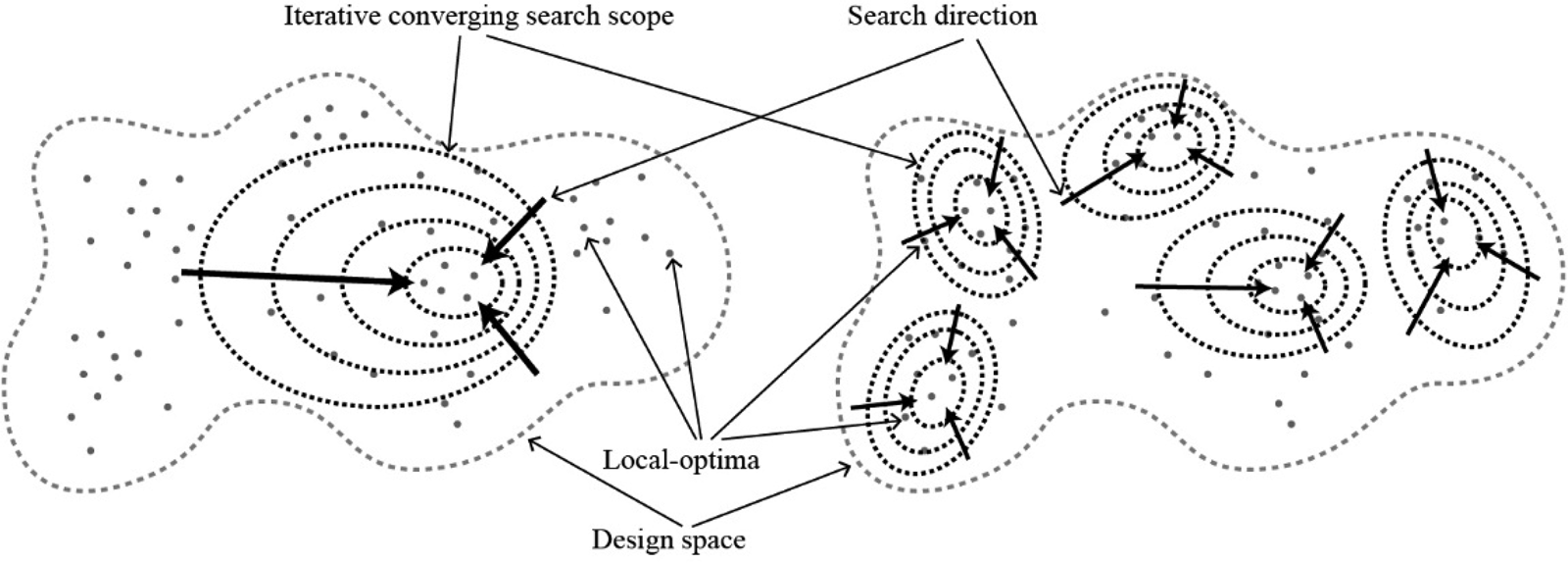
SSIEA is aimed to enhance design diversity and improve search efficiency. The algorithm achieves this by using an island model consisting of a series of parallel evolutionary optimization processes, each focusing on different non-neighboring subspaces. For each of the islands, the algorithm uses a steady-state replacement strategy to exploit the subspace in a “greedier” manner. The difference between the search behavior of a standard EA and SSIEA can be described as Figure 1.
Comparison of search approaches between the standard EAs (left) and SSIEA (right).

The usefulness of SSIEA lies in the character of optimization problems during conceptual architectural design. First and foremost, the design space defined by parametric models during conceptual architectural design is typically vast and multimodal (Wang et al., Reference Wang, Janssen and Ji2018b). In addition, due to the ill-defined nature of conceptual design problems, there are often many feasible and legitimate design solutions inside the design space. Such multimodal design search spaces are, in fact, preferable for conceptual design since the aim is exploring diverse legitimate high-performing design solutions rather than finding a single global optimal solution. Such an exploration would be enhanced by multiple parallel searches for various sub-optimal alternative solutions (Woodbury and Burrow, Reference Woodbury and Burrow2006). With the island model, parallel evolutionary processes enable the evolutionary optimization to focus on multiple design subspaces concurrently. This search approach allows multiple feasible design solutions to be found at the end of the evolutionary optimization process, which helps reveal more information about the design problem.
SSIEA is based on an EA optimization algorithm. As mentioned above, two key weaknesses of EAs are poor search efficiency and inadequate design diversity. In SSIEA, these weaknesses are addressed by integrating the steady-state replacement strategy and the island model strategy. The integration of these two strategies can be mutually supporting because the strength of one strategy can help to overcome certain negative tendencies within the other strategy.
On the one hand, as a niching-based strategy, the island model may have a tendency to reduce search efficiency (Montgomery and Chen, Reference Montgomery and Chen2012). The steady-state replacement strategy is an efficient search mechanism that can counteract this tendency. On the other hand, while the steady-state replacement strategy may have a tendency to increase the evolutionary pressure, it makes the evolutionary process too exploitative. The use of subpopulations with the island model can counteract this tendency. When a subpopulation gets trapped by poor local optima, the application of the island model can facilitate the subpopulation to escape from the entrapment by exchanging genetic material with other subpopulations.
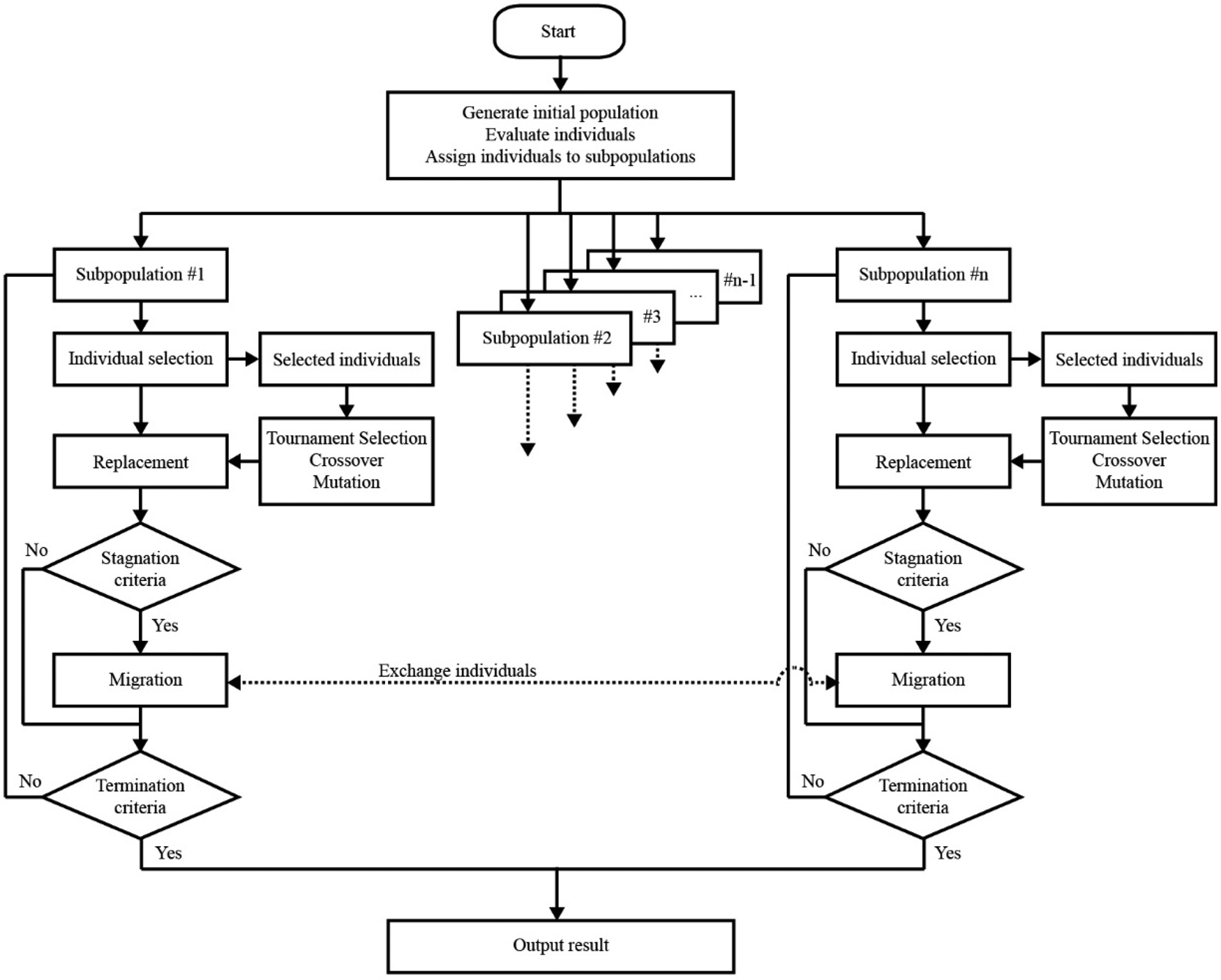
Before explaining the concept and the techniques implemented in SSIEA, we first briefly outline the overall SSIEA workflow. As shown in Figure 2, the workflow consists of four steps:
-
Setp 1: The workflow starts with the creation of the initial population by Latin hypercube sampling (LHS). After being evaluated by the fitness function, each individual in the initial population is assigned to one of the subpopulations in turn.
-
Setp 2: After the initial generation, a small number of individuals in each subpopulation are selected based on the “generation gap” setting. These selected individuals go through a standard evolutionary procedure, including tournament selection, crossover, and mutation, to create offspring. The newly created offspring compete against their parents. Any offspring individual with better fitness than the parents is inserted back into the subpopulation, replacing a weaker parent individual.
-
Setp 3: Step 2 is repeated until no offspring with better fitness has been found. If no improvement is obtained for a certain consecutive number of generations, the optimization process for that subpopulation is seen as having stagnated. The stagnation triggers a migration process, which exchanges several individuals in the subpopulation with another subpopulation.
-
Setp 4: Lastly, steps 2 and 3 are repeated until either the termination criteria or the maximum number of generations are reached. When the criteria have been reached, the optimization results are returned.
The workflow of SSIEA.

Island model
Conventional EAs with centralized population models treat the entire population as a single breeding unit and execute evolutionary operations (crossover and mutation) on the whole population. Such EAs are weak in maintaining desirable design diversity primarily because many subspaces with legitimate design solutions are often discarded when solutions with only slightly better fitness are found.
In order to avoid this drawback, the island model can be used to restrain the competition between individuals from different subspaces. Island models split the population into several "niche" subpopulations that are evolved relatively independently (Whitley et al., Reference Whitley, Rana and Heckendorn1999). Thus, the individuals found by each subpopulation can be preserved for a longer time and will not be immediately replaced, even when better individuals are found in other subpopulations. When multiple legitimate subspaces can be preserved and covered by the design subpopulations, it allows the evolutionary process of each subpopulation to exploit the subspace more accurately without intervention by others.
In addition, the island model will also perform an implicit clustering of the design population. As a niching-based method, the individuals in each subpopulation tend to become more homogeneous over the course of the evolutionary process. Thus, if the architects find legitimate solutions among the elite solutions from a particular subpopulation, they can easily explore other similar alternative design variants in the same subpopulation without requiring any additional clustering. For the architects, this can streamline the process of using evolutionary optimization in design exploration.
Migration
Natural evolutionary processes often benefit from mating across the boundaries of the subgroups of different species (Chipperfield and Fleming, Reference Chipperfield and Fleming1994). Likewise, the exchange of genetic material among subpopulations is also encouraged when using island models, and the exchange process is referred to as migration (Alba and Troya, Reference Alba and Troya1999). Migration can help a subpopulation escape entrapment within a poor design subspace by inputting new genetic material from other subpopulations. The mixture of genetic material from two subpopulations can allow the focus of the subpopulation to be repositioned somewhere between the two associated subspaces.
For standard island model algorithms, migration is performed synchronously. When triggered, all subpopulations simultaneously send out and receive individuals with another subpopulation. However, such a migration operation can be adverse if high-fitness individuals are sent to a subpopulation consisting of individuals with lower fitness. To avoid this drawback, SSIEA applies an asynchronous migration scheme (Horii et al., Reference Horii, Miki, Koizumi and Tsujiuchi2002). This scheme triggers migration only when the evolution of a subpopulation falls into stagnation. Specifically, if a subpopulation has had no new individuals for several generations, the evolution of this subpopulation will be judged as stagnant. After that, new genetic materials are allowed to be inputted through migration.
For SSIEA, the migration operation is also aimed to introduce heterogeneous genetic materials to a stagnating subpopulation in order to increase the genetic differentiation in the subpopulation. Thus, for a stagnating subpopulation, the migration operation exchange individuals with the subpopulation that has the largest distance to the stagnating subpopulation. The distance between the two subpopulations is calculated by averaging the pairwise Euclidean distance of the individuals in the two subpopulations.
Steady-state replacement strategy
With the steady-state replacement strategy, SSIEA executes all other evolutionary operations sequentially as standard EAs do. In each generation, a fixed number of individuals in each subpopulation are randomly selected based on the "generation gap" setting. Next, tournament selection is applied to choose the fitter individuals from these as parents to create offspring. The parents and offspring all compete with one another. The higher-ranking offspring individuals are inserted back into the subpopulation, replacing the inferior parents, while the remaining inferior offspring are discarded. Although the selective nature of the steady-state replacement strategy renders the evolutionary process exploitative, the risk of over-exploitation or premature convergence is compensated by the explorative nature of the island model.
Initial population generation
When using EAs, the initial population plays an important role in determining the quality of the obtained optimization result, as uneven population distributions could lead to early entrapment by particular local optima (Maaranen et al., Reference Maaranen, Miettinen and Penttinen2007; Talbi, Reference Talbi2009). Some researchers seek to avoid the negative impact on the optimization result due to the uneven distributed initial population by applying techniques such as Mersenne Twister Fast Random Number Generator (Vierlinger, Reference Vierlinger2013) and LHS (Park et al., Reference Park, Jeong and Choi2015). For SSIEA, an uneven initial population distribution can also undermine the goal of achieving adequate design diversity because an uneven initial population can result in several subpopulations having overlapping design subspaces containing similar design variants.
In order to prevent the subpopulations from focusing on overlapping design subspaces, LHS is applied to generate the initial population for ensuring that the individuals are spread uniformly in the design space. The advantage of using LHS is that, for every individual in the initial population, the value in each parameter does not coincide with that of any other individual (Shields and Zhang, Reference Shields and Zhang2016). Thus, using LHS can reduce the possibility of individuals with similar parameters, which may introduce biases in the initial population toward some design subspaces.
Software and platform
To facilitate the ease of use for architects and designers, SSIEA is implemented in the Rhino-Grasshopper environment as a plug-in component. Rhino-Grasshopper is one of the most popular parametric modeling design platforms in architecture, and there is an increasing number of performance simulators or interfaces being integrated into it, such as DIVA and Archsim (Jakubiec and Reinhart, Reference Jakubiec and Reinhart2011). Thus, the implementation in this platform can allow architects to establish design optimization systems by connecting SSIEA to the parametric model for building design generation and performance simulation tools for fitness evaluation.
Case studies
To demonstrate the efficacy of SSIEA, we present two case studies of architectural optimization problems (Wang et al., Reference Wang, Janssen and Ji2018b, Reference Wang, Janssen, Chen, Tong and Ji2019b). These two case studies describe optimization problems related to building massing design, and each problem incorporates a different fitness evaluation criterion.
The first case study describes a building design optimization problem with the fitness evaluated by a fast, simplified calculation of the building's economic performance. Thus, the optimization process based on this calculation is inexpensive to compute. In this regard, the focus of the first case study is on comparing SSIEA against other optimization algorithms.
The second case study aims to show how SSIEA can be used in a conceptual design scenario with a more realistic design problem. Hence, in addition to comparing the performance of SSIEA against other optimization algorithms, the second case study also investigates the utility of SSIEA in supporting conceptual design.
Design setting
Case study 1
The first case study describes a 40-story high-rise building design with a central vertical atrium and a series of sky gardens (Wang et al., Reference Wang, Janssen and Ji2018b). The optimization objective is to search for design variants that can optimize the economic performance considering various factors, including potential rental revenue, façade cost, and construction cost.
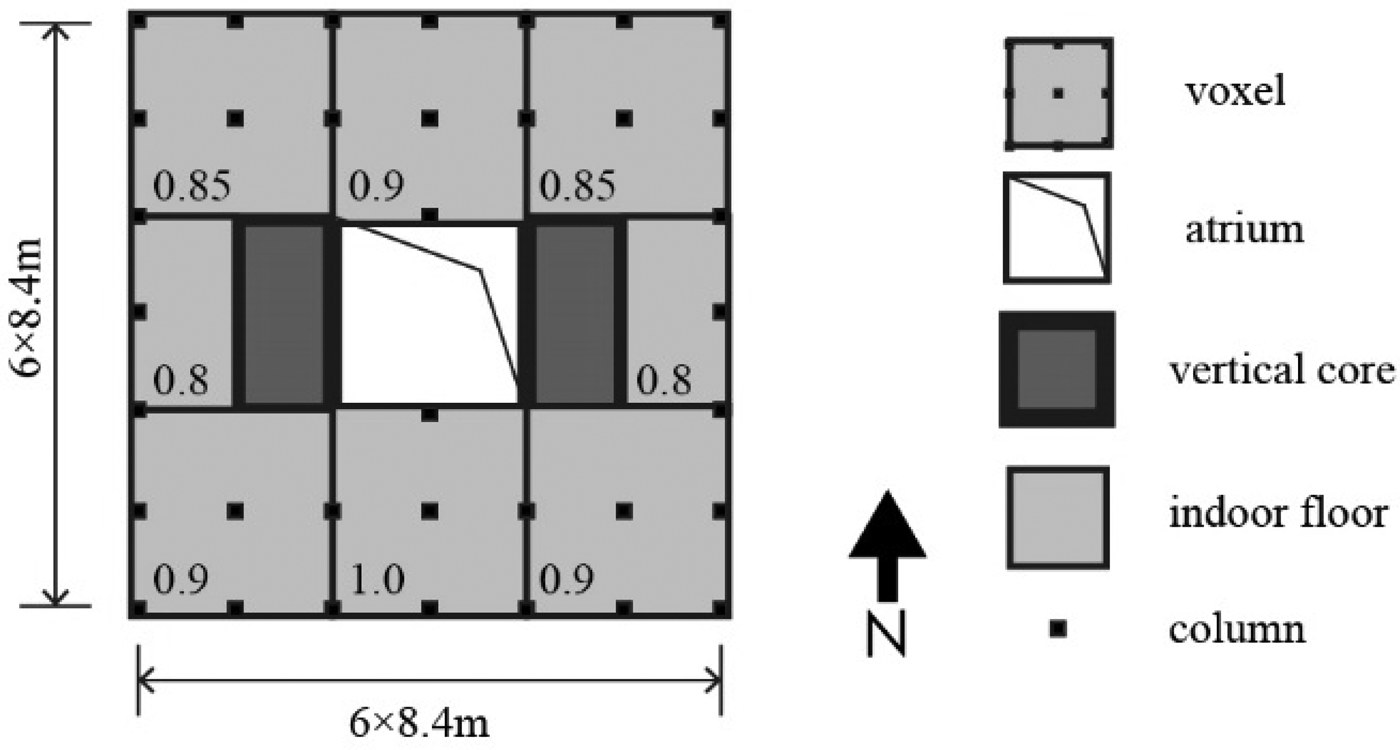
In terms of the building design generation, the parametric model used in this case study defines the positions of sky gardens by using a 3D cellular voxel approach (Wang et al., Reference Wang, Janssen and Ji2018b). The building mass is represented as a series of fixed-size spatial voxels (Fig. 3). Except for the voxels representing the structural cores and the atrium, sky garden voids can be inserted into the building mass by switching voxels from solid to void. In order to avoid chaotic design variants, a set of predefined floor layouts are used that constrain the ratio of indoor space to outdoor voids. In addition, a set of repair functions are used to correct infeasible local features such as over-large voids (Wang et al., Reference Wang, Janssen and Ji2018b).
Voxels of floor plan.

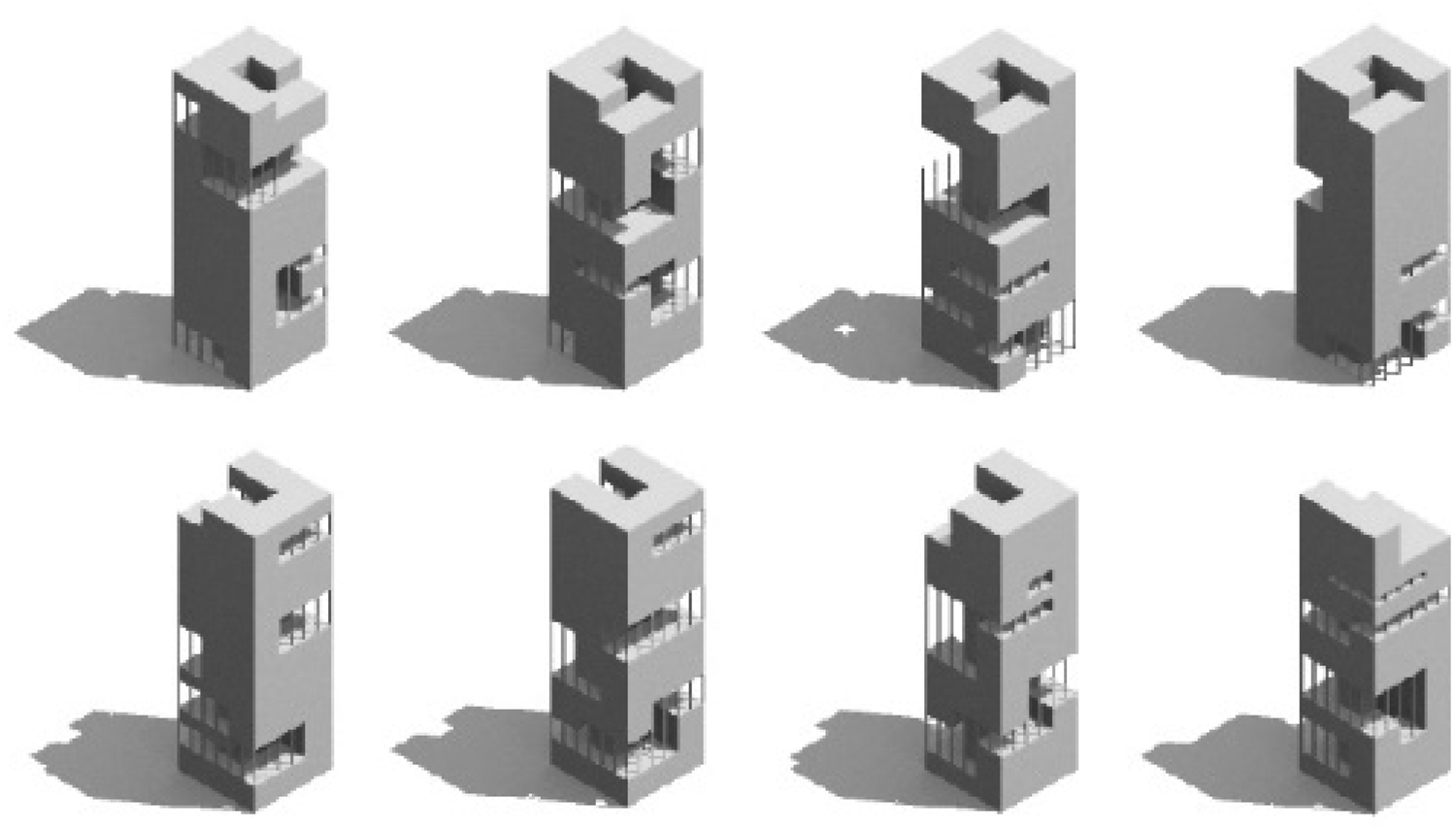
In order to reduce the number of parameters that are required, the building is represented as 15 floor groups. Each group consists of three to five consecutive floor levels, and all these levels have the same floor layout. Each floor group requires three parameters, defining the number of floor levels within the group, the orientation of the floor layout, and the plan of the floor layout. Hence, to generate design solutions, the parametric model requires 45 discrete parameters. Figure 4 shows a random sampling of design variants.
Random sampling of design variants.

Based on the parametric model, the fitness of the generated building design variants is calculated by the function described below:
 $${\rm fitness} = \sum\limits_{i = 1}^N {\lpar {{\rm R}{\rm R}_i\ast {\rm PRF} + {\rm F}{\rm C}_i + {\rm S}{\rm C}_i + {\rm C}{\rm C}_i} \rpar }.$$
where N is the total number of floors, which is equal to 40. RRi indicates the rental revenue each floor, which is calculated by multiplying the rentable floor area each voxel with the unit rental price. PRF is a floor rental price regulating factor that gives different preferences to space with better orientations based on the ratio indicated in Figure 3 and also gives preference to spaces on the upper or lower floors (due to the better view or accessibility). FCi, SCi, and CCi indicates the construction cost of facades, slabs, and structural cores of each floor. FCi is calculated by multiplying the façade surface area with a fixed unit price of façade material. SCi and CCi are calculated by multiplying the floor surface area of the voxel with different unit construction price raising along with an increase in floor levels because the construction in higher floor levels is pricier.
Due to the use of the constraints and repair functions, the genotype–phenotype mapping is many-to-one and not very linear, which results in an irregular design search space that is challenging for optimization algorithms to search (Wang et al., Reference Wang, Janssen and Ji2018b). The irregular design search space can mislead the optimization process by local optima and may make the process suffer from premature convergence. For architectural optimization problems that incorporate rule-based methods or implicit generative methods, this type of irregular design search space is not unusual. In this respect, this case study intentionally creates such an irregular design search space to differentiate the capability of each optimization algorithm in handling the challenge.
Case study 2
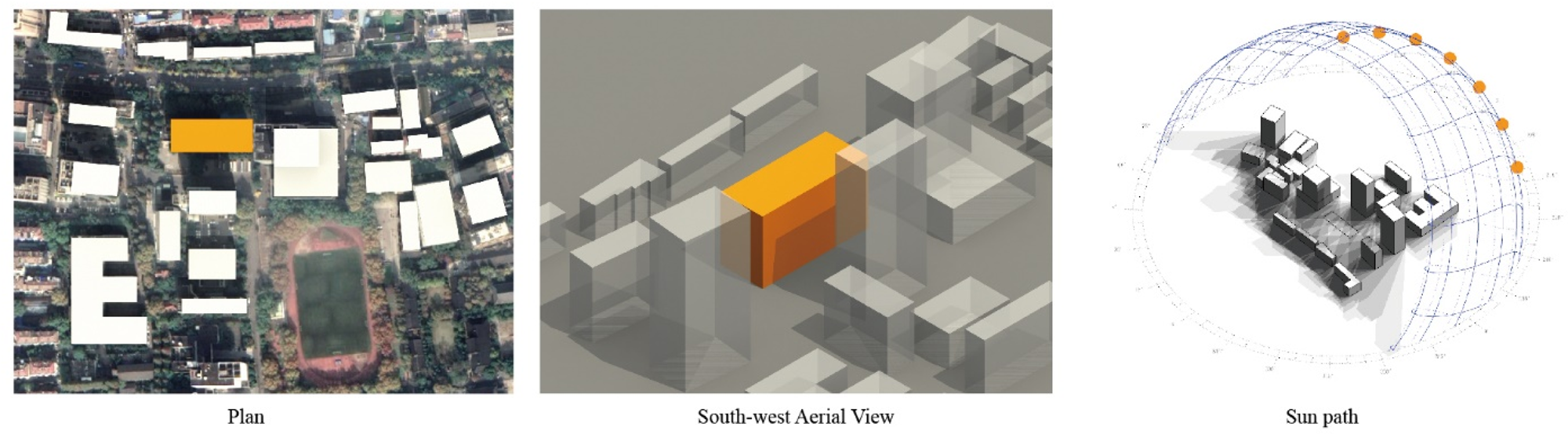
The second case study (Wang et al., Reference Wang, Janssen, Chen, Tong and Ji2019b) describes a high-rise slab-type building located in an actual urban environment, and daylighting performance is considered the optimization objective. Figure 5 shows the building plot and its sun path analysis. The building plot is surrounded by several high-rise buildings, which leads to significant daylight obstructions. This condition makes it challenging for the building massing to achieve desired daylighting performance.
The building plot and sun path analysis.

The daylighting performance is evaluated by the annual lighting energy(LE) consumed by the building. At the same time, the gross area of the generated building is considered a functional requirement in this design, which is set to 45,000 m2. The gross area target is defined as a penalty function. The penalty function proportionally scales up the value of LE to punish the design variants failing to satisfy the gross area requirement. The fitness function of this case study can be described below:
 $${\rm fitness} = {\rm LE} \times \left({1 + \left\vert {\displaystyle{{A_{{\rm actual}}-A_{{\rm target}}} \over {A_{{\rm target}}}}} \right\vert } \right).$$
where LE indicates the lighting energy consumption, and A actual and A target indicate the actual gross area of the building massing and the required target gross area.
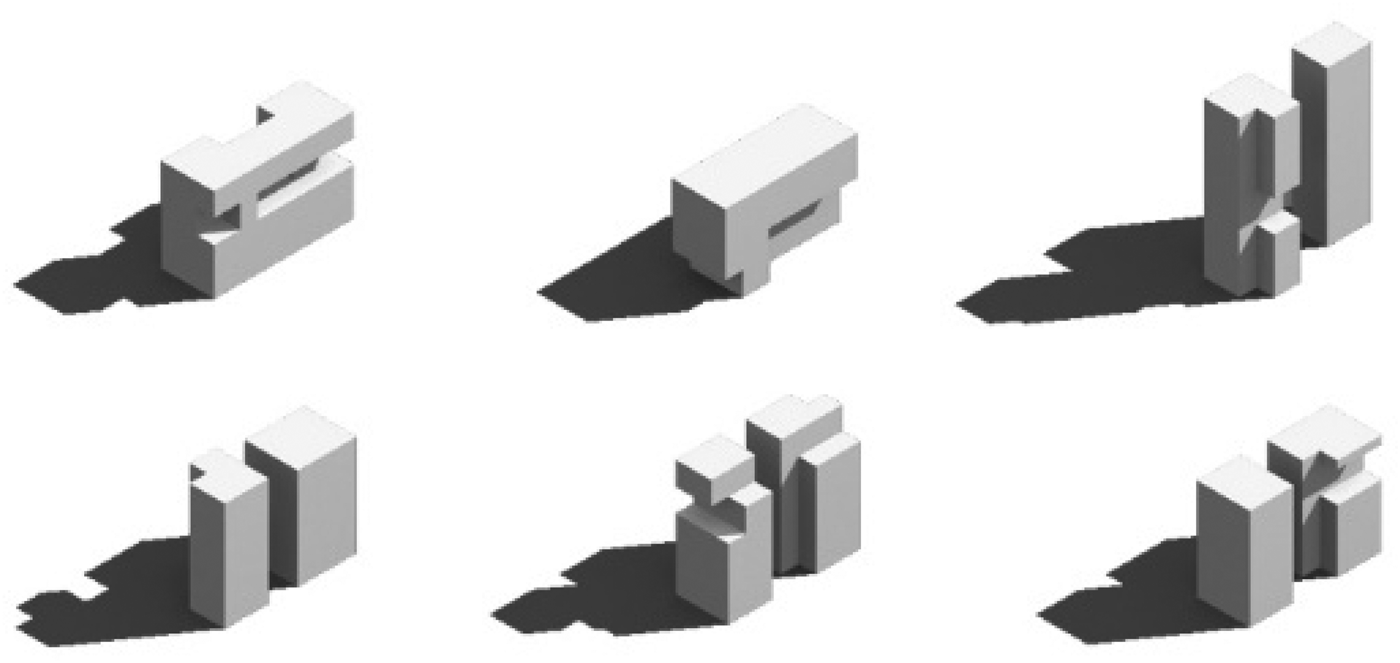
The parametric model generates the building massing based on the subtractive form generation principle, which removes different parts from a predefined cubic building block (Wang et al., Reference Wang, Janssen, Chen, Tong and Ji2019b). This principle creates building massings with high topological variability, while it can also schematically describe many passive energy-saving strategies in the generated building massing design such as stilts, atriums, and solar envelope. Figure 6 shows building massings generated by random sampling.
Random sampling of design variants.

In this case-study design, 42 continuous parameters are used to define seven subtracting volumes. Each subtracting volume requires six parameters, defining its position (x, y, z) and dimensions (length, width, height). Similar to the first case study, various constraints and repair functions are used related to the alignment and size of the subtracting volumes. These result in the relationship between genotype and phenotype also being a many-to-one with various non-linear behaviors. This genotype–phenotype relationship, in turn, results in an irregular design search space (Wang et al., Reference Wang, Janssen, Chen, Tong and Ji2019b), creating challenges for search and optimization.
The simulation of LE is carried out on DIVA, a lighting simulator based on Radiance in Rhino-Grasshopper (Jakubiec and Reinhart, Reference Jakubiec and Reinhart2011). The simulation is time-consuming, being roughly 60–80 s for each evaluation, which can make optimization processes with thousands of iterations take days to complete. The time taken to run the optimization process is problematic when considering fast design cycles that are typical in design offices. However, this can be addressed by other methods beyond the scope of this research, such as reducing simulation time by offline simulation (Su and Yan, Reference Su and Yan2015), parallel computing, and cloud computing (Kyropoulou et al., Reference Kyropoulou, Ferrer and Subramaniam2018).
Algorithm setup
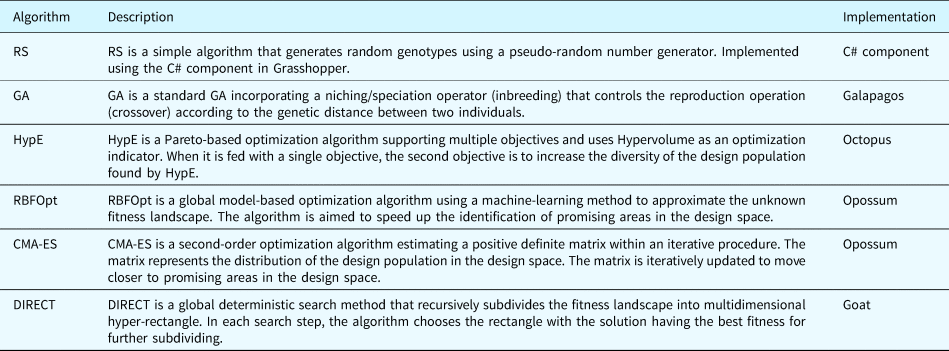
We previously examined the performance of SSIEA by comparing it against the genetic algorithm (GA) and a random search (RS) algorithm based on pseudo-random techniques (Wang et al., Reference Wang, Janssen and Ji2019a). While SSIEA significantly outperforms to these two, in this paper, we extend our examination by considering another four more advanced evolutionary and non-evolutionary optimization algorithms – HypE, DIRECT, CMA-ES, and RBFOpt (Table 1), for comparing against SSIEA in regards to design diversity and search efficiency.
The algorithms for comparison with SSIEA

These four algorithms have been extensively tested in several studies and showed good performance on average (Wortmann, Reference Wortmann2017; Wortmann et al., Reference Wortmann, Waibel, Nannicini, Evins, Schroepfer and Carmeliet2017; Waibel et al., Reference Waibel, Wortmann, Evins and Carmeliet2019). In addition, the application of HypE, RBFOpt, and CMA-ES can also produce different design variants in the optimization result, which allows for the comparison of design diversity between these algorithms and SSIEA.
For SSIEA, the basic algorithm parameters are set as follows. (1) In order to obtain an adequate diversity in the optimization result, the number of subpopulations is set to 5, and each subpopulation has 40 individuals. Thus, the initial population size (including all subpopulations) is 200. (2) After the initial generation, the generation gap for the steady-state replacement strategy is set to 75%. Thus, 10 out of the 40 (25%) individuals in each subpopulation are randomly selected in each generation for evolution. Among the 10 randomly selected individuals, the selection rate for the tournament selection is set to 60%. Thus, the six highest-ranking individuals are used to create offspring. (3) We consider two different mutation rates, 0.3 and 0.15, to investigate its impact on the design diversity and search efficiency of the optimization process.
The other four algorithms are all implemented in the Rhino-Grasshopper platform. DIRECT is implemented in Goat (Rechenraum GmbH, 2019), HypE in Octopus (Vierlinger, Reference Vierlinger2019), and RBFOpt and CMA-ES in Opossum (Wortmann, Reference Wortmann2018). In this case study, default setups are applied to these algorithms, while it should be noted that the parameter setup can have a significant impact on the performance of optimization algorithms.
For the second case study, we apply the same algorithm parameter setup of SSIEA and other optimization algorithms as in the first case study. However, the inferior mutation rate (0.30) of SSIEA found in the first case study is no longer used in this case study.
Optimization process setup
For the optimization process, 2000 iterations of design generations and fitness evaluations are set as the termination criteria for both case studies. This limit took into consideration the complexity of the problem and the need for reasonably fast feedback during conceptual architectural design processes.
For SSIEA, the initial population size is 200, and each generation has 30 design generations and fitness evaluations. Hence, it requires the generation number of 60 to make the optimization process reach 2000 iterations. For HypE, the default initial population is also 200, and each generation has 100 design generations and fitness evaluations as the default, which requires 18 generations to reach the termination criteria. For DIRECT, RBFOpt, and CMA-ES, it generates one design each iteration, and, therefore, the number of iterations is 2000.
For the first case study, the fast fitness evaluation also allows for the repetition of the optimization process to ensure the statistical significance of the results obtained. As a result, except for DIRECT, we repeat the optimization process based on each algorithm five times to avoid stochastic deviation. The reason why DIRECT is excluded was that, as a non-stochastic algorithm, DIRECT produces the same optimization results each time. For the second case study, each optimization process based on daylighting simulation roughly lasts two days. As a result, we only carry out the optimization process based on each algorithm once.
Algorithm performance measurement
For both case studies, we consider several metrics to evaluate the performance of the algorithm in terms of design diversity and search efficiency. For design diversity, genetic diversity (diversity in parameters) is used as the primary indicator for evaluating diversity in the optimization result. Genetic diversity is calculated based on a subset of the final evolved population, referred to as the elite set.
For SSIEA, the elite set is created by selecting the highest-ranking design variant in each of the five subpopulations. For the other algorithms, the elite set is created by a process that selects representative high-fitness design variants from the population. These representative design variants are selected using a three-step process. First, a group of high-fitness design variants is created by selecting the best 200 design variants from each optimization process. This group is the same size as the population in SSIEA. Second, these 200 design variants are clustered into five subgroups according to the genotypic similarity. Five subgroups are chosen in order to keep the size of the elite set equal to that of SSIEA. The clustering is performed by a K-means algorithm implemented in the LunchBox plug-in in Grasshopper. Last, the elite set is created by selecting the highest-ranking design variant in each of the five subgroups. In addition, we also use this approach to processing the evolved population of SSIEA to compare the results produced by the explicit clustering approach with the K-means algorithm and the implicit clustering approach with the island model approach.
With the elite set, we measure the genetic diversity by averaging the genetic difference value of all design variants in the elite set. The genetic difference value of each design variant is calculated by averaging the genetic distance between the design variant and all other design variants in the elite set. The genetic distance between two design variants is measured by the normalized Euclidean distance between the parameters (genotypes) of the two design variants. The genetic diversity is calculated as follows:

As mentioned in Introduction section, the relevance of diversity in the optimization result also depends on the fitness of the design variants. Thus, the fitness of the five design variants in the elite set is also taken into account. Moreover, the building design (phenotypic diversity) of these selected design variants is also presented to show the design diversity at the phenotypic level, which helps to explain how differences of the optimization result among these algorithms may affect the information extraction.
In terms of search efficiency, we consider the best fitness achieved by each optimization process within the predefined time frame (2000 iterations). To visualize the search efficiency, we draw fitness progress trendlines (FPTs) to show more detailed search behaviors among different algorithms. The drawing of FPTs is based on the best solutions found over time.
Last, in the first case study, the optimization process is run multiple times. Multiple executions allow us to investigate the robustness of the algorithm. Robustness is an important indicator evaluating the performance of optimization algorithms. The ability to repeatedly obtain similar results is important for architects to develop trust in the optimization algorithm. We investigate the ability of each algorithm to achieve stable optimization results in terms of design diversity and search efficiency. For the second case study, since the optimization process based on each algorithm is executed only once, the robustness of the algorithm cannot be considered.
Results
Case study 1
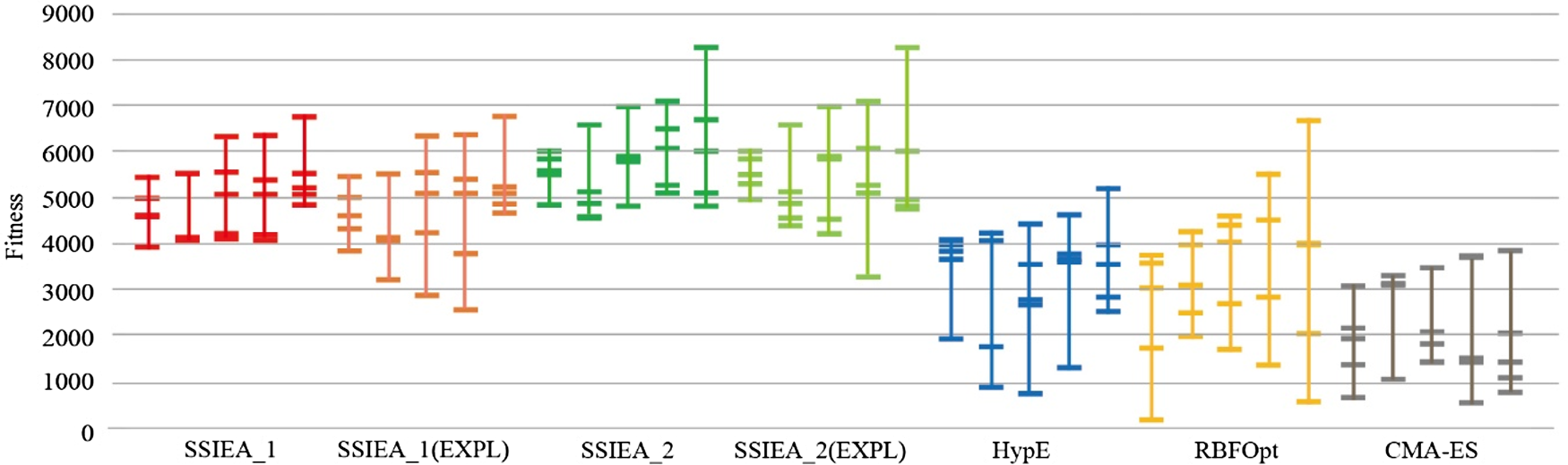
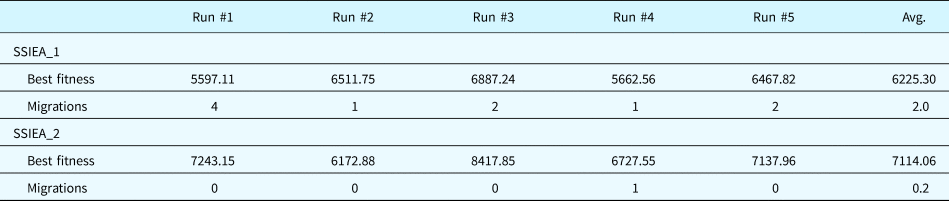
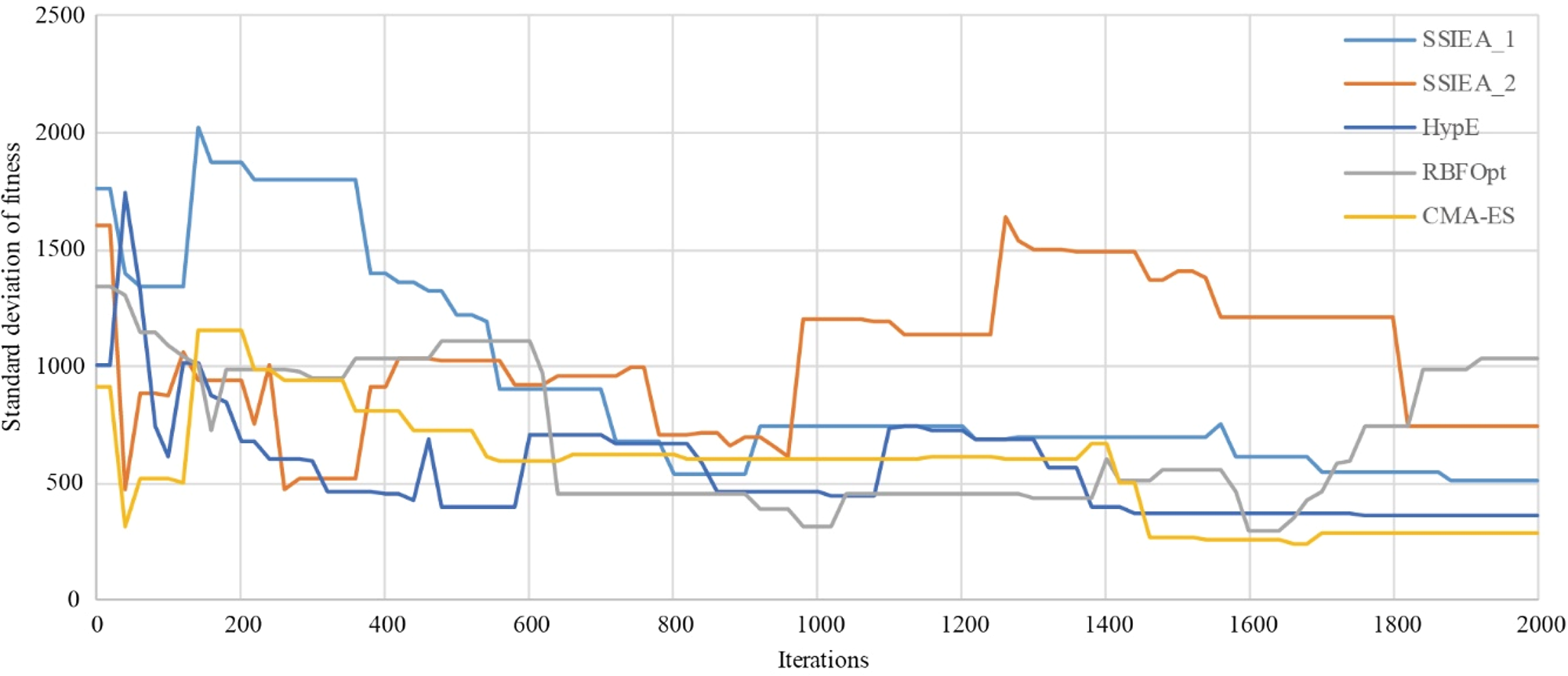
For the first case study, the optimization goal is to maximize the economic performance of the building. Each algorithm (excluding DIRECT) is executed five times to avoid stochastic deviation. Table 2 and Figure 7 summarize the results for the design diversity and fitness ranges of the five selected elite design variants. Table 3 summarizes the best fitness (the highest value) obtained by each of the five optimization runs. Figure 9 shows the FPTs for each algorithm, as an average of the five runs. To differentiate the optimization process based on the two mutation rates of SSIEA, we label the one with a 0.3 mutation rate as SSIEA_1 and the one with a 0.15 mutation rate as SSIEA_2.
The box-plotting of the fitness range of the elite set from each optimization process. (EXPL: SSIEA elite set produced by explicit clustering, hereinafter).

The statistical analysis of design diversity in the optimization result (EXPL: SSIEA elite set produced by explicit clustering, hereinafter)

Fitness values of search results and statistical analysis

Design diversity
Design diversity is measured as the average genetic difference among selected design variants in the elite set, and the average difference value ranges from 0.0 to 1.0. For design diversity, DIRECT is excluded, as it fails to solve the design problem (the best fitness obtained is −35295.51). The significant inferior fitness obtained renders the solutions found by DIRECT to be of no use to solve the design problem. Hence, in this case, we do not consider DIRECT.
When only considering the average genetic difference, SSIEA underperforms relative to all other tested algorithms (Table 2). This result suggests that these other algorithms are able to achieve more explorative search than SSIEA. These algorithms typically explore many design subspaces during the optimization process, thereby preventing the optimization from converging into a single design subspace. However, a closer examination of the design variants in the elite set reveals that this diversity primarily results from the inclusion of relatively low-fitness design variants in the optimization result. This is also reflected in the overall low average fitness for the elite set.
When comparing the average fitness of the elite set, SSIEA_1 and SSIEA_2 stand out and achieve a markedly better fitness as compared with the other algorithms. Even though the other algorithms are able to obtain a higher genetic diversity score than SSIEA, the design variants in the elite set are less competitive. This tendency can be further clarified by Figure 7, which shows that the fitness range of the elite set produced by the other algorithms is markedly wider than those produced by SSIEA. In contrast, the design variants in the SSIEA elite sets tend to have similar competitive fitness. Moreover, the narrow fitness range can also account for the relatively lower genetic diversity obtained by SSIEA, as high-fitness design variants are likely to resemble global optima.
When comparing SSIEA_1 and SSIEA_2, we find that a lower mutation rate can make the discovery of better design variants more likely. At the same time, it does not result in any significant compromise when it comes to genetic diversity. In addition, the comparison of the SSIEA clustering approaches reveals that implicit clustering typically results in lower average genetic difference but higher average fitness than explicit clustering.
The elite sets produced by the two clustering approaches are largely in agreement with one another. In most cases, the best three or four design variants are typically shared by both elite sets. The explicit clustering approach typically achieves higher genetic diversity by including one or two relatively low-fitness but more heterogeneous design variants into the elite set. The higher genetic diversity produced by the explicit clustering approach reveals the fact that the optimization process of SSIEA is more explorative as shown in the result produced by the implicit clutersing.
The result shows that SSIEA produces elite sets that are more optimized than the elite sets of the other algorithms. The design variants in the SSIEA elite set are closer to global optima compared with other algorithms, which is critical for information extraction as under-optimized results can be very misleading. In order to demonstrate this more clearly, Figure 8 shows the design variants in the elite set with the median best fitness among the elite sets produced by the five optimization runs.
The design variant found by different algorithms.

As shown in Figure 8, the elite sets (either achieved by the implicit or explicit clustering approach) found by SSIEA_1 and SSIEA_2 contain design variants sharing similar configurations in terms of the number of sky gardens and their vertical positions. The diversity among these variants mainly reflects the varying size and orientation of the sky garden. This result implies that there is a specific configuration that is essential in achieving the desirable good economic performance on the one hand. On the other hand, changes in the size and orientation of the sky garden are relatively insignificant to the overall performance.
On the contrary, the elite sets found by the other algorithms primarily show the diversity in the number of sky gardens, which reflects a tradeoff between the economic performance and the number of sky gardens. These design variants mostly have average fitness. For the architects, the tradeoff primarily conveys that controlling the number of sky gardens is essential in avoiding undesirable solutions with poor economic performance. However, the critical information for the architect about how to achieve further improvements in performance – for example, where to place the sky garden to get the desired good performance – remains unclear.
Search efficiency
The results in Table 3 indicate that, on average, SSIEA stands out amongst all tested algorithms. Between SSIEA_1 and SSIEA_2, the lower mutation rate further improves the search efficiency but makes the optimization results less stable. In reverse, the higher mutation rate of SSIEA_1 (0.3) improves the early optimization phase. In particular, it speeds up the rate at which the optimization process discovers highly improved solutions at the outset. By comparing the FPTs shown in Figure 9, it can be seen that during the first 1000 iterations, SSIEA_1 makes greater fitness progress. It suggests that, during the early optimization phases, the higher mutation rate may heighten the tendency of the optimization process to continue exploring new design subspaces. This tendency can, in turn, lead to the discovery of better solutions.
Mean FPTs of the four search approaches. (For the sake of comprehensive comparison, we also include the FPTs of a GA and a RS approach retrieved from Wang et al. (Reference Wang, Janssen and Ji2019a). The FPT based on DIRECT is not included because the solutions found by DIRECT are very poor).

On the contrary, the low mutation rate of SSIEA_2 (0.15) restrains it from exploring too many other subspaces. This tendency forces the optimization process to exploit the design subspace that it is already exploring, which can be corroborated by the number of migrations, shown in Table 4. With the lower mutation rate of SSIEA_2, the exploitation of design subspaces means that each subpopulation is more likely to continue discovering new improved solutions by mating (crossover) individuals within the design subspace. This tendency reduces the likelihood of the optimization process falling into stagnation, which, in turn, suppresses the migration between subpopulations during the optimization process. Hence, despite being slow in achieving significant fitness progress at the outset, the lower mutation rate allows SSIEA_2 to discover more optimized solutions at the later optimization phases.
Number of migrations and statistical analysis based on SSIEA_1 and SSIEA_2

For the other algorithms, the optimization results of HypE and CMA-ES show marked decreases in search performance as compared with SSIEA, while RBFOpt can achieve comparable fitness progress to SSIEA in certain optimization processes. In addition, all these algorithms outperform the performance of GA and RS.
Robustness
Robustness is evaluated with respect to both design diversity and search efficiency. For robustness of design diversity, we investigate the fitness range of the elite set for each algorithm, as shown in Figure 7. The fitness range obtained by using SSIEA_1 and SSIEA_2 is, in most cases, quite narrow but also more stable than those obtained by the other three algorithms. One exception is an optimization process of SSIEA_2 that outputs an elite set with large fitness differences. The overall tendency can also be corroborated with the standard deviation of the average difference demonstrated in Table 2, where the values of SSIEA_1 and SSIEA_2 are markedly lower than that of other algorithms. A stable result can ensure that the information extracted is consistent across different optimization processes without significant deviations.
For the robustness of search efficiency, we focus on two aspects for each algorithm: the standard deviation of the best fitness (the highest value) for the five optimization runs and the ability to achieve similar progress for all five runs. In terms of the first aspect, SSIEA_1 and SSIEA_2 are more stable than RBFOpt while less stable than HypE and CMA-ES (Table 3).
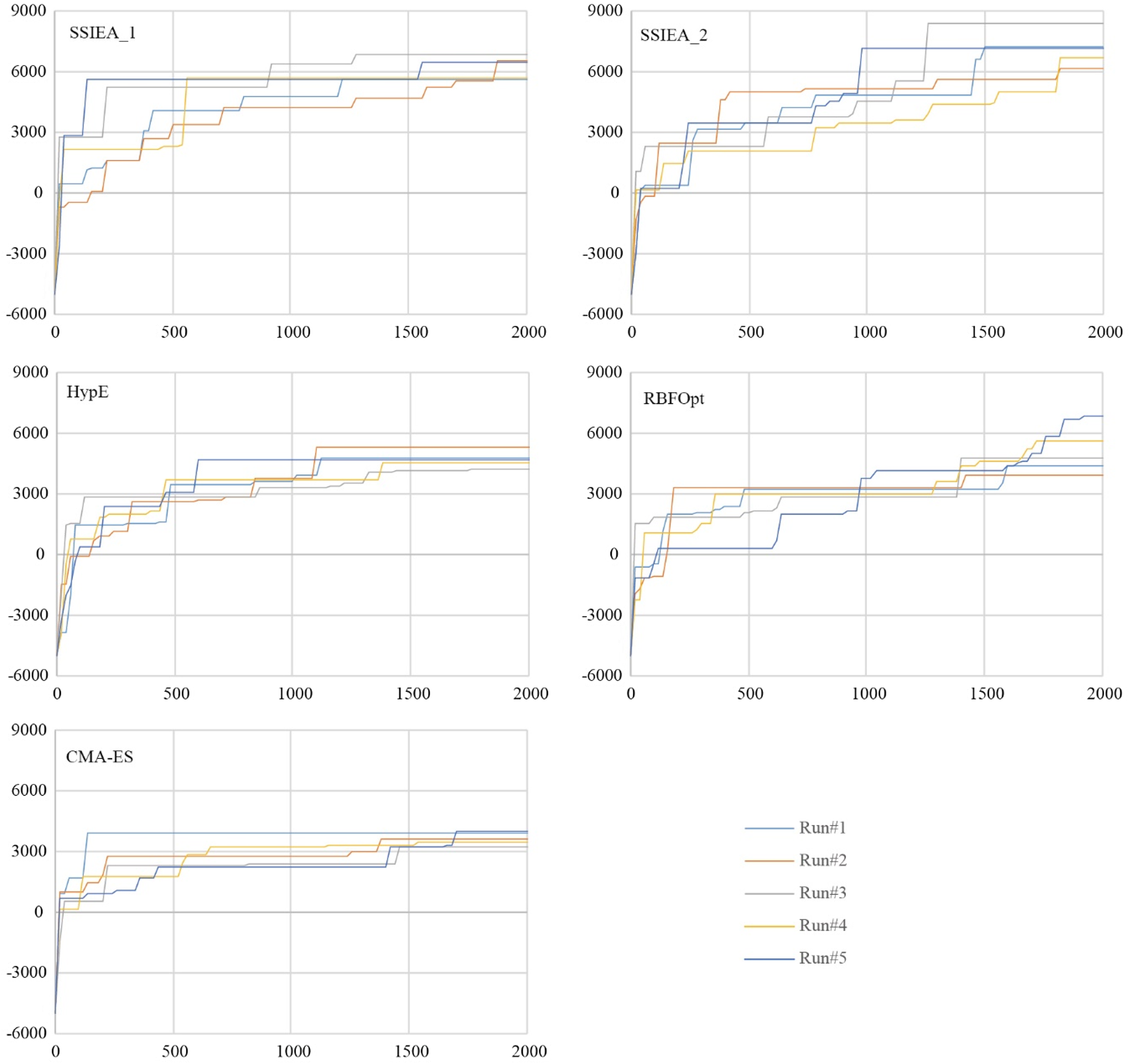
In terms of the second aspect, CMA-ES and HypE are the most consistent. For all five runs, the fitness progress is quite similar (Fig. 10). For these two algorithms, the fitness deviation of the five optimization runs across 2000 iterations is, in general, lower than most of the other algorithms. This result can be further corroborated by Fig. 11, which shows that all FPTs for these two algorithms achieve roughly equivalent fitness progress at the same iteration number. In contrast, marked fitness leaps can occur during the optimization process based on SSIEA_1 and SSIEA_2 (Fig. 11). Nonetheless, as shown in Figure 10, the fitness deviation trendlines of SSIEA_1 start falling after 600 iterations, and the trendlines of SSIEA_2 only show high variation from 1000 to 1800 iterations. These may suggest that SSIEA_1 and SSIEA_2 can achieve better robustness if the optimization process can be prolonged, whereas if the optimization process is too short, the optimization result can be prejudiced due to stochastic variation.
Trendlines of the standard deviation of fitness obtained by the five optimization runs. (The trendline is drawn based on the FPTs in Fig. 11).

FPTs obtained by different algorithms.

Case study 2
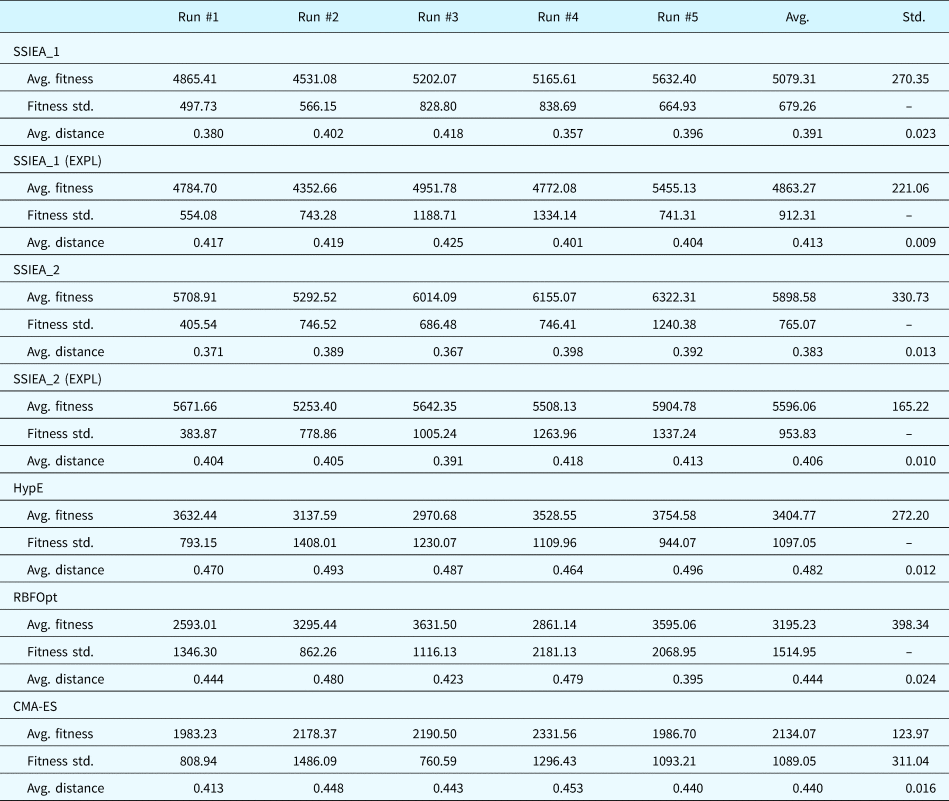
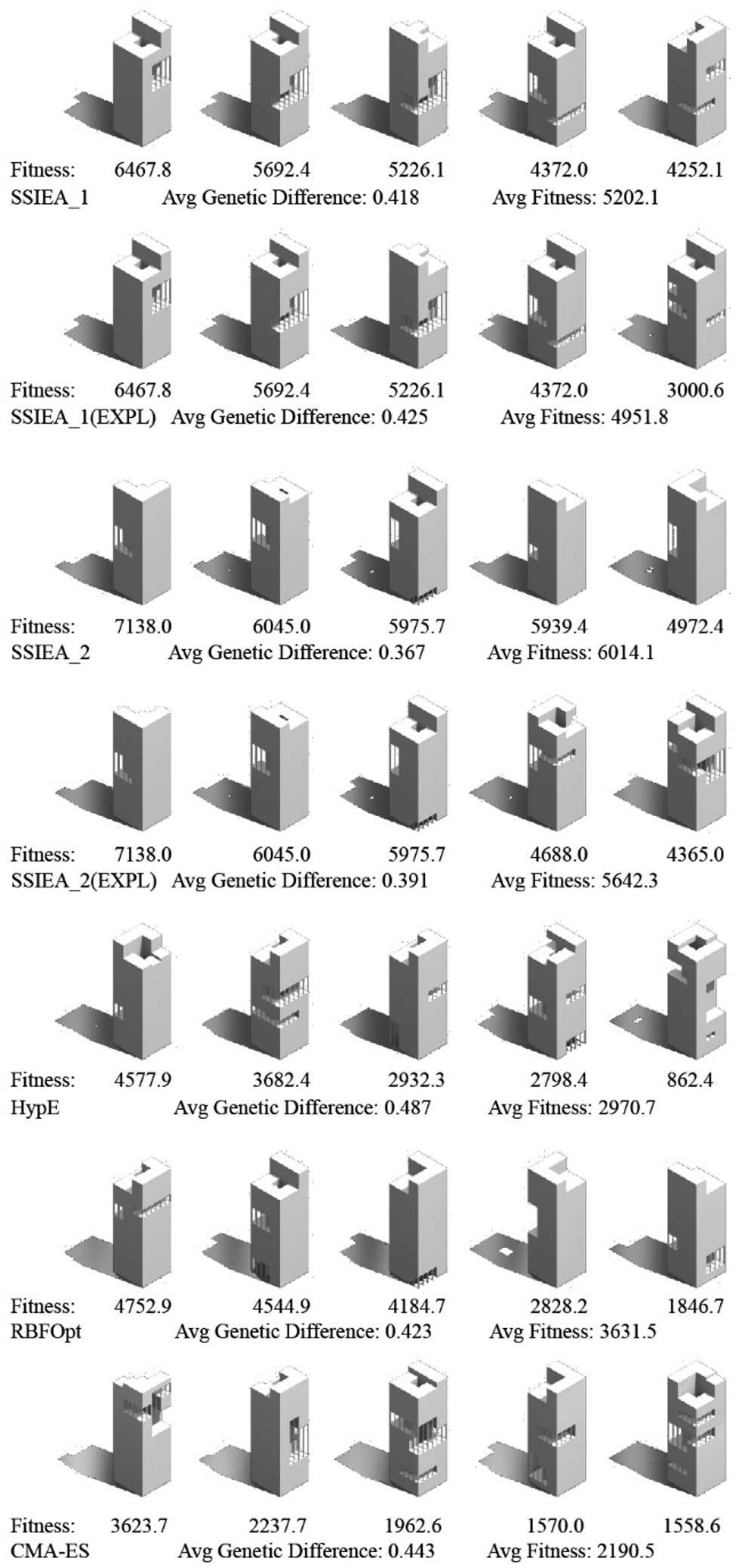
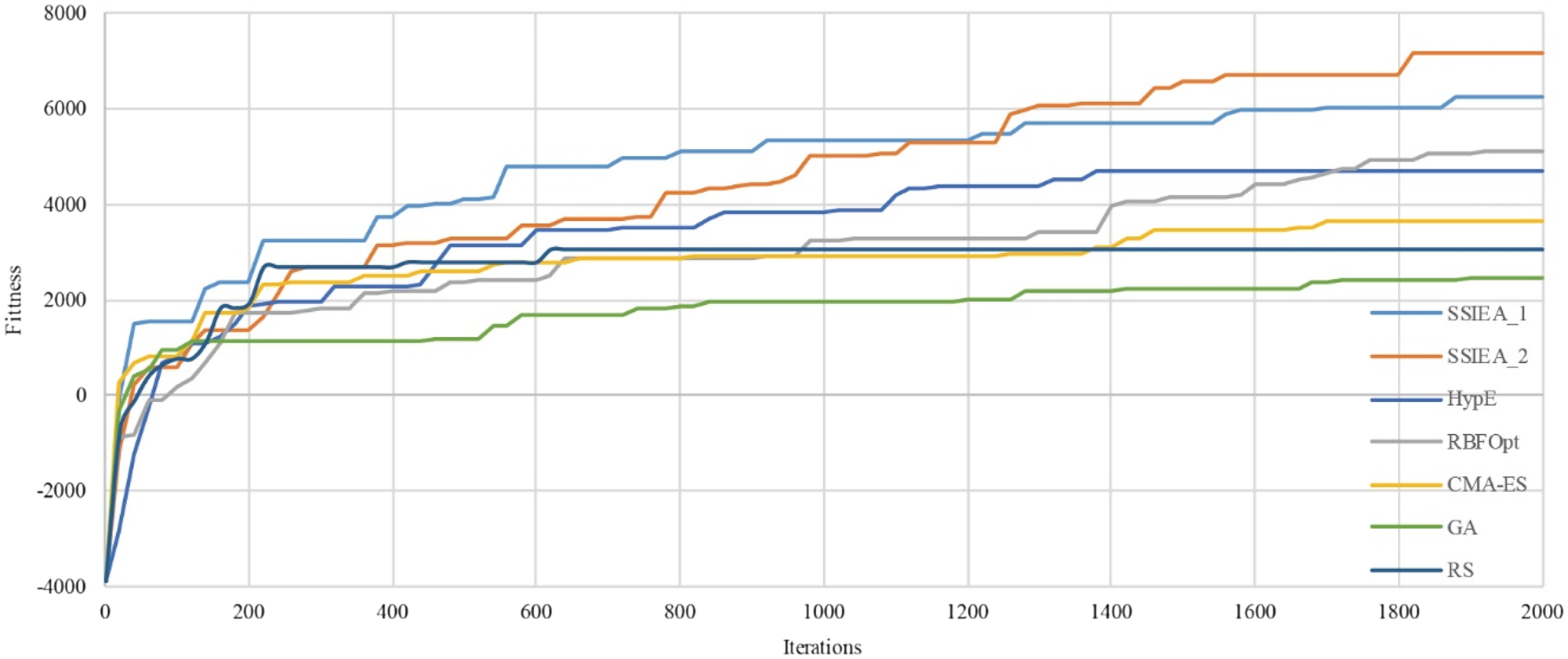
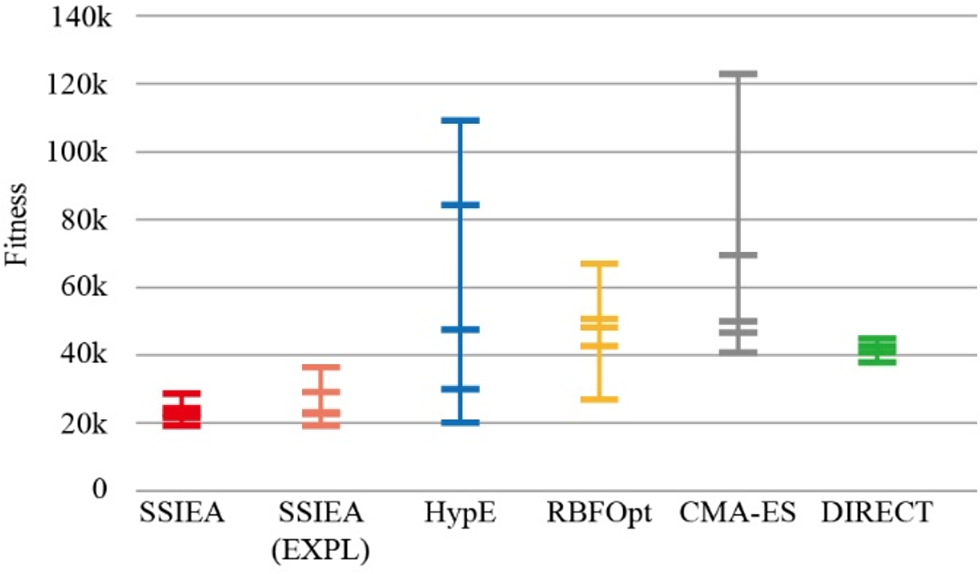
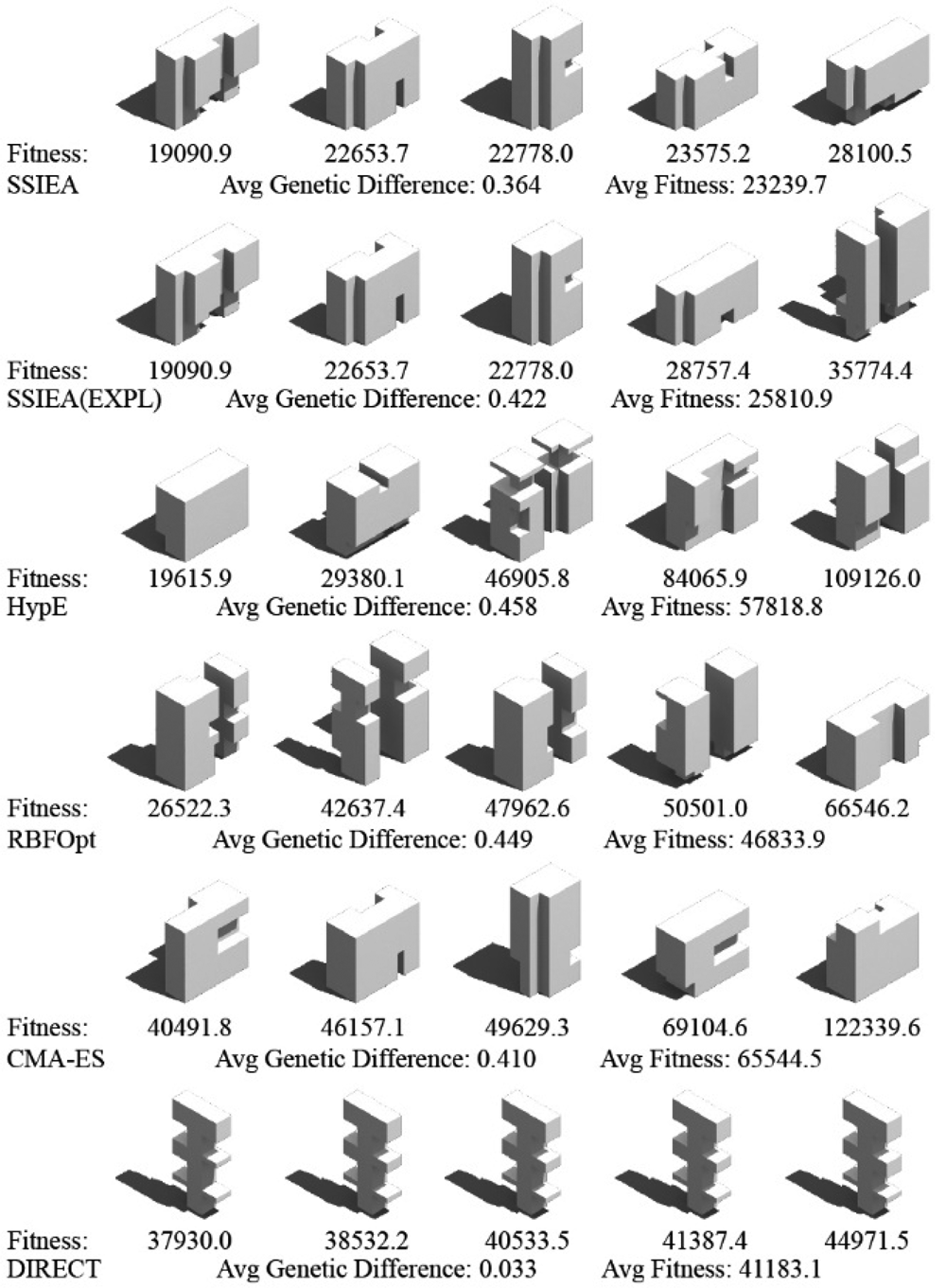
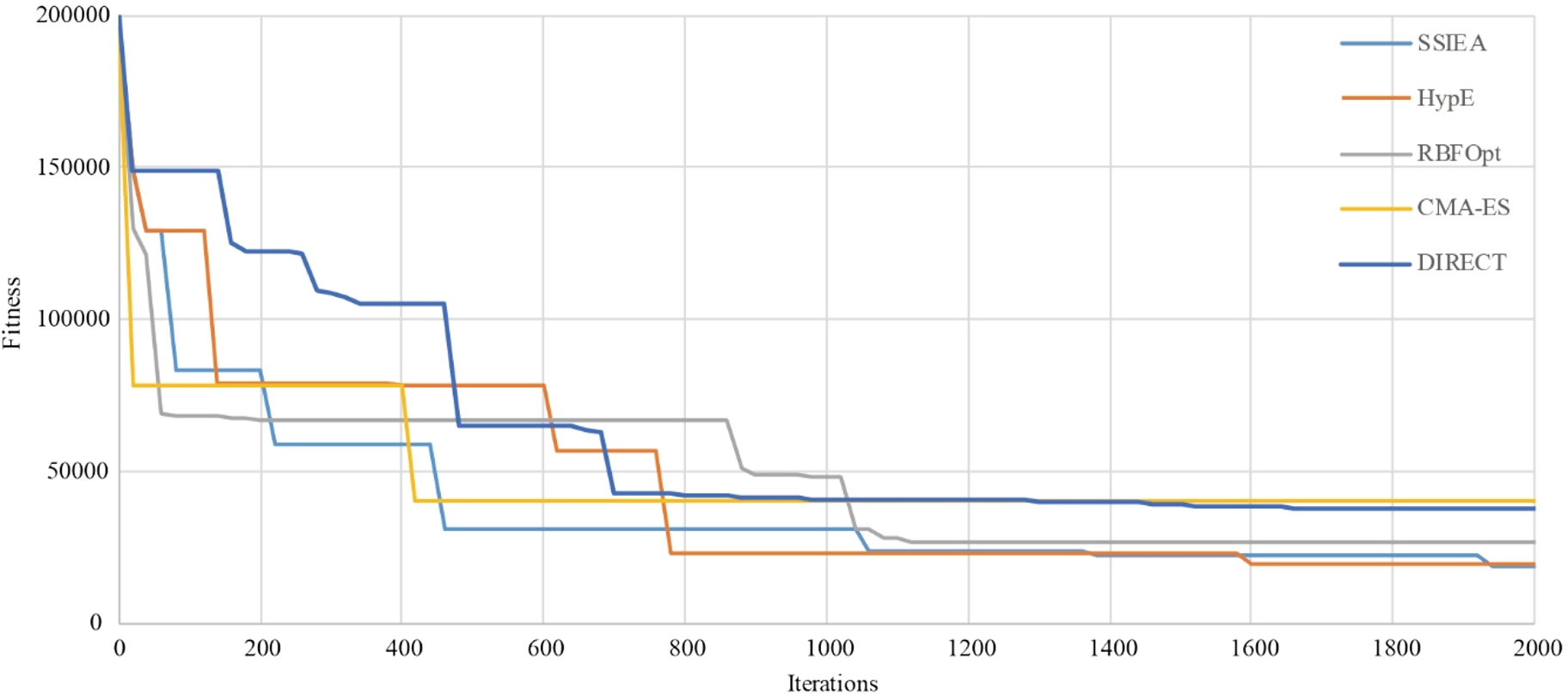
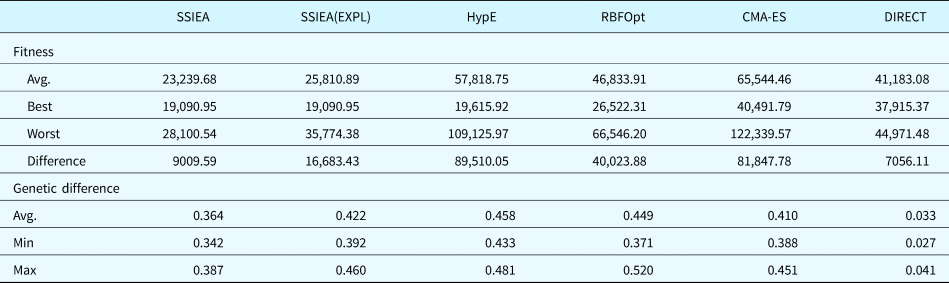
For the second case study, the optimization goal is to minimize the annual LE consumed by the building, while the building is required to have a minimum gross area difference to the target value. In this case study, each algorithm is only run one time. The results are, therefore, more prone to stochastic deviation. Table 5 and Figure 12 summarize the results for the design diversity and fitness ranges of the selected elite design variants for each algorithm (including DIRECT). Figure 13 shows the design variants in the elite set obtained by the five algorithms. Figure 14 shows the FPTs for each algorithm.
The box-plotting of the fitness range of the elite set from each optimization process.

The design variant in the elite set found by different algorithms.

FPTs obtained by different algorithms (The drawing of FPTs are based on the best solutions found over time).

The statistical analysis of design diversity in the optimization result

Design diversity
For genetic diversity, the result in this case study is similar to that of the first case study (Table 5). On the one hand, the genetic diversity of the SSIEA elite set is generally lower than most other algorithms. Using implicit clustering, SSIEA only manages to outperform DIRECT. When using explicit clustering, SSIEA outperforms both DIRECT and CMA-ES. On the other hand, SSIEA obtains an elite set (using either implicit or explicit clustering) with the markedly better average fitness compared with the elite sets obtained by the other algorithms. In addition, Figure 12 also shows that the SSIEA elite sets contain design variants that tend to have similar competitive fitness. In contrast, the elite set obtained by the other algorithms often contains certain undesirable design variants with relatively low-fitness.
Figure 13 shows the design variants in the elite sets obtained by the five algorithms. The first row in Figure 13 shows the elite set produced by SSIEA using the implicit clustering approach. In this set, the design variants all have distinct architectural features. The second rows in Figure 13 show the elite set produced using explicit clustering. This clustering approach has improved design diversity to some extent.
The third to the fifth rows in Figure 13 show the elite sets for HypE, RBFOpt, and CMA-ES, respectively. The design differentiation among these design variants is higher than that in the SSIEA elite set. However, it should also be noted that the SSIEA elite set with explicit clustering provides three major alternative solutions – single or two high-rise towers or one slab-type building. In contrast, the elite sets produced by HypE, RBFOpt, and CMA-ES typically include only two of the three solutions found in the SSIEA elite set.
The last row in Figure 13 shows the elite set for DIRECT. This elite set displays the least diversity. The division and subdivision of the design space into multidimensional hyper-rectangles produces chaotic design variants, as many parameters have identical values.
In this case study, HypE and RBFOpt also show good performance. Both HypE and RBFOpt elite sets contain high-fitness solutions and have higher genetic diversity than that of the SSIEA elite set. However, the design variants in the elite sets differ significantly in fitness, which suggests that not all the design variants in the elite set have competitive fitness. In comparison, SSIEA obtains an elite set where all design variants have competitive fitness while also maintaining the design diversity at an acceptable level. At the same time, the subjective analysis of the phenotypes suggests that the elite set obtained by SSIEA allows architects to extract a more balanced understanding of possible design strategies as compared with the other four algorithms.
Search efficiency
In terms of search efficiency, Figure 14 shows the FPTs of the optimization process obtained by each algorithm. RBFOpt and CMA-ES discover good solutions at the beginning of the optimization process. However, for CMA-ES, achieving further progress after 500 iterations seems difficult. In contrast, SSIEA and HypE, both adopting evolutionary mechanisms, show similar search behaviors in this case study. The optimization processes based on the two algorithms reach convergence at around 1000 iterations while still making some progress in the later stages. Lastly, DIRECT achieves more marked fitness improvement as compared with the first case study, but it still underperforms to most other algorithms. Overall, in the 2000-iteration optimization process, SSIEA, HypE, and RBFOpt can achieve competitive fitness progress but at a different convergent rate.
Information extraction and design process
In this case study, we further demonstrate how the application of SSIEA can facilitate information extraction for conceptual architectural design. From the design variants in the SSIEA elite set (Fig. 13), we can find different passive energy-saving strategies and combinations of these strategies appearing among these elite building massing design variants. For example, stilts, tower-type buildings, and jagged floor plans. The diversity among the elite design variants reveals how to achieve competitive daylighting performance using different design strategies in the design setting. For example, one strategy for improving daylighting seems to be the raising of the building massing. Detailed analysis of the architectural implication of these strategies can be found in Wang et al. (Reference Wang, Janssen, Chen, Tong and Ji2019b).
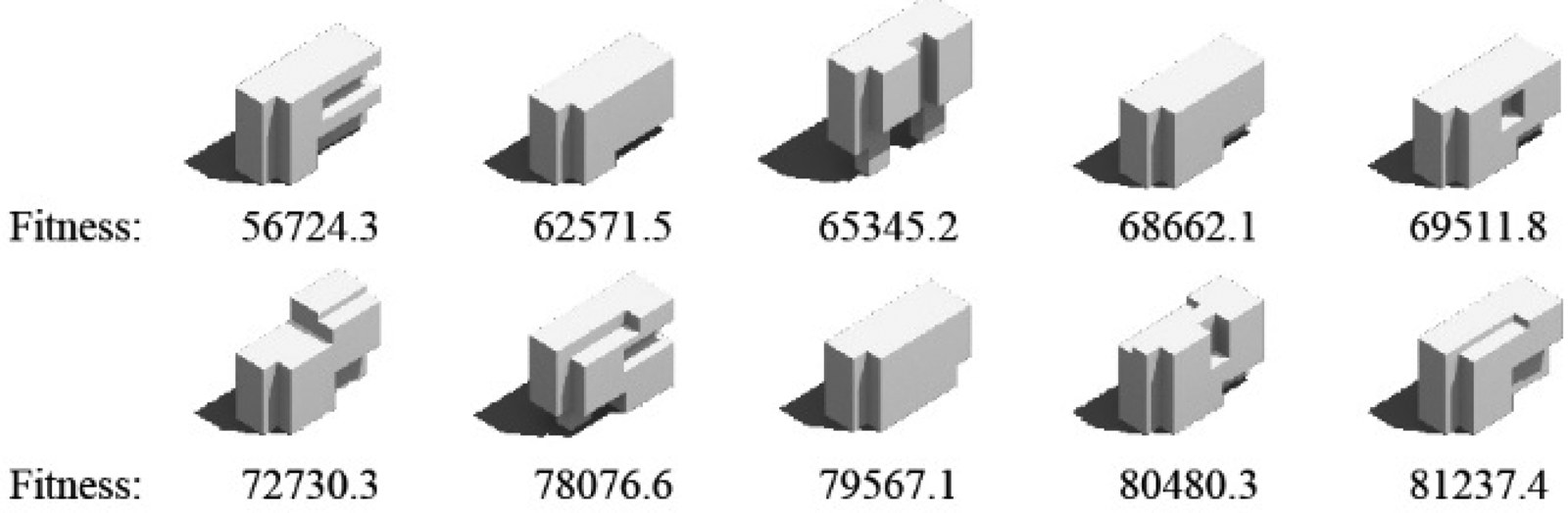
Beyond the diversity of the design variants directly provided in the optimization result, another advantage of using SSIEA is that it helps to cluster the optimization result during the optimization process. With the clustering of the design population, the optimization result allows architects to explore other similar design variants in the same subpopulation with ease. As an example, we may assume that the architect might consider selecting the slab-type building massing incorporating stilts, as shown in the first and fifth design variants in Figure 13, for further design development. Figure 15 illustrates several high-ranking design variants remaining in the same subpopulations containing the two elite design variants. Due to the genetic homogeneity, these design variants share a similar but not identical topological configuration to the two elite design variants, which remains a slab-type building massing incorporating stilts. These design variants provide a broader range of design alternatives and facilitate the uncovering of more in-depth tradeoffs between the position and size of the subtracted void and its impact on daylighting performance under this specific type of building massing design. This information can better support the architects’ decision-making process.
High-ranking design variants remaining in the subpopulation.

Discussion
In the two case studies, we compare the performance of SSIEA against RBFOpt, HypE, CMA-ES, and DIRECT. The comparison focuses on two aspects: design diversity and search efficiency. In certain cases, the other algorithms were able to outperform SSIEA in either design diversity or search efficiency. However, the strength of SSIEA was its ability to perform reasonably well in both design diversity and search efficiency at the same time. SSIEA can achieve acceptable diversity in the optimization results while being able to discover high-fitness individuals with good search efficiency when there is a reasonable amount of search budget. Last, considering all five algorithms, we find that evolutionary-based algorithms (SSIEA, CMA-ES, and HypE) generally tend to be more explorative than non-evolutionary ones (RBFOpt and DIRECT). In contrast, it is also noted that certain non-EAs, such as RBFOpt, are capable of discovering good solutions faster than evolutionary-based algorithms.
In the second case study, we also demonstrate how SSIEA can support conceptual design. The diversity in the elite design variants helps architects discover the architectural implications related to daylighting performance in a challenging design setting. Furthermore, the use of SSIEA not only provides several competitive design alternatives for architects to choose from but it also clusters the design variants during the optimization process. Thus, it facilitates the architect to readily continue exploring other homogeneous design variants remaining in the design subpopulations. In contrast, using other algorithms typically requires an additional working step to achieve such exploration.
The design problem of the second case study also helps to amplify the strength of using SSIEA. With a parametric model capable of generating higher topological variability, the optimization result also shows higher design diversity at the phenotypic level compared with that of the first case study. It indicates that SSIEA is of greater utility if the design space defined by the parametric model encompasses a broader range of design variants with significant design differentiation. In other words, to exploit the potential of performance-based optimization in early stage design exploration, both optimization algorithms and parametric models play an indispensable role.
Based on the result of this study, we can also compare the search behaviors of the different optimization algorithms. SSIEA focuses on discovering a small number of design solutions with competitive fitness while ensuring that these design solutions have sufficient design diversity for information extraction. This tendency differs from the Pareto-based optimization approach, such as HypE, which can produce a very large number of Pareto-optimal design variants. Although this can result in a more comprehensive range of possibilities, it can also be overwhelming for the architect. Moreover, many of the design variants may not be able to satisfy the optimization objective. In contrast, SSIEA can be used to retrieve the most relevant information, in the form of a selected set of high-fitness solutions, while filtering out other less relevant solutions with inferior fitness. It facilitates architects to understand the essence of the design problem quickly without having to analyze large numbers of design solutions, as is common with the Pareto-based optimization approach (Yousif and Yan, Reference Yousif and Yan2018).
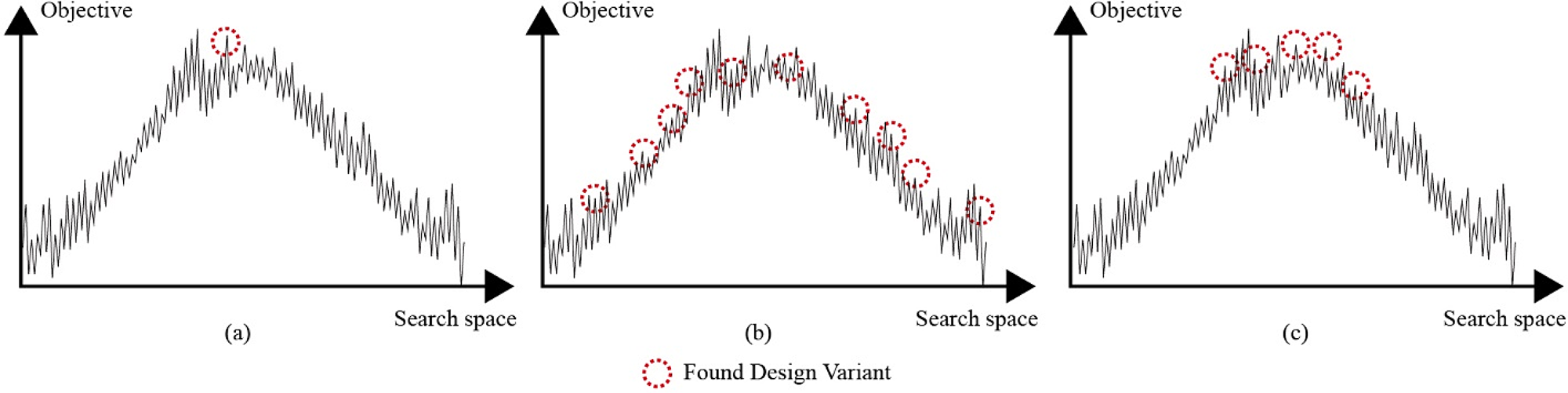
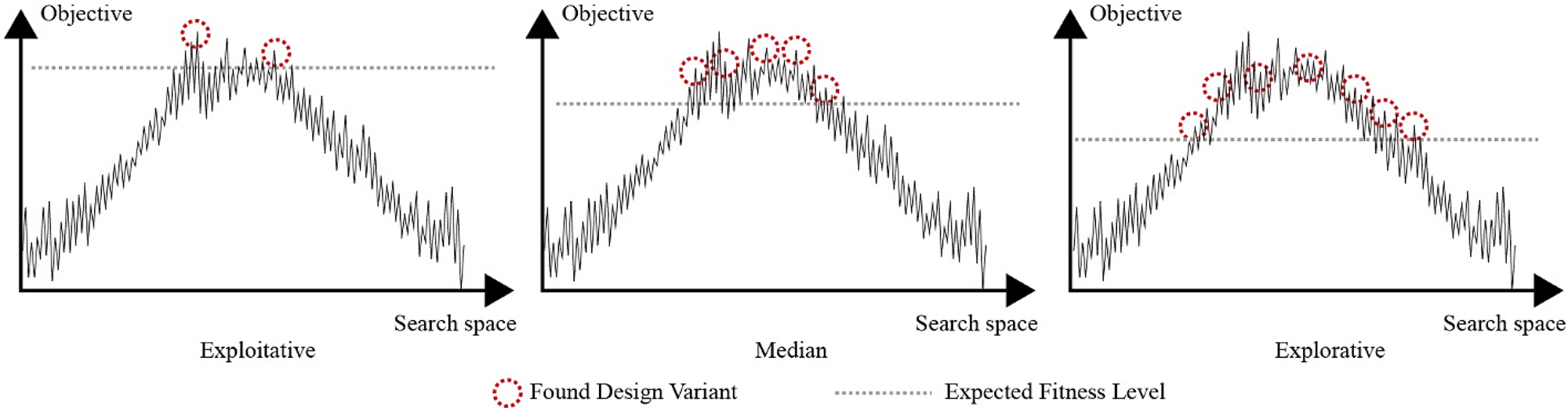
Figure 16 summarizes the underlying concepts of different types of optimization algorithms considered in the research. First, standard optimization algorithms, such as GA and DIRECT, tend to focus on searching for a near-optimal within single design subspace. As a result, these algorithms typically compromise on design diversity to differing extents (Fig. 16a). Moreover, simple algorithms, such as GAs, may actually perform quite poorly when it comes to discovering near-optimal solutions (Wang et al., Reference Wang, Janssen and Ji2019a). In contrast, the second type of optimization algorithms, such as the Pareto-based optimization (HypE), model-based algorithms (RBFOpt), and distribution-based algorithms (CMA-ES), tend to explore many design subspaces during the optimization process. This tendency can reduce search efficiency, and as a result, many feasible local-optimal or near-optimal solutions may not be found (Fig. 16b).
Diagrammatic comparison of the search behaviors of different optimization algorithms.

Lastly, SSIEA focuses on several non-neighboring design subspaces while managing to find a set of legitimate and high-fitness solutions within these design subspaces, which are helpful for accurately characterizing and representing these design subspaces (Fig. 16c). Although the design diversity for SSIEA is lower than the other algorithms, the average fitness is higher. SSIEA is capable of providing essential information about the design problem.
Future research
The results of the research raise three potential avenues for further investigation. First, the application of the island model may provide an intuitive method for controlling the tradeoff between exploitation and exploration. Architects can easily and directly control this tradeoff by setting the total number of subpopulations to be maintained by the algorithm. The impact of such a change is also more easily understood than other approaches, such as modifying selection pressure or step sizes.
Figure 17 illustrates the hypothesis of the tradeoff between the number of subpopulations and the search efficiency of the optimization. An increase in the number of subpopulations is likely to result in higher design diversity. In contrast, a decrease results in the discovery of higher-fitness solutions from within each design subspace as more search budget can be assigned to each subpopulation. However, the search behaviors of SSIEA under different subpopulation numbers and subpopulation sizes need further investigation.
Diagrammatic comparison of the relationship between numbers of subpopulations and the expectation of the quality of the result.

Second, the difference in the search performance and behavior between SSIEA_1 and SSIEA_2 highlights that different mutation rates may have various advantages and disadvantages to the optimization process. In this regard, adaptive mutation rate control schemes (Thierens, Reference Thierens2002) can potentially synergize the conflicting advantages of high and low mutation rates by varying the mutation rate as evolution progresses.
The last question is to identify the range of design problems for which SSIEA is suitable. The research has demonstrated the success of SSIEA on the two case-study design problems. Based on the No-free-lunch theorem (Wolpert and Macready, Reference Wolpert and Macready1997), it is clear that search algorithms only tend to perform well on certain classes of problems. For SSIEA, this class of problem is likely to focus on those that have a large design space with many promising subspaces, while the search budget should be assumed to be limited. However, further research is required to describe this class of problems more precisely.
Conclusion
To conclude, the research proposes an implementation of a new optimization algorithm – SSIEA – which is aimed at enhancing design diversity, while minimizing any degradation in search efficiency. The development of SSIEA focuses on conceptual architectural design, where the role of computational optimization is not merely a design problem solver but rather a means of design exploration. The conducted case-study experiments systematically investigate the efficacy of SSIEA by comparing against other optimization algorithms. The results of the two case studies demonstrate that SSIEA can achieve a good compromise between design diversity and search efficiency. Furthermore, the implicit clustering of the design population also helps architects explore the design space with ease. These features make SSIEA an ideal algorithm for architects using evolutionary optimization in design space exploration, which will, in turn, lead to richer design reflection and ideations. As such, the application of SSIEA allows the performance feedback to become a catalyst for the ongoing synthesis process in conceptual architectural design.
Abbreviations
- EA
Evolutionary algorithm
- SSIEA
Steady-stage island evolutionary algorithm
- LHS
Latin hypercube sampling
- GA
Genetic algorithm
- RS
Random search
- RBFOpt
Radial basis function optimization
- HypE
Hypervolume-based multi-objective EA
- CMA-ES
Covariance matrix adaption evolution strategy
- DIRECT
DIviding RECTangles algorithm
- DIVA
A radiance-based daylight simulation tool in Rhino-Grasshopper environment
- FPT
Fitness progress trendline
- Avg.
Average
- Std.
Standard deviation
Acknowledgements
The authors would like to thank the Editors in Chief of the journal and three anonymous reviewers of the paper for the execllent revision process carried out, which helped greatly to improve the quality of this paper.
Funding
This research is partly supported by the National Natural Science Foundation of China (51378248) and the China Scholarship Council (201706190203).
Likai Wang is a Ph.D. candidate in the School of Architecture and Urban Planning, Nanjing University. His current doctoral research deals with a generation and optimization system for performance-based building massing design. His research interests include computational design optimization, design exploration, and parametric design.
Patrick Janssen is an Associate Professor at the Department of Architecture at the National University of Singapore and is the Director of the Design Automation Laboratory. He is also Adjunct Associate Professor in Automation in Urban Planning and Design at the 3D GeoInformation research group at the Department of Urbanism, Faculty of Architecture and the Built Environment, TU Delft. He received his Ph.D. from Hong Kong Polytechnic University. He conducts research into computational methods and tools for design exploration and optimization at the urban scale.
Guohua Ji is dean and professor of School of Architecture and Urban Planning at Nanjing University. He received his Ph.D. from ETH-Zurich. He mainly engages in architectural design and methodology, with particular focus on computer-aided architectural design and digital architecture. He is a member of National Steering Committee of Architectural Education in China, an executive director of Academic Committee of Computational Design of Architectural Society of China (ASC) and a member of Digital Construction Academic Committee of ASC.