Many clients meet sand diviner Namagan Kante for the first time when they arrive for a consultation. Namagan makes them feel at home and analyses their problems. This requires not only a specialized knowledge of divination, but also skill in accommodating clients and creating the impression that he understands their problems. These skills are crucial to any expert, and in this essay I analyse them within a performative framework largely established by Namagan himself. My focus, therefore, is on the skills involved in impression management, as well as on the expert's insights into the possibilities and restrictions set out by the frame. Recognition of another person's knowledge is often based on trust, and the one who is able to configure the frame is in control of the process.Footnote 1 I will argue that Namagan establishes his frame to a large extent through activities that are not directly related to sand divination. These activities help Namagan to ‘guide and control the impression people make of him’ (Goffman Reference Goffman1990: 9).
The protagonist of my story lives in the small village of Farabako in Mali's isolated Sobara region, south-west of Bamako near the border with Guinea. The village of Farabako is a place long renowned for its resident Kante family of somaw (plural), healthcare and divination experts. The one hundred or so Kante family members live in one large compound (but have separate households). Over the past five years the older generation of somaw have died out. It seems that Namagan is their only successor. Though relatively young (born in 1964), he is now the most esteemed sand diviner of Farabako and his fame exceeds regional limits.
The broader historical setting of Namagan's activities is the ‘occult economy’: in other words, the real or imagined deployment of magical means for material ends (Comaroff and Comaroff 1999). The origins of the ‘occult economy’ in Mali and beyond lay in the 1980s when the International Monetary Fund introduced Structural Adjustment Programmes (SAPs). States met IMF demands in order to narrow the ‘gaps’ in national budgets by cutting healthcare spending, and this had catastrophic consequences. Decreases in the healthcare budgets have resulted in dramatic price rises in biomedical healthcare services, and – as an effect – a growing search for solutions in alternative forms of healthcare.
Interestingly, the recent turn toward alternative forms of medicine and healthcare knowledge has become associated with images of modernity, and people spend more money than ever before on a wide spectrum of healthcare services (cf., for Mali, Schulz 2005).2
Health (kènèya) is defined more broadly than good physical condition, and throughout sub-Saharan Africa images of ‘tradition’ have been re-imagined in order to provide people with solutions for living a healthy, modern lifestyle. Sorcery, for instance – a phenomenon that is often considered to have disappeared with the introduction of ‘modernization’ (new technologies, large-scale production, rationalization, monetization) – is in fact now a prerequisite for successful participation in the modern market economy.
This ‘occult economy’ constitutes the historical background in which Namagan frames his activities as a divination expert. In order to describe this frame, I employ three dimensions: namely space, economy and network. By analysing these as regions – a concept I borrow from Goffman – I aim to demonstrate the logic that resides in the performances of divination experts, their ‘entourage’, and their clients. I describe these three critical dimensions in the form of answers to my question: ‘Where is Namagan?’ Data was collected during a six-month stay in Farabako in 1999 followed by shorter annual visits.
‘WHERE IS NAMAGAN?’ – ON DRAMATURGICAL DISCIPLINE
‘Namagan bè mi?’ (‘Where is Namagan?’) is the question most frequently posed in Farabako by men and women, old and young, visitors and local inhabitants alike. Everyone seems to be in perpetual search for Namagan. His renown is not limited to the Sobara region of his origin, but extends well beyond this place. While staying in Farabako, I met people from Sikasso and Conakry who had travelled far specially to see Namagan. Most of the year, however, he is away from home visiting other villages, and when he is in Farabako he is rarely to be found in his compound. Thus, all the time one hears ‘Namagan bè mi?’ In my estimation, this searching and waiting for Namagan constitutes a crucial component of his performance.
Those who work with Namagan – his entourage or team – play well-defined roles at this preliminary stage in facilitating Namagan's performance. Goffman (1990: 210) refers to this principle as ‘dramaturgical discipline’, on which he comments as follows: ‘It is crucial for the maintenance of the team's performance that each member of the team possess dramaturgical discipline and exercise it in presenting his own part.’ This dramaturgical discipline is a prerequisite for Namagan's successful performance in each of the regions I describe.
Information about the space, economy and network in which Namagan performs is supplied by his oral accounts of his life. I have constructed his ‘life story’ on the basis of numerous comments, remarks and observations. I don't present it as ‘true’, but, in keeping with my argument, as a consistent impression that Namagan wished to make on me.
When I was young, I sat next to the old men and watched how they practised sand divination. Some people criticized me saying that the old men's practices are bad and would soon disappear because of Islam and the medical practices of the White people. My age mates made fun of me because I often refused to join them in having a good time. Any moment of spare time that I had I spent with the old divination experts. That is how I learned it. When I reached the age of twelve, my eyes became sick. Every time I went to the millet fields, they became red and painful. The reason I regularly wear sunglasses is because of my painful eyes. Thus, I decided to stop working on the land and subsequently took responsibility for the cattle of Farabako. I herded them. In the dry season I wandered with them through the bush. And during the wet season [the period during which food for cattle is abundant and they stay in and around the village], when diseases pose a serious menace to the health of the animals, I also took care of them. I stayed with the cattle every day and didn't go to the fields with my age mates. And so [see analysis] during the wet season I learned my fathers’ practices to protect both men and cattle from diseases and other evil things.
Only recently did people start to re-appreciate sand divination as good and meaningful practice. Young men, both literate and illiterate, visit Farabako and stay here for a long period to learn divination from us. Some come from far away since there are few divination experts of my age around. But nowadays the youth want to learn it! I treat my apprentices the way I was treated and I teach them the way I was taught. I don't charge them anything for their stay in the way that my parents never charged a visitor. They are permitted to attend the divination sessions, and the smarter apprentices are allowed to draw the divination schemes. They listen to my interpretation of the divination schemes and then I send them into the bush (kongo) to fetch the leaves and bark necessary for the production of medicines and for the sacrifices to the sand. An apprentice expresses his respect towards me by working. For instance, he will fetch a bundle of wood from the forest or work in my fields. Thus, I am remunerated by labour rather than financial payment. It is not through discussion (baroo) that an apprentice learns sand divination, but by following and serving his teacher.
Many of the medicines we prepare are unknown to you because White people don't know our diseases and they are not vulnerable to many of them. For instance, we are capable of handling a koroté, a magical poison that is thrown at someone from a distance. A koroté will cause swelling to a part of the victim's body and antibiotics (furakisè, literally ‘pills’) are incapable of curing it. We have medicines to protect someone against this disease, and yes, even to cure the victim of a koroté. And we have many medicines that protect people from djinns in the bush. We also have great knowledge about virility (cèya) and possess medicines to cure fertility problems.
In the rainy season I spend most of my time in the village. Nowadays, the families of Farabako have many more cattle than they did a few decades ago. Every day I visit the cows and check their health. In the dry season I travel a lot, driving more than eighty kilometres a day on my motorcycle. I am constantly on the move. People throughout the region need my advice – my affairs are many and manifold (n ka ko ka ca). I go to Bamako, to Siguiri (Guinea), and even to Conakry.
When guests come to the village, they spend the night in my compound. ‘Namagan loves visitors’ (Namagan bè lolanw fè). Everybody knows that [cf. discussion below on experts and visitors]. When I am not at home, my family always takes care of any visitor. That is the reason why my wife Nasira requested that I marry a second. Raising the children and cooking for so many guests had become too much work. Now, after marrying Ntènè last year, things are easier for her.
I don't spend all my time performing divination and consultations. Selling cattle and grain to Bamako merchants is also my responsibility; and I buy goods that the villagers need. Some of these, like fuel, sugar, tea, and batteries, I sell to the villagers in small quantities. Other things are merely donated to people who need them. I am not the compound chief (lutigi); that function is held by an old man. They nevertheless call me the lunyèmògò [‘compound manager’]. That is why I am also responsible for the orphans and widows of this compound. I have to feed and clothe them, and I have to find brides for the male orphans. Because I have a good motorcycle, I am capable of managing all my affairs. We also use my motorcycle as an ambulance or to fetch a doctor from Sandama [20 kilometres from Farabako] when someone is very ill or if a woman is having troubles delivering a child.
The above is an example of the way Namagan spoke about himself to me. However, there was also much to learn from what he did in combination with what he said. I will now reply to the question ‘Where is Namagan?’ by describing the three regions in which he practised his expertise. These accurately display Namagan's skills in framing his performance as an expert.
‘WHERE IS NAMAGAN?’: A GEOGRAPHIC ANSWER
In the wet season, a stereotypical Maninka (Malinké) agriculturist is meant to stay in the buguda (the hamlet close to his fields). During this period only the old men and women stay in the village, accompanied by children and some younger women who run the households. In the dry season a Maninka will live as much as possible in his village, and only a bad harvest will compel him to leave the village in order to seek ‘adventure’.
Namagan's activities are almost the reverse. During the wet season he remains close to the village because he has to take care of the cows and more especially because the roads are too bad for driving long distances. During the dry season he is rarely to be found in the village since he is touring throughout the area. Namagan is one of the few persons in Farabako with a good motorcycle,Footnote 3 and this machine was the material prerequisite for his ‘deviant’ lifestyle.
In this respect it is necessary to say something about travelling in this part of Africa. Movement and change are considered to produce heat and therefore to be dangerous; they should be avoided. I was both admired and criticized for travelling from Farabako to Bamako (125 kilometres) in a single day by bicycle. The admiration was due to my physical stamina, and the critique was levelled against my perceived rudeness in passing villages without stopping and extensively greeting people. It always took Namagan two days to make the same journey on his motorbike! Thus, driving eighty kilometres a day is a full-time job for Namagan since he must satisfy the cultural demand of greeting his ‘host’ (jatigi) in each village. (He sometimes avoided or resolved this problem by travelling at night. But this is dangerous. In May 2007 Namagan barely survived a nocturnal accident on his motorbike.) Therefore Namagan's travels imply a reinforcement of his large and widely spread network. He is more often to be found in other locations than in his own Sobara region.
‘WHERE IS NAMAGAN?’: AN ECONOMIC ANSWER
Historically the Maninka people are proud of their agricultural livelihood. A Maninka who refuses to work in the fields is both anomalous and extraordinary. Namagan is such a person. Namagan compensates for this, however, by his dedication to cattle herding. Monoculture has proven to be unprofitable despite intensive government support in the decades following independence, so the Maninka have intensified their reliance on cattle. Cattle are not considered to be a resource for investment or for making money. In Sobara, discussing the commercial use of cattle is a tricky subject because people prefer to use them for establishing social relations (they are used for dowries or gifts during communal labour prestations). It is only in conditions of serious financial hardship, and with great reluctance, that a cow is sometimes sold.
The introduction of more intensive forms of cattle exploitation in the Sobara region coincided with the arrival of the nomadic cattle-herding Fulbe to the area. In the early 1950s colonial administrators recorded that 99 per cent of the population in Sobara was Maninka (Jansen and Diarra 2006: 22), but a contemporary tour through the region readily shows that the number of Fulbe has greatly increased during the past fifty years. By herding the cattle of Farabako, Namagan became engaged in an activity that brought him into contact with Fulbe, and as a result many of his clients who come for sand divination consultations are of that ethnic group.4
Among Farabako's inhabitants, Namagan is by far the person most involved in monetary transactions. It is remarkable, however, that he refuses to employ an idiom of commerce. The people in the Sobara region seem to be suspicious of relating both cows and agricultural labour to money. Instead they tend to use a discourse grounded in gift exchange and respect for almost any transaction that takes place. For instance, a truck once delivered 500 litres of red wine to Namagan. As we watched the twenty-litre jerry cans being carried into his compound, Namagan remarked to me that ‘a friend had given this to him’.Footnote 5 I am convinced that Namagan bought the wine in Bamako, but he could not say this because it would suggest that he had the money and the liberty to buy what he wanted, and this was not considered to be a desirable image.
From a financial perspective, the sale of this wine is as problematic as its purchase. Consumers sometimes refuse to pay, but they nevertheless hang around his compound for hours waiting for the free drink that Namagan is morally bound to offer out of ‘respect’, ‘kinship’, and other social obligations. Yet there must be some profit in this ‘commerce’ (though perhaps indirectly), since Namagan persists in the activity.
Because Namagan is centrally positioned within a huge regional network, and most of the goods that arrive in Farabako can only be purchased with money (since imported products are commodities with standardized prices), he must have skills to ‘de-commodify’ goods with an explicit market value. Hence, from an economic point of view, Namagan is in a different, and economically more complex and differentiated, region than the rest of Farabako.
‘WHERE IS NAMAGAN?’: A SOCIO-CULTURAL ANSWER
Namagan's skilled ability in ‘de-commodifying’ market goods, transforming them into gifts, and relocating them within social structures, brings me to the cultural answer to the question ‘Where is Namagan?’ Namagan always explained his own behaviour to me in terms of his being a traditional Maninka. When I asked him about various things, the answer was often ‘an ka sariya’ (‘our tradition’). It is significant, however, that Namagan used the word sariya, for this is a neologismFootnote 6 (from Arabic) replacing the other local term for ‘traditional’ (laadaa, also from Arabic).
Indeed Namagan is a ‘traditional’ Maninka in the sense that he exerts much effort in caring for the members of his household. But the configuration of this household is an anomaly in comparison to what the Maninka usually consider to be denbaya (‘family’). Namagan is the youngest of four brothers (same father, same mother), but he is the head of a separate household (gwa) despite the fact that ‘blood-brothers’ traditionally cultivate fields and manage a household together. Namagan's household consists of his own wives and children, as well as several widows of his father's brothers and their children, and orphaned children who are only distantly related to him. Widows and orphans are traditionally looked after by ‘close’ relatives, but even here in the Sobara region these people tend to be the victims of the combined forces of individualization and increasing segmentation within households and the subdivision of fields. These processes are taking place throughout Mali, and beyond. It is remarkable that a person like Namagan, who is economically innovative, follows the trend of individualization by refusing to collaborate with his brothers, but on the other hand upholds ‘tradition’ by ‘adopting’ all the widows and their children. It should be mentioned, however, that these same people worked his fields and Namagan profited from their horticultural activities.
This emphasis on ‘tradition’ is an important quality of Namagan's network in the Sobara region. I have the impression that those who consume his wine form the core of this network. Consumers of alcohol within the village may pay with money or millet. In the Sobara region, other somaw also seem to function as distributors of alcohol. When the twenty-five jerry cans of wine arrived, several were fetched that same day by somaw from neighbouring villages. Hence, on a regional level there is a significant correlation between the people with whom Namagan exchanges ideas and those with whom he ‘exchanges’ alcohol. Sharing the same practices appears to be a prerequisite for trust during economic transactions. Fellow somaw were also typically partners in the rare ‘commercial’ transactions with cows that I witnessed.
Namagan was particularly appreciated by the women of Farabako, though he never boasted about this. Namagan is important to the women not only because of his ‘commitment’ to widows, but also because of the tasks he performs for pregnant women. Since Namagan has the best motorbike in the village, and because pregnant women generally wait until they suffer from severe delivery complications (due to poverty), his motorbike is crucial for saving the lives of some women and their new babies.
Moreover, Namagan is regionally renowned as the host to any traveller who visits Farabako. Increasing poverty and monetization have seriously undermined the generosity which people in the Mande Mountains extended to visitors in the past. Nowadays, people will agree to lodge ‘family’, but not true strangers. However, all visitors (‘étrangers’, lolanw) are welcome into Namagan's compound. This also gives Namagan the aura of being someone who does things the ‘old-fashioned’ way – with the help of his ‘team’, of course.
It should be noted, however, that many present-day travellers in the Sobara region are smugglers en route from Guinea to Bamako with bicycle-loads of cigarettes, cattle merchants heading to Bamako, or truck drivers who transport people and smuggle consumer goods that enter Africa through the harbour of Conakry. Hence, the present-day traveller in the area is often someone deeply involved in the cash economy. This gives a special ‘modern’ dimension to Namagan's ‘traditional’ hospitality. Moreover, as I will explain below, Namagan depends emphatically on ‘strangers’ for successfully performing as a divination expert.
Namagan's position within the region and local culture is most clearly illustrated by his ritual duties during the 1999 circumcision of Farabako's young men. At the end of August that year, Namagan took me to Kalifabugu – the isolated buguda situated ten kilometres from Farabako where most of Farabako's population spends the wet season in order to live close to the fields they cultivate. I knew from ethnographic literature that in the Mande world a circumcision ideally takes place in the dry season (cf. Leynaud Reference Leynaud1966; Arnoldi 1995: 106–13). When I asked why the Farabako people had their circumcision in August, I was told that the schoolteachers of Sobara region had announced that they would expel children who did not attend school during the dry season.Footnote 7 Thus the circumcision was rescheduled to the holiday period which coincides with the wet months of July and August. This phenomenon has also been observed elsewhere in West Africa (de Jong 2001: 72).
This rescheduling to the wet season has had major effects on Sobara life. First, the threat of infections is much higher during the rainy season. Second, it has a huge impact on the social organization of the village. In the past, young men who were circumcised together formed an age group (kare). This meant that for the rest of their lives they shared particular rights and obligations such as working communally on the village fields (forobaw) and having the right to dance with a particular mask.8
By circumcising the young men of Kalifabugu together, sons of inhabitants of several villages (Farabako, Sorokoto, Danbele-Makandjana) underwent the very same ritual. Because a settlement like Kalifabugu is only temporary (people will abandon it within a few decades), and since families do not go to the same hamlet each year, there is no guarantee that the boys circumcised together in 1999 will ever live together, if only for a part of the year, in the same area. They will never be able to act together in the way that an age group did in the past. Hence, the shift from dry to wet season may accelerate the disappearance of communal labour prestations in either one's own or another village (Jansen Reference Jansen2002). A shift in the annual calendar of ritual events – caused by the importation of a Western educational system – has had a major impact on Sobara ritual life and social organization.9
Although I was not permitted to see the act of circumcision itself, I nevertheless made relevant observations during the days following the ritual. First, I noted that Namagan's older brother Nfaly Kante was said to be one of the region's circumcisers. His son Bréhima and some other young Kante told me so. And indeed it was Nfaly who disappeared with the uncircumcised boys into the bush; who visited these solimadenw in the days after the circumcision, and who, shortly after the circumcision, showed me a handful of antibiotic pills which he used to treat his patients.
However, Namagan later told me that he himself circumcised young men. In the morning after the circumcision, when the circumcisers were officially welcomed in Kalifabugu, Nfaly was nowhere to be seen. I supposed that this modest, even shy, man was busy taking care of his patients. The person who was officially welcomed and praised was … Namagan. Proudly holding the circumcision knife in his hands (picture in Jansen and Diarra 2006: 77), he allowed himself to be celebrated with songs and other expressions that praise him as the powerful blacksmith capable of changing boys into men (a powerful and dangerous issue). Indeed, Namagan had arrived from Farabako the evening before to accompany his older brother and the young boys to the bush, but before and after the circumcision Namagan expressed no particular interest in, or dedication to, the solimadenw.
It is relevant that Namagan was the one praised for the circumcision, although he did not in fact play a (significant) role in the act. As I described above, those boys circumcised together in Kalifabugu in 1999 will never form an ‘age group’, and not even a kind of social unit that resembles an age group. While ‘traditional’ Maninka boys will greatly respect the village blacksmith who circumcised them for the rest of their lives, the boys circumcised in Kalifabugu in 1999 will face Namagan in this role: he combines modern mobility with a strong performance of tradition which is necessary for imposing a dimension of social unity (a kind of ‘group feeling’) on the solimadenw who spent the rainy season of 1999 in Kalifabugu, but who will live most of their lives in villages all over the Sobara region. One should note that, because of Namagan's mobility, all the young boys will see Namagan on a regular basis, whereas several of the boys did not expect to continue seeing the ‘immobile’ Nfaly (who was at that time a strong and healthy man). The circumcision of August 1999 actually was a departure from the past, the result of structural changes in the daily life of the region's population, but thanks to Namagan this change could be perceived in terms of ‘tradition’.
STAGING A DIVINATION PERFORMANCE: HOW STRANGERS DEAL WITH EACH OTHER
Namagan has much experience as both a host and a guest. Hence, it is of major importance to study his ‘presentation of self’ (cf. Goffman 1990) when he stages a divination session for a visitor. Namagan often found himself in situations where he and another person had to improvise during a first contact in order to establish a relationship.10
In the practice of divination, it is important to note that clients and diviners often do not know each other, and this is a prerequisite for a successful ‘deal’. The logic of this is well explained by Colleyn (2005: 10): ‘The person who knows you and who knows how to “seize” [cast a spell on] your family, that person would not be your diviner.’ Hence, a divination session is a sort of rendezvous between two ‘perfect strangers’. This explains why people in Africa's occult economy often travel long distances in order to visit an expert of whose name/fame they have heard.Footnote 11 This fact is highly relevant to my decision to analyse ‘experts’ and ‘expertise’ from Goffman's perspective. In principle, actors do not know each other and perform a play on the spot in which they use implicit norms that they have derived from different contexts and which they organize into a multi-layered interaction (cf. Goffman 1990).12
During a divination session for a ‘friend’, Namagan once offered a remarkable perspective on the dynamics of the relations in which he was involved:Footnote 13 ‘God (Allah) has made three categories of relations. When two good persons meet, the relationship will last long. When two bad persons meet, the relationship will last long. When a good person and a bad person meet, the relationship will last only three days.’ With this statement, Namagan supplies an unambiguous answer to his ambiguous position as a soma. ‘Traditional healers’ in Mande are often accused of being involved with black magic and sorcery. Namagan maintains that it is not he who will introduce a visitor to these ‘occult’ issues. He explicitly says that two ‘persons’ are both responsible for the success of a relationship, whatever its character. At the same time, he suggests that no matter whether a visitor's intentions are good or bad, he will be able to help them. He reassures those visitors who may feel anxious or unsure about the divination context that he will not turn good intentions into trouble since that would spoil the relationship. If a visitor has bad intentions and is not impressed by the services on offer, Namagan explicitly blames that person for their bad intentions, and suggests that they are dissatisfied because Namagan himself is a ‘good person’. Statements such as Namagan's social philosophy on the three categories of relations are crucial to a successful performance as an expert.
Namagan and his family are well organized to host visitors, and his wife Nasira who serves specially prepared meals plays a critical role in the process.Footnote 14 Namagan shows appreciation for Nasira's endless work by frequently complimenting her in public. This is a seemingly rare occurrence in this region. Namagan and Nasira's public relationship provides a comforting feeling for all the people around. Namagan's compound is indeed a peaceful stage.
Receiving good meals as part of the exemplary hospitality within the huge Kante compound makes visitors feel relaxed. To my mind, Namagan's hospitality and his compliments to his wife are part of his impression management. His behaviour is characterized by what Goffman (1990: 44ff.) calls ‘idealization’:
The notion that a performance presents an idealized view of the situation is, of course, quite common … . Thus, when the individual presents himself before others, his performance will tend to incorporate and exemplify the officially accredited values of the society, more so, in fact, than does his behaviour as a whole.
Namagan gives his clients the impression of being open and transparent. It is interesting to consider how he deals with his ‘front office’, since this category is the most crucial (and famous) in Goffman's theory of the ‘presentation of self in everyday life’. Namagan performs all divination sessions in the same room where he spends most of his time with clients, but in which he does not live. For Namagan, this is his office – he even once called it his ‘biro’ (from the French word ‘bureau’). Although he is not secretive about the whereabouts of his sleeping quarters where he also keeps a stock of medicine and amulets, he never negotiates or discusses with clients there.15
Entering into Namagan's consultation room gives clients the impression of professional care. Other people who attended Namagan's sessions always paid serious attention to the client's issues, but it was Namagan who had to decide – as the perfect stranger with the special skills – what had really brought the client to his place. He did so by simultaneously making sand divination schemes (a complicated calculation, see Jansen 2005), inquiring about personal matters and formulating powerful statements about what the sand revealed. Many clients are also impressed by the occult nature of Namagan's performance: clients are often asked to keep their hand on a chicken that is sacrificed or sometimes to stand on top of the divination scheme during the sacrificial practices. Impressions were probably enhanced by the number of amulets (basiw) and medicines on display in Namagan's ‘office’.
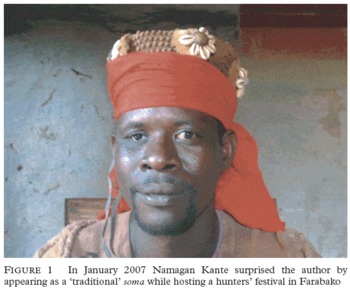
But here I should emphasize that Namagan rarely performed as a ‘traditional’ soma. The garments he is wearing in Figure 1 were donned only for the occasion,Footnote 16 and, in contrast to his colleagues, Namagan does not dance and is a modest consumer of alcohol. Thus, though he appears in all places where society is in turmoil, he manages to maintain a remarkably calm appearance – like what I would call an ‘urban professional’. This is also important for making urban visitors feel at ease in a rural region (kongo, or in French la brousse) which may otherwise be unsettling for them.
AN EXPERT AMONG EXPERTS
Namagan is widely renowned as an expert. It is, of course, not only the audience, but also fellow-experts who have to accept him as such; they mutually depend on each other to produce a stage on which they perform. Hence, I paid much attention to how experts treated one another. I summarize by describing three strategies I witnessed.
First, an expert should be modest in his presentation.Footnote 17 Namagan achieved modesty by always reciting a list of ‘teachers’ (karamògòw) when he presented himself to the sand before starting to produce a divination scheme. Central to his list was a teacher from as far away as a village outside Segou, and therefore a source who could never be consulted by anyone else. Moreover, he paid tribute to his ancestors from whom he also learned a great deal. When there was another man present in the audience who also had experience with sand divination, Namagan always introduced him to me as one of his teachers,Footnote 18 and afterwards asked him for his interpretation of the scheme in the sand. To the words of this ‘teacher’ he then added an affirmative statement like: ‘Yes, indeed, that's true and indeed very important. And I would like to add to this . …’ He then slowly elaborated upon his own insights. (Note that the procedure is not dissimilar to the way academics discuss contrasting viewpoints with each other.)
This modesty, however, disappeared completely when Namagan was with his pupils (kalandenw). In such cases he was full of self-confidence – never asking for information, never having doubts, and issuing strict instructions (and occasionally explanations).
Another strategy that works well in the Mande context is to claim that the solution and/or sacrifice is known, but that it is forbidden to reveal it because it is a dalilu (‘personal secret’). I witnessed this on several occasions with Moussa Kante (1961), son of the famous (Farabako) Jigin, who became active as a soma after the death of his father in 2003.Footnote 19 After Moussa announced that he knew the dalilu, he waited a few minutes to see if someone else came up with an interpretation. If that did not happen, then he rather solemnly announced the secret to the audience. I have to add, however, that Moussa's ambition to establish fame as a soma, in combination with his serious consumption of alcohol, may also have played a role in his increasing willingness to reveal personal secrets.
A third strategy for someone to establish self-presentation as an expert is that of the ‘additional round’. Namagan often employed this strategy. After consulting the sand, a sacrifice was made and a medicine prepared. Namagan then gave the client the impression that the session was finished, which probably made his client more relaxed than they were before the session started. However, sometime later – perhaps five minutes or even an entire day – Namagan announced that an additional round was necessary. This round was often more elaborate and time-consuming than the first. It could also be more complicated. My own experience illustrates this strategy. In 1999 I asked Namagan to consult the sand in relation to my professional career in African studies. The result was that it was not problematic, and that the sacrifice of a white ram was required. Moreover, he prepared a medicine that his wife boiled for me in water with which I had to wash myself three times within a 24-hour period. However, the following day at sunset, Namagan suddenly commanded one of his apprentices to fetch a black rooster which he buried west of the village in a hole in the ground in which he had produced twenty-two nimisa signs. This rooster is meant to ‘work’ (baara) in permanently protecting me against treason and rivalry by people in the ‘Peyi Ba guferneman’ (Dutch government).Footnote 20 I know enough about Mande cosmology to be certain that this sacrifice is quite an aggressive and dangerous action.21
MEDIATING THE PAST TO THE PRESENT: THE EXPERT'S KNOWLEDGE
Several of my Malian friends in Bamako, most of them fellow academics, were uneasy about my enthusiasm for Namagan's combination of divinatory and commercial activities. They told me that one day Namagan would experience a serious tumble in status and wealth. For them, Namagan was combining immoral trade (alcohol) with occult divination practices.
I nevertheless think that Namagan's ‘manifold’ approach (‘my affairs are manifold’) is a condition sine qua non for success as an expert since it creates a unique and powerful frame to perform ‘expertise’. I would like to illustrate this by arguing that an ‘expert’ is someone whose actions and services are applicable. This idea has been inspired by the Dutch Wolters dictionary which, in contrast to more prestigious dictionaries (Oxford, Van Dale, to mention only two), makes a significant differentiation between ‘expert’ and ‘specialist’. According to the Wolters dictionary, an expert is invited for advice on issues which are a point of debate (my italics); while a specialist is consulted for his knowledge. When defining ‘expert’ and ‘specialist’ other dictionaries tend to place knowledge and skills on an equally important level, and do not recognize a dichotomy between practice (application, things that work) and theory (knowledge, things that are true). The emphasis that the Wolters dictionary puts on ‘practical solution’ can be justified by the Latin root of ‘expert’ which is ‘experiri’ ( = to try [Oxford]). Moreover, this use of ‘expert’ is in line with the use of ‘expert’ in the expression ‘expert system’, a computer programme which has to propose a good solution.
Hence, to me, the expert's contribution is always a form of applied knowledge. This implies that his knowledge is accepted as relative; his knowledge is by definition a point of discussion. The solution proposed by the expert consolidates social tensions that are represented by the problem that the expert has to deal with. This marks the difference between the expert and the specialist.Footnote 22 And because of this importance of consolidating social tensions, an expert needs a unique frame (and much team support) within which to operate and foster public trust in his knowledge.
If one accepts the idea that the expert's opinion is an object of discussion per se, one should ask how the expert acquires authority. Why do people consult an expert, with the risk that his advice may increase the confusion? This can be understood on the one hand by an expert's strong performance, and the ‘practical reality’ that knowing is equal to giving confidence. We normally accept all kinds of ideas because they are expressed by people to whom we attribute authority, not because we have personally verified this knowledge.
Thus, if (Namagan's) expertise is a man-made social construction, the study of (Namagan's) network and performance and presentation of self is, by definition, the key to an understanding of the expert's social status. Although the study of expertise is, in the end, based on the tautology that an expert's advice is by definition not (only) based on (specialists’) knowledge, the concept of the ‘expert’ is a valuable and useful model to understand why and how people can cope with change – a central issue in anthropology. From this point of view the individual practitioner's capacity and ability to innovate and to draw upon other (sometimes foreign/imported) bodies of knowledge are crucial for success. Namagan Kante, for instance, would never have become an esteemed expert if he had not ‘imported’ knowledge about cows and cattle rearing to his family of cultivators, and if he had not ‘exported’ sand divination to the multi-ethnic network required by present-day Farabako people for survival in a world of new and changing social and economic dimensions. As an expert, Namagan produces applied knowledge which helps people to cope with new circumstances.
Namagan is correct in his claim that his affairs are ‘manifold’. He reinforces both classical obligations (hospitality, taking care of widows) and present-day developments (contact with a large multi-ethnic social configuration, negotiations with the monetary economy, a refusal to work in the fields, a refusal to collaborate with his older brothers, the maintenance of a motorbike). Such an outstanding person, whose activities are ‘manifold’, is able to deal with the changes that his society is experiencing.
Namagan performs his specialist's knowledge (on sand divination) in this complex frame, thus becoming a successful expert. He both mediates and embodies social change. If I had focused only on Namagan's skills and activities as a sand diviner, and thus emphasized and de-contextualized his knowledge, I would have described him as a specialist and probably given the reader the impression that Namagan is merely a ‘clever guy’.
By describing Namagan as an ‘expert’, however, I include an appreciation of both his ‘propositional’ and ‘non-propositional’ knowledge (cf. Marchand, this issue). I even go one step further: to me expertise is ‘applied knowledge’ that should be studied in relation to the frame that is maintained by the expert. Such an approach best features Namagan's (and other experts’) achievements, and gives the necessary attention to ‘appearance’ – nba dimension that is easily underestimated in studies of the transmission of expert knowledge. A mere focus on Namagan's ‘propositional knowledge’ (see Jansen 2005) would equate ‘expert’ with ‘savant local’. That would not only underestimate the sociological component in the appreciation of extraordinary people by both scholars and local populations, but would also imply an epistemological denial of the (sociologically) constructed nature of human knowledge.
ACKNOWLEDGEMENTS
Research for this article was financed by a five-year (1999–2004) post-doctoral grant from the Royal Netherlands Academy of Arts and Sciences (KNAW). I thank the editors for their support and comments, and the two anonymous reviewers for their critical reading of an earlier draft of this article.
In January 2007 Namagan Kante surprised the author by appearing as a ‘traditional' soma while hosting a hunters’ festival in Farabako