INTRODUCTION
Radiotherapy (RT) is used to complement conservative surgery in early stages of breast cancer, and it has been demonstrated that this combination achieves the same results in terms of local control and survival as radical surgery.Reference Poggi, Danforth and Sciuto1 Local tumour control depends on the eradication of tumour cells, and it has been observed that local control may be compromised by a small increase in the residual number of these cells.Reference Mackillop2 In addition, an important factor for locoregional control of the disease is the time between surgery and the initiation of RT. Evidence suggests that delays in the initiation of RT may have negative effects on treatment outcomeReference Tubiana3 and negative implications for local control of the disease.Reference Chen, King, Pearcey, Kerba and Mackillop4
Systematic reviews have provided mixed results: Huang et al.Reference Huang, Barbera, Brouwers, Browman, William and Mackillop5 and Chen et al.Reference Chen, King, Pearcey, Kerba and Mackillop4 found an association between the risk of locoregional recurrence and longer intervals between surgery and initiating RT. Olivotto et al.Reference Olivotto, Lesperance and Truong6 found statistically significant differences in metastasis-free survival and breast cancer-specific survival between patients commencing RT after 20 weeks and before. Punglia et al.,Reference Punglia, Saito, Neville, Earle and Weeks7 observed a greater risk of local recurrence when RT was delayed by more than 6 weeks after surgery. However, other research groups have not found any association between survival and the time delay in commencing RT.Reference Yock, Taghian, Kachnic, Coen, Assaad and Powell8–Reference Corradini, Niemoeller and Niyazi11
In contrast, Hébert-Croteau et al.Reference Hébert-Croteau, Freeman, Latreille and Brisson12 concluded that RT is effective for controlling microscopic residual disease, regardless of when it is initiated; however, they did not find any evidence of impact of delaying RT on treatment outcome.
These inconsistencies led other authors to suggest that factors such as the status of the margins may modulate the impact of time elapsed between surgery and RT.Reference Recht13
It has been suggested that delays in initiating RT may not affect survival outcomes in patients who receive and do not (stage 0) receive chemotherapy after surgery.
An important issue is the steady increase in the demand for RT due to the increasing incidence of cancer, attributable to the growth in the elderly population, and to the discovery and adoption of new indications for RT. Over the last two decades, the use of RT has increased together with the corresponding waiting times and waiting lists around the world.Reference Jack, Davies, Robinson, Sainsbury and Moller14–Reference Mackillop, Fu, Quirt, Dixon, Brundage and Zhou16
Overall, there is no consensus on how long the initiation of RT can be delayed after surgery without undesirable effects in patients (loco-regional recurrence and/or death), with estimates ranging from 2–26 weeks.Reference Chen, King, Pearcey, Kerba and Mackillop4, Reference Tsoutsou, Koukourakis, Azria and Belkacemi17, Reference Mikeljevic, Haward and Johnston18 In our hospital, the rate of loco-regional recurrences is low according to a previous study in a small sample of patients of early breast cancer (39 patients), and we consider it necessary to investigate whether this low rate is associated with following the recommended intervals (6 weeks after last treatment) or with patients’ other conditions. We decided to carry out a retrospective study in order to investigate the correlation between the previous treatment and the initiation of RT in patients with stage 0, I and II breast cancer, and to assess whether it was related to disease-free and overall survival.
MATERIALS AND METHODS
We conducted a retrospective observational study including women with a primary diagnosis of breast cancer stage 0, I, or II (Tis N0 M0, T1 N0 M0, T0 N1 M0, T1 N1 M0, T2 N0 M0 and T2 N1 M0), between January 2003 and December 2008, who received treatment at the Radiotherapy Department of Araba University hospital, who underwent breast conserving surgery or mastectomy and treatment with RT. All the patients have been diagnosed in accordance with the TNM system, 2003.Reference Singletary and Greene19
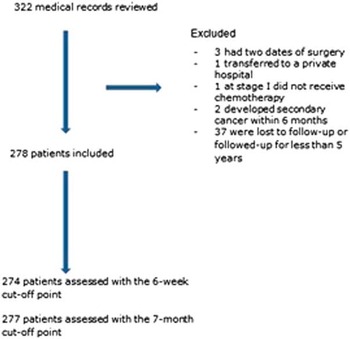
We excluded from the analysis women who moved to another city or another hospital before or after diagnosis, those who had a personal history of any type of cancer or a secondary diagnosis of cancer within 6 months after surgery, those in stage I and II who did not receive chemotherapy, those who received neo-adjuvant chemotherapy, as well as those with a follow-up period of less than 5 years (Figure 1). Data were obtained from the medical records of the patients, and a follow-up period of 5 years after the diagnosis of the disease was considered for assessing the disease-free survival (confirmed by imaging such as X-rays or ultrasound) and overall survival. All the patients were followed-up for 5 years.
Flow chart.

The primary measure was disease-free survival, the time in months between the diagnosis, and the detection of any recurrence, disease progression or death, within 5 years afther diagnosis.
The secondary measure was overall survival, the time in months between the diagnosis of the disease and death of the patient, within 5 years after diagnosis.
The independent variable was the delay in initiating RT, assessed with respect to the following two different criteria:
(a) Time since the last treatment (surgery—stage 0 patients—or chemotherapy stage I and II patients), this being considered acceptable when it was ≤6 weeks.Reference Punglia, Saito, Neville, Earle and Weeks7 (b) Time since surgery, this being considered acceptable when it was ≤7 months.Reference Punglia, Saito, Neville, Earle and Weeks7
We also collected other variables that might have an impact on the prognosis of the disease: age at diagnosis,Reference Nixon, Neuberg and Hayes21 hormone receptors (yes/no),22, Reference Mass, Engle and Trams23 type of chemotherapy (anthracyclines/taxanes/anthracyclines+taxanes/CMF cyclophosphamide, methotrexate and fluorouracil),Reference Rosen, Groshen, Saigo, Kinne and Hellman24 tumour stage,Reference Rosen, Groshen, Saigo, Kinne and Hellman24 type of tumourReference Ciatto, Biggeri, Rosselli Del Turco, Bartoli and Iossa25 and status of margins.Reference Olivotto, Lesperance and Truong6 The time in days between the diagnosis and surgery and the type of surgery (conservative+lymphadenectomy/conservative+sentinel node procedure/lymphadenectomy/mastectomy) were also recorded.
The disease-free survival and overall survival were assessed by Cox regression analysis, adjusting for variables that might affect the prognosis of the disease (age, hormone receptors, type of chemotherapy, hormone therapy, etc.).
The incidence of recurrence and mortality was assessed by logistic regression, also adjusting for the above variables, and was expressed with the odds ratio.
Analysis was carried out on the overall sample and sub-groups (stage 0 and stages I–II) with the first cut-off point (6 weeks), but only with patients in stages I–II with the second cut-off point (7 months after surgery), because among patients with stage 0 only 1 started RT after 7 months.
RESULTS
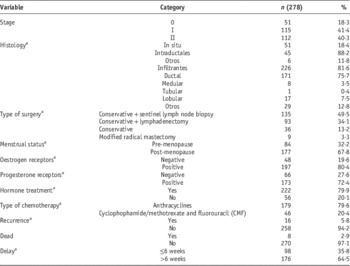
The mean age of the women included in the analysis was 54·4 years (SD=9·5). At diagnosis, 67·8% (n=177) of these women were post-menopausal. Among all, 18·3% (n=51) of the patients were classified as stage 0, 41·4% (n=115) as stage I and 40·3% (n=112) as stage II (Table 1).
General characteristics of the sample

Note:aThere were patients without information regarding this variable.
Analysis by sub-groups
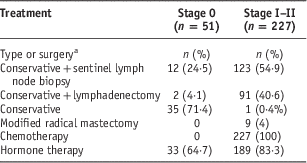
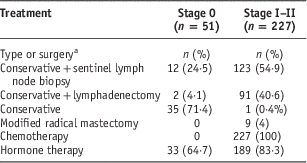
All patients with breast cancer stage I–II (n=227) received chemotherapy, and none of patients with stage 0 disease received chemotherapy (Table 2).
Treatment by stages
Note:aThere were patients without information regarding this variable.
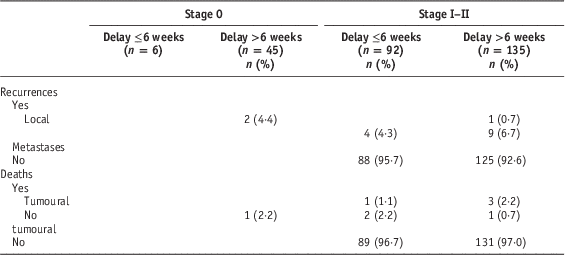
Recurrences and deaths: 5·8% of the patients had a recurrence (n=16) and 2·9% (n=8) died within 5 years after diagnosis, four (50%) of them due to no tumour cause and four (50%) due to neoplasm (Table 3).
Recurrences and deaths by stages
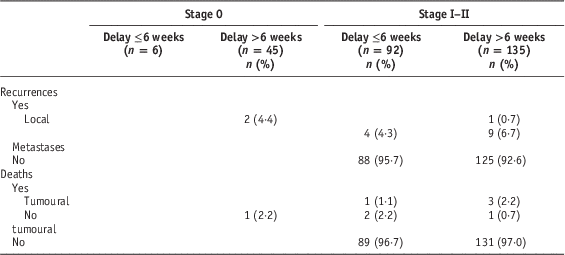
In patients with stage 0 disease, the percentage of recurrences has been 3·9% (n=2). These have been local, and have appeared in women who initiated RT 6 weeks after surgery.
In patients with stage I–II, the percentage of recurrences was 6·2% (n=14; Table 3). Among these recurrences, 5·7% (13) were metastases and 0·4% (1) were local; 10 have appeared in women who started RT 6 weeks after completing chemotherapy.
DISEASE-FREE SURVIVAL
In the analysis of the overall sample, no statistically significant differences were found in the probability of disease-free survival with the cut-off point considered: 6 weeks after the last treatment—p=0·412, hazard ratio (HR)=1·534 [0·553–4·259].
Analysis by sub-groups
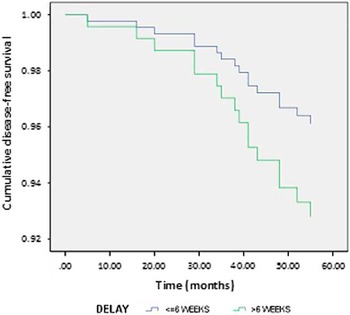
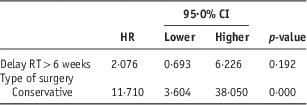
Further, no significant differences were observed in the analysis by sub-groups: 6 weeks after the last treatment—stage 0, p=0·698; and stages I and II, p=0·192; HR 2·076 [0·693–6·226] (Table 4 and Figure 2)—and 7 months after surgery—stages I and II, p=0·059; HR 2·606 [0·966–7·030].
Disease-free survival. Cut-off point: 6 weeks after last treatment. Stage I–II.

Disease-free survival
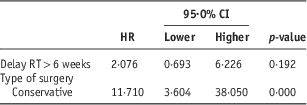
Note: Cut-off point: 6 weeks after last treatment (stages I–II).
Abbreviations: HR, hazard ratio; CI, confidence interval.
No significant differences were found in overall survival in either entire sample or sub-group analysis (p>0·05), also no differences were found in the probability of recurrence or death (p>0·05).
Among all the variables explored, none of them related to survival apart from type of surgery (p=0·000). Conservative surgery was associated with a higher probability of survival (Table 4).
DISCUSSION
Although it is clear that RT is complementary to breast-conserving surgery in early stages of this disease, there are no strict criteria for its use, neither regarding sequencing nor regarding the interval between chemotherapy or surgery and initiating RT.Reference Hickey, Francis and Lehman10 Studies on this topic have provided inconclusive results, reducing its potential use to guide the management of RT waiting lists. The latter are growing considerably due to the rising incidence of cancer associated with population ageing, as well as the discovery and adoption of new indications for RT, making this a common problem across the world.Reference Jack, Davies, Robinson, Sainsbury and Moller14–Reference Mackillop, Fu, Quirt, Dixon, Brundage and Zhou16
As discussed in the introduction, authors do not agree on the timing between surgery and RT to avoid having impact on the overall and disease-free survival.Reference Chen, King, Pearcey, Kerba and Mackillop4–Reference Corradini, Niemoeller and Niyazi11
In our study, we employed the same parameters as others (Punglia et al.,Reference Punglia, Saito, Neville, Earle and Weeks7 Corradini et al.,Reference Corradini, Niemoeller and Niyazi11 6 weeks and Hickey et al.,Reference Hickey, Francis and Lehman10) to review 278 medical records of women diagnosed with breast cancer at stage 0 who underwent surgery and RT, or stage I–II who underwent surgery, chemotherapy and RT with or without hormone therapy (depending on the receptors).
We have not found any significant differences in disease-free survival, overall survival, recurrence or mortality (p>0·05). These results are in contrast with the aforementioned findings of Punglia et al.,Reference Punglia, Saito, Neville, Earle and Weeks7—namely, a higher risk of recurrence when RT was delayed for more than 6 weeks after surgery (HR 1·19, 95% CI 1·01–1·39, p=0·033)—but are consistent with those of Hickey et al.Reference Hickey, Francis and Lehman10 and Corradini et al.,Reference Corradini, Niemoeller and Niyazi11 who did not observe any significant difference in survival, recurrences or mortality (p>0·05) when RT was initiated within 6–7 months after surgery.
Among the factors that may explain the significant differences found by Punglia’s group,Reference Punglia, Saito, Neville, Earle and Weeks7 it is worth mentioning that their patients were older than ours (above 65 years of age) and, in particular, they did not receive chemotherapy; this factor is associated with an increased likelihood of recurrence.22 Furthermore, they did not report the status of insert tumour (one of the most important factors in local control of the disease),Reference Fuentes, Piedrafita and Isern26 and there were no data regarding the presence or absence of hormone receptors in more than 25% of their patients; when knowing patients are positive, they can receive hormone therapy that reduces the probability of recurrence.22, Reference Mass, Engle and Trams23 In Olivotto’s study,Reference Olivotto, Lesperance and Truong6 patients did not received chemotherapy either, and thus the probability of recurrence was also more significant.
In our study, 222 out of the 278 women (80%) received hormone therapy. Further, all the women with stage I/II received chemotherapy, of whom 79·6% (n=179) were treated with anthracyclines—drugs that have been associated with a significant reduction in the annual risk of recurrence or death.Reference Ciatto, Biggeri, Rosselli Del Turco, Bartoli and Iossa25 All these factors may have contributed to the lower incidence of recurrence in our patients, 16 out 278 (5·75%), a figure that is lower than those reported by other authors.Reference Ciatto, Biggeri, Rosselli Del Turco, Bartoli and Iossa25–Reference Neff, Bear and Pierce29
In view of the results obtained, delaying the initiation of RT by more than 6 weeks after the last treatment (surgery at stage 0 and chemotherapy at stages I and II) or by more than 7 months after surgery in patients with stage I–II does not seem to have a negative impact on disease-free survival, overall survival, recurrences or mortality.
These results should be interpreted with caution because our sample included women with stage 0–II. Women in whom the true effect of delaying RT can be assessed are those with stage 0 disease, because they only receive RT as a treatment for cancer, but only 18·3% of women were in this category in our study. We believe it is important to further investigate this topic, and to carry out randomised studies, for controlling different variables that may influence treatment from the beginning.
The only variable that was found to be associated with disease-free survival was type of surgery. Patients who underwent BCS had a higher cancer-free survival compared with those treated with mastectomy. These results are similar to those obtained by Agarwal et al.Reference Agarwal, Pappas, Neumayer, Kokeny and Agarwal30
Limitations of the study
Given the fact that this was a retrospective study, any data not documented in the medical records of the patients could not be collected. In addition, it is possible that the selection of patients for RT was influenced by their risk factors for recurrence, making this a potential source of bias in the analysis of the association between delaying the initiation of RT and recurrence. Given that local recurrence after RT is relatively uncommon, we decided to assess the appearance of not only local recurrence but also distant recurrences (metastasis), although this complicates comparisons with other data in the literature.
In contrast, there is growing evidence that metastasis may occur much earlier than previously thought, as tumour cells spread through the body in the initial stages of cancer, even before it has been detected. This underlines the importance of assessing not only local recurrence but also distant recurrence.Reference Klein31 Indeed, in our study, most of the cases of recurrence were distant recurrences.
It would have been interesting to have recorded the reasons for delays in initiating RT; however, the reasons were not documented in the medical records of the patients. In addition, it would be interesting to explore the factors that might influence the delay, such as proximity to the hospital centre, co-morbidity and having sought information about illness.Reference Bouche, Ingrand, Mathoulin-Pelissier, Ingrand, Breton-Callu and Migeot32
Acknowledgements
None.
Financial support
This research received no specific grant from any funding agency, commercial or not-for-profit sector.
Conflicts of Interest
None.
Ethical Standards
The authors assert that all procedures contributing to this work comply with the ethical standards of the relevant national guidelines on human experimentation and with the Helsinki Declaration of 1975, as revised in 2008, and has been approved by the institutional committees (Clinical Research Ethics Committee of Araba University Hospital).