The global rise in carbapenem-resistant gram-negative bacteria has led to increased use of the polymyxins, antimicrobial agents mostly abandoned by the mid-1970s due to toxicity.Reference Kaye, Pogue, Tran, Nation and Li 1 Resumption of polymyxin use in human and veterinary medicine has coincided with emergence of polymyxin-resistant organisms.Reference Monaco, Giani and Raffone 2
Colistin resistance in Enterobacteriaceae has predominantly been caused by chromosomal mutations in the PmrA/PmrB and PhoP/PhoQ two-component systems leading to modifications in lipid A.Reference Gao, Hu and Li 3 However, in November 2015, a plasmid-mediated mechanism of colistin resistance, the mobile colistin resistance-1 (mcr-1) gene, was reported in Enterobacteriaceae recovered from food, animals, and human specimens in China, and it has subsequently has been reported worldwide.Reference Liu, Wang and Walsh 4
We present results from a colistin resistance surveillance program in Enterobacteriaceae at Michigan Medicine, including details regarding 4 patients with mcr-1–positive colistin-resistant Escherichia coli.
Methods
In January 2016, the Michigan Medicine Clinical Microbiology Laboratory began colistin susceptibility testing of all Enterobacteriaceae isolates using broth microdilution (BMD, Trek Sensititre, Thermo Fisher, Oakwood Village, OH). The minimum inhibitory concentration (MIC) of ≥4 mg/L was the epidemiological cutoff for resistance. Resistance was confirmed by the Michigan Department of Health and Human Services (MDHHS) Bureau of Laboratories (BOL) by repeat BMD testing. Beginning in July 2016, real-time polymerase chain reaction (RT-PCR) to screen for the mcr-1 gene was performed at MDHHS BOL, according to the Centers for Disease Control and Prevention (CDC) protocols. 5
Microbiology analyses
The CDC performed whole-genome sequencing and identification of mcr-1, sequence typing, and incompatibility plasmid typing. The Bonomo lab at the Cleveland Veterans’ Affairs Medical center performed sequence and phylogenetic typing and evaluation for virulence factors on isolates collected from July 2016 to March 2017 (Supplementary data online).
Screening and survey of patients and household contacts
Rectal screening for mcr-1 carriage was performed on mcr-1–positive patients and household contacts using rayon-tipped swabs, which were transported in a tube containing a sponge soaked in Amies media (Copan for Healthlink). PCR for mcr-1 was performed at the CDC.
Travel and food histories were obtained through patient interviews by the MDHHS.
Results
From January 2016 through April 2017, all Enterobacteriaceae (n = 15,894), were tested for colistin resistance. Overall, 95 unique patients had colistin-resistant isolates: 45 Enterobacter spp, 33 E. coli, and 20 Klebsiella pneumoniae. A subset of 36 isolates were tested for mcr-1, and 4 were positive (all E. coli). The remainder were unavailable for testing.
Case description
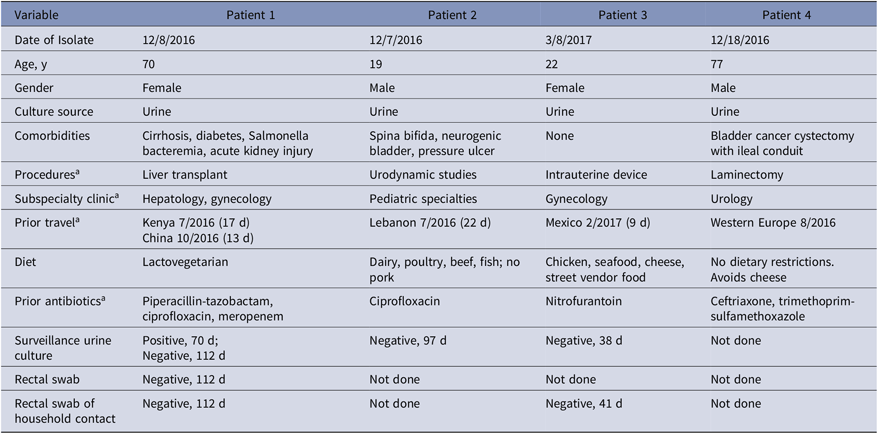
Patient #1. A 70-year-old woman with diabetes mellitus and nonalcoholic steatohepatitis was hospitalized for liver transplantation in November 2016 (Table 1). Several weeks earlier, she was hospitalized for nontyphoidal Salmonella (colistin-susceptible) bacteremia after travel to China. Urine culture at that time grew extended-spectrum β-lactamase (ESBL)–producing E. coli with colistin MIC 4 mg/L (mcr-1 positive). She was treated for 14 days with meropenem with clinical response. Urine culture collected while the patient was asymptomatic 70 days after the initial culture grew mcr-1 positive E. coli. A subsequent urine culture collected 112 days after the first culture grew K. pneumoniae (mcr-1 negative).
Patient Demographics, Potential Risk Factors, and Surveillance Cultures

a Within 6 months prior to detection of the resistant isolate.
Patient #2. A 19-year-old man with spina bifida and recurrent urinary tract infections (UTIs) was diagnosed with a UTI in December 2016 (Table 1). The urine culture grew E. coli, colistin MIC 4 mg/L (mcr-1 positive). He had visited Lebanon 6 months prior. He was treated with trimethoprim-sulfamethoxazole for 7 days with clinical response. A urine culture obtained 4 months later grew Proteus penneri, but mcr-1 testing was not performed.
Patient #3. A 22-year-old healthy woman presented in February 2017 with pansusceptible E. coli UTI 1 day after intrauterine device insertion (Table 1) and was treated with nitrofurantoin. In March 2017, she had recurrent UTI. Urine culture grew E. coli with colistin MIC >4 mg/L (mcr-1 positive). She was treated with nitrofurantoin for 7 days with symptomatic relief. Between the 2 episodes, she had travelled to Puerto Vallarta, Mexico. A urine culture obtained 38 days after the mcr-1 positive specimen was sterile.
Patient #4. A 77-year-old male with history of cystectomy and ileal conduit for bladder cancer was hospitalized in November 2016 with complicated UTI. He was treated with ceftriaxone for 3 days and trimethoprim-sulfamethoxazole for 7 days. The urine culture was sterile. He presented in December 2016 with pyelonephritis. This urine culture grew E. coli with colistin MIC >4 mg/L (mcr-1 positive). He responded to a 9-day treatment regimen with cefepime (2 days), ertapenem (2 days), and nitrofurantoin (5 days). Five months prior, he had traveled to Switzerland, Germany, France, and the Netherlands. A subsequent urine culture in August 2017 was sterile.
Additional demographic and microbiologic details for all 4 cases are listed in Table 1.
Molecular characterization
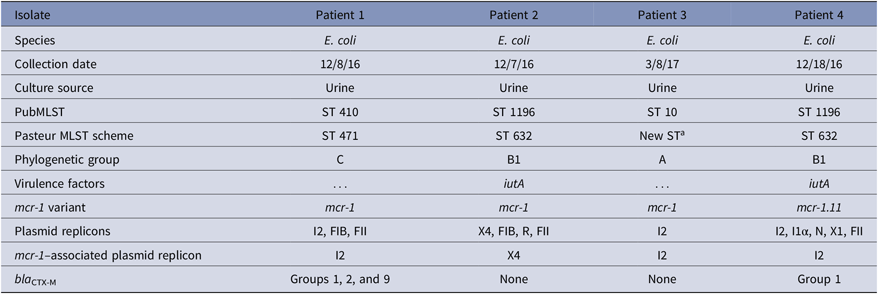
Three E. coli isolates harbored mcr-1, while the fourth E. coli isolate presented a variant of mcr-1 determined to correspond to mcr-1.11 (99% amino acid similarity to mcr-1, Val duplication at V8). Isolates belonged to different sequence types (STs) (Table 2), except for isolates 2 and 4, which belonged to Pasteur scheme ST 632 and PubMLST ST 1196. Those 2 isolates shared the same virulence factor (iutA) and belonged to the same phylogenetic group (B1). Isolates 1 and 3 belonged to phylogenetic groups C and A, respectively (Table 2). Plasmid typing revealed that the isolate from patient 2 carried mcr-1 on an IncX4 plasmid; isolates from the other 3 patients carried mcr-1 on IncI2 plasmids. PCR revealed the presence of bla CTX-M groups 1,2 (plasmidic) and 9 (chromosomal) for isolate 1, and isolate 4 carried bla CTX-M group 1 (chromosomal).
Molecular Findings of mcr-1 Isolates

Note. MLST, multilocus sequence typing; mcr, mobile colistin resistance; ND, not done.
a No exact match; assigned alleles for 7 loci, 1 new allele.
Discussion
As of November 2018, 53 human cases of mcr-1–producing Enterobacteriaceae had been reported from 19 states, including Michigan. 6
Our 4 patients had similar epidemiologic exposures. All had international travel within 6 months prior to mcr-1 identification, consistent with most US cases. 6 Second, 2 case patients consumed meat while traveling abroad. Higher frequencies of isolates carrying resistance genes are recovered from animals than from humans.Reference Skov and Monnet 7
Third, all cases reported antibiotic use within 6 months of mcr-1 detection, an important risk factor for MDRO infection.Reference Marchaim, Chopra and Bhargava 8
Isolates carrying the mcr-1 gene may carry other resistance genes, including β-lactamases.Reference McGann, Snesrud and Maybank 9 In this study, 2 mcr-1–positive isolates were also ESBL producers carrying bla CTX-M genes. Both patients had prior antibiotic exposure and comorbid conditions that increased MDRO risk. CTX-M has been reported in other mcr-1–containing isolates in the United States.Reference McGann, Snesrud and Maybank 9
Duration of mcr-1 gene carriage is unknown. One study reported <1 month carriage duration among 6 patients.Reference Arcilla, van Hattem and Matamoros 10 Two of our subjects demonstrated clearance of mcr-1–containing E. coli from urine at the first follow-up culture. One patient displayed prolonged colonization, potentially due to immunocompromise and continued antibiotic exposure. Defining the duration of mcr-1 carriage can inform interventions to prevent spread of mcr-1. Although transmission of mcr-1 between humans was not identified among study patients, limited surveillance of potential contacts was performed. No additional patients with mcr-1 E. coli have been identified in our hospital, despite ongoing testing of Enterobacteriaceae for colistin resistance.
The limitations of this study include incomplete screening of all colistin-resistant isolates due to unavailability. Potential transmission was incompletely evaluated as only clinical isolates were captured and limited rectal surveillance culturing was performed.
Isolates carrying mcr-1 in this study were detected through routine colistin susceptibility testing of Enterobacteriaceae isolates. Further study is required to define mcr-1 prevalence in community and healthcare settings, to identify risk factors for mcr gene acquisition, and to describe the natural history of mcr-1 gene carriage.
Supplementary material
To view supplementary material for this article, please visit https://doi.org/10.1017/ice.2019.177
Author ORCIDs
Laraine Washer, 0000-0002-5699-7706
Acknowledgments
We are grateful for the contributions of David Lonsway and Adrian Lawsin and the Division of Healthcare Quality Promotion, Centers for Disease Control and Prevention, especially those of whole-genome sequence and identification of mcr-1, sequence typing of the isolates, and incompatibility plasmid typing. This content is solely the responsibility of the authors and does not necessarily represent the official views of the National Institutes of Health or the Department of Veterans Affairs.
Financial support
Research reported in this publication was supported in part by the National Institute of Allergy and Infectious Diseases of the National Institutes of Health (grant nos. R01AI100560, R01AI063517, and R01AI072219 to R.A.B.). This study was supported in part by funds and/or facilities provided by the Cleveland Department of Veterans’ Affairs (grant no. 1I01BX001974 to R.A.B.) and from the Biomedical Laboratory Research and Development Service of the VA Office of Research and Development and the Geriatric Research Education and Clinical Center (VISN 10 to R.A.B.).
Conflicts of interest
All authors report no conflicts of interest relevant to this article.