Introduction
Demographic changes in recent decades, most prominently declining birth rates and increased longevity, have led to changes in the age structure of the workforce, with more older workers (aged 50+) than ever before (Wheaton and Crimmins Reference Wheaton, Crimmins and Wang2013). In addition, due to changes in retirement legislation in many countries, older workers cannot afford to retire as early as they did in previous decades, which has resulted in increasing numbers of older workers looking for prolonged employment (D'Addio, Keese and Whitehouse Reference D'Addio, Keese and Whitehouse2010). However, older workers’ opportunities for prolonged employment can be obstructed by their poor labour market position. For example, re-employment after job loss is negatively related to workers’ age, especially after the age of 50 (Wanberg et al. Reference Wanberg, Kanfer, Hamann and Zhang2016), leading to longer unemployment durations among older workers than among younger workers (Chan and Stevens Reference Chan and Stevens2001). This is related to the finding that many organisations employ older workers, but do not hire them (i.e. they hire workers at younger ages and employ them into their fifties and beyond, but rarely hire older workers out of the labour market; Adler and Hilber Reference Adler and Hilber2009; Daniel and Heywood Reference Daniel and Heywood2007).
One strand of the literature suggests that the poor labour market position of older workers is the result of age discrimination. Studies have shown that older workers consistently receive more negative evaluations than otherwise equivalent younger workers in different employment contexts, such as internal evaluations (Gordon, Rozelle and Baxter Reference Gordon, Rozelle and Baxter1988; Rosen and Jerdee Reference Rosen and Jerdee1976) and personnel selection for hiring (Ahmed, Andersson and Hammarstedt Reference Ahmed, Andersson and Hammarstedt2012; Bendick, Brown and Wall Reference Bendick, Brown and Wall1999; Perry et al. Reference Perry, Golom, Catenacci, Ingraham, Covais and Molina2016). The main argument is that many employers, recruiters and managers hold predominantly negative stereotypical views of older workers and older job applicants, such as older workers having a lower willingness and ability to engage in training and to work with new technologies, and being overall less productive than younger workers (Bal et al. Reference Bal, Reiss, Rudolph and Baltes2011; Finkelstein, King and Voyles Reference Finkelstein, King and Voyles2015; Posthuma and Campion Reference Posthuma and Campion2009; Van Dalen, Henkens and Schippers Reference Van Dalen, Henkens and Schippers2010), and are therefore more likely to evaluate an older worker or job applicant negatively than a younger worker or job applicant (Finkelstein, Burke and Raju Reference Finkelstein, Burke and Raju1995; Roscigno et al. Reference Roscigno, Mong, Byron and Tester2007). However, these studies focus explicitly on age, comparing older workers to younger workers, and thereby largely ignore other factors that may influence older workers’ job search outcomes. For example, it is not clear what distinguishes older workers from one another in the eyes of hiring managers. In addition, as Landy (Reference Landy2008) argues, many of these studies lack external validity as a result of their use of student samples and unrealistic evaluation experiments that are not generalisable to real-world situations.
Managers’ evaluation of job applications and their subsequent decision whether or not to invite a job applicant to an interview is one of the few cases that is comparable in an experimental setting and in the real world (Landy Reference Landy2008). Screening job applications is one of the main methods of personnel selection that organisations use for virtually all jobs (Cole, Feild and Giles Reference Cole, Feild and Giles2003; Schmidt and Zimmerman Reference Schmidt and Zimmerman2004). In addition, it is a phase where job applicants and managers usually have not had any personal interaction, which makes the decision prone to stereotype-related bias (Derous, Ryan and Serlie Reference Derous, Ryan and Serlie2015; Landy Reference Landy2008). Research on the effects of résumé contents on managers’ hiring recommendations suggests that human capital plays an important role: résumé contents such as academic achievement and work experience are related to managers’ inferences about the productivity of the job applicant and how well the job applicant may fit the job and the organisation (Chen, Huang and Lee Reference Chen, Huang and Lee2011; Cole et al. Reference Cole, Rubin, Feild and Giles2007; Tsai et al. Reference Tsai, Chi, Huang and Hsu2011). However, within this literature, little attention has been paid to job applicants who may suffer from stereotypical bias about their productivity, such as older job applicants, and it is therefore unclear to which extent human capital-related factors may influence employment outcomes for such groups. Studying these mechanisms for older job applicants specifically is furthermore empirically relevant in a labour market with growing proportions of older workers looking for prolonged employment. In addition, there is a need for a better understanding of boundary conditions that may alter the relationship between résumé contents and the interview invitation decision of managers (Tsai et al. Reference Tsai, Chi, Huang and Hsu2011). In particular, economic and organisational contexts have been suggested to shape human resource management practices and micro-level decision-making among managers (Jackson and Schuler Reference Jackson and Schuler1995; Kim and Ployhart Reference Kim and Ployhart2014; Oude Mulders, Henkens and Schippers Reference Oude Mulders, Henkens and Schippers2016).
Therefore, the purpose of the current study is to examine how older job applicants’ human capital-related characteristics affect managers’ interview invitation decisions, while also considering the effects of external economic conditions and managers’ organisation-specific perception of changes in job demands. To do so, we analysed data from two waves of a vignette experiment among 211 Dutch managers from various organisations. The same experiment was carried out in 2010 (before the European debt crisis) and in 2013 (after the European debt crisis). Between the two experiments, the Dutch economy went through a persistent recession, which was part of the broader Great Recession and the European debt crisis (Organisation for Economic Co-operation and Development 2014). This is, for example, evidenced by Statistics Netherlands reporting an increase in the unemployment rate from 5.6 per cent in the second quarter of 2010 to 8.3 per cent in the second quarter of 2013, while economic growth declined from 1.8 per cent (2010) to −1.2 per cent (2013), and government debt increased from 59 per cent (2010) to 68.5 per cent (2013) of the gross domestic product. By studying the same decision among the same managers in these different economic conditions, we create a natural experiment that allows us to evaluate the effects of external economic conditions on how managers evaluate older job applicants. In addition, it contributes to a better understanding of the effects of recessions on human resource-related practices (Latham and Braun Reference Latham and Braun2011).
Theoretical framework and hypotheses
Older job applicants’ human capital-related characteristics and managers’ interview invitation decisions
The screening of job applicants’ résumés is often one of the first steps in the personnel selection process (Cole, Feild and Giles Reference Cole, Feild and Giles2003; Schmidt and Zimmerman Reference Schmidt and Zimmerman2004). Because interviewing and other selection methods such as testing are costly, résumé evaluation is used as an inexpensive initial screening tool to determine whether job applicants have the characteristics that warrant further evaluation (Cole et al. Reference Cole, Feild, Giles and Harris2009). The relationship between résumé contents and hiring recommendations has been well established empirically, and has been shown to be mediated by factors such as recruiters’ evaluations of applicants’ job competencies (Chen, Huang and Lee Reference Chen, Huang and Lee2011; Huang, Chen and Lai Reference Huang, Chen and Lai2013) and person–job and person–organisation fit (Kristof-Brown, Zimmerman and Johnson Reference Kristof-Brown, Zimmerman and Johnson2005; Tsai et al. Reference Tsai, Chi, Huang and Hsu2011).
The human capital perspective and signalling theory can be applied to understand the relationship between job applicants’ characteristics and hiring recommendations. Specifically, job applicants’ characteristics, such as summarised in a résumé or, for example, learned through recommendations, generate managers’ inferences about the applicants’ personality (Cole et al. Reference Cole, Feild, Giles and Harris2009) and work-related knowledge, skills and attributes (Chen, Huang and Lee Reference Chen, Huang and Lee2011). Through these inferences, managers will form predictions about the applicant's suitability and performance for the job position, as well as the applicant's fit within the broader context of the organisation (Cole et al. Reference Cole, Rubin, Feild and Giles2007; Tsai et al. Reference Tsai, Chi, Huang and Hsu2011). In other words, managers use the human capital-related characteristics of the job applicant to form evaluations about the potential productivity of the job applicant (Becker Reference Becker1975). Furthermore, because the information in a résumé is limited and the predictions about a job applicant's productivity are therefore inherently uncertain, managers may draw further inferences about the job applicant based on signals that are provided in the job application process (Bangerter, Roulin and König Reference Bangerter, Roulin and König2012; Protsch and Solga Reference Protsch and Solga2015; Spence Reference Spence1973). For example, long unemployment spells or a large number of different employers over the career of an older worker may signal an applicant's lack of loyalty or an inability to perform up to expectations (Bills Reference Bills1990). Even though such inferences may be unjustified or incorrect, they matter because they influence managers’ decisions whether or not to invite the job applicant for a job interview (Cole et al. Reference Cole, Feild, Giles and Harris2009). Here, we specifically consider three human capital-related characteristics of older job applicants that may influence managers’ interview invitation decisions: qualifications, employment status and recommendations. Note that here these mechanisms are specifically described for older job applicants, although they may work in much the same way for younger job applicants.
A job applicant's qualifications are central to the managers’ inferences about the applicant. Here, we refer to qualifications in the broad sense, meaning not only formal qualifications such as diplomas and degrees, but also skills, knowledge, abilities, education and experience that may be useful for the ability to perform in a job (Erdogan et al. Reference Erdogan, Bauer, Peiró and Truxillo2011). This is especially relevant for older job applicants, since they commonly hold fewer formal qualifications than younger job applicants, and rely more on their career track record to imply qualifications. When a manager perceives a lack of qualifications on the part of the job applicant, in other words when the job applicant is under-qualified, the manager is likely to infer a lack of person–job fit, which would lead to a lower likelihood to invite the job applicant to a job interview for further evaluation (Tsai et al. Reference Tsai, Chi, Huang and Hsu2011). Over-qualification, in other words when the job applicant possesses qualifications that exceed job requirements (Erdogan et al. Reference Erdogan, Bauer, Peiró and Truxillo2011), is also expected to lead to a lower likelihood of the manager to invite the job applicant for a job interview. This is because managers may find over-qualified personnel harder to motivate and fear such employees may leave when a job better suited to their qualifications becomes available (Martinez, Lengnick-Hall and Kulkarni Reference Martinez, Lengnick-Hall and Kulkarni2014; Wald Reference Wald2005).
-
• Hypothesis 1: Managers are less likely to invite older job applicants who are (a) over-qualified or (b) under-qualified to a job interview than those whose qualifications meet the job requirements.
As mentioned above, managers may interpret signals provided in the application to make inferences about job applicants’ human capital (Bills Reference Bills1990; Protsch and Solga Reference Protsch and Solga2015; Spence Reference Spence1973). Such inferences may lead to discrimination when individuals are judged based on the generalised characteristics of the group they belong to (Akerlof Reference Akerlof1970). One particularly important signal in this respect is the applicant's employment status (Bills Reference Bills1990; Lockwood Reference Lockwood1991). Compared to applicants that are employed elsewhere at the time of application, unemployed applicants may be perceived by managers to be less competent and have lower human capital (Karren and Sherman Reference Karren and Sherman2012; Lockwood Reference Lockwood1991). Even though the reason for unemployment may be unknown to the evaluating manager, they may consider the unemployed job applicant to possess negative attributes or characteristics that have led to unemployment. The notion that at least some unemployed individuals may have lower human capital may thereby tarnish all job applications from unemployed applicants (Akerlof Reference Akerlof1970; Karren and Sherman Reference Karren and Sherman2012). This may be especially true for older job applicants in labour markets with relatively high levels of employment protection (such as in the Netherlands), since laying off employees with longer tenure is very costly so that when it happens, it may be interpreted as a reflection of the applicant's capacities (De Graaf-Zijl et al. Reference De Graaf-Zijl, Van Der Horst, Van Vuuren, Erken and Luginbuhl2015).
-
• Hypothesis 2: Managers are more likely to invite older job applicants who are employed elsewhere to a job interview than unemployed older job applicants.
Furthermore, managers may base their inferences of job applicants’ human capital and expected productivity on recommendations from relevant sources. Letters of recommendation are regularly used in the personnel selection process, predominantly because they may include information about past performance and personality traits that may signal a good person–job fit (Muchinsky Reference Muchinsky1979). However, a common problem is that letters of recommendation include solely positive traits of job applicants, and are considered non-discriminative and non-differentiating by managers (Baxter et al. Reference Baxter, Brock, Hill and Rozelle1981). This may be different when the recommendation for a job applicant comes from a source that is well known by the manager and perceived as trustworthy, as these sources put their reputation at stake by making a recommendation for a specific job applicant (Marsden and Gorman Reference Marsden, Gorman, Berg and Kalleberg2001). In other words, a recommendation from a trustworthy source for a particular job applicant may increase the manager's perception of that applicant's suitability for the job. Two possible trustworthy sources are current employees of the organisation, who may be able to judge first-hand whether the job applicant they recommend possesses the necessary human capital for a satisfactory performance, or fellow employers or managers that the recruiting manager deems trustworthy, as they are involved in personnel selection themselves and are better able to judge applicants from an organisational perspective. For older job applicants in particular, recommendations may be especially important in the application process because person-specific recommendations have the power to challenge stereotypical images that are pervasive for older workers.
-
• Hypothesis 3: Managers are more likely to invite older job applicants who are recommended by (a) a current employee of the organisation or (b) a trustworthy fellow employer to a job interview than those who do not have such recommendations.
Boundary conditions of the effects of human capital-related characteristics
The general economic conditions in which an organisation operates have wide-ranging implications for organisations’ human resource practices and operations (Jackson and Schuler Reference Jackson and Schuler1995; Robie et al. Reference Robie, Emmons, Tuzinski and Kantrowitz2011). For example, Kim and Ployhart (Reference Kim and Ployhart2014) showed that organisations that diversified their staffing and training practices before, during and after the Great Recession were more productive and profitable in the long run. However, whether and how economic conditions such as a recession influence personnel selection processes of organisations has received little attention. Studying the effects of economic conditions on the selection of older job applicants in particular is interesting, since recessions are known to be especially tough on groups with weak labour market positions, such as older workers, although evidence also shows that the recent Great Recession affected older workers less so than earlier economic downturns (Beck Reference Beck2013). Still, while older workers’ tenure and steady contracts may have provided protection from layoffs, evidence shows older workers who are laid off involuntarily lose their connection to the labour market and are unlikely to find re-employment (De Graaf-Zijl et al. Reference De Graaf-Zijl, Van Der Horst, Van Vuuren, Erken and Luginbuhl2015; Neumark and Button Reference Neumark and Button2014; Wanberg et al. Reference Wanberg, Kanfer, Hamann and Zhang2016).
In the current study, we study the effects of a change in the general economic conditions on managers’ selection of older job applicants in a two-wave design. By comparing data from two time-points, between which the economy was in recession, we are able to investigate how the general economic conditions affect managers’ evaluation of older job applicants. Specifically, we investigate both a direct effect of the general economic conditions on managers’ interview invitation decision for older job applicants, and a moderation effect of the general economic conditions on the effect of older job applicants’ human capital-related characteristics.
First, the general economic conditions are expected to affect directly managers’ evaluations of older job applicants through a labour supply effect. In an economic recession, unemployment rises and the supply of labour increases. In other words, there will be a larger number of job applicants for the same number of job openings. There is little reason to believe that the number of job applicants invited for an interview changes as the number of job applicants change (Robie et al. Reference Robie, Emmons, Tuzinski and Kantrowitz2011), which implies that when the supply of labour increases, any single job applicant is less likely to be invited for an interview. This mechanism is especially expected to affect groups that are already disadvantaged in the labour market, such as older job applicants (De Graaf-Zijl et al. Reference De Graaf-Zijl, Van Der Horst, Van Vuuren, Erken and Luginbuhl2015; Van Dalen and Henkens Reference Van Dalen and Henkens2013). Conversely, when economic conditions are comparatively better, there will be fewer job applicants, and job applicants are more likely to be invited for an interview.
-
• Hypothesis 4: Managers are more likely to invite older job applicants to a job interview when the general economic conditions are better than when they are worse.
Further, we expect a moderation effect of the general economic conditions on the effects of human capital-related characteristics on managers’ interview decisions for older job applicants for two reasons. First, a recession often implies a large negative shock to organisations’ business environments and a thorough reconsideration of organisational practices and policies (Van Dalen and Henkens Reference Van Dalen and Henkens2013). In such conditions, organisations often expect that their available resources will be undermined due to the deteriorating business environment, and thus are likely to enter a mode of resource conservation (Barker and Mone Reference Barker and Mone1998). When this resource conservation-oriented practice is carried out in the hiring process, it is conceivable that the managers will carefully scrutinise the candidates’ human capital-related characteristics to ensure the hiring to result in favourable return on investment.
Second, a job opening is likely to attract more applicants during a recession than during better economic conditions, because of increased labour supply. Therefore, during a recession, there will be more job applicants that possess the desired human capital-related characteristics, such as the right qualifications, relevant job history and recommendations from trustworthy sources (Robie et al. Reference Robie, Emmons, Tuzinski and Kantrowitz2011). As such, managers are less likely to invite job applicants who lack such characteristics for interviews. In other words, when there is a sufficient supply of qualified job applicants, managers can afford to be more selective, and job applicants that lack desirable human capital-related characteristics will be even less likely than normal to be invited for a job interview.
-
• Hypothesis 5: General economic conditions will moderate the effect of older job applicants’ qualifications on managers’ likelihood of inviting job applicants to job interviews, such that the negative effects of (a) over-qualification and (b) under-qualification will be stronger in worse general economic conditions.
-
• Hypothesis 6: General economic conditions will moderate the effect of older job applicants’ employment status on managers’ likelihood of inviting job applicants to job interviews, such that the positive effect of job applicants’ employment status will be stronger in worse general economic conditions.
-
• Hypothesis 7: General economic conditions will moderate the effect of older job applicants’ recommendation status on managers’ likelihood of inviting job applicants to job interviews, such that the positive effects of having a recommendation from (a) a current employee and (b) a trustworthy fellow employer will be stronger in worse general economic conditions.
Next to factors external to the organisation, it is important to also consider how within-organisation developments over time affect human resource practices and managers’ evaluations of older job applicants. Although many within-organisation developments may affect managers’ hiring behaviour, here we focus on one interesting variable: managers’ perception of changes in organisational job demands. Job demands are defined as the amount of physical or psychological effort that is required by the job (Demerouti et al. Reference Demerouti, Bakker, Nachreiner and Schaufeli2001; Schaufeli, Bakker and Van Rhenen Reference Schaufeli, Bakker and Van Rhenen2009). Here, we focus explicitly on how managers perceive that job demands within the organisation as a whole have changed over time. Measuring changes in organisational job demands by studying managers’ perceptions of them is deemed more appropriate than attempting to measure objective changes in job demands or considering employees’ perceptions, since managers are most likely to draw on their own perceptions in analysing organisational needs and making hiring evaluations (Morgeson and Campion Reference Morgeson and Campion1997). Changes in organisational job demands may specifically affect older job applicants, since older workers are commonly seen as less adaptable to changes than younger workers (Chiu et al. Reference Chiu, Chan, Snape and Redman2001), even though empirical research shows that older workers are not more but less resistant to changes than younger workers (Kunze, Boehm and Bruch Reference Kunze, Boehm and Bruch2013).
Since changes in organisational job demands are unlikely to affect the number of job applicants that respond to a job opening, or how many job applicants will be invited for a job interview, we do not expect a main effect of the managers’ perception of changes in organisational job demands on their evaluation of older job applicants. However, we do expect that when managers have perceived a change in organisational job demands, the importance of other criteria by which they evaluate an older job applicant may change. According to the human capital perspective, workers with higher levels of human capital are better able to deal with high job demands, and are therefore less likely to experience work stress in response to high job demands than workers with lower levels of human capital (Cole et al. Reference Cole, Rubin, Feild and Giles2007; Schaufeli, Bakker and Van Rhenen Reference Schaufeli, Bakker and Van Rhenen2009). As such, from a person–environment fit perspective (Kristof-Brown, Zimmerman and Johnson Reference Kristof-Brown, Zimmerman and Johnson2005), managers may expect older job applicants with higher levels of human capital to have better person–job fit when they have perceived an increase in organisational job demands. Since the human capital of job applicants is inferred from characteristics such as qualifications, employment status and relevant recommendations (Chen, Huang and Lee Reference Chen, Huang and Lee2011; Tsai et al. Reference Tsai, Chi, Huang and Hsu2011), we expect that managers will value these characteristics more in their evaluation of job applicants when they have perceived an increase in job demands than when they have not.
-
• Hypothesis 8: Managers’ perception of changes in organisational job demands will moderate the effect of job applicants’ qualifications on managers’ likelihood of inviting older job applicants to job interviews, such that the negative effects of (a) over-qualification and (b) under-qualification will be stronger for managers who have perceived an increase (versus a decrease) in job demands.
-
• Hypothesis 9: Managers’ perception of changes in organisational job demands will moderate the effect of job applicants’ employment status on managers’ likelihood of inviting older job applicants to job interviews, such that the positive effect of job applicants’ employment status will be stronger for managers who have perceived an increase (versus a decrease) in job demands.
-
• Hypothesis 10: Managers’ perception of changes in organisational job demands will moderate the effect of job applicants’ recommendation status on managers’ likelihood of inviting older job applicants to job interviews, such that the positive effects of having a recommendation from (a) a current employee and (b) a trustworthy fellow employer will be stronger for managers who have perceived an increase (versus a decrease) in job demands.
Methods
Sample and procedure
Two waves of a vignette experiment (also known as a factorial survey; Rossi and Anderson Reference Rossi, Anderson, Rossi and Nock1982; Wallander Reference Wallander2009) were conducted in 2010 and 2013 with a sample of managers from the Longitudinal Internet Studies for the Social Sciences (LISS) panel of CentERdata, Tilburg University, The Netherlands. The vignette experiments were embedded in broader questionnaires about managers’ images of younger and older workers, and participants were not informed of the specific purpose of the vignette experiments. The LISS panel consists of a representative sample of Dutch inhabitants who participate in monthly internet surveys on a variety of topics (Scherpenzeel and Das Reference Scherpenzeel, Das, Das, Ester and Kaczmirek2010; for more information, see http://www.lissdata.nl). For the current study, we randomly selected a sample of 700 managers who had indicated that they worked in a management position and were responsible for recruitment, selection and hiring of employees in their organisation; 426 out of the 700 approached managers responded in the first wave of the study in May 2010, for a response rate of 60.9 per cent. Shortly before the second wave of the vignette experiment, participants were asked to complete a brief questionnaire on changes in their organisation since the first experiment. This questionnaire was separated from the second wave of the vignette experiment to limit the risk of carryover effects (Tourangeau et al. Reference Tourangeau, Rasinski, Bradburn and D'Andrade1989). Of the 426 initial respondents, 275 participated in the second wave of the vignette experiment in April 2013, implying a retention rate of 64.6 per cent. Managers who changed jobs, had become unemployed or had retired between the two waves of the vignette experiment (N = 64) were excluded from the analysis, rendering a final sample size of 211. The average age of the managers was 48.35 years (standard deviation (SD) = 9.44) at the time of the second vignette experiment. The majority of managers in the sample were male (70.1%); and 23.2 per cent of the managers worked in the industry and construction sector, 22.8 per cent in the services and trade sector, 25.6 per cent in the public sector and 28.4 per cent in other non-specified sectors.Footnote 1
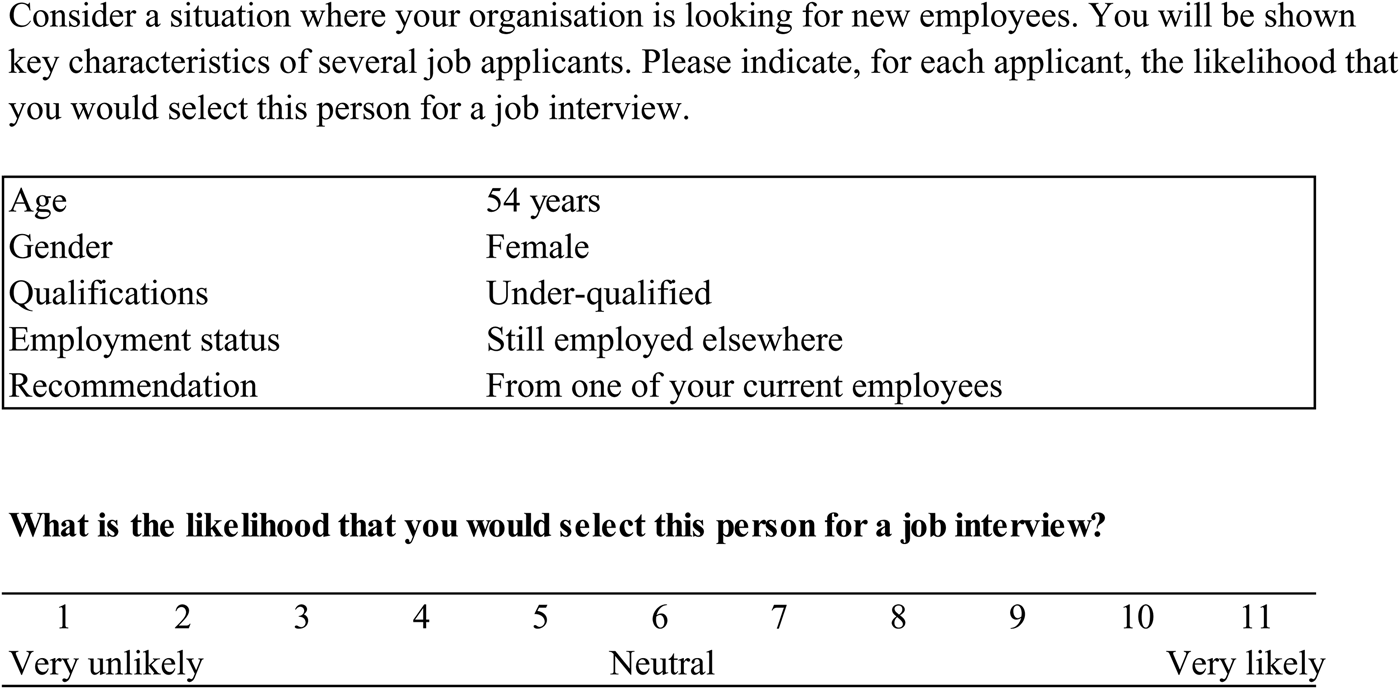
A vignette experiment combines survey questions with experimental methods, and is considered especially suitable for uncovering the underlying structure of human judgements in social contexts (Rossi and Anderson Reference Rossi, Anderson, Rossi and Nock1982; Wallander Reference Wallander2009). Participants in this type of experiment usually see a vignette that contains descriptive information about the situation, after which they are prompted for their judgement. In the current study, the vignettes contained variables on three human capital-related characteristics of the older job applicant (qualifications, employment status and recommendation) and two control variables (applicant's age and gender). The values on these vignette factors are randomised, so that each combination of values is equally likely (an example of a random vignette is presented in Figure 1). Because of this, the vignette factors are independent of each other and their effects can be reliably estimated (Wallander Reference Wallander2009). It is common to have participants complete multiple vignettes, in order to increase the reliability of the estimates and to be able to assess both between-subject and within-subject effects (Wallander Reference Wallander2009). In the current study, participants completed five vignettes in each wave, so there were ten observations for each participant. Our final sample thus consisted of 2,110 vignette observations from 211 participants, evenly split over the two waves.
Example of a vignette.

Measures
Qualifications
Job applicants’ qualifications were manipulated. Applicants were described in the vignettes as ‘under-qualified’, ‘qualified’ or ‘over-qualified’. We used the ‘qualified’ category as the reference category in the analysis for this variable.
Employment status
Job applicants’ employment status was manipulated. Applicants were described in the vignettes as either ‘employed elsewhere’ or ‘unemployed’. We used the ‘unemployed’ category as the reference category in the analysis for this variable.
Recommendation
Job applicants’ recommendations were manipulated. Applicants were described in the vignettes as ‘recommended by a current employee’, ‘recommended by a trustworthy fellow employer’ or had ‘no recommendations’. We used the ‘no recommendations’ category as the reference category in the analysis for this variable.
General economic conditions
The general economic conditions were assessed with a dummy for the year in which the experiment took place. Observations under relatively worse general economic conditions (April 2013) were coded 0; observations from relatively better general economic conditions (May 2010) were coded 1.
Managers’ perception of changes in organisational job demands
In the questionnaire conducted two months before the second wave of the vignette experiment, managers’ perception of changes in organisational job demands was assessed with a single question that read ‘In the last three years, how did job demands change in your organisation?’ The answers were recorded on a five-point scale (1 = ‘strongly decreased’, 3 = ‘remained the same’, 5 = ‘strongly increased’).
Interview invitation decision
The managers’ decision whether or not to invite a job applicant for an interview was measured on a scale from 1 (‘very unlikely’) to 11 (‘very likely’).
Control variables
Job applicants’ age was manipulated and appeared on the vignette. Applicants were 50, 54, 58 or 62 years old, with 62 as the reference category in the analysis. Job applicants’ gender was also manipulated in the vignette, with female as the reference category in the analysis.
Analytic strategy
The data had a nested structure, with responses to ten vignettes nested within each participant. Therefore, we performed multi-level modelling to account for this data structure in Mplus 7 software. Specifically, a two-level model was specified. At Level 1 (i.e. the within-individual level), we created a dummy variable for year to distinguish between vignettes from the two different general economic conditions (i.e. 0 = ‘2013’ and 1 = ‘2010’) and five other sets of dummy variables for applicants’ qualifications, employment status, recommendation, age and gender. The interaction terms between general economic conditions and applicants’ human capital-related characteristics were created by multiplying the dummy variables accordingly. We then specified the random effects (i.e. random slopes) of each vignette-based dummy variable, the fixed effect of the dummy variable of general economic conditions, as well as the fixed effects of general economic conditions by human capital characteristic interaction terms on likelihood of job interview. At Level 2 (i.e. the between-individual level), we specified the fixed effects of managers’ perception of changes in organisational job demands (grand-mean centred before analysis) on likelihood of job interview and on the random slopes we specified at Level 1.
Results
Preliminary analysis
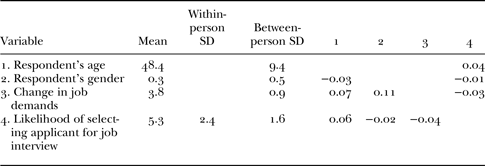
Means, standard deviations and correlations of the non-manipulated study variables are presented in Table 1. Overall, participants were on average slightly unlikely to invite older job applicants to an interview (mean = 5.33, within-person SD = 2.41, between-person SD = 1.58). One-way random-factor analysis of variance results showed that the between-person variances were significant for the dependent variable, intraclass correlation coefficient = 0.35, F(210, 1,899) = 6.43, p < 0.01, warranting the use of multi-level modelling for analysing the current data. Further, the average score of managers’ perception of changes in organisational job demands (mean = 3.82, SD = 0.87) indicates that, on average, managers perceived an increase in job demands in their organisations between 2010 and 2013.
Means, standard deviations (SD) and correlations of non-manipulated study variables

Notes: The vignette characteristics were random, so they are not significantly correlated with each other or other variables. Correlations below the diagonal represent between-subject correlations (N = 211). To calculate the between-subject correlation for the dependent variable (i.e. likelihood of selecting applicant for job interview) we averaged the within-subject scores. The respondent's gender was scored 0 for men and 1 for women. Correlations above the diagonal represent within-subject correlations (N = 2,110).
Hypothesis testing
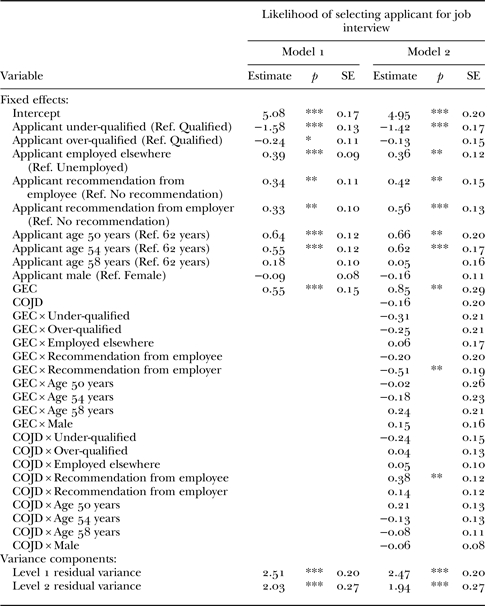
Unstandardised coefficient estimates for the model are presented in Table 2. Model 1 presents a baseline model which only contains Level 1 main effects of older job applicants’ characteristics and the general economic conditions on managers’ likelihood of inviting older job applicants for interview. Applicant's qualifications were related to managers’ interview invitation decisions in the expected direction. Managers were less likely to invite older job applicants that were either under-qualified (γ = −1.58, p < 0.01) or over-qualified (γ = −0.24, p < 0.05) than those that had qualifications fitting the job description, supporting Hypothesis 1. Further, managers were more likely to invite older job applicants that were employed elsewhere than applicants that were unemployed (γ = 0.39, p < 0.01), providing support for Hypothesis 2. Managers were also more likely to invite older job applicants with a recommendation from a current employee of the organisation (γ = 0.34, p < 0.01) or from a fellow employer (γ = 0.33, p < 0.01) than those with no recommendation, supporting Hypothesis 3. These results indicate that, as expected, older job applicants’ human capital-related characteristics are very important factors affecting managers’ decisions whether or not to invite them to a job interview. Although not the focus of this study and not hypothesised, it should be noted that applicants’ age also strongly affects managers’ evaluations, with applicants of 50 and 54 years old being much more positively evaluated than applicants of 58 and 62 years old. Indeed, applicants’ age is more important in predicting managers’ evaluations than applicants’ employment status or whether they have any relevant recommendations.
Unstandardised coefficients of the multi-level model

Notes: SE: standard error. Ref.: reference category. GEC: general economic conditions. COJD: changes in organisational job demands.
Significance levels: * p < 0.05, ** p < 0.01, *** p < 0.001.
We also found that managers’ likelihood of inviting older job applicants for a job interview was higher when general economic conditions were better (i.e. in May 2010) than when general economic conditions were worse, after several years of recession (i.e. in April 2013), γ = 0.55, p < 0.01. Hypothesis 4 is thus also supported.
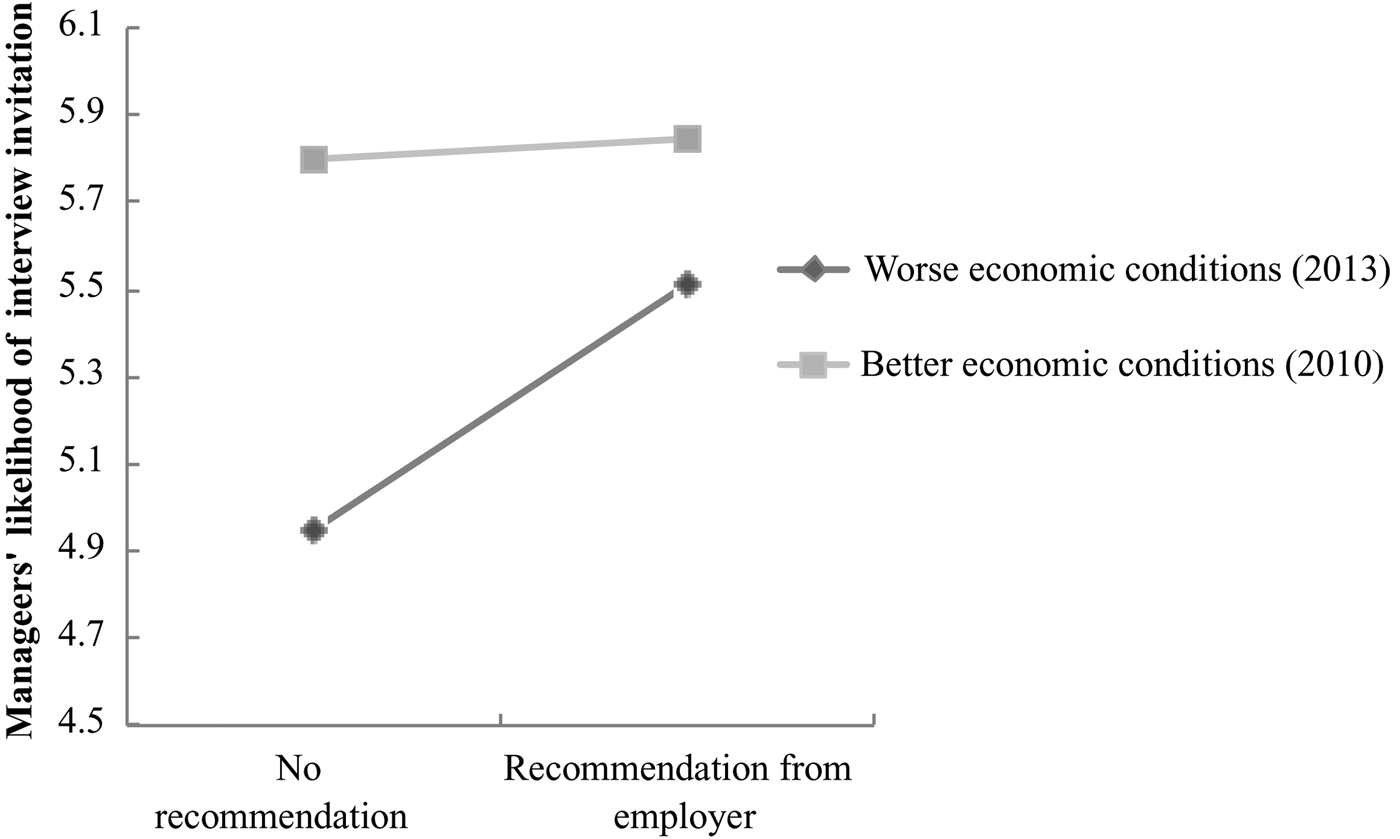
In Model 2, the interaction effects between the general economic conditions and the applicants’ characteristics were added, as well as the cross-level interaction effects between managers’ perception of changes in organisational job demands and applicants’ characteristics, and the between-individual main effect of managers’ perception of changes in organisational job demands. Snijders and Bosker's (Reference Snijders and Bosker1999) formulas were used to calculate pseudo-R 2 for the effect sizes in predicting the outcome variable. All predictors included in the model accounted for 19 per cent of the total variance in managers’ interview invitation decisions, suggesting the model explained a sizeable portion of the variation in the outcome variable. As presented in Table 2, the majority of the main effects of human capital-related characteristics on managers’ likelihood of inviting older job applicants for interview still held significant, except for the effect of over-qualification (γ = −0.13, p > 0.05). Further, Model 2 shows that the interaction effects between the general economic conditions and the applicants’ qualifications and employment status were not significant, providing no support for Hypotheses 5 and 6. However, the interaction between general economic conditions and the applicant being recommended by a fellow employer was significant (γ = −0.51, p < 0.01) in predicting managers’ job interview decisions. This interaction effect is illustrated in Figure 2, which shows that managers were more likely to invite older job applicants who hold a recommendation from a fellow employer than those with no recommendations when the general economic conditions were worse. This finding provides support for Hypothesis 7b (but not 7a).
Illustration of the interaction effect between general economic conditions and applicants’ recommendations.

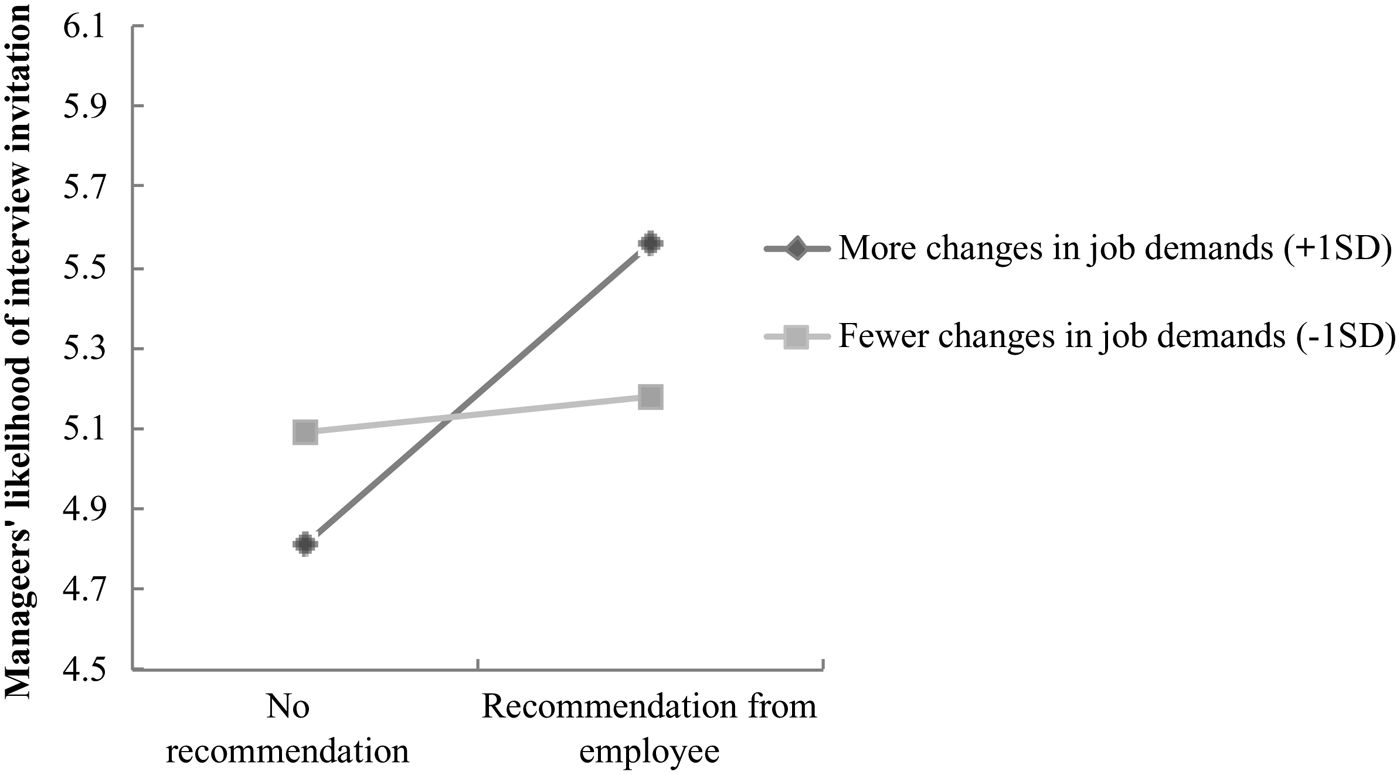
With regard to changes in organisational job demands, Table 2 shows that the interaction effects between changes in organisational job demands and older job applicants’ qualifications and employment status were not significant, providing no support for Hypotheses 8 and 9. An interaction effect is observed between changes in organisational job demands and the applicant being recommended by an employee of the organisation (γ = 0.38, p < 0.01). This interaction effect is illustrated in Figure 3, which shows that when managers had perceived an increase (versus decrease) in the level of organisational job demands in recent years, they were more likely to invite older job applicants with a recommendation from a current employee of the organisation to an interview than those with no recommendations. This provides support for Hypothesis 10a (but not 10b).
Illustration of the interaction effect between managers’ perception of changes in organisational job demands and applicants’ recommendations.

Discussion
In the current study, we found that managers’ interview invitation decisions regarding older job applicants were strongly associated with applicants’ human capital-related characteristics. In particular, managers were more likely to interview older job applicants who had matching qualifications than those who were under-qualified or over-qualified, who were employed elsewhere over those who were unemployed, and who had recommendations from an employer or an employee of the organisation over those who did not have such recommendations. Also, managers were more likely to invite older job applicants to an interview in better general economic conditions than in worse general economic conditions. Further, the effects of applicants’ recommendations on managers’ interview invitation decisions were moderated by the general economic conditions and managers’ perceptions of changes in organisational job demands, with a recommendation from a fellow employer being especially relevant in bad economic conditions, and a recommendation from an employee within the organisation being especially relevant when job demands had increased.
We did not find the hypothesised interaction effects between the other two human capital-related characteristics (i.e. applicants’ qualifications and employment status) and general economic conditions and changes in organisational job demands. A possible reason might be that job applicants’ qualifications and employment status were already very important in managers’ decision-making regarding job interview invitations, and that external conditions could not further increase their importance. Regardless of economic and organisational contexts, the effects of these human capital-related characteristics appear to be quite robust.
Theoretical and practical implications
The current findings have important theoretical and practical implications. First, theoretically, our findings support the human capital mechanism that has been suggested in earlier studies (e.g. Chen, Huang and Lee Reference Chen, Huang and Lee2011; Cole et al. Reference Cole, Rubin, Feild and Giles2007; Tsai et al. Reference Tsai, Chi, Huang and Hsu2011), and thus shows that human capital-related characteristics are one of the most important drivers of managers’ interview invitation decisions when screening older job applicants. More specifically, we found that under-qualification and over-qualification were both harmful to older job applicants’ job perspectives, but that under-qualification was about six to seven times more harmful than over-qualification in terms of its predictive effect. When the economic and organisational contexts were considered, the harmful effect of over-qualification even disappeared, and over-qualified older job applicants were equally likely as those with fitting qualifications to be invited to a job interview. This finding suggests that over-qualification may not be as detrimental for older workers as it is for younger workers, since older workers are often more motivated to support and mentor others than younger workers, while over-qualified older workers may be less likely than over-qualified younger workers to display high turnover rates and low motivation (Erdogan et al. Reference Erdogan, Bauer, Peiró and Truxillo2011). Overall, we conclude that over-qualification may be a smaller concern for older job applicants than is sometimes assumed. Further, our results offer support for the notion that the unemployment status may manifest as a stigma that can lead to unjustified perceptions of lower human capital on the part of job applicants, which appears to be especially relevant for vulnerable groups such as older workers (Karren and Sherman Reference Karren and Sherman2012).
Second, our results also indicate that managers were more likely to invite older job applicants to a job interview when general economic conditions were better, and that general economic conditions and managers’ perceptions of changes in organisational job demands moderated the effects of applicants’ recommendations on managers’ interview invitation decisions. However, the expected moderation effects between applicants’ qualifications and employment status and general economic conditions and changes in organisational job demands were not found, rendering the effect of especially within-organisation changes on managers’ evaluation of older job applicants rather small. Although this may be related to measurement limitations (discussed further below), this finding indicates that within-organisation developments are not as strongly related to managers’ evaluations of older job applicants as we expected. Still, the findings support previous research that suggests general economic conditions affect organisations’ human resource practices in various ways, which may specifically affect older workers or older job applicants (Robie et al. Reference Robie, Emmons, Tuzinski and Kantrowitz2011; Van Dalen and Henkens Reference Van Dalen and Henkens2013). In particular, the observation that unemployed older workers find it very difficult to find re-employment, especially after a recession (e.g. De Graaf-Zijl et al. Reference De Graaf-Zijl, Van Der Horst, Van Vuuren, Erken and Luginbuhl2015; Wanberg et al. Reference Wanberg, Kanfer, Hamann and Zhang2016), can be partly explained by managers being much less likely to invite older job applicants to a job interview in worse economic conditions.
With regard to the effects of recommendations, our results showed that recommendations from a fellow employer were especially important in bad economic conditions, whereas a recommendation from an employee of the organisation was especially important when job demands had increased in recent years. This difference in the importance of employee and employer recommendations was not expected based on our theoretical reasoning, but we think this may be because managers trust other employers to be better able to judge whether a job applicant is suitable from an organisational point of view since other employers know what is called for in bad economic conditions. Conversely, managers may trust the judgement of current employees of their own organisation more when the manager has perceived an increase in job demands, because the recommending employee has also had to deal with those increasing job demands. An interesting direction for future research would be to investigate this particular mechanism more closely, and to study to what extent recommendations from employees and employers that are external and internal to the organisation are valued differently.
Moreover, although not the prime focus of this study, we found a negative effect of applicants’ age on managers’ interview invitation decision. This corroborates findings from earlier studies regarding age discrimination in hiring (Roscigno et al. Reference Roscigno, Mong, Byron and Tester2007), and shows that even within the group of older job applicants, age negatively affects labour market success (Karpinska, Henkens and Schippers Reference Karpinska, Henkens and Schippers2013; Oude Mulders et al. Reference Oude Mulders, Van Dalen, Henkens and Schippers2014). The results do not show any interaction effects between applicants’ age and general economic conditions and changes in organisational job demands, suggesting that within the group of older job applicants, the young-old job applicants were not less negatively affected by difficult economic or organisational circumstances than old-old job applicants. This finding informs the changing legislative framework in which employers operate and supports the notion that both young-old and old-old job applicants deserve the same level of protection in the face of adverse labour market conditions (Beck Reference Beck2013). Still, it should be noted that applicants’ age is a strong predictor of managers’ evaluations of older job applicants, and that age is more important in predicting managers’ evaluations than applicants’ employment status or whether they have any relevant recommendations. Even though age discrimination is explicitly prohibited in many countries, this research shows that many managers do use age as a selection criterion in their evaluation of job applicants, even when human capital-related characteristics of applicants are controlled for, and that especially job applicants aged 58 or over are judged negatively.
Practically, on the policy level, although most developed countries have anti-age discrimination legislation in place, Neumark and Button (Reference Neumark and Button2014) have found that such legislation has not been particularly helpful in protecting older workers, and may sometimes even be detrimental to older workers’ employment potentials. Addressing the disadvantage that older workers and job applicants may face, our findings suggest that older job applicants themselves can increase their chances of job market success by updating their qualifications during their career. Also, policy makers could try to make training more attainable for older job workers so that their qualifications are more in line with changing job requirements. Special policy measures may be needed to protect the interests of older job applicants in bad economic conditions, as the findings here suggest older job applicants are strongly affected in those circumstances. Organisations can also try to adjust their job design and personnel selection procedure to attach more value to older job applicants’ experience and mentoring skills (Wang, Olson and Shultz Reference Wang, Olson and Shultz2013).
Limitations and future research
This study has several limitations. First, an inherent limitation of the vignette experiment method is that participants judge hypothetical situations, which limits the generalisability of the findings (Hainmueller, Hangartner and Yamamoto Reference Hainmueller, Hangartner and Yamamoto2015; Wallander Reference Wallander2009). In particular, real-world selection managers or recruiters have more detailed information available about job applicants than we were able to provide in the experiment. In addition, the judgements in the experiment are without consequences for the managers and their organisations, which may imply an under-estimation of the effects of several important factors (Pager and Quillian Reference Pager and Quillian2005). Still, we studied the interview invitation decision in a sample of real-world managers, who in reality also judge an applicant's résumé on paper or on screen without meeting the applicant in person (Derous, Ryan and Serlie Reference Derous, Ryan and Serlie2015; Landy Reference Landy2008). It is important for future research to study both actual behaviour and improve the external validity of research by using designs that mimic real-world incentives for the participants, such as the paired conjoint design (Hainmueller, Hangartner and Yamamoto Reference Hainmueller, Hangartner and Yamamoto2015).
Second, the study design limited the opportunity to examine interaction effects. This applies especially to factors manipulated at Level 1, because a full factorial design is impossible given the amount of Level 1 variables that we studied in the current study and the small amount of vignettes that we asked the managers to evaluate. Future studies using large field samples (i.e. measuring characteristics of real job applicants) may be able to allow the evaluation of more interaction effects.
Third, we assessed changes in organisational job demands with a single-item measure, two months before the second wave of the vignette experiment. Although the measure of changes in organisational job demands was separated from the vignette experiments to limit carryover effects, future studies could increase the validity and reliability of the measure by assessing job demands at each wave of the experiment and computing change scores, as well as by using previously established multi-item scales, such as parts of the Questionnaire on the Experience and Evaluation of Work (e.g. Schaufeli, Bakker and Van Rhenen Reference Schaufeli, Bakker and Van Rhenen2009) or the Job Content Questionnaire (Karasek et al. Reference Karasek, Brisson, Kawakami, Houtman, Bongers and Amick1998). In addition, future studies could include a measure on expected future changes in job demands, since this may be more directly related to outcomes for older job applicants due to the stereotype that older workers are more resistant to changes (Chiu et al. Reference Chiu, Chan, Snape and Redman2001; Kunze, Boehm and Bruch Reference Kunze, Boehm and Bruch2013). Next to improving the measure of organisational job demands, it is also important that future studies study the effects of other organisation-specific developments on managers’ hiring behaviour and organisations’ human resource practices, such as changes in the age composition of the workforce, the organisation of work in teams and whether the organisation has gone through restructuring.
Next to addressing these limitations, future research could try to expand on our findings by considering other types of personnel selection decisions and employment outcomes for older job applicants and older workers. Also, future research could address the topic of how managers’ characteristics may influence their decisions, and how the combination of applicants’ and managers’ characteristics (such as their age (dis)similarity) may affect employment outcomes. Finally, future studies may try to replicate and expand on our findings, focusing on a different country or studying national and cultural variation in a multi-country study.
Conclusion
The current study demonstrated that managers’ interview invitation decisions regarding older job applicants were strongly associated with the applicants’ human capital-related characteristics, and were also affected by the general economic conditions. Furthermore, the effect of older job applicants’ recommendations on managers’ interview invitation decisions was moderated by the general economic conditions and the changes in organisational job demands. The findings suggest that older workers should pay attention to updating their human capital during their career, and employers and policy makers should create opportunities to facilitate that. Older job applicants also have to consider getting recommendations that come from relevant sources to improve their chances across different economic conditions and organisational contexts.
Acknowledgements
This research was supported by the Netherlands Organization for Scientific Research NWO (VICI Grant 453-14-001 to KH), Netspar (grant IRG2016.03 to JOM and KH) and the Netherlands Institute for Advanced Studies (NIAS to KH and MW).