Children growing up in conditions of adversity face many challenges as they move into adolescence and adulthood, including heightened risks for academic failure, social difficulties, conduct problems, and various forms of psychopathology (Burt & Masten, Reference Burt, Masten, Grant and Potenza2009; Luecken & Gress, Reference Luecken, Gress, Reich, Zautra and Hall2010; Luthar, Reference Luthar, Cicchetti and Cohen2006). Yet, a surprising number of children facing serious adversity in their families and communities avoid such negative outcomes and show positive patterns of development; such phenomena have come to be labeled “resilience” (Masten, Reference Masten2001). A number of childhood factors have been identified as promoting resilience, including contextual factors such as positive parenting and schools (Luthar, Reference Luthar, Cicchetti and Cohen2006; Masten, Reference Masten2007). Children's individual differences likewise may promote positive functioning in the face of adversity; there is considerable evidence, for example, showing that IQ, self-regulation, and positive self-perceptions are associated with good developmental outcomes among children who have overcome diverse disadvantages and adversities (Sapienza & Masten, Reference Sapienza and Masten2011).
Children's personality traits, which are their typical patterns of behaving, thinking, and feeling, are likely to be another source of resilience as young people navigate the years from childhood to adulthood. Although a number of studies have examined the contributions of children's traits to resilient outcomes over shorter time windows (Lengua & Wachs, in press), few studies have examined the contributions of a broad range of childhood traits to the development of resilience in adulthood. The present study examines the contributions of the Big Five personality traits assessed in childhood to resilient outcomes assessed in the transition to adulthood (around age 20) and young adult years (age 30) in the longitudinal Project Competence study of risk and resilience (Garmezy & Tellegen, Reference Garmezy, Tellegen, Morrison, Keating and Lord1984; Masten & Powell, Reference Masten, Powell and Luthar2003; Masten & Tellegen, Reference Masten and Tellegen2012).
Risk, Competence, and Resilience: A Conceptual Overview
Over the last four decades, researchers have developed increasingly complex models for describing and investigating resilience in young people who overcome adversity (Egeland, Carlson, & Sroufe, Reference Egeland, Carlson and Sroufe1993; Garmezy, Masten, & Tellegen, Reference Garmezy, Masten and Tellegen1984; Luthar, Reference Luthar, Cicchetti and Cohen2006; Luthar, Cicchetti, & Becker, Reference Luthar, Cicchetti and Becker2000; Masten, Reference Masten2001, in press; Masten et al., Reference Masten, Garmezy, Tellegen, Pellegrini, Larkin and Larsen1988; Rutter, Reference Rutter1987; Werner & Smith, Reference Werner and Smith1982, Reference Werner and Smith1992, Reference Werner and Smith2001). Resilience can be conceptualized as “the capacity of a dynamic system to withstand or recover from significant challenges that threaten its stability, viability, or development” (Masten, Reference Masten2011, p. 494). Although there remain disagreements about the definition of resilience, most contemporary models require two conditions to be met for identifying resilience in the lives of individuals (Luthar, Reference Luthar, Cicchetti and Cohen2006; Masten, Reference Masten2007, Reference Masten2011): the individual must have been exposed to significant risk that increases the likelihood of negative development, and the individual must display positive adaptation in spite of that risk.
Risk is a very broad term referring to elevated probability for some undesired outcome in a population or group, and a risk factor usually designates an attribute (of the individual or the context) that is associated with the negative outcome (Masten, in press). Individuals with the risk factor have a generally higher likelihood of developing the undesired outcome, but whether they actually do develop the problem will vary: risk is a probabilistic concept. Adversity, including negative or traumatic life experiences, encompasses a broad subtype of risk factors, whether acute (e.g., car accident) or chronic (e.g., child maltreatment) in nature. Risk factors commonly co-occur or pile up in the lives of individuals, and often show cumulative effects; on average, problems tend to arise as risk cumulates, a phenomenon described in terms of risk gradients or dose effects (Obradović, Shaffer, & Masten, in press).
Positive adaptation likewise has been defined in a variety of ways across studies. Although some researchers have focused on the absence of problematic behaviors as the developmental outcome of interest, most work on psychosocial resilience instead has focused on the development of positive outcomes (Luthar, Reference Luthar, Cicchetti and Cohen2006; Masten, in press). These positive outcomes may include external adaptation (e.g., academic achievement or the development of positive relationships), internal adaptation (e.g., well-being or maturity), or both. The model adopted in the present study conceptualizes positive adaptation in terms of the development of competence, or the accomplishment of age-salient developmental tasks (Masten & Coatsworth, Reference Masten and Coatsworth1998; Masten et al., Reference Masten, Coatsworth, Neemann, Gest, Tellegen and Garmezy1995; Waters & Sroufe, Reference Waters and Sroufe1983). Developmental tasks encapsulate expectations for behavior in different domains of life within a particular context, culture, and time in history, and they change in different periods of life as people mature and face new challenges (McCormick, Kuo, & Masten, Reference McCormick, Kuo, Masten, Fingerman, Berg, Smith and Antonucci2011). At this time, in the United States and many other societies, it is widely expected that school-age children will achieve in school (academic achievement), follow rules of conduct in the home, school, and community (rule-abiding conduct), and get along with peers and develop friendships (social competence; Masten et al., Reference Masten, Coatsworth, Neemann, Gest, Tellegen and Garmezy1995). These three domains of competence remain important in the late adolescent and “emerging adult” years spanning the late teens to the 20s (Arnett, Reference Arnett2000), and they play an important role in shaping later success in competence in work and romantic relationships, two domains that become especially salient in young adulthood (McCormick et al., Reference McCormick, Kuo, Masten, Fingerman, Berg, Smith and Antonucci2011; Roisman, Masten, Coatsworth, & Tellegen, Reference Roisman, Masten, Coatsworth and Tellegen2004).
Much of the early work on resilience addressed the question of what factors or processes enable children to attain positive outcomes despite exposure to adversity and risk (Masten, Reference Masten2007, in press). As with the concepts of risk and positive adaptation, these factors have been conceptualized in a variety of ways. Two particularly important basic models for defining these factors are “main effect” models and “moderating effects” models. In the case of main effects, the identified factors are related to outcomes of interest in similar ways across levels of risk exposure. Factors with positive effects independent of risk have been variously termed promotive factors (Sameroff, Reference Sameroff2000), assets, or resources. For example, in a study of children either exposed or not exposed to domestic violence, “easy temperament” predicted positive outcomes, regardless of the children's violence exposure (Martinez-Torteya, Bogat, von Eye, & Levendosky, Reference Martinez-Torteya, Bogat, von Eye and Levendosky2009). In many cases, however, and particularly in the case of individual differences in personality, the same attribute could be easily described by positive or negative language, because it is distributed along a continuum.
In the case of moderating effects, the effects of the moderator variable differ depending on level of risk exposure (Masten, Reference Masten2001, in press). Moderators are described as “protective factors” when the expected negative effect of high risk or adversity appears to be attenuated or reduced in the presence of the protective factor. For example, in a study of young homeless children, parenting quality moderated risk, such that when sociodemographic risk was high, the achievement of children with good parenting quality appeared to be protected (Herbers et al., Reference Herbers, Cutuli, Lafavor, Vrieze, Leibel and Obradović2011). In the case of individual differences in personality as moderators of adversity, when adversity is expected to have negative effects on outcomes, personality traits could attenuate the effects of adversity (protective function) or exacerbate them (vulnerability effect) or both. Moreover, these effects could vary across situations, developmental timing, or criteria of adaptation.
In the context of considering the contributions of personality traits to resilience, it is especially important to emphasize that resilience itself is not a trait (Masten, in press). The capacity for adaptation indicated by the concept of resilience extends beyond the individual (e.g., relationships also contribute to resilience), and also is dynamic over time, changing as a result of many interactions between individuals and their contexts. Resilience emerges from the interplay of many processes in concert; it is not a static characteristic of a person (Luthar et al., Reference Luthar, Cicchetti and Becker2000; Masten, Reference Masten2001, in press; Yates, Egeland, & Sroufe, Reference Yates, Egeland, Sroufe and Luthar2003). Resilience therefore can change as the person and context change. Sometimes researchers describe particular personality traits or personality types as being “resilient personalities”; this name is problematic if it suggests that resilience is a stable characteristic of a person. Personality traits undoubtedly contribute to the development of resilience (and maladaptation), both overall and in specific outcome domains, but the processes involved are complex. Moreover, the same trait (e.g., fearfulness) could be protective with regard to one outcome (such as delinquency or risk-taking behavior), while at the same time posing vulnerability for another outcome (social problems or anxiety symptoms). Furthermore, recent research on biological sensitivity to context suggests that there may be individual differences in how responsive individuals are to experience. In other words, the same trait could function to enhance vulnerability in the context of adversity, but in a benign environment or in an intervention context it could function to enhance positive adaptation (Belsky, Bakermans-Kranenburg, & van IJzendoorn, Reference Belsky, Bakermans-Kranenburg and van IJzendoorn2007; Ellis & Boyce, Reference Ellis and Boyce2011).
Children's Personality Traits as a Potential Source of Resilience
From the inception of research on resilience over four decades ago, researchers have been interested in the possibility that children's traits may influence their capacity to thrive even in the face of adversity. For example, in the pioneering Kauai Longitudinal Study initiated by Emmy Werner (Werner & Smith, Reference Werner and Smith1982, Reference Werner and Smith1992, Reference Werner and Smith2001), the researchers included measures of the young children's early temperaments as potential predictors of later resilience. Similarly, in the Project Competence study that is the focus of this paper (Garmezy et al., Reference Garmezy, Masten and Tellegen1984; Masten & Tellegen, Reference Masten and Tellegen2012), Garmezy and colleagues measured a broad range of individual differences in the children at the start of the study. Garmezy did so because he considered individual attributes to be a major potential source of resilience (Garmezy, Reference Garmezy and Stevenson1985). Thus, the children in Project Competence were rated by parents, interviewers, and teachers on a wide range of individual differences that might prove to be moderators of risk, either reducing or exacerbating the effects of adversity on outcomes. The researchers included such items as “turned on by the life of the mind,” “kind and generous,” “cynical,” “gets upset easily,” “serious about schoolwork,” “colorful and expresses self vividly,” and “imaginative and creative.” Researchers studying resilience seem to have recognized from the outset that children's typical patterns of behavior, thought, and emotion likely shape their competence and influence adaptation in the face of stress.
Although researchers studying resilience recognized the potential importance of children's traits from the start, they had relatively little guidance about what traits to measure in the early days of resilience research. Over the last two decades, the structure of children's personality traits has become increasingly well understood. The basic structure observed in children, adolescents, and adults is a five-factor structure (Caspi & Shiner, Reference Caspi, Shiner, Damon, Lerner and Eisenberg2006; Shiner & DeYoung, in press); specifically, the Big Five traits are extraversion, neuroticism, conscientiousness, agreeableness, and openness to experience. Extraversion describes the extent to which a person actively engages the world or avoids intense social experiences. Extraverted children are outgoing, energetic, and expressive versus socially inhibited and passive. This trait bears similarity to a temperamental trait of surgency/positive emotionality, which taps young children's tendencies toward high activity, a rapid approach style, expressions of positive emotions, and pleasure and excitement in social interactions (Rothbart, Reference Rothbart2011). Neuroticism describes the extent to which a person experiences the world as distressing or threatening. More neurotic children routinely experience a wide variety of negative emotions, such as worry, irritability, distress, and feelings of vulnerability and self-consciousness. This trait shares significant overlap with a temperament trait called negative emotionality, which taps children's tendencies toward sadness, fear, irritability, and frustration, and their difficulty with being quieted after high arousal (Rothbart, Reference Rothbart2011). Conscientiousness describes the extent and strength of impulse control in task-focused endeavors. Children high on this trait are persistent, planful, careful, and attentive rather than careless and impulsive. This trait appears to be an expanded version of the temperament trait effortful control, which includes persistence at tasks, pleasure in low intensity situations, and the ability to inhibit impulses and sustain attention (Rothbart, Reference Rothbart2011). Agreeableness describes a person's interpersonal nature on a continuum from warmth and compassion to antagonism. Highly agreeable children are cooperative with limits set by adults, generous, kind, and considerate, rather than selfish, egotistical, aggressive, and hurtful. Openness to experience (sometimes called intellect) describes the degree to which a person explores, seeks, and attends to internal and external sensory stimulation and abstract information. Children high on this trait are quick and eager to learn, perceptive, curious, creative, and adaptable in the face of uncertainty, whereas children low on this trait exhibit lower levels of creativity and intellectual interests. This Big Five model thus includes a more complete range of traits than most temperament models, while still including important temperament traits (Caspi & Shiner, Reference Caspi, Shiner, Damon, Lerner and Eisenberg2006; Shiner, Reference Shiner1998).
Findings on the Contributions of Temperament and Personality Traits to Resilient Outcomes
Children's personality traits are likely to shape the development of resilience through a number of direct and indirect processes. Dozens of studies now document that children's temperament and personality traits shape their competence and maladaptation over time (Caspi, Roberts, & Shiner, Reference Caspi, Roberts and Shiner2005; Caspi & Shiner, Reference Caspi, Shiner, Damon, Lerner and Eisenberg2006; Roberts, Kuncel, Shiner, Caspi, & Goldberg, Reference Roberts, Kuncel, Shiner, Caspi and Goldberg2007; Rothbart & Bates, Reference Rothbart, Bates, Damon, Lerner and Eisenberg2006; Shiner & Caspi, Reference Shiner and Caspi2003; Zenter & Shiner, in press). Children's traits appear to have direct effects on academic achievement, rule-abiding conduct, and relationships with peers, both concurrently and across time into adulthood, even when earlier competence in those domains is taken into account. For example, conscientiousness and effortful control are robust and consistent predictors of academic achievement, and this seems to be the case because these traits directly affect homework completion, classroom behavior, and regulation of interpersonal- and work-related impulses (Duckworth & Allred, in press). Similarly, children with high levels of positive affect engage in less solitary activity and have more positive interactions with peers than do children low on positive affect, as long as the positive emotions are accompanied by good self-regulation (Coplan & Bullock, in press); these behaviors seem to be likely mediators between positive affect and stronger friendships and popularity with peers. Thus, children's traits may have a direct impact on resilience by directly shaping children's capacity for competent functioning in the face of adversity.
Children's traits are likely to have indirect effects on eventual competence and resilience as well, because traits shape experiences of the environment (Caspi & Shiner, Reference Caspi, Shiner, Damon, Lerner and Eisenberg2006; Lengua & Wachs, in press). Several indirect processes seem especially relevant to coping with adversity: children's traits influence the reactions and support that they evoke from others, their interpretation of daily experiences, and their ability to cope with adversity. First, children's traits elicit different reactions from the environment and influence others' reactions, beginning in the first few months of life. For example, there is some limited evidence that more emotionally positive children evoke more support and acceptance from adults, especially parents (Bates, Schermerhorn, & Peterson, in press; Werner, Reference Werner1996). By evoking more support, emotionally positive children may garner more resources for coping with chronic adversity. Second, traits are likely to have an impact on how youths interpret adverse life experiences. With the emergence of belief systems and expectations, children's traits may begin to influence how environmental experiences are construed, thus shaping children's effective experiences of the environment. A recent empirical example of such construal processes involves the development of depressogenic cognitive styles. Children's early tendencies toward negative emotionality interact with their negative life experiences to predict a negative attributional style for explaining life events (Mezulis, Hyde, & Abramson, Reference Mezulis, Hyde and Abramson2006). A child lower in negative emotionality may therefore tend to develop a more protective way of interpreting adverse life experiences. Third, traits shape children's capacities for coping with daily stress. A recent meta-analysis explored the relations between personality traits and particular coping styles in youths and adults and found that traits were more strongly related to coping strategies in younger samples than older ones (Connor-Smith & Flaschbart, Reference Connor-Smith and Flachsbart2007). For example, the highly effective coping strategy of problem solving is associated positively with agreeableness, openness to experience, and conscientiousness and negatively with neuroticism. Children with different traits therefore may have different sources of support, interpretive styles, and coping strategies to draw from in times of stress.
Lengua and Wachs (in press) recently reviewed the existing literature examining the links between children's temperament traits and their resilient outcomes. These authors examined two primary models for how children's traits and their outcomes may be linked. First, they reviewed studies that examined whether children's temperament traits predict their competent or adaptive outcomes, over and above the effects of adversity. In other words, these studies investigated “main effects” models for temperament traits. Lengua and Wachs (in press) found relatively few studies looking at children's extraversion or positive emotionality as predictors of children's adjustment in studies also examining the impact of adversity. However, aspects of children's negative emotionality and effortful control have received more intensive study; there is good evidence that negative emotionality predicts more negative outcomes and that effortful control predicts more positive outcomes, even after controlling for the effects of adversity. These findings suggest that low negative emotionality and high effortful control may serve as assets or promotive factors, with positive effects across conditions.
Second, Lengua and Wachs (in press) reviewed studies investigating whether temperament traits moderate the impact of adversity on children's outcomes. Again, very few studies have examined the moderating role of extraversion or positive emotionality. However, a handful of studies examining diverse types of adversity and a range of outcomes have found that negative emotionality and effortful control sometimes moderate the effects of adversity. Specifically, in some instances, high negative emotionality and low effortful control interact with adversity to predict worse outcomes. Children high on negative emotionality and low on effortful control appear to be at particular risk in adverse conditions, whereas children low on negative emotionality and high on effortful control appear to be buffered from the negative effects of stress. These traits may serve as protective or vulnerability factors for children facing adversity.
There were some significant limitations, however, to the moderation studies reviewed by Lengua and Wachs (in press). Some of the studies examined traits, adversity, and competent outcomes simultaneously, which limits the conclusions that may be drawn regarding the role of traits in shaping outcomes over time. Of the few studies examining the prediction of competence longitudinally, the samples were not tracked for much more than 5 years. More generally, very few studies have examined whether traits interact with adversity to predict resilient outcomes in adulthood. Finally, only a limited number of traits have been examined as predictors of competence and resilience. The present study was designed to provide a more thorough investigation into whether children's personality traits serve as promotive or protective factors in the development of competence and resilience in adulthood.
The Present Study
In the present study, we investigated whether Big Five personality traits assessed in childhood predict competence and resilience in adulthood in a normative sample of participants tracked from childhood through adulthood. As noted above, the data for this study were drawn from the Project Competence Longitudinal Study of risk and resilience. The study was initiated to investigate resilience in development, with a focus on the structure, predictors, and moderators of competence under varying conditions of stress and adversity (Garmezy et al., Reference Garmezy, Masten and Tellegen1984; Masten et al., Reference Masten, Hubbard, Gest, Tellegen, Garmezy and Ramirez1999, Reference Masten, Burt, Roisman, Obradović, Long and Tellegen2004; Masten & Tellegen, Reference Masten and Tellegen2012). At the start of the study, the participants were 8 to 12 years old, and their childhood personalities, competent functioning, and adverse experiences were measured through a variety of means. The cohort was followed up by mail 7 years later. Approximately 3 years after that (10 years from the initial data collection), when the cohort was on average 20 years old, during a transitional period between adolescence and adulthood sometimes referred to as “emerging adulthood” (EA; Arnett, Reference Arnett2000), the participants and their parents completed a variety of tests and questionnaires about the participants' adaptive functioning. Again after approximately 10 more years, when participants were on average 30 years old and in young adulthood (YA), participants and their parents completed questionnaire packets by mail. Competence was defined for each assessment period in terms of success in multiple domains of age-salient developmental tasks, with multiple measures and informants.
We chose to focus on the children's Big Five traits as potential predictors of resilience because these traits offer a fairly complete picture of children's personality traits in middle childhood. Previous work on Project Competence identified a set of four traits in childhood and explored the links between these traits and concurrent and EA competence (Shiner, Reference Shiner2000) and between these traits and YA personality and competence (Shiner, Masten, & Roberts, Reference Shiner, Masten and Roberts2003). For the present study, we modified the measurement of those traits to bring them more in line with what is known about the Big Five traits in childhood, which resulted in measures of extraversion, conscientiousness, agreeableness, and openness to experience. We added a new measure of neuroticism as well.
Because of the comprehensive and long-term nature of the Project Competence study, we were able to address the question of whether children's personality traits predict whether they are able to achieve competent outcomes in adulthood even after facing chronic adversity earlier in life. We addressed this fundamentally important question about resilience through three sets of analyses. In the first set of analyses, we adopted a variable-focused approach. We tested whether chronic adversity in childhood and adolescence, childhood personality traits, and their interaction predicted change versus continuity in competence from childhood through EA and to YA. For EA at around age 20, we considered three salient developmental task domains of competence: academic attainment, rule-abiding versus antisocial conduct, and social competence in friendships with peers. In YA at around age 30, we looked at the same domains, along with additional domains that become salient in early adulthood: work competence, competence in romantic relationships, and parenting competence (for participants who had become parents). Through these analyses, we were able to test whether the participants' exposure to adversity and childhood traits had main effects on their eventual competent outcomes. Positive main effects of childhood traits on later competence, after controlling for the main effects of chronic adversity, would suggest that personality traits serve as promotive factors for adult competence, meaning that such traits have positive effects on competent outcomes in both high- and low-adversity conditions. Based on previous research in this sample, we expected to find main effects of childhood personality on adulthood competence (Shiner, Reference Shiner2000; Shiner et al., Reference Shiner, Masten and Roberts2003). More specifically, we expected adult academic achievement and work competence to be predicted positively by childhood conscientiousness, agreeableness, and openness and negatively by childhood neuroticism; adult rule-abiding conduct to be predicted by childhood conscientiousness and agreeableness; and friendships and romantic competence to be predicted positively by childhood extraversion and agreeableness and negatively by childhood neuroticism.
The variable-focused analyses also allowed us to test whether the participants' childhood traits moderated the effects of adversity on adult outcomes; in other words, we were able to determine whether childhood traits served as protective factors in high-adversity conditions. As noted previously, relatively few studies have obtained evidence for moderating effects, but some studies have found negative emotionality and effortful control to moderate effects of adversity on some outcomes, particularly externalizing behavior (Lengua & Wachs, in press). Thus, we expected that child neuroticism and conscientiousness might moderate the effects of adversity on some adult outcomes, particularly rule-abiding versus antisocial conduct.
In a second set of analyses, we took a person-centered approach to probing the links between childhood personality traits and resilience (following the strategy delineated by Masten et al., Reference Masten, Hubbard, Gest, Tellegen, Garmezy and Ramirez1999, Reference Masten, Burt, Roisman, Obradović, Long and Tellegen2004). Specifically, we examined the childhood personalities of three sets of individuals classified by their EA outcomes: competent (average or better competence in EA, low adversity), resilient (average or better competence in EA, high adversity), and maladaptive (below average competence in EA, high adversity). Those in the competent and resilient groups had similar outcomes in EA (good functioning across major developmental tasks domains at the time of assessment) but different histories (low vs. high adversity). The resilient and maladaptive groups had similar histories of very high adversity but very different EA outcomes (good vs. poor adaptation). We then examined the childhood personalities of those three groups, as defined by the same chronic adversity scores in childhood and adolescence, but using YA outcomes instead of EA outcomes to define competence. These person-centered analyses took into account configural patterns of resilience, meaning that we were able to explore whether there was anything distinctive about the childhood personalities of those who were able to do well across multiple domains of adult competence despite their earlier exposure to adversity. Prior Project Competence analyses of these configural groups have found that, in most instances, the resilient and competent groups have similar resources (e.g., socioeconomic status, parenting quality, IQ), and much better resources than the maladaptive group (Masten et al., Reference Masten, Hubbard, Gest, Tellegen, Garmezy and Ramirez1999, Reference Masten, Burt, Roisman, Obradović, Long and Tellegen2004). We therefore predicted that, similarly, the participants classified as resilient and competent in EA or YA would have had higher levels of positive personality traits in childhood than those classified as maladaptive in EA or YA. Specifically, we expected that the resilient and competent groups would have had higher levels of conscientiousness, agreeableness, and openness to experience and lower levels of neuroticism in childhood than the maladaptive group, because previous research has linked these traits with a number of different positive outcomes (Caspi & Shiner, Reference Caspi, Shiner, Damon, Lerner and Eisenberg2006; Rothbart & Bates, Reference Rothbart, Bates, Damon, Lerner and Eisenberg2006; Shiner & Masten, Reference Shiner and Masten2008). We did not expect the groups to differ in extraversion because, although this trait is associated with good social outcomes, it is sometimes associated with higher levels of conduct problems (Caspi & Shiner, Reference Caspi, Shiner, Damon, Lerner and Eisenberg2006; Lengua & Wachs, in press).
In a third set of analyses, we explored whether there was anything notable about the childhood personality traits of those individuals who switched from the maladaptive category in EA to the competent category in YA; we were interested in whether this small group differed, first, from those who remained competent or resilient from EA to YA, and, second, from those who remained maladaptive from EA to YA. Previous longitudinal studies of competence and resilience have sometimes identified a group of “late bloomers,” who achieve positive outcomes later in adulthood, after struggles earlier in adolescence or emerging adulthood (Masten, Obradović, & Burt, Reference Masten, Obradović, Burt, Arnett and Tanner2006; Rutter, Reference Rutter1987). These later transformations have been predicted by new opportunities in early adulthood, such as military service, good marriages, or school opportunities (Werner & Smith, Reference Werner and Smith1992). Earlier work on Project Competence identified a small group of participants who switched from maladaptive in EA to competent in YA (Masten et al., Reference Masten, Burt, Roisman, Obradović, Long and Tellegen2004) and found that this group at the time of the EA assessment showed higher planfulness/future motivation, autonomy, and adult support outside the family than the group who would prove to be consistently maladaptive. Although our analyses looking at the childhood personalities of this late resilient group were largely exploratory, we expected that they may have differed from the consistently maladaptive group in higher childhood conscientiousness or openness, given that these traits may be precursors to planfulness/future motivation and autonomy.
Method
Sample and procedures
Participants were drawn from a sample of 205 children (91 boys, 114 girls) who have participated with their families in the 20-year Project Competence study of competence and resilience (Garmezy & Tellegen, Reference Garmezy, Tellegen, Morrison, Keating and Lord1984; Masten et al., Reference Masten, Coatsworth, Neemann, Gest, Tellegen and Garmezy1995, Reference Masten, Hubbard, Gest, Tellegen, Garmezy and Ramirez1999, Reference Masten, Burt, Roisman, Obradović, Long and Tellegen2004). Families were recruited from two Minneapolis elementary schools when the children were 8 to 12 years old (M = 9.96) and in third to sixth grade. The participants' schools were located in a diverse but generally lower- to middle-class area of Minneapolis; socioeconomic status among the children's families ranged from 7 to 92.3 on the 100-point Duncan Socioeconomic Index (Hauser & Featherman, Reference Hauser and Featherman1977), with a sample mean of 43 (the equivalent of skilled labor or clerical positions). After the initial study phase, participants and their families were subsequently followed up after 7, 10, and 20 years, with retention rates of 88%, 98%, and 90%, respectively. This study focuses on the subsample of 176 participants (71 males, 105 females) for whom there were complete data on childhood personality traits, childhood/adolescent adversity, and adult competence. Within this subsample, 25.6% were ethnic minority (16.5% African American, 3.4% Chicano, 4.6% American Indian, and 1.1% Asian). Compared to the group of participants missing key data or lost to attrition, the subsample in this study was slightly more conscientious, F (1, 195) = 4.17, p = .043, M = 0.04 for subsample versus M = −0.35 for missing participants, and less extraverted, F (1, 203) = 7.50, p = .007, M = −0.05 for subsample versus M = 0.33 for missing participants, in childhood. The subsample did not differ from the missing participants on other childhood personality traits, chronic adversity scores, EA or YA competence, sex, minority status, or socioeconomic status.
Extensive information on the participants and their life experiences was collected during each phase of the study. During childhood, participants' parents or guardians (mostly mothers) were interviewed at home, and the children were interviewed twice, typically at school. Classroom peer nominations were obtained using the Revised Class Play (Masten, Morison, & Pellegrini, Reference Masten, Morison and Pellegrini1985; Morison & Masten, Reference Morison and Masten1991), and parents also completed questionnaires. Several other measures of child functioning were obtained, including school records, an individual standardized achievement test, and a teacher questionnaire assessing classroom behavior. During the assessment 7 years later in adolescence (ages 14–19), participants and their parents completed parallel packets of questionnaires, which included assessments of adverse life events that had occurred during the interval between the first and second assessments. During the 10-year follow-up during EA, when the cohort was 17–23 (M = 19.8 years), participants and their parents underwent interviews and completed a wide variety of questionnaires. The cohort was recontacted 10 years later (20-year follow-up) during YA (ages 28–34; M = 30.8). This follow-up was designed to be conducted by mail, and again both participants and their parents completed an extensive set of questionnaires.
Measures
Childhood personality (age 10)
Measures of four personality traits in childhood were derived previously in this sample: mastery motivation, academic conscientiousness, surgency, and agreeableness (Shiner, Reference Shiner2000). Each of these higher order traits was measured through the combination of lower order scales from the parent interview, the child interview, and/or the teacher report from the Devereux Elementary School Rating Scale (Spivack & Swift, Reference Spivack and Swift1967). Reliability information is not available for the parent interview ratings used to measure personality in this study; however, the interviewers did not have to make many inferences in coding the parents' responses, and in many cases the interviewers read parents the possible options for answering questions. For the child interview, two advanced graduate students made ratings of the items for a subset of the cases; for the scales created from the child interview, the two raters obtained a mean intraclass correlation of 0.78, indicating good reliability. The Devereux teacher questionnaire has previously been established as a reliable and valid measure of children's classroom behavior (Finkelman, Ferrarese, & Garmezy, Reference Finkelman, Ferrarese and Garmezy1989; Kendall, Pellegrini, & Urbain, Reference Kendall, Pellegrini, Urbain, Kendall and Hollon1981).
As noted in the introductory section, in the decade since these personality scales were created, it has become increasingly clear that the structure of childhood personality traits fits a five-factor model akin to the Big Five personality trait model observed in adulthood (Shiner & DeYoung, in press). Thus, for the present study, two of the childhood personality traits—surgency and mastery motivation—were modified to bring them more in line with Big Five measures of extraversion and openness to experience, respectively. Specifically, the components labeled poor comprehension/disattention (from the teacher ratings) and expressiveness (from the child interview) were dropped from the Surgency Scale, leaving only the component that is a clear marker of extraversion: extraversion from the parent interview. Likewise, a component labeled performance anxiety (from the teacher ratings) was dropped from the Mastery Motivation Scale, leaving only the two components that strongly resemble other childhood measures of openness to experience: zestful engagement in activities from the parent interview and achievement motivation from the childhood interview. The two personality scales of agreeableness and academic conscientiousness were retained in their prior form because they already mapped well onto the relevant Big Five traits, but the Academic Conscientiousness Scale is simply called conscientiousness for the sake of simplicity.
Finally, to complete the measurement of the Big Five traits, we added a fifth scale to assess the children's neuroticism, or predispositions toward experiencing and expressing negative emotions. Childhood neuroticism scales often include a broader range of negative emotions than adult neuroticism scales, which focus more narrowly on internalizing negative emotions (Shiner & DeYoung, in press). The present scale was designed to reflect the broader range of negative emotions typically included in other childhood neuroticism scales. Specifically, during the childhood assessment, parents completed a Behavior Rating Scale questionnaire on a 3-point scale that assessed their children's behavior, including a wide range of negative emotions, such as “worries,” “gets upset easily when things go wrong,” “depressed and unhappy,” “complains ‘no one loves me,'” “suddenly changes from happy to sad,” and “inferiority feelings.” The 11 questionnaire items measuring negative emotions were averaged, and that score was standardized to create a neuroticism subscale with a resulting alpha value of 0.84.
In Table 1, we present descriptions of the Big Five childhood personality traits, including the components of each and sample items.
Big Five childhood personality traits: Components and sample items

Note: The teacher questionnaire items are from the Devereux Elementary School Behavior Rating Scale Manual by G. Spivak and M. Swift, 1967, Devon, PA: Devereux Foundation. Copyright 1967 by the Devereux Foundation. Reprinted with permission.
Chronic adversity in childhood and adolescence
A thorough description of the procedures used to develop comprehensive measures of chronic adversity is offered in Gest, Reed, and Masten (Reference Gest, Reed and Masten1999). More briefly, at each assessment, detailed information from multiple informants was gathered on negative life events and adversities experienced by the participants, for example, through structured life events interviews and Life Event Questionnaires (Gest et al., Reference Gest, Reed and Masten1999). After the 10-year follow-up, all of the information on adverse life experiences was culled, so that “life charts” could be generated for each participant detailing negative life events experienced during particular periods of his or her lifetime. The three periods included birth to the childhood assessment; the 7 years from the childhood assessment to the adolescent assessment; and the 3 years from the adolescent assessment to the EA assessment. Cumulative negative experiences that were independent of the participants' behavior were printed onto life charts for each of these time periods, and independent judges with no knowledge of participants' competence or resources then rated these life charts. Judges made the adversity ratings on a 7-point scale that corresponded closely to the Severity of Psychological Stressor Scale used at the time for Axis IV of the diagnostic system of the American Psychiatric Association (1987). In this system, the ratings ranged from a 1 indicating minimal adversity (only common, routine events such as a friend's move, or isolated events, such as a sibling jailed overnight) to a 7 indicating catastrophic adversity (severe acute and/or chronic stressors such as marital violence or loss of both parents). The two ratings used in this study were the one spanning birth to the childhood assessment and the one spanning from the childhood to the adolescent assessment 7 years later. Both ratings were rated reliably (intraclass correlation coefficients = 0.82 and 0.85, respectively), and the scores (r = .62) were averaged to create a composite measure of chronic adversity experienced over the course of childhood and adolescence. The average levels of adversity exposure during these two periods were 4.97 (SD = 1.47) for birth to childhood and 5.34 (SD = 1.15) for childhood to adolescence. This indicates that the mean level of cumulative adversity during both periods fell in the severe range on the DSM scale (which was designed for a shorter time interval). Cumulatively the average was approximately 5, indicating exposure to multiple or chronic events, such as interparental conflict, divorce, or stressful family illnesses.
Competent adaptive functioning
Extensive prior work with the Project Competence data set established robust indicators of participants' competent functioning in key age-salient developmental tasks at each assessment point. In childhood and EA, three competence domains were defined as age salient: academic achievement, social competence, and rule-abiding versus rule-breaking conduct. By YA, three new domains became salient as well: work, romantic relationships, and parenting (for those who became parents). These had emerged earlier, but were viewed as important, additional salient domains of competence in YA. The multidimensionality of competence in childhood, EA, and YA has been confirmed repeatedly in structural equation models in the course of analyzing the continuity and cross-domain cascades in competence over time in this study (e.g., Masten et al., Reference Masten, Coatsworth, Neemann, Gest, Tellegen and Garmezy1995, Reference Masten, Roisman, Long, Burt, Obradović and Riley2005; Masten, Desjardins, McCormick, Kuo, & Long, Reference Masten, Desjardins, McCormick, Kuo and Long2010; Obradović, Burt, & Masten, Reference Obradović, Burt and Masten2010). Indicators of these major domains have also been composited for linear regression analyses (e.g., Masten et al., Reference Masten, Hubbard, Gest, Tellegen, Garmezy and Ramirez1999, Reference Masten, Burt, Roisman, Obradović, Long and Tellegen2004; Roisman et al., Reference Roisman, Masten, Coatsworth and Tellegen2004). For each domain of competence for the present study, the participants' standardized scores on two to eight reliable indicators were averaged to create a composite competence score. More than one indicator was used for each domain of competence to increase reliability and validity.
Childhood (age 10)
A detailed description of the measures used to assess childhood academic achievement, rule-abiding conduct, and social competence is provided elsewhere (Shiner, Reference Shiner2000). The childhood competence indictors used in this study were somewhat different from those used in most Project Competence studies (e.g., Masten et al., Reference Masten, Hubbard, Gest, Tellegen, Garmezy and Ramirez1999, Reference Masten, Burt, Roisman, Obradović, Long and Tellegen2004) because the indicators were modified to minimize overlap with the measures used to assess child personality. The measure of academic achievement (α = 0.96) tapped (a) the child's grade point average in academic subjects as reported on the school record and (b) performance on the Peabody Individual Achievement Test (Dunn & Markwardt, Reference Dunn and Markwardt1970). The measure of rule-abiding versus antisocial conduct provided an index of the extent to which a child followed rules rather than engaging in rule-breaking or antisocial behavior in the home, school, and broader community. The measure (α = 0.72) included both peer nominations of disruptive behavior and parent report of six disruptive behaviors. The social competence measure (α = 0.62) assessed the child's social acceptance with peers through peer nominations on seven aspects of positive social functioning and through (reversed) peer nominations on three aspects of social problems.
EA (age 20; 10-year follow-up)
A detailed description of the measures used to assess EA academic attainment, rule-abiding conduct, and social competence is provided elsewhere (Masten et al., Reference Masten, Hubbard, Gest, Tellegen, Garmezy and Ramirez1999). Academic attainment was defined in terms of the level and quality of education attained to date and was a composite of four variables (α = 0.90): clinical ratings of achievement based on adolescent self-report Status Questionnaires, parallel but independent ratings based on parent Status Questionnaire reports, an interviewer's ratings of grades and attainment based on the interview with the adolescent, and a parent report of how far the participant had gone in school. Rule-abiding conduct was defined in terms of a track record of following or breaking societal norms for conduct, including legal and illegal behavior and was a composite of five variables (α = 0.79): parallel adolescent and parent questionnaire ratings of the seriousness of the adolescent's involvement with the law, a five-item factor-based scale from the adolescent interview, a three-item factor-based scale from the parent interview, and a two-item scale taken from a parent-report version of Harter's Competence Rating Scales modified for young adults (Harter, Reference Harter1986; Neemann & Harter, Reference Neemann and Harter1986). The social competence measure primarily tapped the extent to which the participant had close friends and an active social life. The eight indicators were the following (α = 0.86): parallel adolescent and parent questionnaire ratings of the extent to which the adolescent had a positive, active social life; parallel adolescent and parent questionnaire ratings of the extent to which the adolescent had close, confiding relationships; an eight-item composite from the adolescent interview; a two-item composite from the parent interview; two items tapping general quality of social life taken from the parent report Competence Rating Scales; and two items tapping close friendships taken from the parent report Competence Rating Scales.
YA (age 30; 20-year followup)
The six YA competence domains were assessed by combining reports from three sources: the participants themselves, the parents, and “clinical ratings” provided by two independent judges who were clinical psychologists. Academic attainment and rule-abiding conduct were conceptualized in a similar manner in EA and YA. Social competence was judged on evidence of having a close, confiding friendship. Work competence was defined as successful performance in paid work, evidenced by a clear track record of reliably holding and successfully executing the responsibilities of paid positions. Success in romantic competence was conceptualized in terms of having engaged in a close and positive reciprocal relationship with a romantic partner for more than a brief period of time. Parenting competence, or effectiveness in the role of parenting, was assessed for each participant who was a parent by YA.
The indicators used to assess the participants' level and quality of academic attainment (α = 0.93) included a clinical rating of educational success, and parallel participant and parent composites of two status questionnaire items tapping level of education and educational success. Work competence (α = 0.72) combined a composite of two clinical ratings of holding a job successfully and doing well in work; a composite of two participant status questionnaire items tapping job responsibilities and doing well in work; and a composite of two parent status questionnaire items parallel to those from the participant. Rule-abiding versus antisocial conduct (α = 0.86) combined a composite of two clinical ratings of trouble with the law and general rule-abiding conduct; a participant composite consisting of one global law-abiding item from the status questionnaire, eight behavioral/life events items from the status questionnaire and Competence Rating Scales (e.g., history of arrests, convictions, and parole, and time in prison), and the Delinquency subscale from the Young Adult Self-Report (Achenbach, Reference Achenbach1997); and a parent composite that was parallel to the participant composite except that it included the Delinquency subscale from the Young Adult Behavior Checklist instead of from the self-report checklist (Achenbach, Reference Achenbach1997).
Social competence (α = 0.67) combined a clinical rating of friendship quality; a participant composite of five participant status questionnaire items tapping friendship quality and two self-report Competence Rating Scale items tapping close friendships; and a parent composite of a parent status questionnaire item tapping friendship quality and two parent-report Competence Rating Scale items tapping close friendships. Romantic competence (α = 0.80) combined a composite of two clinical ratings of involvement in and quality of romantic relationships; a participant composite of three status questionnaire items tapping being close and getting along with the romantic partner and three items from the Competence Rating Scales; and a parallel parent composite. Parenting competence (α = 0.81) combined the average of two clinical ratings of involvement in parenting and global ratings of how well participants were doing as parents; a participant composite of two status questionnaire items on how well they were carrying out the job of child care and how well they were doing as a parent overall; and a comparable parent composite.
Results
To examine the role of childhood personality in the development of resilience, we conducted two sets of analyses: variable focused and person focused. First, in the variable-focused analyses, we conducted a series of regressions to test whether childhood personality traits, chronic adversity, and their interaction predicted change and continuity in competence from childhood to EA and YA, 10 and 20 years later, respectively. Second, in the person-focused analyses, we used classification criteria to create groups of competent, resilient, and maladaptive participants in EA and YA to determine whether these groups differed in their childhood personality traits.
Variable-focused analyses
Correlations among the childhood variables and between the childhood predictor variables and adult competent outcomes
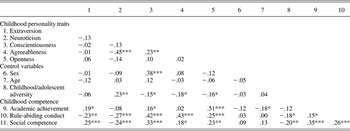
We first obtained the correlations among the childhood variables: the Big Five personality traits, the control variables of sex and age, chronic adversity in childhood/adolescence, and competence. These correlations are shown in Table 2. These correlations reveal several important patterns. First, agreeableness was positively correlated with conscientiousness and negatively correlated with neuroticism, but no other traits were significantly intercorrelated. Second, sex was correlated with conscientiousness (girls had higher conscientiousness in childhood) but no other childhood variables, and age was correlated with academic achievement (older children had modestly worse academic achievement) but no other childhood variables. Third, chronic adversity (life experiences judged to be independent of child behavior) was modestly negatively correlated with conscientiousness, agreeableness, and openness to experience and modestly positively correlated with neuroticism. Fourth, childhood competence showed a number of associations with concurrent personality traits. Academic achievement was associated modestly with extraversion and conscientiousness and strongly with openness. Rule-abiding versus antisocial conduct was moderately negatively correlated with extraversion and neuroticism and moderately positively correlated with conscientiousness, agreeableness, and openness. Social competence with peers showed modest to moderate associations with all the traits: a negative association with neuroticism and a positive association with all the other traits. Thus, all of the childhood personality traits already showed significant relationships with competence in childhood.
Correlations among the childhood variables: Big Five personality traits, sex and age, childhood/adolescent adversity, and competence

*p < .05. **p < .01. ***p < .001.
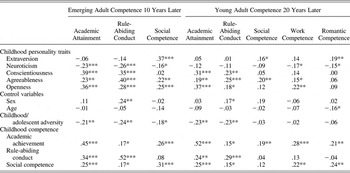
We next computed the correlations between all of the childhood predictor variables (the Big Five personality traits, the control variables of sex and age, chronic adversity in childhood/adolescence, and childhood competence in the domains of academic achievement, rule-abiding conduct, and social competence) and the competence variables in EA and YA; the correlations are presented in Table 3. The results demonstrate that all of the competence outcomes in EA and YA were predicted by at least one and often by more than one childhood personality trait. Sex was related to rule-abiding conduct in EA and YA, such that females developed higher levels of rule-abiding conduct. Age was modestly negatively related to social competence in YA but no other outcomes. Participants' history of exposure to chronic adversity in childhood and adolescence was modestly negatively related to all of the EA competence outcomes and to academic attainment and rule-abiding conduct in YA. Finally, academic attainment in EA and YA, rule-abiding conduct in EA and YA, and social competence in EA were all moderately to strongly predicted by childhood competence in the same domains, but were predicted by other domains of childhood competence as well. Work competence and romantic competence in YA were both predicted by childhood academic achievement and social competence.
Correlations between childhood predictor variables and emerging adult and young adult competent outcomes 10 and 20 years later

*p ≤ .05. **p ≤ .01. ***p ≤ .001.
Regressions
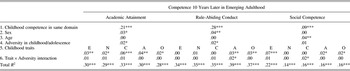
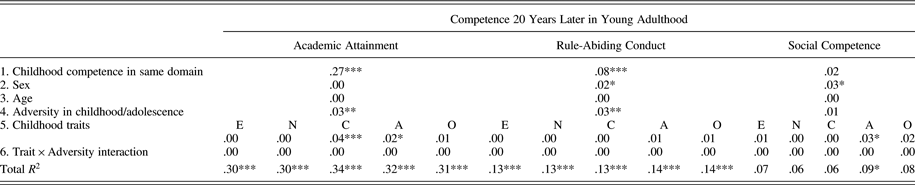
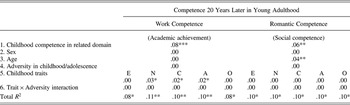
We investigated whether chronic adversity, childhood personality traits, and their interaction predicted EA and YA competence, after taking into account childhood competence in the same or the most conceptually related domain for aspects of competence that were not salient in childhood (e.g., academic was controlled for work and social for romantic competence). In other words, we examined whether chronic adversity, childhood traits, and their interaction predicted interindividual change in competence from childhood through EA and YA. We addressed this question by conducting separate hierarchical multiple regressions predicting each of the three EA and five YA competence variables in a series of steps. In Step 1, we entered the scores for the most relevant childhood competence domain. In Steps 2 and 3, the control variables of sex and age, respectively, were entered. In Step 4, scores for chronic adversity in childhood and adolescence were entered to examine the potential main effect of adversity on later competence. In Step 5, we entered a single Big Five childhood trait to determine whether that trait predicted later competence after taking chronic adversity into account. Finally, in Step 6, we entered the interaction of the specific Big Five childhood trait and chronic adversity; this final step enabled us to determine whether the effects of adversity on EA and YA adaptation varied depending on the participants' childhood personality traits. The results are summarized in Table 4, Table 5, and Table 6 and indicate the increment in R 2 for each step of the regressions and the significance of the F test for that step. The results presented in this section report the beta weights for variables at their entry.
Hierarchical multiple regressions relating childhood Big Five personality traits to competence 10 years later in emerging adulthood

Note: E, extraversion; N, neuroticism; C, conscientiousness; A, agreeableness; O, openness to experience. The R 2 change and the significance of the increment are shown at each step.
*p ≤ .05. **p ≤ .01. ***p ≤ .001.
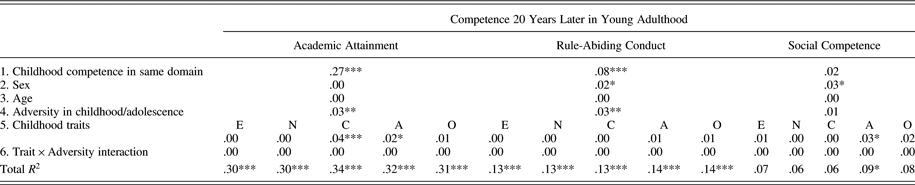
Hierarchical multiple regressions relating childhood Big Five personality traits to competence in the domains of academic attainment, conduct, and social competence 20 years later in young adulthood
Note: E, extraversion; N, neuroticism; C, conscientiousness; A, agreeableness; O, openness to experience. The R 2 change and the significance of the increment are shown at each step.
*p ≤ .05. **p ≤ .01. ***p ≤ .001.
Hierarchical multiple regressions relating childhood Big Five personality traits to work and romantic competence 20 years later in young adulthood

Note: E, extraversion; N, neuroticism; C, conscientiousness; A, agreeableness; O, openness to experience. The R 2 change and the significance of the increment are shown at each step.
*p ≤ .05. **p ≤ .01. ***p ≤ .001.
The results of the regressions predicting EA and YA academic attainment, rule-abiding conduct, and social competence are shown in Tables 4 and 5, respectively. Academic attainment in EA and YA was predicted positively by childhood academic achievement (B = 0.45 for EA, B = 0.52 for YA); negatively by chronic adversity (B = −0.16 for EA, B = −0.17 for YA); and positively by childhood conscientiousness and agreeableness (conscientiousness: B = 0.29 for EA, B = 0.23 for YA; agreeableness: B = 0.19 for EA, B = 0.15 for YA). In addition, for EA academic attainment, sex was a significant predictor (females had higher attainment), extraversion was a negative predictor (B = −0.16), neuroticism was a negative predictor (B = −0.18), and openness was a positive predictor (B = 0.17). The interaction of chronic adversity and the childhood traits did not add to the prediction of academic attainment once the main effects of both variables were accounted for.
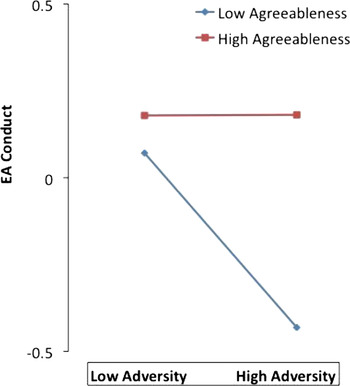
Rule-abiding conduct in EA and YA was positively predicted by childhood conduct (B = 0.52 for EA, B = 0.29 for YA); predicted by sex (females had higher rule-abiding conduct at both times); and negatively predicted by adversity (B = −0.14 for EA, B = −0.18 for YA). In addition, EA conduct was positively predicted by childhood agreeableness and openness (agreeableness: B = 0.19; openness: B = 0.17), but YA conduct was not predicted by any of the childhood traits. The interaction of agreeableness and chronic adversity added to the prediction of EA conduct (B = 0.13); the interaction is plotted in Figure 1 for low and high adversity (1 SD above and below the mean) and low and high agreeableness (1 SD above and below the mean). At high levels of childhood agreeableness, adversity did not predict EA rule-abiding conduct. In contrast, at low levels of childhood agreeableness, conduct was much worse at outcome with a high adversity history. Thus, the combination of low childhood agreeableness and high chronic adversity predicted a heightened risk for conduct problems in EA, consistent with agreeableness functioning as a protective factor or its lack functioning as a vulnerability, or both. None of the other interactions of childhood traits and adversity added to the prediction of EA or YA conduct.
The interaction effect of childhood/adolescent adversity and childhood agreeableness in the prediction of rule-abiding conduct in early adulthood (EA). [A color version of this figure can be viewed online at http://journals.cambridge.org/dpp]

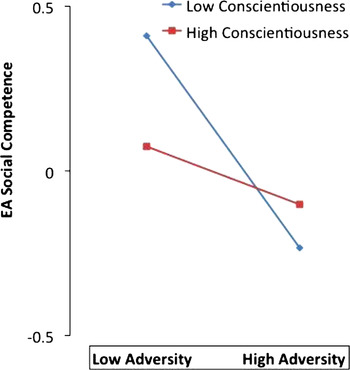
Findings for predictors of social competence varied somewhat for EA and YA. For EA, social competence was positively predicted by childhood social competence (B = 0.31), negatively predicted by age (B = −0.19), and positively predicted by extraversion, agreeableness, and openness (B = 0.28 for extraversion and B = 0.16 for agreeableness and openness). Neither sex nor chronic adversity added to the prediction of EA social competence. Only in the case of childhood conscientiousness did the interaction of a childhood trait and chronic adversity add to the prediction of EA social competence (B = 0.15); the interaction is plotted in Figure 2 for high and low adversity (1 SD above and below the mean) and low and high conscientiousness (1 SD above and below the mean). Generally, a history of adversity was negatively related to social competence outcomes in EA, but this association was stronger for those who were less conscientious in childhood. When adversity exposure was low (more benign life conditions), less conscientious children had better social competence outcomes in EA, but when adversity exposure was high, the less conscientious did not show an advantage in this domain. This finding was surprising because it suggested positive outcomes for low childhood conscientiousness in this domain when there was a history of low adversity exposure. Ten years later, social competence in YA was predicted only by sex (females had better quality YA friendships) and by childhood agreeableness (B = 0.17), but not by childhood social competence, age, any of the other childhood traits, chronic adversity, or the interaction of the childhood traits and adversity.
The interaction effect of childhood/adolescent adversity and childhood conscientiousness in the prediction of social competence in early adulthood (EA). [A color version of this figure can be viewed online at http://journals.cambridge.org/dpp]

The results of the regressions predicting YA work competence and romantic competence are shown in Table 6. YA work competence was predicted positively by childhood academic achievement (B = 0.28), positively by childhood conscientiousness (B = 0.15) and agreeableness (B = 0.15), and negatively by childhood neuroticism (B = −0.16). YA romantic competence was predicted positively by childhood social competence (B = 0.24) and negatively by age (B = −0.19), but not by any of the other predictors.
The overall pattern of findings from the regressions suggests several conclusions. Chronic childhood and adolescent adversity predicted more negative EA and YA outcomes in the domains of academic attainment and rule-abiding conduct, even after taking into account earlier competence in the same domains. However, chronic adversity did not add to the prediction of EA and YA social competence, nor to the prediction of YA work and romantic competence. Consistent with previous findings, childhood personality traits predicted multiple domains of adaptive competence outcomes in EA and YA (Shiner, Reference Shiner2000; Shiner et al., Reference Shiner, Masten and Roberts2003), and the current regressions demonstrated that this was true even after controlling for participants' history of chronic adversity. These findings provide support for a “main effects” model of childhood personality traits in which such traits serve as promotive factors across levels of adversity. Finally, the interaction of childhood traits and chronic adversity did not add to the prediction of EA and YA adaptive outcomes, except in two instances, once the main effects of chronic adversity and childhood personality were taken into account. Thus, the effects of childhood traits on later outcomes did not vary in most instances by the participants' exposure to cumulative adversity experiences, at least for adversity that arose independent from child behavior.
Person-focused analyses
Comparison of EA and YA competent, resilient, and maladaptive groups on childhood personality traits
We undertook person-focused analyses to provide a complementary perspective on the contributions of childhood personality to competent EA and YA functioning in the face of adversity. These analyses looked at the childhood traits of participants with particular configurations of adversity exposure and competent EA and YA functioning across multiple domains. Participants were classified in EA into groups based on participants' EA competent outcomes and history of chronic adversity in childhood and adolescence. Three groups of individuals were identified: competent (adequate competence, low adversity), resilient (adequate competence, high adversity), and maladaptive (low competence, high adversity). Following procedures used in Masten et al. (Reference Masten, Burt, Roisman, Obradović, Long and Tellegen2004) for YA, participants were reclassified in YA into competent, resilient, and maladaptive groups, this time based on their YA competent outcomes and the same measure of chronic adversity in childhood and adolescence. There were too few participants in the highly vulnerable cell (low competence, low adversity) in EA and YA to include that cell in the analyses. Although many participants remained classified in the same group in EA and YA, some participants switched groups because those participants' adaptive functioning changed from EA to YA.
The competent, resilient, and maladaptive groups were identified during EA and YA by using cut scores on adversity and competence. High adversity was defined in both EA and YA by ratings of severe to catastrophic adversity (≥5.0) in two periods: from birth through the childhood assessment and from the childhood assessment through the adolescent assessment 7 years later. Low adversity was defined as ratings below 5.0 throughout childhood and adolescence. These cut points yielded a high adversity group that averaged above a 6 on the 7-point scale. These high adversity scores translated into a childhood and adolescent history of many serious events (e.g., divorce, financial crises), multiple traumatic experiences (e.g., death of parents, assault), or chronic severe stressors (e.g., living with a violent alcoholic parent in chronic poverty).
Although high and low adversity was defined the same way in EA and YA, the definitions of adequate and low competence differed for EA and YA outcomes. In EA, competence was defined using cut scores for the three major competent outcomes (academic attainment, rule abiding conduct, and social competence). Participants were classified as having adequate competence if they scored higher than 0.5 SD below the sample mean on all three competence indicators in EA (i.e., z scores > −0.5). In contrast, participants were classified as exhibiting low competence if they fell more than 0.5 SD below the mean on at least two of the three competence indicators (i.e., z scores < −0.5). Adequate and low competence was defined somewhat differently in YA to accommodate the changing expectations for competence in YA versus EA. During YA competent individuals may step back from some domains of life to focus on others (e.g., a person may choose not to work in order to focus on parenting, or may opt to focus on work rather than on cultivating a long-term romantic relationship). In addition, parenting becomes an especially important domain of competence for those individuals who have become parents. Thus, in YA participants were considered adequate in competence if they scored higher than 0.5 SD below the sample mean on four YA competence indicators (i.e., z scores > −0.5) and low in competence if they fell more than 0.5 SD below the mean on at least three YA competence indicators (i.e., z scores < −0.5). Parents were required to score in the adequate range on parenting competence to be considered adequate in competence overall. Using these criteria for adversity and competent outcomes, in EA 27 competent, 36 resilient, and 25 maladaptive participants were identified, and in YA 34 competent, 49 resilient, and 21 maladaptive participants were identified. A number of participants were not assigned to any group because they did not meet the criteria for the high and low adversity groups and/or they did not meet the criteria for the adequate and low competence groups.
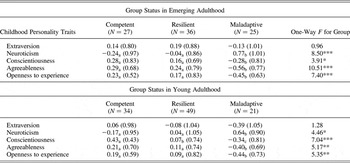
Once the groups were identified, we turned to the question of whether the competent, resilient, and maladaptive groups identified in EA and YA differed in their childhood personality traits. First, a series of one-way analyses of variance (ANOVAs) was conducted to compare the three EA groups and then the three YA groups on their average levels of the Big Five traits in childhood. In the cases in which the F values indicated significant differences among the groups on a childhood trait, a post hoc least significant difference test was used to pinpoint which groups significantly differed from another. The results of the ANOVAs and post hoc tests are presented in Table 7. A very similar pattern of results was obtained for both the EA and YA groups. The competent, resilient, and maladaptive groups in EA and YA did not differ on childhood extraversion. However, the groups in EA and YA differed on all of the other Big Five childhood traits. In all cases except for one, the competent and resilient groups did not differ from each other but did differ from the maladaptive group. Specifically, for both EA and YA outcomes, the competent and resilient groups exhibited higher agreeableness and openness to experience and lower neuroticism in childhood than did the maladaptive group. Similarly, for EA outcomes, the competent and resilient groups exhibited higher conscientiousness in childhood than did the maladaptive group. A somewhat different pattern emerged for childhood conscientiousness among the YA groups; in this case only, the competent participants demonstrated higher childhood conscientiousness than the resilient group, which in turn demonstrated higher childhood conscientiousness than the maladaptive group. In most cases for both EA and YA outcomes, the competent and resilient groups had obtained personality trait scores close to the mean in childhood, whereas the maladaptive group had displayed notably negative personality traits in childhood. This pattern suggests that the participants who eventually became competent and resilient in EA and YA had displayed normal-range personalities in childhood, whereas the participants who eventually became maladaptive in EA and YA had already manifested personality difficulties earlier in life.
Group means (standard deviations) on childhood personality traits for competent, resilient, and maladaptive youth defined by competence in emerging adulthood and young adulthood

Note: Personality trait values are reported in full sample-based z scores. Groups with different subscripts differ significantly.
*p ≤ .05. **p ≤ .01. ***p ≤ .001.
Continuity and change group comparisons on childhood personality traits
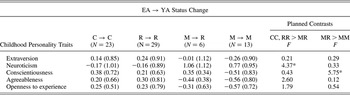
As noted earlier, although most participants remained in the same group from EA to YA, there were some participants who switched groups from EA to YA. We were especially interested in exploring the childhood personality traits of the participants who switched from the maladaptive group in EA to the resilient group in YA a decade later. Thus, we created a change classification for participants based on their group identifications at EA and YA: participants who were competent at both time points, participants who were resilient at both time points, participants who were maladaptive at both time points, and a small group of six participants who changed from maladaptive in EA to resilient in YA. Only two participants switched from resilient in EA to maladaptive in YA and therefore could not be studied as a group. All of the participants in the change group were female.
Two sets of planned contrasts were undertaken. The first set of contrasts compared the stable competent and resilient groups (CC or RR) to the group changing from maladaptive to resilient (MR) to determine whether the latter group had faced any particular challenges in terms of negative childhood personality traits. The second set of contrasts compared the group changing from maladaptive to resilient to the group that remained maladaptive across time (MR vs. MM) to determine whether the change group exhibited any childhood personality traits that may have served as resources for their late-emerging positive development. The results of the one-way ANOVAs testing the planned contrasts on the Big Five childhood traits are presented in Table 8. First, for the tests comparing the stable competent and resilient groups to the change group, the groups significantly differed on only one childhood trait: the group that changed from maladaptive to resilient received scores more than 1 SD higher on childhood neuroticism than the stable competent and resilient groups. Second, for the tests comparing the stable maladaptive group to the change group, one childhood trait differed; the group that changed from maladaptive to resilient displayed higher childhood conscientiousness than the stable maladaptive group. These results suggest that the group that changed from maladaptive to resilient was characterized by very high levels of neuroticism in childhood but also displayed levels of childhood conscientiousness comparable to the competent and resilient groups.
Group means (standard deviations) on childhood personality traits for stable/change groups

Note: Personality trait values are reported in full sample-based z scores. C → C, Competent in emerging adulthood (EA) and young adulthood (YA); R → R, resilient in EA and YA; M → R, maladaptive in EA and resilient in YA; M → M, maladaptive in EA and YA.
*p < .05.
Discussion
This study examined the significance of the Big Five personality traits assessed in childhood for resilience in early adulthood. Resilience was defined in terms of adaptive competence in multiple domains of age-salient developmental tasks despite significant adversity throughout childhood and adolescence. Variable-focused and person-focused analyses were conducted. Regression analyses showed significant main effects and only two interactions effects (personality by adversity) for childhood personality predicting competence 10 and 20 years later. Specifically, childhood personality traits predicted adult adaptive outcomes, even after controlling for the main effects of adversity. Person-centered analyses found that individuals identified as resilient in EA and YA (adequate competence, high adversity) differed from those identified as maladaptive (low competence, high adversity) in manifesting higher conscientiousness, agreeableness, and openness and lower neuroticism 10 or 20 years earlier. Resilient adults generally did not differ from their competent, low-adversity peers in childhood personality. Participants who moved from the maladaptive category in EA to competent in YA exhibited higher childhood conscientiousness than their consistently maladaptive peers. Results point to the importance of childhood personality for the development of adult competence across both high- and low-adversity conditions. In the following, we explore the findings in greater detail, first addressing the general findings for the links between child personality traits and adult competence and resilience and then turning to the results for each of the Big Five traits. We close by discussing the implications of the findings for future research on child personality and resilience.
General findings for childhood personality and adult resilience
Does personality assessed in childhood predict adult competence and resilience?
Variable-focused analyses
In the variable-focused analyses, we examined whether the participants' exposure to chronic adversity across the childhood and adolescent years, their personalities as children, and the interaction of the two predicted the participants' competence in developmental tasks 10 and 20 years later. In both EA and YA, the tasks included academic attainment, rule-abiding versus antisocial conduct, and social competence with peers. Two additional tasks were examined in YA: work competence and competence in romantic relationships. Chronic childhood/adolescent adversity predicted academic attainment and rule-abiding conduct in EA and YA but none of the other competent outcomes; thus, main effects of chronic adversity seemed to be limited to the domains of academic attainment and conduct.
For all of the outcomes 10 years later in EA and for academic attainment, social competence with peers, and work competence 20 years later in YA, at least one of the childhood Big Five traits added significant predictive power, even after controlling for childhood competence in the same domain (or for childhood academic achievement in the case of YA work competence) and for the main effects of adversity. These results indicate that childhood personality traits predicted changes in competent adaptation over time. These findings are consistent with a model of personality traits serving as promotive factors for children facing adversity. Positive personality traits added to the prediction of participants' adaptive outcomes regardless of the participants' exposure to significant adversity. In other words, particular personality traits confer benefits for specific adult outcomes both for people who have grown up in adverse conditions and for people who have grown up in more benign conditions. Our findings in this regard complement those summarized by Lengua and Wachs (in press) in their review of the contributions of temperament to resilience; they found a number of previous studies in which low negative emotionality (similar to low neuroticism) and high effortful control (similar to high conscientiousness) predicted positive outcomes, controlling for adversity exposure. We obtained similar findings for neuroticism and conscientiousness. Our findings add to the previous ones by documenting that the predictive effects of childhood traits extend to adulthood and that the personality traits of agreeableness and openness to experience additionally serve as promotive factors for some adult outcomes. In addition, we were able to document that extraversion was a promotive factor for EA social competence with peers but a risk factor for worse EA academic attainment.
In the regression analyses, after examining whether adversity and childhood traits predicted adult outcomes, we investigated whether the interaction of adversity and the childhood traits added to the prediction of adult competence. We found two instances of this: child agreeableness interacted with adversity to predict EA rule-abiding conduct, and child conscientiousness interacted with adversity to predict EA social competence. We discuss these interaction effects in more detail in the next section on each of the Big Five traits. It should be kept in mind, however, that for the majority of the regressions, the interaction effects did not add to the prediction of adult outcomes. Thus, we did not obtain consistent evidence for childhood traits serving as protective or vulnerability factors because childhood personality only rarely moderated the effects of adversity on adult outcomes. Lengua and Wachs' (in press) review of the literature did identify some instances in which the temperament traits of negative emotionality and effortful control moderated the impact of adversity; however, these studies generally measured personality, adversity, and outcomes simultaneously or over much shorter periods of time. Our findings should not be taken as demonstrating that moderating effects of child personality and adversity do not occur; such effects are difficult to detect without a very large sample size (Donnellan, Conger, McAdams, & Neppl, Reference Donnellan, Conger, McAdams and Neppl2009). Moreover, it is conceivable that the moderating influences of personality and adversity are more readily detected during short time windows rather than across long time periods. Future work with large, longitudinal samples is needed to examine the possible moderating role of childhood personality and adversity for adult outcomes.
Person-centered analyses
In the person-centered analyses, we examined the childhood personality traits of participants with particular configurations of EA or YA competence and childhood/adolescent adversity. The competent and resilient groups defined in both EA and YA exhibited different patterns of childhood traits than the maladaptive group. Specifically, the competent and resilient groups manifested higher levels of childhood conscientiousness, agreeableness, and openness to experience and lower levels of childhood neuroticism than the maladaptive group; the three groups did not differ in childhood extraversion. The competent and resilient groups did not differ from each other in their earlier childhood traits, with one exception; in the YA analyses, the competent group manifested higher childhood conscientiousness than the resilient group.
The pattern of findings for these person-centered analyses yields some important insights into the prediction of resilience from childhood personality. In most cases, the mean personality trait scores for the competent and resilient groups fell within 0.33 SD of the mean for the whole Project Competence sample. In other words, the two groups with good adult outcomes had not exhibited extremely positive personality traits in childhood; rather, they had exhibited personality traits that were modestly above or below the average in a positive direction. Further, the findings indicated that the resilient participants were able to attain positive adult outcomes with the same levels of positive childhood traits as the competent participants, suggesting that only modestly positive levels of personality traits were needed for participants to be able to overcome adversity. In contrast, for all the childhood traits except for extraversion, the maladaptive participants scored between 0.28 and 0.77 SD away from the sample mean in a negative direction. The participants who struggled to overcome adversity by adulthood were those who had exhibited relatively higher negative emotions, along with lower levels of positive interpersonal traits, self-control, and drive for mastery as children.
It is interesting to note that three of the childhood traits that differentiated the later competent and resilient participants from the maladaptive ones were (low) neuroticism, conscientiousness, and agreeableness. Across a number of studies with both children and adults, these traits tend to covary and, at a higher level of organization, form a metatrait labeled “stability” by DeYoung (Reference DeYoung2006). Digman (Reference Digman1997) was one of the first researchers to identify this metatrait of low neuroticism, high conscientiousness, and high agreeableness; he described this metatrait as representing a system indexing “the different degrees of success achieved by the socialization process” (p. 1250). He viewed these traits as the ones that adults strive to cultivate in the children under their care. This overarching trait measures individuals' tendencies to maintain well-controlled, stable functioning in emotional, social, and motivational domains (DeYoung, 2006). Given the importance of this cluster of traits for maintaining stable, adaptive functioning, it is not surprising that all three traits foreshadowed later adult competent outcomes.
What childhood traits characterize the late-blooming participants?
Following earlier work by Masten et al. (Reference Masten, Burt, Roisman, Obradović, Long and Tellegen2004), we examined the childhood traits of the group of six participants who changed status from maladaptive in EA to competent in YA. Relative to the participants who remained competent or resilient from EA to YA, this late-blooming group differed on one notable childhood trait: neuroticism. The group changing from maladaptive to competent exhibited levels of neuroticism more than 1 SD higher than the two groups that had already achieved positive outcomes by EA. Most likely, the high levels of negative emotions experienced by the change group posed difficulties for them in childhood and adolescence. Perhaps the final maturing of cognitive control systems or opportunities to move into new contexts in early adulthood facilitated positive change in this group (Burt & Masten, Reference Burt, Masten, Grant and Potenza2009; Steinberg, Reference Steinberg2009).
This change group also differed from the group that was consistently maladaptive from EA to YA; in this case, the change group turned out to have demonstrated higher levels of childhood conscientiousness than the stable maladaptive group. Given the level of negative emotionality displayed in childhood by this group, perhaps they were able to correct their developmental pathway in early adulthood with the support of adult executive functions that require late-maturing prefrontal neural systems. They may have needed fully mature executive functions to make important changes in their lives, including better self-regulation of negative emotions. The current findings are consistent with results from earlier analyses from Project Competence on the EA resources of the two groups (Masten et al., Reference Masten, Burt, Roisman, Obradović, Long and Tellegen2004); in these earlier analyses, the change group exhibited higher planfulness/future motivation and autonomy in EA than the group remaining maladaptive from EA to YA. The late-blooming group showed evidence of potential internal resources in terms of self-control, both in childhood and in EA. We should note that all of the participants in the change group were female, which is consistent with Werner and Smith's (1992) finding that females were more likely than males to show significant turnarounds in resilience from adolescence to adulthood. Females exhibited higher childhood conscientiousness than boys in this sample, consistent with other research on childhood gender differences in self-control (Else-Quest, Hyde, Goldsmith, & Van Hulle, Reference Else-Quest, Hyde, Goldsmith and Van Hulle2006). The all-female makeup of the late-blooming resilient participants in this study sample may perhaps be due in part to the fact that the female participants had higher average levels of conscientiousness, which may have provided them with an advantage over the males in the development of competence over time.
Findings for specific Big Five childhood traits and adult competence and resilience
Extraversion
Extraversion measured the children's tendencies toward being outgoing and socially dominant, rather than socially withdrawn and passive. The current measure of extraversion emphasized participants' tendencies toward social potency, rather than their positive emotions and warm connections with others. In the present study, extraversion had mixed relationships with competence and resilience. Concurrently, childhood extraversion was associated positively with academic achievement and social competence, but it was associated negatively with rule-abiding conduct. Consistent with previous findings in this sample (Shiner, Reference Shiner2000), extraversion predicted positive relationships with peers in EA, controlling for childhood social competence and adversity exposure. However, extraversion also predicted negative changes in academic attainment from childhood to EA, controlling for adversity. Extraversion was also the only childhood trait that did not vary across the EA and YA competent, resilient, and maladaptive groups. Overall, in this study extraversion seemed less relevant for the development of adult resilience than any of the other traits, perhaps in part because of its mixed impact on the development of competence. This finding may seem to contradict earlier work from the Kauai Longitudinal Study showing that more emotionally positive children became more resilient as adults (Werner & Smith, Reference Werner and Smith1992). It seems possible that the childhood measures of emotional positivity in the Kauai study may have indexed the positive emotions associated with early agreeableness, rather than extraversion.
Neuroticism
Neuroticism measured the children's propensity toward feeling worried, distressed, easily upset, inferior, and sad. Childhood neuroticism was negatively associated with concurrent rule-abiding conduct and social competence. This trait predicted worsening academic achievement from childhood to EA, and it negatively predicted YA work competence after controlling for childhood academic achievement. In addition, the maladaptive participants in EA and YA exhibited much higher levels of neuroticism as children than those who were competent and resilient in EA and YA, and the late-blooming participants who switched from maladaptive in EA to competent in YA likewise showed extremely high levels of childhood neuroticism compared to the persistently competent and resilient groups. Taken together, these findings suggest that high levels of neuroticism pose risks for development across all levels of adversity. Previous work in the Project Competence sample examined differences in concurrent negative emotionality and stress reactivity in the EA competent, resilient, and maladaptive groups and found that the maladaptive group reported considerably higher levels of these negative personality traits (Masten et al., Reference Masten, Hubbard, Gest, Tellegen, Garmezy and Ramirez1999); the present findings add to this earlier work by showing that these differences in negative emotions in the three EA groups were already present in childhood. The present findings are consistent with the large literature linking negative emotionality with adaptive failures in childhood and neuroticism with social difficulties and psychopathology in adults (Caspi & Shiner, Reference Caspi, Shiner, Damon, Lerner and Eisenberg2006). Previous work from Project Competence demonstrated that adaptive problems in childhood predicted increasingly high levels of negative emotionality from childhood through EA (Shiner, Masten, & Tellegen, Reference Shiner, Masten and Tellegen2002). Thus, negative emotions in childhood and adaptive difficulties may have reciprocal negative effects on each other.
Conscientiousness
Conscientiousness focused on the children's serious, thorough, and responsible approach to school; children high on this trait embraced the schools' agenda for them and showed good self-control. Conscientiousness was positively associated with all three concurrent indicators of competence. Further, even after controlling for adversity exposure, the trait was a robust predictor of positive increases in academic achievement from childhood to EA and YA, and it predicted YA work competence as well. In addition, the competent and resilient participants in EA and YA had a childhood history of higher conscientiousness than their maladaptive peers. As noted previously, this was the one childhood trait that differentiated those who switched from maladaptive in EA to resilient in YA from those who remained maladaptive over time. The present findings add to the cumulating evidence that childhood self-control is crucial for many aspects of positive adult development (Moffitt et al., Reference Moffitt, Arseneault, Belsky, Dickson, Hancox and Harrington2011) and demonstrate the importance of children's conscientious approach to schoolwork.
We found an interesting interaction effect for childhood conscientiousness and chronic adversity in the prediction of social competence with peers in EA. Specifically, children who were low on conscientiousness and exposed to low levels of adversity had higher levels of social competence in EA, whereas children who were low on conscientiousness and exposed to high adversity and the children who were high on conscientiousness (regardless of adversity exposure) developed lower levels of social competence in EA. In other words, low conscientious children with relatively benign life conditions had the best outcomes in terms of friendships with peers in the EA years. Previous work in Project Competence may help to clarify this surprising finding. Children who were high on conscientiousness grew up to be more likely to see themselves as behaviorally controlled, nonaggressive, and traditional and as disliking risky situations, and they reported having somewhat more inhibited social relationships as adults (Shiner et al., Reference Shiner, Masten and Roberts2003). Perhaps the less conscientious children who had experienced less adversity were less inhibited in the EA years and better able to cultivate friendships with peers during the EA phase of life, when forming friendships requires considerable self-initiative. It is important to emphasize, however, that any advantage of low childhood conscientiousness for positive friendships disappeared by YA.
Agreeableness
Agreeableness assessed the children's tendencies to be considerate, flexible, kind, and tolerant rather than selfish, egotistical, rude, and cynical. This trait was positively associated with rule-abiding conduct and social competence in childhood and with a broader range of positive adult outcomes than any other trait. After controlling for adversity exposure, childhood agreeableness predicted positive changes in academic achievement in EA and YA, rule-abiding conduct in EA, and social competence with peers in EA and YA, and it predicted positive work competence in YA, controlling for earlier academic achievement. Clearly, agreeableness was important both for more task-focused endeavors like school and work and for relationships. The competent and resilient groups in EA and YA also manifested higher agreeableness in childhood than the maladaptive group. Because much of the work on traits as sources of resilience has focused on temperament traits, agreeableness has been an overlooked contributor to resilient outcomes. Other research confirms that disagreeableness is associated with a wide variety of negative outcomes (Caspi & Shiner, Reference Caspi, Shiner, Damon, Lerner and Eisenberg2006; Laursen, Hafen, Rubin, Booth-LaForce, & Rose-Krasnor, Reference Laursen, Hafen, Rubin, Booth-LaForce and Rose-Krasnor2010) and that agreeableness may be an especially important source of resilience for those confronted by severe difficulties (Boyce & Wood, Reference Boyce and Wood2011).
Agreeableness may also serve a protective effect for conduct for people exposed to high levels of adversity, given that the interaction of childhood agreeableness and chronic adversity predicted EA rule-abiding versus antisocial conduct. Participants with a history of high childhood agreeableness manifested good rule-abiding conduct rather than antisocial conduct in EA regardless of adversity exposure; in contrast, at low levels of childhood agreeableness, conduct was worse in EA in interaction with high adversity. Although results do not always replicate, a number of studies have documented gene–environment interactions in which particular types of chronic adversity in combination with specific genes predicted heightened risks of conduct disorder or antisocial behavior (Thapar, Harold, Rice, Langley, & O'Donovan, Reference Thapar, Harold, Rice, Langley and O'Donovan2007). Looked at differently, these studies show that particular genes may promote resilience in the face of adversity (Kim-Cohen & Gold, Reference Kim-Cohen and Gold2009). The trait of agreeableness may be a mediator through which genetic vulnerabilities and protections have their effects. Certainly, this trait warrants more consideration as a source of resilence, given its association with many positive adult outcomes.
Openness to experience
Openness to experience described the children's imaginativeness, creativity, enthusiastic involvement in activities, and engagement in the life of the mind. Similar constellations of traits with the label mastery motivation or achievement motivation have received a great deal of attention in the developmental literature, particularly because these traits typically are linked with better academic attainment, at least in childhood (Wigfield, Eccles, Schiefele, Roeser, & Davis-Kean, Reference Wigfield, Eccles, Schiefele, Roeser, Davis-Kean, Damon, Lerner and Eisenberg2006). In this study, childhood openness was associated positively with all three childhood competence domains, and it predicted positive changes in academic achievement in EA and YA and in social competence in EA, controlling for adversity and childhood competence in those domains. Higher childhood openness also differentiated the competent and maladaptive groups in EA and YA from the maladaptive group. Some childhood measures of openness actually include items measuring children's ability to adapt flexibly to new or challenging situations (e.g., Goldberg, Reference Goldberg2001). In a study of adults presented with a laboratory stressor, higher openness was related to better stress regulation at both the physiological and psychological levels (Williams, Rau, Cribbet, & Gunn, Reference Williams, Rau, Cribbet and Gunn2009). This trait appears to index individual differences in positive engagement with novel information and situations and may be an important source of adaptability in stressful times.
Limitations and implications of findings for future work on childhood personality and the development of resilience
This study had a number of limitations as well as strengths. The sample size was moderate for the complexity of the analyses, and the cohort varied in age at each assessment point. In addition, the Big Five childhood personality traits were measured using different measures for each trait, rather than via a single standardized personality measure. This study also did not attempt to elucidate the processes by which childhood personality may influence the development of competence or resilience. Nonetheless, this study offers a rare glimpse at the predictive significance of childhood personality for competence and resilience in adulthood, providing important clues for future investigation. Strengths of the study include the longitudinal design with high retention, multimethod assessments, and robust indicators of a wide range of child traits, including agreeableness and openness, two traits that have been previously overlooked in developmental research on resilience.
The present findings demonstrate that all of the Big Five childhood traits except for extraversion are harbingers of adult competence and resilience. Taken together, the results suggest that children who do well in important developmental tasks, whether they face low or high adversity, have the ability to regulate their emotions and apply themselves seriously to schoolwork, as well as the capacity for empathy and connection, and the drive for mastery and exploration. However, youths do not need to exhibit unusually high levels of these positive traits for them to attain resilient outcomes in the face of stress and adversity; rather, modestly positive levels of these traits seem to suffice. In contrast, youths with more challenging personality traits—high levels of negative emotions, poor self-control, disagreeableness, and disinterest in mastery development—are likely to be at risk for negative outcomes, regardless of their exposure to adversity.
There undoubtedly are many processes by which personality traits in childhood could influence adult success, in low- as well as high-adversity contexts. These were not examined in this study, but it will be important to elucidate these processes, particularly for the goal of preventing maladaptive outcomes and promoting resilience among young people exposed to high adversity. Childhood personality already was moderately related to concurrent competence at the outset of the study, suggesting earlier influence of child traits on competence already had occurred. Moreover, specific traits were related to multiple domains of competence over time, suggesting that there may be multiple pathways through which child traits affect adaptation. A number of previous reports from this study have indicated cascade effects, where adaptive behavior in one domain appears to spread to other domains over time (Masten et al., Reference Masten, Roisman, Long, Burt, Obradović and Riley2005, Reference Masten, Desjardins, McCormick, Kuo and Long2010; Obradović et al., 2010). Personality could have various indirect effects on adult competence via its effect on related domains of competence. For example, agreeableness could influence work outcomes indirectly though effects on social competence; earlier results from this study indicate that social competence in childhood has unique predictive effects on work competence (Masten et al., Reference Masten, Desjardins, McCormick, Kuo and Long2010). Future work may help to elucidate the processes through which children's personality traits shape their behavior and subsequent adaptation.
Although temperament and personality traits show some continuity across time, even in the early childhood years (Roberts & DelVecchio, Reference Roberts and DelVecchio2000), they also change over time. Rather than being static, endogenous features of the person, traits are developmental constructions that emerge through the interplay of genetic and environmental factors (Rothbart, Reference Rothbart2011). There is thus the potential for traits to change, both naturally and through intervention. A number of intervention programs have been designed to modify children's typical patterns of behavior, including their capacities for self-regulation, emotional competence, and coping (Blair & Diamond, Reference Blair and Diamond2008; Duckworth & Allred, in press; McClowry & Collins, in press; Noam & Herman, Reference Noam and Hermann2002). Findings like those in the present study help to pinpoint what behavioral patterns may be effective targets for prevention and intervention.
Finally, the present results point to the need to better understand the interplay of adversity and personality development. This study focused on chronic adversity that was independent of the participants' behavior and its impact on the development of competence. Much of the adversity that individuals experience arises either directly or indirectly from their own behavior and thus is likely to be related to their personality traits (see, e.g., King, Molina, & Chassin, Reference King, Molina and Chassin2008). Future work should consider the possibility that nonindependent adversity may have its own separate impact on the development of competence and resilience. Adversity may also have an impact on personality development. Preliminary work indicates that some exposure to adversity may actually confer benefits for both external adaptation and internal life satisfaction, relative to no exposure to adversity at all (Seery, Holman, & Silver, Reference Seery, Holman and Silver2010). Nonetheless, there is other evidence that extreme adversity, including significant poverty, has negative effects on personality development, including children's emerging self-regulatory skills (Blair, Reference Blair2010; Hart, Atkins, & Matsuba, Reference Hart, Atkins and Matsuba2008). In this study, chronic adversity was modestly negatively correlated with childhood conscientiousness, agreeableness, and openness to experience and modestly positively correlated with childhood neuroticism. It is thus possible that early adversity may have already impacted the participants' personality traits before the study began. Future work should attempt to gain a more complete picture of the complex processes through which children's personalities and their adverse experiences affect their development of effective adaptation over time.