


Introduction
Obsessive-compulsive disorder is a chronic and often disabling anxiety disorder, and has been recognized for more than 300 years (Salzman and Thaler, Reference Salzman and Thaler1981). Although several etiological theories of OCD have been proposed, including psychogenic factors, learning theory, neurological and biological models, most of the theories offer only sketches of putative mechanism and unfortunately fail to account for the full picture of pathological processes. Clark and Purdon (Reference Clark and Purdon1993) suggested that high rate of drop-out, poor treatment compliance, limitation of exposure and response prevention for many patients, and the treatment resistant nature of pure obsession (Rachman and Hodgson, Reference Rachman and Hodgson1980; Salkovskis and Westbrook, Reference Salkovskis and Westbrook1989) have led researchers to explore cognitive processes in the aetiology and treatment of OCD.
The first comprehensive cognitive model of OCD was developed by Salkovskis (Reference Salkovskis1985, Reference Salkovskis1989). Consistent with previous studies in non-clinical populations (e.g. Rachman and de Silva, Reference Rachman and de Silva1978), Salkovskis suggested that cognitive intrusions are universally experienced and may be triggered by external and internal stimuli, and cause a problem to individuals only if they appraise the intrusions as having important adverse personal implications for them. Salkovskis argued that if an appraisal does not include an element of responsibility, the person is likely to be anxious or depressed rather than developing obsessional problems.
Responsibility appraisals lead both to more adverse mood, such as anxiety and depression, and the decisions and motivation to engage in neutralizing behaviours to decrease discomfort, diminish the intrusion, and avoid being responsible for the feared catastrophic consequences. The successful completion of these neutralizing behaviours not only increases the likelihood of further intrusions, but also increases the perceived threat and the perception of responsibility. The role of the exaggerated responsibility was supported by clinical observations (e.g. Rachman, Reference Rachman1993), questionnaires (e.g. Foa, Amir, Bogert, Minar and Preworski, Reference Foa, Amir, Bogert, Milnar and Preworski2001; Foa, Sacks, Tolin, Preworski and Amir, Reference Foa, Sacks, Tolin, Preworski and Amir2002), experimental manipulations (e.g. Arntz, Voncken and Goosen, Reference Arntz, Voncken and Goosen2007; Shafran, Reference Shafran1997), and treatment efficacy studies (e.g. Freeston, Rheaume and Ladouceur, Reference Freeston, Rheaume and Ladouceur1996; Ladouceur, Leger, Rheaume and Dube, Reference Ladouceur, Leger, Rheaume and Dube1996). Moreover, the inflated sense of responsibility in OCD was further supported by the findings from non-Western countries, such as Iran (Ghassemzadeh, Bolhari, Birashk and Salavati, Reference Ghassemzadeh, Bolhari, Birashk and Salavati2005) and Turkey (Altın and Gençöz, Reference Altın and Gencoz2007; Altın and Karanci, Reference Altın and Karanci2008; Yorulmaz, Karanci and Tekok-Kılıç, Reference Yorulmaz, Karancı and Tekok-Kılıç2006; Yorulmaz, Altın and Karanci, Reference Yorulmaz, Altın and Karancı2008).
Rachman (Reference Rachman1997, Reference Rachman1998, Reference Rachman, Menzies and de Silva2003) proposed and elaborated a cognitive model of obsessions that is based upon Salkovskis’ (Reference Salkovskis1985) cognitive behavioural theory of OCD and D. M. Clark's (Reference Clark1986) cognitive model of panic. Rachman (Reference Rachman1997) summarizes his cognitive theory of obsessions as:
Obsessions are caused by catastrophic misinterpretations of the significance of one's intrusive thoughts (images, impulses). By deduction: (a) the obsessions will persist for as long as the misinterpretations continue; and (b) the obsessions will diminish or disappear as a function of the weakening/ elimination of the misinterpretations” (p. 793).
Thus, individuals who appraise the intrusions as important and personally significant, and interpret them catastrophically, will experience significantly more intrusions, will be more distressed by them, and will feel the need to neutralize them (Rachman, Reference Rachman1993). He indicated that patients with OCD often have beliefs about the exaggerated importance of thoughts (e.g. if an intrusive thought pops into my mind, it must be important). This form of cognitive bias is called thought–action fusion (TAF). TAF covers two different types of beliefs, which are (a) having a thought focused on an immoral thing is equal to carrying it out in real life (TAF-morality), and (b) having a thought increases its chance of happening in real life (TAF-likelihood; Shafran, Thordarson and Rachman, Reference Shafran, Thordarson and Rachman1996). The role of TAF in OCD was supported in various studies (e.g. Rachman, Thordarson, Shafran and Woody, Reference Rachman, Thordarson, Shafran and Woody1995; Shafran et al., Reference Shafran, Thordarson and Rachman1996) and in different cultures like Turkey (e.g. Yorulmaz, Yilmaz and Gençöz, Reference Yorulmaz, Yılmaz and Gençöz2004).
Purdon and Clark (Reference Purdon and Clark1993, see also Purdon and Clark, Reference Purdon, Clark, Frost and Steketee2002) have drawn attention to other obsessive like beliefs in OCD to answer why unwanted intrusive thoughts become more persistent and distressing. They proposed that holding unrealistic beliefs about the occurrence of unwanted intrusive thoughts and personal capacity to control them has an important effect on the severity of obsessions. Furthermore, obsession-prone individuals hold unrealistic beliefs about failed thought control efforts, and have a greater tendency to appraise their lack of control as a catastrophic experience. The misinterpretations of occurrences and consequences of unwanted intrusive thoughts, and of failed thought control, promote intentional attempts to control one's thoughts. However, suppression efforts paradoxically increase the frequency of these unwanted thoughts, and may even evoke stronger and more persistent intrusions in the future. Based on inconsistent findings regarding the not significant role of thought suppression on OC symptoms (e.g. Belloch, Morillo and Giménez, Reference Belloch, Morillo and Giménez2004; Janeck and Calamari, Reference Janeck and Calamari1999; Kelly and Kahn, Reference Kelly and Kahn1994; Purdon, Reference Purdon2001; Purdon, Rowa and Antony; Reference Purdon, Rowa and Antony2005), Purdon and Clark (Reference Purdon, Clark, Frost and Steketee2002) have argued that the inevitable occurrence(s) of the thought when it is being suppressed strengthens the negative appraisal of the thought's meaning and degrades mood. Thus, instead of underlying the pure role of thought suppression in OCD, a direct relationship between appraisal and suppression is implicated.
Besides examining the unique contribution of the OC like cognitions, beliefs and appraisals (i.e. inflated sense of responsibility, TAF, and beliefs about the necessity for controlling one's thoughts, and misinterpretations of failure to control) to OC symptoms, recent studies have also addressed the question of whether there are interrelationships between belief domains or which type of interpretation may be more fundamental in experiencing more severe OC symptoms. Researchers proposed that there are good reasons to believe that there would be strong relationships among different OC like cognitions. For example, if an individual holds beliefs such as “my thoughts may cause the feared outcome” that one needs to suppress, the interpretation and resulting neutralization serve to reinforce the obsessive-compulsive cycle, and leads the person to be even more vigilant for the next intrusion (Purdon and Clark, Reference Purdon, Clark, Frost and Steketee2002). Rachman provided further reason to believe that interaction between TAF and suppression in fact contributes to the exacerbation and persistence of OCD symptoms. (Rachman (Reference Rachman1998, p. 393) states: “an inflated increase in the significance attached to an unwanted intrusive thought, such as an obsession, will lead to more vigorous and intense attempts to suppress such thoughts”. Another possibility is that the interaction between TAF and suppression takes the form of a vicious circle:
Given that patients can misinterpret the frequency with which they experience the obsession as evidence for the importance of the obsession (. . .), paradoxical increases in frequency that arise from attempts at suppression, may actually strengthen the catastrophic misinterpretation themselves. A vicious cycle is established. (Rachman, Reference Rachman1998, p. 394).
Consistent with these arguments, two recent studies indicated that beliefs about the importance of thoughts and control of thoughts are highly correlated in samples of OCD patients, students, and community controls (OCCWG, 1997, 2001, 2003). Similarly, Rassin, Muris, Schmidt and Merckelbach (Reference Rassin, Muris, Schmidt and Merckelbach2000) found that TAF and control of thoughts were closely related concepts. Their study suggests that TAF triggers the attempts to suppress thoughts, while the efforts of thought suppression, in turn, increases the severity of OC symptoms. Furthermore, their study indicates that both constructs of the TAF (i.e. TAF-morality and TAF-likelihood) lead to thought suppression, which, in turn, results in more severe OC symptoms. However, results also suggest that likelihood bias seems to directly affect OC symptoms. These results underlined a fundamental primary role of TAF and the secondary role of control of thoughts in OCD (see also Berle and Starcevic, Reference Berle and Starcevic2005).
As stated before, according to Salkovskis’ model, dysfunctional appraisals of responsibility and unsuccessful attempts to neutralize or control the unwanted, upsetting intrusive thoughts play an important role in the transformation of normal intrusive thoughts into clinical obsessions. Purdon and Clark (Reference Purdon and Clark2000) suggested that there is good reason to believe that “the paradoxical effects of the suppression of obsessional thoughts will only occur when individuals believe that they will be held responsible for thinking the to-be-suppressed” (p. 431) because individuals who assume that having the thought itself is dangerous and that harm prevention can be achieved through thought control will show a higher tendency to perform any purposeful effort to control their thoughts. Thus, thought suppression alone is not the primary factor involved in the pathogenesis of obsessions, but rather suppression is usually triggered by the need to extinguish all occurrences of intrusive thoughts as a means of harm prevention or amelioration. Unsuccessful suppression efforts are important factors in OCD because they increase the intensity of the target thought and sustain beliefs about responsibility and importance of thoughts. Similarly, beliefs about the importance of thoughts and inflated responsibility were found to be closely related constructs in various samples, including OCD patients, non-OCD anxiety disorder patients, community controls, and students as measured by both the Obsessive Beliefs Questionnaire (OBQ) and Interpretations of the Intrusions Inventory (III) (OCCWG, 2001, 2003).
Thus, previous studies indicate that TAF, thought suppression, and inflated sense of responsibility are closely connected concepts in relation to OCD symptoms. It appears that people experiencing TAF tend to either feel inflated responsibility over causing and preventing some negative consequences, or in order to relieve the distress they try to suppress these fusion-like thoughts, which in turn seem to aggravate the OC symptoms. In spite of several studies that examined the unique contribution of dysfunctional OCD like beliefs and cognitions to maintenance of OCD symptoms, there is little empirical evidence to support the interrelationship between OC like cognitions. As stated before, Rassin and colleagues’ study (Reference Rassin, Muris, Schmidt and Merckelbach2000) tested the mediator role of thought suppression between two dimensions of TAF and OCD symptom severity. Based on the proposed model of their study, the present study also aimed to examine the mediator role of responsibility attitudes between TAF and OCD symptoms. Thus, the present study aimed to test the importance of thought beliefs by examining the mediator roles of inflated sense of responsibility and thought suppression between the TAF and OC symptoms relationship. Furthermore, TAF has been examined via its two dimensions (i.e. TAF-morality and TAF-likelihood) since previous studies indicated that TAF dimensions are sensitive to cultural differences, such as religion and other cultural customs (Cohen and Rozin, Reference Cohen and Rozin2001; Siev and Cohen, Reference Siev and Cohen2007; Yorulmaz et al., Reference Yorulmaz, Yılmaz and Gençöz2004). Thus, it was hypothesized that the two dimensions of TAF would reveal different paths toward OC symptoms. Moreover, it is worth noting that since several researchers and clinicians have recognized that there is a considerable association between OC symptoms and mood disorders, particularly depression (e.g. Rasmussen and Eisen, Reference Rasmussen, Eisen, Zohar, Insel and Rasmussen1991; Rasmussen and Tsuang, Reference Rasmussen and Tsuang1986), in the present study, while regressing the OC symptoms, the variance accounted for by the depressive symptoms has been controlled.
Method
Participants
Participants were 283 undergraduate students from different departments of Middle East Technical University, Ankara, Turkey. Among the participants 53.4% were males (n = 151) and 46.6% were females (n = 132); their ages varied from 17 to 24, with a mean of 20.10 (SD = 1.40). The participants’ average year in college ranged from 2 to 5 years. All participants were natives of Turkey and their native language was Turkish. This study was part of a larger project, and so these participants were also enrolled in other studies.
Instruments
Maudsley Obsessive-Compulsive Inventory (MOCI; Hodgson and Rachman, Reference Hodgson and Rachman1977). MOCI is a 30-item self-report measure of obsessive-compulsive symptoms. The Turkish adaptation study was performed by Erol and Savaşır (Reference Erol and Savaşır1988). They reported the Cronbach's alpha coefficient as .86. The test-retest reliability was .88. Furthermore, the scale successfully discriminated individuals with OCD from those having no psychopathology.
Responsibility Attitude Scale (RAS; Salkovskis et al., Reference Salkovskis, Wroe, Gledhill, Morrison, Forrester, Richards, Reynolds and Thorpe2000). RAS consists of 26 items that assess general attitudes, beliefs, and predisposing characteristics of responsibility and harm concerns in OCD. The RAS has been adapted into Turkish by Yorulmaz (Reference Yorulmaz2002). He found the internal consistency of RAS as .88, and 2-week test-retest reliability as .55. Furthermore, RAS was found to be significantly correlated with MOCI, and it successfully discriminated individuals with high obsessive-compulsive symptoms from those with low obsessive-compulsive symptoms. As expected, individuals with high obsessive-compulsive symptoms reported more responsibility attitudes than those with low obsessive-compulsive symptoms.
Thought Action Fusion Scale (TAF scale; Shafran et al., Reference Shafran, Thordarson and Rachman1996). TAF consists of 19 items rated on a 5-point Likert-type scale (0 = strongly disagree to 5 = strongly agree). The items of TAF scale cover morality bias (12 items; e.g. “When I think unkindly about a friend, it is almost as disloyal as doing an unkind act”), likelihood bias (9 items, e.g. “If I think of myself falling ill, this increases the risk that I will fall ill”; “If I think of a relative/friend losing their job, this increases the risk that they will lose their job”). Total scores range from 0 to 76, with higher scores indicating stronger predisposition to thought-action fusion. The scale has been adapted into Turkish by Yorulmaz et al. (Reference Yorulmaz, Yılmaz and Gençöz2004). They found the reliability and validity coefficients as comparable to the values of the original scale. The alpha coefficients were .92 for the likelihood factor, .85 for the morality factor, and .86 for the whole scale. Furthermore, TAF scale was found to be significantly correlated with MOCI, and it successfully discriminated individuals with high obsessive-compulsive symptoms from those with low obsessive-compulsive symptoms. As expected, individuals with high obsessive-compulsive symptoms reported more TAF than individuals with low obsessive-compulsive symptoms.
Beck Depression Inventory (BDI; Beck, Rush, Shaw and Emery, Reference Beck, Rush, Shaw and Emery1979). BDI assesses intensity of depressive symptoms. This inventory was adapted into Turkish by Hisli (Reference Hisli1988, Reference Hisli1989) with reliability and validity coefficients comparable to the original values. The split half reliability of BDI was found to be between .74 and .78 for university students, and .61 for depressive patients. Test-retest reliability was reported to be .65 and .73 (Hisli, Reference Hisli1988, Reference Hisli1989).
White Bear Suppression Inventory-Corrected Version (WBSI; Wegner and Zanakos, Reference Wegner and Zanakos1994). WBSI is a 15-item measure that evaluates people's inclination toward thought suppression. The scale was adapted into Turkish by Altın and Gençöz (Reference Altın and Gençöz2009). It has been argued that five WBSI items (i.e. “I have thoughts that I cannot stop”; “There are images that come to my mind that I can not erase”; “Sometimes I wonder why I have the thoughts I do”; “My thoughts frequently return to one idea”; “There are thoughts that keep jumping into my head”) explicitly pertain to the experience of intrusive distressing thoughts rather than thought suppression per se (Muris, Merckelbach and Horselenberg, Reference Muris, Merckelbach and Horselenberg1996). Therefore these five intrusion items were removed (i.e. corrected WBSI) and corrected version of the WBSI was used in the present study. The Cronbach's alpha coefficient for this corrected WBSI has been found as .86 (Altın and Gençöz, Reference Altın and Gençöz2009).
Procedure
The instruments were administrated to the undergraduate students in the classroom settings. Except for the first part of the instrument, which included the informed-consent and a brief explanation about the study, the scales were presented in a randomized sequence, in order to eliminate the errors related to the influence of ordering. Following the receipt of written consent, participants were asked to complete the data set. Each administration took approximately 30 minutes.
Results
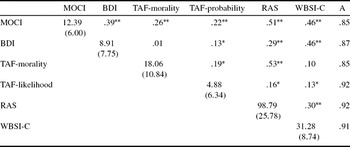
Descriptive information, internal consistency coefficients for, and intercorrelations between the measures of the present study are presented in Table 1. As can be seen, all measures revealed adequate internal-consistency coefficients ranging from .85 to .92. Furthermore, OC symptoms (i.e. scores from MOCI) had weak to moderate associations with the other measures of the study.
Mean scores, standard deviations, inter-correlations, and reliability coefficients for the variables

Note: Means, and standard deviations (in parentheses) are given on diagonal. MOCI: Maudsley Obsessive-Compulsive Inventory; BDI: Beck Depression Inventory; RAS: Responsibility Attitude Scale; TAF-morality: Thought-Action Fusion Morality Subscale; TAF-likelihood: Thought-Action Fusion Likelihood Subscale, WBSI-C: Corrected White Bear Suppression Inventory.
*p < .05, **p < .01.
The method recommended by Baron and Kenny (Reference Baron and Kenny1986) was used to test for mediator roles of inflated responsibility and thought suppression between TAF and OC symptoms relationship. Thus, two sets of mediation analyses were carried out. In the first set of analyses the mediator role of inflated responsibility was examined via two hierarchical regression analyses in which OC symptoms (i.e. MOCI scores) and inflated responsibility (i.e. RAS scores) served as the dependent variables respectively. For the first hierarchical regression analyses, due to the high correlation between MOCI and BDI (see Table 1), the depression score was entered on the first step as a control variable, two dimensions of TAF (i.e. TAF-morality and TAF-likelihood scores) were entered in the second step, and the RAS score was entered in the third step as a mediator variable. For the second analysis of the same set, again following the depression score, two dimensions of TAF were entered into the equation on the second step, and their association with the inflated responsibility was checked for mediator role of the inflated sense of responsibility.
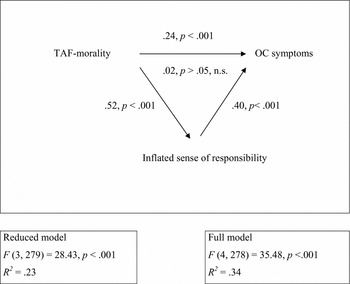
Considering the mediator role of inflated responsibility between two dimensions of TAF and OC symptoms, the result of the first regression analysis revealed significant association between control variable (i.e. depression) and OC symptoms, and explained 15% of the variance (F change[1, 281] = 49.98, p < .001). After excluding this variance, TAF-morality and TAF-likelihood scores were entered into the equation on the second step, and explained 8% of the variance (F change [2, 279] = 15.13, p < .001), and had significant associations with OC symptoms (pr = .26, β = .24, t [279] = 4.47, p < .001; pr = .14, β = .12, t [279] = 2.28, p < .001, respectively). On the last step, inflated sense of responsibility entered into the equation and accounted for 12% of the variance (F change [1, 278] = 43.62, p < .001), and this variable had a significant association with OC symptoms (pr = .37, β = .40, t (278) = 6.60, p < .001). After controlling for the inflated sense of responsibility appraisals on this third step, TAF-morality bias lost its significance (pr = .03, β = .02, t (278) = .49, p > .05) though TAF-likelihood remained to be significant with a very similar β value (pr = .14, β = .11, t (278) = 2.28, p < .05). The sobel test confirmed this significant decrease (z = 6.78, p < .001) for TAF-morality; thus these results of the first regression analysis supported the mediator role of inflated sense of responsibility between TAF-morality and OC symptoms relationship.
As a part of this first set of mediation analysis, to further support the mediator role of inflated sense of responsibility, TAF-morality should also reveal a significant association with the mediator. Thus, to examine this association, another regression analysis was conducted, in which inflated sense of responsibility was the dependent variable, and after controlling for depressive symptoms (pr = .28, β = .28, t (281) = 4.89, p < .001), TAF-morality and TAF-likelihood entered into the equation. As a result of this analysis, 28% of the variance was explained (F change[2, 279] = 60.30, p < .001), and only TAF-morality revealed a significant association with inflated sense of responsibility (pr = .54, β = .52, t (338) = 10.68, p < .001).
Thus the first set of mediation analyses, together with the sobel test, indicated that inflated sense of responsibility mediates the TAF-morality and OC symptoms relationship. Therefore, it supported the finding that the observed association between TAF-morality and OC symptoms is maintained by the inflated sense of responsibility belief domain, but when the variance accounted for by this belief domain was controlled, the previously observed association was diminished. The mediator role of inflated sense of responsibility between TAF-morality and OC symptoms is depicted in Figure 1.
Mediator role of inflated sense of responsibility between TAF-morality and OC symptoms.

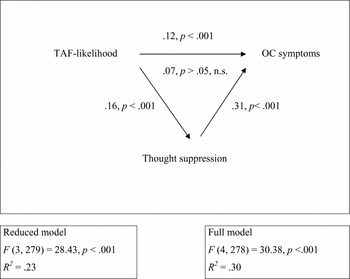
In the second set of mediation analyses, the mediator role of thought suppression between two dimensions of TAF and OCD symptoms was examined. The same procedure was utilized to test this model. Two regression analyses were performed, in which OC symptoms (i.e. MOCI scores) and thought suppression (i.e. corrected WBSI scores) served as the dependent variables respectively. For the first regression analysis, on the first step the depression score was entered into the equation as a control variable. TAF-morality and TAF-likelihood scores were entered into the equation on the second step. These values have been given in the first set of analyses. On the third step thought suppression entered into the equation and the explained 7% of the variance (F change [1, 278] = 27.98, p < .001), and thought suppression significantly predicted OC symptoms (pr = .30, β = .31, t [278] = 5.29, p < .001). After controlling for the thought suppression, TAF-likelihood bias lost its significance (pr = .09, β = .07, t (278) = 1.42, p > .05) although TAF-morality remained significant with a very similar β value (pr = .25, β = .22, t (278) = 4.23, p < .001). The sobel test confirmed this significant decrease (z = 2.69, p < .01) for the TAF-likelihood; thus the mediator role of thought suppression between TAF-likelihood and OC symptoms relationship was supported in this first regression analysis.
As for the second set of mediation analyses, to further support the mediator role of thought suppression, TAF-likelihood should also indicate a significant association with the mediator. Thus, to examine this association, another regression analysis was conducted, in which thought suppression was the dependent variable, and following depressive symptoms (pr = .46, β = .46, t (281) = 8.79, p < .001), TAF-morality and TAF-likelihood entered into the equation. As a result of this analysis 3% of the variance was explained (F change [2, 279] = 6.35, p < .001), and only TAF-likelihood revealed a significant association with thought suppression (pr = .18, β = .16, t (279) = 2.96, p < .001).
This latter set of mediation analyses, together with the sobel test, indicated that thought suppression mediates the TAF-likelihood and OC symptoms relationship. Therefore, it is suggested that the observed association between TAF-likelihood and OC symptoms is maintained by thought suppression, but when the variance accounted for by this variable was controlled for, the previously observed association was diminished. The mediator role of thought suppression between TAF-likelihood and OC symptoms is shown in Figure 2.
Mediator role of thought suppression between TAF-likelihood and OC symptoms.

It is worth noting that none of these mediation analysis results changed when the same analyses were carried out without partialling out the BDI scores.
Discussion
The present study aimed to examine the mediator roles of inflated responsibility and thought suppression between TAF and OC symptoms relationship. Specifically, it was aimed to explore the relative effects of TAF factors (i.e. morality and likelihood) on inflated sense of responsibility and on thought suppression to increase the obsessive qualities of intrusions. Results indicated that two components of TAF followed different paths to aggravate the OC symptoms. Inflated sense of responsibility mediated the relationship between TAF-morality and OC symptoms, whereas thought suppression mediated the relationship between TAF-likelihood and OC symptoms.
The results of the present study indicate that dysfunctional appraisals and/or beliefs about the equality of thinking to behaving (i.e. TAF-morality; “If I wish harm on someone, it is almost as bad as giving harm”) seem to trigger responsibility schemas, which in turn may lead to distress; consequently, it might evoke motivation to perform something to neutralize the intrusions. According to the proposed cognitive models of OCD (e.g. Salkovkis, Reference Salkovskis1985; Rachman, Reference Rachman1997), the basic motivation to neutralize such intrusions is that the agent feels himself responsible for any act or thought that would harm others. Due to the equality of thinking to behaving (i.e. TAF-morality), the misinterpretation of the intrusive thoughts as being crucial and threatening may trigger one's responsibility schemas. As a result, one might feel not only responsible over the potential harm to others but also for having the potential to prevent possible harm to others. This increased sense of responsibility may motivate people to perform compulsions to prevent the possible harm. However, neutralization efforts to diminish the sense of responsibility usually cause temporary anxiety reduction, and in the long run it results in stronger and more persistent intrusive thoughts (Salkovskis, Thorpe, Wahl, Wroe and Forrester, Reference Salkovskis, Thorpe, Wahl, Wroe and Forrester2003). Rachman (Reference Rachman1993) proposed that when a person attaches great significance to intrusive thoughts having an aggressive or sexual nature, this tendency is often associated with a belief that the person is morally responsible for having such unpleasant intrusive thoughts. TAF-morality rather than TAF-likelihood would presumably be most closely associated with this type of responsibility belief in OCD. Therefore, examining the meditative role of responsibility between TAF and OCD by taking into account the types of intrusive thought would increase our understanding about the nature of this relationship.
An important feature of the findings of the present study is that the relationship between TAF and responsibility seems to be specific to the TAF-morality dimension. Results suggest that Turkish people are inclined to feel an inflated sense of responsibility as a result of their thoughts about “equality of thinking to behaving”. This finding may be related to cultural features; in Turkish culture, self-responsibility about one's immoral thoughts are strongly emphasized during early childhood (e.g. thinking about a bad thing is as bad as doing it in real life, and only the doer is responsible for his behavior or thoughts). As reported in a cross-cultural study (Yorulmaz, Gençöz and Woody, Reference Yorulmaz, Gençöz and Woody2009), compared to likelihood fusion, morality fusion has been a more prevalent belief for Muslim groups and this belief domain showed a stronger association with OCD symptoms. Furthermore, it was found that the level of the religiosity did not differ on morality fusion for the Muslim sample, and low religious Muslims had even higher scores on morality fusion than low religious Christians. Therefore, it can be suggested that Turkish people may be quite sensitive to their immoral thoughts and instead of just trying to suppress these thoughts, they may feel inflated responsibility over having these unacceptable thoughts. Consequently, these feelings of inflated responsibility might evoke a significant amount of anxiety, and to reduce this anxiety people tend to initiate neutralizing behaviours, such as trying to replace the negative intrusive thought with a more pleasant thought or by undoing things that evoke checking-like behaviours. Parallel to this argument, Shafran et al. (Reference Shafran, Thordarson and Rachman1996) proposed that people with TAF-moral may become more vulnerable to feeling guilty and responsible for their intrusive negative thoughts. Although according to basic tenets of Islam, Muslims are only responsible for their behaviours, not thoughts, purity of thought is strongly underlined by Islamic doctrine. For example, the Kur'an states that:
Whatever is in the heavens and whatever is in the earth is Allah's; and whether you manifest what is in your mind or hide it, Allah will call you to account according to it; then He will forgive whom He pleases and chastise whom He pleases, and Allah has power over all things (Kur'an, 2:284).
Thus, it is believed that God knows what is going on in your mind. Therefore, as proposed by Shafran et al. (Reference Shafran, Thordarson and Rachman1996), it is probable that feeling intense moral responsibility for one's thoughts may result in guilt, and it is possible that this guilt is then misinterpreted as a sign that the person would be blamed for her/his negative thoughts. Therefore, guilt may also be a critical area to focus on while uncovering the effects of TAF on OCD symptoms.
While TAF-morality was related to inflated sense of responsibility, TAF-likelihood was found to be associated with thought suppression that aggravates OC symptoms. Results indicate that the belief that even thinking about an unpleasant situation seems to increase the likelihood of occurrence of that situation in real life (i.e. TAF-likelihood) may result in remarkable distress and motivates one to suppress unwanted intrusions. This, in turn, would lead to activation of OC symptoms. The association of thinking bad things with probability of actually experiencing these things in real life is strongly emphasized in Turkish culture. For example, “thinking bad things will call them to actual life” and when Turkish people think bad things, they usually, following superstitious behaviour, hit the board to neutralize these thoughts. Therefore, beliefs about TAF-likelihood may directly motivate a person to suppress these thoughts to prevent the feared outcome. Parallel to the findings of the present study, Rassin and colleagues (Reference Rassin, Muris, Schmidt and Merckelbach2000) underlined the relationship between TAF and thought suppression. They found that TAF appears to trigger the attempt to suppress one's thoughts, and both TAF-likelihood and thought suppression contribute to the obsessive qualities of the intrusive thoughts. Consistently, Marino-Carper and colleagues (Reference Marino-Carper, Negy, Burns and Lunt2010) examined the effect of psychoeducation regarding TAF on the OCD symptoms and thought suppression scores. Results revealed that participants who had received psychoeducation regarding TAF reported lower likelihood TAF scores than those of the control group. In addition, the group that received psychoeducation regarding TAF was the only group that did not experience a significant increase in thought suppression and in both frequency of and belief in low-responsibility thoughts from baseline to post-intervention. Consistent with the present study, their results supported the interrelationship among TAF, thought suppression and responsibility.
There are certain methodological weaknesses in the present study. The most important limitation is the cross sectional nature of the study; thus cause and effect relations cannot be drawn from the results. The second limitation is the generalization of the results; the sample used in this study is a university sample with a limited age range. Furthermore, the sample used in this study was a non-clinical sample with a relatively small sample size. These findings therefore may or may not be observed in a clinical sample. Although most of the previous studies reported that almost 80% of non-clinical subjects experienced unwanted intrusive thoughts (Clark and de Silva, Reference Clark and de Silva1985; Freeston, Ladouceur, Thibodeau and Gagnon, Reference Freeston, Ladouceur, Thibodeau and Gagnon1991, Reference Freeston, Ladouceur, Thibodeau and Gagnon1992; Rachman and de Silva, Reference Rachman and de Silva1978), the concepts examined in the present study are closely related to psychopathology and so it is strongly encouraged to also carry out similar studies with clinical samples. The most important strength of the present study is the examination of the interrelations between important factors of OCD (i.e. TAF-morality, TAF-likelihood, inflated sense of responsibility, and thought suppression efforts). Furthermore, previous research examining the content of obsessional thoughts in nonclinical samples has found that certain types of thoughts are over-represented, particularly sexual and aggressive types of thoughts (Purdon and Clark, Reference Purdon and Clark1993, Reference Purdon and Clark1994). Therefore, the findings of the present study should be replicated using a OCD measure assessing different types of OCD symptoms, particularly sexual and aggressive symptoms. Another limitation of the study might be that the MOCI mainly focuses on assessing two of the most common compulsions, i.e. washing and checking. It has been suggested that this measure omits important obsessive-compulsive contents/symptoms, especially sexual, aggressive obsessions or covert compulsions (Clare, Reference Clare, Menzies and de Silva2003). Therefore, it has been strongly suggested that these findings should be replicated with other measures of OCD symptoms in order to obtain more reliable and valid assessment of the obsessions and compulsions subtypes (e.g. Clark–Beck Obsessive-Compulsive Inventory, Clark, Antony, Beck, Swinson and Steer, Reference Clark, Antony, Beck, Swinson and Steer2005)
To conclude, the findings of the present study imply that two components of TAF appear to follow different paths to aggravate obsessive-compulsive symptoms. Morality assumptions seem to activate responsibility appraisals, and due to the anxiety evoked by inflated responsibility people may tend to initiate some OC symptoms (e.g. undoing, reassurance seeking, or thought replacement). On the other hand, likelihood assumptions tend to motivate one to perform suppression efforts, which in turn might further increase the frequency of intrusive thoughts and, consequently, people try to prevent the possible negative consequence through OC symptoms. Thus two different paths, for different components of TAF, emerged toward OC symptoms. However, these findings could be specific to Turkish culture and therefore similar studies conducted in different cultures are strongly encouraged.
The findings of the present study highlight the importance of examining response patterns of participants from different cultural contexts to understand which appraisals are salient. The significant role of appraisals in defining the distress level of intrusions in the Turkish university sample suggests that the cognitive model of OCD may be universal; however, the salience and types of appraisals may vary across different cultures, and subsequent studies may increase our understanding about aetiology of OCD.



Comments
No Comments have been published for this article.