1 Introduction
This paper presents the results of an analysis of the realization of word-final /k/ in read and casual speech by female pupils from a single-sex Glasgow high school, focusing on its realization as velar ejectives. Phonetic research on ejectives in varieties of English is still at an early stage. Much of what we know is based on statements in the literature, for example, they are more prominent word-finally, they usually do not follow voiceless sounds, or they are found in varieties of Northern English. We examine the phonetic, linguistic, and interactional factors that promote ejective use in Scottish English, and at the same time, consider, of the groups sampled, who uses ejectives more and what social factors this depends on. Our results show that an interplay of phonetic, linguistic, interactional and social factors together constrain ejective realization. Overall, we find that using ejectives for word-final /k/ is very common for these Glaswegian girls. Intriguingly, given impressions that ejectives may be increasing in British English, cautious comparison with earlier recordings from 1997 suggests that we may also be witnessing real-time change in Glasgow.
2 Ejectives
Ejectives, or glottalic egressive stops, are used contrastively in about 18% of the world's languages, although most are minority languages. Ladefoged & Maddieson (Reference Ladefoged and Maddieson1996: 78) observe that they are found in many language families ‘as diverse as Mayan, Chadic and Caucasian’. They also occur in varieties of English (e.g. Ogden Reference Ogden2009: 163), in which they are not contrastive, but are possible realizations of stop consonants; for example, /k/ in back can be realized as [k] or [k’].
Unlike the pulmonic egressive airstream mechanism that is used to produce English stops, the air flow initiator for ejective stops is the larynx. Ejectives are a distinctive speech sound that are characterized by a short, intense burst of energy that manifests itself auditorily as a loud ‘popping’ sound or, as Jones (Reference Jones1956: 154) observes, are similar to ‘the sound made in drawing a cork out of a bottle’. Ejectives are usually described as being produced through an approximately simultaneous tight closure of the vocal folds along with an occlusion elsewhere in the vocal tract. The entire larynx is then raised roughly about 1 cm, acting like a piston (Ladefoged & Johnson Reference Ladefoged and Johnson2011: 137), which compresses the air in the now reduced oro-pharyngeal cavity thus generating a high build-up of pressure. This pressure is expelled by articulatory release and the subsequent lowering of the larynx, causing an outward, or egressive, airflow that is often quite abrupt and intense.
Ejective stops are mainly voiceless. As ejectives cannot be produced without glottal closure, it is impossible for the vocal folds to vibrate simultaneously (Hayward Reference Hayward2000: 269). Furthermore, because the glottal occlusion is usually released following the oral one, the phonetic symbol for the ejective reflects this – e.g. [p’] – where the symbol for glottalization comes after that for the oral articulation (Greenberg Reference Greenberg1970: 124).
2.1 Variation in ejectives
Ladefoged & Maddieson (Reference Ladefoged and Maddieson1996: 79) highlight the ‘considerable phonetic differences among the ejectives that occur in different languages’. Ejectives show a range of variants, from the very salient ‘canonical’ ones to much weaker ones, some of which may arise as epiphenomenal artefacts from temporal overlap of articulatory gestures (Simpson Reference Simpson2007, in press). As with the difficulties in satisfactorily describing ejectives (Catford Reference Catford1939: 3; Fallon Reference Fallon2002: 4), there have also been (and indeed still are) some disputes over categorizing the range of possible ejective realizations. Some phoneticians have grouped the intra- and inter-language variation of ejectives into a traditional fortis/lenis binary typology. Fallon (Reference Fallon2002: 265) states that ‘it has long been recognized that there are two general types of ejectives’. He further cites Swanton (Reference Swanton and Boas1911: 210), who recognized that two general types of ejectives occur in Haida, a language isolate in the Pacific Northwest coast of North America. Swanton observed that ‘some speakers bring these [ejectives] out very forcibly, while others pass over them with considerable smoothness’. The acoustic results of the study of ejectives in Hausa and Navajo by Lindau (Reference Lindau1984: 154) showed highly significant differences between the two languages in terms of total duration and closure duration/VOT ratio. Earlier investigations, by Kingston (Reference Kingston1985) into Tigrinya and Quiché, revealed significant contrasts between the ejectives in both languages, which prompted Kingston to use a phonetic typology of fortis and lenis to describe the contrast, referring to them as ‘tense’ and ‘lax’ ejectives.
Ladefoged (Reference Ladefoged1980: 498–499) also points out the inadequacy of phonological theories to account for ejectives, when considering how to describe measurable phonetic differences between languages. For example, the velar ejectives in Hausa and Navajo are both phonetically transcribed with the same symbol, [k’], despite there being a clear difference in sound between them. Thus, if there is a clear difference in ejective quality that creates a fortis/lenis binary classification, then there is also a clear need for that to be represented phonetically in transcription. A practical solution to this is to build upon the existing apostrophe diacritic that accompanies the stop symbol. Fallon (Reference Fallon2002: 267) proposes that a double apostrophe, as in [k”], or double-closed quotes, as in [k”], are suitable possibilities for fortis ejectives, while the single apostrophe as in [k’] could be used for lenis ejectives.
2.2 An ejective continuum?
At the same time, there are also findings which point to inconsistencies in a binary classification, and suggest an ejective continuum, and one which is multidimensional too. Warner's (Reference Warner1996) investigation into ejectives in Ingush, a Caucasian language, revealed that they did not pattern as fortis or lenis but instead contained acoustic properties that were a combination of both types. Likewise, Wright, Hargus & Davis (Reference Wright, Hargus and Davis2002: 69–70) conclude their acoustic study of the Witsuwit'en alveolar ejective by highlighting that the notion of an ‘average ejective stop’ is questionable. They argue that the traditional binary typology of ejectives needs to be revised as it does not accommodate the range of variation in Witsuwit'en ejective production. Further support is presented in the research by Ham (Reference Ham2007) on whether Tsilhqut'in (a Northern Athabaskan language) ejectives pattern with the traditional stiff/slack binary classification. The overall results showed considerable variability at the phonetic level and lead Ham to conclude that ‘the binary classification is neither universal nor categorical and suggests [a] need for the traditional dichotomous typology of ejectives to be reconsidered’ (Ham Reference Ham2007: 14).
A more recent study of acoustic and articulatory aspects of ejectives in six Caucasian languages (Avar, Ingush, Tsez, Bezhta, and Lezgi from the Nakh-Daghestanian family, and Georgian from the Kartvelian family) by Grawunder, Simpson & Khalilov (Reference Grawunder, Simpson, Khalilov, Fuchs, Toda and Marzena2010) indicated rather homogeneous behaviour particularly in relation to acoustic patterning from their small sample of material from the Daghestanian languages, and concluded that according to the classical binary typology the stops would be classed as stiff ejectives. Yet, durational measurements for VOT and closure duration did not always yield significant results, and the authors suggest that ‘compensation strategies would need to be investigated on the level of each individual speaker’ (Grawunder et al. Reference Grawunder, Simpson, Khalilov, Fuchs, Toda and Marzena2010: 239).
Evidence suggests, therefore, that the phonetic realization of ejectives falls along a continuum rather than necessarily into a binary categorization. This acknowledgement echoes Ladefoged's (Reference Ladefoged1973: 78) recognition that glottalic egressive sounds are part of a scale or range, and that, conceivably, there is a limitless number of possible phonetic values for the speech sounds that fall under the umbrella term ‘ejective’. He argues that the term ejective should not be used to imply a discrete phenomenon, but rather ‘we need additional terms such as . . . weakly ejective (to describe for example some variants of final voiceless stops in English)’. This assertion is further reiterated in more recent literature such as Vicenik (Reference Vicenik2010: 60), who notes that ejectives in various languages, and ejectives produced by different speakers within a single language, range over a continuum of acoustic characteristics. Fallon (Reference Fallon2002: 269) also recognizes that the phonetic realization of ejectives is a ‘gradient phenomenon’.
2.3 Epiphenomenal ejectives
Simpson (e.g. Reference Simpson2009, in press) also suggests other possible production mechanisms for ejectives in German and English. As opposed to ‘true’ ejectives, which imply an active movement of the larynx with a closed glottis which subsequently compresses the air contained in the supraglottal chamber, the epiphenomenal pattern relating to the glottalic airstream mechanism described by Simpson does not involve active movement of the larynx. Overlap of glottal and supralaryngeal articulations, such as when a plosive is followed by a glottal stop, can produce so-called ‘novel’ sounds which, although produced unintentionally by the speaker, can become active phonetic correlates of new phonological elements (Simpson Reference Simpson2009: 1). This is in line with Ohala's (Reference Ohala1997) theory that ejectives may result from a sequence of pulmonically-initiated plosive and glottal stop: ‘There is evidence that an oral constriction can coarticulate with a glottal closure to produce not an emergent stop as such but to change a pulmonic stop into a glottalic one, i.e. an ejective’ (Ohala Reference Ohala1997: 5; Ohala glosses ‘emergent stops’ as ‘stops created out of phonetic elements present in the surrounding sounds’, p. 1). Simpson (in press) also offers the hypothesis that the pressure build up that is released with the plosive burst in an ejective is as a result of a pulmonic airstream that is previously stored or reserved intraorally. He proposes that the ejective burst quality results from the resonance characteristics during release of a supraglottal cavity with complete occlusion.
3 Ejectives in English
The relative lack of research into ejectives in English is surprising given the fact that they are not a recent discovery. As MacMahon (Reference MacMahon, Aarts and McMahon2006: 363) states: ‘The occurrence of ejectives in English has been noted informally for many years – especially in some Northern English and Scottish accents in certain word-final positions as the realization of /ptk/ – but to date a full scale sociolinguistic study of their occurrence is lacking’ (see Ashby & Maidment Reference Ashby and Maidment2005: 107). Ladefoged (Reference Ladefoged1993: 131) also reports that some English speakers (without specifying the dialect) are inclined to produce ejectives at the end of words, particularly in sentence-final position, noting instances such as the word cake being realized with a glottal stop accompanying the final [k]. He also mentions that, when the velar occlusion is released while the glottal stop is still being held, a weak ejective can be produced.
In the phonetics literature, some areas of northern England are pointed to as being predominantly associated with the realization of ejectives as an allophone of bilabial, alveolar and velar voiceless stops. Catford (Reference Catford1977: 68) reports their occasional occurrence in northern English dialects but does not expand on any phonetic or sociophonetic contexts that may condition their realization. Shorrocks’ (Reference Shorrocks1988: 60) study on glottalization and gemination in the Greater Bolton area also mentions that from time to time ejective consonants are encountered in the words night and week, although no other specific phonetic details are revealed.
On the other hand, Roach (Reference Roach2009: 23) points out that, in addition to being found in Northern England, some Midlands accents – although it is not specified which ones – can also feature ejective plosives word-finally and before a pause. He notes that ‘in utterances like “On the top”, “That's right” or “On your bike”, it is often possible to hear a glottal closure just before the final consonant begins, followed by a sharp plosive release’. Likewise, the occurrence of ejectives as possible free variants of voiceless plosives is mentioned by Wells (Reference Wells1982: 261) as not merely being particular to Northern English dialects. He reports that southerners as well as northerners can sometimes realize ejectives as a result of emphatically articulating the glottal component in word-final /ptk/. Lass (Reference Lass1984: 20) also recognizes that voiceless stops in English dialects can be produced with a glottalic airstream; however, he does not specify which dialects. Moreover, there is a feeling that the occurence of ejectives is increasing, even though this has not yet been substantiated (Simpson, in press).
3.1 Ejectives in Scottish English
In Scotland, ejectives have been noted for some time as being realized in emphatic speech word-finally and before a pause, in phrases such as, will you please sto[p’] (Macafee Reference Macafee1983: 33). Shuken's (Reference Shuken, Higgs and Thelwall1984: 123) discussion of glottal stops notes in passing an ejective realization of /t/ by a Glasgow English speaker in the word great; and Chirrey (Reference Chirrey1999) also reports that speakers in Edinburgh will occasionally use ejective realizations of /ptk/ in utterance-final position.
The regional ethnic accent of Glaswegian Asians also shows the presence of ejectives word-finally for /t/ in read speech (Lambert, Alam & Stuart-Smith Reference Stuart-Smith, Timmins and Tweedie2007; /k/ and /p/ were not analysed). Initial perceptions of the realization of the voiceless alveolar plosive were that they were being released by the Glaswegian Asian speakers with much greater intensity than the Glaswegian non-Asian control group. The spectrogram of the word but (Lambert et al.'s Figure 3) confirms these initial impressions. Their sample of Glaswegian Asians not only uses ejectives for /t/, they also avoid glottal stops, which are traditionally typical of Glasgow dialect (e.g. Stuart-Smith Reference Stuart-Smith1999a). Although not usually perceived as allophones of stops in Urdu or Punjabi, ejectives have been observed in socially-aspirational varieties of Indian English in Delhi (Manjari Ohala, p.c.).
The first systematic account of ejectives in any variety of English seems to be that conducted by Gordeeva & Scobbie (Reference Gordeeva, Scobbie, Scobbie, Mennen and Watson2011), which focuses on the realization of ejectives word-finally by seven preschool speakers of Scottish Standard English. The findings corroborate some of the previous less formal observations reviewed earlier (see Section 3.2 below): ejectives are significantly more frequent in velar stops than alveolar or bilabial ones, and they appear more frequently (though not exclusively) in phrase-final positions. Overall, five out of the seven children produced ejective stops and the longitudinal data suggest that some children use them categorically. It was also found that there is a consistent occurrence of word-final ejectives in these preschool children with 10% of all final stops being ejectives.
3.2 Phonetic, linguistic, and interactional factors in the distribution of ejectives
Although ejectives are often noted in English, rather little is known for certain about their distribution, or the factors that may constrain or promote them (Ogden Reference Ogden2009: 163). The following summarizes the observations to date about the contexts in which ejectives are found. A widely held consensus is that ejectives in English are greatly influenced by position in the word and position of the carrier word in the discourse, mainly (though not exclusively) occurring word-finally and phrase-finally and/or as part of an utterance before a pause, in addition to at the end of an utterance (Wells Reference Wells1982; Macafee Reference Macafee1983; Chirrey Reference Chirrey1999; Lambert et al. Reference Lambert, Alam, Stuart-Smith, Trouvain and Barry2007; Ogden Reference Ogden2009: 163; Gordeeva & Scobbie Reference Gordeeva, Scobbie, Scobbie, Mennen and Watson2011; Simpson, in press). Ejective variants of word-final plosives have been observed when the plosive follows voiced sounds such as vowels, nasals and laterals (Scobbie, Gordeeva & Matthews Reference Scobbie, Gordeeva and Matthews2006; Ogden Reference Ogden2009: 163), but not following voiceless sounds like [s]; they are also reported as occurring more often in stressed syllables (Ogden Reference Ogden2009: 163).
That ejectives occur phrase-finally may relate more fundamentally to interaction. Ogden's (Reference Ogden2009: 164–167) fine-grained discussion of ejectives in the speech of a young woman from Aberdeen and that of two Northern English students illustrates ejectives before different kinds of pauses in the talk. /k/ in week is realized as [k’] by one of the students from the north of England when the word is turn-final (line 2), and again in line 4, when week precedes a 200 ms pause and is part of a list (week one, week two, week three, . . .). But there is also another ejective in the same word when the speaker is holding the floor; in this case the following word begins with a glottal stop, but the velar closure for /k/ is held across the 300 ms pause. Ogden (Reference Ogden2009: 165) states:
Articulations which are held across gaps in speaking within a speaker's turn like this have been shown for English to mark: ‘I may not be speaking now but I have more to say and I am keeping the turn’. So perhaps the ejective in this environment is a side-effect of some other work that is being done by a glottal stop.
Simpson (in press) also notes the potential importance of interactional factors, and considers how these might lead to epiphenomenal ejective productions of plosives in English and German.
The relationship between ejectives and glottalization is another area that requires further investigation. Ogden (Reference Ogden2009: 163) suggests that ejectives could be a development of glottal reinforcement, while Wells (Reference Wells1982: 261) views them as resulting from an emphatic articulation of the glottal component in word-final stops. However, with regard to Scottish Standard English, this idea is contradicted by Gordeeva & Scobbie (Reference Gordeeva, Scobbie, Scobbie, Mennen and Watson2011), who contend that ejectives in this variety of English are a form of ‘glottalization’ distinct from what Wells (Reference Wells1982: 261, 409–410) labels ‘T-Glottalling’ and ‘glottal reinforcement’.
Some commentators on ejectives in English point to possible phonetic reasons for their occurrence in the language. Ogden (Reference Ogden2009: 164) also observes that the burst release of ejectives being characteristically louder than the release of a pulmonic plosive means that the audibility of the burst is magnified, which consequently makes it easier to perceive the place of articulation of the stop. This is reminiscent of the argument put forward by Ladefoged (Reference Ladefoged2001: 131), who highlights the fact that speakers and listeners fundamentally like languages to have distinct sounds, such as ejectives, that are easy both to hear and to make. Building on Greenberg's (Reference Greenberg1970: 127) assertion – later supported by Javkin (Reference Javkin1977: 559) and Maddieson (Reference Maddieson1984: 105) – that languages with an ejective inventory will have velar ejectives at the top of the hierarchy, Ladefoged points out that this illustrates the balance between ease of articulation and ease of hearing: [k’] is perhaps favoured slightly more because it may be auditorily more distinct than either [p’] or [t’].
4 Research questions
The first author of this paper has worked as a teacher in an all-girls Glaswegian high school for some years. While analysing the recordings for his first graduate phonetics assignment, he noticed that ejectives were very common in the speech of the two Polish informants he had recorded. But what struck him more forcibly – when he was back in the classroom for the next term – was the number, and also the patterning, of ejective stops in all of the school girls he was teaching. His impressions were that ejectives were very common, especially for word-final /k/, and in particular discourse contexts, for example, when girls were involved in question/answer sessions during class. It also seemed that ejectives might vary according to social factors such as age, socio-economic background and ethnic identity, particularly with respect to Glaswegian Asian and Glaswegian non-Asian girls.
These informal observations provided the motivation for this study, and in particular its focus on possible ejective realizations of /k/ in a stratified sample of girls from this Glasgow high school. They also seem to fit with a more general – but as yet unsubstantiated – impression that ejectives are increasing, and so may represent change in progress in Scottish English. If so, we would expect phonetic, linguistic, interactional and social factors to play a role, as Simpson (in press) notes: ‘The suspected increase in the prevalence of ejectives in different varieties of English over the last few decades must correlate with patterns of sociophonetic variability involving ejectives that were not previously present’.
Our study had several research questions. The first two questions were general, relating to the initial stages of our research and arose from observations in the classroom:
(1) How much do Glaswegian girls use ejectives for word-final /k/?
(2) Is the use of ejectives linked to speech style, e.g. reading sentences or spontaneous speech?
The next two questions were more specific:
(3) What are the phonetic, linguistic, and interactional factors that promote ejective use?
(4) What social factors constrain ejective use: e.g. age, social category, ethnicity?
And finally (and more tentatively, given the available data):
(5) Can the use of ejectives for /k/ be regarded as language change in progress?
In the following sections we outline our method, sample, materials and elicitation technique, and then present and discuss our results.
5 Method
5.1 Sample
This paper analyses the realization of word-final /k/ in the speech of Glaswegian school girls elicited in two styles, reading sentences and completing a map task. Glasgow is the largest city in Scotland and one that has suffered from the decline of heavy industry, but at the same time it has seen substantial urban regeneration and economic revival (see e.g. Stuart-Smith, Timmins & Tweedie Reference Stuart-Smith, Timmins and Tweedie2007). Scottish English comprises a range of varieties along a sociolinguistic continuum. Middle-class speakers are at one end, using mainly Scottish Standard English. Working-class Glaswegians gravitate towards the vernacular, Scots, end (e.g. Wells Reference Wells1982: 395), which is highly stigmatized, but they are able to move up and down the continuum as particular social contexts demand (e.g. Stuart-Smith Reference Stuart-Smith, Corbett, McClure and Stuart-Smith2003). Voiceless plosives are usually reported to be less aspirated in Scottish Standard English than Southern Standard British English (e.g. Wells Reference Wells1982: 409). In addition, the glottal stop has been the main allophone for non-initial /t/ for a long time, though it is also found for /p/ and /k/ (e.g. Stuart-Smith Reference Stuart-Smith1999b).
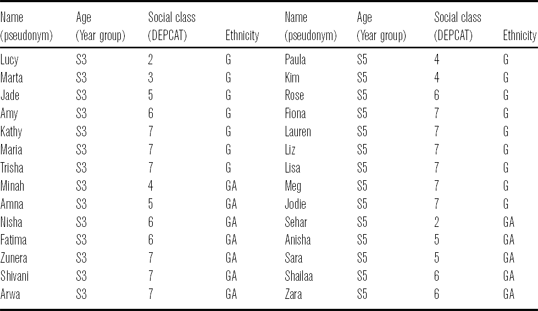
We worked with 28 girls in a single-sex high school located in the west of Glasgow, with a roll of about 800 pupils drawn from a wide catchment area across the city. There is also a large and varied ethnic mix within the school, with over 50 different languages being spoken, and one third of all the pupils have English as an additional language. The most common languages among those pupils who are bilingual are Punjabi and Urdu. In addition, around a third of all pupils attending the school are from inner-city areas of multiple social deprivation. Our participants were stratified according to age, social class, and ethnicity (see Table 1).
The social stratification of the sample. Year group: S3 = 14 years old, S5 = 16/17 years old; Deprivation Category (DEPCAT): 2 = most affluent, 7 = most deprived; Ethnicity: G = Glaswegian non-Asian, GA = Glaswegian Asian.

5.1.1 Age
Fourteen girls were in the third year of secondary education (referred to as S3) and were all 14 years old. The other half of the group were in the fifth year of secondary education (S5), and were all between 16 and 17 years old.
5.1.2 Social class
Glasgow exhibits sharp social stratification, which is also represented in the school.We based our classification of the two broad categories of ‘working’ and ‘middle’ class on the Deprivation Categories (DEPCATs) identified in the Carstairs scores for Scottish postcode sectors from the 2001 Census (2004; http://www.sphsu.mrc.ac.uk/library/other%20reports/Carstairs_report.pdf). This report derives DEPCAT scores by comparing areas according to postcodes and not according to ‘individual material well being or relative disadvantage’ (p. 1). DEPCAT scores range from 1 to 7, with 1 being the most affluent areas and 7 the most deprived. We approximated social class categories by grouping together the data from participants in DEPCAT 6–7 as ‘working class’ and those from DEPCAT 2–5 as ‘middle class’.
5.1.3 Ethnicity
In Scotland the minority ethnic population stands at just 2% (2001 Census figure; http://www.scrol.gov.uk/scrol/common/home.jsp), with the main ethnic group being Asian, originally from the Indian subcontinent; Glasgow has the largest south Asian community (5.45% of its total population). Seventy-seven percent of the Glasgow Asian population is of Pakistani heritage (Alam & Stuart-Smith Reference Alam, Stuart-Smith, Lee and Zee2011). The high percentage of the population of Pakistani heritage is also reflected in the school cohort, with over 30% of the school roll being pupils of Pakistani heritage. Initial observations in the classroom seemed to suggest that Glaswegian Asian pupils used more ejectives, or at least their ejectives seem to be auditorily stronger or perhaps more distinct than those of the Glaswegian non-Asian pupils. This different quality of ejective was variable between speakers and within speakers too.
5.2 Materials: Phonetic context
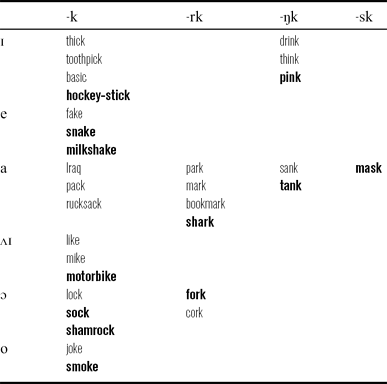
Words were chosen so that word-final /k/ would follow both vowels and consonants. Since there are no clear predictions from the literature about how vowel quality might promote or constrain ejective distribution, we chose vowels to represent aspects of vowel height and frontness/backness: /ɪ ea ʌɪ ɔ o/ as in e.g. thick, snake, pack, like, sock, smoke, respectively. The consonant cluster contexts /-ŋk/ and /-sk/ were chosen as they are mentioned by Ogden (Reference Ogden2009: 163) as promoting and constraining ejective use, respectively. We added /-rk/ because of the frequency of this cluster in common words, to investigate what effect, if any, a preceding /r/ might have on ejective realization. Table 2 shows the words used (those which occurred in both the reading task and the map task are in bold).
Words containing final /k/ used in the read sentences. Target words for the map task are in bold.
5.3 Speech recordings and style elicitation
High-quality recordings were made of girls reading sentences and completing a map task (see Section 5.3.2 below). Recordings were made with an M-Audio Microtrack 2-channel mobile digital recorder using battery-powered lapel microphones (AT831b). Analysis of speech was carried out using Praat 5.2.12 (Boersma & Weenink Reference Boersma and Weenink2013). All recording took place within the school in a quiet classroom. Pupils were recorded in friendship pairs, which helped to reduce the effects of the recording environment on the nature of the recordings themselves (the ‘Observer's Paradox’, Labov Reference Labov1972). The girls were anonymized using pseudonyms.
5.3.1 Read speech: Sentences
There were 44 sentences in total, including distractor sentences (see Appendix). Words containing word-final /k/ were positioned sentence-finally with the stress falling on the final syllable. In order to further ensure that the participants would not recognize a discernible pattern of words ending in /k/, sentences that were semantically and thematically related to each other were used. For example, sentences 1, 6 and 32 fell under the theme of ‘going out’; sentences 15 and 40 related to travel; and sentences 18 and 26 related to sailing. As a result two sentences (28 and 32) were repeated.
Where time permitted, both pupils who were present were recorded consecutively. The recording equipment and the read sentences were set up in advance so that, following a brief explanation of the task, participants were ready to begin reading. Completion of the reading task averaged about 15 minutes overall for each participant. This time included the initial acclimatization period, which allowed the pupils to become familiar with the recording equipment. When a pupil made a mistake, she was asked to repeat the sentence again once she had finished the reading list.
5.3.2 Casual speech: Map task
A map task (Anderson et al. Reference Anderson, Bader, Bard, Boyle, Doherty, Garrod, Isard, Kowtko, McAllister, Miller, Sotillo, Thompson and Weinhart1991) was used to elicit more informal, spontaneous speech. The map contained clip-art type illustrations associated with lexical items ending in /k/ which were easy to recognize (see Figure 1). One informant was asked to describe the route to the other informant using the drawings as a guide, so that her interlocutor could draw the same route.
Map used to elicit spontaneous speech: pre-drawn route for director.
The maps given to the informants were not identical to one another and subtle changes were made to some colours of the objects and to the illustrations. This provoked queries from the route follower, so that they also had a chance to talk, thus ensuring that a greater number of tokens were elicited.
5.4 Data analysis
5.4.1 Phonetic analysis
This paper reports the initial phonetic analysis of these data, which was carried out using narrow auditory transcription. A Praat script was used to present and play extracted sound files for subsequent transcription into a Textgrid tier using IPA symbols. Although it was possible to see the waveforms and spectrograms, the analysis was primarily auditory. All tokens were transcribed by the first author, and approximately 10% were cross-transcribed by the second author. In addition, instances which were difficult to transcribe were discussed, and a final transcription was agreed.
This process resulted in the identification of a number of auditory variant categories for word-final /k/, which were then further collapsed into four main categories (see Section 6 below). The next phase of this project will be an acoustic analysis of relevant parameters, including duration of closure and duration of release phase (both normalized for speech rate), and intensity of the burst and release phase, which will help determine the extent to which our impressions of distinct auditory categories are reflected in clusters of acoustic measures for specific parameters for the full dataset. In the absence of a systematic acoustic analysis, we present here only a few illustrative examples (see Ogden Reference Ogden2009: 165).
5.4.2 Statistical analysis
All tokens of /k/ were coded for phonetic, linguistic/interactional, and social factors. The phonetic factors noted the immediately preceding context, either ‘vowel’ (/ɪ ea ʌɪ ɔ o/), or ‘consonant cluster’ (/-rk -ŋk -sk/). The linguistic/interactional factors examined the role of the position of the word in which /k/ occurs, ‘turn-final’ (at the end of the speaker's sentence or utterance, and before the other speaker's turn), ‘end of clause/sentence’, or ‘(anywhere else) within turn’. The social factors were ‘age’ (represented by school year group, S3 or S5), ‘social class’ (‘working class’ and ‘middle class’), and ‘ethnicity’ (Glaswegian non-Asian or Glaswegian Asian).
The relative potential effects of the phonetic, linguistic/interactional and social factors on the four variant realizations of /k/ were explored statistically using multinomial logistic regression in SPSS (e.g. Field Reference Field2009). This technique allows the consideration of main effects and/or specified interactions of one or more independent variables on a categorical dependent variable with more than two levels, within a single model. So, for example, we took as our dependent variable the realization of /k/, which had four variants/levels (glottal, velar, weak ejective, strong ejective), set one variant as a ‘reference category’, and then modelled the relative effects of the independent variables (style, phonetic context, position in turn, age, social class, ethnicity) on the other three variants with respect to the behaviour of the reference category. We began by fitting simple models with main effects, and then fitted models with main effects and interactions, provided that the cell sizes of the resulting interactions were not too low (small cell sizes lead to unstable models with very high standard errors). In Section 7 we summarize the significant results arising from this procedure (significance is set for values of p < .05).
6 The realization of /k/ in Glasgow girls
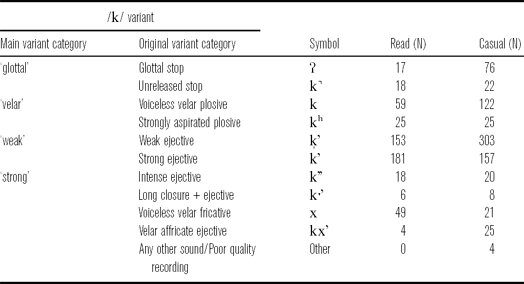
In total, the 28 speakers produced 1313 tokens of /k/ across both styles. This was made up of 530 tokens in read speech and 783 in casual speech. The auditory transcription identified eleven auditory variant categories of word-final /k/, which were further reduced into four main variant categories, as shown in Table 3. Glottal stops and velar plosives were relatively unproblematic to transcribe and represent. It is clear from Table 3, however, that the main realization of /k/ is as some kind of ejective.
Variant categories for word-final /k/ identified by the auditory transcription. Results for the main variant categories are presented in Section 7. Figures under Read and Casual indicate counts of each variant.
The first phase of transcription distinguished a range of ejective realizations which are expressed as four kinds of ejective (Ladefoged Reference Ladefoged1980: 498–499): weak, strong, intense, and, although relatively low in number, velar ejective affricate (a stop with normal closure duration followed by a velar fricative with ejective release). We also noted instances of ejectives preceded by what sounded like a relatively longer closure.Footnote 1
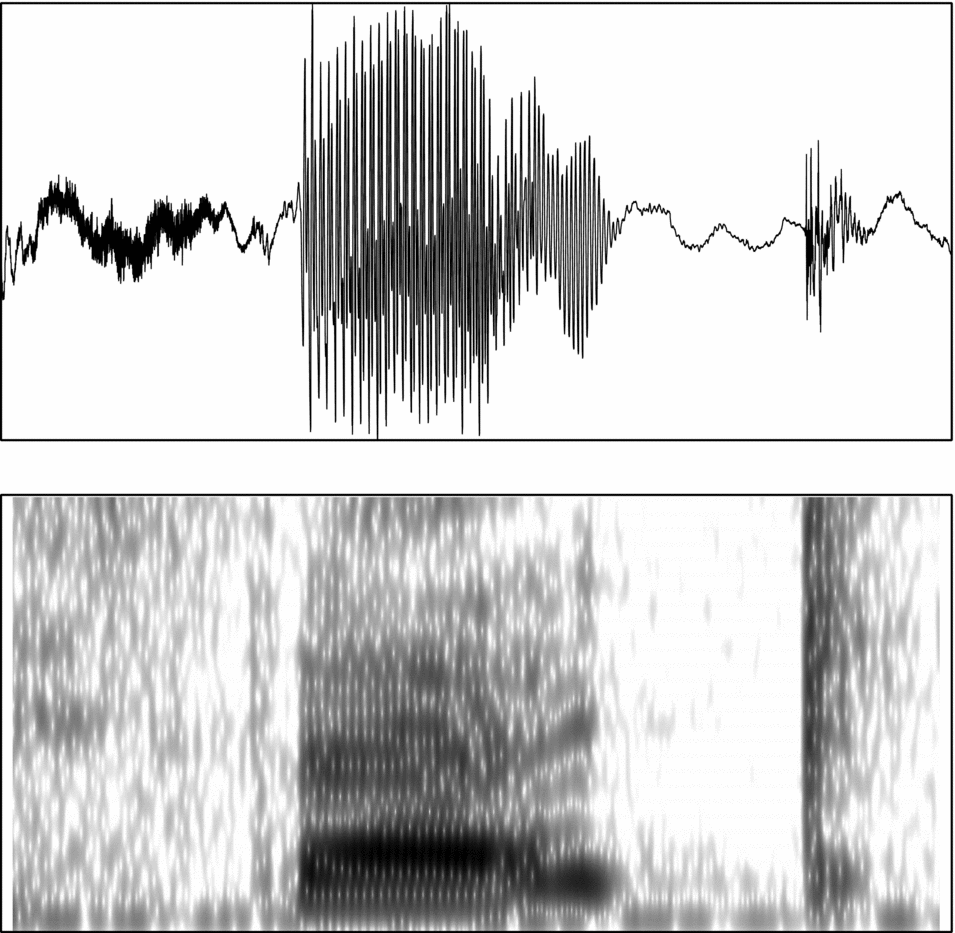
As outlined above, our phonetic analysis was auditory. We give acoustic illustrations (waveforms and spectrograms) for three examples of ejectives found in the data. Figure 2 shows stick from hockey-stick produced by an S5 working-class Glaswegian non-Asian pupil in spontaneous speech; /k/ was heard as a ‘strong’ ejective. The abrupt onset of several high intensity bursts is clearly visible after the closure phase.
S5 (16/17-year-old) working-class Glaswegian non-Asian girl saying stick with strong velar ejective.
Figure 3 shows a ‘weak’ sounding ejective in joke from an S3 middle-class Glaswegian Asian girl in read speech. We suspect that the weak striations during the closure reflect lowering of the velum, and hence some reduction in the air pressure, which may account for the audibly reduced intensity of this ejective. We also note the lower frequency glottal pulse immediately before the stop closure.
S3 (14-year-old) middle-class Glaswegian Asian girl saying joke with weak velar ejective in read speech.
Figure 4 shows tank in spontaneous speech from an S3 working-class Glaswegian Asian girl, where the word was followed by a long pause and the ejective was heard as having a relatively long closure. The waveform and spectrogram show that the abrupt closure is followed by a series of three distinct bursts and noisy frication. The speaker had been asked to recall what objects on the map she had avoided when tracing the route. The tank was the first object she recalled before listing the other objects (see Ogden Reference Ogden2009: 165).
S3 (14-year-old) working-class Glaswegian Asian girl saying tank with ejective preceded by long closure in spontaneous speech.
These examples point to the need for a subsequent acoustic analysis of these data, and in particular to consider the extent to which the auditory categories are supported by the patterning of temporal and spectral acoustic measures. We now turn to the distribution of the main auditory variant categories according to style, and phonetic, linguistic/interactional and social factors.
7 Factors governing ejective production in Glasgow girls
7.1 Style
Figure 5 shows the distribution of the four main variant categories for /k/ across all 28 speakers according to style. The main effect of style was significant for glottal stops, weak and strong ejectives (glottal: b = 0.94, Wald χ2(1) = 9.7, p < .05; weak: b = 0.9, Wald χ2(1) = 36.24, p < .05; strong: b = −0.66, Wald χ2(1) = 14.89, p < .05).
Distribution of main variant categories of /k/ for all speakers according to style.
Read speech shows 78% ejectives overall, 8% more than casual speech. Within the ejectives, strong ejectives are used more in read speech (44%), but less in casual speech (25%); weak ejectives show the opposite pattern, with less in read speech and more in casual speech. As we might expect (e.g. Stuart-Smith Reference Stuart-Smith1999b), glottals are less likely in read speech than in casual speech, though we also note that in comparison to studies which have analysed spontaneous conversations, the number of glottal stops used here by these girls is very low.
7.2 Phonetic context
We were interested in how ejectives might be promoted or constrained by preceding vowel quality, and/or the preceding consonant with which the velar would cluster. Given differing numbers of tokens for the relevant contexts across the two speech styles, we modelled phonetic context for preceding consonant and vowel within each speech style.
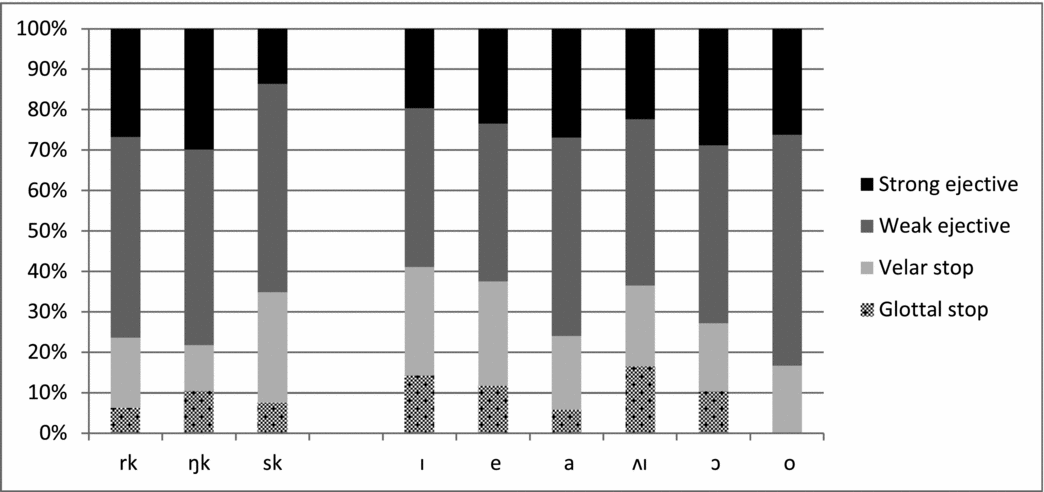
The distribution of the main variant categories for /k/ according to preceding segment in casual speech is shown in Figure 6. There was a significant effect of preceding consonant for strong ejectives in casual speech (strong: b = 0.34, Wald χ2(1) = 5.96, p < .05). In this speech style, strong ejectives occur most when /k/ is in the /-ŋk/ cluster and least when it is in the /-sk/ cluster. The results for the /-sk/ cluster are interesting, as out of a total of 66 tokens, 65% are realized as an ejective of some kind. It looks as if Glaswegian does permit ejectives even after voiceless sounds such as [s] (see Ogden Reference Ogden2009: 163).
Distribution of main variant categories of /k/ in casual speech according to phonetic context: (left) preceding consonant; (right) preceding vowel.
In casual speech, Figure 6 also shows that a clear pattern has emerged in terms of ejective frequency across vowel contexts, from [ɪ] (59%) to [o] (82%). There was a significant effect of preceding vowel for weak ejectives, b = −0.63, Wald χ2(1) = 4.59, p < .05, which are least likely following /e/ (e.g. snake) than /o/ (e.g. smoke). Overall, we see a tendency for the number of ejectives to increase from front to back vowels. It is possible that this may be linked to the relative size of cavity across these vowels from front to back, and in particular, that the tongue configurations for the back vowels lead to greater constriction above the pharynx, and hence greater possibility for pressure build up. Another reason may relate to the timing of the oral and glottal releases and the effect that the preceding vowel can have on their release (see Kingston Reference Kingston1985: 16–17).
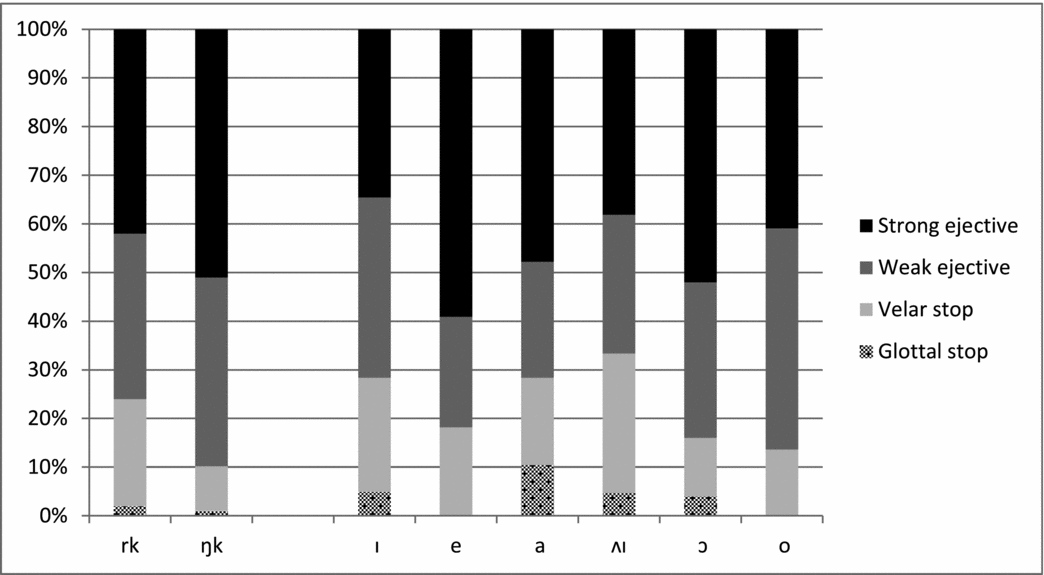
The distribution of the main variant categories for /k/ according to preceding segment in read speech is shown in Figure 7 below. The overall distribution of /k/ variants in read speech shows that the /-ŋk/ cluster has the highest distribution of ejectives (90%) with 50% of these being strong ejectives. Both weak and strong ejectives were significantly more likely to occur after /ŋ/: weak: b = −1.07, Wald χ2(1) = 5.69, p < .05; strong: b = −1.005, Wald χ2(1) = 4.76, p < .05.
Distribution of main variant categories of /k/ in read speech according to phonetic context: (left) preceding consonant; (right) preceding vowel.
There is no significant difference for the vowel context, though there seems to be a trend towards a ‘less–more’ pattern for ejectives according to vowel quality, with a fall in the number of ejectives from [e] to [ʌɪ] and a rise in ejectives from [ʌɪ] to [o].
7.3 Position in turn
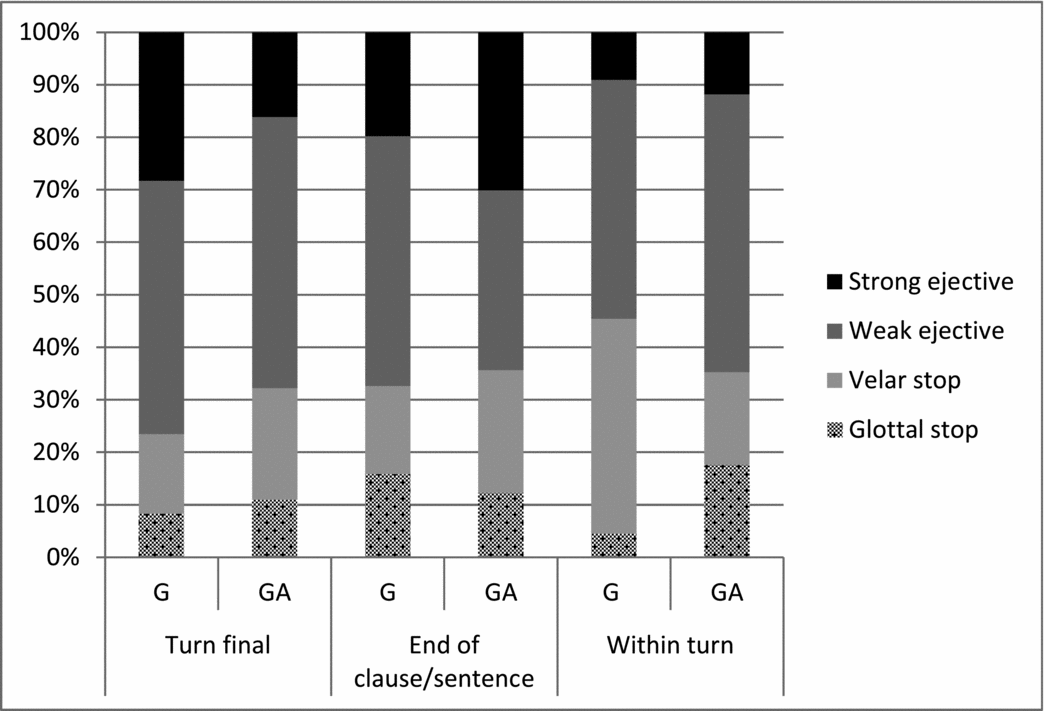
In addition to examining phonetic context, the tokens in casual speech were also analysed in terms of their position in the turn and/or at the end of a clause/sentence, as observations in the literature suggest that ejective realizations of English voiceless plosives are found more often in these contexts (e.g. Ogden Reference Ogden2009). The results are shown in Figure 8. The overall frequency of ejectives occurring in turn-final and end of clause/end of sentence positions is identical, each accounting for 74% of the total /k/ variants. Far fewer ejectives occurred anywhere else within the turn (35%); glottal stops were also much more common in this position, accounting for 30% of all variants.
Distribution of main variant categories of /k/ according to interactional/linguistic factors.
Statistically, glottal stops are least likely to occur turn-finally (b = −0.82, Wald χ2(1) = 5.11, p < .05), whereas weak and strong ejectives are more likely to occur in turn-final position (weak: b = 1.16, Wald χ2(1) = 11.91, p < .05; strong: b = 1.63, Wald χ2(1) = 12.94, p < .05) and at the end of a clause or sentence (weak: b = 1.301, Wald χ2(1) = 13.57, p < .05; strong: b = 1.61, Wald χ2(1) = 11.56, p < .05), than anywhere else within the sentence/turn. The reduced likelihood of ejectives in non-final contexts reflects the distributions found by Ogden (Reference Ogden2009) and Simpson (in press), and may result from the articulatory requirements for the following segment, which take precedence and effectively block an ejective release. Conversely, the prosodic and phonetic properties of final contexts, such as relatively longer closure durations from phrase-final lengthening, may facilitate ejective production.
7.4 Social factors
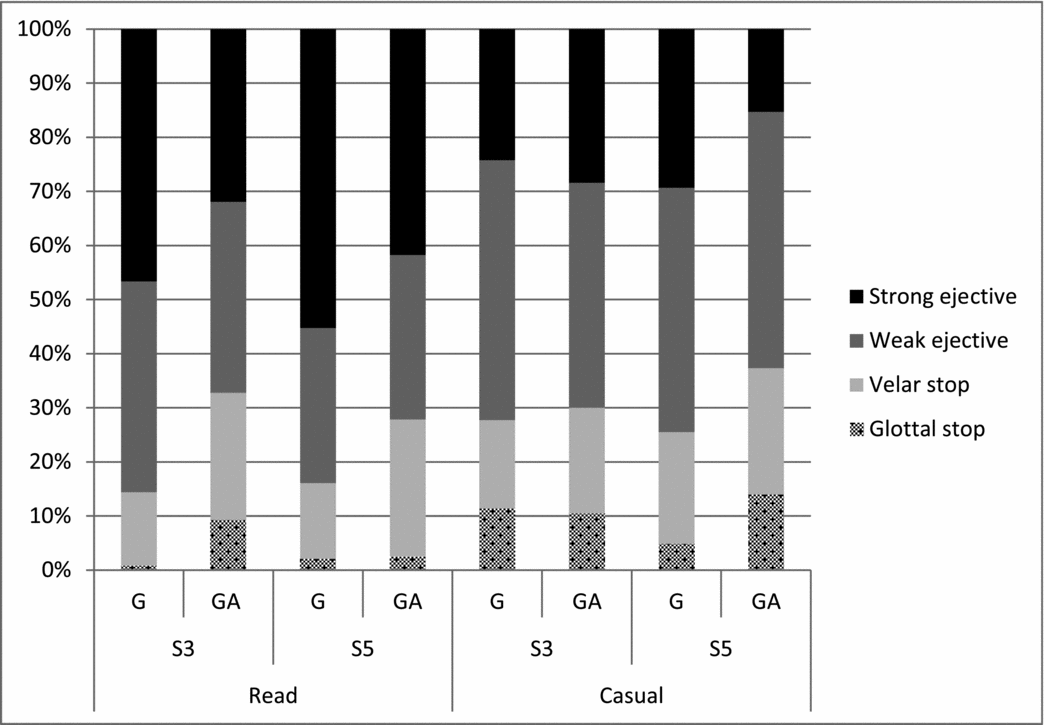
There were no significant main effects of age or social class, but ethnicity was significant, with Glaswegian non-Asian girls showing fewer glottal stops and more strong ejectives than Glaswegian Asian girls (glottal: b = −0.58, Wald χ2(1) = 6.45, p < .05; strong: b = 0.82, Wald χ2(1) = 12.24, p < .05). Overall, Glaswegian non-Asian girls used more ejectives than their Asian counterparts (78% vs. 68%), who correspondingly showed more glottal stops (6% vs. 10%); see Figure 9. There were also two interesting sets of interactions of social factors with style and position in turn, respectively, which we discuss below.
Distribution of main variant categories of /k/ according to style, age and ethnicity (G = Glaswegian non-Asian, GA = Glaswegian Asian; S3 = 14-year-olds; S5 = 16/17-year-olds.
7.4.1 Style, age and ethnicity
There were significant two-way interactions of style and ethnicity, and age and ethnicity, for strong ejectives (b = −1.31, Wald χ2(1) = 4.04, p < .05; b = −1.19, Wald χ2(1) = 5.92, p < .05). There was also a three-way interaction of style, age and ethnicity for glottal stops and both kinds of ejective (glottal: b = 3.436, Wald χ2(1) = 1.57, p < .05; weak: b = −3.303, Wald χ2(1) = 4.68, p < .05; strong: b = −4.25, Wald χ2(1) = 7.64, p < .05). Figure 9 shows the patterning of the variants. We can see that while overall Glaswegian non-Asian girls use more strong ejectives than Glaswegian Asian girls, this is more pronounced in read speech, and in older girls. The three-way interactions further show an almost reciprocal relationship between the use of strong ejectives and glottal stops. Read speech promotes more strong ejectives and fewer glottals than casual speech, and Glaswegian non-Asian girls show fewer glottal stops and more strong ejectives than Glaswegian Asian girls, but this does not extend to younger girls in casual speech, who show no differentiation according to ethnicity in their realization of /k/.
7.4.2 Position in turn and ethnicity
There was also a significant interaction for position in turn and ethnicity, for the strong ejective (b = −1.52, Wald χ2(1) = 4.56, p < .05), which is shown in Figure 10.
Distribution of main variant categories of /k/ according to position in turn and ethnicity (G = Glaswegian non-Asian, GA = Glaswegian Asian).
Again, we can see the main effects of position in turn, strong ejectives are used more turn-finally and at the end of a clause or a sentence, and ethnicity, Glaswegian non-Asian girls show more strong ejectives than Glaswegian Asian girls. But there is one context where this is not the case: at the end of a clause or sentence, Glaswegian non-Asian girls use fewer strong ejectives, and Glaswegian Asian girls use more. There is also little differentiation according to ethnicity anywhere else within a turn.
8 Discussion
This study analysed the realization of word-final /k/ in read and casual speech by 28 female pupils in a Glasgow high school. /k/ occurred in different phonetic contexts, and in different positions within the turn. The girls differed in age, social class, and ethnicity. We structure our discussion of the results around the five research questions posed at the outset.
8.1 How much do Glaswegian female pupils use ejectives for word-final /k/?
Previous descriptions of Glaswegian /k/ led us to expect released or weakly-aspirated velar plosives, some glottal stops, and occasional ejectives (e.g. Macafee Reference Macafee1983). Our results show a different picture. The most common realization of /k/ in these speakers is some kind of ejective. Across both speech styles, 65% of all instances were ejectives. The narrow auditory transcription revealed an auditory continuum in line with Ladefoged's (Reference Ladefoged1973) observations. We found a range from weak to strong to intense sounding ejectives, and also those for which the closure sounded very long. Apart from ejectives, other variants were released or aspirated plosives, velar fricatives, and glottal stops, though not as many as we might expect.
8.2 Is the use of ejectives linked to speech style?
In order to investigate the role of speech style in the realization of /k/, the girls were recorded reading a list of sentences aloud and completing a map task with a friend. We found a clear difference according to style: speakers used more ejectives in read than in spontaneous speech. We also found that auditorily strong ejectives (strong, intense, and with long closures) were more common in read speech. Given Simpson's (in press) observations about the interactional properties of read speech, we wondered whether the increased use of ejectives in read speech could be due to interactional factors, and in particular the fact that /k/ occurred not only in a sentence, but also turn-finally.
It seems likely that this may at least partly account for the stylistic difference. But there were also interesting interactions of the social factors of ethnicity and age with style. In read speech Glaswegian non-Asian girls use more strong ejectives than Glaswegian Asian girls; in casual speech, older Glaswegian non-Asian girls still use more strong ejectives than Glaswegian Asian girls, but younger girls show no ethnic differentiation (see below, Section 8.4). That the production of ejectives in read speech – while overall more common – patterns with speakers of different ages and ethnicities, suggests that interactional function alone does not account for the preponderance of ejectives. Rather, these findings suggest that reading the sentences was a task which involved both the properties of turn-finality and the sociolinguistic construction of identity by younger/older, Glaswegian non-Asian/Glaswegian Asian girls. Producing ejective stops seems to be constrained by both factors together. Conversely, casual speech is characterized by fewer strong ejectives, but this too is under some level of sociolinguistic control.
There was also another interesting aspect to the stylistic variation elicited by these tasks. We treated the difference between the two kinds of speech as between reading and speaking spontaneously and casually with a good friend; the map task had been chosen as a way to collect naturally occurring speech but with some control over lexical items. However, two properties of the map task recordings suggested that these were not quite the same as, for example, a conversation between two friends. The first is that the proportion of glottal stops for /k/ (and even impressionistically for /t/) was rather lower than that found in conversational Glaswegian speech in other corpora (e.g. Stuart-Smith Reference Stuart-Smith1999b. The second concerns like. We had assumed that the map task would be an ideal way to obtain many instances of this word, as it was expected that given the age and gender cohort of the participants there would be multiple instances of both quotative and discourse marker like (Tagliamonte & Hudson Reference Tagliamonte and Hudson1999). However, this was not the case: in the entire corpus there were only four instances of like. Our incidental findings underscore the subtle differences between spontaneous speech elicited through completing a map task, which is structured and shows some differences from that in naturally-occurring conversations (see e.g. Warner Reference Warner, Cohn, Fougeron and Huffman2011).
8.3 What are the phonetic, linguistic, and interactional factors that promote ejective use?
8.3.1 Phonetic context
The realization of /k/ was analysed as part of three different consonant clusters /-ŋk -rk -sk/. Ejectives were expected to occur in the nasal cluster /-ŋk/ (e.g. Scobbie et al. Reference Scobbie, Gordeeva and Matthews2006; Ogden Reference Ogden2009: 163) but not in the /-sk/ cluster (Ogden Reference Ogden2009: 163). Nothing specific was reported in the literature about ejectives following [r] so it was difficult to predict the outcome here. Our results showed that the preceding velar nasal promoted the most ejectives, and especially strong ejectives in casual speech.
The results for the /-sk/ cluster are interesting and show that contrary to what had been observed by Ogden (Reference Ogden2009: 163), in Glaswegian English ejectives may follow voiceless sounds. 65% of /k/s following [s] were realized as ejectives. We do not have an explanation for the increased use of ejectives in the /-ŋk/ cluster, other than to wonder whether the preceding velar articulation may help to effectively prolong the velar closure period, and reduce the supralaryngeal cavity further, both allowing greater pressure build up (whether produced by larynx movement or epiphenomenally, see Simpson, in press). It is also possible that ejectives might enhance the auditory salience of /k/ and hence the lexical distinction between words ending in /-ŋk/ and /-ŋ/, as in e.g. bank as opposed to bang (see Ogden Reference Ogden2009: 164). We have not yet analysed the rhotic consonants that made up the /-rk/ cluster, beyond being aware that there was a socially-stratified range of articulations from taps to auditorily-stronger, approximant /r/s (e.g. Lawson, Scobbie & Stewart-Smith Reference Lawson, Scobbie and Stuart-Smith2011). We might expect different rhotics to impose different constraints on ejective production, but we did not find an interaction of social class and consonant cluster; links between types of rhotic articulation and ejective production remain for future investigation.
The lack of previous results for the effect of vowel context on ejectives in English meant that it was difficult to predict a pattern. The results for casual speech showed patterning of ejectives with vowel quality, such that strong ejectives were less likely following close vowels than back rounded vowels, and this tendency was also found for read speech. This may be due to factors such as the relative size of cavity across vowels from front to back, tongue configuration, and the timing of the oral and glottal release (see ection 7.2 above).
8.3.2 Position in turn
In read speech the words containing final /k/ were all at the end of the sentence, which could also be considered to be turn-final (Simpson, in press). In the more casual speech elicited by the map task, it was possible to consider these two positions separately. Our results for casual speech showed that ejectives are more likely to occur when word-final /k/ is in a word which is turn-final and/or one that occurs at the end of a clause or sentence which is still within the turn. The frequency of ejectives occurring in turn-final and end of clause/sentence position is equally distributed; suggesting turn-final position per se does not specifically favour ejective realizations. These results align with the observations in the literature which note both turn-final and sentence-final position as favouring ejectives (Wells Reference Wells1982; Macafee Reference Macafee1983; Chirrey Reference Chirrey1999; Lambert et al. Reference Lambert, Alam, Stuart-Smith, Trouvain and Barry2007; Ogden Reference Ogden2009: 163; Gordeeva & Scobbie Reference Gordeeva, Scobbie, Scobbie, Mennen and Watson2011; Simpson, in press). It seems that ejectives in Glasgow English are influenced both by interactional function and sentence prosody.
A further interesting finding was that ejective realizations were surprisingly frequent in words which were simply within the turn (not sentence- or turn-final). Just over a third of the overall variation for /k/ in words ‘within the turn’ was an ejective, though the majority of these were weak ejectives. The salience of strong ejectives may account for them being more likely to be noticed in turn-final position (see Ogden (Reference Ogden2009: 164), who discusses ejective realization as enhancing the salience of the burst).
8.4 What social factors constrain ejective use?
A key aspect of this study was to discover more about the sociolinguistic nature of ejectives in Glasgow English. Our sample of speakers was stratified according to age (one group of 14 year old girls and another group of 17 year old girls), social class (working and middle as defined by DEPCAT groupings), and ethnicity (Glaswegian non-Asian and Glaswegian Asian). Previous research on Glaswegian has shown that production of a range of consonants is strongly stratified by social class (e.g. Stuart-Smith et al. Reference Stuart-Smith, Timmins and Tweedie2007), with innovative variants being particularly common among working-class adolescents in the core period of adolescence (aged 13–15 years old). We have also found variation according to ethnicity, including ejectives in read speech in Glaswegian Asian speakers (Lambert et al. Reference Lambert, Alam, Stuart-Smith, Trouvain and Barry2007). We anticipated that ejective realization might pattern with social class and ethnicity, and possibly with age. In fact our results did not show straightforward differences in the distribution of ejectives (or other variants) in line with age or social class. Ethnicity alone showed a significant main effect, with Glaswegian non-Asian girls producing more strong ejectives than Glaswegian Asian ones.
We did, however, find some interesting interactions with respect to speech style, and position in turn, and the social factors of age and ethnicity. Whereas read speech resulted in more strong ejectives (and fewer glottal stops), Glaswegian Asian girls used relatively fewer strong ejectives (and more glottal stops) than Glaswegian non-Asians. Older girls show a similar pattern of ethnic differentiation in casual speech, but it does not hold for the younger girls in this speech style, who all showed very similar realizations of /k/ across all variants. We also found an intriguing anomaly to the main pattern of ethnicity for instances of /k/ occurring at the end of a clause or sentence: in this one context, Glaswegian Asian girls used more strong ejectives than Glaswegian non-Asian girls
These findings suggest that in Glasgow, ejective stops as variants for /k/ are subject to a fine degree of sociolinguistic control, and as noted above (Section 8.2) they are promoted by, but are not necessarily the product of, the interactional context that this elicitation task entailed. The inverse patterning of strong ejectives with glottal stops also suggests that producing ejectives may be part of a more general, expanding, sociolinguistic repertoire for stop production, in contrast to using glottal stops. Glottal stops for unstressed word-medial /t/ are both extremely common, and strongly socially-stratified, occurring very frequently in working-class speech (Stuart-Smith Reference Stuart-Smith1999b; glottal stops for /p/ and /k/ are also found in Glaswegian vernacular. We found it interesting that glottal stops and ejectives seemed to exist in a kind of socially-determined complementary distribution, especially in the more monitored speech style. This result also seems to be in line with Gordeeva & Scobbie's (Reference Gordeeva, Scobbie, Scobbie, Mennen and Watson2011) claim that ejectives in this variety of English are distinct from glottalling and glottal reinforcement.
We were also intrigued by the social patterning of ejectives with respect to ethnicity. Previous research has shown that several features function as sociolinguistic variables for ‘Glaswasian’ ethnicity, and that their fine phonetic variation also patterns closely with social practices, so for example, clearer laterals, closer GOAT and FACE vowels, and more retracted /t/ are used by Glaswegian Asian girls who are also more involved in cultural and social practices associated with the heritage culture (see e.g. Stuart-Smith, Timmins & Alam Reference Alam, Stuart-Smith, Lee and Zee2011). It seems that ejectives may also play a role in constructing a ‘Glaswasian’ identity, though not quite as we might expect. The original impressions that the Glaswegian Asian pupils were using more ejectives than the Glaswegian non-Asian girls were not substantiated by the study. In fact the opposite pattern is found, Glaswegian Asian girls show fewer strong ejectives in most contexts, and use more glottal stops, variants which are traditionally associated with Glaswegian vernacular. But we do note a subtle differentiation in words which occur at the end of a clause or sentence; in this context Glaswegian Asian girls use more strong ejectives than Glaswegian non-Asians. We wonder whether differentiation in this context may be more sociolinguistically salient than in turn-final position, where ejective realizations of /k/ may partly be promoted by several phonetic and prosodic factors, such as stress and phrase-final lengthening. The role of ethnicity in the realization of /k/ clearly deserves further attention.
8.5 Can the use of ejectives for /k/ be regarded as language change in progress?
Ejectives have been reported as realizations of voiceless plosives in varieties of English at least since the 1970s, and are likely to have existed earlier. There is also the increasing impression that ejectives are now more usual than they used to be (Simpson, in press). Are ejectives actually being used more, or are we becoming more aware of them?
In Glasgow, the earliest overt reference to ejectives being used in Glaswegian English appears to be by Macafee (Reference Macafee1983), though see Shuken (Reference Shuken, Higgs and Thelwall1984: 123). Our study only considered speakers from a single time point, but we were able to make a cautious comparison with a corpus of Glaswegian collected in 1997 (Stuart-Smith Reference Stuart-Smith1999a). Recordings were made from participants similar to ours in terms of the area of the city, age, gender and social background. However, the results for variation in /k/ in the earlier study do not include a velar ejective variant, and Timmins, Tweedie & Stuart-Smith (Reference Timmins, Tweedie and Stuart-Smith2004: 19) state: ‘there have been no reports either anecdotally or in the literature to suggest that /k/ may be changing in Glaswegian speech’. In order to consider this further, both authors listened to all instances of word-final /k/ from the 1997 Glasgow corpus which occurred in the words, lock, beak and peak in the word list recordings from the middle- and working-class girls (aged 13–14 years). Out of 48 tokens, we heard only two as ejectives, both of which were only weakly ejective. This real-time comparison, albeit very small-scale, does suggest that in Glasgow at least, ejectives have increased rather substantially over the last 14 years, and that we are witnessing language change in progress. We await with interest the results from the new Glasgow real-time project, which is considering variation and change in the Glaswegian accent since the 1970s (http://soundsofthecity.arts.gla.ac.uk/), to see whether the use of ejectives for /k/ really should be regarded as language change.
9 Conclusions
Before conducting this research, classroom observations indicated that velar ejectives were very common in pupils’ speech. Our initial impressions were that Glaswegian Asian pupils used ejectives more, but we soon realized that this was not just particular to a single group, since ejectives occurred in the speech of every pupil in our sample. This small-scale auditory analysis of word-final /k/ in a socially-stratified sample of 28 girls from the school confirmed this realization. We found that ejectives are the most usual variant for word-final /k/ in both read and casual speech, and that they were more common in read speech. Our auditory impressions suggested a continuum of ejective production, ranging from weak to intense ejectives.
Ejectives occurred in words which were both turn-final and at the end of sentences and clauses in casual speech; but they also constituted over a third of the tokens for /k/ in words anywhere else within the turn. Ejectives were more likely after nasals, in words like tank, and after back rounded vowels; they were also found after /s/. Our results also showed that social factors, specifically ethnicity and age, constrain ejective production, particularly in read speech. Ogden (Reference Ogden2009) and Simpson (in press) point out the relationship between ejectives in English and their position in talk. Our findings show that social factors also play a role in promoting and/or constraining ejectives alongside interactional factors.
Finally, a cautious comparison of these data with recordings made 14 years ago suggests a real-time increase in the use of ejectives for /k/ in Glaswegian adolescents. This is an initial confirmation of the increasing suspicion that ejectives are becoming more common in (Scottish) English (see Gordeeva & Scobbie Reference Gordeeva and Scobbie2013). It will be extremely interesting to see whether further real-time research substantiates this initial finding. We are also very curious to learn the results of other sociophonetic studies pursuing the use and progress of ejectives in other varieties of English. We very much hope that these will be undertaken.
Appendix. Sentences used for the reading task
1. There seems to be a big party in her house every weekend.
2. Out of all the outfits Sarah and Emma tried on this is the one they like.
3. Kampala is not in Nigeria it is the capital city of Uganda.
4. Blue is for boys while girls usually prefer pink.
5. Maria says that when she is finished school she will get a good job.
6. Samantha said last week that she didn't want to invite Mark.
7. They went to the movies twice last week, they said it was fun.
8. I could have easily told you that Bagdad is in Iraq.
9. I think we spend far too much time in school, we'd be better off at home.
10. There's nothing worse than turning up late for an event, I hate people staring.
11. I had to upgrade to a more advanced model as the one I had was far too basic.
12. The spectacular green rolling hills were dotted with sheep.
13. My mum has banned me from going out at weekends during exam time.
14. Every Sunday they go for a run in the park.
15. She has travelled all over Europe but has never actually been to Spain.
16. If you join they will send you out a starting out pack.
17. At the dancing in town last night I saw Daniel and Matt.
18. The huge hole in the bottom of the boat was the reason it sank.
19. Rose knew she had to start writing the essay but she didn't know where to start.
20. On Saturday mornings Luke takes his dogs for a long walk before breakfast.
21. I like to spend time by myself, it helps me to think.
22. The exams begin next week; I better start studying Romeo and Juliet.
23. Peter said that he wants to work far away like on an oil rig.
24. Brian sat there, showing no emotion, casually chewing on a toothpick.
25. The feeling of being surrounded by too many people is like being stuck in a trap.
26. The conditions for sailing were very dangerous; the fog was dense and thick.
27. I can't believe it! You're cancelling all the flights, this is a joke!
28. I don't think I'll be going out tonight, I've got no money.
29. The movie was nowhere near as interesting or as exciting as the novel.
30. Steven tried to push the door as hard as he could but it wouldn't lock.
31. As usual the last person to leave the house was Mike.
32. I don't think I'll be going out tonight, I've got no money.
33. I hate when people bend over the pages of a book rather than using a bookmark.
34. He likes to get away from it all sometimes and just walk the dog.
35. Denise said that she never drank tea or coffee.
36. Chloe said that her new bag was the real deal but we all knew it was a fake.
37. I can't wait to go on holiday; it's going to be the best yet.
38. Martin's mouth suddenly went dry but the interviewer told him to take a drink.
39. Before you call to the house be sure to give me a ring
40. John went on holiday to Ireland; he flew from Glasgow to Cork.
41. If I could live anywhere I wanted I would definitely choose to be near the sea.
42. It would be a pretty boring Friday night if all you did was tidy the house.
43. David sold his car last week but bought a much more modern one.
44. Gavin says that the only thing you need for travelling is a good rucksack.