INTRODUCTION
Izapa has long been recognized for its impressive corpus of Late Formative period (300 b.c.–a.d. 250) carved monuments, which captured the attention of scholars and the public with the early reports by Marquina (Reference Marquina1939:40) and Stirling (Reference Stirling1941), and the first extensive excavations by the New World Archaeological Foundation in the 1960s (Lowe et al. Reference Lowe, Lee and Espinosa1982; Norman Reference Norman1973, Reference Norman1976). Rather than a focus on the array of pictorial imagery at Izapa, however, this paper takes one particular monument as its starting point, and situates it within a larger framework of contemporaneous imagery in southeastern Mesoamerica referencing captive-taking, sacrifice, and warfare. In this essay, I refer to Izapa sculpture as Late Formative in date, in keeping with Lowe et al.'s (Reference Lowe, Lee and Espinosa1982) assignation of most of the monuments to the Guillén phase, now dated to 300–100 cal b.c. (Lowe et al. Reference Lowe, Ekhom and Clark2013:Figure 2), as well as more recent archaeological and environmental data presented in this special section by Macías et al. (Reference Macías, Arce, Capra, Saucedo and Sánchez-Núñez2018), Mendelsohn et al. (Reference Mendelsohn2018), and Rosenswig et al. (Reference Rosenswig, Culleton, Kennett, Lieske, Mendelsohn and Núñez-Cortés2018). Yet, I do so with the caveat that the specific chronological placement of the extensive Izapa corpus, as well as monuments carved in the “Izapan style” at other sites (see Guernsey [Reference Guernsey2006:43–73] for discussion of the history and problematic nature of this designation), remains a subject of ongoing investigation and debate (Inomata and Henderson Reference Inomata and Henderson2016; Inomata et al. Reference Inomata, Ortiz, Arroyo and Robinson2014).
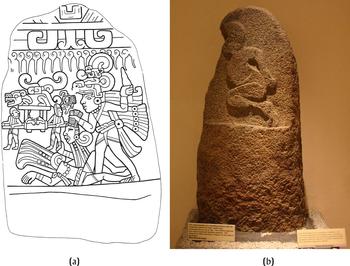
Izapa Stela 21 (Figure 1a), which vividly portrays a scene of captive sacrifice (Miles Reference Miles and Willey1965:258; Norman Reference Norman1976:123), is one of several monuments that calls attention to the significance of the representation of violence during this period within a region encompassing the Pacific slope and adjacent Guatemalan highlands. Violence, as attested archaeologically, epigraphically, and visually, is an important topic of exploration in and of itself. It is also the subject of a growing body of scholarly literature engaged with definitional issues concerning the use of admittedly vague terms like warfare and sacrifice, and complex issues such as the relationship between violence and the evolution of complex society in Mesoamerica and beyond (see, for example, Baudez and Mathews Reference Baudez, Mathews, Robertson and Jeffers1979; Boone Reference Boone1984; Brown and Stanton Reference Brown and Stanton2003; Carrasco Reference Carrasco1999; Chacon and Mendoza Reference Chacon and Mendoza2007; Demarest Reference Demarest and Gregor1997, Reference Demarest2013; Freidel Reference Freidel, Renfrew and Cherry1986; Hassig Reference Hassig1992; V. Miller Reference Miller, Ruiz, Sosa and Ponce de León2003; Orr and Koontz Reference Orr and Koontz2009; Reyna and Downs Reference Reyna and Downs1994; Schele and Miller Reference Schele and Miller1986; Scherer and Verano Reference Scherer and Verano2014; Strathern et al. Reference Strathern, Stewart and Whitehead2006:27; Webster Reference Webster1975; Whitehead Reference Whitehead2004).
(a) Izapa Stela 21. Drawing by Ajax Moreno, courtesy of the New World Archaeological Foundation. (b) Izapa Stela 89. Photograph by Michael Love.

Across the globe, images of aggression can serve to justify the use of violence in pursuit of order, as Strathern and Stewart (Reference Strathern, Stewart, Strathern, Stewart and Whitehead2006:27) cogently argued. Orr and Koontz (Reference Koontz, Orr and Koontz2009:xiii–xv) demonstrated that representations of aggression were employed to mark “the limits or threshold of cultural order,” its disintegration, and its reintegration in Mesoamerica. This paper explores the potential sociopolitical significance of imagery like that of Izapa Stela 21, as well as its relationship to the mutually reinforcing roles of ideology and coercive power, as best as we are able for a period in which we lack the specificities of text. It also frames images of violence, as well as those that adopt a similar visual repertoire for statements of political subordination or allegiance, as key components of Late Formative expressions of social order. In other words, this study explores “the encoded record of violence,” to quote Orr and Koontz (Reference Koontz, Orr and Koontz2009:xv), and its associated visual repertoire rather than the acts in and of themselves or their archaeological signatures. Encoded records of violence during the Late Formative period, I argue, were central to expressions of social order that linked governance and political allegiance to larger cosmological processes that include the arrival of rain and agricultural fertility.
Before beginning, another caveat is in order: the majority of monuments at sites in this region do not focus on violence, warfare, captive sacrifice, or even overt political subordination. The images that do, however, provide a subtle counterpoint to broadly shared messages emphasizing the authority of rulers and its mythological justification (Guernsey Reference Guernsey2006, Reference Guernsey2012a). This is probably due to the fact that, as Hirth (Reference Hirth, Chase and Chase1992:27) recognized, the most productive way to regulate disputes and negotiate relationships within a regional network of interaction is to maintain peace. Nevertheless, I would assert that scenes of violence, which went hand-in-hand with a visual framework for expressing political subordination, hint at the ways in which negative social discourses worked in tandem with those emphasizing more positive assertions. The scenes of aggression that I address here were, to borrow Freidel's (Reference Freidel, Renfrew and Cherry1986:95) words, a fundamental component of political charter, and part of “an elaborate material symbol system…shared and recognized by antagonist and protagonist alike.”
IZAPA STELA 21
In the foreground of Izapa Stela 21 (Figure 1a), located in plaza Group D, a figure wielding a blade has just decapitated a victim; he grasps the severed head in his right hand. The protagonist wears an elaborate zoomorphic headdress, which is crowned by a small head or mask whose cranium is formed by a curling volute that links it to suite of Late Formative imagery associated with rain and lightning gods (Guernsey Reference Guernsey, Guernsey, Clark and Arroyo2010a:208–221; Henderson Reference Henderson2013:281–332; Norman Reference Norman1976:122–127; Taube Reference Taube and Coe1995). While this headress detail is key to the meaning of the scene, as discussed below, it may also function as a nominal device, in keeping with Mesoamerican conventions of including glyphs in headdresses in order to convey names or titles (Davíd Mora Marín, personal communication 2016; also see Strauss Reference Strauss2018). In combination with the protagonist's feathered backrack, beaded necklace, large earflares, and belted skirt, this regalia signifies an individual of some status. Noteworthy, though, is that similar regalia adorns his victim, who sports a beaded necklace, knotted belt, and large earflares; as Norman (Reference Norman1976:123) observed, this indicates that the victim was a relative peer of the protagonist rather than a social inferior. No headdress is visible above the victim's striated locks of hair and, instead, the artist highlighted the jeweled blood that spurts in linear streams from the base of his head and severed neck. As if underscoring the symbolic significance of this sacrificial act, curling volutes accompanying the gushing blood mirror those at the crown of the protagonist's headdress, as well as those that descend from the skyband. In fact, the volutes descending from the skyband at the top of the scene make it clear that while, at one level, this scene is about taking captives and sacrifice, it is as much about the arrival of rain. Similar watery imagery featuring falling rain, flowering trees, the performances of fluvial deities, flowing rivers at times teaming with fish, and references to canoe travel appear on other Izapa monuments (see Stelae 1, 5, 23, 26, and 67). This additional imagery further contextualized the Stela 21 act of sacrifice within a positive discourse of agricultural fertility and aquatic abundance, which ensued under the auspices of a ruler whose ritual actions were credited with ensuring social order (Guernsey Reference Guernsey2016). An additional vignette on Stela 21, smaller in scale and placed as if to suggest that it transpired in the background beyond the scene of sacrifice in the foreground, features a figure transported in a palanquin topped by a feline creature. Between the litter and the protagonist is one of the few hieroglyphs, albeit undeciphered, that grace Izapa monuments.
LATE FORMATIVE FIGURES WITH HANDS BOUND BEHIND THEIR BACKS
Stela 21 was not unique at Izapa. Stela 89 (Figure 1b) also alludes to taking captives or, at the very least, acts of submission utilizing the language of captive-taking that were publicly memorialized, in this case in the plaza of Group B. In this scene, a figure kneels before an implied audience, hands bound behind his back. The emphasis placed on his dramatically arched torso, rendered with sinewy contours, as well as the laces that bind his arms, effectively conveys the discomfort of his posture in spite of the fact that his body seems to hover oddly in the air, balanced only by the toes of his feet that brush the ground line. Based on this unusual composition and the lack of typical Izapan framing bands, Norman (Reference Norman1976:163) suggested an early carving date for Stela 89.
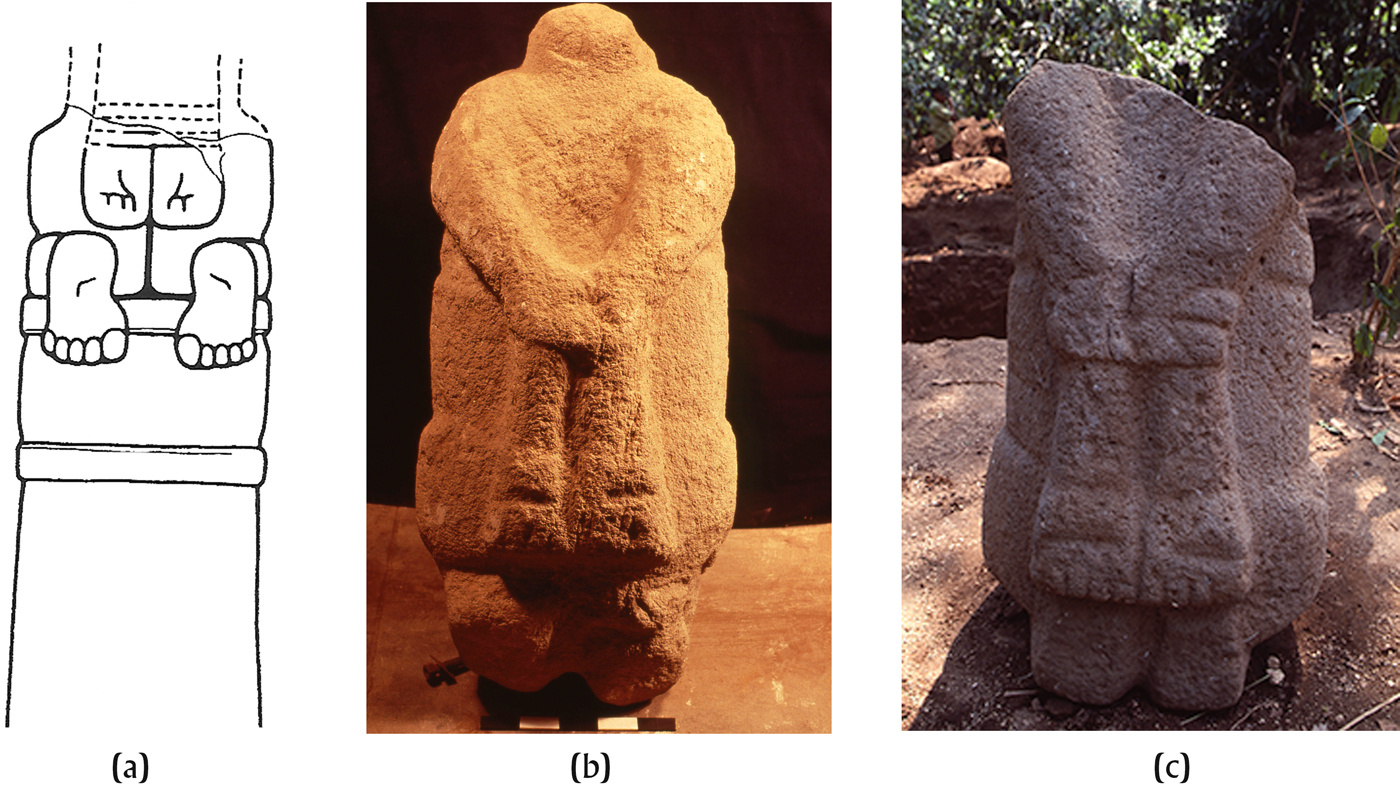
Miscellaneous Monument 4 (Figure 2a), a pedestal sculpture found in Group F in what was likely a secondary context (Lowe et al. Reference Lowe, Lee and Espinosa1982:225–226; Norman Reference Norman1976:262), repeats this theme. Although fragmentary, one can see what remains of the lower body of a kneeling figure whose feet dangle over the edge of the back; above them bound arms and hands are visible. Miscellaneous Monument 4 bears some similarities to another more fragmentary pedestal sculpture from Kaminaljuyu (Parsons Reference Parsons1986:Figure 39), although the kneeling posture differs. An unprovenienced pedestal sculpture attributed to the Guatemalan highlands likewise portrays a figure with hands bound behind his back (Kidder Reference Kidder1959:Figure 9). The twisted rope slung around the figure's neck, in addition to the bound arms, may connote the status of captive although, as Kidder (Reference Kidder1959:48) noted in the caption to the photo, whether the bound man “represents a prisoner or a sacrificial victim, or both, is not known.”
(a) Izapa Miscellaneous Monument 4. Drawing by Ajax Moreno, courtesy of the New World Archaeological Foundation. (b) Takalik Abaj Monument 5 and (c) Takalik Abaj Monument 44. Photographs by Michael Love.

Examples of similar figures with hands bound behind their backs exist at other sites in the region, including Takalik Abaj (Figures 2b and 2c). The first, a headless captive figure with neck still intact (Figure 2b), is listed as Monument 5 from San Isidro Piedra Parada on the Takalik Abaj sculpture inventory prepared by Graham (Reference Graham1980) during the Berkeley project excavations; it was published by Thompson (Reference Thompson1943:Figure 2d–2e). The second, a bound captive figure (Figure 2c), is listed as Monument 44 and attributed to “a sculpture dump located just south of Stela 28” (Graham Reference Graham1980); it was published by Orrego Corzo (Reference Orrego Corzo1990:Lámina 28). Two other monuments on Graham's sculpture inventory, numbers 4 and 54, are described as figures with hands behind their backs, but I have not seen them to confirm this.
The posture of these three dimensional captives at Takalik Abaj closely compares to that of the figure on Izapa Stela 89, suggesting that, already by the Late Formative period, there was a shared vocabulary of representation in which kneeling figures with arms clasped behind their backs signified some sort of captive or degraded status. In many ways, these Late Formative images of captives—or their sacrifice, as on Izapa Stela 21—anticipate the sorts of scenes better known from the Classic period, as at Bonampak, where captive display and decapitation were a fundamental part of courtly spectacle (M. Miller Reference Miller1986; V. Miller Reference Miller1983). The Madrid Codex makes clear that the significance of individuals with arms bound behind the back would endure into the Postclassic period: in the first of two sequential almanacs, a captive appears with arms bound behind his back. In the second, he is shown decapitated (Vail and Hernández Reference Vail, Hernández, Tiesler and Cucina2007:134, Figure 6.7). While it is essential to note the endurance of this iconography into later periods, it is equally vital to underscore its novelty during the Late Formative period: such imagery was innovative, and laid the formal and conceptual foundations for the expression of similar ideas for centuries to come. Although Clancy (Reference Clancy2002:27–28) claimed, in her discussion of Classic-period captive-taking imagery from Yaxchilán, that there was no previous “tradition for depicting a ruler and his captive in the ritualized moment of capture,” the opposite is true. Izapa Stela 21 demonstrates the antiquity of this tradition and the pictorial innovations devised to convey acts of captive-taking and sacrifice during the Late Formative period.
A number of scholars have pointed out that imagery of captive-taking and sacrifice was not merely the result of artists' vivid imaginations or political propaganda: throughout Mesoamerica, from the Formative period through the conquest, there is extensive skeletal evidence attesting to the violent deaths of victims (see López Luján and Olivier [Reference López Luján and Olivier2010] and Tiesler and Cucina [Reference Tiesler and Cucina2007] for recent summaries of this data). At the Late Formative site of Sin Cabezas, located in the Tiquisate region of the department of Escuintla, the burial of some individuals—face-down, hands bound behind the back, and typically missing limbs or a head—contrasts with the usual pattern of burials at the site. Whitley and Beaudry (Reference Whitley, Beaudry and Fowler1991:112) interpreted these individuals with hands bound behind their backs as sacrificial victims, evidence that matches well with the artistic record, particularly in this region of southeastern Mesoamerica. Moving between this archaeological evidence and the pictorial record, however, poses interpretive challenges, especially for the Formative period, a point stressed by Henderson (Reference Henderson2013:170–237). As I address below, the visual language associated with Late Formative captive-taking, like that for the Classic period, overlaps with themes of submission, humility, dishonor, fealty, and supplication (see Baudez and Mathews [Reference Fields and Reents-Budet1979], Houston et al. [Reference Houston, Stuart and Taube2006:203–226], Koontz [Reference Koontz, Orr and Koontz2009], Schele [Reference Schele and Boone1984], V. Miller [Reference Miller1983], and Marcus [Reference Marcus1974:84], who recognized that Morley and Morley [Reference Morley and Morley1938:13] were among the first to attempt to define the postures associated with figures representing captives, subsidiary figures, degraded individuals, and supplicants).
LATE FORMATIVE FIGURES WITH HANDS CLASPED OR GATHERED IN FRONT OF THEIR BODIES
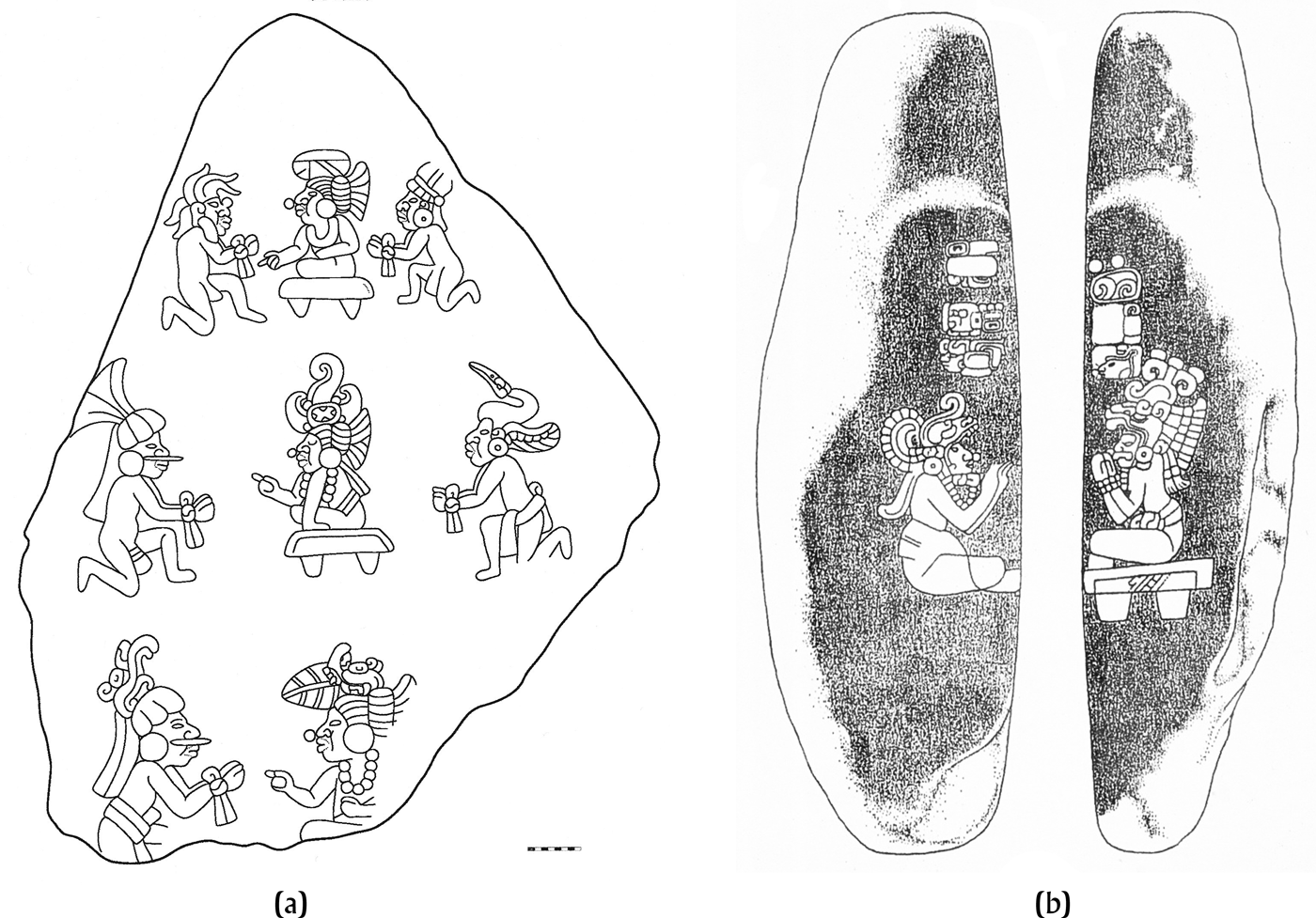
Not all of the Late Formative images associated with captives and sacrifice within this region render victims with their hands bound behind their backs. As in other regions of Mesoamerica, a related body of monuments features individuals, often kneeling, with their hands clasped or gathered in front of them in a gesture widely understood as signifying submission or, at the very least, deference and humility. For example, Late Formative Kaminaljuyu Sculpture 65 (Figure 3a) portrays a series of individuals whom scholars (Fahsen Reference Fahsen, Love, de Hatch and Escobedo2002; Henderson Reference Henderson2013; Kaplan Reference Kaplan2000:186–191; Parsons Reference Parsons1986:57–58) have interpreted as captives arrayed on either side of enthroned lords. This interpretation was based in part on the genuflecting pose of the figures—which, like kneeling, was interpreted as a sign of deference or submission—as well as their lack of clothing and the fact that their hands were drawn together as if bound at the wrists by a knotted band. Doering and Collins (Reference Doering, Collins, Guernsey, Clark and Arroyo2010:264–267) recently argued, however, that new three-dimensional scans of the imagery indicate that the kneeling figures are not naked, but wearing loincloths. That said, Henderson (Reference Henderson2013:212) countered that the loincloths of other figures on Sculpture 65, like that of the individual in the second tier of the image, to the right of the throne, are readily visible. Based on this, she maintained that the other figures whose costumes are less legible must not have been originally portrayed with a full loincloth but, instead, a sort of codpiece.
(a) Kaminaljuyu Sculpture 65 obverse. Drawing by Lucia R. Henderson. (b) Imagery from the sides of Takalik Abaj Stela 5. Drawings by James Porter, courtesy of John Graham and the University of California, Berkeley.

Doering and Collins further noted that knotted bands similar to those around the wrists of the Sculpture 65 figures appear elsewhere at Kaminaljuyu on individuals whose hands are obviously separated (see, for example, Kaminaljuyu Sculpture 11). They thus concluded that it is inaccurate to assume that, on Sculpture 65, the wrists of the genuflecting figures are necessarily bound. In truth, it is difficult to discern if this motif signifies a knot that binds both wrists together, or if it is merely a profile view of a single wristband whose mirror opposite on the other arm was implied. In other words, while it is apparent that the imagery of Sculpture 65 portrays the deference of the genuflecting figures before the enthroned lords, I would concur with Doering and Collins that it is less clear that it is necessarily a scene portraying the presentation of bound captives. The very fact that the submissive individuals retain their headdresses, replete with unique, individuating elements, distinguishes them from the victim on Izapa Stela 21 (Stephanie Strauss, personal communication 2016).
A related composition characterizes Takalik Abaj Stela 5 (Figure 3b). On either side of the stela are two individuals, one of whom is enthroned, the other seated on the ground. Both raise their hands together in a similar gesture of humiliation, deference, or submission, although only the wrists of the figure seated on the throne bear beaded bands. The relationship of these subsidiary figures to the composition on the face of the monument, which portrays two elaborately costumed individuals framing a long hieroglyphic, text isn't clear; certainly the enthroned individual on the right side of the monument possessed a certain status, in spite of being relegated to the side of the stela (Clark et al. Reference Clark, Guernsey, Arroyo, Guernsey, Clark and Arroyo2010:13–15). So, too, the headdresses of the figures on the sides of the monument convey a certain rank. The imagery by no means communicates an identity of captive for these subsidiary individuals. What the imagery underscores, I argue, is that this specific gesture, during the Late Formative period, of wrists drawn together in front of one's body, whether clearly bound or not, signified secondary status or submission or fealty before a more powerful individual. And it did so by deliberately employing postures and gestures—such as gathered wrists, or a secondary position vis-à-vis a more prominent individual (or individuals)—associated with captives. It is too simplistic, however, to assume that a gesture of gathered wrists, in all cases, implied one's destiny to die as a captive. As the individual seated on the ground on the left side of the monument demonstrates, this gesture during the Late Formative period carried symbolic significance whether one's hands were bound or not.
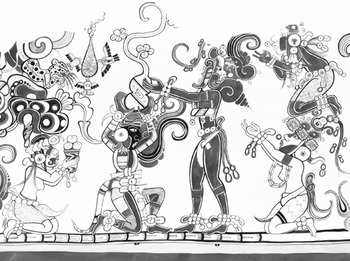
This pattern is sustained at San Bartolo. On the north wall of Las Pinturas Structure Sub-1 (Figure 4), two women kneel on either side of a Late Formative version of the Maize God (Saturno et al. Reference Saturno, Taube and Stuart2005). The one to his rear gestures with her arms forward in deference or supplication; the figure directly above her performs the same gesture, with both extending their forefingers. While the lower woman's wrists reveal a beaded and knotted band, those of the figure above bear a band composed of long and spherical beads. Doering and Collins (Reference Doering, Collins, Guernsey, Clark and Arroyo2010:266) noted that even the Maize God extends his arms forward in a similar fashion, wrists close together, encircled by a prominent beaded and knotted band. So, too, does the woman who kneels before the deity although, in this case, the gesture accommodates the presentation of a vessel full of tamales. Nevertheless, the rendering of her jeweled wristband compares to that of the others: only one band is rendered by the artist, as if the second is hidden in the profile view but is nevertheless implied. One might argue that the recurring gesture in this scene, albeit with subtle compositional variations, was intended to communicate deference or supplication to the Maize God. Regardless, the distinctly mythological scene underscores the fact that this gesture does not readily conform to any single context or one simple meaning during the Late Formative period, nor is it necessarily associated with bound hands and captive status.
Detail of the San Bartolo Las Pinturas Sub-1 chamber north wall. Drawing by Heather Hurst, courtesy of Heather Hurst, William Saturno, and the Proyecto San Bartolo.

The imagery on Kaminaljuyu Sculpture 67 (Figure 5) does little to clarify the ambiguity surrounding this suite of gestures. As Henderson (Reference Henderson2013:197–198) noted, Kaminaljuyu Sculpture 67 portrays an explicit scene of decapitation, in which the kneeling figure, minimally clothed except for a woven belt, has been beheaded. Resting on top of his neck, where a head should be, is instead a knot like that binding his wrists, which are lowered in front of him. The positioning of the hands is also interesting: the palms are turned outward, not unlike the “crab claw” position adopted by the standing lord on the Leiden Plaque, but also by captives of noble status who model this gesture on Tikal Stela 39 and in the lower register of the Leiden Plaque (see Schele and Miller Reference Schele and Miller1986:Plate 33). While the Sculpture 67 victim's minimal clothing and lack of sandals might signal a person of subsidiary status, his elaborately woven and beaded belt, loincloth, and beaded anklets in combination with the crab claw gesture suggest otherwise. In that sense, it compares to Izapa Stela 21, which also portrays the sacrifice of a relative peer.
Kaminaljuyu Sculpture 67 obverse. Drawing by Lucia R. Henderson.

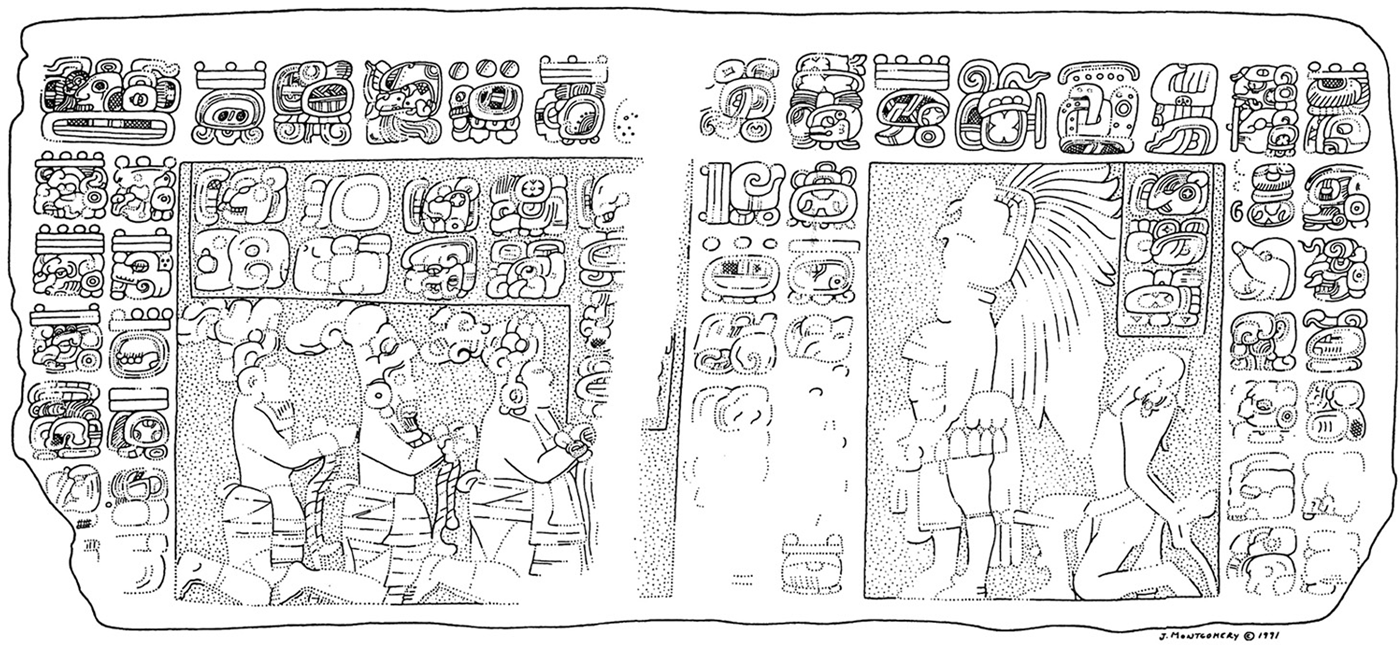
The spectrum of meaning in which this gesture operated during the Late Formative period endured, as Early Classic period Panel 12 from Piedras Negras illustrates (Figure 6). Doering and Collins (Reference Doering, Collins, Guernsey, Clark and Arroyo2010:267) noted that this monument, in particular, contrasts figures whose arms are raised in deference in front of them—not unlike those on Kaminaljuyu Sculpture 65, Takalik Abaj Stela 5 and at San Bartolo—with those whose arms are clasped behind them, much as on Izapa Stela 89, Izapa Miscellaneous Monument 4, and the two fragmentary sculptures from Takalik Abaj. The Piedras Negras panel depicts three rulers from neighboring kingdoms, each of which was located along a key river passage in the region (Stuart Reference Stuart2007). They kneel before the Piedras Negras ruler not as captives per se, but as evidence of their subsidiary status, much as when, on later Maya monuments, subject rulers appear as bound prisoners even when hieroglyphic evidence indicates that they continued to rule for many years. As Stuart phrased it, “the scene on Panel 12 is largely performative and symbolic of … political dominance, not to be taken too literally as evidence of long-distance taking of royal prisoners.” Yet, one wonders if the three subservient rulers arrayed in front of the king, kneeling with arms in front of them, headdresses intact, and with elaborate breech cloths, are qualitatively different from the figure to the king's rear, who may represent an actual captive. That individual genuflects, lacks a headdress, and appears somewhat contorted, as if due to the fact that his arms are bound behind his back at an unnatural angle.
Piedras Negras Panel 12. Drawing by John Montgomery, courtesy of the Foundation for the Advancement of Mesoamerican Studies.

Either way, imagery like this demonstrates that statements of political domination were couched in a language drawn from long-standing traditions of representation, going back to the Late Formative period, which alluded to state-sanctioned violence, captive-taking, and sacrifice at one extreme and, at the other, humility and/or fealty. Understanding such imagery only as a political statement, however, overlooks what may have been an equally potent aspect of its meaning. McAnany (Reference McAnany2010:279–283), arguing that captive imagery also carried implicit economic significance, asserted that “[a] captured member of a royal family or a high-ranking warrior and/or scribe represented the wealth of a vanquished kingdom and could be used to extract that wealth in the form of goods, labor, land, advantageous alliances, and so forth (Miller and Martin Reference Miller and Martin2004:166).” Stuart's (Reference Stuart2007) conclusion that the Panel 12 scene represents a statement of Piedras Negras' “political influence, if not control, over a vast territory to its north and south” is certainly in keeping with the notion that such imagery was imbued with potent political and economic ramifications. The display of individuals arrayed as captives does not necessarily imply warfare; a number of other sociopolitical and economic understandings are equally plausible, each of which drew from a vocabulary of postures and gestures that had been in place since the Formative period. While conflict certainly played a significant role in the ancient Mesoamerican past, my point here is that one cannot assume that representations of subordinated, even bound, individuals necessarily signify warfare or sacrifice: by the Late Formative period, the imagery already connoted a much broader and more nuanced set of meanings.
EXPRESSIONS OF SOCIAL ORDER: THE COSMOLOGICAL IMPLICATIONS OF THIS IMAGERY
The details of Izapa Stela 21 (Figure 1a) intimate that Late Formative scenes of captive-taking may, like their later Classic period analogs, have invoked a range of meanings that encompassed political, economic, and more cosmological agendas. By cosmological, I mean that the imagery encompasses multimodal messages that range from mythically charged to those concerned with more pragmatic goals of ordering people in time and space (Guernsey Reference Guernsey2012a). As mentioned above, Stela 21 portrays an individual transported in a palanquin by two porters who turn their heads towards the act of violence; however, the directionality of the gaze of the individual being transported is difficult to discern due to the eroded state of the monument (Norman Reference Norman1976:124). It may be that the figure looks directly forward, toward the act of violence. A slight protuberance on the left side of the figure's face, however, may indicate a nose, which would mean that the individual's countenance was turned away from the scene. Norman (Reference Norman1973:Plate 34), in his drawing of Stela 21, concluded that the individual in the palanquin was depicted frontally, as if looking at the scene in the foreground. In a more recent interpretation, however, Clark and Moreno (Reference Clark, Moreno, Lowe and Pye2007:Figure 13.19) rendered the figure's face in profile, looking away from the scene.
Even if one concludes that the individual in the palanquin on Stela 21 looks away, it is difficult to know whether this communicates disdain, dismay, or was merely an attempt on the part of the artist to indicate that the palanquin was moving across the scene, to the viewer's left, and that the act had already been witnessed, as in a sort of narrative progression. Because of these difficulties of interpretation, I hesitate to draw any hard and fast conclusion, but nevertheless think it important to note that, whether the figure looks directly at the scene or turns toward the direction in which the porters are moving, it seems clear that the act was, indeed, witnessed by the individual as well as his porters. Such an act of witnessing anticipates, as Astrid Runggaldier (personal communication 2016) noted, later Classic Maya accounts of witnessing, in which activities were seen and thereby authorized by an individual of higher status (Houston et al. Reference Houston, Stuart and Taube2006:173). Moreover, as Norman (Reference Norman1976:123) observed, the way that the victim's left hand “cups” the foot of the right-most porter strengthens the visual connection between the two vignettes although, again, the particular significance of this is difficult to ascertain; it may just as likely be the result of a purely formal solution by means of which both the victim's hand and the porter's foot could be rendered completely.
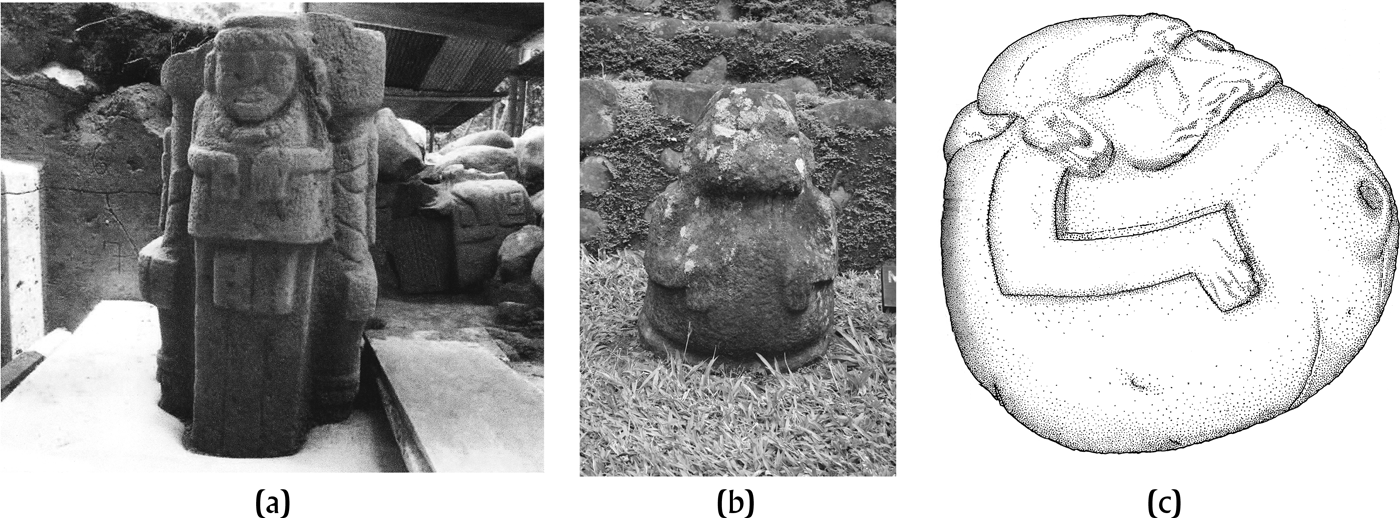
The identity of the individual who does the witnessing on Izapa Stela 21, from his perch in the palanquin, is even less clear. Although the obvious assumption is that the individual represents a ruler, the individual's body is oddly truncated. This may be due to the purely formal challenges that faced the artist, who had to devise a compositional scheme in which the figure was convincingly conveyed in the litter, peering out from it. But other details suggest that a different conclusion is possible. For example, the individual's arms are very deliberately positioned, elbows angled outward from his torso at a right angle, with hands and fingers pointing straight down. Nearly identical gestures make a regular appearance in the Late Formative period corpus, as on a pedestal sculpture from El Portón, Baja Verapaz (Parsons Reference Parsons1986:Figure 40), or in the case of the diminutive figure on Takalik Abaj Monument 215/217 (Figure 7a). Transported on the back of a much larger standing individual, the diminutive Takalik Abaj figure appears to represent an ancestral mummy bundle (Schieber de Lavarreda and Orrego Corzo Reference Schieber de Lavarreda, Corzo, Guernsey, Clark and Arroyo2010). Several Late Formative potbelly monuments from Takalik Abaj and other sites, including Santa Leticia (Figures 7b and 7c), also display this gesture, which seems to be closely associated with the representation of ancestors during the Late Formative period, as I have argued elsewhere (Guernsey Reference Guernsey2012b:Figures 4.19b and 4.38). Yet, the gesture traces its antiquity even deeper into the Formative period, as evidenced by the supernatural character portrayed on San Lorenzo Monument 52 (Cyphers Reference Cyphers2004:Figure 62), or the figure carved on an incised celt whose posture and features anticipate the potbellies (Coe Reference Coe1995:Catalog No. 128). Clearly, this gesture was reserved not only for powerful ancestors, but also adopted by mythic beings. Accordingly, it is difficult to confirm the identity of the litter-born individual on Stela 21, although it seems reasonable to conclude that the gesture connotes some attribute that the figure shared with other beings including ancestors and supernatural characters.
(a) Takalik Abaj Monument 215/217. Photograph by author. (b) Takalik Abaj Monument 107. Photograph by Michael Love. (c) Santa Leticia Monument 1. Drawing courtesy of the Middle American Research Institute, Tulane University.

The imagery of Izapa Stela 21 anticipates, to some degree, that of Lintel 3 from Temple 1 at Tikal, where the Tikal ruler rides in a palanquin in celebration of a military victory over Calakmul in 695 a.d. while, above, a supernatural jaguar effigy looms (see Freidel Reference Freidel, Renfrew and Cherry1986:100; Harrison Reference Harrison1999:Figure 77; Martin and Grube Reference Martin and Grube2000:45). Martin (Reference Martin, Macri and McHargue1996:12), working with the robust Classic-period epigraphic record, argued that the recurring motif of rulers and palanquins at Tikal speaks to more than just individual militaristic events and, instead, invokes a broader geopolitical landscape that included numerous polities, both friendly and antagonistic. While we lack this specificity for the Late Formative period, it is not a stretch to assume that similar political alliances and schisms characterized this period, as well, and were expressed, as at Tikal centuries later, through monumental programs that referenced these conflicts. In fact, I would suggest that it may have been in a context of regional conflict and competition that this repertoire of Late Formative captive imagery emerged: it provided a vehicle through which such relationships and tensions could be expressed, particularly in an era of incipient state formation and rapidly developing urbanism (see Love [Reference Love, Love and Kaplan2011] for discussion of Late Formative state formation and urbanism in this region, or Demarest [Reference Demarest and Gregor1997], Freidel [Reference Freidel, Renfrew and Cherry1986], Hassig [Reference Hassig1992], and Webster [Reference Webster1975] for the complex interrelationships between warfare, peer-polity interaction, and the development of complex society in Mesoamerica). Warfare, or conflict more generally, can provide the impetus to relocate to or settle in cities (Chase and Chase Reference Chase and Chase1989; Carneiro Reference Carneiro1970; Yoffee Reference Yoffee2005:14, 91), and it may be that imagery such as that on Stela 21 alludes to the relative safety and protection afforded by more urban living in a city governed by a powerful ruler who, simultaneously, asserted his political dominion with this imagery. Put simply, it seems hardly serendipitous that a repertoire of imagery associated with warfare, captives, and postures of deference came into fruition at a moment within the history of Mesoamerica that also witnessed dramatic sociopolitical transformations.
As I have indicated, however, how literally imagery like that on Stela 21 can be read is a different question. While I do not doubt that it alludes to very real political friction and even, perhaps, warfare events, it was also polyvalent and able to communicate a range of meanings and relationships, from captive-taking and sacrifice to statements of political dominance and subordination. One message that appears to be quite deliberately communicated by Stela 21 is that of violence between relative peers, who wear accouterments suggestive of a certain level of social status. Likewise, the artist sought to imbue the scene with heightened drama by including details like the jeweled blood that sprays from the victim's severed body. Mesoamerican scholars have addressed the sensory impact of scenes such as this, which invite viewers to respond in more than visual terms to the imagery, imagining the smell and stickiness of blood (Geller Reference Geller2004:202–206; Henderson Reference Henderson2013:233; Houston et al. Reference Houston, Stuart and Taube2006; Schele and Miller Reference Schele and Miller1986:267). In Mesopotamian art programs, Neer (Reference Neer and Ragavan2013:462) has argued that similar sensory stimuli are “integral to the spatialization” of imagery. Applying his ideas to Stela 21, one might suggest that as a viewer's gaze moves between the foreground and background, sensorium beyond the visual are activated, which accentuate the perception of depth, movement, and drama in the scene.
Stela 21's location in Group D of the site center also suggests that its polyvalent messages were viewed as important to the urban fabric of Izapa, not unlike those of the later Tikal lintels and other related Classic period imagery (see Martin Reference Martin, Macri and McHargue1996). Its messages stress the mutually reinforcing roles of ideology and coercive power through which Izapa's political authority, and the costs of refusal, were communicated. Late Formative images of capture, like that of Stela 21, were featured in the site center along with those portraying bound captives, as in the case of Stela 89 or Miscellaneous Monument 4. These visual strategies are especially interesting to contemplate in light of the fact that, during the Classic period, the most common verb for warfare was chuhkaj, “he is seized/roped” (Miller and Martin Reference Miller and Martin2004:166). This emphasis on individual capture and binding, with people treated akin to bound game, according to Houston (Reference Houston2001:211), and its implications of warfare or sociopolitical domination is eloquently illustrated by Piedras Negras Panel 12 (Figure 6), which perpetuates artistic traditions already well-defined by the Late Formative period. The text and imagery of Panel 12 operate at a sophisticated level, in which events of the past and present, allies and hereditary enemies, comingle and contextualize the sociopolitical history of Piedras Negras within a regional framework (Houston et al. Reference Houston, Stuart and Taube2006:202).
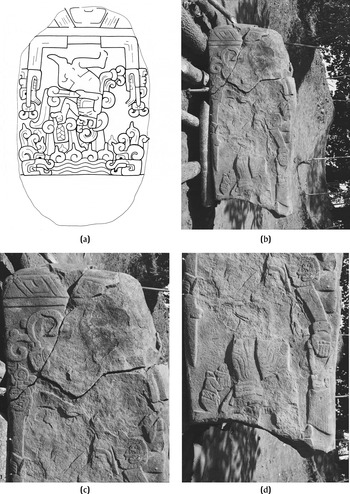
I would argue that Izapa Stela 21 operates at an equally sophisticated level, especially when understood within the context of Izapa's urban center, where its imagery was in direct conversation with that of other monuments (Guernsey Reference Guernsey2006; Guernsey and Strauss Reference Guernsey and Strauss2015). Stela 21 was paired in the Group D plaza at Izapa with Stela 23 (Lowe et al. Reference Lowe, Lee and Espinosa1982:211–218), which portrays a rain deity with a diagnostic, scrolled forehead that links him to a Late Formative water, rain, and lightning god complex (Figure 8a; see Guernsey Reference Guernsey2010b; Henderson Reference Henderson2013; Norman Reference Norman1976:130–131; Taube Reference Taube and Coe1995). What ties the imagery of Stela 23 to that of Stela 21 is the recurring motif of rain volutes: on Stela 23, they undulate across the top of the watery band into which the rain deity descends, while they stream down from the sky band on Stela 21. The curled brow of the Stela 23 deity echoes not only those of the zoomorphic heads that frame the watery basal band below him, but also that of the headdress worn by the Stela 21 protagonist (as well as those that curl out from the body and head of the decapitated victim). While the iconography of water scrolls on Stela 21 alone is enough to imply a relationship between the act of captive sacrifice and the arrival of rain, its pairing with Stela 23 in Group D, whose explicit rain iconography overlaps with that of Stela 21, makes this link particularly clear. When viewed in tandem, Stelae 21 and 23 also mutually reinforce themes of both negative and positive social discourse. The imagery of Stela 21 links acts of violence and sacrifice (negative social discourse) to the arrival of rain (positive social discourse): together, the images invoke a greater, yet fundamentally precarious, cosmic balance in which blood sacrifice appeased the gods. The imagery also alludes to the “costs of refusal” for those who violated this cosmic balance, or challenged the authority of the Izapa polity. While individuals often accept domination by ruling elites because, to use Gilman's (Reference Gilman1996:57) words, “the costs of compliance are less than the costs of refusal,” coercion “obviously does alter the cost balance…and need not be frequent or large-scale to be effective: occasional reminders will provide sufficient encouragement.”
(a) Izapa Stela 23. Drawing by Ajax Moreno, courtesy of the New World Archaeological Foundation. (b) El Jobo Stela 1. (c) Detail of top half of El Jobo Stela 1, showing femur staff crowned by scroll-headed deity. (d) Detail of lower half of El Jobo Stela 1, showing kneeling captive (on left) and trophy head with streaming hair (on right). Photographs courtesy of the Peabody Museum of Archaeology and Ethnology, Harvard University, Peabody Museum Nos. 58-34-20/40390 (digital file #CI633609), 58-34-20/40391 (digital file #CI633610), and 58-34-20/40392 (digital file #CI633611).

EL JOBO MONUMENT 1, CAPTIVE SACRIFICE, RELICS, AND RAIN
Another monument, Stela 1 from the nearby site of El Jobo, is closely related thematically, yet also poses challenges to how we draw the line between “captives” and “subservient” individuals (Figures 8b–8d). Although terribly effaced, one can make out a standing individual on the right who towers above a diminutive figure at his feet whose head is missing; the narrow neck of the decapitated victim compares to those of the victims on Kaminaljuyu Sculpture 67 and Takalik Abaj Monument 4. Henderson (Reference Henderson2013:198) vividly described the narrow, headless neck of the captive on El Jobo Monument 1 as a “bloodless stump,” calling to mind Whitehead's (Reference Whitehead2004:11) entreaty to engage critically with “the fleshy detail of violent acts” in order to situate them more effectively within their wider fields of meaning (also see Orr and Koontz Reference Orr and Koontz2009:xvi–xvii). One can see that the arms of the victim on El Jobo Stela 1 are raised and drawn together in front of him, wrists together, similar to those of the individuals on Kaminaljuyu Sculpture 65, Takalik Abaj Stela 5, and San Bartolo which, as discussed earlier, probably do not depict victims but, instead, subservient individuals who emulate the posture of captives. Yet, describing the figure on El Jobo Monument 1 as merely “subservient” would be an understatement, given his missing head.
As if to underscore the fate of the victim, the standing protagonist on El Jobo Monument 1 clasps in his left hand a trophy head with hair streaming down. Although it is tempting to suggest that this head belongs to the decapitated body of the victim, the difference in scale gives pause. Nevertheless, there is an implied relationship between the act of decapitation and the display of the trophy head in the image. The staff clenched in the right hand of the standing figure also merits attention. Miles (Reference Miles and Willey1965:259) suggested that the staff is formed from a femur: beneath the protagonist's hand one can make out the condyles, or knobs at the distal end of the bone, from which descends a pointed shaft. Two more knobs, consistent with Mesoamerican depictions of bone, are visible at the top of the staff beneath the zoomorphic visage (Andrew Scherer, personal communication 2016). Archaeological examples of human femora used as ceremonial objects towards the end of the Late Formative period exist, as from Tomb 1 at Chiapa de Corzo (Agrinier Reference Agrinier1960), lending credence to Miles' suggestion while simultaneously reminding us that body modification was not just for the living: the alteration of human bone, in which a subject is transformed into an object, “traces another of the unstable frontiers of the ancient self” (Meskell and Joyce Reference Meskell and Joyce2003:127).
Perhaps the femur portrayed on El Jobo Monument 1 was an ancestral relic, akin to an example from the Terminal Classic site of Ek’ B'alam, where an elite lord was buried clasping a human femur whose inscription suggests that the bone may have come from his father (Fitzsimmons Reference Fitzsimmons, Fitzsimmons and Shimada2011:71; Lacadena García-Gallo Reference Lacadena García-Gallo2002:79–83). Yet, this possibility cannot be confirmed at El Jobo: the carved femur may be an ancestral relic, but it may just as likely be a trophy taken from a victim or even, potentially, a femur from a jaguar or other animal, as in the case of two Early Classic carved jaguar femora from Michoacán (Fields and Reents-Budet Reference Fields and Reents-Budet2005:Figure 74; also see Fitzsimmons Reference Fitzsimmons, Fitzsimmons and Shimada2011:62). Equally possible is that the shaft was carved from another material, such as wood, to resemble a femur. Scherer (Reference Scherer2015:104, Plate 6) noted that dancers at Bonampak also clasp femora, but conceded that in such representations it is impossible to know whether the staffs portray actual femora or wooden hafts carved to resemble them. Similar imagery appears at Terminal Classic Kabah (Rubenstein Reference Rubenstein Dankenbring2015:179–185), and Blomster (Reference Blomster, Fitzsimmons and Shimada2011:132, 142–143, Figures 5.8 and 5.11) called attention to a femora-staff, replete with condyles, clasped by the figure on Stela SP-1 from the South Platform at Monte Albán and another grasped by Lord 8 Owl on the lower panel of the south frieze at Lambityeco. Regardless of the interpretive challenges that such images pose, it is clear that the display of long bones in Mesoamerica was often linked to acts of aggression, as made especially clear at Cacaxtla where a warrior wears a femur covered in red spots that may signify blood (Blomster Reference Blomster, Fitzsimmons and Shimada2011:142). At the very least, the display of trophies or their symbolic analogues was imbued with enormous sociopolitical significance already by the Late Formative period (see Berryman Reference Berryman, Chacon and Dye2007; Blomster Reference Blomster, Fitzsimmons and Shimada2011:106, 126–127, 138; Fitzsimmons Reference Fitzsimmons2009, Reference Fitzsimmons, Fitzsimmons and Shimada2011:56–57; Houston et al. Reference Houston, Stuart and Taube2006:204; McAnany Reference McAnany, Fitzsimmons and Shimada2011:233; Scherer Reference Scherer2015).
The top of the femur-staff held by the protagonist on El Jobo Monument 1 is crowned by the head of a supernatural creature whose scrolled cranium bears an uncanny resemblance to those on Izapa Stelae 21 and 23, which were part of the Late Formative rain and water god complex (Henderson Reference Henderson2013:198, 202). As a matter of fact, if one considers this imagery together, there are some very interesting parallels. The relationship between captive sacrifice and rain is particularly evident when Izapa Stela 21 and 23 are viewed as a pair, as they were in the ancient past. It is subtler on El Jobo Monument 1, where the scroll-headed deity that tops the scepter is the sole allusion to this complex of rain and water symbolism.
The scene on El Jobo Monument 1, found at the site of El Jobo located across the border from Izapa in the municipio of Ayutla, Guatemala, just west of the Río Melendres, if taken at face value, indicates that other sites in the region asserted the same sorts of messages of violence and subjugation as seen on Izapa Stela 21. Yet, stylistic and archaeological evidence suggest otherwise. Norman (Reference Norman1976:287) noted that the celestial framing band of El Jobo Stela 1 bears remarkable formal similarities to similar bands on stelae at Izapa; so too, Shook (Reference Shook1947), before him, recognized that El Jobo Stela 1 shared significant stylistic affinities with monuments at Izapa. Importantly, Shook also provided some details about the monument's context, which suggest that it may have been relocated to the site of El Jobo, where it is the only known carved stela from the site. Shook (Reference Shook1947:181) wrote that the stela, which had been found in association with two urn burials and approximately 40 vessels,
had been disturbed and broken in recent times and lay at the foot of a mound. An unsuccessful attempt was made to locate its base and associate the stela with the ceramic material. The structure with which the monument was associated had been built during the early period, but surface sherds of plumbate also indicated that El Jobo had a more recent occupation.
To my mind, this evidence suggests that it is entirely possible that El Jobo Monument 1 was removed from Izapa and transferred to El Jobo during a later period, not unlike the fate met by other monuments at Izapa, which were removed from their Late Formative contexts at some point during the Classic period and relocated to Group F at Izapa, which became the locus of ritual during this later period (Lowe et al. Reference Lowe, Lee and Espinosa1982:226–231; Rosenswig et al. Reference Rosenswig, López-Torrijos, Antonelli and Mendelsohn2013). If this is true, and it is obviously only conjecture, then it means that the imagery of El Jobo Stela 1 does not necessarily provide us with a greater regional understanding of captive imagery and its significance at sites in the Pacific piedmont zone. It does, however, offer further evidence that these scenes of captive sacrifice, much as Henderson (Reference Henderson2013) argued, were imbued with meanings related to distinctly cosmological concerns.
CONCLUSIONS
Imagery of captives and subjugated individuals in Late Formative southeastern Mesoamerica was about much more than captive sacrifice or acts of warfare. It was part of a nuanced web of meaning that linked acts of captive sacrifice to political authority, the arrival of rain, and agricultural fertility. This same visual vocabulary was used as well to assert messages of subjugation before paramount kings, in some cases blurring the boundaries between individuals destined to die and those who were exhibiting deference; either role, sacrificial victim or faithful subject, was, in any case, cast as critical to the maintenance of social order. This suite of imagery, like the body of archaeological data, also confirms that these Late Formative urban centers did not exist within a vacuum, but were compelled to interact, sometimes even violently, with regional competitors, each of whom borrowed from this same visual repertoire for expressing statements of political dominance. In this sense, the scenes invoking captives allude to domains that unfolded beyond the boundaries of individual site centers. I have argued elsewhere (Guernsey Reference Guernsey2006, Reference Guernsey2012a, Reference Guernsey2012b, Guernsey and Strauss Reference Guernsey and Strauss2015) that many of the monuments at Izapa situated their rulers within a rhetoric of Late Formative divine kingship that was shared throughout a broad geographic region, and which defined those rulers as fully participatory in the sociopolitical networks that accompanied the rise of states and the advent of urban living during the Late Formative period. While it is true that many of the Izapa stelae portray images concerned with myth and politics, others speak to more prosaic economic endeavors, which were equally fundamental to expressions of cosmopolitan identity (Guernsey Reference Guernsey2016). The scenes invoking a rhetoric associated with captives, I would argue, functioned in a similar way: they referenced an external world, at times threatening or, at the very least, in need of being reminded of territorial claims and boundaries. Harmanşah (Reference Harmanşah and Ragavan2013), working with imagery from second millennium b.c. Mesopotamia and utilizing Foucault's notions of “pastoral power,” made a compelling case that specific imagery from Sumeria was employed not only to articulate authority, but to situate that power as something that moved between spaces, from urban centers into the broader landscape. In my opinion, the suite of imagery from Late Formative Mesoamerica discussed here did just this: rulers are characterized as individuals who govern, but who also serve as a guiding force, paying heed to the cosmological well-being of their communities that extended from site centers, with their fine structures and monuments, to the agricultural fields that provided sustenance and the hinterlands more vulnerable to external threats.
Nevertheless, some questions will remain about how literally each scene invoking captives can be read. Norman Yoffee (personal communication 2015), while by no means downplaying the very real history and significance of warfare events, suggested that the imagery on Izapa Stela 21 be approached with the same healthy skepticism given by Mesopotamian scholars to the boastful litany of military conquests claimed by Akkadian rulers like Sargon and his successors. Keeping this wise admonition in mind, I would nevertheless assert that this Late Formative imagery from southeastern Mesoamerica operated within a spectrum of meaning that ranged from expressions of violence and captive sacrifice to more metaphorical statements of political control, subjugation, deference, and fealty. This spectrum of meaning, and the novel pictorial conventions designed to express it, was central to the rhetoric of powerful Late Formative rulers and their polities. That many of the meanings and pictorial conventions associated with the overarching themes of violence or captives persevered into the Classic period and beyond attests to the fact that ruling elites continued to view these matters as significant and worthy of monumental expression.
RESUMEN
Este ensayo examina la imagen gráfica del sacrificio de un cautivo en la Estela 21 de Izapa y la contextualiza dentro de un análisis de cómo los actos de agresión eran representados en los monumentos del formativo tardío en una región que incluye la costa del Pacífico de México y las tierras altas de Guatemala. También se estudia el significado social de los temas de la violencia y el sacrificio de cautivos y su papel dentro de un sistema de iconografía más amplio diseñado para incluir las ideas, mutuamente apoyadas, de la ideología y el poder coactivo. Las imágenes cargadas de significados sobre el control político, la subyugación, la deferencia y la lealtad, también aluden a la fertilidad agrícola, la llegada de lluvia y conceptos más amplios del orden social.
Este ensayo examina en detalle además la estela 1del sitio de El Jobo, que se ubica cerca del sitio de Izapa. La Estela 1 de El Jobo presenta una escena de sacrificio y, como la estela de Izapa, hace referencia a la llegada de la lluvia. El rey representado en la estela agarra un hueso – probablemente un fémur – que incluye, en la parte superior, la cabeza de un ser zoomórfico con los atributos del dios de la lluvia.
Este espectro de sentidos – el control político, el sacrificio, y la fertilidad agrícola – fue importante para la retórica de entidades políticas durante el formativo tardío. Este espectro de sentidos también fue innovador. Las reglas de las entidades políticas necesitaron afirmar su autoridad, pero además necesitaron desarrollar un idioma que expresaría éstas ideas. Este sistema de expresión fue ampliamente compartido en Mesoamérica durante el formativo tardío y como es evidente en la iconografía del período clásico, dicho sistema duró por muchos siglos en la región mesoamericana.
ACKNOWLEDGMENTS
This paper was first presented in draft version at the 55th annual International Congress of Americanists in San Salvador in July of 2015, and several people in that session, including Annick Daneels, Annabeth Headrick, and Dominique Michelet, provided helpful feedback for which I am most grateful. I thank Geoffrey Braswell, Fabio Amador, Valorie Aquino, and Marlon Escamilla for organizing that conference, which provided me the opportunity to think about Late Formative themes of warfare and violence. The final paper also benefitted enormously from conversations with Norman Yoffee, as well as Michael Love, who provided access to the photographic archive of the Berkeley Takalik Abaj project. I also thank the following individuals who read early drafts of this essay or provided valuable insights—Heather Orr, Astrid Runggaldier, Andrew Scherer, Stephanie Strauss, and an anonymous reviewer—as well as those who shared images—Marcello Canuto, Arlene Colman, John Graham, Lucia Henderson, Heather Hurst, Bill Saturno, the Middle American Research Institute of Tulane University, the Peabody Museum of Archaeology and Ethnology at Harvard University, and the Foundation for the Advancement of Mesoamerican Studies at the Los Angeles County Museum of Art.