Introduction
Current evidence from across much of prehistoric Eurasia suggests that copper-base metallurgy was in place by the fourth millennium BC, prior to the eastward transmission of tin-bronze technology during the third millennium (Roberts et al. Reference Roberts, Thornton and Pigott2009). Thus, in Eurasia's complex mosaic of culture areas, experienced metalworkers were often already present and ready to engage with the new tin-bronze, and may well have been the vectors of this technology transfer (Ciarla Reference Ciarla2013: 31, 37–38; Pigott Reference Pigott, Linduff and Rubinson2018: 191).
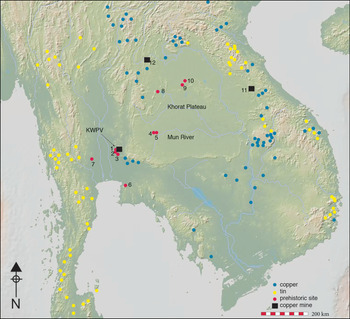
In Mainland Southeast Asia, little archaeological metal is documented with reasonable certainty before the later second millennium BC (cf. White & Hamilton Reference White and Hamilton2020), despite the region's rich copper and tin deposits (Figure 1). This is a remarkable situation, given the antiquity of metallurgy elsewhere in Asia, and, in particular, the proximity of Mainland Southeast Asia to the metal-using cultures of the Eastern Steppe, north-west China and on its Central Plain, dating to the later third and early second millennia BC (Pigott Reference Pigott, Linduff and Rubinson2018: 216, fig. 3). Until recently, the dating of early copper-base technology in Southeast Asia has been determined primarily on the evidence from consumption sites. Here, we present a new chronology for a copper-production centre in central Thailand and discuss its ramifications well beyond the immediate region.
Map showing the location of copper and tin, copper mines and the sites mentioned in the text: 1) Non Pa Wai, Non Mak La; 2) Nil Kham Haeng; 3) Sai On; 4) Noen U-Loke; 5) Ban Non Wat; 6) Khok Phanom Di; 7) Non Ratchabat; 8) Non Nok Tha; 9) Ban Na Di; 10) Ban Chiang; 11) Vilabouly; 12) Phu Lon (figure by C.F.W. Higham made using GeoMapApp (www.geomapapp.org) CC BY (Ryan et al. Reference Ryan2009)).

The introduction of tin-bronze metallurgy to Mainland Southeast Asia
When, and by what routes and mechanisms, tin-bronze technology was transmitted from the Eastern Steppe into Mainland Southeast Asia has been long debated (Pigott & Ciarla Reference Pigott, Ciarla, Niece, Hook and Craddock2007; cf. White & Hamilton Reference White, Hamilton, Roberts and Thornton2014). There is a consensus that the ultimate origins of Southeast Asian tin-bronze metallurgy lie on the Eurasian Steppe, and that this technology arrived fully developed across southern China and much of Mainland Southeast Asia (Ciarla Reference Ciarla2013; cf. Pryce Reference Pryce, Choi and Park2019). This technology appears, however, to have arrived only partially developed in central Thailand with competent early foundry work, but rudimentary primary smelting techniques in evidence at Non Pa Wai are supported, in part, by lead isotope analysis (Pryce et al. Reference Pryce, Pigott, Martinón-Torres and Rehren2010, Reference Pryce2014, Reference Pryce, Aung Kyaw, Kyaw and Win2018a & Reference Pryceb).
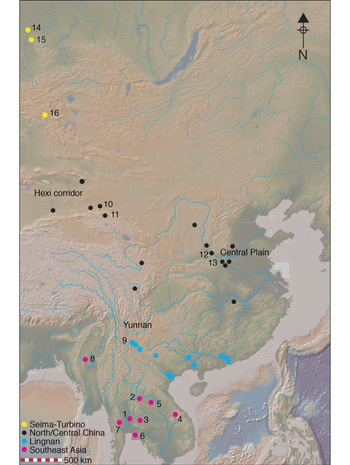
At the heart of the debate concerning prehistoric Thailand is what Pryce (Reference Pryce and Selin2014) terms the ‘long’ and ‘short’ chronologies. The ‘short’ chronology dates the appearance of copper-base metallurgy to c. 1100/1000 BC (all radiocarbon date ranges are calibrated using OxCal 4.3 and the INTCAL13 calibration curve (Reimer et al. Reference Reimer2013). Figure 1; Ciarla Reference Ciarla2007a; Higham & Higham Reference Higham and Higham2009; Higham et al. Reference Higham, Ciarla, Higham, Douka, Kijngam and Rispoli2011, Reference Higham, Higham and Douka2014, Reference Higham, Douka and Higham2015). In this view, the introduction of copper/bronze coincided with the rise of social elites at sites in north-east Thailand such as Ban Non Wat, an occupation site incorporating a Bronze Age cemetery (Higham Reference Higham2011). Following an in-depth assessment of the archaeology of the Chinese Bronze Age, the ‘short’ chronology is considered compatible with the transmission of Steppic tin-bronze technology, which, it has been argued, originated in the Seima-Turbino horizon (c. 2300–1700 BC) of the Altaï region (e.g. Chernykh & Kuzminykh Reference Chernykh and Kuzminykh1989; Chernykh Reference Chernykh1992). We have argued elsewhere for a progressive transmission from the Steppe onto the Chinese Central Plain, and from there gradually southward into Lingnan and eastern Yunnan Province. Numerous sites in Lingnan have revealed tin-bronze technology and socketed implement casting in bivalve moulds, located close enough for transmission into Mainland Southeast Asia (Figure 2; Ciarla Reference Ciarla2013; Higham et al. Reference Higham, Ciarla, Higham, Douka, Kijngam and Rispoli2011, Reference Higham, Higham and Douka2014). This proximity would have been expedited by human mobility via the rivers flowing south from the Yunnan and Yangtze River hubs (Takaya Reference Takaya1987: 3, fig. 2).
Map showing the location of key sites in the transmission of copper-base technology into Southeast Asia: 1) Non Pa Wai, Nil Kham Haeng, Non Mak La; 2) Phu Lon; 3) Ban Non Wat; 4) Vilabouly; 5) Ban Chiang; 6) Khok Phanom Di; 7) Non Ratchabat; 8) Oakaei; 9) Haimenkou; 10) Huoshiliang; 11) Xichengyi; 12) Taosi; 13) Erlitou; 14) Kamyshnoe; 15) Verkhnyaya Alabuga; 16) Novonikolskoe. Note the radial nature of the rivers flowing south from Yunnan (figure by C.F.W. Higham made using GeoMapApp (www.geomapapp.org) CC BY (Ryan et al. Reference Ryan2009)).

The ‘long’ chronology, advocated by White and Hamilton (Reference White, Hamilton, Roberts and Thornton2014), argues for a rapid movement along the eastern flanks of the Himalayas of tin-bronze-using metalworkers of the Seima-Turbino horizon, which had spread west and east across Northern Eurasia (Marchenko et al. Reference Marchenko, Svyatko, Molodin, Grishin and Rykun2017). These metalworkers, and/or their ‘trainees’ (Pryce Reference Pryce and Selin2014), moved south-east from the Eastern Steppe, skirting China's Central Plain, as well as the Yellow and Yangtze River Basins, passing through Yunnan to reach north-east Thailand at Ban Chiang by c. 2000–1800 BC (White Reference White, Pautreau, Coupey, Zeitoun and Rambault2008; White & Hamilton Reference White, Hamilton, Roberts and Thornton2014). The metallurgical material culture that reached Ban Chiang would have been transmitted relatively intact into Southeast Asia, with muted socio-cultural consequences. While arguments have been made for a Steppic origin of the metallurgy that arrived in Yunnan, however, its advent there occurred too late to support the ‘long’ chronology (Li & Min Reference Li, Min and Hein2014; Chiou-Peng Reference Chiou-Peng, Linduff and Rubinson2018).
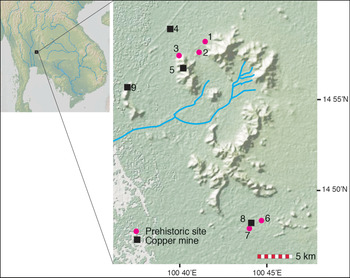
Only a precise chronological framework will order these alternative scenarios in terms of plausibility. Here, we report on new research that dates three prehistoric metalworking communities excavated by the ‘Thailand Archaeometallurgy Project’ (TAP) in the Khao Wong Prachan Valley in central Thailand: Non Pa Wai, Nil Kham Haeng and Non Mak La (Figure 3). The first two are among the largest prehistoric copper-production sites known in Eurasia. The sites’ occupants smelted vast quantities of copper ore mined around the Khao Wong Prachan Valley (Natapintu Reference Natapintu, Charoenwongsa and Bronson1988: 115, tab. 2).
Map showing the sites mentioned in the text in the Khao Wong Prachan area: 1) Non Pa Wai; 2) Non Mak La; 3) Nil Kham Haeng; 4) Khao Tab Kwai; 5) Khao Phu Ka; 6) Noen Din; 7) Khok Din; 8) Khao Sai On; 9) Khao Pha Daeng (figure by C.F.W. Higham made using GeoMapApp (www.geomapapp.org) CC BY (Ryan et al. Reference Ryan2009)).

Only three other prehistoric copper-producing locations are documented in Southeast Asia: the Khao Sai On mineral district, immediately south of the Khao Wong Prachan Valley, was a mining locus with two copper-producing sites at Khok Din and Noen Din (Ciarla Reference Ciarla2007b, Reference Ciarla2008; Pryce et al. Reference Pryce, Bevan, Ciarla, Rispoli, Castillo, Hassett and Malakie2013); the mining complex of Phu Lon, located to the north-east along the Mekong River (Natapintu Reference Natapintu, Charoenwongsa and Bronson1988; Pigott & Weisgerber Reference Pigott and Weisgerber1998; Pigott Reference Pigott, White and Hamilton2019); and the Vilabouly Complex in Laos (Tucci et al. Reference Tucci, Sayavongkhamdy, Chang and Souksavatdy2014; Cadet et al. Reference Cadet2019). These sites provide the evidence for metal production in Thailand and Laos that underpins discussions of the development of copper-base technology across Southeast Asia.
Prehistoric sites in the Khao Wong Prachan Valley
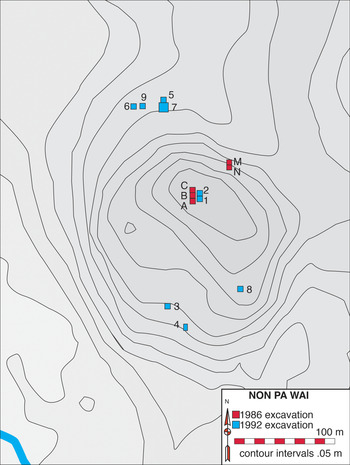
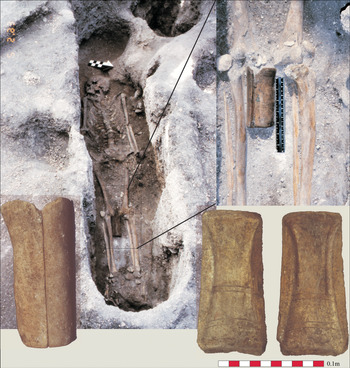
Current evidence suggests that Non Pa Wai was initially settled by Neolithic millet farmers. These were followed by new arrivals familiar with metallurgy who exploited local ores to smelt copper, albeit in a rudimentary fashion with no apparent evidence for alloying with tin (Figure 4; Pryce et al. Reference Pryce, Pigott, Martinón-Torres and Rehren2010; Pigott Reference Pigott, White and Hamilton2019). Two Bronze Age foundry workers’ burials containing ceramic bivalve moulds for casting socketed axes using suspended cores were cut into the shallow Neolithic occupation layer (Figure 5). Metal, however, was rare in the excavated contexts. Copper production intensified over time, resulting in a disturbed and poorly stratified powdery deposit up to 2m thick, covering approximately 5ha. This distinctive ‘industrial deposit’ is full of slag, ore, fragments of crucibles, chimneys and moulds (technical ceramics), pottery sherds and faunal remains.
Plan of Non Pa Wai, showing the excavation areas (figure by A.D. Weiss & C.F.W. Higham).

Non Pa Wai: a foundry worker's burial (late second millennium BC) containing bivalve moulds for casting a deep-socketed axe and a copper-base fish hook (figure by the Thailand Archaeometallurgy Project).

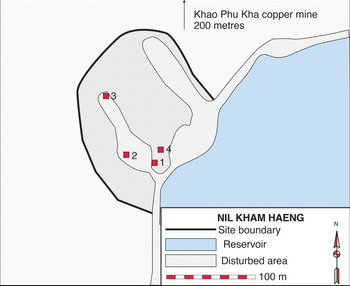
Neighbouring Nil Kham Haeng (Figure 6) comprises a unique 6m-thick deposit of varve-like lenses of crushed ore, host rock, slag, mixed along with technical ceramics as at Non Pa Wai, fragmentary clay-lined bowl furnaces, domestic pottery and faunal remains. Smelting at Nil Kham Haeng was more consistent and proficient than at Non Pa Wai (Pryce et al. Reference Pryce, Pigott, Martinón-Torres and Rehren2010). Burials are interleaved between habitational floors with post-holes. Some individuals are associated with disassembled but complete ceramic chimneys and small, socketed, cordiform, copper-base implements (possibly ingots) (Pigott Reference Pigott, White and Hamilton2019). Some burials contained imported, marine turtle carapaces, and one late burial yielded spherical carnelian beads (Rispoli et al. Reference Rispoli, Ciarla and Pigott2013).
Plan of Nil Kham Haeng, showing the excavation areas (figure by A.D. Weiss & C.F.W. Higham).

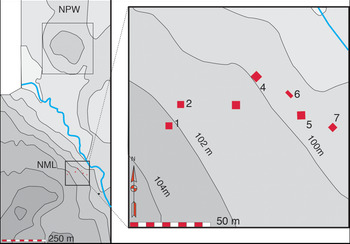
Non Mak La has yielded more than 50 extended burials and burials of small children in pots ranging from the Neolithic into the Iron Age (Figure 7). Burials contained a few copper-base bangles and other ornaments, pottery anvils, domestic pottery and freshwater bivalve shells. While metallurgical debris was encountered in the occupational matrix, it was not as dense as at Non Pa Wai or Nil Kham Haeng (Weiss Reference Weiss, Rahtz and Richards1989; Pigott Reference Pigott, White and Hamilton2019). In a different location at the site, excavations encountered a 1m-thick, copper-smelting slag heap spread across approximately 100m2 (Natapintu Reference Natapintu, Charoenwongsa and Bronson1988).
Plan of Non Mak La, showing the excavation areas (figure by A.D. Weiss & C.F.W. Higham).

Previous dating initiatives in the Khao Wong Prachan Valley
Flotation of soil samples was undertaken during later excavation seasons at the three sites described above, and millet and rice grains and Spilanthes seeds were identified (Weber et al. Reference Weber, Lehman, Barela, Hawks and Harriman2010; d'Alpoim Guedes et al. Reference d'Alpoim Guedes, Hanson, Lertcharnrit, Weiss, Pigott, Higham, Higham and Weber2020). Using radiocarbon determinations based on charcoal, Pigott and colleagues (Reference Pigott, Weiss, Natapintu, Ciarla and Rispoli1997: 127) initially dated the beginning of copper smelting at Non Pa Wai to c. 1500 BC, characterised by “a great burst of intensive copper production” that continued into the early first millennium BC, and which began to tail off after c. 700 BC. Their dating of the industrial activity at Nil Kham Haeng to between c. 1100 and 300 BC would indicate an overlap in copper smelting of a few centuries between these two sites.
Subsequently, Rispoli et al. (Reference Rispoli, Ciarla and Pigott2013: 108–109) have presented a new chronology applying stricter chronometric hygiene, accepting only 5 out of 31 dates. They relied more on the relative chronologies of ceramic evidence and well-dated artefact classes that placed early occupation of Non Pa Wai at c. 1800–1100 BC, followed by two burial phases: c. 1100–800 BC and c. 800–500 BC. Thereafter, the copper-smelting activity was dated to c. 500 BC–AD 200. At Nil Kham Haeng, Rispoli et al. (Reference Rispoli, Ciarla and Pigott2013) dated copper extraction to between c. 500 and 200 BC, followed by two burial phases between c. 200 BC and AD 600. The dating of accumulated industrial debris at these sites has therefore deviated between predominantly the late second/early first millennium BC at Non Pa Wai (Pigott et al. Reference Pigott, Weiss, Natapintu, Ciarla and Rispoli1997) and primarily the later first millennium BC at Nil Kham Haeng (Rispoli et al. Reference Rispoli, Ciarla and Pigott2013). Given the differences between these two chronologies, we present a new strategy that seeks to establish a middle ground and integrate crucial evidence for the Khao Wong Prachan Valley copper production and the deployment of its output to regional metal-consumption sites.
The Khao Wong Prachan Valley AMS radiocarbon dating programme
The variously disturbed industrial deposits at Non Pa Wai and Nil Kham Haeng are challenging to date. While Bayesian analysis of multiple samples is the most effective method of building a chronometric model for a prehistoric site, it is best applied to a stratified sequence in which sample selection is aimed at selecting dating materials that avoid residuality or intrusion and can be precisely ordered relative to one another (Bayliss et al. Reference Bayliss, Bronk Ramsey, van der Plicht and Whittle2007). Without these prerequisites, we would have to assume that the dated material fitted an arbitrary temporal distribution, such as a uniform or trapezium phase (Bronk Ramsey Reference Bronk Ramsey2009; Lee & Bronk Ramsey Reference Lee and Ramsey2012). Such an assumption, however, would mask the underlying age distributions that we wish to examine. We concluded that a dual approach would be the most optimal method. First, we sought to date single grains of domesticated millet or rice directly, reasoning that even if they came from a disturbed context, they nevertheless date the presence of humans. We also dated a limited number of charcoal samples that are probably associated with human activity. Second, we decided to use a kernel density estimation (KDE) for modelling human presence and activity at Non Pa Wai, Nil Kham Haeng and Non Mak La (Bronk Ramsey Reference Bronk Ramsey2017), interpreted with respect to a judicious input of typological evidence (Rispoli et al. Reference Rispoli, Ciarla and Pigott2013). KDE is a non-parametric technique used for visualising the shape of a dataset's underlying distribution. The kernel function (usually a Gaussian), with an associated bandwidth, is used to define the region over which a single observation contributes to the estimated frequency function. Radiocarbon uncertainties are also included within the KDE approach, as implemented in the OxCal 4.3 software, and it is possible to incorporate KDEs within Bayesian models (KDE_Model), where the KDE-derived distribution is treated as a prior, or just as a means to visualise a group of dates (KDE_Plot).
This dating initiative represents a positive step towards an integrated chronological scheme that will allow archaeologists of Southeast Asia to discuss both chronological and interregional interactions within prehistoric Thailand. Ultimately, it will be possible to meld these new data into a pan-regional overview that sets the chronology on a firmer footing.
Sample selection and treatment
The new dates were produced at the Oxford Radiocarbon Accelerator Unit (ORAU). Where possible, single identified seeds were directly AMS-dated, together with charcoal samples from selected contexts. In Tables S1 and S2 in the online supplementary material (OSM), we report the analytical data associated with each sample, and the pre-treatment codes in Table S2 that correspond to the chemistry applied to pre-treat the samples in the laboratory. Where seeds were excessively small or fragile, we applied a less robust pre-treatment method (ORAU code ‘RR’; see Brock et al. Reference Brock, Higham and Bronk Ramsey2010). This involved demineralisation with 1M HCl (1 hour), followed by ultrasonication in fresh 1M HCl for 15 minutes, rinsing in ultrapure water (×4), and, finally, a five-minute ultrasonication in fresh ultrapure water (×6, or until the water remained clear). The samples were then acidified for a further five minutes in 1M HCl and rinsed twice with ultrapure water. Larger or more robust samples, along with less fragile seeds, were pre-treated using the ‘ZR’ method. This includes a base wash designed to solubilise humates (Brock et al. Reference Brock, Higham and Bronk Ramsey2010).
Following pre-treatment, samples were dried and weighed into a pre-cleaned tin capsule, and combusted in an EA-IRMS system, consisting of a CHN elemental analyser (Carlo-Erba NA, 2000) coupled to a gas source isotope ratio mass spectrometer (Sercon 20/20). Purified CO2 from the combustion was converted to graphite using established protocols (Dee & Bronk Ramsey Reference Dee and Ramsey2000) and AMS-dated in either the Oxford HVEE accelerator mass spectrometer or the IonPlus MICADAS system.
KDE modelling: the results
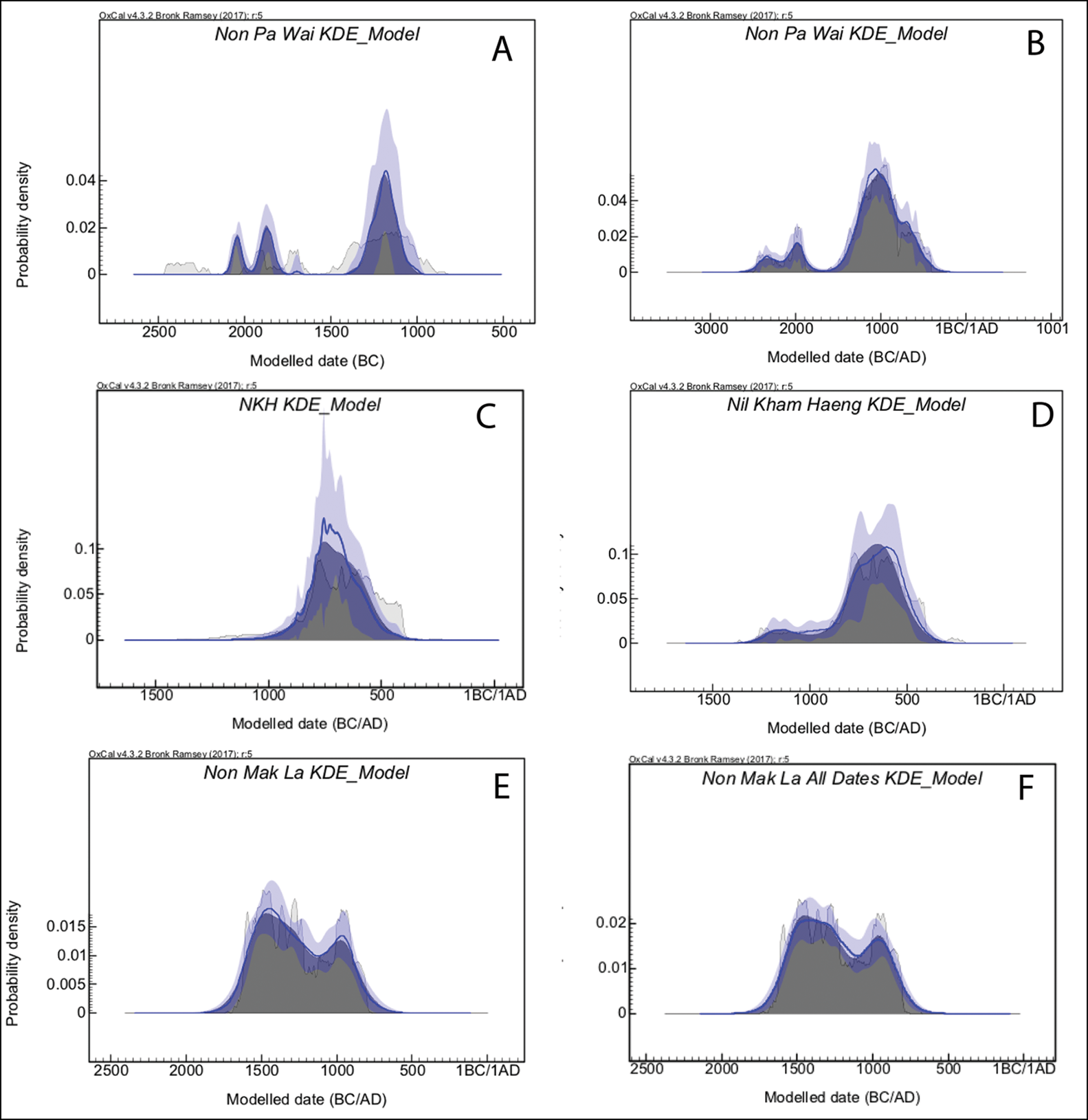
We used the KDE modelling approach in OxCal, outlined by Bronk Ramsey (Reference Bronk Ramsey2017), to analyse the Nil Kham Haeng, Non Pa Wai and Non Mak La datasets. We used KDE_Model to analyse 91 new AMS results (see the OSM). Two models were run with slightly different datasets. The first involved analysing only the single-entity samples, primarily Setaria italica (foxtail millet) and Oryza sp., in a KDE_Model. The second involved the addition of the charcoal results, which are on organic remains unidentified to species. We aimed to use the generated KDE estimates to explore aspects of human subsistence, which we correlate with the direct dating of agricultural crops, as well as metallurgical activity, which we link to the direct dates of single samples of charcoal that reflect metallurgical activities and daily human occupation (Figure 8).
Kernel density estimate models: A) single-entity model (n = 10) from Non Pa Wai; B) charcoal/single-entity model (n = 43) from Non Pa Wai; C) single-entity model (n = 29) from Nil Kham Haeng; D) charcoal/single-entity model (n = 39) from Nil Kham Haeng; E) single-entity model (n = 11) from Non Mak La; F) charcoal/single-entity model (n = 14) from Non Mak La. The more recent determinations from Non Mak La, as shown in Table S1, are not included in order to focus on the earlier part of the dated sequence. The sampled KDE estimated distribution is shown in dark grey. The blue line and lighter blue band represent the mean ±1σ for the KDE distribution; the light grey distribution is the sum distribution (figure by T. Higham & C. Bronk Ramsey, Oxford Radiocarbon Accelerator Unit).

The Non Pa Wai charcoal/single-entity model shows three peaks, the principal one centred around 1200 BC, and two smaller, earlier peaks at around 2000 BC (Figure 8A). We interpret the earlier peaks as correlating with Neolithic occupation, while the later peak corresponds with the Bronze Age occupation. There are, however, very few determinations, so caution is required in interpreting this KDE plot. Note also that the blue band indicating uncertainty in the distribution is wide in these cases, probably denoting that the dated material could all derive from a small number of distinct events rather than being a representative spread.
The second plot for Non Pa Wai contains an additional 33 charcoal determinations (Table S1). While this plot resembles the first, the peak of the distribution centres around 1000 BC and extends over one to two centuries either side. We suggest that this peak corresponds with burgeoning metal production and resulting quantities of charcoal. The evidence also indicates that a period of abandonment occurred at the site between the Neolithic and Bronze Age phases (Figure 8B). The output of these models justifies our choice of KDE modelling because of the multi-modal nature of the distribution. Here, the error margin in the KDE distribution is narrower, indicating a more robust estimate of the age distribution of the dated material.
The Nil Kham Haeng charcoal/single-entity model (Figure 8D) shows a major peak between c. 900 and 400 BC. There is also an earlier, smaller peak at around 1200 BC, which implies continuous occupation at the site. In the single-entity-only plot, the earlier pulse disappears (Figure 8C). The similarity of the main peak in both plots gives us confidence that this is representative of occupation. The earlier peak in the charcoal-material-only plot may reflect a different type of activity, or perhaps an old wood effect. In either case, the KDE modelling approach enables this to be seen clearly, whereas a uniform-phase model would probably have flagged these dates as outliers.
For Non Mak La, we excluded the youngest determinations from the models in order to focus only on the Neolithic and Bronze Age periods. The two models are very similar and show two peaks. The earlier one, centred around 1500 BC, and the later one, at around 1000 BC, probably represent two occupation phases corresponding to the Neolithic and Bronze Age, as defined within the continuous occupation of this site (Figure 8E–F).
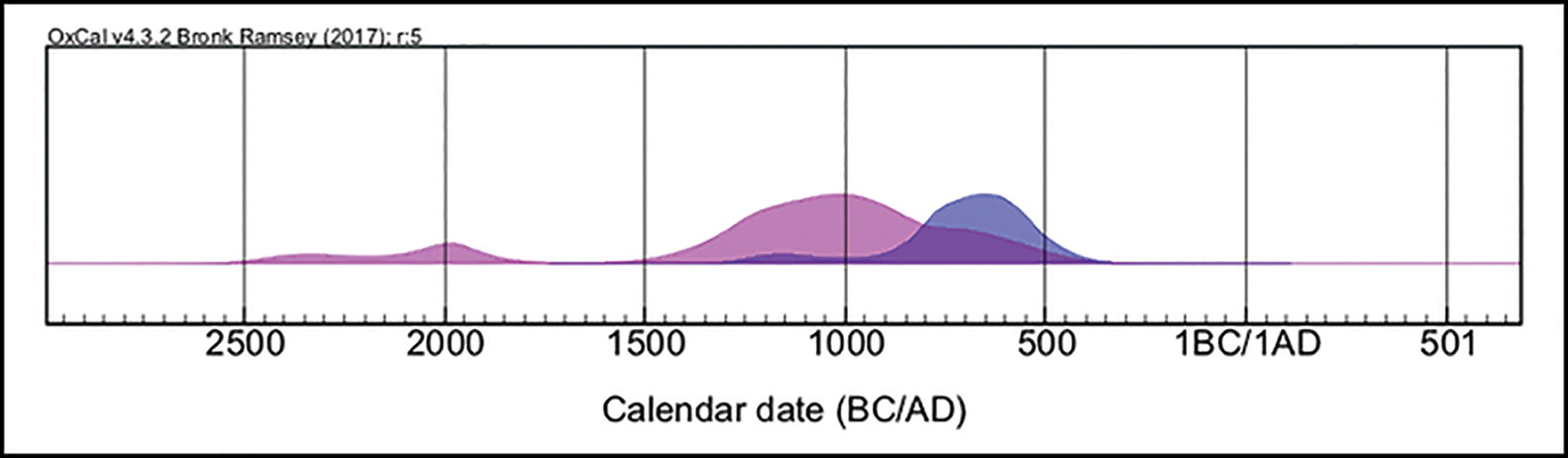
Non Pa Wai and Nil Kham Haeng are approximately 3km apart. Given the differences in smelting technology between the two (Pryce et al. Reference Pryce, Pigott, Martinón-Torres and Rehren2010), it is vital to assess their relative chronologies. Figure 9 presents the KDE modelling for the two sites, which suggests that copper smelting at Nil Kham Haeng began when that at Non Pa Wai was tailing off (cf. Rispoli et al. Reference Rispoli, Ciarla and Pigott2013). We suggest that smelting activity was probably transferred from one site to the other, with a slight chronological overlap. Currently, however, we have no conclusive evidence as to why smelting appears to have shifted locations.
Kernel density estimate plots of Non Pa Wai (mauve) and Nil Kham Haeng (blue). Note that as one distribution declines, the other increases (figure by T. Higham & C. Bronk Ramsey, Oxford Radiocarbon Accelerator Unit).

Integrating production and consumption: Ban Non Wat as a case study
Integrating this new chronology into the dating of the metal-consumption sites located on the Khorat Plateau, approximately 200km to the east, constitutes a key issue. Ban Non Wat lies in the direct path of any exchange that linked this region with copper production in the Khao Wong Prachan Valley (Figure 1). The transition from the Late Neolithic to the Bronze Age phase 1 at Ban Non Wat saw a sharp rise in mortuary wealth (Higham & Higham Reference Higham and Higham2009). Burial rituals became more complex, and four of the seven Bronze Age phase 1 burials contained a copper-base socketed axe. The analysis of one of these reveals it to be almost pure copper (Pryce et al. Reference Pryce2014). The site's radiocarbon chronology places these burials in the eleventh century BC. We link this phase directly with the two foundry workers’ burials at Non Pa Wai that are now dated to between c. 1200 and 800 BC.
The dovetailing of the two sites is not only reflected in their chronologies. At Non Pa Wai, we know that deep-socketed copper axes were cast. This technique, which has a Steppic origin, is widely documented in northern Vietnam and southern China (Ciarla Reference Ciarla2013). The intriguing outcome of the first results of lead isotope analyses is that socketed axes from Ban Non Wat Bronze Age phase 1 and from a Non Pa Wai burial were not cast from Khao Wong Prachan Valley copper, nor from that originating in the two other known prehistoric copper-producing areas elsewhere in Southeast Asia. We find this startling, and suggest that copper-base metal axes reached Ban Non Wat and Non Pa Wai as exotica, through exchange, at about the same time as copper ores in the Khao Wong Prachan Valley were being exploited by immigrant foundry workers (Pryce et al. Reference Pryce, Pigott, Martinón-Torres and Rehren2010, Reference Pryce, Pollard, Martinón-Torres, Pigott and Pernicka2011). Such a situation was not confined to the Khao Wong Prachan Valley: an early, bronze socketed spear from a Ban Chiang burial dated to c. 1025–935 BC has a lead isotope signature entirely consistent with copper mines 300km to the east, at the Vilabouly Complex in upland Laos. These mines are also dated to c. 1000 BC and later (Pryce et al. Reference Pryce2014). Khao Wong Prachan Valley copper has also now been documented as being in use c. 1000 BC in Myanmar (Pryce et al. Reference Pryce, Aung Kyaw, Kyaw and Win2018a & Reference Pryceb).
The marked increase in the intensity of Bronze Age phase 1 mortuary rituals at Ban Non Wat rose to new heights in the Bronze Age cemetery (phases 2–3A) at the same time as copper production at Non Pa Wai was in full swing. This is seen in the quantity and the innovative forms and decorations of ceramic vessels accompanying the dead. Men, women and infants were now interred in very large graves, and were adorned with multiple exotic marine shell and marble ornaments. Fourteen of the 32 Bronze Age phase 2 dead were accompanied by a deep-socketed, copper-base axe conforming to those cast at Non Pa Wai (Higham Reference Higham2011; Rispoli et al. Reference Rispoli, Ciarla and Pigott2013: 126, fig. 14). The lead isotope signatures for two Bronze Age phase 2 axes and one chisel are highly consistent with the Khao Wong Prachan Valley source, providing the most reliable cross-dating evidence between the two areas (Pryce Reference Pryce and Selin2014). Burial 178 at Ban Non Wat, a young adult female of Bronze Age phase 2 date, was interred with a socketed axe comprising 96.3 wt% copper, which was probably sourced in the Khao Wong Prachan Valley.
Notably, hearths for melting copper at Ban Non Wat were absent in these Early Bronze Age levels. Like any other site, Ban Non Wat has been subject to disturbance. It is therefore impossible to be sure that every artefact was found in situ. The relative scarcity of crucible fragments in the Early Bronze Age levels at Ban Non Wat, for example, suggests that they were probably redeposited. Moreover, the remnant metal in all analysed crucibles was a tin-bronze (Cawte Reference Cawte, Higham and Kijngam2012). We are therefore inclined to conclude that the copper-base artefacts in the Bronze Age phase 2 burials were imported as finished artefacts, with the Khao Wong Prachan Valley being the only source of copper confidently identified at present (Pryce et al. Reference Pryce2014). This harmonises with the known presence of shell-bangle workshops in the Khao Wong Prachan Valley and vicinity—the most likely origin for the nearly 1000 Tridacna and Trochus shell bangles worn by those interred at Ban Non Wat, along with copper-base tools and ornaments (Ciarla et al. Reference Ciarla, Rispoli and Yukongdi2017).
Conclusions
The radiocarbon determinations for the Khao Wong Prachan Valley sites match the revised chronologies for Non Nok Tha and Ban Chiang and the key chronology for the metal-consumption sites of Ban Non Wat and Ban Lum Khao (Higham et al. Reference Higham, Higham and Douka2014, Reference Higham, Douka and Higham2015; cf. White & Hamilton Reference White and Hamilton2018: 12–19, 32–40, 47, 174–179, tab. 2.3). Furthermore, recent dates from northern-central Myanmar (Pryce et al. Reference Pryce, Aung Kyaw, Kyaw and Win2018a & Reference Pryceb) and central and northern Laos (Pryce & Cadet Reference Pryce, Cadet, Patole-Edoumba and Demeter2018; Cadet et al. Reference Cadet2019) also provide radiometric dates of c. eleventh/tenth century BC, at the transition to the Bronze Age. These interlink with lead isotope analysis data to endorse Pryce's (Reference Pryce2014) ‘short’ chronology for the advent of copper/bronze metallurgy in the late second millennium BC in Mainland Southeast Asia. We have approached the dating of disturbed industrial sites by employing KDE modelling based on the AMS dating of single-entity seeds and charcoal. In one series of results, we employed all samples; in the second, only the single-entity seed fraction was analysed (Figure 8), and in a third we have demonstrated a degree of modest overlap between Non Pa Wai and Nil Kham Haeng (Figure 9). As might be expected, the series containing charcoal samples suggests that some determinations may have been affected by inbuilt age. The results, however, are consistent between the three sites.
Current evidence suggests that Neolithic millet farmers settled at Non Pa Wai before c. 2000 BC. This was followed by an extended hiatus. Non Pa Wai copper smelting began c. 1100–1000 BC, perhaps undertaken by new arrivals with substantial, albeit partial, knowledge of metallurgy. Intensive smelting extended into the later first millennium BC. At Nil Kham Haeng, the single-entity (seed-based) KDE model (Figure 8) indicates that copper smelting had begun by c. 900 BC, and persisted until at least c. 400 BC (if not later), attesting to some overlap with Non Pa Wai (Figure 9). At Non Mak La, the two peaks at c. 1500 and 1000 BC probably reflect continuous occupation from the Neolithic into the Bronze Age and later with a degree of overlap with both Non Pa Wai and Nil Kham Haeng.
The extension of activity into the Early Iron Age and later at the three Khao Wong Prachan Valley sites is strongly supported by the detailed evidence that Rispoli and colleagues (Reference Rispoli, Ciarla and Pigott2013) have cited for entire classes of artefacts found in industrial, occupation and mortuary contexts. Here, we have presented a new and more precise overview of when and over what time frame the three sites in the Khao Wong Prachan Valley were occupied and began to form one of Mainland Southeast Asia's major regional copper-production centres. This research represents an important step in the further understanding of the archaeology and archaeometallurgy of central Thailand, as well as that of the wider region.
Acknowledgements
This article is dedicated to the memory of our friend and colleague Andy Weiss, whose infectious enthusiasm in the field and during the generation of this dating programme was a stimulus to us all, and whose tragic death in the final stages of preparing this article came as such a profound shock. The central Thai sites discussed here were excavated under the auspices of the ‘Thailand Archaeometallurgy Project’, a collaboration between the Thai Fine Arts Department, Bangkok, and the University of Pennsylvania Museum. The Project is co-directed by Vincent C. Pigott and Surapol Natapintu, supported by the National Science Foundation, the National Geographic Society and the American Philosophical Society, to all of whom we are most grateful. We wish to thank the Marsden Fund of New Zealand for supporting the research programme ‘The Passage of Time: Dating the Prehistory of Southern China and Southeast Asia’. Site contour mapping was undertaken by Andrew D. Weiss. We thank the staff of the Oxford Radiocarbon Accelerator Unit for their careful and conscientious laboratory work on the samples dated in this paper.
Supplementary material
To view supplementary material for this article, please visit https://doi.org/10.15184/aqy.2020.120