Dairy calves are usually separated from their mothers soon after birth, and so any maternal effect can be assumed to have occurred prenatally (Gudex et al., Reference Gudex, Johnson, Gondro and Singh2014). The prenatal effects include maternal additive genetic effect plus maternal permanent environmental effect, which includes both maternal non additive genetic effect of the dam and the dam's mothering capacity (Gudex et al., Reference Gudex, Johnson, Gondro and Singh2014). Daily milk yield of a cow changes significantly during lactation. The milk production decreases after peak yield due to rate of secretory cells loss exceeding the rate of formation of secretory cells in mammary gland. So, the ability of a cow to continue milk production at a high level after the peak yield, defined as lactation persistency, is an important economic trait in dairy industry. Highly persistent cows are expected to have higher lactation production, longer productive life and considered as efficient producers.
Published literature reported that one or more of the maternal effects such as additive maternal genetic and permanent environmental effects (or both) could significantly effect milk yield traits (Eman et al., Reference Eman, Elfadl and Radwan2016), which may indicate some degree of cytoplasmic inheritance (Huizinga et al., Reference Huizinga, Korver, McDaniel and Politiek1986). Because mitochondria are transmitted only from female parents to offspring, mitochondrial DNA is a source of cytoplasmic inheritance (Schutz et al., Reference Schutz, Freeman, Beitz and Mayfield1992). Genetic evaluations for persistency can be used to increase the average level of persistency in the herd through selection (Dekkers et al., Reference Dekkers, Ten Hag and Weersink1998; Jamrozik et al., Reference Jamrozik, Jensen, Schaeffer and Liu1998). Including persistency in breeding goals may also help to improve the disease resistance and reproductive performance if genetic correlations are favorable and sufficiently strong. Some published literature showed the existence of relationships between reproductive traits and lactation persistency in different cattle breeds (Muir et al., Reference Muir, Fatehi and Schaeffer2004; Weller et al., Reference Weller J, Ezra and Leitner2006; Albarrán-Portillo and Pollott, Reference Albarrán-Portillo and Pollot2013; Yamazaki et al., Reference Yamazaki, Hagiya, Takeda, Yamaguchi, Osawa and Nagamine2014). In India, investigation into relationships between persistency and reproductive performance of crossbred cattle is lacking.
Despite crossbred cattle being more productive than indigenous cattle, poor persistency remains a concern that needs to be addressed. In India, the crossing of native breeds like Red Sindhi, Sahiwal and Tharparkar with exotic breed like Jersey is the best suited breeding practice for improving the productivity of animals and it is being carried out in lower Gangetic regions of West Bengal and some other parts of India, where farmers are maintaining herds of this Jersey crossbred with 5–6 animals under field conditions. Very few large herds of Jersey crossbred cattle are available in the country, but a herd has been maintained at the National Dairy Research Institute (NDRI: Eastern Regional Station, Kalyani, West Bengal, India) since 1982 and data related to production and reproductive performance of animals are available. The present study was conducted on this single dataset due to the non-availability of data from multiple sources. Our objective was to estimate the genetic parameters of different lactation persistency measures and their correlations with reproductive performance in Jersey crossbred cattle.
Material and methods
Animals and management
Data on lactational yield records of Jersey crossbred cattle, maintained at the Eastern Regional Station of ICAR-NDRI, Kalyani over a period of 35 years (1982–2016) were collected and utilized for the present study. The location and climatic condition of the farm has been depicted by Mandal et al. (Reference Mandal, Roy, Ghosh, Chatterjee and Das2013). In this study, the majority of the crossbred animals were produced from the mating of two Bos indicus breeds, Tharparkar and Red Sindhi by out-crossing using imported semen of Jersey breed. A total of ten genetic groups having different levels of Jersey inheritance produced in the breeding program were used in this study. Generally, heifers were bred at at-least two years of age when they attained a body weight of 230 kg. Heat detection was done visually every day from 06:00 to 08:00 h in the morning and from 17:00 to 18:00 h in the afternoon by a trained inseminator and the herdsmen. Cows and heifers observed in heat were inseminated with frozen semen (Jersey) within 8–12 h after onset of heat. During winter, fodders like berseem, oats and maize were offered ad libitum whereas during summer and rainy season fodders like maize, cowpea, rice bean and sorghum were offered ad libitum, always twice a day. The amount of additional concentrate provided to the animals was calculated based on their body weight and production status. Concentrate was offered at the rate of 1.5 kg/day as maintenance diet.
Data and statistical analyses
Data on part lactation yields (50-days, 70-days, 1st 100, 2nd 100 d, 3rd 100, 182 d), 305-days milk yield comprising all lactations of 378 Jersey crossbred cattle for a period of 35 years were used. Five lactation persistency indices of animals (P 21, P 31, P 32, P 4 and P 5) were calculated using ratio method as follows: (i) P 21 is the persistency index No. 1 = 2nd 100 d milk yield/1st 100 d milk yield (Danell, Reference Danell1982), (ii) P 31 is the persistency index No. 2 = 3rd 100 d milk yield/1st 100 d milk yield (Johansson & Hansson, Reference Johansson and Hansson1940), (iii) P 32 is the persistency index No. 3 = 3rd 100 d milk yield/2nd 100 d milk yield (Johansson & Hansson, 1940), (iv) P 4 is the persistency index No. 4 = 305 d milk yield/50 d milk yield and (v) P 5 is the persistency index No. 5 = (182 d milk yield – 70 d milk yield)/70 d milk yield (Mahadevan, Reference Mahadevan1951).
Estimates of variance components and genetic parameters of different persistency measures were obtained by restricted maximum likelihood using a derivative-free algorithm fitting an animal model (DFREML; Meyer, Reference Meyer2000). To identify the fixed effects to be included in the model, least-squares analyses (Harvey, Reference Harvey1990) were performed considering effects of year of calving (7 levels), season of calving (3 levels), parity of animal (1, 2, 3, 4, 5, 6, ≥7), and genetic groups of animal (10 levels). All these effects except genetic groups of animals were highly significant (P < 0.01) for all persistency measures of animals (Koloi et al., Reference Koloi, Pathak, Behra, Mandal, Karunakaran, Dutta and Mandal2018) and hence all significant effects were included in the models subsequently used to estimate genetic parameters. A total of six different animal models (Meyer, Reference Meyer2000), ignoring or including maternal genetic or permanent environmental effects (detailed in the online Supplementary File), were fitted for all persistency traits. Convergence of the REML solutions was considered to have been reached when the variance of function values (−2log-likelihood) in the simplex was less than 10−8. If likelihood values changed substantially during the analysis, iterations were restarted using the final parameter estimates from the previous analysis as starting values. When estimates did not change, convergence was confirmed. Standard errors were calculated for the estimated parameters as a part of the DFREML program (Meyer, Reference Meyer2000). The most appropriate model for the trait was selected based on log likelihood ratio test (Meyer, Reference Meyer1992). A total of 876 records of each of reproductive traits were used for correlation studies in this analysis. Genetic and phenotypic correlations between lactation persistency measures and reproductive traits viz., calving interval, conception rate and gestation length of animals were estimated by least-squares analyses (Harvey, 1990) considering the fixed effects of year of calving, season of calving and parity of animal in the model.
Results and discussion
Number of observations, phenotypic mean, standard deviation and coefficient of variation for all persistency measures for milk yield of Jersey crossbred cattle are shown in the online Supplementary Table S1. In this data set, data were distributed over 7 calving periods with 52, 133, 185, 227, 194, 241 and 295 observations in each year. Calving seasons discriminated among animals calved in winter (n = 418), summer (n = 440) and rainy season (n = 433). Parity of the animals ranged from 1 to 7 with 374, 295, 220, 146, 109, 69 and 78 records at parity 1, 2, 3, 4, 5, 6 and 7 or above, respectively. The least-squares means of P 21, P 31, P 32, P 4 and P 5 were 0.76 ± 0.01, 0.59 ± 0.01, 0.80 ± 0.01, 4.70 ± 0.06 and 1.30 ± 0.02 respectively in Jersey crossbred cattle as reported by Koloi et al. (Reference Koloi, Pathak, Behra, Mandal, Karunakaran, Dutta and Mandal2018) in earlier study.
Genetic parameters estimates
Estimates of (co)variance components and heritability estimates of different lactation persistency indices viz., P 21, P 31 and P 32, P 4 and P 5 of Jersey crossbred cattle are presented in the online Supplementary Tables S2, S3, S4, S5 and S6. Estimates of direct heritabilities for P 21, P 31, P 32, P 4 and P 5 ranged from 0.09 to 0.20, 0.09 to 0.17, 0.01 to 0.05, 0.08 to 0.14 and 0.12 to 0.17 respectively depending on the model applied. Fitting a permanent environmental maternal effect (Model 2 in the Supplementary Table) didn't increase the log-likelihood value over that for Model 1 for all traits (online Supplementary Tables S4, S5 and S6) except P 21, P 31 (online Supplementary Tables S2 and S3), indicating maternal effect accounting for 2 to 9% of the total variance for all the persistency indices with the reduction in estimates of direct heritability from 0.15 to 0.09, 0.17 to 0.09, 0.05 to 0.02, 0.14 to 0.10 and 0.14 to 0.12 for P 21, P 31 and P 32, P 4 and P 5, respectively. Fitting a maternal genetic (Model 3 in Supplementary Table) rather than permanent environmental effect also resulted in very similar heritability estimates for all persistency measures as observed in Model 2 with the estimates of maternal genetic effect of 2–8% of the total variance for these traits. Fitting a non-zero covariance (r am) along with a maternal genetic effect (Model 4 in Supplementary Table) detected maternal effects contributing 3–11% of total variation for all persistency indices and also resulted in large negative direct–maternal covariance (r am) estimates (−0.41 to −0.94) for all lactation indices except P 4 where the value for r am was of positive (−0.08). Fitting both genetic and environmental components of the dam effect (Model 5 in Supplementary Table) didn't yield any better a fit as compared to models, 2, 3 and 4 for all traits under study. Allowing for a direct–maternal covariance in Model 6 (in Supplementary Table) also yielded large estimate of r am, ranged from −0.06 to −1.0 for all persistency traits and this model didn't yield any significant improvement in likelihood as compared to Model 5, except for P 21.
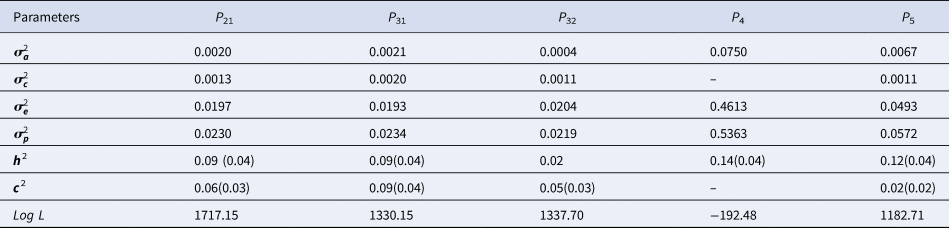
The estimates of direct heritability were 0.09, 0.09, 0.02, 0.14 and 0.12 for P 21, P 31, P 32, P 4 and P 5, respectively under the best fitted animal model (Table 1). In this study, the estimates of heritabilities for different persistency measures were well within the ranges of estimates of other workers (Zurwan et al., Reference Zurwan, Moaeen-ud-Din, Bilal, Zia-ur-Rehman and Khan2017; Grayaa et al., Reference Grayaa, Vanderick, Rekik, Gara, Hanzen, Grayaa, Mota, Hammami and Gengler2019) for different breeds of cattle. The permanent maternal environmental (c2) effects of different lactation persistency indices viz. P 21, P 31, P 32 and P 5 accounted for 2–9% of the total phenotypic variance in this study. The existence of permanent environmental effects due to dam (c2) for these traits in the present study could be an indication of the large influence of environment on milk production of the animal. The low heritability estimates of all the persistency indices in this study indicate that there is some limited scope of genetic improvement of lactation persistency of animals through selection under the prevailing management conditions.
Estimates of variance components and heritability of lactation persistency measures under the best model

 ${ \sigma }_{a}^2 $, direct additive genetic variance;
 ${\sigma }_{c}^2 $, maternal permanent environmental variance;
 ${\sigma }_{e}^2 $, residual variance;
 ${\sigma }_{p}^2 $, phenotypic variance; h 2, direct heritability; c 2: σc2/σp
Correlations studies
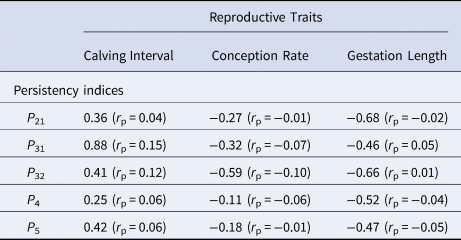
Genetic and phenotypic correlations between persistency indices and reproductive traits for Jersey crossbred cattle are summarized in Table 2. In the present study, the genetic correlation estimates of different persistency indices with calving interval (CI) were positive and moderate to high, ranging from 0.25 to 0.88. The phenotypic correlations between different persistency indices with calving interval were also positive and ranged from 0.04 to 0.15 (Table 2). Similarly, positive and moderate genetic correlations between persistency indices and calving interval (ranging from 0.22 to 0.40) were reported by Muir et al. (Reference Muir, Fatehi and Schaeffer2004) and Albarrán-Portillo and Pollott (Reference Albarrán-Portillo and Pollot2013), both in Holstein cattle. The longer calving interval of animals corresponds to the higher persistency of animals in this study. Longer CI are generally viewed as undesirable, therefore, genetically an antagonistic relationship existed between persistency and CI of animals.
Estimates of genetic and phenotypic correlations (in parenthesis) between persistency indices and reproductive traits of Jersey crossbred cattle

Examination of Table 2 also reveals that antagonistic relationships existed between lactation persistency indices and conception rate of animals both at genetic (r g = −0.11 to−0.59) and phenotypic level (r p = −0.01 to−0.10). Similarly, negative genetic and phenotypic correlations between lactation persistency and conception rate were reported by Yamazaki et al. (Reference Yamazaki, Hagiya, Takeda, Yamaguchi, Osawa and Nagamine2014) who observed r g and r p values in the range of −0.23 to −0.26 and −0.19 to −0.15, respectively. They declared that cows with higher than average peak milk yields were less likely to conceive with one or two services. In this current study, the genetic correlations of different persistency indices (P 21, P 31, P 32, P 4 and P 5) with gestation length were moderate which ranged between −0.46 to −0.68 and for phenotypic correlations, these values ranged from −0.01 to −0.05. The antagonistic relationships of lactation indices with gestation length at genetic and phenotypic level were also noticed by other workers (Solkner and Fuchs, Reference Sölkner and Fuchs1987; Dhaka, Reference Dhaka2013) in different cattle breeds. The phenotypic correlations between considered reproductive traits for this study and lactation persistency indices were weaker than their genetic counterparts, which is in agreement with the findings of Muir et al. (Reference Muir, Fatehi and Schaeffer2004) in Holstein cattle.
Many of the earlier studies have utilized very large data sets with relatively large numbers of measurements on each individual recorded across a range of time points on multiple herds. In contrast, our data had only a modest number of observations on the traits from a single herd. In India, very few organized herds of Jersey crossbred cattle with a hundred or more animals are available. Due to non-availability of dataset on milk production and reproduction of Jersey crossbred animals over the years in multiple herds of the country, we estimated the genetic parameters of lactation persistency indices from a single herd of Jersey crossbred animals. As, the estimates of genetic parameters of lactation persistency indices and their correlations with some reproductive traits obtained in this study were consistent with earlier published reports on this aspect, we believe that results are thus appropriate for possible application as estimates of genetic parameters of lactation persistency indices in other regions. However, we acknowledge the potential benefits of using larger data sets from multiple herds for obtaining the precise estimates of genetic and phenotypic parameters of any economic trait.
In conclusion, different persistency indices of milk production of Jersey crossbred cattle were significantly affected by various environmental factors, which indicates the necessity of improving the management conditions of the farm for better productivity. Low heritability estimates indicate that some limited genetic progress is possible by selection. Estimates revealed antagonistic genetic correlations between persistency and reproductive traits like conception rate and gestation length in cows. Therefore, when selecting to increase persistency without reducing reproductive efficiency, the genetic evaluation must include the reproductive traits in cows.
Supplementary material
The supplementary material for this article can be found at https://doi.org/10.1017/S0022029920000825.
Acknowledgement
The authors are thankful to Director, ICAR-NDRI, Karnal and Head, ERS of ICAR-NDRI, Kalyani, India for providing necessary facilities for conducting this work. The help rendered by staff of cattle yard for maintaining and providing the records for this study is also duly acknowledged.