In his Cronica of Italian mathematicians, Bernardino Baldi (1533–1617) devotes a brief but meaningful paragraph to the life and work of Niccolò Tartaglia (c.1500–1557). Baldi presents Tartaglia as a man of poor origins who was interested in geometry and arithmetic, and who had stood out in his own time for his ingenuity. Baldi stresses Tartaglia's relevance as a translator into Italian of Euclid's Elements, and he mentions without any specification Tartaglia's works on ballistics and on the fortification of cities, and the two volumes with speculations on pure mathematics. Baldi goes on to refer to Tartaglia's rivalry with Girolamo Cardano (1501–1576), and he concludes by criticizing Tartaglia's language, which made those who read his works laugh.Footnote 1 Tartaglia's style generated suspicions among scholars and was probably an impediment to the acceptance of his works in academic circles. Even today it constitutes a fundamental problem for their interpretation: it is complicated to follow Tartaglia's arguments, and sometimes it is difficult to determine whether Tartaglia had a clear idea of what he wanted to say.
The ambiguity of his thought has been taken as evidence of an intellectual process in which nature started to be analysed with new eyes. Historians of science, using his treatises on dynamics and mathematics, have looked into Tartaglia's ideas, stressing the complex and difficult path he took towards innovation.Footnote 2 This approach can be very useful for interpreting Tartaglia's conception of hydrostatics, an aspect of his work that has been mostly overlooked by historians.Footnote 3 For example, Baldi does not mention the two works Tartaglia wrote on the subject during the last years of his life, the Regola generale da sulevare con ragione e misura non solamente ogni affondata nave ma una torre solida di metallo (…) intitolata la travagliata inventione and the Ragionamenti sopra la travagliata inventione, both published in Venice in 1551. The first one is dedicated to Francesco Donato (1486–1553), a Venetian doge who had tried to raise a ship that had sunk near Malamocco. The work summarizes the Archimedean principles on the equilibrium of fluids. It also describes methods for raising a wreck and for descending safely into the depths of the sea. The edition of this treatise is accompanied by the Ragionamenti, in which Tartaglia gives an Italian translation of the first book of On Floating Bodies and describes the natural and physical reasons that support his invenzione.
Despite Tartaglia's claim for originality, Girolamo Cardano had given a brief exposition on the same subject a year earlier in his influential De subtilitate, a section of which describes how to raise a sunken ship. The long-lasting enmity between these two authors, which began after Cardano's publication of Tartaglia's solution to the cubic equation in 1545, seems to have had more than personal consequences: Tartaglia probably decided to study and explain more deeply a problem already analysed by his declared enemy.
Hydrostatics and sunken ships
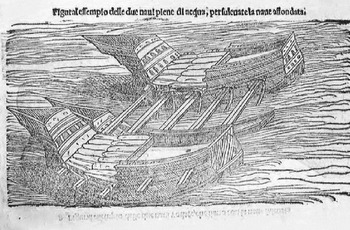
Tartaglia began his treatise by describing the equivalence between the upward force exerted by water when an object is placed on it and the weight of the fluid displaced. He considered this physical principle as the starting point for proposing a practical method for raising a sunken object, and he recognized Archimedes as the most important theoretical referent. His device (see Figure 1) – composed of two empty ships united at the top by several logs – was placed above the wreck on the sea's surface. Each ship had a hole at the bottom with a beam that, when placed in the hole, impeded water from entering the ship. To recover the sunken ship, the beams would be removed and the ships on the surface would fill with water. Once the ships were full, the holes would be closed and the wreck, which would have risen to just beneath the surface, would be tied to the logs. Then, the water inside the ships would be drawn out with funnels. This would result in the final and complete ascension of the sunken ship.
Tartaglia's device. From Niccolò Tartaglia, Travagliata inventione, Venice: Nicolo Bescarini, 1551. Source: Mathematica Italiana website, URL: mathematica.sns.it.

Tartaglia alluded very briefly to the sources that, apart from Archimedes, had inspired him to develop his device. In the tenth Dichiarazione of Book I of his Travagliata invenzione, Tartaglia mentions Vitruvius (first century BCE), Vegetius (fourth century CE) and Roberto Valturio (1405–1475) as authors who taught different ways of raising water. He refers to the variety of techniques proposed by authors in this tradition before putting forward his own.Footnote 4
Vegetius and Valturio alluded to the extraction of subterraneous waters but neither of them gave an explanation of the physical principles used. They concentrated mainly on the technical description of instruments.Footnote 5 However, in his De architectura, Vitruvius mentioned the case studied by Tartaglia explicitly. In Book Ten of this work, Vitruvius described in great detail the different kinds of machine involved in the movements of weights. It is not difficult to see how this book could have influenced Tartaglia: in the second chapter, Vitruvius described a machine made of two pieces of timber connected at the top with a brace for raising sunken objects. This machine was of a very similar construction to the one presented by Tartaglia in his Travagliata invenzione. He even might have followed Vitruvius’ hint that such a machine could be used for unloading ships.Footnote 6
If the connection to Vitruvius is evident, the relation to Vegetius and Valturio is not clear at all. Tartaglia probably decided to mention them because he was trying to connect his invenzione to well-known accounts of water clocks, pumps and diving appliances, and by these means to differentiate himself from the Renaissance tradition on wreck-salvage operations that had been developing since the fifteenth century. He omitted any reference to his direct predecessors on the subject and preferred to link his treatise to a parallel tradition that shared with him the practical approach on the mechanical motion of waters. Tartaglia probably wanted to stress the originality of his method and, by avoiding any allusion to the failed enterprise led by Leon Battista Alberti in 1446 to rescue the two ships of Caligula sunk at Lake Nemi, thought he might save himself from accusations of plagiarism.Footnote 7 Besides, he attributed to his invention a strategic and political meaning that was incompatible with a reference to the operation organized by the Roman Cardinal Prospero Colonna a century earlier. Tartaglia offered his device as a unique gift to the rulers of Venice for the enrichment of his city.
Although these intellectual and political reasons might explain Tartaglia's silence on the actions carried out at Nemi, they do not clarify another significant silence: in 1550, Girolamo Cardano published a method for raising sunken ships that undoubtedly challenged his enemy to propose a new and more practical device.
Cardano and the theory of elementary form
In the first book of the De subtilitate, Cardano presented a system for recovering a sunken ship based on the combination of weights. The analysis occured in the context of the motion of light bodies, and Cardano used it only as an example of his general explanation of motion. Cardano stated that, when ships are sunken in the sea, divers should bind them by ropes to vessels loaded with stones. Then the stones would be taken out and put in other vessels so that the emptied vessels drew the ship to them. This was possible, according to Cardano, because of the natural motion of air, which avoided being under water and thus would take the vessels, which had been almost sunken by the heaviness of the stones, up to the surface, pulling the tied ship with them. By the transference of stones from one set of vessels to another set located above, a ship could be brought to the sea's surface.Footnote 8
Cardano's presentation of the problem was fundamentally theoretical. He faced the question of establishing that the weight of the stones was equal to that of the water and to that of the ship that lay at the bottom of the sea. This equivalence must be combined with the motion of air towards its natural place. The solution might not seem very practical, for it involved a complicated and slow mechanism, and was probably inserted by Cardano only to strengthen his general theory of natural affection.
Cardano's theory of sublunary movement, which was based on his description of the elements, stands out as one of the most original produced at that time. He acknowledged the existence of a primary, underlying matter that did not change, and, instead of following Aristotle's conception of elementary motion (that is to say, towards natural places), he considered the movement of bodies to be determined by the rarefaction and condensation of matter.Footnote 9 According to Cardano, the elements could contract and expand up to a certain limit, depending on the circumstances, and attract or repulse any contiguous element. Using this principle, he completely transformed the traditional idea of natural motion. Cardano asserted that motions usually considered unnatural – of water going upwards, for example – were actually natural movements in the sublunary world. He established the predominance of the elementary form and the impossibility of the separation of the parts of matter, denying that the escape from a vacuum was a cause of motion. In fact, for Cardano, the conservation of form was the essential characteristic of elements, and it conditioned the usual motion towards natural places. Thus when a body could expand or rarefy more, it abandoned its natural movement to preserve its form, rising if heavy and descending if light.Footnote 10
Cardano based his explanation of the method for raising a wreck on the following single fact: air moved upwards with such force that it could pull even a sunken ship. His system was based on the traditional understanding of the natural movement of heavy things going downwards and of light ones going upwards. Although he omitted any reference to the notion of rarefaction as a consequence of the principle of the conservation of forms and natural affection, one can infer that when the stones were taken out of the vessels, the air contained in them expanded while the surrounding air entered and filled the emptied space. It was a combination of the traditionally accepted natural motion of light bodies with the theory of natural affection, which stressed the continuity of matter.
I have emphasized this last aspect mainly because Tartaglia presented a totally different theory for solving the same problem, and the distance between both solutions resided not only in the characteristics of the practical method used, but also in the natural principles that supported the respective methods.
Tartaglia's invenzione
Tartaglia based his invenzione on the following, simple principle: if two empty ships placed above a wreck were filled with water, the wreck would rise. He not only referred to the specific process by which water could be elevated, but also emphasized practical details, such as the speed with which the water inside the ships should be pumped out.Footnote 11
In addition, Tartaglia explained the natural mechanism that justified his method and gave a description of the behaviour of liquid media after being moved. He claimed that one who wants to separate a heavy body from the bottom of a deep stretch of water must move not only that body, but also all the water that lay above it. If the earthy bottom were liquid, he said, it would have to rise up to the space left by the body. However, because the bottom was immobile earth, it could not ascend to fill that vacant space. Instead, the surrounding water would accomplish that task. Tartaglia stated that the water that was first placed above the body descended to fill the vacant space left as the body was raised. Thus the water initially opposed the ascension and after a few seconds it occupied the bottom. This liquid medium was followed by more water that came to fill the spaces left by the body, helping the ascension. According to Tartaglia, that was the reason why it was much more difficult to separate a heavy sunken body from the bottom than it was to pull such a body to the surface once separated. This initial separation was even more difficult if the bottom was deeper, for in such a case there was more water above the body, and this water must be moved and raised with it.Footnote 12
The action that explained the entire process and turned an almost impossible task into a simple and practical mechanism was the continuous filling of vacant spaces left by the elevation of the sunken body. Tartaglia also alluded to the characteristics of the soil as something that could complicate the procedure. If the soil was stony, the sunken body would be surrounded and hugged by water except for the small part that touched the bottom. If swampy or sandy, the body would be embedded in the ground. In the first case, it was easier to separate the body from the bottom, for the water that filled the place left by the ascension of the body was already there, whereas in the second case it was necessary to bring far-off water to fill the whole swampy or sandy box, which took a lot of time. ‘Since nature does not allow void places to exist for a minute space of time’, Tartaglia said, ‘it is much more difficult to separate a body from a swampy or sandy bottom, than from a stony one’. As water needed time to fill the space, it was impossible to separate instantaneously all the parts of a body placed in such a box.Footnote 13
Elio Nenci has stressed that, even if some aspects of Tartaglia's and Cardano's expositions are quite similar, the Brescian author showed a deeper practical interest, for he focused on conditions that could make one case different from another.Footnote 14 In fact, Tartaglia's description of the method was less simplistic than Cardano's, for he included alternatives that related the efficiency of the method to the natural context. Tartaglia approached the difficulties caused in the salvage operation from the idea of the abhorrence of a vacuum. This medieval notion was well known at the time, but he quotes no authority for his position.Footnote 15 I believe that Tartaglia was probably inspired by a work that displayed a similar procedure based on the suction of water, namely the Pneumatica of Hero of Alexandria (first century CE).
In the description of the first device – the bent siphon – Hero explained the consequences of a vacuum's principle of attraction. According to Hero, it was possible to suck wine upwards with a siphon even though this was contrary to the nature of the liquid because, after the air inside the siphon had been extracted, a great pressure was exerted and the wine found no other place into which it could escape from it.Footnote 16 Although the situation to which Tartaglia refers was different – for he mentioned the consequences that the suction of water had on the lower strata of the sea – the logic of his answer was the same. Sucking off some of the water above the ship altered the state of natural equilibrium insofar as it altered the amount of water naturally above the ship. The result of this alteration was that the remaining water pushed the ship upwards and filled the empty spaces that were left behind as it did so.
Despite his description of the siphon, Hero defended the possibility of a vacuum. In the introduction to his Pneumatica, Hero explicitly denied the existence of a continuous void in nature.Footnote 17 But immediately after that, he proposed a subtle definition that functioned as the basis for his whole treatise and constituted its real peculiarity. Hero asserted that a vacuum was distributed in small measures through all bodies and used air as an example. According to Hero, the particles of air were in contact with each other, yet they did not fit together closely at every point. Rather, void spaces were left between the particles of air, as in the sand on the seashore. Thus when any force was applied to it, air was compressed and, contrary to its nature, fell into the vacant spaces by means of the pressure exerted on its particles. However, when the force was withdrawn, the air returned to its former position due to the elasticity of its particles.Footnote 18 Hero admitted that, when a continuous vacuum was produced by artifice, such a great pressure was exerted on the matter involved that it behaved contrary to its natural tendency. That is, despite his acceptance of a kind of void, Hero shared the fundamental idea of horror vacui, namely the direct relation between the unnatural motion of the elements and the resistance to an extended vacuum in nature. In other words, the experiments described in the Pneumatica could have been interpreted perfectly well in the light of the medieval theory of the abhorrence of a vacuum.Footnote 19 This ancient treatise might have helped Tartaglia to understand more clearly the way in which water could be used as a source of energy under determined circumstances. It also might have helped Tartaglia to focus on practical conditions, something that he could not find in Archimedes.
We do not have explicit evidence that Tartaglia was familiar with Hero's treatise. Antonio Favaro has analysed the official documents in which the Venetian Senate gave permission to Tartaglia for the publication of some mathematical works and has noticed an interesting fact. In a deliberation of December 1542, Tartaglia obtained an exclusive right to the publication in the city of his translations of and commentaries on Euclid, Archimedes and ‘Horone’.Footnote 20 As Favaro stresses, no work on ‘Horone’ has survived.Footnote 21 This right suggests that Tartaglia was familiar with some of Hero's mathematical work, but there is no proof of whether he was familiar with the Pneumatica. The only direct reference to Hero that we find in Tartaglia's work was a brief mention of Hero's method of inserting two mean proportionals in his Third Answer to Ludovico Ferrari.Footnote 22 The source in this case is indirect. Tartaglia clearly quoted, in exactly the same order, the exposition of different authors on the subject made by Eutocius in his Commentary to The sphere and cylinder. Footnote 23
Yet another element must be considered. The surviving registers of Bessarion's library in Venice for the years 1545 to 1559 record multiple loans of Greek codices. As Paul Lawrence Rose emphasizes, one of these borrowers is particularly noteworthy: the imperial ambassador to Venice, Diego Hurtado de Mendoza. The registers of 1545–1546 record the loan of the Pneumatica of Hero to Hurtado and, in view of Hurtado's friendship with Tartaglia, it is more than probable that Hurtado introduced this text to the mathematician.Footnote 24
It is also important to note that in the Pneumatica we find a reference that might be connected with Tartaglia's work. Using Archimedes’ treatise on floating bodies, Hero explained why divers were not crushed by the water above them, and he referred to the law according to which bodies of weight equal to that of a liquid would neither project above nor sink below the surface of that liquid when immersed in it.Footnote 25 Tartaglia himself described a winch, similar to the one used by Francesco de Marchi in Nemi in 1535, that could be submerged in deep waters.Footnote 26
The influence of Hero's explanation of the pressure exerted by a vacuum reveals a twofold aspect of Tartaglia's invenzione. On the one hand, by reviving horror vacui as the main cause of the raising of water, Tartaglia openly opposed the explanation offered by Cardano, and the Travagliata invenzione can be interpreted in light of their rivalry. On the other hand, the tacit reliance on the Pneumatica was limited to the description of devices and the practical application of the force produced by a vacuum, for Hero's theory of matter was totally omitted. This exclusion should be related to the absolute silence on the elasticity of bodies that characterizes Tartaglia's description of the phenomenon.
Rarefaction and the abhorrence of vacuum
The omission of the term ‘rarefaction’ stands out as a peculiar feature of Tartaglia's thought.Footnote 27 In the passages in which he referred to the detachment of the ship from the bottom of the sea, Tartaglia seems to follow the discussion of the separation of two surfaces in direct contact, which was a traditional subject of physical analysis. As Edward Grant has shown, most medieval authors agreed with Lucretius’ assumption that a momentary vacuum would be formed if two plane surfaces, with no material medium intervening, were separated in such a manner that they remained continuously parallel. ‘In rushing to fill the totally empty space between the now separated surfaces, the air would require some time, however small, to move from the outer perimeters to the innermost parts of the surfaces’, so it was concluded that separation could only occur gradually and successively, minute part after minute part.Footnote 28
Some authors did not limit their analyses to the classical case of two plane surfaces located in air that are pulled in opposite directions but mentioned also other situations. Roger Bacon and John of Jandun, for example, referred to the case in which a single surface came into contact with air or water, and they both stated that more air or water must arrive to fill the space produced by separation.Footnote 29
One can clearly see an influence of this medieval position in Tartaglia's invenzione. Apart from the evident resemblance, the mathematician's analysis was complemented by a fundamental role attributed to water, namely its double action as a filler and as a pusher, which makes his description of the phenomenon unique. This practical application of the theoretical explanation elaborated in the Middle Ages reveals Tartaglia's interest in silencing the role of rarefaction, for he not only reproduced a tradition that did not refer to the elasticity of matter in this particular case, but he also denied the possibility of expansion to a fluid soil (as found, for example, in a swamp) and explained the movement of masses of water without referring to the expansion of the element. The importance of this omission can be understood by considering the relevance that rarefaction had in sixteenth-century discussions on the existence of void as a basic characteristic of matter. According to these discussions, rarefaction confirmed either the capacity of matter to increase in volume or the presence of void pores inside it.Footnote 30 In those years, the classical approaches found a renewed relevance. The Aristotelian position, which considered the contraction and expansion of matter as a qualitative rather than a quantitative change, was challenged by the atomist approach, which denied the possibility of the rarefaction of matter and interpreted it as a proof of the existence of void.
As Grant has stated, the medieval tradition that criticized the approach of Bacon and John of Jandun used rarefaction as its central argument. This tradition relied on the claim by Aristotle in De anima II, 11 423a, that surfaces in a medium could not come into direct contact since a portion of the medium itself would always intervene. Among the authors who defended this position was the English logician Walter Burley, who stated that the intervening film of matter would expand and fill the widening space.Footnote 31
This second explanation seems to have been more popular among Italian authors writing in the middle of the sixteenth century than the one followed by Tartaglia. The significance of Tartaglia's omission of the notion of rarefaction can be seen by comparing his account of the separation of two adjacent bodies (ship and soil) with others given at the time. Alessandro Piccolomini faced the same problem in his 1551 La prima parte della filosofia naturale.Footnote 32 Piccolomini stated that, when two flat and clean bodies were separated, a void was necessarily produced between both of them before air could flow in and fill the space. But, he said, due to the imperfection of matter, it was impossible to find bodies made of natural substances that had surfaces so flat that they could touch so completely in water or air, ‘and that a particle of air and water would not be enclosed, which in the separation of the said bodies, would rarefy and consequently not make necessary the presence of vacuum’.Footnote 33
Piccolomini strictly followed the Aristotelian assumption and reproduced the allusion to rarefaction made by Burley. So did Cardano, who referred to this question in the second edition of his De subtilitate, which was published in 1554. There, he included a passage on the separation of flat objects in which he claimed that air filled the separation that otherwise would constitute a vacuum. According to Cardano, since flat things were exactly united, less air was included between them, so it was more difficult to separate them. ‘The reason’, wrote Cardano, was ‘that it is the more necessary that air separates from its proper form the more it rarefies’.Footnote 34
This explanation reveals the main difference between Cardano and Tartaglia. While the latter held that for raising a wreck it was necessary that the surrounding water converged at the bottom of the ship to avoid a vacuum, Cardano held that when two surfaces were united, there was a small separation only because the matter between them was reduced and had a limited rarefaction. So, although they agreed on the necessity of more matter to complete the separation, their basic physical assumptions differed radically. It is likely that Tartaglia defended the concept of horror vacui to explain this process as a way of stressing the impossibility of eliminating this principle and thereby criticizing Cardano's theory. And maybe the Milanese philosopher added this passage to express clearly his idea concerning this phenomenon and to pose a diverse explanation based on the strictly Aristotelian tradition of Burley.
I believe Tartaglia's preference for the non-Aristotelian tradition in this particular passage of his treatise was a consequence of his notion of matter, which differentiated him from his contemporaries. Tartaglia conceived the medium as a continuous body in which motion was produced and that had a defined and unalterable extension. Unlike his medieval predecessors – who did not deny rarefaction as a property of matter, but only omitted it in the interpretation of a specific phenomenon – Tartaglia never mentioned the elasticity of media.Footnote 35 For him, not only was there no expandable medium intervening between the wreck and the soil, but also the water located at its sides was inextensible.