Introduction
Cervical lymph node metastasis is reported in 12–90 per cent of papillary thyroid carcinoma patients under going prophylactic or therapeutic lymph node dissection.Reference Pellegriti, Scollo, Lumera, Regalbuto, Vigneri and Belfiore1–Reference Randolph, Duh, Heller, LiVolsi, Mandel and Steward4 In general, lymph node metastasis is considered a poor prognostic factor for recurrence risk and survival in older patients.Reference Hay, Grant, van Heerden, Goellner, Ebersold and Bergstralh5, Reference Harwood, Clark and Dunphy6 However, the significance of small volume lymph node metastases in papillary thyroid carcinoma prognosis is debated.Reference Randolph, Duh, Heller, LiVolsi, Mandel and Steward4 The development of diagnostic methods for small metastatic lymph nodes and unwarranted upstaging due to the presence of small metastatic lymph nodes after prophylactic central neck dissection may contribute to this issue.Reference Randolph, Duh, Heller, LiVolsi, Mandel and Steward4, Reference Hughes, White, Miller, Gauger, Burney and Doherty7
Several studies have reported that the size, number, extranodal extension and lymph node ratio of metastatic lymph nodes are significantly associated with recurrence risk or survival, but that simple identification of a metastatic deposit in a dissected lymph node is not.Reference Rajeev, Ahmed, Ezzat, Sadler and Mihai8–Reference Schneider, Chen and Sippel15 Recently, the American Thyroid Association Surgical Affairs Committee's Task Force on Thyroid Cancer Nodal Surgery reported that an understanding of risk stratification in tumour–node–metastasis (TNM) N1 patients based on these specific features of lymph node metastasis is critical for enabling clinicians to tailor their initial treatment and follow-up regimen.Reference Randolph, Duh, Heller, LiVolsi, Mandel and Steward4
We hypothesised that specific features of lymph node metastasis may be associated with primary tumour characteristics such as size and extrathyroidal extension. There is consensus that tumour size and extrathyroidal extension of papillary thyroid carcinoma are important in determining the primary tumour stage and eventual oncological outcome.Reference Mazzaferri16–Reference Jukkola, Bloigu, Ebeling, Salmela and Blanco18 It is therefore possible that primary tumour characteristics may be associated with certain histopathological features of metastatic lymph nodes related to tumour invasiveness. An analysis of these clinical characteristics may therefore provide a rationale for the optimal management of cervical lymph nodes in papillary thyroid carcinoma patients.
Materials and methods
Patients
A retrospective review was conducted of the medical records of 1154 patients who underwent thyroidectomy for papillary thyroid carcinoma at our centre between January 2011 and December 2013. Of these, 411 patients who were pathologically diagnosed with lymph node metastasis after initial papillary thyroid carcinoma surgery were included in the study. In all, 249 patients (60.6 per cent) underwent prophylactic central neck dissection and 162 (39.4 per cent) underwent therapeutic central or lateral neck dissection. All patients with clinically staged N0 tumours underwent prophylactic central neck dissection, including removal of the pretracheal, prelaryngeal and ipsilateral paratracheal lymph nodes. Patients with lymph node metastasis identified before (clinically) or during surgery underwent therapeutic neck dissection. Therapeutic central neck dissection included contralateral paratracheal lymph nodes and therapeutic lateral neck dissection included levels IIa, III, IV, and Vb. Pathology findings included the total number of retrieved lymph nodes, number of metastatic lymph nodes, maximal size of the metastatic deposit within the lymph node and the presence of extranodal extension (Figure 1). The lymph node ratio was defined as the number of metastatic lymph nodes divided by the lymph nodes retrieved by neck dissection.
Photomicrographs showing metastatic lymph nodes without (a) and with (b) extranodal extension. (a) Metastatic tumour confined to the lymph node (H&E; ×12.5). (b) Tumour showing extracapsular extension (arrow) (H&E; ×40).

Based on the association between lymph node ratio and extrathyroidal extension (data not shown), receiver operating characteristic curve analysis showed that 0.31 was an appropriate cut-off value for the lymph node ratio: less than 0.31 was considered a low lymph node ratio and 0.31 and above was considered a high lymph node ratio. Primary tumour characteristics were reviewed, including the size of the largest tumour, presence of extrathyroidal extension (Figure 2), multifocality, bilaterality, ultrasonography-determined primary tumour location, aggressive (i.e. invasive) variants of papillary thyroid carcinoma (i.e., tall cell variant) and Hashimoto thyroiditis. The primary tumour location was determined for cases of unifocal tumour. Associations between and among clinicopathological factors and specific pathological features of lymph node metastasis were assessed. The study was approved by the local institutional review board (1040549–201411-BM-016).
Photomicrographs showing extrathyroidal extension of a primary papillary thyroid carcinoma (H&E; ×40).
Statistical analysis
Univariate analysis was conducted to evaluate associations between specific features of lymph node metastasis and clinicopathological factors using the chi-square test or Fisher's exact test, as appropriate. Multivariate analysis of categorical variables was conducted using a binary logistic regression model; a p value of less than 0.05 was considered statistically significant. Statistical analysis was performed using the PASW 18 software program (SPSS Inc, Chicago, Illinois, USA). To decide the cut-off values for certain parameters, receiver operating characteristic analysis was conducted using MedCalc for Windows version 14.10.2 (MedCalc Software, Ostend, Belgium).
Results
The patient cohort comprised 317 women (77.1 per cent) and 94 men (22.9 per cent), with a mean (±standard deviation (SD)) age of 47.22 (±11.69) years (range 14–80 years). The mean primary tumour and metastatic deposit sizes were 12.85 (±9.36) mm (range 2–68 mm) and 3.47 (±3.23) mm (range 0.2–20 mm), respectively. The TNM stage was T1 in 152 patients (37.0 per cent), T2 in 9 patients (2.2 per cent), T3 in 208 patients (50.6 per cent) and T4a in 42 patients (10.2 per cent). In addition, 325 patients (79.1 per cent) had pathologically staged N1a tumours and 86 (20.9 per cent) had pathologically staged N1b tumours. In all, 70 patients (17.0 per cent) underwent lobectomy and 341 (83.0 per cent) underwent total thyroidectomy. The mean (±SD) number of retrieved lymph nodes was 7.3 (±4.4; range 1–27) in the central neck and 23.7 (±13.4; range 3–69) in the lateral neck.
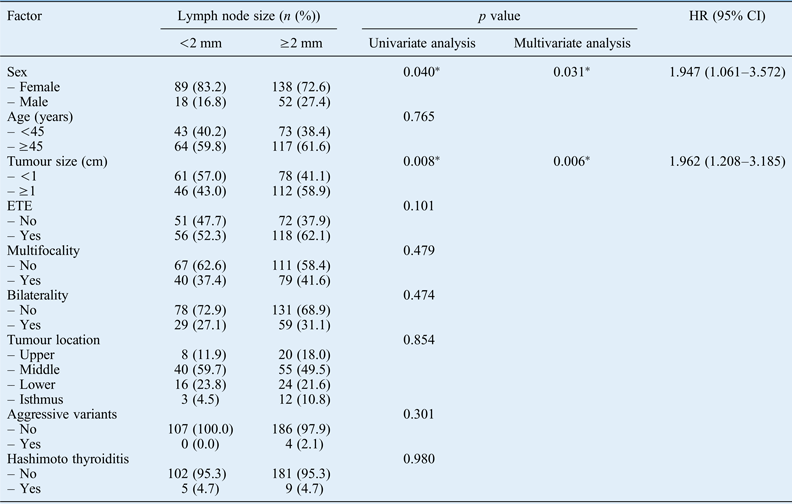
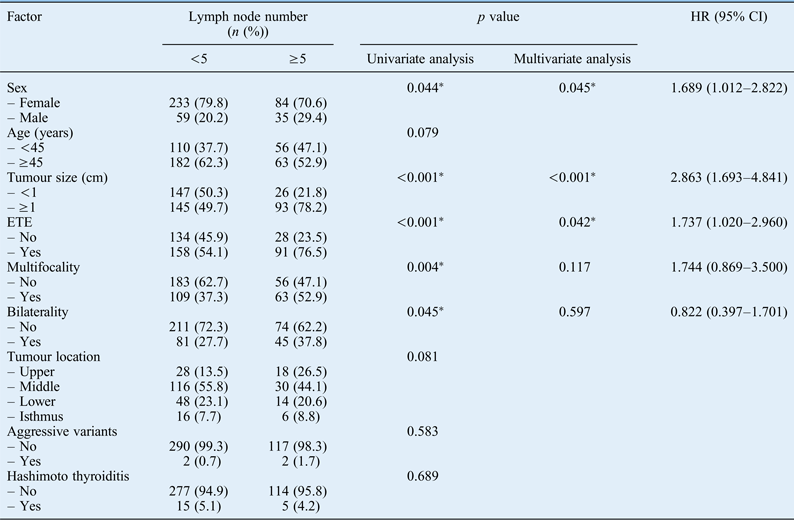
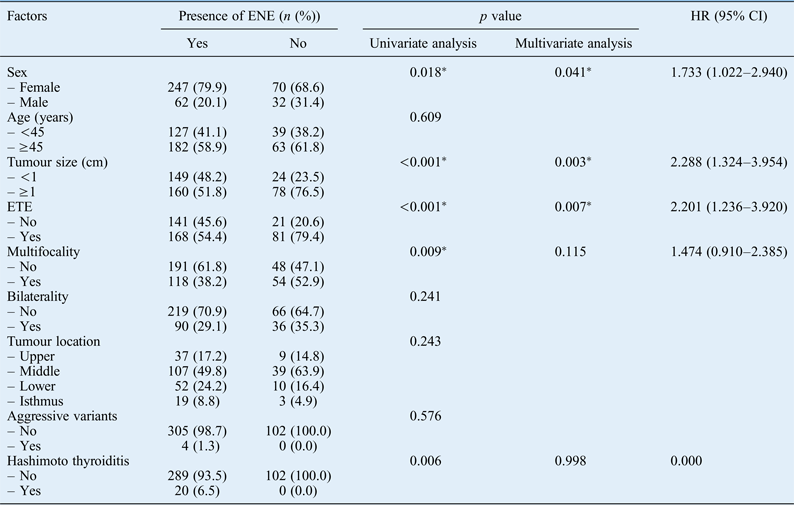
A metastatic focus size of at least 2 mm was independently associated with male sex (p = 0.031, hazard ratio 1.947) and primary tumour size of at least 1 cm (p = 0.006, hazard ratio 1.962; Table I). A number of at least five lymph node metastases was independently associated with male sex (p = 0.045, hazard ratio 1.689), a primary tumour size of at least 1 cm (p < 0.001, hazard ratio 2.863) and extrathyroidal extension (p = 0.042, hazard ratio 1.737; Table II). Extranodal extension was independently associated with male sex (p = 0.041, hazard ratio 1.733), a primary tumour size of at least 1 cm (p = 0.003, hazard ratio 2.288) and extrathyroidal extension (p = 0.007, hazard ratio 2.201; Table III). Extranodal extension was identified in 6.5 per cent of smaller metastatic lymph nodes (<2 mm) and 24.7 per cent of larger metastatic lymph nodes (≥2 mm; p < 0.001, hazard ratio 4.695, 95 per cent confidence interval (CI) 2.039–10.813). The cut-off value for the metastatic lymph node size associated with extranodal extension was determined to be 2.5 mm by receiver operating characteristic analysis (Figure 3). The area under the curve was 0.703 (95 per cent CI 0.647 to 0.754; p < 0.0001), representing the maximal sensitivity (74.07 per cent) and specificity (58.44 per cent) to predict extranodal extension based on metastatic lymph node size. A lymph node ratio of at least 0.31 was significantly associated with male sex (p = 0.001, hazard ratio 2.233), extrathyroidal extension (p = 0.013, hazard ratio 1.665), Hashimoto thyroiditis (p = 0.031, hazard ratio 0.369), multifocality (p = 0.015, hazard ratio 1.646) and bilaterality (p = 0.020, hazard ratio 1.677). However, only male sex (p = 0.003, hazard ratio 2.147) was independently associated with lymph node ratio.
Receiver operating characteristic curve showing that metastatic lymph node size is associated with extranodal extension. Area under the curve = 0.70 (95 per cent confidence interval, 0.647 to 0.754); p < 0.001. Sensitivity = true positive rate; 100 – specificity = false positive rate.
Univariate and multivariate analyses of metastatic lymph node size and clinicopathologic factors
*p < 0.05. HR = hazard ratio; CI = confidence interval; ETE = extrathyroidal extension
Univariate and multivariate analyses of lymph node metastasis number and clinicopathological factors
*p < 0.05. HR = hazard ratio; CI = confidence interval; ETE = extrathyroidal extension
Univariate and multivariate analyses of extranodal extension and clinicopathologic factors
*p < 0.05. ENE = extranodal extension; HR = hazard ratio; CI = confidence interval; ETE = extrathyroidal extension
Discussion
The importance of metastatic lymph node size, number and extranodal extension and of the lymph node ratio in papillary thyroid carcinoma patients has been demonstrated in several studies.Reference Rajeev, Ahmed, Ezzat, Sadler and Mihai8–Reference Vas Nunes, Clark, Gao, Chua, Campbell and Niles12, Reference Schneider, Chen and Sippel15, Reference Wang, Palmer, Nixon, Thomas, Shah and Patel19 Recently, there has been consensus that these features should be considered in the assessment of retrieved lymph nodes after neck dissection rather than simply for determining the presence or location of lymph node metastasis.Reference Randolph, Duh, Heller, LiVolsi, Mandel and Steward4, Reference Clain, Scherl, Dos Reis, Turk, Wenig and Mehra20 While these specific features are demonstrated prognostic factors in patients with cervical lymph node metastasis, associations between these features and primary tumour characteristics have not yet been established. In a recent study, Clain et al. showed that extrathyroidal extension is associated with extranodal extension in lymph node metastasis.Reference Clain, Scherl, Dos Reis, Turk, Wenig and Mehra20 However, these authors performed only a simple univariate analysis of extrathyroidal extension and extranodal extension. Thus, the impact of other clinicopathological factors, such as primary tumour size was not assessed. To the best of our knowledge, this is the first study to investigate associations among primary tumour characteristics and the histopathological features (i.e. size, number, extranodal extension, lymph node ratio) of metastatic lymph nodes in papillary thyroid carcinoma patients.
A recent study reported that patients with metastatic lymph node diameters larger than variable cut-off values (0.75, 1 and 2 cm) had a significantly increased recurrence risk compared with those with metastatic lymph nodes smaller than the respective values.Reference Wang, Palmer, Nixon, Thomas, Shah and Patel19 Metastatic lymph node size may be important for assessing lymph nodes retrieved by prophylactic central neck dissection. In a study with an identifiable lymph node metastasis incidence of up to 90 per cent, Noguchi et al. reported that 57 per cent of patients had metastases smaller than 3 mm.Reference Noguchi, Noguchi and Murakami3 In general, 2 mm is considered the cut-off value for micro- and macro-metastases, and the impact of small lymph node metastases on recurrence risk or survival in papillary thyroid carcinoma patients is considered to be limited.Reference Randolph, Duh, Heller, LiVolsi, Mandel and Steward4, Reference Jeon, Yoon, Han, Yim, Hong and Song10 Therefore, patients with micro-metastases (<2 mm) were considered to be in the N1 lower recurrence risk group.Reference Randolph, Duh, Heller, LiVolsi, Mandel and Steward4 The present study found that 64 per cent of patients had metastatic lymph nodes of at least 2 mm and that a metastatic deposit size of at least 2 mm was independently associated with male sex and a primary tumour size of at least 1 cm.
The metastatic lymph node number is reported to be a prognostic factor for papillary thyroid carcinoma patients.Reference Rajeev, Ahmed, Ezzat, Sadler and Mihai8, Reference Lee, Song and Soh9, Reference Wang, Palmer, Nixon, Thomas, Shah and Patel19, Reference Ito, Jikuzono, Higashiyama, Asahi, Tomoda and Takamura21, Reference Leboulleux, Rubino, Baudin, Caillou, Hartl and Bidart22 Lee et al. reported that patients with two to five metastatic lymph nodes had 2.3 times the recurrence risk and those with more than six metastatic lymph nodes had 3.7 times the recurrence risk of patients presenting with fewer than two metastatic lymph nodes.Reference Lee, Song and Soh9 Others showed that a higher positive lymph node number was associated with a risk of lateral lymph node metastasis and elevated serum thyroglobulin at one year post-ablation.Reference Rajeev, Ahmed, Ezzat, Sadler and Mihai8 The cut-off value for the lymph node metastasis number linked to recurrence varied from 2 to 10 among studies.Reference Lee, Song and Soh9, Reference Wang, Palmer, Nixon, Thomas, Shah and Patel19, Reference Ito, Jikuzono, Higashiyama, Asahi, Tomoda and Takamura21, Reference Leboulleux, Rubino, Baudin, Caillou, Hartl and Bidart22 However, all reported that the metastatic lymph node number may reflect tumour burden, which has a significant impact on recurrence risk. The present study found that male sex, a primary tumour of at least 1 cm and extrathyroidal extension were independently associated with the number of lymph node metastases.
Lango et al. reported that extranodal extension is associated with a 20 per cent increase in the nodal persistence risk and reduces the likelihood of a complete biochemical response.Reference Lango, Flieder, Arrangoiz, Veloski, Yu and Li11 These researchers reported that extranodal extension is associated with a high rate of persistent residual tumours after initial surgery. However, others found that extranodal extension affects papillary thyroid carcinoma outcome via innate tumour invasiveness rather than the completeness of resection.Reference Ito, Hirokawa, Jikuzono, Higashiyama, Takamura and Miya23 Some studies have reported an increased recurrence risk in patients with extranodal extension;Reference Leboulleux, Rubino, Baudin, Caillou, Hartl and Bidart22 others reported an association between extranodal extension and both distant metastasis and disease-specific survival.Reference Yamashita, Noguchi, Murakami, Kawamoto and Watanabe13, Reference Yamashita, Noguchi, Murakami, Toda, Uchino and Watanabe14, Reference Ito, Hirokawa, Jikuzono, Higashiyama, Takamura and Miya23 Extranodal extension was also reported to be associated with unresectable disease or a reduced response to radioiodine therapy.Reference Lango, Flieder, Arrangoiz, Veloski, Yu and Li11, Reference Vassilopoulou-Sellin, Schultz and Haynie24 The present study revealed that male sex, a primary tumour size of at least 1 cm in size and extrathyroidal extension are independently associated with extranodal extension. Other studies reported that extranodal extension is associated with male sex, gross extrathyroidal extension and distant metastasis.Reference Lango, Flieder, Arrangoiz, Veloski, Yu and Li11, Reference Ito, Hirokawa, Jikuzono, Higashiyama, Takamura and Miya23 Clain et al. reported that lymph node size may not be directly associated with extranodal extension; however, the present study identified a significant association between these factors (p < 0.0001).Reference Clain, Scherl, Dos Reis, Turk, Wenig and Mehra20 Metastatic lymph node size (cut-off value of 2.5 mm) was associated with extranodal extension. The clinical significance of this cut-off value for metastatic lymph node size should be verified by further studies into the oncological outcome.
Several studies have reported that the lymph node ratio is an important prognostic factor for papillary thyroid carcinoma patients. Jeon et al. showed that patients with a lymph node ratio of more than 0.4 had a higher recurrence risk and that the lymph node ratio had a greater effect on recurrence risk compared with lymph node size.Reference Jeon, Yoon, Han, Yim, Hong and Song10 Moreover, others reported that patients with lymph node ratio of at least 0.42 had a 77 per cent higher disease-specific mortality risk.Reference Schneider, Chen and Sippel15 Although the lymph node ratio reflects papillary thyroid carcinoma invasiveness, the current study failed to identify an independent association between the lymph node ratio and primary tumour characteristics.
This study demonstrated that male sex and primary tumour biology (at least 1 cm in size and extrathyroidal extension) are significantly associated with specific pathological features of metastatic lymph nodes related to tumour invasiveness. These associations could provide a rationale for managing lymph nodes in papillary thyroid carcinoma patients. The primary tumour size and presence of extrathyroidal extension determines the primary tumour stage; consequently, these factors are associated with the lymph node metastasis or recurrence risk or with survival for papillary thyroid carcinoma patients.Reference Mazzaferri16, Reference Ito, Jikuzono, Higashiyama, Asahi, Tomoda and Takamura21, Reference Leboulleux, Rubino, Baudin, Caillou, Hartl and Bidart22, Reference Ortiz, Rodriguez, Soria, Perez-Flores, Pinero and Moreno25 In addition, although male sex does not determine tumour stage, previous studies have demonstrated it to be a prognostic factor in papillary thyroid carcinoma patients.Reference Lee, Song and Soh9, Reference Sipos and Mazzaferri17 Therefore, it was not surprising to identify associations between these well-known prognostic factors for papillary thyroid carcinoma (primary tumour ≥1 cm, extrathyroidal extension, male sex) and specific features of metastatic lymph nodes related to aggressive tumour biology. However, associations between primary tumour characteristics and pathological features of lymph node metastases have rarely been investigated in papillary thyroid carcinoma patients.
• Metastatic lymph node invasiveness is associated with worse outcomes for papillary thyroid carcinoma patients
• Specific features of lymph node metastasis in papillary thyroid carcinoma patients are associated with primary tumour characteristics
• Male sex, primary tumour size (≥1 cm) and extrathyroidal extension were associated with aggressive features of metastatic lymph nodes
This study found a significant relationship between specific factors related to primary tumour invasiveness and metastatic lymph nodes. However, a limitation is that potential associations between these factors and oncological outcome could not be assessed because of the short follow-up period. Although the impact of these factors on recurrence risk or tumour-related death have been demonstrated in several studies, further long-term studies should be conducted to verify the clinical significance of associations between primary tumour invasiveness and metastatic lymph nodes identified in this series.
Conclusion
In papillary thyroid carcinoma, primary tumour size and extrathyroidal extension, which determine primary tumour stage, are related to pathological features of metastatic lymph nodes. Primary tumour characteristics should therefore be considered when managing papillary thyroid carcinoma patients who require prophylactic or therapeutic neck dissection.
Acknowledgements
This study was supported by a 2012 grant from Kosin University College of Medicine, Busan, Republic of Korea.