At the beginning of the twentieth century, Vital Mareille—a champion of the plaidoirie sentimentale—tried to explain the reasons for its rise in France and its continued popularity into his own era. He defined it in the following terms: “The plaidoirie [defense summation] sentimentale is, precisely, that which seeks to move; one can say: that which comes from the heart of the attorney, to address that of the judges.”Footnote 1 The plaidoirie sentimentale had existed in France before 1800, but it entered its golden age in the nineteenth century, and became a specialized form of judicial oratory.Footnote 2 It developed chiefly in response to the introduction of trial by jury in 1791. Attorneys had to craft a rhetorical approach that would appeal to these “simple citizens,” and for this, sentimental eloquence was ideal;Footnote 3 however, no recent scholar has attempted a systematic study of this important form of courtroom rhetoric from its origins in the early nineteenth century to its gradual replacement after 1890 or thereabouts by a more fact-based, “positivist” approach.Footnote 4 This is unfortunate, because the history of the plaidoirie sentimentale reveals much. It includes juridical issues such as how the rhetorical practices of magistrates themselves contributed to the affective nature of French jury trial and the impact of the abolition in 1881 the résumé (summing up),which had been the judge's one means of countering the effect on a jury of an eloquent defense summation. It also reveals important changes in the attitudes of judges and jurors toward male mistreatment of women and the sexual “double standard” from the middle of the nineteenth century on and of how attorneys of the era drew on both the “new” emotion of sympathy and the “old” one of honor to persuade jurors to acquit. This adds to the evidence that emotions have a “history.”Footnote 5
Melodrama and the Origins of the Plaidoirie Sentimentale
Although Mareille and several modern scholars have stressed the influence of Romanticism (which was broadly characterized by an emphasis on emotions and the imagination) on much courtroom speechifying in the nineteenth and early twentieth centuries,Footnote 6 the conventions of the plaidoirie sentimentale more precisely owe the most to melodrama. In 1791, the National Assembly enacted two laws that established the preconditions for the rise of the plaidoirie sentimentale. One was the introduction of trial by jury, by nonprofessionals who delivered verdicts on the basis of “moral proofs.”Footnote 7 The other was an edict allowing any citizen to operate a theater.Footnote 8 Before then, dialogue was forbidden in the dramatic productions of all but a few officially sanctioned theaters. Popular theaters often had to make do with pantomime. But the 1791 decree legalized dialogue in all theaters. This resulted in a proliferation of small theaters patronized by lower-class audiences insufficiently appreciative of classical drama. A new theatrical genre had to be developed to appeal to such audiences. Many producers now began to integrate dialogue into the pantomimes that they had been offering, which helps to explain melodrama's emphasis on visual appeal, simple dramatic conflicts, and the use of stock characters. In 1800, the term “melodrama” was coined to refer to the popular dramas which arose from these theatrical experiments.Footnote 9
Melodrama is a form of drama that combines pantomime with prose, with music often added for dramatic effect, and is intended for a popular audience. It is primarily concerned with situation and plot and relies on stock characters engaged in a Manichean conflict between good and evil. There is a suffering hero or heroine, with women and children best playing the role of the villain's innocent victims. Melodrama has been described as “overwrought,” “exaggerated,” with emotional “excess,” histrionic “overacting,” and “inflated and extravagant expression” or “hyperbole.” There is a frequent use of moral epithets—people are “honest,” “virtuous,” “respectable,” or “false,” “terrible,” “wretched,” “cruel,” “tyrannical”. The epithets are shorthand characterization, to be clear and unambiguous, for an audience unused to subtleties. Melodrama is highly sentimental and moralistic, with virtue rewarded and vice punished in the end.Footnote 10
According to Peter Brooks, the moralism of the melodrama arose from the need to clarify “ethical imperatives” at a time when the French Revolution completed “a process of desacralization that was set in motion at the Renaissance.”Footnote 11 Good and evil could no longer be conceived in transcendant terms; now it was necessary to embody them in stereotyped characters.Footnote 12 Whereas Frank Rahill maintains that melodrama appealed mainly to lower-class audiences,Footnote 13 other scholars, such as Brooks and Jean-Marie Thomasseau, claim that in France (although not in England), theatrical melodrama remained popular among all social classes down through the end of the nineteenth century.Footnote 14 Soon after, its conventions were taken over by silent films.Footnote 15 Even William Reddy, who claims that the real heyday of sentimentalism was the late eighteenth century, evident especially in the rhetoric of the French Revolution, admits that in the nineteenth century “Melodramas and tempestuous operas continued to pack theaters in Paris and the provinces.”Footnote 16 Sentimentalism in political rhetoric was abandoned after 1794, but it “lived on as a private code of behavior.”Footnote 17 Through the courts, this private code of behavior was made public in cases that grew out of private conflicts and passions, especially those concerning women.
The Plaidoirie Sentimentale and Trial Procedure
It was not long before some defense attorneys appropriated the conventions of melodrama to appeal to the “impressionable” citizen-judges. The successful use of the plaidoirie sentimentale was facilitated by procedure in the cours d'assises (the trial courts for felonies and the only ones in France to use juries). Trials in nineteenth century France often took on an emotional or affective character in which even the magistrates were complicit. Procedure and ceremony in the cour d'assises engendered drama and spectacle.Footnote 18 This owed much to the procedure put into place by Napoleon's Code d'instruction criminelle of 1808, which remained essentially intact through the next century and a half. At the start of the trial, the président of the three judge court,Footnote 19 resplendent in his red robe, administered a solemn oath to the jurors as they stood with their hats off: “Do you swear before man and God…that you will decide according to the charges and evidence, following your conscience and intimate conviction, with the impartiality and firmness which becomes a free and upright man?”Footnote 20 Each juror, called individually by the président, responded, with his hand raised, by saying je le jure (I swear it). Next, the greffier (court clerk) read to the court in a loud voice the acte d'accusation (bill of indictment), drawn up by the procureur-général (public prosecutor) and summarizing the evidence against the accused. It was often long, denunciatory, and “drawn with great literary skill.”Footnote 21
According to Katherine Fischer Taylor, much of the drama and theatricality characteristic of the French cours d'assises were the result of the conflict between opposing elements of the French criminal justice system.Footnote 22 This system was an uneasy hybrid of the Ancien Régime “inquisitorial” procedure of extensive and secret pretrial investigation by professional magistrates, and trial by jury, introduced during the Revolution and borrowed from England's “accusatory” system.Footnote 23 According to the late nineteenth century legal historian Adhemar Esmein, there was “strife” between inquisitorial procedure and trial by jury.Footnote 24 The crux of the strife was that the results of the inquisitorial procedure placed a heavy presumption in favor of the guilt of the defendant, whereas in jury trials, the question of guilt was very much an open one.
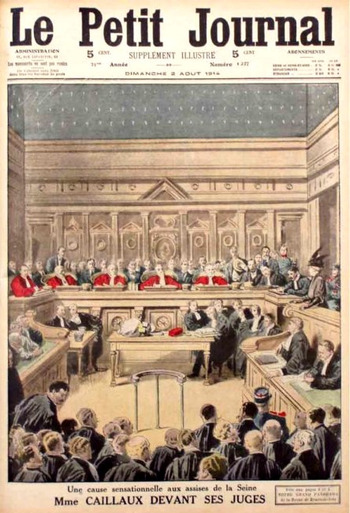
The theatricality of trial in the cours d'assises, and the tension between the inquisitorial and accusatory systems, were reinforced by the physical layout and appearance of the nineteenth and early twentieth century courtroom (Figure 1). The typical cour d'assises trial chamber of the era was a long rectangle. At the far end was the judges’ tribune. The public prosecutor sat with the judges, entered and exited the courtroom with them and, like the président, wore a red robe. Below the magistrates’ tribune was a large open space known as the barreau. At the center of this was a little railing in which witnesses stood to address the judges. Flanking the barreau on one side was the jury's box, facing the box of the defendant on the other side, with the bench of his or her attorney below. Beyond the gates of the barreau was another enclosure for the benches of the witnesses (primarily), and outside its gates stood the public. According to Taylor, the large barreau encouraged theatricality (for example, it allowed grand gestures by the attorneys). The different placement and dress of the prosecutor and defense attorney emphasized the superiority of the former.Footnote 25
The Paris Cour d'assises, 1914. Le Petit Journal Supplement Illustré, August 2, 1914. http://gallica.bnf.fr/ark:/12148/bp6k717123q.r.=1914%201914?rk=77 (accessed on May 30, 2017).

It was not true, as Britons and Americans commonly alleged, that in France one was guilty until proven innocent, but the results of the exhaustive pretrial investigation—conducted by several levels of magistrates—weighed heavily against the defendant.Footnote 26 The pretrial procedure produced a voluminous dossier on the accused, which was then transmitted to the président of the cours d'assises that tried the defendant. The président found himself in what the twentieth century jurist Maurice Garçon claimed was a delicate situation. He had the duty, before trial, to thoroughly familiarize himself with the contents of the dossier, and, therefore, could hardly avoid forming his opinion of the case after reading the documents included therein.Footnote 27
This was why it was mainly through the président's interrogatoire (interrogatory) of the accused that followed the reading of the acte d'accusation that the inquisitorial system invaded the jury trial.Footnote 28 In the interrogatoire, the président himself often introduced an emotional or affective dimension to the proceedings. This again grew out of the pretrial procedure. When the juge d'instruction (investigating magistrate) investigated a case, he not only looked at the facts of the crime, but also at the life and character of the accused in order to understand the motivation for the crime and to assess guilt for the offense within the context of the defendant's life.Footnote 29 A personality profile was thereby constructed. The defendant was asked to submit an autobiographical account, and witnesses from his or her early life were called in, whose statements could include gossip and hearsay.Footnote 30
The president of the cour d'assises often drew on this material in his interrogatoire of the defendant—which in important cases could last for days—to make moralistic statements about the character of the accused (including previous convictions), usually at the beginning. The judge would let the jury know that the person was of “good” or “bad” character, and according to some jurists, it was often the latter.Footnote 31 One accused person exercised the “shameful” occupation of pimp (denied by the accused).Footnote 32 Another judge said he had received “unfavorable reports” of the defendant being a gambler, a drunk, and a liar.Footnote 33 In another case, the judge started off by mentioning that the accused had had the reputation of being a hypocrite when he was a seminary student and that he had been expelled for misconduct. “You have always had a sickly sweetness of a kind to fool everyone.”Footnote 34 One judge mentioned that the accused was no longer a man of honor, and when the defendant said that he still was, the judge insisted that he was not.Footnote 35 Another defendant had “shameful habits.”Footnote 36 In one instance the judge mentioned that the defendant was a skilled and intelligent mason, but that he ran around cafes.Footnote 37 In the famous murder trial of Michel Eyraud in 1890, the président began his interrogatoire by noting of the defendant, “we have been given some very bad information on your morality…You are married, and however it has been reported everywhere that you are a debauché, a woman chaser…You have lived in debauchery for all of your life…In respect to probity, your reputation is the same; all those who have known you say that you are a crook; that you are capable of anything.”Footnote 38 Another defendant was castigated for his “deplorable,” morals,Footnote 39 and yet another was a “thief” and a fainéant (do-nothing).Footnote 40
Therefore, defense attorneys had to respond not only to the criminal charge, but also to charges concerning the character of the accused. The plaidoirie sentimentale (which, like any defense summation in the cours d'assises down through the 1880s generally lasted anywhere from 2 to 6 hours,Footnote 41 was ideally suited to create jury sympathy for the defendant. The plaidoirie sentimentale appealed to what Ute Frevert claims were new emotions “found” and invented in the modern period: empathy and sympathy/compassion.Footnote 42 Sometimes such an oration even brought jurors to tears.Footnote 43 In at least one case, it brought the judge to tears.Footnote 44 Because jury trial was oral, defense attorneys could counter the exhaustive pretrial research that went into the dossier and thereby into the interrogatoire by making dramatic appeals, through speech, but also through gestures and even through how they wore their robes.Footnote 45
Whatever its length, the model plaidoirie included five parts: introduction, narration of the case, argument for the defense, refutation of the prosecution, and conclusion. If Mareille and Maurice Joly are to be believed, after 1830 or thereabouts, attorneys generally ceased to write out their plaidoiries and resorted to improvisation instead, something particularly suitable for the sentimental approach.Footnote 46 Perhaps this was more apparent than real. According to Benjamin F. Martin, the plaidoirie was “written out and memorized so thoroughly that the delivery would seem spontaneous.”Footnote 47 Plaidoiries were sometimes published in the form of pamphlets.Footnote 48 For notorious trials, newspapers also published the plaidoiries verbatim or summarized them with extensive quotations. The journals frequently commented on the quality of plaidoiries and the reactions of courtroom audiences (such as applause, or “movements”).Footnote 49 Collections of the more notable plaidoiries of famous defense attorneys of the nineteenth century—Pierre-Antoine Berryer, Chaix d'Est d'Ange, Charles Lachaud, Jules Favre—were published posthumously in edited volumes.Footnote 50 By the late nineteenth century, the question arose of whether the plaidoirie should be considered literature.Footnote 51
Although the plaidoirie sentimentale was supposedly effective in persuading jurors in the cours d'assises, it was evidently much less so before the three judge panels of the tribunaux correctionnels (misdemeanor courts), which operated without juries. For one thing, these tribunals were entirely unsuitable for long speeches of any sort. The tribunaux correctionnels tried far more cases than did the cours d'assises.Footnote 52 In the early twentieth century, Henri Robert noted that in the tribunaux correctionnels, overburdened as they were with heavy caseloads (and where many cases were disposed of in a matter of minutes) the judges were pressed and impatient. This meant that defense attorneys had to keep their remarks very brief. Moreover, the judges of the tribunaux correctionnels, because of their professionalism, were largely “shielded from the assaults of eloquence” which influenced the “judges of occasion who constitute the jury.”Footnote 53 Chaix d'Est-Ange, one of the great defense attorneys of the romantic oratorical style, was said to have been very fond of the cour d'assises precisely because its lengthy hearings allowed him a degree of success that he could not hope for when the trial was only before the “blasé and distrustful” professional judges.Footnote 54
The plaidoirie sentimentale was also of a piece with the very loose rules of evidence in the cours d'assises. Unlike in American courts, where witnesses are allowed to respond only to questions posed by legal counsel—questions that must conform to legal norms—in France they, along with the accused, could not be interrupted during their depositions, delivered before their interrogations by the président.Footnote 55 According to Berenson, defendants, attorneys, witnesses, and presiding judges were “allowed long soliloquies.”Footnote 56 Witnesses were free to say almost anything they pleased., including hearsay, rumor, and their own interpretations of events.Footnote 57 Opinion testimony was also allowed, and like the interrogatoire, frequently dealt with the character of the accused person and even of the victim.Footnote 58 According to Eliza Earle Ferguson, the rules regarding testimony in the cours d'assises allowed witnesses to make statements that often reflected nonlegal or community norms that resonated with jurors.Footnote 59
Following the hearing of the witnesses, first the prosecution and then the defense presented their final arguments. The fact that the defense spoke last was a great advantage to the accused.Footnote 60
There was not much prosecutors and judges could do to limit the impact of a particularly eloquent plaidoirie. The acte d'accusation may also have been lengthy and written with literary skill; however, it was read at the beginning of the trial by a court clerk and “usually so rapidly that the jury could barely understand him.”Footnote 61 The président also had to be on guard against making his interrogatoire too harsh, lest it create sympathy for the defendant among the jury.Footnote 62 Moreover, the prosecution's concluding speech, or requisitoire, tended to be limited in its impact not only because it preceded the defense plaidoirie, but also because it was generally brief. An American jurist of the early twentieth century, James W. Garner, wrote that American critics of French trial procedures claimed that public prosecutors did so little during trial because “the interests of the prosecution are sufficiently looked after by the judge.” French observers, however, claimed that it was because prosecutors did not want to provoke “the hostility of the jury” and arouse the panelists’ sympathy for the defendant.Footnote 63
There remained one significant check on the impact of an eloquent defense plaidoirie. This was the court president's résumé at the end of the trial.Footnote 64 But even this was abolished in 1881. From 1808 on when the jurors deliberated in their chamber, they were required to read an instruction telling them to judge not on the basis of rules of evidence, but rather according to their “intimate conviction.”Footnote 65 French legal writers in the nineteenth and early twentieth centuries maintained that this allowed jurors to judge according to sentiment or emotion.Footnote 66 If so, this underscored the efficacy of the plaidoirie sentimentale. Attorneys knew very well what they were attempting to do when they delivered an emotional and eloquent plaidoirie before a jury. This was an era in which courtroom audiences in France strongly applauded particularly eloquent plaidoiries, with at best only sporadic admonishment from the courts,Footnote 67 and lawyers were congratulated for such orations by fellow attorneys, who were provided with special seats to watch the performance.Footnote 68
The theatricality of trials in the French cours d'assises contrasted strongly with the relative sobriety of jury trials in Britain and the United States. In nineteenth century Britain, unlike in France, the drama created by the tension between two different forms of procedure did not exist. In the “accusatorial” Old Bailey courtroom in London, the prosecution and defense attorneys addressed each other as equals from a close distance across a table. The courtroom was also too cramped for theatrical gestures.Footnote 69 Contemporary American trials were even less dramatic. When Alexis de Tocqueville sat in a New York courtroom in 1831, he noted that the prosecuting attorney spoke with his hands in his pockets, the judge chewed, and the defense counsel picked his teeth when questioning witnesses!Footnote 70 American informality no doubt helped to explain the dissimilarities in tone between French and American jury trials, whereas the procedures that prevailed in the cours d'assises provided ample opportunities for lengthy displays of lawyerly eloquence.
The emphasis on eloquence was also related to the political role of lawyers in nineteenth century France. Lawyers saw themselves as the defenders of liberty. Many would go on to political careers. As Philip Nord has observed, in nineteenth century France, the bar was the “premier school of eloquence.” Eloquence was the lawyer's “most potent weapon.” Whether pleading in a courtroom or orating in Parliament, his “task remained the same: the exercise of eloquence to address and avert the public to protect its rights against the state.”Footnote 71 The great orators of the bar defended persons accused of both political and nonpolitical crimes, some of which commanded much public attention. As Yves Ozanam has put it, by the middle of the nineteenth century, “the cour d'assises appeared as a unique theater, where everyone could freely watch the spectacle of contemporary passions. The premier lawyers of the time came there to plead and knew the prestige and celebrity that the public reserved for great actors.”Footnote 72 One of the most celebrated was Charles Lachaud (1818–82), the master of the plaidoirie sentimentale. During a jury trial, Lachaud responded to a discussion on a juridical issue by crying out: “Let us close the codes and open our hearts.”Footnote 73 According to Mareille, this approach henceforth became “the sole means of succeeding with a jury.”Footnote 74
Examples of the Plaidoirie Sentimentale
This was already evident in the plaidoirie of M. (no first name given) Michel in the November 1830 trial in the cour d'assises of the Department of the Cher of a certain Perrot, drummer for the city of Bourges. He was a married man who was charged with the murder of his mistress, the femme Ragon, who was also married. Michel began his plaidoirie by focusing on the evidentiary weaknesses of the prosecution case, but ended his summation by trying to evoke pity among the jurors for Madame Perrot. Since her husband had been imprisoned, Madame Perrot had been the sole support of her family, including both her husband and children. She worked at night, and during the day she went to the prison to sit beside her husband and share with him the “bread soaked with her sweat and tears.” The child she had suckled had died from lack of nourishment. Then Michel added:
At this moment still, Messieurs, she roams about your enclosure, pushing back her tears; she regrets that the decency of her sex and the majesty of your proceedings does not permit her to present herself before you, to beseech you for her husband, for her son, the son so innocent and yet whose future is threatened. She lifts her hands to heaven, she addresses with fervor her touching prayers; she invokes heaven, from where descend all merciful thoughts, to inspire you with leniency. Can her prayers be answered! Can you render the accused to his son, to his admirable wife!
Perrot was acquitted of the principal charge of voluntary homicide, but found guilty of the lesser offense of negligent homicide, for which he was sentenced to 2 years in prison.Footnote 75
Michel's plaidoirie clearly included certain melodramatic conventions: hyperbolic rhetoric (“blood soaked with sweat and tears,” the woman “lifting her hands to heaven” with “fervor” and “touching prayers”) and the portrayal of the accused man's wife as an innocent female victim who is too much the embodiment of female domestic virtue to plead for her husband directly. This reflected a belief during the period that women, although they had strong emotions, were too physically and morally weak to follow them with actions, as men were allegedly able to do.Footnote 76 Reddy shows this in his recounting of a civil case of 1827, in which the relatives of a recently deceased young woman, Anna de Favorcourt, contested the will in which she had left her entire fortune to her fiancé, Frédéric Descoutures, because she had not drawn it up in a right state of mind. The pleadings of the attorneys were very emotional. The attorney for the plaintiffs, Antoine Hennequin, had to stop twice in one rebuttal because he was choked by emotion. The other attorney, François Maugin, stated that Anna de Favorcourt, distraught that her impending death would deprive her lover of their happiness together, was moved to leave all her fortune to Descoutures because of her great love and compassion for him.Footnote 77 This was symptomatic of the “delicacy that only women feel.”Footnote 78 The court ruled in favor of Descoutures.Footnote 79
This view of women as sensitive (or weak) was also evident in Pierre-Antoine Berryer's plaidoirie for Marie de Morell before the cour d'assises of the Seine in July 1835. Berryer was the great master of romantic judicial oratory. An attorney and Legitimist member of the Chamber of Deputies during the July Monarchy, Berryer defended fellow Legitimists and the Catholic Church in many court cases.Footnote 80 He was himself tried and acquitted for alleged involvement in the Duchesse de Berry's plot to raise a Legitimist insurrection in 1832.Footnote 81 Contemporaries lauded him as the greatest orator of the romantic style.Footnote 82 He, along with Chaix d'Est-Ange, made the courtroom a theater. Berryer was an ardent speaker, and contemporaries were impressed with the sonorousness of his voice and the unequalled variety of intonations that he used.Footnote 83 In 1838, Berryer published his Leçons et modèles de l’éloquence judiciaire, which included excerpts from the writings of judicial orators from the Middle Ages through the early nineteenth century, all models of rhetoric for lawyers to emulate.Footnote 84
In the case of Mlle. Morell, the fact that the girl was only 16 years old made Berryer's task easier. She had received menacing letters from a Lieutenant de la Roncière, who also attempted to rape her. Soon after the assault, the girl developed a “nervous malady.” Marie's father, General de Morell, lodged a criminal complaint against de la Roncière. The accused denied the attempted rape charge, invoking an alibi that was attested to by several witnesses. Moreover, three experts claimed that the letters were not written by de la Roncière, but were really fabricated by Marie de Morell. The Morell family also lodged a civil complaint against the accused, and hired Berryer and Odilon Barrot to plead for it.Footnote 85
In his plaidoirie, Berryer contrasted the odious character of de la Roncière with the virtuous character of Mlle. Morell. Speaking of the upbringing of the latter: “With what tender cares this young girl had been surrounded! What purity, what candor in her family relationships!”Footnote 86 Then Berryer stated: “There, messieurs, are the two beings who had been brought before you. Between them you must choose the guilty one…My choice is made; I do not hesitate; my thought is not uncertain; my conviction is profound, unshakeable; the guilty one is de la Roncière: the guilty one is he!”Footnote 87 Referring to the girl's continuing illness, which the attorney attributed to the attempted rape, Berryer said: “The crime endures: it is living; it is visible; it is palpable; it still flows in the veins of Marie de Morell.”Footnote 88 Berryer ended his speech by stating to the jury, “if you declare Marie de Morell, age sixteen, guilty; if La Roncière is acquitted, no doubt, he will say, with an insulting and triumphant joy, and honest people will say with despair, these words from an anonymous letter: ‘ What use is it to love the good?’ [italics in the original]”Footnote 89
Here, Berryer uses the melodramatic stereotype of the male villain—identified in no uncertain terms—the innocent, virtuous, female victim, and the Manichean contrast between good and evil. His plaidoirie was received with “universal bravos” in the courtroom. The jury found de la Roncière guilty of attempted rape, with aggravating circumstances. He was sentenced to 10 years in prison.Footnote 90
Berryer's opposing counsel in this case, Chaix d'Est d'Ange, was another great master of the plaidoirie sentimentale. His plaidoiries sometimes brought about great outpourings of emotion among courtroom audiences. This was very evident in his defense of 18-year old Edouard Donon-Cadot, who in 1844 was accused of complicity in the parricide of his banker father. Edouard's co-defendant, a locksmith named Rousselet, claimed that the son promised him 10,000 F to kill the father. Much of Chaix d'Est d'Ange's 6 hour plaidoirie was devoted, in a systematic and detailed fashion, to demonstrating the falsity of Rousselet's allegation and the dubiousness of the evidence against Edouard Donon-Cadot, but several times during his speech, Chaix d'Est d'Ange inspired emotional outbursts from the courtroom which interrupted the proceedings. One followed this statement to the jury:
I hope, Messieurs, that in the high ministry which you exercise here, holding in your hands the life or death of the two men in front of you, that you will have regard for these considerations and never lose view of them. Yes, I hope, praying to God ardently that the accused men under the weight of these perilous ordeals are judged by men firm enough, enlightened enough, sure of themselves enough, to never let themselves be carried away by these deceptive proofs!Footnote 91
Another outburst of emotion from the audience followed this statement: “There is in the greatest crimes a limit which no one can overstep; there are some things a son can never do. Renouncing his position as a son, he could take the dagger to the breast of his father; but do not go beyond, do not invent imaginary crimes which neither you nor I can ever believe.”Footnote 92 Speaking of Rousselet toward the end of his plaidoirie, Chaix d'Est d'Ange said: “Well, then, he is damned. And in the supreme moment, when the minutes for the return to the truth and to repent are counted, in the presence of the God that his hypocritical prayer implored before appearing here, in the presence of God before which he is seated…seeing that he still persists in this lie, seeing that, after having massacred the father, he wishes to have the innocent son mount the scaffold and destroy an entire family.” The attorney then seemed to stop and wait for a word from Rousselet, who did not respond. Then Chaix resumed: “Yes, he is damned…and whatever happens here, whatever is decided, his lot is fixed; and passing from the hand of man to the eternal hand of God, he will go from justice to justice, from condemnation to condemnation, never to expiate the crimes… and who, until here at least, was for us without example!”Footnote 93
Here again are the melodramatic features of grandiose, overstated rhetoric, the Manichean opposites of good and evil, with Donon-Cadot as the innocent persecuted victim (although this time a male one) and Rousselot as the incarnation of evil, the treacherous villain who is “damned.”
According to the editor of his collection of plaidoiries, Chaix d'est d'Ange sat back down and appeared overwhelmed with emotion and fatigue. “And this magnificent plaidoirie, full of oratorical movements, captivated general attention for six hours and produced a sensation difficult to express.” After half an hour of deliberation, the jury convicted Rousselet and acquitted Edouard Donon-Cadot.Footnote 94
Yet even by the era of Berryer and Chaix d'est d'Ange, the plaidoirie sentimentale was being ridiculed. In 1839, the satirist Louis Huart wrote that
the plaidoirie romantique, sentimentale et lacrymatoire… is cultivated with much success especially…in the cour d'assises. Tears in his [the defense attorney's] voice, tears in his eyes, and especially tears at the end of his nose, produces the greatest effect on the sensitive jurors…When the sentimental attorney perceives that tears do not suffice to move the jury, he takes pathos to the utmost degree, and pronounces…a crowd of phrases capable of touching Bengal tigers and sergents de ville [Paris patrolmen], two classes of personages very difficult to move.Footnote 95
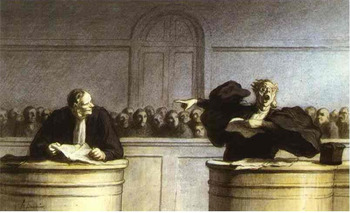
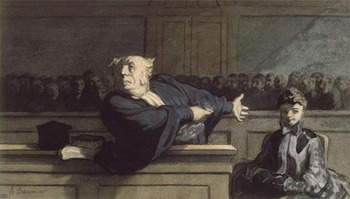
Lawyers of the era who used melodramatic rhetoric and gestures were also caricatured by Daumier in some of his pictures in the years near 1860 (Figures 2 and 3).
Honoré Daumier, Une cause célèbre, ca. 1858–62. Google Images for Honoré Daumier Gens de justice. http://www.michel hubert./be/photos%20pour%20mon%20site/plaideurs.jpg.

Honoré Daumier, Avocat, 1860. Google images https://www.histoire-image.org/sites/default/styles/hors-series-list/public/defenseur-daumier

Philip Nord, however, has claimed that by the 1860s, contemporary observers of the legal scene began to notice some movement away from the romantic oratorical style among the younger lawyers of the day. These attorneys cut down on the “rhetorical flights” of romantic oratory in order to cultivate a more “businesslike” style, using everyday language and a “solid narration of facts.” Nord maintains that the development of the new style of oratory was related to the growing number of business cases, and the need to explain the complexities of such cases in terms that laypeople could understand. However, even this style did not rule out “improvisational appeals to the listener's emotions.” The new style could alternate between the mundane and the sublime, although only according to “the promptings of good sense.”Footnote 96
The Survival of the Plaidoirie Sentimentale: Crimes of Passion
The melodramatic plaidoirie, however, did not by any means die out. Frédéric Chauavaud claims that the plaidoirie sentimentale was still very much in vogue during the Second Empire period.Footnote 97 The contradiction can perhaps be explained by the different rhetorical strategies that attorneys used for different kinds of cases, and whether one pleaded before a jury or before professional judges. Nord was not clear about which business cases he meant. If they were civil, as very many presumably would have been, they were not tried by juries, but by three-judge tribunals; unlike in Britain and the United States, there never was trial by jury in civil cases in France. For white collar felonies, which were tried by juries in France, the new style was appropriate.
For “crimes of passion,” attorneys still used melodramatic rhetoric, because in such cases it evidently continued to work with juries, especially when the defendant was a woman. According to Ruth Harris, some of the women accused of crimes passionnnels in fin-de-siècle Paris continued to model themselves on the wronged romantic heroines of melodrama in order to elicit the sympathy of all-male juries.Footnote 98 Ann-Louise Shapiro has defined crimes of passion as “acts of violence fueled by jealousy, vengeance, or madness and provoked by betrayal or disappointment in love.”Footnote 99 In nearly all crimes of passion, the accused admitted to his or her violent acts.Footnote 100 The defendant (and his or her attorney) typically tried to justify the crime by blaming the victim whose abandonment, rejection, or betrayal of the perpetrator in matters of love had led to a deep emotional suffering, which culminated in the perpetrator's “irresistible compulsion” to attack the one who had wronged him or her.Footnote 101 Even when the crime was premeditated, that very premeditation was “considered proof of an uncontrollable obsession.”Footnote 102 Nor were those who committed crimes of passion likely to become recidivists.Footnote 103
Because of these characteristics of crimes of passion, juries in fin de siècle France often acquitted the defendants. It helped when the defendant showed remorse for his or her crime during the trial. Jurors were evidently aware that normal people could lose control of their impulses under extreme emotional duress,Footnote 104 “that expressing emotions through violent behavior was legitimate in certain situations.”Footnote 105 According to Shapiro, in the culture of the period “extreme jealousy was identified as a central component of normal love, and violent death following betrayal or abandonment…part of the order of things.” Men typically justified their crimes against wives, mistresses, or rivals as necessary acts to defend male honor. Female defendants and their attorneys often followed a melodramatic script in which the accused portrayed herself as a “heroine-victim” who was “consumed by love” and whose act emphasized “her dependency and powerlessness.”Footnote 106 According to Harris, most women who were tried for murder in Paris from 1880 to 1910 were accused of crimes passionnels, and most were acquitted.Footnote 107 The witnesses too often made statements in accordance with a “popular system of retributive justice,” which justified the crimes. The mostly middle-class jurors evidently accepted the legitimacy of this “retributive justice” even though most of the defendants belonged to the lower classes.Footnote 108
The master at defending persons accused of crimes of passion during the Second Empire and early years of the Third Republic was Lachaud. He used a very emotional style of oratory to persuade jurors. He was even alleged to have challenged jurors who appeared too intelligent.Footnote 109 The emotion that his sentimental and moving plaidoiries aroused among jurors supposedly led to many acquittals.Footnote 110 Lachaud was even known to weep at trials and to get jurors and courtroom audiences to do the same. In his day, Lachaud was seen as “a model to imitate.”Footnote 111
Perhaps the most notable example of Lachaud's style of rhetoric was his plaidoirie in the well-publicized case of Marie Bière, a lyric singer who in 1880 was tried in the cour d'assises of the Seine for shooting and wounding her estranged lover, Robert Gentien. The trial, according to Shapiro, “provided a particularly vivid example of theatrical justice.”Footnote 112
The circumstances of the case were ideal for melodramatic treatment. Marie Bière was 29 years old when in 1877 she met Robert Gentien, a wealthy landowner, in Biarritz. She then became his mistress in Paris. But Marie's mother went to see Gentien and insisted that he marry Mlle. Bière. Gentien was irritated by this, and began to distance himself from Marie. He encouraged her to take on a singing engagement in Brussels while he took off on a long trip. But after arriving in Brussels, Marie discovered that she was pregnant and that she had lost her voice. Gentien refused to recognize the child as his own, and allegedly encouraged Marie to have an abortion. She refused to do this, and in October 1878 gave birth to a girl. This led Gentien to break off his affair with Marie Bière entirely. The child, who had been placed with a nourrice in Saint-Denis, died in April 1879. Gentien, who had refused to ever see the child, did not even go to the funeral. Not long after, Marie learned that Gentien had a new mistress. Enraged, Marie vowed to kill Gentien in the name of her dead daughter. In January 1880, she shot him in the back and right leg as he was walking with his new mistress in a Paris street. Marie was arrested immediately.Footnote 113
Lachaud's impassioned and moving plaidoirie in this case was one of his greatest oratorical successes. At no point did Lachaud dispute the evidence for Marie Bière's crime. Rather, he read a series of letters between her and Gentien, and the former's diary entries, to portray Marie as an honorable, loving and generous woman who had been seduced and abandoned by a cold-hearted wealthy cad who sought only pleasure. The first two paragraphs of the plaidoirie set the tone for the rest:
I have never known a woman more unfortunate, more worthy of pity than my client! She has the most upright sentiments, the most generous passions; she loves the good. And here she is on the defendant's bench, distressed, fallen, with no more hope in this world.
How then can a nature good, sweet, so gifted, change thus? How did she acquire the ill-will to commit a crime, or, overwhelmed by despair, by the most profound grief, she had ceded to such a terrible force?…Messieurs the jurors, I will show you where all this misfortune came from, and I hope that after you have heard me, you will hold out a hand to this young woman to help raise her up!Footnote 114
Marie Bière was unfortunate indeed, because “the mother had lost her daughter, the artist had lost her voice.” Gentien “belonged to a class of men who love only brief liaisons.” When he first set his sights on Marie Bière, this “decent woman” at first resisted, “and when she finally gave herself to him, she had done so with the conviction that this love would be serious, sincere, and worthy of a gallant man.” Marie “had given all her heart, all her passion, all her ardor.” But Gentien soon had enough of his mistress, and broke with her entirely after she had given birth. For Marie, it “was the commencement of despair, of aberration, of madness. This woman was no longer herself; she suffered as a mother suffers. Messieurs, you are excellent judges, but if women could judge, if they were told that this man did not want to see their child, there is not one who would not cry that this man is odious, that he is put outside the law by his selfishness and the brutality of his sentiments.” Mlle. Bière came to believe that Gentien was responsible for the baby's death because he rejected the child. Marie now became deranged by despair. Gentian had “neither love nor humanity, he had never wished to see his daughter. He had been implored in vain by the unfortunate woman who I defend; by this unfortunate woman who had the madness of maternal love!”Footnote 115
Lachaud ended his plaidoirie on a very pathetic and sentimental note: “Courage, my child, life is hard, because this man has taken everything from you, honor, future, tranquility of soul. You have suffered greatly.” He concluded to the jury: “I put this unfortunate woman in your hands, messieurs the jurors, and I await your verdict with confidence.” It took only 15 minutes of deliberation for the jury to acquit Marie Bière. The verdict was greeted with numerous and loud cheers in the courtroom, and Lachaud was reportedly acclaimed when he left the courthouse.Footnote 116
Lachaud skillfully used the melodramatic device of Gentien as male villain and Marie Bière as innocent and virtuous female victim. The all-male jury was exhorted to be the generous paternal figure who would pardon her.Footnote 117
This seems in accord with traditional patriarchal values. However, there was another possible reason why Lachaud was able to mount his successful defense of Marie Bière in 1880. There appears to have been growing public and judicial sympathy for women who had been mistreated, betrayed, or abandoned by men. Marie Bière was one example. Feminism—defined by Karen Offen as “a comprehensive and critical response to the deliberate and systematic subordination of women as a group by men”—became increasingly active in France and elsewhere in Europe in the late nineteenth century in terms of both organization and propaganda.Footnote 118 However, the relative strength or weakness of feminism had little to do with sympathy for women seen as victims. The sympathy appears, rather, to have been related to the growth of humanitarianism in the nineteenth century. For example, from the middle of the century on, judges were able to interpret tort law in a way that allowed them to award damages to mothers of illegitimate children despite the Civil Code's ban on paternity suits. Moreover, the rise of newspapers allowed for more publicity in court proceedings and this gained sympathy for the “seduced young women” who sought compensation from the irresponsible men who had impregnated them.Footnote 119 This was a prelude to the eventual legalization of paternity suits in 1912.Footnote 120
Less toleration of male abuse of women was also evidently reflected in marital separation cases. Although divorce was illegal in France from 1816 to 1884, the introduction of legal aid in 1851 made it possible for many more wives to obtain legal separations on the grounds of abuse.Footnote 121 Moreover, in the late nineteenth century, judges of the tribunaux correctionnels were able to undermine the “double standard”(which prescribed much harsher penalties for wives than for husbands) in adultery cases by finding extenuating circumstances (and therefore lesser punishments) for a growing number of convicted adulteresses who had been abused or neglected by their husbands. This paved the way for the divorce law of 1884, which allowed wives as well as husbands to seek divorce on equal terms in cases of adultery.Footnote 122
But most relevant for “crimes of passion” was the fact that Article 324 of the Napoleonic Code pénal, which excused the husband, but not the betrayed wife, from murder charges if he killed his spouse or her lover when he found them in flagrant délit, remained law until 1975.Footnote 123 Shapiro has argued that frequent acquittals for women accused of crimes of passion in the late nineteenth century were in some cases the result of increased jury willingness to allow betrayed wives the same right to kill a cheating spouse.Footnote 124 Nineteenth century France was a society of honor, an emotion which, according to Frevert, has been “lost” in the modern Western world. Gentlemen fought duels with men who had insulted them. Women also had their honor to protect, but it was primarily sexual, meaning the preservation of their chastity or purity.Footnote 125 This was what Gentien had taken from Mlle. Bière when he had impregnated and then abandoned her. In infanticide cases also, accused women were treated leniently by juries when they could convince them that they had killed their newborns to avoid shame and protect their honor.Footnote 126
The Impact of the Abolition of the Judge's Résumé
The trial of Marie Bière was followed by a major procedural reform that would have supposedly resulted in even more success for lawyers who made similarly emotional pleas. This was the abolition of the presiding judge's résumé in 1881. The defense now truly had the last word.Footnote 127 Early in the twentieth century, the Lyon procureur-général, William Loubat, regretted the elimination of the one means that judges had of checking the impact on jurors of an eloquent plaidoirie.Footnote 128
Defense attorneys, and many Third Republic deputies, did not see the résumé in such a benign light. They (and some historians since) alleged that even though the Code of Criminal Procedure required the président to summarize the principal proofs both for and against the accused,Footnote 129 too often the résumé was biased in favor of the prosecution.Footnote 130 Even before 1880, according to the jurist Jean Cruppi, the “suppression of the résumé” was “one of the articles of the liberal program.”Footnote 131 The movement to outlaw it gained more momentum following the Marie Bière trial. In this case, the résumé of the judge was allegedly so biased against the defendant that Lachaud protested vigorously. It was “too much” for the Republican parliamentarians who had taken control by 1879, and the résumé was abolished by a law of June 19, 1881.Footnote 132
However, the abolition of the résumé appears to have had little impact on jurors. The law of 1881 was not followed by a significant spike in acquittals in the years immediately following, at least not for most crimes. Not until the mid-1890s did overall acquittals increase significantly.Footnote 133 At most, the abolition of the résumé may have resulted in a considerable rise in acquittals for a few categories of crime. Acquittals for theft barely rose in the years immediately following 1881. In spite of the notorious leniency of juries for “crimes of passion,” neither was there an immediate significant rise in acquittals for murder. The acquittal rate for meurtre (unpremeditated murder) did rise somewhat, but it actually declined for assassinat (premeditated homicide). The abolition of the résumé may have had some delayed impact on the acquittal rate for white collar crimes, which began to rise substantially in the mid-1880s. Acquittal rates for arson and abortion—both notoriously difficult to prove—did rise considerably in the years immediately following the abolition of the résumé.Footnote 134
Other reasons evidently outweighed the elimination of the résumé in bringing about the significant rise in acquittals after 1880, although they are speculative since jurors did not explain their verdicts. These factors also brought about changes in both the style and substance of at least some plaidoiries. For one thing, changes in the personnel of the courts evidently made judges and jurors less conservative than in preceding periods. Because conservatism was associated with a strong defense of law and order,Footnote 135 the changes in the personnel of the justice system may very well have resulted in more concern with the rights of accused persons and a greater willingness to see innocence in the absence of proof of guilt.
According to Jean-Pierre Royal, of key importance to these changes was the “révolution judiciaire” of 1879–83.” During most of the 1870s Republicans and monarchists had been engaged in a struggle to determine whether the Third Republic, proclaimed in 1870, was to remain a republic or become a monarchy. The monarchists were dominant in the earliest years of the Third Republic, but by 1879 Republicans had gained control of both the Parlement and the presidency. The liberal democratic “république aux républicains” inherited a magistracy consisting of holdovers from the more rightist Second Empire (1852–70) and government of “moral order” (1873–79). The Republicans sought to replace conservative magistrates with more liberal ones. The purge began in 1879 with the removal of most members of the magistrature debout (the prosecution officers), who enjoyed no security of tenure.Footnote 136
However, there remained the magistrature assise (judges of the bench) who enjoyed inamovibilité (security of tenure). Republicans were angered when many judges in the early 1880s blocked enforcement of new anticlerical laws. In 1883, the Parlement passed a law that suspended the inamoviblité of the judges of the bench for 3 months. Many of these magistrates were removed because of their real or alleged antirepublican sentiments, and many other judges resigned in protest.Footnote 137 They were replaced by men “dedicated to republican institutions.”Footnote 138
The new présidents of the cours d'assises conducted themselves in a less authoritarian fashion than their predecessors. Their calls to order in the courtroom were less abrupt. They seemed to tolerate interruptions of their interrogatoires, and to let defense attorneys directly question witnesses (although here the letter of the law had not changed).Footnote 139
This, along with Republican electoral successes, meant that liberals came to dominate the commissions of magistrates and locally elected officials who drew up the annual jury lists from which the trial panels were drawn. They appear to have chosen more jurors of relatively humble social status than in the past, although the machinery of selection created through a law of 1872 remained the same. The result was a democratization—partial though it was—in the socioeconomic composition of juries, from panels dominated by wealthy landowners to ones dominated by petits bourgeois and small farmers. During the Bourbon Restoration and the July Monarchy (1814–48), jurors had to meet the same stiff property qualifications as electors, meaning that nearly all were notables. Such men accounted for less than 1% of the population in 1846. The brief-lived government of the Second Republic in 1848 slightly democratized the qualifications for jury duty, but excluded illiterates and servants and allowed workingmen who lived by their daily labor to be excused from jury duty if they desired and if it imposed too much of a hardship on them. In most cases it did, because jurors before 1907–8 served without compensation.Footnote 140 As a consequence, jury composition remained far from democratic. From 1849 through 1853, more than two fifths of all persons inscribed on the annual jury lists were described as propriétaires and rentiers “vivant de leur revenu” that is, living from incomes provided by their properties or investments. Nearly two fifths were merchants, manufacturers, members of the liberal professions, and civil servants. Far smaller percentages were workers and farmers.Footnote 141 A new law of 1853 further restricted jury membership. In the years 1854–70, the proportion of peasants on the lists declined sharply and workers almost disappeared. Propriétaires and rentiers rose to almost half of the total, whereas the other categories remained roughly the same, except for some increase in the proportion of civil servants.Footnote 142
In October 1870, the provisional government of the new Third Republic reinstated the slightly more democratic jury selection law of 1848. This made only a slight difference in the socioeconomic composition of the jury lists.Footnote 143 A law of 1872 put in place mixed commissions of locally elected officials and members of the judiciary to draw up the annual jury lists, and continued to “excuse” members of the working classes from jury duty.Footnote 144 Unfortunately, after 1872, the Justice Ministry's annual Compte général de l'administration de la justice criminelle discontinued its tables on the composition of the annual jury lists.
However, there is sufficient information on the socioeconomic composition of juries in several departments at the end of the nineteenth century to make a comparison with earlier periods possible. These are the Seine (Paris) and the mostly rural department of the Sarthe. In both cases, there was significant democratization following the Second Empire. In the Seine department, from 1849 through 1853, less than 5% of persons inscribed on the annual lists were workers and artisans. Merchants and manufacturers made up 41%, propriétaires and rentiers made up 24%, and civil servants and members of the liberal professions made up 29%. In the period 1854–70, workers and artisans made up less than 1% (and from 1865 through 1870 the local jury commissions did not even bother to inscribe men from these categories), the proportion of propriétaires and rentiers living from their properties or investments rose considerably to 36%, whereas the other categories declined slightly or remained roughly the same.Footnote 145
By 1898, however, according to Jean Cruppi's analysis of the socioeconomic composition of 1,500 persons on the annual jury list for the Seine department, the proportion of propriétaires and rentiers had declined sharply to 19%. Small proportions of the persons inscribed were retirees and artists. Nineteen percent were civil servants and members of the liberal professions. The proportion of merchants, industrialists, and commercial employees had increased to 56.6%. Whether the commerçants and industriels were big or small businessmen could not be ascertained from the jury lists. Cruppi, based on his experience as an assistant public prosecutor, believed that the majority were small businessmen.Footnote 146
The change in the socioeconomic composition of juries was even more dramatic in the primarily agricultural department of the Sarthe. From 1849 through 1853, only 13% of persons inscribed on the department's annual jury lists were small farmers (cultivateurs, fermiers, laboureurs), but a much larger 43 % were propriétaires “vivant de leur revenu” and rentiers. In the period 1854–70, the proportion of farmers dropped to just 3%, and the proportion of proprietors and rentiers rose to 48%.Footnote 147 However, by 1899, according to Maurice Ajam's estimation based on local jury trial lists, petits cultivateurs made up half or more of jurors in the Sarthe, whereas big landowners had almost disappeared.Footnote 148
Further democratization of juries occurred after 1908, following the enactment of laws compensating jurors for their expenses and the order by the Independent Socialist Minister of Justice Aristide Briand that the jury commissions inscribe workingmen on the annual lists.Footnote 149 By 1912–13, according to J. Maxwell's study of 954 names on the jury lists in the Seine whose occupations were known, 197 (20.8%) were workers and propriétaires, and rentiers accounted for just 117 jurors (12%). This was only one third of their proportion in the Seine jury lists of 1854–70. Workers, employees, and petits commercants altogether now comprised 38 % of jurors.Footnote 150
National figures of 1909 confirm this picture. An analysis of the jury lists for 1909 issued by the Ministry of Justice to study the impact on jury composition of the laws and circulars of 1907–8, showed that the proportion of workers had increased from less than 1% in 1908 to more than 10% in 1909, and the proportion of employees rose from less than 3% to 6.5%. Citoyens sans profession (propriétaires, fonciers, rentiers, pensionnés) dropped from 31% in 1908 to 23% in 1909,Footnote 151 or less than half of their proportion in 1854–70.
The Rise of the “Positivist” Plaidoirie and the Decline of the Plaidoirie Sentimentale
Cruppi, however, believed that another factor leading to a significant increase in acquittals in the 1890s was the appearance of a new-style plaidoirie that would come to be labeled “positivist,” and which created more doubt among jurors of the guilt of the persons they tried. The characteristics of the “positivist” plaidoirie were a reliance on “science” and “facts” and relative brevity.
The rise of the French school of criminology in the last two decades of the nineteenth century was crucial. It was a sort of hybrid of biological, medical, sociological, and psychological-psychiatric explanations that arose in opposition to the theories of Cesare Lombroso, the founder of the “science” of criminal anthropology. Lombroso, an Italian prison doctor, published his Uomo delinquente in 1876. In it, Lombroso rejected earlier “free will” theories of crime, and developed in its place the concept of the “born” criminal, an atavistic throwback to earlier stages of human evolution. This extreme form of biological determinism disturbed many French criminological thinkers and their allies among the nation's jurists, who were committed to “free will” theories of crime. Thinkers in the emerging French school of criminal anthropology, such as Alexandre Lacassagne and Gabriel Tarde, challenged Lombrosianism, but in a way that could be seen as “scientific” or “positivist.” These scholars stressed environmental (or sociological) theories of crime causation, or as Lacassagne put it, the influence of the “the social milieu,” but they also borrowed from biology, although in a way that one would hope preserved some degree of “free will.”Footnote 152
This synthesis produced the theory of “degeneration” based on a native French “Neo-Lamarckian” concept of the heritability of acquired characteristics. A pathological predisposition to crime begins with the influence of dysfunctional environmental factors (poverty, bad upbringing, family discord, alcoholism) on an individual, and this predisposition is inherited by his/her descendants. Moreover, French psychiatrists “extended the boundaries of mental medicine far enough that the commission of a criminal act became grounds for suspecting the presence of insanity.”Footnote 153 Michel Foucault contends that this era witnessed the rise of “the psychiatrization of criminal danger.” This meant that the judicial apparatus should judge a criminal not for his or her specific crime, but for the potential danger he or she posed to the society.Footnote 154
Variants of these theories were developed to explain specific crimes, particularly those of women, who were assumed to have less willpower than men. Women who shoplifted suffered from the newly discovered mental illness of “kleptomania,” an irresistible impulse to steal objects that were useless or which one could have easily paid for.Footnote 155 In some infanticide cases, doctors were moving toward attrib what today is called “postpartum psychosis,” and some attorneys pleaded that their clients had killed their infants because of a “fureur maniaque” or “folie passagere” as a result of the atrocious pains of the last moments of labor.Footnote 156 And women who committed crimes passionnels were acting from “irresistible impulses.”Footnote 157 Shapiro argues that such theories “worked to construct in scientific terms the disabilities and incapacities of the feminine.”Footnote 158 The new theories might help to explain why, after about 1880, the acquittal rate for women rose much more sharply than the acquittal rate for men.Footnote 159
Many jurors were hardly intellectuals, but according to Cruppi (who as an avocat général, or assistant public prosecutor, was often delegated to represent the state in cases tried by the Paris cour d'assises), the new positivist ideas had become very widespread among the public, resulting in doubts about guilt that “the words of the lawyer and the expert will bring to consciousness.”Footnote 160 During this period also, the rise of a mass press, with its accounts of spectacular crimes and spectacular trials, helped the spread of vulgarized versions of the new ideas.Footnote 161
However, historians disagree about the extent to which the new “scientific” ideas of diminished responsibility took root by the fin de siècle in trials for crimes that seemed most amenable to excuses based on “irresistible impulses”: the crimes of passion. The relative lack of scientific excuses for crimes of passion before 1900 has been noted by Eliza Earle Ferguson. In opposition to Ruth Harris's thesis that the medicalization of crime, and especially the diagnosis of temporary insanity in crimes of passion, led to frequent acquittals of the accused, Ferguson claims that defenses based on psychological theories were relatively rare in trials of such crimes. In her sample of 264 persons tried for crimes of passion in Paris from 1871 to the end of the nineteenth century, only 28 went through a psychological evaluation. Of these, only nine persons—five men and four women—were judged mentally ill by the psychiatrists, and, therefore, not responsible for their crimes. Nonetheless, four of these nine were convicted by juries. Moreover, ten of the defendants who were diagnosed as sane by the doctors were acquitted. To Ferguson, these verdicts “are persuasive evidence that the juries were using other standards than those of medical experts when they judged a case.”Footnote 162 However, one necessary limitation to Ferguson's sample is that it ends in 1892, as no relevant dossiers from the cours d'assises of the Seine have been preserved after that date.Footnote 163
However, this did not prevent the slow decline of the plaidoirie sentimentale from the end of the nineteenth century. In 1890, Henri Robert, in the famous murder trial of Gabrielle Bompard, created a “sensation” among lawyers by limiting his plaidoirie to “a simple synopsis of the evidence.”Footnote 164 Robert's new style of rhetoric seemed suitable for Bompard's case, perhaps at least in part because she and her lover, Michel Eyraud, were being tried not for a crime passionnel, but for a crime crapuleux (vile or villainous crime), premeditated and motivated by greed. The two lovers had carefully conspired to murder a bailiff named Gouffé in order to steal a large sum of money from him.Footnote 165 However, Robert claimed that Bompard was not responsible for her part in the crime because she had committed it under the hypnotic spell of Eyraud. Here was a “scientific” explanation for criminal irresponsibility and one that drew on the widespread fascination with, and fear of, hypnotism in France at the time, and on the supposed particular female susceptibility to it.Footnote 166
Robert ended his plaidoirie for Bompard on a concise and simple note worlds apart from Lachaud's conclusion in the Marie Bière case only 10 years before: “My conclusion is this: Gabrielle is a sick woman. But the sick are cared for, one cures them if one can. One does not send them to a penal colony or to the scaffold. Reflect upon the childhood of this unfortunate woman, the misconduct of her father, the domination of Eyraud. I am persuaded that your hearts will be in accord with your consciences. Men, you are left to feel; judges, to be convinced.”Footnote 167
Robert became the most notable attorney in the years near 1900. The new rhetorical style, at least from his mouth, was no less effective than the plaidoirie sentimentale in securing acquittals.Footnote 168 Robert's sober and concise style “sought less to move jurors than to convince them of the necessity of an acquittal.”Footnote 169
A simple and concise style of rhetoric was also suitable for pleading before the kind of men who, by the 1890s, dominated Parisian juries: small businessmen, with a presumably pragmatic outlook and perhaps not patient with persons who used up too much of their time. They were possibly less willing than the wealthy and leisured landowners of an earlier era to listen to plaidoiries lasting 5 or 6 hours. Robert invented the brief and rapid plaidoirie lasting no more than half an hour, and reduced to its essentials in order to achieve an immediate effect.Footnote 170
Robert's style of rhetoric was soon adopted by other attorneys. By the second half of the 1890s, Jacques Munier-Jolain and Cruppi were claiming that the “positivist” type of plaidoirie was replacing the sentimental kind.Footnote 171 Among modern historians, Fréderic Chauvaud claims that Robert in 1890 “drastically changed judicial eloquence.” As a consequence, “one no longer pleads after the Belle Epoque or in the Années folles [1920s] as one did in 1889.”Footnote 172
However, not all attorneys immediately followed Robert's lead. The old melodramatic approach appears to have died out only slowly. According to Martin, Robert's rhetorical approach was in the short term imitated by only a few lawyers, such as René Waldeck-Rousseau.Footnote 173 In 1907, Mareille (although his bias in favor of the romantic approach may have led him to overstate the case) wrote about “the favor that the public has constantly shown and still shows for it” [the plaidoirie sentimentale].Footnote 174 After all, melodramatic plays still enjoyed a good deal of popularity among lower-middle class and working-class class audiences at the end of the nineteenth century.Footnote 175
Two notable trials of women accused of murder showed the continued vitality of the plaidoirie sentimentale for certain types of cases (mainly crimes passionnels) into the early years of the twentieth century. The first was that of Jeanne-Marguerite Steinheil in 1909 and the second was that of Hélène Cassassus in 1910. In both cases, the defense attorneys’ “dramatic accents” won the day with juries.
Madame Steinheil was accused of murdering her mother and her husband. At her trial, her attorney, Antony Aubin, tried to show, through the reading of family letters and other evidence, that Madame Steinheil was a loving daughter and a supportive wife to her artist husband and could not have killed either him or her mother. The accused was “sweet, tender to all, for Julien her brother, Mimi her little sister, for all those for whom she was the consoler and helper.” Le Petit Journal commented favorably on Aubin's “sentimental eloquence.” Maître Aubin ended his plaidoirie by trying to make the jurors feel sorry for Madame Steinheil's “admirable” daughter who had faithfully visited her mother every day in Saint-Lazare prison, the mother who had cried for her daughter when entering the facility: “Is there no lot more painful than that of this young girl? In the month of May, when the earth rivals heaven, it would seem to this young girl that the earth was full of hope. Then all of a sudden, the catastrophe. Her father and grandmother are murdered, the love of her fiancé has vanished, her mother is imprisoned…How many tears the two unfortunate women have shed. Give to them the means to be consoled, if only a little, and for the long term, to be grateful for your justice.”Footnote 176
Madame Steinheil was acquitted, and in response “everyone” in the courtroom audience applauded. It was, according to Le Petit Journal, a “tremendous and extraordinary ovation.”Footnote 177
The traditional tactic of eliciting sympathy for an alleged woman murderer was used again by attorney Henry-Millié in the manslaughter trial of Hèlène Cassassus, who had killed the lover who had abandoned her, René Landais, with vitriol. The conclusion of Millié’s plaidoirie is stated in terms very similar to those of Lachaud in the trial of Marie Bière 30 years earlier: “Ask yourself [the jury] if this day so moving and painful is not a sufficient expiation for the unfortunate woman who is prostrate in the dock. I appeal to your heart and on my part it is a final but ardent prayer: has this child not found in the conduct of René Landais who had seduced, abandoned, dishonored her, the largest excuses? Go, Messieurs the jurors, I put her fate and her life in your hands; I remain confident that your verdict will be sufficiently lenient.Footnote 178 ”
The jury found Mlle. Cassussus guilty, but she was given the lenient sentence of a suspended 2 year prison term.Footnote 179
On the other hand, in the most famous trial for a crime of passion in early twentieth century France, that of Henriette Caillaux in 1914, the defense combined the old melodramatic approach with new psychological theories. In the days just preceding the outbreak of World War I, Madame Caillaux, second wife of Joseph Caillaux, the leader of the left-leaning Radical Party, was tried for the murder of Gaston Calmette, editor of the conservative newspaper, Le Figaro. Calmette had been engaged in a journalistic smear campaign against Joseph Caillaux. This included the publication of an embarrassing letter M. Caillaux had written to his mistress, Berthe Gueydan, who was then married to another man, and who later became Joseph's first wife. Mme. Caillaux also feared that Le Figaro had obtained, and would publish, love letters Joseph had written to Henriette when the former was still married to Berthe. This supposedly enraged Henriette, who came to Calmette's office and shot him. Madame Caillaux maintained that hers was a crime of passion, and on the stand she used both the romantic language of old and the new language of psychology to argue that she had been “the victim of passions beyond her control, as a woman rendered irresponsible by emotions more powerful than will itself.”Footnote 180
The prominent attorney-politician Fernand Labori represented Madame Caillaux. According to Le Siècle, Labori's tone was “extremely ardent and passionate from the beginning” and his rhetoric had an “admirable power.” The accused had been so troubled by what Le Figaro had done, and might yet do, that this engendered within her “a subconscious impulse that resulted in a split personality…her psychic life was split into two parts, one subconscious which prepared for the crime and automatically executed it, the other conscious, which continued to accomplish, as usual, the habitual acts of ordinary existence.”Footnote 181
Labori ended his his plaidoirie by appealing to a powerful emotion at the end of July 1914, as France prepared for war: patriotism. “Put an end to this nightmare by an acquittal that everyone this evening will accept. Save our anger for our enemies from without…Let us proceed united as one…towards the perils that threaten us” This conclusion to Labori's plaidoirie was greeted by prolonged applause from the courtroom audience.Footnote 182 As the modern jurist Jean-Bredin has noted, Labori in this case equated acquittal of Madame Caillaux with patriotism.Footnote 183 The jurors retired to their chamber to deliberate “still hearing the applause of the immense courtroom which acclaimed the strongest, most unanimous sentiment of the time, patriotism.” Madame Caillaux was acquitted.Footnote 184
The survival of the plaidoirie sentimentale into the 1920s was attested to by Robert himself. However, he claimed that the style had lost its effectiveness: “It is imagined too often …that a great attorney must necessarily be grandiloquent and tumultuous.” But: “It is almost always the contrary which is true.” It was a serious error to think that to plead well, it was necessary to resuscitate the “dramatic accents” of the nineteenth century. There was nothing more false than the theatrical style, “nothing more dangerous for the cause, because nothing gives less the impression of sincerity.” Rather, a good plaidoirie would be characterized by sincerity, conciseness, and an “elegant simplicity.” It must express the “the fire of conviction” but it must also “try to convince and not seduce.”Footnote 185 One sign of Robert's influence was a greater brevity in judicial rhetoric: by the 1930s, it was a matter of remark when a plaidoirie lasted as long as 2 hours.Footnote 186
Even into the 1940s, according to Martin, an “appreciation for florid oratory” survived in the courts.Footnote 187 The attorney and law professor Georges Cohendy, writing in 1948, claimed that some lawyers who argued in the cours d'assises were still “using methods borrowed directly from the theater; for example, mimicking a tragic scene and reproducing the gestures and the facial expressions of the criminal or of the victim.” But although Cohendy admitted that there was a greater stress on eloquence in the cours d'assises than before tribunals of professional judges only, by this time attorneys had to be careful about becoming too melodramatic, or they would invite ridicule. This happened, for example, when one lawyer seized a pen and pretended to plunge it into his heart. An “ardent conviction” was persuasive enough.Footnote 188 Echoing Robert , Cohendy maintained that the model plaidoirie was characterized by clarity, simplicity, brevity, liveliness and sincerity. Nothing would be more disastrous for the lawyer's case than a “false pathos, a poorly feigned indignation, an attitude of affectation.” A plaidoirie had the most credibility when it was characterized by simplicity and a strong sense of conviction. It should have an eloquence which appeared natural.Footnote 189
Perhaps the plaidoirie sentimentale had lost much of its effectiveness by the 1940s because jurors no longer decided verdicts on their own. In response to a continuing high rate of acquittals (something authoritarian governments found especially intolerable), the Vichy regime in 1941 instituted échevinage, or the joint determination of both verdict and penalty by judges and jurors. The democratic governments of the post-World War II era kept the new system. Henceforth, the three judges of the cours d'assises deliberated with the jurors (whose number was reduced from twelve to six in 1941, increased to seven in 1945, and increased to nine in 1958).Footnote 190 In this fashion, judges regained even more influence over jurors than they had had before 1880, although this influence must have been limited by the fact that jurors continued to vote by secret ballot, as they had done since 1835.Footnote 191 The judges were now in a position to check the “carrying away” of the jurors by the plaidoirie at the end of the trial. Judges, with their apparent pro-conviction bias, henceforth had the last word with jurors. This seems to explain at least in part the sharp decline in acquittal rates after 1941.Footnote 192
Changes in the physical layout of the courtroom also appear to have reduced theatricality and the tension between the inquisitorial and accusatory systems in the cour d'assises. In 1958, the Napoleonic Code d'instruction criminelle was replaced by the Code de procédure pénal, which sought to minimize the old antagonism. The président still questioned the accused, but he had “a duty not to indicate his opinion on guilt.”Footnote 193 More important, perhaps, was that since the introduction of échevinage, jurors no longer sat in their own box facing the defendant, but—where the arrangement of the courtroom permitted it—they now took seats flanking the judges on the platform at the back of the room, otherwise on seats separated from the public and facing the accused.Footnote 194 The new seating arrangement suggested collegiality and collaboration between judges and jury. This must have made it harder for defense attorneys to play on antagonism between the magistrates and the citizen-judges.
Nonetheless, a command of eloquence remained important for defense attorneys who delivered plaidoiries before juries even after World War II, but it was no longer the plaidoirie sentimentale. Footnote 195 A perusal of notable plaidoiries of the late twentieth century does show them to have been “frequently eloquent and moving.” However, they were much less melodramatic, and much briefer, than their nineteenth century predecessors.Footnote 196
Conclusion
Contemporaries and historians since have claimed that in the nineteenth and early twentieth centuries “impressionable” French jurors were strongly influenced by the eloquence of defense attorneys.Footnote 197 This was especially true of the plaidoirie sentimentale. Its rise, however, owed something to French criminal procedure and to the fact that it was the magistrates themselves—juges d'instruction and présidents of the cours d'assises—who introduced an affective dimension into trials by investigating and commenting upon the character of accused persons, often in quite moralistic terms. The plaidoirie sentimentale, by drawing on the conventions of melodrama, seemed for a time ideally suited for a defense response to this approach. After 1890 or thereabouts, its usefulness as a defense tool declined, as attorneys discovered a more “scientific” way to defend accused persons, and one that was apparently at least as successful in obtaining acquittals. The new rhetorical strategy of defense attorneys, and their growing success in obtaining acquittals, may also have been related to the changes in the social composition of juries, from panels dominated by wealthy landowners before 1870 to ones dominated by the lesser bourgeoisie and farmers by the turn of the twentieth century. The plaidoirie sentimentale, furthermore, drew upon the newly “found” emotions of sympathy, empathy, and humanitarianism along with a surviving strong sense of honor, an emotion that has since been “lost.” It appealed not only to stereotyped notions of women as weak creatures driven by “irresistible impulses,” but also to a growing popular and judicial disapproval of male mistreatment of women and of the “double standard.” By the twentieth century in France, the character (or personality) of the defendant still played a major role in assessing guilt and punishment, but it was now placed on a more “scientific” basis.Footnote 198