This is the third annual report that I have submitted since assuming the editorship of the
APSR in September of 2001. In my initial report, I characterized 2001–2002 as a
start-up year for the new editorial office, greatly complicated by the September 11 attacks
and the disruption of mail service by the anthrax threat, but highlighted by major procedural
and outreach initiatives and by a massive upsurge in submissions. My second report described a
year of beginning to settle in to a more “normal” operating mode, of undergoing an intensive
internal review and instituting new procedural refinements as a consequence, and of
experiencing a further, and unexpected, increase in submissions. The main theme of my third
report is one of stability—continuity with, rather than major departures from, the situation
described in last year's report. I think it is accurate to say that during the past year we
functioned in normal operating mode rather than making it up as we went along, as often seemed
to be the case during the early going.
As in prior reports, the first and most important item of business is to acknowledge the
contributions that numerous individuals made to the operation of the APSR during the
past year. Conspicuous among these individuals are Assistant Editor Elizabeth Cook;
APSR Editorial Assistants Todd Andrews, Lan Chu, and Lee Michael; the 44 members of
the APSR Editorial Board; staff members too numerous to list at the APSA office,
George Washington University, and Cambridge University Press; the authors who submit their
papers; and the reviewers who donate their time, expertise, and good will to assessing these
submissions (and who will be acknowledged by name in our November issue). Special thanks are
due to the six members of the APSR Executive Committee—Neta Crawford, Darren Davis,
Robert Goodin, Kirstie McClure, James Morrow, and Sven Steinmo—who have performed heroically
and whose three-year terms as Executive Committee members have now expired.
Submissions and Processing
Number of Papers Submitted
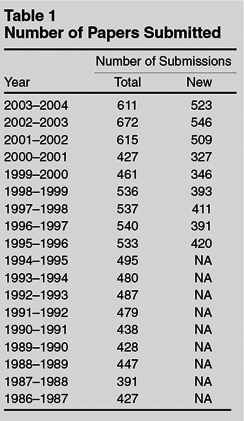
During my first year as editor, submissions rose by 44% overall and by 56% for new
manuscripts, compared to the preceding year.1
“Total
submissions” count successive resubmissions of the “same” paper separately. For example,
by this measure a paper that was submitted, revised and resubmitted, and then finally
resubmitted following its conditional acceptance pending final changes would count as
three submissions, not one. In terms of assessing the workflow for our office, this
counting rule is reasonable, for in the example just given, several separate review
processes would have been conducted. For “new” or “original” submissions, by contrast,
that sequence would be counted as a single submission, not as three.
The next
year, we expected submissions to level or even drop off somewhat, but instead they continued
to increase, with total submissions running 9% over the first-year figure and new
submissions up 7%. This extraordinary growth over two years was both gratifying and
problematic-the latter because it strained our capacity to do business in a timely and
efficient manner. During 2003–2004, the expected leveling off of submissions did occur,
albeit a year later than we had anticipated. Total submissions were down 9%, reverting to
their 2001–2002 level, while new submissions declined slightly from 546 to 523, a 4% drop.
We continue to welcome, and in various venues we continue actively to encourage, new
submissions, but a realistic expectation for the next few years is for submissions to hover
around their current level. I suspect that we have now reached a new equilibrium in terms of
submissions.
Turnaround Times
Even as the flow of submissions was rising dramatically during 2001–2002 and 2002–2003, we
managed to compile substantially faster processing times than had been achieved in the
past—thanks to a combination of new procedures, close monitoring, and the efforts of our
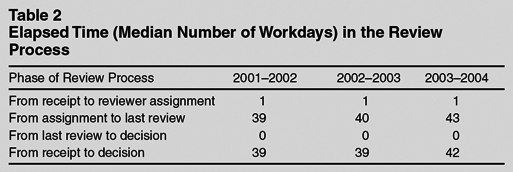
reviewers. In the first two years, our median turnaround time, calculated as the number of
elapsed working days between the arrival of a paper in our offices until I signed the
decision letter, was 39 days. In 2003–2004, the flow of submissions subsided somewhat, but
our average processing time actually increased by three working days. The reason for the
slight slowdown was simple: We planned it that way.
One of the recommendations of the site visit team that reviewed our operations in the
spring of 2003 was that we consider slowing the process down in selected instances. Until
then, when the first two reviews of a paper came in negative, we had more or less
automatically been canceling the third review and rejecting the paper. The feedback we had
received about that procedure from reviewers and authors alike was generally highly
favorable. The site visit team, however, suggested that in some cases authors might derive
greater profit from receiving an extra assessment of their work than from saving a few days
of waiting for what was going to be a rejection letter. (Reading between the lines, I think
the site review team was also fearful that the sheer pace of our operation might be taking a
toll on the editor and staff.) Acting on the site visit team's recommendation, on several
occasions during the past year we waited for the third review to arrive even though the
negative outcome of the review process was not in doubt. As a consequence, a somewhat
greater proportion of rejections was based on three rather than just two reviews, producing
a somewhat—though not, I think, seriously—longer median turnaround time.
More generally, the APSR staff and I continue to take pride in our ability to
process submissions in a timely manner, and my reading of annual reports prepared by editors
of other journals suggests that our pride is justified. As in the first two years of our
operation, the median number of working days between receiving a paper and sending it out
for review was one, and the median number of working days between receiving the last review
and signing my decision letter was zero. Despite our best efforts, and in several instances
due to circumstances for which no one could be faulted, some review processes dragged on for
far too long; fortunately, these instances were rare and the authors of these papers earned
my gratitude by displaying great patience.
Mix of Submitted Papers
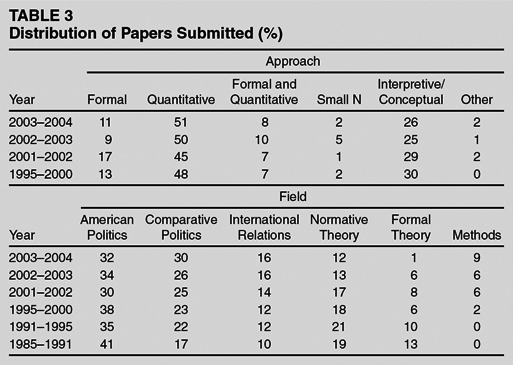
Categorized according to primary analytical approach, as in the top portion of Table 3, the distribution of submitted papers remained virtually
identical to the pattern that has become familiar in recent years. Most of what we received
was primarily quantitative and/or formal, and about one submission in four (predominantly
but by no means exclusively normative theory) was classified as “interpretive/conceptual.”
We continued to receive very few “small-N” papers.
When the submitted papers are categorized by subfield, as in the bottom portion of Table 3, some intriguing patterns come into focus. Before proceeding
any further, I need to note that the apparent dropoff in the formal theory submissions is
largely a coding artifact. Following my predecessor Ada Finifter's practice, we classify
papers that employ formal modeling according to their substantive focus. Thus, for example,
we would put a paper that presented a formal model of arms races in the international
relations category; only if formal work were otherwise unclassifiable (as, for instance,
would be the case in an abstract consideration of cooperation in mixed-motive games) would
we put it in the “formal” category. By departing from the practice of Finifter's
predecessors, who had put formal modeling papers in the “formal” category irrespective of
their subject matter, we have in effect reduced the number of entries in that category and
thereby increased the number in some subject matter categories—predominantly American
politics and international relations. That being the case, the relative decline over the
years of American politics-focused papers as a proportion of all submissions becomes all the
more striking. Indeed, American politics and normative theory, which together accounted for
the clear majority of submissions during the 1980s and 1990s, have during the last three
years fallen well short of majority status—and no less strikingly, even the plurality status
of American politics submissions is now being challenged. I hasten to add that the
APSR is not now receiving fewer American politics and normative theory submissions
than it used to. In fact, it is receiving more. But the growth of these two historically
dominant categories has been far overshadowed by the growth of other categories.
In recent years, the leading growth areas for the APSR have been comparative politics and
research methods. Indeed, it is comparative politics that now challenges the numerical
dominance of American politics submissions, a turn of events that not very long ago would
have been widely regarded as an extremely remote possibility. Also noteworthy is the
increase in methods-oriented submissions. I am especially encouraged by this trend because
the best of these submissions, including some that were published during 2003–2004 or are
currently awaiting publication,2
In particular, King et al.'s
“Enhancing the Validity and Cross-Cultural Comparability of Measurement in Survey
Research,” Gerring's “What is a Case Study and What is it Good For?,” and Mahoney and
Goertz's “The Possibility Principle: Choosing Negative Cases in Comparative
Research.”
present broadly accessible treatments of research issues of widespread
interest to political scientists of various stripes.
In short, the flow of submissions to the APSR, while still dominated by work in
the quantitative and formal modes, has been moving in a direction directly counter to the
traditional dominance of work in American politics and political theory. If it is true, as
many editors have responded to those who decry the dominance of “mainstream” journals by
work representing certain analytical approaches and substantive fields, that “We can't
publish what we don't get,” it is no less true that as we receive more submissions of types
that traditionally have not been well represented in our pages, we will undoubtedly be
publishing more such work. Thus, the trends depicted in the lower portion of Table 3 convey good news for those in other fields of political
science, given that rejection rates vary little across fields. These trends also convey good
news for those who see the mission of the APSR as serving as a showcase for the
best work being done across the broad sweep of our discipline. I should also note, with some
concern, that normative theory submissions have not increased as the numbers of submissions
in other fields have grown; I am not certain what to make of this, but we will continue to
monitor this situation and to encourage submissions from all corners of the discipline.
Outcomes
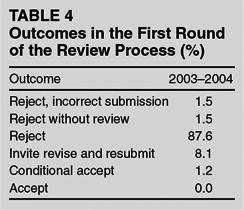
Just as in 2002–2003, 88 of every 100 first-round decisions that I made during 2003–2004
were rejections based on the recommendations of reviewers. Another 2% or so (so-called
incorrect submissions) were refusals to open the review process because the authorship of a
paper had not been rendered sufficiently anonymous, the paper far exceeded our length limit,
or its formatting was wildly at variance with our guidelines. In such instances, the author
was invited to fix the problem and submit a corrected version of the paper, and that
invitation was invariably accepted. Another 2% or so of decisions were to reject papers
without review because in my judgment they were so inappropriate for the APSR that no purpose
would be served by sending them out for review.
In sum, only about 9% of my firstround decisions were “positive” in the sense of holding
the review process open by inviting the author to revise the paper for further consideration
or accepting it subject to some final conditions; no paper was unconditionally accepted in
the first round.
As in 2001–2002 and 2002–2003, the outcomes of subsequent rounds of the review process
reflected the principles that I applied and the practices that I followed in the first round
of the process. I continued to make very sparing use of “revise and resubmit” invitations and
to resist any temptation to pile one such invitation on top of another. Moreover, I accepted
the great majority—more than 85%—of the resubmissions that I had invited, though more often
than not I made such acceptance conditional on completion of some final, narrowly defined
revisions that would not be subject to further outside review; these final revisions were
generally intended to enhance the accessibility of a paper by improving its introductory and
concluding sections and/or editing the text to enhance readability or, on some occasions, by
taking care of a few relatively minor substantive matters that remained.
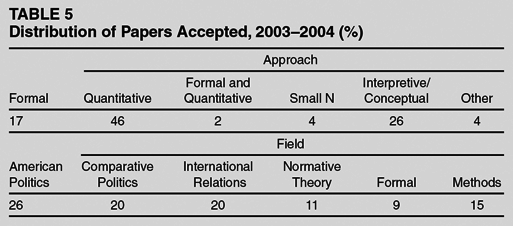
Overall, 46 papers were accepted during 2003–2004 for publication in the APSR. Of
these, 65% were classified as primarily quantitative or formal in approach, slightly below
the proportion of such papers that we received (70%). Similarly, the proportions of accepted
and submitted interpretive/conceptual papers matched exactly (26%). Across fields, American
politics and comparative politics each accounted for a slightly smaller proportion of
acceptances than of submissions, and international relations, formal work not elsewhere
classified, and research methods all fared better in terms of outcomes than their sheer
proportions of submissions would have suggested. In light of the small number of acceptances
overall, differences of the magnitude suggested by comparing the figures in Tables 2 and 5 should not be taken very
seriously, especially because some of the categorizations on which these figures are based
involve judgments that some would regard as questionable.
Conclusion
For any journal, the APSR certainly included, submission levels, turnaround times,
rejection rates, and the like matter. Information of this nature provides valuable insights
into, among other things, the perceived attractiveness of the journal as an outlet for
research, the efficiency with which business is being conducted, and the stringency of the
assessment criteria that are being applied. All of these factors speak to the underlying
quality of the journal. However, what matters most is difficult or impossible to quantify:
the quality of the work that the journal is publishing. To be sure, some quantitative
indicators of journal quality are available, and according to these indicators the
APSR is doing very well, indeed. For example, data on citation frequencies compiled
by the Institute for Scientific Information indicate that the APSR is easily
outdistancing every other political science journal in terms of the scholarly impact of the
articles it publishes.3
Thanks to Mark Zadrozny of Cambridge
University Press for calling the ISI rankings to my attention.
Ultimately, though,
the key question is whether we are attracting and publishing the most interesting and
important article-length research that is being done across the broad range of our highly
diverse discipline. Because my perspective on that issue is inevitably beclouded by the
position that I currently occupy, I will defer publicly rendering my own judgment on it. I
will, however, point with pride of editorship to the work that appeared in the
APSR
during the past year and to the work that was accepted during 2003–2004 for publication in
forthcoming issues.