Introduction
Flies within the genus Delia Robineau-Desvoidy (Diptera: Anthomyiidae) are known agricultural pests in Canada, Europe, and the United States of America (van Schoonhoven and Voyest Reference van Schoonhoven and Voyest1991). The following Delia species are commonly found in Nova Scotia and Prince Edward Island, Canada: Delia antiqua (Meigen), Delia florilega (Zetterstedt), Delia platura (Meigen), and Delia radicum (Linneaus). Delia larvae cause significant losses to commercial crops including Brassica napus Linnaeus (Brassicaceae) by feeding on the root tissues, negatively affecting plant survival (Finch Reference Finch1989; Dosdall et al. Reference Dosdall, Herbut and Cowle1994; Broatch et al. Reference Broatch, Dosdall, Clayton, Haker and Yang2006). Delia platura, the seedcorn maggot, causes crop losses in many vegetables, and can cause significant damage in common bean, Phaseolus vulgaris Linnaeus (Fabaceae) (Finch Reference Finch1989; Broatch et al. Reference Broatch, Dosdall, Clayton, Haker and Yang2006; Soroka and Dosdall Reference Soroka and Dosdall2011).
Nova Scotia and Prince Edward Island support three generations of Delia in a growing season (Howard et al. Reference Howard, Garland and Seaman1994). The first generation will emerge from the soil in early spring, feeding on germinating seeds and the roots of established plants (Finch Reference Finch1989). The first and second generations in each growing season are reported to cause the majority of damage to crops (Howard et al. Reference Howard, Garland and Seaman1994). To allow offspring easy access to food, adult females oviposit on soil near plants and germinating seeds (Finch Reference Finch1989; Howard et al. Reference Howard, Garland and Seaman1994). Females use olfactory cues as their primary method in choosing an oviposition site (Gouinguené and Städler Reference Gouinguené and Städler2006). A single adult female can oviposit between 50 and 270 eggs (Bennett et al. Reference Bennett, Burkness and Hutchison2011; Soroka and Dosdall Reference Soroka and Dosdall2011). Delia larvae will eclose approximately two days after oviposition (Throne and Eckenrode Reference Throne and Eckenrode1986). The developmental time for larvae is approximately two weeks during which feeding occurs on vegetation. After the larval stage, Delia will pupate, emerging as adults approximately two weeks later. The documented degree days between oviposition of one generation to the next is 495 (Funderburk et al. Reference Funderburk, Higley and Pedigo1984).
Traditional control of Delia involves the use of insecticides, and has been shown to reduce plant damage, however, few options are available to organic growers (Montecinos et al. Reference Montecinos, Patricio Arretz and Araya1986; Valenciano et al. Reference Valenciano, Casquero and Boto2004). One method used to manage Delia species in canola in Alberta, Canada is the cultural practice of selectively timed planting (Dosdall et al. Reference Dosdall, Herbut, Cowle and Micklich1996). Selectively timed planting can cause asynchrony between the phenology of the plant and pest. An optimal planting date would avoid damage from Delia larvae, while also optimising crop yield. Delia adults typically emerge from the soil in early spring and will lay eggs on germinating seed over a two-week period. Larvae hatch from eggs and feed on newly germinated seedlings before pupating. Such a method, if timed appropriately, could be useful to snap bean producers in Nova Scotia and Prince Edward Island. The snap bean industry in Nova Scotia and Prince Edward Island is small with each province having less than 8 ha in production. Snap beans are produced for local markets with each grower planting between 0.4 and 1.2ha. Growers typically start direct seeding bean at the end of May or early June, with additional sequential plantings every 10–14 days to ensure a continuous supply of fresh beans for the local market. At harvest, the plant is pulled from the field and the bean pods removed and placed in a bin for transport to the market. The pods are graded and any pods with bacterial spot or insect chewing are left in the field. Growers sow at a density of 4 cm between bean seeds. This spacing creates large plants each producing 15–20 bean pods.
Although most snap bean diseases attack the pods, Delia species will feed on the germinating seed and taproot tissues and, in severe cases, larvae will chew through the plant stem and tunnel up the stalk (Vea and Eckenrode Reference Vea and Eckenrode1976b). With no available controls, growers are left with little recourse but to accept loss. Selectively timed planting could allow establishment and maturation of the bean plant, well before attack by Delia species. Alternatively, a later planting date could avoid the first generation of Delia species altogether (Vea and Eckenrode Reference Vea and Eckenrode1976b; Dosdall et al. Reference Dosdall, Herbut, Cowle and Micklich1996). Selectively timed plantings are not a widely used practice as further study is required to perfect this management strategy to synchronise planting with local Delia populations (Finch Reference Finch1989; Dosdall et al. Reference Dosdall, Herbut, Cowle and Micklich1996).
This research examines the cultural practice of selectively timed planting for management of Delia species in the Canadian Atlantic provinces of Nova Scotia and Prince Edward Island in organically managed common bean, P. vulgaris. The major objectives of this study are to: (1) observe the relationship between planting date and occurrence of Delia species damage on P. vulgaris, (2) document host oviposition preference of D. platura females on two varieties and eight growth stages of P. vulgaris, and (3) to quantify the impact of D. platura larvae (at two levels of infestation) on two growth stages of P. vulgaris.
Materials and methods
Monitoring Delia
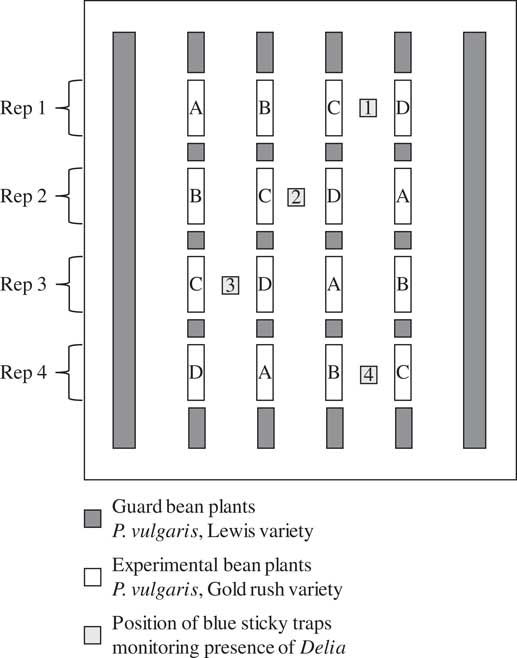
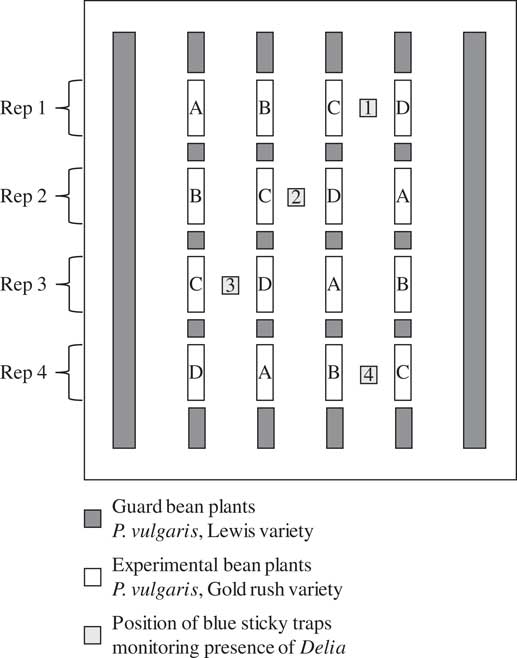
In each field, over both years, four blue “dry touch” sticky traps (12×14 cm; Solida, Saint-Ferréol-les-Neiges, Québec, Canada) were attached to wooden stakes (1×4 cm and 1 m tall) with a bull clip 30 cm off the ground, as recommended by Finch (Reference Finch1989), and placed within the plot (see Fig. 1). Two additional traps were located east and west of the plot, in the surrounding vegetation ~10 m away to capture the population before field preparation. Traps were collected and replaced each week. Only flies within the genus Delia were sexed and identified to species using a Delia taxonomic key (Savage et al. Reference Savage, Fortier, Fournier and Bellavance2016). Delia platura and D. florilega Zetterstedt males were counted while D. platura and D. florilega females were pooled as they are not reliably distinguishable morphologically. As the larvae are not distinguishable at the species level, any damage observed in the field studies could not be attributed to either of the Delia species present. As such, any reference to damage in the field studies will be attributed to Delia species. Degree days were calculated from 1 January each year, with a base of 3.9 °C (Funderburk et al. Reference Funderburk, Higley and Pedigo1984).
Plot design for 2016 field trials at Canning, Nova Scotia and Wilmot Valley, Prince Edward Island. Letters A through D represent planting dates. Dark grey areas indicate guard plants (Gold Rush Phaseolus vulgaris variety). Numbered boxes show location of blue sticky traps for monitoring adult populations of Delia.
Field observations: 2015
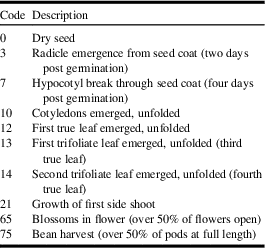
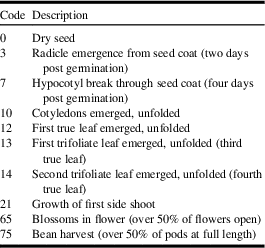
Grower observation of plant loss early in the season in previous years and again in 2015 prompted closer observation in two Prince Edward Island fields: Milton (46.306444°N, 63.227500°W) and Loyalist (46.310317°N, 63.247808°W). These fields were commercial organic agricultural fields surrounded by natural vegetation or other crops, e.g., radish (Raphanus raphanistrum Linnaeus; Brassicaceae), soybean (Glycine max (Linnaeus) Merrill; Fabaceae), or winter wheat (Triticum aestivum Linnaeus; Poaceae). No insecticides were applied and weeding was done by hand. As per usual practice, P. vulgaris (Gold Rush and Lewis varieties, yellow and green, respectively) from Vesey’s seed (York, Prince Edward Island) were sown on various planting dates: 16 May, 26 May, and 5 June in Loyalist and on 16 June, 27 June, and 7 July in Milton (Table 2). A preliminary sample of damaged plants from the 16 and 26 May plantings in Loyalist found Delia species larvae. Plant counts were conducted when the plants reached the second trifoliate, stage 14, using the BBCH-scale developed by the Biologische Bundesanstalt, Bundessortenamt and Chemical Industry (BBCH) working group (Biologische Bundesanstalt, Bundessortenamt and Chemical Industry 2001, Table 1) and again at flowering, stage 65, by randomly selecting 20 2-m-long sections and counting the number of plants present. At these growth stages it was not possible to distinguish variety and the sampling occurred over all rows of the same planting date. As the fields had sequential plantings, the dates for these samplings ranged from 12 June to 20 August 2015. At harvest, the different varieties were easily distinguished. A sample of 30 plants per planting date and variety (where applicable) were collected from each field by walking down every second or third row (depending upon number of rows in the planting) and selecting a plant every 20 steps. Number of bean pods per plant was counted and damage from Delia to the root was recorded as present or absent.
Selected phenological stages of Phaseolus vulgaris (Biologische Bundesanstalt, Bundessortenamt and Chemical Industry 2001).
Field trials: 2016
Based on the results from the 2015 field observations, replicated trials were conducted in three fields in Nova Scotia and Prince Edward Island in 2016. Fields in Prince Edward Island were located at Saint Ann (46.438631°N, 63.406906°W) and Wilmot Valley (46.384709°N, 63.701667°W) and the Nova Scotia site was located in Canning (45.170202°N, 64.437527°W). All field sites were commercial organic agricultural fields surrounded by natural vegetation or other crops, e.g., radish, soybean, or winter wheat. No insecticides were applied to any site and weeding was done by hand.
In Canning and Saint Ann, blocks measuring 2.5×7.5 m were established and contained six parallel rows (spaced 30 cm); where the two outer rows served as guard rows, and the four inner rows were used for treatments (Fig. 1). The guard rows were sown by hand with Gold Rush variety beans (2–3 cm deep and 5 cm apart) while the four inner rows were divided into four sections, each 1.5 m in length to create 16 plots. Additional guard plants, also Gold Rush variety and six per row were sown on either end of the treatment area. A 4×4 Latin square design (four replicates of four planting dates) was sown by hand with Lewis seed on the following dates: 17 May, 31 May, 14 June, and 28 June 2016 for Canning and 25 May, 8 June, 22 June, and 6 July 2016 for Saint Ann. Planting dates were consistent with commercial grower planting timing in each area. At Wilmot Valley, the treatment block was planted in amongst the regular grower plantings and was two rows wide and 16 plots (each 1.5 m in length) into the field and sown with 30 seed of Lewis. Guard plants, variety Gold Rush, six in each row, were sown at each end of the treatment block. Planting dates were systematically randomised within each replicate and occurred on 1 June, 15 June, 29 June, and 13 July 2016.
Plants were checked once or twice weekly and counted to assess survival. Any plant showing any sign of damage was sampled and examined to determine the cause. At harvest, bean plants were removed from the field and brought to the laboratory. Number of bean pods per plant and damage rating were recorded from all sites, fresh weight of the plant and root diameter was recorded from Wilmot Valley and Saint Ann. Root damage caused by Delia was identified and categorised on a scale of zero to five (Dosdall et al. Reference Dosdall, Herbut and Cowle1994; Howard et al. Reference Howard, Garland and Seaman1994).
Laboratory studies
Laboratory studies were conducted in a walk-in growth chamber (constant temperature of 20±1 °C, 60±5% relative humidity, and a 16:8 light/dark photoperiod) located at the Kentville Research and Development Center, Kentville, Nova Scotia. Phaseolus vulgaris var. Gold Rush and Lewis and D. platura colonies were reared and all experiments conducted under these conditions.
Insects
Colonies were maintained in Bug Dorms measuring 30×30×30 cm (BioQuip, Compton, California, United States of America). Water was provided in 25 mL solo cups, with the lid cut to hold a 5 cm long dental wick. Delia platura pupae were obtained from François Fournier (Collège Montmorency, Laval, Québec, Canada) and placed in the Bug Dorms (BioQuip, Rancho Dominguez, California, United States of America) to develop. Upon eclosion, adults could mate and oviposit freely. Dry food, composed of sucrose, milk powder, yeast, and organic soy flour in a ratio of 10:10:2:1, was provided in a petri dish (McClanahan and Miller Reference McClanahan and Miller1958). Oviposition substrate consisted of a petri dish with damp paper towel and a slice of rutabaga (Brassica napobrassica (Linnaeus) Miller Brassicaceae). Egg collection and rutabaga replenishment occurred twice weekly. Eggs were transferred to 500-mL plastic containers filled with 200 mL of larval diet (Ishikawa et al. Reference Ishikawa, Mochizuki, Ikeshoji and Matsumoto1983). Up to 200 eggs were added, and covered in damp vermiculite. Larvae hatched, developed, and formed pupae in the larval food container. Pupae were then transferred to a petri dish with paper towel and damp vermiculite and placed in a Bug Dorm. Emerging adults were separated by generation.
Phaseolus vulgaris seeds were individually planted in pots (7.5 cm diameter by 10 cm deep) and watered daily. Bean seed required for studies at the germination stage were grown on a petri dish with damp paper towel and covered with vermiculite. Plants were selected for experimentation when they reached one of eight different phenological stages: 03, 07, 10, 12, 13, 21, 65, and 75 (Table 1).
Female oviposition preference
Choice experiments occurred in Bug Dorms under the same conditions used for maintaining the colony. Ten D. platura mating pairs were placed within a Bug Dorm with two bean plants (one Lewis and one Gold Rush) for 48 hours, and provided with a water source and adult food. Bean plants of the same phenological stage and planting date of similar shape and colour were selected for each trial. Ten replicates for each of eight phenological stages were completed for a total of 80 trials. Plants and flies were used only once. Following removal of adult flies, the soil, roots, and stem were examined for eggs and larvae, as described by Dosdall et al. (Reference Dosdall, Herbut and Cowle1994). Counts of eggs and larvae were recorded for each plant.
Larval impact trial
Phaseolus vulgaris plants (see plant growth conditions above) at two phenological stages, 12 and 13, were exposed to 0 (control), 5 or 10 D. platura larvae until flies emerged as adults. The trials began between 5 July and 19 July 2016 at asynchronous intervals; all plants were then grown to maturity (stage 75, 56 days after planting) when all plants were harvested. After harvest, each plant was processed by recording the number of bean pods, weight of each plant, and root damage (using the zero to five scale) from 28 July to 13 September 2016.
Statistical analysis
R Studio software was used to conduct all statistical analyses (R Studio Team 2015).
Field observations: 2015
As the planting dates were not repeated across the two fields (all “early” plantings were in Loyalist and all “later” plantings were in Milton) only the three planting dates within each field could be compared. Plant density (as mean number of bean plants per 2 m length), and percentage of surviving plants was analysed following transformation using asin(x) and analysis of variance methods for differences between planting date (within each field), and between plant stage surveyed within each field and planting date. Mean number of bean pods per plant were analysed for differences between planting date and variety (where both varieties were planted) using analysis of variance methods at α=0.05.
Field trials: 2016
Percentage of surviving plants was transformed using asin (x) and analysis of variance methods used to evaluate differences between planting date for each site. Mean damage rating, number of bean pods per plant, fresh plant weight, bean pod weight and root diameter were evaluated for differences between planting date using analysis of variance within each site. Post-hoc means separation was determined using Tukey’s honestly significantly different test at α=0.05. Degree day values were calculated using a threshold of 3.9 °C (Broatch et al. Reference Broatch, Dosdall, Clayton, Haker and Yang2006), starting accumulations from 1 January, to standardise the Delia species phenology across field sites in 2016 and cross-reference with plantings.
Laboratory trials
Female oviposition preference was analysed using two-way analysis of variance to determine if bean variety and plant stage influenced number of eggs oviposited. Oviposition preference index (OPI) was calculated using (X−Z)/(X+Z), where X is the number of eggs oviposited on Lewis variety plants and Y the number of eggs oviposited on Gold Rush variety plants to evaluate preference of females for Lewis against Gold Rush varieties (Little et al. Reference Little, Chapman, Moreau and Hillier2017). Larval impact on phenological stage and variety was analysed using ordinal logistical regression.
Results
Monitoring Delia
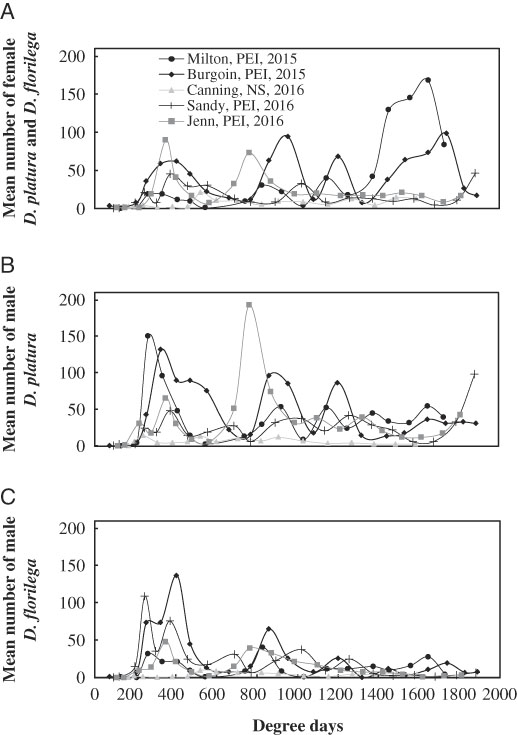
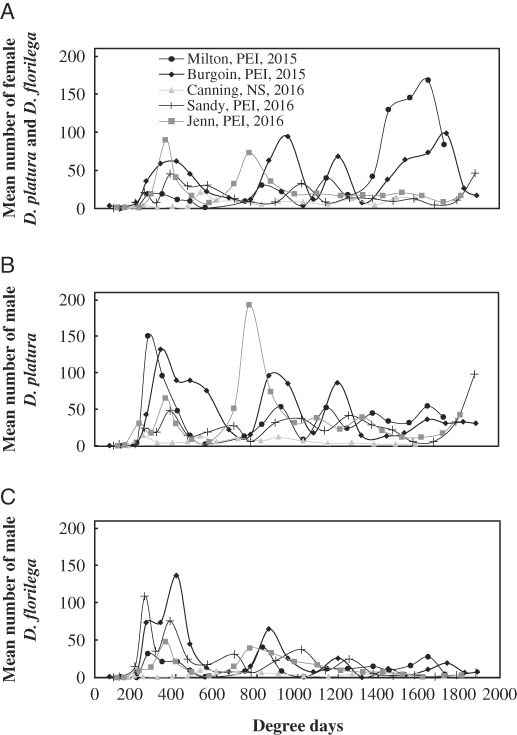
Delia platura and D. florilega were the most abundant species captured in both years (Fig. 2A–C). Delia radicum and D. antiqua were also present but in very low numbers (e.g., less than 10 per collection). Three generations of Delia were clearly present in all fields. More males than females were captured early in the season (Fig. 2B–C) whereas more females than males were captured later in the season (Fig. 2A).
Mean number of Delia platura and Delia florilega females (A) and D. platura males (B), and D. florilega males (C), identified per trap from four traps collected weekly from organic commercial bean fields on Prince Edward Island (PEI) (2015 and 2016) and Nova Scotia (NS) (2016).
Field observations: 2015
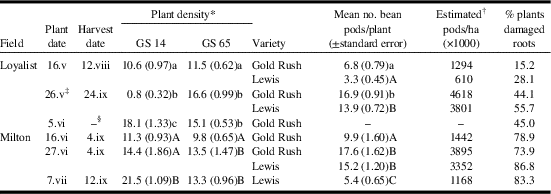
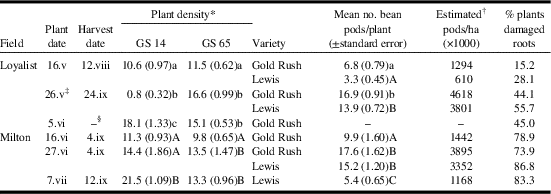
Plant density was significantly affected by planting date in Milton and Loyalist fields on Prince Edward Island (Table 2). In both fields, the first planting had significantly fewer plants per 2 m transect than the last planting when assessed at growth stage 14 (F(2,47)=91.3, P<0.0001 and F(2,27)=14.8, P<0.0001, Loyalist and Milton fields, respectively) and at growth stage 65 (F(2,67)=6.96, P=0.002 and F(2,57)=5.75, P=0.005, Loyalist and Milton fields, respectively). The 26 May planting at Loyalist experienced the greatest plant loss (plant death) and was replanted on 16 June. This planting had the lowest plant counts at growth stage 14 (0.85 plants) whereas the 7 July planting in Milton had the highest plant counts (21.5 plants) (Table 2). At growth stage 65, the 16 June planting in Milton had the fewest plants per transect (9.8 plants) while the replant of the 26 May planting in Loyalist (16 June) had the highest plant count at stage 65 (16.6 plants). Within each planting date, plant density was significantly different between assessments in Loyalist for the 5 June planting (F(1,48)=5.63, P=0.02) and in Milton for the 16 June (F(1,28)=40.0, P=0.04), and 7 July plantings (F(1,28)=27.7, P<0.0001), in each case showing a decrease in plant density.
Mean number of bean pods/plant (±standard error) at two growth stages, mean number (±standard error) of bean pods per plant at harvest, estimated yield/ha and percentage of plants at harvest showing damage from Delia species for Phaseolus vulgaris variety Gold Rush and Lewis, sown at various dates at two locations on Prince Edward Island in 2015.
* Plant densities taken from fields when plants too young to allow variety differentiation.
† Estimated yield determined by multiplying the mean number of bean pods/plant by the plant density at growth stage 65 and using a conversion factor of 6634, which is based upon a row spacing of 0.61 m and assuming that the plant density is the same for both varieties.
‡ 26 May planting was replanted on 16 June, plant density from stage 14 is the 26 May planting and from stage 65 is the 16 June replacement planting.
§ Grower harvested bean pods on 10 September before sample could be taken, leaving plants in the field. A sample of these plants allowed evaluation of Delia species damage for this planting.
Means within column (for plant density) and means within column (number bean pods/plant) and variety (Loyalist field only) with same letter not significantly different using analysis of variance methods followed by Tukey’s honest significant difference mean separation test (P<0.05). Lower case letters for within Gold Rush comparison, upper case for within Lewis comparison.
Mean number of bean pods at harvest was significantly different by planting date within each field. In Loyalist there were only two plantings with harvest data and both varieties. The 16 May planting for both Lewis and Gold Rush varieties produced significantly fewer beans per plant than the 16 June planting (replant of the 26 May planting) (F(1,182)=144.82, P<0.0001 and F(1,182)=15.33, P<0.0001, planting date and variety, respectively, Table 2). In the Milton field, there was no significant difference between the bean varieties (F(1,136)=2.05, P=0.16) for mean number of bean pods/plant, but planting date was significantly different (F(2,136)=41.5, P<0.0001, Table 2). Greatest number of bean pods/plant were harvested from the 27 June planting with an average of 17.6 bean pods from the Gold Rush and 15.2 bean pods from the Lewis varieties. The lowest number of bean pods was harvested from the 7 July planting with an average of 5.4 bean pods per plant. Estimates of the number of bean pods/ha show the 16 June (replant of the 26 May planting) in Loyalist and the 27 June planting in Milton to produce the greatest yields. Yields were estimated to be 4619 and 3801×1000 bean pods/ha for Gold Rush and Lewis varieties in Loyalist and 3895 and 3352×1000 bean pods/ha for Gold Rush and Lewis varieties in Milton.
Examination of the plant roots post-harvest found high percentages of plants showing damage from Delia feeding in the Milton field with > 70% of the roots showing damage across all plantings and varieties (Table 2). Lowest percentages of plants with damaged roots were in the Loyalist field and the 16 May planting, 15.1 and 28.1%, Gold Rush, and Lewis varieties, respectively.
Field trials: 2016
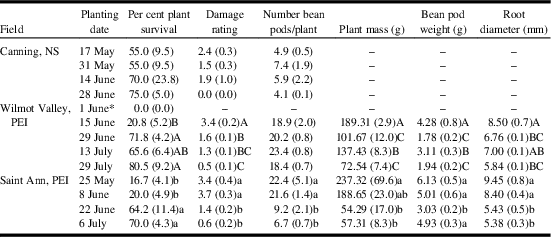
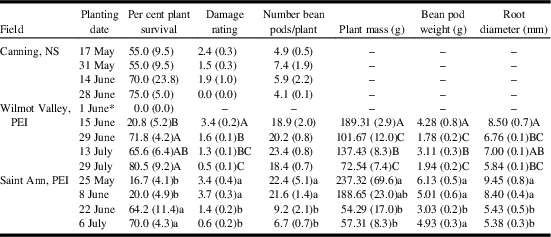
Survival of bean plants was significantly different across planting dates in Wilmot Valley (F(3,11)=6.65, P=0.008) and Saint Ann (F(3,12)=10.11, P=0.001) but not Canning (F(3,12)=0.98, P=0.43) (Table 3). At all sites, plant survival was highest for later planting dates. Percentage of plants surviving until harvest was significantly lower for the first and second planting dates, in both Saint Ann and Wilmot Valley with no plants surviving the first planting (1 June) in Wilmot Valley (Table 3). Recovery of the seed from these plots found rotten, partially germinated seed containing larvae. Larvae were reared to adulthood and identified as D. platura and D. florilega. The 1 June planting in Wilmot Valley was replanted on 29 July 2016.
Mean (±standard error) per cent survival, mean (±standard error) number of bean pods per plant, and mean (±standard error) damage rating of Phaseolus vulgaris at all field locations in Nova Scotia and Prince Edward Island in 2016.
NS, Nova Scotia; PEI, Prince Edward Island.
* Denotes planting date where no plants germinated and evidence of Delia larval infestation was found.
Letters within column, for each site, denote significant differences within each measured variable using analysis of variance methods and Tukey’s honest significant difference mean separation test (P<0.05). Upper case letters indicate Wilmot Valley, lower case letters indicate Saint Ann.
A significant decrease in mean damage rating across planting dates was found in Wilmot Valley (F(3,11)=48.07, P<0.0001) and Saint Ann (F(3,12)=25.23, P<0.0001) but not Canning (F(3,12)=3.49, P=0.05). Across all sites, Wilmot Valley had the highest mean damage as the first planting date here, 1 June, experienced severe damage and failure to survive Delia attack. Examination of the ungerminated seed showed evidence of Delia feeding. Later plantings at this site had significantly lower mean damage ratings. A similar pattern of damage early in the growing season was observed at Saint Ann and Canning fields.
The number of bean pods per plant was significantly different across planting dates in Saint Ann (F(3,12)=8.05, P=0.003) but not in Canning (F(3,12)=0.92, P=0.46) or Wilmot Valley (F(3,11)=3.27, P=0.06) (Table 3). A higher number of bean pods was harvested from plantings occurring in the middle of the growing season with number of bean pods per plant being lower at the beginning of the season (22.4 and 6.7 pods per plant in Saint Ann, first and last planting, respectively). Mean bean pod weight was statistically different across planting dates at Saint Ann (F(3,12)=8.41, P=0.003) and Wilmot Valley (F(3,11)=31.64, P<0.0001). Lowest bean pod weights were observed on the last planting date for Wilmot Valley and the second last planting date at Saint Ann, 1.94 and 3.03 g, respectively (Table 3). Highest bean pod weights were from the 25 May planting for Saint Ann (6.13 g) and the 15 June planting for Wilmot Valley (4.03 g).
Larger plants were harvested from plantings occurring earlier in the season for both sites on Prince Edward Island. Plant mass and root diameter were higher from early plantings, and lower from later plantings across both Prince Edward Island field locations (plant mass Wilmot Valley, F(1,4)=44.24, P<0.0001; Saint Ann, F(1,4)=50.02, P<0.0001; root diameter, Wilmot Valley, F(1,4)=3.54, P<0.0001; Saint Ann, F(1,4)=3.06, P<0.0001).
Laboratory trials
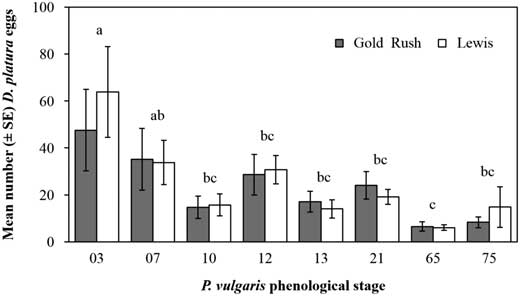
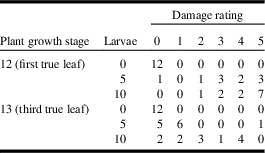
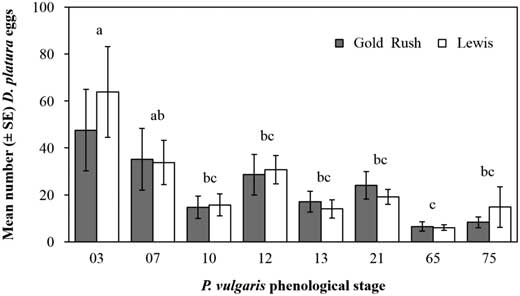
Delia platura females showed no significant variety preference during oviposition (F(1,150)=0.14, P=0.71, Fig. 3). OPI values ranged from −0.13 to 0.004 across plant stages, suggesting that for any given plant stage the difference in number of eggs laid was at most 13% more on Gold Rush over Lewis. When varieties were pooled, a significant difference in oviposition rate between phenological stages was disclosed (F(7,71)=5.41, P<0.001, Fig. 3). Significantly higher oviposition occurred at phenological stages 3 and 7, two to four days post germination, when compared with later stages (P<0.05). There were no significant differences in larval damage to varieties of P. vulgaris tested (F(1,7)=0.55, P=0.48, Table 4). A significantly higher damage rating was observed on the roots of plants infested with larvae over the controls (P<0.05, residual deviance 186.3, Akaike information criteria 204.3). Lower damage ratings were experienced by plants infested with larvae at phenological stage 12, first true leaf, than on stage 13, third true leaf. Although compelling, this result was not statistically significant. Further, the larvae did not complete development and were not recovered from the pots at the end of the trial. We cannot say for certain that the feeding pressure within each treatment (five or 10 larvae) was consistent throughout the trial. Plant loss from other factors, pathogens (n=2) and lack of germination (n=1), also occurred in the laboratory.
Mean number (± standard error) of Delia platura eggs per plant when given choice of two varieties of Phaseolus vulgaris: Gold Rush and Lewis in a growth chamber study. Phenological growth stage (varieties pooled) followed by the same letter not significantly different (P<0.05). For most growth stages n=10, with the exception of growth stages 12 and 13 (n=9) and 75 (n=8).
Number of Phaseolus vulgaris plants (two varieties pooled) showing damage (0–5 rating) when infested at two phenological stages (12 and 13, first and third true leaf, respectively) with either 5 or 10 Delia platura larvae in a growth chamber experiment, n=12 for each treatment.
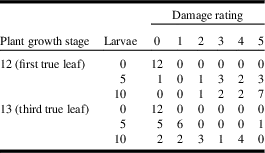
Significant difference observed between first and third true leaf phenological stages (P<0.05, residual deviance 186.3, Akaike information criterion 204.3).
Discussion
Organic bean producers in Nova Scotia and Prince Edward Island can experience severe plant loss early in the growing season. It is recognised that D. platura prefer to oviposit on early growth stage P. vulgaris (Gouinguené and Städler Reference Gouinguené and Städler2006), and P. lunatus (Weston and Miller Reference Weston and Miller1989) and that the most vulnerable time for a bean plant is from planting to three to four weeks of growth (Vea and Eckenrode Reference Vea and Eckenrode1976b; van Schoonhoven and Voyest Reference van Schoonhoven and Voyest1991). Lack of lignification during early development leaves P. vulgaris vulnerable to attack, while healthy, lignified P. vulgaris experience little damage from Delia (Turnock et al. Reference Turnock, Timlick, Galka and Palaniswamy1992). In this study, examination of damaged P. vulgaris plants disclosed damage characteristic of Delia feeding (Vea et al. Reference Vea, Eckenrode and Webb1975; Turnock et al. Reference Turnock, Timlick, Galka and Palaniswamy1992; Howard et al. Reference Howard, Garland and Seaman1994), described as superficial chewing of the taproot tissues and chewing through the plant stem and tunnelling up the stalk (Vea and Eckenrode Reference Vea and Eckenrode1976b; Finch Reference Finch1989). Additionally, these fields had high Delia species trap catches during May and June (average 50–350 per trap per collection date), and Delia larvae were recovered from damaged roots and stems, making Delia the likely cause for the crop losses observed by growers. Further, significant damage by D. platura to P. vulgaris was documented under controlled conditions with plants having damage similar to that observed in field studies. The Canning site had a heavier soil type and retained moisture more than the field sites on Prince Edward Island. As a result, some seed failed to germinate and upon recovery were found rotting and infected with fungal pathogens. This type of damage accounted for ~2% of the plants in this trial and was easily distinguishable from damage by Delia species.
Producers wanting to ensure a continuous supply of fresh beans for the market will often use sequential plantings, starting when the ground has thawed and repeat every 10–14 days. Such plantings, typically done without consideration of Delia phenology, are at risk of coinciding with peak larval eclosion from the egg. The importance of selecting a planting date to maximise crop growth while avoiding pest damage has been noted by others (van Schoonhoven and Voyest Reference van Schoonhoven and Voyest1991; Balasubramanian et al. Reference Balasubramanian, Vandenberg and Hucl2004; Valenciano et al. Reference Valenciano, Casquero and Boto2004). An optimal planting date would result in a high number of plants producing a large number of bean pods per plant. Many studies evaluating the use of selectively timed plantings will refer to a period of time based on the Julian calendar, e.g., mid-June or early summer (Dosdall et al. Reference Dosdall, Herbut and Cowle1994). Selection of a Julian-based planting date faces challenges when transferred to a different region due to climatic issues, requiring the study to be repeated in each region where the crop-pest complex is present. We propose using the degree-day model for D. platura, the predominant Delia species present in these fields to best determine the planting date most likely to result in avoidance of the larvae.
Degree-day models for D. platura have been developed in the United States of America (Funderburk et al. Reference Funderburk, Higley and Pedigo1984) and Korea (Lee et al. Reference Lee, Choi, Han and Kim2000) using field observations. In the laboratory, developmental rates for D. platura and D. florilega were determined by Sanborn et al. (Reference Sanborn, Wyman and Chapman1982) and Throne and Eckenrode (Reference Throne and Eckenrode1986). Such studies can produce a range of base development temperatures, e.g., 0.6–7.9 °C, creating the need to evaluate each model in specific regions. The field study by Funderburk et al. (Reference Funderburk, Higley and Pedigo1984) and the laboratory study by Sanborn et al. (Reference Sanborn, Wyman and Chapman1982) both found the same development temperature for D. platura, e.g., 3.9 °C. In Canada, Broatch et al. (Reference Broatch, Dosdall, Clayton, Haker and Yang2006) used this threshold and found it effective to predict D. platura populations in canola (Brassica Linnaeus) in western Canada. Previous work with Delia species in Nova Scotia have found this threshold to reasonably predict Delia phenology.
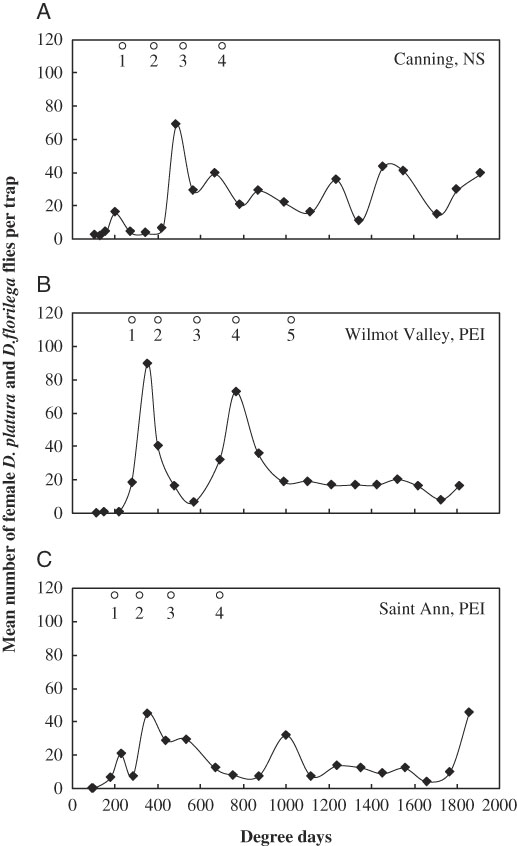
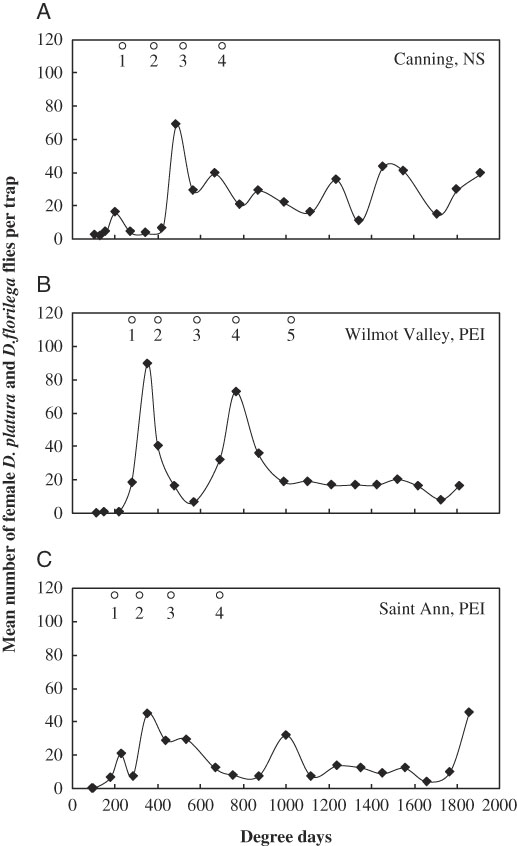
The phenology of the female is more critical than the male when trying to predict and avoid damage from the larvae. For the Delia species in Nova Scotia and Prince Edward Island, comparison of D. platura and D. florilega female phenology and planting dates from 2016 within each site (Fig. 4) shows how the various plantings were likely to be affected by Delia larvae. The first planting in Wilmot Valley (Fig. 4B) was decimated (0% survival) by Delia larvae. This planting occurred at 277 DD3.9 and at the peak flight of the first generation. That timing creates the situation where females have been emerging and ovipositing eggs on the soil for a few days, many have likely started to eclose and larvae are ready to feed on any newly germinating seed. The second planting at Wilmot Valley (at 400 DD3.9) experienced high plant death (~73%) as well, occurring when oviposition would be starting to decline, but the eggs and larvae are still eclosing and feeding. By the third planting date (765 DD3.9), Delia larvae are starting to pupate and only 28% loss was realised. The fourth planting (765 DD3.9) experienced 34% loss, occurring shortly after the second emergence peak, when larvae would again be seeking food. The fifth planting (1024 DD3.9) experienced 19% loss. Similar patterns were found in Canning and Saint Ann (Fig. 4A, C). When seeding occurred during the first generation emergence, newly germinating seed were at risk of attack. Seed planted later in the season, even if Delia populations were on the rise, had the advantage of warmer temperatures to advance the lignification process. Based on these results, it would be recommended that growers monitor the degree days and plant their bean seed to avoid the first and second generations, i.e., between 500 and 600 DD3.9 for the first planting in areas where populations are high or about 400 DD3.9 where populations are low (see Saint Ann, Prince Edward Island, Fig. 4C). Avoidance of the second generation would require planting around 900 DD3.9. However, planting at this time means that plants will have shorter days and fewer heat units for development, as P. vulgaris has a relatively high-temperature threshold for growth, e.g., 10 °C (de Medeiros et al. Reference de Medeiros, Arruda, Sakai, Fujiwara and Boni2000). Planting earlier than 300 DD3.9 results in the bean seed not having enough heat units to grow and produce lignin to withstand larval feeding.
Mean number of Delia platura and Delia florilega females per blue sticky trap from organic bean fields in Canning, Nova Scotia (NS) (A), Wilmot Valley (B), and Saint Ann (C) on Prince Edward Island (PEI) in 2016 by accumulated degree days (base 3.9, start date of 1 January). Numbers 1–5 denote planting times in conjunction with Delia phenology.
Data collected from our field and laboratory experiments suggest a potential for P. vulgaris to tolerate Delia attack. Tolerance, the ability of a plant to compensate quickly after attack or to withstand attack, has been observed in many crops and a variety of insect pests, including the common bean (Vea and Eckenrode Reference Vea and Eckenrode1976a; Blatt et al. Reference Blatt, Smallegange, Hess, Harvey, Dicke and van Loon2008; Ojwang Reference Ojwang2010). In our study, the Wilmot Valley field site showed no significant change in number of bean pods per plant between the 15 June and 29 July plantings even though damage rating was 3.4 for the 15 June planting where only 21% of the plants survived, compared with the 29 July planting with a mean damage rating of 1.6 and 71% of plants surviving. Laboratory experiments found severe D. platura damage on plants infested at early phenological stages of growth, while low damage ratings were realised from older P. vulgaris plants. Consistent with Turnock et al. (Reference Turnock, Timlick, Galka and Palaniswamy1992), such tolerance could be due to lignification of these older plants.
Field evidence from 2015 suggested that Delia may exhibit a varietal preference, an observation supported by Vea and Eckenrode (Reference Vea and Eckenrode1976a). However, no significant difference in oviposition or extent of damage between bean varieties was observed in the current laboratory studies. Oviposition site is chosen by Delia female flies through the detection of plant volatiles by olfactory senses (Hough-Goldstein Reference Hough-Goldstein1985; Spencer et al. Reference Spencer, Candolfi, Keller and Miller1995; Gouinguené and Städler Reference Gouinguené and Städler2006). The lack of oviposition site preference found in this study could speak to similarity in olfactory profiles between the two varieties of bean. As such, there is no benefit to using one of these varieties over the other to reduce Delia damage. One issue which may have skewed our results is the large number of flies used (10 males and 10 females per replicate). This may have caused competition between females for an oviposition site, possibly altering preferences.
Conclusion
Laboratory experiments found no varietal preference by D. platura females for either Lewis or Gold rush varieties of P. vulgaris. In the laboratory, high oviposition rates and high damage from D. platura occurred on early phenological plant stages. In the field, selectively timed planting to avoid the first and second generations of Delia can be an effective strategy to avoid loss from Delia feeding. However, to obtain high crop yields, a balance must be achieved between late planting to manage pest damage and early planting to ensure high yield. Using the phenology of Delia as an indicator of when to plant will provide growers with a selective planting date where young P. vulgaris plants are not subject to high numbers of Delia larvae. Further study to compare plantings based on Julian day with degree day recommendations are required to verify these results.
Acknowledgements
The authors wish to thank Red Soil Organics, Vermuelen Farms, Alexanders Fresh Vegetables, as well as Jenn’s Organic Farm for use of field sites for this work. Many thanks are extended to the Prince Edward Island Horticultural Association, Andrew Ryan, Shelley Adams, Joanne Driscoll, and Caitlyn vanKeymeulen for their technical support. The authors also like to thank the anonymous reviewers for their helpful comments. Funding was provided by Agriculture and Agri-Food Canada (A-base: Project ID 811) and Acadia University.