A large strand of research in gender and politics has long focused on the substantive representation of women since Pitkin's (Reference Pitkin1967) seminal work on representation. A growing body of research delves further into the conditionality of (and assumptions related to) the substantive representation of women in legislatures (Childs Reference Childs2004; Celis et al. Reference Celis2014; Celis and Childs Reference Celis and Childs2008; Childs and Krook Reference Childs and Krook2009; Celis and Childs Reference Celis and Childs2020). The bulk of this scholarly work emphasizes the inevitable necessity to rethink some important a priori assumptions about the nature of women as a group (Reingold and Swers Reference Reingold and Swers2011) – primarily the assumption that there are ‘issues’ or ‘interests’ that all women, both in legislatures and within the mass public, share in common. However, scholars have yet to reach a consensus on how to objectively define ‘women's interests’ and whether distinct subgroups of women prioritize a common set of issues, despite its centrality to the study of women's representation.
This lack of consensus on defining ‘women's interests’ arguably stems mainly from scholars' increasing willingness to ‘undertake empirical studies sensitive to “creative” accounts of representation, which simultaneously recognize diversity among women, …given that women in society hold different views and a wide array of actors…make claims on behalf of “women” as a group’ (Celis et al. Reference Celis2014, 151). Indeed, although women's shared experiences likely result in commonalities in their perceived priorities (Mansbridge Reference Mansbridge1999; Philips 1995; Sapiro Reference Sapiro1981), gender's intersection with race, class and partisanship necessitates the recognition of women's heterogeneity as a group (Huddy, Cassese and Lizotte Reference Huddy, Cassese, Lizotte, Wolbrecht, Beckwith and Baldez2008; Smooth Reference Smooth2011; Celis and Childs Reference Celis and Childs2020). Therefore group interests must be cautiously conceptualized when the group under investigation is too diverse to generalize (Hakim Reference Hakim1996a). With these concerns in mind, recent scholarship recommends adopting an inductive approach to women's interests and avoiding a priori definitions that are often ‘context-related and subject to evolution’ (Celis Reference Celis2007, 87; Celis et al. Reference Celis2014; Reingold and Swers Reference Reingold and Swers2011).
The present study contributes to this discussion in two important ways. First, I take the ‘inductive approach’ a step further by examining women's policy priorities in the broader population over a long period of time. As Campbell, Childs and Lovenduski (Reference Campbell, Childs and Lovenduski2010 174) succinctly explained, ‘one way to circumvent the vexed problem of defining “objective” interests is to focus instead on preferences of constituents as expressed in survey data…[as] an alignment of political beliefs and values between women politicians and women in the electorate is a minimum requirement for “women to act for women”’. Quite surprisingly, studies utilizing a priori definitions of women's interests assume that differences in policy concerns between men and women within the mass public will be automatically reproduced among elected officials due to shared experiences and perspectives (Mansbridge Reference Mansbridge1999; Philips 1995; Sapiro Reference Sapiro1981). Yet Celis et al. (Reference Celis2014, 154) warn that this assumption discounts ‘the perspectives of women in civil society by emphasizing the role of female elected officials’.
The study's second contribution is its focus on gender's intersectionality with race and partisanship. Few would disagree with the observation that women's heterogeneity as a group is much more pronounced within the mass public than it is in legislatures, which has important implications for the study of women's representation. For one thing, if women's everyday needs and perceived priorities vary considerably across different demographic and political divisions, then this would further complicate scholarly efforts to determine who represents women and what constitutes ‘women's interests’. To that end, I examine the following questions: Do women's interests differ from those of men in the mass public? Are women more likely to share policy priorities with other women than with their male counterparts of the same race and same partisan background?
The rest of the article proceeds as follows. I first review the literature on gender differences in the policy priorities and preferences of citizens and representatives, and then demonstrate the advantages of using ‘the most important problem’ (MIP) questions in answering my research questions. Leveraging a recently constructed dataset that content codes over 930,000 Americans' responses to open-ended MIP questions from 1939–2015 (Heffington, Park and Williams Reference Heffington, Park and Williams2019), I show that women differ considerably from men in policy priorities, especially in policy areas that are often considered to be ‘women's interests’. Women are more likely than men to prioritize issues such as health policy, education, housing, poverty, family and children, welfare and crime, whereas men are more likely to prioritize issues concerning foreign trade, economic and foreign policies, farming, energy sources, taxes, corruption and immigration. Furthermore, I show that while the gender gap tends to overshadow partisan and racial differences in policy priorities, the large heterogeneity among women must be taken into account when considering women's representation in politics. The concluding section discusses the implications of these findings for the study of representation of interests.
The Missing link in the Study of the Substantive Representation of Women
Much research from across the globe documents strong empirical evidence that male and female legislators' policy priorities and preferences differ considerably (Bäck, Debus and Müller Reference Bäck, Debus and Müller2014; Childs and Withey Reference Childs and Withey2004; Schwindt-Bayer Reference Schwindt-Bayer2010; Swers Reference Swers2001, Reference Swers2002; Taylor-Robinson and Heath Reference Taylor-Robinson and Heath2003; Wängnerud 2009). The broad consensus in this literature is that female legislators are more likely than their male counterparts to prioritize what are generally referred to as ‘women's issues’, ‘women's interests’ or ‘feminine issues’ (see Lawless Reference Lawless2015; Wängnerud 2009 for overview). The well-documented gender differences in the legislative behavior of men and women led scholars to conclude that ‘[e]lecting more women reduces the possibility that politicians will overlook gender-salient issues’ (Lawless Reference Lawless2015, 358).
However, some of the key assumptions behind the notion of substantive representation have not been subjected to systematic empirical tests despite their normative importance (Campbell, Childs and Lovenduski Reference Campbell, Childs and Lovenduski2010, 174; Celis et al. Reference Celis2008, Reference Celis2014). Not only do scholarly opinions diverge as to what constitutes the set of policy interests and priorities that women are believed to share in common; we also know little about the degree to which the policy priorities of women in legislatures differ from women's interests and priorities in the broader population. After all, in order for descriptive representation to translate into substantive representation, as Bratton and Ray (Reference Bratton and Ray2002, 430) remind us, ‘there must be gender differences within the mass public – differences in opinion or interests that can be ‘represented’ at the elite level’. One way to fill this gap in the literature is to devote more effort to identifying gender differences in policy priorities within the mass public across a wide range of policy areas in a fashion similar to studies of women's representation in legislatures.
To better understand the link between representatives and the represented, it is important to shift the theoretical focus from policy preferences to policy priorities. Recent scholarship has shown that representational inequalities originate in the very early stage of the policy-making process – in the agenda-setting stage (Flavin and Franko Reference Flavin and Franko2017). In contrast, policy preferences (for example, whether the government should spend more on a policy area) come into play later in the policy-making process, when elected officials discuss the plan of action to address a societal problem. Therefore, it is surprising that much of what we know about gender differences in the public is restricted to preferences; we know much less about priorities across policy areas. As Jones and Baumgartner (Reference Jones and Baumgartner2005, 250) convincingly put it, ‘most scholarship on representation focuses on the correspondence in the policy positions of representatives and the represented…but this approach is incomplete, because it neglects priorities among issues. How representative is a legislative action that matches the policy preferences of the public on a low-priority issue but ignores high-priority issues?’ (p. 250). Similarly, in an attempt to document the problems associated with indices of policy preferences based on ideology (such as ‘policy liberalism’), Broockman (Reference Broockman2016, 206) argues that ‘what appears to be a legislator providing ‘good representation’ on an ideological index can correspond to very poor representation in reality if legislators do not match their constituents on the actual issues that go into the index’. These observations support the idea that a closer look at gender differences in priorities would advance our understanding of the substantive representation of women in important ways.
Gender Differences in Policy Priorities
Thus far, research on gender differences in policy priorities has focused heavily on representatives. Much less attention has been devoted to the question of whether there are similar gender-related differences within the mass public. Previous research on gender differences in policy priorities and attitudes in the broader population has only examined a handful of policy issues with generic attitude questions (see Norris Reference Norris and Carroll2003 for an overview). According to Kellstedt, Peterson and Ramirez (Reference Kellstedt, Peterson and Ramirez2010, 479), this work ‘has been almost entirely cross-sectional, focusing on the gender differences that exist at any one point in time’. Stated differently, although scholars exploring gender differences in legislative attention have used systematic, content-coded data from multiple points in time, the empirical examination of gender differences within the mass public has been limited to generic attitude questions that have failed to reveal which issues compete for space and priority in the public's agenda. Instead, such generic questions have proven useful in exploring gender differences in preferences and attitudes regarding the most salient issues of the day. While this approach has its own benefits, it does not allow us to investigate various research questions that are of great importance to the study of substantive representation: What are women's policy concerns within the mass public, and do they align with what scholars focusing on political representation refer to as ‘women's interests’? Do gender differences in policy priorities cut across racial and partisan divisions?
Empirical evidence from rather distinct fields of inquiry suggests that women differ from men in some broad ways. According to these studies, women tend to be more co-operative, caring and nurturing (Chodorow Reference Chodorow1978), more liberal and egalitarian (Shapiro and Mahajan Reference Shapiro and Mahajan1986), and more sympathetic to disadvantaged groups such as the poor and minorities (Cook and Wilcox Reference Cook and Wilcox1991; Gilens Reference Gilens1988). Sociological research shows that women differ from men in values and perspectives due to differing socializations and experiences (Beutel and Marini Reference Beutel and Marini1995). Prior studies also contend that gender role beliefs interact with the division of labor to strengthen gender differences in behavior and attitudes (Eagly and Wood Reference Eagly and Wood2016). The resulting differences in empathic response, helping behavior and fairness are consistent with the predictions of various sociological and psychological theories (Eagly and Crowley Reference Eagly and Crowley1986; Eagly and Steffen Reference Eagly and Steffen1986). For instance, relative to men, women are significantly less supportive of military action in foreign policy (Fite, Genest, and Wilcox Reference Fite, Genest and Wilcox1990), more supportive of crime prevention (Hurwitz and Smithey Reference Hurwitz and Smithey1998; Miller, Rossi and Simpson Reference Miller, Rossi and Simpson1986), show greater concern for war casualties and terrorist attacks (Bendyna et al. Reference Bendyna1996; Huddy et al. Reference Huddy2005) and the security of their neighborhood (Burns and Schumaker Reference Burns and Schumaker1987). Building on the findings obtained from decades of research, Page and Shapiro (Reference Page and Shapiro2010, 296) conclude that women care more than men about ‘compassion issues’ that concern the advancement and empowerment of the needy, poor and socially disadvantaged. Women are also less responsive to changes in government policies (Kellstedt, Peterson, and Ramirez Reference Kellstedt, Peterson and Ramirez2010), which highlights the relative stability of women's policy preferences and priorities. Recent studies demonstrate that gender differences in internalized norms, emphatic concern and support for social harmony are indeed so consistent that they are highly consequential for election outcomes (Harteveld et al. Reference Harteveld2019; Harteveld and Ivarsflaten Reference Harteveld and Ivarsflaten2018; Ondercin Reference Ondercin2017).
Focusing on the origins of gender differences in public opinion and political decision making, Huddy, Cassese and Lizotte (Reference Huddy, Cassese, Lizotte, Wolbrecht, Beckwith and Baldez2008) reviewed different fields of scholarly inquiry, considering three broad explanations for the observed gender differences in politics: socialization and personality, gender and feminist consciousness, and self-interest. The socialization and personality perspective suggests that political attitudes can be traced back to differences between men and women in personality traits such as agreeableness, empathy and assertiveness. The authors suggest that such differences translate into differences in basic values such as egalitarianism, government activism and antimilitarism, which may help to explain broader differences in policy preferences and priorities. Building on studies of socialization, Eagly's (Reference Eagly2013) theory of gender differences provides a slightly different account: she argues that women's differing socialization and gender role expectations drive the variations in political attitudes. This body of research posits that women's orientation toward responsibility for others, particularly for the less privileged, is a product of gendered social roles and socialization, and such gender differences manifest themselves in attitudes toward public policies (Beutel and Marini Reference Beutel and Marini1995).
The gender and feminist consciousness approach to examining gender differences in attitudes focused on women's participation in social movements and support for feminist policies (Conover Reference Conover1988). While this approach has attracted considerable scholarly attention, Huddy, Cassese and Lizotte (Reference Huddy, Cassese, Lizotte, Wolbrecht, Beckwith and Baldez2008) suggest that it explains a rather small portion of gender differences in attitudes and policy priorities. Similarly, the authors point out that the self-interest approach, which builds on the contention that economically vulnerable women are more likely to prioritize certain types of policies, has received limited empirical support in public opinion research. Taken together, although Huddy, Cassese and Lizotte (Reference Huddy, Cassese, Lizotte, Wolbrecht, Beckwith and Baldez2008) suggest that all three explanations fall short in various respects, their review of the vast literature implies that women's differing social roles and socialization may be the driving force behind their collective interest in a common set of policy issues.
The above discussion suggests that women and men might prioritize different sets of policy issues due to their differing social roles, socialization and self-interests. This view has received strong empirical support from various strands of research (Lawless Reference Lawless2015). In Reingold's (Reference Reingold2008, 130) words:
[W]omen in public office frequently are expected – by voters, activists, and researchers alike – to care more about, know more about, and do more about ‘women's issues,’ whether they are defined strictly in feminist terms (for example, women's rights) or more broadly as issues related to women's traditional roles as caretakers (for example, social welfare)… A large body of research confirms these popular expectations. Across time, office, and political parties, women, more often than men, take the lead on women's issues, no matter how such issues are defined. In interviews, surveys, press releases, and newsletters, women officeholders are more likely to express concern about such issues and claim them as their own.
Although socialization theories make a convincing case as to why women may be collectively more concerned about a set of policy issues, newer work reminds us of important theoretical problems associated with ‘the all-too-common assumption that the experiences of one group of women are indicative of the experiences of all women’ (Wolbrecht Reference Wolbrecht, Wolbrecht, Beckwith and Baldez2008, 9). Essentializing gendered patterns in experiences, this assumption also overlooks how gender interacts with other identities to shape policy priorities and attitudes (Wängnerud 2009, 61). As sociologists and political scientists have argued, the needs and personal experiences of subgroups of women are often dissimilar (Cassese, Barnes and Branton Reference Cassese, Barnes and Branton2015; Hakim Reference Hakim1996a, Reference Hakim1996b; Smooth Reference Smooth2011; Celis and Childs Reference Celis and Childs2020), which requires us to pay careful attention to the intersectionality of gender with other social identities. For instance, Orey et al. (Reference Cassese, Barnes and Branton2007, 103) report that the challenges facing racial minorities center around poverty and employment, housing, crime, health care and education because of their shared experiences, which in turn strengthens the association between racial attitudes and government policies (Steinbugler, Press and Dias Reference Steinbugler, Press and Dias2006; Tesler Reference Tesler2012). Page and Shapiro (Reference Page and Shapiro2010) suggest that African Americans are more likely than Whites to favor government spending on redistributive policies and less likely to support military spending and foreign involvements. Highlighting the similarities between disadvantaged groups within society, Hawkesworth (Reference Hawkesworth2003, 531) contends that ‘racialization may produce marked commonalities of privilege between men and women of the dominant race/ethnic groups and of disadvantage among men and women of the subordinate racial/ethnic groups…[whereas] gendering may produce particular commonalities….among women across race and ethnic groups and among men across race and ethnic groups’. That is to say, certain subgroups of women and racial minorities may hold distinct policy preferences and priorities due to their unique experiences in society (Reingold and Smith Reference Reingold and Smith2012).
Partisanship further complicates attempts to define women's interests. Analyzing the interaction between party identification and gender in the United States, several studies document strong evidence of within-party gender gaps across various policy areas (Dittmar, Sanbonmatsu and Carroll Reference Dittmar, Sanbonmatsu and Carroll2018; Dolan Reference Dolan2014). Studies of public opinion in the United States and Europe show that there are predictable ideological differences between men and women, and that ideological sorting along party lines leads to partisan gender gaps (Barnes and Cassese Reference Barnes and Cassese2017; Jelen, Thomas and Wilcox Reference Jelen, Thomas and Wilcox1994). Such gender differences are apparent particularly in the United States, where women hold much more liberal views than men and increasingly identify with the Democratic Party (Shapiro and Mahajan Reference Shapiro and Mahajan1986). Although none of these studies delved directly into the link between gender's intersection with race and partisanship and policy priorities, they are still highly suggestive of the complex interplay between gender and other social characteristics.
On the one hand, there are consistent gender differences that may have stemmed from differing social roles, socialization and self-interests (Huddy, Cassese and Lizotte Reference Huddy, Cassese, Lizotte, Wolbrecht, Beckwith and Baldez2008). Studies building on these theoretical accounts have documented considerable gender differences in legislative priorities (Schwindt-Bayer Reference Schwindt-Bayer2010; Swers Reference Swers2001, Reference Swers2002), and there is little reason not to expect to see similar patterns at the mass level. In fact, congruence in the policy concerns of women in legislatures and women within the mass public is a core assumption of the notion of the substantive representation of women (Bratton and Ray Reference Bratton and Ray2002; Campbell, Childs and Lovenduski Reference Campbell, Childs and Lovenduski2010; Sapiro Reference Sapiro1981). Thus, to the extent that socialization and gender role theories are correct, we might expect to find systematic gender differences in policy concerns that overshadow other sources of differences in policy priorities. On the other hand, as discussed above, women are highly heterogeneous as a group, and certain subgroups of women may have distinct policy priorities (Celis et al. Reference Celis2014; Hakim Reference Hakim2002; Reingold and Swers Reference Reingold and Swers2011). Therefore, it is critically important to delve into gender's interaction with other important identities such as partisanship and race.
Research Design
Gender, Race and Partisanship in the United States
Race and gender have been at the core of the study of descriptive representation since Pitkin's (Reference Pitkin1967) influential work (Dittmar, Sanbonmatsu and Carroll Reference Dittmar, Sanbonmatsu and Carroll2018; Mansbridge Reference Mansbridge1999; Philips 1995; Smooth Reference Smooth2011). As Hardy-Fanta et al. (Reference Hardy-Fanta, Pinderhughes and Sierra2016, 13) once wrote, ‘race and gender, whether alone or in interaction, are not simply demographic classifications or identity markers, but rather factors that interact in dynamics ways with historical and structural political conditions’. Indeed, scholars from across the globe have documented the various ways in which the intersections of race and gender shape political behavior both in legislatures and in the public (Ondercin Reference Ondercin2017; Tesler Reference Tesler2012). In the context of substantive representation, gender and race are two commonly studied identities in scholarship adopting intersectionality perspectives (Minta and Brown Reference Minta and Brown2014; Smooth Reference Smooth2011), as they ‘represent some of the social identities afforded meaning in terms of relative sociocultural power and privilege’ (Parent, DeBlaere and Moradi Reference Parent, DeBlaere and Moradi2013, 639).
The US case provides excellent opportunities to explore gender's intersectionality, where race and partisanship emerged as two important identities that interact with gender to shape political attitudes both in legislatures and in the public (Barnes and Cassese Reference Barnes and Cassese2017; Dolan Reference Dolan2014). As Reingold and Smith (Reference Reingold and Smith2012, 132) conclude, scholars studying the representation of interests ‘must take into account the simultaneous and overlapping nature of race, ethnicity and gender and acknowledge the diversity among women and within racial/ethnic minority groups’. In a series of interviews with elected officials, Dittmar, Sanbonmatsu and Carroll (Reference Dittmar, Sanbonmatsu and Carroll2018) lend credibility to this view. Delegate Stacey Plaskett (D-VI), for example, said that the policy priorities of congresswomen of color are ‘very different than White women's issues…because our experiences in America have been enormously different than theirs’ (p. 165). In a similar way, representative Barbara Lee (D-CA) has stated that ‘we have our agenda which is very similar to women, all women, but then on top of that we have the unique perspective that we bring coming from the African American experience’ (p. 166). Documenting similar perspectives from Latina women, Dittmar, Sanbonmatsu and Carroll (Reference Dittmar, Sanbonmatsu and Carroll2018) conclude that women of color have distinct policy priorities as a consequence of their shared experiences and perspectives.
The US case also constitutes a vivid example of how gendered personalities are linked to partisan affiliation and political preferences. For instance, a relatively recent study has showed that having masculine traits is strongly associated with being a strong Republican (McDermott Reference McDermott2016), which leads to conscious and unconscious cognitive connections between party and gender images (Winter Reference Winter2010). In line with these gendered party images, Dolan (Reference Dolan2014, 179) examines the websites of elected officials and reports that there are important partisan differences in policy priorities among female elected officials; Republican women exhibit relatively little interest in such issues as family/children and education, and more interest in tax, immigration and spending/debt. As an inevitable consequence of party system polarization at the elite level, such gendered policy attitudes are also reproduced within the mass public (Barnes and Cassese Reference Barnes and Cassese2017).
Data
This study departs from past scholarship by utilizing MIP surveys to explore gender differences in policy concerns. Before describing the empirical methodology, I therefore explain in greater detail the reason for using this measure. Research on the substantive representation of women has implicitly assumed that women within the mass public, just like women representatives in legislatures, are concerned with a common set of policy problems (referred to as ‘women's issues’), but has never tested this assumption in a systematic way. Instead, relying exclusively on generic attitude questions, the bulk of this research draws on sociological explanations of gender differences in attitudes to make the case for women's shared interests (Wängnerud 2009, 61).
As such, this approach falls short of explaining how well the issue priorities of women in the mass public align with the issue priorities of women in legislatures. The literature on the substantive representation of women in legislatures has mostly adopted an agenda-setting perspective and focused on how legislators allocate their limited time and attention to prioritizing what they view as the most pressing problems facing the society (Celis Reference Celis2007; Lawless Reference Lawless2015; Wahman, Frantzeskakis and Yildirim Reference Wahman, Frantzeskakis and Yildirim2021). Similarly, our measure of attention to policies among the public should be based on some form of rank ordering to allow cleaner comparisons between the policy agendas of legislators and citizens. For example, while a recent survey conducted by the Pew Research Center (2019) shows that majorities favor increased spending for education (72 per cent), veteran benefits (72 per cent), rebuilding highways and bridges (62 per cent), environmental protection (55 per cent) and scientific research (52 per cent), none of these issues has occupied significant space in the public's policy agenda in the past decade.Footnote 1 Put another way, individuals, both legislators and citizens, may be strong supporters of particular policies, and yet still prioritize other problems. Thus in order to ensure comparability between the studies of gender differences in legislatures and within the mass public, we need to shift our focus from how people perceive existing policies to what issues compete for space and priority in the public's policy agenda. The MIP surveys will help us accomplish this by facilitating an empirical examination of attention allocation patterns among citizens in a fashion similar to the substantive representation literature.
I capitalize on a recently constructed dataset that codes over 930,000 Americans' responses to the MIP question from nearly 700 public opinion surveys that were conducted by various organizations between 1939–2015 (Heffington, Park and Williams Reference Heffington, Park and Williams2019). The Most Important Problem Dataset (MIPD) collected all available surveys from the Roper Center for Public Opinion Research and the American National Election Study (ANES) that were conducted on a nationally representative sample (excluding surveys limited to specific states), that asked some variation of the MIP question, and that provide open-ended responses. The MIPD codes open-ended responses to the MIP question into policy categories using three coding schemes, the Comparative Agendas Project (CAP), Singer and MARPOR.Footnote 2 Unlike generic research questions, open-ended MIP questions provide us with great opportunities to measure respondents' perceived policy priorities. Moreover, because the MIPD codes responses to the MIP question for all available MIP surveys from 1939 to 2015, we are now able for the first time to examine gender differences in policy priorities in varying political contexts.
A large portion of respondents come from surveys conducted by Gallup (47 per cent), CBS News/NYT (16 per cent), CBS News (8 per cent), Princeton Survey Research Associates (7 per cent), Los Angeles Times (7 per cent) and ANES (4 per cent). A comparison with the US census data shows that women constituted 51.2 per cent (52.2 per cent in the MIPD), Whites 83 per cent (86.4 per cent in the MIPD) and those who went beyond high school 24.3 per cent (26.8 per cent in the MIPD) of the sample, which suggests that the MIP surveys in our dataset are highly representative of the broad US population. Utilizing the US census dataset (that is, the Current Population Survey) that consists of around 60 million individuals interviewed from 1940 to 2010, I created survey weights based on age, gender, race and educational attainment, and used them in my empirical models. I also report additional results without survey weights in the Appendix.
Empirical Methodology
My empirical strategy is twofold. First, I explore gender differences in thirty-six policy categories over the past seven decades. As I am primarily interested in the effect of gender on policy prioritization, I do not report the full results and instead graphically illustrate the coefficients of the gender variable from each of the thirty-six linear probability models (see Equation 1 below).Footnote 3 The second part of my analysis focuses on gender's interaction with partisan identification and race (see Equations 2 and 3). To that end, I illustrate in a figure the coefficients of the interaction terms (‘gender × party’, ‘gender × race’) from selected topic categories. In these figures, we are interested in both qualitative and quantitative differences in policy prioritization patterns. More specifically, to the extent that socialization and social role theories are correct, we might expect to find that gender gaps exist for a wide range of issues, and that such gender differences can be categorized using the traditional domains of ‘feminine’ (that is, issues related to care, harm and empowerment) and ‘masculine’ issues (that is, issues related to economic survival, order and law) (Funk and Philips Reference Funk and Philips2019).Footnote 4 The empirical models take the following form:
 $$Pr( MIP_{issue} = 1) = F( \beta _0 + \beta _1Gender + \beta _2PartisanID + \beta _3Race + \beta _4Gender^\ast\, PartisanID + \beta _5Residence_{South} + \beta _6Age_{log} + \beta _7Education + \beta _8IncomeLevel + \beta _9DemocraticPresident + YearFixedEffects) $$
 $$\eqalignno{Pr( {MIP_{issue} = 1} ) &= F( {\beta_0 + \beta_1Gender + \beta_2PartisanID + \beta_3Race + \beta_4Residence_{South}} \cr&\quad+ \beta_6Age_{log} + \beta_7Education + \beta_8IncomeLevel + \beta_9DemocraticPresident \cr&\quad+ YearFixedEffects )&( 2 )$$
 $$Pr( MIP_{issue} = 1) = F( \beta _0 + \beta _1Gender + \beta _2PartisanID + \beta _3Race + \beta _4Gender \times Race + \beta _5Residence_{South} + \beta _6Age_{log} + \beta _7Education + \beta _8IncomeLevel + \beta _9DemocraticPresident + YearFixedEffects) $$
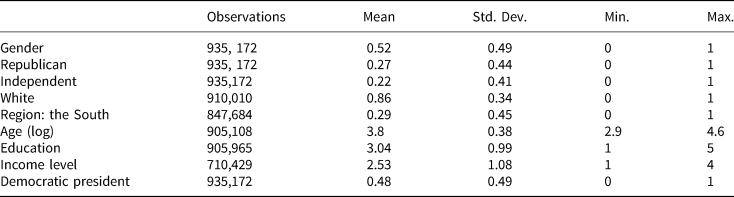
I utilize two sets of independent variables. Variables related to demographic characteristics include gender, race (White, non-white), age (logged), formal education (1 = no high school, 5 = post-graduate), income level (quartiles), respondent's residence (region: the South), whereas political variables include the respondent's party identification and the president's party affiliation at the time of the interview. The models also include year fixed effects. Table 1 presents the full list of broad policy categories utilized in this study,Footnote 5 and Table 2 reports the descriptive statistics of key variables. In addition, Figure 1 illustrates the gender, partisan and racial composition of the data over time.
Gender, partisan and racial composition of the data over time
Note: the bottom portion of the figure shows the mean sample size (by year) over time.

Examples of open-ended MIP responses and Singer (Reference Singer2011) topic categories

Descriptive statistics of key variables

Note: descriptive statistics for individual dependent variables (that is, policy categories) are reported in the Appendix.
Results
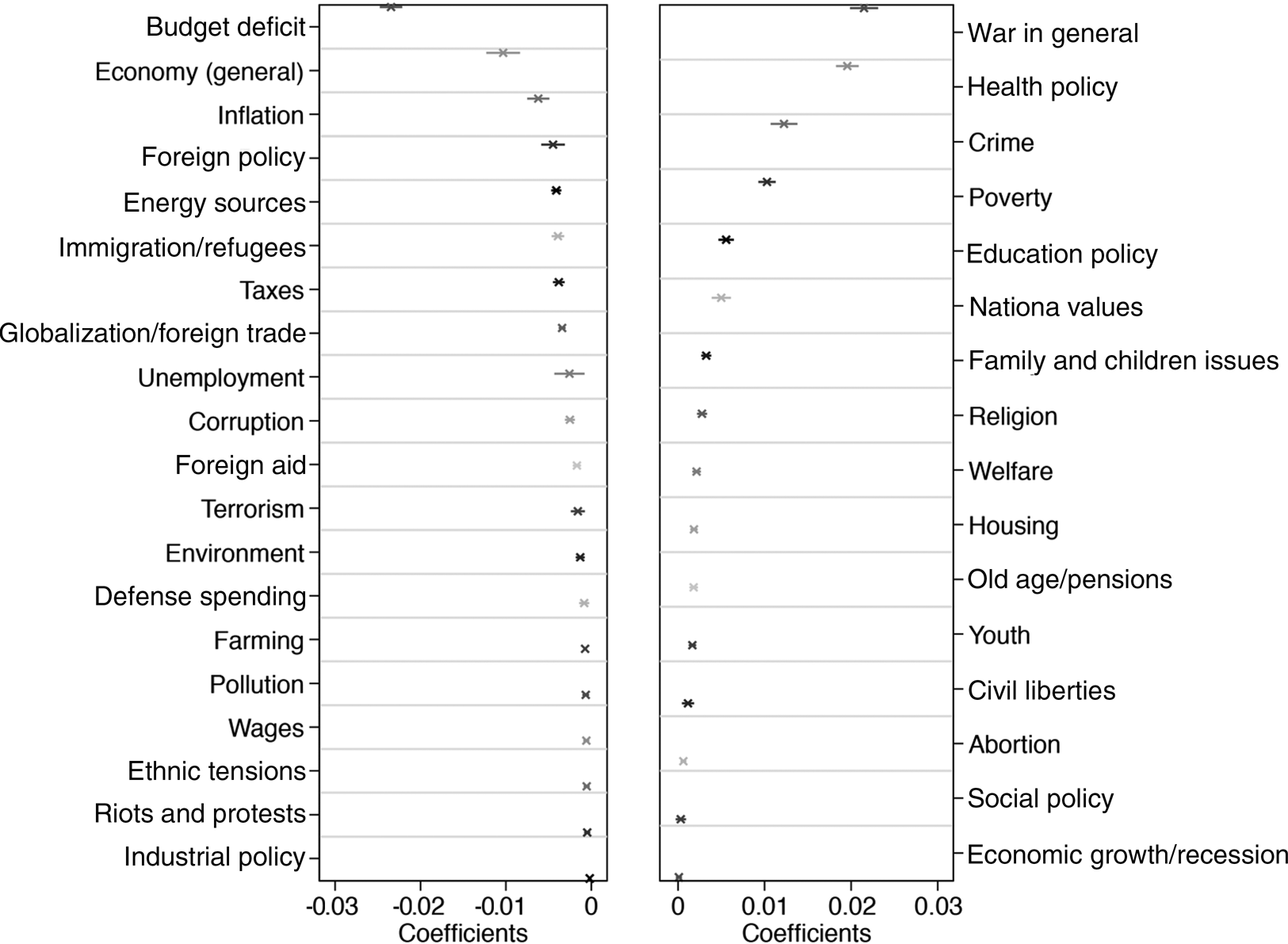
I begin my analysis by exploring gender differences in the prioritization of thirty-six policy categories. At least two observations are immediately evident from Figure 2.Footnote 6 First, there are statistically significant gender differences in the great majority of individual policy categories, though the gender gap in many policy categories is small in absolute terms. Secondly, the figure shows that the issue categories for which there are sharp gender gaps are greatly in line with the predictions of socialization and social role theories that often categorize policy domains as ‘masculine’ or ‘feminine’. As seen in the figure, women are more concerned with ‘compassion’ issues that are related to care and the advancement of the disadvantaged, whereas men focus more on issues related to economic protection, governance, and law and order. In particular, the gender gap is much larger for issues such as war, health policy, poverty, education policy, and family and children issues (in favor of women); and budget deficit, the economy, inflation, foreign policy and immigration (in favor of men). This implies that the issues of concern to women go well beyond what scholars call ‘feminist issues’ (those that are directly related to the economic and political well-being of women such as abortion and gender rights),Footnote 7 and supports the contention that the conception of women's issues defined strictly in feminist terms is too narrow to represent women's policy concerns (Celis Reference Celis2009; Huddy, Cassese and Lizotte Reference Huddy, Cassese, Lizotte, Wolbrecht, Beckwith and Baldez2008).
Gender differences in policy prioritization (individual policy categories)
Note: the figures display coefficients on the variable Gender obtained from thirty-six linear probability models. The figure on the left (right) shows the list of policy categories that men (women) were more likely to prioritize, compared to women (men). The models account for various sociodemographic and political factors including partisan identification, respondent's residence (region: the South), race, age, formal education, income level (quartiles), and the party of the president at the time of the survey. Additionally, year fixed-effects are employed.

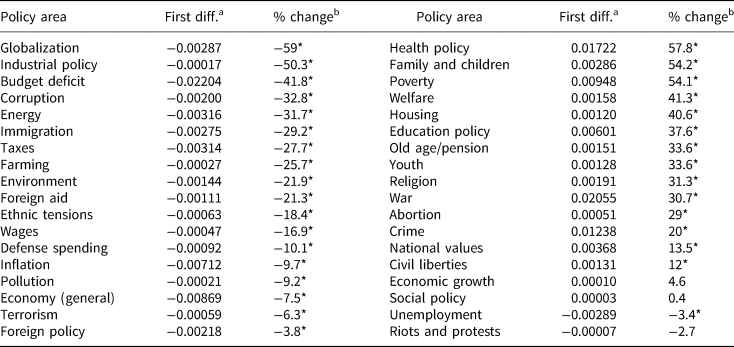
While Figure 2 documents gender differences in policy concerns across a wide range of policy areas, it provides little insight into the substantive impact of gender on policy prioritization. To ease the interpretation, I use Clarify (King, Tomz and Wittenberg Reference King, Tomz and Wittenberg2000) to generate 1,000 simulated MIP mention probabilities for each of the thirty-six policy areas and report them in Table 3 (based on logistic regression models). The table shows that shifting the gender variable from 0 (male) to 1 (female) produces substantively meaningful changes in the probability of MIP mentions. For instance, holding other variables constant at their means, a switch from male to female decreases the likelihood of mentioning budget deficit by 42 per cent, corruption by 33 per cent and immigration by 29 per cent, whereas the same change increases the likelihood of mentioning health policy by 58 per cent, poverty by 54 per cent and education policy by 38 per cent. However, a hypothetical change from male to female leads to smaller changes in the probability of mentioning some traditionally salient policy areas such as defense spending (10 per cent), foreign policy (4 per cent) and unemployment (3 per cent).
Substantive impact of gender on policy priorities (logistic regressions)

a Change in quantity of interest (first difference) obtained from simulated probabilities based on logistic regressions replicating the results reported in Figure 2. Using Clarify (King et al. Reference King, Tomz and Wittenberg2000), the column displays the change in probabilities when switching from ‘male’ to ‘female’, holding all other variables constant at their means.
b The column displays percentage changes in predicted probabilities (changes relative to baseline probabilities) when switching from ‘male’ to ‘female’, holding all other variables constant at their means (year-fixed effects are excluded). * p < 0.05
While the gender gap in many policy areas is fairly small in absolute terms (as seen in Figure 2), relative changes in predicted probabilities (that is, changes relative to baseline probabilities) point to considerable gender differences in many policy areas. Due to this discrepancy, it is worth devoting more attention to the substantive importance of gender. As a direct consequence of utilizing a very large number of topic categories (that is, the Singer coding scheme) across decades, each policy category was mentioned by a small fraction of the sample, which resulted in small baseline probabilities. However, although effect sizes in absolute terms are small, these small gaps amount to thousands of respondents in most policy categories. Notably, while the gender gap in the issue of ‘health policy’ in absolute terms is only 1.4 per cent, this small percentage gap translates into 8,065 respondents (in a universe of 32,353 respondents who mentioned health policy as the MIP). That is, nearly 63 per cent of the respondents who named health policy as the MIP were female (37 per cent were male). Similarly, more than 63 per cent of the respondents who mentioned ‘poverty’ as the MIP were female (12,692 out of 20,052 respondents), while the gender gap is smaller than 1 per cent in absolute terms. These small differences in absolute terms translate into thousands of respondents when measured in relative terms, which suggests substantively important gender gaps for many of the reported policy categories.
Following studies on gender's intersectionality, the second part of my empirical investigation explores whether the effect of gender varies across categories of race and partisanship. For instance, Figure 2 shows that female respondents were significantly more likely than their male counterparts to mention issues related to health policy, poverty, and family and children as the MIP. However, we do not know whether both Republican and Democrat women, for example, were more likely than their male counterparts to mention these policies as the MIP. It may well be the case that the gender gap in the prioritization of certain issues is negligible or non-existent for some demographic and political groups (for example, people of color, Republicans, etc.), which would have important implications for the questions of ‘whose interests’ and ‘who should represent women’.
To explore this possibility, I estimated a series of linear probability models that include dummy variables for non-White women, White men and non-White men; the reference category is White women.Footnote 8 For the interaction between gender and partisan identification, the reference category is Republican women, where I use Republican men, Democrat women and Democrat men as dummy variables. Given that the documentation of these estimates for all thirty-six policy categories would be too demanding in a single figure, Figure 3 only displays the interactive effects of gender, race and partisan identification, and only for some of the most salient policy categories.Footnote 9 The presence of a statistical significance in one or more of the dummy variables would indicate that the effect of gender on the prioritization of given policy issues is different at different values of the variables race and/or partisan identification. Stated differently, a significant effect would mean that certain subgroups of women, such as women of color or Democrat women, deviate considerably from the reference categories (that is, White women and Republican women) in policy prioritization. With this in mind, Figure 3 points to considerable heterogeneity among women in many policy areas. The figure shows that, for instance, in all but one policy category women of color have significantly different priorities from White women. Just to name a few policy categories, women of color are significantly less likely than White women to mention the economy, budget deficit, terrorism and foreign policy, and more likely to mention crime, poverty and civil liberties as the MIP facing the country.
Interactive effects of gender, race and partisanship on policy priorities

As the models reporting gender's interaction with partisan identification show, Democrat women and Republican women are statistically indistinguishable in the prioritization of crime, terrorism and welfare. Republican women are more likely than Republican men – but less likely than both Democrat men and women – to name war, health policy, poverty, civil liberties and immigration as the MIP. The figure also shows that while men and women of the same party identification (especially Republicans) tend to differ in priorities, the partisan gap in priorities among women is considerable in many policy areas including the economy, health policy, poverty, immigration and war. Taken together, these racial and partisan priority gaps among women lend support to the oft-cited argument that we need to proceed with caution in defining women's interests as a group.
Conclusions
The vast literature on the substantive representation of women has explored gender differences in legislative attention in various contexts. The point of departure in this literature is the implicit assumption that women in legislatures and within the mass public share a common set of policy priorities. This literature has shown that women legislators, compared to their male counterparts, focus disproportionately on what has come to be known as issues of ‘women's interests’ – those related to health policy, social welfare, education, family and children issues, and civil rights, among others. While studies of gender differences in public opinion have indeed shown that women tend to differ from men in policy attitudes such as spending preferences, these observed gender differences fail to justify the basis of the concept of substantive representation, namely, that women in legislatures and within the mass public share a common set of policy priorities. This is because studies that have explored gender differences in the public have mostly utilized generic attitude questions, and have paid less attention to what issues compete for space and priority in the policy agendas of men and women. I argue here that an empirical examination of gender differences in responses to the MIP question would advance our understanding of the representation of women's interests, as the literature on women in legislatures has extensively utilized a similar agenda-setting approach that assumes individuals have a limited agenda space.
To recap, two research questions motivated the present study. First, what are women's interests within the American public? If substantive representation is ‘acting in the interests of the represented’ (Pitkin Reference Pitkin1967, 209), then the observed gender differences in legislatures (that is, women focusing more heavily on issues related to ‘women's interests’) should also be observable within the mass public (Bratton and Ray Reference Bratton and Ray2002, Campbell, Childs and Lovenduski Reference Campbell, Childs and Lovenduski2010). Secondly, does the gender gap in policy priorities cross-cut other political and social divisions? Given that women within the mass public are arguably much more heterogeneous than their counterparts in legislatures, it is critical to explore gender's intersection with such important identities as race and partisan identification. To the best of my knowledge, this study represents the first empirical attempt to examine gender differences in a wide range of policy areas and over seven decades in the United States. It has empirically tested some of the preconditions of the substantive representation of women.
The findings reported here indicate that the gender gap in policy concerns observed in legislatures also exists within the American public. The empirical results demonstrate that there are modest but consistent gender gaps across a wide range of policy categories, highlighting women's tendency to show particular concern for ‘compassion’ or ‘protection’ issues that are typically of greater importance to people in need (Page and Shapiro Reference Page and Shapiro2010, 295). Women were more likely than men to prioritize issues related to education, health policy, civil liberties, poverty, welfare, social policy, old age and pension, problems with youth, family and children issues, housing issues and abortion. Yet the empirical analysis also showed that women as a group are fairly heterogeneous: in many policy areas they were more similar to the men with whom they shared a common partisan or racial background.
These results have three important implications for the conceptualization of women's interests. First, the inductive approach used here showed that women indeed differ from men in the prioritization of a wide range of policy problems. Furthermore, the fact that women are collectively more concerned than men about issues relating to care, harm and the empowerment of the needy lends strong support to the socialization perspective that explains gender differences in political attitudes with differing socialization and gendered experiences (Beutel and Marini Reference Beutel and Marini1995; Mansbridge Reference Mansbridge1999; Phillips Reference Phillips1995). Secondly, the analysis presented here supports the contention that women are very heterogeneous as a group. In particular, I show that partisan and racial divisions among women are often fairly large: women of particular partisan or racial background and men are equally likely to prioritize certain issues. Thirdly, this study demonstrates that gender differences in policy concerns go well beyond the feminist conception of women's interests. The empirical findings support the contention that the self-interest perspective, the idea that men's and women's policy priorities are a product of ‘their differing material circumstances’ (that is, economic and social vulnerability), fails to explain broad gender differences in policy concerns (Huddy, Cassese and Lizotte Reference Huddy, Cassese, Lizotte, Wolbrecht, Beckwith and Baldez2008, 36).
While this study makes a comprehensive attempt to examine the extent to which women differ from men in policy concerns, it is not without limitations. Most importantly, the small gender differences in absolute terms reported here suggest the importance of issue salience in gendered priorities. For instance, although women were far more likely than men to mention health policy as the MIP in the past 75 years, the issue of health policy occupied virtually no space in the public's agenda prior to 1985 and very little space after 2010, according to the MIP dataset. This raises an important normative question: Should representatives aiming to maximize the substantive representation of women today bring issues related to health policy to the legislative floor? In other words, do the documented gender gaps in policy priorities suggest women's greater tendency to prioritize certain issues at all times? Whereas it is important to proceed with caution in answering such questions as the data at hand do not permit a closer examination, it is clear that issue salience plays an important role in the link between gendered priorities and the substantive representation of women (Kaufmann and Petrocik Reference Kaufmann and Petrocik1999).
Another limitation of the present study is that the empirical observations made above are drawn from a single case. Although there are important similarities between the United States and other advanced democracies in terms of policy attitudes and political behavior, the intersectionality of identities tends to vary across countries due to idiosyncratic political and historical trajectories. It is also important to note that the two-party system in the United States, especially in an era of increasing polarization, requires the use of caution in generalizing the findings regarding gender's interaction with partisanship to other countries. Although similar ideological differences between men and women have also been documented in Western Europe (Jelen, Thomas and Wilcox Reference Jelen, Thomas and Wilcox1994), the incentives associated with different party systems may interact with issue ownership patterns to shape gender differences within and across partisan lines. Therefore, future research should delve further into gender's intersectionality with partisan identities in other political contexts, especially in multiparty systems.
Finally, while this study attempted to shift our empirical focus from policy preferences to policy priorities, it was unable to take into account differences in policy preferences in empirical analyses given that the MIP dataset contains little information about preferences. For example, women and men may be equally concerned with a policy issue, even though they differ greatly from one another in their preferred level of policy (for example, opposite spending preferences). Although past scholarship suggests there are relatively minor gender differences in policy preferences at the aggregate level (Kellstedt, Peterson and Ramirez Reference Kellstedt, Peterson and Ramirez2010; Page and Shapiro Reference Page and Shapiro2010; Shapiro and Mahajan Reference Shapiro and Mahajan1986), future research should examine how priorities interact with preferences within the mass public, and how this interaction varies across demographic and partisan groups.
Supplementary material
Online appendices are available at https://doi.org/10.1017/S0007123421000235.
Data availability statement
Replication data for this article can be found in Harvard Dataverse at https://doi.org/10.7910/DVN/D9FL9Z.
Acknowledgements
I thank Shaun Bevan, Hanna Brant, Emiliano Grossman, Kerim Can Kavakli, Lael Keiser, Julie Sevenans, Stefaan Walgrave, Laron K. Williams, as well as the editors and four anonymous reviewers for their extremely helpful feedback on the article. Earlier versions of this article were presented at the Western Political Science Association (San Francisco) and the Comparative Agendas Project (Budapest) annual conferences, and I am grateful to audience members at these venues for their suggestions and comments.