The island's agricultural prospects were not uppermost on the country trader Francis Light's mind when he in the 1780s initiated a campaign for the English East India Company to establish a trading post on Penang Island. It was well known that the increase in the Company's trade with China had created a desire for a provisioning post east of India. A permanent base on the eastern side of the Bay of Bengal would firmly signal British ambitions for eastward expansion, and there were strong incentives to engage more actively in regional trade. Persuasive arguments were also made for the island's prospects as a naval base, as it was assumed that Penang's forests would contain teak trees suitable for shipbuilding. Furthermore, the island's lush vegetation, Light argued, indicated that food could easily be grown locally to feed the settlement's inhabitants.Footnote 1
Having eventually obtained permission to proceed with his long-term plan, Light and his party landed on the beach of what was soon renamed ‘Prince of Wales Island’ in August 1786. A frenzy of activities followed, starting with land clearing. Food production was a concern for both Light and the Company, and rice and vegetables were initially grown on cleared land. Within a few years pepper became the first commercial crop, but cultivation in Penang would take a new direction as a consequence of political events in Europe. Britain became temporary occupants of the fabled Spice Islands in the Moluccas, where the Dutch had monopolised and tightly guarded clove and nutmeg production for centuries. The East India Company wasted no time and gave instructions for shiploads of nutmeg and clove seedlings to leave the Moluccas on British ships. Most of these plants ended up in Penang, the British possession closest to the Moluccas. Despite initial problems and uncertainties nutmeg would form the core of Penang's commercial cultivation during the first half of the nineteenth century. The 1830s in particular was a period of expansion and optimism among Penang's nutmeg planters, but the ‘nutmeg mania’ would be short-lived. In the 1840s global prices fell, and the first signs of what was then thought to be a disease of the nutmeg tree were observed. By the early 1860s Penang's nutmeg trees had died, and spice planting was now seen as ‘at best a lottery and more frequently a ruinous infatuation’.Footnote 2
The rise and fall of nutmeg cultivation in Penang in several ways give a first taste of the difficulties which would characterise colonial agriculture in the Straits Settlements throughout the nineteenth century. This new British ‘colony’ was established with little planning, in a tropical environment and a climate of which the East India Company had very limited agricultural experience, and initial experiments with non-indigenous, ‘imperial’ crops would fail. Confusion regarding land distribution and tenure was not resolved for decades. The rapid influx of Asian settlers created a unique ethnic makeup perhaps not found anywhere else at the time. Access to labour became linked to British ideas of the ‘usefulness’ of the island's ethnic groups, but this also meant that cultivation became heavily dependent on local knowledge and agricultural techniques.
The quest for new commercial plants, global plant transfers and the accumulation of botanical knowledge have in recent decades been identified as important drivers of colonial expansion, and it is within this particular historiographical field that early Penang can be seen. The island constitutes a telling example of the role of knowledge about and the transfer of plants at this particular time, initiating a transition to larger scale plantation agriculture which would, at least partly, later justify British expansion in Southeast Asia. By the early nineteenth century attempts at plant acclimatisation instigated by the Linnaean project had given way to global systems of plant transfer: Penang was flooded by nutmeg seedling since it was thought that the island had a climate and soil similar to the Moluccas. The swiftness by which a Company Garden was set up reflected wider developments within the British Empire, where gardens administered and financed by authorities have been identified as crucial sites for botanical research.Footnote 3 However, in Penang initial official enthusiasm for research was soon overshadowed by more pressing concerns, with experimentation left to individual planters.
There are further ways in which Penang can be linked to global histories of empire at this particular time. Both planters and the authorities were driven by the idea of creating orderly, ‘tamed’ landscapes, and Penang would in a particular way lend itself to prevailing British ideas of ‘improvement’ and garden aesthetics.Footnote 4 Through his study of eighteenth century Mauritius, Richard Grove long since argued that islands are particularly well suited as lenses through which Europeans were able to observe the ecological consequences of large-scale monoculture, and that these observations came to propel global ecological awareness.Footnote 5 The case made here is that nineteenth century Penang Island, due to its topography and small size, was particularly well suited for such observations, and came to feature in British collation of global examples which eventually led to measures promoting the conservation of forests.
Nutmeg as a plant and commodity has attracted the attention of historians of botany mainly through the eventful transfer of nutmeg plants from the Moluccas to the Mascarenes in the eighteenth century, which has meant that its cultivation has mainly been seen in the context of French colonial expansion. It was in Mauritius that the institutionalised imposing of a ‘colonial machine’ on botany could be observed, and it was from this island that taxonomical debates between rivalling botanists were fed.Footnote 6 On the ground in early Penang, however, intricate botanical nomenclature would be of little concern to planters struggling to keep nutmeg trees alive and sustain commercial cultivation.
Agriculture in early Penang
Shortly after the establishment of the settlement Francis Light was sent seeds from India and given instructions to grow vegetables, grain and fruit to feed its inhabitants.Footnote 7 The authorities were acutely aware of the importance of food production, as severe famines in Bengal had rocked British administration in India in the later eighteenth century. Light, however, assured officials in Calcutta that the island's topography meant that it easily could become self sufficient: the coolness of the hills would provide growing conditions for almost every kind of European fruit as well as pasture for herds of sheep. This initial optimism was shared by compilers of early reports evaluating the island's commercial and agricultural prospects.Footnote 8
Clearing of the forest became a priority, but this was a difficult task: the jungle was found to be so dense that it was impossible to penetrate, and Light reported to his superiors that the wood of tall trees was so hard that ‘our tools double like a piece of lead’.Footnote 9 As Penang became a site of transportation, convict labour was used to clear the plain south of the main settlement George Town, but many of the convicts became ill and died, and requests from Penang for an increase in the number of convicts sent from India were turned down. Instead, authorities in Calcutta encouraged Penang to make more efficient use of local labour.Footnote 10
From the start, Light had employed groups of Malays, said to be ‘far more expert in the use of the axe and parang, or chopper, than the Chinese’.Footnote 11 However, traditional Malay forest techniques did not extend to tackling enormous trees, as demanded by the British, and it became difficult to persuade the Malays to carry on after their bulongs (axes) had been broken.Footnote 12 In clearing the forest the traditional Malay method of ‘stumping’ was used, whereby trees were cut down at six or seven feet from the ground and left to decay, but this was a long and elaborate process. Cultivation could be commenced around the stumps, but it still took years before yields improved. To European visitors, the standing stumps were an eyesore, giving cleared areas ‘the most barbarous appearance’.Footnote 13
Among the British there was a widespread view that the Malays were ‘fit for little else than cutting down Trees’, and groups of Chinese, seen as ‘industrious and orderly’, were paid to prepare the ground for cultivation. This was done by digging up the roots of felled trees and then levelling the ground. Tree trunks were often cut up and burnt, with the ashes serving as a valuable fertiliser.Footnote 14
The logistics of forest clearing was not the only obstacle to agricultural enterprise, as unresolved land tenure issues continued for decades. Light had not been given instructions on the distribution of land, and was free to grant land without orderly records.Footnote 15 This meant that large tracts of cleared land were given out to Europeans, most notably to Light himself, his business partner James Scott, and a handful of British merchants turned planters such as David Brown, George Caunter and Philip Mannington. Groups of men who had worked on French plantations in India and Mauritius also arrived in Penang in the hope of acquiring virgin land.Footnote 16
After Light's death in 1794 land holders were assured that they could keep their allocated land, but the land situation changed in 1805 when Penang was declared a Fourth Presidency of India. The new Governor, Philip Dundas, ordered that no further land grants were to be given out, and in 1809 the Government agreed to resume allocation of land of less than 50 orlongs in perpetuity on the condition that the land was cultivated.Footnote 17 This was reversed again in 1831, whereby five-, ten- or fifteen-year leases of land were issued. The length of leases was dependent on crops cultivated, something which caused much frustration and in 1837 land regulation was still reported to be in ‘wild confusion’.Footnote 18 In 1841 outright sale of land was finally introduced in the Straits Settlements, and in 1843 a completely new system of land allocation was agreed, similar to those applied in Canada, Australia and Ceylon.Footnote 19
Despite confusion over land tenure agriculture in Penang took off. Initially both local smallholders and European cultivators adopted the traditional combination of rice, coconuts, vegetables, fruit and betelnut, grown in combination with pepper (Piper nigrum), the island's first substantial cash crop. Francis Light himself had paid a Chinese merchant to bring pepper vines from Aceh, and pepper cultivation in Penang, both on Chinese smallholdings and European estates, took off at a pace that surprised many. By 1802 over one million pepper plants had been planted, covering an area of c.2,200 acres. When Penang's status as a Presidency was declared in 1805, the island produced 27,000 pikuls of pepper.Footnote 20
Pepper was a labour-intensive crop, which required careful tending, weeding, and turning of the soil. Pepper also exhausted the soil, and planters had to move to new land every fifteen years, something which posed problems in Penang where the clearing of land was difficult and expensive. Furthermore, in Southeast Asia pepper had been grown in conjunction with gambier (Uncaria gambier), a product used for dyeing and tanning. The residue from gambier preparation was used to manure pepper plants, but the preparation of gambier through boiling its leaves was an elaborate process. British experiments with gambier in Penang revealed that production costs here were higher than the market price, and in contrast to Singapore, gambier cultivation never became widespread in Penang.Footnote 21 But this also meant that fertilisers were in short supply.
The fortunes of the pepper planters deteriorated quickly when the changing international situation resulted in price falls in Europe. Penang's planters attempted alternative markets: in 1807–08 pepper from Penang was exported to China, but prices were low.Footnote 22 In 1809 the Penang government was urged to discourage pepper planting, and in 1810 it was reported that much of the land previously used for pepper cultivation had ‘reverted to its original state of Jungle’.Footnote 23 The production of pepper increased after the Napoleonic Wars (1803–15), but pepper prices fell again after 1817. Pepper production decreased further due to the enthusiasm for nutmeg, and by the 1840s pepper production on the island was insignificant.Footnote 24
Meanwhile, experiments with a number of other commercial crops were carried out.Footnote 25 The cultivation of cotton was actively encouraged by the government, and cotton seeds from Mauritius and India arrived in Penang to be distributed among planters. Seeds from Bengal were initially successful, but it was reported that ‘although it bloomed, yet from being continually in that State, it did not ripen’.Footnote 26 A similar situation later arose in Singapore, where extensive experiments with cotton cultivation would continue until the 1850s. The absence of seasons and a climate that proved too damp would prevent Penang, as well as the other Straits Settlements, from becoming cotton-producing colonies.Footnote 27
Coffee was another crop which would engage administrators and planters alike. Coffee plants from Java and the Moluccas were brought to Penang in the 1790s, and experiments were initially carried out by European planters.Footnote 28 But there was no official support for coffee cultivation, and prices fluctuated wildly. By the 1820s it had become clear that the coffee experiment ‘did not prove the success that was anticipated’, and in 1836 only a few thousand coffee plants remained in Penang's hills.Footnote 29 The problem again seems to have been the lack of seasons, inexperience in caring for the plants, as well as unsuitable soil conditions. Other crops, such as tobacco, were tried out but failed. The only crop cultivated with more success was sugar cane, which had long been grown by the Chinese in Southeast Asia. Initial attempts by Europeans to cultivate sugar failed, as the island's prospective entrepreneurs had no knowledge about processing techniques. This changed in the 1840s when European planters began to establish large-scale and later successful sugar plantations in Province Wellesley, the strip of land on the mainland opposite Penang ceded to the Company in 1800. By then, planters on Penang Island had already turned their main attention to nutmeg.
Nutmeg
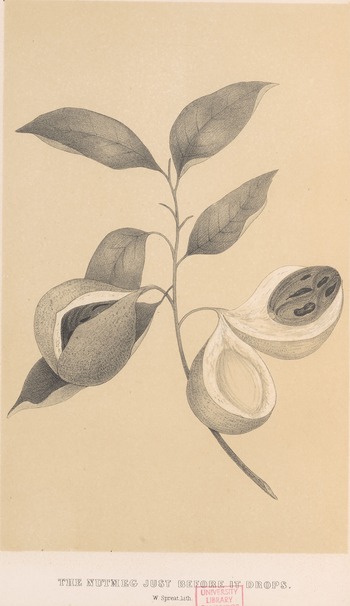
It was the quest for the fabled spices clove (Syzygium aromaticum) and nutmeg (Myristica fragrans) that had propelled the first Portuguese trading expeditions to Southeast Asia in the fifteenth century, with Dutch and English traders following a century later. Highly prized in Europe mainly for their medicinal properties, these commodities were produced only on the so-called Spice Islands in the Moluccas (Maluku). Whereas the production of cloves was concentrated to Ternate and Tidor, the cultivated, ‘true’ nutmeg tree originated in the north Moluccas and had travelled to the Banda Islands in the early sixteenth century (fig. 1). After occupying the Bandas in the early 1620s, the Dutch used violent means to confine the production of nutmeg to these remote islands, where cultivation required strict policing and regulation in order to keep prices up.Footnote 30
‘The nutmeg just before it drops’. Lithograph by W. Spreat in ‘A Bengal civilian’ [Charles Walter Kinloch], De Zieke Reiziger: or, Rambles in Java and the Straits. In 1852 (London: Simpkin, Marshall & Co, 1853), opp. p. 125. Published by permission of the Syndics of Cambridge University Library.

This would change in the later eighteenth century, when French expansion in the Indian Ocean led to the emergence of a plantation economy in the Mascarenes, backed by a French Government increasingly assertive in its quest for new commercial crops. In the 1770s the French Physiocrat Pierre Poivre was sent out to the East as a commercial spy, and was eventually able to send seedlings of nutmeg and clove to Mauritius under great secrecy. Experimentation and acclimatisation in the Botanic Gardens at Mauritius were initially unsuccessful, but spice plants were swiftly distributed throughout France's tropical possessions within an expanding colonial botanical network, and by 1800 nutmeg was produced in commercially viable quantities.Footnote 31
It was then not far-fetched for Penang's aspiring planters, as well as the authorities, to suggest that this tropical island would also be suitable for nutmeg cultivation. There was initially a great deal of uncertainty about the difference between ‘true’ nutmeg grown in the Moluccas and local varieties, a distinction which had caused a great deal of debate among European botanists.Footnote 32 In Penang, Francis Light noted early on that nutmeg sold in local markets did not have the quality of the commercial spice, and he managed to bring, ‘at great expense’, not only cloves and nutmeg but also cinnamon from Mauritius to Penang.Footnote 33 There was, however, then little knowledge in Penang about how to care for spice plants, and the first shipments expired.
It was eventually the turn of events in Europe which enabled Penang's transformation into a British spice garden. Following the British occupation of Ambon and the Banda Islands in 1796, the East India Company botanist Christopher Smith was sent to the Moluccas with the explicit order to obtain and send back seedlings of nutmeg and clove. The first shipment of 600 nutmeg seedlings and half a dozen clove trees were sent to Penang with the returning invasion fleet in November 1796. Smith, a former assistant to Joseph Banks, initially spent 18 months in the Moluccas. Returning in 1799 he spent another four years in Banda, organising for spice seedlings, trees and other plants to be shipped to India and the British trading post Bencoolen (Benkulu) in east Sumatra, but also further afield to the Botanic Gardens at Kew, the Cape Colony and St Helena.
The great majority of spice plants shipped from the Moluccas ended up in Penang: 71,266 nutmeg and 55,264 clove plants were received in 1802, and the following year, spice seedlings arrived on seven different ships.Footnote 34 The Court of Directors declared that Penang was ‘the most eligible spot of all the East India Company's possession for spice cultivation’ and at least initially pledged official support for the island's European spice planters.Footnote 35 In Penang, however, the relentless shipments seem to have overwhelmed the authorities. Some of the plants were given to Chinese smallholders, large numbers were distributed among European planters, but many ended up in the Company Garden.Footnote 36
The Bengal Council had issued Light with instructions to establish a Company Garden in Penang already in May 1786. There was a long tradition for European trading posts to include a garden where vegetables and medicinal plants were grown. By the end of the eighteenth century, these botanical gardens were becoming important sites for experiments with commercial crops and centres for plant exchange, and it was within this thinking that a botanical garden had been founded in Calcutta in 1787.Footnote 37 In Penang, there was initially much enthusiasm for the prospect of the Company Garden becoming a hub for regional plant experimentation, and detailed reports on the progress of spice plants were dispatched to Calcutta.Footnote 38
However, there was little expertise in Penang in the handling of spice trees, and labour was in short supply. Many plants died, and in 1802 only 33,000 clove and nutmeg trees were said to be in cultivation on the island.Footnote 39 This meant that nutmeg plants became a valuable commodity: in 1803 a regulation was introduced whereby spice plants had to be registered, and the theft of nutmeg plants was severely punished.Footnote 40
In 1805 a report recommended that support for nutmeg cultivation in Penang should be abandoned, as it was argued that the tree seemed to thrive much better in Bencoolen.Footnote 41 Later that year Lt Governor Robert Farquhar, said to be more interested in spending money ‘on his own luxury and on useless fortifications’, decided to sell off the spice trees in the Company Garden at twelve days’ notice.Footnote 42 The abrupt sale reflected official disinterest in Penang's agriculture which lasted until the early 1820s. A new garden was founded in 1822, initiated by the ‘botanical schoolmaster’ George Porter, but in 1834 this second garden was also sold within a few years.Footnote 43 With no Company Garden it fell to individual private planters to experiment their way to successful spice crops. Most prominent of these was David Brown, who at one point grew four-fifths of Penang's nutmegs on his Glugor estate.Footnote 44
Although prices fell sharply in 1816,Footnote 45 enthusiasm for nutmeg would return in the wake of the Anglo-Dutch Treaty in 1824, which divided up the Malay world into two distinct spheres of interest along the Straits of Malacca. This meant that Bencoolen and its nutmeg plantations were lost to the British.Footnote 46 In Penang, however, there was at first reluctance to invest in spice cultivation due to the unsatisfactory land situation.Footnote 47 Another issue of concern was the duty levied on spices grown in Penang, which was the same as for spices produced in India. Penang's planters argued that they were still experimenting with spice trees ‘in a climate and soil foreign to them’, resulting in high production costs. A petition to lower duties was launched in 1825, another in 1830, as planters bitterly complained that the government seemed to be totally ignorant of the difficulties of this new colony.Footnote 48 Both petitions were turned down, but a third succeeded a few years later.
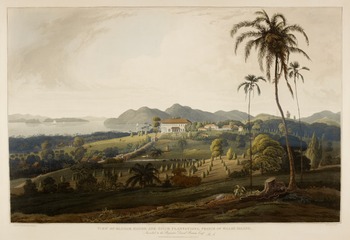
In the 1830s both Penang and Singapore became gripped by a ‘nutmeg mania’, with tens of thousands of new trees planted. In 1836 there were around 80,000 spice trees on Penang Island and Province Wellesley.Footnote 49 A rosy future for nutmeg cultivation was now predicted, as the Pinang Gazette mused in 1838: ‘wherever we turn our eyes we meet young plantations rising up, of all extents … New clearances are taking place every day, plantations forming, and when these operations will cease is difficult to say’, and it was predicted that the whole island was about to become ‘one vast Spice garden’.Footnote 50 By 1853 nutmeg trees covered 9,430 acres in Penang, and seven years later 13,153 acres were devoted to spice cultivation.Footnote 51 Paintings and prints depicted Penang's rolling landscapes, relaying a message to Britain of a colony covered in orderly rows of trees amid beautiful country residences (fig. 2). These were the homes of traders turned plantation owners, many of humble origins, a poignant illustration of the prospects for social mobility offered on this remote island.
‘View of Glugor House and Spice Plantations, Prince of Wale's Island’. Aquatint by William Daniell, after Robert Smith (1818). © British Library Board, X 685, plate 5.

But the high prices which propelled Penang's nutmeg boom also led to an increase in nutmeg production in the Moluccas, and to ‘wild’ nutmeg flooding the market, all resulting in a sharp price fall in the later 1840s.Footnote 52 It was also around this time that the ‘nutmeg canker’, then thought to be a disease, was first noticed. By 1854 half of Penang's nutmeg trees were affected, and the situation worsened after droughts in 1860. Within a few years the island's nutmeg plantations were all but abandoned, nutmeg now seen ‘a most disastrous deception to all who have engaged in its cultivation’.Footnote 53
Growing nutmeg
Whereas the island's smiling and ordered spice gardens impressed European visitors, for the spice planter the road to a successful and profitable crop was rocky and unpredictable. The very first task had initially been to keep seedlings alive during the sea voyage from the Moluccas, and many larger specimens expired en route.Footnote 54 Whereas commodities such as coffee and sugar could be grown in a variety of soils, it was acknowledged that nutmeg required specific soil conditions. It was also clear that the relatively heavy soils of Penang bore little resemblance to the light and rich volcanic soil of the Bandas. Measures such as banking up soil to retain moisture were suggested, and various soil experiments were carried out in the Company Garden. In the end, an island-wide search for perfect soil conditions failed, as it proved too difficult to monitor shipments distributed among private planters.Footnote 55
Whereas the French had experimented with various growing techniques for decades, to the British nutmeg was largely an untried crop, and the scarce knowledge available was exchanged with sites elsewhere. Numerous reports were dispatched to Calcutta, from where the superintendent of the Botanical Garden sent back reports with information about experiments carried out in the West Indies and Bencoolen. One of many unanswered questions was how many years it would take for trees to blossom and bear fruit, which, it was agreed, had to be different from the Moluccas. There was also a great deal of debate about how densely the trees should be planted.Footnote 56 Nutmeg trees are dioecious, whereby only female trees produce nuts, something it had taken the French in Mauritius a long time to establish.Footnote 57 Although Penang's planters were aware of this, it was still not possible to determine the gender of a tree until it blossomed, after which most of the male trees were removed. As in Mauritius earlier, the inability to determine the gender of young trees would cause much uncertainty and add to labour costs.
Another issue debated in Mauritius was whether nutmeg trees should be exposed to sunshine. In Penang, it was agreed that young plants should be protected, and a method tried out in the Company Garden was to cover young trees with a conical shade of grass, but this was labour intensive and costly.Footnote 58 In the Bandas nutmeg trees grew in the shade of large trees, and from there Christopher Smith had early on warned against the cutting down of Penang's forests. Whereas he thought that Penang's topography, with ‘hills and valleys’ would provide perfect growing conditions for nutmeg trees, Smith's strong advice was that only low shrubbery should be cut, so that taller trees could be left to provide shade, to form the ‘most natural, and consequently the most proper situation’. The nutmeg ‘parks’ in the Bandas were in fact ‘exactly similar to the rude state of Prince of Wales Island’, Smith pointed out.Footnote 59 This advice was not adhered to, as spice trees were planted in orderly rows in cleared land without shade trees. This seems to have been at least partly based on information exchanged with Bencoolen, where nutmeg was grown without shade trees and clean weeding was mandatory, with the soil kept free from cogon grass (lalang) by the use of hoe and plough.Footnote 60
This strategy was, however, not supported by all. As mentioned, it was claimed at the time that Governor Farquhar's decision to sell the Company Garden in 1805 was due to his disinterest in agriculture. However, it is clear from Farquhar's reports to Calcutta that he was in fact an eager and knowledgeable promoter of spice cultivation, having earlier been stationed in the Banda Islands for three years. What he objected to was the growing methods in the Company Garden, as he saw it as a grave mistake to plant nutmeg trees into cleared and cultivated ground ‘whereas they thrive best in thick woods of large timber, whose shelter and shade is necessary for their coming to perfection’, and where they would have required little care and attendance. In Penang Farquhar had himself witnessed how ailing spice plants which had been moved to ‘proper shaded situations in the Jungle’ had quickly recovered.Footnote 61
This call for a natural, shaded environment for spice trees was soon forgotten. In 1836, James Low argued that it had been a mistake to plant some seedlings brought from the Moluccas under enormous forest trees, which prevented ‘dews and vivifying light’ to reach them. It was great ignorance on the part of spice planters, Low wrote, to think that spice trees would grow ‘almost without culture’.Footnote 62
The culture called for by Low depended heavily on access to labour, which in Penang initially was both scarce and costly. The first spice seedlings to arrive from the Bandas were accompanied by four minders, ‘park slaves’, but the relentless shipments of plants arriving in Penang meant that further labour was quickly needed. Although slave labour was still used to run spice plantations in the West Indies, it was the strong belief of the authorities that this was not an option for Penang, where slaves were used only for domestic tasks.Footnote 63 Penang, however, had another source of labour: convicts transported from India. A group of 50 convicts initially worked in the Company Garden, and European planters such as David Brown were also allowed to use this cheap workforce.Footnote 64 But convicts were short in supply, many fell ill, and convict labour was badly needed for public building projects. The overseer of the Company Garden William Hunter soon had to ask the Governor for permission to employ Chinese labourers, and in 1805 it was reported that the garden was looked after by 80 ‘coolies’.Footnote 65
Although Penang's Malay inhabitants grew rice on cleared areas and initially worked on pepper plantations, the Malays were gradually dismissed as valuable agricultural workers. Already Governor Leith was of the opinion that the Malays were ‘incapable of any labour beyond the cultivation of Paddy’, and similar views were expressed by other British officials.Footnote 66 In Penang, wages for Malays working on European plantations were always lower than for immigrants from South India, arriving in increasing numbers and generally seen as good plantation workers. The highest wages were paid to the Chinese, without whom Penang, it was claimed, would have ‘little or no cultivation’.Footnote 67
In the end, most European plantation owners came to rely almost exclusively on Chinese labour, agricultural experience and techniques. On land owned by Europeans, groups of Chinese were often contracted to set up a plantation and work it for a certain number of years (usually three), using sinkeh labour.Footnote 68 This system was born out of the long-held view of the Chinese, that ‘few labourers in the world can equal them, when working on the account, but on regular wages are most complete eye-servants’,Footnote 69 but it also meant that little commercial risk was taken by the Europeans.
Chinese settlers in the Malay Peninsula had adopted more intensive farming methods, and had, for example, for a long time used a plough which turned the soil into a furrow. This was now used to prepare the ground for spice trees, having a distinct advantage over the Malay tengala.Footnote 70 Chinese methods were also used in the manuring of spice trees, an issue which would be debated among Europeans for decades. In the Moluccas spice trees were not manured, but in Penang it was initially thought that the island's soil had to be ‘dressed and manured’ in order for nutmeg to thrive.Footnote 71 In Bencoolen a mixture of cattle manure and burnt earth was regularly applied to nutmeg trees. This mix could not be more than a few months old, which meant that European spice planters in Bencoolen had to keep large herds of cattle.Footnote 72 Although it had initially been envisaged that Penang would be self-sufficient in fresh meat, both authorities in Calcutta and officials in Penang expressed doubts that the island could sustain cattle, as cleared land was too expensive to use for pasture.Footnote 73 Apart from the long established British view that the Malays were not a ‘pastoral race’, cattle also required large quantities of fresh water, not readily available on the island. In addition periods of drought brought on disease which killed cattle in great numbers, and it became increasingly clear that sufficient quantities of manure for larger plantations could not be obtained in Penang.Footnote 74
It was well known among Europeans that the Chinese ‘never let anything be wasted which can serve as manure’.Footnote 75 Chinese smallholders usually kept pigs, and pig manure mixed with burnt earth was widely used to fertilise spice trees. Alternatives included human waste, ‘urine from coolie lines, or night-soil’, as well as traditional fertilisers such as ‘prawn-dust’, fish refuse and blood. Carcasses of animals were also utilised: suffering nutmeg trees had been seen making a quick recovery after ‘a dead pariah dog or two’ were buried at their roots.Footnote 76
This was a time when the chemical composition of fertilisers attracted global interest, and European planters in the Straits began to argue that local Chinese practices did not pay sufficient attention to the composition of the manure applied: whenever a dead horse or cow was available ‘it is carted to the field and immediately applied as a fertiliser without admixture’.Footnote 77 European planters therefore began to modify Chinese methods: in the 1850s John Lumsdaine experimented with residue from plants, and saw promising results from mixing human waste with water.Footnote 78 A fertiliser used by both Malay and Chinese was bat guano (tai klawa) collected from limestone caves in Kedah and transported from Langkawi and other islands off the Malayan coast.Footnote 79 Emerging European interest in the highly profitable trade in South American guano turned British planters’ attention to this local fertiliser, but it was considered to be too strong to be applied on its own. Experiments were carried out mixing bat guano with crushed limestone, but this proved to be too costly.Footnote 80
Opinions were, however, divided about whether spice trees should be manured at all. In 1821 the British official Stamford Raffles, by then stationed in Bencoolen, wrote to David Brown in Penang: ‘you must manure—and manure high or you will do nothing. Our soil is far better than yours & you will see what we are obliged to do.’ In his reply, Brown maintained that in Penang trees had in fact become ‘large and luxuriant’ without manuring. Although there would be no general agreement on the actual effects of the use of fertilisers, it was increasingly argued among Europeans that both nutmeg and clove trees would remain ‘stunted and almost unproductive’ unless they were highly manured.Footnote 81 Eventually, over-manuring was suggested as having caused the death of Penang's nutmeg trees: the trees were simply exhausted by having been forced to produce heavy crops. This would also explain why Penang was more heavily hit than Singapore, as Penang's planters were by now ‘rich and could afford much manure’.Footnote 82
Several other theories emerged around the causes of the ‘nutmeg canker’. Many blamed the inexperience of European planters, who furthermore had simply neglected their trees after prices had fallen. Others pointed to Chinese smallholders, who were said not to have planted trees deep enough.Footnote 83 Another theory was that the old tree stock had deteriorated, and officials were sent to the Banda Islands to obtain fresh plants and seed nuts.Footnote 84 There was also a suggestion that the nutmeg trees were suffering from the effects of a change in climate.Footnote 85
Climate change
Whereas debates arose around soil conditions and fertilisers, the fact that Penang's tropical climate was very similar to the Moluccas and so ideal for nutmeg cultivation was not doubted. This meant that it was assumed that plants would not require watering unless there were long periods of drought, something which was initially thought to be exceptional in Penang.Footnote 86 But periods of diminished rainfall did occur. Droughts were reported in the first months of 1822, and James Low described an ‘unprecedented’ drought lasting four months in 1832, when nutmeg trees lost their leaves, fruit ‘shrivelled up’, and plantations were only saved by intense and expensive watering. Another dry period occurred in 1835, when forest trees became so dry that they caught fire and perished.Footnote 87 A drought was also reported in 1843, but the following year spice plantations had already recovered to assume their ‘former luxuriant verdure’. As feared, however, the drought was repeated the following year, with the Gazette reporting that ‘the whole labour of the planter is now applied to watering the trees’ in order to save the plantations.Footnote 88
The impact of droughts on agriculture, and nutmeg in particular, would provide the impetus for more systematic climate observation. The surgeon T.M. Ward who collated and published weather observations from Penang in the late 1820s did note droughts, but did not speculate on their occurrence.Footnote 89 Writing a decade later, however, the official T.J. Newbold concluded that droughts in the Straits seemed to occur every four or five years, with more severe occurrences at longer intervals. A decade later the British lawyer James Richardson Logan also sought to determine the frequency of droughts in Penang, suggesting intervals of five or six years.Footnote 90 Spice plantations then served to attract attention to the cyclical nature of droughts, but it was the ecological impact of cultivation that would generate a wider debate, propelled by climatological theories of the day.
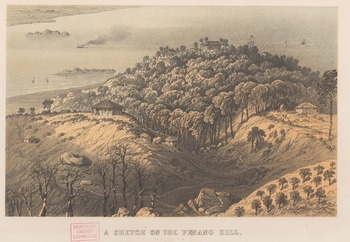
From the start, Francis Light had been instructed by the authorities to be ‘cautious of not falling into a common Error, in settling Countries overgrown with Woods, which is that of causing every Tree to be cut down’.Footnote 91 These early remarks seem to be stemming mainly from aesthetic rather than ecological concerns, and early visitors to Penang were dismayed by the bare patches, scrub and rocks visible in the hills which ‘loomed heavy and shapeless after their primeval forests have been destroyed’ (see fig. 3).Footnote 92
‘A sketch on the Pinang Hill’. Lithograph by W. Spreat in ‘A Bengal civilian’ [Charles Walter Kinloch], De Zieke Reiziger: or, Rambles in Java and the Straits. In 1852 (London: Simpkin, Marshall & Co, 1853), opp. p. 130. Published by permission of the Syndics of Cambridge University Library.

A development closely linked to the nutmeg boom in the 1830s was official lenience regarding the establishment of untenured smallholdings set up by groups of Chinese, referred to as ‘squatters’, who cleared small patches of land in ‘less favourable localities on the hills’.Footnote 93 In between food crops such as vegetables, hill rice, and plantains, the Chinese planter grew cash crops. In the 1830s, nutmeg became the most favoured of these cash crops, driven by price increases.Footnote 94
The increase in Chinese smallholdings meant clearing of new land, something noted by various visitors to Penang. It was suggested that the deforestation would cause an increase in diseases, and in the 1840s more serious ecological concerns were raised among British officials.Footnote 95 The most powerful intervention was delivered by Logan, who had been stationed in Penang for several years.Footnote 96 In 1848 Logan published a paper which he had earlier given to the Asiatic Society of Bengal. Appearing in his own Journal of the Indian Archipelago, the article entitled ‘The probable effects on the climate of Pinang of the continued destruction of its hill jungles’ fiercely attacked the authorities’ land policies, whereby Chinese settlers were allowed to clear forest in the hills.Footnote 97
Importantly, Logan's concern was not soil erosion, but climate, as he explained how forests in mountainous areas played an important part in condensing clouds, predicting that the uncontrolled expansion of cultivation in Penang's hills would result in diminished rainfall and higher temperatures. It had, Logan wrote, become an ‘urgent necessity for a stop being at once put to a war with nature, which must entail severe calamities on the future’. He therefore called on the authorities to follow the governments of Germany and France, where laws had been created to safeguard the preservation of forests.Footnote 98
Logan's references to the German scientist Alexander Humboldt and the French chemist Jean-Baptiste Boussingault make it clear that his concern for Penang must be seen in the light of rising global environmental awareness around this time. The 1790s had seen the emergence of ‘desiccation’ theories, initially proposed by Humboldt, who, based on his work in South America, had argued that the disappearance of forests led to a change in rainfall, as forests around mountains in particular were thought to attract and condense clouds. In the 1830s Humboldt's theories were promoted in Britain by Boussingault, igniting debates on the climatological effects of deforestation within the British colonial administration.Footnote 99 These debates focused on India, but desiccation arguments were not confined to British colonial possessions: in the Dutch East Indies both civil servants and scientists warned the Government in Batavia of the danger of the clearing of hill slopes in Java, in a development which eventually led to a protection scheme for teak forests.Footnote 100
Through his own observations, Logan was able to hold up mountainous Penang Island as a prime example of the actual workings of Humboldt's desiccation theories. During the following decades, Logan's article would be referred to in the collating of global examples of the impact of deforestation, propelling emerging conservationist thinking within the British Empire. Penang became one of the central cases brought up by a committee set up by the British Association for the Advancement of Science to investigate the climactic impact of deforestation in the tropics. Reporting in 1852, the committee pointed to Penang, where Chinese ‘squatters’ were said to have totally destroyed the forests of the hills, urging the Government to take action.Footnote 101 In the 1860s, Penang was again held up as a reminder of how climate change was ‘entirely the consequence of human action’, as the island emerged as an important example in increasing, Empire-wide evidence of the consequences of deforestation.Footnote 102
Conclusion
Shortly after his landing on Penang Island Francis Light was instructed by officials in Calcutta to collect local plants and experiment with new crops, being reminded that ‘we are twenty years behind hand with ev'ry other European Nation possessing Settlements in the East, and you will agree that we ought to make up as quickly as we can for the lost time’.Footnote 103 Making up for lost time meant improvisation and uncertainty, and historians have agreed with the views of contemporary commentators: early commercial cultivation in Penang turned out to be an ‘almost unrelieved failure’.Footnote 104
Whereas the ‘canker’ was the immediate reason for the death of Penang's nutmeg trees, it is clear that several long-term factors played a part in the ultimate failure to sustain large-scale plantations. Uncertainty over land tenure had been resolved by the 1840s, but the lack of experience and knowledge about nutmeg cultivation was felt throughout the period. Most importantly, this was a crop that required long-term investment, in an agricultural environment which was changing fast. The amount of time by which any return could be expected was found to be between five and nine years, and in Penang (unlike the Bandas) trees were carefully looked after during the long maturation periods. This meant not only heavy dependence on long-term inputs of capital but also increased vulnerability to price fluctuations. Furthermore, as a consequence of the labour scarcity, wages paid in the Straits Settlements were much higher than for India and Java, Penang's competitors as spice growing regions.Footnote 105
The emergence of commercial nutmeg cultivation in Penang was largely coincidental, a result of Britain's sudden and temporary direct access to the Moluccas, a telling illustration of the haphazardness and improvisation which characterised British early expansion in Southeast Asia. Nevertheless, the quest for commercially successful crops in early Penang can also be seen through a prism of wider global developments and more specifically the role of agriculture in imperial expansion, brought to visibility in recent historiography.
Experimentation with ‘imperial’, non-indigenous crops promoted by the authorities did not take off, despite seeds, plants, and know-how being sent from around the Empire. Global scientific networks of knowledge were also at work when experiments with fertilisers were carried out. In the first decades of the nineteenth century advances in chemistry had created an intense interest in the chemistry of agriculture, and fertilisers in particular. Across the Empire, practical handbooks such as Elements of agricultural chemistry (1839) were widely read by colonial officials, signalling a new era of scientific farming and experimentation. Alexander Humboldt's promotion of the growth-promoting properties of Peruvian guano had sparked a global interest in bird dung as a fertiliser among both farmers and soil scientists in the 1820s. In the 1850s the trade in guano took off, a tightly controlled monopoly resulting in very high prices. In Penang, Lumsdaine's experiments with bat guano from Langkawi must be seen against the commercial and scientific interest in fertilisers at the time.Footnote 106
Similarly, reporting on the frequency and severity of droughts and their impact on Penang's spice plantations reflected increasing European awareness of the cyclical nature of the weather phenomenon now referred to as El Niño. Reports of regional droughts soon propelled initiatives to establish ‘the law of their recurrence’ in Southeast Asia.Footnote 107 Instrumental meteorological observations initiated in Penang and the setting up of a meteorological observatory in Singapore in 1841 at least partly had the purpose of establishing these laws.Footnote 108
Throughout this period, the Straits Settlements were seen as part of a larger ‘India’, and it is here that Penang can provide a counterpoint to imperial concerns on the Subcontinent. One example is the scholarship on the emerging concept of ‘tropicality’ among British officials in India. It has been suggested that the realisation that lush tropical vegetation did not mean fertile soil was slow and gradual in India, and Penang forms a pointed parallel.Footnote 109 Francis Light and his contemporaries were convinced that an island covered in lush forest must have fertile soil, but by mid-century John Crawfurd ridiculed earlier assumptions about Penang's fertility. This was now seen as a ‘vulgar error derived from the notion that the land, which grows huge forest trees, must, of necessity, be fertile’.Footnote 110 As in India, this insight had been hard-won.
Another strain of recent historiography has shown how ‘garden aesthetics’ reflected British thinking about its expanding empire at this particular time. In India, the emergence of large-scale plantations has been seen as driven by wider ideas of ‘improvement’, where tea and sugar plantations became emblematic ‘ideological spaces’ which would bring order and civilisation to an untamed land.Footnote 111 In Penang too, the transformation of the island ‘from a jungle to a garden’ was a recurring theme.Footnote 112 Additionally, the perceived beauty of the nutmeg trees themselves was often commented on, and in both Penang and Singapore the gardens of private residences were planted with rows of spice trees. Penang's spice gardens then form a telling example of the ways in which aesthetic considerations drove colonial agriculture.
The practicalities of nutmeg cultivation, experiments and discussions around growing techniques reveal not only how knowledge was transmitted through imperial networks, but importantly the workings of the ‘creolization of knowledge’.Footnote 113 Whereas it has been claimed that European willingness to acknowledge ‘indigenous’ knowledge about plants and growing techniques generally decreased in the nineteenth century, in Penang nutmeg planters could not afford not to rely on Chinese skills and methods.Footnote 114 Another example of the interplay between local experience and colonial ambitions presented here is the way in which nutmeg planters chose to ignore advice about the necessity for shade trees and warnings against clean weeding. The naturalist Alfred Russel Wallace, who himself had visited the Bandas, argued later that it was the ‘forced and unnatural system of cultivation’ in Penang and Singapore that had caused the fatal disease of the nutmeg, and the botanist Henry Ridley strongly advocated similar views, blaming ‘the habit of scraping every scrap of herbaceous plants from beneath the trees’.Footnote 115 It would take the failure of a variety of imported commercial crops for agriculturalists in the Straits Settlements to realise the dangers of clean weeding in tropical settings. From Melaka, where new crops habitually failed, the planter F.L. Baumgarten wrote that it was in fact necessary for clearing of the ground to be kept to a minimum in order for any cultivation to be successful, calling for a return to traditional diversification of crops in the Straits.Footnote 116
In 1848 one commentator dryly advised prospective nutmeg planters: ‘if he be in haste to get rich, let him attend to some other pursuit’.Footnote 117 By then, both European agriculturalists and Penang's Chinese planters were in fact already turning to other pursuits. From the late 1840s onward large sugar plantations were being established in Province Wellesley, bringing European plantation capitalists and monoculture to the Malay Peninsula.Footnote 118
In Penang, both soil conditions and topography prevented large-scale sugar cultivation, and in the 1860s former spice plantations were reported to be ‘formed into orchards and coconut groves’.Footnote 119 The idea of local crops being more suitable to Penang Island was not new. Already in 1800 Governor Leith argued for official support for the cultivation of coconut and betelnut, which, he pointed out, did not require clean weeding, was almost risk-free and had low labour costs.Footnote 120 But the prospect of large profits made from spices occupied the minds of Penang's planters for decades, and it took the death of the nutmeg trees for the island's agriculturalists to return to traditional crops. By the 1880s Penang had become a major regional exporter of coconut and copra, a parallel development to the return to indigenous crops and plant species which has been observed in India.Footnote 121 But the idea of imported crops was not given up: coffee cultivation was still attempted in the hills, until it was finally conceded that coffee would probably never thrive on Penang ‘without the shelter of large trees’.Footnote 122 But this was no longer an option, as colonial intervention had by then irreversibly changed the island's tropical landscape.