1 Introduction
The dynamic nature of reference means not only that terms are used to shift between different deictic positions but also that they can be used to express the speaker's attitude towards the referent. Stivers (Reference Stivers2007), for example, has found this to be true of what she calls alternative recognitionals, such as demonstrative pronouns this and that, in particular. Whereas the name is considered the unmarked reference form for recognitionals, alternative terms not only refer to a person but often are also markedly used to perform a certain pragmatic action, such as complaining.
This article deals with the use of deictic pronouns this/these and that/those as demonstrative determiners in person-referential terms in Early and Late Modern English personal letters. The material for the study comes from the Corpus of Early English Correspondence and its Extension. The data chosen for this study cover personal correspondence between 1600 and 1800. The period in question has been shown to be critical in relation to changes in, for example, the use of address forms, as well as person reference (see e.g. Nevala Reference Nevala2004, Reference Nevala2009).
The main purpose of the study is to show the link between the use of such demonstratives and what e.g. Tajfel & Turner (1979; also Hogg & Abrams Reference Hogg and Abrams1988) call social identification. It concerns when and why individuals identify with social in-groups and adopt shared attitudes to members of the out-group. Moreover, my study concentrates on the diachronic use of referential expressions, which is then mirrored against studies on the present-day use of demonstrative determiners in reference. Since research shows that use of person reference in Modern English is biased towards group distinction, linking positive characteristics to members of one's in-group and distancing people in the out-group with negative reference, it might be that this was the case in historical language use as well.
This article will study the form of the referential terms in question and the frequency of these terms in the material. In particular, I will examine which pragmatically evaluative functions are the reasons for their use: can they be recognised as negatively, positively or neutrally connotative, and if so, is it the term itself or its immediate textual context which guides the reader's interpretation? Moreover, the aim is to discuss whether the different types of connotation are linked to the relationship between the writer and the referent and the way in which the writer identifies the referent in relation to his/her own in-group and possible out-group(s).
2 Reference in identification
2.1 Social identification and group membership
In Tajfel's (1982; also Tajfel & Turner Reference Tajfel, Turner, Austin and Worchel1979) Social Identity Theory, a person has not one, personal self, but rather several selves that correspond to the widening circles of group membership. Apart from the level of self, an individual has multiple social identities. Social identity is the individual's self-concept derived from perceived membership of social groups: it is the perception of what distinguishes ‘us’ from ‘them’. The theory asserts that group membership creates in-group or self-categorisation in ways that favour the in-group at the expense of the out-group (see also Gumperz Reference Gumperz1982; Jenkins Reference Jenkins2004).
Tajfel & Turner identify different stages in the building of one's social identity. Firstly, the process starts with categorisation: people have an inbuilt tendency to categorise themselves into one or more ‘in-groups’. This entails building a part of one's identity on the basis of a membership of the in-group and enforcing boundaries with other groups. Secondly, when the in-group has been established, the identification process can begin. In this stage, people identify themselves with their group, preferring other members of their group and favouring them with rewards that maximise their own group's outcomes. The third stage involves comparison between one's own in-group and any out-group. This is usually when stereotyping and labelling of the out-group members begins. The fourth and final stage relates to psychological distinctiveness: people identify with groups so as to maximise positive distinctiveness. Groups offer both identity (they tell us who we are) and self-esteem (they make us feel good about ourselves).
In other words, social identification concerns how, when and why individuals identify with social in-groups and adopt shared attitudes to members of the out-group (Hogg & Abrams Reference Hogg and Abrams1988). In-group bias is an effect where people tend to give preferential treatment to others when they are perceived to be in the same in-group. Social identity attributes the cause of in-group bias to a psychological need for positive distinctiveness and describes the situations where in-group bias is likely to occur (as a function of perceived group status, legitimacy, stability and permeability). In general, individuals ‘strive for a positive self-concept’ (Tajfel & Turner Reference Tajfel, Turner, Austin and Worchel1979: 40).
People do not construct only their personal Self but also a social Self as a part of a group or community (van Dijk Reference van Dijk2009: 71). According to Stivers et al. (Reference Stivers, Enfield and Levinson2007: 4), when we describe a person, we commit to selecting some features and not others as constituting ‘the description’. The same applies to the description of different social and societal groups and communities. Social groups usually share ideologies, which define their identity and relations with other groups, whereas communities typically share cultural properties, such as knowledge, language, religion and customs. Both groups and communities are defined not only by their members, properties of members, interaction, organisation, etc., but also by their shared social representations, such as knowledge for communities, and goals and ideologies for groups (van Dijk Reference van Dijk2009: 143–4). Both function within a broader sociological frame of different types of collectivities, in terms of the presence or absence of such characteristics as membership access and inclusion/exclusion (in-group/out-group), shared knowledge and goals, shared language, shared norms and values (also attitudes and ideologies), as well as reference groups (‘us’ vs ‘them’).
Social conventions become even more central in such communicative situations where there are more than two participants. The tension caused by the use of different referential expressions for the same referent, i.e. the acknowledgement of the different social roles of the referent, is usually solved by making compromises between the expressions the speaker would use of the referent and the ones the addressee or the audience would use. The common ground is a symmetrical form of shared knowledge: it joins the speaker and the addressee and puts them on a roughly equal footing relative to the referent. It makes no difference whether the participants are separated spatially or perceptually, they nevertheless share specific knowledge of the referent based on experience prior to the speech event (Hanks Reference Hanks, Duranti and Goodwin1992: 68; also Clark & Marshall Reference Clark, Marshall, Joshi, Webber and Sag1981; Rickford & McNair-Knox Reference Rickford, McNair-Knox, Biber and Finegan1994; Clark & Bangerter Reference Clark, Bangerter, Noveck and Sperber2004). According to Schegloff (Reference Schegloff and Barbara1996: 458–9; see also Clark & Murphy Reference Clark, Murphy, Le Ny and Kintsch1982), this can also be recipient design: it means that reference forms are chosen on the basis of who the addressee is and what the addressee knows about and understands with respect to the referent. Or as Hanks (Reference Hanks1996: 178; also van Dijk Reference van Dijk2009) puts it, referential terms categorise utterance situations, meaning that the more people have in common, the more deictic expressions can be used. Such referential expressions as unelaborated noun phrases, proper names and pronouns can even be considered ‘critically’ dependent on the interlocutors’ common ground (Smith & Jucker Reference Smith and Jucker1998: 160; also Wilson & Zeitlyn Reference Wilson and Zeitlyn1995).
The actual content of group behaviour (what people actually think and do as members of a group) is shaped by more macro-level dimensions of social identity processes (Hogg Reference Hogg, Thye and Lawler2005: 208–9). Tajfel (Reference Tajfel1982) sees stereotypes not only as descriptive but also as functional, in that when we have a certain stereotype of an out-group as being, for example, incompetent, it serves to justify and legitimise our actions. So, groups often define their identity by their common opposition to some enemy or ‘out-group’. While this process can be very effective in strengthening the ‘in-group’, it does so by significantly intensifying the intergroup conflict. Social stereotypes are generalisations, or assumptions, which people make about the characteristics of all members of a group, based on an image (often incorrect) about what people in that group are supposed to be like. Stereotypes and social beliefs are generally embedded in and part of relatively coherent ideological belief systems that explain and justify our place in the world and our relations to other people and groups, and prescribe particular forms of individual and group-based conduct and social action (Hogg & Abrams Reference Hogg and Abrams1988).
2.2 This and that as social identifiers
In language use, intergroup relations are often manifested in so-called in-group and out-group discourse. The majority culture comes to be seen, and talked about, as the norm, and that of the minority group as the ‘other’. Typically in discourse, this is achieved by creating an opposition between ‘us’ and ‘them’. Perdue et al. (Reference Perdue1990) have found, for example, that words referring to in-group categorisation (e.g. first-person plural pronominal forms such as us, we, ours) may induce primarily positive connotations, whereas out-group-referent pronouns (such as them, they, theirs) are more likely to accumulate less favourable, or even negative, connotations. Pronouns may work as a tool for introducing evaluative biases to new and unfamiliar people: if one uses an inclusive in-group designator, like we, to refer to a person, one may automatically establish a positive predisposition towards that referent. Respectively, the use of an exclusive out-group designator, like they, may in turn elicit a less positive or even negative predisposition.
Indexicals like demonstrative pronouns this/these and that/those express in themselves proximity in relation to the speaker. In the history of English, both this and that derived from the Old English demonstrative þes, þēos, þis.Footnote 1 The Old English nominative plural was þās, now represented by those, which functions as the plural of that. Middle English þēs is now in turn represented by these. According to the OED, this is used as a demonstrative determiner when referring to something as known, talked about, or inferred. Similarly, the determiner use of that indicates a person or thing assumed to be known, or to be known to be such as is stated. If that is used in front of a person's name, it often implies censure, dislike or scorn, but sometimes also commendation or admiration.
Negative labelling in particular means creating and maintaining negative impressions, which can be aided or achieved through the use of ‘labels of primary potency’, labels which are seen to be of such significance that they overshadow any other labels. Certain characteristics carry more perceptual potency than others, and signal difference from what is considered mainstream (e.g. ethnical distinctiveness). Identity terms also often encode negative social stereotypes. In the case of ethnic groups, verbs such as riot, hate or fight may be used more often than verbs which carry a more positive connotation.
My study will look at the use of person reference as a linguistic act which always carries the element of performing some kind of social action, here more closely defining the relationship between the writer and the referent on the in-group–out-group axis. However, referential terms and expressions can be, and often are, used not only indexically to express e.g. membership categorisation, but also to do actions other than referring (Schegloff Reference Schegloff2007). Demonstratives like this and that are often markedly used to perform a certain pragmatic action, such as complaining. When used alone to refer to a person, that can, for example, even be considered ‘grossly offensive’ (Mühlhäusler & Harré Reference Mühlhäusler and Harré1990: 108). According to Stivers (Reference Stivers2007: 86), the demonstrative that can be used not only to show that the referent is outside the speaker's interactional focal area, but also to foreground a complaint sequence before any actual complaint has been made. Such demonstratively determined phrases like that next door neighbour do not actually associate the referent to either the speaker or the addressee; the demonstrative that is used to show that the referent is outside the speaker's interactional focal area. When compared to the form our nextdoor neighbour, that nextdoor neighbour can, however, be seen to denote a critical complaint towards the neighbour in question. The term nextdoor neighbour does not in itself suggest there is anything wrong with the referent, but adding that to the term changes the whole interpretation (Stivers Reference Stivers2007: 86–7). Similarly, Gernsbacher & Shroyer (Reference Gernsbacher and Shroyer1989) have found that the pronoun this can be used as what they call ‘a cataphoric device’, in that it often influences the way in which the referent is mentally represented and thus makes it easier for the listener to access that mental image in the subsequent narrative.
Most of the contemporary research on referential terms in general and demonstrative pronouns in particular, like Stivers’ and Gernsbacher & Shroyer's studies, has been conducted on spoken English. My purpose is to investigate whether the results from these studies are comparable to written, historical language use. In the current study I will concentrate on issues like the negatively and positively connotative terms and their immediate textual contexts. I am interested in whether this and that are used as indicators of either positive or negative attitude towards the referent, since the above-mentioned studies have particularly shown that the pronoun that is often used for negative foregrounding and labelling in Present-Day English.
3 Material and method
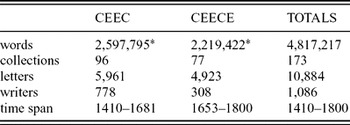
The material for the study comes from the seventeenth- and eighteenth-century part of the Corpora of Early English Correspondence (CEEC-400), which in full consist of c. 5.2 million words of personal correspondence from the Late Middle to Late Modern English period (c. 1400–1800).Footnote 2 The corpus has been built by converting material from printed letter editions into electronic form and annotating the data to facilitate linguistic searches. This has made it possible to study, for example, the long-span development of the language of particular informants, as well as the written interaction between certain writers and recipients. Table 1 includes more detailed information on the CEEC proper and CEEC Extension used in the current study.
The CEEC and CEECE

* The exact word counts for the centuries relevant to the current study are 1,931,278 (seventeenth century) and 1,932,683 (eighteenth century).
I have concentrated my searches on the use of this/these and that/those as a demonstrative preface prescription, meaning that I have taken in all the indexicals in which the pronoun is used together with (a premodifying adjective and) a noun or a proper name. Different types of referential noun phrases in the material, both in their cataphoric and anaphoric uses, include such NPs as demonstrative pronoun + noun (this girl), demonstrative pronoun + adjective + noun (this pretty girl), demonstrative pronoun + noun + of-possessive (this girl of mine), demonstrative pronoun + (title) proper name (this Mr Johnson). Therefore, cases like these two or that one have been excluded from the current study.
The resulting examples have been divided into different categories according to their pragmatic function. For the purpose of the analysis I have categorised the expressions (i.e. the adjective + noun combinations) into positive, negative and neutral. The categorisation depended primarily on the adjective(s) (when they were present) and the immediate context of the term or expression, and was not easy to carry out in every case. The adjective played a significant role in determining the evaluative status of the noun, particularly, of course, in examples where the noun itself was (fairly) neutral in tone. But adjectives like poor, for example, could carry either positive (when writing about one's own family member), negative (used of local misfits) or neutral (used of the treatment of poor people in society). In each case, the semantic interpretation of the term itself was further corroborated by close reading of the context.
In addition to categorising the examples according to an evaluative scale, I have used a binary pragmatic division into those referential terms which were used of a person in the writer's in-group and those used of someone in the writer's out-group. The categorisation used in the CEEC for determining the proximity between the writer and the recipient has been applied as the rough basis for the division: referents such as family members, other kin relations and close friends and colleagues may thus form the writer's in-group, whereas referents in the out-group most often are those who are more distant to the writer. The division is not, however, clear-cut, since e.g. acquaintances can be considered both close and distant, depending on the strength of their social network ties. Moreover, the writer's or the referent's social status may also influence the analysis in certain contexts, particularly when the writer aspires to the referent's, or the recipient's, in-group.
The purpose of the study is to draw some parallels on how the pragmatic function of the indexical pronoun and the writer–referent relationship are connected to each other in general, and in relation to the positive–negative description in particular. By drawing these parallels, we can observe whether the writers tend to refer to the members of their out-group(s) with more negative terms than positive, and, respectively, whether they give their in-group members positive rather than negative characterisations, as suggested in the Social Identity Theory.
4 This and that
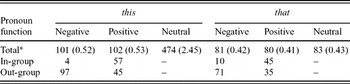
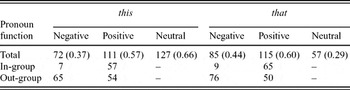
The use of the demonstrative pronouns this and that as a part of a person reference term is relatively scarce in the data. In both the CEEC and CEECE, there appears to be a considerable drop in the number of instances of this from the seventeenth to the eighteenth century, from the total of 677 down to 310. The use of that remains, however, approximately the same, 244 to 257, respectively. Tables 2 and 3 show the totals of both pronouns and the distribution of the instances according to their evaluative function (negative, positive and neutral) and the referent's group membership respective to the writer (in-group and out-group).
This and that in seventeenth-century correspondence

* The total number of instances in each table also includes the relative frequency per 10,000 words for each functional category (in brackets).
This and that in eighteenth-century correspondence

If we take a closer look at the number of the seventeenth-century instances according to their pragmatic function, we can see that while the use of that is equally distributed between all three categories, the use of this is much more frequent in the neutral than in the other functions. Based on these figures alone, it seems there is no connotative bias towards either positive or negative interpretation, as both pronouns are used more as mere indexicals.
The division of the referents into the writer's in- and out-group members shows more variation. This is more frequently used in noun phrases referring to out-group members (142 instances) than to in-group ones (61 instances). Similarly, the use of that of an out-group member (106 instances) is more common than its use of an in-group member (55 instances). The differences between this and that are not, however, striking as such, and thus it appears that according to the data, the writers have no clear preference for either pronoun when referring to someone outside their own in-group.
In the eighteenth century, this is mostly used in neutral contexts, whereas the use of that appears to be most common in the positive function. When the pronouns are compared, the number of instances in the neutral category is generally higher for this than for that (0.66/0.29), although there is a big drop in the neutral use of this from the seventeenth to the eighteenth century.
If we look at the distribution according to group membership, the same as in the previous century appears: both this and that are more often used of out-group (119/126) than in-group referents (64/74). While most instances of in-group reference fall into the positive category for both pronouns, in out-group reference there is a slight preference for the negative function. The differences in the use of the pronouns are, however, too small to make any far-reaching generalisations. Also in this respect the results from the data do not show much diachronic change.
As I mentioned earlier, there are two different ways in which we can determine the evaluative function of the reference term. The evaluation between the positive, negative and neutral characteristics of the pronouns was done either by looking at the NP itself (term-based) or the immediate context outside the NP which in most cases included a further description of the referent (context-based). Examples (1) and (2) show instances of this in negative description. In the first example, the term itself is clearly slandering, as William Petty uses it to refer to an old carpenter whom he happens to meet.
(1) Within 2 dayes I mett with Mr Houblon of whom I inquired concerning this Choleric old Coxcomb. (1687, William Petty)
(2) Is not this Lord B[arnard] a sort of a Plague of Egypt to us. I desire nothing more than ones to have an end with him, and for ever to add him in the Church litany. (1709, Anne Clavering)
In example (2) the reference term itself is indexing and the pronoun this functions here more as a device which foregrounds the following negative description of Lord Barnard. The effect would have probably been the same with the term that Lord Barnard, the only difference being that when using this, the writer indicates that she is or has somehow been dealing with the referent and, although he would not be considered a member of her in-group, she knows him and his character. The use of this also indicates that the recipient of the letter knows the referent in some way.
In the next examples (3) and (4), this is used in positive description. John Holles refers to Mary Talbot, Countess of Shrewsbury, with the attribute charitable and his positive attitude towards the referent also comes across later in the sentence. Much of the use of this in this context emphasises the fact that the Countess has kindly employed Holles, wherefore Holles considers her, or at least he himself aspires to be, a member of the in-group.
(3) Now it may be this charitable Countess remembering the Kings employing me in the search of her abbey of Rufford made it parcell her bargain, that uppon the first occasion my Lord Cook should remember that kindness. . . (1616, John Holles)
(4) I shd. be sorry, I assure you, to part with this man. He has true Musical feelings, & relishes Em. Bach, Haydn, &c., tho’ as a fidler he is shambling & incorrect. He loves humour, & has that modest quietness, & unpushingness (a pretty vocable!) about him, that never did anything but harm to its possessors since the world stood. (1784, Thomas Twining)
In example (4), Thomas Twining uses the plain term this man. In itself, the term does not tell us much about the referent, nor the writer's relationship with him, but, again, the description is complemented by the following context. Although Twining's account includes some negative qualities (shambling, incorrect), the reader is given a generally positive and sympathetic picture of the referent. All in all, the use of this in the term adds to the impression that the writer is on the referent's side and considers him, if not a close friend, at least a close acquaintance.
The pronoun this in examples (5) and (6) is a part of a reference term which has a neutral function. In the first extract, this is used in a very typical phrase found in many letters of the time, since it was common to mention the bearer of the letter, particularly when the writer sent the recipient something in addition to the letter itself or when, for example, the writer wished the recipient to employ the carrier. In this case Brilliana Harley has sent her son some of his things, and by mentioning the bearer, she also makes sure the son knows who has been responsible for their delivery, should something be missing. Neither the term nor the context includes an evaluation of the referent.
(5) I haue, by this carrier, sent vp your rwiteing boox, and your boox of bookes. I pray God blls you, and beleeue you are most deare to, Your most affectinat mother, Brilliana Harley. (1642, Brilliana Harley)
(6) I shall perhaps see Sir W[alter] Y[onge] this afternoon and shall speak to him as you desire about Selby. This knight's son is upon the point off committing matrimony with a niece off Sir Gil[bert] Heathcote's. (1716, Henry Liddell)
Example (6) shows another kind of neutral reference. Henry Liddell does not describe the referent in any way, nor does he reveal his attitude towards him, but only uses this in the term to index the person. Cases like this are very common in sequences in which the writer only cites, for example, local news and does not express any opinion of the referent. The pronouns this and that are often interchangeable in these kinds of contexts.
If we now turn to look at examples of that in more detail, we can see a similar pattern to the pronoun this in its term-based and context-based usage. Examples (7) and (8) show how that can be used to refer to a person in a negative way. In the first extract, Henry More makes a reference to Dr Banes with the term that whitleather witt. And to make sure the reader gets his drift, he makes a further remark about the referent's Taurine blood. In (8), Thomas Twining gives a negative characterisation of Sir Walter Blackguard by describing him as a sneaking fellow. In both cases, that is used for added emphasis on the referent's bad qualities.
(7) O that Dr Banes that whitleather witt had but had the hap to have been at Tedworth in those transactions. What tough tugging would there have been betwixt the evidence of sense and the prejudicate phancyes that his Taurine blood had hatched against the existence of Daemons. (1663, Henry More)
(8) I think just as you do about his failure at Newcastle; moreover, I am persuaded that had he been elected, the people there wou'd have been disappointed at his performance, & he wou'd have been uncomfortable. But that same Sir Walter Blackguard is a sneaking fellow tho’! (1777, Thomas Twining)
Examples of the use of that in its positive function are shown in (9) and (10). The first shows a case in which Thomas Browne refers to the death of Dr Needham in a letter to his son in London. He uses the attributes worthy and honest to describe the referent, and further defines him by stating his full name and title, since obviously the son does not know about the person.
(9) Butt I am exceedingly sorry for the death of that worthy honest gentleman Dr Jaspar Needhame, and the colledge will have a great losse of him. (1679, Thomas Browne)
(10) The General is now attending Princess Amelia at Worthing. That Princess is become one of the most lovely & charming young Creatures you ever beheld. (1798, Fanny Burney)
In example (10), Fanny Burney first mentions the referent by giving her name, and then refers to her in the next sentence by using that. The second reference could, in fact, be read as either negative or positive, and to give her own opinion of the Princess, Burney gives a very positive description of her. The use of that in this particular case might also mean the writer wishes to emphasise the fact that Princess Amelia is not a member of her in-group (compared to, for example, plain Princess or she).
The last two examples here show the use of that in its neutral function. In the first extract, there has been some confusion over which Howard is being referred to. Dorothy Osbourne's use of that in this context is merely indexing (in the meaning of ‘not that one, but this one’), which is corroborated by the next sentence.
(11) I did not mean that Howard. ‘twas Arundell Howard, and the seal's were some Remainders that showed his father's love to Antiquity's and therfore cost him deer enough if that would make them good. (1653, Dorothy Osbourne)
(12) I took all the notes & entry that any ways asisted us in yr. Pedigree at the Herald's office; & hoped to have had a better information from Faringdon Register in which parish Wadley is situate, which became yr. Ancestors’ chief seat on their marriage with that Heiress. (1746, Brother Willis)
Example (12) is from a parish clerk's letter to Henry Purefoy, in which he apologises for not being able to find enough information for a pedigree Purefoy is compiling of his ancestors. The heiress referred to in the passage is only mentioned once in this letter, but by using that in the reference, the writer indicates that the matter has been discussed in the previous one(s). The overall context remains, however, neutral and report-like.
5 These and those
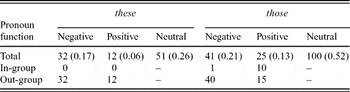
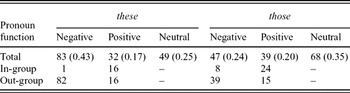
Whereas the singular pronouns this and that are used in reference to individual members of in- and out-groups, the plural forms these and those refer more to multiple single referents or entire groups. In both the CEEC and CEECE, there is an increase in the overall number of instances of these (95 to 164), whereas the number of those stays relatively the same (166/154) from the seventeenth to the eighteenth century. The overall number of instances of the plural forms in person reference is lower than the singular ones in both centuries. Tables 4 and 5 show the totals of both pronouns and the distribution of the instances according to their evaluative function and the referent's group membership respective to the writer.
These and those in seventeenth-century correspondence

These and those in eighteenth-century correspondence

In the seventeenth-century data, these is used most often in the neutral function, which seems to be the case with those as well. At least for these, this seems to coincide with the results of the use of the singular form this. Interestingly, there are no instances of these used to indicate in-group membership; instead, 44 instances are used to refer to members of an out-group, and most often in negative description. With those the situation is slightly different, and there are 11 examples of in-group and 55 cases of out-group usage. Also here the pronoun is mostly used in its negative function.
In table 5 we can see the plural forms in the eighteenth-century letters of the corpus. The negative function of these increases from the previous century (0.17 to 0.43), whereas there is a slight increase in the positive (0.13 to 0.20) and a decrease in the neutral use of those (0.52 to 0.35) from one century to the next. In general, these appears to be used most often in negative reference, and those in neutral reference. The referential use of these is more common in out-group than in-group identification (98/17), which seems to be the case with those as well (54/32). This follows the results from the singular use of both pronouns.
Also here, the examples have been chosen from both term-based and context-based instances. Examples (13) and (14) show instances of these in negative referential terms. In the first extract, Matthew Hutton writes to Edmund Sheffield, complaining against these traitors, by which he refers to both papists and protestants. The word traitor is in itself negatively connotative, and Hutton emphasises the effect by making a reference to poison, hence the mental image of venomous snakes.
(13) ffor, albeit these traitors vomit their poison one against an other, yet they joine together in casting out poison against religion and the State. (1602, Matthew Hutton)
(14) Not one of these Biographers has to my thinking a single Qualification necessary for the work he so flippantly undertakes; not one who sufficiently reverenced his learning, Genius, & Piety; or who is possessed of a style & abilities capable of doing them justice. (1784?, Charles Burney)
In (14), the negative impression comes across through the context of the referential term. Charles Burney writes to his daughter Fanny and complains about some current biographers, namely James Boswell, Thomas Tyers and Mr Cook, the editor of the Johnsoniana, who all wrote about Samuel Johnson after his death in 1784. Another extract of this particular letter gives an even more negative description of the three writers, in which he claims, for example, that ‘Tommy Tyers is such a quaint, feeble, fumble-fisted writer, as is only fit for Mother Goose's tales’.
The use of these in its positive function is similar to the use of the singular this. In term-based description, the positive impression of the referent is most often given by using a flattering attribute. In example (15), Agnes Porter calls Lord Ilchester's grandchildren, who she takes care of, these dear children. In many other letters, she refers to them with terms like little cherubs or angels.
(15) As I perceived she looked rather pensive at this conclusion, I asked her how many Louisas her papa had? How many Lilys? How many Maries, Charlottes etc., and assured her as he had but one of each these dear children he loved them all equally, or according to their goodness. (1792, Agnes Porter)
(16) These two gentlemen beeing persons of quality and heirs to considerable estates, I thought fit to give you this account, that, if hereafter by chance you have anything to doe with them, you may from hence learn what kind of men they are. (1674, Henry Prideaux)
The second example above comes from a letter written by Henry Prideaux. Although his description is not as sympathetic as the one found in Porter's letter, it shows that Prideaux is in favour of the gentlemen in question, hence his use of the phrases persons of quality and heirs to considerable estates, both of which were admirable qualities at the time. The use of these within the NP itself can be considered conventional, and it is only in the following context that we learn about the writer's attitude towards the referents.
Example (17) is a passage from Elizabeth of Bohemia's letter. Although Elizabeth seems to be very concerned about the topic of the Swedes’ invasion, the reference to the ambassadors is neutral and given without any positive or negative description of the referents. The tone of the extract is more reporting than evaluating, and by the use of these the writer here conveys to the reader that the ambassadors are neither members of her out- nor in-group, i.e. the reference form is merely discourse anaphoric.
(17) I pray lett me know what you think of the Suedes entering into Holstein, I doe nott heare yett what forces my vncle hath levied to resist them; these Ambassadours doe seeme to be verie much troubled at this invasion of the Suedes (1644, Elizabeth of Bohemia)
In general, both the seventeenth- and the eighteenth-century data include some very candid, even brutal, references to people. Referents can be called snakes, monsters, villains, or, as in example (18), Leviathans. Samuel Crisp is one of the more inventive users of negative reference in the material, along with Hester Thrale (Piozzi) and Charles Burney. In this example, Crisp refers to Hester Thrale and Samuel Johnson by calling them those two Leviathans, probably referring to their less than flattering opinion of Fanny Burney's (a further reference in ‘Fan-eaters’) first novel Evelina, published anonymously in 1778. Those is used in the reference for added distance.
(18) Besides, that great Gulph of Streatham & those two Leviathans (Mrs Thrale & Doctor Johnson) that swim about in it, & devour all small Fry, that approach there are, I dare say, [brood] of other Voracious Fan-eaters (1778?, Samuel Crisp)
(19) But now a public Court and an honorable Acquittal is much more satisfactory to the whole World – and how can we blacken those People more than they have blacken'd themselves – the Man is off and the Shop I hear must be ruin'd. (1800, James Leigh Perrot)
In (19), the negative use of those comes out in the context. Leigh Perrot writes about a court case against his wife, Jane, who was charged with stealing a yard of lace from the haberdasher's. The reference to the people who have accused the wife of the theft is in itself neutral, but the context (they have blacken'd themselves) brings out the writer's negative attitude towards the referents.
More positive use of those can be found in examples (20) and (21). In (20), Fanny Burney writes to her sister Esther and refers to her sister's children, using such words as lovely and charming. This is very typical of women's writing in the data, and in reference to children in particular. In example (21), John Ferrar also makes a reference to members of his in-group, but the following context, more than the use of the term friend itself, shows his positive opinion of the referents.
(20) the lovely Fanny should be here, I really think – but who could take her from her Mother? & what were that sweet mother with neither of those charming children? (1798?, Fanny Burney)
(21) And doe alsoe vndertake for those friends of myne (my truly louing kindred) they all shall and wilbe ready and realy willing to performe any office of loue as Sincerely to you and youres vpon any occation that shall offer it selfe (as any of your owne friends and kindred Can doe) (1657, John Ferrar Sr)
(22) Those commanders sent to His Excellency for three field pieces, and offered with them to keep them in on that side untill we had surrounded them: but they were denied this day. (1642, Nehemiah Wharton)
Finally, example (22) comes from the correspondence of Sergeant Nehemiah Wharton whose letters contain long and detailed reports from the English Civil War. The reference to the commanders appears in a context which shows no personal attitude or opinion towards the referent. Therefore, the use of those here remains on a more neutral level.
6 Discussion
6.1 Diachronic trends
One of the aims in this study was to look at the overall diachronic change in the use of this/these and that/those as part of a person-referential term in the light of the studies done on their use in Present-Day English data. Therefore, much of the analysis concentrated not only on comparing material from the seventeenth to the eighteenth century but also on the pragmatic function of describing the writer's positive, negative or neutral attitude towards the referent. This position was found to be central in placing the referent either in the writer's in-group or in his/her out-group.
When we observe the diachronic changes in the use of the singular forms of the pronoun, we can see that the neutral (indexical) function decreases from the seventeenth to the eighteenth century for both this (from 2.45 to 0.66) and that (from 0.43 to 0.29). At the same time, the instances of the demonstratives used in the positive function increases in time (more so for that, from 0.41 to 0.60). The use of the pronouns in their negative function decreases for this (from 0.52 to 0.37) and stays more or less the same for that (0.42 – 0.44). So, there is some indication that the change is for the use of this and that in positive referential terms from one century to the next. So when both pronouns increasingly appear as connotative demonstrative determiners, their use as mere indexicals decreases. In general, this is mostly used in neutral identification in both centuries, whereas that is most often used in neutral (seventeenth century) and in positive description (eighteenth century).
Similar trends can be detected for the plural forms of the pronouns. For those, its use in the neutral function decreases from the seventeenth to the eighteenth century (from 0.52 to 0.35). The neutral use of these stays approximately the same (0.26 – 0.25). We can detect diachronic changes in both the negative and positive use of the pronouns: both functions increase, only for these the negative one more (from 0.17 to 0.43) and for those the positive one more (from 0.13 to 0.20). Both these and those are used least in the positive function during both centuries. These appears to be most common in the neutral context in the seventeenth and in the negative context in the eighteenth century, whereas those is mostly used in its neutral function from one century to the next. The diachronic changes in the use of the plural forms in these data show that mere indexicality seems to be a declining phenomenon, as both the negative and positive functions increase over time. Also, those resembles that in all respects (negative slightly increases, positive increases and neutral decreases). The situation between this and these is a bit more varied, the only common trend being the increase in their use in positive contexts.
6.2 Evaluative categorisation
If we then examine the character of the referential terms from the contextual viewpoint, we can see that whereas negative referent description is most often term-based, the positive characterisation is in turn mostly context-based. In other words, whenever the writer refers to the referent in a negative way, it is more common to use the pronoun in the same phrase with a derogatory noun or adjective.Footnote 3 The range of negatively connotative nouns and adjectives is far wider than that of positive ones, and so, in the data, nouns like villain, knave, rogue, clown, miscreant, fool, rascal and beast, or adjectives such as bad, barbarous, dirty, cursed, vile and insolent are commonly used. Although positive description is more often extended to the immediate context of the referential term, there are still several term-based cases in which particularly the adjective is positively connotative. So, we can find reference including nouns like saint, angel, hero or champion (depending on the context, also gentleman and lady can be considered positive nouns), and such adjectives as wise, great, precious, good, sweet, brave, learned, dear, noble and worthy. As already mentioned, adjectives like poor can have either negative, positive or even neutral meaning, depending on the immediate context.
The singular forms of the demonstratives can also be used with proper names or titles either to identify the referent or to describe him/her in a positive or negative way (possibly with a laudatory or derogatory adjective). Referential terms like this dear little Charlotte (positive), that scuffling scoundrel Tyler (negative) and this Greene (neutral) are typical in the material. There seems to be a slight difference in the use of this and that: whereas the distribution of this + proper name is rather equal in all functions (negative 15, positive 13 and neutral 16), that is most often used with a name in the terms indicating negative reference (30 instances), the positive function (15 instances) and the neutral one (5 instances) being less common. Although the number of instances is too low to make any definite conclusions, particularly the use of that in the data seems to resemble its present-day equivalent in this respect (e.g. see section 2.2, our nextdoor neighbour vs that nextdoor neighbour).
In addition to the clear-cut positive/negative/neutral cases, there are some instances in which a ‘positive’ term is used in a ‘negative’ context. Examples (23) and (24) show this kind of sarcastic use in the material. In (23), Mary Wortley Montagu discusses the attributes of Miss Howe and Sally Martin, who appear in Richardson's Clarissa. Although the referents are fictitious characters, we can still see how Montagu refers to Miss Howe with a seemingly positive term, this virtuous Damsel, which is embedded in a very negative description of the person. By using the pronoun this, Montagu reduces the mental distance between herself and the characters in a book that has obviously made an impact on her. The function of those in (24) is totally different. Daniel Defoe refers to the English Dissenters with the term those honest men, and, as it becomes clear he does not think them honest at all, emphasises the great distance between himself and the out-group of the referents.
(23) Miss How, who is call'd a young Lady of sense and Honor, is not only extreme silly, but a more vicious character than Sally Martin, whose Crimes are owing at first to Seduction and afterwards to necessity, while this virtuous Damsel, without any reason insults her mother at home and ridicules her abroad, abuses the man she marrys, and is impertinent and Impudent with great applause. (1752?, Mary Wortley Montagu)
(24) It is an Unhappy Truth, that The Temper of those honest men is yet So Ruffled at the Loss of their Politick Intrest, That it Threatns their Religious, and I find too Many of them willing Enough to Sacrifice the Latter, to Retriev the former. (1712, Daniel Defoe)
Third-person reference is used in some cases to refer to the writer or the recipient him/herself. This kind of referential use is rare, and in the current material it appears only in a few letters. The reference terms in examples (25) and (26) can as such be considered neutral on the evaluative scale, and so they derive their pragmatic meaning from the immediate context. This context includes not only the relationship between the writer and the recipient, but also their relative social standing. In (25), Thomas Wentworth uses self-reference this servante of yours not only to lower himself in respect to the recipient, but also to show his aspirations to the recipient's in-group. The mood of the sentence itself is flattering: Wentworth expresses his happiness to serve as well as describing himself as the readiest and the most carefull to fullfill any requests made to him.
(25) Whatever my occasions or hast be, it must not deprive me the happiness of still putting your Lordship in remembrance of this servante of yours, who will ever be the readiest to receave and the most carefull to fullfill your commaundes in the whole world. (1633, Thomas Wentworth)
(26) she is seen by her as she has always been by me – as a wonderful Child, as uncommon in heart as in head, & loving her dear Mother as that Mother deserves to be loved. (1797, Fanny Burney)
Similarly, Fanny Burney, referring to the recipient of the letter in the third person, that Mother, alters the distance between herself, the recipient and the referent. Burney takes on the viewpoint of a narrator, who in a way quotes or interprets what she thinks the referent feels towards the recipient. The relationship between the writer, the recipient and the referent is very close, and by shifting from direct address into third-person reference, Burney distances herself from the others involved in the situation.
6.3 The use of demonstratives in social identification
In relation to the role this/these and that/those play in social identification, the data clearly show a difference in the way in which in-group and out-group members are referred to. Most of the referents in the writer's in-group are indexed with positive descriptions and reference terms in positive contexts, whereas identifiable out-group referents mostly receive negative descriptions. This seems to comply with one of the main hypotheses of the Social Identity Theory, which states that people are likely to boost their own identity within a group by positive enhancement. This means that in language use, they associate their own in-group and its members with positive qualities and at the same time compare themselves with their out-group(s) which in turn are addressed and referred to with less favourable attributes. Neutral reference is also used of people outside one's own group, but since referring in such cases mostly means mere indexing, the positive–negative scale is not directly applicable.
One aspect which partly has influenced the choice of the reference terms in the material is of course the social constraints prevalent at the time, an aspect which has to do with the relative power between the writer and the referent. The data show that it is more likely that the writer wants to use a positive term when s/he refers to a person higher on the social scale. This is particularly the case if the writer wants the recipient to help the referent in some way or has something to gain him/herself from using laudatory reference, for example, material goods or a favour. In cases like these, the recipient is often in the out-group of either the writer, the referent, or both. Another possibility is the writer's obvious aspirations upward on the social ladder, in which case s/he may use reference in its positive function to ‘soften’ the recipient and/or the referent to accept him/her as a member of their in-group.
Moreover, the writer may simply be considerate of the relationship between the referent and the recipient, i.e. s/he does not, for example, want to hurt the recipient's feelings by using a derogatory or otherwise negative term of the referent in his/her in-group. This aspect relates to the amount of distance between the writer, the recipient and the referent. In the data, there are a few examples of this: example (27) shows an instance in which the referent is in the writer's in-group, but not the recipient's, and in example (28) the situation is reversed, so that the referent is closer to the recipient than to the writer.
(27) Sir, I was very glad I had so good an occasion to write, as I now have by this bearer Captaine Crompton my especyall good frende, whom I haue longe knowen to be an honest man, and most worthyly suffycyent of that place, wherin he is now employed. (1604, Philip Gawdy)
(28) Daughter this is for a memorial to you that I doe: your aged father utterly discents from your mariage wththis man Mr Hoskins 1 for the person of whom after severall jorneyes I have made & inquired at bridport Sarum Shurborne I find not one person that gives him a good report but all speek Evill of him as a lascivious lose man (1696?, John Pinney)
Most of the instances in which the distance between the writer and the referent is different to the one between the recipient and the referent show positively evaluative description of the referent. So, the writer often wants to portray the referent in a positive way both when s/he is a member of his/her in-group, as in example (27), and when s/he belongs to the recipient's in-group. Instances of negative evaluation of an in-group referent are much rarer in the material. This is particularly so when the referent is close to the recipient. In (28), Pinney's main impetus for using negative description of the referent is the urgency of warning his daughter not to marry Mr Hoskins, i.e. he has to use every possible way of convincing her of her fiancé's bad character.
7 Conclusions
The main purpose of the current study was to show the link between the use of demonstratives this/these and that/those in person-referential terms and the practice of social identification. My study concentrated on the diachronic use of referential expressions in Early and Late Modern English personal letters, in relation to the present-day use of demonstrative determiners in reference.
When we examine the implications of present-day studies on the use of person reference, we see that it is in general biased towards showing group distinction, which means linking positive characteristics to members of one's in-group and distancing people in the out-group with negative reference. This was also found to be the case in the historical material used in the current study. Most of the referents in the letter writers’, and in many cases also in the recipients’, in-group were indexed with positive descriptions and reference terms in positive contexts, whereas identifiable out-group referents mostly received negative descriptions.
The aim of the study was to identify the forms of the referential terms in question and how common these terms were in the material. The most typical types of referential noun phrases in the material included such cases as demonstrative pronoun + noun (this girl), demonstrative pronoun + adjective + noun (this pretty girl), demonstrative pronoun + noun + of-possessive (this girl of mine), demonstrative pronoun + (title) proper name (this Mr Johnson). The number of instances was rather low, as the total number of demonstrative pronouns as determiners remained under a thousand examples in each category (this 987, that 501, these 259 and those 320).
A further purpose of the study was also to see what pragmatic functions lay behind the use of the referential terms in question. The negatively, positively and neutrally evaluative functions were found to be central during both centuries, the latter perhaps more so than the others in the seventeenth century, but the negative and positive gaining more emphasis in the eighteenth century. This shows that when both pronouns increasingly started to appear as connotative demonstrative determiners, their use as mere indexicals decreased.
Overall, we can conclude that although the historical use of demonstrative pronouns as determiners in reference did not show a similar bias towards negative foregrounding to their Present-Day English equivalents, there is some indication that a change towards a more specialised use was on the way from the eighteenth century onwards. Between that time and the present, specifically how this change occurred and to what extent is a topic recommended for further studies.