



1. Introduction
1.1 Motivation
Let  $C$ be a smooth curve over a finite field
 $\mathfrak {K}=\mathbb {F}_q$ in characteristic
 $p$. Classically, the study of motives over
 $C$ has focused on lisse
 $\ell$-adic étale sheaves on
 $C$, where
 $\ell \neq p$. It is natural to ask for a
 $p$-adic counterpart to the
 $\ell$-adic theory. However, there are far too many lisse
 $p$-adic étale sheaves and they tend to be poorly behaved compared with their
 $\ell$-adic counterparts. For example, if we have a family of ordinary elliptic curves
 $f:E \to C$, the relative first-degree
 $p$-adic étale cohomology
 $R^1_{\rm {\unicode{x00E9}}} f_* \mathbb {Q}_p$ has rank one. In contrast, the relative
 $\ell$-adic cohomology sheaf
 $R^1_{\rm \unicode{x00E9}} f_* \mathbb {Q}_\ell$ has rank two, as is expected. Instead, the correct
 $p$-adic coefficient objects are overconvergent
 $\mathbf {F}$-isocrystals, which were first introduced by Berthelot (see [Reference BerthelotBer96]).
Overconvergent  $\mathbf {F}$-isocrystals have a remarkable extra structure that is absent in the
 $\ell$-adic theory: a slope filtration. Without giving any definitions, consider the overconvergent
 $\mathbf {F}$-isocrystal
 $M$ that acts as the
 $p$-adic counterpart to the lisse sheaf
 $R^1_{\rm \unicode{x00E9}} f_* \mathbb {Q}_\ell$. The properties of
 $M$ follow those of
 $R^1_{\rm \unicode{x00E9}} f_* \mathbb {Q}_\ell$. First,
 $M$ has rank two. Just as in the
 $\ell$-adic case, for any
 $x \in C$ we may consider the fiber
 $M_x$ and the action of Frobenius on
 $M_x$. The characteristic polynomial of this action will describe the zeta function of the elliptic curve
 $E_x$:
 \[ Z(E_x,s) = \frac{\det (1 - \text{Frob}^*s, M_x)}{(1-s)(1-q^{\text{deg}(x)}s)}. \]
Here, we see a fundamental difference between the  $\ell$-adic and
 $p$-adic situations. The roots of the numerator of
 $Z(E_x,s)$ are both
 $\ell$-adic units. However, because
 $E_x$ is ordinary, one root is a
 $p$-adic unit and the other root has
 $q$-adic valuation one. Even before the modern definition of an
 $\mathbf {F}$-isocrystal was in place, Dwork discovered something miraculous with no
 $\ell$-adic analogue: these unit roots come from a rank-one subobject
 $M^{\rm unit}$ of
 $M$ existing in a larger category of convergent
 $\mathbf {F}$-isocrystals. It was later demonstrated by Katz in [Reference KatzKat73] that any ‘unit-root’
 $\mathbf {F}$-isocrystal corresponds to a
 $p$-adic étale sheaf. As one may expect, the
 $p$-adic étale sheaf corresponding to
 $M^{\rm unit}$ is
 $R^1_{\rm \unicode{x00E9}} f_* \mathbb {Q}_p$.
This phenomenon generalizes. Let  $N$ be an overconvergent
 $\mathbf {F}$-isocrystal on
 $C$ and assume that the Newton polygon of
 $\det (1 - \text {Frob}^* s, N_x)$ remains constant as we vary
 $x \in C$. Katz proved in [Reference KatzKat79] that
 $N$ obtains an increasing filtration in the larger category of convergent
 $\mathbf {F}$-isocrystals. The graded pieces of this filtration are ‘twists’ of unit-root
 $\mathbf {F}$-isocrystals and thus correspond to lisse
 $p$-adic étale sheaves on
 $C$. We say that a lisse
 $p$-adic étale sheaf is geometric if it arises in this manner. Geometric
 $p$-adic étale sheaves remain mysterious. When one studies properties of overconvergent
 $\mathbf {F}$-isocrystals, such as their cohomology or Frobenius distributions, the
 $\ell$-adic theory often serves as a guiding light suggesting what is true and occasionally how it should be proven. However, as there is no
 $\ell$-adic analogue to the slope filtration, it is less clear how to proceed in developing a coherent theory. It is natural to ask whether all geometric
 $p$-adic étale sheaves share certain properties or, more ambitiously, is it possible to determine when a
 $p$-adic étale sheaf is geometric?
In this article, we study the monodromy of geometric  $p$-adic étale sheaves of rank one and the ‘growth’ properties of the slope filtration. In the case where the
 $\mathbf {F}$-isocrystal has integral slopes, we prove a monodromy stability result for geometric
 $p$-adic étale sheaves. This result says that the ramification breaks satisfy a certain type of periodicity. We are naturally led to consider
 $\mathbf {F}$-isocrystals with logarithmic decay and we prove a monodromy theorem for these
 $\mathbf {F}$-isocrystals. We also establish a relationship between the Frobenius slopes and the rate of logarithmic decay of the slope filtration. This allows us to give a new proof of the Drinfeld–Kedlaya theorem.
1.2 Monodromy results
1.2.1 Local results
Let  $F$ be either
 $\mathfrak {K}((T))$ or a finite extension of
 $\mathbb {Q}_p$ and let
 $G_F$ be the absolute Galois group of
 $F$. We let
 $L$ be a finite extension of
 $\mathbb {Q}_p$ with ring of integers
 $\mathcal {O}_L$. For
 $k\geqslant 0$, we set
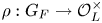
 $O_k^\times = \{x \in \mathcal {O}_L^\times \mid v_p(1-x)> k\}$. Consider a continuous character
 $\rho :G_F \to \mathcal {O}_L^\times$. We define
 $s_k(\rho )$ to be the largest upper numbering ramification break of the Galois extension of
 $F$ corresponding to
 $\rho ^{-1}(O_k^\times )$. When
 $F$ has characteristic zero, a celebrated result of Sen (see [Reference SenSen72]) tells us that there exists a positive rational number
 $c$ such that
 $ke -c \leqslant s_k(\rho ) \leqslant ke + c$, where
 $e$ is the ramification index of
 $F$ over
 $\mathbb {Q}_p$. Sen's theorem fails dismally in equal characteristic, because
 $s_k(\rho )$ may grow arbitrarily fast with respect to
 $k$. In this article, we study the growth of
 $s_k(\rho )$ when
 $F=\mathfrak {K}((T))$ and
 $\rho$ has geometric origin. We show that
 $s_k(\rho )$ grows exponentially and under some additional geometric assumptions, we show that
 $s_k(\rho )$ satisfies a certain periodicity.
Definition 1.1 We say that  $\rho$ has finite monodromy if the image of the inertia subgroup of
 $G_F$ is finite. For
 $r> 0$, we say that
 $\rho$ has
 $r$-bounded monodromy if there exists a positive rational number
 $c$ such that
 \[ s_k(\rho)< cp^{rk}, \]
for all  $k>0$ (note that when
 $\rho$ has finite monodromy there exists
 $c>0$ such that
 $s_k(\rho )< c$ for all
 $k$, and thus
 $\rho$ has
 $r$-bounded monodromy for all
 $r>0$). Let
 $a\in \mathbb {Z}_{\geqslant 1}$ and let
 $s=v_p(q^{a})$, where
 $v_p$ denotes the
 $p$-adic valuation normalized so that
 $v_p(p)=1$. We say that
 $\rho$ has
 $a$-stable monodromy if for every
 $k \in [0,s]$, there exists
 $m_k$ and
 $b_k$ such that
 \[ s_{k+sn}(\rho)=m_kq^{an} + b_k \]
for  $n\gg 0$. We say that
 $\rho$ has stable monodromy if it has
 $a$-stable monodromy for some
 $a$.
We now restrict ourselves to the case where  $F=\mathfrak {K}((T))$. Let us explain what it means for a character of
 $G_F$ to be geometric. Let
 $M$ be an overconvergent
 $\mathbf {F}$-isocrystal over
 ${\rm Spec}(F)$ with coefficients in
 $L$ and let
 $\iota ^{{\dagger} }(M)$ be the corresponding convergent
 $\mathbf {F}$-isocrystal (see § 4.2). Then
 $\iota ^{\dagger} (M)$ has a Frobenius slope filtration (see § 4.2.1.4):
 \[ 0=M_0\subset M_1 \subset \dots \subset M_d = \iota^{\dagger}(M), \]
where  $gr_i(M)=M_i/M_{i-1}$ is isoclinic of slope
 $\alpha _i$. After enlarging
 $L$, we may associate to
 $\det (M_i)$ a character
 $\rho _i:G_F \to \mathcal {O}_L^\times$. This character is well-defined up to twist by an unramified character. We say that a character of
 $G_F$ is geometric if it arises this way.
Theorem 1.2 Let  $r_i= {1}/({\alpha _{i+1}-\alpha _i})$.
(i) Then
 $\rho _i$ has $r_i$-bounded monodromy.
(ii) Assume that
$M$ is irreducible and that the slopes of $M$ are integers. Then $\rho _i$ has stable monodromy.


From Theorem 1.2, we see that rank-one geometric  $p$-adic étale sheaves are intricate and fascinating objects. This is in stark contrast to the
 $\ell$-adic situation, where rank-one objects have finite monodromy and are easily understood. The stable monodromy of
 $\rho _i$ when
 $M$ has integral slopes is particularly surprising. Indeed, Theorem 1.2 shows that the ramification filtration of
 $\rho _i$ is completely determined by the first few ramification breaks. This is in contrast to a general
 $p$-adic character of
 $\rho$, where there are essentially no restrictions on
 $s_n(\rho )$.
Example 1.3 Let  $f:X \to {\rm Spec}(F)$ be a smooth proper morphism and assume that
 $R^i_{\rm \unicode{x00E9}} f_* \mathbb {Q}_p$ is a rank-one
 $p$-adic lisse sheaf. The corresponding character
 $\rho$ is geometric (see [Reference KedlayaKed00]). In particular, Theorem 1.2 applies to many unit-root
 $\mathbf {F}$-isocrystals studied by Dwork and others.
(i) Let
$M$ be the $\mathbf {F}$-isocrystal associated to an elliptic curve $E$ over ${\rm Spec}(\mathfrak {K}[[T]])$, whose generic fiber is ordinary and whose special fiber is supersingular. By Theorem 1.2, the $p$-adic Tate module of the generic fiber of $E$ has stable monodromy. This was previously know by work of Katz–Mazur (see [Reference Katz and MazurKM85, Chapter 12.9]). These types of ramification bounds for Abelian varieties play a crucial role in the theory of $p$-adic modular forms and canonical subgroups.(ii) Let
$A \to {\rm Spec}(\mathfrak {K}[[T]])$ be a generically ordinary Abelian variety of dimension $2g$ with a non-ordinary special fiber. Assume that $A$ has multiplication by a real field $K$ of degree $g$ over $\mathbb {Q}$. Then the $\mathbf {F}$-isocrystal $M$ associated to $A$ with coefficients in $\mathbb {Q}_p$ has rank $2g$ and has a linear action by $\mathbb {Q}_p\otimes K$. If there is only one prime in $K$ above $p$, so that $\mathbb {Q}_p \otimes K$ is a field, we may regard $M$ as an $\mathbf {F}$-isocrystal with coefficients in $\mathbb {Q}_p \otimes K$ of rank two. The unit-root subcrystal of the generic fiber of $M$ is a rank-one $\mathbf {F}$-isocrystal with coefficients in $\mathbb {Q}_p \otimes K$. The corresponding Galois representative is surjective by [Reference RibetRib75] and by Theorem 1.2 it has stable monodromy.(iii) The rank
$n+1$ Kloosterman $\mathbf {F}$-isocrystal on $\mathbb {G}_m$ is irreducible and ordinary at every point with slopes $\{0,\dots,n\}$, due to work of Sperber in [Reference SperberSpe80]. The unit-root subcrystal has stable monodromy at $0$ and $\infty$ by Theorem 1.2.


1.2.2 Global results
By applying the Riemann–Hurwitz formula together with Theorem 1.2, we may deduce an interesting result about genera growth along towers of curves. Let  $U$ be a smooth curve over
 $\mathfrak {K}$ and let
 $C$ be its smooth compactification. Let
 $\rho :\pi _1^{\rm \unicode{x00E9}}(U) \to \mathbb {Z}_p^\times$ be a continuous representation. For any
 $k\geqslant 1$, we let
 $g_k(\rho )$ denote the genus of the compact curve corresponding to
 $\rho ^{-1}(1+p^k\mathbb {Z}_p) \subset \pi _1^{\rm \unicode{x00E9}}(U)$.
Definition 1.4 Let  $a \in \mathbb {Z}_{\geqslant 1}$ and let
 $s=v_p(q^a)$. We say that
 $\rho$ is has
 $a$-stable genus growth if for every
 $k \in [0,s]$, there exists a polynomial
 $b_k(x) \in \mathbb {Q}[x]$ of degree
 $2s$ such that
 \[ g_{k+an}(\rho) = b_k(q^n), \]
for  $n \gg 0$. We say that
 $\rho$ has pseudo-stable genus growth if
 $\rho$ has
 $a$-stable genus growth for some
 $a$.
Let  $M$ be an overconvergent
 $\mathbf {F}$-isocrystal on
 $U$ with coefficients in
 $\mathbb {Q}_p$. After replacing
 $U$ with an open dense subset, there exists a slope filtration:
 \[ 0=M_0\subset M_1\subset \dots \subset M_d = \iota^{\dagger}(M), \]
where  $gr_i(M)=M_i/M_{i-1}$ is isoclinic of slope
 $\alpha _i$. As in § 1.2.1, we may associate a character
 $\rho _i:\pi _1(U) \to \mathbb {Z}_p^\times$ to
 $\det (M_i)$ (see § 4.2.1.3).
Theorem 1.5 Assume  $M$ is irreducible and has integral slopes. Then for each
 $i< d$, the representation
 $\rho _i$ has pseudo-stable genus growth.
Let  $f:X \to U$ be a smooth proper morphism and let
 $M$ be the overconvergent
 $\mathbf {F}$-isocrystal
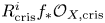 $R^i_{{\rm cris}} f_* \mathcal {O}_{X,{\rm cris}}$ (see Appendix A for an explanation of why this is overconvergent). After shrinking
 $U$ we may assume that
 $M$ has a slope filtration. Thus,
 $\det (R^i_{\rm \unicode{x00E9}} f_* \mathbb {Q}_p )$ corresponds to the character
 $\rho _i$. Assume that
 $M$ is irreducible and has integral slopes. Theorem 1.5 implies that
 $\rho _i$ has pseudo-stable genus growth. This proves a weaker version of a conjecture of Wan, which states that there exists a quadratic
 $b(x) \in \mathbb {Q}[x]$ such that
 $s_k(\rho )=b(p^k)$ for large
 $k$ (see [Reference WanWan19, Conjecture 5.2]).
1.3 Logarithmic decay and slope filtrations
We now give an informal overview of our results on  $\mathbf {F}$-isocrystals with logarithmic decay. For simplicity, we restrict ourselves to
 $\mathbb {Q}_p$-coefficients here. See § 9 for more general statements. Let
 $E=\mathbf {Frac}(W(\mathfrak {K}))$, where
 $W(\mathfrak {K})$ is the
 $p$-typical Witt vectors of
 $\mathfrak {K}$. We define the integral Amice ring
 \[ \mathcal{O}_{\mathcal{E}} := \bigg\{\sum_{n=-\infty}^\infty a_nT^n \biggm | \begin{array} {@{}l@{}} \text{We have } a_n\in W(\mathfrak{K}) \text{ and } \lim\limits_{n\to-\infty} v_p(a_n)=\infty.\end{array}\!\bigg\}. \]
We let  $\mathcal {E}$ be the field of fractions of
 $\mathcal {O}_\mathcal {E}$ and let
 $\mathcal {E}^{\dagger}$ be the subring of
 $\mathcal {E}$ consisting of Laurent series convergent on some annulus
 $r < |T|_p < 1$. Let
 $\sigma :\mathcal {O}_\mathcal {E} \to \mathcal {O}_\mathcal {E}$ act on
 $E$ as the
 $p$-Frobenius map and send
 $T \mapsto T^p$. A convergent
 $\mathbf {F}$-isocrystal over
 ${\rm Spec}(F)$ is a finite-dimensional vector space over
 $\mathcal {E}$ with an isomorphism
 $\varphi : M \otimes _{\sigma }\mathcal {E} \to M$ and a compatible differential equation (see § 4). An overconvergent
 $\mathbf {F}$-isocrystal is a finite-dimensional vector space over
 $\mathcal {E}^{\dagger}$ with the same extra structure.
Given an overconvergent  $\mathbf {F}$-isocrystal
 $M$, the convergent
 $\mathbf {F}$-isocrystal
 $M\otimes _{\mathcal {E}^{\dagger} } \mathcal {E}$ has a slope filtration. In general, the steps
 $M_i$ of the slope filtration will not be overconvergent. However, it turns out that there are intermediate ‘logarithmic decay’ rings between
 $\mathcal {E}^{\dagger}$ and
 $\mathcal {E}$, over which
 $M_i$ are defined. This builds on an idea of Dwork–Sperber and utilized by Wan (see [Reference Dwork and SperberDS91, Reference WanWan99]), where they consider Frobenius structures with logarithmic decay. To define the
 $r$-log-decay ring, we need to introduce naive partial valuations on
 $\mathcal {E}$. For any
 $a(T)=\sum a_nT^n \in \mathcal {E}$ we define
 \[ w_k(a(T)) = \min_{v_p(a_n)\leqslant k} \{n\}. \]
That is,  $w_k(a(T))$ is the
 $T$-adic valuation of
 $a(T)$ reduced modulo
 $p^{k+1}$. We define
 $\mathcal {E}^r$ to be the subring of
 $\mathcal {E}$ consisting of
 $a(T)$ such that for some
 $c>0$, we have
 $w_k(a(T))\geqslant -cp^{rk}$ for
 $k$ large. Roughly, a convergent
 $\mathbf {F}$-isocrystal has
 $r$-log-decay if the Frobenius and differential equation descend to
 $\mathcal {E}^r$ (the actual definition we use is a bit more subtle, see § 4.2.0.2). The following theorem states that the rate of logarithmic decay is closely related to differences between consecutive slopes. We further conjecture that if
 $M$ is irreducible, then the slopes are entirely determined by the rate of log-decay (see Conjecture 4.11).
Theorem 1.6 Let  $r={1}/({\alpha _{i+1}-\alpha _i})$. Then
 $M_i$ has
 $r$-log-decay.
We also study the monodromy of rank-one  $\mathbf {F}$-isocrystals with logarithmic decay.
Proposition 1.7 Let  $N$ be a rank-one convergent
 $\mathbf {F}$-isocrystal with
 $r$-log-decay. Let
 $\rho : G_F \to \mathbb {Z}_p^\times$ be the corresponding character (well-defined up to unramified twist). Then
 $\rho$ has
 $r$-bounded monodromy.
The first part of Theorem 1.2 follows from Theorem 1.6 and Proposition 1.7. There is another somewhat surprising consequence of Theorem 1.6 and Proposition 1.7: a proof of the Drinfeld–Kedlaya theorem for irreducible  $\mathbf {F}$-isocrystals on curves. This result first appears in (see [Reference Drinfeld and KedlayaDK17] and [Reference KedlayaKed22, Appendix A]), though a local version appeared in Kedlaya's thesis (see [Reference KedlayaKed00]). See Remark 9.8 for a comparison of our approach with the work of Kedlaya.
Corollary 1.8 (Drinfeld–Kedlaya)
Let  $M$ be an irreducible
 $\mathbf {F}$-isocrystal on a smooth curve
 $U$ and let
 $\alpha _1<\dots <\alpha _d$ be the generic slopes of
 $M$. Then
 $|\alpha _{i+1}-\alpha _i|\leqslant 1$.
Remark 1.9 It is possible to prove the Drinfeld–Kedlaya theorem using logarithmic decay without studying representations with infinite monodromy. This is the content of work of the author (see [Reference Kramer-MillerKra21]), where the Drinfeld–Kedlaya theorem follows from studying connections with logarithmic decay. It was discovered somewhat accidentally that one could deduce the Drinfeld–Kedlaya theorem by studying ramification filtrations, and we view it as a fortunate consequence of the main results of this paper.
1.4 The question of more general ground fields
It would be interesting to see if Theorem 1.2 or Theorem 1.5 still hold if we only require that  $\mathfrak {K}$ have characteristic
 $p$. In this case, defining the ramification filtration is more nuanced (see the work of Abbes–Saito [Reference Abbes and SaitoAS02]). However, in the case of
 $\mathbf {F}$-isocrystals with finite monodromy, the differential structure determines the ramification invariants through a differential Swan conductor defined by Kedlaya (see [Reference KedlayaKed07]). This is due to work of Chiarellotto–Pulita and Xiao (see [Reference Chiarellotto and PulitaCP09, Reference XiaoXia11]). This suggests that monodromy stability may hold for more general
 $\mathfrak {K}$.
1.5 Outline
In § 3 we introduce several rings that will be used throughout the article. In § 4 we give an overview of  $\mathbf {F}$-isocrystals and introduce the notion of logarithmic decay. Next, in § 5 we discuss ramification theory for
 $p$-adic characters and in § 6 we prove a monodromy theorem for rank-one
 $\mathbf {F}$-isocrystals. We prove several results on recursive Frobenius equations in § 7 and we study the growth of the slope filtration in § 8. Finally, in § 9 we combine the results of §§ 6–8 to prove our main results.
2. Conventions
Let  $R$ be any ring. If
 $R$ has a valuation
 $v:R \to \mathbb {R}$ and
 $x \in R$ satisfies
 $v(x)>0$, we let
 $v_x(\cdot )$ denote the normalization of
 $v$ satisfying
 $v_x(x)=1$. Let
 $\mathcal {O}_R \subset R$ be the subring of elements with
 $v(x)\geqslant 0$. For a matrix
 $A \in M_{n\times m}(R)$, we let
 $v(A)$ denote the infimum of the valuations of its entries. For
 $f \in \mathcal {O}_R$, we let
 $\overline {f}$ denote the image of
 $f$ in the residue field. For any field
 $F$ we let
 $G_{F}$ denote the absolute Galois group of
 $F$. If
 $L$ is a Galois extension of
 $F$ we let
 $G_{L/F}$ denote the Galois group of
 $L$ over
 $F$. We assume all characters/representations of
 $G_F$ are continuous.
The following conventions are used throughout the article. Let  $p$ be prime and let
 $q=p^f$. We always take
 $L$ to be a finite extension of
 $\mathbb {Q}_p$ with residue field
 $\mathbb {F}_q$. Let
 $e$ be the ramification index of
 $L$ over
 $\mathbb {Q}_p$ and let
 $\pi$ be a uniformizing element of
 $L$. We let
 $\Theta$ denote the set of embeddings of
 $L$ into
 $\mathbb {Q}_p^{\rm alg}$. Let
 $\mathfrak {K}$ be a perfect field containing
 $\mathbb {F}_{q}$ and let
 $E$ be
 $\mathbf {Frac}(\mathcal {O}_L\otimes _{W(\mathbb {F}_{q})}W(\mathfrak {K}))$, where
 $W(R)$ denotes the ring of
 $p$-typical Witt vectors of
 $R$. Then
 $E$ is totally ramified over
 $\mathbf {Frac}(W(\mathfrak {K}))$. Let
 $\nu$ denote the
 $p$-Frobenius endomorphism on
 $\mathbf {Frac}(W(\mathfrak {K}))$ and let
 $\sigma$ denote the endomorphism
 $1 \otimes \nu ^f$ on
 $E$.
3. Some rings
3.1 The Amice ring and the bounded Robba ring
Let  $F=\mathfrak {K}((T))$ and let
 $F^{\rm un}= \mathfrak {K}^{\rm alg}((T))$. We define the following
 $E$-algebras:
 \[ \mathcal{E}_{F,L} := \Bigg\{ \sum_{n=-\infty}^\infty a_nT^n \Biggm | \begin{array} {@{}l@{}} \text{We have } a_n\in E, \lim\limits_{n\to-\infty} v_p(a_n)=\infty, \\ \text{and the } v_p(a_n) \text{ is bounded below.} \end{array} \Bigg \}, \]
 \[ \mathcal{E}_{F,L}^{\dagger} := \Bigg\{ \sum_{n=-\infty}^\infty a_nT^n \in \mathcal{E}_{F,L} \Biggm | \begin{array} {@{}l@{}} \text{There exists $m>0$ such that} \\ v_p(a_n) \geqslant -mn \text{ for $n\ll 0$} \end{array} \Bigg \}. \]
If there is no ambiguity, we omit  $F$ and
 $L$. Note that
 $\mathcal {E}^{\dagger}$ and
 $\mathcal {E}$ are local fields with residue field
 $F$. The valuation
 $v_p$ on
 $L$ extends to the Gauss valuation on each of these fields. We also define
 \[ \mathcal{E}_\infty = \mathcal{E} \hat{\otimes}_{W(\mathfrak{K})} W(\mathfrak{K}^{\rm alg}), \quad \text{and}\quad\mathcal{E}_\infty^{\dagger} = \mathcal{E}_\infty \cap \mathcal{E}_{F^{\rm un},L}^{\dagger}, \]
where  $\hat {\otimes }$ denotes the completed tensor product.
3.2 Logarithmic decay rings
Let  $k \in ({1}/{e})\mathbb {Z}$. We define the partial valuation
 $w_k:\mathcal {E}_{F^{\rm un},L} \to \mathbb {Z}\cup \infty$ as follows: for
 $x = \sum a_nT^n$ we have
 \[ w_k(x) = \min_{v_p(a_n)\leqslant k} \{n\}. \]
Informally,  $w_k(x)$ is the smallest power of
 $T$ occurring in
 $x$ reduced modulo
 $\pi ^{ke+1}$. These partial valuations satisfy the following inequalities:
 \begin{align} \begin{split} w_k(x+y) & \geqslant \min(w_k(x),w_k(y)), \\ w_k(xy) & \geqslant \min_{i+j\leqslant k} (w_i(x) + w_j(y)). \end{split} \end{align}
In either inequality, there is an equality if the minimum is attained exactly once. For  $r > 0$ we define
 \begin{align*} \mathcal{E}^r_\infty &= \bigg\{ x \in \mathcal{E}_\infty \biggm | \begin{array} {@{}l@{}} \text{there exists $c>0$ such that} \\ w_k(x) \geqslant -cp^{kr} \text{ for $k\gg 0$} \end{array} \bigg \}, \\ \mathcal{E}^r &= \mathcal{E}^r_\infty \cap \mathcal{E}. \end{align*}
By (1) both  $\mathcal {E}^r_\infty$ and
 $\mathcal {E}^r$ are rings. Let
 $s= {1}/{r}$ and let
 $P\subset \mathbb {R}^2$ denote the lower convex hull of the points
 \[ (0,0), (s,p), (2s,p^2), \ldots . \]
Then  $P$ is the graph of a continuous piece-wise linear function
 $f_r:\mathbb {R}_{\geqslant 0} \to \mathbb {R}_{\geqslant 0}$. For
 $c>0$ we define
 \begin{align*} \mathcal{O}_{\mathcal{E}_\infty}^{r,c} &= \{ x \in \mathcal{O}_{\mathcal{E}_\infty}\mid w_k(x) \geqslant -cf_r(k),\text{ for }k\geqslant 0 \}, \\ \mathcal{O}_{\mathcal{E}}^{r,c}&= \mathcal{O}_{\mathcal{E}_\infty}^{r,c} \cap \mathcal{E}. \end{align*}
As  $f_r$ is super-additive (i.e.
 $f_r(x+y)\geqslant f_r(x)+f_r(y)$ for all
 $x,y\geqslant 0$) we know that
 $\mathcal {O}_{\mathcal {E}}^{r,c}$ (respectively,
 $\mathcal {O}_{\mathcal {E}_\infty }^{r,c}$) is a
 $p$-adically closed subring of
 $\mathcal {O}_{\mathcal {E}}^r$ (respectively,
 $\mathcal {O}_{\mathcal {E}_\infty }^r$).
Lemma 3.1 Let  $x \in \mathcal {O}_{\mathcal {E}_\infty }^{r,c}$ with
 $w_0(x) =0$. Then
 $x^{-1} \in \mathcal {O}_{\mathcal {E}_\infty }^{r,c}$.
Proof. This follows from (1) and the super-additivity of  $f^r$.
Proposition 3.2 The rings  $\mathcal {E}^r_\infty$ and
 $\mathcal {E}^r$ are fields.
Proof. Let  $x\in \mathcal {E}^r$. After multiplying by a power of
 $p$ and a power of
 $T$ we may assume that
 $x \in \mathcal {O}_{\mathcal {E}^r}$ and
 $w_0(x)= 0$. Then for
 $c$ sufficiently large, we have
 $x \in \mathcal {O}_{\mathcal {E}}^{r,c}$. The proposition follows from Lemma 3.1.
3.3 Auxiliary spaces of power series
We now introduce subrings of  $\mathcal {E}_\infty$ that are used throughout this article. First, extend
 $\sigma$ (respectively,
 $\nu$) to an endomorphism of
 $\mathcal {E}_\infty$,
 $\mathcal {E}_\infty ^{\dagger}$, and
 $\mathcal {E}_\infty ^r$ (respectively,
 $\mathcal {E}_{F,\mathbb {Q}_p}$,
 $\mathcal {E}_{F,\mathbb {Q}_p}^{\dagger}$, and
 $\mathcal {E}_{F,\mathbb {Q}_p}^r$) sending
 $T \mapsto T^q$ (respectively,
 $T\mapsto T^p$). We define
 \[ \mathcal{E}_{\infty}^{(p^r)} = \biggl \{ \sum a_nT^n \in \mathcal{E}_\infty \biggm| a_n=0 \text{ for all }p^r\mid n \biggr \}. \]
Note that  $\mathcal {E}_{\infty }^{(q)}$ is a
 $\sigma (\mathcal {E}_{\infty })$-module. Next, for any
 $m>0$ we define the
 $p$-adically closed ring
 \[ \mathcal{O}_{\mathcal{E}_{\infty}}^{{\dagger},m} = \{ x \in \mathcal{O}_{\mathcal{E}_\infty^{\dagger}} \mid w_k(x) \geqslant mk \text{ for all }k\geqslant 0) \}. \]
Finally, we define the ring
 \[ \mathcal{E}_{\infty}^{{\dagger},-} = \biggl \{ \sum a_nT^n \in \mathcal{E}_\infty^{\dagger} \biggm| a_n=0 \text{ for all }n>0 \biggr \}. \]
4. $\mathbf {F}$-isocrystals and their slope filtrations

4.1 $(\sigma,\nabla )$-modules

For this subsection we let  $R$ be
 $\mathcal {E}_*, \mathcal {E}_*^r$, or
 $\mathcal {E}_*^{\dagger}$, where
 $*$ is either
 $\infty$ or nothing.
Definition 4.1 A  $\sigma$-module over
 $R$ is a finite-dimensional vector space
 $M$ over
 $R$ equipped with a
 $\sigma$-semilinear endomorphism
 $\varphi : M \to M$ whose linearization is an isomorphism. That is, we have
 $\varphi (am)=\sigma (a)\varphi (m)$ for
 $a\in R$ and
 $\sigma ^* \varphi : R \otimes _{\sigma } M \to M$ is an isomorphism. Given a basis
 $\mathbf {e}=(e_1, \dots, e_n)$ of
 $M$, there exists a matrix
 $A \in M_{n\times n}(R)$ such that
 $\varphi (\mathbf {e})=A\mathbf {e}$. This matrix is well-defined up to skew-conjugation. We refer to
 $A$ as a Frobenius matrix of
 $M$ or a Frobenius structure of
 $M$.
Definition 4.2 Let  $\Omega _R$ be the module of differentials of
 $R$ over
 $E$. We define the
 $\delta _T: R \to \Omega _R$ to be the map
 $a(T) \mapsto ({da(T)}/{dT}) \, dT$. A
 $\nabla$-module over
 $R$ is a vector space
 $M$ over
 $R$ equipped with a connection. That is,
 $M$ comes with an
 $E$-linear map
 $\nabla : M \to M\otimes _R \Omega _R$ satisfying the Leibnitz rule.
Definition 4.3 By abuse of notation, we let  $\sigma : \Omega _R \to \Omega _R$ be the map defined by
 $\sigma (f(T)dT)=\sigma (f(T)) \, d\sigma (T)$. A
 $(\sigma,\nabla )$-module is a
 $\sigma$-module
 $M$ with a connection
 $\nabla$ such that

is a commutative diagram. We denote the category of  $(\sigma,\nabla )$-modules over
 $R$ by
 $\textbf {M}\Phi ^\nabla _{ R, \sigma }$
Remark 4.4 Let  $\sigma _0:R \to R$ be another lift of the
 $q$-Frobenius morphism that extends
 $\sigma |_E$. We may define the category
 $\textbf {M}\Phi ^\nabla _{ R, \sigma _0}$ in an analogous way. One may show that the categories
 $\textbf {M}\Phi ^\nabla _{ R, \sigma _0}$ and
 $\textbf {M}\Phi ^\nabla _{ R, \sigma }$ are equivalent (see [Reference TsuzukiTsu98b, Proposition 3.4.2] for
 $R=\mathcal {E},\mathcal {E}^{\dagger}$ and the case where
 $R=\mathcal {E}^r$ is similar). However, for the purposes of this article it is enough to only consider
 $\sigma$.
4.2 F-isocrystals
Let  $X$ be
 ${\rm Spec}(\mathfrak {K})$,
 ${\rm Spec}(F)$, or a smooth geometrically connected variety over
 ${\rm Spec}(\mathfrak {K})$. We let
 $\mathbf {F}-\mathbf {Isoc}^{\dagger} (X)$ denote the category of overconvergent
 $\mathbf {F}$-isocrystals on
 $X$ and we let
 $\mathbf {F}-\mathbf {Isoc}(X)$ denote the category of convergent
 $\mathbf {F}$-isocrystals on
 $X$ (see [Reference KedlayaKed22, § 2] for precise definitions). These categories are
 $\mathbb {Q}_q$-linear. We define
 $\mathbf {F}-\mathbf {Isoc}(X)\otimes L$ (respectively,
 $\mathbf {F}-\mathbf {Isoc}^{\dagger} (X)\otimes L$) to be the category whose objects are pairs
 $(M,f)$, where
 $M$ is an object of
 $\mathbf {F}-\mathbf {Isoc}(X)$ (respectively,
 $\mathbf {F}-\mathbf {Isoc}^{\dagger} (X)$) and
 $f:L \to End(M)$ is a
 $\mathbb {Q}_q$-linear map. For a finite extension
 $L'$ of
 $L$, there is a functor
 $\mathbf {F}-\mathbf {Isoc}(X)\otimes L \to \mathbf {F}-\mathbf {Isoc}(X)\otimes L'$ (respectively,
 $\mathbf {F}-\mathbf {Isoc}^{\dagger} (X)\otimes L \to \mathbf {F}-\mathbf {Isoc}^{\dagger} (X)\otimes L'$). We have the following equivalences of categories:
 \begin{align*} \textbf{M}\Phi^\nabla_{ \mathcal{E}_{F,L}, \sigma}&\longleftrightarrow \mathbf{F}-\mathbf{Isoc}(\text{Spec}(F))\otimes L,\\ \textbf{M}\Phi^\nabla_{ \mathcal{E}_{F,L}^{\dagger}, \sigma}&\longleftrightarrow \mathbf{F}-\mathbf{Isoc}^{\dagger}(\text{Spec}(F))\otimes L. \end{align*}
There is a functor  $\iota ^{\dagger} :\mathbf {F}-\mathbf {Isoc}^{\dagger} (X)\otimes L \to \mathbf {F}-\mathbf {Isoc}(X)\otimes L$. In terms of
 $(\sigma,\nabla )$-modules, this functor sends a
 $(\sigma,\nabla )$-module
 $M$ over
 $\mathcal {E}_{F,L}^{\dagger}$ to
 $M \otimes _{\mathcal {E}_{F,L}^{\dagger} } \mathcal {E}_{F,L}$. This functor is known to be fully faithful (see [Reference KedlayaKed04]).
4.2.0.1 Pullbacks
Let  $f:Y\to X$ be a smooth morphism. There are pullback functors:
 \begin{align*} f^*: \mathbf{F}-\mathbf{Isoc}(X)\otimes L &\to \mathbf{F}-\mathbf{Isoc}(Y)\otimes L, \\ f^*: \mathbf{F}-\mathbf{Isoc}(X)^{\dagger} \otimes L &\to \mathbf{F}-\mathbf{Isoc}(Y)^{\dagger} \otimes L. \end{align*}
Consider the morphism  $\eta : {\rm Spec}(F^{\rm un}) \to {\rm Spec}(F)$. Then
 $\eta ^*$ sends a
 $(\sigma,\nabla )$-module
 $M$ over
 $\mathcal {E}_{F,L}$ (respectively,
 $\mathcal {E}_{F,L}^{\dagger}$) to
 $M\otimes _{\mathcal {E}_{F,L}} \mathcal {E}_{F^{\rm un},L}$ (respectively,
 $M\otimes _{\mathcal {E}_{F,L}^{\dagger} } \mathcal {E}_{F^{\rm un},L}^{\dagger}$). In particular, the functor
 $\eta ^*$ factors through the ‘tensor by
 $\mathcal {E}_\infty$’ (respectively, ‘tensor by
 $\mathcal {E}_\infty ^{\dagger}$’) functors.
4.2.0.2 The log-decay condition
Let  $K=\mathfrak {K}'((u))$ be a finite separable extension of
 $F$. An object
 $M$ of
 $\mathbf {F}-\mathbf {Isoc}({\rm Spec}(K))\otimes L$ may be realizes as a
 $(\sigma _u,\nabla )$-module over
 $\mathcal {E}_{K,L}$, where
 $\sigma _u$ sends
 $u$ to
 $u^q$.
Definition 4.5 Let  $r>0$ and let
 $M$ be an object of
 $\mathbf {F}-\mathbf {Isoc}({\rm Spec}(K))\otimes L$. We say that
 $M$ has
 $r$-log-decay for
 $u$ if there exists a
 $(\sigma _u,\nabla )$-module
 $M^r$ over
 $\mathcal {E}_{K,L}^r$ such that
 $M^r \otimes _{\mathcal {E}_{K,L}^r} \mathcal {E}_{K,L} \cong M$. We say that an object
 $M$ of
 $\mathbf {F}-\mathbf {Isoc}({\rm Spec}(F))\otimes L$ has
 $r$-log-decay if for every finite separable morphism
 $f:{\rm Spec}(\mathfrak {K}'((u))) \to {\rm Spec}(F)$, the pullback
 $f^*M$ has
 $r$-log-decay for
 $u$. We say that
 $M$ has strict
 $r$-log-decay if
 $M$ has
 $r$-log-decay and does not have
 $s$-log-decay for any
 $s< r$.
Remark 4.6 Our definition of  $r$-log-decay is slightly ad hoc. One can prove that if an object of
 $\mathbf {F}-\mathbf {Isoc}({\rm Spec}(F))\otimes L$ has
 $r$-log-decay for
 $T$, then it has
 $r$-log-decay. This intrinsic approach to
 $r$-log-decay will appear in future work of the author, but is not necessary for this article.
4.2.1 Unit-root $\mathbf {F}$-isocrystals and $p$-adic representations


Definition 4.7 Assume  $k$ is algebraically closed. We say an object
 $M$ of
 $\mathbf {F}-\mathbf {Isoc}({\rm Spec}(k))\otimes L$ is étale or unit-root if all of its slopes are zero when viewed as a Dieudonnè module (see, e.g., [Reference KatzKat79, § 1.3]). More generally, we say that an object
 $M$ of
 $\mathbf {F}-\mathbf {Isoc}(X)\otimes L$ (respectively,
 $\mathbf {F}-\mathbf {Isoc}^{\dagger} (X)\otimes L$) is unit-root if for every geometric point
 $x$ in
 $X$, the pullback
 $x^*M$ is unit-root. We denote the category of unit-root objects by
 $\mathbf {F}-\mathbf {Isoc}(X)^{\rm \unicode{x00E9}} \otimes L$ (respectively,
 $\mathbf {F}-\mathbf {Isoc}(X)^{{\dagger}, et} \otimes L$).
Theorem 4.8 (Katz, see [Reference KatzKat73] or [Reference CrewCre87], Tsuzuki, see [Reference TsuzukiTsu98a])
There is an equivalence of categories
 \[ \mathbf{F}-\mathbf{Isoc}^{{\rm \unicode{x00E9}}{\rm t}}(X)\otimes L \longleftrightarrow \bigg\{\begin{array} {@{}l@{}} \text{continuous finite-dimensional} \\ \text{representations } \rho:\pi_1^{{\rm \unicode{x00E9}}{\rm t}}(X) \to {\rm GL}_n(L) \end{array} \!\bigg\} . \]
If we restrict ourselves to unit-root  $\mathbf {F}$-isocrystals over
 ${\rm Spec}(F)$ that are overconvergent, we obtain
 \[ \mathbf{F}-\mathbf{Isoc}^{{\dagger}, {\rm et}}({\rm Spec}(F))\otimes L \longleftrightarrow \{\text{continuous representation } \rho:G_F \to {\rm GL}_n(L), |\rho(I_F)|<\infty\}, \]
where  $I_F$ denotes the inertia subgroup of
 $G_F$.
4.2.1.1 Embeddings of $L$ into $\mathbb {Q}_p^{\rm alg}$


Let  $(M,f)$ be an object of
 $\mathbf {F}-\mathbf {Isoc}(X)\otimes L$. For any
 $g\in \Theta$, we obtain an object
 $(M,f\circ g^{-1})$ of
 $\mathbf {F}-\mathbf {Isoc}(X) \otimes g(L)$. In particular, if
 $L$ is a Galois extension of
 $\mathbb {Q}_p$ there is an action of
 $G_{L/\mathbb {Q}_p}$ on
 $(M,f)$. What does this mean in terms of Galois representations? Assume that
 $(M,f)$ is unit-root and corresponds to the Galois representation
 $\rho :\pi _1^{\rm \unicode{x00E9}}(X) \to \mathcal {O}_L^\times$. Then
 $(M,f\circ g^{-1})$ corresponds to the composition
 $g\circ \rho$, which we denote by
 $\rho ^g$.
4.2.1.2 Pullbacks
Let  $f:{\rm Spec}(Y) \to {\rm Spec}(X)$ be a finite étale morphism. Let
 $M$ be an object of
 $\mathbf {F}-\mathbf {Isoc}(X)^{\rm \unicode{x00E9}} \otimes L$ corresponding to the representation
 $\rho$ of
 $\pi _1^{\rm \unicode{x00E9}}(X)$. Then the pullback
 $f^* M$ corresponds to the pullback of
 $\rho$ along the map
 $\pi _1^{\rm \unicode{x00E9}}(Y) \to \pi _1^{\rm \unicode{x00E9}}(X)$.
4.2.1.3 Galois representations associated to isoclinic $\mathbf {F}$-isocrystals

Definition 4.9 Let  $\omega \in \mathbb {Q}_p^{\rm alg}$. After enlarging
 $L$ we may assume that
 $\omega \in L$. Let
 $L(\omega )$ denote the object of
 $\mathbf {F}-\mathbf {Isoc}({\rm Spec}(\mathfrak {K})) \otimes L$ whose Frobenius structure is multiplication by
 $\omega ^{-1}$. By abuse of notation, we regard
 $L(\omega )$ as an object of
 $\mathbf {F}-\mathbf {Isoc}(X) \otimes L$. We say that an object
 $M$ of
 $\mathbf {F}-\mathbf {Isoc}(X) \otimes L$ is isoclinic of slope
 $\alpha$ if there exists
 $\omega \in \mathbb {Q}_p^{\rm alg}$ with
 $v_q(\omega )=\alpha$ such that
 $M\otimes L(\omega )$ is unit-root.
Now let  $M$ be an isoclinic object of
 $\mathbf {F}-\mathbf {Isoc}(X)\otimes L$ with slope
 $\alpha$. Let
 $\omega _1,\omega _2 \in \mathbb {Q}_p^{\rm alg}$ have
 $q$-adic valuation
 $\alpha$. Then
 $M_i=M\otimes L(\omega _i)$ are both unit-root
 $\mathbf {F}$-isocrystals. Let
 $\rho _i$ be the representation of
 $\pi _1^{\rm \unicode{x00E9}}(X)$ corresponding to
 $M_i$. We have
 $M_1\cong M_2 \otimes L({\omega _1}/{\omega _2})$. The
 $\mathbf {F}$-isocrystal
 $L({\omega _1}/{\omega _2})$ is unit-root, and thus corresponds to a
 $p$-adic character
 $\chi$ of
 $\pi _1^{\rm \unicode{x00E9}}(X)$. Note that
 $L({\omega _1}/{\omega _2})$ descends along the structure map
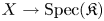 $X \to {\rm Spec}(\mathfrak {K})$. This means that
 $\chi$ descends to a character of
 $G_\mathfrak {K}$. Thus, we may associate to
 $M$ a
 $p$-adic representation of
 $\pi _1^{\rm \unicode{x00E9}}(X)$ that is well-defined up to twist by a character of
 $G_\mathfrak {K}$.
4.2.1.4 Slope filtrations and log-decay
Let  $M$ be an object of
 $\mathbf {F}-\mathbf {Isoc}^{\dagger} (X)\otimes L$. After replacing
 $X$ with a dense open subset, there is a unique slope filtration
 \[ 0=M_0 \subset M_1 \subset M_2 \subset \cdots\subset M_d=\iota^{\dagger}(M), \]
where each graded piece  $gr_i(M)=M_{i}/M_{i-1}$ is isoclinic of slope
 $\alpha _i$ and
 $\alpha _1<\alpha _2<\dots <\alpha _d$ (see [Reference KatzKat79, Theorem 2.4.2] or [Reference KedlayaKed22, § 4]).
Definition 4.10 The Newton polygon  $NP(M)$ of
 $M$ is the lower convex hull of the points
 $({\rm rank}(M_i), \sum _{i=0}^n {\rm rank}(gr_i(M))\alpha _i)$ in the
 $xy$-plane, where
 $i$ ranges from
 $0$ to
 $d$.
This slope filtration is functorial in  $X$. If
 $\alpha _1=0$, then
 $M_1$ is a unit-root convergent
 $\mathbf {F}$-isocrystal. In this case, we denote
 $M_1$ by
 $M^{\rm unit}$. The following conjecture relates the rate of logarithmic decay of
 $M_i$ to the differences between consecutive slopes.
Conjecture 4.11 Assume that  $M$ is irreducible. Take
 $X={\rm Spec}(F)$ and let
 $r_i = {1}/({\alpha _{i+1} - \alpha _i})$. Then
 $M_i$ has strict
 $r_i$-log-decay.
In § 9 we provide evidence for this conjecture. For example, we prove that  $M_i$ has
 $r_i$-log-decay for any
 $M$. We also prove Conjecture 4.11 when the slopes of
 $M$ are integers and
 $L=\mathbb {Q}_p$.
5. Ramification theory for $p$-adic characters

5.1 Ramification and $p$-adic Lie filtrations

For any  $k \geqslant 0$, we define
 \begin{align*} O_k^\times &= \{x \in \mathcal{O}_L^\times \mid v_p(1-x)> k\}, \\ O_k^+ &= \{ x \in \mathcal{O}_L^+ \mid v_p(x) > k\}. \end{align*}
Consider a multiplicative character  $\rho : G_F \to \mathcal {O}_L^\times$ (respectively, an additive character
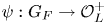 $\psi : G_F \to \mathcal {O}_L^+$). We let
 $s_k(\rho )$ (respectively,
 $s_k(\psi )$) denote the largest upper numbering ramification break of the extension corresponding to
 $\rho ^{-1}(O_k^\times ) \subset G_F$ (respectively,
 $\psi ^{-1}(O_k^+) \subset G_F$). The following lemma is immediate.
Lemma 5.1 Let  $\psi :G_F \to \mathcal {O}_L^+$ be an additive character with
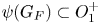 $\psi (G_F) \subset O_{1}^+$. Then
 $s_k(\psi ) = s_k(\exp (\psi ))$ for all
 $k \geqslant 1$. Similarly, let
 $\rho : G_F \to \mathcal {O}_L^\times$ be a multiplicative character with
 $\rho (G_F)\subset O_1^\times$. Then
 $s_k(\rho ) = s_k(\log (\rho ))$ for all
 $k \geqslant 1$.
The image  $\psi (G_F) \subset \mathcal {O}_L^+$ is a free
 $\mathbb {Z}_p$-module whose rank
 $d$ is at most
 $[L:\mathbb {Q}_p]$. We may break up
 $\psi$ as
 $\psi =\sum \psi _i$, such that the image of
 $\psi _i$ is a rank-one
 $\mathbb {Z}_p$-module. Note that
 \begin{equation} s_k(\psi) = \max \{s_k(\psi_i)\}. \end{equation}
This follows from the ‘quotient property’ of the upper ramification numbers (see, e.g., [Reference SerreSer79, Proposition 14]). Finally, we mention a natural restriction on the growth of  $s_k(\psi )$ and
 $s_k(\rho )$.
Lemma 5.2 Let  $\rho$ (respectively,
 $\psi$) be a multiplicative (respectively, additive) character. For all
 $k \geqslant 0$ we have
 $s_{k+1}(\rho )\geqslant p s_k(\rho )$ and
 $s_{k+1}(\psi ) \geqslant p s_k(\psi )$.
Proof. Let  $F_\infty /F$ be the Abelian
 $p$-adic Lie extension corresponding to
 $\psi$. By local class field theory,
 $F_\infty /F$ corresponds to an open subgroup
 $H$ of
 $\mathcal {O}_F^\times$ such that
 $\mathcal {O}_F^\times / H \cong G_{F_\infty /F}$. The image of the subgroup
 $U^s = 1 + T^s\mathcal {O}_F$ in
 $\mathcal {O}_F^\times / H$ corresponds to the subgroup
 $G_{F_\infty /F}^s$. For any group
 $A$ we let
 $A^{\times p}$ denote
 $\{ a^p\mid a \in A\}$. As we are in characteristic
 $p$, we have
 $(U^s)^{\times p} \subset U^{ps}$ for any
 $s$. On the Galois side of the correspondence this means
 $(G_{F_\infty /F}^s)^{\times p} \subset G_{F_\infty /F}^{ps}$. However, because
 $G_{F_\infty /F}$ is isomorphic to
 $\mathbb {Z}_p^d$ for some
 $d$, we know that
 $(G_{F_\infty /F}^{s_{k}(\rho )})^{\times p} = G_{F_\infty /F}^{s_{k+1}(\rho )}$. The multiplicative case is identical.
Corollary 5.3 Let  $r<1$. If
 $\rho$ has
 $r$-bounded monodromy, then
 $\rho$ has finite monodromy.
Definition 5.4 Let  $\rho$ be a multiplicative character. We say
 $\rho$ is harshly ramified if for
 $k \gg 0$, we have
 $s_{k+1}(\rho ) > ps_k(\rho )$.
5.2 Ramification and base change
Proposition 5.5 Let  $\rho : G_F \to \mathcal {O}_L^\times$ be a multiplicative character. Let
 $K$ be a finite Galois extension of
 $F$. There exists
 $c\geqslant 0$ such that for
 $k$ sufficiently large we have
 \[ s_k(\rho|_{G_K}) = |G_{K/F}^0|s_k(\rho) - c. \]
Furthermore,  $c=0$ if and only if
 $K$ is tamely ramified over
 $F$.
Proof. Recall the inverse Hasse–Herbrand function
 \begin{equation} \psi_{K/F}(s) = \int_0^s [G_{K/F}^0:G_{K/F}^x] \, {{d} x}. \end{equation}
Let  $F_\infty$ (respectively,
 $K_\infty$) be the fixed field of
 $\rho ^{-1}(\{1\})$ (respectively,
 $\rho |_{G_K}^{-1}(\{1\})$). We claim that for
 $s$ sufficiently large, the map
 $G_{K_\infty /K} \to G_{F_\infty /F}$ restricts to an isomorphism
 \begin{equation} G_{K_{\infty}/K}^{\psi_{K/F}(s)} \cong G_{F_\infty/F}^s. \end{equation}
To see this, let  $K_1$ be a finite Galois extension of
 $F$ containing
 $K$. Using [Reference SerreSer79, § 4, Proposition 15], we see that
 \begin{align*} G_{K_1/F}^s \cap G_{K_1/K} &= (G_{K_1/F})_{\psi_{K_1/F}(s)} \cap G_{K_1/K} \\ &= (G_{K_1/K})_{\psi_{K_1/F}(s)} \\ &= (G_{K_1/K})_{\psi_{K_1/K} \circ \psi_{K/F}(s)} \\ &= (G_{K_1/K})^{\psi_{K/F}(s)}. \end{align*}
By taking a limit along the finite subextensions of  $K_\infty$ over
 $F$ we obtain
 \begin{equation} G_{K_\infty/F}^s \cap G_{K_\infty/K} = G_{K_\infty/K}^{\psi_{K/F}(s)}. \end{equation}
As  $K/F$ is a finite extension we have
 $G_{K_\infty /F}^s \subset G_{K_\infty /K}$ for large
 $s$. In addition, for
 $s$ large the restriction map
 $G_{K_\infty /F}^s \to G_{F_\infty /F}^s$ is an isomorphism. Combining this with (5) proves (4). From (4) we see that
 $s_k(\rho |_{G_K})=\psi _{K/F}(s_k(\rho ))$ for
 $k$ sufficiently large. The proposition follows from (3).
Corollary 5.6 Assume  $\rho (I_F)$ is infinite. If
 $K$ is wildly ramified over
 $F$, then
 $\rho |_{G_K}$ is harshly ramified.
Corollary 5.7 Adopt the notation from Proposition 5.5. Then  $\rho$ has
 $a$-stable monodromy (respectively,
 $r$-bounded monodromy) if and only if
 $\rho |_{G_K}$ has
 $a$-stable monodromy (respectively,
 $r$-bounded monodromy).
6. Monodromy of rank-one $\mathbf {F}$-isocrystals

6.1 Frobenius structures of $p$-adic characters

6.1.1 Rings of periods
Let  $\widetilde {\mathcal {E}}=L\otimes _{W(\mathbb {F}_{q})} W(F^{\rm alg})$. There is an embedding
 $\iota : \mathcal {E} \hookrightarrow \widetilde {\mathcal {E}}$ that sends
 $T$ to the Teichmuller lift
 $[T]$. Recall that
 $\sigma : \mathcal {E} \to \mathcal {E}$ (respectively,
 $\nu : \mathcal {E} \to \mathcal {E}$) is the endomorphism that sends
 $T$ to
 $T^q$ (respectively,
 $T$ to
 $T^p$) and restricts to endomorphism
 $\sigma$ (respectively,
 $\nu$) of
 $L$ as defined in § 2. If
 $K$ is a finite separable extension of
 $F$, there exists a unique unramified extension
 $\mathcal {E}^K$ of
 $\mathcal {E}$ contained in
 $\widetilde {\mathcal {E}}$ whose residue field is
 $K$ (see [Reference MatsudaMat95, Theorem 2.2]). Define
 \[ \mathcal{E}^{\rm un} = \bigcup_{[K:F]<\infty}\mathcal{E}^{K}, \]
and let  $\widetilde {\mathcal {E}}^{\rm un}$ be the
 $p$-adic completion of
 $\mathcal {E}^{\rm un}$. Note that
 $G_F$ acts continuously on
 $\widetilde {\mathcal {E}}^{\rm un}$.
6.1.2 Multiplicative characters
Let  $\rho : G_F \to \mathcal {O}_L^\times$ be a multiplicative character and let
 $V=e_0 L$ be a one-dimensional vector space over
 $L$ on which
 $G_F$ acts through
 $\rho$. The corresponding object
 $M$ of
 $\mathbf {F}-\mathbf {Isoc}^{\rm \unicode{x00E9}}({\rm Spec}(F))\otimes L$ is
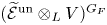 $(\widetilde {\mathcal {E}}^{\rm un} \otimes _{L} V)^{G_F}$, where the Frobenius acts by
 $\sigma \otimes \text {id}$. Thus,
 $M$ consists of elements
 $x_0\otimes e_0$ such that
 ${x_0}/{x_0^\gamma } = \rho (\gamma )$. The Frobenius structure of
 $M$ is given by
 $m= {x_0^\sigma }/{x_0}$. Note that
 $m$ is well-defined up to multiplication by elements of the form
 ${c^\sigma }/{c}$, where
 $c \in \mathcal {E}^\times$.
Let  $V_0=\mathbb {Q}_p e_0$, so that
 $V=V_0 \otimes _{\mathbb {Q}_p} L$. Assume that
 $\rho$ factors through a map
 $\rho _0: G_F \to {\rm GL}(V_0)$ and let
 $M_0$ be the corresponding object of
 $\mathbf {F}-\mathbf {Isoc}^{\rm \unicode{x00E9}}({\rm Spec}(F))$. There is an isomorphism
 \[ (\widetilde{\mathcal{E}}^{\rm un} \otimes_{\mathbb{Q}_p} V_0)^{G_F} \to (\widetilde{\mathcal{E}}^{\rm un} \otimes_{L} V)^{G_F} \]
sending  $x_0 \otimes _{\mathbb {Q}_p} e_0$ to
 $x_0 \otimes _L e_0$. Then
 $m_0={x_0^{\nu }}/{x_0}$ is a Frobenius structure of
 $M_0$ and we have
 $m = \prod _{i=0}^{f-1} m_0^{\nu ^i}$
6.1.3 Additive characters
Let  $\psi :G_F \to p\mathcal {O}_L^+$ be an additive character. For some
 $y_0 \in \widetilde {\mathcal {E}}^{\rm un}$ and
 $a \in \mathcal {E}$ we have
 \begin{align*} y_0 - y_0^{\gamma} &= \psi(\gamma), \\ y_0^\sigma - y_0 &= a. \end{align*}
We refer to  $a$ as the Frobenius structure of
 $\psi$. It is well-defined up to addition by elements
 $c^\sigma - c$ for
 $c \in \mathcal {E}$. If we set
 $\rho =\exp (\psi )$, then we may take
 $y_0=\log (x_0)$ and
 $a=\log (m)$ (here
 $x_0$ and
 $m$ are as in § 6.1.2). If
 $\psi$ factors through
 $\psi _0: G_F \to p \mathbb {Z}_p^+$, we obtain
 \begin{align*} y_0^\nu - y_0 &= \log(m_0), \\ \log(m)&= \sum_{i=0}^{f-1} \log(m_0)^{\nu^i}. \end{align*}
6.1.4 Maximal Frobenius structures
Let  $x \in \mathcal {O}_{\mathcal {E}_{F^{\rm un},L}}$. For
 $k \geqslant 0$, define the
 $k$th weighted partial valuation as follows:
 \[ c_k(x) = \min_{\stackrel{i \in \mathbb{Z}_{\geqslant 0}}{i\leqslant k}}\{ p^i w_{k-i}(x)\} \cup \{0\}. \]
These weighted partial valuations satisfy the following properties.
Lemma 6.1 Let  $x,y \in \mathcal {O}_{\mathcal {E}_{F^{\rm un},L}}$. The following hold.
(i) For
$k\geqslant 0$ we have $c_{k+1}(px) = c_k(x)$, $c_k(x^\nu )=pc_k(x)$, and $c_k(x^\sigma )=qc_k(x)$.(ii) We have
$c_k(x+y) \geqslant \min (c_k(x),c_k(y))$. If the minimum is attained exactly once there is equality.(iii) We have
$c_k(x\cdot y) \geqslant c_k(x) + c_k(y)$.(iv) If
$v_p(x-1)\geqslant 1$ (respectively, $v_p(x)\geqslant 1$), then $c_k(x)=c_k(\log (x))$ (respectively, $c_k(x)=c_k(\exp (x))$) for all $k\geqslant 1$.





Proof. Statements (i)–(iii) follow from the definition and the statement about exponentials will follow from the statement about logs. Write  $x=1+py$, with
 $y \in \mathcal {O}_{\mathcal {E}_{F^{\rm un},L}}$. It is enough to prove
 $c_k({p^ny^n}/{n})>c_k(py)$ for all
 $n\geqslant 2$. Let
 $m=v_p(n)$. Then by statements (i) and (iii), we see
 \begin{align*} c_k\biggl(\frac{p^ny^n}{n}\biggr) &\geqslant\frac{n}{p^{n-1-m}} c_k(py) \\ &> c_k(py). \end{align*}
Definition 6.2 Let  $x \in \mathcal {O}_{\mathcal {E}_{F^{\rm un},L}}$. We say that
 $x$ is maximal if the following holds: for all
 $k\geqslant 0$, we have
 $q|c_{k+1}(x)$ if and only if
 $c_{k+1}(x)=pc_k(x)$.
The term maximal is justified by the following proposition.
Proposition 6.3 The following hold.
(i) Let
$x \in \mathcal {O}_{\mathcal {E}_{F^{\rm un},L}}$ be maximal. If $y \in \mathcal {O}_{\mathcal {E}_{F^{\rm un},L}}$, then $c_k(x)\geqslant c_k(x+y^\sigma - y)$ for all $k\geqslant 0$.(ii) Let
$x \in 1 + p\mathcal {O}_{\mathcal {E}_{F^{\rm un},L}}$ be maximal. If $y \in 1 + p\mathcal {O}_{\mathcal {E}_{F^{\rm un},L}}$, then $c_k(x)\geqslant c_k(x ({y^\sigma }/{y}))$ for all $k\geqslant 0$.


Proof. By Lemma 6.1 it is enough to prove part (i). Let  $z=x+y^\sigma - y$ and let
 $k\geqslant 0$ be the smallest value with
 $c_k(z)>c_k(x)$. As
 $x$ is maximal, we have
 $c_k(x) < 0$. By Lemma 6.1 we see that
 $c_k(y^\sigma )=c_k(x)$. Thus,
 $q|c_k(x)$, so
 $c_k(x)=pc_{k-1}(x)\geqslant pc_{k-1}(z)$. This implies
 $c_k(z) > pc_{k-1}(z)$, which is impossible.
Definition 6.4 Let  $\rho :G_F \to \mathcal {O}_L^\times$ be a multiplicative character. A maximal Frobenius structure of
 $\rho$ is a Frobenius structure
 $m$ that is maximal. A
 $\Theta$-maximal Frobenius structure of
 $\rho$ is a set
 $\{m_g\}_{g \in \Theta }$, where
 $m_g$ is a maximal Frobenius structure of
 $\rho ^g$. We make analogous definitions for additive characters.
Corollary 6.5 Let  $\rho : G_F \to 1+p\mathcal {O}_L$ (respectively,
 $\psi : G_F \to \mathcal {O}_L^+$) be a multiplicative (respectively, additive) character. Let
 $\alpha _1, \alpha _2$ be a maximal Frobenius structure of
 $\rho$ (respectively,
 $\psi$). Then
 $c_k(\alpha _1)=c_k(\alpha _2)$ for all
 $k\geqslant 0$.
It will be helpful to distinguish when a Frobenius structure is maximal. This motivates the following.
Lemma 6.6 If  $x \in \mathcal {O}_{\mathcal {E}_\infty ^{(q)}}$, then
 $x$ is maximal.
Remark 6.7 Let  $\rho : G_F \to 1+p\mathcal {O}_L$ be a multiplicative character. One may show that
 $\rho$ has a Frobenius structure contained in
 $\mathcal {O}_{\mathcal {E}_\infty ^{(q)}}$ (start with a Frobenius structure
 $\alpha \equiv 1 \mod p$ and successively find a Frobenius structure that looks like it is in
 $\mathcal {O}_{\mathcal {E}_\infty ^{(q)}}$ modulo powers of
 $\pi$). Thus, by Lemma 6.6 we know that
 $\rho$ has a maximal Frobenius structure.
6.2 The additive situation
For this subsection we assume  $\mathfrak {K}$ is a finite field.
Proposition 6.8 Let  $\psi : G_F \to \mathcal {O}_L^+$ be an additive character and let
 $\{a_g\}_{g \in \Theta }$ be a
 $\Theta$-maximal Frobenius structure. Then, for
 $k\geqslant 0$, we have
 \begin{equation} \frac{q}{p}s_k(\psi) = \max_{g \in \Theta} \{-c_k(a_g)\}. \end{equation}
We deduce this proposition from a theorem due to Kosters and Wan as follows.
Theorem 6.9 (Kosters–Wan, see [Reference Kosters and WanKW18, Proposition 3.3 or § 4.1])
Let  $\psi : G_F \to p\mathbb {Z}_p^+$ be an additive character that surjects onto
 $p\mathbb {Z}_p^+$. Then there exists a maximal Frobenius
 $a\in \mathcal {O}_{\mathcal {E}_{F,\mathbb {Q}_p}}$ of
 $\psi$ and
 $-c_k(a)=s_k(\psi )$ for all
 $k\geqslant 0$.
Proof. Let  $F_\infty$ be the fixed field of
 $\ker (\psi )$. Then
 $F_\infty /F$ is a
 $\mathbb {Z}_p$-extension, and thus by Artin–Schreier–Witt theory corresponds to an equivalence class of
 $W(F)/(1-\nu )W(F)$ (here
 $\nu$ denotes the standard
 $p$-power Frobenius endomorphism on the ring of
 $p$-typical Witt vectors). By [Reference Kosters and WanKW18, Proposition 3.1], for any
 $b \in \mathfrak {K}$ with
 $Tr_{\mathfrak {K}/\mathbb {F}_p}(b)\neq 0$, there exists a unique representative
 $a_0$ in
 $z$ of the form
 \[ a_0 = r[b]+ \sum_{i\geqslant 1,(i,p)=1} r_i T^{-i}, \]
where  $r \in \mathbb {Z}_p$ and
 $r_i \in W(\mathfrak {K})$ (here we regard
 $\mathcal {E}$ as a subring of
 $W(F)$ via the map
 $\iota$ defined at the beginning of § 6.1). Note that by Lemma 6.6, the element
 $a_0$ is maximal. As in § 6.1.3, from
 $a_0$ we obtain a surjective character
 $\psi _0: Gal(F_\infty /F) \to \mathbb {Z}_p$ (take
 $y_0$ satisfying
 $y_0^\nu - y_0 = a_0$ and then set
 $\psi _0(g)=y_0^g - y_0$). Thus, for some
 $b \in \mathbb {Z}_p$ we have
 $\psi =b\psi _0$, so that
 $a=ba_0$ is a maximal Frobenius structure of
 $\psi$. A proposition due to Kosters–Wan [Reference Kosters and WanKW18, Proposition 3.3] states that
 $s_n(\psi _0)$ is equal to
 $-c_n(a_0)$ (note that [Reference Kosters and WanKW18] state their result in terms of conductors, but this easily translates into a statement about higher ramification groups). From here we deduce that
 $s_n(\psi )=-c_n(a)$.
Corollary 6.10 Let  $\psi : G_F \to \mathcal {O}_L^+$ be an additive character such that
 $\psi (G_F)\subset b \mathbb {Z}_p^+$ for some
 $b \in \mathcal {O}_L^+$. Let
 $a$ be a maximal Frobenius structure of
 $\psi$. Then
 $({q}/{p})s_k(\psi ) = -c_k(a)$ for all
 $k\geqslant 0$.
Proof. Let  $\psi _0:G_F \to \mathbb {Z}_p^+$ be the character defined by
 $b^{-1}\psi$ and let
 $a_0$ be a maximal Frobenius of
 $\psi _0$. By Lemma 6.1 we see that
 $b\sum _{i=0}^{f-1} a_0^{\nu ^i}$ is a Frobenius structure of
 $\psi$. The result follows from Corollary 6.5 and Theorem 6.9.
Definition 6.11 Let  $M\subset \mathcal {O}_L$ be a
 $\mathbb {Z}_p$-module and let
 $B$ be a basis of
 $M$. For
 $i=0,\dots, e-1$, define
 $B_i=\{b \in B | v_p(b) \equiv {i}/{e} \text { mod~}\mathbb {Z}\}$. In particular, we may write
 $B_i=\{\pi ^i p^{r_{i,1}} u_{i,1}, \dots, \pi ^i p^{r_{i,d_i}}u_{i,d_i}\!\}$. We say
 $B$ is nice if for each
 $i$, the reductions of
 $u_{i,1}, \dots, u_{i,d_i}$ modulo
 $\pi$ are linearly independent over
 $\mathbb {F}_p$.
Lemma 6.12 Every  $\mathbb {Z}_p$-module
 $M \subset \mathcal {O}_L$ has a nice basis.
Lemma 6.13 Let  $B$ be a nice basis of
 $M$. For every
 $b\in B$, let
 $x_b$ be an element of
 $W(\mathfrak {K})$. Then
 \[ \min_{b \in B} \{ v_p(x_b b) \}= \min_{g \in \Theta}\bigg\{ v_p\biggl(\sum_{b \in B} x_b b^{g}\biggr)\bigg \}. \]
Proof. We may replace  $L$ with a field that is Galois over
 $\mathbb {Q}_p$. Let
 $r=\min _{b \in B}(v_p(x_bb))$ and write
 $r={i}/{e}+n$ with
 $0\leqslant i < e$. Let
 $B'\subset B$ consist of all
 $b\in B$ such that
 $v_p(x_bb)=r$. Note that
 $B'$ is a subset of
 $B_i$ from Definition 6.11. For each
 $b\in B'$ we write
 $b=u_b\pi ^i p^{r_b}$ and
 $x_b=v_b p^{s_b}$, where
 $u_b\in \mathcal {O}_L^\times$ and
 $v_b \in W(\mathfrak {K})^\times$. Let
 $\overline {A}$ be a matrix whose columns are
 $[\overline {u}_b,\overline {u}_b^p, \dots, \overline {u}_b^{p^{f-1}}]^T$ for each
 $b \in B'$. By the definition of nice, we know that the rank of
 $\overline {A}$ is
 $|B'|$. Thus, there exists
 $j$ such that
 \[ \sum_{b \in B'} \overline{u_b}^{p^j} \overline{v_b} \neq 0. \]
Let  $g$ be an element of
 $G_{L/\mathbb {Q}_p}$ that reduces to the
 $p^j$th power map on
 $\mathcal {O}_L/\pi \mathcal {O}_L$ and let
 $c ={g(\pi ^i)}/{\pi ^i}$. Then
 \[ \sum_{b \in B} x_b b^g \equiv c\pi^ip^n \sum_{b \in B'} \overline{u_b}^{p^j} \overline{v_b} \not \equiv 0\mod \pi^{er+1}. \]
Corollary 6.14 Consider a subset  $\{y_b\}_{b \in B} \subset \mathcal {O}_{\mathcal {E}_{F,\mathbb {Q}_p}}$. There exists
 $g \in \Theta$ such that
 \[ \max_{b \in B} \{-c_k( y_b b) \} = -c_k\biggl (\sum_{b \in B} y_b b^g \biggr ). \]
Proof. Let  $n=\min _{b \in B} w_k( y_b b)$ and let
 $x_b\in W(\mathfrak {K})$ denote the coefficient of
 $T^n$ in
 $y_b$. Note that
 $\min _{b \in B} v_p(x_b b) \leqslant k$. By Lemma 6.13, there exists
 $g \in \Theta$ with
 $v_p(\sum _{b \in B} x_b b^{g})\leqslant k$. It follows that the
 $p$-adic valuation of the coefficient of
 $T^n$ in
 $\sum _{b \in B} y_b b^{g}$ is less than
 $k$.
Proof of Proposition 6.8 Let  $B$ be a nice basis of
 $\psi (G_F)$. Decompose
 $\psi$ as
 $\sum _{b \in B} b\psi _b$, where the image of
 $\psi _b$ is
 $\mathbb {Z}_p$. For each
 $b \in B$, let
 $y_b \in \mathcal {O}_{\mathcal {E}_{F,\mathbb {Q}_p}}$ be a maximal Frobenius of
 $\psi _b$. Then
 $a_g = \sum y_b b^g$ is a maximal Frobenius of
 $\psi ^g$ for each
 $g \in \Theta$. By (2) and Corollaries 6.10 and 6.14 we have
 \begin{align*} \frac{q}{p}s_k(\psi) &= \max_{b \in B}\bigg\{ \frac{q}{p}s_k(b\psi_b) \!\bigg\}\\ &=\max_{b \in B} \{-c_k(y_b b) \}\\ &= \max_{g \in \Theta} \{-c_k(a_g) \}. \end{align*}
6.3 The multiplicative situation
Again, we assume  $\mathfrak {K}$ is a finite field for this subsection.
Proposition 6.15 Let  $\rho : G_F \to 1+p\mathcal {O}_L$ and let
 $\{m_g\}_{g \in \Theta }$ be a
 $\Theta$-maximal Frobenius structure of
 $\rho |_{F^{ur}}$. Then for
 $k\geqslant 0$, we have
 \[ \frac{q}{p}s_k(\rho) = \max_{g \in \Theta} \{-c_k(m_g)\}. \]
Proof. By Lemma 6.1 we know that  $\{\log (m_g)\}_{g \in \Theta }$ is a
 $\Theta$-maximal Frobenius structure for
 $\log \circ \rho$ and that
 $c_k(m_g) = c_k(\log (m_g))$ for all
 $k\geqslant 0$. The proposition follows from Lemma 5.1 and Proposition 6.8.
Corollary 6.16 Adopt the notation of Proposition 6.15 and assume  $\rho$ is harshly ramified. For
 $k$ large, we have
 \[ \frac{q}{p}s_k(\rho) = \max_{g \in \Theta} \{ -w_k(m_g)\}. \]
Corollary 6.17 Let  $\rho$ be a multiplicative character of
 $G_F$ and let
 $M$ be the corresponding unit-root
 $\mathbf {F}$-isocrystal. Let
 $r>0$ and assume that
 $M^g$ has
 $r$-log-decay for each
 $g\in \Theta$. If
 $r\geqslant 1$, then
 $\rho$ has
 $r$-bounded monodromy. If
 $r<1$, then
 $M$ is overconvergent and
 $\rho$ has finite monodromy.
Proof. After replacing  $F$ with a finite extension we may assume
 $\rho (G_F) \subset 1+p\mathcal {O}_L$. We may also assume that
 $\rho$ is either harshly ramified or unramified by Corollary 5.6. Let
 $\{m_g\}_{g \in \Theta }$ be a
 $\Theta$-maximal Frobenius structure. There exists
 $c>0$ such that
 $\{m_g\}_{g \in \Theta } \subset \mathcal {O}_{\mathcal {E}}^{ r,c}$. By Proposition 6.15, we know
 $\rho$ has
 $r$-bounded monodromy. The statement about
 $r<1$ follows from Corollary 5.3.
7. Recursive Frobenius equations
For this section, we define  $E_a$ to be
 $\mathbf {Frac}(\mathcal {O}_L \otimes _{\mathbb {F}_q} W(\mathbb {F}_{q^a}))$ and
 $\mathcal {E}_a$ (respectively,
 $\mathcal {E}_a^{\dagger}$) to be
 $\mathcal {E}_{\mathbb {F}_{q^a}((T)),L}$ (respectively,
 $\mathcal {E}_{\mathbb {F}_{q^a}((T)),L}^{\dagger}$). Note that
 $\mathcal {E}_{\infty }$ is the closure of
 $\bigcup _{a=1}^\infty \mathcal {E}_a$ and
 $\bigcup _{a=1}^\infty \mathcal {E}_a^{\dagger}$ is dense in
 $\mathcal {E}_\infty ^{\dagger}$.
7.1 Basic definitions
Let  $A \in M_{d\times d}(\mathcal {O}_{\mathcal {E}_\infty })$ with
 $v_q(A)> 0$ and let
 $C \in M_{d \times 1}(\mathcal {O}_{\mathcal {E}_\infty })$. We define
 $R_a(A;C)$ to be the unique
 $d \times 1$ matrix satisfying the recursive Frobenius equation:
 \begin{equation} x=Ax^{\sigma^a} +C. \end{equation}
We define  $R(A;C)$ to be
 $R_1(A;C)$. These solutions have the following explicit formula:
 \begin{equation} R_a(A;C) =\sum_{i=0}^\infty A^{({1-\sigma^{ai}})/({1-\sigma^a})}C^{\sigma^{ai}}. \end{equation}
More generally, for  $A_1,\dots, A_m,B_1,\dots, B_{m-1} \in M_{d\times d}(\mathcal {O}_{\mathcal {E}_{\infty }})$ with
 $v_q(A_i)>0$, we give the recursive definition:
 \[ R_a(A_1,\dots,A_m;B_1,\dots,B_{m-1},C) =R_a(A_1,\dots,A_{m-1};B_1,\dots,B_{m-1}\cdot R_a(A_m;C)^\sigma). \]
If the  $A_i$ are all equal to
 $A$, we define
 \[ R_a(A; B_1,\dots,B_{m-1},C) =R_a(A_1,\dots,A_m;B_1,\dots,B_{m-1},C). \]
When  $d=1$ we drop the pretext of dealing with matrices and view everything as elements of
 $\mathcal {O}_{\mathcal {E}_{\infty }}$.
Lemma 7.1 We have
 \begin{align} R_a(A,B+C) &= R_a(A,B)+R_a(A,C), \end{align}
 \begin{align} R_a(A+B,C) &= \sum_{m=0}^\infty R_a(A; \underbrace{B,\dots,B}_{m \text{ times}}, C). \end{align}
Proof. The first equation is immediate. Define  $S_m=R_a(A; \underbrace {B,\dots,B}_{m \text { times}}, C)$ and note that
 \[ S_m=\begin{cases} AS_m^{\sigma^a} + BS_{m-1}^{\sigma^a} & m\geqslant 1, \\ AS_0^{\sigma^a} + C & m=0. \end{cases} \]
Thus,  $\sum S_m$ is the solution to the Frobenius equation
 $x=(A+B)x^{\sigma ^a} + C$, which proves (10).
7.2 Growth of recursive Frobenius equations
We begin by proving some basic properties of  $\mathcal {O}_{\mathcal {E}_\infty }^{r,c}$, which are used throughout the rest of the article.
Lemma 7.2 Let  $r,c>0$ and let
 $\omega \in \mathcal {O}_L$ satisfy
 $v_q(\omega )={1}/{r}$.
(i) If
$x \in \mathcal {O}_{\mathcal {E}_\infty }^{r,c}$, then $\omega x \in \mathcal {O}_{\mathcal {E}_\infty }^{r,q^{-1}c}$ and $x^\sigma \in \mathcal {O}_{\mathcal {E}_\infty }^{r,qc}$.(ii) If
$y=\omega x \in \mathcal {O}_{\mathcal {E}_\infty }^{r,c}$ and $w_0(x)\geqslant 0$, then $x \in \mathcal {O}_{\mathcal {E}_\infty }^{r,qc}$ and $y^{1+\sigma +\dots +\sigma ^n} \in \mathcal {O}_{\mathcal {E}_\infty }^{r,c}$.(iii) Let
$x$ and $y$ be as in part (ii) and let $z \in \mathcal {O}_{\mathcal {E}_\infty }^{r,c}$. Then $yz^\sigma \in \mathcal {O}_{\mathcal {E}_\infty }^{r,c}$.


Proof. Parts (i)–(ii) follow from the definition of  $\mathcal {O}_{\mathcal {E}_\infty }^{r,c}$. To prove part (iii), note that
 $xz^\sigma \in \mathcal {O}_{\mathcal {E}_\infty }^{r,qc}$.
Corollary 7.3 Let  $y=\omega x \in \mathcal {O}_{\mathcal {E}_\infty }^{r,c}$ and assume that
 $w_0(x)\geqslant 0$. If
 $z \in \mathcal {O}_{\mathcal {E}_\infty }^{r,c}$, then
 $R(y,z)\in \mathcal {O}_{\mathcal {E}_\infty }^{r,c}$.
7.2.1 Approximating Frobenius equations
For this section, we fix  $c>0$ and
 $c>c_1>0$.
Lemma 7.4 There exists  $N_0>0$, depending only on
 $c$ and
 $c_1$, such that:
(i) if
$x,y \in \mathcal {O}_{\mathcal {E}_\infty }^{1,c}$ and $q^{N_0}| x,y$, then $xy^\sigma \in \mathcal {O}_{\mathcal {E}_\infty }^{1,c_1}$;(ii) let
$x \in \mathcal {O}_{\mathcal {E}_\infty }^{1,c}\cap q\mathcal {O}_{\mathcal {E}_\infty }$ and let $y \in \mathcal {O}_{\mathcal {E}_\infty }^{1,c_1} \cap q^{N_0}\mathcal {O}_{\mathcal {E}_\infty }$; then $xy^\sigma \in \mathcal {O}_{\mathcal {E}_\infty }^{1,c_1}\cap q^{N_0}\mathcal {O}_{\mathcal {E}_\infty }$.


Proof. Let  $x,y \in \mathcal {O}_{\mathcal {E}_\infty }^{1,c}$ and assume
 $q^{N_0}| x,y$. Write
 $x=q^{N_0-1}u$ and
 $y=q^{N_0-1}v$. By Lemma 7.2, we know
 $u \in \mathcal {O}_{\mathcal {E}_\infty }^{1,q^{N_0-1}c}$ and
 $v^\sigma \in \mathcal {O}_{\mathcal {E}_\infty }^{1,q^{N_0}c}$. Thus,
 $uv^\sigma \in \mathcal {O}_{\mathcal {E}_\infty }^{1,q^{N_0}c}$. From Lemma 7.2 we see that
 $xy^\sigma \in \mathcal {O}_{\mathcal {E}_\infty }^{1,q^{-N_0+2}c}$. In particular, if
 $N_0$ is large enough, part (i) holds. The proof of part (ii) is similar.
For the remainder of this subsection, we fix  $N_0>0$ as in Lemma 7.4.
Lemma 7.5 Let  $x \in \mathcal {O}_{\mathcal {E}^{\dagger} _\infty }\cap \mathcal {O}_{\mathcal {E}_\infty }^{1,c}$. Then, for some
 $a\geqslant 0$, we may write
 $x=y+z$, where
 $y \in \mathcal {O}_{E_a}((T)){\cap} \mathcal {O}_{\mathcal {E}_\infty }^{1,c}$ and
 $z \in \mathcal {O}_{\mathcal {E}_\infty }^{1,c_1}{\cap} q^{N_0}\mathcal {O}_{\mathcal {E}_\infty }$.
Proof. Write  $x=y+z$, where
 $z \in \mathcal {O}_{\mathcal {E}_\infty }^{1,c_1}\cap q^{N_0}\mathcal {O}_{\mathcal {E}_\infty }$ and
 $y$ is a Laurent series with a finite pole. As
 $\cup \mathcal {O}_{\mathcal {E}_n^{\dagger} }$ is dense in
 $\mathcal {O}_{\mathcal {E}^{\dagger} _\infty }$, we may take
 $y$ to lie in
 $\mathcal {O}_{E_a}((T))$ for
 $a$ sufficiently large. Furthermore, we know
 $y\in \mathcal {O}_{\mathcal {E}_\infty }^{1,c}$, as both
 $x$ and
 $z$ lie in
 $\mathcal {O}_{\mathcal {E}_\infty }^{1,c}$.
Lemma 7.6 Let  $A$ be a matrix such that
 $qA\in M_{d\times d}(\mathcal {O}_{\mathcal {E}_\infty }^{r,c})$ and
 $w_0(A)\geqslant 0$. Let
 $C\in M_{d\times 1}(\mathcal {O}_{\mathcal {E}_\infty }^{1,c})$ and
 $Y_1$ (respectively,
 $Y_2$) be an
 $d\times d$ (respectively,
 $d \times 1$) matrix with entries in
 $\mathcal {O}_{\mathcal {E}_\infty }^{1,c_1}\cap q^{N_0}\mathcal {O}_{\mathcal {E}_\infty }$. Then,
 \begin{align} R(qA+Y_1,C)&\equiv R(qA,C) \mod \mathcal{O}_{\mathcal{E}_\infty}^{1,c_1}\cap q^{N_0}\mathcal{O}_{\mathcal{E}_\infty} , \end{align}
 \begin{align} R(qA,Y_2+C) &\equiv R(qA,C) \mod \mathcal{O}_{\mathcal{E}_\infty}^{1,c_1}\cap q^{N_0}\mathcal{O}_{\mathcal{E}_\infty}. \end{align}
Proof. Let  $Z_n=(qA)^{({1-\sigma ^n})/({1-\sigma })} Y_2^{\sigma ^n}$. We have
 $Z_n\in \mathcal {O}_{\mathcal {E}_\infty }^{1,c_1}\cap q^{N_0}\mathcal {O}_{\mathcal {E}_\infty }$ by Lemma 7.4 and the relation
 $Z_{n+1}=AZ_n^\sigma$. Then (12) follows from (8) and (9). To prove (11), by Lemma 7.1 it is enough to show
 $R(qA; \underbrace {Y_1,\dots,Y_1}_{m \text { times}}, C)$ has entries in
 $\mathcal {O}_{\mathcal {E}_\infty }^{1,c_1}\cap q^{N_0}\mathcal {O}_{\mathcal {E}_\infty }$ for
 $m\geqslant 1$. This follows from Lemma 7.4.
7.3 Spaces of recursive Frobenius solutions
A tuple  $\lambda$ will be taken to mean a finite tuple of negative integers
 $\lambda =(m_1,\dots,m_r)$. We define
 $\mathbf {len}(\lambda )$ to be
 $r$, i.e. the length of the tuple. For any
 $c \in \mathbb {Z}_{\geqslant 1}$ we let
 $c\lambda$ denote the tuple obtained by scalar multiplication. We say
 $\lambda$ is
 $q^a$-prime if
 $q^a\nmid m_i$ for each
 $i\geqslant 1$. If
 $\mathbf {len}(\lambda )\geqslant 1$, we define
 \[ S_a(\lambda) =R_a(q^a; T^{m_1},\dots, T^{m_r}). \]
and if  $\mathbf {len}(\lambda )=0$ we set
 $S_a(\lambda )=1$. For
 $\mu _0,\mu _1 \in \mathbb {Z}_{<0}$ we have the following relations:
 \begin{align} S_a(\mu_0, \lambda) &= T^{\mu_0} \cdot S_a(q^{a}\lambda) + q^a S_a(q^a\mu_0,q^a \lambda), \end{align}
 \begin{align} S_a(\mu_0,\mu_1,\lambda) &= S_a(\mu_0+q^{a}\mu_1, q^a\lambda) + q^a S_a(\mu_0,q^a\mu_1,q^{a}\lambda), \end{align}
which follow from (7). Finally, we define the following  $E_{a}[T^{-1}]$-modules:
 \begin{align*} \mathcal{N}_a &= \bigg\{\sum_{i=1}^n b_i S_a(\lambda_i)\biggm| b_i \in E_a[T^{-1}] \text{ and the }\lambda_i\text{ are tuples}\!\bigg\}, \\ \mathcal{N}_a^{(p)} &= \bigg\{\sum_{i=1}^n b_i S_a(\lambda_i)\biggm| b_i \in E_a[T^{-1}] \text{ and the }\lambda_i\text{ are $q^a$-prime tuples}\!\bigg\}. \end{align*}
Lemma 7.7 We have  $\mathcal {N}_a^{(p)} = \mathcal {N}_a$.
Proof. We proceed by induction on  $r=\mathbf {len}(\lambda )$. When
 $r=1$ the result follows from (13). Let
 $r\geqslant 1$ and assume the result holds for all
 $k< r$. Write
 $\lambda =(\mu _0,\mu _1,\lambda _0)$, where
 $\mathbf {len}(\lambda _0)=r-2$. By our inductive hypothesis we may assume that
 $(\mu _1,\lambda _0)$ is
 $q^a$-prime. If
 $q^a|\mu _0$, from (13) and (14) we obtain
 \[ S_a(\mu_0,\mu_1,\lambda_0) = S_a(\mu_0+q^a\mu_1,q^a\lambda_0) - T^{\mu_0}S_a(\mu_1,q^a\lambda_0) + S_a\biggl(\frac{\mu_0}{q^a},\mu_1,\lambda_0\biggr). \]
Both  $S_a(\mu _0+q^a\mu _1,q^a\lambda _0)$ and
 $T^{\mu _0}S_a(\mu _1,q^a\lambda _0)$ are contained in
 $\mathcal {N}_a^{(p)}$ by our inductive hypothesis, so it suffices to prove
 $S_a({\mu _0}/{q^a},\mu _1,\lambda _0)\in \mathcal {N}_a^{(p)}$. Repeating this argument proves the lemma.
Lemma 7.8 Let  $x \in \mathcal {E}_\infty$ and let
 $a,b$ be integers with
 $b=a\cdot c$. We have
 \[ R_a(q;x) = \sum_{i=0}^{c-1} q^{ia} R_b(q^b;x^{\sigma^{ia}}). \]
Lemma 7.9 Let  $C \in M_{d\times 1}(\mathcal {E}_\infty )$ have entries in
 $\mathcal {N}_a$ and let
 $B\in T^{-1}M_{d\times d}(E_a[T^{-1}])$. Then
 $R(q1_d;BC)$ has entries in
 $\mathcal {N}_a$.
Corollary 7.10 Let  $B_1,\dots, B_m \in T^{-1} M_{d\times d}(E_a[T^{-1}])$ and
 $C \in T^{-1}M_{d\times 1}(E_a[T^{-1}])$. Then we have
 $R(q1_d;B_1,\dots,B_m,C)$ has entries in
 $\mathcal {N}_a$.
Proposition 7.11 Let  $A \in q1_d+q^2T^{-1}M_{d\times d}(\mathcal {O}_{\mathcal {E}_{\infty }^{{\dagger},-}})$ and
 $C \in qT^{-1}M_{d \times 1}(\mathcal {O}_{\mathcal {E}_{\infty }^{{\dagger},-}} )$. Let
 $c_1>0$ and let
 $N_0$ be a positive integer. Then, for
 $a$ sufficiently large, there exists
 $Z_{c_1}\in M_{d\times 1}(\mathcal {E}_\infty )$ with entries in
 $\mathcal {N}_a^{(p)}$ such that
 \[ R(qA,C) \equiv Z_{c_1} \mod \mathcal{O}_{\mathcal{E}_\infty}^{1,c_1}\cap q^{N_0} \mathcal{O}_{\mathcal{E}_\infty}. \]
Proof. Write  $A$ as
 $q1_d + q^2 A_1$. There exists
 $c>c_1$ such that
 $qA_1$ and
 $C$ have entries in
 $\mathcal {O}_{\mathcal {E}_\infty }^{1,c}$. After increasing
 $N_0$, we may assume that the results of § 7.2.1 hold. By Lemma 7.5 and Lemma 7.6, we may also assume the entries of
 $qA_1$ and
 $C$ lie in
 $T^{-1}\mathcal {O}_{E_a}[T^{-1}]\,{\cap}\, \mathcal {O}_{\mathcal {E}_\infty }^{1,c}$. Then, by Corollary 7.3, we know that
 \[ R(q1_d; \underbrace{qA_1,\dots,qA_1}_{m \text{ times}},C) \]
is contained in  $M_{d\times 1}(\mathcal {O}_{\mathcal {E}_\infty }^{1,c})$ for all
 $m$. Thus, for
 $m_0$ sufficiently large, we know that
 \[ R(q1_d; \underbrace{q^2A_1,\dots,q^2A_1}_{m \text{ times}},C) = q^mR(q1_d; \underbrace{qA_1,\dots,qA_1}_{m \text{ times}},C) \]
has entries in  $\mathcal {O}_{\mathcal {E}_\infty }^{1,c_1}\cap q^{N_0} \mathcal {O}_{\mathcal {E}_\infty }$ for all
 $m>m_0$. From Lemma 7.1 we obtain
 \[ R(A,C) \equiv \sum_{m=0}^{m_0} R(q1_d; \underbrace{q^2A_1,\dots,q^2A_1}_{m \text{ times}},C_0) \mod \mathcal{O}_{\mathcal{E}_\infty}^{1,c_1}\cap q^{N_0} \mathcal{O}_{\mathcal{E}_\infty}. \]
The right-hand side of this equivalence has entries in  $\mathcal {N}_a^{(p)}$ by Lemma 7.7 and Corollary 7.10.
7.4 Stable growth for solutions of Frobenius equations
In this subsection, we study the growth of certain solutions to recursive Frobenius equations.
Definition 7.12 Let  $S$ be a finite subset of
 $\mathcal {O}_{\mathcal {E}_\infty }$. Let
 $a$ be a positive integer and let
 $s=v_p(q^a)$. We say that
 $S$ has
 $a$-stable growth if for any
 $k \in [0,s]$, there exists
 $m_k$ and
 $b_k$ such that
 \[ \min_{x \in S}( w_{k+sn}(x))=m_kq^{an} + b_k \]
for  $n\gg 0$. We say that
 $S$ has stable growth if
 $S$ has
 $a$-stable growth for some
 $a$.
Lemma 7.13 For  $i=1,2$, let
 $S_i \subset \mathcal {O}_{\mathcal {E}_\infty }$ have
 $a_i$ stable growth. Then
 $S_1 \cup S_2$ has
 $ {\rm lcm}(a_1,a_2)$-stable growth.
Proof. Observe that a set with  $a$-stable growth has
 $ad$-stable growth for
 $d\in \mathbb {Z}_{\geqslant 1}$.
To state our main result of this subsection, we define the following spaces:
 \begin{align*} \mathcal{M}_a &= \mathcal{N}_a \otimes_{E_a[T^{-1}]} E_a((T)) \\ \mathcal{M} &= \bigcup_{a=1}^\infty \mathcal{M}_a. \end{align*}
Proposition 7.14 Let  $S \subset \mathcal {M}$ and assume there exists
 $c_1>1$ such that
 \[ \min_{x \in S} \{w_k(x)\} \leqslant -c_1 p^k \]
for all  $k\geqslant 0$. Then
 $S$ has stable growth.
The proof of Proposition 7.14 is broken into several lemmas.
Lemma 7.15 Let  $a\in \mathbb {Z}_{\geqslant 1}$ and
 $s=v_p(q^a)$. Fix
 $x \in \mathcal {O}_{\mathcal {E}_\infty }$ and
 $k\geqslant 0$. Assume that
 $q^a\nmid w_k(x)$ and that
 \begin{equation} w_{k+sn}(x) > q^{an}w_k(x) \end{equation}
for  $n\in \mathbb {Z}_{\geqslant 1}$. Then for
 $n\in \mathbb {Z}_{\geqslant 0}$ we have
 \[ w_{k+sn}(R_a(q^a,x))=q^{an}w_k(R_a(q^a,x)). \]
Proof. We proceed by induction on  $n$. The case where
 $n=0$. Set
 $n\geqslant 1$. Let
 $z=R_a(q^a,x)$, so that
 $z=q^az^{\sigma ^a} + x$. Note that
 $w_k(z)\leqslant w_k(x)$, because
 $q^a \nmid w_{k}(x)$ and
 $q^a|w_k(q^az^{\sigma ^a})$. We have
 \begin{align*} w_{k+sn}(z) &\geqslant \min(w_{k+sn}(q^az^{\sigma^a}), w_{k+sn}(x)) \\ &= \min (q^aw_{k+s(n-1)}(z),w_{k+sn}(x)) \\ &= \min(q^{an}w_k(z),w_{k+sn}(x)). \end{align*}
By (15) we know that  $q^{an} w_k(z)< w_{k+sn}(x)$, which proves the result.
Lemma 7.16 Let  $a$ and
 $s$ be as in Lemma 7.15. Let
 $\beta _1,\dots, \beta _r \in \mathcal {O}_{E_a}$ and let
 $\Lambda =\{\lambda _1, \dots, \lambda _r\}$ be a set of
 $q^a$-prime tuples. We set
 $x=\sum \beta _i S_a(\lambda _i)$. Then for any
 $k \in [0,s]$, there exists
 $m_k$ such that
 \begin{equation} w_{k+sn}(x) = m_kq^{an} \end{equation}
for  $n$ sufficiently large.
Proof. Define  $\mathbf {L}(\Lambda )$ to be
 $\max \{{\mathbf {len}(\lambda _i)}\}$. We proceed by induction on
 $\mathbf {L}(\Lambda )$. When
 $\mathbf {L}(\Lambda )$ is
 $1$, then
 $x=R_a(q^a,y)$ with
 $y \in \mathcal {O}_{E_a}[T^{-1}] \cap \mathcal {E}_\infty ^{(q^a)}$ and the lemma follows from Lemma 7.15. Now assume the proposition holds for all collections of
 $q^a$-prime tuples
 $\Lambda '$ such that
 $\mathbf {L}(\Lambda ')\leqslant m$. Let
 $\Lambda =\{\lambda _1,\dots, \lambda _r\}$ be a collection of
 $q^a$-prime tuples with
 $\mathbf {L}(\Lambda )=m+1$. There exist tuples
 $\Lambda '=\{\lambda _1',\dots, \lambda _r'\}$ and negative integers
 $\{\kappa _1, \dots, \kappa _r\}$ such that
 $\mathbf {L}(\Lambda ')=m$ and
 $\lambda _i=(\kappa _i, \lambda _i')$. For each
 $d<0$ we define
 \[ y_d = \begin{cases} 0 & \text{ if }d \neq \kappa_i \text{ for every }i, \\ \sum _{\kappa_i=d} \beta_iS_a(\lambda_i') & \text{ otherwise.} \end{cases} \]
Let  $d_{1},\dots, d_{t}$ be the values of
 $d$ for which
 $y_{d}\neq 0$. Then we have
 \begin{align*} x&= \sum_{i=1}^r R_a(q^a;\beta_iT^{\kappa_i}S_a(\lambda_i')) \\ &= \sum_{j=1}^t R_a(q^a;T^{{d_j}}y_{d_j}). \end{align*}
By our inductive assumption, there exists  $m_{j,k}$ such that
 $w_{k+sn}(y_{d_j})=q^{an}m_{j,k}$ for
 $n\gg 0$. Without loss of generality, we may assume
 $d_1 + q^{an} m_{1,k} < \min _{j\geqslant 2} \{d_j + q^{an} m_{j,k} \}$ for
 $n \gg 0$. This holds because the
 $d_j$ are distinct. Thus,
 $w_{k+sn}(x) = d_1 + q^{an} m_{1,k}$, for large
 $n$. The proposition follows from Lemma 7.15.
Proof of Proposition 7.14 By Lemma 7.13, it is enough to prove the proposition for  $S=\{x\} \subset \mathcal {M}_a$. After multiplying
 $x$ by a large power of
 $qT$ we may write
 $x=\sum _{i=1}^r b_i S_a(\lambda _i)$, where
 $b_i \in \mathcal {O}_{E_a}[[T]]$ and
 $\lambda _i$ are
 $q^a$-prime. Let
 $\mathcal {A} \subset \mathcal {O}_{\mathcal {E}_a}$ be the
 $\mathcal {O}_{E_a}$-module generated by
 $S_a(\lambda _1),\dots,S_a(\lambda _r)$. For
 $N$ sufficiently large, we know
 $p^N\mathcal {A} \subset \mathcal {O}_{\mathcal {E}_a}^{1,c_1}$. Let
 $X=\{x_1,\dots,x_t\} \subset \mathcal {A}$ be a system of representatives of
 $\mathcal {A} / p^N \mathcal {A}$. Then
 \begin{align} x &= \sum_{i=0}^\infty y_i T^i \nonumber\\ &\equiv \sum_{i=0}^\infty z_i T^i \mod \mathcal{O}_{\mathcal{E}_a}^{1,c_1}, \end{align}
where  $y_i \in \mathcal {A}$ and
 $z_i \in X$ with
 $y_i \equiv z_i \mod p^N\mathcal {A}$. After reorganizing (17), we obtain
 \[ x \equiv \sum_{j=1}^t x_jf_j(T) \mod \mathcal{O}_{\mathcal{E}}^{1,c_1}, \]
where  $f_j(T)\in T^{d_j} + T^{d_j+1}\mathcal {O}_{E_a}[[T]]$ and the
 $d_j$ are distinct. By Lemma 7.16, there exists
 $m_{j,k}$ such that for
 $n$ large we have
 \[ w_{k+sn}(x_jf_j(T)) = d_j+ m_{j,k} q^{an}. \]
For  $n$ sufficiently large, the values
 $d_j+ m_{j,k} q^{an}$ are distinct. Without loss of generality, we may assume that
 $d_{1}+ m_{1,k}q^{an}< \min _{j\geqslant 2} \{d_j+ m_{j,k} q^{an}\}$, which implies
 $w_{k+sn}(x) = d_{1}+ m_{1,k}q^{an}$ for
 $n$ large.
8. Growth properties of the slope filtration
8.1 Local setup
Let  $M$ be a rank-
 $n$ object of
 $\mathbf {F}-\mathbf {Isoc}^{\dagger} (F)\otimes L$ with slope filtration
 \begin{equation} 0=M_0 \subset M_1 \subset M_2 \subset \dots\subset M_d=\iota^{\dagger}(M), \end{equation}
where each graded piece  $gr_i(M)=M_{i}/M_{i-1}$ is isoclinic of slope
 $\alpha _i$ and has rank
 $n_i$ (see § 4.2.1.4). After replacing
 $L$ with a finite ramified extension, we may assume there exists
 $\omega _i \in L$ with
 $v_q(\omega _i)=\alpha _i$. From (18), we know that there is a Frobenius matrix
 $A_0$ of
 $\iota ^{\dagger} (M)$ of the form
 \begin{equation} A_0 = \begin{pmatrix} \omega_1 A_1 & * & * & \dots & * \\ 0 & \omega_2 A_{2} & * & \dots & * \\ 0 & 0 & \omega_3 A_3 & \dots & *\\ \vdots & \vdots & \vdots & \ddots & \vdots \\ 0 & 0 & 0 & \dots & \omega_{d} A_d \end{pmatrix}, \end{equation}
where  $\omega _i A_i$ is the Frobenius structure of
 $gr_i(M)$. As
 $gr_i(M) \otimes L(\omega _i)$ is unit-root, we may assume that
 $A_i$ has entries in
 $\mathcal {O}_{\mathcal {E}}$. This follows from the construction of the Frobenius structure from the corresponding Galois representation (see, e.g., [Reference KatzKat73, § 4]).
8.2 The shape of the Frobenius structure of $M$

8.2.1 Logarithmic growth of the slope filtration
We now show that  $M_1$ has a Frobenius matrix with log-decay entries. The rate of log-decay depends on the difference of the first two slopes.
Lemma 8.1 Let  $A$ be a Frobenius matrix of
 $M$. Let
 $N > \alpha _d$ and let
 $r={1}/({\alpha _2-\alpha _1})$. There exists
 $C \in M_{n\times n}(\mathcal {O}_{\mathcal {E}^r})$ such that
 $CAC^{-\sigma }$ is of the form
 $\big (\begin {smallmatrix} \omega _1 A_{1,1} & q^N A_{1,2} \\ 0 & \omega _2 A_{2,2} \end {smallmatrix}\big )$, where
 $A_{1,1}$,
 $A_{1,2}$ and
 $A_{2,2}$ have entries in
 $\mathcal {O}_{\mathcal {E}^r}$ and
 $A_{1,1}$ is an
 $n_1\times n_1$ matrix.
Proof. After replacing  $M$ with
 $M \otimes L(\omega _1)$, we may assume
 $\alpha _1=0$ and
 $\omega _1=1$. Consider the Frobenius matrix
 $A_0$ of
 $\iota ^{\dagger} (M)$ from (19). We may conjugate
 $A_0$ by a matrix with powers of
 $q$ along the diagonal, so that each
 $*$ in the upper-right is divisible by
 $q^N$. Next, we skew-conjugate (19) by a matrix with powers of
 $T$ along the diagonal so that
 $w_0(A_1^{-1})\geqslant 0$. Let
 $A$ be a Frobenius matrix of
 $M$. There exists
 $B \in {\rm GL}_n(\mathcal {O}_{\mathcal {E}})$ such that
 $BAB^{-\sigma } = A_0$. By approximating
 $B$ with some
 $B_1$ in
 ${\rm GL}_n(\mathcal {O}_{\mathcal {E}^{\dagger} })$ and skew-conjugating
 $A$, we may assume that
 \begin{equation} A = \begin{pmatrix} A_{1,1} & q^NA_{1,2} \\ q^N A_{2,1} & \omega_2 A_{2,2} \end{pmatrix}, \end{equation}
where  $A_{1,1} \equiv A_1 \mod q^N$. For
 $c$ sufficiently large, the entries of
 $A_{1,1}^{-1}, q^NA_{1,2}, q^N A_{2,1}$, and
 $\omega _2 A_{2,2}$ are contained in
 $\mathcal {O}_{\mathcal {E}}^{r,c}$. We show inductively that there exists
 $C_k=\big (\begin {smallmatrix} 1_{n_1} & 0 \\ C_{2,1,k} & 1_{n-n_1} \end {smallmatrix}\big )$ such that:
(i)
$A_k=C_k A C_k^{-\sigma }$ is of the form $\big (\begin {smallmatrix} A_{1,1,k} & q^N A_{1,2} \\ \omega _2^k A_{2,1,k} & \omega _2 A_{2,2,k} \end {smallmatrix}\big )$;(ii) the entries of
$\omega _2^k A_{2,1,k}$, $\omega _2 A_{2,2,k}$, and $A_{1,1,k}^{-1}$ are contained in $\mathcal {O}_{\mathcal {E}}^{r,c}$;(iii) for all
$k$ we have $C_k \equiv C_{k-1} \mod \omega _2^k$.


The result follows by taking  $C=\lim _{k \to \infty } C_k$. When
 $k=1$, this follows from (20). Now let
 $k\geqslant 1$ and assume
 $C_{k}$ exists. We define
 $D_k = \big (\begin {smallmatrix} 1 & 0 \\ -A_{1,1,k}^{-1}\omega _2^k A_{2,1,k} & 1 \end {smallmatrix}\big )$ and set
 $C_{k+1}=D_kC_k$. It is immediate that parts (i) and (iii) are satisfied. We verify part (ii) using Lemma 7.2.
8.2.2 Approximating the Frobenius structure by diagonal matrices
Lemma 8.2 Let  $N>\alpha _d$. After replacing
 $F$ with a finite extension, we may assume that
 $M$ has a Frobenius matrix of the form
 \begin{equation} A \equiv \begin{pmatrix} \omega_1 1_{n_1} & 0 & 0 & \dots & 0 \\ 0 & \omega_2 1_{n_2} & 0 & \dots & 0 \\ \vdots & \vdots & \ddots & \vdots & \vdots \\ 0 & 0 & 0 & \dots & \omega_{d} 1_{r_d}. \end{pmatrix} \mod q^N. \end{equation}
Proof. Let  $\rho _i:G_F \to {\rm GL}_{n_i}(\mathcal {O}_L)$ denote the representation corresponding to
 $gr_i(M) \otimes L(\omega _i)$. After replacing
 $F$ with a finite separable extension, we may assume that
 $\rho _i(G_F) \subset 1_{n_i} + q^N M_{n_i \times n_i}(\mathcal {O}_L)$ for each
 $i$. In particular, there exists a Frobenius matrix
 $A_i$ of
 $gr_i(M) \otimes L(\omega _i)$ such that
 \begin{equation} A_i \equiv 1_{n_i} \mod q^N. \end{equation}
As in the proof of Lemma 8.1, we may assume the  $*$ in (19) are divisible by
 $q^N$. Then (22) gives
 \[ A_0 \equiv \begin{pmatrix} \omega_1 1_{n_1} & 0 & 0 & \dots & 0 \\ 0 & \omega_2 1_{n_2} & 0 & \dots & 0 \\ \vdots & \vdots & \ddots & \vdots & \vdots \\ 0 & 0 & 0 & \dots & \omega_{d} 1_{r_d} \end{pmatrix} \mod q^N. \]
Let  $A$ be a Frobenius matrix of
 $M$. There exists a matrix
 $B \in {\rm GL}_n(\mathcal {E})$ such that
 $B A B^{-\sigma } = A_0$. The lemma follows by taking
 $B_0\in {\rm GL}_n(\mathcal {E}^{\dagger} )$ whose entries are sufficiently close to
 $B$.
8.2.3 The case of integer slopes
We now assume that  $\alpha _i=i-1$ and fix
 $N>\alpha _d$. Assume that
 $M$ has a Frobenius matrix as in Lemma 8.2. We may write
 \begin{equation} A = \begin{pmatrix} A_{1,1 } & q^N A_{1,2} & q^N A_{1,3} & \dots & q^N A_{1,d} \\ q^N A_{2,1} & qA_{2,2} & q^N A_{2,3} & \dots & q^N A_{2,d} \\ q^N A_{3,1} & q^N A_{3,2} & q^2A_{3,3} & \dots & q^N A_{3,d} \\ \vdots & \vdots & \vdots & \ddots & \vdots \\ q^N A_{d,1} & q^NA_{d,2} & q^N A_{d,3} & \dots & q^{d-1} A_{d,d} \end{pmatrix}, \end{equation}
where  $A_{i,j} \in M_{n_i\times n_j}(\mathcal {O}_{\mathcal {E}^{\dagger} })$ and
 $q^{i-1}A_{i,i}\equiv q^{i-1} 1_{n_i} \mod q^N$. In particular, there exists
 $c>0$ such that
 $A$ and
 $A_{1,1}^{-1}$ have entries in
 $\mathcal {O}_{\mathcal {E}}^{1,c}$.
Proposition 8.3 Let  $c>c_1>0$ and let
 $N_0>N>\alpha _d$. There is a Frobenius matrix
 $A$ of
 $\eta ^* M$ satisfying:
(i) the congruence (21) holds and
$A$ has entries in $\mathcal {O}_{\mathcal {E}_\infty }^{1,c}\cap \mathcal {O}_{\mathcal {E}_\infty ^{\dagger} }$;(ii) (bottom left) for any
$i>j$, the matrix $q^NA_{i,j}$ is divisible by $q^{N_0}$;(iii) (first column) for
$i>2$, the matrix $q^NA_{i,1}$ has entries in $\mathcal {O}_{\mathcal {E}_\infty }^{1,c_1}$;(iv) (first row) for
$j\geqslant 1$, the matrix $A_{1,j}$ has entries in $\mathcal {O}_{\mathcal {E}_\infty }^{(q)}$;(v) the matrix
$A_{2,1}$ has entries $T^{-1} \mathcal {O}_{\mathcal {E}_\infty ^{{\dagger},-}}$; the matrix $A_{i,i}$ lies in $1_{n_i} + qT^{-1} M_{n_i \times n_i}(\mathcal {O}_{\mathcal {E}_\infty ^{{\dagger},-}})$ for $i=1,2$.


Proof. The Frobenius matrix (23) already satisfies property (i). We prove properties (ii)–(v) in two steps. We must ensure that the second step does not undo the first step. To this end, we increase  $N_0$ so that Lemma 7.4 is satisfied.
Step 1. Consider the matrix
 \[ B = \begin{pmatrix} 1_{n_1} & 0 & 0 & \dots & 0 \\ -q^NA_{2,1} & 1_{n_2} & 0 & \dots & 0 \\ -q^N A_{3,1} & -q^N A_{3,2} & 1_{n_3} & \dots & 0 \\ \vdots & \vdots & \vdots & \ddots & \vdots \\ -q^NA_{d,1} & -q^NA_{d,2} & -q^N A_{d,3} & \dots & 1_{n_d} \end{pmatrix}. \]
By Lemma 7.2, we know  $BA B^{-\sigma }$ has entries in
 $\mathcal {O}_{\mathcal {E}}^{1,c}$. In addition, we have
 \[ B A B^{-\sigma} \equiv \begin{pmatrix} A_{1,1} & q^N * & q^N* & \dots & q^N * \\ 0 & qA_{2,2} & q^N* & \dots & q^N *\\ 0 & 0 & q^2A_{3,3} & \dots & q^N * \\ \vdots & \vdots & \vdots & \ddots & \vdots \\ 0 & 0 & 0 & \dots & q^{d} A_{d,d} \end{pmatrix} \mod q^{N+1}. \]
Furthermore, from Lemma 7.2 we see that the  $(j,1)$-block matrix has entries in
 $\mathcal {O}_{\mathcal {E}}^{1,q^{-1}c}$ for
 $j>2$. After repeating this finitely many times we obtain a Frobenius matrix satisfying properties (i)–(iii).
Step 2. By the previous step, we may assume properties (i)–(iii) hold. Let  $m>0$ be large enough so that
 $A$ has entries in
 $\mathcal {O}_{\mathcal {E}_\infty }^{{\dagger},m}$ (see § 3.3). Assume that
 $A$ satisfies properties (iv) and (v) modulo
 $q^v$. We find a matrix
 $B$ such that:
(a)
$B^\sigma \in M_{n\times n}(\mathcal {O}_{\mathcal {E}_\infty }^{{\dagger},m})$ and $B \equiv 1_n \mod q^v$.(b)
$B A B^{-\sigma }$ satisfies properties (i)–(iii) and properties (iv) and (v) modulo $q^{v+1}$.


The proposition follows by taking the limit. This limit exists because  $\mathcal {O}_{\mathcal {E}_\infty }^{{\dagger},m}$ is
 $p$-adically closed.
For  $j>1$ (respectively,
 $j=1$) we write
 $q^N A_{1,j}=C_j + D_j^\sigma$ (respectively,
 $A_{1,1} = 1_{d_1} + C_1 + D_1^{\sigma }$), where
 $C_j$ has entries in
 $\mathcal {O}_{\mathcal {E}}^{(q)}$. We have
 $v\geqslant v_q(D_j)$ for each
 $j$ by our inductive assumption. Consider the matrix
 \[ B_0= \begin{pmatrix} 1_{n_1} -D_1 & -D_2 & \dots & -D_d \\ 0 & 1_{n_2} & \dots & 0 \\ \vdots & \vdots & \ddots & \vdots \\ 0 & 0 & \dots & 1_{n_d} \end{pmatrix}. \]
Note that  $B_0 A B_0^{-\sigma }$ satisfies properties (i)–(iii) (we are using Lemma 7.4 to verify property (iii)). Furthermore,
 $B_0^{-\sigma }\in M_{n\times n}(\mathcal {O}_{\mathcal {E}_\infty }^{{\dagger},m})$, because each
 $D_j^\sigma$ has entries in
 $\mathcal {O}_{\mathcal {E}_\infty }^{{\dagger},m}$. The top row of
 $B_0 A B_0^{-\sigma }$ is equivalent to
 $\begin {bmatrix} 1+C_1 & C_2 & \dots & C_d\end {bmatrix}$ modulo
 $q^{v+1}$.
By the previous paragraph, we may assume  $A$ satisfies properties (i)–(iii) and (iv) modulo
 $q^{v+1}$. Write
 $q^NA_{2,1} = X_{2,1} + Y_{2,1}$ with
 $X_{2,1}\in T^{-1} \mathcal {O}_{\mathcal {E}_\infty ^{{\dagger},-}}$ and
 $Y_{2,1} \in \mathcal {O}_E[[T]] \otimes \mathcal {O}_{E_{\infty }}$. Similarly, we write
 $A_{i,i}= X_{i,i} + Y_{i,i}$ with
 $X_{i,i}\in T^{-1} \mathcal {O}_{\mathcal {E}_\infty ^{{\dagger},-}}$ and
 $Y_{i,i} \in \mathcal {O}_E[[T]] \otimes \mathcal {O}_{E_{\infty }}$ for
 $i=1,2$. There exists
 $Z_i$ with entries in
 $\mathcal {O}_E[[T]] \otimes \mathcal {O}_{E_{\infty }}$ such that
 $Z_i^\sigma - Z_i = Y_{i,i}$ (note that this is only true after tensoring by
 $\mathcal {O}_{E_{\infty }}$). Consider the matrix
 \[ B_1= \begin{pmatrix} 1_{n_1} +Z_1 & 0 & 0 & \dots & 0 \\ -Y_{2,1} & 1_{n_2}+Z_2 & 0 & \dots & 0 \\ 0 & 0 & 1_{n_3} & \dots & 0 \\ \vdots & \vdots & \vdots & \ddots & \vdots \\ 0 & 0 & 0 & \dots & 1_{n_d} \end{pmatrix}. \]
The matrix  $B_1AB_1^{-\sigma }$ still satisfies property (iv) modulo
 $q^{v+1}$ and properties (i)–(iii) (again, we use Lemma 7.4 to verify property (iii)). Furthermore, we see that
 $B_1AB_1^{-\sigma }$ satisfies property (v) modulo
 $q^{v+1}$ by construction.
Remark 8.4 In the proof Proposition 8.3, it was sufficient to remain in  $\mathcal {O}_{\mathcal {E}}^{1,c}$ for properties (i)–(iv). It is only necessary to go to the geometric fiber
 $\eta ^* M$ for property (v).
8.3 The Frobenius structure of the unit-root subcrystal
We continue with the setup from the beginning of § 8.2.3, with the additional assumption that  $M^{\rm unit}$ has rank one (see § 4.2.1.4). This subsection is dedicated to proving the following proposition.
Proposition 8.5 There exists a maximal Frobenius  $\lambda \in \mathcal {O}_{\mathcal {E}_\infty }$ of
 $\eta ^* M^{\rm unit}$ such that the following is satisfied: for any
 $c_1>0$, there exists
 $\lambda _{c_1} \in \mathcal {M}$ with
 \[ \lambda \equiv \lambda_{c_1} \mod \mathcal{O}_{\mathcal{E}_\infty }^{1,{c_1}}. \]
Let  $N_0$ be sufficiently large so that the results of § 7.2.1 hold. Let
 $A$ be a Frobenius matrix of
 $\eta ^* M$ satisfying the properties in Proposition 8.3 and write
 $A$ as a block matrix as in (23). Let
 $\mathbf {e} =(e_1, \dots, e_n)$ be the basis of
 $\eta ^* M$ such that
 $\varphi (\mathbf {e}^T)=A\mathbf {e}^T$ and let
 $u \in \eta ^*M^{\rm unit}$. After normalizing
 $u$ we have
 \[ u = e_1 + \epsilon_2 e_2 + \dots + \epsilon_n e_n, \]
where  $\epsilon _i \in \mathcal {E}_\infty$. The Frobenius structure of
 $\eta ^* M^{\rm unit}$ is given by
 $\lambda \in \mathcal {E}_\infty$ satisfying
 $\varphi (u)=\lambda u$. Write
 $a_{i,j}$ for the
 $(i,j)$th entry of
 $A$ and let
 $b_{i,j} = {a_{i,j}}/{a_{1,1}}$. We obtain the following equations:
 \begin{equation} \begin{aligned} \lambda & = a_{1,1}+ a_{1,2}\epsilon_2^\sigma+ \cdots + a_{1,n}\epsilon_n^\sigma, \\ \epsilon_i & = b_{i,1}+ b_{i,2}\epsilon_2^\sigma + \cdots+ b_{i,n}\epsilon_n^\sigma-(b_{1,2}\epsilon_2^\sigma\epsilon_i+ \dots + b_{1,n}\epsilon_n^\sigma\epsilon_i). \end{aligned} \end{equation}
By Lemma 8.3(iv), we know  $\lambda \in \mathcal {O}_{\mathcal {E}_\infty }^{(q)}$ and by Lemma 6.6, we know
 $\lambda$ is maximal. Define the matrices
 \[ B = \begin{bmatrix} b_{2,2} & \dots & b_{2,n} \\ \vdots & \ddots & \vdots \\ b_{n,2} & \dots & b_{n,n} \end{bmatrix} \quad \text{and}\quad \mathbf{x}=\begin{bmatrix} x_2 & \dots & x_n \end{bmatrix}, \]
where  $x_i = b_{i,1} - \sum _{j=2}^n b_{1,j}\epsilon _j^\sigma \epsilon _i$. It is convenient to write
 $B$ as the block matrix
 $\big [\begin {smallmatrix} B_{1,1} & B_{1,2} \\ B_{2,1} & B_{2,2}, \end {smallmatrix}\big ]$, where
 $B_{1,1} = a_{1,1}^{-1} A_{2,2}$. The vector
 $\mathbf {\epsilon }=\begin {bmatrix} \epsilon _2 & \dots & \epsilon _n \end {bmatrix}$ satisfies the recursive equation
 \begin{equation} \mathbf{\epsilon}^T = B\mathbf{\epsilon}^{\sigma T} + \mathbf{x}^T. \end{equation}
From Proposition 8.3 and Lemma 7.4 we may deduce the following lemma about  $B$.
Lemma 8.6 We have the following.
(i) The entries of
$B$ lie in $\mathcal {O}_{\mathcal {E}_\infty }^{1,c} \cap \mathcal {O}_{\mathcal {E}_\infty ^{\dagger} }$.(ii) The block matrix
$B_{2,1}$ has entries in $\mathcal {O}_{\mathcal {E}_\infty }^{1,c} \cap q^{N_0}\mathcal {O}_{\mathcal {E}_\infty }$.(iii) For
$i>n_2+1$, we have $b_{i,1} \in \mathcal {O}_{\mathcal {E}_\infty }^{1,c_1} \cap q^{N_0}\mathcal {O}_{\mathcal {E}_\infty }$.(iv) The matrix
$B_{1,1}$ is of the form $q1_{n_2} + q^2C$, where $q^2C$ has entries in $T^{-1} \mathcal {O}_{\mathcal {E}_{\infty }^{{\dagger},-}}$.


Lemma 8.7 For each  $i$ we have
 $\epsilon _i \in \mathcal {O}_{\mathcal {E}_\infty }^{1,c}\cap q^{N_0} \mathcal {O}_{\mathcal {E}_\infty }$.
Proof. We first prove that  $v_q(\mathbf {\epsilon })\geqslant N_0$. Let
 $k=v_q(\mathbf {\epsilon })$. By the definition of
 $\mathbf {x}$ and the fact that
 $q^{N_0}|b_{i,1}$ we see
 $v_q(\mathbf {x})\geqslant \min (k+1,N_0)$. Then from (25) we see that
 $v_q(\mathbf {\epsilon })\geqslant \min (k+1,N_0)$. Thus,
 $v_q(\mathbf {\epsilon }) \geqslant N_0$. Next, we show that
 $\mathbf {\epsilon }$ has entries in
 $\mathcal {O}_{\mathcal {E}_\infty }^{1,c} + q^k\mathcal {O}_{\mathcal {E}_\infty }$ for every
 $k$. For
 $k=N_0$ this is immediate. Let
 $k\geqslant N_0$ and assume
 $\mathbf {\epsilon }$ has entries in
 $\mathcal {O}_{\mathcal {E}_\infty }^{1,c} + q^k\mathcal {O}_{\mathcal {E}_\infty }$. Then
 $\epsilon _i=u_i + q^kv_i$, where
 $u_i \in \mathcal {O}_{\mathcal {E}_\infty }^{1,c}$. As
 $q|B$, we know
 \begin{equation} B\mathbf{\epsilon}^{\sigma T} \equiv B \begin{bmatrix} u_2^\sigma & \dots & u_n^\sigma \end{bmatrix}^{ T} \mod q^{k+1}.\end{equation}
By Lemma 7.2, the right-hand side of (26) is contained in  $\mathcal {O}_{\mathcal {E}_\infty }^{1,c}$. Thus,
 $B\mathbf {\epsilon }^{\sigma T}$ has entries in
 $\mathcal {O}_{\mathcal {E}_\infty }^{1,c} + q^{k+1}\mathcal {O}_{\mathcal {E}_\infty }$. Similarly, observe
 $\mathbf {x}$ has entries in
 $\mathcal {O}_{\mathcal {E}_\infty }^{1,c} + q^{k+1}\mathcal {O}_{\mathcal {E}_\infty }$. By (25), we know
 $\mathbf {\epsilon }$ has entries in
 $\mathcal {O}_{\mathcal {E}_\infty }^{1,c} + q^{k+1} \mathcal {O}_{\mathcal {E}_\infty }$.
Lemma 8.8 Let  $B_0$ denote the
 $(n-1)\times (n-1)$ matrix
 $\big [\begin {smallmatrix} B_{1,1} & 0 \\ 0 & 0 \end {smallmatrix}\big ]$ and let
 \[ \mathbf{x_0}=\begin{bmatrix} b_{2,1} & \dots & b_{n_2+1, 1} & 0 & \dots & 0 \end{bmatrix}. \]
Then
 \[ R(B,\mathbf{x}^T) \equiv R(B_0, \mathbf{x_0}^T) \mod \mathcal{O}_{\mathcal{E}_\infty}^{1,c_1}\cap q^{N_0} \mathcal{O}_{\mathcal{E}_\infty}. \]
Proof. First, note that  $b_{i,j}\epsilon _j^\sigma \epsilon _i \in \mathcal {O}_{\mathcal {E}_\infty }^{1,c_1} \cap q^{N_0}\mathcal {O}_{\mathcal {E}_\infty }$. This follows from Lemmas 7.4, 8.6, and 8.7. Furthermore, for
 $i>n_2+1$ we know from Lemma 8.6 that
 $b_{i,1} \in \mathcal {O}_{\mathcal {E}_\infty }^{1,c_1} \cap q^{N_0}\mathcal {O}_{\mathcal {E}_\infty }$. This means
 $\mathbf {x}-\mathbf {x_0}$ has entries in
 $\mathcal {O}_{\mathcal {E}_\infty }^{1,c_1} \cap q^{N_0}\mathcal {O}_{\mathcal {E}_\infty }$. By Lemma 7.6 we have
 \[ R(B,\mathbf{x})\equiv R(B,\mathbf{x}_0) \mod \mathcal{O}_{\mathcal{E}_\infty}^{1,c_1}\cap q^{N_0} \mathcal{O}_{\mathcal{E}_\infty}. \]
Let  $B_1=\big [\begin {smallmatrix} 0 & B_{1,2} \\ B_{2,1} & B_{2,2} \end {smallmatrix}\big ]$ and set
 $S_m = R(B_0; \underbrace {B_1,\dots,B_1}_{m \text { times}}, \mathbf {x}_0)$. By Lemma 7.1, it suffices to prove
 $S_m$ has entries in
 $\mathcal {O}_{\mathcal {E}_\infty }^{1,c_1} \cap q^{N_0}\mathcal {O}_{\mathcal {E}_\infty }$ for
 $m\geqslant 1$. Write
 $S_0=\begin {bmatrix}z_2 & \dots & z_n \end {bmatrix}$. By Corollary 7.3 we know
 $z_i \in \mathcal {O}_{\mathcal {E}_\infty }^{1,c}\cap q^{N_0}\mathcal {O}_{\mathcal {E}_\infty }$. In addition,
 $z_i=0$ for
 $i>n_2+1$. Thus, by Lemmas 7.4 and 8.6, the entries of
 $B_1 S_0$ are contained in
 $\mathcal {O}_{\mathcal {E}_\infty }^{1,c_1} \cap q^{N_0}\mathcal {O}_{\mathcal {E}_\infty }$. The result follows from Lemmas 7.4 and 7.6.
Proof of Proposition 8.5 Let  $\begin {bmatrix} y_2 & \dots & y_n \end {bmatrix}^T=R(B_0,\mathbf {x_0}^T)$ and note that
 $y_i=0$ for
 $i>n_2+1$. By (24) and Lemmas 7.4 and 8.8, we see that
 \begin{equation} \lambda \equiv a_{1,1} + a_{1,2}y_2^\sigma + \dots + a_{1,n_2+1}y_{n_2+1}^\sigma \mod \mathcal{O}_{\mathcal{E}_\infty}^{1,c_1}\cap q^{N_0} \mathcal{O}_{\mathcal{E}_\infty}. \end{equation}
Let  $\mathbf {y_0}=\begin {bmatrix} y_2 & \dots & y_{n_2+1} \end {bmatrix}^T$ and note that
 $\mathbf {y_0} =R(B_{1,1};\begin {bmatrix} b_{2,1} & \dots & b_{n_2+1,1} \end {bmatrix}^T)$. By Lemma 8.6, the hypothesis of Proposition 7.11 is satisfied. Therefore, there exist
 $a>0$ and a column matrix
 $\mathbf {z}=[z_2,\dots,z_{n_2+1}]^T$ with entries in
 $\mathcal {N}_a$ (see § 7.3 for the definition of this space) such that
 \[ \mathbf{y}_0 \equiv \mathbf{z} \mod \mathcal{O}_{\mathcal{E}_\infty}^{1,c_1}\cap q^{N_0} \mathcal{O}_{\mathcal{E}_\infty}. \]
By Lemma 7.5, after increasing  $a$ we may assume that
 $a_{1,i}=u_i + v_i$, where
 $u_i \in \mathcal {O}_{E_a}((T))$ and
 $v_i \in \mathcal {O}_{\mathcal {E}_\infty }^{1,c_1}\cap q^{N_0} \mathcal {O}_{\mathcal {E}_\infty }$. Then we set
 \[ \lambda_{c_1} = u_1 + u_2z_2^\sigma + \dots + u_{n_2+1}z_{n_2+1}^\sigma, \]
which is contained in  $\mathcal {M}_a$ (see § 7.4 for the definition of this space). From Lemma 7.4 we have
 \[ \lambda \equiv \lambda_{c_1} \mod \mathcal{O}_{\mathcal{E}_\infty}^{1,c_1}\cap q^{N_0} \mathcal{O}_{\mathcal{E}_\infty}, \]
which proves the proposition.
9. Main results
9.1 Local results
Theorem 9.1 Adopt the notation from § 8.1. Let  $r_i={1}/({\alpha _{i+1}-\alpha _i})$. Then
 $M_i$ has
 $r_i$-log-decay.
Proof. We first show that  $M_i$ has
 $r_i$-log-decay for
 $T$. The general result will follow by the fact that the slope filtration is functorial. Note that
 $M_i$ has
 $r_i$-log-decay for
 $T$ if and only if
 $\det (M_i)$ has
 $r_i$-log-decay for
 $T$. This follows from a standard exterior power trick ([Reference KatzKat79, Theorem 2.4.2] or [Reference Kramer-MillerKra21, proof of Proposition 6.1]). Thus, by replacing
 $M$ with
 $\wedge ^{\text {rank}(M_i)}M$, it suffices to prove the result when
 $i=1$ under the assumption that
 $M_1$ has rank one. Let
 $A$ be a Frobenius matrix of
 $M$ and let
 $C$ be the corresponding connection matrix. By Lemma 8.1, there exists
 $B \in {\rm GL}_n(\mathcal {O}_{\mathcal {E}^{r_i}})$ such that
 \begin{equation} B A B^{-\sigma} = \begin{pmatrix} X & Y \\ 0 & Z \end{pmatrix}. \end{equation}
The connection matrix after this change of basis is
 \[ B^{-1}(\delta_T(B) + CB) = \begin{pmatrix} Q & R \\ S & U \end{pmatrix}, \]
whose entries are contained in  $\mathcal {O}_{\mathcal {E}^{r_i}}$. From (28) we see that
 $M{\otimes}\, \mathcal {O}_{\mathcal {E}^{r_i}}$ has a sub-
 $\sigma$-module
 $M_1'$ of rank one. We prove that
 $S=0$. This implies that
 $M_1'$ is fixed by
 $\nabla$, which means
 $M_1'$ is a
 $(\sigma,\nabla )$-module over
 $\mathcal {E}^{r_i}$. The uniqueness of the slope filtration implies
 $M_1'=M_1$.
The compatibility between the Frobenius and the connection gives the relation
 \[ SX = \frac{dT^\sigma}{dT} ZS^\sigma. \]
Then  $v_p(SX)=v_p(S)$, because
 $X$ is a
 $p$-adic unit. In addition, note that
 $v_p(({dT^\sigma }/{dT})Z)>0$ and
 $v_p(S)=v_p(S^\sigma )$. In particular, if
 $v_p(S)<\infty$, then
 $v_p( ({dT^\sigma }/{dT})ZS^\sigma )>v_p(S)$. It follows that
 $v_p(S)=\infty$.
Remark 9.2 The proof of Theorem 9.1 uses an exterior power trick to reduce to the case of  $i=1$ and
 $M_1$ has rank one. It is natural to ask whether the same trick can be applied to Conjecture 4.11. The answer is no (at least without some additional work). An issue arises if
 $\wedge ^{\text {rank}(M_i)} M$ is not irreducible. It could happen that
 $\wedge ^{\text {rank}(M_i)} M$ has an irreducible subobject
 $N$ such that
 $\det (M_i)$ is the first step in the slope filtration for
 $N$. It is not clear that the second smallest slope of
 $N$ will be the second smallest slope of
 $\wedge ^{\text {rank}(M_i)} M$.
Corollary 9.3 Keep the notation from Theorem 9.1. If  $\alpha _{i+1}-\alpha _i>1$, then
 $M_i$ is overconvergent.
Proof. Assume that  $\alpha _{i+1}-\alpha _i>1$. Let
 $g \in \Theta$. From Theorem 9.1 we know that for
 $\det (M_i^g)$ has
 $r_i$-log-decay, where
 $r_i<1$. By Corollary 6.17, we see that
 $\det (M_i)$ is overconvergent. The fully faithfulness of
 $\iota ^{\dagger}$ (see [Reference KedlayaKed04]) implies
 $\det (M_i)$ is a subobject of
 $\wedge ^{\text {rank}(M_i)} M$ in
 $\mathbf {F}-\mathbf {Isoc}^{\dagger} ({\rm Spec}(F))\otimes L$. The result follows from the same exterior product argument used in Theorem 9.1.
Corollary 9.4 Let  $M$ be an irreducible object of
 $\mathbf {F}-\mathbf {Isoc}^{\dagger} ({\rm Spec}(F))$ with integral slopes. Then Conjecture 4.11 holds.
Proof. We know that  $M_i$ has
 $1$-log-decay by Theorem 9.1. If there exists
 $r<1$ such that
 $M_i$ has
 $r$-log-decay, then
 $\det (M_i)$ also has
 $r$-log-decay. From Corollary 6.17, we find that
 $\det (M_i)$ is overconvergent. Then Kedlaya's fully faithfulness theorem tells us that
 $M$ is not irreducible.
Theorem 9.5 Adopt the notation from Theorem 9.1 with the additional assumption that  $M$ is irreducible. Let
 $\rho _i$ denote a Galois representation associated to
 $\det (M_i)$ (see § 4.2.1.3). The following hold:
(i)
$\rho _i$ has $r_i$-bounded monodromy;(ii) if
$M$ has integer slopes, then $\rho _i$ has stable monodromy.


Proof. The first statement follows from Corollary 6.17 and Proposition 9.1. Assume the slopes of  $M$ are integers. It suffices to prove this result for
 $i=1$ under the assumption that
 $M_1$ is unit-root and has rank one. After replacing
 $F$ with a finite ramified extension we may assume that
 $\rho _1$ is harshly ramified (see Corollary 5.6). We may also assume Proposition 8.5 is satisfied. These base changes do not change the result by Corollary 5.7. As
 $\rho _1$ is harshly ramified, there exists
 $c_1$ such that
 $s_k(\rho _1) >c_1p^{k}$ for all
 $k\geqslant 0$. By Proposition 8.5, for each
 $g\in \Theta$ there exists a maximal Frobenius
 $\lambda _g$ of
 $M_1^g$ with
 $\lambda _g=\lambda _{g,c_1} + z_{g,c_1}$, where
 $\lambda _{g,c_1} \in \mathcal {M}$ and
 $z_{g,c_1} \in \mathcal {O}_{\mathcal {E}_\infty }^{1,c_1}$. From Corollary 6.16, we know
 \[ s_k(\rho_1) = \max_{g \in \Theta} \{-w_k(\lambda_{g,c_1})\} \]
for all  $k$. The theorem follows from Proposition 7.14.
Corollary 9.6 Let  $\psi : V \to {\rm Spec} (F)$ be a smooth proper morphism. Then
 $M=R^i \psi _* \mathcal {O}_{V,{\rm cris}}$ is an object of
 $\mathbf {F}-\mathbf {Isoc}({\rm Spec}(F))$. Assume that
 $R^i \psi _* \underline {\mathbb {Q}_p^{\rm \unicode{x00E9}}}$ and let
 $\rho$ be the Galois representation corresponding to the lisse étale sheaf
 $\det (R^i \psi _* \underline {\mathbb {Q}_p^{{{\unicode{x00E9}}{\rm t}}}})$.
(i) Let
$\alpha$ denote the first non-zero slope of $M$ and let $r= {1}/{\alpha }$. Then $\rho$ has $r$-bounded monodromy.(ii) Assume
$M$ has integer slopes. Then either $\rho$ has finite monodromy or $\rho$ has stable monodromy.


9.2 Global results
Theorem 9.7 (Drinfeld–Kedlaya)
Let  $C$ be a smooth curve and let
 $M$ be an irreducible object of
 $\mathbf {F}-\mathbf {Isoc}(C)\otimes L$ or
 $\mathbf {F}-\mathbf {Isoc}^{\dagger} (C)\otimes L$. The differences between the consecutive generic slopes of
 $M$ are bounded by one.
Proof. Assume that  $M$ has two consecutive generic slopes whose difference is greater than one. By taking exterior powers and twisting we may assume that the first two generic slopes of
 $M$ are
 $0$ and
 $\alpha >1$. In particular,
 $(1,0)$ is a vertex on the generic Newton polygon of
 $M$. For any map
 $x \to C$, we let
 $M|_x$ denote the pullback of
 $M$ to
 $x$. We show that if
 $x \to C$ corresponds to a closed point of
 $C$, then
 $NP(M|_x)$ contains the vertex
 $(1,0)$. Let
 $\mathcal {O}_F=\widehat {\mathcal {O}_{C,x}}$ and let
 $F$ be the fraction field of
 $\mathcal {O}_F$. Let
 $S={\rm Spec} (\mathcal {O}_F)$ and let
 $T={\rm Spec} (F)$. Then
 $M|_T$ is overconvergent. By Corollary 9.3 we know that
 $M^{\rm unit}|_{T}$ is overconvergent. In particular, there exists a finite totally ramified extension
 $F'$ of
 $F$ such that
 $M^{\rm unit}|_{{\rm Spec}(F')}$ extends to
 ${\rm Spec}(\mathcal {O}_{F'})$. This means that if
 $x' \in {\rm Spec}(\mathcal {O}_{F'})$ is the special point, then
 $NP(M|_{x'})$ contains the vertex
 $(1,0)$. However, because
 $F'$ is totally ramified over
 $F$ we have
 $M|_{x'} \cong M|_{x}$, which means
 $NP(M|_{x})$ contains the vertex
 $(1,0)$.
By the preceding paragraph, we know that for each  $x \in C$, closed or generic, the Newton polygon
 $NP(M|_x)$ contains the point
 $(1,0)$. Then if
 $M$ is in
 $\mathbf {F}-\mathbf {Isoc}(C)\otimes L$, Katz’ slope filtration theorem (see [Reference KatzKat79, Theorem 2.4.2]) implies that
 $M$ has a subobject
 $M^{\rm unit}$, and thus
 $M$ is reducible in
 $\mathbf {F}-\mathbf {Isoc}(C)\otimes L$. Now, let
 $M$ be an object of
 $\mathbf {F}-\mathbf {Isoc}^{\dagger} (C)\otimes L$. Let
 $X$ be the smooth compactification of
 $C$ and let
 $y \in X-C$ be a point at infinity. We let
 $K$ be the fraction field of
 $\widehat {\mathcal {O}_{X,y}}$. Then
 $M|_{{\rm Spec}(K)}$ is overconvergent and by Corollary 9.3 we know that
 $M^{\rm unit}|_{{\rm Spec} (K)}$ is also overconvergent. It follows that
 $M^{\rm unit}$ is overconvergent. Then by Kedlaya's fully faithfulness theorem we know that
 $M^{\rm unit}$ is a subobject of
 $M$ in
 $\mathbf {F}-\mathbf {Isoc}^{\dagger} (C) \otimes L$.
Remark 9.8 Our proof of Theorem 9.7 is somewhat perpendicular to the work of Drinfeld and Kedlaya. In [Reference Drinfeld and KedlayaDK17], they shrink  $C$ until the Newton polygons is the same at each point of
 $C$. They then prove that certain
 $Ext$ groups vanish, using ideas that trace back to Kedlaya's thesis (see [Reference KedlayaKed00, 5.2.1]). From more advanced faithfulness results of Kedlaya, Shiho, and de Jong, it follows from general nonsense that
 $M$ decomposes into the direct sum of two
 $\mathbf {F}$-isocrystals. In contrast, we use Corollary 6.17 and Theorem 9.1 to prove the Newton polygon at each
 $x \in C$ agrees with the generic Newton polygon.
Theorem 9.9 Let  $U$ be a smooth curve over
 $k$ and let
 $C$ be its smooth compactification. Let
 $M$ be an irreducible object of
 $\mathbf {F}-\mathbf {Isoc}^{\dagger} (U)$. After replacing
 $U$ with a dense open subset, there is a slope filtration
 $0=M_0 \subset M_1 \subset \cdots \subset M_d = \iota ^{\dagger} (M)$, where each graded piece
 $M_{i+1}/M_i$ is isoclinic of slope
 $\alpha _i$. Let
 $\rho _i$ be a
 $p$-adic character of
 $\pi _1^{{{\unicode{x00E9}}{\rm t}}}(U)$ corresponding to
 $\det (M_i)$.
(i) The character
$\rho _i$ has $r_i$-bounded genus growth, where $r_i={1}/({\alpha _{i+1}-\alpha _i})$.(ii) If the slopes of
$M$ are all integers, then $\rho _i$ is genus pseudo-stable.


Proof. Let  $D=C-U$. For each
 $x\in D$, let
 $F_x=\mathbf {Frac}(\widehat {\mathcal {O}}_{C,x})$ be the fraction field of the completed local ring at
 $x$. Let
 $\rho _{x,i}$ denote the representation induced by pulling back
 $\rho _i$ along
 $\eta _x: {\rm Spec}(F_x) \to U$. Then
 $\rho _{x,i}$ corresponds to
 $\eta _x^*(\det (M_i))$. By the Riemann–Hurwitz formula (see [Reference OortOor16]) we know that
 $\rho _i$ is genus pseudo-stable if
 $\rho _{x,i}$ has stable monodromy for each
 $x \in D$. In addition,
 $\rho _i$ has
 $r_i$-bounded genus growth if
 $\rho _{x,i}$ has
 $r_i$-bounded monodromy for each
 $x \in D$. The result follows from Theorem 9.5.
Corollary 9.10 Let  $U$ be a smooth curve and let
 $\psi : V \to U$ be a smooth proper morphism. Let
 $M=R^i \psi _* \mathcal {O}_{V,{\rm cris}}$ and assume that the generic slopes of
 $M$ are integers. Then the
 $p$-adic character of
 $\pi _1^{{{\unicode{x00E9}}{\rm t}}}(U)$ corresponding to
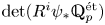 $\det (R^i \psi _* \mathbb {Q}_p^{{{\unicode{x00E9}}{\rm t}}})$ is genus pseudo-stable.
Proof. Let  $X$ be the smooth compactification of
 $U$. By Theorem A.1 applied to each
 $x \in X-U$, we know that
 $M$ is an object of
 $\mathbf {F}-\mathbf {Isoc}^{\dagger} (U)$. The
 $p$-adic character of
 $\pi _1^{\rm \unicode{x00E9}}(U)$ corresponding to
 $\det (R^i \psi _* \mathbb {Q}_p^{\rm \unicode{x00E9}})$ is the same as
 $\rho _1$ from Theorem 9.9.
Acknowledgements
We thank Daqing Wan for his encouragement and enthusiasm for this work, as well as for several insightful discussions. It should be noted that his conjecture was a major motivation for us pursuing this work. We also acknowledge Kiran Kedlaya, with whom we had several discussions about the Drinfeld–Kedlaya theorem and slope filtrations. We have had several useful discussions with Raju Krishnamoorthy. Finally, we would like to thank Liang Xiao for some helpful comments on an earlier version of this manuscript and we would like to thank an anonymous referee for many helpful suggestions.
Appendix A. A local Berthelot's conjecture for constant sheafs
Berthelot's conjecture states that the higher direct images of an overconvergent  $F$-isocrystal along a smooth proper morphism are again overconvergent
 $F$-isocrystals. In this appendix, we prove a local version of this conjecture for the higher direct images of the constant sheaf. This is originally due to Kedlaya in [Reference KedlayaKed00, Chapter 7], as an application of a fully faithfulness result. However, to the best of our knowledge there is no published proof. We follow closely the proof in [Reference KedlayaKed00, Chapter 7].
Theorem A.1 Let  $\psi : V \to {\rm Spec} (F)$ be a smooth proper morphism. Then
 $M=R^i \psi _* \mathcal {O}_{V,{\rm cris}}\otimes \mathbb {Q}_p$, which a priori is an object of
 $\mathbf {F}-\mathbf {Isoc}({\rm Spec}(F))$, is overconvergent.
We begin with two lemmas.
Lemma A.2 Let  $\overline {\psi }: \overline {V} \to {\rm Spec}(\mathfrak {K}[[T]])$ be a proper morphism whose special fiber is reduced with strict normal crossings. Let
 $\psi$ be the generic fiber of
 $\overline {\psi }$. Let
 $A$ be the standard fine log structure associated to
 ${\rm Spec}(\mathfrak {K}[[T]])$ and let
 $B$ be the fine log structure associated to the special divisor of
 $\overline {V}$. In particular,
 $\overline {\psi }:(\overline {V},B) \to ({\rm Spec}(\mathfrak {K}[[T]]), A)$ is a smooth map of log schemes. Then
 $R^i\psi _*(\mathcal {O}_{V,{\rm cris}})\otimes \mathbb {Q}_p$ is an object of
 $\mathbf {F}-\mathbf {Isoc}^{\dagger} ({\rm Spec}(F))$.
Proof. First note that  $R^i\psi _*(\mathcal {O}_{V,{\rm cris}})\otimes \mathbb {Q}_p$ and
 $R^i\overline {\psi }_*(\mathcal {O}_{\overline {V},{\rm cris}}^{\rm log})\otimes \mathbb {Q}_p$ give rise to the same element of
 $\mathbf {F}-\mathbf {Isoc}({\rm Spec}(F))$. That is, the restriction of
 $R^i\overline {\psi }_*(\mathcal {O}_{\overline {V},{\rm cris}}^{\rm log})\otimes \mathbb {Q}_p$ to the generic point of
 ${\rm Spec}(\mathfrak {K}[[T]])$ is the same as
 $R^i\psi _*(\mathcal {O}_{V,{\rm cris}})\otimes \mathbb {Q}_p$. Thus, it suffices to prove the result for
 $R^i\overline {\psi }_*(\mathcal {O}_{\overline {V},{\rm cris}}^{\rm log})\otimes \mathbb {Q}_p$. First, we use
 $\mathcal {O}_L[[T]]$ as a test object in the log-crystalline site over
 $\mathfrak {K}[[T]]$. Thus,
 $R^i\overline {\psi }_*(\mathcal {O}_{\overline {V},{\rm cris}}^{\rm log})\otimes \mathbb {Q}_p$ gives rise to a free
 $\mathcal {O}_L[[T]]\otimes L$-module with a connection and semilinear Frobenius map. From [Reference Hyodo and KatoHK94, Proposition (2.24)] we deduce that the Frobenius structure must be an isomorphism. As
 $\mathcal {O}_L[[T]]\otimes L \subset \mathcal {E}^{\dagger}$, we see that the
 $(\sigma,\nabla )$-module over
 $\mathcal {E}$ associated to
 $R^i\psi _*(\mathcal {O}_{V,{\rm cris}})\otimes \mathbb {Q}_p$ descends to
 $\mathcal {E}^{\dagger}$.
Lemma A.3 Let  $\psi :X \to {\rm Spec}(F)$ and
 $\eta :Y \to {\rm Spec}(F)$ smooth, irreducible, proper varieties over
 ${\rm Spec}(F)$. Let
 $f:X\to Y$ be a surjective morphism. Then the induced map
 $f^*: R^i\eta _*(\mathcal {O}_{Y,{\rm cris}}) \to R^i\psi _*(\mathcal {O}_{X,{\rm cris}})$ is injective and there exists a projector mapping
 $R^i\psi _*(\mathcal {O}_{X,{\rm cris}})$ to the image of
 $f$.
Proof. Crystalline cohomology for varieties over  ${\rm Spec}(F)$ is a Weil cohomology theory (see, e.g., [Reference BerthelotBer74]). The injectivity then follows from [Reference KleimanKle68, Proposition 1.2.4]. Furthermore, from the proof of [Reference KleimanKle68, Proposition 1.2.4] we see that
 $f_*f^*$ is injective. The projector is then
 $({1}/{d})f^*f_*$, where
 $d$ is the generic degree of
 $f$.
Corollary A.4 Let  $X$ and
 $Y$ be as in Lemma A.3. If
 $R^i\psi _*(\mathcal {O}_{X,{\rm cris}})$ is an object of
 $\mathbf {F}-\mathbf {Isoc}^{\dagger} ({\rm Spec}(F))$, then
 $R^i\eta _*(\mathcal {O}_{Y,{\rm cris}})$ is an object of
 $\mathbf {F}-\mathbf {Isoc}^{\dagger} ({\rm Spec}(F))$.
Proof. Recall from § 4.2 that  $\iota ^{\dagger}$ is fully faithful. This means that the projector from Lemma A.3, which is a morphism in
 $\mathbf {F}-\mathbf {Isoc}({\rm Spec}(F))$, must be a morphism in
 $\mathbf {F}-\mathbf {Isoc}^{\dagger} ({\rm Spec}(F))$. The corollary follows.
Lemma A.5 Let  $\phi :{\rm Spec}(F_0)\to {\rm Spec}(F)$ be a finite field extension. Let
 $M$ be an object of
 $\mathbf {F}-\mathbf {Isoc}({\rm Spec}(F))$. If
 $\phi ^*M$ is overconvergent, then
 $M$ is overconvergent.
Proof. For separable extensions this follows from the fully faithfulness of  $\iota ^{\dagger}$ and the fact that
 $M$ is a direct summand of
 $\phi _*\phi ^*M$. For the inseparable case, it suffices to prove the lemma for the degree-
 $p$ case. Thus, we may assume
 $F=\mathfrak {K}((T))$ and
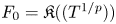 $F_0 = \mathfrak {K}((T^{{1}/{p}}))$. We may view
 $\mathcal {E}_{F,L}$ as a subfield of
 $\mathcal {E}_{F_0,L}$ and note that
 $\sigma$ extends to a Frobenius endomorphism of
 $\mathcal {E}_{F_0,L}$ sending
 $T^{{1}/{p}}$ to
 $T$. It is known that
 $\sigma ^*$ induces an equivalence of categories between
 $(\sigma,\nabla )$-modules over
 $\mathcal {E}_{F_0,L}^{\dagger}$ and
 $\mathcal {E}_{F,L}^{\dagger}$. Explicitly, let
 $M$ be a
 $(\sigma,\nabla )$-module over
 $\mathcal {E}_{F_0,L}^{\dagger}$ and let
 $A$ be a Frobenius matrix of
 $M$ corresponding to a basis
 $\mathbf {e}$ (i.e.
 $\varphi (\mathbf {e})=A\mathbf {e}$). Then
 $\varphi (A\mathbf {e})=A^\sigma (A\mathbf {e})$, so that the Frobenius structure descends to
 $\mathcal {E}_{F,L}^{\dagger}$ (one deduces the connection in a similar manner).
Proof of Theorem A.1 First assume that  $X$ is projective over
 $F$. Take an embedding
 $X \hookrightarrow \mathbb {P}_{F}^n$ and let
 $\overline {X}$ be the Zariski closure of
 $X$ in
 $\mathbb {P}_{\mathfrak {K}[[T]]}^n$. By [Reference de JongdJ96, Theorem 6.5], there exists a finite extension
 ${\rm Spec}(\mathfrak {K}'[[u]]) \to {\rm Spec}(\mathfrak {K}[[T]])$, an alteration
 $\phi _1: X_1 \to X$ where
 $X_1$ is a
 ${\rm Spec}(\mathfrak {K}'[[u]])$-variety, and an open immersion
 $j_1: X_1 \to \overline {X}_1$ such that the pair
 $(\overline {X}_1, \overline {X}_1\backslash X_1)$ is semi-stable. Furthermore, we may assume that
 $\overline {X}_1\backslash X_1$ is equal to the special fiber. Let
 $F_1= \mathfrak {K}'((u))$ and consider the map
 $\psi _1:\overline {X}_1 \times _{{\rm Spec}(\mathfrak {K}'[[u]])} {\rm Spec}(F_1) \to {\rm Spec}(F_1)$. By Lemma A.2 we know that
 $R^i(\psi _1)_*(\mathcal {O}_{X_1 \times _{{\rm Spec}(\mathfrak {K}'[[u]])} {\rm Spec}(F_1),{\rm cris}})$ is an object of
 $\mathbf {F}-\mathbf {Isoc}^{\dagger} ({\rm Spec}(F_1))$. Then by applying Corollary A.4 to the map of
 ${\rm Spec}(F_1)$-varieties
 $X_1 \times _{{\rm Spec}(\mathfrak {K}'[[u]])} {\rm Spec}(F_1) \to X \times _{{\rm Spec}(F)}{\rm Spec}(F_1)$ induced by
 $\phi$, we see that
 $R^i (\phi \times {\rm Spec}(F_1))_* \mathcal {O}_{X \times _{{\rm Spec}(F)}{\rm Spec}(F_1),{\rm cris}}$ is an object of
 $\mathbf {F}-\mathbf {Isoc}^{\dagger} ({\rm Spec}(F_1))$. By base change for crystalline cohomology (see, e.g., [Reference Berthelot and OgusBO78, Corollary 7.12]) and Lemma A.5, this implies
 $R^i \phi _*\mathcal {O}_{X,{\rm cris}}$ is overconvergent.
Now consider general  $V$. By [Reference de JongdJ96, Theorem 4.1] we know that there is an alteration
 $V_1 \to V$ that is projective and that
 $V_1$ will be smooth over a finite extension of
 $F$. The result follows by repeating an argument from the previous paragraph.



