Introduction
Prospective memory (PM) is defined as remembering to realize a planned action at a particular point in the future while being engaged in an ongoing activity (Ellis, Reference Ellis, Brandimonte, Einstein and McDaniel1996; Ellis and Kvavilashvili, Reference Ellis and Kvavilashvili2000; Martin and Kliegel, Reference Martin and Kliegel2003). Everyday examples of PM are to remember to switch off the stove after cooking, pay utility bills in time or remembering to take medication according to schedule. These examples underline the importance of successful PM for maintaining independence and autonomy in old age and it is therefore unsurprising that researchers have become increasingly interested in age-related changes in this complex memory skill (Zeintl et al., Reference Zeintl, Kliegel and Hofer2007; McDaniel et al., Reference McDaniel, Einstein, Jacoby, Craik and Salthouse2008).
Recent research on this topic in normal adult aging has revealed a striking pattern of age-related deficits in standard laboratory-based PM tasks but age-related benefits in naturalistic tasks, which are tasks that are carried out in the everyday life of participants rather than in a testing session controlled by the experimenter and are conducted over several days rather than the short period of a laboratory task (Phillips et al., Reference Phillips, Henry, Martin, Kliegel, McDaniel and Einstein2008; but for different patterns in cognitively impaired older adults, see Will et al., Reference Will, Rendell, Ozgis, Pierson, Ong and Henry2009). The main empirical support for this pattern comes from a meta-analytic review on PM and aging by Henry et al. (Reference Henry, MacLeod, Phillips and Crawford2004) comparing age effects in studies that focus either on laboratory or on naturalistic PM paradigms. Both contradictory effects were reported as being of almost identical size (age-related deficits in laboratory PM tasks: effect size r = −0.34; and age-related benefits in naturalistic tasks: effect size r = +0.35). This pattern has been described as “paradoxical” (Rendell and Craik, Reference Rendell and Craik2000).
The first aim of the present study was to replicate the age-prospective memory-paradox in a single sample using a laboratory and naturalistic PM task with parallel general constraints. This appears to be of particular relevance as only one published study has so far revealed the paradox in a single sample of young and older adults (Rendell and Thomson, Reference Rendell and Thomson1999). In addition, a recent study by Bailey et al. (Reference Bailey, Henry, Rendell, Phillips and Kliegel2010) has shown that the paradox also emerges when considering solely naturalistic PM tasks which differ in controllability and demands of their ongoing tasks. In the earlier study by Rendell and Thomson (Reference Rendell and Thomson1999), young (18–28 years), old (60–69 years) and old-old adults (80–92 years) were invited to take part in a laboratory-based session involving retrospective memory tasks and completion of a questionnaire in which two time-based tasks were integrated (stopping a clock seven minutes after starting the session and noting the time that the questionnaire was finished). As a naturalistic task, participants had to remember to press a particular sequence of keys on a Sharp Organizer at four prescribed times a day, for seven days. Results indicated that older adults in general were superior to young adults on the naturalistic PM task and inferior on the laboratory PM tasks. Furthermore, the old-old adults were inferior to the old adults on the laboratory tasks, but the two groups did not differ on the naturalistic task. One weakness of this study, however, was that the two PM tasks used in these different settings differed substantially in many potentially important task parameters.
Rendell and Craik (Reference Rendell and Craik2000) aimed to overcome this limitation by creating parallel versions of laboratory and naturalistic tasks. The laboratory task took the form of a board game (Virtual Week) which requires participants to circuit the board seven times in a simulation of a week in their life, with each circuit representing a day. As they move around the board, participants make choices about daily activities and are required to remember to carry out lifelike activities (PM tasks). For the naturalistic task, the board game was translated back into a real-life setting (Actual Week). Even with this specific laboratory task that gave participants the opportunity to use the simulated structure of a typical day to support their performance, the typical pattern of age effects emerged, with old outperforming young on Actual Week, but performing more poorly than their younger counterparts on Virtual Week. However, only partially overlapping samples were examined (only the same older adults completed both tasks, while two different samples of young adults performed the virtual and actual week task), the sequence of tasks was not counterbalanced for the older adults who performed both tasks (the naturalistic task was always completed second), and no information on daily activities was reported.
Recent research on the age-prospective memory-paradox has initiated a debate on the potential underlying mechanisms and specifically on which properties of naturalistic and lab-based tasks are critical in determining the direction of age effects. Considering previous findings, it can be concluded that the differential aging effects on PM tasks do not simply reflect higher complexity of laboratory tasks as age deficits are found even on very simple laboratory tasks (e.g. Huppert et al., Reference Huppert, Johnson and Nickson2000) and age benefits are obtained in complex naturalistic tasks (Rendell and Craik, Reference Rendell and Craik2000). In addition, although the majority of naturalistic tasks requires a PM response at a specific time, and most lab-based tasks require a PM response to a specific event, this time/event distinction cannot explain the pattern of results (Park et al., Reference Park, Hertzog, Kidder, Morrell and Mayhorn1997; Rendell and Craik, Reference Rendell and Craik2000; Henry et al., Reference Henry, MacLeod, Phillips and Crawford2004). One explanation that has received some attention is the use of reminders. It has been argued that age benefits for naturalistic PM tasks may occur because older adults set up external cues to act as reminders (e.g. Moscovitch, Reference Moscovitch, Craik and Trehub1982; Maylor, Reference Maylor1990; Patton and Meit, Reference Patton and Meit1993). However, although older adults have sometimes been reported to use more external cues (Jackson et al., Reference Jackson, Bogers, Kerstholt, Gruneberg, Morris and Sykes1988), a number of researchers have demonstrated that it would be an oversimplification to attribute superior PM performance in naturalistic settings to increased use of reminders (Maylor, Reference Maylor1990). Other authors also emphasize that age benefits in implementing intentions in naturalistic settings cannot be explained by the use of external aids (Patton and Meit, Reference Patton and Meit1993; d'Ydewalle and Brunfaut, Reference d'Ydewalle, Brunfaut, Georgas, Manthouli, Besevegis and Kokkevi1996; Rendell and Thompson, 1999).
Recently, Phillips et al. (Reference Phillips, Henry, Martin, Kliegel, McDaniel and Einstein2008) have suggested four alternative mechanisms that might be critical for the paradoxical pattern – motivation, control over memory cues, metacognitive awareness, and intervening ongoing activities that have to be attended to during the delay between intention formation and PM task performance. It was the aim of the present study to provide the first direct test of the relative importance of those four variables.
The first hypothesis tested is that the motivation to complete PM tasks successfully may contribute to the paradoxical pattern inside and outside of the laboratory (Moscovitch, Reference Moscovitch, Craik and Trehub1982; Rendell and Craik, Reference Rendell and Craik2000). Here the assumption is that the majority of younger participants in typical PM studies are undergraduate students who complete those studies for course credits. Thus, the level of motivation of younger participants to complete PM tasks among the other demands of everyday life may be relatively low (Maylor, Reference Maylor1993) while the motivation to perform well in tasks that closely mirror textbook paradigms may be stronger. In contrast, older adults may favor tasks carried out in their everyday life as they closely mirror contextual everyday experience and may be less motivated in abstract laboratory tasks that have little overlap with their daily experience (see also Kliegel et al., Reference Kliegel, Martin, McDaniel and Phillips2007, for similar evidence in an errand planning task).
The second hypothesis tested concerns the level of control participants have over the task. Here, the assumption is that in most naturalistic tasks the participant is more or less free to choose the best way to recall and implement intentions (for example, in the postcard task, which is a typical naturalistic PM task, participants may decide which specific letter box they go to and at what specific time of the day; Patton and Meit, Reference Patton and Meit1993). In contrast, in laboratory tasks the experimenter usually exerts full control over the specific cues and target times and participants have to follow those external instructions (e.g. Einstein and McDaniel, Reference Einstein and McDaniel1990). Cockburn (Reference Cockburn, Brandimonte, Einstein and McDaniel1996) suggested that it may be rare for older adults to make spontaneous use of cues in that kind of PM tasks. Therefore, control of the situation in such circumstances is likely to be perceived by older adults as resting in the hands of the experimenter rather than in their own, which may in turn hamper their performance.
The third hypothesis tested rests on the idea that age differences in ongoing task absorption may serve as a possible reason for the age PM paradox (McDaniel and Einstein, Reference McDaniel and Einstein2000; Henry et al., Reference Henry, MacLeod, Phillips and Crawford2004). Here, the rationale is that a constitutive element of all PM tasks is the delay between intention formation and the point of realizing the intention (Ellis and Kvavilashvili, Reference Ellis and Kvavilashvili2000). Typically, this delay is filled with ongoing activities that may vary in terms of how absorbed someone is in performing those activities. While most laboratory tasks impose a standardized ongoing activity and assess ongoing task absorption by ongoing task performance, the ongoing activities occurring in everyday life are much more variable. In fact, and this is the key issue for the third hypothesis, there may be systematic age differences in the demands of those daily ongoing activities between young and older adults. This is because the majority of older participants are retired, whereas the majority of young participants are students. This could have strong effects, especially for performance in naturalistic tasks, as retirement might result in less demanding ongoing activities and possibly more available time to devote to setting up strategies and carrying out PM tasks in everyday life for older adults, while younger adults might be confronted with more daily stressors (Phillips et al., Reference Phillips, Henry, Martin, Kliegel, McDaniel and Einstein2008, but see Bailey et al., Reference Bailey, Henry, Rendell, Phillips and Kliegel2010 for inconsistent results). In line with this reasoning, diary studies have shown that younger adults report a higher amount of everyday stress than older adults and also perceive their stressors as more severe (Almeida and Horn, Reference Almeida, Horn, Brim, Ryff and Kessler2004; Sliwinski et al., Reference Sliwinski, Smyth, Hofer and Stawski2006). From the laboratory perspective, this assumption dovetails with the notion of the multiprocess framework on PM (McDaniel and Einstein, Reference McDaniel and Einstein2000), in which one of the central tenets is that absorption in the ongoing task may affect PM performance. Indeed, Kvavilashvili (Reference Kvavilashvili1987) demonstrated that the proportion of participants who reported thinking about a previously formed intention decreased with increasing degree of interest elicited by the ongoing activity. However, to date there have been no investigations of age differences in the susceptibility to absorbing (laboratory and daily) ongoing task performance and it may well be that the systematic difference in the structure of the ongoing activities in laboratory versus naturalistic settings may be associated with the paradox.
The fourth hypothesis tested follows up on the idea that metacognitive awareness could play an important role in age-related PM performance in general (Kliegel et al., Reference Kliegel, MacKinlay, Jäger, Kliegel, McDaniel and Einstein2008). Here, the assumption is that participants with a better prediction of their actual performance are better able to invest in the appropriate strategies (see similar findings in the domain of learning, e.g. Thiede et al., Reference Thiede, Anderson and Therriault2003; Vrugt and Oort, Reference Vrugt and Oort2008). As older adults have more experience in naturalistic PM tasks they might evaluate their performance in those settings more precisely and might then initiate proper strategies to achieve an optimal level of performance. In reverse, the same might hold for younger adults in laboratory settings as they will be more familiar to the younger age group.
In sum, the first aim of the present study was to cross-validate the age PM paradox within a single sample. The second aim was to explore empirically the relative importance of four recently proposed factors that may be associated with the direction of age effects inside and outside the laboratory.
Methods
Participants and design
The sample consisted of 40 participants: 20 young adults (4 males, 16 females, M = 21.5 years, SD = 2.26, range 18–25 years) and 20 old adults (12 males, 8 females, M = 68.55 years, SD = 4.66, range 61–79 years). All young adults were undergraduate students from the local university, who volunteered in exchange for partial course credit. All old adults were retired volunteers, whose effort was reimbursed with money. Exclusion criteria were current physical and mental health problems. Inclusion criteria were the possession of a mobile phone and basic knowledge about sending text messages. Three older adults were less familiar with sending text messages and therefore got an additional briefing from the experimenter.
In terms of general cognitive abilities, the two age groups differed in both crystallized and fluid intelligence in the anticipated directions. Crystallized intelligence was assessed with a German vocabulary test (MWT; Lehrl, Reference Lehrl1977). There was a trend for older adults (M = 33.05, SD = 1.23) to attain higher scores than young adults (M = 32.05, SD = 1.96; t (38) = 1.93, p = 0.06). Fluid intelligence was indexed using the Digit-Symbol-task (Wechsler, Reference Wechsler1981), with younger adults obtaining significantly higher scores (M = 66.59, SD = 13.64) than older adults (M = 46.24, SD = 9.96; t (32) = 4.97, p < 0.001).
Procedure and tasks
Each participant was asked to complete two PM tasks: one in the field and one in the laboratory. The tasks across these two different settings were designed to be parallel in structure and task constraints. Therefore a new PM task was developed for the laboratory, which was similar to the naturalistic task. Participants starting with the naturalistic task were asked to attend a meeting at the university, where they were instructed how to perform the task. During this session, in addition to receiving PM instructions for the naturalistic task, participants completed a demographic questionnaire in addition to the tests of crystallized and fluid intelligence described previously. The group starting with the laboratory PM task performed the cognitive tests after the laboratory PM task and received the instructions for the naturalistic task at the end of the session. The four hypothesized mechanisms under consideration in the present study as potential contributors to the age-PM paradox were also measured in relation to both settings and directly linked to the respective task (for details see below).
PM task: laboratory
Participants had to remember to press a specified key on the computer keyboard and type in the letter “a” at two specific target times during each of three distinct ongoing task blocks presented in counterbalanced order, and consequently a total of six PM responses had to be remembered. Each block lasted 12 minutes. In each block one target time was externally given, the second one could be chosen freely. Other than the requirement that one target time be in the first half of each block, and the second target time be in the second half, the arrangement of the given target times was randomized. A clock showing the elapsed time could be invoked on the computer screen at any point in each block by pressing a pre-specified computer key. In line with previous studies (e.g. Kliegel et al., Reference Kliegel, Jäger, Phillips, Federspiel, Imfeld, Keller and Zimprich2005; Aberle et al., in press) a time window (here of six seconds or less) before and after the target time was used to classify responses as correct PM answers.
The three different ongoing tasks were selected in order to engage older participants in activities they know from their everyday life to avoid a general effect of (un-)familiarity in older adults caused by abstract material (Ellis and Kvavilashvili, Reference Ellis and Kvavilashvili2000). Thus, participants were asked to watch a documentary, read a magazine article or sort a deck of cards in a pre-specified order. To assess ongoing task performance, participants were asked questions about the content of the documentary and the magazine article. (Participants were informed prior to watching the video and reading the article about this.) For the card task, sorting errors were recorded. The order of the tasks was counterbalanced across participants.
PM task: naturalistic
In line with Aberle et al. (in press), participants were asked to send two text messages per day with the content “a” at pre-specified target times to the investigator across three consecutive days (totalling six). One target time was set by the experimenter, the second by the participant. One text message had to be sent during the morning, one in the afternoon. The dates were arranged in the laboratory meeting before the naturalistic task started. In accordance with the laboratory task, entries six minutes or less before and after the prescribed time were classified as correct PM answers.
Possible mechanisms
In addition to experimentally manipulating target time control and quantifying ongoing activity absorption, in the laboratory several other variables were measured via questionnaire-based assessments. To collect data in the field, participants were asked to fill out a diary every evening and send it back to the investigators afterwards. All variables were not only measured in relation to the PM tasks but also with regard to ongoing activities to avoid an emphasis on the PM task. In the present analysis, however, only variables central for testing our hypotheses will be focused upon.
Motivation was measured on a five-point rating scale, where 5 = not motivated and 1 = very motivated. Participants had to evaluate how motivated they were to conduct the task correctly previous to every ongoing task block in the laboratory and on every day in the field.
Daily activity absorption was measured using a visual analogue scale. Every evening during the naturalistic task, participants were asked to state their daily activities and then rate how much stress they had perceived during the morning and afternoon. Both ratings were added and summed up over the three days.
Ongoing activity absorption in the laboratory was considered as equivalent to daily activity absorption and – in keeping with most of the literature – was estimated by computing an ongoing task performance score collapsed across the z-standardized results of the three ongoing tasks.
In line with previous studies (e.g. Nelson and Dunlosky, Reference Nelson and Dunlosky1991) participants predicted the probability of successful future PM performance (i.e. 0%, 20%, 40%, 60%, 80%, or 100% correct), with these estimates used as a measure of metacognition. Predictions had to be given separately after the instruction for every ongoing task in the laboratory and after the instructions for the naturalistic task. The difference between prediction and performance in percent was used as an index of metacognitive awareness of one's own PM ability.
Data analyses
The statistical package SPSS-17 for Windows was used for data analysis. Independent t-tests were run to test for mean level age differences in the possible mechanisms (motivation, daily/ ongoing activity absorption and metacognitive awareness), both concerning the laboratory as well as the naturalistic task. Effect sizes were calculated for every significant t-test result as Cohen's d (Cohen, Reference Cohen1988) – i.e. the standardized mean difference in performance between pretest and post-test (pre-/post-test difference divided by the pooled standard deviation).
Mean level age differences in PM performance in the laboratory and the naturalistic task were analyzed with a 2 × 2 (age × task setting) repeated measures ANOVA. To further explore interaction effects independent t-tests were used as planned comparisons to test separately for age-related PM performance differences in the laboratory and the naturalistic task, respectively.
The effect of level of control over PM target times on age-related PM performance was tested with a 2 × 2 (age × level of control) ANOVA, both in the laboratory and the naturalistic task, respectively. The possible association of the remaining postulated mechanisms was explored by statistically covarying for variance related to the respective factors in each PM task.
Results
Descriptive statistics
The first step involved analyzing age differences in motivation, daily/ ongoing activity absorption and metacognitive awareness by testing the directional hypotheses stated in the introduction. Results revealed that young adults reported more daily activity absorption in their diaries (M = 64.04, SD = 33.35) than old adults (M = 18.33, SD = 18.41; t(35) = 5.12, p < 0.001, Cohen's d = 1.70; Cohen (Reference Cohen1988) defines effect sizes of 0.2 as small, 0.5 as medium, and 0.8 as large), while young adults (M = 0.42, SD = 0.53) performed better on the ongoing task in the laboratory relative to old adults (M = −0.42, SD = 0.63; t(38) = 4.54, p < 0.001, d = 1.44). Concerning motivation, there was a trend of higher motivation among older adults (M = 1.60, SD = 0.65) than young adults (M = 1.35, SD = 0.44; t(37) = 1.39, p = 0.09, d = 0.45) in the naturalistic task, but no group differences in the laboratory task (t(38) = 0.59, p = 0.28). Furthermore, no group difference was obtained in metacognitive awareness in the laboratory (t(38) = 1.09, p = 0.14), but older adults showed a better prediction of their performance (M = 12.33, SD = 11.04) than young adults (M = 22.50, SD = 15.18) in the naturalistic task (t(38) = 2.42, p < 0.01, d = 0.77).
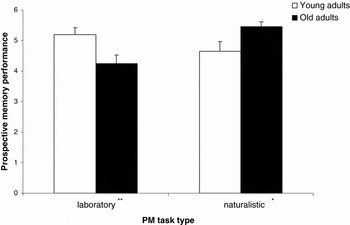
In a second step, age differences in PM performance in the laboratory and the naturalistic task were analyzed with a 2 × 2 (age × task setting) repeated measures ANOVA. There was a highly significant interaction effect between age and task setting, F(1, 38) = 15.28, p < 0.001, indicating that age effects differed across the two settings. Subsequent planned comparisons revealed that older adults outperformed young adults in the naturalistic PM task, t(38) = 2.22, p < 0.05, d = 0.7 while young adults showed better PM performance in the laboratory PM task, t(38) = 2.70, p < 0.01, d = 0.85 (see Figure 1), confirming the paradox in one sample using parallel task constraints.
PM performance in the laboratory and naturalistic task for both age groups. Number of correct responses out of six. Error bars represent the standard error (SE).

Exploring the paradox
In a third step, the influence of level of control in PM was tested with two ANOVAs, one on laboratory performance and one on naturalistic PM performance. There were main effects for age (F(1, 38) = 7.31, p < 0.01) and level of control (F(1, 38) = 5.54, p < 0.05) for the laboratory PM performance showing a better overall PM performance for the younger adults and indicating that both age groups benefited substantially when they could freely choose the target times. The interaction effect did not reach significance, F (1, 38) = 2.24, p = 0.14. Concerning the naturalistic PM task, there was only the main effect for age (older adults performing better than younger adults as reported above), F(1, 38) = 4.91, p < 0.05. The main effect for level of control (F (1, 38) = 0.20, p = 0.66) and the interaction effect (F (1, 38) = 0.78, p = 0.38) did not reach significance.
In a fourth step, the influence of the remaining variables was explored by statistically covarying for variance related to the respective factors in each PM task. (All formal stages preceding the ANCOVAs for both task settings were analyzed and revealed appropriate results (homogeneity of regression, all p > 0.2; correlations between variables, all p < 0.05)).
Laboratory PM task
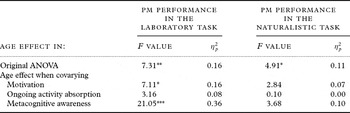
As revealed by an initial ANOVA, there was an effect of age group on PM performance in the laboratory PM task indicating that younger adults showed a better performance (F = 7.31, p < 0.01, η2p = 0.16). The following ANCOVAs showed that the age effect was substantially reduced (by 50% to η2p = 0.08) and no longer reached significance only when covarying for ongoing task performance (for the F values and effect sizes, see Table 1).
Changes in F values and η2p concerning the age effect, after covarying for the possible mechanisms for both task settings

*p < 0.05. **p < 0.01. ***p < 0.001.
PM = prospective memory; ANOVA = analysis of variance.
Naturalistic PM task
As revealed by an initial ANOVA, there was an effect of age group on PM performance in the naturalistic PM task, indicating that older adults showed a better performance (F = 4.91, p < 0.05, η2p = 0.11). The following ANCOVAs showed that covarying metacognitive awareness and motivation markedly reduced the age effect by 36 % (motivation) and slightly reduced it by 9 % (metacognitive factors) respectively, no longer reaching significance in both cases (for the F values and effect sizes, see Table 1). However, only covarying daily activity absorption had a strong effect and completely eliminated the age effect (F < 1). Considering the decrease in η2p, daily activity absorption totally explained the age related variance in PM performance in the naturalistic task (see Table 1).
Discussion
The first aim of the present study was to confirm the age PM paradox within one sample and extend previous literature by using two tasks with well-matched parallel task constraints and counterbalancing order of administration. The data clearly showed the paradoxical pattern: as predicted, older adults outperformed young adults in a naturalistic PM task, while younger adults showed better PM performance in a laboratory PM task. This result underlines the reliability and validity of this pattern and demonstrates that the paradox extends to more typical task designs in addition to former studies. Rendell and Thomson (Reference Rendell and Thomson1999) were the first and so far only study demonstrating the paradox within one sample that was tested in the laboratory and in their everyday life (although see Bailey et al. (Reference Bailey, Henry, Rendell, Phillips and Kliegel2010) for evidence of the paradox in different PM tasks carried out in participants' everyday lives). However, Rendell and Thomson used two very simple time-based tasks in the laboratory that were integrated in the test session. Extending this approach, the laboratory PM task used in the present study offered a wider performance range and (by using standardized ongoing tasks) the opportunity to control for ongoing task performance. In addition, the naturalistic task applied in Rendell and Thomson's study could be seen as somewhat artificial and it was reported that a significantly larger number of young adults had difficulties in keeping the organizer with them than the elderly. In this regard a major advantage of the present work is that sending text messages is something all participants knew as a normal everyday activity, participants were familiar with taking their mobile phones with them and reported no problems in doing so. Thus, PM errors did not result from forgetting the PM recording device altogether but from using it at the appropriate times. Finally, while the laboratory and the naturalistic tasks used in the study by Rendell and Thomson (Reference Rendell and Thomson1999) differed from each other in their general requirements, the present tasks were parallel in structure. Participants had to remember to fulfill two PM entries of the same content in each 12 minute-block in the laboratory (one in the first and one in the second half) and to send two text messages in a 12-hour time slot each day (again, one in the first and one in the second half).
Rendell and Craik (Reference Rendell and Craik2000) investigated the paradox with analogue naturalistic and laboratory tasks, but performance in both tasks was examined only in older adults and without counterbalanced task administration; thus, the high naturalistic task performance could have been influenced by test repetition effects. Furthermore, contrary to the approach by Rendell and Craik (Reference Rendell and Craik2000), the present study used activities in the laboratory that young and old adults knew from their everyday life as ongoing tasks in the laboratory (e.g. watching a documentary, reading a magazine article) and as the naturalistic task (sending text messages). Another important difference is that the tasks in Rendell and Craik's study were only hypothetical. It is possible that it makes a difference if an action has to be performed or only stated. Of course future research is needed to confirm this assumption. Furthermore, participants had a greater level of control by freely choosing the target times for half of the responses. While this allowed for possible use of strategies, such as choosing the date of birth as a time or the same target time in every block/day, the absence of any interaction between age and level of control suggests that level of control as operationalized in the present study is independent of age effects.
This leads to our second aim, the exploration of the relative importance of four recently proposed factors that may be associated with the direction of age effects inside and outside the laboratory. The present pattern strongly suggests that different variables may be crucial for understanding age effects in these different settings: The age deficit in the laboratory PM task was mainly related to higher ongoing activity absorption. Concerning the PM performance in the naturalistic task, the present results support the mechanisms suggested by Phillips et al. (Reference Phillips, Henry, Martin, Kliegel, McDaniel and Einstein2008). The age benefit was associated with higher motivation and better metacognitive self-assessment of one's own PM abilities in older adults. However, remarkably the most important mechanism seemed to be daily activity absorption, as covarying for this variable eliminated the age effect completely. This highlights the need for further research that explores the mechanisms underlying this effect. As outlined in the Introduction, we argue that this effect of ongoing task absorption reflects the systematic differences in the activities younger and older adults are faced with during the delay between intention formation and intention realization. In the present study we assessed that effect by measuring subjectively perceived task involvement via stress ratings. Arguably, this is only one aspect of processes associated with ongoing task absorption and future studies will have to disentangle the factors and processes underlying this effect. However, findings from stress research support the possibility that daily stressors and perceived stress may have such effects on cognition (e.g. Sliwinski et al., Reference Sliwinski, Smyth, Hofer and Stawski2006). Thus, possible candidates for further investigation include the physiological correlates of stress as high doses of stress hormones are associated with impaired memory retrieval (Roozendaal et al., Reference Roozendaal, McEwen and Chattarji2009) and/or associated cognitive processes as stress leads to a reduced amount of available attention and increased intrusive thinking (Sliwinski et al., Reference Sliwinski, Smyth, Hofer and Stawski2006).
These findings appear to have important conceptual implications. Specifically, the factor identified to be of importance for the age deficit in the laboratory (ongoing task absorption; specifically attentional resources in a dual-task situation) is one that can be related to normative physiological changes. Thus, it seems that the age deficit in laboratory PM tasks may reflect limited cognitive resources (i.e. dual task attentional control). In turn, data suggest that in laboratory environments there is only limited scope to use strategies and benefit from experience even in contextualized task settings.
In sharp contrast, a different picture emerged for the naturalistic PM task. Here, factors that are subject to voluntary control or short-term intervention appeared to play an important role. Older adults benefited from their higher motivation and better metacognitive self-awareness. Hence, the naturalistic task setting appeared to have offered them the opportunity to use their knowledge and their personal strengths and strategies.
The findings are especially interesting from an applied perspective because they show that (healthy) older adults are indeed able to perform complex cognitive tasks in everyday life despite deficits in the laboratory. This suggests that complex daily activities for which an intact PM performance is needed, such as organizing work or managing finances, can still be fulfilled despite an age-related decline of cognitive functioning; if motivation is high enough, one is aware of one's cognitive strengths and weaknesses, and one does not have too many intervening activities to cope with.
Possible limitations of the present study comprise the sample size. However, even with this rather small experimental study, the critical age PM paradox could be reliably confirmed and, even more importantly, obtained effects were large effects in terms of Cohen's d. A further limitation is the correlative structure of part of the data set and thus the examination of some of the mechanisms has to remain exploratory; however, as the present study is the first to explore comprehensively the main variables that have been conceptually suggested in the literature, it can serve as initial empirical evidence for identifying which of the many factors discussed are promising candidates for future research. Follow-up studies will be required to corroborate our results using experimentally controlled designs with higher power and focusing on specific factors revealed as particularly important by the present study.
Another issue that will need further attention in future studies is the multifaceted nature of ongoing and daily activity absorption. While all other possible mechanisms were assessed in close parallel structure for the laboratory and the naturalistic task, daily activity absorption and ongoing activity absorption arguably are assessed by somewhat different measures. While ongoing activity absorption is a direct performance measure, daily activity absorption is a subjective measure. However, our main conceptual point is that the ongoing task was originally introduced to PM paradigms in the laboratory by Einstein and McDaniel (Reference Einstein and McDaniel1990) in their seminal paper in order to simulate the demanding activities which occupy us in our daily lives. Thus, ongoing task absorption in the multiprocess framework from McDaniel and Einstein (2000), which is usually measured by ongoing task performance in the laboratory, refers to those processes that keep a participant busy during the delay between intention formation and the prospective target time (e.g. marking a set of student papers before a deadline while having to remember to call someone at 3pm). As there is no comparable formal task in everyday life that could be assessed in terms of ongoing task performance scores, we argue that the amount of stress experienced by those daily activities may be one of the closest parallel variables available to laboratory ongoing task involvement. Nevertheless, as these two factors turned out to be very important in the present analyses, further research is needed to clarify which aspects of these factors are mostly driving the effects.
Taken together, the present study helps elucidate the current debate about which properties of naturalistic and laboratory-based tasks may be critical in determining the direction of age effects, and suggests that different factors may be involved in both settings. Among our findings, one effect stands out that warrants further attention: everyday stress appears to be a particularly important determinant of age benefits in naturalistic PM tasks.
Conflict of interest
None.
Description of the authors' roles
K. M. Schnitzspahn supervised the data collection, analyzed the data and wrote the paper. A. Ihle contributed to conceptualizing the study and carried it out. J. D. Henry and P. G. Rendell participated in writing the paper. M. Kliegel formulated the research question, designed the study and was involved in writing the paper.
Acknowledgments
We thank the participants of the study for their time and effort.