Introduction
Internalizing problems refer to “overcontrolled behaviors” and covert, inner-directed emotional disturbances (e.g., fearfulness, distress, withdrawal, sadness; Achenbach & McConaughy, 1992). They typically include anxiety and/or depression, which show a substantial phenomenological overlap and commonly co-occur (e.g., Melton et al., Reference Miller-Slough and Dunsmore2016; Schleider & Weisz, Reference Schwartz, Sheeber, Dudgeon and Allen2016; Zahn-Waxler et al., Reference Zhu and Dunsmore2000). It is well established that anxiety and depression symptoms and disorders are the leading mental health problems for children and adults in western societies (Murray et al., Reference Nair, Waslin, Rodrigues, Datta, Moore and Brumariu2015); symptoms typically emerge prior to adulthood, with peak onset around 5.5 years for anxiety and fear related disorders and 20.5 years for mood disorders (Solmi et al., Reference Song, Smiley and Doan2022). Further, anxiety symptoms and disorders (including generalized anxiety disorder, separation anxiety, social anxiety, specific phobia, panic disorder, and agoraphobia) and unipolar depressive symptoms and disorders (including major depressive disorder, persistent depressive disorder, and disruptive mood dysregulation disorder) tend to persist if not addressed (Kessler et al., Reference Kessler and Greenberg2005). Across childhood and adolescence, they are related to developmental difficulties such as lower academic competence and greater school dropout (Brumariu et al., Reference Cassidy2023), lower achievement goals (Diaconu-Gherasim et al., Reference Dunbar, Zeytinoglu and Leerkes2024), diminished emotional competence (Mathews et al., Reference McDonnell, Lawson, Speidel, Fondren and Valentino2016), and low quality social relationships (Christina et al., Reference Cicchetti and Rogosch2021). In adulthood, they are linked to increased risk for suicidal behavior (Kessler et al., Reference Kessler and Greenberg2005) and unemployment and work difficulties (Kessler & Greenberg, Reference Klimes-Dougan, Brand, Zahn-Waxler, Usher, Hastings, Kendziora and Garside2002).
Not surprisingly, interest in identifying determinants and correlates of internalizing problems in childhood and adolescence has been a priority, and notably, theoretical models and meta-analytic evidence showed that parent-related factors in the context of parent–child dynamics are significantly related to children’s internalizing problems (e.g., parental control and rejection, McLeod et al., Reference Melton, Croarkin, Strawn and Mcclintock2007; Wood et al., Reference Wu and Hooper2003; less warmth and overinvolvement; Yap & Jorm, Reference Yi, Gentzler, Ramsey and Root2015; attachment security, Brumariu & Kerns, Reference Brumariu and Kerns2010). Parental emotion socialization (ES) is the process through which parents enable and facilitate their children’s understanding, regulation, and expression of emotions (Eisenberg et al., Reference Eisenberg, Spinrad and Cumberland1998). Thus, it is a key influence shaping children’s social and emotional development, including their capacity to regulate emotions (Denham, Reference Denham, Bassett, Wyatt, Grusec and Hastings2019; Denham et al., Reference Denham, Mitchell-Copeland, Strandberg, Auerbach and Blair2007; Morris et al., Reference Morris, Silk, Steinberg, Myers and Robinson2017). While there are several individual studies investigating the relations of parental ES with internalizing problems, a comprehensive meta-analytic review synthesizing existent effect sizes is needed to understand the robustness of the associations between parental ES and internalizing problems in childhood and adolescence. The purpose of this meta-analytic work is to fill this gap by evaluating relations of parental ES (supportive and unsupportive practices/behaviors, and elaboration) with internalizing problems in childhood and adolescence (up to age 18 years). As a note, the terms emotion-related parenting practices, behaviors, and strategies are often used interchangeably in the literature (e.g., Eisenberg et al., Reference Eisenberg, Spinrad and Cumberland1998; Johnson et al., Reference Jugovac, O’Kearney, Hawes and Pasalich2017; Klimes-Dougan et al., Reference Kraft, Ebner, Leo and Lindenberg2007; Rodrigues et al., Reference Rutter2025). For clarity and consistency with previous meta-analytic work (e.g., Johnson et al., Reference Jugovac, O’Kearney, Hawes and Pasalich2017), we hereby refer to emotion socialization behaviors (ESBs).
Parental emotion socialization: conceptual approaches
Eisenberg et al.’s (Reference Eisenberg, Spinrad and Cumberland1998) influential model of parental ES highlights how parents socialize emotions and delineates three mechanisms or types of ESBs through which parents teach their children about emotions: parents’ reactions to children’s emotions, discussion of emotions, and parents’ expressions of their own emotions. These parental ESBs are typically operationalized via observed behaviors and parent/child reports, and are broadly dichotomized in the literature into supportive and nonsupportive (Eisenberg et al., Reference Eisenberg, Spinrad and Cumberland1998; Morris et al., Reference Murray, Barber, Foreman, Abbasoglu Ozgoren, Abd-Allah, Abera, Aboyans, Abraham, Abubakar, Abu-Raddad, Abu-Rmeileh, Achoki, Ackerman, Ademi, Adou, Adsuar, Afshin, Agardh, Alam and Vos2007). Supportive ESBs such as problem-solving (i.e., guiding their children to think about and arrive to solutions), comforting the child, and encouragement of open emotion expressions, communicate to children that emotion discussions and explorations are appropriate, and emphasize constructive feedback on children’s emotions. Nonsupportive ESBs such as ignoring, minimizing, invalidating, or punishing children’s emotional experiences and expressions communicate to children that emotions, emotion displays, and their processing are undesirable. Supportive and nonsupportive ESBs can also influence whether children form and maintain secure attachment relationships with their parents, which can be an important context for the socialization of emotion (Cassidy, Reference Cheung, Boise, Cummings and Davies1994).
Further, Gottman et al. (Reference Hajal and Paley1997) proposed that parental meta-emotion philosophy (MEP), an organized set of beliefs and feelings that parents have about their children and their own emotions, guides their ESBs. Gottman et al. (Reference Hajal and Paley1997) delineated two additional ESBs, emotion coaching and emotion dismissing, that broadly parallel supportive and nonsupportive ESBs. Parents with an emotion coaching philosophy view their children’s expression of (negative) emotions as an opportunity for intimacy and teaching, validate children’s emotions, actively label emotions and problem-solve with their children, and encourage children’s appropriate expression and regulation of emotions. Parents with an emotion-dismissive MEP view (negative) emotions as harmful, criticize, avoid, and invalidate their children’s emotions, and teach them that emotions have negative consequences and are undesirable (Gottman et al., Reference Gottman, Katz and Hooven1996, Reference Hajal and Paley1997). The MEP approach involves more explicit teaching about emotions than does Eisenberg’s framework, and emotion coaching and emotion dismissing ESBs are typically assessed with structured interviews rather than questionnaires.
Whereas Eisenberg’s approach is broader, highlighting multiple ESBs, Gottman’s framework centers on parents’ internal beliefs and attitudes about emotions (i.e., what parents feel and think about emotions is the core focus) and how these influence their ESBs. Overall, Eisenberg’s theory of ES and Gottman’s MEP both emphasize the key role of parents in fostering children’s emotional development. They share a focus on how parental beliefs, behaviors, and emotional responses contribute to children’s social-emotional competence and adjustment, and both capture supportive and nonsupportive ESBs. Thus, the present meta-analytic work partially addresses similarities between these two conceptual frameworks by evaluating supportive and unsupportive ESBs.
As noted by Eisenberg et al. (Reference Eisenberg, Spinrad and Cumberland1998) and echoed by others (Johnson et al., Reference Jugovac, O’Kearney, Hawes and Pasalich2017; Klimes-Dougan et al., Reference Kraft, Ebner, Leo and Lindenberg2007), some ESBs have been conceptualized as more “active,” directed toward the child, intentional, purposeful, and can be clearly distinguished as supportive or unsupportive (e.g., parental reactions to emotions, discussion of emotion, and emotion coaching). In contrast, other behaviors (e.g., parental expressiveness, social referencing, modeling, and overall family climate or affective environment) are indirect, more “passive,” and not necessarily intentionally directed toward the child (Eisenberg et al., Reference Eisenberg, Spinrad and Cumberland1998; Johnson et al., Reference Jugovac, O’Kearney, Hawes and Pasalich2017; Klimes-Dougan et al., Reference Kraft, Ebner, Leo and Lindenberg2007). Further, some indirect ES behaviors such as parental expressiveness and modeling (indexed as observational learning effects) are difficult to differentiate from broader family or parenting factors such as family emotional climate or expressiveness and parental hostility/warmth (Eisenberg et al., Reference Eisenberg, Spinrad and Cumberland1998; Morris et al., Reference Murray, Barber, Foreman, Abbasoglu Ozgoren, Abd-Allah, Abera, Aboyans, Abraham, Abubakar, Abu-Raddad, Abu-Rmeileh, Achoki, Ackerman, Ademi, Adou, Adsuar, Afshin, Agardh, Alam and Vos2007). Therefore, consistent with another meta-analysis of ESBs (Johnson et al., Reference Jugovac, O’Kearney, Hawes and Pasalich2017), we focused only on active ESBs.
In addition, Fivush and Salmon (Reference Fredrick and Luebbe2023) highlighted that parental elaboration during reminiscing is another essential parental ES mechanism facilitating children’s learning about emotions as parent–child conversations about the past provide a tapestry of opportunities for parents to ask questions, provide details and information, and incorporate children’s responses into the narrative. Specific to elaboration is the reflective processing of children’s lived experiences in emotion-provoking situations. Specifically, elaborative parents have the goal of creating a shared narrative collaboratively, co-construct detailed coherent stories with their children, foster rich examinations and discussions of emotions in personally meaningful situations, integrate emotions into reminiscing conversations, and facilitate their children’s understanding of the causes and consequences of emotions as well as finding resolutions appropriate to children’s lived emotional experience (Fivush, Reference Fivush and Salmon2007; Fivush & Salmon, Reference Fredrick and Luebbe2023).
Parental emotion socialization and children’s internalizing problems
Theoretically, parental ES might relate to children’s internalizing problems because they enable children to practice, learn, and internalize how to cope with and navigate life events and to learn how to manage and express their emotions in socially acceptable ways (e.g., Denham et al., Reference Deno, Iimura and Endo1997; Eisenberg & Fabes, Reference Engle and McElwain1994; Gottman et al., Reference Gottman, Katz and Hooven1996). Further, optimal, supportive parental ESBs and elaboration facilitate children’s understanding of social contexts and thereby foster their social success (e.g., Denham et al., Reference Deno, Iimura and Endo1997; Eisenberg & Fabes, Reference Engle and McElwain1994; Saarni, Reference Sanders, Zeman, Poon and Miller1999). Parental nonsupportive ESBs can also lead to internalized beliefs that one’s emotions are unacceptable or wrong or unworthy and may foster feelings of shame, low self-esteem, and inadequacy, often associated with internalizing problems (Sowislo & Orth, Reference Spector2013). Thus, ES is increasingly recognized as a key mechanism promoting children’s emotion regulation and emotion competence (Denham, Reference Denham, Bassett, Wyatt, Grusec and Hastings2019; Fivush & Salmon, Reference Fredrick and Luebbe2023; Morris et al., Reference Murray, Barber, Foreman, Abbasoglu Ozgoren, Abd-Allah, Abera, Aboyans, Abraham, Abubakar, Abu-Raddad, Abu-Rmeileh, Achoki, Ackerman, Ademi, Adou, Adsuar, Afshin, Agardh, Alam and Vos2007). Further, ESBs have been associated with individual differences in the structure/function of neural networks underlying emotion processing and regulation (Tan et al., Reference Tasdelen, Kumru and Arikan2020). Importantly, emotions are at the core of internalizing problems (i.e., fear in anxiety, sadness in depression; American Psychiatric Association, Reference Arikan and Kumru2022), and difficulties with emotion competence and regulation are demonstrated risk factors for internalizing problems. For example, meta-analytic findings show that children and adolescents experiencing anxiety have pronounced difficulties with acceptance of the experience of emotions, emotional self-efficacy, and emotional awareness (Mathews et al., Reference McDonnell, Lawson, Speidel, Fondren and Valentino2016). Further, children experiencing anxiety and depression show similar patterns in that they use more maladaptive cognitive coping and emotion regulation strategies (rumination, avoidance, suppression), and less often employ adaptive strategies (acceptance and problem-solving; Kraft et al., Reference Lin, Kehoe, Pozzi, Liontos and Whittle2023; Mathews et al., Reference McDonnell, Lawson, Speidel, Fondren and Valentino2016).
Importantly, while theoretical models (e.g., Eisenberg et al., Reference Eisenberg, Spinrad and Cumberland1998; Gottman et al., Reference Gottman, Katz and Hooven1996) underscore that ES has its impact on children’s internalizing problems mainly through building or undermining the child’s emotion competence, these models also allow for the possibility of direct effects of ES on children’s internalizing beyond skill-building. For example, Gottman et al., (Reference Gottman, Katz and Hooven1996, p. 249) explicitly proposed and tested for “direct effects of meta-emotion, which are theoretically unexplained by the model” on child outcomes, including internalizing problems.
Consistent with a developmental psychopathology perspective emphasizing a transactional principle and bidirectional interactions between social environments and individuals, children’s experiences of anxiety and depression are also likely to influence how parents respond to their emotions (e.g., Pardini, Reference Pereira, Muris, Roberto, Stallard, Garcia-Lopez, Tulbure and Barros2008), further pointing out the benefit of evaluating direct effects. Thus, regardless of explanatory mechanisms, these conceptual pathways support the notion that parental ES should be associated with internalizing problems in offspring. Evaluating this link meta-analytically can inform interventions that target parent-focused approaches to curb children’s internalizing problems and provide insights into further refining ES models.
The evidence for a link between parental ES and children’s internalizing problems has been a focus of several reviews. Miller-Slough and Dunsmore’s (Reference Miller-Slough and Dunsmore2016) narrative review showed that parental ESBs are closely linked to broadband indexes of internalizing symptoms in adolescents. Empirical studies in early or middle childhood were excluded, however, and the included empirical studies were selected based on theoretical relevance only, with no systematic search. Breaux et al.’s (Reference Briscoe, Stack, Dickson and Serbin2022) systematic narrative review focused on ES and youth’s positive emotions in clinical samples with externalizing (e.g., oppositional defiant disorders), internalizing, and neurodevelopmental disorders. It is difficult to draw conclusions; however, as out of seven identified studies, only three assessed overall internalizing problems (including one study of anxiety disorders) and no study of depressive disorders was identified. Schwartz et al.’s (Reference Shortt, Katz, Allen, Leve, Davis and Sheeber2012) literature review evaluated the association between patterns of observed parent–child emotional interactions and adolescents’ emotional display and found that parental reinforcement of depressive behavior, lack of or minimum reinforcement of positive behaviors, and reciprocation of aggression are associated with youth depression. However, it did not capture all methodological approaches to ES, anxiety, or internalizing problems, and it focused primarily on adolescence. Importantly, Lin et al. (Reference Lobo, Lunkenheimer, Lucas-Thompson and Seiter2024) provided meta-analytic evidence that family factors, including nonsupportive parental ESBs, but surprisingly not supportive ESBs, impact children’s (age 5–18 years) internalizing problems through their influence on children’s emotion regulation. However, the results were based primarily on one questionnaire measure (the Coping with Children’s Negative Emotions Scale, CCNES; Fabes et al., Reference Fabes, Poulin, Eisenberg and Madden-Derdich1990). While certainly providing valuable insights, this meta-analysis focused on indirect effects of emotion regulation, and potentially a vast pool of empirical studies of direct effects of parental ES on internalizing problems only was not included. Thus, it did not address the question of whether parental ES relates directly to children’s internalizing problems.
Our first aim was to evaluate the relations between supportive and nonsupportive ESBs and children’s internalizing problems. We also tested the relation between parental elaboration and internalizing problems, consistent with previous meta-analytic work conceptualizing elaboration as a unique aspect of parental ES (Rodrigues et al., Reference Rutter2025). We expected that greater levels of parental supportive ESBs and elaboration would be related to lower levels of internalizing problems and that higher levels of nonsupportive ESBs would be associated with greater levels of internalizing problems.
Moderators of the relations between parental emotion socialization and children’s internalizing problems
Theoretical models of parental ES and children’s outcomes acknowledge that these links may depend on several moderators such as child developmental level, gender, or the valence type of emotion being socialized (e.g., Eisenberg, Reference Eisenberg, Cumberland and Spinrad2020; Eisenberg et al., Reference Eisenberg, Spinrad and Cumberland1998). Thus, we evaluated if there are differences in the relations between parental ES and children’s internalizing problems based on potential key moderators.
It is important to identify whether the developmental period of when ES and internalizing problems were assessed influences the relations between ES and internalizing problems. The rates of internalizing problems tend to increase with age (American Psychiatric Association, Reference Arikan and Kumru2022), as does children’s capacity to engage in emotional self-regulation (Saarni, Reference Sanders, Zeman, Poon and Miller1999). Parents may thus need to adapt their ESBs to fit changing characteristics of developmental stages (Eisenberg, Reference Eisenberg, Cumberland and Spinrad2020; Waslin et al., Reference Watson, Clark and Tellegen2023). For example, supportive ESBs decrease and nonsupportive ESBs increase during adolescence (McKee et al., Reference McLeod, Weisz and Wood2022), which may reflect parents’ increasing expectations for self-regulation of emotions. There is also some evidence that supportive ESBs are more beneficial, and nonsupportive ESBs are more strongly linked to maladjustment, in early childhood (Morris et al., Reference Murray, Barber, Foreman, Abbasoglu Ozgoren, Abd-Allah, Abera, Aboyans, Abraham, Abubakar, Abu-Raddad, Abu-Rmeileh, Achoki, Ackerman, Ademi, Adou, Adsuar, Afshin, Agardh, Alam and Vos2007); some studies reported a shift around school age, with supportive ESBs becoming more detrimental (e.g., Mirabile et al., Reference Moher, Liberati, Tetzlaff and Altman2018) or less relevant (e.g., Suveg et al., Reference Suveg, Sood, Barmish, Tiwari, Hudson and Kendall2011; see Denham, Reference Denham, Bassett, Wyatt, Grusec and Hastings2019 for a review). Given this complex set of factors (i.e., changes in the incidence of internalizing problems, shifting parental expectations, developing child emotion regulation capacities), we did not have specific hypotheses regarding whether the link between internalizing symptoms and parental ES would vary by children’s developmental period (early childhood, middle childhood, adolescence), although we tested this moderator given that evidence for the developmental period effects has implications for developmental models of the etiology of internalizing problems.
Because ES of negative emotions (e.g., fear, sadness) is likely to provide more teaching opportunities than positive emotions do (see Fivush & Salmon, Reference Fredrick and Luebbe2023), we hypothesized that effect sizes would be larger for studies that evaluated ES of negative emotions than those that evaluated ES of positive or unspecified emotions. Both mothers and fathers serve as attachment figures and emotion socializing agents (e.g., Brumariu & Kerns, Reference Brumariu, Waslin, Gastelle, Kochendorfer and Kerns2022; Spinrad et al., Reference Spinrad, Stifter, Donelan-McCall and Turner2020). Mothers are more supportive and less punitive toward their children’s negative emotion expressions, and more likely to discuss emotional problems than fathers are (e.g., Brand & Klimes-Dougan, Reference Breaux, Lewis, Cash, Shroff, Burkhouse and Kujawa2010; Denham, Reference Denham, Bassett, Wyatt, Grusec and Hastings2019). In addition, parents may socialize boys and girls differently (e.g., Klimes-Dougan et al., Reference Kraft, Ebner, Leo and Lindenberg2007; Miller-Slough & Dunsmore, Reference Miller-Slough and Dunsmore2016, for a review), with parents (particularly mothers) being more elaborative, using more emotion words, and showing greater open communication and a stronger focus on emotions with daughters than with sons (e.g., Bardack & Obradović Reference Bardack and Obradović2017; see Fivush, Reference Fivush and Salmon2007, for a review). Girls are more likely to experience internalizing problems than are boys (American Psychiatric Association, Reference Arikan and Kumru2022). Despite these average differences based on parent or child gender, there is no a priori rationale to speculate that the relation between parental ES is stronger or weaker for girls, and there is evidence that supportive ESBs of both mothers and fathers are related to better adjustment in children (e.g., Denham, Reference Denham, Bassett, Wyatt, Grusec and Hastings2019; Spinrad et al., Reference Spinrad, Stifter, Donelan-McCall and Turner2020).
Whereas internalizing problems significantly overlap in manifestations (e.g., sleep difficulties) and etiology (e.g., attachment insecurity, Brumariu & Kerns, Reference Brumariu and Kerns2010), they do vary in symptomatology. Further, diagnoses of depressive and anxiety disorders imply functional impairment (American Psychiatric Association, Reference Arikan and Kumru2022). Some findings suggest that nonsupportive ESBs are not invariably associated with higher levels of internalizing problems, in that some nonsupportive (e.g., punitive) ESBs may encourage approach behavior and discourage rumination, which can lessen anxiety/depression levels over time (e.g., Suveg et al., Reference Suveg, Sood, Barmish, Tiwari, Hudson and Kendall2011; Viana et al., Reference Wang, Liu, Wang, Lin, Lin and Wang2016). To check the generalizability of our findings across different manifestations of internalizing problems, we evaluated whether results are stronger for specific types of internalizing problems (anxiety vs. depression) and if they differ at diagnosis vs. symptom levels and in clinical versus non-clinical samples.
We also examined study quality and some study methodological factors. We were interested in measurement modalities (e.g., interviews, questionnaires) of ES and of internalizing problems, specific assessment measures as a way to capture potential differences between ES conceptual frameworks, as well as in informant approach (i.e., the same or different informant), as potential moderators of the strength of the association between ES and internalizing problems. Further, we were interested in whether the robustness of the associations between ES and internalizing problems depends on study characteristics. As such, we evaluated (a) the type of research design utilized (e.g., cross-sectional vs. longitudinal; whether ES or internalizing problems were measured first in longitudinal studies; length of time between assessments in longitudinal studies) and (b) publication status (i.e., publication vs. dissertation, to assess potential publication bias).
Finally, we were interested in whether sample demographic factors might influence the associations between parental ES and internalizing problems. Low socioeconomic status (SES) is a risk factor for psychopathology (Peverill et al., 2021) and thus might accentuate the associations between parental ES and internalizing problems. Further, parental psychopathology is a well-documented risk factor for internalizing problems (e.g., Ivanova et al., Reference James, Reardon, Soler, James and Creswell2022), and it is likely to promote less supportive ESBs and elaboration and more nonsupportive ESBs. Calls to apply a culturally sensitive perspective toward ES have started to translate to research (Raval & Walker, Reference Rodrigues, Waslin, Nair, Kerns and Brumariu2019). For example, how emotions are understood and conceptualized, emotion expression rules, and parental socialization goals and approaches vary across cultures/geographical regions (Eisenberg et al., Reference Eisenberg, Spinrad and Cumberland1998; Raval & Walker, Reference Rodrigues, Waslin, Nair, Kerns and Brumariu2019). Thus, we evaluated whether the strength of the association between ES and children’s internalizing problems is stronger for those children experiencing low SES or parental psychopathology, and if this relation varies by minority status and geographic region.
Method
Literature search
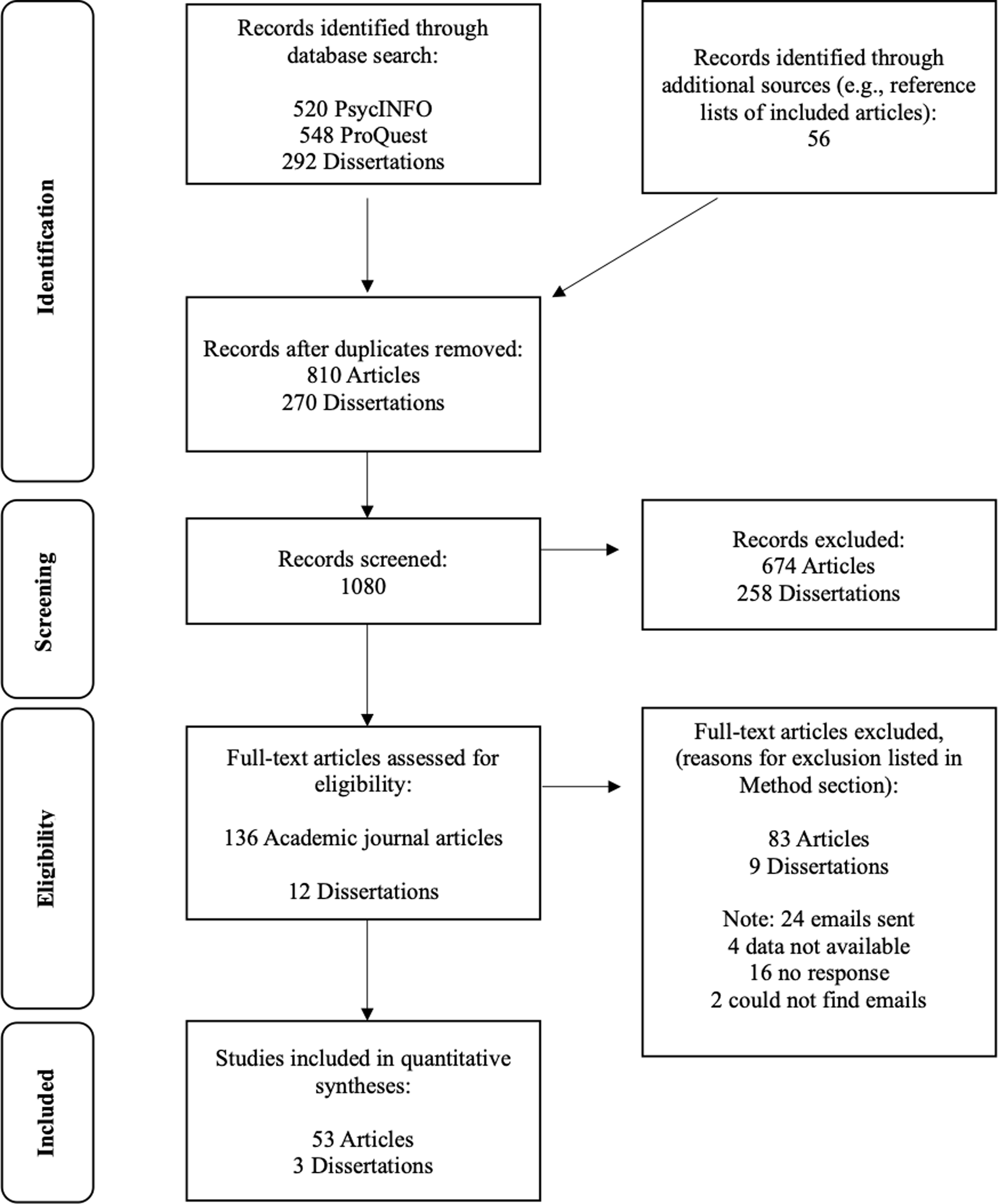
Following PRISMA guidelines (Moher et al., Reference Moran, Root, Vizy, Wilson and Gentzler2009), we conducted three database searches in PsycInfo, ProQuest, and ProQuest Dissertation and Theses Full Text to identify published and unpublished studies that examined the relations between parental ES and children’s internalizing problems. Consistent with previous meta-analyses examining correlates of parental ES (e.g., Johnson et al., Reference Jugovac, O’Kearney, Hawes and Pasalich2017; Rodrigues et al., Reference Rutter2025), the following keyword categories were searched: parent (i.e., paternal*, parents/ parent*, maternal*, mother*, caregiver*, father*), child (i.e., child*, child/ childhood development/ early childhood development/ child psychiatry/ child psychology/ child psychopathology/ child preschool, infan*, toddler*, preschool*, adolescen*, youth*, teen*, juvenile*, girl*, boy*), and emotion socialization terms (i.e., [emotion* or affect*] NEAR/2 [socialis* or socializ*], [emotion* or affect*] NEAR/2 [coach* or dismiss* or punitiv* or punish* or minimis* or minimiz* or encourage* or supportive or unsupportive or nonsupportive or contingen*],[emotion* or affect] NEAR/2 [express* or style* or climate* or model*], [emotion* or affect*] NEAR/2 [discuss* or communicat* or talk* or discourse* or explanation* or convers* or speech or speak* or elaborate*], respons* NEAR/3 negative emotion*, reaction* NEAR/3 negative emotion*, meta-emotion*, metaemotion*, coping with toddler* negative emotion*, coping with children* negative emotion*, elaboration*, “emotion communication”), and internalizing terms (i.e., anx* or worry or phobia or panic or (internalizing or internalising) or depress*). The search was limited to peer-reviewed journals or dissertations, published in English, through June 2023. The first search in PsycInfo yielded 520 abstracts (see Figure 1). A similar search in ProQuest yielded 234 additional abstracts after 314 duplicates were removed. Finally, a search in ProQuest Dissertation and Theses Full Text yielded 270 dissertations after removing duplicates that were later published as articles. In addition, all references of the included articles were screened to identify any additional studies, yielding an additional 56 articles.
PRISMA flow diagram describing the process of study selection.

We established a protocol to identify non-overlapping samples and ensure independent effect sizes. First, we cross-referenced authorship across publications. When authors published multiple articles, we reviewed the method section to establish if the same participants were included in each study. Further, we cross-referenced dissertation authorship to determine if a dissertation was later published as a journal article. If a dissertation had later been published in a journal, the journal article was selected for inclusion. After duplicates were removed, we screened 1,080 abstracts, reviewed 136 full-text articles and 12 dissertations, and identified 56 studies (53 articles and 3 dissertations) and 64 samples that were included in at least one meta-analysis (see Figure 1 for PRISMA flowchart).
Inclusion and exclusion criteria
For inclusion, studies had to rely on samples of children up to 18 years and needed to contain effect sizes or relevant data for the associations of parental ES and children’s internalizing problems. Studies needed to include a measure of parental ES (e.g., supportive approaches, nonsupportive approaches, and elaboration), measuring parental reactions to children’s emotions, parental discussions of emotions, and/or parental meta-emotion philosophies. Studies were excluded if they included studies of general parental warmth or sensitivity, parental responsiveness, more ambiguous methods of parental ES (e.g., emotional expressiveness), or general family emotional climate. Consistent with Johnson et al. (Reference Jugovac, O’Kearney, Hawes and Pasalich2017), we also excluded studies that parsed out and reported only parent’s self-reported internal experience of distress rather than parental overt expression of distress in response to the child’s emotions (e.g., the distress scale of the Coping with Children’s Negative Emotions Scale (CCNES; Fabes et al., Reference Fagan, Day, Lamb and Cabrera2002) or the Coping with Toddler’s Negative Emotions Scale (CTNES; Spinrad et al., Reference Stocker, Richmond, Rhoades and Kiang2004). Thus, distress reactions were excluded from analyses when data were presented for this subscale separately; when distress reactions were included in a nonsupportive composite, we used this composite score.
In addition to parental ES, studies also needed to include a measure of children’s internalizing symptoms. This included DSM-5-TR-related anxiety and depression symptoms or disorders as well as general internalizing symptomatology. Studies that included (a) global or trait anxiety or symptoms, (b) worry, (c) social anxiety, (d) separation anxiety, (e) generalized anxiety, (f) panic symptoms, (g) specific phobias, (h) major depressive disorder, (i) persistent depressive disorder, and(j) disruptive mood dysregulation disorder were included. We excluded studies that included temperamental traits to operationalize internalizing problems (e.g., behavioral inhibition), state anxiety, measures of affect (e.g., Positive and Negative Affect Schedule, Watson et al., Reference Wood, McLeod, Sigman, Hwang and Chu1988), and internalizing scores based on projective assessments.
We emailed authors (n = 26) when articles did not offer sufficient information for effect size calculation for the association between parental ES and child internalizing problems. Of the authors contacted, five responded with the necessary statistics, and their studies were included; the remaining studies could not be included (n = 3, authors indicated that data were no longer available, n = 16 authors did not reply, n = 2 email addresses could not be located).
Study quality assessment
Consistent with other literature (Madigan et al., Reference Magai and O’Neal2020), we relied on a 10-point quality assessment tool adapted from the National Institutes of Health (NIH) National Heart Lung and Blood Institute Quality Assessment Tool for Observational Cohort and Cross-Sectional Studies (2021), which included criteria related to the clarity of the research question, sample and recruitment, participation rate, study design, validity of predictor and outcome measures, and statistical analyses (see Appendix A). We calculated the percentage of criteria met for each study, range = 70–100, M(SD) = 82.32(6.32). We assessed study quality (i.e., the percentage of criteria met) as a continuous moderator for each of the three meta-analyses.
Coding of study variables
We determined a protocol to code the included studies on both ES and internalizing problems, as well as several moderators.
Parental emotion socialization
Studies were coded for the type of parental ES (e.g., supportive ESBs, nonsupportive ESBs, and elaboration) and if specified, the specific ESB measured. ES included parental MEP and behaviors (e.g., Gottman et al., Reference Gottman, Katz and Hooven1996), parental predicted responses to children’s emotions in different hypothetical situations (e.g., Fabes et al., Reference Fagan, Day, Lamb and Cabrera2002), and parent reported emotion-related behaviors (e.g., Magai & O’Neal, Reference Mathews, Koehn, Abtahi and Kerns1997). Supportive ESBs included problem-solving, emotion-focused comforting, encouragement of emotional expression, emotion coaching, and savoring, among others. Nonsupportive ESBs included minimizing, punitive responses, ignoring, dampening, and dismissing. Elaboration included behavioral coding of parental engagement in reflective processing of children’s prior experiences.
Furthermore, studies were coded for the valence of the emotion being socialized (i.e., positive, negative, combined/general/unspecified) and the ES agent (i.e., mother, father, parent). We also coded the percentage of child participants who were male.
Internalizing problems
Additionally, studies were coded for type of internalizing problems being assessed (anxiety, depression, and internalizing problems) and the specific type of anxiety or depression measured: (a) global or trait anxiety or symptoms, (b) worry, (c) social, (d) separation, (e) generalized, (f) panic, (g) specific DSM-5 related phobias, (h) major depressive disorder, (i) persistent depressive disorder, and (j) disruptive mood dysregulation disorder. Studies were also coded based on whether internalizing problems were assessed at the diagnosis or symptom level and in clinical versus non-clinical samples.
Child developmental stage
We coded the developmental period at the time of the ES and internalizing assessments: early childhood (up to 5 years old), middle childhood (6–11 years old), and adolescence (12–18 years old).
Measurement approaches
Studies were further coded for the method of ES assessment (e.g., questionnaire, interview, behavioral coding), specific assessment measures, and related adaptations (i.e., The Meta Emotion Interview, Gottman et al., Reference Gottman, Katz and Hooven1996; CCNES, Fabes et al., Reference Fagan, Day, Lamb and Cabrera2002; Emotions as a Child Scale, Magai & O’Neal, Reference Mathews, Koehn, Abtahi and Kerns1997). Further, studies were coded for the assessment method of anxiety, depression, and internalizing problems (i.e., whether diagnostic interviews or questionnaires were used). Further, studies were coded for informant of ES and internalizing problems (i.e., child, parent, teacher) as well whether the informant of the parental ES and child’s internalizing problems were the same or different persons.
Study design
Studies were coded for study design (cross-sectional or longitudinal), length of time between assessments in longitudinal studies, and which construct was assessed first chronologically (ES or internalizing problems). Additionally, studies were coded for type of publication (e.g., peer-reviewed article or dissertation).
Additional moderators
Several additional moderators were coded to aid in the understanding of the findings. These included:
-
1. sample SES represented categorically as (a) low SES, (b) middle to high SES, based on explicit indices of SES through quantitative methods (e.g., statements of low, middle, or upper SES; sample income average) provided by studies;
-
2. presence of parental psychopathology indexed as a mental health diagnosis or clinically significant scores of symptomatology on self-report questionnaires (e.g., a score of 16 or above on the CES-D based on data and statements provided by studies; no psychopathology, portion of the sample with psychopathology, entire sample has psychopathology);
-
3. if the sample was mostly comprised of majority or minority ethnicity in the country where the study was conducted; and
-
4. geographic region of the study (North America, Europe, Australia, Asia, Middle East, Africa, and South America).
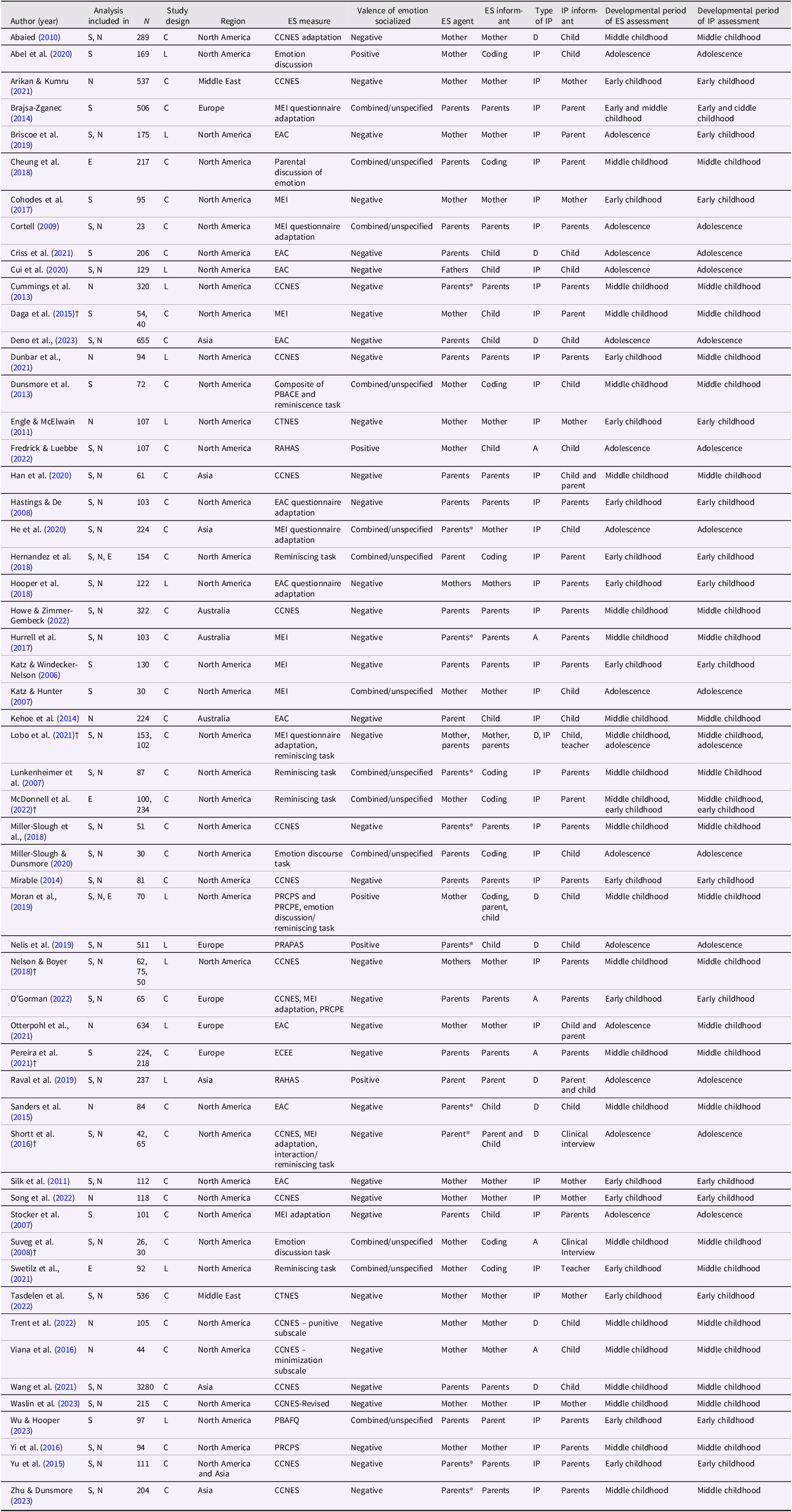
The first and third authors coded whether to include or exclude abstracts, overlapping on 20% of total abstracts to calculate reliability. Interrater reliability was 95% based on percent agreement and kappa = .88. The second, third, and fourth authors coded full-text articles for inclusion and study quality assessment, as well as data extraction with the fourth author overlapping on 22% of randomly selected articles. Interrater reliability was excellent (kappa range = .88–1.00). All categories of coding had over 90% percent agreement. Any discrepancies in coding were conferenced and resolved. Characteristics of the included studies in the meta-analyses are listed in Table 1.
Descriptive characteristics of studies included in the meta-analyses

Note. E = elaboration; S = supportive emotion socialization behaviors; N = nonsupportive emotion socialization behaviors; C = cross-sectional; L = longitudinal; * mother and father effect sizes were aggregated; A = anxiety; D = depression; IP = internalizing problems. †Studies providing effect sizes for multiple samples; CCNES = Coping with Children’s Negative Emotions Scale; CTNES = Coping with Toddler’s Negative Emotion Scale; EAC = Emotions as a Child Questionnaire; MEI = Meta Emotion Interview; PBACE = Parent’s Beliefs about Children’s Emotions questionnaire; PBAFQ = Parents’ Beliefs about Feelings Questionnaire; PRAPAS = Parental Responses to Adolescents’ Positive Affect Scale; PRCPE = Parent’s Responses to Children’s Positive Events; PRCPS = Parent’s Responses to Children’s Positive Emotions Scale; RAHAS = Responding to Adolescents’ Happy Affect Scale.
Effect size calculation
We used Comprehensive Meta-Analysis Version 4.0 (Borenstein et al., Reference Borenstein, Hedges, Higgins and Rothstein2022) to analyze effect sizes (Pearson’s r). When other data were reported (e.g., t-tests), statistics were converted to Pearson’s r. We interpreted the effect sizes based on Funder and Ozer (Reference Gottman, Katz and Hooven2019)’s criteria indicating that Pearson’s r = .10 small, r = .20 medium, and r = .30 large. Since we conducted separate analyses for the type of parental ES (supportive ESBs, nonsupportive ESBs, and elaboration), studies could contribute to multiple analyses. Consistent with previous meta-analyses (Brumariu et al., Reference Cassidy2023; Nair et al., Reference Nelis, Bastin, Raes and Bijttebier2024), if a study contained multiple effect sizes for a single analysis, aggregation rules were followed to ensure the inclusion of one effect size. Aggregated variables were standardized by transforming correlation coefficients into Fisher’s z, computing the average, and transforming the average to Pearson’s r.
Aggregation rules
-
1. If effect sizes were reported for the associations between supportive ESBs and internalizing problems, as well as associations between nonsupportive ESBs or elaboration with internalizing problems, all effect sizes were retained and included in separate analyses.
-
2. If a study presented effect sizes for independent samples within the study (e.g., results split by child gender or country of data collection), effect sizes were not aggregated.
-
3. If a study provided multiple measures of ES or internalizing problems from the same informant, we aggregated the effect size.
-
4. Studies in early childhood relied on parental reports of children’s internalizing problems. Studies of older children relied on either parent or child reports, with one exception (Viana et al., Reference Wang, Liu, Wang, Lin, Lin and Wang2016), where we prioritized child report, since children are better able to report on their emotions at older ages. We relied on teacher report of internalizing symptoms in one study where parent and child reports were not available (Lobo et al., Reference Lunkenheimer, Shields and Cortina2021). We also retained observational coding rather than parental self-report of ES in one study (Miller-Slough & Dunsmore (Reference Miller-Slough, Dunsmore, Zeman, Sanders and Poon2020) due to fewer studies using observational coding of parental ESBs).
-
5. If a study reported ESBs separately for mothers and fathers, we aggregated the effect size to represent ESBs of parents for the main analyses, but retained the original effect sizes to be included in comparative analyses for mothers and fathers (n = 13).
-
6. If a study presented both concurrent and longitudinal associations, we retained longitudinal bivariate associations due to stronger methodology (n = 13).
-
7. If longitudinal data points were presented, we retained the effect size with the longest interval between time points (n = 1).
-
8. If a study presented longitudinal data with both ES and internalizing problems assessed at both time points (e.g., both ES and internalizing problems at Time 1 and Time 2), we retained the effect size that was less represented (internalizing problems at Time 1, n = 3) so we had enough effect sizes to conduct moderation analyses (e.g., which construct was assessed first).
-
9. If there were not enough studies from a particular geographic region to conduct moderation analyses across meta-analyses, we combined samples from that region with samples from other regions based on some cultural similarities and interconnectedness. Thus, Europe (n = 5 in unsupportive ESBs, n = 3 in supportive ESBs) and Australia (n = 2 in supportive ESBs and 3 in nonsupportive ESBs) categories were combined with North America).
Data analysis
We conducted three separate meta-analyses for the relations of children’s internalizing problems with: (a) supportive parental ESBs, (b) nonsupportive parental ESBs, and (c) parental elaboration. Random effects methods were used to address possible measurement error and within-sample variability (Hedges & Olkin, Reference Hernandez, Smith, Day, Neal and Dunsmore1985). We used Duval and Tweedie’s (Reference Egger, Smith, Schneider and Minder2000) trim-and-fill method, Begg and Mazumdar’s (Reference Borenstein, Hedges, Higgins and Rothstein1994) Rank Correlation test, and Egger et al.’s (Reference Eisenberg1997) Test of the Intercept to address publication bias in addition to assessing funnel plots of effect sizes (see Appendices B–D). In addition, we evaluated effect size heterogeneity with Q-statistics (Borenstein et al., Reference Borenstein, Hedges, Higgins and Rothstein2009). We tested % of the child sample that was male, the length of time between assessments in longitudinal studies, and study quality as continuous moderators. All other moderators were categorical and consistent with previous meta-analyses (e.g., Brumariu et al., Reference Cassidy2023; Nair et al., Reference Nelis, Bastin, Raes and Bijttebier2024); we tested categorical moderators only for levels of a moderator that had four or more studies. Further, to test whether the relation between ESBs and children’s internalizing problems is different for mothers and fathers as the socialization agent, we compared effect sizes for supportive and nonsupportive ESBs and internalizing problems for the studies that reported effect sizes for both mothers and fathers (n = 13).
Results
Supportive emotion socialization behaviors and internalizing problems
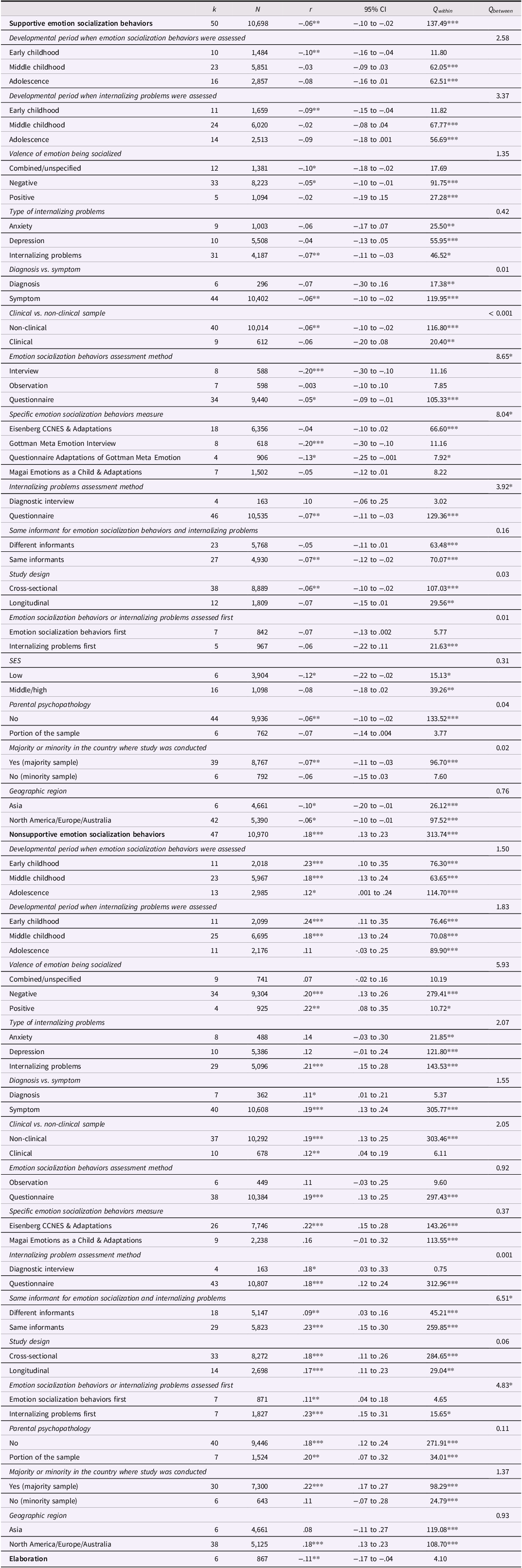
Table 2 presents the results for the three main meta-analyses and their categorical moderators, and we report significant moderators and follow-up analyses in-text. It is important to note that the number of studies reported for moderators in Table 2 does not always sum to the total number of studies in the main analyses, as not all studies provided usable data (i.e., data were not available, or the data were included in a level of a moderator with insufficient studies).
Results of meta-analyses of the associations between supportive emotion socialization behaviors (ESBs), nonsupportive ESBs, and elaboration with internalizing problems and categorical moderators

Notes. 1) *p < .05, **p < .01, ***p < .001.
2) The number of studies reported for moderators in Table 2 does not always sum to the total number of studies in the main analyses, as not all studies provided usable data (i.e., data was not available or the data was included in a level of a moderator with insufficient studies).
3) In the meta-analysis on supportive ESBs and internalizing, one study (Dunsmore et al., Reference Duval and Tweedie2013) included an oppositional defiant disorder (ODD) sample and was removed from the moderator analyses evaluating clinical and community samples, as all clinical samples were clinical samples of internalizing problems. Results were similar when including Dunsmore et al. (Reference Duval and Tweedie2013).
4) Supportive emotion socialization behaviors geographic regions: Asia included China (n = 4), India (n = 1), and Japan (n = 1), and North America/Europe/Australia included the United States (n = 33), Canada (n = 2), the United Kingdom (n = 2), Portugal (n = 1), Croatia (n = 1), Belgium (n = 1), and Australia (n = 2). Nonsupportive emotion socialization behaviors geographic regions: Asia included China (n = 4), India (n = 1), and Japan (n = 1), and North America/Europe/Australia included the United States (n = 30), Canada (n = 2), the United Kingdom (n = 1), Belgium (n = 1), Germany (n = 1), and Australia (n = 3). One study (Yu et al., Reference Zahn–Waxler, Klimes–Dougan and Slattery2015) was removed from the moderator analyses in the supportive ESBs and nonsupportive ESBs meta-analyses evaluating geographic regions due to providing effect sizes for the total sample comprised of participants living in the United States and China.
To address our first hypothesis, we performed a meta-analysis assessing whether greater parental supportive ESBs would relate to children’s lower levels of internalizing problems (k = 50, N = 10,698). Supportive ESBs had a very small, negative, and statistically significant association with internalizing problems (r = −.06, p = .001; 95% CI = [−.10, −.02]). Trim and fill procedures (Duval & Tweedie, Reference Egger, Smith, Schneider and Minder2000), visual inspection of funnel plots, and rank correlation and Egger’s tests (all p’s > .05) did not indicate the presence of missing studies or publication bias (Appendix B).
There was significant heterogeneity within studies evaluating the relation between supportive ESBs and internalizing problems (Q = 137.49, p < .001), suggesting the presence of potential moderators. We were able to evaluate all the moderators (see Table 2), except specific type of anxiety and specific type of depression, and three were significant: the ESBs’ assessment method (Q between = 8.65, p = .01), the specific measure of ESBs (Q between, 8.04, p = .045), and the internalizing problem assessment method (Q between = 3.92, p = .048). Associations were stronger when ESBs were assessed using interviews (r = −.20, p < .001) compared to observational assessments (r = −.003, p = .96; Q between = 7.38, p = .01) and questionnaires (r = −.05, p = .03; Q between = 7.09, p = .01). Questionnaire and observation-based assessments of ESBs did not significantly differ in their effect sizes (Q between = 0.69, p = .41). Regarding specific measures of ESBs, post hoc analyses showed that effect sizes were stronger for the Gottman Meta Emotion Interview (r = −.20, p < .001) than measures based on/adapted from the Eisenberg’s CCNES scales (r = −.04, p = .22; Q between = 6.77, p = .01) and the Magai Emotions as a Child Scales (r = −.05, p = .12; Q between = 5.78, p = .02). Effect sizes from studies using questionnaire adaptations based on the Gottman Meta Emotion Interview (r = −.13, p = .048) did not differ significantly from studies using the Gottman Meta Emotion Interview (Q between = 0.80, p = .37), the Magai (Q between = 1.11, p = .29) and Eisenberg measures and their adaptations (Q between = 1.48, p = .22). Assessments based on the Magai and Eisenberg’s measures did not differ (Q between = .06, p = .80). Regarding the assessment method for internalizing problems, associations were positive and nonsignificant when internalizing problems were assessed using diagnostic interviews (r = .10, p = .23) and were negative and statistically significant when assessed using questionnaires (r = −.07, p = .001). The percentage of the sample that was male, the length of time between assessments in longitudinal studies, M(SD) = 1.90(2.48), and study quality were not significantly associated with the size of the relation between supportive ESBs and internalizing problems (slope = −.001, Z = −.66, p = .52, slope = .01, Z = .30, p = .77, and slope = −.001, Z = −.22, p = .82, respectively).
Nonsupportive emotion socialization behaviors and internalizing problems
Next, we tested whether greater parental use of nonsupportive ESBs was associated with children’s greater internalizing problems. Based on the meta-analysis (k = 47, N = 10,970), there was a positive and statistically significant association approaching a medium effect size between nonsupportive ESBs and internalizing problems (r = .18, p < .001; 95% CI = [.13, .23]). Trim and fill procedures (Duval & Tweedie, Reference Egger, Smith, Schneider and Minder2000) showed that 6 studies were missing. However, overlapping confidence intervals between the original and adjusted effect size using trim and fill (r = .22; 95% CI = [.16, .28]) suggest results were not substantially affected by the missing studies. Further, visual inspection of funnel plots (Appendix C), rank correlation, and Egger’s tests (all p’s > .05) did not indicate publication bias.
There was significant heterogeneity within studies assessing nonsupportive ESBs and internalizing problems (Q = 313.74, p < .001), suggesting the presence of potential moderators. We were able to test all the moderators (see Table 2), except SES, specific type of anxiety, and specific type of depression, and two were statistically significant. First, effect sizes were weaker in longitudinal studies that assessed ESBs before internalizing problems (r = .11, p = .001) relative to longitudinal studies that assessed internalizing problems, first (r = .23, p < .001; Q between = 4.83, p = .03). Second, the strength of the association between nonsupportive ESBs and internalizing problems was significantly stronger when the informant was the same for both constructs (r = .23, p < .001) compared to when the informants were different (r = .09, p = .01; Q between = 6.51, p = .01). The valence of the emotion socialized was marginally significant (Q between = 5.93, p = .05), and we performed follow-up analyses for descriptive purposes. The association between nonsupportive ESBs and internalizing problems was stronger in studies on socialization for negative emotions (r = .20, p < .001) compared to studies that did not distinguish between socialization for positive and negative emotions (i.e., assessed combined, or not specified emotion; r = .07, p = .11; Q between = 4.91, p = .03). Effect sizes from studies evaluating socialization for positive emotions (r = .22, p = .001) did not significantly differ from studies that did not distinguish positive and negative emotions (Q between = 3.43, p = .06) or from studies evaluating socialization for negative emotions (Q between = .15, p = .70). The percentage of the sample that was male was not associated with the size of the relation between nonsupportive ESBs and internalizing problems (slope = .001, Z = .55, p = .58). The length of time between assessments in longitudinal studies, M(SD) = 1.66(2.26) years, was not associated with the size of the relation between nonsupportive ESBs and internalizing problems (slope = −.004, Z = −0.28, p = .78). Differences in effect sizes depending on whether nonsupportive ESBs or internalizing problems were assessed first in longitudinal studies remained significant when controlling for the length of time between assessments using meta-regression (slope = .15, Z = 2.50, p = .01). Study quality was not associated with the size of the relation between nonsupportive ESBs and internalizing problems (slope = −.01, Z = −1.54, p = .12).
Parental elaboration and children’s internalizing problems
Finally, we assessed whether greater use of elaboration is related to lower levels of internalizing problems. Based on the meta-analysis (k = 6, N = 867), there was a small, negative, and statistically significant association between elaboration and internalizing problems (r = −.11, p = .002; 95% CI = [−.17, −.04]). Trim and fill procedures (Duval & Tweedie, Reference Egger, Smith, Schneider and Minder2000), visual inspection of funnel plots, and rank correlation and Egger’s tests (all p’s > .05) did not indicate the presence of missing studies or publication bias (Appendix D). There was no significant heterogeneity to be accounted for in studies evaluating elaboration and internalizing problems (Q = 4.10, p = .54) and insufficient studies to conduct any categorical moderator analyses. The percentage of the sample that was male and study quality were not associated with the size of the relation between elaboration and internalizing problems (slope = −.01, Z = −.47, p = .64 and slope = .01, Z = 1.54, p = .12, respectively).
Comparing the strength of associations across meta-analyses
The confidence interval for the effect size representing the relation between nonsupportive ESBs and internalizing problems did not overlap with the confidence interval for supportive ESBs and internalizing problems, indicating that the relation between nonsupportive ESBs and internalizing problems was significantly stronger (e.g., Cumming et al., Reference Cummings, George, Koss and Davies2012). This was also true of the confidence intervals for the effect sizes representing elaboration and internalizing problems and nonsupportive ESBs and internalizing problems, where the effect between nonsupportive ESBs and internalizing problems was stronger. Further, the confidence interval for the effect size for elaboration overlapped with the one for supportive ESBs, suggesting a lack of significant difference between the two effect sizes and no specificity of results.
Mothers and fathers: comparing associations between emotion socialization behaviors and internalizing problems
We compared the effect sizes for the relation of internalizing problems with: (a) mothers’ and fathers’ use of supportive ESBs (k = 13, N = 4,553) and (b) mothers’ and fathers’ use of nonsupportive ESBs (k = 12, N = 3,675; see Table 3). To ensure comparable samples (i.e., within study comparisons), mother/father comparisons were based only on those studies that had separate data for both parents. Associations between supportive and nonsupportive ESBs and internalizing problems did not differ between mothers and fathers (all Q between p’s > .05; internalizing symptoms with mothers’ and fathers’ supportive ESBs, rs = −.13 and −.09, respectively, and for nonsupportive ESBs, mothers’ and fathers’ rs = .22 and .22, respectively).
Results of the meta-analyses comparing associations between supportive and nonsupportive emotion socialization behaviors and internalizing problems for mothers and fathers

Note. *p < .05, **p < .01, ***p < .001.
Discussion
This study aimed to quantify the strengths of the associations of parental supportive ESBs, nonsupportive ESBs, and elaboration with children’s internalizing problems. We calculated effect sizes from 50, 47, and 6 samples for each meta-analysis, respectively. Results showed that children’s internalizing problems were significantly related to all three types of parental ES, although overall, results were modest.
Parental supportive ESBs and children’s internalizing problems
We based our first prediction, that children experiencing parental supportive ESBs would show lower levels of internalizing problems, on theoretical models underscoring the positive effect of supportive ESBs on child development and adjustment, most likely due to their influence of effective emotion regulation strategies (e.g., Eisenberg et al., Reference Eisenberg, Spinrad and Cumberland1998; Morris et al., Reference Morris, Silk, Steinberg, Myers and Robinson2017) or due to broader direct effects (e.g., Gottman et al., Reference Gottman, Katz and Hooven1996). We found that children whose parents rely more on supportive ESBs that facilitate exploration and understanding of emotions have lower levels of internalizing problems, although the effect size was very small. Thus, using supportive ESBs might not be a particular key correlate of internalizing problems in itself. However, from a developmental psychopathology perspective, risk factors may potentiate each other so that their cumulative effects may be stronger than their separate effects (Rutter, Reference Saarni1979). These findings should also be contextualized based on the significant moderators: assessment method of ESBs, the specific measure of ESBs, and the internalizing problem assessment method.
Relations were more robust when ESBs were assessed using interviews rather than observational or questionnaire measures. By prompting parents to think about specific examples of situations when a child experienced a particular emotion, interviews might elicit both more focus and more relevant (child) emotional reactions that are considered by the respondent. Thus, it is likely that interviews offer richer material and opportunities for parents to elaborate on how they problem-solve, support, and validate their children’s emotions. As a note, all studies assessing ESBs with interviews relied on Gottman’s interview and its conceptual MEP approach (Gottman et al., Reference Gottman, Katz and Hooven1996). Additional analyses with specific ES measures showed that studies based on the Gottman’s interview had stronger effect sizes than those based on Eisenberg’s CCNES scales or the Magai Emotions as a Child Scales (although not stronger effects sizes than those based on the questionnaire adapted from Gottman’s MEP interview). Thus, overall, results based on Gottman’s meta-philosophy approach/interview were most robust, pointing out the importance of assessing ESBs as an integrated, goal-oriented strategy. This is likely to facilitate problem-solving with the child and teaching the child to rely on effective strategies for dealing with emotions in particular situations (Gottman et al., Reference Gottman, Katz and Hooven1996), including fear or sadness, central to internalizing problems (American Psychiatric Association, Reference Arikan and Kumru2022), and thus, lowering their symptomatology levels.
Surprisingly, the direction of the association between supportive ESBs and internalizing problems depended on the method of assessing internalizing problems: higher use of supportive ESBs was associated with lower internalizing problems assessed with a questionnaire, but with higher levels of internalizing problems when assessed with an interview. Given that there was no difference in effect sizes when internalizing symptoms were assessed as diagnoses vs. symptoms, this finding is difficult to interpret, particularly given the small number of studies relying on diagnostic interviews (k = 4; n = 163), and underscores the need to further investigate how measurement approaches influence the relation between parental ESBs and children’s internalizing problems.
Parental nonsupportive ESBs and children’s internalizing problems
Our second meta-analysis, synthesizing the literature on parental nonsupportive ESBs and children’s internalizing problems, yielded a medium and significant effect size, which was significantly stronger when compared to the effect sizes for supportive ESBs and elaboration, suggesting that children whose parents minimize, deny, or punish their emotions and manifestation of emotions experience greater internalizing problems. This finding is consistent with and expands Miller-Slough and Dunsmore’s (2016) narrative review that showed that nonsupportive parental ESBs (e.g., dismissing) are associated with greater internalizing problems in adolescence. Although this finding could be interpreted as suggesting that parent ES efforts may contribute to the development of internalizing problems, a key finding from the moderator analyses suggests an alternative interpretation. Specifically, the magnitude of the relation between nonsupportive parental ESBs and internalizing problems was stronger in longitudinal studies which first assessed internalizing problems compared to those which first assessed parental ESBs first (although significantly related in both cases). Notably, these differences remained significant when controlling for the length of time between assessments. This child-driven rather than parent-driven result underscores that children’s experiencing and expressing greater internalizing problems are likely to elicit parental ESBs that invalidate children’s emotional experience. Our finding is in line with the idea that one’s experience of depressed mood/internalizing problems might set the stage for a stressful interpersonal context (e.g., Hammen & Shih, Reference Han, Zhang, Davis and Suveg2014) and might affect how parents respond to children’s symptomatology (Pardini, Reference Pereira, Muris, Roberto, Stallard, Garcia-Lopez, Tulbure and Barros2008). For example, children’s greater level of worries, depressed mood, and associated internalizing difficulties is likely to erode the quality of the parent–child relationship and, thus, parents might tend to show less acceptance and more dampening of the child’s emotion (e.g., Katz et al., Reference Katz and Windecker-Nelson2014). It is also possible that parents of children with anxiety/depression may have difficulty tolerating their children’s emotions and may try to dampen them as a way to cope with their own emotions (e.g., see Tiwari et al., Reference Trent, Viana, Raines, Conroy, Woodward, Storch and Zvolensky2008). Findings reviewed in Schwartz et al. (Reference Shortt, Katz, Allen, Leve, Davis and Sheeber2012) also point out that dysphoric behavior of children experiencing high levels of depression is reinforced (either positively or negatively) by their parents. Further, their parents are more likely to respond negatively to the positive emotions of more depressed children. Overall, results also point out that intentionally assessing bidirectional effects in future work will provide a more comprehensive picture of the emotion-related transactions that occur between parents and their children experiencing anxiety or depression.
Not surprisingly, the strength of the association between nonsupportive parental ESBs and children’s internalizing problems was significantly stronger when the informant was the same (e.g., parent) for both constructs, compared to when the informants were different individuals. There are amplified concerns regarding common method variance when cross-sectional designs and self-reports (interviews, questionnaires) are employed (Spector, Reference Spinrad, Morris and Luthar2006) and given that most studies relying on the same informant were also cross-sectional (18 out of 29), our findings suggest that some effect sizes might be inflated. They also point out the strong need for methodologically robust studies relying on multiple informants (and longitudinal designs simultaneously) to gain a more nuanced understanding of the relation between parental nonsupportive ESBs and children’s internalizing problems.
Although the results of the analysis evaluating the valence of emotions were marginally significant (p = .05), we address them for descriptive purposes. We found no statistically significant differences between the relations of nonsupportive ESBs with children’s negative or positive emotions and internalizing symptoms. We did find that the association between nonsupportive ESBs and children’s internalizing problems was stronger in studies evaluating ESBs of negative emotion compared to studies assessing ESBs of unspecified emotions or combining ESBs of positive and negative emotions. The lack of difference for ESBs to positive and negative emotions is contrary to the notion that ESBs of negative emotions provide more teaching opportunities and facilitate more understanding of the causes of events than ESBs of positive emotions do (e.g., Fivush & Salmon, Reference Fredrick and Luebbe2023; Gottman et al., Reference Gottman, Katz and Hooven1996). Thus, parental nonsupportive ESBs of both negative and positive emotions are relevant for children’s internalizing problems. Other research has shown that experiences of positive emotions can sometimes “undo” or lessen the effects on lingering negative emotions (Fredrickson, Reference Funder and Ozer1998), and thus dampening children’s experiences of positive emotion could contribute to higher levels of internalizing emotions.
Parental elaboration and children’s internalizing problems
Our last meta-analysis addressed a gap in the literature by synthesizing the strength of the relation between parental elaboration and children’s internalizing problems. Results revealed a small, negative, and significant effect size, suggesting that parents who reminisce with their children about emotions and emotion-provoking events in more highly elaborative ways (i.e., labeling and coherently addressing children’s emotional experience) have children experiencing lower levels of internalizing problems. Thus, elaborative responses that teach about emotions promote better adaptation, consistent with previous literature (e.g., Fivush & Salmon, Reference Fredrick and Luebbe2023). We should note that, due to the small number of studies which might have contributed to the lack of heterogeneity, we could not test potential moderators, and therefore these findings need to be interpreted within the context of the available studies which primarily included middle/high SES samples of children in early and middle childhood from North America, and ES assessed with observational coding. Given the plethora of literature underscoring the importance of parental elaboration/reminiscence of emotions for child development (e.g., Fivush, Reference Fivush and Salmon2007; Fivush & Salmon, Reference Fredrick and Luebbe2023) future studies should consider this particular ES approach in relation to children’s internalizing problems.
Mothers and fathers: associations between ESBs and internalizing problems
Previous literature points out the importance of both mothers’ and fathers’ ES (e.g., see Eisenberg, Reference Eisenberg, Cumberland and Spinrad2020; Spinrad et al., Reference Spinrad, Stifter, Donelan-McCall and Turner2020) for child adjustment, although some differences in their ES correlates are noted (e.g., Brand & Klimes-Dougan, Reference Breaux, Lewis, Cash, Shroff, Burkhouse and Kujawa2010; Gottman et al., Reference Hajal and Paley1997). Our meta-analytic results based on studies with effect sizes for both parents demonstrated that the magnitude of the association of supportive and nonsupportive ESBs and children’s internalizing problems did not significantly differ based on parental gender. That is, regardless of the identity of the socializing agent, parents who encourage discussions and expression of emotions more and employ less punitive and minimizing approaches to children’s emotional experiences have children experiencing less internalizing problems. This result is consistent with the idea that fathers and mothers’ behaviors may have similar effects, most likely because they share similar socialization goals and values, and that both play a key role in child development (e.g., Spinrad et al., Reference Spinrad, Stifter, Donelan-McCall and Turner2020). This result also parallels current thinking that fathers’ involvement in raising children has been evolving as parental norms and social cultural norms have changed to emphasize a more egalitarian role with that of mothers (Fagan et al., Reference Fivush2014).
Strengths, limitations, and future research
In addition to meta-analytically quantifying the relations between parental supportive and nonsupportive ESBs, and elaboration with children’s internalizing problems, this review charts the landscape of current empirical work and provides insights into priority future directions. In none of the three meta-analyses were we able to examine whether there were differences by the type of depression (e.g., major depressive disorder, persistent depressive disorder) or anxiety (e.g., generalized anxiety, social anxiety, specific anxiety) due to the limited number of studies. Across meta-analyses, most studies focused on global/trait anxiety and depressive symptoms, with an extremely limited number of studies assessing social anxiety and major depressive disorders or dysthymia or a combination of general anxiety, social anxiety, and separation anxiety. We did not identify any studies focusing on panic disorder, specific phobias or disruptive mood regulation disorder. Each type of symptomatology has a unique constellation of challenges and future studies can advance the literature by assessing specific types of symptomatology. For example, given the importance of emotions and emotion regulation in social interactions (e.g., Saarni, Reference Sanders, Zeman, Poon and Miller1999), the effects of parental ES may be stronger for children’s social anxiety. Further, in the meta-analysis concerning nonsupportive ESBs, we were unable to evaluate if there are differences based on SES as most studies relied on samples with medium/high SES. Thus, studies that include a spectrum of SES possibilities, including low SES, are a priority in order to establish if effect sizes are similar or not as a function of family SES. Although included studies had relatively high study quality (i.e., M percentage quality assessment = 82.32), many studies had only one or a small number of effect sizes precluding a meaningful multi-level meta-analytic approach; however, this approach should be adopted in the future as research in this area continues to grow.
Further, parents are likely to engage in a mix of ESBs to varying degrees (e.g., Zhu & Dunsmore, Reference Zhu and Dunsmore2023). Few studies assess clusters of ESBs, and results might look different when this literature is evaluated meta-analytically. In this meta-analysis, we examined parental ES in isolation, as is typically done in research studies, although children experience parental ES in a broader context. It would also be important to establish if ES is related to children’s internalizing problems over and beyond other parenting-related factors. For example, among the three ES approaches, parental elaboration is the strongest correlate of secure attachment (Rodrigues et al., Reference Rutter2025), and it would be important to evaluate if there are unique associations of elaboration with internalizing problems beyond attachment security. It would also be important to test whether the magnitude of the relations between ES and children’s internalizing problems varies as a function of parenting style or the quality of parent–child relationship (e.g., moderated effects; Darling & Steinberg, Reference Denham, LoBue, Pérez-Edgar and Buss1993; Eisenberg, Spinrad et al., Reference Eisenberg and Fabes1998). Further, our review indicates that most studies are cross-sectional, and we acknowledge that they are important as parental ES processes could happen on a micro-time scale (i.e., days, hours) as child-elicited or child-eliciting behaviors effects. However, studies assessing reciprocal influences between parental ES and children’s internalizing problems over multiple time points are much needed to further understand the complex dynamic between ES and children’s internalizing problems.
Although nonsignificant, some results deserve comment. When there were enough studies to conduct moderation, we found no differences based on children’s developmental period of assessing ES or internalizing problems. Thus, despite potential changes in both parental ESBs (Denham, Reference Denham, Bassett, Wyatt, Grusec and Hastings2019; Eisenberg, Reference Eisenberg, Cumberland and Spinrad2020; Waslin et al., Reference Watson, Clark and Tellegen2023) and children’s rates of symptomatology, the relation among the constructs appears similar across ages. Similarly, the strengths of relations between parental supportive and nonsupportive ESBs and children’s internalizing problems emerged as similar across clinical and non-clinical samples, assessment of diagnosis and symptoms, samples assessing parental psychopathology or not, majority and minority samples, and North America/Europe/Australia and Asia. While from a statistical standpoint there were enough samples to conduct these moderation analyses, it is important to note that most studies relied on normative samples from North America with few risk factors such as parental psychopathology. It was therefore difficult to fairly evaluate the hypothesis that relations of ES approaches with children’s internalizing problems vary across cultures/geographical regions or based on parental level of functioning. Although some authors suggested that nonsupportive ESBs, particularly reactions in response to child distress, may have some benefits at the diagnostic and clinical levels as they may minimize and discourage faulty cognitions and foster approach behavior (e.g., Suveg et al., Reference Suveg, Sood, Barmish, Tiwari, Hudson and Kendall2011; Viana et al., Reference Wang, Liu, Wang, Lin, Lin and Wang2016), we did not find such differences. To broaden our understanding, studies employing clinical samples and minority samples from diverse geographical regions should be a priority.
The practical implications of our findings require consideration. The effect sizes for the relations of parental supportive ESBs and elaboration with children’s internalizing problems were in the small range, and the effect size for the relation between nonsupportive ESBs and internalizing problems was in the medium range (Funder & Ozer, Reference Gottman, Katz and Hooven2019). Abelson (Reference Achenbach, McConaughy and Reynolds1985) cautioned against disregarding smaller effect sizes as “very little is a lot,” particularly when multiple influences are likely to cumulate to lead to meaningful outcomes. A corollary proposition is that many factors are likely to combine to lead to the same outcome (Cicchetti & Rogosch, Reference Cohodes, Chen and Lieberman1996), and parental ES is one of many correlates of childhood internalizing problems. Thus, our results have some applicability for prevention and intervention efforts. Cognitive behavioral therapy, focused on skill acquisition and changing biased thinking and behavioral patterns that maintain children’s symptomatology, is considered the gold standard of treatment for internalizing problems, although there is room for improvement (e.g., James et al., Reference Johnson, Hawes, Eisenberg, Kohlhoff and Dudeney2020; Sun et al., Reference Suveg, Shaffer, Morelen and Thomassin2019). Parents are typically involved in their children’s treatment for anxiety and depression either in the form of psychoeducational sessions or family-based approaches (e.g., Sun et al., Reference Suveg, Shaffer, Morelen and Thomassin2019). Our results reinforce the notion that educating parents about the benefits of relying more on supportive ESBs and less on nonsupportive ESBs to socialize their children’s emotions, including having meaningful conversations about emotions, helping children label and understand their emotions and their causes, would be an important intervention component. In line with this idea, attachment- and emotion-focused parenting interventions show effectiveness for reducing children’s internalizing problems (Jugovac et al., Reference Katz and Hunter2022), and interventions using an ES framework show improvements in parents’ own emotion regulation and children’s outcomes (Hajal & Paley, Reference Hammen, Shih, Gotlib and Hammen2020). Our findings suggest that mothers’ and fathers’ responses to their children’s emotions should be a deliberate target of interventions aiming to mitigate children’s internalizing problems.
In summary, our meta-analytic review evaluated the empirical evidence regarding the associations of parental supportive and nonsupportive ESBs as well as parental elaboration with children’s internalizing problems across developmental periods. Results revealed small effect sizes between supportive ESBs or elaboration and children’s internalizing problems and a medium effect size between nonsupportive ESBs and children’s internalizing problems. There were very few significant moderators, mainly methodological (e.g., assessment methods for ESBs and internalizing problems; which construct was assessed first; and if there were the same or different informants for the constructs of interests). Importantly, we found no differences in the relation between ESBs and children’s internalizing problems based on parent gender, pointing out that fathers and mothers might operate in similar ways when socializing their children’s emotions experiencing internalizing problems. Results also suggest that incorporating an ES framework in intervention and preventive efforts might be beneficial for children at risk or experiencing internalizing problems.
Supplementary material
To view supplementary material for this article, please visit https://doi.org/10.1017/S095457942510059X.
Data availability statement
In line with the Open Science Framework, all of the data and research materials (e.g., codebook) have been made publicly available on the OSF and are accessible via https://osf.io/r65xh/?view_only=4ef60e0a5e7f4887b22fbea526759c74
Funding statement
This work was supported by faculty award grants awarded to Laura E. Brumariu and Michael T. Moore by Adelphi University.
Competing interests
The authors have no relevant financial or non-financial competing interests to disclose.