

Introduction
Yeast products, especially live yeast, are primarily added to ruminant feeds to enhance rumen function. This can be applied in young animals, during rumen development, and in older animals, to stabilise rumen pH and environment and improve digestive efficiency. Live yeast research in cattle started over 30 years ago, and published data since that time has shown that benefits in dairy cows include enhanced dry matter intake (DMI), reduced oxygen levels and improved fibre digestion in the rumen. Furthermore, live yeast supplementation has been demonstrated to result in a decrease in lactic acid levels in the rumen, thereby improving microbial fermentation, increasing nitrogen utilisation and reducing the risk of acidosis (Newbold et al., Reference Newbold, Wallace and Mcintosh1996).
Trials investigating the outcomes of feeding live yeast in dairy cows have been reviewed in a meta-analysis published by Desnoyers et al., (Reference Desnoyers, Giger-Reverdin, Bertin, Duvaux-Ponter and Sauvant2009), which covered 110 papers relating to 157 trials involving commercial, in-feed yeast based products. They found that, on average, feeding live yeast to ruminants caused an increase in rumen pH (average +0.03) and volatile fatty acids from fermentation (average +2.17 mM), a decline in rumen lactic acid levels and improved rumen environment to support the correct rumen micro-organisms. A review by Tricarico et al., (Reference Tricarico, Harrison and Johnston2006) reported similar results from feeding Yea-Sacc® on rumen pH and fibre digestion. These changes were linked to improvements in organic matter digestibility, increased DMI and milk yield. Other trials with live yeast, in addition to these common benefits, have shown improved rumen microbial population numbers (Gombos et al., Reference Gombos, Tossenberger and Szabo1995), better digestion of forage straw and increases in nitrogen flow from the rumen (Erasmus et al., Reference Erasmus, Botha and Kistner1992; Mruthunjaya et al., Reference Mruthunjaya, Kailas and Thirumalesh2010) as well as reduced methane production (Lila et al., Reference Lila, Mohammed, Takahashi, Tabata, Yasui, Kurihara, Kanda and Itabashi2006; Lascano and Heinrichs, Reference Lascano and Heinrichs2009; Lascano et al., Reference Lascano, Zanton, Suarez-Mena and Heinrichs2009). Furthermore, supplementing ruminant diets with live yeast led to an improved acetate: propionate ratio (Oeztuerk, Reference Oeztuerk2009). These improvements in rumen performance by live yeast supplementation were most notable when cows were fed high starch diets, which are typically associated with greater levels of lactic acid production and the development of acidosis. Lascano et al. (2012) demonstrated a quadratic, dose-dependent response by live yeast (Yea-Sacc® ) for the improved digestibility of a high starch diet.
The objectives of the current trial were to determine the effects of Yea-Sacc® (Saccharomyces cerevisiae CBS 493.94) in the diet of lactating dairy cows on aspects of milk production, milk quality, environmental outputs and financial impact on farm.
Materials and methods
Two groups of 32 cows (balanced for different levels of parity, physiological stage and milk production) were used in the trial. During the first two weeks of the trial, all cows in both groups were fed the basal TMR with no supplementary test ingredients to adapt them into the diet. The basal TMR was made up of corn silage (8 kg DM/h/d), beet pulp (2.2 kg DM/h/d), alfalfa hay (3.5 kg DM/h/d), corn (1.5 kg DM/h/d), alfalfa silage (1.8 kg DM/h/d), rapeseed cake (1.0 kg DM/h/d) and distillers dried grains and soluble (0.5 kg DM/h/d) plus a premix to balance amino acids, vitamins and minerals and a dairy cow concentrate. The same basal diet was used during the experimental period, with or without YS supplementation. The test diet was supplemented with 25 g of Yea-Sacc® Farm Pak per head per day (YS; Alltech Inc, USA) to give a dosage of live yeast of 1.07 × 10⁸ CFU/g.
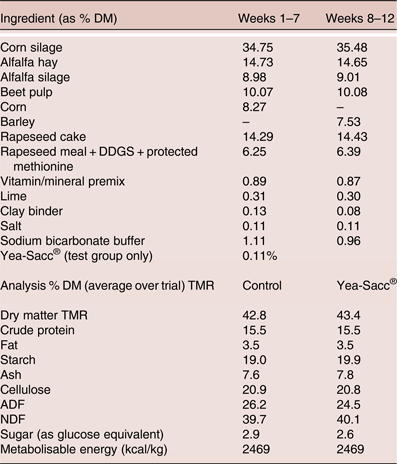
Cows were loose-housed in groups of 32, housed indoors with access to cow mattresses in cubicles. Ad libitum access to water was provided. One week before the start of the trial and on day one of the trial, all cows used in the experiment were weighed, blocked by parity, calving date, lactation/milk yield (early lactation period) and randomly allocated to trial groups. During the 12 week trial period, TMR samples were taken weekly and stored at −20 °C for analysis. During the first seven weeks of the trial, the cereal source of the TMR was corn, which was then changed to barley from weeks eight to 12. YS was added to the feed via the mixer wagon immediately before feeding out (Table 1).
Basal dairy cow TMR formulation and analysis used in 12 week performance study, supplemented with or without Yea-Sacc®

Cows were fed daily after morning milking, with any previous refusals being weighed back. Feed intake was recorded daily. All cows were inspected by the farm veterinarian daily and any cows showing ill health were immediately removed from the study. Milk production was recorded daily immediately after each milking. The composition of the milk was assessed from samples taken in two consecutive milkings per week and analysed for protein, fat, lactose, somatic cell count (SCC) and urea content. Body condition scores were taken weekly.
The data were analysed as a randomised block design study by Repeated Measures ANOVA using PROC MIXED in SAS (SAS Institute, version 9.1.3 service pack 4), with confidence limits set at 5%. In addition, a second analysis using ANCOVA was performed, where the period of production was used as a covariate, in order to take into consideration the specificity of high performing dairy cows.
The trial was run on an experimental farm in France and was conducted in accordance with AgroParisTech ethical standards.
Results and discussion
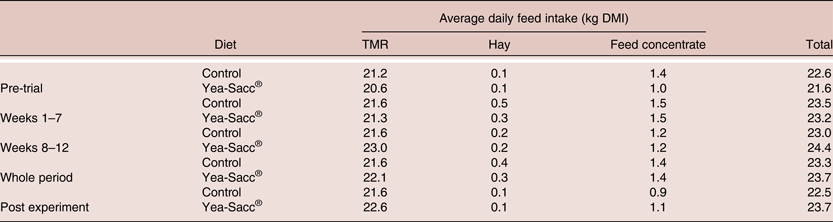
Each group of cows randomly allocated to the control or YS diet before the trial were compared and found to be not significantly different from one another. The groups consisted of cows from first calving as well as individuals with two or more parities, with an average lactation of 133 and 134 days respectively, pregnancy rate of 0.59 (for both groups) and milk yields of 39.0 and 38.8 kg/d respectively. During the whole trial, only three cows failed to complete the experiment for issues not related to the trial diets. In the week preceding the trial, the DMI for the YS group was lower than the control group and so the milk records for the pre-trial period were used as a covariate in the final data analyses regarding performance. As the feed intake records were based on total group intakes, no statistics could be applied, however Table 2 shows the intakes based on average daily consumption (based on weekly data).
Feed intakes for group housed dairy cows fed a TMR (kg DM basis) without (control diet) or with Yea-Sacc®
There was a decrease of approximately 1 kg DMI in the pre-trial period for the YS group however, this normalised during the first phase (weeks one to seven) of the trial. During weeks six and seven, when ambient temperatures dropped, the intake increased by 2 kg for both groups even though the TMR and overall feed was kept constant. This is most likely a response to increased maintenance energy requirements under such environmental conditions. When the diets were changed from corn to barley as the main cereal source at week eight, there was a 1.4 kg DMI difference between groups, with the YS group having higher intakes. This difference in DMI remained evident even after the experiment had finished.
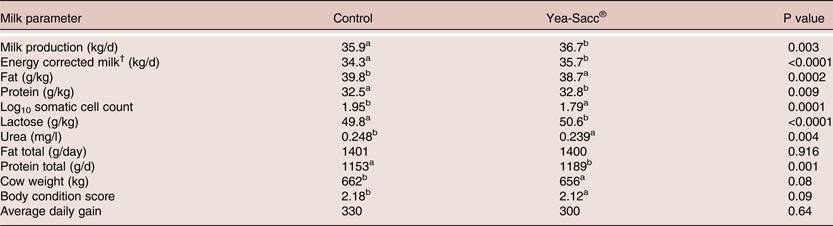
In terms of cow weight changes, body condition score, milk production and quality parameters, there was a significant improvement (P < 0.05) in the cows fed YS for daily milk production, energy-corrected milk yield (ECM), milk protein level, lactose, SCC and total protein output in milk (Table 3). As feed intake was reduced during the trial period, the YS-fed cows showed a decrease in ECM production the same week. Cows fed the control diet had significantly higher milk fat levels, urea, cow body weight and condition score (P < 0.05). This suggested that the addition of YS in the diet increased the conversion of nutrients into milk, except fat, as well as a higher daily yield of milk (0.8 kg/d). As the protein levels were significantly higher (P < 0.05) in milk from the cows fed YS, this suggested that protein utilisation, via optimised rumen efficiency, was significantly improved. This is in agreement with previously published data (Skórko-Sajko et al., Reference Skórko-Sajko, Sajko and Zalewski1993; Desnoyers et al., Reference Desnoyers, Giger-Reverdin, Bertin, Duvaux-Ponter and Sauvant2009; Meller et al., Reference Meller, Firkins and Gehman2014).
Impact of feeding Yea-Sacc® to lactating dairy cows on milk production, quality parameters, body weight and condition score.
†ECM corrected for 4% fat and 3.4% protein according to the equation:
ECM (4% fat, 3.4% protein) = Milk × (0.124% fat + 0.073% CP + 0.256)
Means in rows not sharing a superscript differ significantly (P < 0.05)
Overall, when weekly data were analysed (data not shown), there was an increase in BCS for all cows, independent of diet, between weeks four and eight, but a decrease during the last part of the experiment, when barley was used in the diet instead of corn. The cows in general had poor BCS, but the YS-fed cows increased their BCS by 0.47 points during the experiment while the cows fed the control diet increased by 0.42 points. Some cows did not attain the expected 305 DIM, because of fertility issues or abortion. However, there was an increase of approximately 400 kg of cumulative 305 days milk production for the YS fed cows, which also had better uniformity as evidenced from a lower standard deviation in the data. Cows fed the YS diet produced 10,825 kg of milk versus 10,420 kg for the controls during the 305 DIM period, which included the calculations of projected milk production from the cows that failed to complete the trial (based on their performance up to the point of removal). For cows that actually completed the trial period, the YS group produced significantly more milk (P < 0.001) with 10,797 kg versus 10,647 kg from the control group.
During the experiment and in the post-experimental period (12–15 weeks), an extra 220 kg of milk was produced by cows in the YS group, equating to nearly 2 kg extra milk per cow per day. The amount of saleable milk was compared between the groups and was numerically higher for the YS-fed cows compared to the control group (3850 kg versus 3630 kg, respectively).
In addition, the impact of the two feeding phases on production parameters was investigated. While the feed phase effect was often significant, it did not impact on the treatment effect. Overall, effect of YS was higher for ECM, protein and lactose during the earlier period up to seven weeks on trial (P < 0.05), when cows were in the early lactation stage and had the highest potential for milk production.
Two statistical analyses were conducted. The first one was an ANOVA where the YS effect was analysed. The second one was an ANCOVA where the DIM was included as a covariate, in order to take into consideration the high performing cows. In each case, the total 305 days milk production was numerically better for YS group. As the average length of production was higher for YS group (303.6 days versus 299.5 days for the control group), the second analysis highlighted an effect of the covariate, which decreased the estimation of means square for the YS group.
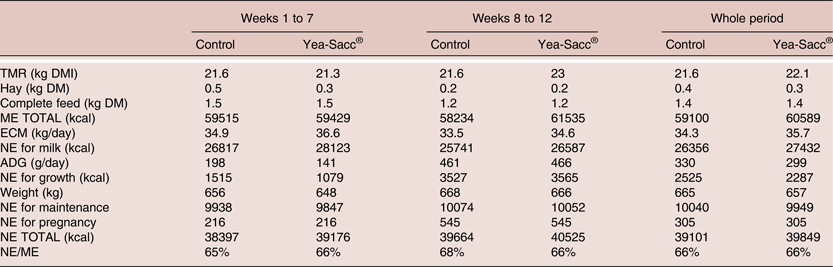
Metabolisable energy (ME) of total mixed rations were calculated from each feedstuff and analysed composition of diets per week. These data were used to calculate the energy balance and net energy (NE) of the two groups of cows during the two trial periods (Table 4).
Influence of feeding Yea-Sacc® on energetic balance in early and later lactating dairy cows
The energetic needs for pregnancy were evaluated by the formula:
 $$\eqalign{{\rm ME} & = 0.00072 \times \hbox{calf weight} \times {\rm EXP}\cr & \quad \left( 0.116 \times \hbox{pregnancy stage in weeks} \right) \times 1700} $$
Calf weights of 50 kg were used for calculating the pregnancy data. The YS group showed best use of ME during the first period. Indeed, the extra 1.7 kg ECM and lower 0.5 kg feed intake in the cows fed YS resulted in one point more ME than the control group. During the second feed phase (with barley instead of corn), intake was higher for YS group (+ 1.4 kg DM). ECM production was also higher but only by 1.1 kg. Starch from barley is digested differently from corn and can negatively impact ruminal pH, affecting microflora balance, rumen fermentation and nutrient availability. The meta-analysis undertaken by Tricarico et al. (Reference Tricarico, Harrison and Johnston2006) showed that YS used in diets for cows could improve NDF digestibility, raise ruminal pH and give an increase of 1.2 kg in ECM production. In the current experiment, the energetic balance underlined a difference in ME between groups according to period. In the first feeding phase up to week seven, YS appeared to increase ME, in agreement with Tricarico et al. (Reference Tricarico, Harrison and Johnston2006). Conversely, during the second phase, YS stimulated feed intake but the total digestibility of TMR decreased, in accordance with a shorter dwell time in the rumen. It is thought that YS regulated pH in the rumen during this period and stabilised feed intake at a higher level compared to the control group. Hence, the calculated levels of ME were better for the control group during this second period. However, if the whole experiment is considered, both groups had the same levels of ME (66%).
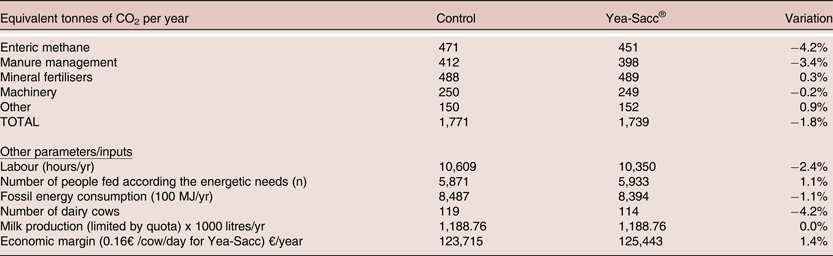
The data from the trial were used in the PerfAgro® model developed by the Research Center on Economics and Organisation for Animal Production (CEREOPA) to study the impact of the use of YS on the whole farm. This model manages the interactions between crop and livestock production, as well as other variables including economics, fossil fuel use and greenhouse gas emissions, nutrient inputs and milk outputs, impacting on farm production as an optimisation model developed for linear programming.
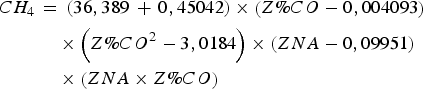
The trial farm used in the experiment was modelled as 540 hectares with 120 Prim Holstein cows, which produce 1.1 million litres per year, plus 450 ewes, in order to observe the whole impact of YS (impact on crops, number of cows and heifers, diets adjusted due to improved NDF digestibility and fertility) when it is added to the diet of dairy cattle. Enteric methane emission was estimated by the equation (Giger-Reverdin et al., Reference Giger-Reverdin, Sauvant, Vermorel and Jouany2000):
 $$\eqalign{CH_{4}\, & = \,(36\comma389\, + \,0\comma45042) \times \left( {Z\% CO - 0\comma004093} \right) \cr & \quad \times \left( {Z\% C{O^2} - 3\comma0184} \right) \times \left( {ZNA - 0\comma09951} \right) \cr & \quad \times \left( {ZNA \times Z\% CO} \right)} $$
where Z% CO, is the part of concentrates in the diet (% DM) and ZNA is the ratio between dry matter intake and body weight (Table 5).
Influence of feeding Yea-Sacc® to lactating dairy cows on whole farm economics
The impact on the whole farm was a decrease of 1.8% of greenhouse gas emissions, due to a decrease in the number of cows required to maintain milk production. As the diet was more efficient, this allowed some areas to be potentially converted from forage cultivation to crop cultivation, hence an increase in the number of people fed according to human energetic needs (+1.1%). Feeding YS to the dairy herd decreased the need for labour (−2.4%) and the dependence on fossil energy (−1.1%).
Conclusions
This experiment demonstrated that feeding YS to dairy cows increased milk production (0.8 kg/d), energy corrected milk production (1.4 kg/d) and synthesis of protein (36 g/d). The data for the YS group showed better protein content (0.3 g/kg) but a lower fat content (1.2 g/kg). The increase in protein synthesis in milk, even with a higher daily milk yield, indicated that the YS could be stimulating rumen bacteria growth, thus optimising fermentation and nitrogen uptake by rumen bacteria. This may result in increased microbial protein reaching the small intestine, which is in-line with a lower milk urea nitrogen, as less dietary nitrogen was being lost though urea. This could have important consequences in regions where nitrogen utilisation and excretion are environmental issues for dairy production.
The lactose content was always higher (+0.8 g/kg) for cows fed YS, showing improved energy utilisation from the diet. All these effects were higher during early lactation, when the potential for production was greater. The YS-fed cows produced more milk, resulting in an extra 220 kg milk per cow between the beginning of the experiment and the end of the post experiment period, although this did not attain significance. The 305 days calculated milk production was higher for the YS group (approximately 400 kg more) but again this difference was not significant. Even with the extra production recorded during the experiment for the YS group (an extra 1.4 kg ECM) this did not have any negative effects on later lactation.
Overall, feeding YS to lactating dairy cows had significant benefits on milk production and quality parameters. In addition, analysis of these improvements in a total farm model showed that feeding YS reduced methane emissions by 4%, reduced the number of dairy cows needed to maintain the same milk yield by 4% and increased overall farm margins by 1.4%, due to reduced labour costs and farm inputs. Hence, feeding YS to lactating dairy cows not only has benefits in terms of animal performance but also impacts pollution and improves whole farm economics.
Acknowledgements
The authors would like to thanks Alltech Inc, USA for funding this project. The authors would like to express their gratitude to Mrs. Sylvie Andrieu for monitoring the study and to Dr. Helen Warren for her review of the manuscript.
Declaration of Interest
C.A. Moran is an employee of Alltech France Ltd.