Introduction
The dipteran agromyzid leafminers, Liriomyza trifolii (Burgess), Liriomyza chinensis (Kato) and Chromatomyia horticola (Goureau) are important pests of vegetables and ornamental crops (Spencer, Reference Spencer1990). In Japan, L. chinensis and C. horticola are indigenous species while L. trifolii is an invasive species that was first reported in Japan in 1990 (Saito, Reference Saito1993; Sasakawa, Reference Sasakawa1993). The pest status of these leafminers is compounded by their lack of susceptibility to insecticides (Parrella & Keil, Reference Parrella and Keil1984; Saito et al., Reference Saito, Oishi, Ikeda and Sawaki1992, Reference Saito, Ikeda and Ozawa1996, Reference Saito, Doi, Katayama, Kaneko, Tagami and Sugiyama2008a; Saito, Reference Saito2004; Tokumaru & Okadome, Reference Tokumaru and Okadome2004). A koinobiont parasitoid of leafminers, Halticoptera circulus (Walker) (Hymenoptera: Pteromalidae), is also resistant to the broad-spectrum insecticides, malathion (organophosphate) and tralomethrin (pyrethroid), and is, therefore, considered to have great potential as a biological control agent of leafminers within integrated pest management systems that include the use of insecticides (Saito et al., Reference Saito, Doi, Katayama, Kaneko, Tagami and Sugiyama2008a; Matsuda & Saito, Reference Matsuda and Saito2014). However, H. circulus is rarely reported from L. trifolii in Japan (Saito et al., Reference Saito, Ikeda and Ozawa1996, Reference Saito, Doi, Tagami and Sugiyama2008b; Arakaki & Kinjo, Reference Arakaki and Kinjo1998; Amano et al., Reference Amano, Suzuki, Hiromori and Saito2008) while it is relatively abundant in L. chinensis and C. horticola populations (Takada & Kamijo, Reference Takada and Kamijo1979; Tokumaru, Reference Tokumaru2006; Saito et al., Reference Saito, Doi, Katayama, Kaneko, Tagami and Sugiyama2008a). To develop successful biological control of leafminers using H. circulus, we need to understand the reasons why so few have been reported from L. trifolii. The purpose of this study was to assess parasitism and development of H. circulus in L. trifolii compared with the indigenous leafminer hosts, L. chinensis and C. horticola.
Materials and methods
Culture of leafminers and the parasitoid H. circulus
The leafminers, L. trifolii, L. chinensis and C. horticola, were collected from tomato, garden pea and leek in Shizuoka Prefecture, Japan, in 1991, 2012 and 2005, respectively. Both L. trifolii and C. horticola were maintained on potted kidney bean plants at 23 ± 1°C in a 16L: 8D photoperiod; L. chinensis, a specialist on Allium spp., was maintained on potted leek plants (about 20 cm height) under the same abiotic conditions. These potted host plants were used throughout the study. The parasitoid H. circulus was collected from L. chinensis infesting leek plants in Shizuoka and Okinawa Prefecture, Japan, in 2010 and 2013, respectively; they were named Shizuoka strain and Okinawa strain. Both strains were maintained on C. horticola larvae on potted kidney bean plants at 23 ± 1°C in a 16L: 8D photoperiod.
Parasitism and host feeding by H. circulus on each potential leafminer host
The Shizuoka strain of H. circulus was used in this study. Its parasitism and host feeding were evaluated in two trials each of which had different densities of host larvae. To prepare leafminer larvae as hosts for H. circulus, approximately 200 adults of each leafminer species were released into a large cage (40 cm width, 40 cm depth, 40 cm height, with gauze sides) containing five or ten potted host plants for Trial 1 and Trial 2, respectively, for 6 h at 23 ± 1°C and in light during which time oviposition proceeded. The plants were then transferred to another large cage ensuring that all adult leafminers were removed, and maintained at 23 ± 1°C in a 16L: 8D photoperiod for 7 days during which time leafminer eggs hatched and larvae developed. Then numbers of host larvae were adjusted by removing excess larvae using minute pins; in Trial 1 and 2 there were approximately 60 and 30 third-instar larvae per plant, respectively. The potted host plants were then placed individually into smaller cages (22 cm width, 18 cm depth, 35 cm height, with gauze sides); five adult female and five adult male H. circulus (2-day-old) were introduced into each small cage and maintained at 23 ± 1°C in a 16L: 8D photoperiod for 24 h. All leafminer larvae were then dissected in saline solution (0.8% NaCl) with minute pins under a binocular microscope (MZ16, Leica Microsystems, Wetzlar, Germany) and the presence of parasitoid eggs was determined. Simultaneously, the number of host larvae that had been killed by host feeding was determined; these larvae were recognizable as they had turned brown in colour and there was no evidence of parasitoid eggs or larvae. Percentage data for parasitism and host feeding in each cage were logit transformed and submitted to analysis of variance (ANOVA) followed by Tukey's honestly significant difference (HSD) tests in the software package IBM SPSS Statistics (SPSS, 2009).
Development of H. circulus in each potential leafminer host at different temperatures
The Shizuoka strain of H. circulus was used in this study. Five potted host plants infested with eggs of each leafminer species were prepared as described in the previous section. The cages were maintained at 23 ± 1°C in a 16L: 8D photoperiod for 4 days during which time leafminer eggs hatched and larvae developed; each plant bore 50–80 first-instar larvae by the end of this time period. A mixed sex population of approximately 100 adult H. circulus (2-day-old) was introduced into each cage and maintained at 23 ± 1°C in light for 6 h during which time oviposition proceeded. For each cage the leaves were then cut from all plants and divided into three groups. Each group was wrapped in a paper towel, placed in a container (16 cm width, 21 cm depth, 6 cm height) covered with a gauze lid, and maintained at either 15 ± 1, 20 ± 1, or 25 ± 1°C in a 16L: 8D photoperiod. Thereafter, the number of emerged female and male parasitoids were counted and removed daily between 15.00 and 16.00 h. Developmental time (eggs to adults) of the parasitoid were compared statistically using the Student's t-test in the software package SPSS (SPSS, 2009).
Encapsulation of H. circulus in each potential leafminer host
Both the Shizuoka and Okinawa strains were used in this study. Large cages, each containing five potted host plants infested with third-instar larvae of each leafminer species were prepared as described previously. Three large cages were prepared for each leafminer species. A mixed sex population of approximately 50 adult H. circulus (2-day-old) was introduced into each cage and maintained at 23 ± 1°C in light for 6 h during which time oviposition proceeded. The plants were then transferred to another large cage ensuring that all adult parasitoids were removed, and maintained at 20 ± 1°C in a 16L: 8D photoperiod. For the Shizuoka strain, after 1, 3, 5 and 7 days, 50–60 larval and/or pupal leafminers were sampled from each cage and dissected in 5% saline solution on a glass slide under a microscope (Axio Imager 2, Carl Zeiss Microscopy, Jena, Germany). For the Okinawa strain, dissection was done after 5 days using the same method as described above. The percentage of parasitoid eggs and/or larvae that were encapsulated within parasitized leafminers was determined as an indication of the host's immune response; the data from the three cages for each leafminer species were pooled.
Results
Parasitism and host feeding by H. circulus on each potential leafminer host
In Trial 1, parasitism rates by H. circulus were 21.6% for L. trifolii, 22.3% for L. chinensis and 18.6% for C. horticola and there was no significant difference in parasitism rates between the species (F 2,12 = 0.262, P = 0.773; table 1). In Trial 2, which had about half the initial larval density of Trial 1, parasitism rates were 46.7% for L. trifolii, 39.7% for L. chinensis and 46.3% for C. horticola and there was also no significant difference in parasitism rates between the species (F 2,27 = 1.180, P = 0.323; table 1). In both trials, host feeding of the parasitoid was observed and ranged from 14.6 to 32.8% and 8.9–23.0% in Trial 1 and 2, respectively. The mean percentages of host larvae fed upon by adult parasitoids were significantly different amongst the species in both trials (Trial 1: F 2,12 = 30.012, P < 0.001, Trial 2: F 2,27 = 6.007, P = 0.007), but subsequent analysis using the Tukey's HSD test indicated that the significant effects were different in each trial (table 1).
Parasitism and host feeding rates (%, mean ± SE) of H. circulus (Shizuoka strain) in each potential leafminer host species.

There was no significant difference in the mean percentage of parasitism amongst host leafminer species in Trial 1 (F 2,12 = 0.262, P = 0.773) or Trial 2 (F 2,27 = 1.180, P = 0.323). Within the host feeding column, means followed by the different letters are significantly different to each other (P < 0.05).
Development of H. circulus in each potential leafminer host at different temperatures
There was no development of adult parasitoids from eggs presumed to have been laid in the leafminer L. trifolii at any of the temperatures evaluated (table 2). In contrast parasitoid eggs developed through to adults in larvae of the leafminers L. chinensis and C. horticola at all temperatures evaluated; development was significantly faster for both male and female parasitoids in C. horticola than in L. chinensis at all temperatures (P < 0.01, Student's t-test; table 2).
Developmental time (days from egg to adult, mean ± SE) of H. circulus (Shizuoka strain) in each potential leafminer host species.

1 at each temperature, there was significant difference in the developmental time of male and female H. circulus in L. chinensis and C. horticola (P < 0.01). n = a total number of parasitoids emerged.
Encapsulation of H. circulus in each potential leafminer host
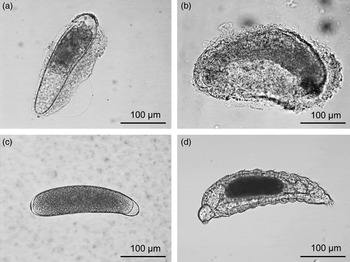
Parasitoid eggs (Shizuoka strain) laid in larvae of the leafminers L. chinensis and C. horticola successfully developed into larvae within 7 days of oviposition and no encapsulated individuals were observed (table 3). The parasitoid eggs laid in larvae of L. trifolii became encapsulated, either as eggs or as larvae, by host haemocytes (fig. 1a, b). The first evidence of encapsulation was observed 3 days after oviposition when encapsulation rates of eggs and larvae were 1.1 and 66.7%, respectively (table 3). After 5 days encapsulation rates of eggs and larvae were 10.2 and 91.4%, respectively, and after 7 days encapsulation rates of eggs and larvae were 5.1 and 100%, respectively (table 3). In contrast, parasitoid eggs laid in larvae of L. chinensis and C. horticola successfully developed into larvae within 7 days of oviposition and no encapsulated individuals were observed (fig. 1c, d, table 3).
Eggs and larvae of H. circulus (Shizuoka strain) in leafminers. An encapsulated egg (a) and larva (b) in L. trifolii. A healthy egg (c) and larva (d) in C. horticola.

Encapsulation rates (%) of eggs and larvae of H. circulus (Shizuoka strain) in each potential leafminer host.

n = number of eggs or larvae observed.
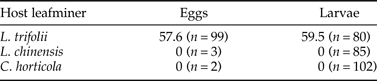
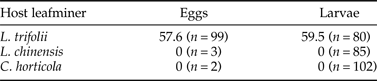
Encapsulation of the Okinawa strain of H. circulus by the leafminers was also examined; the eggs and larvae were encapsulated in larvae of L. trifolii 5 days after oviposition, while no encapsulated individuals were observed in larvae of L. chinensis and C. horticola (table 4).
Encapsulation rates (%) of eggs and larvae of H. circulus (Okinawa strain) in each potential leafminer host at day 5 after oviposition.
n = number of eggs or larvae observed.
Discussion
To understand the reason why there was no emergence of the parasitoid from L. trifolii, even though the parasitoid laid eggs in this leafminer species, larvae exposed to the parasitoid were dissected and development of the parasitoid was observed. This showed categorically that the parasitoid eggs laid in larvae of L. trifolii became encapsulated, either as eggs or as larvae, by host haemocytes (fig. 1a, b, table 3). Encapsulation by L. trifolii was found for both the H. circulus strains evaluated (from Shizuoka and Okinawa Prefecture) (tables 3 and 4), which had been collected approximately 1300 km from each other. This suggests that encapsulation of H. circulus by L. trifolii may be a common phenomenon in Japan.
In insects, the innate immune system involves both humoral and cellular responses to foreign bodies, and plays an important role in defence against parasitoids (Strand & Pech, Reference Strand and Pech1995). The most well characterized immune response to the presence of parasitoid eggs or larvae is encapsulation by host haemocytes, and results in death of the parasitoid (Meloche & Guppy, Reference Meloche and Guppy1990; Lavine & Strand, Reference Lavine and Strand2002). The present study showed that eggs and larvae of H. circulus were encapsulated in L. trifolii, even though the parasitoid accepted L. trifolii as a potential host and laid eggs within it. Furthermore, encapsulation of H. circulus has been found in another invasive leafminer, Liriomyza sativae Blanchard (Diptera: Agromyzidae) (unpublished data), that was first reported in 1999 in Japan (Iwasaki et al., Reference Iwasaki, Kasuga, Iwaizumi and Sasakawa2000). The parasitoid has also only rarely been collected from L. sativae in the field in Japan (Saito et al., Reference Saito, Doi, Tagami and Sugiyama2008b). In contrast, our study also showed that H. circulus successfully developed without any encapsulation when laid in the indigenous leafminers, L. chinensis and C. horticola. Indeed, the parasitoid is also relatively abundant in both leafminer species in the field (Saito et al., Reference Saito, Doi, Katayama, Kaneko, Tagami and Sugiyama2008a; Tokumaru, Reference Tokumaru2006). These observations suggest that H. circulus is killed by encapsulation as part of the host's immune response, but only in invasive species such as L. trifolii and L. sativae and not in indigenous species.
Host resistance and parasitoid virulence are coevolved in host–parasitoid interactions (Kraaijeveld et al., Reference Kraaijeveld, Van Alphen and Godfray1998). In the coevolutionary arms race between parasitoid and host the parasitoid is generally the winner, as a result of low levels of encapsulation (Carton & Nappi, Reference Carton and Nappi1991). In Japan, H. circulus has a short coevolutionary history with the invasive leafminers, L. trifolii and L. sativae, thereby immunosuppressive strategies may be underdeveloped against the resistance mechanisms of these leafminers. This hypothesis is supported by the fact that H. circulus is abundant in populations of L. trifolii and L. sativae in Florida (Schuster et al., Reference Schuster, Gilreath, Wharton and Seymour1991), where L. trifolii is indigenous (Minkenberg, Reference Minkenberg1988). However, when we consider populations of H. circulus in L. trifolii in other regions of its invasive range, our hypothesis does not hold. For example, H. circulus is abundant in L. trifolii populations in California (Trumble, Reference Trumble1985), Texas (Hernández et al., Reference Hernández, Harris and Liu2011) and Hawaii (Johnson, Reference Johnson1987), following invasion by L. trifolii in the mid-1970s (Minkenberg, Reference Minkenberg1988). Thus, there is geographic variation in virulence of H. circulus to L. trifolii that cannot always be explained by the length of their coevolutionary history.
It is known that other factors can be involved in variation in virulence of parasitoids. For example, Kraaijeveld & Godfray (Reference Kraaijeveld and Godfray1997) reported that there was a trade-off between parasitoid resistance (encapsulation) and larval competitive ability in Drosophila melanogaster Meigen (Diptera: Drosophilidae); populations that were highly resistant to the parasitoid had lower larval survival under conditions of intraspecific competition. Such a trade-off may exist in L. trifolii, although the phenomenon has not previously been reported for leafminers and their parasitoids. Kapranas & Tena (Reference Kapranas and Tena2015) also reported that older or larger nymphs of soft scale insects achieved higher encapsulation rates of their parasitoids. However, it is unlikely that the latter factor is responsible for the varied virulence of H. circulus against L. trifolii, because no emergence of the parasitoid was observed in the leafminer species, even though small (first-instar) larvae were used as hosts (table 2). Further immunological studies are needed to fully elucidate geographic variation in virulence of H. circulus to L. trifolii.
An additional, two results were apparent from this study. Firstly, parasitoids developed significantly faster (both males and females) in C. horticola than in L. chinensis at all temperatures, which suggests that developmental time of this koinobiont endoparasitoid also depends on the larval and pupal developmental periods of the host; at 25°C, C. horticola has a shorter developmental period (11.2 days) than L. chinensis (19.2 days) which supports this hypothesis (Mizukoshi & Togawa, Reference Mizukoshi and Togawa1999; Tran & Takagi, Reference Tran and Takagi2005). Secondly, there were also significant differences amongst the leafminer species in the percentages of larvae that were fed on by the parasitoid (table 1). These results are difficult to interpret because the significant effects were inconsistent between the trials; as prey density was the only factor that was different, it is possible that this influenced feeding preference but this would require further research to confirm.
In conclusion, the present study is, to the best of our knowledge, the first record of encapsulation of H. circulus eggs and larvae by L. trifolii. This suggests that the Japanese strain of H. circulus is unlikely to be useful for biological control of L. trifolii in Japan, even though it does kill this leafminer by host feeding. Other strains of the parasitoid may be effective control agents of L. trifolii in other countries such as USA and it may be possible to select strains with greater efficacy against L. trifolii in Japan. In Japan, the parasitoid could also be useful for biological control of the indigenous leafminer species L. chinensis and C. horticola.
Acknowledgements
The work was funded by Shizuoka University. We are grateful to Dr T. Imura and Mr M. Doi for field-collection of H. circulus and L. chinensis. We thank Professor I. Uwafuji for helpful advice on statistical analysis. We also thank J. K. Pell Consulting for editing the manuscript.