

Introduction
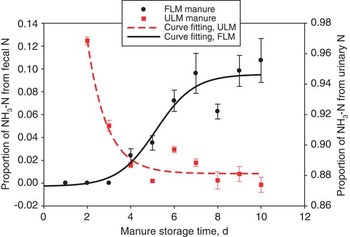
Nitrogen (N) emissions from agriculture are a significant water and air pollutant and the role of livestock in N pollution has been known for decades (Viets, Reference Viets1974). Nitrogen, along with phosphorus, is a major cause of water quality impairment (USEPA, 2009). In the USEPA report, 32% of US streams were rated poor in relation to N pollution and agriculture was the most important source of river and stream impairment. Crop production, animal feeding operations, grazing and manure runoff are the main sources of N pollution from agriculture (USEPA, 2009). Nitrogen excreted with feces or urine has a different fate and contributes differently to ground water nitrate and ammonia (NH3) emitted from cattle manure. Lee et al. (Reference Lee, Hristov, Cassidy and Heyler2011a) demonstrated that more than 90% of NH3-N emitted during the first 10 days of manure storage originates from urine (Figure 1).
Proportion (means ± s.e.; n = 8) of NH3-N emitted from manure originating from fecal- or urinary-N. Data derived from manure containing 15N-labeled feces (FLM), or 15N-labaled urine (ULM; Lee et al., Reference Lee, Hristov, Cassidy and Heyler2011a).

Ammonia emitted from animal feeding operations is an environmental and human health hazard, contributing to eutrophication of surface waters and nitrate contamination of ground waters, soil acidity and fine particulate matter formation (USEPA, 2004a and 2004b). In addition, NH3 emission is a net loss of manure fertilizer value to the producer. For example, daily NH3-N losses of 25% to 50% of the N excreted in manure have been estimated using mass balance approaches for dairy cows and feedlot cattle (Hristov et al., Reference Hristov, Hanigan, Cole, Todd, McAllister, Ndegwa and Rotz2011). Emitted NH3 reacts quickly with atmospheric sulfuric and nitric acids to form fine particulate matter (PM2.5), which according to the World Health Organization affects more people than any other air pollutant (WHO, 2005). Even low concentrations of air pollutants have been related to a range of adverse health effects (Oberdorster, Reference Oberdorster2000; Miller et al., Reference Miller, Siscovick, Sheppard, Shepherd, Sullivan, Anderson and Kaufman2007). It has been estimated that, across different regions of the United States and under different weather conditions, PM2.5 formed from NH3 emitted from livestock operations contributed on average from 5% to 11% of the total PM2.5 concentrations, but could reach 20% in some regions and in cool weather (Hristov, Reference Hristov2011). Ammonia can have an impact on water quality at a considerable distance from the emission source. Models have predicted an average lifetime of atmospheric NH3 aerosol of 3 to 4 days (Pye et al. Reference Pye, Liao, Wu, Mickley, Jacob, Henze and Seinfeld2009). Grimm and Lynch (Reference Grimm and Lynch2005), for example, estimated ammonium wet deposition in the Chesapeake Bay watershed at 2.6 kg/ha, or about 47% of the total inorganic N deposition.
The fact that urinary N is more labile than fecal N and is the primary contributor to NH3 and total N losses from manure emphasizes the importance of reducing urinary N losses and/or shifting N excretion from urine to feces. The advantages of decreasing dietary crude protein (CP) for reducing manure N losses and gaseous N emissions from livestock operations have been demonstrated and discussed in various publications and reviewed by Hristov et al. (Reference Hristov, Hanigan, Cole, Todd, McAllister, Ndegwa and Rotz2011). It has been unequivocally shown that reduction in dietary N input can be a successful strategy for improving N utilization efficiency and reducing N losses with manure in dairy cows. Reducing dietary protein can also benefit the producer by reducing feed cost. There are numerous examples where decreasing protein concentration in diets for dairy or beef cattle dramatically decreased manure N losses without affecting animal production (see Hristov et al., Reference Hristov, Hanigan, Cole, Todd, McAllister, Ndegwa and Rotz2011). These interventions, however, have to be balanced with the risk of decreased productivity. If animal requirements for metabolizable protein (MP) are not met, production cannot be sustained. Milk production of high-producing dairy cows, for example, was reduced with diets containing around 14% CP (Lee et al., Reference Lee, Hristov, Hyler, Cassidy, Long, Corl and Karnati2011b; Lee et al., Reference Lee, Hristov, Cassidy, Heyler, Lapierre, Varga, de Veth, Patton and Parys2012a). Production losses with low-protein diets can be caused by: (1) depressed dry matter intake (DMI) due to impaired rumen function or physiological regulation of intake, (2) deficiency of ruminally degradable protein (RDP) and/or (3) insufficient supply of key amino acids (AA) limiting milk protein synthesis. The effect of low-protein diets on feed intake is critical and must always be considered (Lee et al., Reference Lee, Hristov, Cassidy, Heyler, Lapierre, Varga, de Veth, Patton and Parys2012a). In some cases, dietary CP as low as 12%, did not affect milk production of dairy cows, although nutrient digestibility and microbial protein synthesis in the rumen were depressed (Aschemann et al., Reference Aschemann, Lebzien, Hüther, Döll, Südekum and Dänicke2012). In the latter study, however, intake of the cows was restricted and the important effect of protein on DMI (Picard et al., Reference Picard, Uzu, Dunnington and Siegel1993; Lee et al., Reference Lee, Hristov, Cassidy, Heyler, Lapierre, Varga, de Veth, Patton and Parys2012a) could not be demonstrated. Supplementation with rumen-protected AA (RPAA) limiting milk production and milk protein synthesis may compensate for the lack of MP in dairy cow diets. In some cases, this was a successful strategy (Leonardi et al., Reference Leonardi, Stevenson and Armentano2003; Berthiaume et al., Reference Berthiaume, Thivierge, Patton, Dubreuil, Stevenson, McBride and Lapierre2006; Broderick et al., Reference Broderick, Stevenson, Patton, Lobos and Olmos Colmenero2008), but not in others (Socha et al., Reference Socha, Putnam, Garthwaite, Whitehouse, Kierstead, Schwab, Ducharme and Robert2005; Davidson et al., Reference Davidson, Hopkins, Odle, Brownie, Fellner and Whitlow2008; Benefield et al., Reference Benefield, Patton, Stevenson and Overton2009). This uncertainty of the impact of low-protein diets on milk production can jeopardize efforts for promoting environmentally sustainable practices to the dairy industry. Thus, it is critically important to elucidate the mechanisms by which dietary protein and post-ruminal AA supply regulate feed intake and milk production in dairy cows, so the effect of protein feeding on animal production can be successfully predicted.
Main findings
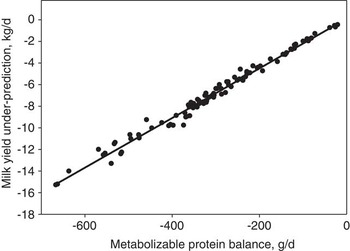
Inaccurate estimation of feed RDP, unaccounted physiological mechanisms, such as urea recycling (Huhtanen and Hristov, Reference Huhtanen and Hristov2009), and improved efficiency of conversion of MP to milk protein (Doepel et al., Reference Doepel, Pacheco, Kennelly, Hanigan, López and Lapierre2004) as diets become increasingly deficient in MP are likely responsible for the observed under-prediction of milk yield in cows fed MP-deficient diets in several experiments conducted at The Pennsylvania State University (Figure 2). In these experiments, urinary N losses, blood urea and milk urea N were consistently decreased compared with the control, MP-adequate diets (Lee et al., Reference Lee, Hristov, Heyler, Cassidy, Lapierre, Varga and Parys2011b, Reference Lee, Hristov, Hyler, Cassidy, Long, Corl and Karnati2012a and Reference Lee, Hristov, Cassidy, Heyler, Lapierre, Varga, de Veth, Patton and Parys2012b). Manure from cows fed MP-deficient diets had up to 40% decreased NH3-emitting potential (Lee et al., Reference Lee, Hristov, Heyler, Cassidy, Lapierre, Varga and Parys2012b). As indicated earlier, however, in some experiments, DMI, milk production and milk protein concentration were decreased with the MP-deficient diets. Supplementation with RPAA (Met and Lys) appeared to alleviate some of these negative effects, but the trends for depressed DMI and milk production still existed (Lee et al., Reference Lee, Hristov, Heyler, Cassidy, Lapierre, Varga and Parys2012b).
Relationship of metabolizable protein (MP) balance (NRC, 2001) and under-prediction of milk yield (NRC (2001) MP-allowable milk yield, kg/day – actual milk yield, kg/day) in dairy cows: milk yield under-prediction, kg/day = 0.0991 (±0.0905) + 0.0230 (±0.0003) × MP balance (g/day); n = 97 (MP balance, min = −20 g/day and max = −666 g/day), R 2 = 0.99, P < 0.001 (data from Lee et al., Reference Lee, Hristov, Heyler, Cassidy, Lapierre, Varga and Parys2012b).

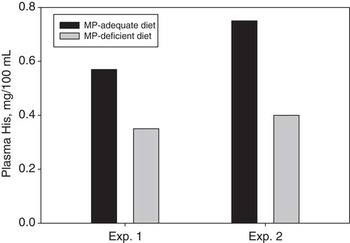
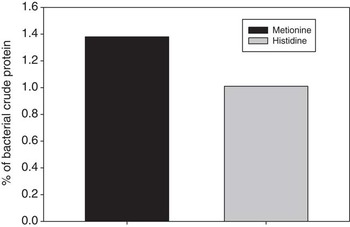
Analysis of the data from these long-term, continuous design studies showed a clear trend for decreased blood plasma His concentrations with the MP-deficient, compared with the control diets (Figure 3). Further, analysis of rumen bacterial samples from unrelated experiments conducted at Pennsylvania State University (with diets similar in feed ingredient composition to the diets fed in the low-protein experiments) indicated about 27% lower His than Met concentration in bacterial protein (Figure 4). Microbial protein is an increasingly important source of AA for the cow when MP-deficient diets are fed. Therefore, based on the plasma His and ruminal bacterial AA composition data, we hypothesized that His may become a limiting AA in high-producing dairy cows fed corn silage- and alfalfa haylage-based diets deficient in MP. Indeed, His has been identified as the first limiting AA in lactating cows fed grass silage-based diets with low inclusion of plant protein supplements (Kim et al., Reference Kim, Choung and Chamberlain1999; Vanhatalo et al., Reference Vanhatalo, Huhtanen, Toivonen and Varvikko1999), but has not been implicated as a limiting AA in dairy cows fed typical North American, corn and alfalfa silage-based diets.
Effect of dietary metabolizable protein (MP) supply on blood plasma His concentration in lactating dairy cows (Exp. 1; s.e.m. = 0.053, P = 0.001; Exp. 2; s.e.m. = 0.042, P < 0.001). The MP-adequate diets met MP requirements of the cows and the MP-deficient diets were about 12% to 15% deficient in MP according to NRC (2001) (data from Lee et al., Reference Lee, Hristov, Heyler, Cassidy, Lapierre, Varga and Parys2012a and Reference Lee, Hristov, Cassidy, Heyler, Lapierre, Varga, de Veth, Patton and Parys2012b).

Methionine and histidine concentrations (% of CP) in fluid-associated ruminal bacteria isolated from lactating Holstein dairy cows (n = 14). Met, s.d. = 0.07; His, s.d. = 0.29; P < 0.001 (data from Lee et al., Reference Lee, Hristov, Cassidy, Heyler, Lapierre, Varga, de Veth, Patton and Parys2012a).

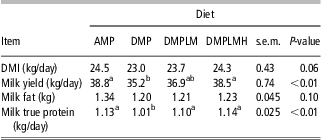
To test our hypothesis, we conducted a long-term (12 weeks), continuous design experiment with 48 lactating dairy cows (75 ± 5.6 days in milk). Following a 2-week covariate period, cows were blocked by stage of lactation and milk yield and randomly assigned to one of four diets, based on corn silage and alfalfa haylage: control, MP-adequate diet (AMP; MP balance: +9 g/day); MP-deficient diet (DMP; MP balance: −317 g/day); DMP supplemented with RPLys (AminoShure®-L; Balchem Corporation, New Hampton, NY, USA) and RPMet (Mepron®, Evonik Industries AG, Hanau, Germany; DMPLM); and DMPLM supplemented with an experimental RPHis preparation (DMPLMH; Balchem Corporation). CP content of the AMP and DMP diets was 15.7% and 13.5% to 13.6%, respectively. Apparent total tract digestibility of all measured nutrients, plasma urea-N and urinary-N excretion were decreased by the DMP diets compared with AMP. Milk N secretion as a proportion of N intake was greater for the DMP diets compared with AMP. Compared with AMP, DMI tended to be lower (P = 0.06) for DMP, but was similar for DMPLM and DMPLMH (Table 1). Milk yield was decreased by DMP, but was similar to AMP for DMPLM and DMPLMH, paralleling the trend in DMI. Milk fat and true protein content did not differ among treatments, but milk protein yield was increased by DMPLM and DMPLMH compared with DMP and was not different from AMP. Supplementation of the DMP diets with RPAA increased plasma Lys, Met and His concentrations. These data clearly identified His as a limiting AA in high-producing dairy cows fed corn silage and alfalfa haylage-based diets, deficient in MP. Milk N efficiency was increased and urinary N losses were dramatically decreased by the DMP diets. Based on our data and the similar concentration of Met and His in milk protein essential AA (5.5%, according to NRC, 2001), we concluded that MP should contain 2.2% His for lactating dairy cows fed corn silage and alfalfa haylage-based diets (similar to the recommended concentration of Met in MP; Schwab et al., Reference Schwab, Huhtanen, Hunt and Hvelplund2005).
Effect of metabolizable protein supply and rumen-protected amino acid supplementation on DMI and milk production and composition in dairy cows (data from Lee et al., Reference Lee, Hristov, Cassidy, Heyler, Lapierre, Varga, de Veth, Patton and Parys2012a)
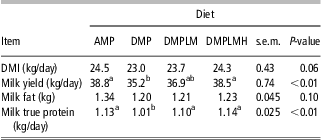
DMI = dry matter intake; AMP = MP balanced diet; DMP = MP-deficient diet; DMPLM = DMP supplemented with RPLys (AminoShure®-L) and RPMet (Mepron®); DMPLMH = DMPLM supplemented with an experimental RPHis product (Balchem Corp., NY).
a,bWithin a row, means without a common superscript letter differ (P < 0.05).
Conclusions
Overfeeding of dietary protein results in increased urinary N losses and NH3 emissions from manure and decreased milk N efficiency in dairy cows. Feeding MP below cow requirements, however, may result in decreased milk and milk protein yields, although milk production will be significantly greater than predicted by the NRC (2001) model. Based on experimental data, we hypothesized that His may be an AA limiting milk production in lactating dairy cows fed diets based on corn silage and alfalfa haylage. This hypothesis was tested in a long-term trial by supplementing an MP-deficient diet with RPAA, that is, Lys, Met and His. Data from this experiment showed increased DMI with RPAA supplementation, particularly when all three RPAA were supplemented. The increased DMI triggered milk and milk protein yield responses with the RPAA-supplemented diets. As total-tract fiber digestibility was suppressed with all MP-deficient diets, we propose that, similar to monogastric species, AA play a role in DMI regulation in dairy cows. Analysis of rumen bacterial samples indicated significantly lower His than Met concentration in bacterial protein. Microbial protein is an increasingly important source of AA for the cow when MP-deficient diets are fed and our data indicate that His may be a limiting AA in high-producing dairy cows fed corn silage- and alfalfa haylage-based diets deficient in MP. We propose that the proportion of His in MP should be similar to that of Met, which, for practical purposes, is suggested to be 2.2%. The MP-deficient diets in this experiment clearly increased milk N efficiency and decreased dramatically urinary N losses, which, based on previous observations, is expected to reduce manure NH3 and potentially nitrous oxide emissions. Thus, supplementation of a MP-deficient diet with RPAA (Met, Lys and His) has the potential to reduce N losses and gaseous N emissions while maintaining milk production and milk protein yield in dairy cows.
Further information
The Dairy Solutions Symposium is a biennial event that covers a wide variety of themes and topics of relevance and importance to the dairy industry. The aim is to provide high level, up-to-date information and research to dairy professionals, technologists and scientists. In 2012, the theme addressed the biggest challenge facing all those involved in dairy production: optimizing production efficiency while lowering environmental impact. For more information, please visit www.dairycowsolutions.com or contact dairycowsolutions@alltech.com.