Introduction
Climate change and anthropogenic impacts have affected sources and redistribution of organic matter in the marine environment. Radiocarbon (14C) has been successfully employed to trace the origin and circulation of environmental organic matters (Druffel and Bauer Reference Druffel and Bauer2000; Wakeham et al. Reference Wakeham, McNichol, Kostka and Pease2006; Lujaniene et al. Reference Lujanienė, Mažeika, Li, Petrošius, Barisevičiūtė, Jokšas, Remeikaitė-Nikienė, Malejevas, Garnaga-Budrė, Stankevičius, Kulakauskaitė and Povinec2015). Among other factors, organic substances of various origin introduced into the marine environment and deposited on the seabed may be subject to utilization and decomposition by microorganisms. Microbial communities consisting of fungi and bacteria can immobilize or mineralize organic matter with complex compositions and thus contribute to carbon pathways in the marine environment (Logue et al. Reference Logue, Stedmon, Kellerman, Nielsen, Andersson, Laudon, Lindström and Kritzberg2016; Simkus et al. Reference Simkus, Slater, Lollar, Wilkie, Kieft, Magnabosco, Lau, Pullin, Hendrickson, Wommack, Sakowski, van Heerden, Kuloyo, Linage, Borgonie and Onstott2016).
Phospholipid-derived fatty acids (PLFA) have been widely used as quantitative bacterial biomarkers to characterize the microbial community structure in sediments, waters, and soils. Recent studies showed that PLFA can be utilized in compound-specific δ13C and Δ14C analyses for source characterization as well as microbial community responses to environmental changes and contamination (Uchida et al. Reference Uchida, Shibata, Kawamura, Kumamoto, Yoneda, Ohkushi, Harada, Hirota, Mukai, Tanaka, Kusakabe and Morita2001; Mollenhauer and Rethemeyer Reference Mollenhauer and Rethemeyer2009; Druffel et al. 2010; Keaveney et al. Reference Keaveney, Reimer and Foy2015).
Although it is generally accepted that bacteria and microbial communities are responsible for degradation of organic compounds, there has been a lack of information on carbon incorporation from different substrates. Environmental data have indicated several potential carbon sources and metabolic pathways from a variety of complex communities (Simkus et al. Reference Simkus, Slater, Lollar, Wilkie, Kieft, Magnabosco, Lau, Pullin, Hendrickson, Wommack, Sakowski, van Heerden, Kuloyo, Linage, Borgonie and Onstott2016). Furthermore, it has been shown that diverse members of the soil microbial community can be responsible for different substrate uptake. For instance, starch, and to some extent glycine, were used mainly by bacteria while fungi mostly utilized glucose, acetic acid and vanillin (Rinnan and Bååth Reference Rinnan and Bååth2009). That study did not confirm if bacteria better utilized simple compounds as compared to fungi. Degradation of ancient organic matter contributed considerably to biogeochemical carbon cycles with impacts on sediment dating. The principle role of microorganisms in this process has been well recognized. It was found that gram-positive bacteria are able to utilize black slate-derived carbon (Seifert et al. Reference Seifert, Trumbore, Xu, Zhang, Kothe and Gleixner2011). Methane has been recognized as important source of 14C-dead carbon (e.g., from seepage of coal-bed methane, or releases of methane from sediments due to climate warming) which could also be estimated from bacterial PLFAs biomarkers (James et al. Reference James, Bousquet, Bussmann, Haeckel, Kipfer, Leifer, Niemann, Ostrovsky, Piskozub, Rehder, Treude, Vielstadte and Greinert2016; Mills et al. Reference Mills, Slater, Dias, Carr, Reddy, Schmidt and Mandernack2013). Calculations indicated that methane-derived fossil carbon can contribute up to 90% of the carbon incorporated into PLFAs. This uptake was attributed to methanotrophic and nonmethanotrophic bacteria (Mills et al. Reference Mills, Slater, Dias, Carr, Reddy, Schmidt and Mandernack2013).
Radiocarbon analysis of bacterial PLFAs in salt-marsh sediments of southeast Georgia (USA) indicated that the PLFAs were most affected by incorporation of a radiocarbon “dead” fossil component derived from petroleum. A wide variety of bacteria were involved in biosynthesis, while the mechanism of fossil carbon utilization was not clear (Wakeham et al. Reference Wakeham, McNichol, Kostka and Pease2006). Petroleum-derived hydrocarbons can be biodegraded by various microbial strains while their capability and utilization potentials decrease from n-alkanes to branched alkanes, low molecular weight n-alkyl aromatics, monoaromatics cyclic alkanes, and polynuclear aromatics (Brooijmans et al. Reference Brooijmans, Pastink and Siezen2009). Among the bacterial groups responsible for the petroleum and other toxic organic compounds Pseudomonas sp. have often been mentioned. Pseudomonas putida is a gram-negative, proteobacterium that is abundant in aerobic environments. Its optimal growing temperature is 25–30°C. Pseudomonas putida are one of the most common and important bacteria in the environment because of their complex metabolism, high adaptation potential, and ability to control contamination. Pseudomonas putida can degrade benzene, xylene, and toluene through oxidative reactions, and it is one of the most significant microbes in bioremediation (Alonge Reference Alonge2016).
Although it is generally accepted that bacteria play an essential role in carbon cycling, differential utilization and carbon sources are still poorly understood. The aim of the present study is to estimate carbon consumption and differential utilization by Pseudomonas putida bacteria. Our interest in microbiological studies of sediments has been triggered by evaluation of organic carbon sources in Baltic Sea sediments in connection with dumping of chemical warfare agents (CWA) in the Gotland Deep after the Second World War (Lujaniene et al. Reference Lujanienė2017). Pseudomonas putida is one of the bacteria that is expected to be responsible for degradation of CWA (Medvedeva et al. Reference Medvedeva, Polyak, Kankaanpää and Zaytseva2009) that were produced before the World War II from raw fossil materials, such as petroleum, natural gas, petroleum distillates, and coal (Franke Reference Franke1973). The main focus of this paper is utilization of chemical compounds with different radiocarbon content, how they can affect dating of sediments as well as Δ14C analysis of organic fractions, particularly, in total lipid extracts and phospholipid-derived biomarkers, which have been recently used in compound-specific analyses for estimation of organic carbon sources. This could be especially relevant not only for CWA investigations but also for climate change studies in the context of releases of aged organics, e.g., in permafrost regions, whose accumulation could be influenced by microorganisms. In addition, it should be pointed out that CWA were dumped not only in the Gotland Deep of the Baltic Sea but in many places worldwide which are still undiscovered. To our knowledge this is the first study that uses radiocarbon and lipid-derived biomarkers to trace toxic organic substances at a CWA dumpsite.
Experimental
Sediment Sampling
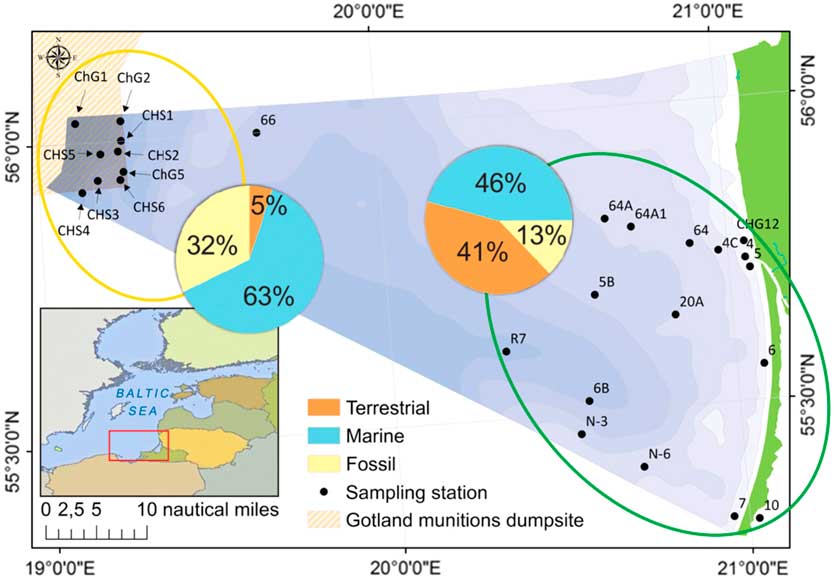
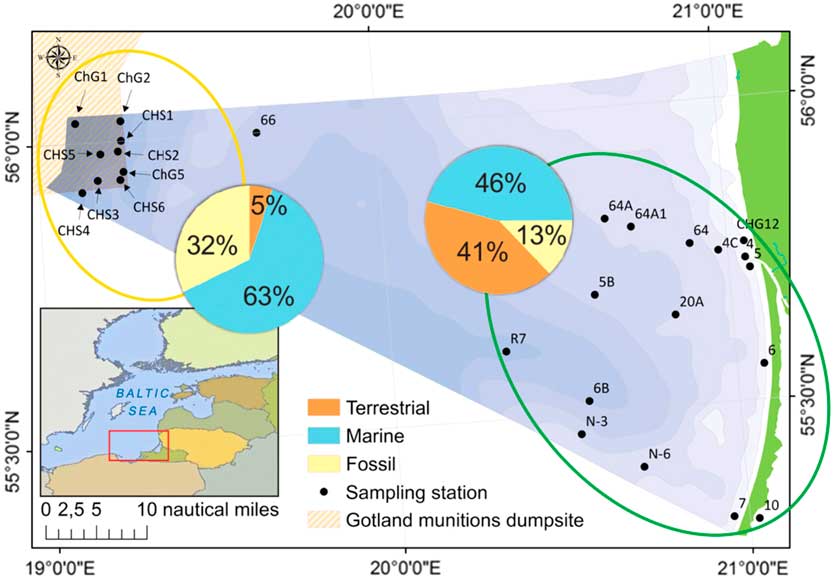
Baltic Sea bottom sediment samples were collected during different sampling campaigns in 2010–2015 (Figure 1) in Gotland Deep CWA dumping site, in the open sea and in the Lithuanian coastal region. A Van Veen grab sampler was used for collection of deep water sediments, while an Ekman-Birge type Bottom Sampler with an effective grasping area of 225 cm2 and weight of 3.5 kg was used for sediment sampling in the Curonian Lagoon. A list of collected sediment samples is presented in Table 1.
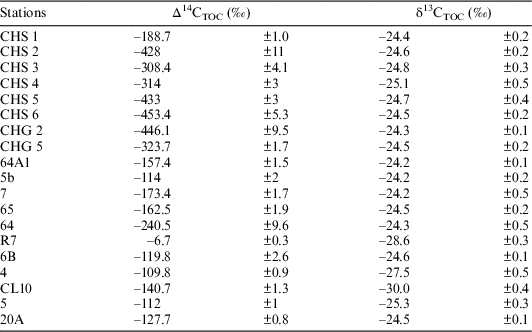
Δ14CTOC and δ13CTOC data used for modeling.

Sampling stations and contribution of organic carbon from different sources to the near shore zone and open waters of Baltic Sea sediments (estimation made on Δ14CTOC measurements in bottom sediments).
Sample Preparation
Total lipid extracts (TLE) from freeze-dried, homogenized surface sediments (0–3 cm) were extracted using methylene chloride, methanol, and phosphate buffer mixture. The TLE were gently evaporated under the nitrogen stream at 37°C and stored at –20°C until further analysis. After removal of elemental sulfur, neutral lipid (NL), glycolipid, and phospholipid fractions were separated by an SPE-SI column (Zelles Reference Zelles1999; Pernet et al. Reference Pernet, Pelletier and Milley2006; Tiwari et al. Reference Tiwari, Sureshkumar Singh, Dkhar, Schloter and Gattinger2011). The glycol- and phospholipids were esterified with methanol and KOH to produce fatty acid methyl esters (FAME). A gas chromatography SHIMADZU GC/MS – QP2010 system with a Rxi-5Sil MS was used for FAME measurements. The system performance was checked using a CRM Supelco 37 Component FAME Mix (Sigma-Aldrich, Germany).
Pseudomonas putida was isolated from the Baltic Sea bottom sediments and identified using a standard procedure (Marchesi et al. Reference Marchesi, Sato, Weightman, Martin, Fry, Hiom and Wade1998; Hongoh et al. Reference Hongoh, Ohkuma and Kudo2003). The identification procedure for bacteria was as follows: the microorganisms were grown on Nutrient Agar (Liofilchem), and the bacterial genomic DNA was extracted from colonies with a ZR Fungal/Bacterial DNA MiniPrep™ Kit (Zymo Research Europe GmbH, Germany) according to the manufacturer’s instructions using about 100 mg—equivalent to 109 bacterial cells. The DNA fragments of bacterial 16S rDNA were amplified using specific primers 39F and 1387R. PCR conditions were the following: initial denaturation for 10 min at 95°C, followed by 35 cycles for 30 sec at 94°C, 30 sec at 55°C, and 45 sec at 72°C, with a final 10 min at 72°C. For sequencing, the PCR products were purified by the Protocol for PCR Product Clean-up with Exonuclease I and FastAP™ Thermosensitive Alkaline Phosphatase (Thermo Fisher Scientific Baltics, Lithuania) and were sequenced in both directions (using the same primers as for PCR) by BacerClear B.V. (Leiden, the Netherlands). The DNA homology searches (BLASTn) were performed at the National Center for Biotechnology Information (National Institutes of Health, Bethesda, Maryland, USA). Pseudomonas putida 16S rDNA sequence has been deposited in the NCBI GenBank database under number MG755186.
The biomass was obtained by growing Pseudomonas putida on a mineral base [(NH4)2SO4 – 6.0 g; KH2PO4 – 5.0 g; K2HPO4 – 5.0 g; NaCl – 5.0 g; CaCl2 – 6.6 mg; MgSO4 – 2.0 g; glucose – 1%; H2O – 1000 mL] media. Bacteria were cultivated under aerobic conditions at 27±2°C on a rotary shaker at 240 rpm in 50 mL. The biomass was separated from the growth medium by centrifugation at 6000×g and washed 4 times with 0.154 mol/L NaCl solution. To study the sorption efficiency a 24-hr culture with vegetative cells of bacteria was prepared. The biomass was separated by centrifugation and, washed with sterile physiological solution (0.154 mol/L NaCl). The separated Pseudomonas putida cells were put in contact with sterile physiological solution containing 14C6H12O6 and Na2 14CO3 for 1 hr at 27oC. The cells separated by centrifugation were washed twice with sterile physiological solution or with sterile physiological solution and 0.1 mol/L HCl. The 14C standard solution (Czech Metrology Institute) in chemical form of Na2 14CO3 (Cert. No: 9031-OL-546/11) as an inorganic 14C carbon source (combined standard uncertainty of 2.0%) and D-Glucose (Amersham Int.) as an organic carbon (Org – Product No. 1210-123) source (combined standard uncertainty of 1.6%) were used in these experiments. The 14C in biomass was measured using Hidex 300SL (Hidex, Finland) and Tri-Carb® 3170TR/SL (PerkinElmer Life and Analytical Sciences, USA) liquid scintillation counters. OptiphaseHiSafe® 3 (PerkinElmer Inc.), Oxysolve C-400 (Zinsser Analytic), Oxysolve T (Zinsser Analytic), and Aqualight Beta (Hidex) were used as absorption solutions and scintillation cocktails. A comparison of the results obtained using two techniques showed an uncertainty about 10%.
To study carbon uptake by Pseudomonas putida in different chemical forms, the biomass was obtained by growing bacteria on media with different carbon source: Nutrient Broth (NB): beef extract – 1.0 g; yeast extract – 2.0 g; peptone – 5.0 g; NaCl – 5 g; H2O – 1000 mL; mineral base: (NH4)2SO4 – 6.0 g; KH2PO4 – 5.0 g; K2HPO4 – 5.0 g; NaCl – 5.0 g; CaCl2 – 6.6 mg; MgSO4 – 2.0 g; C (glucose or/and diesel fuel) - 1%; H2O – 1000 mL. To study glucose utilization, its concentration in the solutions was traced with 14C6H12O6 while Na2 14CO3 was applied to estimate uptake of inorganic carbon derived from equilibrium with the ambient atmosphere. Bacteria were cultivated under aerobic conditions at 27±2°C for a fixed amount of time, the biomass was then separated by centrifugation, and washed with 0.154 mol/L NaCl-solution. Results are presented as average values of C (%) utilized by bacteria obtained from three replicate measurements with the two different techniques described above.
To study utilization of organic substances Pseudomonas putida cells were cultivated on the Mineral Glucose media for 1 day, separated by centrifugation and washed with 0.154 mol/L NaCl-solution. Then cells were dispersed in 0.154 mol/L NaCl-solution and 14C6H12O6 and Na2 14CO3 were introduced into solutions to study their uptake by Pseudomonas putida. The cultures were shaken for 1 hr, cells were separated by centrifugation, washed with NaCl or with NaCl/HCl solutions, and 14C was measured as described in above.
Radiocarbon Measurements
Δ14CTOC measurements in sediments and in different classes of organic substances were carried out at the AMS facility (1.0 MV HVE Tandetron) in the Department of Geosciences of National Taiwan University (NTUAMS). Carbonates were removed by using 0.5 mol/L HCl washing. Each sample was placed in a quartz tube with ~70 mg of CuO and a piece of silver wire (about 3 mg), and then put on a vacuum line until a vacuum of 10–5 mbar was reached. The quartz tube was sealed and placed in a muffle furnace, then heated at 850°C to combust OC into CO2 for 8 hr. The CO2 was purified and sealed in a glass tube. The purified CO2 was introduced into a graphitization system which contained two glass tubes with Zn+TiH2 powders in a 9-mm tube, and Fe powders in a 6 mm tube in the center of the 9-mm tube under a vacuum of 10–5 mbar (Xu et al. Reference Xu, Trumbore, Zheng, Southon, McDuffee, Luttgen and Liu2007). The CO2 was converted to graphite with Fe (Fe:C=3.5:1 ratio) under 550°C for 6–8 hr. Graphite samples were pressed into targets and 14C/12C and 13C/12C ratios were measured, together with oxalic acid standard (OXII, 4900C; National Institute of Standards and Technology, Gaithersburg, Maryland, USA). As backgrounds (NTUB and BKG) and known age inter-comparison (IRI) samples prepared at the NTUAMS Lab were used. The standard and background samples went through the same procedures as the sediment samples. Every batch of samples included at least three OXII standard, three background, and two IRI targets. The Δ14C values were calculated by the following equation:
 $$\rDelta ^{{14}} {\rm C}{\equals}\left[ {\left. {\left( {\left( {^{{14}} {\rm C}\,/\,^{{12}} {\rm C}} \right)_{\rm{sample}} \,/\,\left( {^{{14}} {\rm C}\,/\,^{{12}} {\rm C}} \right)_{\rm{standard}} } \right)-1} \right)} \right]{\times}10^{3} \left( {‰\permil} \right),$$
where (14C/12C)sample and (14C/12C)standard are background and δ 13C-corrected 14C/12C ratios for the sample and standard, respectively. The δ13C is the 13C/12C ratio measured by AMS, simultaneously with the 14C measurement (Kim et al. 2001). The counting uncertainty of 14C for the OXII standard is generally <0.3% (2σ) and the standard deviation of Δ14C for repeated OXII standard is about 1‰ (2σ).
RESULTS AND DISCUSSION
Δ14CTOC Values in Bottom Sediments of the Baltic Sea
The radiocarbon analysis of sediment samples collected during 2012–2016 in the Lithuanian economic zone (Figure 1) showed wide range of Δ14CTOC values (from –446.1‰ to –6.7‰) (Lujaniene et al. Reference Lujanienė, Mažeika, Li, Petrošius, Barisevičiūtė, Jokšas, Remeikaitė-Nikienė, Malejevas, Garnaga-Budrė, Stankevičius, Kulakauskaitė and Povinec2015). The total lipid extracts (TLE) Δ14CTLE values (the average value of –536.0‰) on average were more depleted as compared to the Δ14CTOC (with two exceptions that showed enriched values). The most depleted Δ14CTOC and Δ14CTLE values in sediments were observed at the sampling stations located at the Gotland Deep and were attributed to the different carbon sources in bottom sediments.
An End Member (EM) mixing-model for three sources of OC—continental, marine and fossil—was used to estimate OC sources in the sediments which can be expressed with the following equations:
 $${\rm f}_{{{\rm terrestrial}}} {\plus}{\rm f}_{{{\rm marine}}} {\plus}{\rm f}_{{{\rm fosill}}} {\equals}{\rm 1}$$
 $${ \rdelta }^{{{\rm 13}}} {\rm C}_{{{\rm sample}}} {\equals}{\rm f}_{{{\rm terrestrial}}} { \rdelta }^{{{\rm 13}}} {\rm C}_{{{\rm terrestrial}}} {\plus}{\rm f}_{{{\rm marine}}} { \rdelta }^{{{\rm 13}}} {\rm C}_{{{\rm marine}}} {\plus}{\rm f}_{{{\rm fossil}}} { \rdelta }^{{{\rm 13}}} {\rm C}_{{{\rm fossil}}} $$
 $${\rm \rDelta }^{{{\rm 14}}} {\rm C}_{{{\rm sample}}} {\equals}{\rm f}_{{{\rm terrestrial}}} {\rm \rDelta }^{{{\rm 14}}} {\rm C}_{{{\rm terrestrial}}} {\plus}{\rm f}_{{{\rm marine}}} {\rm \rDelta }^{{{\rm 14}}} {\rm C}_{{{\rm marine}}} {\plus}{\rm f}_{{{\rm fossil}}} {\rm \rDelta }^{{{\rm 14}}} {\rm C}_{{{\rm fossil}}} $$
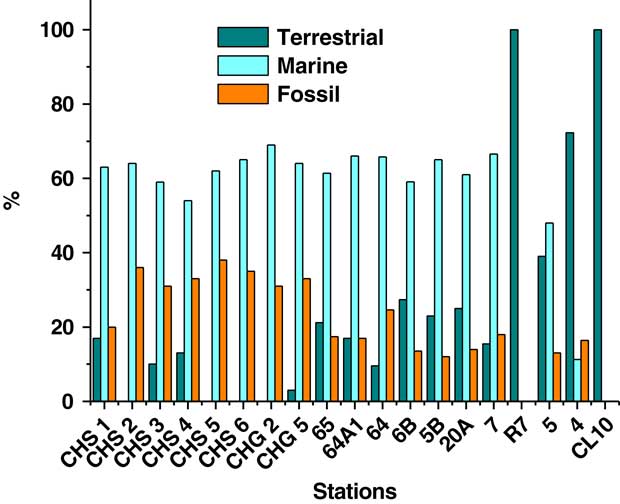
where fterrestrial, fmarine and ffossil are the fractions of continental, marine and fossil OC contributions to sediments. Input data used in the EM model are listed in Table 1. Modeling results are presented in Figure 2.
Contribution (%) of continental, marine, and fossil sources of OC in Baltic Sea sediments.
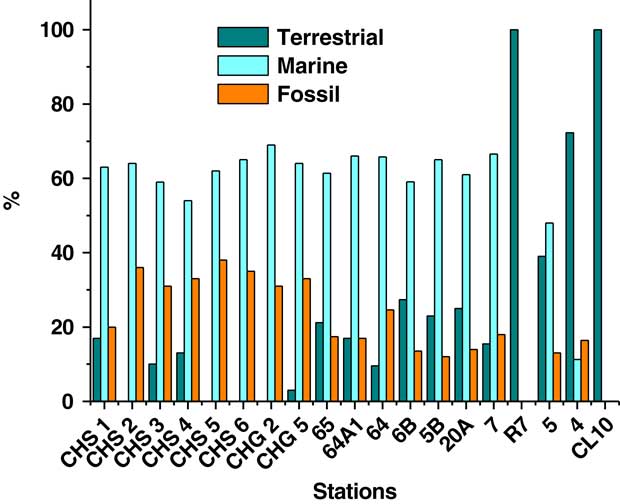
The terrestrial, marine, and fossil sources estimated from the Δ14CTOC measurements on average accounted for 26%, 53%, and 21% of the total, respectively, while the contribution of fossil sources to the Gotland Deep sediments was higher (32%), as compared to the near shore zone with 13% (Figure 1). The coastal zone is affected by the inflow of organic matter of terrestrial origin, whose contribution in the case of Lithuanian coast was 41% (Figure 1). Both dissolved and particulate organic carbon can contribute to variations of Δ14C values in sediments (Deutsch et al. Reference Deutsch, Alling, Humborg, Korth and Mörth2012; Szczepańska et al. Reference Szczepańska, Zaborska, Maciejewska, Kuliński and Pempkowiak2012). One of possible sources of the fossil carbon in the Gotland Deep sediments could be a leakage from the dumped CWA.
It is well known that microorganism communities naturally present in the environment are responsible for degradation and utilization of organic matter (both natural and anthropogenic) and play a key role in the carbon cycle. Although the vast microorganism communities as a rule exist in the estuaries and coastal areas, nevertheless, enhanced activities of bacteria (Achromobacter sp., Pseudomonas sp., and Arthrobacter sp.) have also been found at the CWA dumpsites in the Baltic Sea (Garnaga et al. Reference Garnaga, Wyse, Azemard, Stankevičius and de Mora2006; Medvedeva et al. Reference Medvedeva, Polyak, Kankaanpää and Zaytseva2009). It was also found that Achromobacter sp., Pseudomonas sp., and Arthrobacter sp. are capable of utilizing various organic substances including petroleum and the major product of mustard gas hydrolysis in the marine environment at low temperature (Medvedeva et al. Reference Medvedeva, Polyak, Kankaanpää and Zaytseva2009).
Pseudomonas putida bacteria were isolated from the Baltic Sea bottom sediments collected at ChemSea5 station where the most depleted Δ14CTOC values were found. Pseudomonas putida bacteria were used in laboratory experiments to better understand the differential utilization of carbon from various sources.
Glycolipid (GLFA)- and Phospholipid (PLFA)-Derived Fatty Acids (FA)
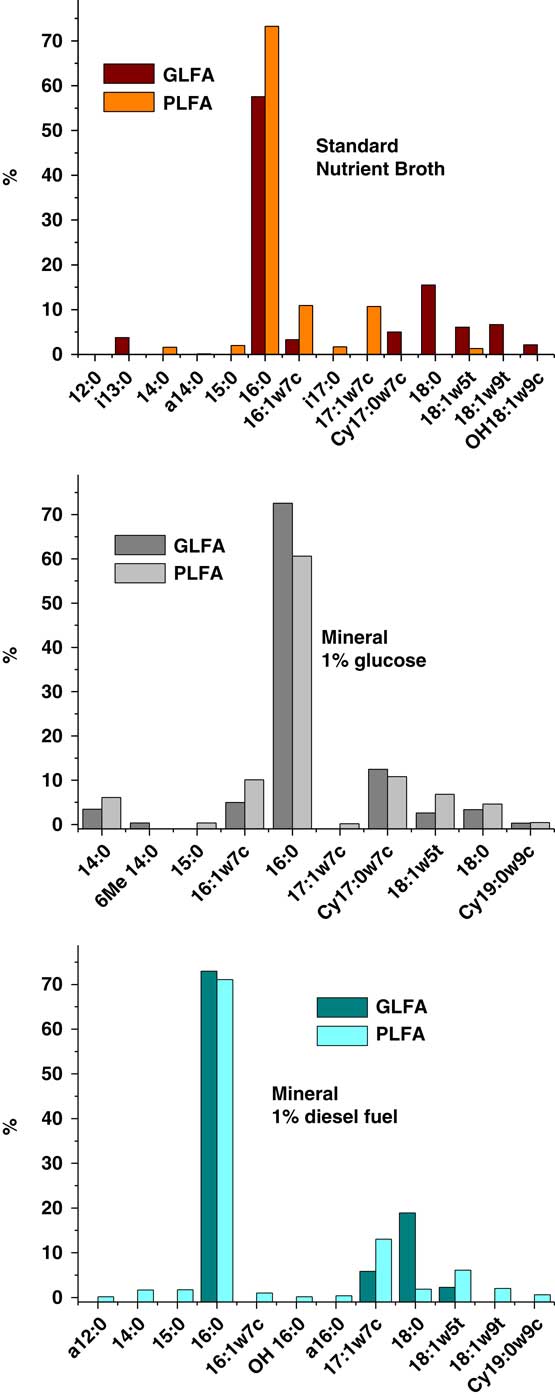
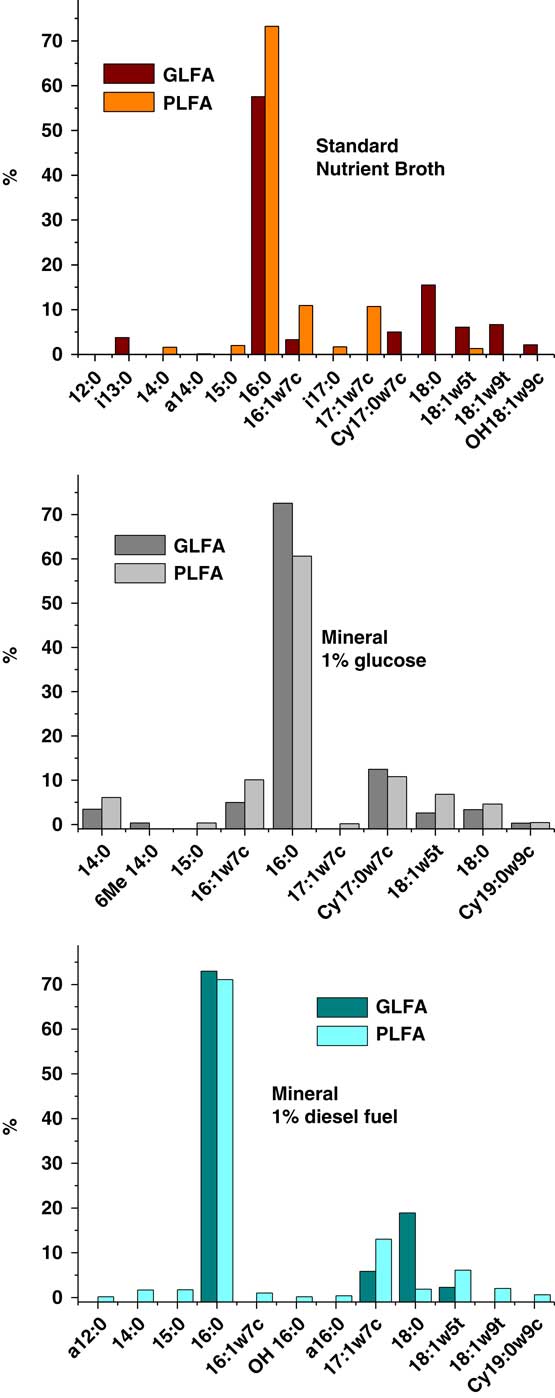
Data on GLFA and PLFA obtained from biomass of Pseudomonas putida grown on media with different sources of carbon are presented in Figure 3. It can be seen that the most abundant FA is 16:0 both in glycolipids and phospholipids, which is usually characterized as a non-specific marker found in a broad range of bacteria and algae. General markers 14:0, 15:0, 17:0, 18:0, 18:1w9t, were also found in biomass grown on all of the media employed here. The markers 18:1w7c and 18:1w9c, reported as a general marker for Gram-negative and proteobacteria were not found in the biomass, while the markers, 16:1w7c, i17:0, 17:1w7c, Cy17:0, and Cy19:0 were detected. In addition, hydroxy fatty acids, e.g. OH16:0 and OH18:1w9c, characteristic of Pseudomonas sp. were found in the biomass. Trans-fatty acids (e.g., 18:1w5t, 18:1w9t) found in the biomass indicate that cytoplasmatic membrane disturbances can be used as stress (temperature or nutrition) indicators. Another useful stress indicator is the cy/pre ratio (i.e., ratio of cyclopropylated fatty acids [cy17:0 + cy19:0] to their metabolic precursors [16:1ω7+18:1ω7]).
Glycolipid (GLFA)- and phospholipid (PLFA)-derived fatty acids measured in Pseudomonas putida biomass grown on different media.
Analyses of fatty acids in environmental samples have been widely used to obtain information about microbial communities. PLFAs were usually associated with living microorganisms while glycolipids were generally interpreted as storage lipids. It has been recently shown that they can also constitute the main portion of membrane lipids of algae and cyanobacteria (Gašparovič et al.Reference Gašparovič, Godrijan, Frka, Tomažic, Penezic, Maric, Djakovac, Ivančic, Paliaga, Lyons, Precali and Tepic2013). Phospholipids normally compose ~40% of the cytoplasmic membrane of bacteria whereas glycolipids typically account for about 5–10% of membrane lipids. GLs are significant for intercellular communication and they act as biosurfactants via an enhancement of the degradation and dispersion of different classes of hydrocarbons (Shaw Reference Shaw1970; Pinkartand White Reference Pinkart and White1998; Pacwa-Płociniczak et al. Reference Pacwa-Płociniczak, Płaza, Piotrowska-Seget and Cameotra2011).
In spite of slight variations in the composition of biomarkers found in the biomass obtained from the cultivation of Pseudomonas putida using different media, these results could be used to fingerprint Pseudomonas putida species in bottom sediments. Further analyses of biomarkers in suspended particulate matter and bottom sediments of the Baltic Sea are in progress.
The most interesting are variations in PLFA composition when the carbon source was changed from glucose to diesel fuel. These carbon source changes resulted in a decrease of the cyclopropylated fatty acid Cy17:0w7c and its metabolic precursor 16:1ω7c amounts, as well as in an increase of anteiso PLFA – a12:0, a16:0 and hydroxyl PLFA OH16:0 markers which were not found in the biomass growing on the Mineral Glucose and the Standard Nutrient Broth medias (Figure 3).
Utilization of Organic Substances by Pseudomonas putida
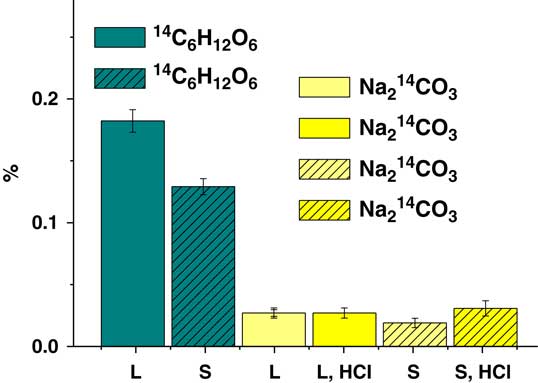
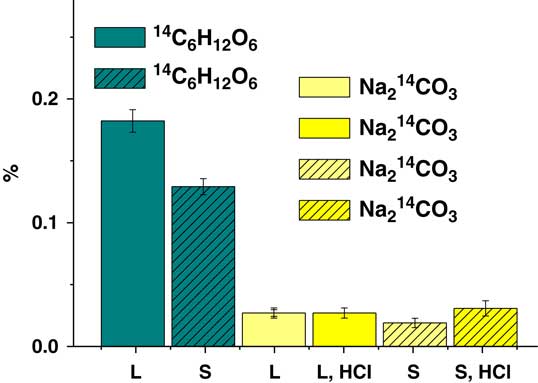
The study of utilization of organic substances by Pseudomonas putida cells indicated an insignificant radiocarbon uptake from the labeled glucose—0.18%, and for cells exposed to ultrasound—0.13% (Figure 4). Radiocarbon from the inorganic source contributed from 0.02% to 0.03% to total activities (close to the detection limit).
14C6H12O6 and Na2 14CO3 uptake by Pseudomonas putida (L–life bacteria, S–bacteria exposed to ultrasound, L, S–biomass washed with NaCl solution, L, S, HCl–biomass washed with NaCl solution and then with 0.1 mol/L HCl).
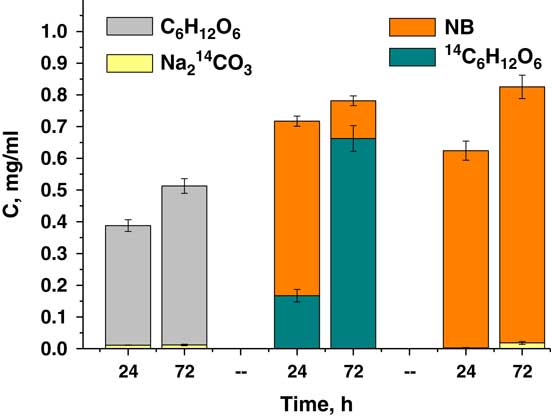
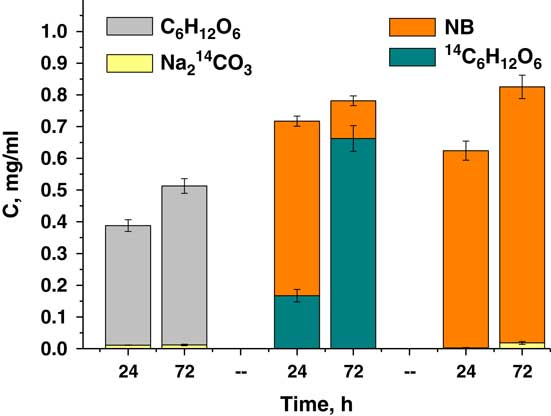
To study carbon utilization from different sources, Pseudomonas putida bacteria were grown (for 24 hr and 72 hr) on the mineral glucose, nutrient broth media and on inorganic carbon derived from the ambient atmosphere traced by Na2 14CO3.
Measurements of radiocarbon in the biomass of Pseudomonas putida have shown that inorganic carbon accounts only 2% of the total amount of carbon biomass in both cultivated on the mineral glucose and the nutrient broth media cells (Figure 5). Sufficiently good glucose utilization was observed both from the media as a sole carbon source, and from the mixed media with a predominant carbon source as protein (standard nutrient broth media).
Contribution of carbon from different sources to biomass of Pseudomonas putida grown on different media.
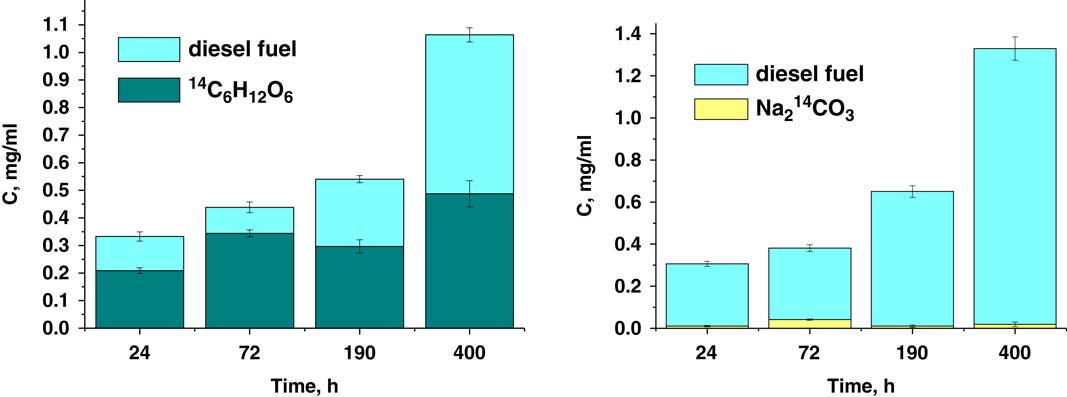
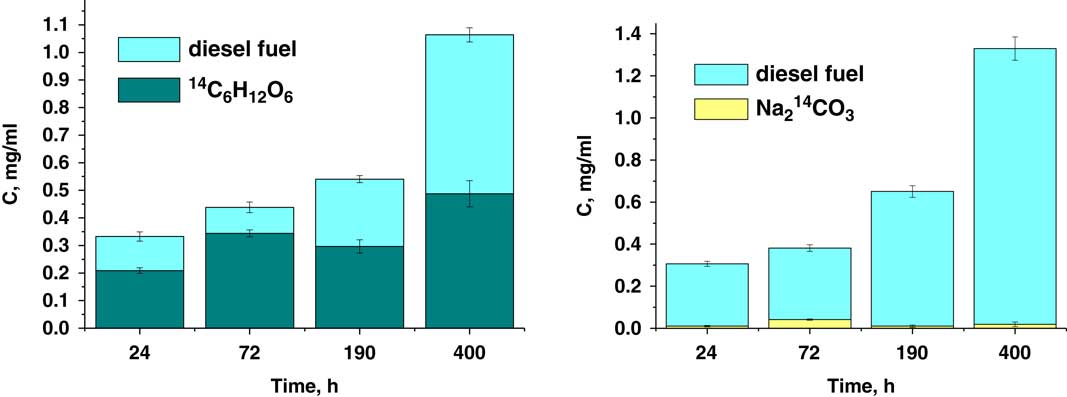
In experiments with diesel fuel where the mineral glucose diesel fuel media were applied for Pseudomonas putida cultivation, glucose was found to be a preferential carbon source (up to 80%) during the first three days while later an increase in a portion (up to 64%) of carbon derived from diesel fuel was observed. This can be attributed to an adaptation of bacteria, and/or to a decrease in the glucose concentration in the growing media (Figure 6). A similar pattern of Pseudomonas putida biomass growth was found for the mineral diesel fuel media where diesel fuel was used as a sole organic carbon source. The maximum contribution of inorganic carbon to the biomass (~10%) was detected after 3 days of the bacteria cultivation.
Utilization of diesel fuel by Pseudomonas putida bacteria in presence of organic carbon—glucose (traced by 14C6H12O6), and inorganic—carbonates (traced by Na2 14CO3).
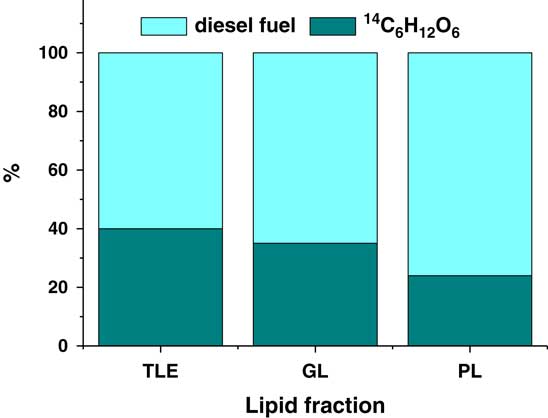
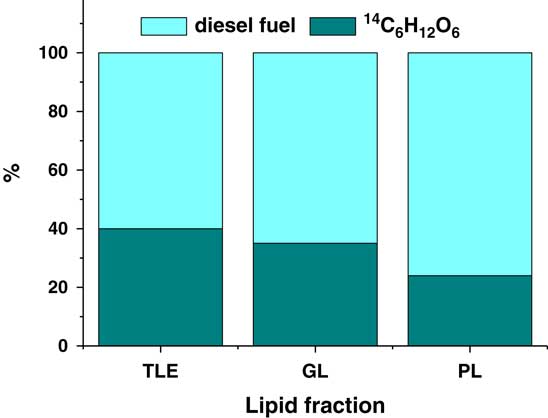
An increase in a carbon amount derived from diesel fuel from 60% in TLE to 65% and 76% in glycolipid and phospholipid fractions, respectively, extracted from Pseudomonas putida biomass after the bacteria was cultivated for 190 hr, indicates the use of diesel fuel carbon for growth and as the membrane constituent (Figure 7).
Contribution of carbon from different sources to TLE, GL, and PL of Pseudomonas putida grown on Mineral glucose (14C6H12O6) diesel fuel media (TLE–total lipid extract; GL–glycolipid; PL–phospholipid).
Conclusions
The results obtained in this study showed that microorganisms responsible for the degradation of organic matter may not necessarily use all compounds equally from complex mixtures naturally present in environmental systems. Preferential utilization of glucose (up to 80%) from the mixed media with a predominant carbon source as protein was found for Pseudomonas putida bacteria. Although similar consumption of glucose was found after 3 days, an increase in the diesel fuel utilization (up to 64%) was observed after 16 days, when glucose concentrations decreased in the growing media. In the absence of glucose as the media substrata, the diesel fuel utilization by Pseudomonas putida was found to be at the same level as in the media with glucose. Incorporation of the inorganic carbon was estimated to be rather low, from 2% to 10% and the maximum values were detected after 3 days when bacteria were cultivated on the Mineral diesel fuel media. An increase in the carbon amount derived from the diesel fuel from 60% in TLE to 65% and 76% in glycolipid and phospholipid fractions, respectively, indicated the use of the diesel fuel carbon for growth and for the membrane constituents.
The microorganisms can choose easily assimilable organic carbon from complex mixtures and provide differential involvement of various substances into the carbon cycle. Preferential utilization of organic carbon with different isotopic composition could result in higher uncertainties of dating results. Variations in carbon amount derived from the diesel fuel between TLE, glycolipid and phospholipid fractions most probably reflect the complicated biochemical processes and indicate the importance of their understanding for the compound-specific 13C and 14C analyses. Large 14C depletions observed in sediments collected in the Gotland Deep of the Baltic Sea may indicate a leakage from the dumped chemical weapons.
ACKNOWLEDGMENTS
The Financial support provided by the Research Council of Lithuania (contract No. MIP-080/2012) is acknowledged. We are grateful for funding support to H-C Li for the AMS 14C measurements from NSC 102-2811-M-002-177 and MOST 103-2116-M-002-001 of Taiwan. PPP acknowledges support provided by the EU Research and Development Operational Program funded by the ERDF (project No. 26240220004).