


Introduction
Problem gambling has been conceptualized as an addictive behaviour that exists on a continuum representing a range of severity (Potenza, Reference Potenza2006). It is often accompanied by a sense of impaired control and can give rise to financial, interpersonal, legal and vocational costs for the sufferer, their families and society. Prevalence rates in the general population are estimated at between 0.4% and 2.0% in Canada and the USA (Ladouceur, Reference Ladouceur1996; Shaffer and Hall, Reference Shaffer and Hall2001) with higher estimates of between 6.0 and 9.0% in young US adults (Barnes, Welte, Hoffman and Tidwell, Reference Barnes, Welte, Hoffman and Tidwell2010).
Cognitive-behavioural therapy (CBT), which is the leading evidence-based treatment for problem gambling, has been shown to benefit problem gamblers (e.g. through the reduction in gambling frequency and improved rates of abstinence; Toneatto, Reference Toneatto2005; Toneatto and Millar, Reference Toneatto and Millar2004); however, high relapse rates and non-response to treatment remain challenges to outcomes (Toneatto, Vettese and Nguyen, Reference Toneatto, Vettese and Nguyen2007). A recent systematic review and meta-analysis (Gooding and Tarrier, Reference Gooding and Tarrier2009) found there was a highly significant effect for CBT in reducing gambling within the first 3 months of therapy cessation regardless of the type of gambling behaviour practised. However, meta-regression analyses showed poorer quality studies had greater effect sizes, indicating that these findings need to be viewed with caution. The 2012 Cochrane Review (Cowlishaw et al., Reference Cowlishaw, Merkouris, Dowling, Anderson, Jackson and Thomas2012) indicated benefits from CBT in the period immediately following treatment for problem gambling. However, evidence of effectiveness at follow-up across longer periods of time (e.g. 12 months) is limited.
The above findings suggest that there is scope for improving the effectiveness of CBT for problem gambling. One such way would be to gain a greater understanding of how metacognition may be involved in the activation and maintenance of problem gambling. Targeting metacognition in psychological treatment has produced promising results for depression (Wells et al., Reference Wells, Fisher, Myers, Wheatley, Patel and Brewin2009, Reference Wells, Fisher, Myers, Wheatley, Patel and Brewin2012) and generalized anxiety disorder (Wells and King, Reference Wells and King2006; Wells et al., Reference Wells, Welford, King, Papageorgiou, Wisely and Mendel2010), not only in terms of treatment effectiveness but also with respect to relapse rates. Additionally, a growing body of research has indicated that metacognition plays a crucial role in addictive behaviours. For example, research exploring the nature of metacognitive beliefs has demonstrated that these play a role in the severity of clinical presentations in problem drinkers (Hoyer, Hacker and Lindenmeyer, Reference Hoyer, Hacker and Lindenmeyer2007; Spada and Wells, Reference Spada and Wells2008, Reference Spada and Wells2009, Reference Spada and Wells2010; Spada, Caselli and Wells, Reference Spada, Caselli and Wells2013; Spada, Moneta and Wells, Reference Spada, Moneta and Wells2007; Spada, Zandvoort and Wells, Reference Spada, Zandvoort and Wells2007) and tobacco users (Nikčević and Spada, Reference Nikčević and Spada2008, Reference Nikčević and Spada2010, Spada, Nikčević, Moneta and Wells, Reference Spada, Nikčević, Moneta and Wells2007). Furthermore, ineffective “metacognitive monitoring” (the monitoring of cognitive-affective change and proximity to goals during the engagement in addictive behaviour) has been linked to both problem drinking and tobacco use perseveration (Nikčević and Spada, Reference Nikčević and Spada2010; Spada and Wells, Reference Spada and Wells2006).
More recently, a preliminary study undertaken by Lindberg and colleagues (Lindberg, Fernie and Spada, Reference Lindberg, Fernie and Spada2011) found that metacognitive beliefs (negative beliefs about thoughts concerning uncontrollability and danger, and beliefs about the need to control thoughts) predicted gambling behaviour independently of anxiety and depression.
In view of the above findings, the central aim of this study was to explore facets of metacognition in gambling disorder that remain unexplored. As a framework for undertaking this study we thus decided to use the Self-Regulatory Executive Function (S-REF: Wells and Matthews, Reference Wells and Matthews1996) model, which emphasizes the role of metacognition in psychopathology. Central to this model is the idea that a set of metacognitive beliefs are responsible for psychological disturbance by maintaining maladaptive attentional (threat monitoring), behavioural (e.g. avoidance), and cognitive (e.g. worry and rumination) coping strategies, collectively referred to as the cognitive-attentional syndrome (CAS; Wells, Reference Wells2000). The CAS is activated and maintained by metacognitive beliefs, which refer to the information individuals hold about their own cognition and about coping strategies that impact on it (Wells, Reference Wells2000). Examples of metacognitive beliefs may include: “Worrying will help me cope” or “My thoughts about craving are out of control”. The activation of the CAS prevents emotional down regulation and the modification of metacognitive knowledge. The inability to recognize and question metacognitive knowledge has been described as a central characteristic in numerous personality disorders and addictive behaviours (Lysaker et al., Reference Lysaker, Olesek, Buck, Leonhardt, Vohs and Ringer2014) and according to the S-REF model it represents an outcome of the perseveration of the CAS.
In the S-REF model metacognitive beliefs and plans for regulating thinking in line with a goal are hypothesized. These factors are typically explored using the metacognitive profiling interview (Wells, Reference Wells2000). This interview has already been successfully employed to identify crucial facets of metacognition in desire thinking (Caselli and Spada, Reference Caselli and Spada2010), pathological procrastination (Fernie and Spada, Reference Fernie and Spada2008), problem drinking (Spada and Wells, Reference Spada and Wells2006) and smoking (Nikčević and Spada, Reference Nikčević and Spada2010).
In line with a metacognitive conceptualization we thus aimed to profile: (1) the presence of specific metacognitive beliefs about gambling; (2) the goal of gambling, and its start and stop signals; (3) and the perceived impact of gambling on self-consciousness.
Method
Participants
The sample was comprised of 10 participants (all men) seeking outpatient treatment for problem gambling from the local Mental Health Service of Modena, Italy. Participants were selected (consecutive presentations) from those who had primary gambling disorder in accordance with the Diagnostic and Statistical Manual of Mental Disorders (5th edn.) (American Psychiatric Association, 2013). Other inclusion criteria were: (1) 18 years of age or above; (2) consenting to the study; (3) understanding spoken and written Italian; (4) absence of co-morbidity diagnosis of either Axis 1 or Axis 2 disorders; (5) no history of having received CBT treatment. The mean age of the sample was 47.0 years (SD = 15.1) and ranged from 30 to 68 years. The mean duration of the gambling problem was 9.2 years (SD = 8.8) and ranged from 1 to 30 years. The mean score on the South Oaks Gambling Screen (SOGS; Lesieur and Blume, Reference Lesieur and Blume1987) was 10.8 (SD = 1.7 years) and ranged from 8 to 13. The entirety of the sample was Caucasian.
Materials and procedure
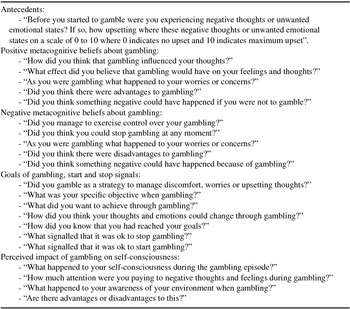
Following diagnostic screening undertaken by a psychologist, participants who met inclusion criteria were outlined the study “Investigating the experience of gambling and associated thinking processes” and asked to consider taking part in it. Recruitment occurred between June and July 2013, with all participants agreeing to take part in the study. Participants were interviewed, by a psychologist specialized in CBT and trained by the second author, using the metacognitive profiling interview (Wells, Reference Wells2000) adapted to focus specifically on cognitive experiences associated with gambling (see Table 1). The interview, which was audio-recorded, lasted approximately 30 minutes and was conducted and transcribed by the third author. The audio recordings were independently evaluated by two psychologists on adherence to the interview structure and content of reported responses. No indicators of discrepancy with respect to the adherence to the interview were observed. The quotes presented were synthetic extracts identified by the evaluators. No marked discrepancies were observed in the identification and selection of these synthetic extracts.
Metacognitive profiling interview template

The interview started with inviting participants to think of a recent gambling episode. Following this, data were elicited from the following areas:
Metacognitive beliefs about gambling
In order to examine positive metacognitive beliefs about gambling participants were asked to identify the perceived advantages of gambling on their thoughts and sensations, and whether they viewed any disadvantages of giving up gambling. Negative metacognitive beliefs about gambling were elicited by asking participants about the possible disadvantages of gambling on thoughts and sensations, and whether they viewed any advantages of giving up gambling.
Goals of gambling, its start and stop signals
Participants were asked questions that sought to identify whether gambling was perceived as a form of coping, what was the goal of gambling, how they knew when this goal had been achieved, what signalled it was ok to start gambling, and what signalled that it was ok to stop gambling.
Perceived impact of gambling on self-consciousness
In this section of the interview, participants were asked what happened to their self-consciousness (defined as “the level of awareness of oneself as an individual or of one's own thoughts and emotions”) while they were engaging in gambling.
Results
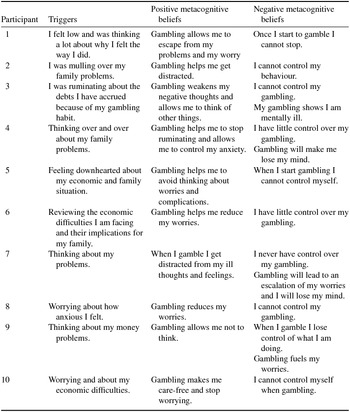
All participants were able recollect a recent episode of gambling. The content of this recollection included mental images and self-talk regarding the act of gambling and its consequences. All participants identified some form of perseverative thinking (related to cognitive-emotional state/in the act of gambling/family concerns/economic hardship) as the main trigger for gambling. All participants identified both positive and negative metacognitive beliefs about gambling. Positive metacognitive beliefs concerned the usefulness of gambling in interrupting perseverative thinking. Negative metacognitive beliefs concerned: (1) the uncontrollability of gambling (10 participants); and (2) the negative impact of gambling on cognitive-emotional state (4 participants). The triggers of gambling and metacognitive beliefs about gambling are presented in Table 2.
Triggers, positive and negative metacognitive beliefs about gambling (N = 10)

In response to the question concerning the goal of gambling, six participants reported engaging in gambling as a means to relieve economic hardship, and four as a means to improve cognitive-emotional state. In response to the question concerning knowledge regarding goal achievement, all participants reported they did not know when the goal was achieved. In response to the question regarding what signalled that it was ok to start gambling, eight participants reported an idea or feeling that problems could be solved, whilst two participants reported a sensation that it may be the right time to win. In response to the question concerning what signalled that it was ok to stop gambling all participants reported running out of money. All participants reported that gambling reduced self-consciousness.
Discussion
The findings of this study suggest that specific facets of metacognition may play a role in gambling disorder. The results are consistent with Wells and Matthews’ (1994) S-REF model and align themselves to previous findings identifying an important role for metacognition in other addictive behaviours (Spada et al., Reference Spada, Caselli and Wells2013).
Positive metacognitive beliefs concerned the usefulness of gambling in interrupting perseverative thinking. Such beliefs may be involved in the initiation of gambling because they may enhance internal states (e.g. an idea or feeling that problems can be solved or the sensation that it is the right time to win) that signal that it is ok to start gambling. Negative metacognitive beliefs concerned the uncontrollability of gambling and its negative impact on cognitive-emotional states. These beliefs may play a role in propagating negative affect and lead to a perseveration of gambling episodes. This view would be consistent with the S-REF model (Wells and Matthews, Reference Wells and Matthews1996), which suggests that psychological disturbance occurs when coping strategies (such as gambling) become perseverative.
The main objective in asking questions related to the goal of gambling and self-consciousness was to elicit information relating to the dynamic of monitoring and controlling cognition during a gambling episode. The majority of participants engaged in gambling as a coping strategy to relieve economic hardship and to regulate cognitive-emotional states. Intention to gamble was driven by internal states that participants used as start signals. They also reported that they did not know if they had achieved their goal. A possible explanation for this is that all participants reported that gambling reduced self-consciousness. This reduction in self-consciousness is likely to be accompanied by a disruption in “metacognitive monitoring” (Spada and Wells, Reference Spada and Wells2006), which will lead to a continuation in gambling because goal progress information (e.g. improving cognitive-emotional states and changing financial status), that may signal it is ok to stop gambling, is not attended to.
From a therapeutic perspective these findings suggest that the techniques and principles of metacognitive therapy (Wells, Reference Wells2008) may be beneficial in helping patients discontinue gambling. The adapted metacognitive profiling interview presented could help elicit useful information about metacognitive beliefs and metacognitive plans involved in both the initiation and maintenance of gambling. Metacognitive beliefs could be questioned and modified using re-attributional techniques (Wells, Reference Wells2008), whilst the role of gambling in affecting cognitive-emotional states and behavioural control could be reviewed. According to the S-REF model, increasing metacognitive monitoring, for example through Situational Attentional Refocusing (Spada and Wells, Reference Spada and Wells2006; Wells, Reference Wells2008), may bring to a discontinuation in gambling because goal progress information (e.g. improving cognitive-emotional states and changing financial status), that may signal it is ok to stop gambling, will increasingly be attended to.
The results of this study are clearly preliminary and several limitations should be noted. First, the sample size was small, exclusively of male gender, and there was no control group. Second, the interview was retrospective and hence participants’ responses may merely reflect rationalizations of gambling rather than beliefs and cognitive processes contributing to it. Third, there was no possibility to verify objectively whether the sample represented a typical gambler. Fourth, there could be time-dependent risk factors that were not considered and that may have had an effect on the aspects of metacognition identified. Fifth, due to the cross-sectional nature of the study causal inferences cannot be supported. Finally, in view of the relatively nascent phase in the evolution of CBT for problem gambling and MCT for addictive behaviours, cautiousness is recommended when interpreting the findings and their possible generalizability to treatment. Future studies investigating the role of metacognition in gambling will require the use of specific metacognitive-focused measures as well as experimental and longitudinal research designs with larger samples.
Despite these limitations, we believe the present findings provide preliminary evidence that metacognition may indeed play a role in gambling disorder.
Acknowledgements
Author Bruce A. Fernie receives salary support from the National Institute for Health Research (NIHR) Mental Health Biomedical Research Centre and Dementia Research Unit at South London and Maudsley NHS Foundation Trust and King's College London. The views expressed are those of the author and not necessarily those of the NHS, the NIHR or the Department of Health.



Comments
No Comments have been published for this article.