Introduction
The mechanisms that explain the composition of haemosporidian communities (here, composition is defined as the combination of parasite prevalence and diversity) within a host species are a complex and poorly understood component of haemosporidian biology. Two biogeographic factors may influence the composition of parasites: landscape-level human disturbance (Land Cover hypothesis) and host dispersal (Dispersal hypothesis). Parasite distributions are likely to vary with anthropogenic changes to the environment (e.g. Loiseau et al., Reference Loiseau, Harrigan, Cornel, Guers, Dodge, Marzec, Carlson, Seppi and Sehgal2012a). One of the most important determinants of blood parasite communities of birds is variation in the presence of vectors due to habitat or climate (see Sol et al., Reference Sol, Jovani and Torres2000; Kimura et al., Reference Kimura, Dhondt and Lovette2006; Pagenkopp et al., Reference Pagenkopp, Klicka, Durrant, Garvin and Fleischer2008; Chasar et al., Reference Chasar, Loiseau, Valkiūnas, Iezhova, Smith and Sehgal2009). This may explain regional differences in parasite prevalence, as vector prevalence is strongly tied to environmental variables (Bishop et al., Reference Bishop, Mckenzie, Barchia and Harris1996; Samuel et al., Reference Samuel, Hobbelen, DeCastro, Ahumada, LaPointe, Atkinson, Woodworth, Hart and Duffy2011; LaPointe et al., Reference LaPointe, Atkinson and Samuel2012; Bernotiene and Bartkeviciene, Reference Bernotiene and Bartkeviciene2013). While climate strongly influences parasite distribution, land cover variables can also be important (Pérez-Rodríguez et al., Reference Pérez-Rodríguez, Fernández-González, de la Hera and Pérez-Tris2013). For example, agricultural irrigation can create damp earth and standing water, which provide habitat for Culicoides midges and mosquitoes, respectively. Additionally, though not all species of black fly can breed in irrigation ditches, they have been found in irrigation systems across the world (see Takoaka et al., Reference Takaoka, Yunus, Hadi, Sigit and Miyagi2000; Montagna et al., Reference Montagna, Gauna, Angelo and Anguiano2012; Córdoba Lloria et al., Reference Córdoba-Lloria, Serna-Mompeán, Giménez-Gras, Acosta-Aleixandre and Bueno-Mari2017), and irrigation areas in Alberta and Saskatchewan had high abundances of Leucocytozoon transmitting black flies (Fredeen and Shemanchuk, Reference Fredeen and Shemanchuk1960). Some tropical studies have found anthropogenic disturbance to be associated with decreased parasite prevalence (Sehgal, Reference Sehgal2010; Loiseau et al., Reference Loiseau, Harrigan, Robert, Bowie, Henri, Smith and Sehgal2012b; but see Okanga et al., Reference Okanga, Cumming, Hockey and Peters2013). However, further study is needed to better understand the effects of habitat type on blood parasites in temperate zones, as the different disturbance types in temperate areas will likely lead to a different mechanism for change to parasite composition.
It is likely that the biogeography of avian parasites is linked to the distribution and dispersal of their host species (the Dispersal hypothesis). There are two hypotheses about how birds may respond to parasite communities following host dispersal: the Enemy Release hypothesis, first proposed to explain patterns in invasive plants (Keane and Crawley, Reference Keane and Crawley2002) but recently applied to animals (Lewicki et al., Reference Lewicki, Huyvaert, Piaggio, Diller and Franklin2015), and the Novel Enemies hypothesis (described in Møller and Szép, Reference Møller and Szép2011, but named here). When a bird disperses into a new habitat, it may benefit from being released from its traditional suite of parasites (the Enemy Release hypothesis) (Lewicki et al., Reference Lewicki, Huyvaert, Piaggio, Diller and Franklin2015), particularly if those parasites are known to have a negative impact on host fitness. Conversely, the Novel Enemies hypothesis is based on parasites being caught in an arms race with their hosts, where host and parasite co-evolve together in a specific geographic area (Møller and Szép, Reference Møller and Szép2011). Thus, host populations become adapted to local parasites, while recent immigrants to an area are more susceptible to the local parasites given a lack of previous exposure (Møller and Szép, Reference Møller and Szép2011; Sarquis-Adamson and MacDougall-Shackleton, Reference Sarquis-Adamson and MacDougall-Shackleton2016). Additionally, these hypotheses are not mutually exclusive, and birds may benefit from being released from old parasite sources while simultaneously being exposed to a suite of novel parasites, with unknown impacts.
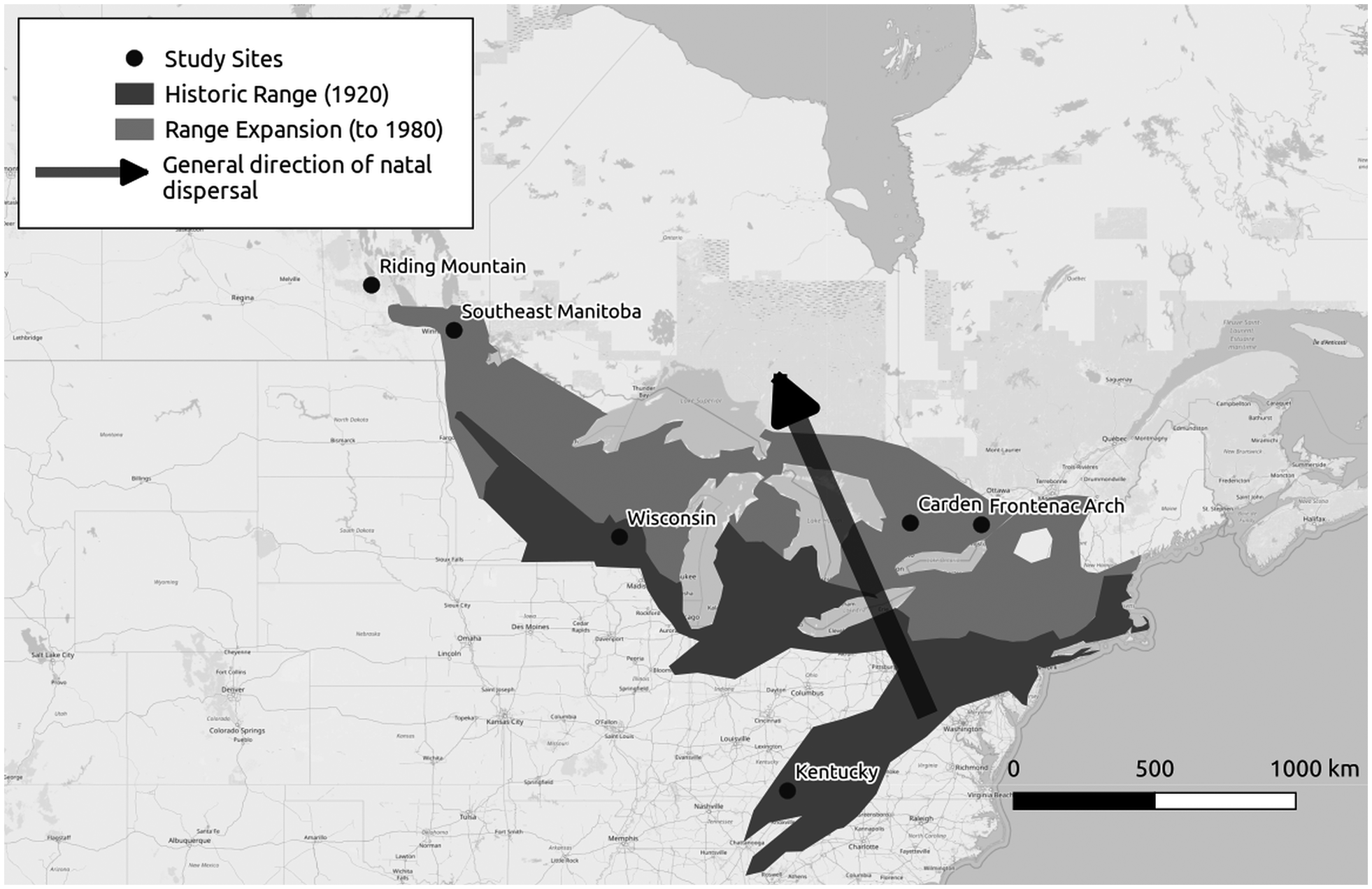
Golden-winged warblers (Vermivora chrysoptera) are an excellent candidate species to study host–parasite biogeography. Parasite prevalence varies strongly across this species' range (Vallender et al., Reference Vallender, Bull, Moulton and Robertson2012), and therefore provides an opportunity to investigate how changes in landscape structure across eastern North American relate to parasite prevalence. Observation and survey records of golden-winged warblers over the past 150 years indicate that the species has expanded its range in a north-northwesterly (NNW) direction, potentially driven by patterns of early successional habitat created by abandonment of cleared agricultural land, and climate change (Gill, Reference Gill1980; Buehler et al., Reference Buehler, Roth, Vallender, Will, Confer, Canterbury, Swarthout, Rosenberg and Bulluck2007; Confer et al., Reference Confer, Hartman, Roth and Rodewald2011; Fig. 1). While adult golden-winged warblers tend to have strong site philopatry, natal dispersal is high, and second-year individuals also tend to disperse to the north-northwest (López-Calderón et al., Reference López-Calderón, Van Wilgenburg, Roth, Flaspohler and Hobson2019, Fig. 1). Golden-winged warblers also display strong migratory connectivity, with northwestern birds overwintering in Central America, and southern birds overwintering in northern South America (Kramer et al., Reference Kramer, Streby, Peterson, Lehman, Buehler, Wood, McNeil, Larkin and Andersen2017, Reference Kramer, Andersen, Buehler, Wood, Peterson, Lehman, Aldinger, Bulluck, Harding, Jones, Loegering and Smalling2018). This connectivity suggests that parasites among different breeding populations should not become admixed on the wintering grounds; further, most haemosporidian parasite lineages are likely transmitted on the breeding grounds instead of the wintering grounds (Ricklefs et al., Reference Ricklefs, Medeiros, Ellis, Svensson-coelho, Blake, Loiselle, Soares, Fecchio, Outlaw, Marra, Latta, Bar and Jeremoabo2016). The combination of these factors allows us to test among competing dispersal-related parasite composition hypotheses. Golden-winged warblers are also threatened in Canada under the federal Species At Risk Act, and classifying the parasite composition across their range will help evaluate the risk that blood parasites could potentially pose to this species (Species At Risk Act, 2002, 11 2007).
Map depicting a historical range of golden-winged warblers and range expansion to 1980, accompanied by most likely natal dispersal patterns. The Riding Mountain, Manitoba population was colonized post-1980. Range data was adapted from Rosenberg et al. (Reference Rosenberg, Will, Buehler, Swarthout, Thogmartin, Bennett, Chandler, Streby, Andersen and Buehler2016), natal dispersal data is from López-Calderón et al. (Reference López-Calderón, Van Wilgenburg, Roth, Flaspohler and Hobson2019). Map data is from openstreetmap.org.

The three common and widespread genera of haemosporidian parasites examined in this study are Plasmodium, Leucocytozoon and Parahaemoproteus, which are transmitted by mosquitoes, black flies and biting midges, respectively (Greiner et al., Reference Greiner, Bennett, White and Coombs1975; Valkiūnas, Reference Valkiūnas2005; LaPointe et al., Reference LaPointe, Atkinson and Samuel2012). The potential impacts of these parasites on their avian hosts are diverse, and include lower mating success due to reduced plumage pigmentation, smaller body size or ability to produce mating calls (Figuerola et al., Reference Figuerola, Munoz, Gutierrez and Ferrer1999; Freeman-Gallant et al., Reference Freeman-Gallant, O'Connor and Breuer2001); reduced clutch sizes, hatching rates and fledging rates (Marzal et al., Reference Marzal, de Lope, Navarro and Møller2005; Asghar et al., Reference Asghar, Hasselquist and Bensch2011) and reduced survival (Lachish et al., Reference Lachish, Knowles, Alves, Wood and Sheldon2011). These fitness effects result in natural selection and cycles of host–parasite evolution, and alteration of these host–parasite interactions through anthropogenic change can pose new challenges to avian populations.
We described the prevalence and parasite lineages across the northwestern portion of the golden-winged warbler's range, with the intention of investigating which populations may be at the greatest risk from parasitism, and of estimating what factors shape trends in parasite prevalence. We compared support for two hypotheses that might explain geographic segregation in parasite composition: (1) the Land Cover hypothesis and (2) the Dispersal hypothesis. The latter may result from either (i) the presence of novel enemies or, conversely, (ii) enemy release. Under the Land Cover hypothesis, we predicted that regions that are highly anthropogenically disturbed would have higher parasite prevalence, because the dominant disturbance in the region is agriculture, and agricultural irrigation can create ideal vector habitat (see Patz et al., Reference Patz, Olson, Uejio and Gibbs2008). Under the Dispersal hypothesis, we predicted that prevalence of parasites would either be lowest in areas more recently colonized by golden-winged warblers (Enemy Release hypothesis) or be highest in the areas most recently colonized by golden-winged warblers (Novel Enemies hypothesis).
Methods
Field methods
We mist-netted and blood-sampled 257 golden-winged warblers (232 males, 24 females and one individual of unrecorded sex) from six study areas across their breeding range between 2005 and 2015 (Fig. 1). All samples were collected during the summer breeding season. Two of these study areas were in Manitoba: one in the west near Riding Mountain National Park (50.887°N, 99.686°W; 2009 n = 19, 2015 n = 31), and one in the southeast near the town of Richer (49.764°N, 96.528°W; 2009 n = 6, 2015 n = 44). Two study areas were in southern Ontario, a western site near the town of Carden (44.683°N, 79.057°W; 2015 n = 25), and an eastern site near Frontenac Arch Provincial Park (44.634°N, 76.332°W; 2015 n = 46). Our two final study areas were in the United States, in Kentucky, near the town of Pineville (36.810°N, 83.759°W; 2005 n = 6, 2006 n = 8, 2007 n = 20, 2008 n = 4) and Wisconsin, near the Sandhill State Wildlife area (44.295°N, 90.191°W; 2010 n = 48). We searched for golden-winged warblers in early successional aspen parkland or mixed forest ecosystems, and targeted the searches based on aerial surveys for available habitat and/or previous survey sightings (Moulton and Artuso, Reference Moulton, Artuso, Artuso, Couturier, De Smet, Koes, Lepage, McCracken, Mooi and Taylor2017; Rondel and Bird Studies Canada, unpublished results). This work was performed under permit by the University of Manitoba Animal Care Committee Protocol F2015-004 (AC11030).
Once a male golden-winged warbler was located, we identified the bird's territory and attracted the bird to 6 or 12-m mist nets using a conspecific territorial song playback. Upon capture, a ~20 µL blood sample was obtained from the brachial vein of each golden-winged warbler and stored in 85% ethanol or a tissue lysis buffer (White and Densmore, Reference White, Densmore and Hoelzel1992), and the bird was released at the location of capture. To determine whether parasites might be transmitted on the breeding grounds, we also sampled resident black-capped chickadees (Poecile atricapillus) co-occurring in golden-winged warbler habitat (Meixell et al., Reference Meixell, Arnold, Lindberg, Smith, Runstadler and Ramey2016). We used the same method to capture black-capped chickadees. However, as we only caught 14 chickadees for this purpose, we interpret these results with caution, and also used a global database of avian haemosporidian parasites (MalAvi) to locate lineages from data that matched the lineages found in this study, and to determine whether these matching lineages were obtained in resident and migrant avian species (Bensch et al., Reference Bensch, Hellgren and Pérez-Tris2009). A matching lineage in a resident species in North America provides evidence that a lineage can be transmitted on the breeding grounds, as resident species by definition do not leave the breeding grounds and therefore must have acquired parasites there. Further, we also screened 100 golden-winged warbler nestlings sampled in Manitoba in previous years, none of which revealed any infections (Enslow and Moulton, unpublished results). As the nestlings were only 5 days old, it is unlikely that they would have both acquired an infection and had it progress to a stage that is detectable within their blood.
Laboratory methods
To determine blood parasite composition, we extracted DNA from all 257 golden-winged warbler and 14 black-capped chickadee blood samples using a homemade kit (Ivanova et al., Reference Ivanova, DeWaard and Hebert2006). To screen for the presence of blood parasites, we used two primer sets that amplified overlapping regions of cytochrome b. Polymerase chain reaction (PCR) protocol A followed the methods of Vallender et al. (Reference Vallender, Bull, Moulton and Robertson2012), which first looked at blood parasites in golden-winged warblers. In this protocol, primers L15183 (Szymanski and Lovette, Reference Szymanski and Lovette2005) and H15725 (Ricklefs and Fallon, Reference Ricklefs and Fallon2002) amplified a 550 bp region in cytochrome b, typically covering the two parasite genera Plasmodium and Parahaemoproteus. PCR protocol B followed the nested PCR protocol outlined in Hellgren et al. (Reference Hellgren, Waldenström and Bensch2004), which uses three PCR steps to detect parasite presence to a dilution of 1:10 000 parasite cell to blood cells. Under protocol B, the first two primers (HaemNF and HaemNR2) initially amplified a 682-bp region of cytochrome b. We then performed a second and third PCR, each using the product from the first PCR. In the second PCR, nested primers (HaemF and HaemR2) isolated a smaller 480-bp region that is present and distinguishable in Parahaemoproteus and Plasmodium species. In the third PCR, nested primers HaemFL and HaemR3L isolated Leucocytozoon species. We tested for the presence of successfully amplified parasite DNA by running each PCR product through an ethidium bromide-stained agarose TAE gel. We viewed these gels through UV light using a Kodak–Fisher Scientific Gel Logic 100 Imaging System and scored birds as infected or not based upon the presence or absence of PCR product, respectively. All PCR assays were run with positive and negative controls; false negatives resulted from failed PCRs and were re-run, while false positives indicated contamination or amplification of a non-target gene and resulted in refreshing reagents and re-running the PCR. A companion to this study determined that protocol B had higher success at detecting infections (Enslow, Reference Enslow2017); therefore, samples initially screened with protocol A were screened again using protocol B.
To identify the parasite to lineage, we sequenced positive blood parasite infections by purifying the PCR product and using a Big Dye sequencing method. Some samples were purified twice: in the first purification, we added 0.02 µL Exo, 0.2 µL of SAP (Applied Biosystems Canada, Burlington, Ontario) and 3.78 µL of DNA grade water (BioShop Canada, Burlington, Ontario) to the PCR product of each positively infected sample, and held this mixture at 37 °C for 15 min then at 80 °C for 15 min in a thermocycler (Eppendorf Mastercycler ep gradient S; Eppendorf Canada, Mississauga, Ontario). When we did not use the first purification step, we diluted the PCR product depending on the brightness of the band, with a minimum of 0× dilution (weak PCR bands) and a maximum of 5× dilution (strong PCR bands). Following the first purification, or dilution, we used each successfully amplified PCR product in two separate sequencing reactions. The first reaction combined 1 µL of PCR product with 1.5 µL ABI buffer, 0.5 µL of forward primer and 0.4 µL of Big Dye (Applied Biosystems Canada, Burlington, Ontario). The second reaction was identical but used the reverse primer to produce two sets of sequence data per sample; the second sequence was used to verify the data and minimize the number of ambiguous bases in the final sequence. We then purified and precipitated DNA from the sequencing reaction by adding 1 µL sodium hydroxide and 1 µL EDTA to each sample, washing and drying the samples with 70 and 90% ethanol, drying the precipitate in a Vacufuge™ (Eppendorf Canada, Mississauga, Ontario), and rehydrating the DNA with 15 µL of HI-DI™ Formamide (Applied Biosystems Canada, Burlington, Ontario). We sequenced the DNA-HIDI mixture on an ABI 3130 XL Automated Sequencer (Applied Biosystems Canada, Burlington, Ontario). We obtained the sequence data and cleaned and aligned sequences using Geneious version 10 (Kearse et al., Reference Kearse, Moir, Wilson, Stones-Havas, Cheung, Sturrock, Buxton, Cooper, Markowitz, Duran, Thierer, Ashton, Mentjies and Drummond2012). We discovered the most similar reported parasite lineages using MalAvi BLAST (Bensch et al., Reference Bensch, Hellgren and Pérez-Tris2009) or NCBI BLAST (Altschul et al., Reference Altschul, Gish, Miller, Myers and Lipman1990), and used this information to assign each infection to the appropriate genus (Parahaemoproteus, Plasmodium or Leucocytozoon).
Statistical and spatial analysis
We tested for significant differences in parasite prevalence among study areas using generalized linear models with binomial distributions. The proportion of ‘successes’ (infections) exceeded 10% across the dataset. We ran models with each genus of parasite as the response variable and study site as the predictor variable, comparing differences among all regions, in ‘R’ 3.1.4 (R Core Team, 2015), using the glm (generalized linear model) function, and the brglm (bias-reduced generalized linear model) function in the package brglm (Kosmidis, Reference Kosmidis2013); brglm was used to test for significant differences when perfect separation occurred in the data (i.e. when any study area had zero infections of one parasite genus). We evaluated whether potentially biologically important variables (sex and capture year) should be included in the model using AIC and parsimony (Burnham and Anderson, Reference Burnham and Anderson2002). Neither additional variable reduced the AIC by 2 points or more (see Table S1), so these models were not selected and for brevity, the results are not detailed here.
To test for genetic variation in haemosporidian parasite lineages among geographic areas, we used analysis of molecular variance (AMOVA), executed in Arlequin 3.5 (Excoffier and Lischer, Reference Excoffier and Lischer2010). We used Kimura-2 to calculate sequence distances (Kimura, Reference Kimura1980), and Monte Carlo simulation with 16 000 permutations to test for significance (as suggested by Guo and Thompson, Reference Guo and Thompson1992). Since Kentucky only contained one Plasmodium infection and zero Leucocytozoon infections it was only included in the Parahaemoproteus analysis. Ontario samples were also pooled because Carden and Frontenac had low sample sizes of Leucocytozoon (n = 1, Carden) and Plasmodium (n = 2, Frontenac), respectively, and successful sequences revealed that these regions contained identical parasite lineages. The genetic differentiation we present here is likely a minimum estimate because AMOVA tends to underestimate differentiation, especially with the relatively small sample sizes of infected birds found here (Fitzpatrick, Reference Fitzpatrick2009; Bird et al., Reference Bird, Karl, Smouse, Toonen, Held, Koenemann and Schubart2011). We also used Arlequin to test for significance of paired FST values by permuting lineages among populations (Excoffier and Lischer, Reference Excoffier and Lischer2010). We compared the P value of pairwise FST values among the populations to determine which populations differed. Given that small differences in haemosporidian cytochrome b sequences have been associated with rapid speciation (Bensch et al., Reference Bensch, Pérez-Tris, Waldenström and Olof2004; Ricklefs et al., Reference Ricklefs, Outlaw, Svensson-Coelho, Medeiros, Ellis and Latta2014), we considered a lineage distinct if it was one base pair different from others, and counted any nucleotide difference, silent or non-silent (e.g. Lewicki et al., Reference Lewicki, Huyvaert, Piaggio, Diller and Franklin2015).
Land cover was described at the site-level (‘landscape’) scale. We created a 50-km buffer around the centre-point of each of the six study areas, as that was the geographic extent that included all sample points for each study site, and determined the proportion of agricultural habitat within the resulting circular landscape, using ArcMap 10.2 (ESRI, 2011). The regional scale was chosen to encompass each population that to the best of our knowledge would have similar historical origins. Ontario and Manitoba study sites were analysed separately, a distinction was expected due to their different historical origins. Because we had six landscapes, we used a single variable to describe the amount of human disturbance within each landscape to reduce the risk of overparameterization. We chose proportion of agriculture as this index as it was the most extensive human disturbance across our study regions. To ensure this was a reasonable index of disturbance, we ran preliminary analyses to compare this model with those using alternate disturbance variables, including total human disturbance (agricultural plus other anthropogenic lands, such as mines and urban). Results were similar regardless of which fixed variable we used, but were strongest for the agriculture variable, so for conciseness we only show that model. We also included the study area as a random effect. For each Manitoba study area, our samples from 2015 were used to calculate this centre-point. Land cover sources differed depending on the broad study area; for Kentucky and Wisconsin we used the USGS Geological survey data (US Geological Survey, 2011); for Manitoba we used the Manitoba Land Initiative land use data (Manitoba Conservation, 2005); and for Ontario we combined two datasets from the Southern Ontario Land Resource Information System, using the older dataset in the geographic area that was not covered by the newer dataset (Ontario Ministry of Natural Resources 2008; Ontario Ministry of Natural Resources and Forestry, 2011). One sample from Wisconsin was excluded because an accurate GPS point was not recorded for this sample. We used binomial generalized linear mixed models in ‘R’ 3.1.4, package lme4, to test for an association between percent agriculture and occurrence of the three parasite genera. We included study area as a random effect, with percent agriculture as the fixed effect.
Results
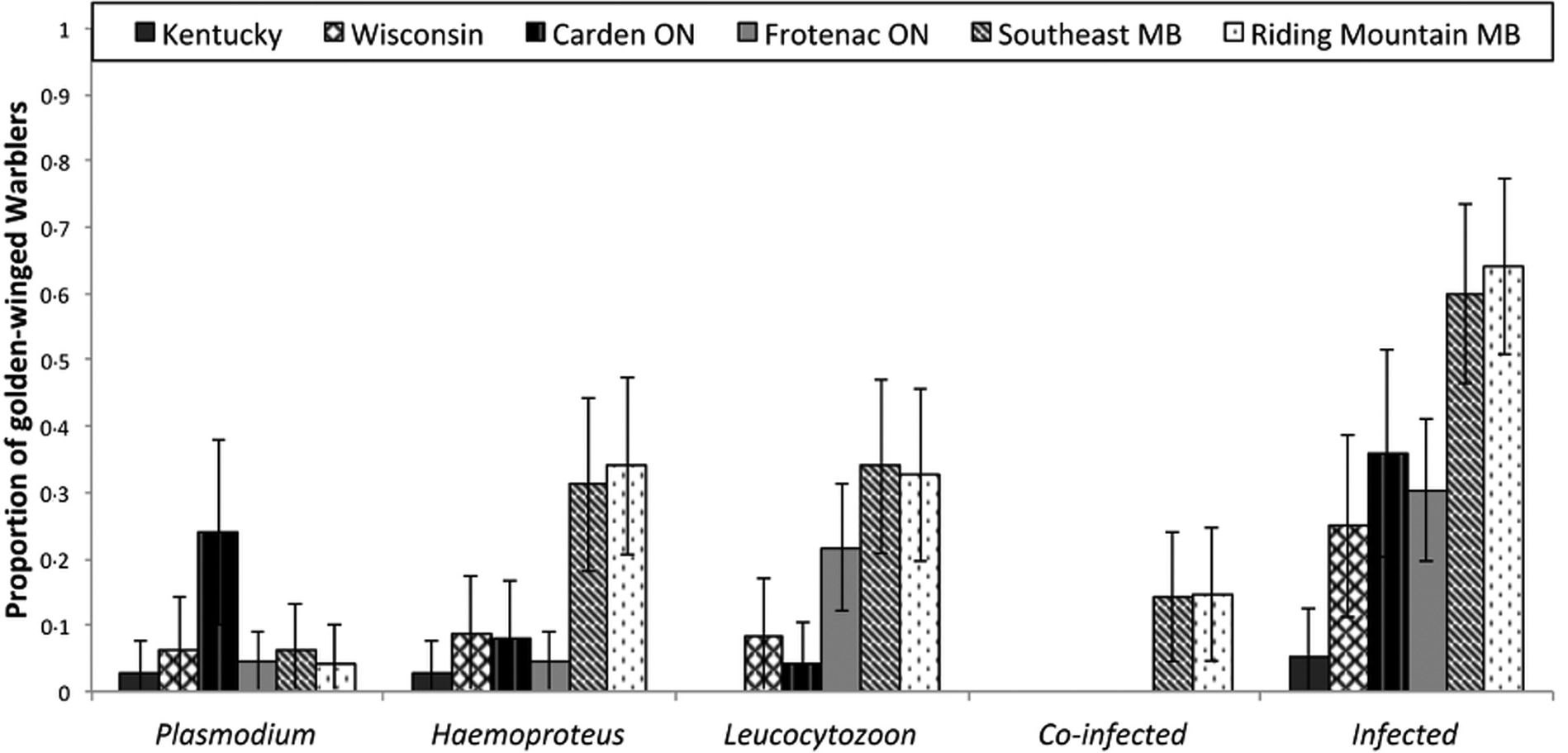
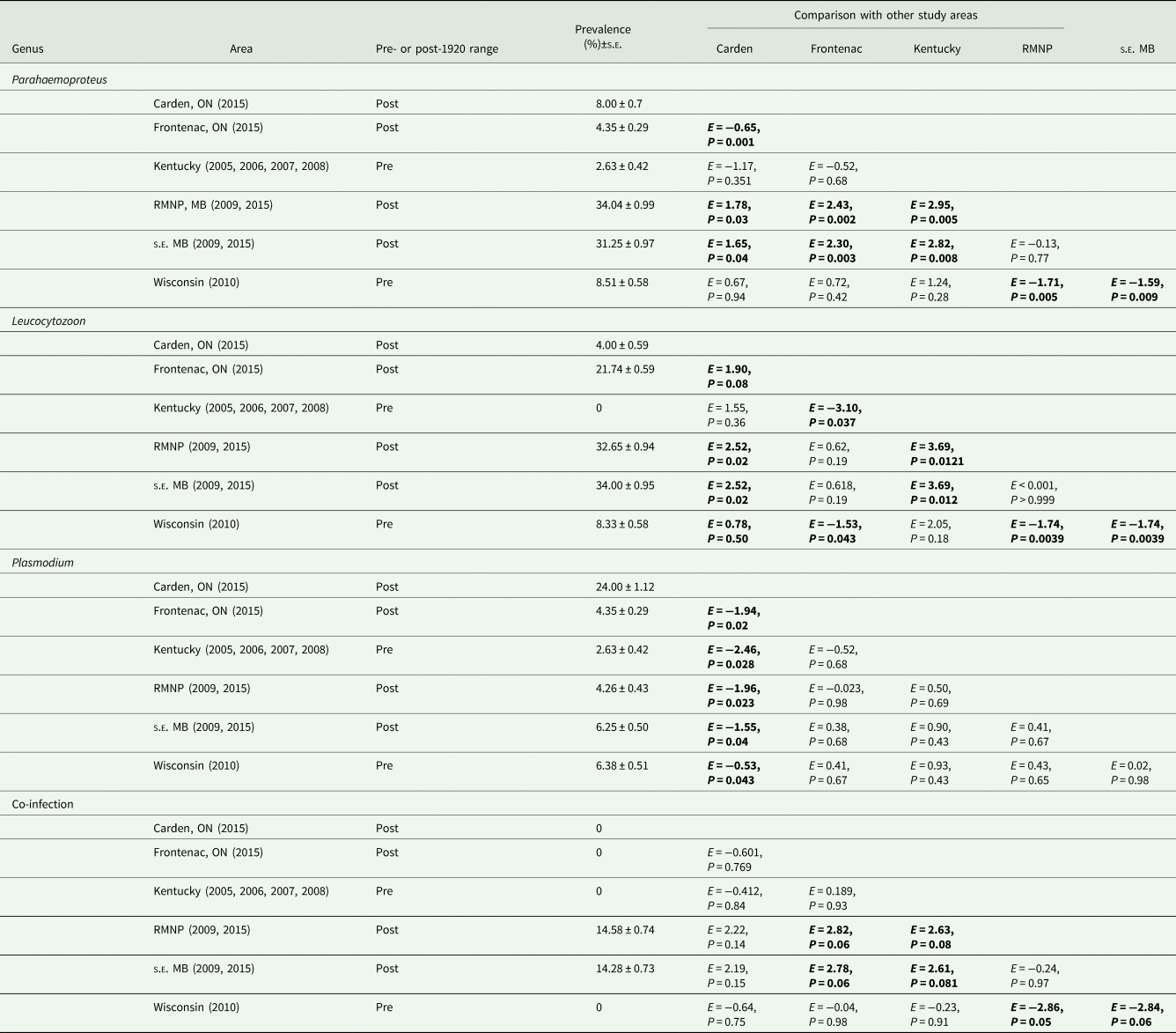
We detected 99 infected individuals out of 257 sampled golden-winged warblers. Five positive infections from Manitoba produced weak PCR bands that either corresponded to Parahaemoproteus or Plasmodium but could not be sequenced and thus were removed from further analyses involving either of these genera. Prevalence of infection varied significantly among study areas (Fig. 2; Table 1). Both Manitoba study sites (Riding Mountain National Park, and Southeast Manitoba) had more overall infections than any other sites, and this trend was driven by the significantly higher prevalence of Parahaemoproteus in Manitoba compared with the other five study sites (Table 1). Both Manitoba study sites and the eastern Ontario study site, Frontenac Arch, had a similar prevalence of Leucocytozoon parasites, but these three sites had greater Leucocytozoon prevalence than the remaining study sites (Table 1). Kentucky, on the other hand, had the fewest infections overall, and tended to have fewer infections of every parasite genus, although this trend was not always statistically significant (Table 1). Both Manitoba sites also had significantly more co-infections (infections of more than one genus of parasite) than nearly all other study sites (Fig. 2; Table 1). The study site that did not have significantly fewer co-infections than Manitoba (Carden) had zero co-infections, but there may be co-infections that are present and undetected due to the smaller number of samples from this site.
Prevalence of Plasmodium, Parahaemoproteus, Leucocytozoon infections in golden-winged warblers across five study sites across the golden-winged warbler's range. Different letters represent significant differences (P < 0.1) within the parasite genus among sites. Sample sizes were: Kentucky, n = 38 (2005, 2006, 2007, 2008), Manitoba, n = 100 (2009, 2015), Ontario, n = 71 (2015), WI = Wisconsin (2010), n = 48. Error bars denote 95% confidence intervals.

Comparison of the prevalence of Plasmodium, Parahaemoproteus and Leucocytozoon infections in golden-winged warblers across five study sites across the golden-winged warbler's range

RMNP, Riding Mountain National Park in Manitoba, SE MB, southeastern Manitoba; ON, Ontario; E, estimate from the binomial generalized linear model, in this case it is the estimated increase in the log odds of a bird being infected with the specified parasite genus between the compared study areas.
Significant differences are bolded (P < 0.1).
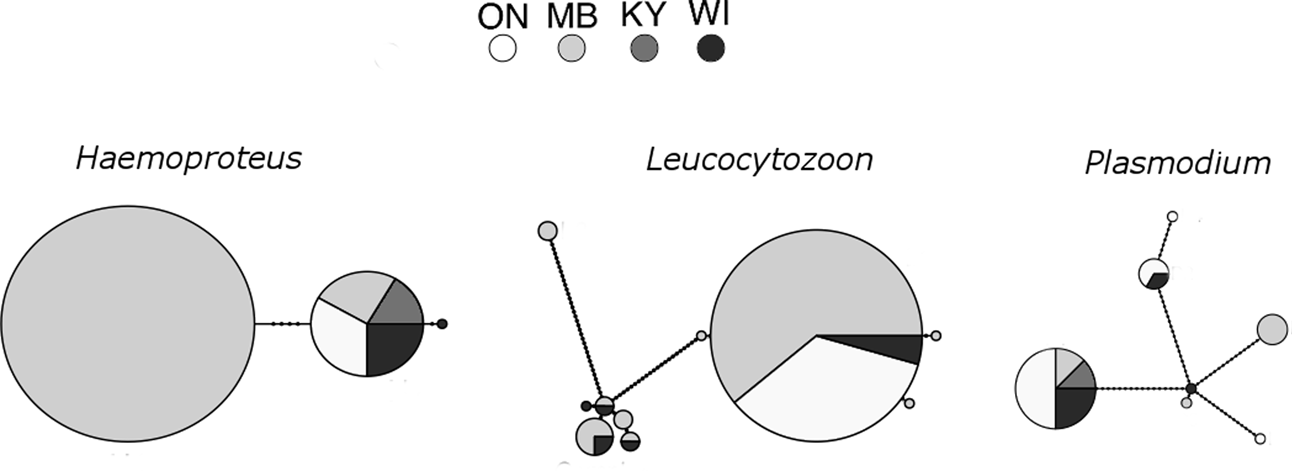
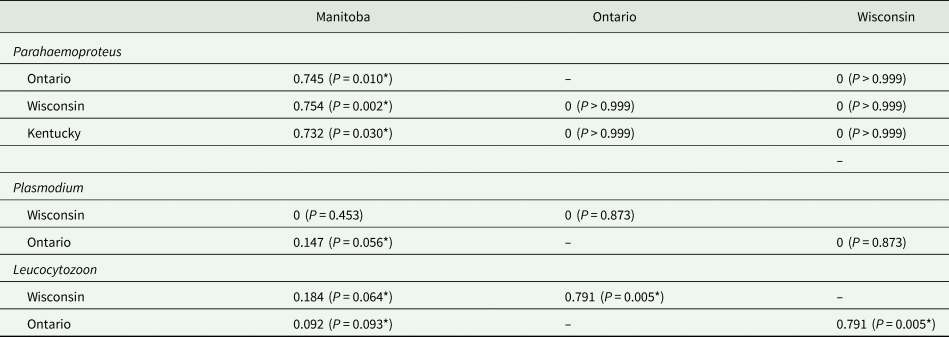
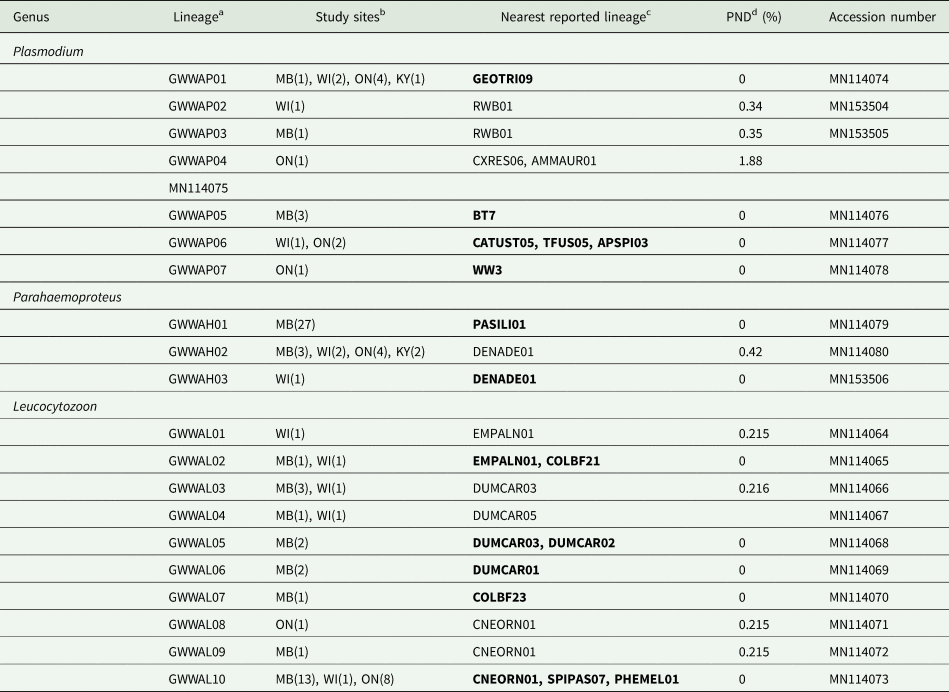
We found 20 unique Haemosporidian lineages, and these displayed some geographic structure. Of these, three belonged to Parahaemoproteus, ten belonged to Plasmodium, and seven belonged to Leucocytozoon. AMOVAs revealed that Plasmodium was not genetically distinct among the study areas (P = 0.214), though FST analysis suggested that the Manitoba and Ontario populations of Plasmodium parasites are the most different from one another (Table 2). Manitoba also had one uncommon parasite lineage, BT7, which was not found in any other population (Fig. 3). Ontario had two unique Plasmodium lineages, one of which is 1.79% divergent from other reported lineages, and may be considered an unrecorded species (Table 3; Ricklefs et al., Reference Ricklefs, Outlaw, Svensson-Coelho, Medeiros, Ellis and Latta2014). The AMOVA for Leucocytozoon displayed a different pattern: the populations were significantly differentiated (P = 0.010), and FST testing suggested that the Manitoba, Ontario, and Wisconsin populations were all significantly different (Table 2). Manitoba and Ontario share one very common lineage that is considerably less common in Wisconsin, and Wisconsin and Manitoba share a complex of similar parasite lineages (Fig. 3). Further, all populations with Leucocytozoon infections had at least one lineage that was unique to that population (Fig. 3). The AMOVA for Parahaemoproteus also revealed that the populations were significantly differentiated (P < 0.001), which was driven by differences between Manitoba and the other sites (Table 2). This is clear from the lineage network, as Manitoba has one unique and very common lineage that is not found in the other study areas (Fig. 3).
Haplotype networks displaying frequencies and genetic distance among Plasmodium, Leucocytozoon and Parahaemoproteus parasite lineages in different golden-winged warbler populations. KY = Kentucky, n = 38 (2005, 2006, 2007, 2008), MB = Manitoba, n = 100 (2009, 2015), ON = Ontario, n = 71 (2015), WI = Wisconsin, n = 48 (2010). Each circle is a unique lineage (differs from other lineages by at least one base pair), the size of the circle corresponds to the relatively frequency of the lineage, and the colour of the shape shows which study site it is found in. Labels denote unique lineages (lineages that differ from a central lineage by more than 2 base pairs).

FST test results comparing frequency and genetic distance of lineages of Parahaemoproteus, Plasmodium and Leucocytozoon among golden-winged warbler populations

Values presented are pairwise FST calculated using the following formula: (average number of base pair differences between populations − average number of base pair differences among populations)/average number of base pair differences among populations. The significance of paired FST values was calculated by permuting lineages among populations, and P indicates the proportion of randomly permuted populations that matched or exceeded the variation found in the actual populations.
Parasite lineagesa present in golden-winged warblers in Kentucky (2005, 2006), Manitoba (2009, 2010, 2015), Ontario (2015) and Wisconsin (2009, 2010)

a Lineages differ from each other by at least one nucleotide difference.
b MB, Manitoba; ON, Ontario; WI, Wisconsin; KY, Kentucky.
c Bensch et al. (Reference Bensch, Hellgren and Pérez-Tris2009).
d Pairwise nucleotide distance from nearest reported lineage.
Evidence for breeding vs wintering ground transmission
Of the 14 black-capped chickadees screened, eight were infected with Leucocytozoon, two of those were co-infected with Plasmodium, and one was only infected with Plasmodium. The Plasmodium lineage that was only found in Manitoba, BT7, was also found in black-capped chickadees. Black-capped chickadees in Manitoba were also infected with the Leucocytozoon lineage DUMCAR03, demonstrating that this lineage may be transmitted during the breeding season in Manitoba. No resident black-capped chickadees were infected with Parahaemoproteus parasites.
Based on comparison with the MalAvi database, we ascertained that at least one of our Parahaemoproteus lineages is probably transmitted on the breeding grounds. The common but Manitoba-specific Parahaemoproteus lineage (PASILI01) has been found in hatch-year fox sparrows (Passerella iliaca) that were caught on their breeding grounds in California (Walther et al., Reference Walther, Carlson, Cornel, Morris and Sehgal2016); suggesting that this lineage is transmittable in breeding grounds in North America. PASILI01 has also been found in a resident American crow (Corvus brachyrhynchos) in Alaska, and migratory yellow-rumped warblers (Setophaga coronata) in Alaska and New Mexico (Galen et al., unpublished results; Williamson et al., unpublished results). To the best of our knowledge, the uncommon lineage with one match in Wisconsin, DENADE01, has only ever been found in the West Indies before (Ricklefs et al., Reference Ricklefs, Outlaw, Svensson-Coelho, Medeiros, Ellis and Latta2014). The common lineage that was found in all sites, GWWAH02, is not yet reported in the genetic databases (Table 3).
Most of the Leucocytozoon lineages found here are also probably transmitted on the breeding grounds. The lineage COLBF23, which was found in one bird in Manitoba only, has not yet been reported in a host species, but has been found in black flies (Simulium silvestre) in the Rocky Mountains of Colorado (Murdock et al., Reference Murdock, Adler, Frank and Perkins2015). Due to the coverage of our sequences, we could not distinguish between DUMCAR03 and DUMCAR01; however, both have been found in resident species in Michigan: the lineage DUMCAR03 has been found in resident tufted titmouse (Baeolophus bicolor) and migrant grey catbird (Dumetella carolinensis), while DUMCAR01 was found resident a resident northern cardinal (Cardinalis cardinalis), and several migratory species (Smith et al., Reference Smith, Gill, Baker and Vonhof2017). DUMCAR01 was also found in migratory yellow-rumped warblers in BC and Alberta, Canada (Cozzarolo et al., Reference Cozzarolo, Christe, Jenkins, Toews and Brelsford2018). DUMCAR05 has only been reported in migratory grey catbird in Michigan (Smith et al., Reference Smith, Gill, Baker and Vonhof2017). We were unable to distinguish between COLBF21 and EMPALN01, but both have been found in resident species. EMPALN01 has been found in two resident species in California (Fruend et al., Reference Freund, Wheeler, Townsend, Boyce, Ernest, Cicero and Sehgal2016), while COLBF21 has been found in resident northern cardinals in Michigan (Smith et al., Reference Smith, Gill, Baker and Vonhof2017). Both have also been found in a number of migratory species in western/southwestern North America (Bensch et al., Reference Bensch, Hellgren and Pérez-Tris2009). For the most common and widespread Leucocytozoon lineage in this study, we were unable to distinguish between CNEORN01, SPIPAS07 and PHEMEL01 due to the coverage of our sequence (Table 3). CNEORN01 is also the most common lineage of the three in the literature, and has been found in black flies in the Rocky Mountains of Colorado (Murdock et al., Reference Murdock, Adler, Frank and Perkins2015) resident northern cardinals in Michigan (Smith et al., Reference Smith, Gill, Baker and Vonhof2017), and in numerous migratory species in Alaska (Oakgrove et al., Reference Oakgrove, Harrigan, Loiseau, Guers, Seppi and Sehgal2014; Cozzarolo et al., Reference Cozzarolo, Christe, Jenkins, Toews and Brelsford2018; Galen unpublished results), California (Walther et al., Reference Walther, Carlson, Cornel, Morris and Sehgal2016), and New Mexico (Smith et al., Reference Smith, Gill, Baker and Vonhof2017). CNEORN01 is very abundant across the hybrid zone between yellow-rumped warbler subspecies in Alberta and British Columbia (Cozzarolo et al., Reference Cozzarolo, Christe, Jenkins, Toews and Brelsford2018). SPIPAS07 has only been reported in a migratory chipping sparrow (Spizella passerina) in Michigan (Smith et al., Reference Smith, Gill, Baker and Vonhof2017), and PHEMEL01 has only been found in migratory black-headed grosbeak (Pheucticus melanocephalus) in California (Walther et al., Reference Walther, Carlson, Cornel, Morris and Sehgal2016).
Our results, in combination with a survey of the literature, strongly support a wide-ranging, continental distribution for Plasmodium parasites. The lineage BT7, the Plasmodium found in local black-capped chickadees, is widely reported in the literature, and appears to be nearly globally distributed (Bensch et al., Reference Bensch, Hellgren and Pérez-Tris2009). BT7 has been found in Alaska, Vermont, and California in the US, and in many regions across Eurasia. Evidence of transmission for this parasite in North America is limited to California (Walther et al., Reference Walther, Carlson, Cornel, Morris and Sehgal2016), Alaska (Oakgrove et al., Reference Oakgrove, Harrigan, Loiseau, Guers, Seppi and Sehgal2014), and now Manitoba. The lineage WW3 has a near-global distribution similar to BT7, with evidence of transmission in breeding and wintering grounds: it has been found in resident northern cardinal, and house finch (Haemorhous mexicanus) in Michigan (Smith et al., Reference Smith, Gill, Baker and Vonhof2017), but also multiple resident species in Peru (Fecchio et al., Reference Fecchio, Silveira, Weckstein and Anciaes2019). The lineage GEOTRI09 has only been found in a handful of migratory species across North America (Oakgrove et al., Reference Oakgrove, Harrigan, Loiseau, Guers, Seppi and Sehgal2014; Sarquis-Adamson and MacDougall-Shackleton, Reference Sarquis-Adamson and MacDougall-Shackleton2016; Smith et al., Reference Smith, Gill, Baker and Vonhof2017; Galen et al., unpublished results). Due to differential sequence coverage, we were unable to distinguish between the Plasmodium lineages CATUSTO05, APSP103, and TFUS05. CATUSTO05 may be transmitted on both wintering and summering grounds: it has been found in a number of migratory species in numerous locations across North America (Bensch et al., Reference Bensch, Hellgren and Pérez-Tris2009), but has also been found in resident tufted titmouse in Michigan (Smith et al., Reference Smith, Gill, Baker and Vonhof2017), and numerous resident species in South America (González et al., Reference González, Lotta, García, Moncada and Matta2015; Fecchio et al., Reference Fecchio, Silveira, Weckstein and Anciaes2019). APSP103 has been found in migratory species in several locations in Canada and the US (Pagenkopp et al., Reference Pagenkopp, Klicka, Durrant, Garvin and Fleischer2008; Sarquis-Adamson and MacDougall-Shackleton, Reference Sarquis-Adamson and MacDougall-Shackleton2016), and has been found in resident thorn-tailed rayadito (aphrastura spinicauda) in Chile (Merino et al., Reference Merino, Moreno, Vásquez, Martínez, Sánchez-monsálvez, Estades, Ippi, Sabat, Rozzi and Mcgehee2008). TFUS05 has only been found in great thrush in Colombia (Mantilla et al., Reference Mantilla, Gonzáles, Moncada and Matta2013).
Site-scale cover of agriculture was positively associated with the prevalence of Parahaemoproteus (β = 8.22, s.e. = 2.26, P < 0.001) and Leucocytozoon parasites (β = 6.93, s.e. = 3.38, P = 0.0407), but was independent of Plasmodium prevalence (P = 0.717).
Discussion
Our results demonstrate high blood parasite prevalence in some populations of golden-winged warblers. Parasite prevalence generally increases to the north-west across the range of the golden-winged warbler. More than half of the Manitoba golden-winged warblers sampled carried at least one genus of a blood parasite, a frequency ten times higher than the site with the lowest prevalence, Kentucky (see also Vallender et al., Reference Vallender, Bull, Moulton and Robertson2012). Manitoba also has the highest number of co-infections, which can have synergistic fitness consequences resulting in poor body condition and mortality (Palinauskas et al., Reference Palinauskas, Valkiūnas, Bolshakov and Bensch2011). The Manitoba population is of great conservation importance, as it appears to have the lowest rates of hybridization with the blue-winged warbler (Vermivora cyanoptera; Moulton et al., Reference Moulton, Vallender, Artuso and Koper2018). Hybridization between these sister species is believed to have been a significant cause of precipitous population declines in golden-winged warblers over the past forty years (Gill, Reference Gill1997; Vallender et al., Reference Vallender, Robertson, Friesen and Lovette2007; Sauer et al., Reference Sauer, Hines, Fallon, Pardieck, Ziolkowski and Link2011). Unfortunately, the Manitoba population appears to be at a fitness disadvantage in terms of lower survival and reduced reproductive output compared to eastern Canada (Moulton, Reference Moulton2017), and we speculate that high parasite prevalence may contribute to this trend. However, further work is needed to elucidate the effect of these parasites on the Manitoba population, as infection with haemosporidian parasites is not inherently negative, and might even result in positive reproductive outputs (Zylberberg et al., Reference Zylberberg, Derryberry, Breuner, Macdougall-shackleton and Cornelius2015). The extensive variation in parasite prevalence among our sites suggests that populations may face differing pressure from parasites, and this might be of particular conservation concern for the ecologically unique and highly parasitized Manitoba population.
We found a considerable genetic structure to parasite communities within the golden-winged warbler across its range. Golden-winged warblers were infected with a number of population-specific lineages, and two of the three parasite genera (Parahaemoproteus and Leucocytozoon) were significantly genetically differentiated among populations. Parahaemoproteus and Leucocytozoon lineages are more likely to be geographic specialists than Plasmodium lineages, which are typically widespread and are host generalists (Olsson-Pons et al., Reference Olsson-Pons, Clark, Ishtiaq and Clegg2015), consistent with our results.
Golden-winged warbler populations in geographic regions with high cover of agriculture had more infections of Parahaemoproteus and Leucocytozoon. However, there is a strong correlation between latitude and agriculture (r = 0.80); therefore, the effect could be related to either geographic location or disturbance, and we must be cautious with the interpretation of these results. This is especially true in the case of Leucocytozoon, which is known to be more likely to be transmitted at higher latitudes and cooler temperatures (Pérez-Rodríguez et al., Reference Pérez-Rodríguez, Fernández-González, de la Hera and Pérez-Tris2013; Galen and Witt, Reference Galen and Witt2014), and may actually be constrained by higher temperatures (Fecchio et al., Reference Fecchio, Silveira, Weckstein and Anciaes2019). Our results differ from the findings of some other, particularly tropical studies, that have found an increase in anthropogenic disturbance to be associated with decreased parasite prevalence (see Sehgal, Reference Sehgal2010; Loiseau et al., Reference Loiseau, Harrigan, Robert, Bowie, Henri, Smith and Sehgal2012b; Laurance et al., Reference Laurance, Jones, Westcott, McKeown, Harrington and Hilbert2013). Variation in responses to landscape change is unsurprising because landscape change results from a wide diversity of human disturbances, and the mechanism of change for parasite communities is likely to change depending on the type of disturbance (Brearley et al., Reference Brearley, Rhodes, Bradley, Baxter, Seabrook, Lunney, Liu and Mcalpine2013). While contiguous forest in tropical regions may contribute to vector habitat (Bonneaud et al., Reference Bonneaud, Sepil, Milá, Buermann, Pollinger, Sehgal, Valkiūnas, Lezhova, Saatchi and Smith2009), agricultural disturbance may increase vector habitat in more temperate regions. Agriculture may increase parasite prevalence if associated irrigation creates wet and open habitat, which is suitable larval habitat for the two species of biting midges that transmit Parahaemoproteus (Kardatzke and Rowley, Reference Kardatzke and Rowley1971; Patz et al., Reference Patz, Olson, Uejio and Gibbs2008). Similarly, though not suitable for all black fly species, irrigation can create larval habitat for Leucocytozoon transmitting black flies (Fredeen and Shemanchuck, Reference Fredeen and Shemanchuk1960; Patz et al., Reference Patz, Olson, Uejio and Gibbs2008). Though we might expect pesticide use to deter the presence of larvae, some black flies are resistant to non-target commercial pesticides (Montagna et al., Reference Montagna, Gauna, Angelo and Anguiano2012).
Our results are not consistent with the Enemy Release hypothesis, because the most recent region to be colonized, Manitoba (Rosenberg et al., Reference Rosenberg, Will, Buehler, Swarthout, Thogmartin, Bennett, Chandler, Streby, Andersen and Buehler2016), has a high level of parasitism. Our results are more consistent with the Novel Enemies hypothesis: that golden-winged warblers are susceptible to novel parasites as they colonize new areas. We detected an increasing trend in parasite infection from the southeast to the northwest across the golden-winged warbler's range, consistent with its historical range expansion (Confer et al., Reference Confer, Hartman, Roth and Rodewald2011; Fig. 1). The pattern of Parahaemoproteus and Leucocytozoon lineage distributions is also consistent with the Novel Enemies hypothesis. Golden-winged warblers in our most southeastern study site, Kentucky, had the fewest lineages of parasites, and the one lineage of Parahaemoproteus in Kentucky was also present in every other study area. Consistent with historic and natal dispersal trends from the southeast to the northwest: golden-winged warblers in Ontario and Manitoba share a common Leucocytozoon lineage that is also present but much less common in Wisconsin, and Golden-winged warblers in Wisconsin and Manitoba share a complex of very similar Leucocytozoon parasites that are not found in other study areas. Manitoba also has at least one unique and distinct parasite lineage from each parasite genus, consistent with the Novel Enemies hypothesis, as golden-winged warblers appear to rarely migrate south from Manitoba, which could limit movement of unique parasites (Lopez-Calderon et al., Reference López-Calderón, Van Wilgenburg, Roth, Flaspohler and Hobson2019). Further, differences in parasite communities between the two Ontario study sites are also consistent with the Novel Enemies hypothesis. Although the sites in Ontario are close in proximity, McCracken's re-creation (Reference McCracken, McNicholl and Cranmer-Byng1994) of the golden-winged warbler's expansion into central Ontario indicates that the Frontenac and Carden populations might not be part of the same colonizing wave, but rather originated from separate northward colonization events from either side of Lake Ontario. Consistent with these historical origins, the dominant parasite genus is different between the two sites; Plasmodium is significantly more abundant in the western site and Leucocytozoon is significantly more abundant in the eastern site. Overall, the patterns observed among parasite lineages are correlated with the historical dispersal patterns of golden-winged warblers. However, as with any correlational study, we cannot be certain of the mechanism.
Both Dispersal hypotheses are robust to violations of the assumption that parasites are transmitted on the breeding ground. Migratory connectivity between golden-winged warbler populations is strong (Kramer et al., Reference Kramer, Streby, Peterson, Lehman, Buehler, Wood, McNeil, Larkin and Andersen2017). If a parasite lineage is transmitted on the wintering ground, the only aspect of the Dispersal hypothesis that changes is that the lineage disperses between wintering ground locations instead of breeding ground locations. In contrast, the Land Cover hypothesis requires the assumption that birds were infected where we analysed the proxies for vector habitat: the breeding grounds. To examine whether parasites may be transmitted on the breeding grounds, we screened parasites of resident black-capped chickadees, and also compared parasite lineages we found in golden-winged warblers with those in the MalAvi database. There are limitations to comparing parasites between different species; black-capped chickadees and golden-winged warblers may have different parasite communities because they are not closely related (Jetz et al., Reference Jetz, Thomas, Joy, Hartmann and Mooers2012) and use different habitat types (Foote et al., Reference Foote, Mennill, Ratcliffe, Smith and Rodewald2010; Confer et al., Reference Confer, Hartman, Roth and Rodewald2011). Despite these limitations, because both species share some otherwise rare lineages, this and other studies (Bensch et al., Reference Bensch, Hellgren and Pérez-Tris2009) suggest that at least some lineages are probably transmitted on the breeding grounds. Additionally, although further study is needed, recent studies indicate that parasites found on the breeding grounds are likely transmitted there as well (Hellgren et al., Reference Hellgren, Wood, Hasselquist, Ottosson, Stervander and Bensch2013; Ricklefs et al., Reference Ricklefs, Medeiros, Ellis, Svensson-coelho, Blake, Loiselle, Soares, Fecchio, Outlaw, Marra, Latta, Bar and Jeremoabo2016; Pulgarín et al., Reference Pulgarín, Fitzgerald, Gómez, Bayly, Bensch, Starkloff, Kirchman, González-prieto, Hobson, Ungvari-martin, Skeen, Isabel, Carlos and Cadena2019).
An additional important caveat to this study is that many study areas were sampled in different years, or only 1 year. Although year was not a significant predictor of parasite prevalence (see ‘Methods'), without extensive multi-year sampling in each area, we cannot be sure that we have the definitive parasite composition for each area (Bensch et al., Reference Bensch, Waldenström, Jonzén, Westerdahl, Hansson, Sejberg and Hasselquist2007).
Our results suggest that both land-cover characteristics and historical patterns of golden-winged warbler dispersal affect the community composition of blood parasites across the species' northern range. As the golden-winged warbler's range continues to gradually move northwards, as habitat allows (Rosenberg et al., Reference Rosenberg, Will, Buehler, Swarthout, Thogmartin, Bennett, Chandler, Streby, Andersen and Buehler2016), the Novel Enemies hypothesis suggests that one of the challenges it might increasingly face across its northern extent is exposure to blood parasites to which it is not adapted. The Manitoba population of golden-winged warblers is likely to continue to increase in importance to conservation of the species, and unless the species rapidly evolves to tolerate these parasites, the high prevalence and diversity of parasites in this region may contribute one more threat to an already at-risk population.
Supplementary material
The supplementary material for this article can be found at https://doi.org/10.1017/S0031182019001240.
Acknowledgements
This work would not have been possible without help from the many scientists that provided data and assistance to this research. Patricia Hartman and David Wesneat collected blood samples for the Kentucky dataset, and Monica Cong collected blood samples for Wisconsin. Rachel Vallender, Steve Van Wilgenberg, Marek Allen and Adam Crosby collected blood samples in Manitoba in 2009. Laurel Moulton assisted with sample collection and laboratory work for the Manitoba samples. Christian Artuso also provided extensive advice in the development of this project. Roger Bull provided assistance, advice, and training in laboratory work. We also thank the technicians and volunteers who helped collect data for this project: Callie Bowman, Sabina Mastrolonardo, Delaney Brooks, Christoph Ng, Marika Olynyk, and Erin Prokopanko. We thank Riding Mountain National Park and the Nature Conservancy of Canada for their generous in-kind support and the Canadian Museum of Nature for providing space in their beautiful and innovative DNA Lab.
Financial support
Financial support was provided by supporting institutions, the University of Manitoba and Bird Studies Canada. Grant funding that supported this research included the National Science and Engineering Council (N.K. 327777-2012, C.E. no grant number); and the Connie Holland Bird Studies Fund (C.E. 20151787).
Conflict of interest
None.
Ethical standards
This work was performed under permit by the University of Manitoba Animal Care Committee Protocol F2015-004 (AC11030). The authors assert that all procedures contributing to this work comply with the ethical standards of the relevant national and institutional guides on the care and use of laboratory animals.