NOMENCLATURE
- a
-
length of a rectangular panel
- b
-
width of a rectangular panel
- D i
-
elements of the bending stiffness matrix, i =11, 12, 22, 66
- E 11
-
elastic modulus of direction 11
- E 22
-
elastic modulus of direction 22
- G 12
-
shear modulus of direction 12
- L
-
guide distance integer for each ply
- n max
-
number of plies in the guide laminate
- n region
-
number of the regions
- μ12
-
Possion ratio of direction 12
- θ
-
fibre angle
- λ
-
buckling factor
1.0 INTRODUCTION
Enforcing stacking sequence continuity from one segment to another is generally referred to as blending. Since the term blending has been introduced by Kristinsdottir and Zabinsky to illustrate the continuity problem(Reference Kristinsdottir and Zabinsky1), many methods to achieve multi-segment blended composite laminate design can be found in the literature. Blending was defined as designing composite laminates for multiple panels with stacking sequences that maintain continuity of some or all of the ply orientation angles across adjacent panels(Reference Kristinsdottir and Zabinsky2). Kim et al(Reference Kim, Kim and Hong3) proposed a patch-wise lay-up design method for the strength optimisation of composite laminates with ply drop was developed and the number of ply and stacking sequence at each ply drop location were adjusted. Liu and Haftka(Reference Liu and Haftka4) and Toropov et al(Reference Toropov, Jones and Willment5) imposed measures of material composition continuity and stacking sequence continuity between two adjacent panels to get a blended composite panel. The authors of the cited paper found that the penalty approach is not an efficient choice for satisfying the blending constraints(Reference Adams, Watson and Gürdal6–Reference van Campen, Seresta, Abdalla and Gürdal9). Adams(Reference Adams, Watson and Gürdal6) used a distributed genetic algorithm with migration to obtain blended panels, the blending process is accomplished using the edit distance between individuals of a population and the set of migrants from adjacent panels. This approach showed that is it not efficient when it is coupled with the design rules. Adams et al(Reference Adams, Watson, Gürdal and Anderson-Cook7) and Seresta et al(Reference Seresta, Abdalla and Gürdal8) achieved a blended solution using a guide-based genetic algorithm and developed two blending models, inner and outer blending, to improve the ply continuity between adjacent laminates. A subsequence of n plies must be the first or the last n plies of the stacking sequence guide. This assumption constitutes the limitation of the method and restricts the optimisation problem to only a small region of the design space. In order to overcome the problem, van Campen et al(Reference van Campen, Seresta, Abdalla and Gürdal9) proposed two new blending definitions, generalised blending and relaxed generalised blending. Zehnder and Ermanni(Reference Zehnder and Ermanni10) introduced a patch concept, in which the patch was a layer that covered an arbitrary part of the whole structure and the stacking sequence of each laminate was defined by the order and orientations of the patches. The question of an optimal placement of reinforcement fibres on the structure and the patch geometry parameterisation still need to be investigated. Irisarri et al(Reference Irisarri, Lasseigne, Leroy and Riche11) introduces a concept of the Stacking Sequence Table (SST) for the optimal design of laminated composite structures with ply drops, which provides more freedom to tailor the laminates compared to the classical guide-based blending. Zein et al(Reference Zein, Basso and Grihon12) proposed a primal-dual backtracking optimisation method for finding the optimal stacking sequence and the ply drop-offs of a blended composite structure. Later, a constraint satisfaction programming approach for computing manufacturable stacking sequences(Reference Zein, Basso and Grihon13) was proposed, the novelty of the proposed algorithm is that it can handle a general blending scheme, where a stacking sequence can be blended with other stacking sequences and it can also be the base of others. Jing et al(Reference Jing, Fan and Sun14,Reference Jing, Fan and Sun15) proposed a Global Shared-Layer Blending (GSLB) method for obtaining manufacturable stacking sequence of composite structures with blending and design rules. This method imposes that the plies constituting the thinnest zone of the structure are shared by all the zones. In the above existing optimisation methods, laminates with identical thicknesses should have the completely same lay-ups. Fan et al(Reference Fan, Wang and Chen16) proposed two newly constructed chromosomes (ply composition and ply ranking chromosomes) to encode the global stacking sequence with no additional chromosomal repair. Recently, Macquart(Reference Macquart17) presented a free open-source toolbox for the Optimisation of BLEnded Stacking Sequences (OptiBLESS). The OptiBLESS, which contributes to this goal by making the first step in developing a free and open source stacking sequence optimisation toolbox, is a numerical implementation of the guide-based blending strategy(Reference Adams, Watson, Gürdal and Anderson-Cook7) combined with the generalised blending rule proposed by van Campen et al(Reference van Campen, Seresta, Abdalla and Gürdal9) Macquart et al(Reference Macquart, Werter and Breuker18) used OptiBLESS for aeroelastic tailoring of blended composite structures. The results show that applying blending constraints leads to more realistic continuous design which, in turn, reduces the number of iterations required to obtain the final stacking sequences.
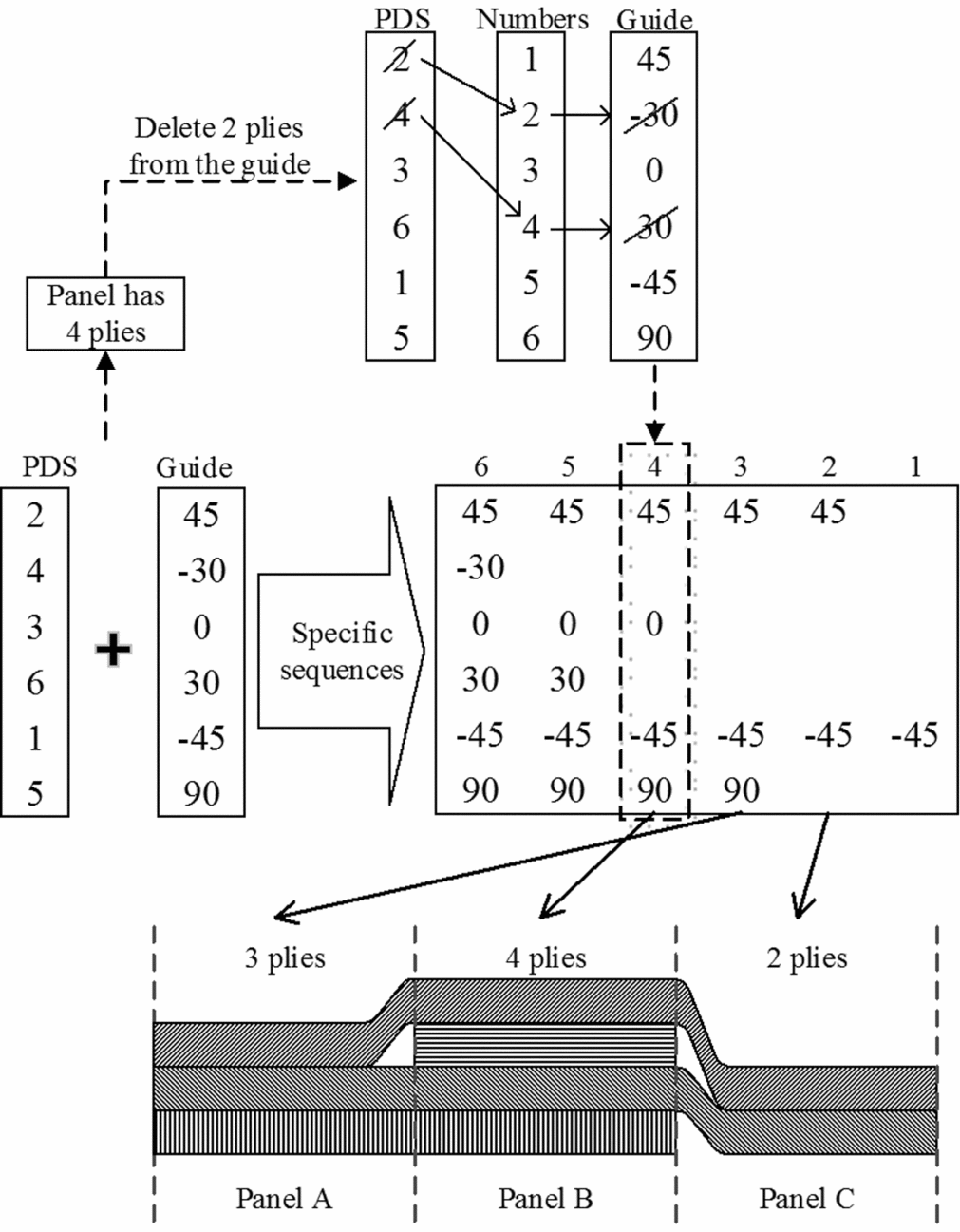
In a previous study(Reference Yang, Song, Zhong and Jin19), the concept of Ply Drop Sequence (PDS) for designing of composite laminate structures with multiple regions was introduced. For symmetrical laminate, plies from the outermost to the innermost layer near the mid-plane are numbered from 1 to n max, respectively. PDS is a permutation of these n max integers, and allows to define any ply drop-offs instead of contiguous innermost/outermost plies for conventional guide blending algorithm. The proposed method is applied to an 18-panel horseshoe benchmark problem. The optimal feasible designs outperform other published solutions with a more optimal (lighter) solution based on classical guide-based blending due to the broader feasible region. The progress of creating laminates using the concept of PDS is shown in Fig. 1.
Illustration of drop-off rule defines by PDS.

2.0 THE PPS BLENDING MODEL
The PDS blending model(Reference Yang, Song, Zhong and Jin19) consists of three types of chromosomes during the GA process: (1) chromosome guide θ represents the stacking sequence of the guide laminate in the structure, (2) chromosome N str represents ply numbers of all the regions over a structure and (3) chromosome PDS is an integer vector to define any ply drop-offs. The permutation PDS defines the ply order following which the plies will be sequentially deleted. In addition, it is worth mentioning that PDS does not change the stacking sequence of the guide, which means that a region whose thickness is identical to the guide, has the same stacking sequence as the guide no matter what the PDS is. So lots of repeated discrete points in the design space are searched during optimisation process. When the number of plies in the guide laminate (n max) is large, the occurrence of repeated discrete points becomes serious. In order to improve the problem, the concept of PPS is introduced and described in the following paragraphs.
2.1 Blending model of panel sequence permutation
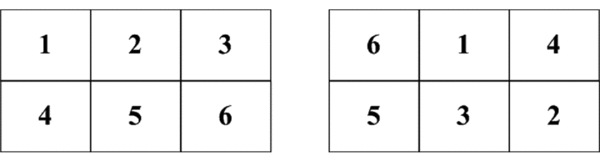
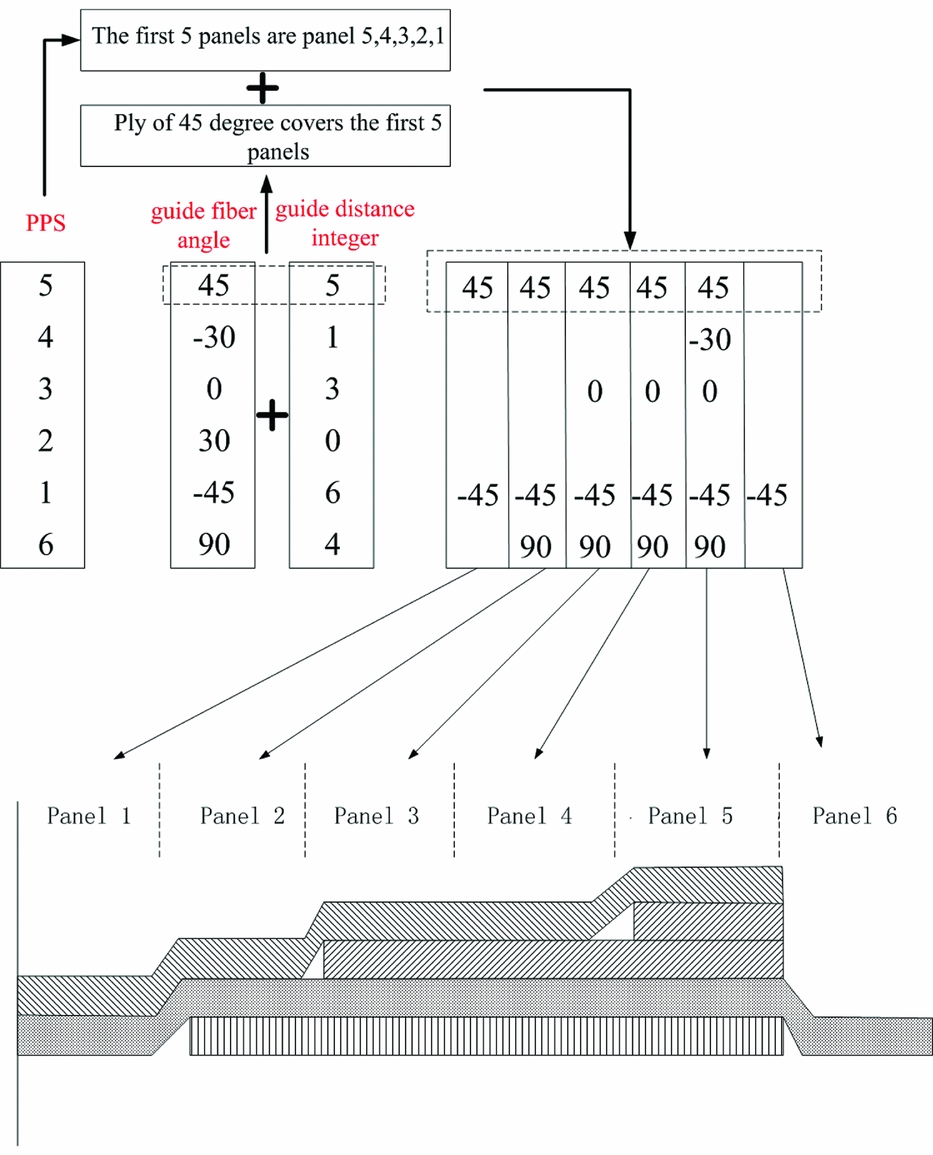
In the second blending formulation of Kristinsdottir and Zabinsky(Reference Kristinsdottir and Zabinsky1), a distance variable is defined as the number of regions a ply occupies. In this work, based on the distance variables concept of Kristinsdottir and Zabinsky(Reference Kristinsdottir and Zabinsky1), a three-chromosome genotype during the GA optimisation process is used: (1) chromosome of guide fibre angle θ, (2) chromosome of guide distance integer L, and (3) chromosome of a PPS. The guide fibre angle chromosome θ represents the stacking sequence of the guide laminate for the whole structure. The guide distance integer chromosome L is used to determine how many regions each ply covers. The PPS chromosome is defined as follows: Suppose a structure is composed of n region regions (panels), and the regions are arbitrarily numbered from 1 to n region initially. PPS is a permutation of these n region numbers and allows the users to define the sequence of the panels. For any ply of the guide laminate, the guide distance integer L is used to define how many panels the ply covers and the PPS is used to define which panels the ply covers. PPS gives the panel sequence a ply covers. For example, a structure composed of 6 panels, the panel number can be numbered arbitrarily. This article gives two original numbering methods (Fig. 2). PPS (1 3 5 6 4 2) based on the numbering method 1 and PPS (6 4 3 2 5 1) based on the numbering method 2 represent the same laminate configuration for each panel during optimisation process. So the original panel number can be numbered arbitrarily. The progress of creating laminates using the concept of PPS is shown in Fig. 3.
Two original numbering methods. (a) numbering method 1; (b) numbering method 2.

The progress of creating laminates using the concept of PPS.
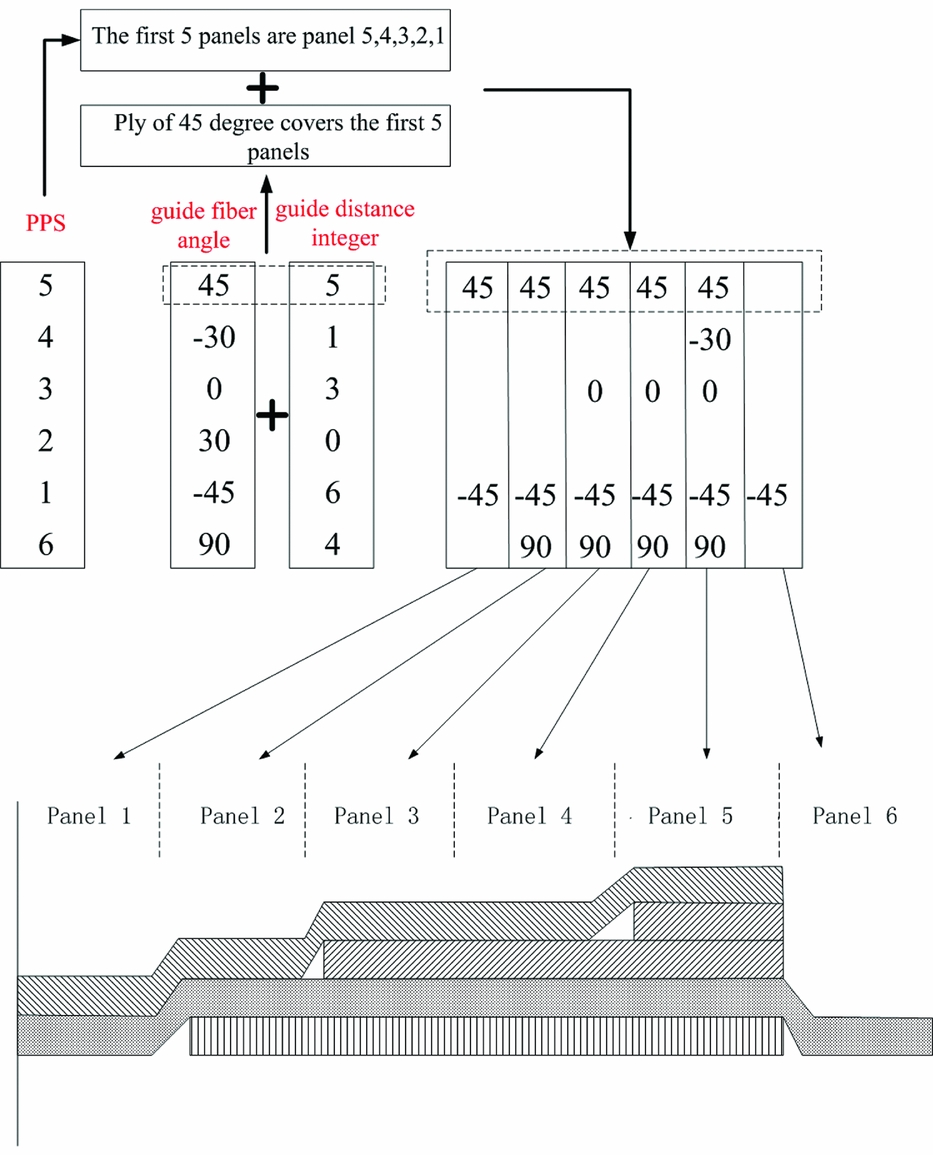
Suppose a PPS of (5 4 3 2 1 6) and a guiding sequence of (45 –30 0 30 –45 90 | 5 1 3 0 6 4), as shown in Fig. 3. The guiding sequence means that the guide is composed of six plies, the first 45° ply covers the first five panels. The –30°, 0°, –45° and 90° plies cover the first 1, 3, 6 and 4 panels, respectively. While the distance integer 0 means that the 30° ply does not exist, the PPS of (5 4 3 2 1 6) represents the panel sequence. So the first five panels which the first 45° ply covers are panel 5, 4, 3, 2 and 1. The first 1 panel which the –30° ply covers is panel 5. The guide distance integer of the 30° ply is 0, which means the 30° ply disappears within all panels. According to the definition of PPS, the corresponding stacking sequences of these panels are obtained, and are shown in Fig. 3.
2.2 Optimisation procedure
The GA used in this article consists of the following steps:
2.2.1 Population initialisation
-
(1) Chromosome of guide distance integer θ
The guide distance integer θ represents the stacking sequence of the thickest laminate in the structure. As Ref. Reference Yang, Song, Zhong and Jin19 shows, the value of the guide fibre angle is chosen from the interval (–90+Δα, 90+Δα), where Δα represents the minimal angle increment between allowable fibre angles. For the case where the orientations are limited to 0, 90 and ±45, Δα is 45. For the guide chromosome decoding, the fibre angle θ with respect to the element of the chromosome θ code can be obtained as
 $$\begin{equation*}
\theta = \Delta \alpha \left\lfloor {{\theta _{{\rm{code}}}}/\Delta \alpha } \right\rfloor ,
\end{equation*}$$
where the symbol ⌊⌋ represents a round down operator that returns the maximum integer which is not greater than the number within the brackets. Since the number of plies of a symmetrical laminate may be an even number or an odd number, the ply thickness of the innermost ply near the mid-plane is set as half of the ply thickness.
-
(1) Chromosome of guide distance integer L
The guide distance integer L of each ply is used to determine how many regions a ply occupied: L = 2 denotes the ply extends through the first two regions, L = 2 denotes the ply does not exist within all regions. the value of the guide distance integer is chosen from the interval (0, n region+1). For the distance chromosome decoding,
 $$\begin{equation*}
{L_i} = \left\lfloor {i,i + 1} \right\rfloor ,{\rm{ }}i = 0,1,2,\!...,{n_{{\rm{region}}}}.
\end{equation*}$$
-
(1) Chromosome of a panel sequence permutation (PPS)
The PDS chromosome is an integer vector, representing the meaning of PDS discussed previously. The length of the PPS chromosome is identical to that of the n region. In the PPS decoding, the stacking sequence of each region is obtained through reading the guide, as described in Section 2.0.
2.2.2 GA crossover operation
(1) For L and θ, the simulated binary crossover operator proposed by Deb and Agrawal are used for real-coded genetic algorithmReference Deb and Agrawal (20) . Assume two parents x (1) and x (2) are selected and crossed with a crossover probability Pc . The chromosomes are crossed variable-by-variable to created two new children y (1) and y (2). Each variable (gene) is crossed with a probability of 0.5 using the following procedure:
Step 1: Create a random number μ ∈ [0, 1].
Step 2: Calculate β q as follows:
 $$\begin{equation}
{\beta _q} = \left\{ {\begin{array}{@{}*{2}{c}@{}} {{{(\alpha \mu )}^{\frac{1}{{{\eta _c} + 1}}}}}&{{\rm{if}}\;\mu \le {\alpha ^{ - 1}}}\\ {{{\left( {\frac{1}{{2 - \alpha \mu }}} \right)}^{\frac{1}{{{\eta _c} + 1}}}}}&{{\rm{otherwise}}} \end{array}} \right.,
\end{equation}$$
where α = 2 − β − (η c + 1), and β is calculated as follows:
 $$\begin{equation}
\beta = \left\{ {\begin{array}{@{}*{2}{c}@{}} {1 + \frac{2}{{x_i^{(2)} - x_i^{(1)}}}{\rm{min}}\left[ {x_i^{(1)} - {x_i}^L,{x_i}^U - x_i^{(2)}} \right],}&{{\rm{ if}}\;x_i^{(1)} < x_i^{(2)}}\\[6pt] {1 + \frac{2}{{x_i^{(1)} - x_i^{(2)}}}{\rm{min}}\left[ {x_i^{(2)} - {x_i}^L,{x_i}^U - x_i^{(1)}} \right],}&{{\rm{if}}\;x_i^{(2)} > x_i^{(1)}} \end{array}} \right.,
\end{equation}$$
where xL i and xU i are the lower and upper bounds of variable xi , respectively. The user-defined parameter η c is the distribution index. In all simulations, we set η c = 15.
Step 3: The children are then computed as follows:
 $$\begin{equation}
\begin{array}{@{}l@{}} y_i^{(1)} = 0.5\left[ {\left( {x_i^{(1)} + x_i^{(2)}} \right) - {\beta _q}\left| {x_i^{(2)} - x_i^{(1)}} \right|} \right]\\[10pt] y_i^{(2)} = 0.5\left[ {\left( {x_i^{(1)} + x_i^{(2)}} \right) + {\beta _q}\left| {x_i^{(2)} - x_i^{(1)}} \right|} \right] \end{array}
\end{equation}$$
(2) For PPS, a method based on the travelling salesman problem ordered crossover operator OX) proposed by Davis(Reference Davis21) is performed on PPS chromosome. At first, a random fragment of the first parent is selected and copied to a child while maintain its location on the chromosome. To produce the rest genes of the child, the remaining non-duplicate genes from the second parent are placed in order from the position after the end of the fragment. For instance, the first parent is p1 = (1 2|3 4|5 6), and the second parent is p2 = (4 2|3 6|1 5), where two vertical bars denote two random cut points. The fragment between the vertical bars of p1 are copied to a child as c1 = (0 0|3 4|0 0). Then p2 is rotated as p2 = (1 5 4 2 3 6), furthermore, by deleting genes 3 and 4 which constitute the fragment, the non-duplicate genes from p2 is q2 = (2 6 1 5). Replace all the ‘0’s in c1 with genes in q2 in the order which the first ‘0’ after the second cut point is associated with the first gene 2 in q2, and the consequent child is c1 = (1 5 3 4 2 6). Exchange p1 and p2, and repeat the same process of crossover, then the other child of p1 and p2 would be c2 = (2 4 3 6 5 1).
2.2.3 GA mutation operation
(1) For L and θ, a polynomial probability distribution is performed to create a new chromosome y in the vicinity of a parent chromosome x. The operator is used for each variable with a probability 0.1 in the following procedure:
Step 1: Create a random number μ ∈ [0, 1].
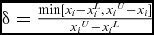
Step 2: Calculate δq as follows:
 $$\begin{equation}
{\delta _q} = \left\{ {\begin{array}{@{}*{2}{c}@{}} { - 1 + {{\left[ {2\mu + (1 - 2\mu ){{(1 - \delta )}^{{\eta _m} + 1}}} \right]}^{\frac{1}{{{\eta _m} + 1}}}}}&{{\rm{if}}\;\mu \le 0.5}\\ {1 - {{\left[ {2\left( {1 - \mu } \right) + 2\left( {\mu - 0.5} \right){{\left( {1 - \delta } \right)}^{{\eta _m} + 1}}} \right]}^{\frac{1}{{{\eta _m} + 1}}}}}&{{\rm{otherwise}}} \end{array}} \right.,
\end{equation}$$
where
 $\delta = \frac{{{\rm{min}}[ {{x_i} - x_i^L,{x_i}^U - {x_i}} ]}}{{{x_i}^U - {x_i}^L}}$
, and η
m
is the distribution index for mutation, we use η
m
=20 here.
Step 3: Calculate the mutated child as follows:
 $$\begin{equation}
{y_i} = {x_i} + {\delta _q}\left( {x_i^U - x_i^L} \right)
\end{equation}$$
(2) For PPS, the mutation operator proposed by Gutin and Karapetyan(Reference Gutin and Karapetyan22) is implemented on the PPS chromosome. It chooses and removes a random fragment of the chromosome and inserts the fragment in some other position. The size of the fragment is restricted to max(0.05m, 1) to max(0.3m, 2). For example, let the parent PDS chromosome be (1 2 3|4 5|6). After removing the fragment between two vertical bars (4 5), we have (1 2 3 6). Assume the position to be inserted is 3, and the new child is (1 2 4 5 3 6).
2.2.4 Elitist selection
Tournament selection method is chosen. When the two individuals both satisfy constraints, the one with lower object is the better; when just one of the individuals satisfies constraints, the one satisfying constraints is the better one; when neither of the two individuals satisfies constraints, the one with lower violation grade is the better one. The characteristic of tournament GA is that the individual with better fitness is more likely to exist. It can avoid the influence of a super individual, control selection pressure and balance evolution speed to overcome prematurity and stagnancy.
2.3 Comparisons of the PDS blending model and the PPS blending model
The design space of the PDS blending model and the PPS blending model proposed are identical. Suppose a guide has m plies and the number of regions is n. For the case where the fibre angles are limited to 0, 90 and ±45, the number of the possible combinations for the discrete points in the design space for PDS model is 4 m *mn *m! (4 m combinations for stacking sequence of guide laminate, mn combinations for laminate configuration of all regions, and m! combinations for permutation for stacking sequence of guide laminate), while the number of the possible combinations for the PPS model proposed in this article is 4 m *mn +1*n! (4 m combinations for stacking sequence of guide laminate, mn +1 combinations for laminate configuration of all regions, and n! combinations for permutation of panel sequence). So it is clear that if the number of the panels is less than the ply number, although the number of design variables for PPS is more than the PDS method (shown in Table 1), the searching points are less than the PDS method. For example, if the ply number of the guide laminate is 20, the number of panels is 18, the possible combination number of the previous method is 420*2018*20! = 7.01236e53. The possible combination number of the proposed method is 420*2019*18! = 3.69072e52. The ratio of possible combinations between the proposed PPS method and the PDS method is 1/19. Compared with the PDS blending model, the PPS model still has the same drawback of repeated searching points. For example, when the thicknesses of the regions are identical to the guide laminate (the chromosome of guide distance integer L for each ply equals n), all regions have the same stacking sequence as the guide laminate no matter what the PDS is. However, when the length of the PPS (number of panels) is less than the PDS (number of plies for guide laminate), the less-repeated individuals are searched for the PPS method.
Comparisons between the PDS method and the PPS method

3.0 BLENDING EXAMPLE
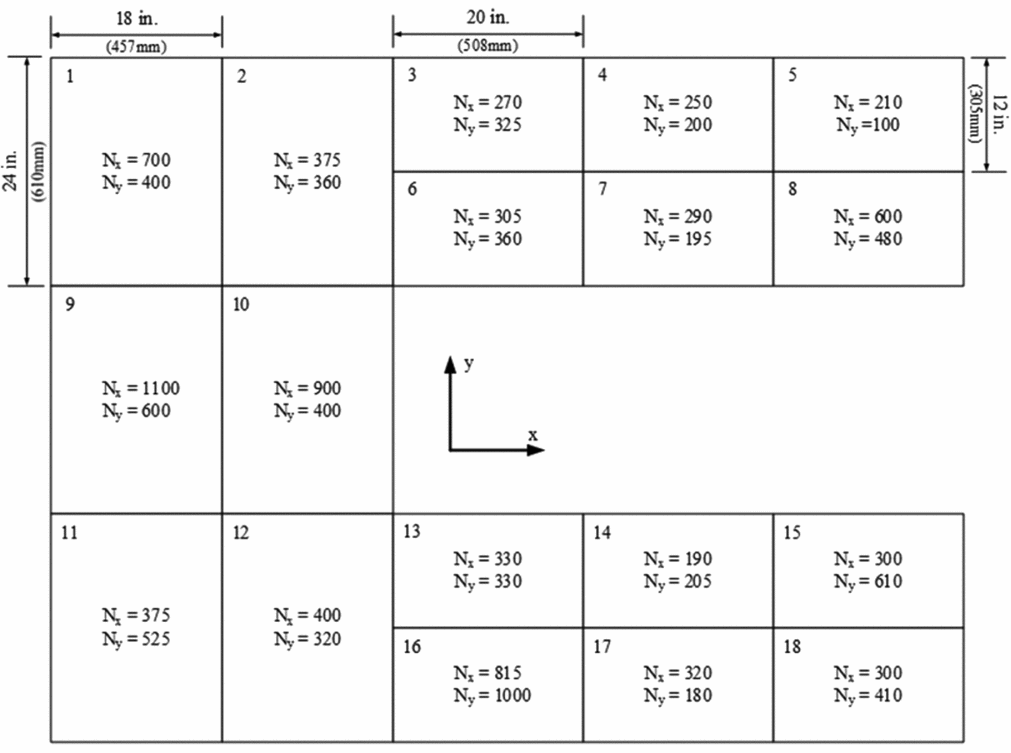
To demonstrate the feasibility of the optimisation method proposed, the classical 18-panel example consisting of 18 panels in a horseshoe configuration was used, as shown in Fig. 4. The local loads of each panel are assumed to be fixed and each panel is considered to have simply supported boundary conditions. The objective is to find a fully blended design with all panels satisfying buckling constraints. Ply orientations are restricted to 0°, ±15°, ±30°, ±45°, ±60°, ±75° and 90°. A Graphite/Epoxy IM7/8552 material is used for construction of each ply where E 1 = 141GPa (20.5Msi), E 2 = 9.03GPa (1.31 Msi), G 12 = 4.27GPa (0.62 Msi), ν 12 = 0.32 and ply thickness is 0.191 mm (0.0075 in.).
Eighteen panel horseshoe configuration(Reference Liu and Haftka4).

The value of λ corresponding to a buckling mode with nx half-waves in the x direction and ny half-waves in the y direction is
 $$\begin{eqnarray}
\lambda ({n_x},{n_y}) &=& \{ {\pi ^2}[{D_{11}}{({n_x}/a)^4} + 2({D_{12}} + 2{D_{66}}){({n_x}/a)^2}{({n_y}/b)^2}\nonumber\\
&&+\, {D_{22}}{({n_y}/b)^4}]\} /\{ {({n_x}/a)^2}{N_x} + {({n_y}/b)^2}{N_y}\} ,
\end{eqnarray}$$
where a and b are the panel length and width, and D ij are the elements of the bending stiffness matrix for the plate obtained using Classical Lamination Theory (CLT).
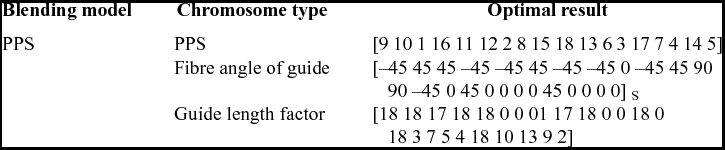
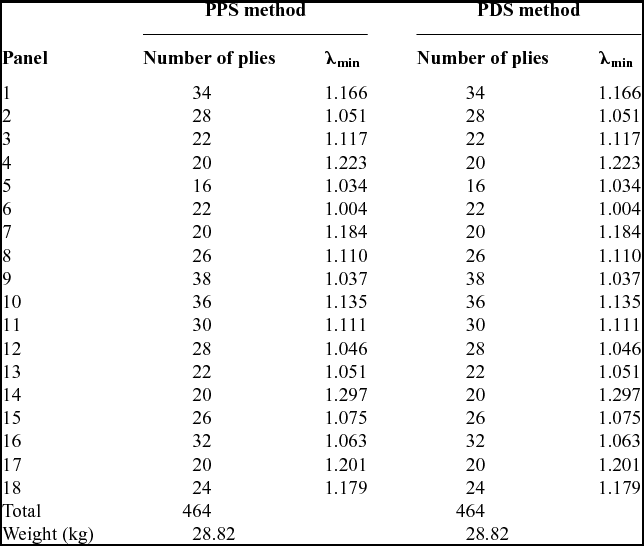
In order to compare the PDS method and the PPS method, the genetic operators adopted are the same as in Ref. Reference Yang, Song, Zhong and Jin19. Also, the way of dealing with the fitness function and constraints are identical with Ref. Reference Yang, Song, Zhong and Jin19. And a guide of 25 layers is used in coding of guide laminate. When both symmetry and balance guidelines are enforced, Yang et al(Reference Yang, Song, Zhong and Jin19) report a blended feasible design with a weight of 28.82 kg for an even case (the laminate is balanced and symmetric with an even number of plies). The solution found in the present work (shown as Table 2) is identical to the optimum design by Yang, shown in Tables 3 and 4.
Optimum design of the 18 panels with symmetry and balance constraints

Result comparison for symmetrical and balanced laminates in even case for the PPS and the PDS methods

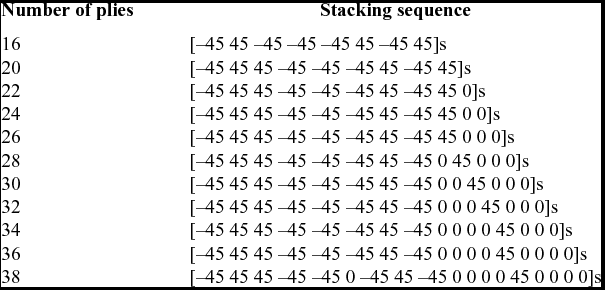
Blended optima for symmetrical and balanced laminates

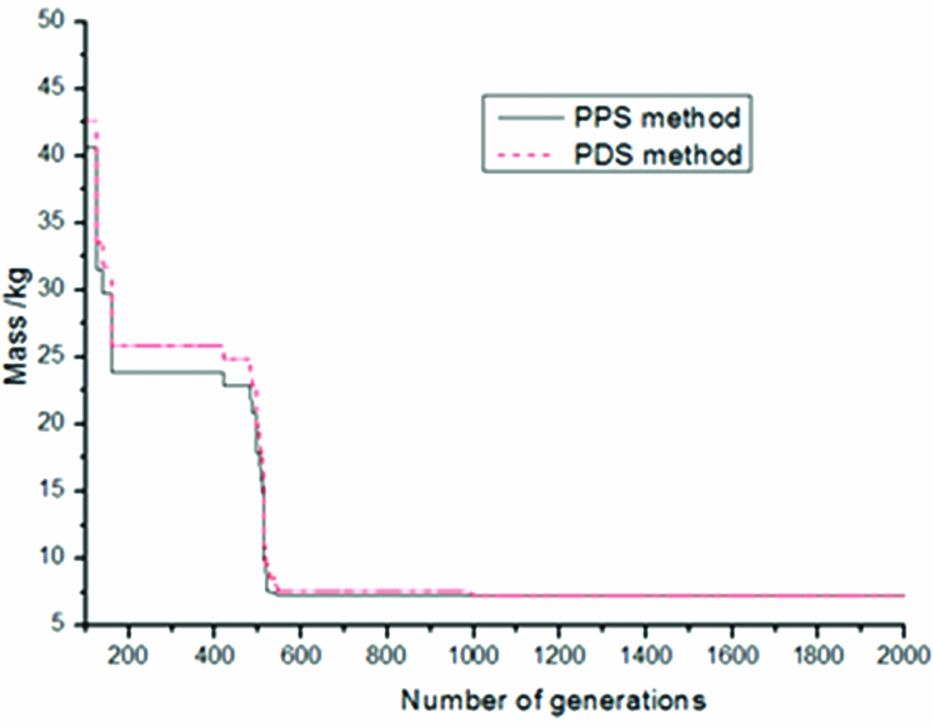
Two thousand five hundred (2500) generations are performed to reach an optimal design for the PDS method(Reference Yang, Song, Zhong and Jin19). In this work, the optimal design is obtained after 2210 generations, 290 fewer generations than the search process of PDS of Ref. Reference Yang, Song, Zhong and Jin19. The reason for a little slower convergence of the PPS method is although the number of design variables of the PPS method is a little more than the PDS method, the repeated searching points of the PPS method are less than the PDS method. Because the ply number of the guide laminate is 25, and the number of panels is 18, the possible combination of the PDS method is 425*2518*25! = 2.54e65. The possible combination of the PPS method is 425*2519*18! = 2.62e57. The ratio of possible combinations between the proposed PPS method and the PDS method is 1/9.69e7.
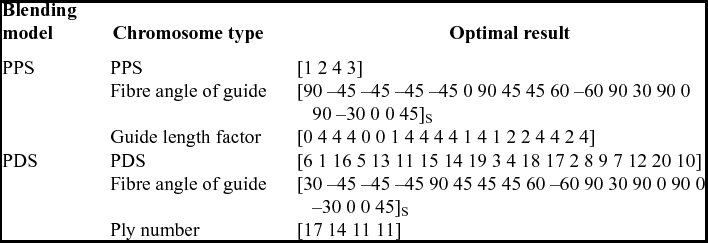
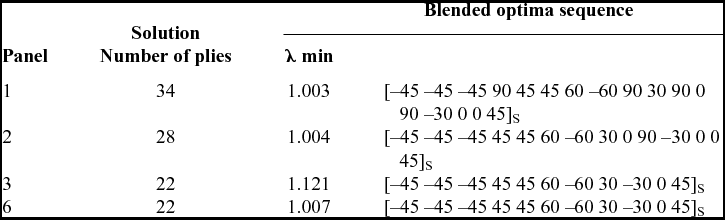
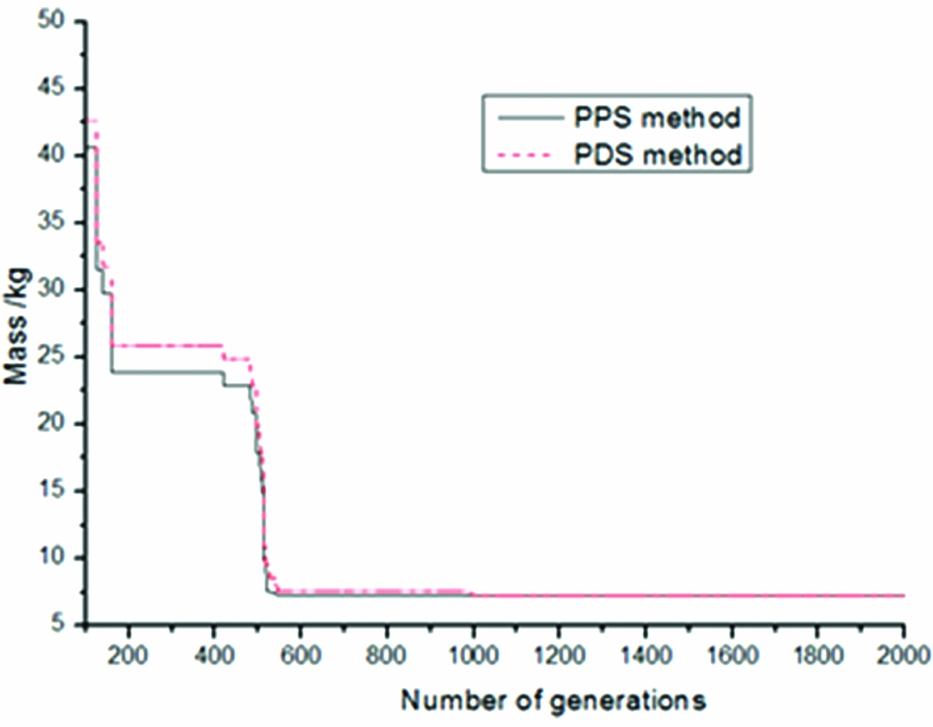
To demonstrate the efficiency of the PPS method when the number of the panels is less than the ply number compared with the PDS method, only four panels (panels 1, 2, 3 and 6) are chosen for blending optimisation design, and a guide of 20 layers is used in the coding of the guide laminate. When both symmetry and balance guidelines are enforced, the solution found in the present work weighs 7.24 kg (as shown in Fig. 5) and 500 generations are performed to reach an optimal design (Solution 3), with 510 fewer generations than the search process of the PDS method (1010 generations) with same optimal weight of 7.24 kg. Table 5 gives the optimum design of the four panels with symmetry and balance constraints using both blending models. Table 6 illustrates the stacking sequence of the optimum design for the four panels. The reason for a faster convergence speed for the PPS method is that there are fewer repeated searching points in the PPS method than in the PDS method. Because the ply number of the guide laminate is 20, and the number of panels is 4, the possible combination of the PDS method is 420*204*20! = 4.28e35. The possible combination of the PPS method is 420*205*4! = 8.44e19. The ratio of possible combinations between the proposed PPS method and the PDS method is 1/5.07e15. Table 7 summarises the total number of generations for both the 18-and 4-panel cases, using PPS and PDS approaches.
Convergence of the PPS method and the PDS method.
Optimum design of the four panels with symmetry and balance constraints

Stacking sequence of the optimum design for the four panels

Summary of the generations for both the 18- and 4-panel cases

4.0 CONCLUSIONS
Based on a previous study, we develop a PPS blending model. A three-chromosome genotype is used: chromosome of guide fibre angle θ, chromosome of guide distance integer L, and chromosome of a PPS. If the number of the panels is less than the ply number, the searching points are less than the PDS method, and the PPS method obtains a little faster convergence speed compared with the PDS method.
ACKNOWLEDGEMENTS
The support for this work by the National Natural Science Foundation of China (11402204) is gratefully acknowledged.