Relative clauses (RCs) have been studied extensively in the fields of language typology and language acquisition. Early studies have yielded support for the typological generalization called the noun phrase accessibility hierarchy (NPAH; Keenan & Comrie, Reference Keenan and Comrie1977), the systematic way in which languages differ with respect to the types of RCs they allow. Recent research, much of which has focused on the RCs of East Asian languages, has argued that these RCs do not follow the same typological or acquisitional generalization as those of European languages. Comrie (Reference Comrie and Ramat2002) has suggested that the RCs of East Asian languages should be classified as attributive clauses, whereas other researchers have highlighted less consistent empirical findings in the study of East Asian RCs compared to the RCs of European languages (e.g., Hsiao & Gibson, Reference Hsiao and Gibson2003; Ozeki & Shirai, Reference Ozeki and Shirai2007; Yip & Matthews, Reference Yip and Matthews2007). According to these researchers, the NPAH does not predict the acquisition findings of head-final RCs in East Asian languages (Ozeki & Shirai).
This article reports the results of an ongoing study of the acquisition of Korean RCs by heritage learners. The current study shows that multiple factors are involved in the heritage language production of East Asian RCs. Although the results exhibit a microcosm of previous studies that show mixed findings, it will be argued that issues raised in the literature can be adequately addressed by taking into account a number of factors, including the topicality and the animacy of the head nouns, the proficiency of the second-language (L2) learners, and the kinds of tasks used (elicited production).
THE NPAH EFFECT AND A NEW THEORY FOR THE RCs OF EAST ASIAN LANGUAGES
The NPAH is an implicational hierarchy proposed by Keenan and Comrie (Reference Keenan and Comrie1977) that illustrates a crosslinguistic consistency concerning the types of RCs that a language allows—namely, if a language can relativize a given NP, then any other NP in a higher position in the hierarchy can also be relativized. Subjects are highest in the hierarchy, followed by direct objects, indirect objects, obliques, genitives, and objects of comparison. This relativizability order is preserved across 49 different languages (Keenan & Comrie).
Although the NPAH was originally formed as a typological universal, it was later extended to the order of difficulty in acquiring and processing RCs (Doughty, Reference Doughty1991; Eckman, Bell, & Nelson, Reference Eckman, Bell and Nelson1988; Gass, Reference Gass1979; J. Hawkins, Reference Hawkins2007). This extension will be called the NPAH effect (following Comrie, Reference Comrie2007) in the current study as opposed to the NPAH, which denotes the original typological generalization. The NPAH effect refers to the phenomenon that subject RCs (SRCs) seem to be easier to acquire or process than object RCs (ORCs). This term will also be used interchangeably with the terms subject-object asymmetry and subject advantage, because the current study compares only SRCs and ORCs.
Many early first-language (L1) and L2 studies found support for the NPAH effect. However, more recently, it has been claimed the NPAH effect may not hold for all languages—primarily, not for East Asian languages. These claims have, in part, been made on the basis of an alternative analysis of East Asian RCs. Comrie (Reference Comrie and Ramat2002), for example, argued that East Asian RCs are noun-modifying clauses loosely connected to the head NP through semantic and pragmatic coreference. Therefore, the relationship between the gap and the head is pragmatic rather than syntactic. According to Comrie (Reference Comrie2007), pragmatically attributive RCs are neutral to the hypotheses for the NPAH (effect), which are built upon grammatical primitives (e.g., subject, object); there is thus no prediction for an advantage of SRCs over ORCs. The ease of formation or comprehension of noun-modifying clauses may instead depend on whether speakers of the language can readily establish a plausible interpretation of the clause (Ozeki & Shirai, Reference Ozeki and Shirai2007).
It is important to note, however, that empirical findings could be compatible with a range of theories. Because the underlying causes of the NPAH effect are not yet clearly understood, it is not clear whether the NPAH effect will hold in noun-modifying RCs. Kwon, Polinsky, and Kluender (Reference Kwon, Polinsky, Kluender, Bumer, Montero and Scanlon2006), for example, showed that there is a processing advantage for both the subject gap in Korean RCs and subject pro-drop in Korean adjunct clauses. As the authors suggested, there may be some processing advantages of the empty categories in subject position regardless of the structural or pragmatic status of the clauses. Therefore, empirical findings in East Asian RCs should be sought independently of changes in theoretical claims.
EAST ASIAN HEAD-FINAL RCs: EMPIRICAL FINDINGS
Empirical findings on the SLA of head-final East Asian RCs are far from conclusive (Hasegawa, Reference Hasegawa2007; Jeon & Kim, Reference Jeon and Kim2007; Kanno, Reference Kanno2000, Reference Kanno2001, Reference Kanno2007; Lee & Lee, Reference Lee and Lee2004; O’Grady, Lee, & Choo, Reference O’Grady, Lee and Choo2003; O’Grady, Yamashita, Lee, Choo, & Cho, Reference O’Grady, Yamashita, Lee, Choo and Cho2000; Ozeki & Shirai, Reference Ozeki and Shirai2007; Roberts, Reference Roberts2000; Tarallo & Myhill, Reference Tarallo and Myhill1983; Yabuki-Soh, Reference Yabuki-Soh2007; Yip & Matthews, Reference Yip and Matthews2007). With respect to the NPAH effect in particular, inconsistent findings have been reported even within the same language. There may be several factors that explain this inconsistency, the most tempting being different L1s. However, this hypothesis does not seem to explain the data fully, as studies with the same target language and L1 background have reported opposing results: Kanno (Reference Kanno2000, Reference Kanno2001) showed the NPAH effect in L2 Japanese, whereas Tarallo and Myhill (Reference Tarallo and Myhill1983) did not. Moreover, depending on the task, there have been contrasting findings sometimes even within a single study with the same group of participants (e.g., Roberts).
Another possible explanation is learner proficiency. It could be that the widely inconsistent findings among different L2 studies are the result of different learner profiles. It is unfortunate, however, that most L2 RC studies do not report the proficiency level of participants; it is thus impossible to gauge the role that proficiency might play.
Additionally, different methodologies may have contributed to the mixed results. It is interesting to note that there is a noticeable difference in findings depending on the task(s) used: Studies that used a picture selection comprehension task (Hasegawa, Reference Hasegawa2007; Kanno, Reference Kanno2000, Reference Kanno2007; Lee & Lee, Reference Lee and Lee2004; O’Grady et al., Reference O’Grady, Yamashita, Lee, Choo and Cho2000, Reference O’Grady, Lee and Choo2003), an elicited production task (Hasegawa; Jeon & Kim, Reference Jeon and Kim2007; O’Grady et al., Reference O’Grady, Yamashita, Lee, Choo and Cho2000), or a sentence combination task (Kanno, Reference Kanno2000; Ozeki & Shirai, Reference Ozeki and Shirai2007; Roberts, Reference Roberts2000; Yabuki-Soh, Reference Yabuki-Soh2007) generally showed evidence for the NPAH effect. In contrast, studies that used a grammaticality judgment task (Tarallo & Myhill, Reference Tarallo and Myhill1983), sentence comprehension task (Roberts; Yabuki-Soh), or naturalistic data (Ozeki & Shirai; Yip & Matthews, Reference Yip and Matthews2007) showed little evidence for the NPAH effect.
Some of the tasks used in previous studies are not without problems or limitations, or both. For example, it is not clear how a grammaticality judgment task and a sentence comprehension task can test the construct of processing difficulty. Given that incorrect grammaticality judgments or misinterpretations of an item could be due to many reasons other than processing difficulty, it seems unreasonable to conclude that these tasks measured the construct that underlies the NPAH effect. Naturalistic or spontaneous speech data also have limitations in that the mere emergence of a structure cannot be considered evidence of acquisition. The data may simply reflect the high frequency of a SRC or an ORC context in the discourse. Without an obligatory context for a particular structure, the emergence or usage in natural production can say little about the difficulties of SRCs compared to ORCs. Finally, the picture identification comprehension task, the most popular type of task used in previous studies, has limitations in that it is difficult to locate the exact locus of error. In such a task, participants who do not know a given RC structure may still appear to perform well. For example, it may appear that a learner has correctly identified the head of an English SRC when in fact he or she has misunderstood the SRC as a declarative statement and picked out the first noun (i.e., the first noun strategy as described in O’Grady et al., Reference O’Grady, Lee and Choo2003).
The elicited production task—although not without its own limitations (e.g., potential data coding ambiguity and possible avoidance or paraphrases, which should be carefully accounted for during data analysis)—thus seems to have several important advantages. First, performance is more transparently observed in production than in comprehension tasks because participants have to provide explicit responses. Second, error patterns observed in production data can provide richer information for the evaluation of interlanguage grammars. Finally, unlike naturalistic data, with the elicited production task, there is more control over what speakers will say. For example, the effect of differential frequency of SRC versus ORC contexts, which is a concern in using naturalistic production data, can be controlled.
Empirical findings with respect to animacy are also worth noting. Some recent L2 studies have cited a role of animacy in relativization. For example, Ozeki and Shirai (Reference Ozeki and Shirai2007), following Comrie’s (Reference Comrie and Ramat2002) noun-modifying clause analysis, emphasized the role of semantic information such as animacy in the acquisition of East Asian RCs. They examined the production data of L2 learners of Japanese, which illustrated that the SRCs produced tended to have more animate heads, whereas the ORCs tended to have inanimate heads. Kanno (Reference Kanno2007) also reported that learners understood RCs better when an animacy cue was provided (i.e., semantically irreversible RCs), and Jeon and Kim (Reference Jeon and Kim2007) found that participants tended to make more errors when ORCs were associated with an animate head noun in picture description tasks.
Despite these results, the empirical findings for an animacy effect are not robust, with the majority of evidence coming from Japanese and Korean. Support for this effect also seems limited to spontaneous speech data and error analysis. Furthermore, neither Ozeki and Shirai’s (Reference Ozeki and Shirai2007) sentence combination task nor Jeon and Kim’s (Reference Jeon and Kim2007) picture description task found a main animacy effect.
The results from previous L2 studies of East Asian languages are thus inconclusive with respect to both the NPAH effect and the animacy effect. Learner proficiency and task effects may contribute to these inconsistent findings. To reveal the nature of such mixed results, it is necessary to understand and define exactly what needs to be measured. Therefore, various hypotheses regarding the cause of the NPAH effect will be briefly reviewed.
THE NPAH EFFECT: HYPOTHESES
There are three distinct accounts that attempt to explain the NPAH effect based on the idea that differential processing difficulties are associated with different gap positions. The two most popular proposals in the L2 literature have used configurationally defined characteristics: linear or structural distance. The linear distance hypothesis (LDH; e.g., Gibson, Reference Gibson1998; R. Hawkins, Reference Hawkins1989; Tarallo & Myhill, Reference Tarallo and Myhill1983) states that the difficulty in relativizing different NP positions stems from the linear distance between the head (i.e., modified) noun and the embedded gap position. The fundamental premise is that it is difficult for the human language processor to keep the filler in working memory until it encounters the gap. The longer the retention of the unresolved filler-gap dependency, the harder the RC is to parse.
The structural distance hypothesis (SDH; e.g., Cho, Reference Cho1999; O’Grady et al., Reference O’Grady, Lee and Choo2003; Wolfe-Quintero, Reference Wolfe-Quintero1992) states that subject-object asymmetry can be attributed to differences in the depth of embedding of the clause-internal gaps. In other words, the more deeply a NP is embedded, the harder it is to relativize. Therefore, the SDH predicts a universal subject advantage because the structural embedding pattern (i.e., objects are more deeply embedded than subjects) presumably holds across all languages.
Alongside these configurational accounts, the informational prominence account offers a third hypothesis. Although this explanation has not been systematically explored or proposed as a unified account for the NPAH, this line of thinking has been proposed in various forms in both the linguistics and language processing literatures (e.g., Kuno, Reference Kuno1987; Schachter, Reference Schachter1973; Zukowski, Reference Zukowski2009).Footnote 1 The idea is that the informational prominence of a NP (or a participant of an event) is related to the ease of relativization. Subjects are more prominent and more likely to be topics in discourse and are therefore easier to relativize (e.g., Kuno’s, Reference Kuno1987, topic empathy hierarchy). As with the NPAH, these prominence hierarchies are assumed to hold for all languages.
RCs AND TOPICALIZATION IN KOREAN
The current study examines the production of Korean RCs. Korean is a head-final language with subject-object-verb (SOV) word order, and SRCs and ORCs are formed as shown in (1), where the subject gap is indicated by SG and the object gap is indicated by OG.Footnote 2
(1) a. SRC
[IP SG [VPai-lulanacwu-nun] yeca
SGkid-acc hug-rel woman
“The woman who is hugging the kid”
b. ORC
[IPYeca-ka [VP OG anacwu-nun] ai
Woman-nom OG hug-relkid
“The kid who the woman is hugging”
Relative clauses come before head nouns in Korean and include a missing argument and case marker (gap). Therefore, according to the LDH, Korean SRCs should be harder to process than ORCs because the distance between the head and the subject gap is farther than the distance from the object gap. However, the SDH and the prominence account predict the opposite: Because subjects are less embedded in the structure and more informationally prominent, SRCs are predicted to be easier than ORCs.
The current study also utilizes Korean topicalization structure. In Korean, arguments are topicalized as in (2).Footnote 3
(2) a. Subject topicalization
[CPYeca-nun[IP SG [VPai-lulanacwueyo]]
Woman-topSGkid-acc hug-decl
“The woman (topic) is hugging the kid.”
b. Object topicalization
[CPAi-nun [IPyeca-ka[VP OG anacwueyo]]
Kid-topwoman-nomOG hug-decl
“The woman is hugging the kid (topic).”
Either the subject or the object can become the topic of a sentence through fronting and marking with a topic marker. Topic is the highest structural and foremost linear position of the sentence as well as the most prominent in the information structure. Specific predictions can thus be made with respect to the relativization of topicalized NPs in Korean. First, when topicalized, NPs should become easier to relativize according to the SDH and the prominence account because the topic position is the highest structural and most prominent position. The LDH predicts that topicalized NPs will be harder to relativize because the linear distance from the head to the topic becomes greater. In other words, the predictions of the SDH and the prominence account again cluster together in opposition to the LDH.
With regard to subject-object asymmetry in relativization, all three hypotheses make the same prediction: Any asymmetry will disappear if arguments are topicalized. When subjects and objects are topicalized, they are placed in a configurationally and pragmatically equivalent position (i.e., the specifier of the focus phrase; the topic position). Therefore, the topicalization of a NP should nullify any subject-object asymmetry or NPAH effect associated with relativization. It is important to note that the SDH, the LDH, and the prominence account all converge on this prediction.Footnote 4
HERITAGE SPEAKERS
The participants of the current study were Korean heritage speakers, defined as individuals who were exposed to Korean during childhood, usually at home, but who did not learn Korean to full capacity (Polinsky & Kagan, Reference Polinsky and Kagan2007). It is usually the case that heritage speakers’ L1 acquisition is interrupted by a more dominant L2 (in this case, English), resulting in incomplete acquisition or language loss in their heritage language (Montrul, Reference Montrul2008; Polinsky, Reference Polinsky2008). The decision to test only heritage speakers (and native controls) was not made with the purpose of examining research questions particular to heritage speakers. Rather, the choice of heritage speakers was considered to confer two advantages over L2 learners. First, they have been exposed to Korean relatively frequently in naturalistic settings, and so it is likely that they have been exposed to RCs. Because RCs are one of the most complex structures of a language, such a population was considered desirable compared to the typical L2 learners available in a university setting, who are usually beginners and are therefore less likely to have been exposed to the target structure on a regular basis. Because the elicited production task used in the current study requires production of explicit responses, this was considered an important advantage. Second, heritage learners—who are less likely to have received formal instruction on RC structures—are expected to exhibit less reliance on explicit knowledge than classroom-taught foreign language learners, which is desirable for the examination of implicit linguistic competence and processing difficulties.
Although it is still possible that some findings in the current study may be specific to the heritage population, the main questions of the current study (i.e., the effects of the NPAH, animacy, and topicalization) seem uniformly applicable to different learner populations, including both L2 and heritage speakers. In fact, previous studies on relativization reported similar findings for heritage and L2 speakers with respect to the NPAH and animacy (e.g., Jeon & Kim, Reference Jeon and Kim2007; Polinsky, Reference Polinsky2008). However, it is not the author’s intention to claim that the findings from the current heritage speaker participant data should be generalizable to L2 speakers. Rather, the claim is that the issues of interest in the current study can be investigated equally effectively with heritage speakers. In other words, independent of the similarities and differences between heritage and L2 learners (see Montrul, Reference Montrul2008), the NPAH effect as well as the effects of animacy, topicalization, and proficiency on relativization should be testable with heritage speakers as well as with L2 learners.
RESEARCH QUESTIONS
Based on a review of the literature, three factors in relativization were considered relevant to the current study: gap position (i.e., subject vs. object), animacy of the head noun (i.e., ± animate), and topic-hood (i.e., canonical vs. topicalized). Gap position was manipulated to examine whether the subject advantage predicted by the SDH and the prominence account would be observed in relativization in Korean. Animacy was manipulated in response to the recent claim that semantic information, such as animacy, is a better predictor of the ease of processing and acquisition of East Asian RCs. Finally, manipulation of topicalization was included to examine whether it indeed nullifies subject-object asymmetry in relativization as predicted by all three accounts for the NPAH. Additionally, learner proficiency was also measured to address this gap in the literature. The main goals of the current study can be summarized in four research questions:
1. Will Korean heritage speakers produce SRCs more accurately than ORCs in the elicited production of RCs? In other words, will a NPAH effect be found?
2. Will topicalized arguments be easier to relativize than arguments in situ (as predicted by the SDH and the prominence account)?
3. Will topicalized subjects and objects be equally difficult to relativize (as predicted by the SDH, the LDH, and the prominence account)?
4. Will animate SRCs and inanimate ORCs be more accurately produced than inanimate SRCs and animate ORCs? In other words, will an animacy effect be found?
METHOD
Participants
Twenty-one heritage speakers of Korean and 13 Korean native speakers participated in the current study. Most of the heritage speakers were enrolled in a first- or second-semester Korean course designed specifically for heritage speakers at the University of Maryland. Although all were exposed to Korean almost exclusively until the age of 3 or 4, their dominant language switched to English as they began to attend daycare or preschool. Their self-reported amount of Korean language use varied from 5% to 40% daily, and their performance on a Korean C-test also varied widely. The Korean native speakers were all late L2 learners of English, enrolled in graduate programs at the University of Maryland. Their length of residence in the United States ranged from 6 months to 6 years.
Materials
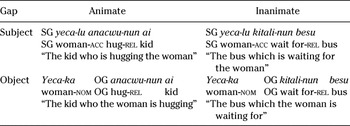
An elicitation task similar to the one in Zukowski (Reference Zukowski2009) was used. The task included computerized pictures designed to elicit specific RC types. A 2 × 2 × 2 design was used with Gap type (subject vs. object), Animacy of the head noun (± animate), and Lead-in type (canonical vs. topicalized) as factors. Table 1 shows the four conditions based on gap type and animacy manipulations (the two lead-in conditions will be described separately).
Gap position and animacy manipulations

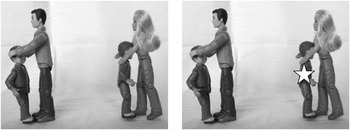
The materials consisted of a base picture that introduced two identical characters or objects engaged in different actions and a second picture that exhibited a star on one of the characters or objects. The participants’ task was to verbally indicate which character or object was marked by the star, which created an obligatory context for the production of a RC. In the set of pictures designed to elicit SRCs, the star appeared on the agent, whereas in pictures eliciting ORCs, the star appeared on the theme. An example picture set designed to elicit an ORC is given in Figure 1.
A sample item eliciting an animate object-gapped RC.

In each trial, participants were first shown the base picture and the experimenter provided a lead-in, which was a simple declarative sentence that described the picture. Two types of lead-in sentences were used in the first picture description. In the canonical condition, a description in canonical word order (i.e., SOV) was provided, whereas in the topicalized condition, lead-in sentences had topicalized word order (i.e., SOV in SRC elicitation and OSV in ORC elicitation). The sentences in (3), which were used to elicit ORCs for the pictures shown in Figure 1, provide examples of both types of lead-ins and of the prompt used to elicit the participant’s response.Footnote 5
(3) a. Canonical lead-in
I namca-ka i ai-lulanacwueyo.
This man-nomthis kid-acc hug-decl
Kuliko i yeca-ka i ai-lulanacwueyo.
And this woman-nomthis kid-acc hug-decl
“This man is hugging this kid, and this woman is hugging this kid.”
b. Topicalized lead-in
I ai-nuni namca-ka anacwueyo.
This kid-top this man-nom hug-decl
Kulentey i ai-nuni yeca-ka anacwueyo.
But this kid-top this woman-nom hug-decl
“This kid, this man is hugging, but this kid, this woman is hugging.”
c. Second picture prompt
Edi-ey byel-i iss-eyo?
Where-loc star-nom is-q?
“Where is the star?”
Six token picture sets in eight conditions created 48 trials total. The order of presentation was counterbalanced other than blocking for lead-in types: Topicalized lead-ins were used after all canonical lead-in trials were finished to preserve comparability of the canonical condition results with previous studies. Given that topicalized lead-ins were hypothesized to facilitate RC production, using this type of lead-in first could result in a priming effect. This would mean that the results from the canonical condition of the current study would not be directly comparable to previous studies. Additionally, the experiment included a Korean C-test. A C-test is a variation of a cloze test that measures general proficiency. This test was independently validated, and the test description and actual test battery are available in Lee-Ellis (Reference Lee-Ellis2009).
Procedure
The experiment was conducted in a lab at the University of Maryland. The investigator’s laptop was connected to a second monitor that faced the participant sitting opposite. In the base picture description stage, the experimenter pointed at one of the identical characters on the participant’s monitor and provided a lead-in description as in (3). For the second picture, the experimenter looked at her own laptop monitor. Participants were told that because there was no star on the investigator’s monitor, they would have to tell the investigator where the star appeared. At least two practice trials were included to help the participants become familiar with the task. The whole experiment was recorded on the investigator’s laptop using Audacity software. The main elicitation experiment took 20–35 min. Participants were given the C-test after the main experiment.
Data Coding and Analyses
The recorded responses were transcribed by the investigator. There were no unclear recordings, but they were, nevertheless, double-checked for any potential errors in transcription. The data were coded for targetlike responses and 21 different types of nontargetlike responses, which, in turn, were classified into 10 categories (see the appendix for coding examples). Targetlike responses included the production of RCs with a gap in the expected position and appropriate case markings. Additionally, case marker or argument omission in information-recoverable contexts were also considered targetlike, in contrast to some previous L2 Korean studies (e.g., Jeon & Kim, Reference Jeon and Kim2007).Footnote 6
Nontargetlike responses were coded according to three criteria: targetlikeness, task sufficiency (i.e., whether the elicited response provided sufficient information to complete the task), and grammaticality. Nontargetlike responses included grammatical alternatives, task-insufficient responses, and ungrammatical responses. The first type included responses that were not necessarily errors but rather alternative responses: Although not the same as the targeted RC form, these were grammatically acceptable alternatives, including passivization, decausativization, and circumlocution. Another type of nontargetlike response is the grammatical but task-insufficient response. A head-internal RC (HIRC), another possible RC construction in Korean, falls under this task-insufficient category. In HIRCs, there are no gaps in the modifying RCs, and a bound noun kes “thing” is placed in the head position, as shown in (4).
(4) HIRC
[Yeca-ka ai-lul anacwy-nun] kes
woman-nom kid-acc hug-rel thing
“The woman who is hugging the kid/The kid who the woman is hugging”
Because there is no gap in the HIRC and no marker to indicate the head noun, the head in (4) can be either yeca “woman” or ai “kid,” which potentially creates ambiguity. Although this ambiguity can sometimes be resolved from the context or the verb’s subcategorization, in the current controlled elicitation task, the ambiguity remains. For example, if the HIRC in (4) were used to describe Figure 1, it would be impossible to tell whether the star was on the agent the woman or on the theme the kid. Given that the task was set up in such a way that the naïve listener looking at a different monitor should have been able to use the participant’s response to place the star on a specific character, participants should have been aware of this ambiguity and the possibility for miscommunication. Therefore, a HIRC used in this experimental context was considered to be a nontargetlike response due to its task insufficiency.
Finally, ungrammatical responses included true errors that would cause incorrect form-meaning mapping or structurally ill-formed sentences. These errors included case errors, head reversals, head omissions, incorrect heads, an extra head copy before or after a (HI)RC, and the failure to produce a RC at all.
Some deviant responses were not coded because of their irrelevance to the purpose of the task. For example, lexical substitutions or errors (e.g., the substitution of ai “kid” with aki “baby”) were not penalized, and morphological errors (e.g., present-progressive relativizer –nun instead of past-perfective relativizer –un) were also considered acceptable. Additionally, after preliminary analysis, participants who showed uninterpretable evidence of RC knowledge and two items that appeared to cause specific verb effects were removed.Footnote 7 One inanimate SRC and 1 animate ORC item were removed, leaving 11 SRC (6 animate, 5 inanimate) and 11 ORC (5 animate, 6 inanimate) items. Given the resulting different numbers in each condition, subsequent analyses were conducted using percentage scores rather than sums or frequencies.
In terms of proficiency scoring, Rasch model analysis (Bond & Fox, Reference Bond and Fox2007) of the C-test was used. Rasch, a one-parameter item response theory model, is an assessment tool that accounts for relative item difficulty and person ability, thus providing a more reliable and defensible scoring and summing of the data collected. To obtain a better estimation of proficiency using Rasch analysis, the C-test scores of the participants of the current study were analyzed along with the scores of an additional 26 participants from another study, resulting in a sample size of 47 participants total (see Lee-Ellis, Reference Lee-Ellis2009, for more details about Rasch analysis and C-test validation).
RESULTS
Group Results
Group data were examined for effects of gap position, animacy, and lead-in type. In the canonical lead-in block, a 2 (Gap position) × 2 (Animacy) repeated-measures ANOVA was carried out on the targetlike response rate. No significant main effect for gap position was found, F(1, 16) = 0.03, p = .862, nor was there a main effect for animacy, F(1, 16) = 1.51, p = .22. The interaction effect was also nonsignificant, F(1, 16) = 0.09, p = .75, which indicates there was no statistically significant effect observed in any of the subcomparisons.
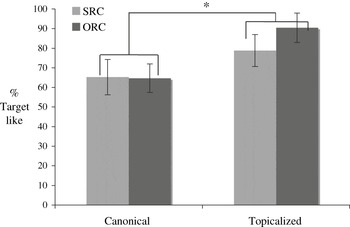
In contrast, a lead-in effect was found when the targetlike response rates across the canonical lead-in block and topicalized lead-in block were compared. A two-way repeated-measures ANOVA (Lead-in × Gap) revealed a significant main effect for lead-in type, F(1, 16) = 5.41, p < .05, but no main effect for gap position, F(1, 16) = 0.46, p = .49, or interaction effect, F(1, 16) = 0.39, p = .53, which indicates that the topicalized lead-in was facilitative to RC production in all subconditions. Figure 2 illustrates the mean targetlike scores in each condition.
Group results comparing lead-in conditions. *p < .05

In sum, the group results exhibit no gap position or animacy effect in the targetlike RC production score. However, lead-in type has a statistically significant effect, which illustrates the facilitative role of topicalized lead-ins. Although the group results of the current study do not reflect the gap-position or animacy effects reported in the literature, as Eckman (e.g., 2007) noted, the apparent null effect in group data may obscure the effects present in individual interlanguage grammars. Therefore, individual response patterns were examined as well.
Individual Results
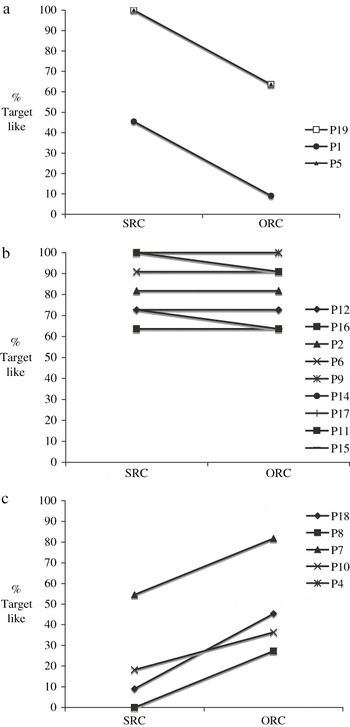
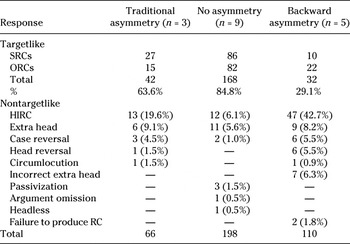
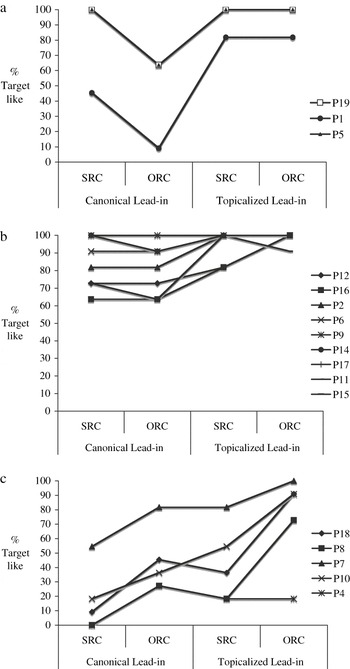
Gap-Position Effect in the Canonical Lead-in Block.Figure 3 illustrates all three response patterns in the canonical lead-in condition. A participant who performed equally well on both SRCs and ORCs was classified as exhibiting no asymmetry. In contrast, participants who showed more than a two-token difference were classified as exhibiting either traditional asymmetry (i.e., SRC > ORC) or backward asymmetry (i.e., SRC < ORC). As shown in Figure 3, all three possible response patterns emerged during individual analysis. Three participants performed better in the SRC condition (Figure 3a). However, five participants exhibited backward asymmetry (Figure 3c), whereas the majority (n = 9) exhibited no asymmetry (Figure 3b). Given these different individual performances, the error patterns of these participants were scrutinized to determine whether any systematic error patterns could be observed across the groups of different response patterns. Table 2 presents the detailed response patterns of the three groups.
Individual data showing a gap position effect among (a) traditional asymmetry (n = 3), (b) no asymmetry (n = 9), and (c) backward asymmetry (n = 5) participants.

Response type tokens by group

Of all the nontargetlike responses, the most common type was the HIRC, which is task insufficient in the current experimental context. Despite the ambiguity that this structure causes, participants often resorted to HIRCs, an easier alternative to the head-external RC (Cho, Reference Cho1999; Jeon & Kim, Reference Jeon and Kim2007; Kim, Reference Kim1987). In terms of targetlike response rate, the no asymmetry group performed best, achieving 84.8% accuracy. The traditional asymmetry group also produced more targetlike (63.6%) than nontargetlike responses (36.4%). These results demonstrate that these two groups have good command over Korean RC structures. In contrast, the backward asymmetry group produced more nontargetlike responses (70.9%). The backward asymmetry group also produced more ungrammatical responses than the other groups. Whereas the nontargetlike responses produced by the traditional asymmetry and no asymmetry groups are almost exclusively grammatical alternatives (e.g., HIRCs, circumlocution, passivization) or responses assumed to compensate for processing difficulty (e.g., an extra head), the backward asymmetry group’s responses include ungrammatical responses, some of which reflect more serious violations of the grammar (e.g., incorrect heads, case reversal, head reversal, failure to produce a RC).
Finally, it should be noted that the backward asymmetry participants showed very frequent recourse to HIRCs (42%). This high rate of HIRCs may reflect an avoidance strategy—that is, speakers may avoid using gaps because they are more difficult to process (e.g., Cho, Reference Cho1999; Kim, Reference Kim1987). Combined with the fact that this group produced more ungrammatical responses, the use of an avoidance strategy seems to indicate that the backward asymmetry participants are the least competent in RC production.
Further examination of the response patterns of all individuals reveals a specific pattern among those who exhibit backward asymmetry. These participants adhere rather strictly to a particular word order pattern for their attempted RC responses. For example, participant 7 (P7) produced the structure [NPnom Vrel] NP in most trials, regardless of the target RC type. Therefore, his ORC production (i.e., [Snom Vrel] O) was almost perfect (82%), but his SRC production included case and head reversal errors. Even in the SRC elicitation context (i.e., [Oacc Vrel] S), this participant produced the structure [NPnom Vrel] H, either by substituting a case marker from the accusative to nominative in the embedded argument (i.e., [Onom Vrel] S) or by reversing the head from subject to object (i.e., [Snom Vrel] O). The consequence of substitution is a change in event structure (i.e., the subject and object are reversed), whereas reversal is a change in the focused element (i.e., the head noun changes from subject to object), which produces an incorrect message. Moreover, even though P7 produced six targetlike SRC constructions (54% accuracy), he omitted case markers in all of these responses ([OØ Vrel] H), which thus contained no fully specified SRC (i.e., [Oacc Vrel] H). These findings suggest a strict adherence to a particular word order ([NPnom V] NP) regardless of task condition. Perhaps not coincidentally, this word order conforms to the basic English word order, SVO.
The rest of the participants in the backward asymmetry group (P4, P8, P10, and P18) showed a similar word order effect but included many productions of HIRCs (i.e., [Snom Oacc Vrel] kes) in addition to the [Snom Vrel] O pattern. During ORC elicitation, these participants produced both the target form (34%) and HIRCs (42%). However, during SRC elicitation, they produced no fully specified targetlike SRCs—successful SRC production (7%) included case omission—and used many HIRCs (52%). Two participants (P18, P4) also showed head reversal errors in SRCs similar to those of P7, converting SRCs ([Oacc Vrel] S) to ORCs ([Snom Vrel] O). Taken together, participants who exhibited backward asymmetry seem to have a bias for certain word order patterns—namely, [NPnom Vrel ] NP or [NPnom NPacc Vrel] kes.
The results of the native-speaker controls also deserve attention. Of the 13 native speakers, 8 exhibited 100% targetlike performance in all conditions, and the overall range of targetlike responses was very high (SRCs: 96.5%; ORCs: 94.4%). However, two native speakers performed better on SRCs than ORCs by more than two tokens, exhibiting traditional asymmetry. A passivization strategy was observed in two items by two native speakers—namely, the production of the passivized SRC the man that is loved by the kid in place of the target ORC the man that the kid loves. Additionally, four head errors, whereby an incorrect referent was chosen as the head (e.g., O’Grady et al., Reference O’Grady, Lee and Choo2003), were made by two native speakers (one and three errors, respectively). For example, in the ORC elicitation that targeted [the woman- nomhug- rel] the boy, meaning “the boy who the woman is hugging,” the nontargetlike response was [the boy- acchug- rel] the woman, meaning “the woman who is hugging the boy.” In these responses, the event structures are correctly captured (i.e., the woman is the agent and the boy is the theme), but the response failed to correctly describe which character was marked by the star. Finally, seven HIRCs were produced by three native speakers; five of these were produced by a single participant (three SRCs and two ORCs). However, this particular participant added a description to disambiguate the correct head noun, unlike most heritage participants that utilized HIRCs.
Lead-In Effects.Figure 4 illustrates the comparative performance of the three groups of heritage participants in the canonical condition and topicalized condition. As shown in Figures 4a and 4b, the traditional asymmetry and the no asymmetry groups behaved as predicted. Their performance improved in the topicalized condition, and their SRC and ORC performances were equally good. In fact, their performance approached ceiling level in the topicalized lead-in condition. However, the backward asymmetry group (Figure 4c) behaved differently. Although, in general, these participants improved in the topicalized lead-in condition, they continued to do better with ORCs than SRCs, even in the topicalized condition. These participants also made case reversal (16.4%) and head reversal errors (14.5%) in the topicalized SRC elicitation, just as in the canonical lead-in condition. Finally, native speakers produced targetlike forms almost exclusively (SRCs: 99.3%; ORCs: 97.2%), with the exception of one HIRC and four passivized ORCs.
Individual results showing interaction between gap position and lead-in among (a) traditional asymmetry (n = 3), (b) no asymmetry (n = 9), and (c) backward asymmetry (n = 5) participants.

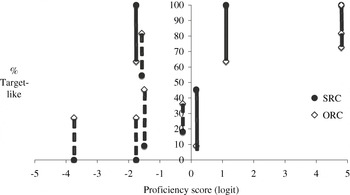
Proficiency Effects. The C-test results were analyzed using Rasch measurement statistics, which provide stable estimations of examinee ability (i.e., person measure) and item difficulty (i.e., item measure). The proficiency of the participants in this analysis is expressed as a person measure using a standardized scale (i.e., logit) relative to the average examinee ability level (set to 0). In other words, a negative logit score indicates a lower-than-average proficiency and a positive score indicates a higher-than-average proficiency.
Figure 5 shows the distribution of participants who showed asymmetric responses. Participants who performed better on SRCs than ORCs are marked with solid lines, whereas participants who performed better on ORCs are marked with dotted lines. With the y-axis representing the targetlike response rate, the longer a participant’s line is, the greater the asymmetry.
Individual results showing interaction between proficiency and grammar type. Only participants (from both heritage- and native-speaker groups) that demonstrated asymmetry were plotted. Solid lines show individuals with traditional asymmetry and dotted lines show individuals with backward asymmetry. Native speakers, who were given a logit score of 4.8, appear at the top right.

As shown in Figure 5, backward asymmetry participants tend not only to be lower in their RC performance but also to have lower proficiency scores, with all scoring below the mean of 0. In contrast, two of the three traditional asymmetry participants were among the highest proficiency scorers in the sample population. Although individuals with no asymmetry were not plotted in Figure 5, they were situated in the intermediate proficiency level ranging from –1.5 to 0.5 logit scores. In sum, proficiency scores increased from backward asymmetry participants to no asymmetry participants to traditional asymmetry participants.
Animacy Effect. Animacy was examined to determine whether an effect was obscured by the group data, as was the case with the gap-position effect. Individual analysis revealed that two participants (P7, P18) showed an advantage for animate over inanimate SRCs, whereas four participants (P1, P2, P6, P12) showed an advantage for inanimate over animate ORCs by one or two items. However, more participants exhibited performance in opposition to this prediction, and no participant followed the pattern that the animacy effect predicts for both SRCs and ORCs (i.e., better performance with animate SRCs and inanimate ORCs). Therefore, the animacy effect cited in previous literature was not found here, even at the individual level.
DISCUSSION
The results of the current study indicate no significant differences among gap types in the group data, but, as shown in the individual data analysis, participants displayed a subset of every possible pattern: a SRC advantage, an ORC advantage, or no asymmetry. The SRC advantage and no asymmetry participants, who conform to the NPAH, tended to exhibit no asymmetry in the topicalized condition and at higher levels of proficiency. In contrast, the backward asymmetry participants, who appeared to apply a word order strategy, maintained backward asymmetry even in the topicalized condition and exhibited lower levels of proficiency. Therefore, the varying grammar patterns observed in the current study do not seem arbitrary.
These mixed findings reflect a similar variation found in the literature. To understand why such variation exists, it is useful to reconsider the factors relevant to the processing of RCs as well as how these factors influence production. The NPAH effect, for example, is a universal principle that should hold for all languages—including interlanguages—all other things being equal (J. Hawkins, Reference Hawkins2007). In reality, as Hawkins pointed out, things are usually not equal; at times, the collective influence of these other things may obscure the transparent observation of language universal effects, an idea supported by the findings of the current study. The different factors that seem to play a role in the production of RCs—including word order isomorphism, language universals, proficiency, and task demands—should be discussed.
Word Order Isomorphism: General Learning Strategies
One interesting finding of the current study is the response pattern of the backward asymmetry participants, which showed word order strategies that utilize both English main clause word order (SVO) and basic Korean word order (SOV). The effect of word order isomorphism with respect to relativization has been discussed in the literature (e.g., Bever, Reference Bever and Hayes1970; Diessel & Tomasello, Reference Diessel and Tomasello2000, Reference Diessel and Tomasello2005; Yip & Matthews, Reference Yip and Matthews2007). According to Diessel and Tomasello (Reference Diessel and Tomasello2000, Reference Diessel and Tomasello2005), the subject advantage in relativization in languages like English can be (at least partly) attributed to the similarity between a SRC (i.e., NPS [RC V NPO]) and a simple main clause (NPS V NPO). Yip and Matthews (Reference Yip and Matthews2007) also provided unambiguous support for the word order isomorphism account. Cantonese creates word order isomorphism between the main clause (NPS V NPO) and ORC ([NPS V] NPO) but not the SRC ([V NPO] NPS). Given this rare parallelism between main clause and ORC word orders, Yip and Matthews (Reference Yip and Matthews2007) found that ORCs emerged earlier than SRCs in the naturalistic production data of three Cantonese-English bilingual children.
It is interesting to note that the ORC advantage reported in Yip and Matthews (Reference Yip and Matthews2007) was also found in the backward asymmetry participants of the current study. Korean-English bilinguals are exposed to both SVO (English) and SOV (Korean) word order, unlike Cantonese-English bilinguals, who speak languages that both have SVO word order. Furthermore, unlike spoken Cantonese, Korean ORCs and HIRCs are not identical to the main clause structure. In a Korean RC, the existence of a gap and a relativizer could provide a clue about the structural differences between a simple main clause and a RC. Therefore, it may seem somewhat surprising that an English main clause word order effect is found in the production of Korean RCs.
It should be noted that this proposed word order effect seems to stem from processing difficulties or a performance deficit rather than a knowledge deficit. All of the participants included in the analysis produced at least some targetlike RCs, and three of the five who showed an ORC advantage produced at least one targetlike SRC. Therefore, the deviant responses cannot be the result of a grammatical knowledge deficit; rather, they show the relative processing facilities associated with more commonly used word order patterns. To adopt Diessel and Tomasello’s (Reference Diessel and Tomasello2005) proposal, the main clause word order pattern may have been more activated in the backward asymmetry group, thus facilitating the production of other structures that have similar patterns. Such an account could explain why a sort of priming effect might have occurred in this study, despite the lack of complete similarity between the structures involved.
It is also important to note that the nature of this ORC advantage seen in the backward asymmetry group is qualitatively different from the SRC advantage seen in the traditional asymmetry group: The data from the topicalized condition reveal the irrelevance of backward asymmetry to the NPAH effect.
The Effect of Topicalization and Language Universals
With respect to lead-in manipulation, topicalized lead-ins were predicted to neutralize the differential effect between the SRC and ORC, because the factors assumed to cause the NPAH effect (e.g., linear distance, structural distance, topic-hood) are all equalized through topicalization. However, such a prediction was confirmed with only the traditional asymmetry and no asymmetry groups. The backward asymmetry participants, in contrast, were unaffected by the fact that the relevant factors were neutralized in the topicalized condition.
The fact that only the backward asymmetry participants were unaffected in topicalized condition is significant in two ways. First, it provides independent evidence to separate the backward asymmetry group from the other two groups. This provides stronger support for the conclusion that the participants who exhibited backward asymmetry are indeed qualitatively different from the other two groups. Second, the results suggest that the backward asymmetry participants’ behavior is independent of the factors that underlie the NPAH. The persistent backward asymmetry in the topicalized condition, in which the NPAH effect has supposedly been neutralized, must have been caused by something outside the domain of the NPAH effect.
These findings raise an interesting question with respect to the status of the NPAH and language universals. In the literature, it has often been claimed that backward asymmetry would be true counterevidence to the NPAH effect (J. Hawkins, Reference Hawkins1987; Yip & Matthews, Reference Yip and Matthews2007). However, if the backward asymmetry found in the current study was driven by a completely different factor from that which underlies the NPAH effect, it is unclear whether these backward asymmetry results form counterevidence to the language universal.
Nevertheless, it might still be argued that such a finding raises questions about the strength of the claim that the NPAH is a universal constraint on grammar. The strongest claim about a language universal would be that it applies to all learners independent of the language. In fact, many previous studies seem to have implicitly accepted the NPAH effect in the strongest sense, thus predicting the NPAH effect to be found in SLA regardless of the learners’ L1 background. However, as shown in the current study as well as by the mixed findings in the literature, such application of a language universal may be too simplistic to capture the complexity of language acquisition. In fact, this interpretation is based on the original notion of the NPAH as a constraint on grammar. Once the notion has been extended to a constraint on language processing—namely, the NPAH effect—the strength of the claim should be reduced.
In L2 processing and SLA, despite the operation of language universals as shown in the traditional asymmetry and native-speaker participants in the current study, various additional factors may influence a learner’s developing language, including L1 transfer (e.g., Kanno, Reference Kanno2007), word order isomorphism (e.g., Yip & Matthews, Reference Yip and Matthews2007), and animacy (e.g., Ozeki & Shirai, Reference Ozeki and Shirai2007). These other factors may sometimes override the effect of language universals in the measures of language acquisition and processing. Therefore, as J. Hawkins (Reference Hawkins2007) stated, these multiple factors should be considered to work together in language acquisition and processing. The current study provides support for such a multifactor approach to RC production, with evidence in support of both learning strategies and language universals.
Some Speculations on the Cause of the NPAH Effect
Although the current study cannot disentangle different accounts of the NPAH effect completely, when combined with a review of the literature, the results do provide some insight into this question. Topicalization had a facilitative effect in relativization, consistent with the SDH and the prominence account. This finding highlights the fact that the prominence account, which has received relatively little attention in the literature, deserves further consideration.
In previous studies that reported traditional asymmetry in Korean RC acquisition, the SRC advantage was interpreted as evidence in support of the SDH and counterevidence to the LDH (e.g., Cho, Reference Cho1999; O’Grady et al., Reference O’Grady, Yamashita, Lee, Choo and Cho2000, Reference O’Grady, Lee and Choo2003). However, an equally viable explanation can be caged in terms of topic-hood, or prominence. As captured by Kuno’s (Reference Kuno1987) topic-hood constraint and Schachter’s (Reference Schachter1973) foregrounding analysis of RCs, the subject advantage may be caused by the fact that the subject is often the most prominent argument in the discourse or informational structure. Such an explanation complements the definition of RCs. In Keenan and Comrie’s (Reference Keenan and Comrie1977) original article about the NPAH, RCs were semantically defined: Any syntactic object can be considered for a RC construction if it specifies a set of objects as a domain of relativization (i.e., head noun). The domain is then restricted to some subset of these objects for which a certain sentence (i.e., the RC) is true. Therefore, the head noun, the domain of relativization, is what the restricting clause (i.e., the RC) is about, the topic. It therefore follows that the more topiclike an argument, the easier it is to relativize.
Additionally, the prominence account may also explain a common type of relativization error called head errors, defined as the selection of a wrong head in relativization (Arnon, Reference Arnon, Brugos and Ha2005; Hsu, Hermon, & Zukowski, Reference Hsu, Hermon and Zukowski2009; O’Grady et al., Reference O’Grady, Lee and Choo2003; Zukowski, Reference Zukowski2009). Zukowski (Reference Zukowski2009), for example, claimed that head errors in the production of ORCs reflect a message-level confusion about what responses should be focused on—the target head or the agent of the modifying event that serves to uniquely identify the target head. Because the production of ORCs requires learners focus on the theme—which is a less prominent argument of an event—and select this as the head noun, the ORC is more likely to cause confusion and head errors in production (see also Hsu et al., Reference Hsu, Hermon and Zukowski2009). Therefore, the notion of topic-hood and the prominence account appear to have some advantage over other accounts: They provide a potential explanation for a common type of relativization error called head errors in production and also supports the facilitative role of the topicalized lead-ins found in the current study.
Proficiency and Cross-Language Influence
One important finding of the current study is the proficiency-response pattern interaction. The backward asymmetry participants generally scored lower on the proficiency test than other groups, which indicates that beginners may rely more heavily on superficial similarity across languages. Such a finding is consistent with the results of a study by Kanno (Reference Kanno2007) on Japanese RC comprehension among beginning-level speakers from different L1 backgrounds (Chinese, Vietnamese, Indonesian, Thai, Singhalese): Participant behaviors varied as a function of word order similarity between the L1 and L2, thus demonstrating evidence of crosslinguistic influence.
Synthesizing Kanno’s (Reference Kanno2007) results with those of the low-proficiency heritage speakers in this current study, it can be tentatively concluded that beginning-level proficiency learners may rely more on general learning strategies based on the surface similarities between their L1 and L2 and are therefore more prone to crosslinguistic influence by their dominant language. However, it is important to recognize the limitations in the way proficiency information is used in the current study. Due to the limited number of participants in this study, proficiency information was only used as a post hoc explanation instead of being examined as a predictor of performance patterns. A larger scale study with different proficiency groups would have to be conducted to be able to make a more robust claim about the role of proficiency in RC production.
Lack of Animacy Effect: Pragmatic Constraint and Controlled Context
The current study also shows that the animacy of the head noun does not have an effect on the production of RCs. Given that some learners of the current study utilized a shallow surface similarity, it seems plausible some learners might also use a salient cue like animacy. However, the data from the current study do not support this supposition, in contrast to the findings of Kanno (Reference Kanno2007) and Ozeki and Shirai (Reference Ozeki and Shirai2007). The divergent results may be explained by the types of data collection used in the different studies. First, the animacy effect reported in Kanno’s (Reference Kanno2007) study may have been obtained due to the nature of the comprehension task. Kanno (Reference Kanno2007) reported that participants were better at comprehending RCs when animacy cues were present (i.e., irreversible RCs) than when there were no such cues (i.e., reversible RCs). However, Kanno’s (Reference Kanno2007) participants were reported to have had minimal exposure to RCs at the time of the test, so it is not clear whether the participants had knowledge of the RC structure. With limited competence, learners might try to comprehend the input using all available clues, which may explain why the participants did better on the RCs that contained animacy cues than the reversible RCs. However, in the elicited production task used in the current study, animacy cues alone would not be sufficient to complete the task successfully.
Furthermore, Ozeki and Shirai (Reference Ozeki and Shirai2007) used naturalistic production data. However, caution should be exercised when using naturalistic data in the examination of an animacy effect: In Japanese and Korean, inanimate subjects are pragmatically avoided, thus rendering such constructions infrequent and unnatural-sounding to native speakers. In these languages, it is often unnatural to produce sentences with inanimate subjects such as The weather makes me happy; instead, such sentences are expressed as I am happy because of the weather, with an animate subject (Sohn, Reference Sohn1999). Assuming that learners are sensitive to these distributional facts with regard to animacy and subject position, it would be natural to find that learners produce fewer SRCs with inanimate head nouns in naturalistic speech data. In other words, the correlation between animate head nouns and SRCs in this study may be a reflection of the distributional characteristics of Japanese and Korean utterances. In short, despite recent claims of the increased role of animacy in the acquisition of East Asian RCs, the empirical evidence gathered thus far is weak. Furthermore, pragmatic constraints on the use of inanimate subjects in languages like Korean should be considered when interpreting naturalistic production data.
The Effect of Task Demands and Data Coding
The findings of the current study differ from those that have been reported in previous studies on Korean RCs (Cho, Reference Cho1999; Kwon et al., Reference Kwon, Polinsky, Kluender, Bumer, Montero and Scanlon2006, for L1 acquisition; O’Grady et al., Reference O’Grady, Yamashita, Lee, Choo and Cho2000, Reference O’Grady, Lee and Choo2003; Jeon & Kim, Reference Jeon and Kim2007, for SLA by English speakers; Lee & Lee, Reference Lee and Lee2004, for Chinese-Korean bilingual children). In both the L1 and L2 literature, virtually all Korean RC studies have reported a SRC advantage. Therefore, it seems unclear at first why previous L2 studies consistently reported a SRC advantage, whereas the current study found a subset of participants who exhibited an ORC advantage.
One explanation can be found in the different experimental paradigms and tasks adopted in previous RC studies. The most popular method used in Korean RC studies has been the picture selection comprehension task used by Cho (Reference Cho1999), O’Grady et al. (Reference O’Grady, Yamashita, Lee, Choo and Cho2000), and Lee and Lee (Reference Lee and Lee2004). In this task, participants are presented with picture sets similar to those used in the current elicitation task, along with a description about one character that uses a RC (e.g., the kid that the woman is hugging). This task has consistently produced a SRC advantage—in fact, using the same material as Cho (Reference Cho1999), an overall SRC advantage was also found in a pilot examination of different heritage speakers (n = 16) with similar linguistic profiles to the participants of the current study. Therefore, the picture selection comprehension task does seem to yield a subject advantage, unlike the results from the current production task.
It should be noted that the same strategy adopted by the backward asymmetry participants in the current elicited production task would generate different results in the comprehension task. The participants who relied on SVO word order produced correct ORCs ([SV]O) in production. However, in comprehension, the same participants would be likely to misinterpret an ORC ([SV]O) as a simple sentence (SVO) or as a SRC (S[VO]) in English, which would result in lower ORC accuracy. Such a misinterpretation is also likely to cause head errors in ORCs; this has been reported in comprehension studies (e.g., O’Grady et al., Reference O’Grady, Yamashita, Lee, Choo and Cho2000, Reference O’Grady, Lee and Choo2003).Footnote 8 In other words, the word order strategy that caused an ORC advantage in the current elicited production task penalizes the ORC interpretation in comprehension studies. Therefore, the data from the current study may not contradict the previous findings obtained in comprehension studies but simply show a different side of the same phenomena.
The SRC advantage found in Kwon et al. (Reference Kwon, Polinsky, Kluender, Bumer, Montero and Scanlon2006) may also be due to a reading time task effect. According to their results, not only RCs but also adverbial clauses produced a reading time advantage for subject-gapped structures over object-gapped structures. Although this may indeed reflect the “overall processing advantage that the subject-gaps enjoys” (Kwon, p. 11) argued for by the authors, the differential word order and case marker cues in the two different RC structures may provide an alternative explanation for faster reading times on the head noun region.
When reading an ORC ([Snom Vrel] H), participants read the subject first. Given that basic SOV word order in Korean starts with a subject NP, the parser may initially interpret the first noun with a nominative case marker as the main clause subject. As the verb with a relativizer ending is encountered, a surprising effect is likely to result as the parser realizes that the initial hypothesis should be discarded, which, in turn, would increase the reading time in the head noun region. However, in the case of SRCs ([Oacc Vrel] H), the parser may be less likely to posit a main clause hypothesis faced with the object NP first, yielding relatively faster reading times at the head noun region.Footnote 9 If such a cue-based processing routine indeed affects reading times in languages such as Korean, the strength of the claim for a subject-gap advantage in such languages is weakened in studies that use reading time tasks.
The fundamental message of the current discussion is that when different tasks are used to examine RC processing, it should not automatically be assumed that what is measured in the different tasks actually reflects the same processes. Comprehension, production, and reading time tasks all require different task demands, and so learner performance must be examined with respect to these different task demands when interpreting results.
CONCLUSION
The findings of the current study demonstrate that the processing of RCs involves many different factors: Word order isomorphism between the L1 and L2 seems to affect participant performance, topicalization of the target head noun enhances relativization accuracy and neutralizes the traditional SRC but not the ORC advantage, proficiency seems to interact with performance, and different task demands seem to affect the results. The individual variation in the results of the current study also mirrors the variation in previous studies. How, then, should these results be interpreted with respect to the status of the NPAH effect in East Asian languages?
The conclusions of this study are threefold. First, although an ORC advantage was observed in a subgroup of the participants, their behavior seems best explained by a word order strategy, which some speakers may adopt irrespective of the existence or universality of the NPAH effect. Second, despite the interaction of learning strategies, the SRC advantage seems to exist in the heritage- and native-speaker production of Korean RCs and seems to stem from the underlying factors of the NPAH effect. It is argued here that the prominence account deserves more attention: The subject’s inherent prominence in topic-hood may create a processing advantage for SRC versus ORC production. Finally—and most importantly—multiple factors seem to interact in the development of RCs, and the current study demonstrates how these factors can be disentangled using additional experimental manipulations (e.g., topicalization, animacy) and individual data analysis.
Findings aside, the current study is not without limitations. First, there were only 34 participants in the current study, and so a larger scale study with different proficiency groups should be conducted to confirm the tentative conclusions presented here. Second, it is possible that some of the current findings are specific to heritage learners even though the factors examined in the current study were assumed to be equally effective in examining heritage and L2 speakers. Therefore, future studies should compare the two groups. Finally, more than one task should be included in the experimental design to determine whether a task effect indeed exists, despite the advantages that an elicited production task seems to convey.
APPENDIX
DATA CODING EXAMPLES
Targetlike Responses
(1) RC with proper case marking
[Yeca-ka OG anacwu-nun] ai
Woman-nom OG hug-rel kid
“The kid who the woman is hugging”
(2) Case and argument omission in an information-recoverable context
[Yeca-Ø OG anacwu-nun ] ai
Woman-Ø OG hug-rel kid
Grammatical but Nontargetlike Responses
(3) HIRC (task insufficient due to ambiguity)
[Yeca-ka ai-lul anacwu-nun] kes
Woman-nom kid-acc hug-rel thing
“The kid who the woman is hugging” (ORC)
“The woman who is hugging the kid” (SRC)
(4) Passivization
[(Yeca-hantey) an-ki-nun] ai
(Yeca-by) hug-pass-rel kid
“The kid who is hugged by the woman”
(5) Circumlocution
[Yeca yep-e iss-nun] ai
Woman next-loc is- rel kid
“The kid who is next to the woman”
Ungrammatical Responses
(6) Case reversal
[Yeca-lul OG anacwu-nun] ai
Woman-acc OG hug-rel kid
“The kid who is hugging the woman”
(7) Head reversal
[Ai-ka OG anacwu-nun] yeca
Kid-nom OG hug-rel woman
“The woman who the kid is hugging”
(8) Head and case reversal
[Ai-lul OG anacwu-nun] yeca
Kid-acc OG hug-rel woman
“The woman who is hugging the kid”
(9) Extra head (before, inside, or after RC)
Ai [yeca-ka ai-lul anacwu-nun] kes
Kid woman-nom kid-acc hug-rel thing
[Yeca-ka ai-lul anacwu-nun ] ai
Woman-nom kid-acc hug-rel kid
[Yeca-ka ai-lul anacwu-nun] kes ai
Woman-nom kid-acc hug-rel thing kid
“The kid who the woman is hugging”
(10) Failure to produce RC
Yeca-ka ai-lul anacwu-yo
Woman-nom kid-acc hug-decl
“The woman is hugging the kid.”