The Australian National Botanic Gardens and the Library and Archives
The Australian National Botanic Gardens (ANBG) is a 40 hectare reserve located in Australia's capital city, Canberra, dedicated to inspiring, informing and connecting people to the Australian flora. Home to Australia's largest scientific collection of Australian native plants, the ANBG's living collection comprises approximately 74 000 individual plants representing 6200 species, around a third of Australia's native plants.Footnote 1 In 2020 the ANBG will celebrate the 50th anniversary of their official opening. The work of the Gardens is supported by an active and engaged Friends of the Australian National Botanic Gardens group which includes three botanical art groupsFootnote 2 comprising over 100 artists and a photographic groupFootnote 3 who meet monthly to practice their art.
Nestled within the tree-filled landscape, is the Australian National Botanic Gardens Library and Archives. Compared to other botanic gardens libraries, the ANBG Library and Archives has a relatively short history which reflects the emergence of Canberra as Australia's purpose built capital city in 1913. The library commenced in the 1960s as a modest collection of books situated in the Herbarium and by 1988 had grown to 2500 items with a dedicated librarian employed to manage the collection. Today the collection has grown to comprise over 35 000 items including books, rare books, journals, pamphlets, ANBG archival material, maps and a collection of botanical artworks.
The ANBG's collection of over 500 artworks includes both framed and unframed original artworks and limited edition reproductions, cartoons featuring botanical subject matter, artists’ sketch books and photographs. In keeping with the relatively young age of our institution, our art collection's holdings mainly date from the past century and are often original artworks donated by the artist. The artworks can be discovered through the online library catalogue and are available for researchers to access by appointment. They are also used in public displays at the ANBG and in the wider community.
Overview of Australian Botanical Illustration
The history of botanical illustration of Australia's native plants is closely interwoven with the history of the exploration of the southern hemisphere.Footnote 4 These voyages of discovery often resulted in the collection and scientific description of native plants with botanical illustrations accompanying the specimens. The first published drawings of Australian plants in 1703 in William Dampier's A voyage to New Holland were the result of one such expedition.Footnote 5
A particularly notable voyage in regards to botanical illustration, was that of Captain James Cook on the Endeavour departing in 1768. The ship carried onboard a team of scientists and artists including natural historians Joseph Banks and Daniel Solander, and the artist Sydney Parkinson.Footnote 6 These men proved to be a formidable combination and their work from this voyage resulted in the landmark publication of Banks’ Florilegium two centuries later. Australia's plants were also illustrated with great accuracy by Ferdinand Bauer during the voyage of the Investigator under Matthew Flinders in 1801. Bauer's plant drawings led to him being regarded by many as one of the greatest botanical illustrators. Footnote 7
In the decades following the colonization of Australia by the British in 1788, the documentation of native flora continued as the focus turned to inland exploration.Footnote 8 As the population grew, an increasingly wider range of artists, both amateur and professionalFootnote 9, began producing artworks. It is interesting to note the role played by women particularly from the 1830s onwards, in capturing the native flora in artworks.Footnote 10 Baron Ferdinand von Mueller, botanist to the Victorian government, was instrumental in encouraging women to collect and paint specimens from across the Australian continent on his behalf in a time when women were not traditionally engaged in scientific pursuits. In advertisements placed in newspapers around 1870, he specifically urged ladies to contribute to his work.Footnote 11 Marian Ellis Rowan, Fanny Anne Charsley as well as the Scott sisters, Harriet and Helena, were just a few of the talented female artists who collected and illustrated for Mueller.Footnote 12
Following the ‘golden age of botanical art’ between 1750 and 1850, there was a downturn in botanical art productionFootnote 13 not just in Australia, but throughout the world.Footnote 14 Fortunately, this situation would change around the 1970s when interest in botanical art and illustration was revived. The past few decades have seen this revival continue with a plethora of Australian botanical artists now capturing the nation's native plants and producing work that has been described as rivalling the greats of the previous centuries.Footnote 15
Banks’ Florilegium
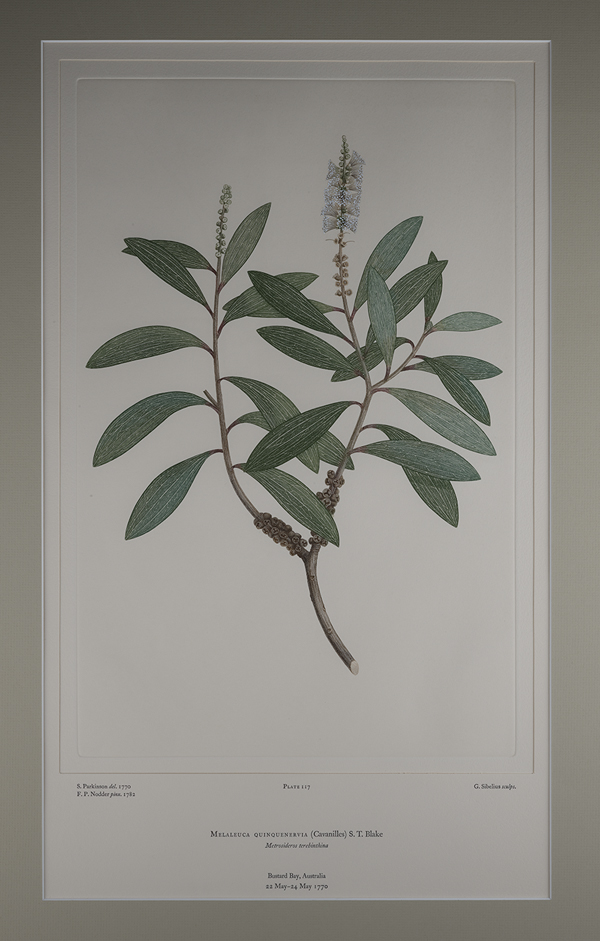
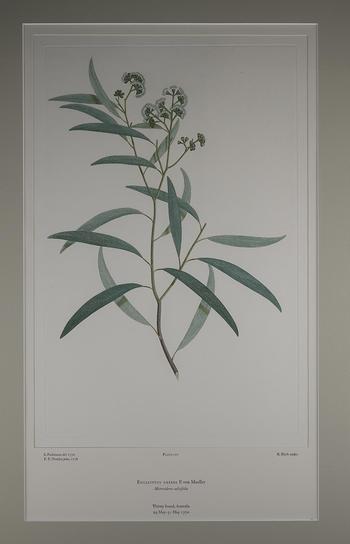
Although the ANBG Library and Archives art collection consists primarily of contemporary content, the collection includes seven artworks depicting plants collected during the voyage of the Endeavour which are a valued part of our collection due to their significance in the history of Australian botanical illustration (Fig. 1). Known collectively as Banks’ Florilegium, Footnote 16 the extant 738 botanical illustrations were drawn by Sydney Parkinson, the botanical artist who was recruited by Banks for Captain Cook's Endeavour expedition sailing in 1768.Footnote 17 After narrowly avoiding being speared in a skirmish at Botany Bay,Footnote 18 Parkinson died at sea soon after the ship had set sail from Batavia in December 1770.Footnote 19 On his return to England Banks, no doubt hampered by the loss of Parkinson, engaged a number of engravers both locally and in Germany to complete the paintings.Footnote 20 However, Banks’ time became increasingly subsumed with competing interests and responsibilities with the result that the Florilegium was not published in his lifetime.Footnote 21 Indeed, it was two centuries later in the 1980s that the collection of plates held in the Natural History Museum, LondonFootnote 22 would be printed by Alecto Historical Editions in a limited edition run of 100 sets.Footnote 23 The engravings were printed in colour a la poupee, Footnote 24 reflecting the advances in technology from wood- block printing to metal engravingFootnote 25 that had occurred in the interim. The artworks in the ANBG art collection are from the set of 337 plates of Australian plantsFootnote 26 and include two works kindly donated by the family of Professor A.B. Wardrop who was the Foundation Professor of Botany at La Trobe University, Victoria (Fig. 2).
Plate 117 from Banks’ Florilegium. Melaleuca quinquenervia Photograph: ANBG

Plate 121 from Banks’ Florilegium. Eucalyptus crebra Photograph: ANBG

Celia Rosser's Banksias
A uniquely Australian set of contemporary artworks are the iconic paintings of The Banksias by Celia Rosser. Beginning in 1974 with her appointment as University Botanical Artist at Monash University in Victoria, Rosser began her life's work of painting every known species of banksia. The project, which spanned 25 years, culminated in the limited edition publication of three half-bound volumes of printed reproductions of the 67 species then known at the exact dimensions of the life-size watercolours of Rosser's paintings, with accompanying text by botanist Alex George AM.Footnote 27 In 2001, shortly after the final volume was published, a new species of banksia was discovered in Western Australia and painted by Rosser in 2003.Footnote 28 Fittingly, the species was named Banksia rosserae in honour of the artist.Footnote 29 The ANBG Library and Archives collection includes a copy of each of the volumes signed by both the artist and author, a portfolio of plates from the second volume, as well as framed plates.
Named for Joseph Banks, the banksias are regarded by many as being among the most difficult of Australia's native plants to paint. It is a testament to Rosser's skill that she was able to master the process.Footnote 30 The creation of each painting was a painstaking affair taking about three months to complete, with Alex George checking each draft for scientific accuracy.Footnote 31 In recognition of her achievement as the first person to paint the species, Rosser received many honours including an honorary Doctorate of Laws (Monash University) in 2000, the Jill Smythies Award from the Linnean Society of London in 1997 and the Medal of the Order of Australia in 1995 for her contribution to botanical art.Footnote 32
Collin Woolcock's Australian orchids
Australian orchids have long captivated the interest of botanical illustrators, with Australia's approximately 1700 native orchids, many endemic to Australia,Footnote 33 providing a diverse range of colours and shapes to inspire artists. The ANBG Library and Archives contains the collection of Collin Woolcock's orchid artworks comprising around 400 individual pieces and several field sketchbooks of orchids and pea-flowers, all of which were donated by his family. Woolcock was a keen amateur biologist, plant illustrator and photographer with an interest in art from a young age. Though his career as a biochemist limited the time Woolcock spent on his art prior to his retirement, he maintained his interest in the arts throughout his life. His retirement in 1975 heralded the start of the ‘botanical years’ which saw his artistic output increase as he and wife Dorothy embarked on trips across western and eastern Australia. Most of the artworks in the ANBG's collection date from 1975 onwards and cover the range of 1968 to 1985. The collected artworks include colour pencil images, line drawings and field sketches, with members of the families Orchidacae and Fabaceae featuring heavily. The collection includes nine of the original orchid illustrations used in Woolcock's first major publication Australian terrestrial orchids which was published in 1984. Other artworks from Woolcock's private collection are now held at the Portland CEMA Arts Centre in a wing named the Collin and Dorothy Woolcock Gallery, and at the Royal Botanic Gardens Melbourne and Botanic Gardens of Adelaide.Footnote 34 A selection of the artworks have been digitized and are available online via the ANBG website.Footnote 35
Gillian Scott's Australian mistletoes
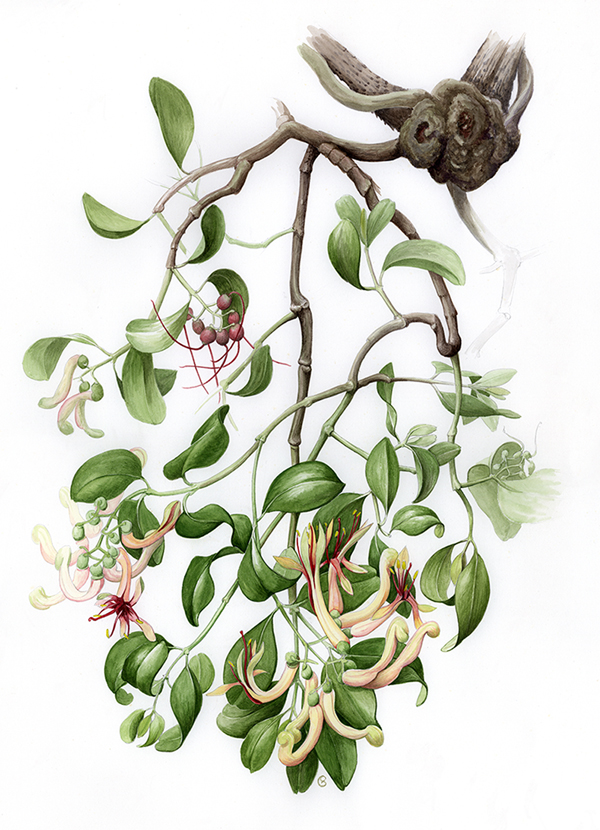
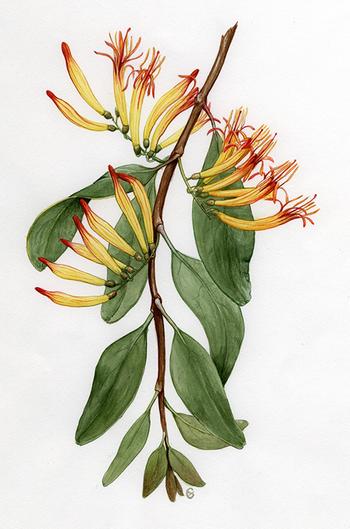
A recent addition to the ANBG Library and Archives art collection is the set of 22 Australian mistletoe watercolour paintings by Australian artist and botanist Dr Gillian Scott. A generous donation from the artist, the artworks depict a range of Australia's native mistletoes painted in Dr Scott's distinctive style (Fig. 3). The paintings are of significance to Australia's history of botanical illustration, being the first artworks by an Australian artist to be awarded the prestigious Gold Medal at the Royal Horticultural Society's Botanical Art Exhibition in London in 1991. Dr Scott has also painted commissioned works for Dr Shirley Sherwood's renowned collection of contemporary botanical art, as well as for the Hunt Museum of Botanical Documentation (Carnegie-Mellon University, Pittsburgh).Footnote 36 The complete set of donated mistletoe paintings are available for viewing online from the ANBG's website (Fig. 4).Footnote 37
Mullerina celastroides on Banksia integrifolia by Gillian Scott. Photograph: ANBG.

Dendrophthoe vitellina on Grevilea robusta by Gillian Scott. Photograph: ANBG.

Aboriginal artworks
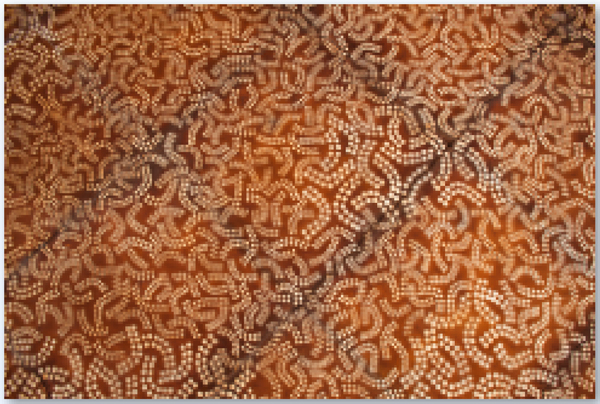
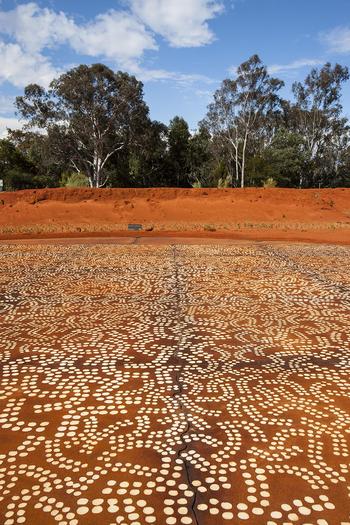
The ANBG Library and Archives also contains traditional artworks by Aboriginal artists which highlight the affinity felt by indigenous people with the Australian landscape. Two notable artworks include Grandmother's Country (2011) (Fig. 5) by Teresa Purla McKeeman and Sydney sandstone dreaming (2004) by Deborah Lennis. Teresa Purla McKeeman was born in 1963, and lives on the outstation of Atnwengerrp in the traditional country of her grandmother and mother in the Northern Territory.Footnote 38 Grandmother's Country is painted using acrylic paint on canvas and depicts the tracks left on the ground by women as a result of ceremonial dancing to sacred songs.Footnote 39 Sections of the artwork were developed into a 5.6m2 pavement design of laser cut steel plates filled with epoxy grout creating a Central Meeting Place in the ANBG's Red Centre Garden, which showcases plants from Central Australia (Fig. 6).
Detail of Grandmother's Country by Teresa Purla McKeeman laser cut in the pavement of the Red Centre Garden. Photographer: A. Tatnell. ANBG, 2013

Grandmother's Country by Teresa Purla McKeeman laser cut in the pavement of the Red Centre Garden. Photographer: A. Tatnell. ANBG, 2013

Similarly the Aboriginal artwork Sydney sandstone dreaming by Deborah Lennis, a local elder of the Dharawal people in Sydney,Footnote 40 depicts an aerial view of the waterways of Sydney Harbour as well as the sun and Xanthorrhoea plants. The acrylic on canvas artwork has been used in situ in the Gardens on interpretation panels in the Sydney Basin garden, which serves to share the original artwork held in the Library and Archives with a wider audience.
Outdoor art installations
Complementing the indoor artworks, visitors to the ANBG also encounter a diverse range of outdoor art installations situated throughout the landscape. Supported by the Friends of the Australian National Botanic Gardens, the artworks form part of the Gardens Outdoor Art Program which aims to “add layers of meaning, content, and resonance to the Gardens’ spaces”Footnote 41 in support of the ANBG's mission. In addition to being aesthetically pleasing, many of the artworks serve a functional purpose. An example of this dual purpose are the sculptural bollards, Sentinels, created by Simon Taylor in 2003. Made of stainless steel, these striking nine bollards collectively list the names of over 1000 endangered, threatened and extinct native species. They stand as sentinels at key entrances to the ANBG while simultaneously acknowledging the significant role that the ANBG has in the promotion and protection of Australia's native plants.Footnote 42
Other outdoor artworks include the Friends Cascades flowform water sculpture and the most recent acquisition in 2017, the Paperbark Treehouse by Cave Urban, a two-storey interactive installation that invites visitors to climb the artwork to gain a new perspective on the surrounding environment.
Photograph collection
A small number of large scale framed and unframed printed photographs are also held within our art collection. These have been mostly acquired from the Friends of the ANBG photographic group's annual photographic exhibition. While most of the subjects covered relate to macro photography of individual flowers or general landscapes, there is an unusual digital image from a scanning electron microscope. Produced as part of a collaboration between artist-in-residence Julie Ryder and the ANBG's Dr D.Christine Cargill in 2005, Phaeoceros evanidus shows the spores and pseudoelaters of the type specimen of the hornwort which shares the artwork's name.
The ANBG Library and Archives works closely with the ANBG Photograph Curator who is responsible for the ANBG's extensive photographic and line drawing collections, many of which have been used in education resources and publications. Digital copies of these photographs and line drawings can be accessed via the ANBG website.Footnote 43
Conclusion
Botanical illustration of Australia's native plants has developed from recording scientific discoveries during early voyages, to contemporary practice by Australian artists in the recent era of revival. While acknowledging the historical significance of the early voyages by holding several historical artworks, the Australian National Botanic Gardens Library and Archives art collection primarily focuses on botanical artists from recent decades. Largely through the generosity of the artists, the collection includes original works of significance to the continuing story of Australian botanical illustration such as Collin Woolcock's orchid and Gillian Scott's mistletoe artworks. Inspired by and complementing the indoor art collection, the outdoor artworks throughout the ANBG provide the public with additional opportunities to enjoy and reflect upon native flora through art. The Library and Archives looks forward to building upon our collection and inspiring the appreciation and study of Australia's native plants.
This is an edited text of a paper originally presented at the 2018 ARLIS/ANZ Conference: Expanding Our Reach, National Portrait Gallery and National Gallery of Australia, Canberra, October 2018.