RYAN SCHREIBER: Yeah, but it's weird—I think a lot of people still don't know [that you have Marfan syndrome]
BRADFORD COX: People think I'm a junkie.
SCHREIBER: Right.
BRADFORD COX: I watch them. Like at this one show, it was completely packed. And their eyes are glued to my fucking body. They think that they're not being watched. They think that they're the audience and I'm the performer, but for me, it's always like watching a film of people. I see it on their faces, that half-smile, you know? That ‘what the fuck’ expression, wrinkled eyebrows and half-smiles, just staring at me. And they don't notice the music—it's almost like they're deaf.Footnote 1
Bradford Cox's physical appearance has enthralled and mystified audiences, critics, and fans since the inception of his indie rock band Deerhunter in the early 2000s. As the band's frontman, Cox is 6’4” with an exceptionally thin, angular frame, physical effects associated with Marfan syndrome, a congenital malformation of the connective tissue that can result in lung collapse, aortic enlargement, and many other life-threatening problems if left untreated.Footnote 2 Yet many critics and fans do not recognize that he has a disability, as Pitchfork interviewer Ryan Schreiber surmises above. Rather, the reception of Cox's body tends to center around speculation about possible substance abuse (i.e., “junkie”), disordered eating, his mental well-being, gender, and sexual orientation. That audiences, critics, and fans are inclined to conflate these categories in their reception of his body is ultimately reflective of the simultaneous fetishization and normalization of corporeal difference in indie rock and punk rock, Cox's primary music genre affiliations.
Through close analysis of Cox's reception, photographic appearances, album art, and songwriting, I reveal that the illegibility of his disability is due to its resonance with two overlapping countercultural discourses: the fetishization of thinness in contemporary indie rock, particularly among men, as a physical manifestation of withdrawal from the mainstream; and the longstanding tradition of freakery and androgyny in punk as self-differentiation tactics. I situate so-called “heroin chic” as an intervening corporeal aesthetic linking the visual logics of these two performance traditions: heroin chic was an emaciated, androgynous “look” evocative of self-neglect and drug abuse that rose to prominence in the 1990s largely due to the widespread traction of the black-and-white Calvin Klein fashion advertisements picturing British supermodel Kate Moss, as I later detail. Dazed magazine aptly referred to heroin chic as the period's “grunge-inspired, generation defining look,”Footnote 3 and indeed the aesthetic was prevalent among certain musical subcultures in the 1990s, most notably grunge, post-punk, and early indie. Musicians like Kurt Cobain, Courtney Love, and PJ Harvey epitomized the look as it reflected the non-conformist values of their music.
If punk and indie find common ground in their arguable idealization of thinness, for Cox, indie is regrettably heteronormative in a way that punk was decidedly queer. (Cox's characterization of male indie rock as heteronormative contradicts its usual feminization in the popular imaginary, and specifically the portrayal of male indie rockers as effeminate, a point to which I will return later.) The singer thus makes verbal and sartorial references to his emaciated, androgynous punk forebears—namely, Patti Smith, Joey Ramone, PJ Harvey, among others—to differentiate himself from the masculine heteronormativity of contemporary indie rock. As Cox draws out these rich aesthetic continuities and conflicts, he further obfuscates the already murky aesthetic distinctions between punk and indie, just as he revels in the slippage between freakery and normalcy. Indeed, Cox uses corporeal defiance to both alienate his audiences and cultivate a sense of aesthetic belonging as a queer-disabled artist. This resistive ethos beautifully culminates in his music through a combination of vocal cues, recording techniques, autobiographical lyrical references, and post-production effects, as I show in my analysis of two songs from his first solo album, Let the Blind Lead Those Who Can See But Cannot Feel.
Ultimately, his richly complex projection of disability, gender, and sexuality has the effect of perplexing his detractors and fans alike, as audiences come to terms with “Bradford Cox's monster,” as one critic put it. The monster reference centers on the same dehumanizing logic as descriptions of the singer as a “freak” or “an ugly weirdo”: monsters are imaginary, dauntingly large, frightening, and decidedly non-human creatures. Just like the “freak,” the figure of the monster is a variation of the same ableist metaphors that frame Cox's body as extraordinary relative to able-bodied norms through a process of dehumanization. His enfreakment is especially relevant to disability's aesthetic preeminence in popular music where “body image is both a transactional and expressive category” allowing for the “intermittent fetishizing of enfreakment,” according to George McKay.Footnote 4 Cox's example reveals that as an intermittent, multisensory phenomenon, disability enfreakment is inextricably bound up with gender, sexuality, and race in ways that obfuscate the specificity of these individual categories. Rosemarie Garland-Thomson elaborates on the complexities of this slippage in the historical construction of the “freak”:
At the same time that enfreakment elaborately foregrounds specific bodily eccentricities, it also collapses all those differences into a “freakery,” a single amorphous category of corporeal otherness. By constituting the freak as an icon of generalized embodied deviance, the exhibitions also simultaneously reinscribed gender, race, sexual aberrance, ethnicity, and disability as inextricable yet particular exclusionary systems legitimated by bodily variation—all represented by the single multivalent figure of the freak. Thus, what we assume to be a freak of nature was instead a freak of culture.Footnote 5
In Cox's case, enfreakment is also tied to genre: punk rock is a genre that traffics in this type of multivalent, amorphous freakery through physical and vocalized expressions of self-neglect, emaciation, gender bending, androgyny, sexual deviance, and trauma. As McKay argues, in punk “signature corporeality is a trick of the trade, and stagecraft a skill to develop, especially for the lead singer.”Footnote 6 While indie has its roots in punk and shares in punk's countercultural ethos, the signature withdrawn posturing of indie is decidedly at odds with punk's more confrontational stance. As a visibly disabled, self-identifying queer man, Cox thus strategically draws on punk's tradition of freakery to distinguish himself from his indie rock counterparts. For instance, in his live performances, he self-consciously plays up a striking visual resemblance to his androgynous male and female punk idols alike by dressing in drag. He also uses different intimidation tactics to amplify the pain, trauma, homoeroticism, and sexual deviance he addresses in his lyrics, an irreverent, hostile, and decidedly engaged approach that he claims differs from the usual withdrawn, cavalier posturing of indie frontmen.
In this sense, Cox serves as a rich case study for understanding how disability and sexuality figure in varying expressions of masculine nonconformity present in both punk and indie, and the performative tensions between the two genres. If, in Cox's view, punk offers an empowering alternative to the affected detachment and masculine heteronormativity of indie rock, his idealization of his punk roots is wholly in keeping with indie rock's nostalgic embrace of punk.Footnote 7 We will discover that, while Cox views his queer-punk persona as a “vital” antidote to indie rock's usual detachment, his performance tactics and invective commentary are ultimately reflective of the “social differentiation” and “self-othering” that Ryan Hibbett argues are defining features of indie in the first place.Footnote 8 Ultimately, his self-proclaimed non-conformism centers on the same simultaneously idealistic disdain for and unexamined dependence on mainstream values characteristic of much indie rock.Footnote 9 It is also significant to note that the two genres are alike in that they construct masculine alterity and power along implicitly white lines, an issue that warrants further unpacking, though is regrettably beyond the scope of this article. These racialized dynamics are especially relevant given that American indie rock has its origins in the South, and Deerhunter hails from Athens, Georgia.
Finally, my analysis situates the representation of Cox's disability as a multisensory endeavor, building on music scholarship on disability in the process. To be sure, vision is a central modality in the social construction of disability: disabilities are typically understood as “visible” or “invisible,” with stigma resulting primarily from the visible markers of a disability, dependent upon an able-bodied “starer” and a disabled “staree.”Footnote 10 The built-in visual spectacle of live music performance typically amplifies the stigma associated with a visible disability to such an extent that audiences “don't notice the music,” as Cox himself describes, what Rosemarie Garland Thomson has called “disability engulfment.”Footnote 11 Joseph Straus contends furthermore that, “for musical performers with visible (or audible) disabilities, the affinity between a performance and a freak show may become even more pronounced.”Footnote 12 Indeed, disability is oftentimes also audible, registering through the sound of the speaking and/or singing voice in ways that might correspond with or defy its visual construction; music thus throws the visual–aural construction of disability into sharp relief.Footnote 13 By feigning vocal damage in his live and recorded performances in ways that signal trauma, sickness, emaciation, and melancholy, Cox establishes a sonic continuity with the visually equivocal terms of his bodily difference, as audiences revel in the multisensory spectacle.
Introducing Bradford Cox
Bradford Cox is best known as the frontman of the indie rock band Deerhunter, a five-piece group originating from Athens, Georgia and boasting an eclectic discography that spans the last two decades—Turn it Up Faggot (2005), Cryptograms (2007), Microcastle (2008), Weird Era Continued (2008), Halcyon Digest (2010), Monomania (2013), Fading Frontier (2015), and Why Hasn't Everything Disappeared (2018). A prolific songwriter, he has also produced three solo albums since 2008 under the moniker Atlas Sound. Cox's musical style encompasses a host of musical influences characteristic of much contemporary indie rock such as punk, post-punk, post-rock, krautrock, noise music, ambient, and shoegaze. These influences coalesce to create a distinctly indie, DIY lo-fi aesthetic replete with production techniques such as frequency feedback, distortion, resonance, humming, and heavily filtered vocals.Footnote 14 Cox has described himself as an avant-garde maverick, likening his experimental ethos to that of musical icons Thelonious Monk and Charles Ives. He elaborates, “in order to be a maverick, you have to destroy rational thought.”Footnote 15 Deerhunter and Atlas Sound have headlined several summer indie music festivals, and Cox was among the most frequently interviewed artists in the early days of the formerly underground, but now mainstream indie music webzine Pitchfork.Footnote 16 His indie credibility extends to film as well, having composed the score for the short film, The Curve of Forgotten Things (2011), and the soundtrack for the indie documentary, Teenage (2014). In 2013, Cox made his acting debut in the Oscar-winning film Dallas Buyers Club, appearing in an extensive cameo as the lover to the HIV positive trans woman Rayon, played by Jared Leto. Ultimately, Cox enjoys widespread visibility as a pioneering indie rocker and taste-maker whose ambivalence towards mainstream popular culture is a defining feature of his artistic persona.Footnote 17
A self-proclaimed “provocateur” and “method actor,” Cox has garnered considerable notoriety for his outrageous performance antics, and eccentric, cynical persona known among fans as a “controversy magnet,” a “lightning rod to controversy,” a “weirdo,” “bizarre,” and “extremely awkward.”Footnote 18 In his live shows, he routinely performs in costume, often donning a dress and a wig, or sometimes performing shirtless as he verbally confronts unruly audience members, and occasionally threatening fellow bandmates on stage. When an obnoxious concertgoer demanded the band play a cover of “My Sharona” by the Knack at a Deerhunter show in Minneapolis in 2012, a belligerent Cox replied, “Fuck you! You want to do this motherfucker?” and launched into a one-hour-long rendition of “My Sharona,” obscuring the beloved seventies hit as if to musically flip the heckler off as disgruntled fans emptied the venue.Footnote 19 Blogger Scott Bernstein recounts the incident as follows: “Cox, who took to the stage wearing a ski mask, ranted about the death of folk music, simulated fellatio on one of the musicians, ordered an audience member to strip and told the crowd members to pick up their chairs above their heads and shake them.”Footnote 20
During an event for the Monomania (2013) album launch, he sneered at a crowd of reporters, “Have I insulted everybody? We're all just whores for a commodity market. We're all sucking the same dick.”Footnote 21 He has been known to occasionally retract some of his more vulgar commentary, such as when he apologized after publicly defaming indie singer-songwriter and producer Samara Lubelski, citing a “nervous breakdown,” an “admittedly fucked up mental state,” and his “completely warped perspectives” as the cause for the lapse in his better judgment.Footnote 22 More generally, his tendency to speak of his mental health and past traumas in flippant, yet sobering terms only contributes to his reputation as a loose cannon, and his audiences’ inclination to read his outlandish performances as a direct reflection of his mental wellbeing.Footnote 23 In most cases, people are divided over whether his obscene behavior is an entertaining art project turned publicity stunt, a sign of an impending nervous breakdown, a genuine expression of his disdain of mainstream pop culture, or all of the above. Once again, even in moments of seeming hostility and candid self-reflection, Cox is also self-consciously performing his ties to indie through a strategic defiance of sorts, posturing that solidifies his authenticity in the eyes and ears of his predominantly indie fan base.
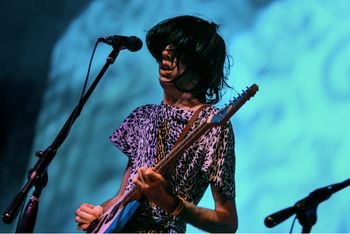
Central to his “freakish,” enigmatic persona and its shock appeal in the minds of his audiences, critics, and fans is his unmistakably striking physical appearance. His towering figure and low body weight, punctuated by a notably curved spine, hollow chest, and pale white skin, plainly obvious when he performs shirtless or in a sleeveless dress, have led many to call him “an ugly weirdo,” a “giant,” a “freak,” and a “monster” (Figure 1).Footnote 24 Critics and fans have a near morbid fascination with his body, evident in such speculative descriptions of Cox as “a knife-thin singer who appears to be anorexic but is said to have a digestive order,” or as the “rail-thin 6’4” performer [who] often drapes his skeletal figure in summer dresses onstage, and has a propensity for abusing antidepressants and Ativan.”Footnote 25 The presumed continuity between Cox's bodily difference and his mystifying persona was the subject of a piece titled, “Too Weird for Weirdos: Deerhunter,” appearing in the Washington Post:
Bradford Cox loves his parents. Bradford Cox is concerned with his mortality. Bradford Cox has no clear idea whether he's gay, straight or what. Bradford Cox smokes dope, says sweet things, maintains a policy of complete openness, occasionally wears a dress onstage and rocks it hard. [ . . . ]
Cox is neither anorexic nor a junkie, though he understands why you might think so. [ . . . ]
He is a divisive figure. [ . . . ]
His band, Deerhunter, is either a critical darling, or a critical disaster.Footnote 26
Bradford Cox playing at the 2013 Austin Psych Fest. Photograph by Bryan C. Parker. Published in Pop Press International (blog), April 30, 2013, http://www.poppressinternational.com/2013/04/30/austin-psych-fest-day-two/.

In such characterizations, the extraordinary thinness associated with Cox's disability stands in for the physical markers of anorexia, drug abuse, and mental illness—interrelated physiological conditions that have a long history in the popular music industry—as the specter of his “mortality” looms. Also notable in this conflation is how the ambiguity over his sexual orientation (i.e., “gay, straight, or what”) mirrors bewilderment over his body. The singer has long confounded his critics, identifying as everything from an asexual, to a homosexual, to a virgin, and a queer at different periods, a perennial fascination that was also hyperbolically evident in a piece titled, “Is Bradford Cox a Skinny Gay Asexual Virgin?”Footnote 27
Suffice it to say that Cox's inscrutable, “freakish” body is the locus onto which critics and fans project a series of anxieties and fantasies about what are in effect the disabling logics of the popular music industry, compounded by the stigmatizing realities of a queer-disabled existence. In the sections that follow, I further attend to the ambiguity of Cox's corporeal difference by unpacking the aesthetic prominence of thinness in indie rock, and the freakery and androgyny in punk, as two interrelated discourses that reflect on masculinity, sexuality, and disability as a combined site of countercultural transgression. The article concludes with discussion of Cox's songwriting, where sickness, emaciation, depression, and homoeroticism lyrically and musically figure in this overarching portrayal of queer masculine defiance.
Indie Rock, Masculinity, and the Aestheticization of Thinness
Disordered eating. Drug addiction and substance abuse. Depression and mental illness. The presumed likely causes of Cox's thinness have longstanding aesthetic traction in popular music where they operate within a larger network of industry-induced self-destructive behavior, what McKay has dubbed pop music's “destructive economy.”Footnote 28 To be sure, the status of anorexia within popular culture is notably complex and gendered in ways that are beyond the scope of this article. Yet, Cox's reception sheds new light on the disabling effects of low body weight as it pertains to men in indie rock. Indeed, in his stunning 1996 memoire, My Life as a Male Anorexic, Michael Krasnow reveals that the disproportionate attention paid to women anorexics—that is, the feminization of anorexia—obscures what is in actual fact a high number of men who contend with this condition, exacerbating its stigmatization among men as a result.Footnote 29
The waning of the punk and post-punk scenes and the genesis of indie rock in both the United States and the United Kingdom in the 1990s coincided with the widespread aestheticization of thinness through a distinctive “look” known as “heroin chic,” immortalized in the haute-couture fashion photography of the time. Photographs that drew on this aesthetic typically featured exceptionally thin, pale (read: white), androgynous-looking models styled with minimal cosmetics, often glancing vacantly at the camera whilst donning haute-couture clothing and pictured in settings evoking drug abuse, violence, poverty, and prostitution. British supermodel and Calvin Klein poster-girl Kate Moss epitomized heroin chic with her distinctly emaciated figure, angular bone structure, and strung out, androgynous appearance; she embodied a social and physical “withdrawal,” while exuding a raw sexuality, amplified through the stark black-and-white backdrop of her Calvin Klein shoots.Footnote 30 The popularization of heroin chic provoked considerable anxiety in the West for its concurrent glamorization and trivialization of drug abuse and disordered eating, and its fatal impact on impressionable consumers of pop culture as they aspired to a dangerously unattainable standard of feminine and masculine beauty.Footnote 31 In the music industry, heroin chic rose to prominence in the grunge and alternative rock scenes of the 1990s, in which thinness served as an authentic physical manifestation of the nihilist spirit in the music and lifestyles of Kurt Cobain of Nirvana and Billy Corgan of the Smashing Pumpkins, and women musicians like PJ Harvey and Courtney Love of Hole. Yet, there is a sense in which these androgynous, emaciated, self-neglecting visual markers of heroin chic were already alive and well in the punk scene, evident among Cox's idols Joey Ramone, Patti Smith, and PJ Harvey. Thus, in the music industry alone, there were several prominent male and female figures across a number of genres spanning several decades, who assumed, whether consciously or unconsciously, voluntarily or involuntarily, the emaciated aesthetic associated with heroic chic.
Perhaps as an outgrowth of heroin chic and the countercultural values of punk, grunge, and alt rock, thinness remains prevalent in indie rock to the point of being naturalized (and arguably persists in contemporary hipster culture). As several writers have separately observed, the genre's “obsession with skinny,” “slender white men,” or so-called “manorexia,” “is the elephant in the room of indie.”Footnote 32 Fonarow attributes the signature emaciated, “wan,” and “androgynous” look not to drug addiction, but to indie's idealization of childhood and youth, one achieved through a “renunciation of food, exercise, and outdoor activities.”Footnote 33 In a 2017 piece for Huff Post with the provocative title, “Indie Rock Gives Men Eating Disorders,” Charlotte Hilton Andersen proffers a notably critical take on this potentially fatal bodily discipline:
[T]hese days you can't go to an indie rock concert without seeing . . . emaciated men? This season, anorexic is the new black for the skinny jeans and eyeliner-for-men set. In a profession where rock stars have typically looked drug-emaciated a la Steven Tyler and David Bowie, this new trend hasn't garnered a lot of attention. The difference now however is that rather than all the bony rib cages being a result of popping OxyContin like tic tacs, thinness is sought after as a goal in its own right. Blame American Apparel or Pete Wentz, but men in this particular hipster subculture are now being held up to the impossibly skinny standard—and realizing firsthand how difficult it is to reach and how painful it is to always come up short.Footnote 34
Indie musicians’ assimilation of thinness thus signals subcultural belonging: it symbolizes a rejection of mainstream values and the commercial excesses of mainstream pop, and mirrors the unadorned, amateurish, lo-fi, infantilizing spirit of indie music. It also offers an alternative to hegemonic constructions of masculine virility epitomized by earlier rock aesthetics. And the strong cultural associations between thinness and femininity vis-à-vis discourse on anorexia arguably strengthens the feminization of indie rock in the popular imaginary. For instance, Fonarow cites writer John Harris's memorable pejorative description of one indie musician as an “anti-macho shrinking violent,” among other misogynist characterizations.Footnote 35
Ultimately, as Hilton surmises, the normalization of thinness has the effect of undermining the disabling physical means by which musicians and fans strive to attain belonging within this subculture, perpetuating shame for those who fail to meet these impossible physical standards. More generally, McKay argues that the longstanding prevalence of anorexia in popular music is indicative of “the ways in which the practices and expectations of the music industry set a conformist template of corporeality.”Footnote 36 In short, thinness among male indie rockers is so ubiquitous as to be normalized, and mundane even. To this end I offer a powerful suggestion: if thinness is indie's specific articulation of what McKay calls a “conformist template of corporeality,” its naturalization is maintained and guaranteed through an insidious racial bias. That is, the undeniable, unexamined whiteness of indie rock bolsters the uniformity of masculine thinness, while racial diversity remains conspicuously absent. Simply put, thinness is all the more mundane in indie precisely because it is white.
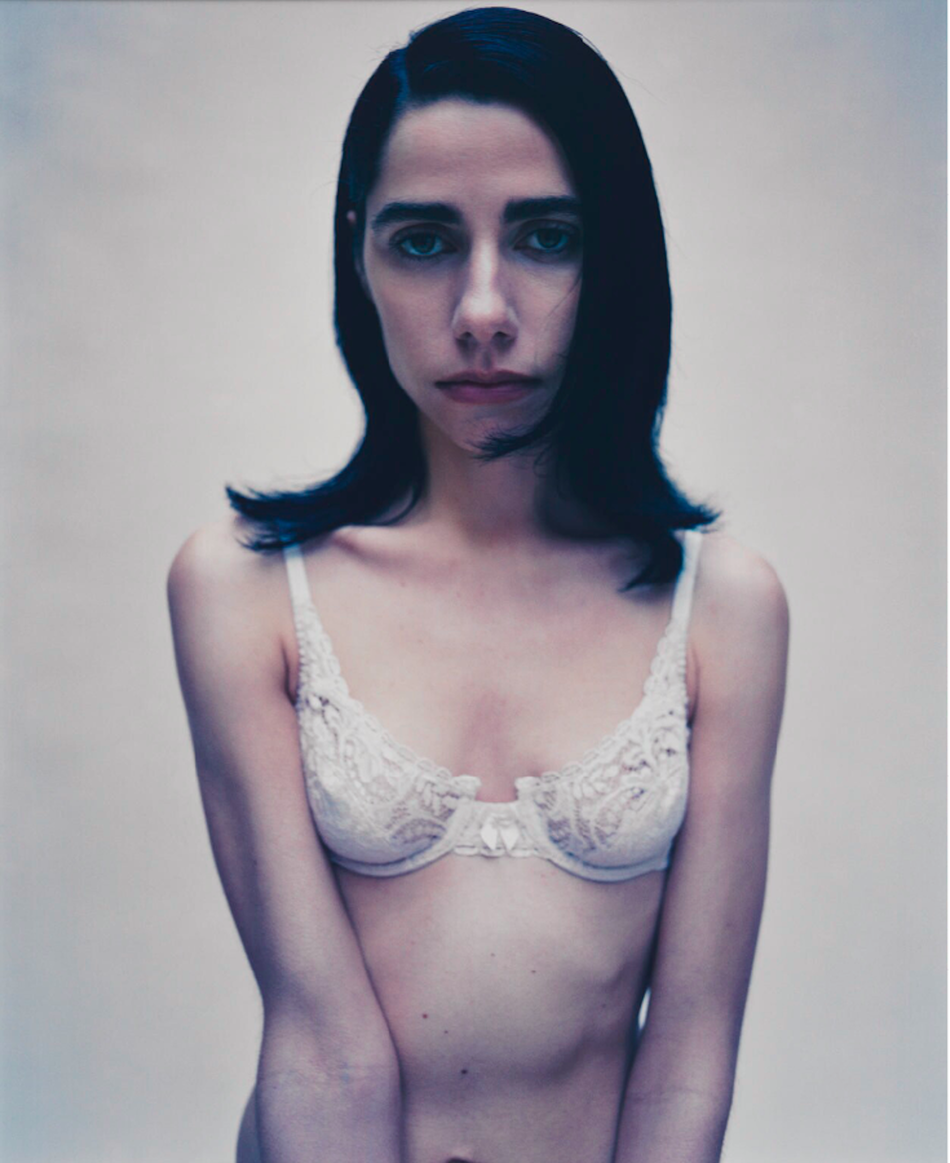
Despite the abundance of thin men in indie rock, Cox's figure is consistently framed as an extraordinary, voluntary, extreme, and sickening take on indie's already exceptional, albeit naturalized bodily conventions, crossing over into the realm of freakery. This only has the effect of intensifying his body's fetishistic appeal and the presumed physiological perils associated with emaciation among audiences. Such moralizing, ableist panic eclipses appreciation of the involuntarily physical markers associated with what is, in actual fact, a potentially life-threatening disability over which he has very little control. Cox himself recognizes that his body lies beyond indie's corporeal norms and is often stigmatized as a result, as he has made clear in many interviews. To put a finer point on this, consider Spin magazine critic Charles Aaron's reflections on his older impressions of British 90s indie rocker PJ Harvey's thinness as shown in her famed May 1995 Spin cover appearance by way of an interview he conducted with Cox. Of notable significance is what Aaron describes as the “chatter” around Harvey's thinness as a likely symptom of anorexia, and how his interactions with Cox inspired him to rethink the political impact of Harvey's image (Figure 2):
Magazines can have a real impact, but usually not in the way you intend. Polly Jean Harvey was on the 1995 cover of SPIN—deathly pale, exposed and frail, wearing nothing but a girlishly small white bra. Her red lips and dark eyes and thick eyebrows loomed cartoonishly. There was a lot of chatter at the time that she was anorexic and that the cover conveyed a damaging, exploitative image of women. That's when I interviewed Bradford Cox, of the bands Deerhunter and Atlas Sound, who suffers from Marfan syndrome, a genetic tissue disorder that can result in a painfully and disproportionately skeletal frame.Footnote 37
Polly Jean Harvey. Photograph by Mario Sorrenti. Published in Spin magazine, May 1995.

The piece then extends to an excerpted portion of Aaron's interview with Cox, where Cox describes relating to the simultaneous sickness and vitality that Harvey embodied:
Every birthday from age 11 until 20, my mom got me a subscription to Spin. And I remember getting that cover with PJ Harvey on it. At the time, it was Pavement and the Breeders and PJ Harvey—they were everything to me. And in the photo, she was in her underwear and was so gaunt and almost looked sick, but still strong somehow, and I remember taking the magazine over to my father and showing it to him, and saying, “See, Dad, if she can do it, I can do it.” If somebody who looks like that can be a rock star, then I can look how I look and be accepted.Footnote 38
It is fitting that Cox should find a model and precursor in Harvey given the above-noted speculation around her mental and physical wellbeing due to her low body weight. Like Cox, Harvey's so-called “skeletal” thinness was the subject of intense scrutiny throughout her career, as Aaron notes. Her thinness was the visible trigger point for concern over her mental health, ostensibly self-loathing behaviors, presumed drug addiction, her outrageous live performance tactics, “malevolent” music, and enigmatic persona. “Polly Harvey seemed very sick. Her weight was becoming an issue. While making the rawest, hungriest sound imaginable, Harvey was looking almost rickety,” wrote one critic for the Guardian.Footnote 39 This reception was not lost on Harvey who, when asked to explain photographer Maria Mochnacz's contentious photoshoot for her 1993 album 4-Track Demos, stated:
the veins in my arms were standing up like a junkie's, and I was in this beautiful, low-cut top and she wanted to use the photo because of the contrast between the beautiful top and these horrific arms, but I wouldn't do it. I was worried people were going to say, “Oh no, Polly Harvey's a heroin addict!”Footnote 40
Harvey's acknowledgement of her body's capacity to visually register with the typical signs of drug addiction mirrors Cox's own admission that “people think I'm a junkie,” quoted in this article's opening. Overwhelmingly, the assumption was that, based on her exceptionally thin frame, Harvey was somehow tortured in a way that fueled her artistry and penetrated to the core of her music—that her music was hungry and raw. In both the case of Harvey and Cox, the numerous physiological perils associated with their thinness only intensify the simultaneously dangerous and romantic appeal of their personae.
Crucially, these interlocking discourses of illness, both physical and mental, vis-à-vis low body weight, have immense visual power, and the aesthetic continuity between them in both Harvey's and Cox's reception is made possible by the prestige of spectacle in popular music. Such images of thinness circulate within and pervade the pop music imaginary, signaling and conflating a host of equally grievous viable causes including disordered eating, substance abuse and addiction, and mental illness. Moreover, thinness becomes a type of physicality that makes alterity and gender non-conformism possible, as the links between Cox and Harvey make clear. Physically marked and emptied of its etiological specificity, then, emaciation symbolizes the physical extremes of the music industry's self-destructive economy enacted on the body of the musician. The extraordinary thinness associated with Cox's disability is both fetishized as an authentic marker of these extremes, and simultaneously normalized through its ubiquity as an aesthetic category, as he himself surmises.
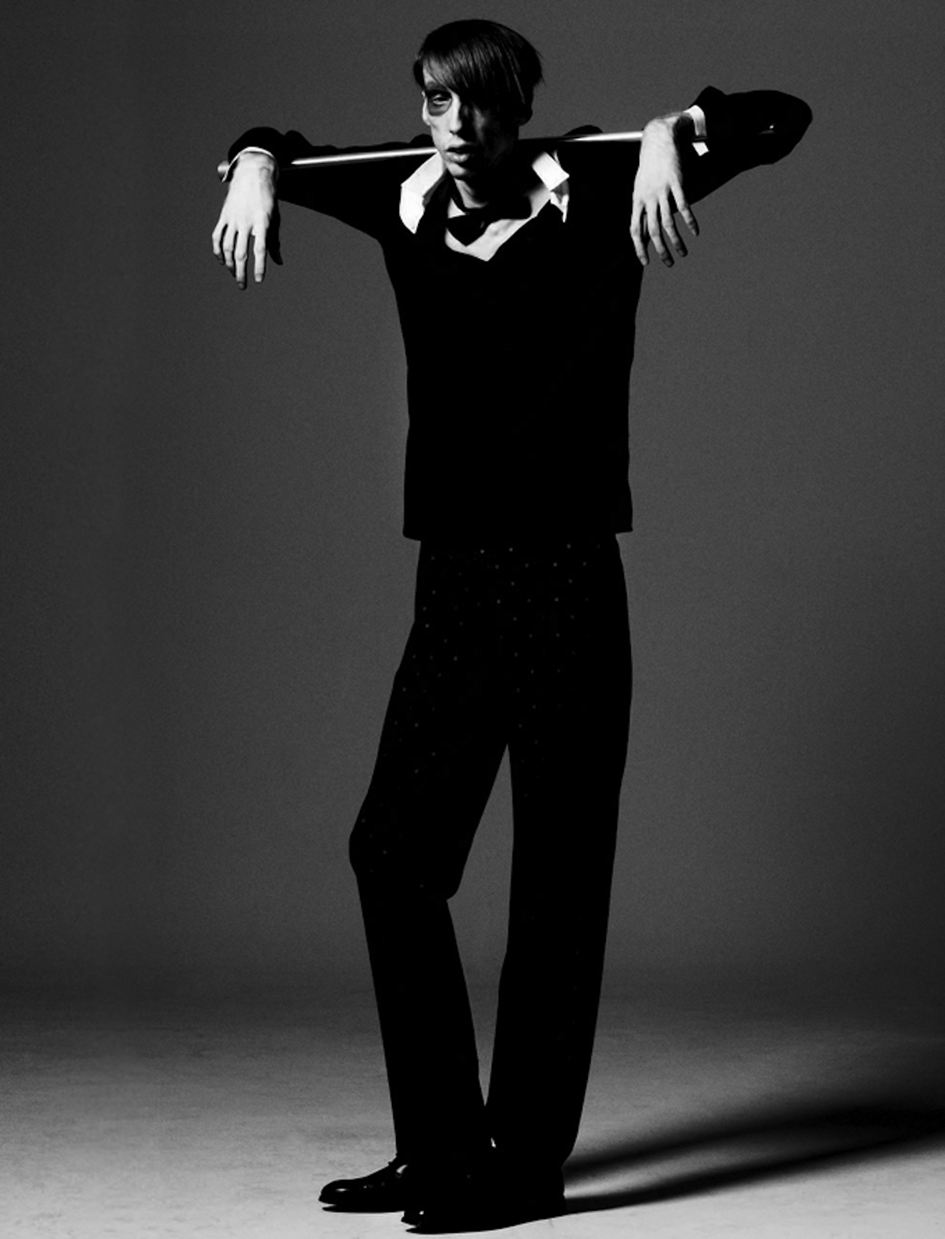
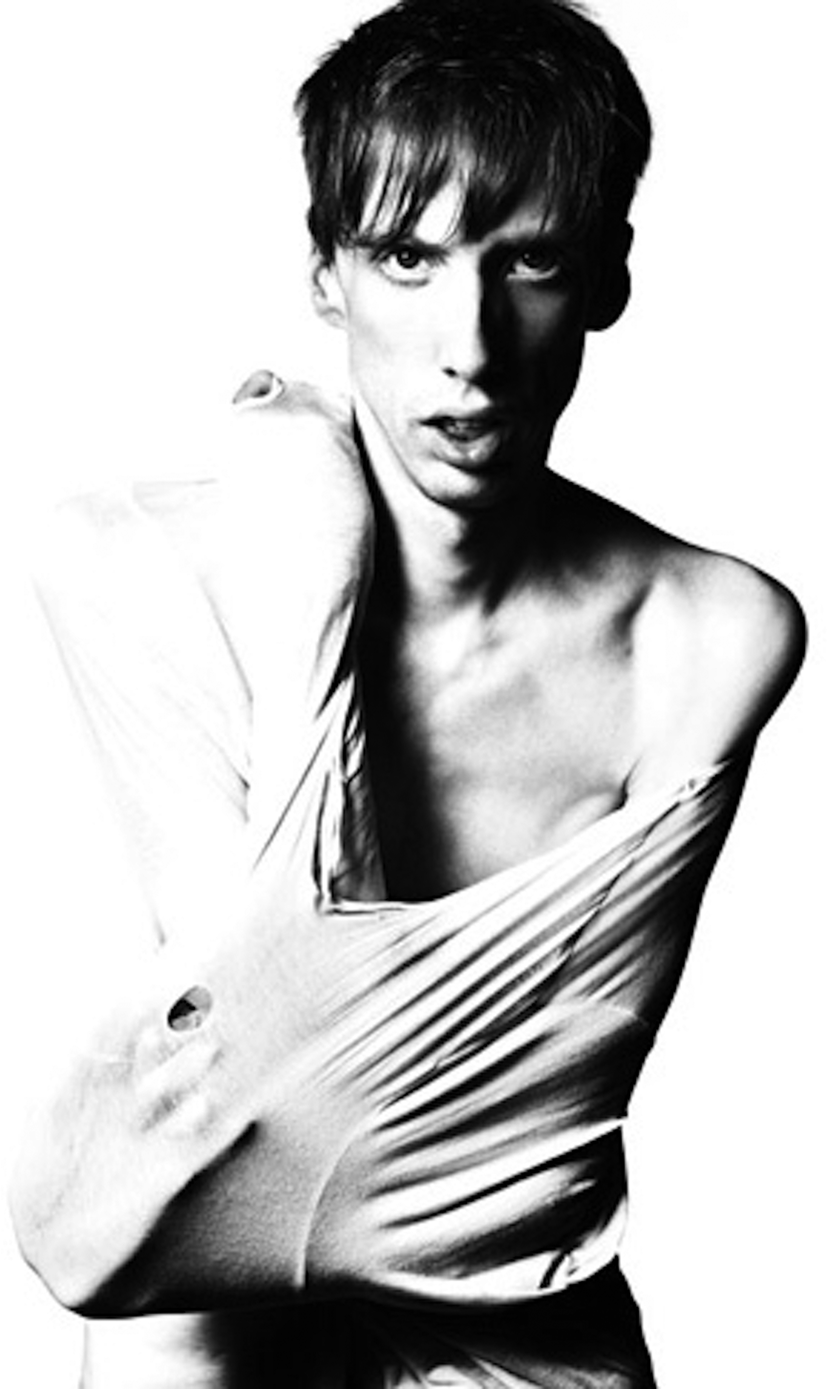
Certain of Cox's photographic appearances tap into heroin chic in a way that both glamorize and neutralize his corporeal difference. In one stylized, black-and-white fashion magazine snap by photographer Gregory Harris, Cox, clad in a black tuxedo with a bow-tie undone around his neck, gazes defiantly at the camera through a blackened right eye with his mouth agape as he wields a metal pipe across his shoulders, his wrists and spindly fingers draped across its front, looking at once like a sinister character from a sideshow and a generic lanky runway model (Figure 3). Similarly, a black-and-white shot of Cox's silhouette by photographer Mark Abrahams focuses on the contours of the singer's upper body, with shadowing around the collarbones, shoulders, neck, throat, and jaw, a commanding portrait that evokes rawness, vulnerability, and sensuality through its striking contouring (Figure 4). A second black-and-white photograph by Abrahams pictures the singer tearing off his white shirt, his chest partially exposed, drawing attention to the otherwise “freakish” features of his body (Figure 5). The photo's intimate composition, white backdrop, stark lighting along with Cox's sultry pose call to mind the Calvin Klein advertisements from the 1990s. If these photographs of Cox convey a defiance by boldly showcasing the otherwise exceptional physiological proportions of his body, Cox's physical appearance simultaneously enjoys a normalcy in a medium where thinness and tallness are standard physical criteria for models in the industry.
Bradford Cox. Photograph by Gregory Harris. Published in Interview magazine, May 6, 2013.

Bradford Cox. Photograph by Mark Abrahams. Published by Mark Abrahams, 2015, http://www.markabrahams.com/bradford-cox/.

Bradford Cox. Photograph by Mark Abrahams. Published in The New York Times Style Magazine, November 2, 2011.

Queerness, Disability, and Punk
Cox speaks of his sexuality in much the same way that he speaks of his body: as something that elicits stigma, intensifying his own sense that he is a social misfit and “freak,” and the sobering realities of his low life expectancy. He once said in an interview that “I don't give a fuck what they say about me, because I'm a white-trash queer who might live to be 30 if I'm lucky.”Footnote 41 The singer typically uses the term “queer” to denote the fluidity of his sexual identity over his formerly-used label “asexual,” explaining his rationale in Rolling Stone as follows:
I don't hide anything, but I don't really highlight anything either. For a long time I just said I was asexual, but now I just realized that . . . I'm still, I guess . . . I mean, I'm queer. I just sort of, don't really have a very big self-esteem, so asexuality is sort of like a comfort zone where you don't get rejected.Footnote 42
Cox's candor has led certain fans to express their respect for and solidarity with his struggle. For instance, in response to an audience member's infamously cruel taunt “Eat a fucking burger!” at an Atlas Sound concert in 2009, one fan commented, “I am Gay myself, and give this guy alot [sic] of credit for living with Marfan's syndrome and being Gay at once. It is a double whammy to have to endure so much shit due to both of these attributes.”Footnote 43 Similarly, music critic Chris Parker claims that, “growing up, Cox took a lot of his shit for his odd physique, let alone his sexuality. Dealing with it made him unflappable and willing to push people's buttons. Onstage, he flaunts his lanky, seemingly undernourished frame, sporting girls’ summer frocks.”Footnote 44 Another blogger, Alyx Vesey, expresses appreciation for Cox's courage and resolve:
I appreciate how confrontational Cox is about his body on stage, in song, and through his blog. At times he's provoked ableist discomfort from critics and concert-goers who wish the skinny white guy would obscure his form with baggy clothes. . . . While we may live in a sartorial moment where huskier men can wear v-neck tees and tight pants, slight men remain under scrutiny for not abiding by normative ideas around masculine virility. . . . I don't know if Cox has any interest in commenting, but I would imagine that his life as a queer Southern teenager with Marfan syndrome informs the resistive artist he is today.Footnote 45
At the heart of the persistent links between Cox's body and his sexuality is a sense that he is innately transgressive (i.e., “resistive”). Pitchfork critic Rachel T. Cole makes these connections explicit when she recalls the first time she “encountered Deerhunter face-to-face”:
It was at a 2007 show around the release of their breakthrough album Cryptograms in which the band essentially destroyed a tiny Brooklyn venue while Cox lurched about the stage in a dress. There was a hysterical, desperate energy—something queer in the truest sense of the word—that separated Deerhunter from their mid-oughts peers. Their music was equal parts noise and beauty, layers of reverb and feedback wrapped around pristine pop executions. Cox was both volatile and unnervingly frail. Back then, it looked as if he might collapse at any minute.Footnote 46
Cole thus interprets Cox's simultaneously frail and monstrous physical comportment (i.e., “lurched”) as well as the polarities of his musical aesthetic (i.e., noise vs. beauty; feedback vs. pristine pop executions) as symbolically reflective of the bizarre, deranged, hysterical, and fatal connotations of the word “queer.” Accordingly, everything that is perplexing and “freakish” about Cox and his music is ultimately queer. And this defiance is precisely what sets him and bandmates apart: “within the milieu of modern indie rock, a landscape still mostly populated with straight white dudes concerned with appearing distantly cool,” writes Cole, “Cox has proven himself to be a lightning rod for controversy.”Footnote 47
As Robert McRuer argues, able-bodiedness and heteronormativitiy are categorically interdependent upon the “otherness” of disability and queerness to maintain their legitimacy. He elaborates on the resulting interlocking dynamics of these marginalized identities:
The cultural management of the endemic crisis surrounding the performance of both heterosexual and able-bodied identity effects a panicked consolidation of hegemonic identities. . . . This consolidation occurs through complex processes of conflation and stereotype: people with disabilities are often understood as somehow queer (as paradoxical stereotypes of the asexual or oversexual person with disabilities would suggest), while queers are often understood as somehow disabled (as an ongoing medicalization of identity, similar to what people with disabilities more generally encounter, would suggest.) Once these conflations are available in the popular imagination, queer/disabled figures can be tolerated and, in fact, utilized in order to maintain the fiction that able-bodied heterosexuality is not in crisis.Footnote 48
As a corrective to this hegemonic logic, McRuer thus emphasizes the transgressive potential of “queer/disabled existence” as a means of “delimiting the kinds of bodies and abilities that are acceptable or that will bring about change.”Footnote 49 It is to this end that I believe fans and critics are inclined to read Cox's disability vis-à-vis his queerness.
Indeed, Cox has often described his physicality and sexuality as a punk-inspired remedy to the withdrawn pretense and masculine heteronormativity he believes is symptomatic of indie. He once even characterized his love of punk as a physical need of sorts: “I need punk rock. It's the medicine for me, but it's bitter and sickening.”Footnote 50 This remark inadvertently strengthens the pathologizing logics governing the reception of his thinness, while echoing his fans' insistence that he is the antidote to the pretense and apathy of the indie mainstream. Extending from this logic, he often paradoxically succumbs to the customary feminization of indie rock by characterizing its frontmen as weak, effeminate, and wimpy.Footnote 51 He elaborates on the dynamics of his position in an interview with Larry Fitzmaurice of Pitchfork:
My idea of punk is not being interested in what other people think of punk.
And I'd rather be Tiny Tim singing “Tiptoe through the Tulips” on national TV than just another indie rocker going through the motions of trying to look really detached: “I was going to go out and get some chicken wings but I ended up on ‘Jimmy Fallon’, so I thought I'd play a song, so I'm just gonna show up in a hoodie and some fucking jeans. No big deal guys!” Actually, fuck it—it is a big deal. If you told me when I was 19 that I'd be playing on shows like “Letterman” and “Fallon” I'd think “Man, I hope I don't fuck this up and do something boring or predictable.”
Indie rock is such a bratty culture, and I don't see a lot of ugly people in it, either. I feel very proud to be hideous. Thank God I don't look like every other fucking dude wearing their girlfriend's fucking jeans out there on stage. That's weak and emasculated—and I don't think masculinity is equivalent to misogyny. It just seems like everything is like a cat that's been declawed—it still tries to fight with you, but it's harmless. Nobody wants to get scratched.Footnote 52
To be sure, if Cox's self-empowerment is rooted in a queer masculine alterity, it comes at the expense of denigrating indie's masculinity through recourse to a misogynist lens, despite his claims to the contrary. Masculinity is not equivalent to misogyny, as Cox rightfully contends, but in his formulation, the male adoption of feminine sartorial codes serves as the ultimate symbol of male weakness and emasculation, just as the declawed cat stands in for the castrated male wholly lacking in power. He also gestures towards the proverbial question often posed of heterosexual couples—who wears the pants in that relationship?—a logic that frames power as a singularly masculine trait, where emasculation is bound up with a misogynist view of women as the weaker sex. His statements here are all the more perplexing given the prevalence of androgyny in punk, and the specific sartorial codes that Cox himself adopts through cross-dressing in order to resemble his punk idols, as I detail below.Footnote 53
Nevertheless, it is clear from Cox's otherwise problematic remarks that he thinks of his queerness as a punk-inspired resistive departure from the usual performative apathy of the indie mainstream. For Cox, punk is thus a valuable, albeit idealized conceptual platform through which to negotiate and legitimize his sexuality and disability. His token “hideousness” functions as a means of self-enfreakment, a way for him to differentiate himself from his peers. And these efforts are not in vain. Cox embodies an image of aesthetic urgency that many of his fans also hold dear. It is precisely because of his body that they read Cox's mystifying persona, theatrical tactics, and signature candor as decidedly authentic in a way that belies the mistrust that Cox suspects indie rock posturing otherwise elicits.Footnote 54
For Cox, androgyny and cross-dressing serve as the culmination of the punk vitality he seeks to embody. In the same Rolling Stone interview quoted above, he insisted that “hetero-centric, boring, scruffy 20-year-olds are ruining the fucking face of rock and roll,” and that missing from the indie scene was “Queerness. Homo-eroticism. Boyhood. . . . [T]here are no Patti Smiths, Joey Ramones, or Lou Reeds, even. . . . [T]here needs to be some vital something, and I mean, I'd like to try to be that, if possible, if I may be so bold.”Footnote 55 In such nostalgic adulation of his punk idols, Cox situates his forebears’ bodies as a locus of aesthetic vitality, as in his aforementioned description of PJ Harvey, or the following description of punk rocker, Patti Smith:
I thought about Patti Smith at her peak, and the vitality of her, and engaging with dangerous music. I used to be a sort of frightening figure, just aesthetically. A stark, bony, sickly figure, and I had all this feedback and noise behind me. I was very theatrical, and it was vital because I was just screaming about hopeless concepts.Footnote 56
Of further significance is the extent to which the women musicians with whom Cox feels an affinity were known for their transgressive approach to gender. A founding member of the New York punk rock scene, Smith was celebrated for her androgynous looks, defiance of feminine stereotypes, and her ability to imitate the gestures and sensibilities of her male rock heroes in live performance.Footnote 57 As he physically assumes the androgynous personae of his punk rock idols, Cox at once engages in self-enfreakment through the genre's legacy of gender bending, while normalizing his body through this compelling generic precedent.
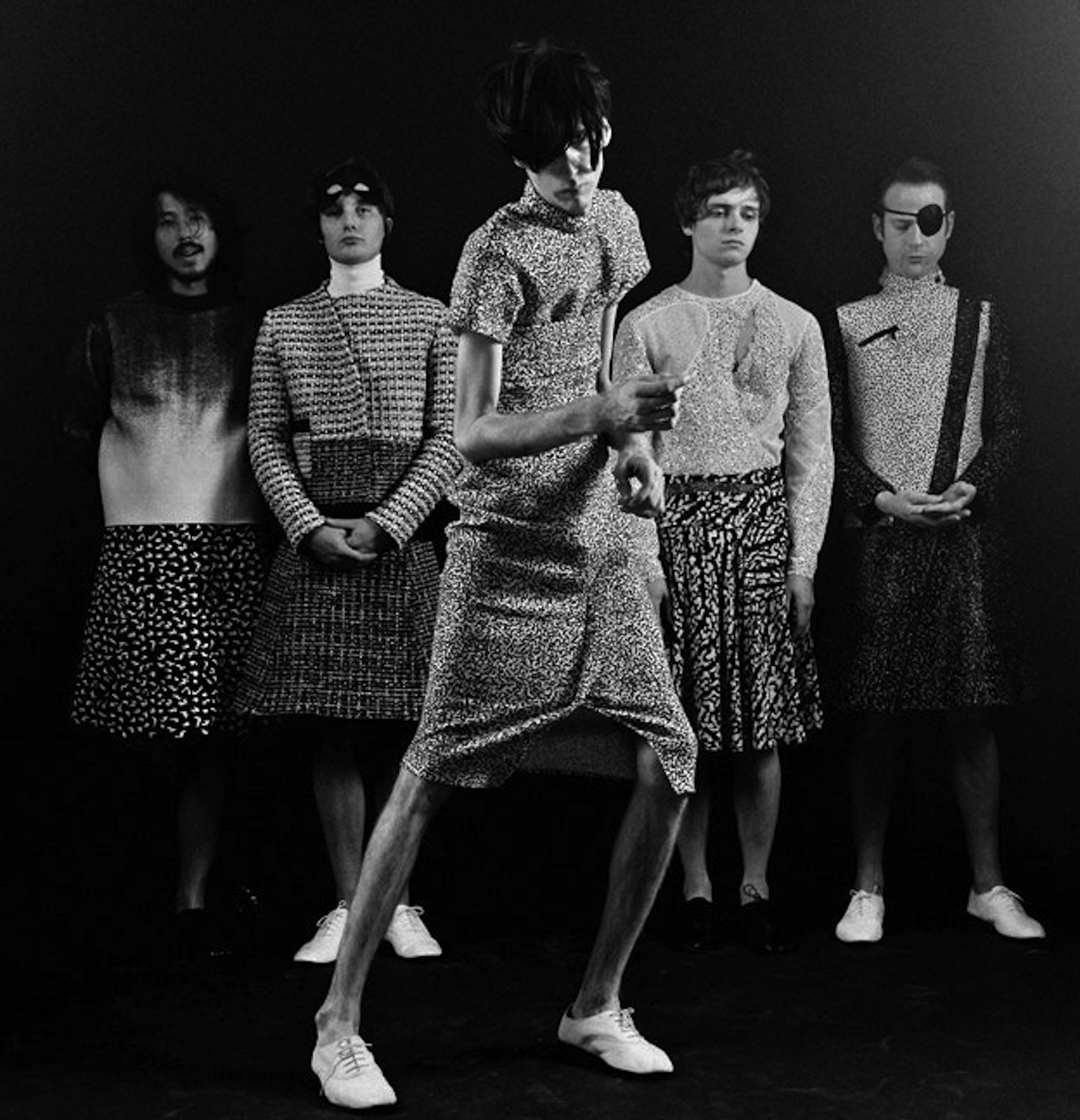
Cox's brand of drag is unkempt and bedraggled, and exudes a naturalness that belies its artificiality, displaying the impression of half-assed DIY costumes.Footnote 58 It is in the deliberately undisguised quality of Cox's drag that he uncannily resembles his punk icons Smith and front man of the Ramones, Joey Ramone. For instance, he once remarked to a London audience, “I love dressing like this because it makes me feel like Patti Smith.”Footnote 59 Cox similarly impersonated Joey Ramone in a live performance of the 1958 song “Do You Wanna Dance?” at a Black Lips concert, wearing the requisite black leather jacket, ripped jeans, and a long shabby black wig. Previewing Cox's guest appearance as Ramone, the Black Lips tweeted to fans before the show: “there are rumors of a resurrected ghost making a guest appearance at tonight's show” (Figure 6).Footnote 60 Cox has also cited Kurt Cobain as inspiration for his drag style, who, in his ugly, sloppy drag was, according to Cox, “challenging gender images” and “making gay kids feel an inch closer to acceptance.”Footnote 61 Accordingly, to announce the release of their 2013 album Monomania, Deerhunter published a series of black-and-white photographs of the entire band dressed in textured and patterned retro frocks, photos no doubt alluding to Nirvana's black-and-white music video for their hit single “In Bloom,” wherein the band sported a similarly half-hearted drag style. Cox has perspicaciously remarked that wearing a dress is often “just a funny footnote” (Figure 7).Footnote 62 Cox flaunts these comical citations, both sartorial and verbal, to achieve a cross-generational continuity. In his drag performances, he effortlessly distils a legacy of cross-dressing and androgyny through referencing his musical idols, inadvertently neutralizing his bodily difference in the process, and inspiring one critic to name him “the dress-clad, out loud singer of queer punks.”Footnote 63
Bradford Cox. Joey Ramone. Photographs published side-by-side in Spin magazine online, September 13, 2011, https://www.spin.com/2011/09/bradford-cox-fronts-black-lips-joey-ramone/.

Deerhunter. Photograph by Robert Semmer. Published in Pitchfork magazine, April 29, 2013, https://pitchfork.com/features/article/9122-deerhunter/.

Queer disabled alienation and belonging in Let the Blind Lead Those Who Can See But Cannot Feel (2008)
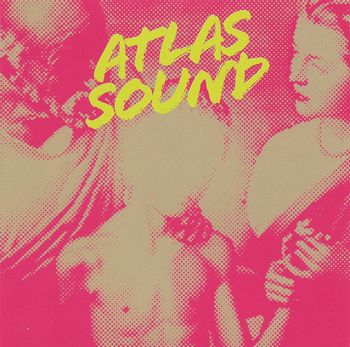
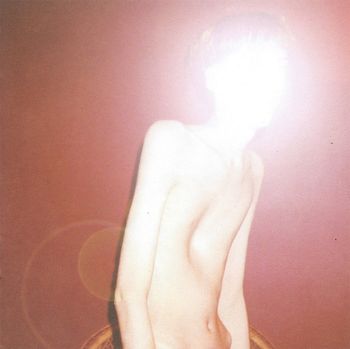
Not surprisingly, Cox's solo musical output, under the moniker Atlas Sound, engages in the aestheticization of thinness and homoeroticism, and similarly addresses the links between illness and pathology in everything from his self-fashioned album art to his song writing. The album cover for his first solo album, Let the Blind Lead Those Who Can See But Cannot Feel (2008) features Cox's own punky zine-styled photograph of a painting he found in an old medical journal in a thrift store. It depicts a doctor examining an emaciated, shirtless boy while his mother looks on in desperation as she clasps the boy's left hand against her chest (Figure 8). The boy's face is obscured by the camera's flash, at once objectifying his body, while casting the boy in a reverent, divine light. Cox explains that in the original painting “the look on his [the boy's] face is the most melancholy thing. He's the saddest boy, and he's lovesick and emaciated. But somehow I found that romantic, the idea that there was so much emotion in the face that it got whited out [by Cox's own camera].”Footnote 64 Cox further emphasizes that he felt a personal affinity to the boy on account of his emaciated figure and his look of “lovesickness”: “I related to that boy so much that I literally, in the thrift store, almost started crying.”Footnote 65 Accordingly, Cox establishes an autobiographical connection to the painting on the cover of his second solo album Logos (2009), arguably bringing it to life through his own body. The cover features a portrait of the singer's own nude torso from the pelvis up, his long arms and hollow chest set against a bright red backdrop, the flash obscuring his face in the same manner as his photograph of the boy in the medical journal (Figure 9).
Let the Blind Lead Those Who Can See But Cannot Feel. Album cover art by Bradford Cox, 2008.

Logos. Album cover art by Bradford Cox, 2009.

That both album covers deliberately obscure the face of their subjects strengthens their aesthetic ties to medical photography where patients’ faces and/or eyes are typically censored with black boxes, not only to protect their anonymity, but also to ensure their objectivity as medical specimens. By isolating and framing his own body in this way, Cox engages in the simultaneous objectification and assimilation on which medical photography is premised—that is, the documentation of physical abnormalities for the purposes of identifying symptoms typical of specific diagnoses. In other words, he normalizes the abnormal through recourse to pathological containment. On these corresponding album covers, emaciation serves as a symptomatic catch-all for various possible physical and mental illnesses, both within the realm of medicine and in the popular imaginary. And by erasing what he exquisitely describes as the “lovesickness” on the boy's face, what was the primary empathic catalyst for Cox, he denies the viewer the same opportunity to emotionally connect with the subject, and instead forces them to fixate on his body. In both cases, the viewer participates in the etiological conflation characteristic of thinness's cultural construction by wondering, what's wrong with him?
Cox musicalizes the physiological perils associated with his thinness in Let the Blind Lead Those Who Can See But Cannot Feel (2008), fleshing out the etiological ambiguities of the above-noted visual imagery through specific musical devices. An autobiographical concept album, or what he has called a “young boy's record,” Let the Blind vividly “documents the transition from childhood to adolescence and losing of innocence,”Footnote 66 thus, referencing the emotional turmoil and physical traumas of Cox's own adolescence, including his social alienation, confusion over his sexuality and male friendships, and summer-long hospital visits due to complications arising from Marfan syndrome.Footnote 67 Although the album's label, Kranky Records, typically does not print lyrics on album inlays, Cox persuaded his producers to include them in an effort to demystify “the process, and us [Deerhunter], and myself as a person.”Footnote 68 He claims, “I'd rather expose frailty, have mistakes. I'd rather embarrass myself, get into fights with journalists. … I think that printing the lyrics is embarrassing, and it's like having a close-up of your zit on the inside of your album cover. Some of the lyrics are very personal on this record.”Footnote 69
Inspired by the AIDS epidemic's oft-overlooked impact on young children, the song “Quarantined” reflects on the loneliness of a quarantined patient, drugged-up and under close surveillance. The lyrics comprise a single repeated line: “quarantined and being kept so far away from my friends / waiting to be changed / I'm waiting to be changed.” Lyrically, the singer's longing for change in the face of quarantine is evocative of a number of experiences including recovery from a disease or injury, rehabilitation following self-injurious behavior, a drug overdose, an anorexic collapse, internalized homophobic shaming, or even sex-reassignment surgery. The pathos of the lyrics finds respite in the drug-induced euphoria of the music: gentle, tinny arpeggiated dulcimer samples recall the sound of a children's music box, while filtered bells, angelic “ahhs,” distortion, and reverb create the impression of weightlessness. All the while, an inconsistent clave rhythm in the background mimics the sound of an intravenous fluid drip. Cox's singing is lethargic and deadpan, emaciated even, as if the singer has exhausted all energy reserves, verging on collapse. The vocal line itself is a simple melody filled with lulling gestures. His breathing is audible and raspy, at times accentuated with prolonged vocal fry as he anticipates his entries, emphasizing the sickly, belabored quality of his voice. The song's final moments sonically evoke a scene of earthly transcendence. As the music fades, the listener can imagine the bedridden hospital patient floating up to heaven, musicalizing the romance Cox ascribes to the boy on the album cover. All of these production techniques afford the listener an intimacy with the singer's body, zeroing in on the audible effects of his hospitalization in a way that resonates with Laurie Stras's contention that the injured, traumatized, and/or disabled body resounds in the voice of the singer, whether feigned or involuntary.Footnote 70 Here, Cox makes the traumas, vulnerabilities, and frailties of his own emaciated, disabled body palpable through the sound of his voice, establishing an exquisite sonic continuity with the tremendous visual power of his persona, and the aestheticization of thinness and queerness therein.
Let the Blind's combination of intense emotional yearning, as expressed through the lyrics, with a palpable expression of the suffering associated with Marfan syndrome, both physical and social, as sounded through the voice, doubles as a representation of the failures of the queer body in the face of heteronormativity. For instance, Cox has plainly stated that the song “Small Horror” explores the protagonist's desperation amid unrequited same-sex love and sexual desire:
[It] is the most depressing song on the album to me. I mean, it's just the sound of like banging depression, you know, it's just concrete. And it basically was like a plea for like, hey . . . I understand you can't return my love exactly how I extend it, but hey, you know, just pretend. Because I'd rather you pretend, you know? Hold me even if you don't care. Even if it doesn't mean shit to you. Just do it, and pretend.Footnote 71
Accordingly, the song's lyrics are pathetic and devastating: “Hold me / Hold Me / Even though you couldn't care or wouldn't care to / These are things that are out of our hands / But we understand, don't we? / Hold me / Even though you couldn't care less / Could not care less.” The song's amorphous formal structure is further reflective of this overwhelming melancholy, as layer upon layer of swirling, swelling drones, and slow-moving, looping, shimmering textures combine to form a dense, ethereal soundscape that obscures any regular sense of meter. Devoid of any formal and metrical signposts, the song disorients the listener in a way that symbolically reflects on the social alienation and physical turmoil that a queer-disabled youth might feel as he comes to terms with his difference. Cox's voice is equally destabilizing. It resides so deep in the mix that at times it is indistinguishable from the ambient noise that encircles it, his words nearly unintelligible. The listener strains to hear his voice, as if eavesdropping from another room while Cox gently lulls himself to sleep, perhaps recalling a comforting tune from childhood to numb the pain as the drugs begin to take effect. This potential vocal allusion to a drug-induced delirium and self-injurious behavior once again widens the song's etiological scope, as sickness, substance abuse, and suicide emerge as potential causes of the singer's distress. Cox also makes his physical and emotional anguish felt through specific vocal gestures. His frequent out-of-tune singing borders on belabored, intoned speech as he audibly struggles to get the words out, as if battling and subsequently surrendering to exhaustion and emaciation. At times he wails, or prolongs certain entries with extended vocal fry, straining to articulate the first syllable of “but” of the lyric “but we understand, don't we?,” as if on the brink of collapse, or worse, death.
Let the Blind ultimately serves as Cox's queer ode to boyhood where the closet's punishing logics exacerbate the physical pain and stigma associated with his disability. “Quarantined” and “Small Horror” serve as the musical culmination of the so-called “lovesickness” that Cox privately cherishes in the young boy's face, and the emaciation that has defined Cox's own personal struggle and public image. By giving voice to the internal conflict and shame associated with homoerotic desire alongside the perils of Marfan syndrome, Cox foregrounds the slippage between queerness and disability and their propensity to signal a host of interrelated physiological and sociocultural conditions, as the specter of his mortality looms.
Conclusion
Cox's reception and musical output reveal the malleability of disability identity as it intersects with gender, sexuality, and sickness across both visual and sonic registers, and within related aesthetic milieus. In the costumes Cox fashions for himself, his body contributes to his self-enfreakment while simultaneously enjoying a normalcy in its likeness to his punk precursors. Cox's drag performances, photographic appearances, and album art also strengthen the ties between queerness and disability through a visible aesthetic consolidation. He uses his body to subvert heteronormative, ableist expectations, drawing on the physiological perils and romantic vitality associated with the corporeal markers of anorexia, substance abuse and addiction, and mental illness in the process. These same aesthetic convergences play out sonically in his solo music, where his voice assumes the physical and emotional pains of the queer-disabled male subject, establishing a continuity across the visual and sonic dimensions of his aesthetic. On its own, his disability is musically inaudible, having little impact on his sound, but Cox imagines and exquisitely renders his physiological turmoil audible through his vocal prowess and production expertise.
The reception of Cox's body illustrates some of the gendered anxieties associated with thinness in pop music, as well as its cultural ties to illness and pathology. Cox reinforces this construction through his visual iconography and musical endeavors. This slippage not only obscures the etiological specificity of his physical appearance and its links to his mortality but also complicates the visual logics of stigma. His body undergoes a constant process of aesthetic renegotiation as the visual and sonic terms of its representation shift constantly between fetishization and normalization. Cox's enfreakment is not guaranteed but rather intermittent, to return to McKay's word, as the cultural ubiquity and open-endedness of thinness renders obsolete the question of whether Cox passes for able-bodied or reads as disabled. Here, disability is not so much a readily identifiable minority identity, but rather subsumed within a larger aesthetic network of idealized physiologically disabling conditions that manifest through low body weight. Ultimately, Cox uses the many generic and aesthetic codes at his disposal to not simply blur straightforward divisions between disability and able-bodiedness, but to harness the liminal positions between these two poles as a source of musical empowerment and artistic legitimation.