Introduction
There are a variety of treatments for adductor spasmodic dysphonia, but periodic intramuscular injections of botulinum toxin type A (Botox; Allergan, Irvine, California, USA) is the current ‘gold standard’.Reference Sulica1–Reference Watts, Nye and Whurr3 Approximately 70 per cent of all botulinum toxin injections for this condition are administered under electromyography (EMG) guidance.Reference Chang, Chabot and Walz4 Electromyography can also support the diagnosis of adductor spasmodic dysphonia by identifying involuntary spasms.Reference Rodriquez, Ford, Bless and Harmon5 Electromyography enables accurate needle localisation,Reference Woo6 and the strength of the EMG signal may predict a favourable outcome.Reference Casserly and Timon7 Limitations of EMG include access and interpretation. In addition, EMG is not widely available to the community-based laryngologist, and the interpretation of results is often subjective.Reference Woodson8 In some cases, this prevents patients from receiving therapy.
Alternative injection techniques have been described in an attempt to address these issues. Rhew et al. Reference Rhew, Fiedler and Ludlow9 reported the administration of botulinum toxin through the operative channel of a flexible fibre-optic laryngoscope, with good results. Ford et al. Reference Ford, Bless and Lowery10 described an indirect laryngoscopic approach to botulinum toxin injection.
Green et al. Reference Green, Berke, Ward and Gerratt11 reported a technique based on anatomical landmarks, known as the point-touch technique. In a group of 13 patients, they demonstrated the speed and efficiency of their new injection method, which also enabled significant improvements in phoniatric and acoustic results, compared with conventional EMG-guided botulinum toxin injection. However, their method has not yet gained widespread acceptance due to concerns regarding improper needle placement (with a consequent increased risk of side effects), higher dose requirements and lower patient satisfaction and quality of life (QoL).
This study aimed to assess patients’ swallowing and voice-related QoL following use of the point-touch technique for botulinum toxin injection, in cases of adductor spasmodic dysphonia.
Methods
Ethical approval for this study was obtained from the institutional review board of Stanford University.
From September 2009 to March 2010, we prospectively recruited consecutive patients with adductor spasmodic dysphonia who had previously shown successful responses to botulinum toxin injection. Adductor spasmodic dysphonia was diagnosed by an experienced voice clinician (EJD) based on previously published vocal and laryngeal findings.Reference Blitzer, Brin, Fahn and Lovelace12 Inclusion was based on subjectively assessed responses to two previous consecutive injections with no dose adjustments, indicating a stable dose–response relationship. All patients received unilateral or bilateral percutaneous thyroarytenoid muscle injection performed by the senior author (EJD), utilising the point-touch technique.Reference Green, Berke, Ward and Gerratt11
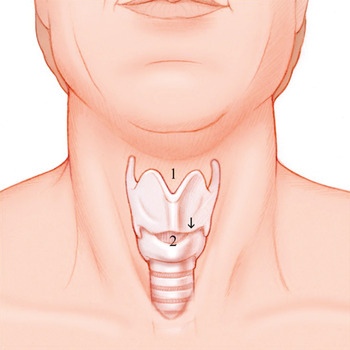
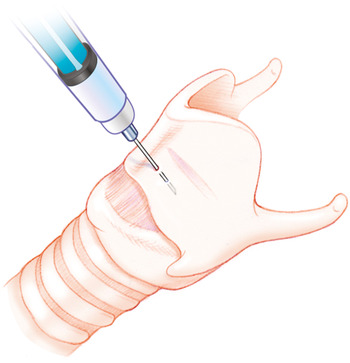
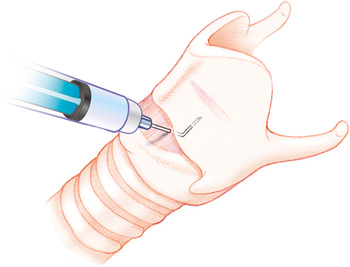
As described by Green et al.,Reference Green, Berke, Ward and Gerratt11 the injection was administered with a 27 gauge needle through the thyroid cartilage into the ipsilateral thyroarytenoid muscle. The anterior commissure was estimated at the midpoint between the thyroid notch and the inferior border of the thyroid cartilage, in the midline (Figure 1). The needle was placed 5 mm lateral and 5 mm inferior to this point (Figure 2). In cases in which the cartilage was ossified, the injection was performed through the cricothyroid membrane (Figure 3). The needle was placed just below the inferior border of the thyroid cartilage, approximately 1.5 cm lateral to the midline and directed superiorly, medially and posteriorly.
Anatomical landmarks required to administer botulinum toxin using the point-touch technique. 1 = thyroid notch; 2 = cricothyroid membrane; arrow = site of needle placement for sub-thyroid ala injection.

Trans-thyroid ala injection.

Sub-thryoid ala injection.

Immediately prior to injection, patients completed the EAT-10 and Voice-Related Quality of Life questionnaires.
Following treatment commencement, the Eating Assessment Tool questionnaire was completed again when 5–10 per cent of the injection cycle had been completed (based on a survey of adductor spasmodic dysphonia patients receiving botulinum toxin every three months who reported dysphagia at weeks one to two (E J Damrose, unpublished data)). The length of the injection cycle was determined by averaging the two time intervals between the two previous injections.
The Voice-Related Quality of Life questionnaire was also completed again, when 30 per cent of the injection cycle had been completed. This follow-up period was based on Paniello and colleagues’Reference Paniello, Barlow and Serna13 finding that, during an average injection cycle, maximum benefit is observed when 30 per cent of the cycle has been completed.Reference Paniello, Barlow and Serna13
Patients were sent both post-treatment QoL questionnaires via email attachment or regular mail, and instructed to complete and return them immediately.
An a priori sample size calculation was performed to determine the number of subjects required to detect a 25 per cent difference in QoL scores, utilising values of α = 0.05 and 1 − β = 0.8. A 25 per cent post-treatment QoL difference was thought to be clinically significant. Utilisation of a two-tailed, paired-sample t-test indicated that a minimum of 30 patients would be required. A paired t-test was used to compare QoL indices, while an independent samples t-test was used to compare studies. Correlation was determined using Pearson and Spearman rank analyses for parametric and non-parametric data, respectively. The Statistical Package for the Social Sciences version 11.0 for Windows software (SPSS Inc, Chicago, Illinois, USA) was used for statistical analysis. Significance was determined at p < 0.05.
Results
Forty-one patients met the inclusion criteria and were recruited into the study. Four patients did not complete follow up and were thus excluded from analysis. There was no systematic difference between the experimental cohort and those patients lost to follow up.
Thirty-seven patients were available for analysis. They comprised 11 men and 26 women, with mean ages of 56.3 years (range 31–74 years) and 56.1 years (range 43–69 years), respectively.
The mean ± standard deviation (SD) duration of injection (defined as the time from palpation of external landmarks to withdrawal of the needle) was 33.51 ± 24.09 seconds (range 5–90 seconds). The mean total botulinum toxin dose was 0.88 units (range 0.06–5.0 units). Injections were bilateral in 19 patients and unilateral in 18 patients. The mean ± SD time between injections was 26.08 ± 11.59 weeks (range seven to 73 weeks).
The mean ± SD follow-up time for Eating Assessment Tool questionnaire completion was 2.53 ± 1.18 weeks (0.7 to seven weeks). The mean ± SD follow-up time for Voice-Related Quality of Life questionnaire completion was 7.84 ± 3.49 weeks (range two to 22 weeks).
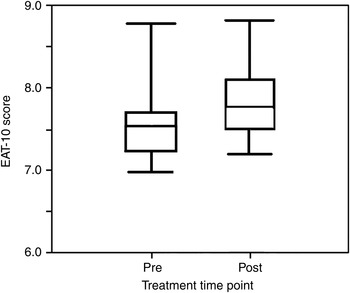
The mean ± SD Eating Assessment Tool questionnaire score was 7.54 ± 3.71 before treatment and 7.78 ± 3.15 after treatment (Figure 4). This difference was not statistically significant (p = 0.40).
Box-plots showing Eating Assessment Tool questionnaire (EAT-10) scores before and after botulinum toxin therapy. Box indicates range, horizontal bar indicates mean and outliers represent standard deviations. There was no statistically significant difference between the pre- and post-treatment means.

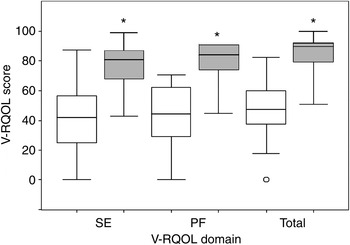
Before treatment, the mean ± SD Voice-Related Quality of Life questionnaire domain and total scores were: social-emotional, 41.22 ± 24.50; physical-functioning, 43.70 ± 22.10; and total, 47.50 ± 19.26. After treatment, scores had improved to: social-emotional, 80.27 ± 18.73; physical-functioning, 83.36 ± 15.18; and total, 87.64 ± 12.05 (Figure 5). The mean ± SD improvement in Voice-Related Quality of Life total score was 40.14 ± 13.80. Improvements in both domain and total scores were statistically significant (p < 0.001).
Box-plots showing Voice-Related Quality of Life questionnaire (V-RQOL) domain and total scores before (white box) and after (grey box) botulinum toxin therapy. Higher scores are associated with improved voice outcomes. *p < 0.05, comparing pre- vs post-treatment score means. SE = social-emotional domain; PF = physical-functioning domain.

Discussion
In order to assess the outcome of botulinum toxin injection utilising the point-touch technique, we used the Voice-Related Quality of Life questionnaire, a 10-item outcome assessment instrument with two domains: social-emotional and physical-functioning.Reference Hogikyan and Sethuraman14 Of the available voice-related QoL instruments, the Voice-Related Quality of Life questionnaire is highly responsive to botulinum toxin therapy,Reference Morzaria and Damrose15 and has been well validated in patients with adductor spasmodic dysphonia.Reference Paniello, Barlow and Serna13, Reference Rubin, Wodchis, Spak, Kileny and Hogikyan16–Reference Braden, Johns, Klein, Delgaudio, Gilman and Hapner19
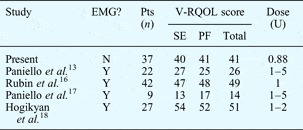
Our patients’ pre-treatment Voice-Related Quality of Life questionnaire scores reflected the significant morbidity associated with adductor spasmodic dysphonia; their scores were far worse than those reported for unaffected individuals, and comparable to those reported for unilateral vocal fold paralysis.Reference Hogikyan, Wodchis, Terrell, Bradford and Esclamado20 Botulinum toxin therapy resulted in a 40-point improvement in our patients’ Voice-Related Quality of Life questionnaire mean total score. This was a significant clinical improvement, comparable to the reported response following correction of unilateral vocal fold paralysis.Reference Hogikyan, Wodchis, Terrell, Bradford and Esclamado20 Our patients’ Voice-Related Quality of Life questionnaire score improvement was similar to that reported by other studies utilising EMG guidance for botulinum toxin injection (Table I).
Botulinum toxin dose and V-RQOL improvement: present study vs other studies with emg

V-RQOL = Voice-Related Quality of Life questionnaire; EMG = electromyographic guidance; pts = patients; SE = social-emotional domain; PF = physical-functioning domain; N = no; Y = yes
Our mean botulinum toxin dose was 0.88 units; again, this was comparable to that reported by other studies utilising EMG guidance. In Green and colleagues’ series,Reference Green, Berke, Ward and Gerratt11 three patients who had previously undergone botulinum toxin injection using EMG guidance subsequently underwent injection with the same dose using the point-touch technique, with the same effective response.
To assess patients’ dysphagia risk, we used the Eating Assessment Tool questionnaire. This is a 10-item, symptom-specific outcome assessment instrument with excellent internal consistency, test–retest reproducibility and criterion-based validity.Reference Belafsky, Mouadeb, Rees, Pryor, Postma and Allen21 Normative data suggest that an Eating Assessment Tool questionnaire score of 3 or greater is abnormal. Before treatment, our patients’ mean Eating Assessment Tool questionnaire score was 7.54; this is above normal but within the range for patients with ‘voice disorders’ (established in the initial validation study). Following 10 per cent completion of the injection cycle, this score had increased to 7.78. However, this difference was neither clinically nor statistically significant.
• Botulinum toxin injections under electromyographic (EMG) guidance are the ‘gold standard’ for adductor spasmodic dysphonia treatment
• Limitations of EMG include access and interpretation
• An alternative injection technique which relies on anatomical landmarks, the point-touch method, is comparable to EMG-guided injection regarding dose and voice-related outcomes, with no appreciably increased dysphagia risk
A potential limitation of the point-touch technique is failure to identify anatomical landmarks. Although not required in this series, we have previously utilised nasal endoscopy in some patients in order to confirm needle position. Another potential limitation of this technique is the required learning curve; assessment of this effect represents an avenue for further study.
Conclusion
In patients with adductor spasmodic dysphonia, botulinum toxin injection utilising the point-touch technique is comparable to EMG-guided injection with respect to dose and voice-related outcome, with no appreciable dysphagia risk. We recommend that laryngologists add this technique to their armamentarium of treatment approaches for this challenging condition.