1. To Organise Sound
In the twentieth century, Edgard Varèse defined music as ‘organised sound’ (Varèse and Wen-chung Reference Varèse and Wen-chung1966: 18). If we break down this definition, approaching it with a soundscape ecology perspective, we realise that aesthetics are first perceptual rather than expressive. Organisation is nowhere but in the perceptible appreciation of the listener. Organised sounds are only organised by those who can hear organisation in them. It is a perceptual quality rather than an expressive one.
It is our own sensible analysis that critically organises the sounds we hear, thus it is only our subjective semiotic process that decides whether what we hear is a form of organisation or not. Is not stochastics a form of organisation? Organisation is a subjective concept of perception, thus if music is ‘organised sound’, then music has the potential to be anything audible to anyone. If this is so, do we really need to concern ourselves so much about its boundaries?
If we understand music as organised sound, and agree that this organisation and aesthetics are perceptual rather than expressive, then we may also agree that inflexible conceptions of music and art are not really defensible, for music becomes as culturally subjective as the very nature of the listening activity.
From the understanding of music as the result of the aesthetic process of active listening, or how we organise sound, we can deduce something that may be obvious, but nonetheless important: listening is a feature that might be culturally and contextually (thus individually) learned and developed:
Everybody inhabits a distinctly individual soundscape, dynamically responding to our surroundings and to others that inhabit it with us. Personalities notwithstanding, our individual sense of sound perception is also influenced by social, cultural and even economic meta-factors that establish the backdrop of our auditory sense of who and where we are. (Stocker Reference Stocker2013: 5)
This means that we have the ability to tune our own ears intentionally by actively listening and sounding, so we empirically can learn to listen. We can engage with the sonic environment in the same fashion as we might do with music in Varèsian terms: organising its sound. This ear-tuning process developed through actively listening is a form of what Eric Clarke defines as ‘perceptual learning’. According to Clarke, ‘perception is a self-tuning process, in which the pick-up of environmental information is intrinsically reinforcing, so that the system self-adjusts so as to optimise its resonance with the environment’ (Clarke Reference Clarke2005: 19). This resonance is not a passive effect. It is the result of an active and exploratory engagement of the perceiver with the environment, which itself influences how the perceiver might ‘organise sound’ through listening.
Pauline Oliveros (Reference Oliveros2012) divides deep listening into two modes of focus that, according to her, when balanced, may bring about homeostasis:
listening can be focused, linear and exclusive and listening can be open, global and inclusive. Focal listening is concentrated moment-to-moment attention to details, such as a phrase or phrases of music. Inclusive listening is receptive to all that can be heard in an ever expanding field of continuous simultaneous events perceived as a whole. (Oliveros Reference Oliveros2012: iii)
Listening is the first and most important step in making sense of our sonic environment, and by training our ears to deeply listen to the environment we are actively involving ourselves with it, engaging with it, creating meaning, thus connecting to it in a deeper way. To listen strengthens our relationship with the environment, develops awareness of our place in it and seduces our curiosity to understand it ever more deeply. This also means that one’s experience and relationship with the environment is singular. Although we may share experiences and resonate with them in similar ways, perceptual learning is something that is developed singularly by each person.
2. Sharawadgi out of The Grief
Sound itself is emotionless. It is only from a person’s point of view that music acquires its emotions. If one listens to music from nature’s point of view, music is free of emotion. Therefore, emotion is a synthetic and not a natural distinction. (Chung Reference Chung2001: 72)
As is often the case with other field-recording practitioners, the moment I actually spent time to listen carefully and attentively to a natural soundscape through a pair of microphones and a headset, I was changed by it. I found myself in a meditative state for hours, static, listening to the most organic piece of music subtly changing through the end of a summer afternoon in the woods by the ocean.
This type of aural aesthetic experience, which one might understand as a sublime moment, is named by Jean-François Augoyard and Henry Torgue (Bick Reference Bick2008) the sharawadgi effect. It is defined as the blurring of the edges of aesthetics, the deterritorialisation of the senses and monumentalisation of sensation:
Unbridled and unintentional structures disrupt the nature–culture binary and reveal new forms of life beyond their disorder […] The sharawadgi affirms itself in contrast with the very banality it is based on. (Bick Reference Bick2008)
Claude Schryer describes the sharawadgi effect as being essentially a ‘state of awareness, in which one tends to open the ear in the hopes of experiencing the sublime beauty of a given sound in an unexpected context’ (Schryer Reference Schryer2001: 125). I believe that this aesthetic experience of aural sublime, or sharawadgi, is closely related to and, in fact, an outcome of what James Agee defines as the ‘grief of incommunicability’ (Dunn Reference Dunn1997). This grief arises from a sensation of otherness that is simultaneously a sensation of belonging to the world/environment/cosmos, when listening to it ‘speaking to itself’. This phenomenon is related to the aural experience of the world, the life we share with the whole terrestrial biome. It consists of our empathetic, although alien relation with what transcends our being, the natural world that envelops and contains us. In my interpretation of it, the grief is what exceeds the struggle to construct meaning within music or the natural environment:
We hear in the world talking to itself a sense of otherness that simultaneously mirrors our deepest sense of belonging […] Somehow we have always intuited that music is part of our reflection to and from the non-human world. (Dunn Reference Dunn1997: 1)
I interpret the grief as being the content of the aural aesthetic experience.
The grief is autonomised sensation leading to the aesthetic experience, the letting go – to catch a glance of Chaos, in a process of sensorial deterritorialisation.Footnote 1 Its incommunicability or untranslatable quality can be explained through Adorno’s aporia of aesthetics:
[The aesthetic] object is determined negatively, as indeterminable. It is for this reason that art requires philosophy, which interprets it in order to say what it is unable to say, whereas art is only able to say it by not saying it. (Adorno Reference Adorno2002: 72)
If we understand that art happens first perceptually, as we have discussed before, then we can understand this statement as valid to any aesthetic experience. As such, we can relate it to the grief of incommunicability. To paraphrase Adorno’s citation into a sound-oriented discourse: the grief of incommunicability is determined negatively, as indeterminable. It is for this reason that soundscapes require sound studies, which interpret them in order to say what they are unable to say, whereas soundscapes are only able to say it by not saying it – but sounding it.Footnote 2
It is out of this grief that one might eventually experience the sharawadgi – the monumentalisation of the aural sensation by resonance with the bodies that experience it: ‘[Sounds] only become Sharawadji by decontextualisation, by a rupture of the sense’ (Schryer Reference Schryer2001: 125). I consider this decontextualisation to be open to comprehension, for I understand that the decontextualisation might often be within our perception and not an exterior factor. I consider it to be a framing of that rupture of the sense, that is, monumentalisation of sensation. The grief is the decontextualisation of our sensation towards the natural world, rendering the sense of belonging and otherness with it, which might evoke the sharawadgi.
Sharawadgi is not only a decontextualisation or displacement, it is an enabler of a creative re-contextualisation from the perspective of the experiencer. Just as Eddie Prévost suggests ‘the first concert’ (Reference Prévost2011) to be a shifting of the auditory stance from a survivalist perception to an aesthetic one (in very simplified terms), the sharawadgi arises from a possibility of free association, an incomprehensible perceptual re-composition or organisation of sound: a grief of incommunicability. The sharawadgi is the sublime experience of this grief. I believe we do not experience the sharawadgi as often as the grief because our perception is culturally constrained.
When Cage would hear a sound, he would not find a plausible reason to dislike it, thus he would listen to it attentively, and consequentially he could enjoy that sound just the way it was. Similarly, Schafer (1969) argued that the best way to ‘overcome’ an unwanted sound is to listen to it carefully. Listening involves an unravelling of dimensions within the sounds perceived. Aesthetics is a conscious or unconscious, subjective way of dealing with our own listening, a conscious or unconscious choice of listening in a determined way. The sharawadgi might be the matching of a specific stance of the active listener with the dimension listened, generating a deep experience of some sort.
This experience might encourage a further exploratory listening. But then again, what is it really that we listen for?
3. Sound and Signification
3.1. Musical values and systems
Pierre Schaeffer states, ‘musical value is inseparable from the idea of system’ (Hodgkinson Reference Hodgkinson2001: 38). I find these two concepts (‘musical value’ and ‘system’) key to a comprehension of a transition from the listening to our music to a music of the environment back to an environmental music. Schaeffer is strongly critical of Western music’s internal structure. He argues that it functions similarly to language: there are musical values, just as there are phonemes in language, which are attributed a meaning by the relations they create within their pre-established system or syntax. It is this system that renders them meaningful, and, according to Schaeffer, sound itself is neglected in favour of its musical value.
To understand how we attribute meaning to sounds, and how we differentiate them in different systems, I shall resort to the semiotics of sound as argued by Barry Truax and Charles Peirce’s theory of semiotics. I shall attempt to relate these two theories in order to understand better the act of listening and our aesthetic experience of sound – the grief of incommunicability.
3.2. Speech–music–soundscape (Truax’s continuum)
Musical instruments refine the sounds of nature into a powerful form of human expression. But music communicates on the basis of its organisation of sound, which is the product of human thought processes. (Truax Reference Truax2001: 50–1)
Truax (Reference Truax2001) divides the semiotics of acoustic communication into a continuum of three fundamental systems: speech, music and soundscape. Analysing the systems in this disposition, we can identify that, from left to right, there is a corresponding increase in the range of the acoustic repertoire: from the relatively small number of phonetic units existent in speech, through the wider variety of musical sounds (that has increased even more since the twentieth century), to the virtually infinite universe of possible sounds of the acoustic environment, which can even integrate the sounds from the other systems.
He also suggests that, from a very general perspective, there is a reduction of the strictness of the syntactic structure, while moving from left to right. This takes into account that, for the transmission of meaning in a language, there are quite stringent rules regarding the organisation of phonemes in order to shape words, to be then organised in the form of speech. Regarding music, the syntactic rules that determine a musical ‘language’ may not be as clear or well understood as in spoken language. However, a listener who is familiar with the genre of a certain piece of music will be able to recognise the occurrence of a mistake or variation. This is certainly less clear in more recent music genres that are structurally freer and exploratory. We can then infer that these will be placed more at the right of the continuum, closer to the soundscape where, to our understanding, there is virtually no syntactic structure, for it is very open-ended, beyond human scale.
Finally, Truax suggests that, along the continuum (from left to right), there is a decrease of the density of information in time. In language, the information is very condensed and structurally optimised in order to be conveyed in a clear and objective manner: ‘compare what can be understood or inferred from two seconds of speech, compared with that of music’ (Truax Reference Truax2001: 52). In music, meaning is developed over longer periods of time, therefore articulated in other ways and out of other syntactic structures. Regarding the soundscape, we have the most extreme examples. Given that it is the totality of a perceived sound environment, it will potentially contain within it all the other acoustic communication systems, only from a macroscopic, or rather ‘macrophonic’ perspective. Nevertheless, I reckon that the soundscape is also the one that potentially contains the highest density of information, if we interpret it as a ‘macrocosmic composition’ (Schafer Reference Schafer1977: 5), using our imagination to consider the entire sound universe taking place in time. This is, of course, an abstraction and, by contrast, on a human scale of perception the soundscape is the one that contains the lowest density of information, that is, it requires a longer temporal development for an attainment of meaning by the human listener.
In short, according to Truax, moving through the continuum from left to right, the acoustic meaning we can attain, or, the acoustic communication, will be determined by the effects of the increasing sound repertoire, the decreasing constriction of the syntactic structure and the temporal density of information.
3.3. Firstness–secondness–thirdness (Peirce’s trichotomies)
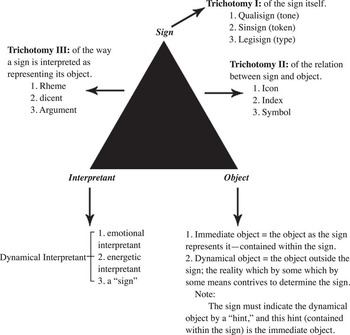
Peirce developed his semiotic theory, based on three main trichotomies, to analyse the different aspects of a sign and the different types of relationship between the three basic components of semiosis: sign–object–interpretant (Figure 1). These trichotomies are, in a way, an escalation of the complexity or of the levels of mediation in the relations between the components of the sign.
Peirce’s trichotomies (Turino 1999).

According to Peirce, a sign is ‘something that stands for something else for someone in some way’ (Turino Reference Turino1999: 222). The components of the sign define it and its reference, or, its relation with the object and the interpretant. Therefore the object is the ‘something else’, the entity signified by the sign, and the interpretant is the effect generated by the sign and object in the perceiver.
According to Peirce, semiosis is a chain reaction process that consists of an unfolding of signs into new signs in the mind, ad infinitum. This chain reaction takes place in time and can be divided in stages of semiosis. In each stage the interpretant (the effect of the sign in the observer, whether feeling and sensation, physical reaction, as well as ideas articulated and processed in language) becomes the object of a new stage of semiosis, creating a new interpretant, and so on until it is interrupted by another process.
On the sign itself, the trichotomy is divided in qualisign, sinsign and legisign. Qualisign refers to a pure quality of something concrete (e.g. the massFootnote 3 of the sound of a particular recording); sinsign to that something concrete, specifically (i.e. that particular recording); and legisign refers to a generalisation produced by building up from specific cases to form a class (i.e. recorded sound).
On the sign’s relation to the object, we have the trichotomy of icon, index and symbol. Icon refers to a relation of the sign with the object through some kind of resemblance of morphology (e.g. the creaking of a door resembling the yelping of a dog); index refers to a relationship by co-occurrence (e.g. the creaking as an indicator that the door is not oiled); symbol refers to a linguistic or conventional relationship (e.g. ‘door’).
On how the sign is interpreted as representing its object, we have the trichotomy of rheme, dicent and argument. Rheme refers to the interpretation of a sign representing its object as a qualitative possibility (‘a sign that is not judged as true or false but as something that is simply possible […] [i.e.] a painting of an unknown or imaginary person or scene may be interpreted as a rheme’ (Turino Reference Turino1999: 229)); dicent refers to its object in respect to actual existence (i.e. a recording is a dicent of the acoustical event that it registered, the direct effect); argument represents its object through symbolic propositions such as language, mathematics or music notation.
The interpreter itself (the effect) of a sign is a dynamic component divided into three classes: emotional (emotional interpretant) – a direct unreflected-upon feeling caused by a sign; energetic (energetic interpretant) – a physical reaction activated by a sign, such as tapping your foot to the music’s rhythm; and signic (sign interpretant) – that is already a linguistic conceptualisation.
Signs are constituted by combinations of these components, which can be categorised by type:
Peirce’s three most basic categories for all phenomena … Firstness [qualisign, icon, rheme], something in and of itself without relation to any second entity; Secondness [sinsign, index, dicent], relations between two entities without the mediation of a third; and Thirdness [legisign, symbol, argument], involving the mediational capabilities of a person to bring a first and a second entity into synthetic or general relationships with each other. (Turino Reference Turino1999: 231)
These categories are not inert. As in Truax’s continuum, there is dynamism in signification that, even categorised, can approach a neighbouring category. In other words, a sign may have components belonging to different categories at the same time; however, in the end it will be generalised in a dominant category, according to the mediation it reflects. There is a basic principle in these significant cadences, that is characterised like this: Thirds include Seconds and Firsts, Seconds include Firsts, and Firsts can only determine Firsts (‘whatever is a Third determines a Third, or degenerately a Second or a First, etc.’ (Turino Reference Turino1999: 223)).
According to Turino, musical signification operates mainly in the first two categories (Firstness and Secondness). Thirdness is reserved for semiosis of symbolic complexity of abstraction (symbol: the component that is related to your subject by signification conventions), belonging to the domain of logical thinking and its mediators and coding systems. However, Western music has developed quite well a whole signification system based on the Thirdness through its notation. I agree that it might not be common for anyone to listen to music on a Third level of mediation, as if reading a score. However I believe that the conventions that are perpetuated in Western music theory and notation also perpetuate legisigns (which are Thirdness components), that is, a glissando from low to high frequencies standing for the abstract concept of ascension.
3.4. Trichotomy and continuum
The power of music to create emotional responses and to realise personal and social identities is based in the fact that musical signs are typically of the direct, less-mediated type. Music involves signs of feeling and experience rather than the types of mediational signs that are about something else. (Turino Reference Turino1999: 224)
Based on Peirce’s semiotic system, Turino argues that musical signification is usually more direct and less mentally mediated, semiotically acting in a more sensitive and emotional fashion rather than a logical and rational one. This will be the later semiotic stage, if the experiencer decides to express the experienced object discursively. This sends us back to Adorno’s aporia of aesthetics.
We can infer from Peirce’s semiotic system that there is meaning in a particular object from the moment it causes an effect (be it an emotion, physical reaction or a linguistic concept) in its perceiver. Also, we can logically deduce that, accordingly with the system’s cadence, there is an emotional interpretant in every semiotic chain. Since every semiotic structure can be deconstructed down to the First category and Firstness is the less mediated category/stage of semiosis, I conclude that it is in Firstness that the aesthetic experience is contained. The aesthetic experience is the emotional interpretant of a semiosis. It is ‘the grief of incommunicability’, in the sense that it does not determine anything but itself, and to verbalise it would be to sublimate from its level of simplicity, from its Firstness to a Thirdness.
Adorno illustrates with his ‘aporia of aesthetics’ how significant structures of First and Second categories (which therefore cannot determine Thirds) require symbolic argumentative systems (hence Thirds) for their logical rationalisation and communication. However, the aporia lies here: while Thirds can be deconstructed into Seconds and Firsts, Firsts and Seconds do not determine Thirds, therefore, resorting to Thirds to ‘translate’ or refer to Firsts will result in a purely symbolic process of classification, distanced from experience by great mediation.
If we analyse Truax’s (Reference Truax2001) continuum again, we discover that, with a similar gradation from left to right, we can recognise in it a Peircian decrescendo:
Speech–Music–Soundscape
Thirdness–Secondness–Firstness
We can then understand that what happens in the movement from left to right is a decrescendo of the mediation within the semiotic processes. In other words, speech, which produces meaning by the articulation of symbols, clearly belongs to the Third Peircian category; on the other hand, music may contain Thirds (symbolic notation and structural conventions that can be understood as legisigns), Seconds (indices that can refer the listener to experienced or imagined situations, such as a flute may evoke a pastoral ambience) and Firsts (using icons in producing sounds that resemble others, such as the imitation of a bird song for flute). Turino claims that ‘the vast majority of musical signs are of three compromise types: rhematic–iconic–legisigns; rhematic–indexical–legisigns; dicent–indexical–legisigns. The aspect of generality provided by the legisign for each is, in fact, the cultural component, and a major defining facet of culture universally’ (Turino Reference Turino1999: 232). These significant composites concede music’s place in Firstness and Secondness according to Peirce’s hierarchy.
From this relation between Truax’s continuum and Peirce’s trichotomy, we can infer that, from left to right, there is not necessarily a reduction in the amount of information but rather a reduction in the mediation of the semiotic process. The semiosis gradually moves towards more energetic rather than signic interpretants as it advances to the right. Therefore, there is a reduction of the symbolic information (Thirdness); however, there is an increase in the acoustic repertoire. In other words, there are more possible causes for consequential effects (interpretants) and thus, conversely, more semiotic potential. This influences a perception of structure, system or syntax, since those are more rigid and required for a Thirdness, as is speech for functioning in an argumentative way for interpretation.
However, there is a peculiarity in Truax’s continuum. Of the three systems presented, we can notice that the soundscape is the only one that might exceed the human scale. In abstraction its dimension is infinite, reaching from micro to macro. It is like a sonic noumenon, a conceptual sonic totality whose experience is always angled and fragmented, contextualised and subjective. In fact, a perceived soundscape is an anthro-scopic perspective of its sounds in context and might therefore be fractioned into music, speech and any remaining acoustic information that there might be, depending on our perceptual focus, like other sonified symbolic systems.
The perceptual rendering of the soundscape as music is the product of the human process that allows us to freely associate all stimuli to signs, subjecting them to a semiotic process.
The soundscape is the original Chaos, the signic compound that acts only in First and Second categories, although it might contain all the Thirdness systems too. It is, in a sense, the audible cosmos ready to be organised in complex semiotic processes, such as music and speech. It is how we listen that renders these systems:
We hear the alien quality of the non-human in our music and the humanity of music in nature. (Dunn Reference Dunn1997: 1)
3.5. To organise the soundscape
John Cage states, ‘I love sounds just as they are, and I have no need for them to be anything more than what they are’ (jdavidm 2007). Similar to Schaeffer’s criticism of Western music previously discussed, Cage exercised listening in a way that opposed the conventionalised listening required in earlier Western music. This listening is, in a sense, a democratisation of the sounds by destroying their conventional system and therefore effacing their original musical value. Cage’s music reflects his listening, approaching a soundscape-listening mode (most famously in his 4′33″ piece). By attempting to hypothetically emulate a possible stochastic behaviour of the soundscape with his chance-based works, Cage intends meaning to be within the sound itself, or even better, to be the sound itself rather than a musical set, letting the aesthetic experience be free. Cage wants to strip his music of acquired musical values, wants to clear the sounds of culturally seized connotations of symbolic meaning: legisigns:
In this century, contemporary music has moved toward the environment with its use of an increased repertoire of sounds. (Truax Reference Truax2001: 53)
The interpretative transition of the soundscape into music depends only on the change in focus of perception through a deep listening practice, allowing the listener to release self, escaping from pre-established conventional modes of musical listening and understanding, giving more space to a grief of incommunicability. We can only listen to the soundscape as music if we re-organise our musical listening towards it. In so doing, we focus on a more empirical and sensorial form of letting in, a sonic meditation, an openness to the grief, an openness to the sharawadgi. I believe this to be a possible direction towards a ‘rewilding’ of the ear:
-
1. Can you find the quiet place in your mind where there are no thoughts, no words and no images?
-
2. Can you remain in this quiet mindplace by listening to all the sounds you can possibly hear, including the most distant sounds beyond the space you now occupy? (Oliveros Reference Oliveros2001: 131)
4. Listening Anew: Rewilding the Ear
4.1. Rewilding
Reductionism in scientific thought has also led us to regard ourselves as apart from the world, rather than a part of the world. This fallacy has led us to dominate life on earth to the extent that our own survival is now threatened. (Adams Reference Adams2009: 9)
We are going through an ecological crisis in every sense, not just on the macrocosmic scale of our planet, but including our own relationship to the environment we live in. Understanding that there is an organic connection and integral relationship with the environment, and faced with the ecological crisis we are going through, I believe an epistemological change in the relationship of human beings with their physical environment is essential.
In his book Feral: Rewilding the Land, Sea and Human Life (2014), George Monbiot develops a proposal to rethink how we relate to the extinguishing of the natural non-human world on our planet in order not only to preserve what is disappearing, but also to let it flourish in its own wilderness, together with a re-connection of our own experience of it.
Monbiot’s argument is spawned from a very real emotion of experience in the wilderness. He describes it as an ecological boredom. This ecological boredom is a very contemporary feeling, for it is the result of our virtually total domination of the environment we inhabit. It is the dullness of the contemporary sterilised urban human life and the craving for a richer, rawer life closer to the excitement of the ‘wilderness’. It is the feeling of disconnection provoked by a lack of direct interaction with the nature outside our own artifice.
In response, he proposes a ‘rewilding of human life’. This ecological notion is drawn from the larger concept of rewilding which ‘is about resisting the urge to control nature and allowing it to find its own way’ (Monbiot Reference Monbiot2014: 9), and applied to human life at the experiential level: ‘rewilding is not about abandoning civilisation but about enhancing it. It is to “love not man the less, but [non-human] Nature more”’ (Monbiot Reference Monbiot2014: 10). Rewilding does not mean a human retreat from ‘Nature’, but a reinvolvement with it. It is a concept that is resultant from a presence, an experience of the natural environment (as opposed to an artificial/human-made one). I also understand rewilding of human life as a search for awareness within the environment. It is the extension of us outwards towards the ecology, to the nature that’s beyond our civilisation. The effort is to re-engage with the nature we have distanced ourselves from, and discover a new way of living, to bring wonder back into our lives by exercising a positive environmentalism.
I believe that the ideas previously discussed in this article can relate strongly to this concept in the aural domain. How can we advance towards a rewilding of the ear through listening and sounding?
4.2. Impression
As previously discussed, hearing is a very malleable sense. There are different ways to hear and listen and different processes of semiosis that might emerge from the acoustic stimuli. My attention has been focused on the practice of an active, deep listening. Deep listening is a practice that we can learn to develop, and the more we learn, the more we find there is to learn; the more we experience, the more we stress the grief and the more we connect with our inner and outer worlds through a Firstness of sensing. Not that there are not other levels of semiosis involved; they are probably unavoidable. However, I understand that this Firstness (the ‘emotional’/energetic interpretant) is the level (which exists at the bottom of every semiotic chain, regardless of its complexity) that is closer to a ‘direct’ connection to the world at the experiential level as opposed to a rational one. It is the aesthetic experience in every semiosis. Surely, when we listen to the sound of an environment, we usually listen at the three Peircian levels of semiosis: first, the sensory/qualitative effect; second, the contextual/dicent information about source and place; and third, our own symbolic/argumentative articulation of what we are listening. This would be a normal analytical way of listening. However, running the risk of sounding vague or esoteric, I believe that a state of deep listening is reached by focusing on the Firstness levels that derive from those semiotic chains, in the attempt to reduce the semiosis down to a Firstness: an inclusive listening that resembles meditation. Hildegard Westerkamp argues this regarding the specific deep listening practice of soundwalking:
A soundwalk simply allows participants to hear the environment for what it is and to become aware of their own relationship to the soundscape. In this sense a soundwalk can be similar to a meditation: the world happens, the sounds occur and they pass. (Westerkamp Reference Westerkamp2006)
The refinement of listening to the world, and especially to non-human nature, is the refinement of a sense of belonging, a strengthening of our bond to the environment; therefore this might spark an awareness of our responsibility towards the ecological issues we are witnessing, for which our species is the one to blame.
Deep listening is not a science; it is not an analysis of the morphology or structure inherent to the sound we hear. That would be the function of sound studies or acoustic ecology: to analytically study the sonic ecology of the environment, grounded in listening. Deep listening is, however, essentially ecological, except that it functions in the realm of experience, in that it consists of a holistic experience of sonic ecosystems. By sonic ecosystems I mean the whole sound matter of a perceived soundscape, its ‘complex multiplicity of elements that function together as a whole’. Deep listening is a direct engagement with the endless network of patterns that forms the soundscape. To listen deeply is to bodily experience sound as matter, a perceptual wholeness. It is to let oneself be immersed in it, to get lost, to meditate, to let sound sink into our Firstness, to open up to the grief of incommunicability in search for the sharawadgi.
In turn, acoustic ecology functions like the Adornian aporia, distanced from the experience of actual sensing by rationalisation and analytical study, in order to unveil another world of information contained in the communicating network of sound. This is the information we use to make logical sense of what composes and shapes the ecology of the sonic realm. Sound studies inform this deep listening towards a rewilding of the ear by analysing patterns from a mediated perspective. As an example, I take Bernie Krause’s Harvard University lecture (Harvard University 2012), where he shows the recording of a Central African Ba’aka pigmy playing a flute to the rhythm of a choir of frogs among the big enveloping sound of the rainforest. Our untrained Western ears cannot distinguish the sound of the frogs from the rest of the environmental sounds, we cannot hear the rhythm of the croaking frogs. We can only know it by the reading of the spectrogram of the recording shown by Krause. Listening becomes a super-power of inclusion and wonder in the environment:
Deep coupled with Listening or Deep Listening for me is learning to expand the perception of sounds to include the whole space/time continuum of sound – encountering the vastness and complexities as much as possible.
Such expansion means that one is connected to the whole of the environment and beyond. (Oliveros Reference Oliveros2005: xxiii)
Listening is a constant learning and unravelling of new realities out of our known ones. The more we learn, the more we discover, the more we have to learn. We learn that sound is bottomless, inexhaustible but volatile, in the sense that it always withholds more than we can grasp for it has no static form. Listening is contextualised, inevitably more or less focused, presential. The wonder of deep listening, or of the attempt to rewild the ear, is also the search for the sharawadgi effect, the aesthetic sublime. It is the effort to overcome the grief of incommunicability by diving into these unravelling dimensions of the soundscape. The sharawadgi might arise from that experience of newness, the decontextualisation, the disembodying of the senses. The sharawadgi ‘strips bodies of their inertia, of the materiality of their presence: it disembodies bodies’ (Deleuze Reference Deleuze2003: 21).
It is only by proximity (direct experience, real engagement) that one can connect to and belong in the environment, and if our concerns are environmental towards a rewilding of life, then we should also learn from those who preserve a strong connection with the wilderness. Sound is one very important part of that proximity for the enhancement of that connection.
4.3. Expression
In Papua New Guinea, when a Kaluli songmaker searches for a new song, he may camp by a waterfall or a running stream. […] The songmaker listens carefully, sometimes for days, until he hears the voice of his new song. (Adams Reference Adams2009: 4)
In the Western world, art has become self-referential, redundant. According to Boris Groys (Reference Groys2008), the paradigm of modern art, which has developed since the classical modernity period (thus including the vanguards since the beginning of the twentieth century), lies in the artists’ creation of paradox-objects. These paradox-objects are the result of an art that is neither religious nor political propaganda: they are the expression of modern art, a product of an enlightened atheism and humanism.
The paradox-object appears when the art world begins to function redundantly in its space/environment/influential area. Art starts to serve its own purpose, that is, to theorise its own nature into a pleonasm, which begins to alienate itself from life. An art market system is formed and art begins to be sterilised and stratified in an independent ‘cosmos’, or, as we may call it by analogy – umwelt.Footnote 4
Music is not an exception. If we refer back to Schaeffer’s criticism of music in the western tradition, we can understand that listening became focused on the development of a vocabulary, a system that has moved toward a defined syntax that approaches the operation of language. Musical values have been refined and the system has been polished. Music has been evolving redundantly by focusing on itself and building on itself as a paradox-object.
Assuming that ‘the sounds of the wild […] determined the first music our ancestors made’ (Hendy Reference Hendy2013: 23), it seems that presently we empirically understand very little and relate less and less to those sounds, for we have been progressively losing that connection. Our fairly recently industrialised and strongly urbanised society has changed our environment, our habitat. Music reflects the status quo, yet its ‘language’, its system of meanings within it, has been highly developed throughout history by both musicians and listeners, to a point where music starts to be based on itself; it refers back to itself and builds upon itself. It becomes familiar to the ear because it expresses, within a particular system, specific musical values that one can come to relate to, and from which one can more accurately and easily draw a meaning. It presents itself as something separate, distinct and independent from the rest of the universe of sounds, hardly relating to them throughout history, because its message is precise in what it is supposed to deliver. Music becomes a reflection upon music and evolves along that line. Its environment, context and status quo influence its display and direction, however, they are not central to its pre-established syntax. The system is already a language, it has become independent. It is an acquired cultural model.
Art is moulded by the context into which it is inserted. As a result, it reflects the world it envisions.
4.4. Reinvolvement
In an ecologically threatened existence we need to reinvolve ourselves within what we have been distanced from. If we silence ourselves to listen to our environment, then we can learn from it and maybe rethink our relationship with our planet. That thought and reinvolvement needs to be reflected in our system of living values. We need to rethink our life on this earth, therefore we ought to be exploratory and experimental, in order to learn:
One of the lessons of ecology is that when we see ourselves as ‘different’ from nature and not as an integral part of it, we are more likely to violate its balance, ultimately at our own peril. (Truax Reference Truax2001: 55)
A rewilding attitude would be the attempt to break the self-referential circle of music, the paradox-object, and refer back to the environment; learning from the Ba’aka flutist, the Kaluli songwriter, the rainforest cacophony or the deep ocean quietness. We need to experience and explore the voice of the wilderness so we can sing along with it in our own fashion. This is an ethical, political attitude, focusing on what we need to save because we need to feel we are part of it again. Rewilding the ear is a re-directing of our aural attention towards the natural non-human world we threaten, a rewilding of our engagement with what we have been distancing ourselves from. The way we listen to our own sound, the sound we make, the way we relate to the sonic environment by sounding also determines and develops the way we listen, and listening has a big role in the ways we experience the world, and therefore in how we live in it:
A way of hearing the world comes from interacting with it, but it also has to do with appreciating it, imagining it as one’s very own. (Feld Reference Feld1994: 5)
In our search for wonder we silence ourselves, we listen. We learn to organise sound. We hear music in nature. We actively engage, explore and widen our perception, perceptually learning. We experience the grief of incommunicability when we open up to this experience – maybe the sharawadgi. When we distance ourselves, we try to make sense of it. So we distance ourselves a bit more, and we circle around it. We learn some more. We need to re-engage with it. So we listen again. We feel immersed. But we want to be involved. We want to belong. We want to further the exploration, further the learning, shorten the distance. So then we sound; and nature re-organises itself; and we re-organise listening; and we learn some more; and listen deeper, again. And ‘by deepening our awareness of our connections to the earth, music can contribute to the awakening of our ecological understanding’ (Adams Reference Adams2009: xvii).
The artistic work is a by-product of a continuous and endless search, informed by a perceptual learning, through an exploratory experimentation with aesthetics in order to unveil new depths of perception. Considering this, the rewilding of the ear becomes pertinent to music as organisation of sound; and music, being a practical experimentation of organisations of sound, stresses further exploration of a rewilding of the ear. This intertwining and permutation of processes steps towards the blurring of a conscious or unconscious distinction we might make between ‘ourselves and nature’, between music and soundscape.