Introduction
The use of chemical insecticides throughout the 20th century to control agricultural pests has led to insect resistance and a number of ecological and human health problems (Howarth, Reference Howarth1991; Mack et al., Reference Mack, Simberloff, Lonsdale, Evans, Clout and Bazzaz2000; Devine & Denholm, Reference Devine, Denholm, Resh and Cardé2009). Biocontrol programs using natural enemies to control pest populations have since been developed for both greenhouses and crop fields (van Lenteren & Woets, Reference van Lenteren and Woets1988; Hoddle & Van Driesche, Reference Hoddle, Van Driesche, Resh and Cardé2009). Over 40 different species of aphidophagous insects are currently used for biocontrol worldwide (Powell & Pell, Reference Powell, Pell, van Emden and Harrington2007; Bale et al., Reference Bale, van Lenteren and Bigler2008; van Lenteren et al., Reference van Lenteren, Bolckmans, Köhl, Ravensberg and Urbaneja2017). The silver fly Leucopis glyphinivora Tanasijtshuk (Diptera: Chamaemyiidae) is a known aphid predator with a Holarctic distribution (Tanasijtshuk, Reference Tanasijtshuk1986; Kaiser et al., Reference Kaiser, Noma, Brewer, Pike, Vockeroth and Gaimari2007; Satar et al., Reference Satar, Raspi, Özdemir, Tusun, Karacaoğlu and Benelli2015). Leucopis glyphinivora feeds on more than 75 aphid species in over 30 genera, many of which are agricultural pests such as Myzus persicae Sulzer (Satar et al., Reference Satar, Raspi, Özdemir, Tusun, Karacaoğlu and Benelli2015), Aphis glycines Matsumura (Kaiser et al., Reference Kaiser, Noma, Brewer, Pike, Vockeroth and Gaimari2007) and Aphis fabae Scopoli (Rad et al., Reference Rad, Hatami and Asadi2003). However, little is known about the biology and ecology of this species and how it can be used for biocontrol. Other species of the genus Leucopis Meigen can be found throughout the Holarctic region and prey on sternorrhynchus hemipterans (Tanasijtshuk, Reference Tanasijtshuk1986; Kohler et al., Reference Kohler, Wallin and Ross2016), and a general review of the family's biology is presented in Gaimari (Reference Gaimari, Brown, Borkent, Cumming, Wood, Woodley and Zumbado2010). Many species have been studied as biocontrol agents in forestry (Ross et al., Reference Ross, Gaimari, Kohler, Wallin, Grubin, Onken and Reardon2011), such as L. argenticollis Zetterstedt and L. piniperda Malloch against Adelges tsugae Annand (Hemiptera: Adelgidae) (Grubin et al., Reference Grubin, Ross and Wallin2011; Kohler et al., Reference Kohler, Wallin and Ross2016) and L. hennigrata McAlpine against A. picea Ratzeburg (Hemiptera: Adelgidae) (McAlpine, Reference McAlpine1978; Humble, Reference Humble1994). Other species have been studied for biocontrol in agriculture, such as L. ninae Tanasijtshuk against Diuraphis noxia Mordvilko (Hemiptera: Aphididae) (Gaimari & Turner, Reference Gaimari and Turner1997; Mohamed et al., Reference Mohamed, Lester and Holtzer2000; Noma et al., Reference Noma, Brewer, Pike and Gaimari2005) and L. simplex Loew is a predator of Daktulosphaira vitifoliae Fitch (Hemiptera: Phylloxeridae) (Stevenson, Reference Stevenson1967). This leads to believe that L. glyphinivora has the potential to be an effective biocontrol agent.
Our main objective was to study the life cycle of L. glyphinivora in order to predict its potential as a biocontrol agent against aphids in an agricultural setting. Few recent studies have presented new candidates for biocontrol programs. Most studies published on the subject focus on a small number of model species that are easy to use and/or obtain (Sloggett, Reference Sloggett2005). Most biocontrol agents became available in the late 20th century, but this number has been declining ever since (van Lenteren, Reference van Lenteren2012). Of the approximately 350 commercially available invertebrate biocontrol agents, 51% are hymenopterans (van Lenteren et al., Reference van Lenteren, Bolckmans, Köhl, Ravensberg and Urbaneja2017). For aphidophagous dipterans, biocontrol studies focus mainly on three families (Cecidomyiidae, Chamaemyiidae and Syrphidae) (Hagen et al., Reference Hagen, Mills, Gordh, McMurtry, Bellows, Fisher, Caltagirone, Dahlsten, Gordh and Huffaker1999), with three species, Aphidoletes aphidimyza Rondan (Cecidomyiidae), Episyrphus balteatus De Geer (Syrphidae) and Sphaerophoria ruppellii Wiedemann (Syrphidae), being commercially available (Völkl et al., Reference Völkl, Mackauer, Pell, Brodeur, van Emden and Harrington2007; van Lenteren et al., Reference van Lenteren, Bolckmans, Köhl, Ravensberg and Urbaneja2017).
The development and survival rates for each life stage were observed for L. glyphinivora and compared with a similar commercially available biocontrol agent, A. aphidimyza, which is also a dipteran with an aphidophagous larval stage, making it a suitable biological reference model for L. glyphinivora. It is hypothesized that L. glyphinivora will have slower development than A. aphidimyza because large insects usually develop more slowly than small ones (Tantawy & El-Helw, Reference Tantawy and El-Helw1970; Roff, Reference Roff1981; García-Barros, Reference García-Barros2000; Šešlija & Tucić, Reference Šešlija and Tucić2003). Slower development is also positively correlated with adult longevity (Šešlija & Tucić, Reference Šešlija and Tucić2003), but usually associated with a lower survival rate (Roff, Reference Roff1980, Reference Roff1981; Šešlija & Tucić, Reference Šešlija and Tucić2003).
Materials and methods
Insect material
Leucopis glyphinivora specimens came from an experimental colony held at the biocontrol laboratory of the Université du Québec à Montréal since 2009. These individuals were collected as larvae on apple trees within or near colonies of Aphis pomi De Geer and Aphis spiraecola Patch (Hemiptera: Aphididae) at the scientific campus in Montréal, Canada. The laboratory colony was supplemented by L. glyphinivora collected on the scientific campus in 2016 as eggs, larvae and pupae on greater burdock with Aphis fabae. Multiple generations were reared in the laboratory using the Gaimari & Turner (Reference Gaimari and Turner1996b) method. Specimens reared from the colony were verified as L. glyphinivora by the third author, and voucher specimens reside in the California State Collection of Arthropods, Sacramento. Rearing cages were made from polyvinyl chloride frames (35 cm × 35 cm × 35 cm) covered by sheets of muslin. These were used to house all life stages of L. glyphinivora as they were reared on Myzus persicae on potato plants, Solanum tuberosum L. (var. Norland). A sugar-water solution and a dry mix of sugar and brewer's yeast were added as food sources for adults. A non-infested or lightly infested plant was introduced weekly until a new generation of adults emerged. Plants were not discarded until 7 days following the beginning of adult emergence to ensure all pupae had completed development.
Aphidoletes aphidimyza specimens were obtained from a commercial supplier, Plant-Products Québec (Laval, Quebec, Canada). Aphidoletes aphidimyza were reared on potato plants infested with M. persicae in the same type of cages and following the same procedure as with L. glyphinivora. A sugar-water solution was added as a food source for adults. Both L. glyphinivora and A. aphidimyza were kept under abiotic conditions of 24°C, RH 75%, 16L: 8D. As the process and terminology for the life stage between the larval and adult stages for the two species under study differ, we use the terms ‘pupa/pupate’, as this effectively covers both situations.
Pre-imaginal development and survival
Individuals of both species collected from the rearing cages at various development stages were isolated in small Petri dishes (diameter = 5 cm) lined with a potato leaf on agar gel. Tests were kept in the same abiotic conditions as the rearing cages.
Eggs were collected from plants introduced 24 h prior in the rearing cages to ensure they were all laid within the same 24 h time frame. These eggs were used immediately for the incubation time trials. Eggs were observed every 24 h until larval emergence, measuring egg incubation time and hatch rate.
More eggs were collected from the rearing cages for larval development trials. These eggs were individually isolated in Petri dishes and observed daily to begin larval development trials no more than 24 h after hatching. Larvae were fed ad libitum with M. persicae and observed daily until pupation. Aphids were introduced into the Petri dish at the same time as the egg so larvae could feed immediately. Larval development time, survival rate and age at death (when it occurred) were recorded.
Third instar larvae were collected from the rearing cages, individually isolated in Petri dishes and observed daily to ensure pupal development time trials all began within a 24 h time frame following pupation. Larvae were fed ad libitum with M. persicae until pupation. All remaining aphids were eliminated after pupation to remove any potential effects on development or survival. Pupae were observed every 24 h until adult emergence, recording pupation time, adult emergence rate and adult sex.
Adult longevity
A single unmated adult (male or female) was placed in a ventilated cylindrical plastic cage (height = 14.5 cm; diameter = 11.0 cm). For both predator species, a sugar water solution was added as a food source. A dry mix of brewer's yeast and sugar was placed in the L. glyphinivora cages as an additional food source. Adults used were collected as pupae from the rearing cages and isolated individually to ensure they remained unmated and emerged less than 24 h beforehand. Adults were sexed and observed every 24 h until death to measure mean longevity.
Statistical analysis
All data underwent a Shapiro–Wilk test to determine if they followed a normal distribution prior to any subsequent analyses. Mean duration for each pre-imaginal life stage was compared between predators with a Wilcoxon rank-sum test. The proportion of time spent for each pre-imaginal stadium was compared amongst predators using a Pearson χ2 analysis. A two-way ANOVA was conducted to test the effect of sex and species (independent factors) on mean pupation time and mean adult longevity (dependent factors). Mean sex ratio was compared amongst predators using a Pearson χ2 analysis. Mean egg hatch rates, larval survival rates and pupal emergence rates were compared amongst predators using a Pearson χ2 analysis. Daily larval survival was compared between predators with the Kaplan–Meier method and a Log-rank test. All statistical analyses were conducted using the R statistical software version 3.3.1 (R Development Core Team, 2016) and the Survival package was used for the Log-rank test.
Results
Immature development
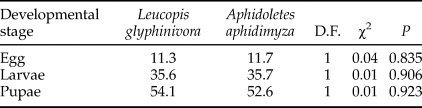
Incubation time for L. glyphinivora eggs was 2.74 days, which was 41% longer than for A. aphidimyza (Wilcoxon; d.f. = 1; W = 634; P < 0.001) (fig. 1a). Larval development time of L. glyphinivora was 8.36 days which was 42% longer than A. aphidimyza (Wilcoxon; d.f. = 1; W = 91; P < 0.001) (fig. 1a). Pupation time for L. glyphinivora was longer than for A. aphidimyza, with 13.07 days and 8.70 days, respectively (ANOVA2; F 1, 54 = 331.54; P < 0.001) (fig. 1b). Pupation time was not significantly different between sexes in both species (ANOVA2; F 1, 54 = 0.727; P = 0.398) and there was no interaction between species and sex (ANOVA2; F 1, 54 = 0.121; d.f. = 1; P = 0.730). There were no significant differences in the proportion of time spent in each immature development stage between predators (table 1).
Mean development time (±SE) for (a) eggs (n = 50), larvae (n = 50) and (b) male (L. glyphinivora n = 13; A. aphidimyza n = 13) and female (L. glyphinivora n = 15; A. aphidimyza n = 17) pupae. An asterisk (*) indicates a significant difference (P < 0.05) between species.

Proportion (%) of time spent in each immature stadium in relation to total pre-imaginal development for Leucopis glyphinivora and Aphidoletes aphidimyza.

Adult longevity and sex ratio
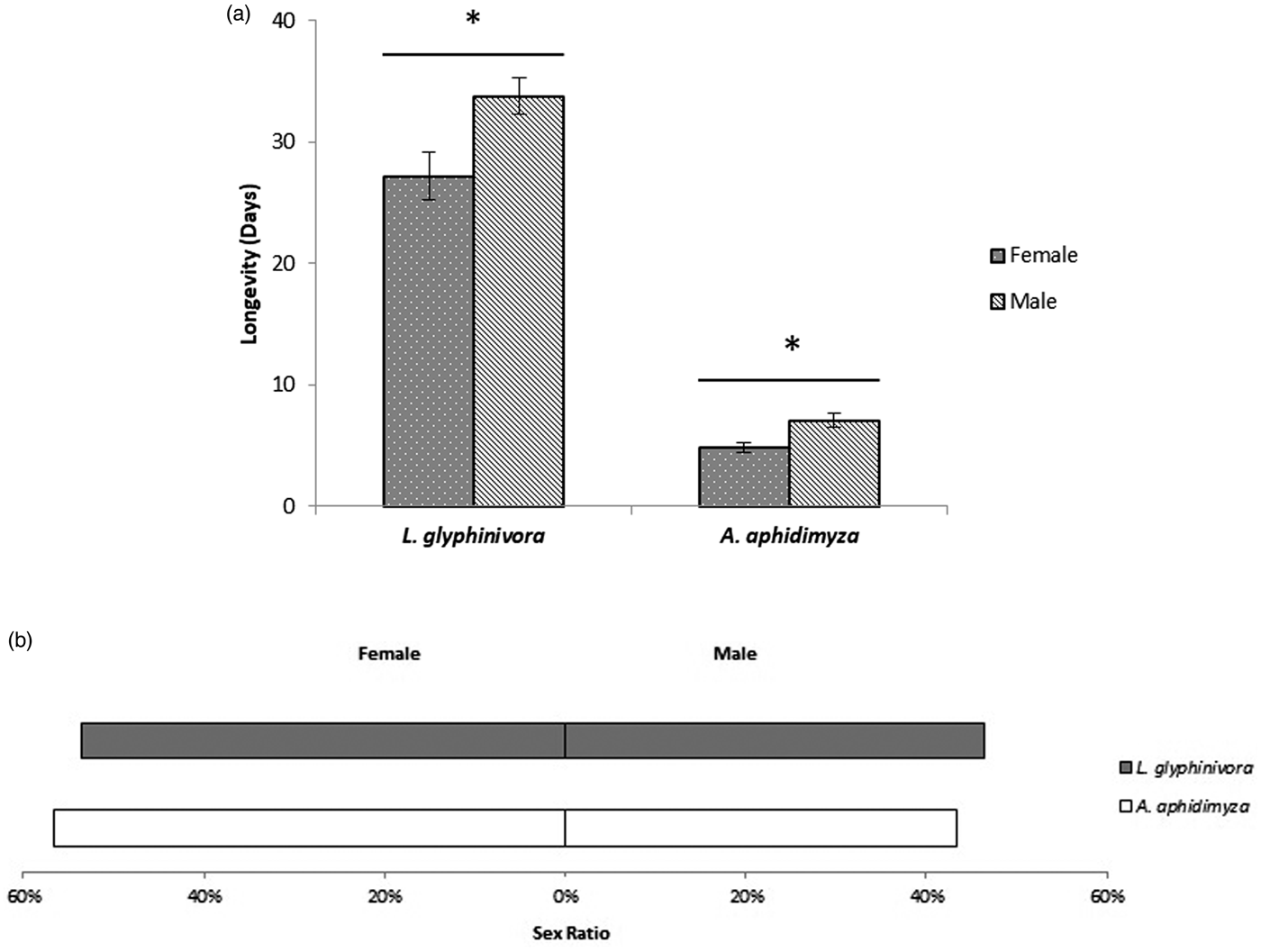
Adult longevity for L. glyphinivora was 30.50 days, which was 5 times longer than for A. aphidimyza (ANOVA2; F 1, 116 = 367.31; P < 0.001) (fig. 2a). Mean longevity was longer for L. glyphinivora in both sexes (ANOVA2; F 1, 116 = 2.87; P = 0.093). The complete life cycle was 54.67 days for L. glyphinivora and 22.51 days for A. aphidimyza. For both species, males lived longer than females (ANOVA2; F 1, 116 = 11.99; P < 0.001). The male/female ratio was 13/15 for L. glyphinivora (Pearson; d.f = 1; χ2 = 0.14; P = 0.706) and 13/17 for A. aphidimyza (Pearson; d.f = 1; χ2 = 0.53; P = 0.465) (fig. 2b). There was no difference in the adult sex ratio between predators (Pearson; d.f = 3; χ2 = 0.76; P = 0.859).
(a) Mean adult longevity (±SE) for males (L. glyphinivora n = 30; A. aphidimyza n = 30) and females (L. glyphinivora n = 30; A. aphidimyza n = 30) and (b) adult sex ratio. An asterisk (*) indicates a significant difference (P < 0.05).

Survival
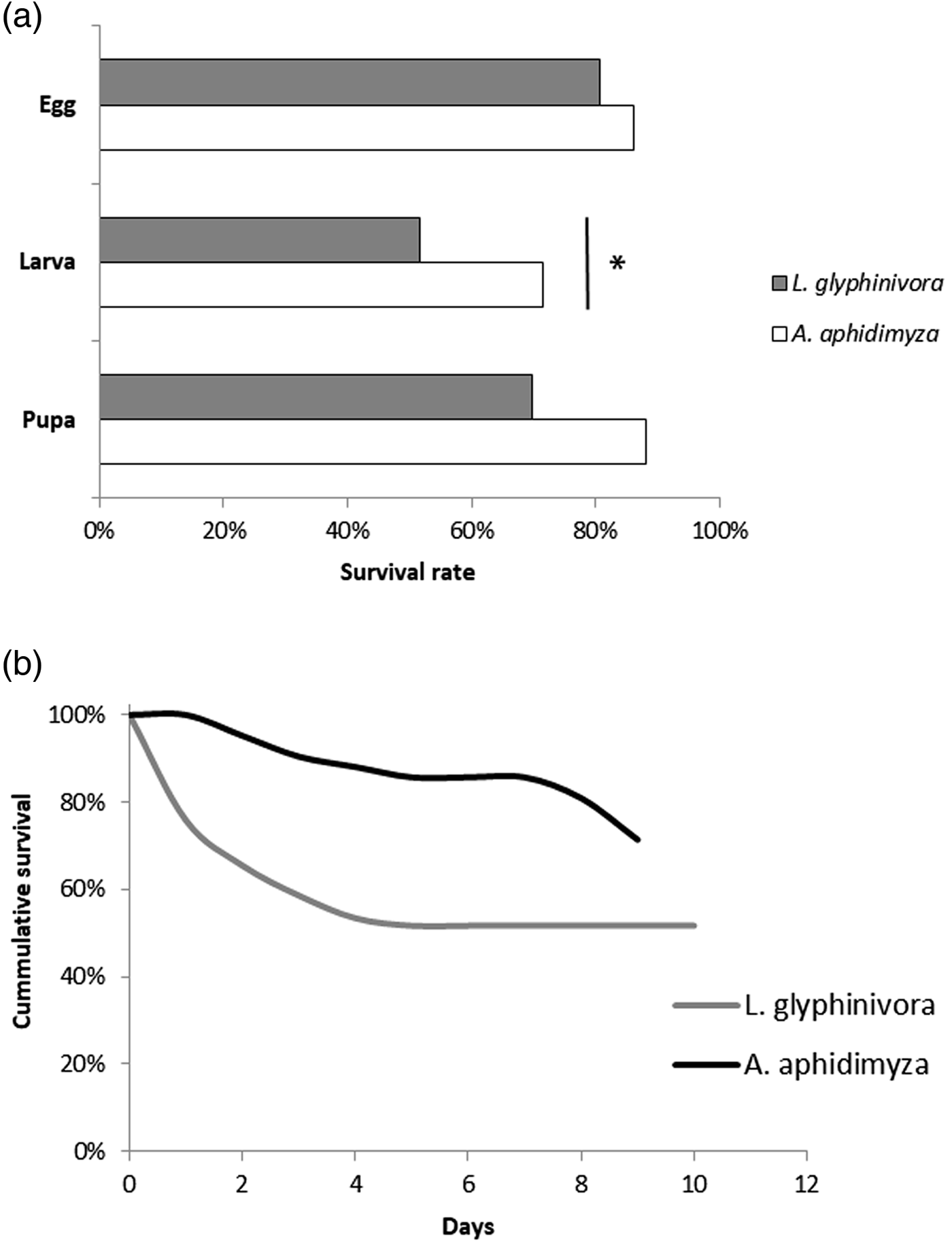
There was no difference for egg hatch rate (Pearson; d.f. = 3; χ2 = 1.96; P = 0.580) and pupal emergence rate (Pearson; d.f. = 3; χ2 = 3.29; P = 0.349) between predators. Larval survival rate was significantly lower for L. glyphinivora (Pearson; d.f. = 3; χ2 = 13.20; P = 0.004) (fig. 3a). Daily larval survival was not significantly different for both species (Log-rank; d.f. = 1; χ2 = 3.7; P = 0.055) (fig. 3b). Larval mortality only occurred in the first 4 days of development for L. glyphinivora. For A. aphidimyza, most mortality occurred in the first 4 days of larval development before stabilizing. However, larval mortality is again observed in A. aphidimyza past day 7. Larval survival for L. glyphinivora is lowest in the first 24 h after hatching whereas, for A. aphidimyza, the last 24 h of larval development show the lowest survival. 24.14% of L. glyphinivora larvae died within the first 24 h after hatching, whereas no A. aphidimyza died on the day they hatched.
(a) Egg hatching rates (L. glyphinivora n = 62; A. aphidimyza n = 58), larval survival rates (L. glyphinivora n = 58; A. aphidimyza n = 42) and pupal emergence rates (L. glyphinivora n = 43; A. aphidimyza n = 34) and (b) cumulative survival rates for L. glyphinivora (n = 58) and A. aphidimyza (n = 42) larvae (Day 1 = Hatch day). An asterisk (*) indicates a significant difference (P < 0.05) between species.

Discussion
Our main objective was to study the life cycle of L. glyphinivora in order to predict its potential as a biocontrol agent against aphids and to compare it with A. aphidimyza. These species are functionally similar, both being aphidophagous dipterans. Leucopis glyphinivora has a longer development cycle than A. aphidimyza. For both predators, pupation time remains the same in males and females. Adult longevity for L. glyphinivora is 5 times longer than for A. aphidimyza. Other Leucopis spp. have a longer life cycle than A. aphidimyza (Sluss & Foote, Reference Sluss and Foote1971; Gaimari & Turner, Reference Gaimari and Turner1996a). Development and survival of L. glyphinivora shown here are comparable with those reported by Canale et al. (Reference Canale, Canova and Raspi2002) at similar temperatures. However, Sluss & Foote (Reference Sluss and Foote1971) found that L. verticalis Malloch females have a greater longevity than males. Our study shows L. glyphinivora and A. aphidimyza females having a shorter longevity. This might be caused by the unmated status in our study. In many insect species, males transfer nutritional supplements to females which increase survival (Fox, Reference Fox1993; Arnqvist & Nilsson, Reference Arnqvist and Nilsson2000). Mating is also quite costly for males, which is expressed by a lowered longevity (Partridge & Farquhar, Reference Partridge and Farquhar1981; Paukku & Kotiaho, Reference Paukku and Kotiaho2005). Unmated males would, therefore, express increased longevity. Further studies are needed to demonstrate how mating affects adult longevity for L. glyphinivora.
Slower larval development in L. glyphinivora is interesting for biocontrol because it may lead to an overall increased voracity (Karl & Fischer, Reference Karl and Fischer2008). The ability to directly suppress pests is an important trait for biocontrol (van Lenteren & Woets, Reference van Lenteren and Woets1988; Stiling & Cornelissen, Reference Stiling and Cornelissen2005). Increased fecundity is also an important trait (Coppel & Mertins, Reference Coppel and Mertins1977) and is positively correlated with adult longevity (Coll, Reference Coll1996). This can also mean the preoviposition period is longer and overall oviposition is more spread out through time, as seen with coccinellids (Borges et al., Reference Borges, Hemptinne and Soares2013). The reproduction behaviour of Leucopis glyphinivora may lead to a more long-term biocontrol effect whereas A. aphidimyza would have a faster rate of population growth over a shorter period of time, leading to a more punctual biological control. A longer adult stage would also give more time for L. glyphinivora to engage in multiple matings, which is linked to increased reproductive success (Arnqvist & Nilsson, Reference Arnqvist and Nilsson2000). However, this is rather speculative, and future studies on the reproductive period and behaviour of L. glyphinivora are needed.
Leucopis glyphinivora can diapause and overwinter, presumably in the pupal stage like other Leucopis spp. (Sluss & Foote, Reference Sluss and Foote1971, Reference Sluss and Foote1973; Urban, Reference Urban2002). Diapausing L. glyphinivora pupae could be exported commercially and applied in biological control programs similar to how A. aphidimyza is used (Alotaibi, Reference Alotaibi2008; Yukawa et al., Reference Yukawa, Abe and Mizota2008). However, a drawback of A. aphidimyza is that larvae fall off the host plant to pupate in soil where they are hard to find, tend to dry out and can increase mortality rates due to adults sometimes being unable to reach the soil surface (van Schelt & Mulder, Reference van Schelt and Mulder2000; Yukawa et al., Reference Yukawa, Abe and Mizota2008; Le Goff et al., Reference Le Goff, Nicolas, Al Mohamad and Hance2016). Leucopis glyphinivora have a rigid puparium and pupate directly on the host plant (Raspi, Reference Raspi1996; Tanasijtshuk, Reference Tanasijtshuk2005), making them easier to collect from mass rearing cages.
Overall larval survival for L. glyphinivora is rather low but mortality only occurs in the first days of development. This could be attributed to the choice of aphid prey. Leucopis glyphinivora is a polyphagous predator (Tanasijtshuk, Reference Tanasijtshuk1986; Satar et al., Reference Satar, Raspi, Özdemir, Tusun, Karacaoğlu and Benelli2015). The wild population from which our experimental colony was built preyed on Aphis pomi, A. spiraecola and A. fabae. Aphis fabae is also known as an important prey species for L. glyphinivora in Ohio (Holdsworth, Reference Holdsworth1970) and New Hampshire (Tracewski et al., Reference Tracewski, Johnson and Eaton1984). This might indicate that M. persicae is not the preferred aphid prey for L. glyphinivora populations in northeastern North America. The choice of host plant may also influence L. glyphinivora larval survival. Potato leaves have many trichomes and, for A. aphidimyza, a high trichome density is a beneficial microhabitat characteristic which aids in avoiding intraguild predation (Lucas & Brodeur, Reference Lucas and Brodeur1999). Leucopis glyphinivora, like other Leucopis spp., move around a lot on the host plant in search of aphid colonies (Sluss & Foote, Reference Sluss and Foote1971, Reference Sluss and Foote1973; Gaimari & Turner, Reference Gaimari and Turner1997). Dispersal ability is an important trait for biocontrol agents (Van Lenteren & Woets, Reference van Lenteren and Woets1988) and would allow L. glyphinivora to attack other aphid colonies on nearby leaves. However, a high trichome density may inhibit L. glyphinivora movement and reduce its ability to find prey (Elsey, Reference Elsey1974; Lucas & Brodeur, Reference Lucas and Brodeur1999). Further research on preferential prey and host plants for L. glyphinivora is required before using this predator for aphid biocontrol.
All L. glyphinivora larvae surviving for at least 5 days reached pupation. This is not the case for A. aphidimyza, where 43% of larvae living past day 6 died. Many of the A. aphidimyza larvae observed buried themselves under aphid carcasses/exuviae or dug into the agar substrate to pupate. Those unable to do so may have postponed pupation to the point of their eventual death.
Aphidoletes aphidimyza uses a furtive predation strategy to avoid detection by both prey aphids and intraguild predators through a dilution effect (Lucas & Brodeur, Reference Lucas and Brodeur2001) and a selfish herd effect (Dumont et al., Reference Dumont, Lucas and Brodeur2015). Such behaviour may also be present with L. glyphinivora. According to our observations, L. glyphinivora larvae did not actively hunt prey and aphids did not avoid predator contact. Furtive predation behaviour was also observed in another chamaemyiid species, L. annulipes Zetterstedt (Fréchette et al., Reference Fréchette, Larouche and Lucas2008), showing potential within the genus. Field observations of L. glyphinivora show a similar effect. Leucopis glyphinivora avoided being attacked by ants tending the aphid colonies, which is typical behaviour for furtive predators. (Sentis et al., Reference Sentis, Lucas and Vickery2012). More research on L. glyphinivora predatory behaviour is required in order to determine its efficiency as a biocontrol agent.
This study shows that L. glyphinivora has potential as a biocontrol agent against aphids. Further research including more detailed studies about the predation and reproduction for L. glyphinivora are needed to more accurately estimate its efficiency. Aphid consumption (both daily and total), ideal prey density and prey specificity are all important factors that can help optimize the use of L. glyphinivora to control pest outbreaks. Adult reproduction is also an important trait for a biocontrol agent. Oviposition period and behaviour, as well as fertility, will shed light on the population dynamics of L. glyphinivora, both for commercial rearing and biocontrol applications.
Acknowledgements
The authors would like to thank all the members of the biocontrol laboratory of the Université du Québec à Montréal, particularly Marc Fournier, for general advice and technical support throughout the project. They would also like to thank Jill Vandermeerschen for advice with statistical analyses. Funding came from the Natural Sciences and Engineering Research Council of Canada (NSERC, Discovery program) to Eric Lucas.