I. INTRODUCTION
One of the most important contributions John Rawls makes to political and legal philosophy is his idea of public reason. Public reason imposes restrictions on arguments citizens can make in the public sphere. When certain kinds of issues are at stake, public reason requires that only considerations stemming from a shared conception of justice may permissibly be appealed to. There are multiple reasons for insisting on such onerous demands. First, the idea of public reason strikes many as normatively attractive. When we use the coercive apparatus of the state to enforce restrictions on our fellow citizens, we ought to give them reasons for doing so that both they and we can accept. And second, restrictions on discourse of the kind imposed by public reason contribute to the stability of a liberal society. When we adhere to such requirements, we communicate to our fellow citizens that we are committed to acting justly along with them.
But though it is an attractive ideal, there are several compelling criticisms of Rawls's idea of public reason. One criticism concerns whether public reason will be complete—that is, whether public reason will contain sufficient material in its content to allow citizens to engage in robust public deliberation. Rawls was aware of this problem. He tells us that the content of public reason does not merely stem from a shared conception of justice, but also from all those considerations you and I as theorists employ when constructing this conception of justice in the first place. Though this is likely sufficient for public reason to be complete, this strategy is inconsistent with reasonable assumptions about typical liberal societies. Requiring that average citizens know about such considerations is too demanding a requirement; and, many of these considerations can be reasonably rejected by the kinds of diverse views we are likely to encounter in a society that allows for freedom of thought, speech, and expression. As such, we need a new way of thinking about the source of public reason's content, so as to avoid incompleteness worries.
This paper offers such an account. The key is to rethink the role certain institutions play in a liberal society. Quite famously, Rawls holds that the United States Supreme Court acts as the “exemplar” of public reason. The Court gives “due and continuing effect to public reason by serving as its institutional exemplar. This means, first, that public reason is the sole reason the court exercises.”Footnote 1 But following recent work in political economy on the coordinating function of law and constitutions, we can understand the Court not just as the exemplar of public reason but also as its fountain. Over a long period of time and body of cases the Court constructs a set of reasons citizens may appeal to in order to adjudicate their disputes in the public sphere in a manner consistent with the ideal of public reason. As citizens come to adopt this common set of reasons, we slowly creep toward complete public reason. Not only this, but we achieve a complete set of public reasons in a manner that is not too demanding on the average citizen, while still being consistent with the diversity we can expect to encounter in liberal, open societies.
II. THE IDEA OF PUBLIC REASON
A. The Demands of Public Reason
Though it is a rich text with several different themes running throughout, perhaps the core idea of Rawls's Political Liberalism is the idea of public reason. Rawls opens his discussion of public reason by telling us that “a political society … has a way of formulating its plans, of putting its ends in an order of priority and of making its decisions accordingly. The way a political society does this is its reason.”Footnote 2 Rawls's idea of public reason is but one way of fleshing out how it is that a political society does this; that is, public reason is but one way of specifying how it is that a political society ought to reason and ought to make its collective decisions together. Very briefly, the idea of public reason says that when certain kinds of questions are at stake in the public sphere (matters of basic justice and constitutional essentials), only reasons and considerations stemming from a shared conception of justice may permissibly be appealed to.
The demands of public reason are quite onerous. As Rawls notes, the skeptic of public reason can quite reasonably ask: “why should citizens in discussing and voting on the most fundamental political questions honor the limits of public reason? How can it be either reasonable or rational, when basic matters are at stake, for citizens to appeal only to a public conception of justice and not to the whole truth as they see it?”Footnote 3 There seem to be two roles public reason plays in Rawls's broader theory, and thus two reasons for insisting that its onerous demands be met. First, public reason serves an important normative function. The liberal principle of legitimacy, Rawls tells us, requires that we exercise coercive political power in a manner justifiable to all. This creates a “moral, not a legal, duty”—the duty of civility—which requires that citizens “be able to explain to one another … how the principles and policies they advocate and vote for can be supported by the political values of public reason.”Footnote 4 That is, as a basic normative requirement, we have an obligation to exercise coercive force in a manner that is justifiable to all those who are subject to such force (this is the liberal principle of legitimacy), which further requires that we adhere to the requirements of public reason in our democratic discourse (this is the duty of civility). Public reason is thus an integral part of treating one's fellow citizens in a certain normatively desirable fashion.
Perhaps more important than this normative function is the practical function public reason is meant to serve. Specifically, public reason plays a crucial role in securing the stability of a liberal society. According to Rawls, even reasonable persons with a sense of justice wish to do as justice requires only on a conditional basis. They “are ready to propose principles and standards as fair terms of cooperation and to abide by them willingly, given the assurance that others will likewise do so.”Footnote 5 This conditional nature of the desire to do what is just creates an instability threat: “even with a sense of justice men's compliance with a cooperative venture is predicated on the belief that others will do their part; citizens may be tempted to avoid making a contribution when they believe, or with reason suspect, that others are not making theirs.”Footnote 6 That is, because persons wish to act justly only if they are reasonably sure that others will also act justly, we might quite easily end up in a situation where everyone acts unjustly even if they all most prefer mutual adherence to justice, because persons are not sufficiently sure that their fellow citizens will do as justice requires.Footnote 7
According to much recent scholarship, Rawls solves this instability threat with public reason.Footnote 8 When citizens adhere to the requirements of public reason while engaged in public discourse they signal commitment to the political conception of justice over their own private interests, assuring their fellow citizens that they will continue to act justly rather than abandon their sense of justice in pursuit of private gain. When citizens do not adhere to the requirements of public reason, though, the worry is that they signal commitment to their own private interests over the governing conception of justice, leading to a breakdown of assurance. In Rawls's words: “For without citizens’ allegiance to public reason and their honoring the duty of civility, divisions and hostilities between doctrines are bound in time to assert themselves … harmony and concord depend on the vitality of the public political culture and on citizens’ being devoted to and realization of the ideal of public reason.”Footnote 9
So public reason can be understood as a set of requirements citizens must adhere to in public discourse that serve an important normative function as well as an important practical function. Yet what are the requirements of public reason specifically? That is, exactly what sorts of considerations does public reason allow citizens to permissibly appeal to in their public deliberation? Above I noted that the content of public reason stems from a shared conception of justice; more, though, needs to be said about what exactly this amounts to. Clearly, public reason allows citizens to appeal to the conception of justice governing the society they inhabit. For example, if the overarching conception of justice is Rawls's justice as fairness, then the demands of public reason would permit citizens to appeal to the principles constituting justice as fairness in their deliberation. A citizen, Althea, for instance, could say to her fellow citizen, Bertha, that “we should support policy p, because p is most likely to maximize the welfare of the least advantaged, and the difference principle requires this.” Moreover, principles of justice also imply a certain constitution and economic institutions as well. Presumably, the requirements of public reason also make it fair game to appeal to these along with the principles of justice themselves. So much seems clear.
For many questions, merely appealing to the governing conception of justice or our political and economic institutions might be insufficient to generate a compelling argument capable of addressing the issue at hand. Many times public deliberation will require the use of social scientific considerations. Other times we might need to appeal to more abstract normative values—a certain conception of dignity or equality, for instance—rather than something as concrete as the difference principle. The worry here is that public reason will be incomplete, in that its content will be insufficient for persons to adhere to its requirements while also engaging in successful public deliberation.Footnote 10 When incompleteness occurs it means that citizens must violate the requirements of public reason in order to fully engage in public debate—that is, citizens will end up appealing to nonpublic reasons in their discourse. But when this happens, the normative and practical functions of public reason go unfulfilled, for these functions are only realized when the requirements of public reason are adhered to.Footnote 11 This, clearly, is a problem.
B. Achieving Complete Public Reason
Perhaps with foresight of the above concerns, Rawls specifies the content of public reason to not only include the conception of justice and corresponding institutions governing society. Rather, the content of public reason also includes the considerations you and I appeal to when choosing the conception of justice to govern society in the first place. Inclusion of such considerations hopefully provides enough material for adequate public debate, thereby remedying potential incompleteness and allowing public reason to serve its normative and practical functions.
This expansion of the content of public reason can be seen most clearly when examining Rawls's three levels of publicity and their relationship to public reason. Publicity conditions are conditions that a society either satisfies or fails to satisfy. A society satisfies the first level of publicity when members of the society know and accept the governing conception of justice as well as its corresponding political and economic institutions. This level of publicity is the least demanding level of publicity that can be met.
The second level of publicity goes deeper than this. A society satisfies the second level of publicity when members of society not only know and accept the political conception of justice and its corresponding institutions, but also adopt the “the general beliefs in the light of which first principles of justice themselves can be accepted, that is, the general beliefs about human nature and the way political and social institutions generally work, and indeed all such beliefs relevant to political justice.”Footnote 12 As an example, if we end up selecting a specific constitution to govern society using complex social scientific facts and methods—something Rawls says we will need to do, as we shall see in the section below—then, when the second level of publicity is satisfied, persons in this society will also know and accept these facts and methods. Clearly a society can satisfy the first level of publicity without this second, more demanding condition being met.
The third and final level of publicity is satisfied when citizens know the full justification of the conception of justice governing their society. In Rawls's words, “the third and last level of publicity has to do with the full justification of the public conception of justice as it would be presented on its own terms. This justification includes everything that we would say—you and I—when we set up justice as fairness and reflect on why we proceed in one way rather than another. At this level I suppose this full justification also to be publicly known, or better, at least to be publicly available.”Footnote 13 As an example, if the conception of justice governing society is justice as fairness, then this third level of publicity is satisfied when citizens know the method of political constructivism, how the original position decision procedure is set up, why the original position includes the features it does, and really everything that Rawls writes in Political Liberalism. Clearly the first two levels of publicity can be satisfied without this final condition being met.
Why introduce these demanding conditions? One of the motivations here is to provide ample content for public reason so that citizens have sufficient material with which to engage in public deliberation.Footnote 14 In Rawls's words: “it is fitting, then, that the first terms of social cooperation between citizens as free and equal should meet the requirements of full publicity … When a political conception of justice satisfies this condition … citizens can give reasons for their beliefs and conduct before one another and not weaken public understanding.”Footnote 15 Note how this resolves the incompleteness worry examined above. There I noted that merely appealing to principles of justice or our governing political and economic institutions is unlikely to provide us with sufficient considerations for robust public debate. The requirements of public reason will then be violated, leaving its normative and practical functions unfulfilled. But if public reason includes those considerations required as public knowledge when the second and third levels of publicity are satisfied then it seems like the content of public reason will be sufficiently robust for successful public discourse. When the second level of publicity is satisfied citizens have social scientific facts and methods at their disposal for public deliberation. When the third level of publicity is satisfied more abstract philosophical considerations will be available. This, hopefully, allows public reason to avoid incompleteness, and thereby serve its important normative and practical functions.
III. THE DEMANDINGNESS AND DIVERSITY PROBLEMS
Is it plausible to think that the second and third levels of publicity will be satisfied in a typical liberal society? From the last section we know that when these two conditions are met public reason likely has sufficient content to avoid incompleteness worries, thereby allowing its normative and practical functions to be fulfilled. But it still might be the case that it is implausible to think that these two conditions can be satisfied in the first place, given reasonable assumptions about liberal societies. If this is true then we are back to the problem raised in the previous section—public reason remains incomplete, meaning that its normative and practical functions go unfulfilled. Given this significance, the current section probes the plausibility of Rawls's second and third levels of publicity being satisfied.
Consider first Rawls's second level of publicity, which says that all those social scientific facts and methods you and I employ in justifying the governing conception of justice and corresponding institutions are believed by those inhabiting the relevant society. Such considerations can then be used in public discourse. In asking whether it is plausible to think this condition can be satisfied we are asking whether it is plausible for persons in a liberal society to harbor the relevant beliefs. And to answer this we need to know more about what exactly the second level of publicity demands persons believe.
In answering this question consider the facts used in the justification of Rawls's justice as fairness specifically. Now certainly some social scientific facts are used here. Rawls says that in modeling deliberators in the original position we presume that they know “general facts about human society. They understand political affairs and the principles of economic theory; they know the basis of organization and the laws of human psychology.”Footnote 16 But even so, it is not clear that these facts would be particularly difficult for persons in society to grasp. For think of the actual kinds of social scientific facts and considerations appealed to in the argument for justice as fairness from the original position. In order for the difference principle to be chosen over a principle of perfect equality, for instance, deliberators must understand how incentives effect production.Footnote 17 The second level of publicity would then require that all citizens in society believe as much. But this does not seem terribly implausible as a requirement.
Things change, however, when we move on to the justification of the constitution and economic institutions demanded by the governing conception of justice. Here, the original position decision procedure is extended: “after the parties have adopted the principles of justice in the original position, they move on to the constitutional convention. Here they are to decide upon the justice of political forms and choose a constitution: they are delegates, so to speak, to such a convention.”Footnote 18 Importantly, in this stage of justification the veil of ignorance is “partially lifted,” in that “the flow of information is determined at each stage by what is required in order to apply these principles intelligently to the kind of question of justice at hand.”Footnote 19 Thus, in the constitutional convention, we give deliberators information of “the kind framers of a constitution would want to know.”Footnote 20 This of course should not be surprising. Designing political and economic institutions is incredibly difficult, and we want deliberators to have all the information required for them to perform well in such an endeavor. Indeed, as Rawls notes: “the most appropriate design of a constitution is not a question to be settled by considerations of political philosophy alone, but depends on understanding the scope and limits of political and social institutions and how they can be made to work effectively.”Footnote 21
But the sorts of considerations framers of a constitution would want to know when choosing a constitution—and thus the kinds of information we give to deliberators in the constitutional convention—can be quite complex. Alexander Hamilton, John Jay, and James Madison—actual framers of a constitution—boasted about employing the most cutting edge “science of politics” available to them at the time when they penned The Federalist.Footnote 22 Indeed, there is an entire subfield of economics and political science—constitutional economicsFootnote 23—that examines the kinds of questions Rawls's deliberators must ask themselves in the constitutional convention. As an example, in their recent study economists Torsten Persson and Guido Tabellini ask:
If the United Kingdom were to switch its electoral rule from majoritarian to proportional, how would this affect the size of its welfare state or of its budget deficits? If Argentina were to abandon its presidential regime in favor of a parliamentary form of government, would this facilitate the adoption of sound policy towards economic development?Footnote 24
Needless to say, much of the analysis in the field of constitutional economics is quite complicated.Footnote 25 But such complex social scientific facts and methods are deeply important when thinking about which competing constitution one should adopt—in other words, these are the kinds of things framers of a constitution would want to know. Thus, though deliberators in the original position likely do not need social scientific considerations that are too complex when choosing between justice as fairness and utilitarianism, the sorts of considerations required to choose between the Constitution of India and the Swiss Federal Constitution will likely be quite elaborate.
Such complexity, though, should make us question whether it is plausible to think the second level of publicity can be satisfied in a liberal society. There are two worries in particular. The first is that the required beliefs are too demanding. The average citizen—let us call her Althea—is not likely to have justified beliefs as to whether econometric analyses are a more fecund approach to analyzing social and political institutions when compared to rational choice modeling. Nor is Althea likely to have justified beliefs concerning the effects bicameral legislatures have on deficit spending or whether parliamentary or presidential systems better protect basic rights. Yet these are the kinds of things framers of a constitution would want to know. Thus, when we include these kinds of considerations in the beliefs of deliberators in the constitutional convention, the second level of publicity then requires citizens like Althea to acquire the relevant beliefs as well, even though the overwhelming majority of citizens will have not thought deeply about these matters. As a result, the second level of publicity goes unsatisfied. Call this the demandingness problem.
There is a second problem. Though most citizens will likely be like Althea and lack justified beliefs concerning the social scientific facts and methods we use in the justification of the constitution, some citizens will have reflective beliefs about such matters that also reject those considerations you and I employ. Thus, the second level of publicity again goes unmet, though for a different reason. There is good reason to think this will happen. For once one starts employing complex social scientific facts and methods—again, the kind that framers of a constitution would like to know and the kind that we must attribute to deliberators to select a constitution—then one begins employing considerations that reasonable persons could quite easily reject. This does not seem to be the case when it comes to those basic considerations employed in the justification of the conception of justice. But once we start employing econometric analyses or rational choice modeling and start advancing specific theses about the operation of political institutions then reasonable disagreement is bound to slip in. Call this the diversity problem. The demandingness and diversity problems should make us skeptical concerning whether Rawls's second level of publicity can indeed be satisfied in a liberal society. By implication, we should also doubt whether public reason has sufficient content to adequately perform its normative and practical functions.
Turn now to the third level of publicity, which says that everything you and I say when we justify the governing conception of justice is known by those in society. Like before, when this level of publicity is satisfied, such considerations become part of the content of public reason and can be employed by citizens in public debate. As we did with the second level of publicity, we need to ask whether it is plausible to think that citizens of a liberal society are likely to harbor the relevant beliefs required for this publicity condition to be met. And, as before, answering this will require us to examine what exactly persons must believe in order for this to be so.
Let us again work with Rawls's justice as fairness in particular. What sorts of abstract considerations does Rawls employ in his full justification of justice as fairness? The list is quite long: the idea of society as a fair system of social cooperation, which includes Rawls's specific definition of cooperation; the idea of persons being both reasonable and rational, which includes Rawls's specific definition of the reasonable; the idea that persons are free and equal, which include Rawls's specific ways of defining these two terms; the idea of the two moral powers; the idea of rational autonomy and full autonomy; and so on. For the third level of publicity to be satisfied, citizens must not only be aware of these considerations but also accept them as in some sense good considerations.
Clearly this third level of publicity faces both the demandingness and diversity problems, as did the second level of publicity. In terms of the demandingness problem, just as most citizens will likely lack justified beliefs concerning complex social scientific facts and methods, they will likely also lack justified beliefs about those deeper, more abstract philosophical matters that the third level of publicity demands that they harbor beliefs about. And in terms of the diversity problem, those citizens who do have justified beliefs about these matters can quite plausibly reject many of those considerations Rawls employs. Though Bertha might think that citizens are indeed free and equal, she might adopt a different understanding of freedom and equality than the specific one Rawls employs in his justification. Or perhaps Bertha rejects the two moral powers Rawls attributes to persons. If either were the case then the third level of publicity would go unsatisfied.
We thus find ourselves in a dilemma. If public reason's content solely consists in the governing conception of justice and its corresponding institutions, then public reason will be incomplete. If public reason is incomplete, then its normative and practical functions go unfulfilled. To avoid this, public reason's content is expanded by including all those considerations that you and I employ when justifying the governing conception of justice and corresponding institutions. This occurs when the second and third levels of publicity are satisfied. Such expansion makes public reason complete, and thus allows public reason to fulfill its normative and practical functions. But, it is implausible to think that the second and third levels of publicity can be satisfied due to what we have called the demandingness and diversity problems. As such, we cannot use this method for expanding the content of public reason. In light of this we need a new way of expanding the content of public reason so that public reason is complete in a manner that is consistent with those considerations that motivate the demandingness and diversity problems. The remainder of the paper proposes such a solution.
IV. THE SUPREME COURT AS THE FOUNTAIN OF PUBLIC REASON
The last section presented a problem. Rawls's solution to public reason's potential incompleteness is to expand public reason's content to include all those things you and I say in our justification of the governing conception of justice and corresponding institutions—such considerations are publicly available when the second and third levels of publicity are satisfied. But, I noted, it is implausible to think that the second and third levels of publicity ever will be satisfied due to what I have called the demandingness and diversity problems. Such being the case, we are back to public reason being incomplete, meaning that its normative and practical functions go unfulfilled.
I now propose a solution to this problem. I first solve the demandingness problem in Sections IV.A and IV.B by articulating a new account of the source of public reason's content. According to the forthcoming proposal, the content of public reason is not exogenously fixed by how you and I justify the governing conception of justice and corresponding institutions, merely hoping that citizens then adopt the requisite beliefs. Instead, the content of public reason endogenously grows via social institutions, giving rise to a body of shared considerations that can then be used in public discourse. In other words, a complete set of public reasons cannot be presumed to exist (as Rawls's proposal examined in the last two sections does), but rather must be constructed.
But what social institutions specifically construct this complete set of public reasons? Contra Rawls, rather than the United States Supreme Court merely acting as the exemplar of an already existing set of public reasons, the Supreme Court also acts as a fountain of public reason by developing a set of considerations citizens may appeal to in order to adjudicate their disputes in the public sphere in a manner consistent with the demands of public reason. As citizens come to adopt this common set of considerations we slowly creep toward complete public reason, allowing public reason to serve its normative and practical functions. Section IV.C complicates this proposal in order to solve the diversity problem.
A. The Basic Model
The demandingness problem says it is unlikely that citizens like Althea have considered views about complex social scientific considerations—the kinds of which are required by the second level of publicity—nor is she likely to have considered views about more abstract philosophical matters—as required by the third level of publicity. Not that such citizens are opposed to having these kinds of commitments; they just have not worked them all out. But how do citizens acquire such commitments when they have no strong, foundational beliefs about such matters in the first place? Moreover, how do they acquire the same commitments that their fellow under-informed citizens acquire in order to generate a set of public reasons shared by all? Here we are concerned with how citizens afflicted by the demandingness problem acquire the kinds of commitments required by the second and third levels of publicity. For now we set aside those citizens who do have considered commitments that might be at odds with those included in the set of public reasons. That is, in this subsection and the next we set aside those citizens giving rise to the diversity problem.
Relevant here is work on the coordinating function of law generally, and the coordinating function of constitutions in particular. Gillian Hadfield and Barry Weingast develop a model showing how constitutions can coordinate decentralized groups of enforcers to enforce behavioral constraints on otherwise unconstrained political actors.Footnote 26 Take a simple example. There is a politician, S, and a constraint on behavior, B, set by the constitution. The politician can either obey B or not obey B. What incentivizes the politician to obey B? One common answer is that ordinary citizens enforce the relevant behavioral constraints through sanctioning in the voting booth—if the politician breaks the rules then they get voted out. But reliance on such decentralized enforcement mechanisms presents a key problem: there must be coordination among the citizenry in that a sufficient number of citizens must agree that S has actually violated B, for it is by no means clear, to take an example, whether the legislature has violated the Necessary and Proper Clause.
According to Hadfield and Weingast's model, this coordination problem is resolved by there being an authoritative steward that deals out a common logic determining whether S has violated B, which takes precedent over each citizen's idiosyncratic logic as to whether S has violated B. This authoritative steward is, in the case of the United States, the Supreme Court, and this common logic consists of decisions released by the Court determining whether S violated B. For example, there was an open question whether the 111th Congress in conjunction with President Barack Obama violated behavioral rule B enumerated in the Constitution when they passed the Affordable Care Act. If they did, then the citizenry must sanction. But citizens all possess their own idiosyncratic logics specifying whether S violated B. Given these conflicting standards there must be some coordination mechanism that offers one evaluative standard all citizens can endorse. Filling this void, the Supreme Court as authoritative steward delivers a common logic in the form of rulings that citizens use in determining whether to sanction the relevant S or not.
When the authoritative steward delivers answers as to whether S violates B as part of the common logic it is usually not just a yes or no answer. Instead, authoritative stewards like the Supreme Court tend to give reasons for why they reach the verdicts they do. Implicit in the common logic delivered by the authoritative steward is thus a common method of reasoning that explains and justifies the common logic, and implicit in this common method of reasoning are standards of reasoning. Some kinds of arguments are rejected as bad arguments. Other kinds of arguments are upheld as good arguments. Over time the Court (and authoritative stewards more generally) build up a body of standards that classify types of arguments as good and bad arguments. Arguments grounded in rational basis and reasonable person tests are judged to be good arguments by the Court. Arguments appealing to oracles and omens, or arguments that fail to take seriously stare decisis, are judged to be bad arguments.
So not only do authoritative stewards give us decisions on S’s violation of B as part of their common logic, they also give us standards of reasoning as part of this common logic. And in these standards of reasoning are both (i) recognition of certain social scientific facts and methods as authoritative, as well as (ii) articulation of more abstract philosophical concepts. Consider first the use of social scientific facts and methods, or those sorts of considerations implicit in the requirements of the second level of publicity.Footnote 27 In Lockhart v. McCree, 476 U.S. 162 (1986), for instance, the Court asked whether judges, in excluding potential jury members at voir dire who principally oppose the death penalty in potential death penalty cases, violate a defendant's rights under the Sixth Amendment to an impartial jury selected from a representative cross-section of the community as well as a defendant's right to due process under the Fourteenth Amendment. In deciding this case Justice Rehnquist spent five pages of the majority opinion critiquing the social science appealed to in the amicus brief submitted by the American Psychological Association. As part of the Court's standards of reasoning, such appeals to social scientific considerations were not authoritative. The Court also codifies certain social scientific considerations as authoritative when it cites them approvingly. As just one example of this, in Paris Adult Theatre v. Slaton, 413 U.S. 49 (1973), the Court had to determine whether a Georgia injunction against pornographic films violated the First Amendment. In his decision Chief Justice Burger cites the Hill-Link Minority Report of the Commission on Obscenity and Pornography, which used behavioral studies to draw a link between obscene material and crime. As part of the Court's standards of reasoning, such appeals were authoritative.
Beyond its use of social science, the Court also articulates more abstract philosophical considerations as part of its standards of reasoning. In other words, the Court also includes those sorts of considerations in its standards of reasoning that are required by the third level of publicity. Consider just one example. In a recent paper Connor M. Ewing traces the Court's articulation of the concept of “equal dignity” from its inception in Lawrence v. Texas, 539 U.S. 558 (2003) to its use in United States v. Windsor, 570 U.S. 744 (2013) to its most recent employment in Obergefell v. Hodges, 576 U.S. __ (2015). As Ewing shows, over a body of cases the Court stakes out a unique understanding of the concept of equal dignity, showing how it coherently relates to the concepts of liberty and equality as also articulated by the Court. Though the details are not important for our purposes, Ewing argues that (according to the Court's articulation of the concept), “dignity is the foundational value of liberty and equality, and each of the latter are cast as constitutionally grounded emanations of dignity. Their jurisprudential function, then, is imbued with dignity.”Footnote 28 Thus not only does the Court—as a part of its standards of reasoning—include those social scientific considerations that are required by Rawls's second level of publicity, but the Court also includes those more abstract philosophical concepts that are required by Rawls's third level of publicity.
Since this section focuses on citizens like Althea who lack commitments of the kind demanded by Rawls's second and third levels of publicity, such citizens can simply follow the authoritative steward's standards of reasoning implicit in its common logic to flesh out their absent or under-theorized views. This is no different than citizens following the authoritative steward's decision as to whether S violates B on Hadfield and Weingast's original model. In the original model, citizens have some predisposition to enforce constitutional constraints, yet are unsure whether all other citizens will think S has violated B because each citizen has their own idiosyncratic logic. The authoritative steward coordinates citizens by delivering a common logic determining whether this is the case. Implicit in the common logic of the authoritative steward, though, are standards of reasoning that can flesh out under-theorized commitments for those afflicted by the demandingness problem. Just as Althea follows the Court's judgment in determining whether S has violated B, she can also follow the Court's judgment in determining what good standards of reasoning are by adopting those considerations employed by the Court for her own use in public discourse. In this way the Supreme Court is not just the exemplar of public reason but also its fountain. When citizens like Althea do not have strong commitments to those kinds of issues required for adequate public debate, the Court can coordinate citizens by filling in the gaps through written opinions such that the result is a shared set of considerations that can then be used by all in public discourse. Over a long period of time, this results in a shared set of commitments across society capable of allowing for robust public discourse. In other words, the result is a complete set of public reasons.
B. Coordinating on Reasons
The last subsection sketched the basic model, but more needs to be said concerning what it means for a citizen like Althea to follow the Court when she endorses the standards of reasoning implicit in the Court's common logic. Does Althea sincerely come to believe those considerations employed by the Court? Relevant here is the literature on the relationship between individual rationality and the construction of public perspectives required for dispute adjudication in society. Thomas Hobbes was the first to recognize that individuals’ reliance on their own private judgment often leads to social conflict. The remedy, according to Hobbes, is that each person submits their own private reason to the reason of a sovereign: all citizens “submit their wills, every one to his will, and their judgments, to his judgment.”Footnote 29 On this view, citizens literally give up their own private judgments and replace them with the judgments of a public arbiter. As David Gauthier, a contemporary follower of Hobbes, puts it: “The individual mode of deliberation, in which each person judges for herself what she has reason to do, is to be supplanted by a collective mode, in which one person judges what all have reason to do.”Footnote 30
On the Hobbes-Gauthier understanding of the relationship between individual rationality and collective judgment, precisely because the Supreme Court as authoritative steward includes standards of reasoning as part of its common logic Althea genuinely comes to believe such standards of reasoning as being correct. In the case of citizens giving rise to the demandingness problem, it is hard to see how anything is being supplanted, for, by hypothesis, citizens like Althea have nothing to supplant. But the main point still stands that, on the Hobbes-Gauthier model, Althea genuinely comes to believe the relevant considerations employed by the Court, and the reason she comes to believe these considerations is simply because they are part of the authoritative steward's common logic.
There are problems with the Hobbes-Gauthier model. Why, for instance, would Althea come to believe the relevant considerations simply because they are part of the Court's standards of reasoning? Gauthier secures this conclusion by offering a controversial theory of rationality: rationality, Gauthier tells us, contains an interpersonal component.Footnote 31 Traditionally, rationality is understood on an individual basis: what it is rational to do depends on one's own beliefs and preferences, and what it is rational to believe depends on one's evidence. Gauthier, following Hobbes, though, extends “this capacity to include accepting the assessment by another person (an arbitrator or judge) of the fit between that other's representations of the world and one's own actions, as if it were one's own assessment, and so to be motivated thereby.”Footnote 32 On this view, the rationality of beliefs in particular crucially depends on the judgments of others, and not from a merely evidential standpoint. The fact that the Court endorses a set of public reasons P is not evidence of P’s verity, but rather provides overriding reason to believe P independent of evidential considerations. Not only is this theory of interpersonal rationality normatively and descriptively questionable, it also seems deeply illiberal: freedom of conscience and thought seems to be sacrificed on this model for the sake of the collective.Footnote 33
A more plausible interpretation of the relationship between individual rationality and collective judgment is offered by Gerald Gaus. On Gaus's view, “the tie between private and public judgment is neither simply ‘abandoning’ the former for the latter, nor simply doing what the sovereign tells us … [citizens] appreciate, however, that in matters of social cooperation, their joint plans must be based on common judgments, not only about evaluative matters (good, bad, etc.) but empirical ones … to plan together they must coordinate their reasoning on common categories, premises and assumptions.”Footnote 34 According to Gaus's model, citizens’ private reasoning is not supplanted by the collective judgment as is the case with the Hobbes-Gauthier model and its controversial conception of interpersonal rationality. Rather, citizens merely adopt collective judgments as pragmatically useful in certain public contexts for ordered social life. They realize that a shared public perspective is necessary in some circumstances to successfully adjudicate disputes and secure stable social order.
Returning to our own model, when the Court as authoritative steward deals out standards of reasoning as part of its common logic, Althea does not necessarily come to believe these standards as correct simply because they are employed by the Court. Rather, Althea comes to endorse these standards of reasoning for pragmatic considerations: when reasoning publicly about matters of basic justice and constitutional essentials, Althea uses these standards of reasoning in order assure her fellow citizens that she remains faithful to the political conception of justice—that she places fidelity to justice above her own private interests. On this understanding, even if Althea does not genuinely believe those considerations implicit in the Court's standards of reasoning, she can still employ these considerations to reap the practical benefits of public reason. She can use these shared reasons to signal fidelity to the governing conception of justice, thus fulfilling public reason's practical role of solving society's assurance problem.
But what about the normative role public reason is meant to play? Recall that along with the practical function public reason serves there is a normative function for public reason in Rawls's framework. We are to use only public reasons when discussing matters of basic justice and constitutional essentials in order to satisfy the liberal principle of legitimacy and duty of civility. One might here think that if citizens like Althea do not genuinely believe those considerations P implicit in the Court's standards of reasoning, as they are not required to on Gaus's model, then when other citizens offer them reasons from the set P, they will not have been offered justifications they endorse. Those giving Althea reasons from the set of public reasons P thus do not satisfy the liberal principle of legitimacy and duty of civility—they do not give Althea reasons that are justifiable to her.
Here it is important to distinguish between different roles persons take up in society, and what roles the liberal principle of legitimacy and duty of civility apply to. Althea, qua public citizen, endorses those considerations in P on Gaus's model because she thinks they are fitting to employ in public discourse in order to secure the practical benefits of public reason. Here, when other citizens give Althea reasons from the set P, they will be treating Althea qua public citizen in a manner that is justifiable to her given that particular role, and thus, in a sense, will fulfill the normative function of public reason. Althea qua private person, though, might not necessarily endorse those considerations in P on Gaus's model.Footnote 35 In this case, when citizens give Althea reasons from P they will not be treating Althea qua private person in a manner that is justifiable to her given that particular role; public reason thus, in a sense, fails its normative function. Whether the current model also secures the normative function of public reason thus crucially depends on what we mean when we talk about giving citizens reasons that are justifiable to them. Must we give them reasons that are justifiable to them qua public citizens, or must we give them reasons that are justifiable to them qua private persons? If it is the former then the current model also secures the normative function of public reason; if it is the latter, then we still have a bit more work to do.
In response, note that though Gaus's model does not require that citizens come to genuinely believe the Court's standards of reasoning wholeheartedly, it does permit them to. And if we take seriously the claim that citizens like Althea who give rise to the demandingness problem totally lack commitments to the relevant kinds of considerations in the first place, then there is a plausible mechanism by which they would come to genuinely believe those considerations in the Court's set of public reasons P. If we count what authorities say as evidence in favor of a proposition, and if citizens like Althea who give rise to the demandingness problem assign equal probabilities or no probabilities to competing sets of consideration due to complete indifference, then repeated endorsement of those considerations in P by authorities like the Court can give rise to a genuine belief that those considerations in P are indeed good considerations. Note, this path to believing P on Gaus's model does not rely on the controversial Hobbes-Gauthier interpersonal conception of rationality. Althea is not accepting others’ judgments as her own simply as a requirement of rationality. Instead, Althea takes other authoritative judgments to be evidence that P is indeed correct. Since Althea is by hypothesis uncommitted concerning her judgments on these sorts of matters, minimal amounts of evidence should be able to tip her in favor of endorsing P when compared to competing sets of public reasons.
When citizens like Althea do genuinely come to believe those considerations in P via this mechanism then public reason will also serve its normative function even when interpreted as requiring giving citizens reasons justifiable to them in their role qua private persons. Because Althea and her fellow citizens (at least those that give rise to the demandingness problem) over time eventually come to genuinely believe those considerations in P, when they appeal to reasons from P in public discourse they treat each other in a manner justified to all: they give each other reasons that all genuinely share, and not just in their role as citizens debating matters in the public sphere. But note, even if the requisite beliefs are not acquired and citizens like Althea only come to endorse the set P as part of a public perspective, the current model still shows how a complete set of public reasons can evolve that is able to serve public reason's crucial practical function, as well as public reason's normative function when interpreted as applying to public persons, not private persons. The model developed in this section thus shows at the very least how (i) complete public reason can evolve in a manner that serves public reason's practical function and one interpretation of public reason's normative function, and likely shows how (ii) complete public reason can evolve in a manner that serves both public reason's practical and normative functions, even given a fuller, more robust interpretation of public reason's normative function.
It should be noted briefly that something like the mechanism proposed has been suggested by others in the literature. In addressing the criticism that agreement on political ideals is “hopelessly naïve,” Joshua Cohen proposes a mechanism by which such a consensus might come about. According to Cohen: “The underlying idea … is that people living within institutions and a political culture shaped by certain ideas and principles are likely to come to understand those ideas and principles and to develop some attachment to them.”Footnote 36 On Cohen's understanding, institutions shape persons’ commitments, which is why we may be hopeful that an overlapping consensus is possible. What I have thus far said in this section is largely in line with this. The Supreme Court as an institution shapes citizens like Althea's commitments to social theory and deeper philosophical matters, allowing public reason to serve its normative as well as practical functions.
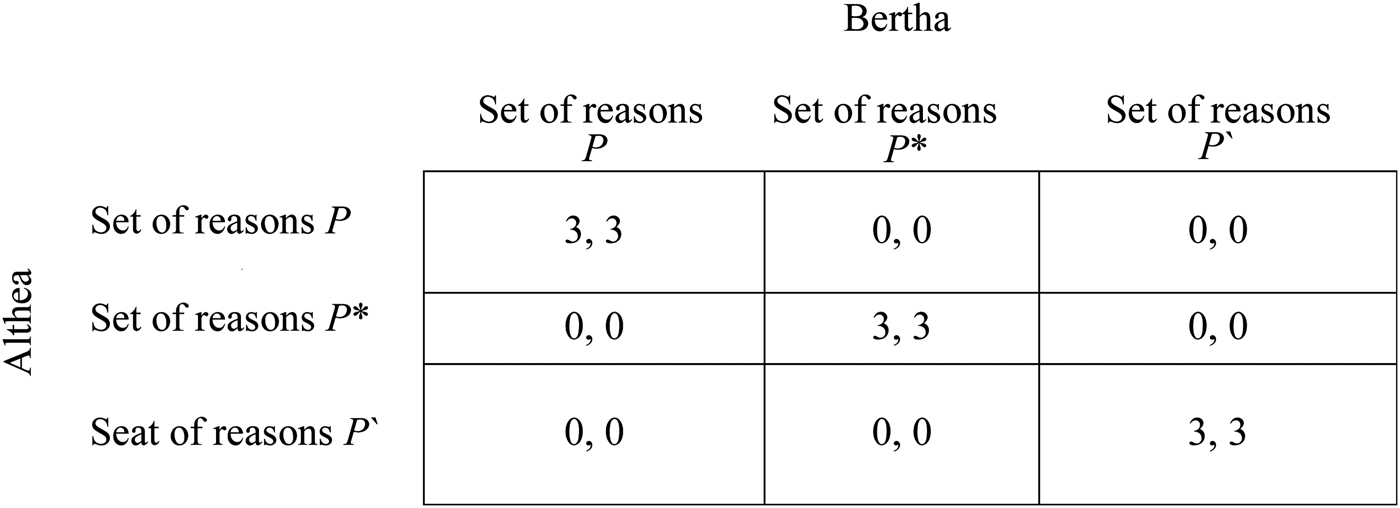
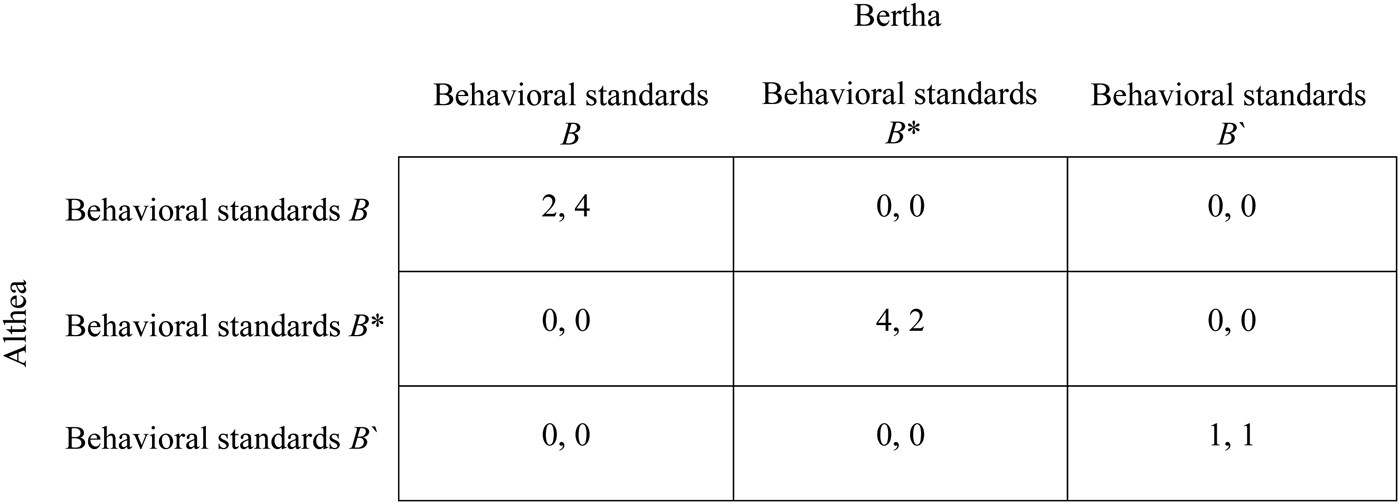
Let us take stock and put things together. Most citizens generally lack considered views on those sorts of considerations required for adequate public debate, though they are not opposed to acquiring them, and likely have a mild preference for coordinating these views with their fellow citizens in order to solidify one standard of public reasoning. Citizens are thus engaged in an n-person coordination game, simplified to the two-person game illustrated in Figure 1 (here, assume Bertha is like Althea in that she is afflicted by the demandingness problem). In offering their coordination theory of law and constitutions, Hadfield and Weingast also assume that citizens are engaged in an n-person coordination game, again simplified to the two-person game illustrated in Figure 2. Citizens want to coordinate on a common standard of behavioral rules B in order to keep S in line. Hadfield and Weingast argue that part of a constitution and indeed system of law more generally entails an authoritative steward that effectively picks out an equilibrium in the game illustrated in Figure 2. My argument is that in doing so the authoritative steward also picks out an equilibrium in the game illustrated in Figure 1. Over a long body of cases the Supreme Court, in telling us whether S violates B, also gives us standards of reasoning implicit in its common logic that come with a set of considerations that can be used in public reasoning. In other words, the Court, in telling us whether S violates B, also gives us a set of public reasons P.
Coordinating on Reasons

Coordinating on Behavioral Rules

But notice that, though both Figures 1 and 2 display coordination games, they are different. Figure 1 is a pure coordination game—all that matters to citizens Althea and Bertha is that they adopt the same set of public reasons. But Figure 2 is a mixed coordination game—citizens Althea and Bertha wish to adopt the same set of behavioral rules, but they have conflicting preferences over which equilibrium is selected. The reason why these games are modeled differently is that Hadfield and Weingast's model, which solves the problem Althea and Bertha are engaged in in Figure 2, assumes that citizens have idiosyncratic logics that conflict. They want to coordinate, but they have conflicting preferences over what interpretation of the behavioral rules they coordinate on. In the last two subsections we have assumed that Althea and Bertha have no commitments to those kinds of things implicit in the Court's standards of reasoning because we focused exclusively on the demandingness problem. They simply want to coordinate, and do not even know enough about what they are coordinating on to have diverging preferences. But what about when citizens do have considered commitments akin to the idiosyncratic logics Hadfield and Weingast assume? How do citizens converge on a common set of considerations to generate a complete set of public reasons then? The next subsection addresses this question.
C. The Diversity Problem
Unlike Althea and Bertha, who are afflicted by the demandingness problem, Cassidy does have considered views about those issues constituting public reason's content. In fact, Cassidy adopts both social scientific commitments as well as abstract philosophical considerations at odds with the Court's standards of reasoning. Suppose the Court, over a long body of cases, solidifies set of public reasons P as its standards of reasoning. Althea and Bertha follow and, let us suppose, eventually come to genuinely believe those considerations in P via the mechanism highlighted in the previous subsection. But what about Cassidy, who thinks a different set of considerations P* is the best way of proceeding? What does she do?
Importantly, on Gaus's model Cassidy does not have to actually come to believe P in order to secure the practical function of public reason. She can merely employ P when debating matters of basic justice and constitutional essentials in order to assure her fellow citizens that she remains faithful to the political conception of justice. But even though Cassidy can employ P in public discourse without genuinely believing P to be true, it does not follow that she will actually do so. From Cassidy's perspective, the considerations in P could be so objectionable given her actual, considered views that it is not worth employing them in public discourse even to secure the practical function of public reason. When such is the case Cassidy will appeal to her preferred P*, which will potentially lead to a breakdown of assurance.
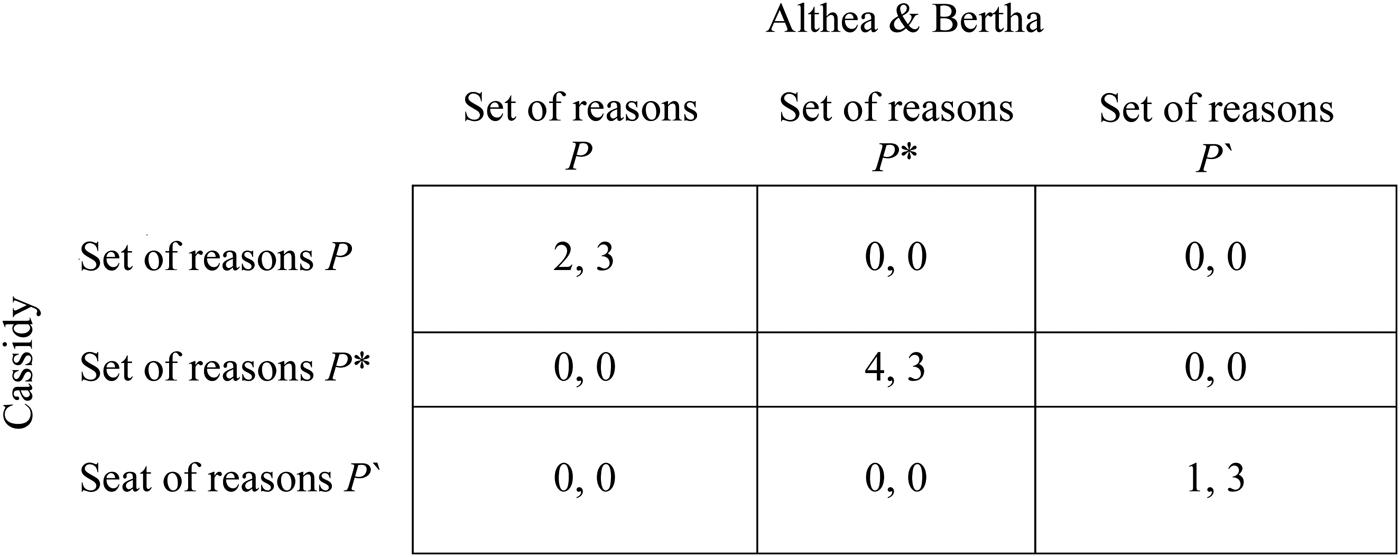
Since it is desirable that Cassidy employ P over P* we need to examine under what circumstances she will in fact do so. Here we can distinguish between two possible cases. The first case is illustrated in Figure 3. In this case Cassidy plays a game with those citizens giving rise to the demandingness problem. Though Althea and Bertha are indifferent as to which set of public reasons is ultimately selected by the Court in its standards of reasoning, Cassidy is not: she prefers P* to P to P`. But though Cassidy thinks that some ways of fleshing out the content of public reason are better than others, she does, all things considered, prefer coordinating with her fellow citizens over not coordinating. Figure 3 thus models the case where Cassidy cares more about securing stable social order than she does about her own idiosyncratic commitments. When the sorts of preferences modeled in Figure 3 obtain, citizens giving rise to the diversity problem cause no trouble at all. The Court, in offering standards of reasoning as part of its common logic, solidifies P. Althea and Bertha follow. Given that Althea and Bertha already employ P in their discourse, Cassidy's best response is to play P as well. This generates a set of reasons all citizens share that can then be employed in public discourse.
Preferring Social Cooperation to Idiosyncratic Logic

It must be noted, however, that there is little chance of securing the normative function of public reason in the case of citizens giving rise to the diversity problem when we interpret the liberal principle of legitimacy and the duty of civility as requiring giving citizens reasons justifiable to them qua private persons. When it comes to citizens giving rise to the diversity problem, the best we can hope for is that they endorse P as part of a public perspective. It is doubtful that citizens like Cassidy will genuinely come to believe P as Althea and Bertha might, for by hypothesis they are strongly committed to considerations at odds with those in P (in this case, set of reasons P*). When others give citizens like Cassidy P-based reasons, they will thus not be giving these citizens reasons they can endorse qua private persons, though they will be giving them reasons they can endorse qua public citizens. Importantly, though, when the preferences in Figure 3 obtain, the practical function of public reason can be secured even in the face of the diversity problem. The assurance problem is solved, and society remains stable.
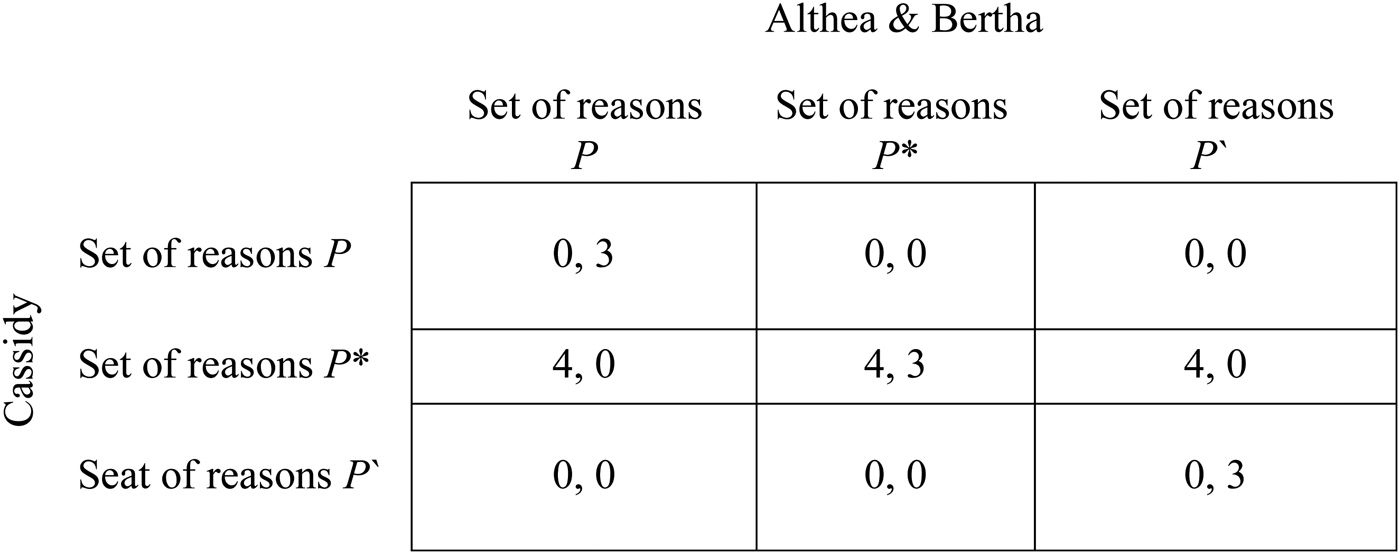
Now consider a second case, illustrated in Figure 4. In this case Cassidy thinks P and P` as standards of reasoning are so misguided that she would rather employ P* regardless of what Althea and Bertha do. Here, when the Court picks out standards of reasoning P as part of its common logic and Althea and Bertha follow, Cassidy's best response is to continue playing P* rather than switch to P. This models the case where Cassidy finds P and P` to be so wrongheaded that she would rather continue appealing to her own idiosyncratic considerations and, in doing so, threaten stable social order. When the preferences in Figure 3 obtain, the practical function of public reason is secured despite the diversity problem; when the preferences in Figure 4 obtain, the practical function of public reason is not secured precisely because of the diversity problem. This leads to an important question: Which preferences are more likely to obtain in a liberal society? Those in Figure 3, or those in Figure 4? If the Figure 3 preferences obtain, then the diversity problem causes no great trouble for generating a complete set of public reasons capable of serving public reason's practical function; if the Figure 4 preferences obtain, then the diversity problem threatens stable social order.
Preferring Idiosyncratic Logic to Social Cooperation

In answering this we turn to Rawls's text. Relevant here is what Rawls says concerning potential conflict between citizens’ comprehensive doctrines and the political conception of justice. This potential conflict tracks closely enough for our purposes the conflict between Cassidy's preferred set of considerations P* and the set of public reasons implicit in the Court's standards of reasoning P. In speculating what citizens will do in times of conflict, Rawls gives us two reasons to be optimistic that the political conception of justice will win the day. He begins by noting that the “virtues of political cooperation that make a constitutional regime possible are, then, very great virtues.” These virtues of political cooperation—tolerance, meeting others halfway, reasonableness, and a sense of fairness—are very great virtues because they “sustain [society's] political conception of justice, they constitute a very great public good, part of society's political capital.”Footnote 37
What Rawls is getting at here is that when we ask whether citizens will adhere to their comprehensive doctrines (Cassidy's preferred set of reasons and considerations P*) or the political conception of justice (public reasons P implicit in the Court's standards of reasoning) in times of conflict, we need to pay special attention to what citizens sacrifice when they choose to follow their private interests over the political conception. For our purposes: in asking whether the Figure 3 or Figure 4 preferences more accurately model Cassidy's actual preferences, we need to think about what Cassidy gives up when she chooses to employ P* over P. If we take Rawls's remarks seriously concerning the integral role public reason plays in securing the stability of a liberal democratic society then Cassidy sacrifices stable social order just so she may employ her idiosyncratic set of reasons in public debate. Since it is unlikely that a reasonable person would do this, the Figure 3 preferences more accurately model citizens giving rise to the diversity problem than the Figure 4 preferences do. Because of what is being sacrificed when citizens do not adhere to public reason, reasonable persons will, all things considered, prefer coordinating with their fellow citizens on a shared set of reasons when compared to not coordinating. When this is the case public reason serves its practical function despite the diversity problem.
Rawls gives us a second reason to be optimistic that the political conception of justice will carry the day when in conflict with citizens’ private interests: “the other reason political values normally win out is that severe conflicts with other values are much reduced.”Footnote 38 Note that this is especially true when it comes to conflicts concerning whether one ought to adhere to one's own standards of reasoning or the Court's standards of reasoning solidified as part of public reason. Recall that, for Rawls, public reason only governs discourse concerning matters of basic justice and constitutional essentials. This implies that much of public discourse will not be governed by public reason: “Many if not most political questions do not concern those fundamental matters, for example, much tax legislation and many laws regulating property; statutes protecting the environment and controlling pollution; establishing national parks and preserving wilderness areas and animal and plant species; and laying aside funds for museums and the arts.”Footnote 39 When these sorts of issues are at stake, Cassidy may appeal to her preferred idiosyncratic reasons without violating the requirements of public reason.
The idea here is that citizens will more likely tolerate deviations from their preferred standards of discourse because these deviations happen so infrequently. If Cassidy were required to employ P over P* in all public discourse then perhaps so great a sacrifice would not be worth it. In such a case, the Figure 4 preferences would more accurately model Cassidy's actual preferences. But, since the context in which Cassidy must employ P over P* is rather limited, it is likely that she is willing to meet her fellow citizens halfway by adhering to public reason, for meeting her fellow citizens halfway happens so infrequently. When this is true, the Figure 3 preferences more accurately model Cassidy's actual preferences. This, coupled with what it is that citizens give up when they fail to adhere to public reason, gives us strong reason to believe that the Figure 3 preferences more accurately model the preferences of those citizens in society giving rise to the diversity problem. We should thus be optimistic that public reason can serve its practical function even in the face of the diversity problem.
This is important, for I think stability considerations are the ultimate motivation for why public reason is included in Rawls's later framework. A major theme running through Rawls's mature work is concern over the possibility of constitutional drift: “For in the long run, the leading interpretations of constitutional essentials are settled politically. A persistent majority, or an enduring alliance of strong enough interests, can make of the Constitution what it wants.”Footnote 40 Such a fact can lead to a corrosive politics: “Frequent controversy over the structure of government, when it is not required by political justice and when the changes proposed tend to favor some parties over others, raises the stakes of politics and may lead to distrust and turmoil that undermines constitutional government.”Footnote 41 Preventing such breakdown not only requires that citizens agree on a set of constitutional essentials, but also requires that citizens assure one another that they remain faithful to these essentials, especially in times of constitutional crisis. A complete set of public reasons is integral for doing just that.