


What we are at present is, to a large extent, a product of our past experience and of what we wish to become in the future. The image that we create of ourselves in the future acts as a model that guides our behaviour and directs our efforts towards a particular purpose (Nurmi, Reference Nurmi1991). In this sense, adolescents’ representation of their future, goals or projects could play a significant role in the comprehension of their current behaviour. Among these representations, future expectations are an important focus of study (Dutra-Thomé, Koller, McWhirter, & McWhirter, Reference Dutra-Thomé, Koller, McWhirter and McWhirter2015). As indicated by Iovu, Hărăguş, and Roth (Reference Iovu, Hărăguş and Roth2016), in order to promote positive future expectations among adolescents, it is essential to understand the combinations of factors involved in this process. There has been some research on predictors of other related constructs such as future selves, future goals or future aspirations (Fleming, Woods, & Barkin, Reference Fleming, Woods and Barkin2006; Sharp & Coatsworth, Reference Sharp and Coatsworth2012). However, less is known about how expectations are formed and the role that other variables play in adolescents’ future expectations.
Regarding the particular culture (Spain) and adolescents within this context, the latest studies conducted by the Spanish Youth Institute (Informe Juventud en España; INJUVE, 2016) indicated that, despite the actual economic situation, young Spaniards’ vision of the future is positive. The hardest years of the economic crisis corresponded to a considerable drop in satisfaction levels. Unlike the previous data for 2012, in 2016 it was observed that the proportion of young people who were optimistic about their expectations was now greater (31%) than the proportion of pessimists (23%). The data from the 2016 IJE (Informe Jeventud en Espana) survey showed relatively high levels of optimism about the future. In the vast majority of cases, expectations and life projects open to multiple possibilities are being built. The elements of life that provide more satisfaction to young people are friends, health and family, three aspects linked to the most personal sphere of the individual.
Future Expectations During Adolescence
From a lifespan perspective, at every stage of development, the goals that each individual sets will have different features according to their core tasks of development (Estaún, Reference Estaún, Sáez, Rubio and Dosil1996). The experience of the past, present and future will vary according to the importance granted to each time period. In youth, the importance granted to the future is greater than that granted to the past, whereas for older people, the opposite is true (Martinez Uribe, Reference Martínez Uribe2004). Thinking about the future and constructing perceptions of oneself in the future might play a more important role during adolescence than during other developmental stages of life (Trempala & Malmberg, Reference Trempala and Malmberg2002). As individuals mature from childhood to adolescence, given advances in cognitive abilities and the process of identity formation, they develop an increased capacity for a complex time perspective (Mello & Worrell, Reference Mello, Worrell, Stolarski, van Beek and Fieulaine2015).
Future expectations are one of the processes involved in time perspective. As Seginer (Reference Seginer2009) defines them, future expectations consist of adolescents’ plans, aspirations and fears about possible events in life related to different domains. Future expectations are particularly relevant to people in a transitional period of their development as a way to prepare for the future (Seginer, Reference Seginer2008), and they are conceived as a positive path to adulthood (Snyder, Rand, & Sigmon, Reference Snyder, Rand, Sigmon, Snyder and Lopez2002). The importance of life goals in the configuration of adolescents’ psychosocial development is well established in the literature (Heckhausen & Tomasik, Reference Heckhausen and Tomasik2002; Hicks & Holden, Reference Hicks and Holden1995; Nurmi, Reference Nurmi1991). Rice (Reference Rice2000) highlighted that the primary task of the adolescent is to achieve a definition of him- or herself and what he or she wants to become in the future.
One of the important tasks to develop at this stage is decision making regarding the academic and professional future (Veenstra, Dijkstra, Steglich, & Van Zalk, Reference Veenstra, Dijkstra, Steglich and Van Zalk2013). Rodriguez Moreno (Reference Rodríguez Moreno2003) also reflected on the importance of young people’s expectations in the process of academic and vocational development. These are related to their self-image, to how they look and feel, and what they expect of themselves at the personal, academic and social level.
Psychosocial Adjustment and Future Expectations
Which variables would be related to positive expectations? Much of the research in this area has analysed future expectations as antecedents of behaviour and therefore of psychosocial adjustment. Unfortunately, direct studies on the antecedents of future expectations have been rare. Prospective studies to identify which factors predict changes in future expectations are needed (Dubow, Arnett, Smith, & Ippolito, Reference Dubow, Arnett, Smith and Ippolito2001; Wyman, Cowen, Work, & Kerley, Reference Wyman, Cowen, Work and Kerley1993). Research seeking to address this issue includes that of Dubow et al. (Reference Dubow, Arnett, Smith and Ippolito2001), who analysed the role of future expectations for internal resources, supportive family and peer relationships, avoidance of exposure to negative peer influences, and current behavioural adjustment. Our work focuses on variables involved in current optimum adjustment in high school and their role in the construction of personal expectations for the future. Having adequate psychological and social adjustment at present could generate positive expectations for adolescents about what will happen in the future.
Overall, adolescents report that both personal and contextual elements have an impact on the achievement of their goals and thus on their expectations about the future (Becker & Luthar, Reference Becker and Luthar2002). In an attempt to gain knowledge about the variables that contribute to building positive future expectations, following the ecological model (Bronfenbrenner, Reference Bronfenbrenner1979), we have identified some individual and psychological variables, and some variables from the social context (peers, teachers) associated with future expectations. Some researchers have analysed other systems. Youth living in urban areas think about the future using more positive statements compared to their rural peers (Iovu, Reference Iovu2014). In addition, authors such as Stoddard and Pierce (Reference Stoddard and Pierce2015) have shown the impact of adolescent participation in other contexts, finding that positive future expectations are higher when collective efficacy in the community is high and youth are engaged in community activities. In this sense, the formation of the time perspective is related to many factors, and some are learnt in the process of socialisation, and by cultural values, religion, education, socioeconomic status and the family model (Boniwell & Zimbardo, Reference Boniwell, Zimbardo, Linley and Joseph2004). Future expectations may be influenced by the development of the individual’s life, profession, and political or economic instability, in addition to personal experiences. Other aspects such as norms, values and living conditions have also shown a relationship with adolescents’ future orientation (Seginer, Reference Seginer2009; Wade, Reference Wade2008).
These two groups of factors (individual and contextual) are not independent because, as indicated by Lerner (Reference Lerner, Lopez and Snyder2009), developmental regulation across ontogeny involves mutually influential individual-context relations. Indeed, researchers have found that, for example, the effect of community-oriented resources on positive future expectations appears to be mediated by the positive psychological assets of hope (Stoddard & Pierce (Reference Stoddard and Pierce2015).
There are individual differences in the construction of these expectations. Applying the perspective of the Five Cs of positive youth development (PYD; Lerner, Reference Lerner2004; Roth & Brooks-Gunn, Reference Roth and Brooks-Gunn2003) to the development of future positive expectations, the existence of healthy conditions (confidence, competence, connection, character, and caring) are necessary to achieve the positive future expectations that allow an optimal transition to the adult world. Future expectations are built in the context of other self-perceptions: self-confidence about the present makes the person able to imagine a more positive future (Sánchez-Sandoval & Verdugo, Reference Sánchez-Sandoval and Verdugo2016). Psychological attributes such as displaying self-confidence and optimism are related to more positive expectations about the future during adolescence (Iovu et al., Reference Iovu, Hărăguş and Roth2016). In the school context, lower academic self-concept has been associated with decreased career aspirations (Krannich et al., Reference Krannich, Goetz, Lipnevich, Bieg, Roos, Becker and Morger2018). Having a good self-appraisal or self-perception and being aware of one’s limitations may help to address the present and the future. Moreover, as Valley, Huebner, and Suldo (Reference Valley, Huebner and Suldo2004) have shown in their study, overall satisfaction correlates positively with future expectations.
Cognitive factors such as self-efficacy have also been considered as personal factors associated with future expectations. This feeling refers to a person’s expectations to successfully achieve whatever he/she is undertaking (Montoya & Landero, Reference Montoya and Landero2008). Individuals’ beliefs about their effectiveness to control events that affect their lives, their confidence in their intellectual ability, and the difficulty of the task influence the choices they make, their aspirations, and their level of effort and persistence (Galicia-Moyeda, Sánchez-Velasco, & Robles-Ojeda, Reference Galicia-Moyeda, Sánchez-Velasco and Robles-Ojeda2013; Kaplan Toren, Reference Kaplan Toren2013).
However, the relationship between social adjustment and future expectations in adolescence has not received much attention. Kandel and Lesser (Reference Kandel and Lesser1969) showed how interests, plans and beliefs about the future are learned in social interaction with other people. In addition to adolescents’ relationships with their parents, those they build with their peers influence their thoughts and plans for the future. The ideas contributed by Casas Aznar et al. (Reference Casas Aznar, Buxarrais Estrada, González Carrasco, Tey Teijón, Noguera Pigem, Rodríguez Rodríguez and Figuer Ramírez2004) are along the same lines. These authors maintained that adolescents anticipate their future in different fields depending on a number of factors, including perceived social support, social peer group influence, and other perceptions, opinions, attitudes and representations, and assessments relating to different areas of their lives (school and/or professional/work experience, family, leisure activities, relationships, and so on). Catalano, Berglund, Ryan, Lonczak, and Hawkins (Reference Catalano, Berglund, Ryan, Lonczak and Hawkins2004) concluded in their study that positive beliefs about the future are related to better social and emotional adjustment in school and to perceived competence, among other factors. Iovu et al. (Reference Iovu, Hărăguş and Roth2016) emphasised in their research that the development of an individual’s future expectations is associated with his or her relationships with significant others (e.g., family members or friends).
Current study
The current study analyses in an educational context the relationship between psychological variables (e.g., self-efficacy, self-esteem, life satisfaction, and emotional and behavioural problems), social adjustment (i.e., educational and social adjustment in the school context) and future expectations in adolescence, testing a theoretical structural model that proposes direct effects of psychological and social adjustment on future expectations (see Figure 1). This model draws on the contributions of authors such as Lerner (Reference Lerner2004), Roth and Brooks-Gunn (Reference Roth and Brooks-Gunn2003), and Iovu et al. (Reference Iovu, Hărăguş and Roth2016), although we try to apply a comprehensive model of these variables and their relations to adolescents’ future expectations.
Hypothesised model of future expectations.

Method
Participants
The sample consisted of 781 adolescents enrolled in the 1st grade of secondary compulsory education in Spain. Of these participants, 402 were boys (51.5%) and 379 were girls (48.5%), aged 11–15 years (M = 12.37, SD = 0.66). Data were collected from 11 different schools in the south of Spain. In order to respect the percentages of students in public and private schools in the province of Cádiz, we maintained similar proportions in our sample when selecting the participating schools (75.9% public schools and 24.1% private schools). Most of the families were of medium-low or medium socioeconomic status. As for other characteristics, 26 families (3.3%) were described by teachers as having significant economic needs, 35 (4.5%) as unstructured families, 26 families (3.3%) with a member with some substance addiction, 9 (1.2%) as adoptive families, and 29 (3.7%) belonging to ethnic minorities.
Measurements
Adolescents’ Future Expectations Scale (EEFA; Sánchez-Sandoval & Verdugo, Reference Sánchez-Sandoval and Verdugo2016)
This 14-item, self-report scale allows us to determine what adolescents think their future will be like in a few years. Each item is rated on a 5-point Likert-type scale ranging from 1 (I am sure that will not happen) to 5 (I am sure that will happen). It includes four dimensions: Economic Expectations (job prospects and acquisition of material resources; e.g., ‘I will find a job’), Academic Expectations (expected level of study; e.g., ‘I will complete secondary education’), Personal Wellbeing Expectations (possibilities of developing social relations and issues related to health and safety; e.g., ‘I will be confident’), and Family Expectations (possibilities of forming a stable family, having children and so on; e.g., ‘I will have children’). Higher scores indicate more positive expectations about the events occurring in the future. Response scores for this and the following questionnaires were averaged to create their composite scores for data analysis. The global scale and subscales showed acceptable reliability (Global scale, α = .86; Economic Expectations, α = .79; Academic Expectations, α = .81; Personal Well-Being Expectations, α = .68; and Family Expectations, α = .70).
Rosenberg Self-Esteem Scale (RSE; Rosenberg, Reference Rosenberg1965)
The Spanish version by Martín-Albo, Nuñez, Navarro, and Grijalvo (Reference Martín-Albo, Núñez, Navarro and Grijalvo2007) was used. This 10-item scale measures global self-worth (e.g. ‘I take a positive attitude toward myself’). Responses are rated on a 4-point Likert-type scale (1 = strongly disagree to 4 = strongly agree), with higher scores reflecting higher self-esteem. It showed a satisfactory level of internal consistency (α = .71).
Students’ Life Satisfaction Scale (SLSS; Pavot & Diener, Reference Pavot and Diener1993)
We used the Spanish version by Galíndez and Casas (Reference Galindez and Casas2010). The SLSS contains seven statements about general life satisfaction (e.g., ‘I wish I had a different kind of life’) rated on a 6-point Likert-type scale (from 1 = strongly disagree to 6 = strongly agree). Higher scores on this measure indicate greater life satisfaction. The SLSS performed well with our sample (α = .79)
General Self-Efficacy Scale (Baessler & Schwarcer, Reference Baessler and Schwarcer1996)
The Spanish version (Sanjuán Suárez, Pérez García, & Bermúdez Moreno, Reference Sanjuán Suárez, Pérez García and Bermúdez Moreno2000) of this scale is a 10-item scale that measures children’s stable belief about their ability to appropriately manage various life stressors (e.g. ‘I can always manage to solve difficult problems if I try hard enough’). Each item is rated on a 10-point Likert-type scale, ranging from 1 (not at all like me) to 10 (very like me). Internal consistency analysis in the current study yielded α = .89.
Youth Self-Report (YSR; Achenbach, Reference Achenbach1991)
This self-report assesses skills and behavioural problems through 112 items which participants rate whether or not they have felt this way in the past six months (0 = not true, 1 = a little true, and 2 = very true). The items are grouped into various scales or ‘narrowband’ syndromes, and two second-order factors or ‘broadband’ syndromes. The reliability for the global scale was α = .94, and for the internalising and externalising problems it was α = .87 and α = .89 respectively. The reliability for the subscales (depression/anxiety, criminal misconduct, aggressive behaviour, somatic complaints, thought problems, relationship problems and attention seeking) ranged between α = .65 and α = .84.
Scale of Teacher’s Perception of School Adjustment (EA-P; Cava & Musitu, Reference Cava and Musitu1999)
Completed by the teacher in the classroom, this scale is made up of eight items about the teachers’ perceptions of each one of their students in different areas: social adjustment (e.g., ‘The student’s degree of social adjustment in the classroom’), academic performance (e.g., ‘Current approximate academic performance’), family involvement (e.g., ‘Degree of family implication in the child’s school performance’), and teacher-student relationship (e.g., ‘His/her relationship with this student’). The response scale ranges from 1 to 10 (1 = poor/very bad and 10 = high/very good). The reliability of the global scale is α = .91, and higher than α = .85 in the four subscales.
Social preference
Following the procedure of Coie and Dodge (Reference Coie and Dodge1983), social preference was calculated. To assess peer liking, we asked adolescents to nominate three classmates with whom they would like to share experiences and personal needs (e.g., ‘If you’re worried or have a problem, which classmates would you/would you not tell it to and ask for advice?’), to play or spend free time (e.g. ‘Which classmate do you like to be with the most/the least in your free time [to go out with, at recess …]?’) and to study with or do homework together (e.g., ‘Which classmate would you choose/not choose to do homework together?’). To assess peer disliking, we asked them to nominate three classmates with whom they would not like to do the above-mentioned activities. These nominations were standardised within classrooms. The standardised social preference score was obtained for each student by subtracting the dislike score from the like score.
Procedure
After receiving the consent of the school directors and families, we visited the classrooms. The research project was accepted by the Doctoral Committee of the University of Cádiz (Spain). Permission was obtained from the local educational authorities and from the School Council at each school. We obtained informed consent from all individual participants included in the study. Student participation was voluntary. We administered the questionnaires in whole class groups. Tutors were provided with the forms to be completed by them about each of their students.
Data Analysis
Data analysis was carried out using the Statistical Program for the Social Sciences PASW Statistics for Windows (version 18.0) and EQS 6.2. We present descriptive results and the correlations. The nonparametric Spearman’s rho test was used to perform bivariate correlation analyses because the data did not follow a normal distribution. We constructed a structural equation model (SEM) in order to study the effect of psychosocial adjustment on future expectations. A confirmatory factor analysis (CFA) was performed using the robust maximum likelihood estimation (RML). Given the sensitivity of the chi-square statistic to sample size, additional measures of model fit were used (Hu & Bentler, Reference Hu and Bentler1999): the root mean square error of approximation (RMSEA), the Bentler comparative fit index (CFI), the Bentler-Bonett non-normed fit index (NNFI), Bollen’s fit index (IFI), and McDonald’s fit index (MFI). RMSEA values below .08 are considered a reasonable fit, whereas values below .05 indicate good fit. CFI, NNFI, IFI, and MFI values above .90 indicate a good fit.
Results
Descriptive Statistics and Correlations Between Future Expectations and Psychosocial Adjustment Measures
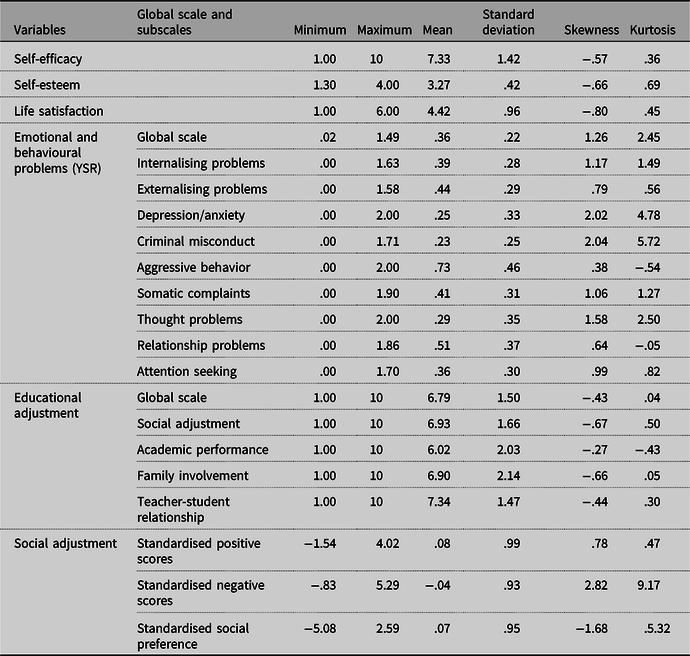
Table 1 shows the descriptive statistics (mean and standard deviations) and estimates of the distributions (skewness and kurtosis) of each of the predictor variables.
Statistical descriptions of the Indexes of Psychological, Educational and Social Adjustment

Note: YSR = Youth Self-Report.
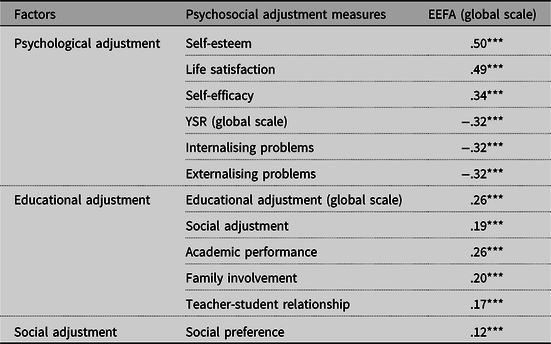
The Kolmogorov-Smirnov (K-S) test indicated that the EEFA was not distributed normally; consequently, alternative analyses were proposed, taking into account the nature of the data. The results of the Spearman correlation analysis (Table 2) revealed statistically significant and positive correlations between self-esteem, life satisfaction, self-efficacy, global future expectations, economic/occupational expectations, academic expectations, personal wellbeing expectations, and family expectations. Adolescents’ higher levels of self-efficacy (r = .34, p < .001), self-esteem (r = .50, p < .001), and life satisfaction (r = .49, p < .001), corresponded to higher levels of global future expectations, and in the different subscales.
Correlations Between Future Expectations and Psychosocial Adjustment Measures

Note: EEFA = Adolescents’ Future Expectations Scale. YSR = Youth Self-Report.
***p < .001.
Another individual factor associated with future expectations is the one concerning emotional and behavioural problems. The correlations between the EEFA and YSR scales were negative and statistically significant (r = −.32, p < .001 for the YSR global scale and internalising and externalising problems). Adolescents’ greater emotional and behavioural problems corresponded to poorer future expectations.
Our analysis revealed a positive significant correlation between educational (r = .26, p < .001), and social adjustment (r = .12, p < .001), preference index) and future expectations (Table 2). These findings confirm that as these adolescents’ school and social adjustment increases, their future expectations increase as well.
Predictive Model of Adolescents’ Future Expectations
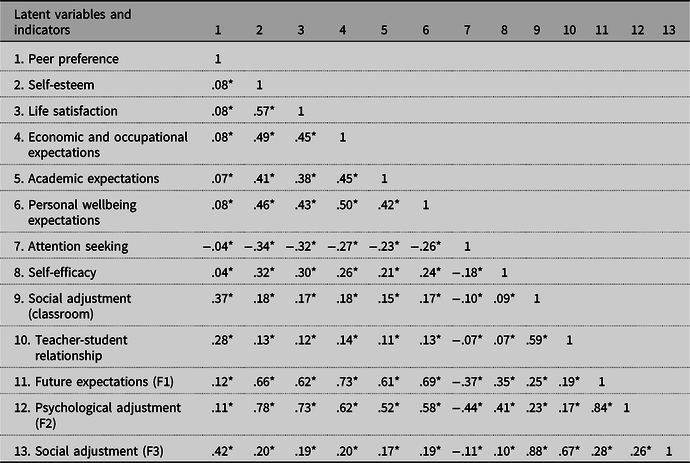
We used an SEM in order to offer a clear overview of interrelationships and influences of the variables that better explain adolescents’ future expectations. First, the normality of the data, skewness and kurtosis, and the multivariate kurtosis Mardia coefficient were analysed. In our structural analysis, the Mardia coefficient was 34.44, and the normalised estimate was 30.94, exceeding by far the limit value of 5 established to be considered a multivariate normal distribution (Bentler, Reference Bentler2005). Therefore, the RML method was used. All estimates were statistically significant, and the models fit adequately, χ2(29) = 91.65, p = .000, NNFI = .93, CFI = .95, IFI = .95, MFI = .96, RMSEA = .05, 90% CI [.041, .065]. The correlation matrix between latent variables and indicators (Table 3) showed significant correlations (p < .05).
Correlation Matrix Between Latent Variables (High Order) and Indicators (First Order)

Note: *p < .05.
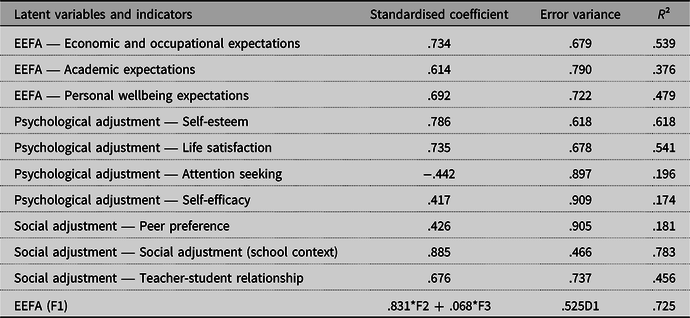
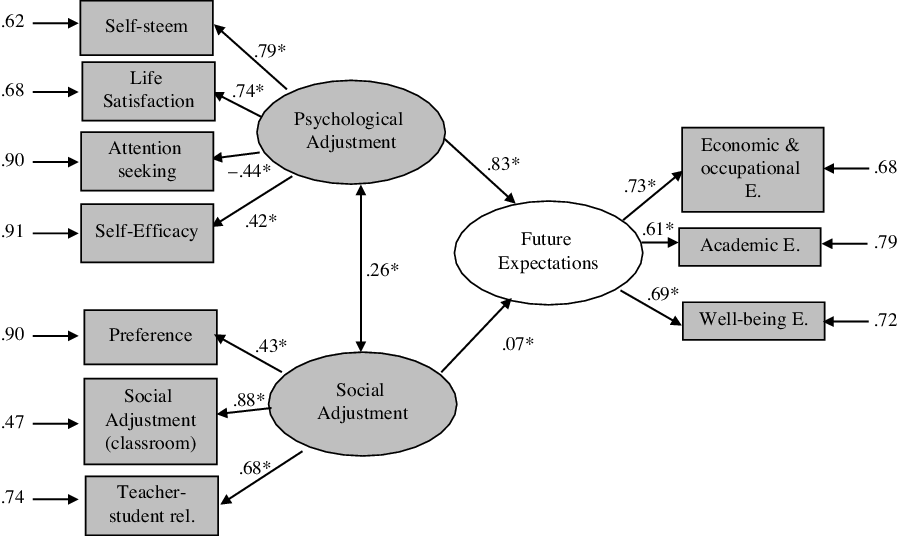
The relationship between the variables shows the importance of the variables included in the model, whose standardised regression coefficients revealed their influence in the dependent latent variable (Table 4). The graphic display of the model (Figure 2) shows which data were included in the SEM. This measurement model shows that almost all the indicators presented high factorial loads, ranging between .42 and .88.
Standardised Solution of the Model

Note: EEFA = Adolescents’ Future Expectations Scale.
Structural equations model of future expectations.

We can confirm the important role played by psychological adjustment (self-esteem, life satisfaction, self-efficacy, and absence of behavioural problems) in future expectations, with attention-seeking being the only subscale included in the SEM because the rest did not fit the higher order factor. Social adjustment is also considered a relevant variable in the construction of these expectations, although to a lesser extent. This factor had a low predictive path. Specifically, this refers to social adjustment in the school context, measured through peer preferences, the social setting in the classroom, and the teacher’s relationship with the student; these last two aspects were assessed by the teacher. These two factors explain 72.5% of the observed variability in future expectations (economic and occupational expectations, academic expectations, and personal wellbeing expectations). The family expectations dimension was not included in the model due to the unsatisfactory results achieved in previous analyses (the low correlation coefficients with latent variables of psychological adjustment and social adjustment indicators were in some cases nonsignificant). The model also revealed the existence of the interaction between the factors of psychological and social adjustment.
To sum up, we confirm that the levels of psychological and social adjustment explained part of adolescents’ future expectations in this study. We can state that adolescents who obtain high scores in self-esteem, life satisfaction and self-efficacy, and low scores in attention-seeking behaviours, have higher future expectations. Similarly, adolescents with a greater social adjustment in the school context, a better teacher-student relationship, and higher peer preference have higher expectations, specifically in economic and occupational expectations, academic expectations and personal wellbeing expectations.
Discussion
The starting point of this work was the importance of adolescents’ positive expectations about their own future for their development, given the motivational nature of such expectations. This study advances our knowledge about which factors promote these positive future expectations among early adolescents. The purpose of this study was to validate a model of the relationship between psychological and social adjustment in adolescence and their future expectations.
The SEM confirms the complexity of the future expectations construct, as there are many variables involved that eventually contribute to explain it. Our results corroborate the ideas of Mihai-Bogdan (Reference Mihai-Bogdan2013), who emphasised the importance of the significant subsystems surrounding adolescents to determine how they build their future expectations (both positive and negative). In accordance with the ecological model of human development (Bronfenbrenner, Reference Bronfenbrenner1979), our results confirm the relations with adjustment variables, both from the ontogenetic system and from other relational systems. The current study did not analyse all the possible systems. Our contribution is related to variables from the ontogenetic system and scholar microsystem.
The data corroborate the link proposed in the theoretical model between adjustment and future expectations. Achieving adequate psychological and social adjustment leads adolescents to generate positive expectations about what they will achieve in the future. Considering our results from the perspective of the positive youth development, the resulting model integrates the indicators (Five Cs) of adolescents’ positive adjustment related to the construction of more positive future expectations. In relation to the perception of Competence and Confidence, the trend of our data is for greater self-efficacy, self-esteem and life satisfaction to be related to greater future expectations. Confident people do not remain negative about their experiences; rather, they make a positive assessment of their capabilities and see the future as positive, considering future problems as challenges that can be solved. In fact, success-oriented individuals with a sense of self-efficacy believe they can cope with future challenges and are capable of setting various tasks for themselves (Katra, Reference Katra, Trempała and Malmberg2002). Our results coincided with previous research finding that adolescents’ self-esteem is positively associated with variables related to an optimistic and positive future orientation (Jackman & MacPhee, Reference Jackman and MacPhee2015; Lanz & Rosnati, Reference Lanz, Rosnati, Trempała and Malmberg2002; Seginer, Reference Seginer2009; Seginer & Shoyer, Reference Seginer and Shoyer2012). Youths with high self-confidence are more likely to have positive expectations about their future outcomes (Thompson & Zuroff, Reference Thompson and Zuroff2010). In contrast, low levels of self-esteem imply negative affect and a more negative view of the future (Ortuño & Vásquez Echeverría, Reference Ortuño and Vásquez Echeverría2013). Moreover, our results support the association between life satisfaction and future expectations (Laghi, Pallini, Baumgartner, & Baiocco, Reference Laghi, Pallini, Baumgartner and Baiocco2015; Martinez Uribe, Reference Martínez Uribe2004; Valley et al., Reference Valley, Huebner and Suldo2004). The greatest satisfaction is the feeling that one has achieved a lot in life and that more is expected to be achieved (Castro & Sánchez López, Reference Castro and Sánchez-López2000). Recent studies, such as that of Verdugo, Freire, and Sánchez-Sandoval (Reference Verdugo, Freire and Sánchez-Sandoval2018), analysed the future expectations of early adolescents in two countries (Spain and Portugal) and focused on the predictive capacity of psychological adjustment — self-esteem, life satisfaction, and self-efficacy — for these future expectations. This corroborates the influence of psychological adjustment variables and their explanatory power of the future expectations of adolescents from different countries. The resulting model confirms that minor problems of attention-seeking are associated with more positive future prospects. This outcome contributes to the study of the relationship between the manifestation of problems and expectations for the future, rarely present in other investigations. The closest evidence refers to how adolescents’ behaviour problems were negatively associated with their future orientation (Bolland, Reference Bolland2003; Chen & Vazsonyi, Reference Chen and Vazsonyi2013; Robbins & Bryan, Reference Robbins and Bryan2004). The positive youth development perspective includes Character (respect for societal and cultural rules, possession of standards for correct behaviours, a sense of right and wrong, or morality, and integrity) as one of the healthy conditions of positive development.
In the initial theoretical model, we proposed social adjustment in the school context as the second factor involved in future expectations. Adolescents’ social support networks play an important role in adolescence and emerging adulthood (Mackinnon, Reference Mackinnon2012) and can therefore affect their future expectations (Buday, Stake, & Peterson, Reference Buday, Stake and Peterson2012). Our results confirm the association between positive and supportive relationships with peers and teachers and more positive future expectations. Conversely, the lack of social peer support has been linked to negative future expectations (Mihai-Bogdan, Reference Mihai-Bogdan2013). This means that future expectations are also constructed from the evaluation of one’s own social achievements.
In particular, greater peer acceptance and preference was associated in the resulting model with the construction of more positive future expectations, as also indicated by Schmidt, Pierce, and Stoddard (Reference Schmidt, Pierce and Stoddard2016). Our work shows that successfully meeting this social need also becomes a driving factor for building a more positive and healthier future self-image. In this way, our results integrate the role of two more of the Five Cs of positive youth development: Caring (a sense of sympathy and empathy towards others) and Connection (positive bonds with people and institutions) in the configuration of future expectations in adolescence. As Nurmi (Reference Nurmi1991) also indicated, if peer relationships influence adolescents’ future plans, it is urgent to promote healthy relationships at this stage of life as well as to prevent and protect youngsters from peer violence and bullying.
Finally, we note the greater weight in the resulting model of the psychological adjustment factor on future expectations compared with the social adjustment factor. Our results are consistent with those of Mihai-Bogdan (Reference Mihai-Bogdan2013), who stated that the construction of a positive future is conceptualised as a single task and relies less on the external support of family members or friends. Moreover, Iovu (Reference Iovu2014) reported that family and peer-group variables contributed little to shape positive expectations of adolescents. In our case, variables such as academic performance and family involvement within the school context were excluded from the model despite the high correlations they presented with future expectations. As McWhirter and McWhirter (Reference McWhirter and McWhirter2008) highlighted, adolescents with a strong and positive self-image are more likely to construct positive futures.
Limitations of the Study and Future Lines of Research
This study contributes to research on the diversity of adolescent development and on the interrelation of individual and contextual factors. As a strength, we highlight that the research was theoretically grounded, using the ecological model and the positive youth development to integrate multiple domains of influence. In addition, it included the use of quite a large sample to explore the future expectations of adolescents. This result allows the application of developmental science in the area of youth programs for promoting positive human development.
Although the study has strengths, it also has some limitations, including the use of self-reports and questionnaires as the only method of data collection. However, the use of questionnaires has obvious advantages, as validated and standardised tests allow for the comparison between participants. We have offset this limitation by also using external sources such as teachers and peers. Another limitation should be noted. Due to the cross-sectional nature of the study, its capacity to determine causality is limited. For this reason, longitudinal studies should be conducted to examine these relationships over time.
Despite the limitations, the results of the present study provide several implications for research and practice in the school context. Positive psychological and social adjustment play a role in understanding future expectations and positive youth development as well as providing clues for designing intervention and prevention strategies. School counsellors or other professionals could design school-based intervention programs to support youths’ future expectations by enhancing their school functioning and psychosocial adjustment. Moreover, the understanding of how adolescents perceive their present and future may serve as the basis for the development of effective strategies to protect them from high-risk behaviours (Laghi et al., Reference Laghi, Pallini, Baumgartner and Baiocco2015). In this sense, adolescents who have fewer emotional problems, a positive self-evaluation, who are satisfied with their lives and, furthermore, feel capable of coping with problems are those who express higher future expectations. Therefore, school becomes an important scenario in which professionals can carry out interventions. We recommend mental health providers design school-based prevention and intervention programs to reduce risk factors and promote youth strengths (American Psychological Association, 2015). These interventions could be used to promote life skills and basic abilities that will help youth in the near future in employment and social inclusion (such as learning strategies, social and socio-labor skills, self-concept and self-esteem, achievement motivation, among others). Educational institutions must go beyond simply teaching skills of intellectual work, and develop students’ beliefs and self-regulating capacities. Changes in adolescence can have profound effects on their beliefs about their capabilities to succeed in many areas. It is essential to listen to adolescents, respect them and believe them, so that they can believe in themselves and trust their own ability to build a healthy life project for their psychosocial wellbeing. Continuing to invest in our youth will give them the possibility to achieve a more positive future and to build healthy homes and safer communities (Sipsma, Ickovics, Lin, & Kershaw, Reference Sipsma, Ickovics, Lin and Kershaw2012).
This study highlights some important future research guidelines. It would be interesting to complete this work with the inclusion of other relevant variables. For example, other individual variables (e.g., age, sex, psychological maturity, vocational orientation, coping strategies), demographic variables (e.g., parents’ educational level, profession, employment status), and contextual variables (e.g., culture; family variables such as parental style, family models, family cohesion, parents’ perceptions of and expectations about their children; or school level differences, i.e., income). This would help to identify other variables as antecedents of future expectations. Another interesting aspect is the longitudinal study of this group of adolescents, which we have already started (1st, 2nd and 4th grades of secondary compulsory education). In future work, our goal is to analyse the trajectories followed by groups of participants. Moreover, these analyses will allow us to determine how the construction of positive future expectations could lead to positive development.
Acknowledgments
We gratefully acknowledge the ongoing contribution of the participants in the study about psychosocial adjustment and future expectations in early adolescence. We would also like to thank teachers of the different schools who have selflessly collaborated.
Funding
This research received no specific grant from any funding agency, commercial, or not-for-profit sectors.
Conflict of interest
None.