Implications
Selection for reduced residual feed intake (RFI) to improve the feed efficiency of pigs diminishes daily feed intake. In this study, physical activity is also reduced, and the energy saving associated with the lower physical activity in the low RFI pigs explains 14% of the feed intake difference between two lines divergently selected for RFI, significantly contributing to the better feed efficiency of the low RFI pigs. This highlights the potential of phenotyping physical activity in pigs to better quantify energy expenditure, together with the impact of improved efficiency on animal behaviour and ultimately on pig welfare.
Introduction
Selection for residual feed intake (RFI), defined as the difference between observed feed intake and feed consumption predicted for maintenance and production requirements, was first proposed to improve feed efficiency in beef cattle (Koch et al., Reference Koch, Swiger, Chambers and Gregory1963). In pigs, some studies have focused on relationships between RFI and appetite and feeding activity (De Haer et al., Reference De Haer, Luiting and Aarts1993; Rauw et al., Reference Rauw, Soler, Tibau, Reixach and Gomez Raya2006; Gilbert et al., Reference Gilbert, Alaïn, Bidanel, Lagant, Billon, Guillouet, Noblet and Sellier2009; Young et al., Reference Young, Cai and Dekkers2011). They indicate that decreased RFI is related to diminished daily feed intake (DFI), feeding patterns characterized by fewer meals, less time eating per day and a higher feeding rate. De Haer et al. (Reference De Haer, Luiting and Aarts1993) reported that the variation in feed intake activity in group-housed growing pigs accounted for 44% of the variation in RFI. Studies in laying hens (Luiting et al., Reference Luiting, Schrama, Vanderhel and Urff1991) and beef cattle (Herd et al., Reference Herd, Oddy and Richardson2004) have demonstrated a significant association between general behavioural activity and RFI. However, this has been investigated to a lesser extent in pigs. Using experimental paradigms, a line selected for decreased RFI and a control line in Yorkshire gilts (Sadler et al., Reference Sadler, Johnson, Lonergan, Nettleton and Dekkers2011) or three genetic lines differing for RFI (Lepron et al., Reference Lepron, Bergeron, Robert, Faucitano, Bernier and Pomar2007) have been compared for their behaviour differences: a lower physical activity was reported in lines showing low RFI. Moreover, Barea et al. (Reference Barea, Dubois, Gilbert, Sellier, van Milgen and Noblet2010) described a lower energy expenditure related to decreased physical activity (standing v. lying) in low RFI pigs penned individually in respiration chambers. The purpose of the present study was to assess, for group-housed growing pigs, the responses to selection for RFI (Gilbert et al., Reference Gilbert, Bidanel, Gruand, Caritez, Billon, Guillouet, Lagant, Noblet and Sellier2007) on the physical and behavioural activity, together with their impact on energy expenditure.
Material and methods
The study was conducted in accordance with the French legislation on experimentation and ethics (certificate of authorization to experiment on Living Animals no 04737 provided by the Ministry of Agriculture to MC Meunier-Salaün).
Animals and feed
The study was carried out on six batches of pure Large-White growing–finishing pigs (288 pigs), from the seventh generation of selection of two divergent lines selected for high RFI (RFI+, less efficient) and low RFI (RFI−, more efficient). The selection process has been described by Gilbert et al. (Reference Gilbert, Bidanel, Gruand, Caritez, Billon, Guillouet, Lagant, Noblet and Sellier2007). From 10 weeks of age until slaughter (110 kg BW), pigs were raised in the experimental unit of INRA GENESI (Rouillé, France) in groups of 12, on fully slatted flooring (0.76 m2/pig). Each room was composed of four pens equipped with a single-place electronic feeder (SEF; Acema 64, Pontivy, France). Pigs in each batch were penned in one room, according to line and sex (i.e. one pen per treatment): females RFI+, females RFI−, castrated males RFI+ and castrated males RFI−. The electronic feeder was located on a concrete area and provided individual ad libitum access to a pelleted diet based on cereals and soybean meal containing 10 MJ of net energy (NE)/kg and 160 g of CP/kg, with a minimum of 0.80 g of digestible Lys/MJ of NE. Water was supplied ad libitum through a drinker located in the slatted area at the bottom of the pen. Two fixed chains were hung at 1 m above the ground at the back of the pen to enrich the environment (Supplementary Figure S1).
Measurements and calculations
Growing performance
Pigs were weighed at the beginning of the test, 11, 15, 19 and 23 weeks of age, and before slaughter (179.1±10.2 days). For the test duration (10 weeks of age to slaughter), DFI was recorded, and lean meat content was estimated at slaughter from cut weights (Tribout and Bidanel, Reference Tribout and Bidanel2000). Thus, average daily gain, feed conversion ratio (FCR) and RFI were computed for the growing–finishing period.
Physical activity
Video recordings of the behavioural activity were conducted during a 24-h period at 17 weeks of age on four of the experimental batches, owing to technical problem in the last two batches. Each pen was equipped with a camera (SONY PC25-2230 P 1/3, Sony Broadcast and Professionnel, France) set on the wall in front of the pen 2 m above the ground. The cameras were connected to a video tape recorder (Panasonic TL 500, Panasonic, France, Bellion Le Relecq Kerhuon) via a multiplexer (Advanced Technology VideoDPX9 PAL, Advanced Technology Inc., Groupe TC, Cesson S��vign��, France), which allowed sequential recording of all cameras and pictures to be viewed on a screen (3 images/s; SONY Triniton, ATV Inc Richmond, Washington, USA). Each pig was individually identified by a number written on its back 1 h before the recording started. A nycthemeral cycle was applied using an artificial neon light and a string of fairy lights during the ‘diurnal’ period between 0800 h and 2000 h, whereas only the string of fairy lights (five fluorescent lamps of 15 W spaced at 2 m; Boulanger company, France) was maintained during the nocturnal period, providing just enough light to distinguish the animal ID on the video records. No access to natural light was available through windows. Three days before the video test, pigs were accustomed to the lighting conditions. A visual cue, indicating the actual opening of the feeder shutter to access the feed, was visible on the video records to distinguish simple occupation of the feeder from effective feeding behaviour within the SEF.
Both the mutually exclusive postures (standing, sitting and lying) and the budget time dedicated to mutually exclusive behavioural activities (resting, investigation, mobility, social interaction, ingestive activity and other) (Supplementary Table S1) were individually recorded using a 5-min instantaneous scan sampling technique. The results corresponding to each posture or activity were expressed at the individual level in percentage of the total number of scans during the video test. An energy cost related to the standing activity (kJ) was calculated from the formula: 0.10×BW (kg)×standing time (min) adapted from Noblet et al. (Reference Noblet, Shi and Dubois1993) and Le Goff et al. (Reference Le Goff, Dubois, Van Milgen and Noblet2002). The BW on test was extrapolated from the BW records flanking the video test. The standing time was expressed in minutes from the percentage of scans over the 24-h period for the standing activity multiplied by the number of minutes in a 24-h period (1440 min).
Motivation test
A motivation test was carried out at 18 weeks of age to evaluate the investigatory motivation of pigs in response to unfamiliar objects introduced during 9 h in the pen (Meunier-Salaün et al., Reference Meunier-Salaün, Dourmad and Lebret2006). The objects consisted of three portions of plastic pipe (length 60 cm) attached at their centre by rings, connected themselves to a central ring (Supplementary Figure S2). The device was chosen for its resistance to chewing or bites and its attractiveness (Courboulay, 2004; Scott et al., 2006). Each allowed simultaneous access of up to three pigs. Two devices were introduced in each pen and placed 50 cm apart in replacement of the fixed chains, without interfering with access to the feeder or the drinkers (Supplementary Figure S1). The whole 9-h test period was videotaped. The pig interest in the devices was analysed at the pen level, using 5-min instantaneous scan sampling, defined by the investigative activity oriented towards the two devices by the experimental groups, including contacts such as sniffing, chewing or biting. Data were compiled per hour after the object introduction as percentage of pen activity dedicated to the object.
Health criteria
Body impairments were recorded by two trained technicians at 17 weeks of age, on the day before the video recordings on the four batches video recorded, when the pigs were in the weighing scale. Four criteria were recorded: lameness, leg lesions, tail lesions and bursae (Welfare Quality®, 2009). Each criterion was scored on a graded scale:
-
∙ score 0=no problem, lack of lameness, no lesions or bursae,
-
∙ score 1=limited weight bearing on limb, more than one superficial lesion (surface penetration of the epidermis) of 2 cm on limbs, superficial lesions on tail without blood, several small bursae or one bursa of 3 to 5 cm.
-
∙ score 2=pig unable to walk, any lesions on legs with penetration of the muscle tissue or >10 superficial lesions of 2 cm, lesions on tails with fresh blood and/or with part of the tail tissue missing and a crust formed, several bursae 3 to 7 cm or one bursa of 5 to 7 cm.
Feed intake SEF recording
After each visit to the SEF, the identity of the animal, the feeder entry and exit times, and the amount of feed consumed during the visit were stored (Labroue et al., Reference Labroue, Guéblez, Sellier and Meunier-Salaün1994). Data were analysed at three stages of the growing–finishing period, around 12, 17 and 22 weeks of age, for periods comprising 2 weeks before and 2 weeks after the day when health criteria were recorded, except for week 12, where only 1 week before was retained to ensure 1 week for pigs to get accustomed to the SEF. A 3 to 4-week period was retained to obtain accurate estimates of feeding patterns for the test (Arthur et al., Reference Arthur, Barchia and Giles2008). The feed intake per visit and the feed intake, number of visits and visit durations per day were computed. A combined analysis of this data set with the feeding activity assessed from the video recordings was performed to evaluate if the video analysis of 24 h is representative of feeding activity over a longer period.
Statistical analysis
Data on growth performance during the experimental period were submitted to a linear model including the line (two levels), sex (two levels) and batch (six levels) as fixed effects, and their interactions
 $$Y_{{ijkl}} =\mu {\plus}{\rm line}_{i} {\plus}{\rm sex}_{j} {\plus}{\rm batch}_{k} {\plus}({\rm line}_{i} {\times}{\rm sex}_{j} ){\plus}$$
 $$({\rm line}_{i} {\times}{\rm batch}_{k} ){\plus}({\rm sex}_{j} {\times}{\rm batch}_{k} ){\plus}{\varepsilon}_{{ijkl}} $$
. A Pearson’s χ
2 test was performed to compare time-budget items (8 d.f.) and health criteria (within criteria, 2 d.f.) between lines. Linear models were applied to the other traits to test line and sex effects (SAS software version 8; SAS Institute Inc., Cary, NC, USA). For feeding patterns, the linear mixed model included the line, sex, batch and growth stage as fixed effects and all the two-way interactions and repeated animal as a random effect:
 $Y_{{ijklm}} =\mu {\plus}{\rm line}_{i} {\plus}{\rm sex}_{j} {\plus}{\rm batch}_{k} {\plus} {\rm stage}_{l} {\plus}({\rm line}_{i} {\times}$
 ${\rm sex}_{j} ){\plus}({\rm line}_{i} \,{\times}\,{\rm batch}_{k} ){\plus}({\rm sex}_{j} {\times}{\rm stage}_{l} ){\plus}({\rm sex}_{j} {\times}{\rm batch}_{k} ){\plus}$
 $({\rm batch}_{k} {\times}{\rm stage}_{l} ){\plus}{\rm animal}_{{ijkm}} {\plus}{\varepsilon}_{{ijklm}} $
. For the energy cost of physical activity, the linear mixed model included the line, sex, batch and the two-way interactions, with live weight (BWb) at beginning of the test as covariate:
 $Y_{{ijkl}} =\mu {\plus} $
 $ {\rm line}_{i} {\plus}{\rm sex}_{j} {\plus}{\rm batch}_{k} {\plus}({\rm line}_{i} {\times}{\rm sex}_{j} ){\plus}({\rm line}_{i} {\times}{\rm batch}_{k} ){\plus}({\rm sex}_{j} {\times}$
 ${\rm batch}_{k} ){\plus}{\rm BWb}_{{ijkl}} {\plus}{\varepsilon}_{{ijkl}} $
. For behavioural activity or posture, the linear mixed model included the main effects of batch, line, sex, pen and period (diurnal v. nocturnal), and the two-way interactions:
 $Y_{{ijklm}} =\mu {\plus}{\rm line}_{i} {\plus}{\rm sex}_{j} {\plus}{\rm batch}_{k} $
 ${\plus}{\rm period}_{l} {\plus}({\rm line}_{i} {\times}{\rm sex}_{j} ){\plus}({\rm line}_{i} \,{\times}{\rm batch}_{k} )$
 ${\plus}({\rm line}_{i} {\times}{\rm period}_{l} ){\plus}$
 $({\rm sex}_{j} {\times}\,{\rm batch}_{k} ){\plus}({\rm sex}_{j} {\times}{\rm period}_{l} ){\plus}({\rm batch}_{k} {\times}{\rm period}_{l} ){\plus}{\varepsilon}_{{ijklm}} $
. Behavioural activities and postures were transformed before the analyses using an arcsine root transformation to achieve a normal distribution. For the motivation test, the model included the batch, line, sex and number of hours after the object introduction as fixed effects, and the two-way interactions, and repeated pen as a random effect:
 $Y_{{ijklmn}} =\mu {\plus}{\rm line}_{i} {\plus}{\rm sex}_{j} {\plus}{\rm batch}_{k} {\plus}{\rm hour}_{l} {\plus}({\rm line}_{i} {\times}{\rm sex}_{j} ){\plus}({\rm line}_{i} {\times}{\rm batch}_{k} )$
 ${\plus}({\rm line}_{i} {\times}{\rm hour}_{l} ){\plus}({\rm sex}_{j} {\times}{\rm batch}_{k} ){\plus}({\rm sex}_{j} {\times}{\rm hour}_{l} ){\plus}({\rm batch}_{k} {\times}$
 ${\rm hour}_{l} ){\plus}{\rm pen}_{m} {\plus}{\varepsilon}_{{ijklmn}} $
. Finally, correlation coefficients were calculated between the percentage of scans representing the ingestion activity in the video test and the feeding patterns obtained from the SEF around week 17. Significance was declared for P<0.05 and tendency for P<0.10.
Results
Performance
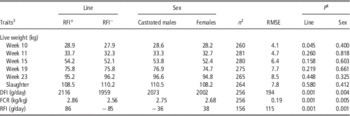
Line differences for traits recorded during growth (Table 1) showed that pigs had similar BW independently from the line, and that low RFI pigs ate less (P<0.001) and had better feed efficiency (P<0.001 for RFI and FCR) than high RFI pigs.
Growth and feed intake performanceFootnote 1 according to line and sex

RMSE=root mean square standard errors; RFI=residual feed intake; DFI=daily feed intake; FCR=feed conversion ratio; ADG=average daily gain.
1 Values are least square means, RMSE and significance levels (P) from linear models including the batch (six levels), line (two levels) and sex (two levels) as fixed effects and their interactions. Live weight at beginning of the test was also included as covariate in models for ADG, DFI, FCR and RFI.
2 Number of data.
3 Traits in reference to the ontology ATOL: http://www.atol-ontology.com/index.php/en/
4 Non-ignificant interactions between factors.
Behaviour analysis
The analysis of the time budget shows that for >80% of the time pigs were in resting behaviour, both in diurnal and nocturnal periods. The active periods were mainly dedicated to the feeding activity and investigation of penmates and pen furniture, with limited agonistic interactions (<1%) (Table 2). Significant differences in time dedicated to each activity were observed both in diurnal and nocturnal periods (P<0.001). The sex effect was not significant on any posture. Time spent in standing posture was significantly lower in RFI− pigs compared with RFI+ pigs (Table 3, 9.6% v. 12.1%, P<0.05), resulting in an estimated line difference of 35 min/day. The energy cost related to this physical activity was estimated to be 269 kJ/day (Table 3, P<0.001). The extrapolated BW on the day of video recording did not differ significantly between lines (68.3 v. 66.6 kg for RFI+ and RFI− lines, respectively). With a feed containing 13 MJ/kg metabolizable energy (ME), the difference in physical activity was equivalent to about 20 g of feed/day, that is, 14% of the difference in DFI (151 g/day or 1963 kJ/day ME) between the RFI− and RFI+ pigs.
Budget time (%) during the diurnal and nocturnal periods in growing–finishing pigs at 17 weeks of ageFootnote 1

1 Distribution of the behavioural activities during the nycthemeral cycles expressed in percentage of total scans; data set on four experimental batches (192 pigs).
2 Definition of behavioural traits reported in the Supplementary Table S1, in reference to the ontology ATOL: http://www.atol-ontology.com/index.php/en/
3 Diurnal, from 0800 to 2000 h; Nocturnal, from 0800 to 2000 h.
4 For each nycthemeral period, P-value of a Pearson’s χ 2 test with 8 d.f. on the distribution of activities.
Energy cost in pigs selected for low (RFI−) or a high (RFI+) residual feed intake, in relation with the physical activity of growing pigs determined by video recordings during 24 h at 17 weeks of ageFootnote 1

RFI=residual feed intake; RMSE=root mean square standard errors; ME=metabolizable energy.
1 Values are least square means, RMSE and significance levels (P) from linear models including the batch (four levels), line (two levels) and sex (two levels) as fixed effects, and interactions and live weight at beginning of test as covariate; 192 pigs.
2 Non-significant interactions between fixed factors.
3 The standing activity was determined by video recording using 5-min scan sampling, analysis carried out on the transformed value in arcsine root of the trait. Least square means were back transformed to percentages, thus not adding up exactly between line and sex effects.
4 The energy cost of standing activity (kJ/day) was calculated from the formula: 0.10×BW (kg)×standing time (min) on the video recording day (Noblet et al., Reference Noblet, Shi and Dubois1993; Le Goff et al., Reference Le Goff, Dubois, Van Milgen and Noblet2002). The percentage of time dedicated to standing activity was converted in standing time in minutes as a proportion of minutes in a 24-h period.
5 For a test period covering 2 weeks before and 2 weeks after the video recording (77±8 kg BW).
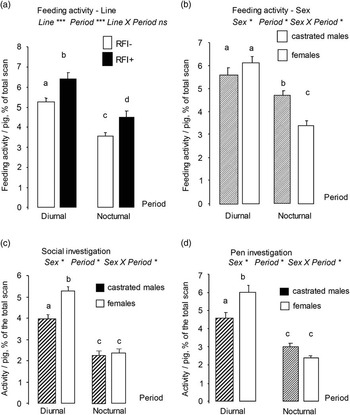
The feeding activity was affected significantly by the line, sex and nycthemeral period (Figure 1a and b). A lower activity was exhibited by RFI− pigs compared with RFI+ pigs during the diurnal (5.3% v. 6.4% of total scans, P<0.001) and nocturnal periods (3.6% v. 4.5% of total scans, P<0.001), and by castrated males compared with females only during the nocturnal period (P<0.001). Investigative activity towards penmates tended to be affected by the line (3.2% v. 3.5% of total scans in RFI− and RFI+ pigs, respectively, P=0.08), and it was higher in females than in castrated males during the diurnal period only (Figure 1c, P<0.001). Similarly, the investigative activity towards the pen furniture was not affected by the line (3.5% and 3.8% of total scans in RFI− and RFI+ pigs, respectively, P=0.12), and a significant interaction between the sex and nycthemeral period (Figure 1d) resulted in females exhibiting higher activity towards pen furniture compared with castrated males during the diurnal period (P<0.001) only.
Effects of line (high RFI: RFI+, low RFI: RFI−) and sex on feeding activity (a and b), and effect of sex on social (c) and pen (d) investigative activity during the diurnal and nocturnal periods of the nycthemeron, determined by video recordings during 24 h in growing pigs at 17 weeks of age. Different letters (a, b, c) indicate a significant difference between means at P<0.05. Values are least square means±s.e. from linear models including sex, line and period as fixed effects, together with their two-way interactions. The line effect was not significant for social and pen investigative activity. Significance level *P<0.05; ***P<0.001.

Motivation test
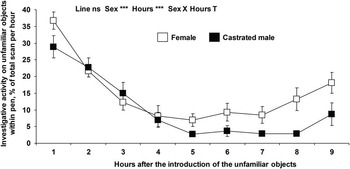
The interest towards the unfamiliar objects showed a significant time effect (P<0.001, Figure 2) with no line effect. Pigs were highly interested when the objects were introduced and the interest declined after the 3rd hour. Females exhibited significantly higher investigative activity on the unfamiliar objects (14.9% v. 10.7% of total scans in castrated males, P<0.001), with a significant increase of interest in unfamiliar objects during the last 2 h only in females (P<0.10 for the interaction sex×hours).
Effects of sex and hours after introduction of two unfamiliar objects in the pen on the investigative activity performed on the objects by the experimental group at 18 weeks of age during 9 h in the pen (motivation test) analysed for video records. Values in percentage of total scan on the pen basis (are least square mean±s.e., from linear mixed model including the batch, line, sex and time as fixed effects, the two-way interactions and repeated pen as random effect. Significance level: ***P<0.01, T P>0.10; no significant effect of line.

Health parameters
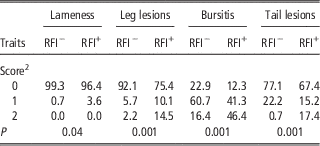
The score distribution of all health parameters differed significantly between the lines (Table 4). With regard to lameness (P=0.04 for the line effect), the majority of pigs showed normal gait, especially in the RFI− line, the frequency of score one was higher in the RFI+ line compared with the RFI−, and no score two was observed. For leg lesions (P=0.001 for the line effect), the number of pigs with no leg lesions was also high in both lines, but 25% of RFI+ pigs had lesions of scores one or two, whereas <8% of RFI− pigs had such scores. Bursitis showed a significant line effect (P=0.001), with a high frequency of RFI− pigs with no or small bursitis, whereas the RFI+ pigs were mainly and equally distributed in the scores 1 and 2. Similarly, the RFI+ pigs were more affected by tail biting (P=0.001), with higher severe damage on the tail.
Effect of line on health criteria measured at 17 weeks of ageFootnote 1
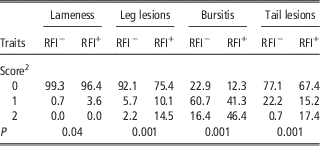
1 For each trait and within line: percentage of pigs in each score level. χ 2 test with 2 d.f. on the distribution of scores between lines within criteria; 192 pigs.
2 Traits in reference to the ontology ATOL: http://www.atol-ontology.com/index.php/en/; score 0: no or small default; score 1: medium default; score 2: major default.
Feeding patterns from the feeder records
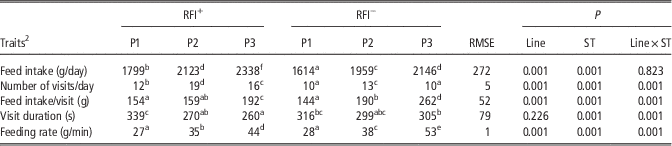
The analysis of the individual daily feeding patterns (Table 5) showed an increase over the growing–finishing period for DFI, feed intake per visit and feeding rate. Independent of the growing stage, DFI was affected by line and sex, RFI+ pigs and castrated males exhibiting significantly higher values than RFI− and females, respectively. The feeding patterns differed between RFI lines, with a lower number of visits (P<0.001) but a higher feed intake and ingestion rate per visit (P<0.001) in RFI− pigs. Parameters related to the visit differed more between lines and growing stages in the later test period (Table 5). The daily duration of visits was significantly affected by the growing stage. The line differences for the daily duration of visits and feeding rate increased significantly with stages.
Individual daily feeding patterns according to the line and the growth stage (ST)Footnote 1
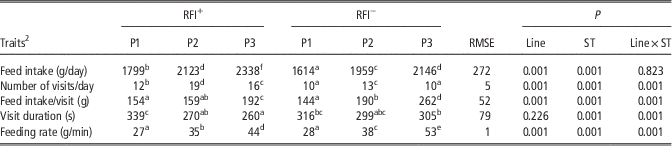
RFI=residual feed intake; RMSE=root mean square standard errors.
1 For each stage, the test period comprised 3 to 4 weeks surrounding the week 12, 17 and 22, corresponding to average live weights: P1=54±7 kg (280 pigs); P2=77±8 kg (275 pigs); P3=96±9 kg (265 pigs). Values are least square means, RMSE and P-values from linear mixed models including the batch, line, sex and growth stage (ST) as fixed effects, interactions between these factors and the animal as repeated random effect. The sex effect was only significant for feed intake (P<0.001). Values within a row with different superscripts differ significantly at P<0.05.
2 Traits in reference to the ontology ATOL: http://www.atol-ontology.com/index.php/en/
The combined analysis of feeding activity evaluated from the SEF and the video recordings showed significant correlations between the percentage of feeding time (video) and the daily feed consumption (R=0.34, P<0.001), the total feeding time (R=0.59, P<0.001) and the total number of visits (R=0.45, P<0.001).
Discussion
Our results confirm the lower feed intake and activity energy expenditure in the low RFI line as shown by Gilbert et al. (Reference Gilbert, Bidanel, Gruand, Caritez, Billon, Guillouet, Lagant, Noblet and Sellier2007, Reference Gilbert, Alaïn, Bidanel, Lagant, Billon, Guillouet, Noblet and Sellier2009) and Barea et al. (Reference Barea, Dubois, Gilbert, Sellier, van Milgen and Noblet2010), and relate these to behavioural line differences. These differences could not be related to increased leg lesions or lameness in the low RFI line: RFI− pigs were less affected by health problems. Our hypothesis was that significantly higher leg lesions could impair the feeding behaviour of pigs, owing to difficulties to move to and/or stay within the feeder, with negative consequences on the feed intake and the energy expenditure. Only limited health problems were detected on the legs or body in our study, although the flooring conditions, that is, slatted floor, represent a risk factor on the prevalence of lameness or leg lesions. Thus, among the different origins of locomotor problems previously reported, such as genetics (Yazdi et al., Reference Yazdi, Lundeheim, Rydhmer, Ringmar-Cederberg and Johansson2000), body conformation (Kirk et al., Reference Kirk, Jorgensen and Jensen2008), nutrition (Bryant et al., Reference Bryant, Kornegay, Knight, Webb and Notter1985), floor condition (Lyons et al., Reference Lyons, Bruce, Fowler and English1995) and exercise level (Marchant and Broom, Reference Marchant and Broom1996), increased physical contact with a rough floor is a cause of leg lesions. In our study, and contrary to the study by Sadler et al. (Reference Sadler, Johnson, Lonergan, Nettleton and Dekkers2011), the high RFI line had a higher physical activity, which could be related to some extent to the higher number of lesions. It is also interesting that the more lame pigs (RFI+) in general stood more (RFI+, relative to RFI−). The relationships between lameness and standing depend also on the degree of exercise when animal are standing. Enforced exercise in growing boars has been shown to decrease the degree and delay the onset of leg weakness (Perrin and Bowland, Reference Perrin and Bowland1977). The effects of exercise in gestating gilts compared with stall housed sows were also shown to improve bone density and quality of articular cartilage, but without benefit on lameness (Schenck et al., Reference Schenck, McMunn, Rosenstein, Stroshine, Nielsen, Richert, Marchant-Forde and Lay2008). The amount of exercise needed to improve the condition of the musculo-skeletal system remains to be assessed in pigs. Leg disorders, including lameness injuries or bursae, cause pain and depress body condition, therefore, early detection of such troubles is important to provide early treatment to pigs and to improve animal welfare and productivity (Flower et al., Reference Flower, Sanderson and Weary2005).
The prevalence of high scores for tail lesions in high RFI pigs may be associated with competition for access to the SEF (Taylor et al., Reference Taylor, Main, Mendl and Edwards2010), with high RFI pigs occupying the feeders more often and for longer durations than low RFI pigs, potentially exposing their tail more to biting while competing to access the SEF. However, no large line difference was evidenced in the investigation activity towards penmates and no major aggressive interaction at the feeder was observed on the video records. Sadler et al. (Reference Sadler, Johnson, Lonergan, Nettleton and Dekkers2011) suggested higher risk of body lesions in the low RFI line, which was partly recorded in our study. Body lesions and/or leg disorders are a major welfare problem because they cause pain and are detrimental to welfare (EFSA, 2007). Further investigations are needed to identify potential general health risk related to RFI selection.
The time-budget analysis indicates that most time was spent in resting behaviour in both lines and sexes, and that active behaviour essentially concerned the feeding and investigative activities, in agreement with time budgets classically reported in literature for pigs (Morrison et al., Reference Morrison, Johnston and Hilbrands2007). The nycthemeral profile of behaviours also showed higher active behaviours during the diurnal period, in accordance with literature on the feeding patterns measured in controlled light and temperature conditions (De Haer and Merks, Reference De Haer and Merks1992; Labroue et al., Reference Labroue, Guéblez, Sellier and Meunier-Salaün1994). Pigs selected for low RFI spent less time standing and had lower physical activity. The energy cost related to the standing posture recorded in the present study highlights a major importance of physical activity in the line difference for energy expenditure. This result is consistent with the previously reported lower heat production associated with decreased physical activity in low RFI animals, in laying hens (Luiting et al., Reference Luiting, Schrama, Vanderhel and Urff1991), beef cattle (Herd et al., Reference Herd, Oddy and Richardson2004) and pigs (De Haer et al., Reference De Haer, Luiting and Aarts1993; Barea et al., Reference Barea, Dubois, Gilbert, Sellier, van Milgen and Noblet2010; Sadler et al., Reference Sadler, Johnson, Lonergan, Nettleton and Dekkers2011). Moreover, Lepron et al. (Reference Lepron, Bergeron, Robert, Faucitano, Bernier and Pomar2007) reported that the postures and other behaviours partly explained residual ME intake in three pig lines. The lower physical activity in the RFI− line in the present study was mainly related to its lower feeding activity, and a tendency for lower investigation of penmates. Assuming that the energy cost per unit of standing time and per kg BW did not differ between genetic lines and sexes, the difference in standing time explained 14% of the line difference in ME intake. Barea et al. (Reference Barea, Dubois, Gilbert, Sellier, van Milgen and Noblet2010) reported in the same lines, from an earlier generation of selection housed in metabolic crates, a proportion of 17% of the variation in ME intake related to a line difference in heat production due to physical activity. They also reported that about 40% of the difference of ME intake between lines (189 kJ/day per kg BW0.60) was due to differences in energy used for basal metabolism (fasting heat production, 75 kJ/day per kg BW0.60), pigs having equal BW in both lines. Part of these line differences in basal metabolism could be explained by the line differences in energy and protein metabolism reported by Faure et al. (Reference Faure, Lefaucheur, Bonhomme, Ecolan, Meteau, Coustard, Kouba, Gilbert and Lebret2013). On the other hand, Barea et al. (Reference Barea, Dubois, Gilbert, Sellier, van Milgen and Noblet2010) did not report any line difference for digestibility or thermic effect of feeding, which is different from recent observations in pigs divergently selected for RFI in Iowa (Harris et al., Reference Harris, Patience, Lonergan, Dekkers and Gabler2012). Among the 45% of the line difference in ME utilization remaining unexplained, some could be related to the differences in metabolism already mentioned (Faure et al., Reference Faure, Lefaucheur, Bonhomme, Ecolan, Meteau, Coustard, Kouba, Gilbert and Lebret2013). However, no detailed picture of the line differences for energy use is yet available.
Several studies comparing breeds or groups of pigs with contrasted RFI have found correlations between RFI and feeding patterns, such as DFI, feeder occupation time per day or daily number of visits to the feeder (De Haer et al., Reference De Haer, Luiting and Aarts1993; Rauw et al., Reference Rauw, Soler, Tibau, Reixach and Gomez Raya2006). Our results also suggest that low RFI is associated with shorter daily eating time and lower number of meals, in agreement with a larger study on these RFI lines at earlier stages of selection (Gilbert et al., Reference Gilbert, Alaïn, Bidanel, Lagant, Billon, Guillouet, Noblet and Sellier2009). In purebred Yorkshire pigs, Young et al. (Reference Young, Cai and Dekkers2011) reported no significant difference in feeding patterns between a low RFI line compared with a control line after five generations of selection, but a trend for low RFI to visit the SEF fewer times and to spend less time eating per visit. In our study, the line difference on feed intake and visit duration was larger at the end of the growing period, as given in the study by Gilbert et al. (Reference Gilbert, Alaïn, Bidanel, Lagant, Billon, Guillouet, Noblet and Sellier2009). In that study, the RFI+ line was also characterized by a greater number of meals of shorter duration and size, which can be related to the line differences observed at the visit level in our study. As animals were penned by line and sex in this study, the effects of line and sex could certainly be different if the composition of the pens were modified, for example, mixing line origins or sexes.
The frequency of posture or specific activities was quantified by scan sampling on one-day video records, whereas the feeding patterns were recorded continuously by a SEF during 4 weeks. Despite major methodological differences, relatively high correlations were estimated between feeding behaviour parameters estimated with the two methods. Thus, a detailed screening of the feeding activity by video recordings can give a good representation of individual feeding patterns. With such data, assessing the relationships between the feeding patterns and the physical activity in the pig’s conventional environment, especially in social groups, is possible. To go further, automated records of the physical activity in group-penned animals could be obtained using data loggers attached to pig’s leg with no major restriction of animal’s movements, as proposed in dairy cows (Müller and Schrader, Reference Müller and Schrader2003; Pastell et al., Reference Pastell, Tiusanen, Hakojärvi and Hänninen2009). However, investigations are needed to evaluate a robust and low cost design in pigs to circumvent their high motivation for exploration (Studnitz et al., Reference Studnitz, Jensen and Pedersen2007).
The feeding and investigative behaviours were affected by the sex, castrated males being more involved in feeding activities than females. The sex effect on feeding behaviour has been reported previously, showing a higher feed intake in the castrated males whereas the feeding pattern is not usually affected by the pig gender (Augspurger et al., Reference Augspurger, Ellis, Hamilton, Wolter, Beverly and Wilson2002). In the present study, castrated males consumed more feed and used the SEF more during the nocturnal period. Females were more involved in the investigative behaviour in agreement with literature. Indeed, Delumeau and Meunier-Salaün (Reference Delumeau and Meunier-Salaün1995) have described a gender effect in young pigs, with females more involved in exploration and social behaviour, and Zonderland et al. (Reference Zonderland, Bracke, den Hartog, Kemp and Spoolder2010) pointed out higher biting activity in growing–finishing females. This higher motivation was confirmed by a significantly higher interest towards unfamiliar objects in the motivation test carried out in the present study. This result may reflect a stronger response of females compared with castrated males to an impoverished environment (Meunier-Salaün et al., Reference Meunier-Salaün, Dourmad and Lebret2006).
In conclusion, the lower physical activity of low RFI pigs described in individually penned pigs is confirmed in group-housed pigs. The differences in physical activity contribute to about 14% of the line difference in feed intake. Although no major health problem was detected in the present study, the low RFI line seems to be less affected by locomotor problems and tail damage, possibly related to their lower activity level. Further, assessment on this risk should be carried out to specify the potential relationships between the RFI selection and detrimental aspects of welfare.
Acknowledgements
The study was funded by the French National Research Agency (ANR, ANR-08-GENM038 PIG_FEED project). The authors thank F. Guiraud, S. Moreau, A. Priet and T. Terrasson for their skilful technical assistance and helpful collaboration, and Etienne Labussière for his critical evaluation of the manuscript.