1 Introduction
The overall aim of this article is to achieve a more detailed understanding of electronic dictionary use by language learners. By electronic or online dictionary, we mean a dictionary that is available online via a browser on a desktop, laptop, tablet or mobile platform. Firstly, our interest is in the scale of dictionary use relative to other CALL-related technologies; anecdotal evidence suggests that students choose to access and use their dictionaries on a very regular basis. Secondly, we are aiming to identify what students perceive as the benefits of dictionary use. In describing these learning benefits, the terms usability and functionality are employed because these constructs are helpful for introducing the topic and describing the qualitative data. We are especially interested in comparing in-class use with out-of-class use. Our intention here is not to track individual learners in their dictionary use, as in analysing look-up behavior, through eye-tracking for example (e.g. Hamel, Reference Hamel2012; Tono, Reference Tono2011). While such studies are valuable, our own goal is rather different. We wish to identify and assess broader trends in CALL technology use in settings where the students are free to act independently. Thus, we wish to understand more fully the types, modes and occasions of dictionary use across a large cohort of language learners.
The evolution in recent years from the hardcopy dictionary to the electronic version has led to many changes and refinements (Dziemianko, Reference Dziemianko2012a; Granger & Paquot, Reference Granger and Paquot2012; Humblé, Reference Humblé2001; Loucky, Reference Loucky2010). In many instances, the traditional dictionary has been combined with such resources as conjugation and translation tools thus converging into a new kind of entity, one that may contain much more information but at the same time, conversely, be more difficult to navigate or read because of poorly-conceived links or advertising (see Dziemianko, Reference Dziemianko2012b).
Dziemianko (Reference Dziemianko2012a) provides a useful overview concerning the “typical” features of the modern electronic dictionary. High search speeds are an obvious advantage. Electronic dictionaries can be more “flexible and dynamic”, “offer a layered, hierarchical inner access structure”, and “provide direct access to a specific definition followed by examples” (Dziemianko, Reference Dziemianko2012a: 321). Dziemianko also makes some thought-provoking observations on the relative merits of paper versus electronic dictionaries, such as the status of the paper dictionary compared to the electronic, the pros and cons of having access to so much information in the electronic format, and differences in the ways headword entries are organized and structured. Clearly there have been numerous developments in dictionary design during the last three decades and our traditional understanding of what a “dictionary” might be requires reappraisal. These changes in design and presentation have been matched by evolving user expectations and word look-up practices. Importantly, “[t]he electronic medium was usually found to stimulate more frequent dictionary consultation, in particular when hand-held dictionaries were used” (Dziemianko, Reference Dziemianko2012a: 329).
2 Language dictionaries: Perspectives on use and design
Granger (Reference Granger2012a: 343) states that “many of the material issues in dictionary design are relatively form-independent”. This is a perceptive observation. While the “interface” may appear very different in electronic form, especially in terms of imagery and screen layout, the fundamental material content beneath may not have changed very much. For example, in many cases partial sentence definitions of headwords have simply carried over from hard copy to electronic. Of course, users have always wanted fast and easy access to the information they require, and there still remains a basic cost/benefit equation working around dictionary use: once located, is the information provided worth the time and effort taken to find it? Such has always been the case, and remains so today in the electronic format.
2.1 Usability
The dictionary user’s perspective is considered here primarily through the notion of usability. Hamel’s definition is relevant and applicable (Hamel, Reference Hamel2012; see also Hamel & Caws, Reference Hamel and Caws2010). Hamel (Reference Hamel2012: 341), following Nogier, Reference Nogier2008, states, “‘Usability’ is a term used in web interface design which refers to the “capacity of an object to be easily used by a given person to perform a task for which it has been designed” (Hamel’s translation). In the context of this study regarding user perceptions, usability focuses attention directly onto the experience of using an electronic dictionary, for example the ease with which a particular headword and its definition might be found.
For users, quick and easy access to dictionary “articles” (i.e. the name given to the complete dictionary entry for one headword) has always been “high on their list of priorities” (Nielsen, Reference Nielsen2008: 177). Users need to be able to find the item they want easily, and then, once found, they want an explanation or examples that are readily comprehensible and suited to their needs.
In a perceptive discussion, Nielsen argues that there is a cost associated with dictionary use of which dictionary designers need to be keenly aware. Described as lexicographical information costs (LIC), Nielsen (Reference Nielsen2008: 170) breaks them down into two essential components, search related costs (effort to look up and find the word), and comprehension related costs (effort to process data found to extract its meaning). The aim should be to minimise these costs as far as possible through effective design (Nielsen, Reference Nielsen2008: 175).
Search-related costs concern the time and effort the user expends to find what they want. Intuitively, it is in this area that one would imagine that electronic dictionaries would provide a distinct advantage. For the user, a speedy electronic word search returning a pop-up window with a definition and an example is surely faster than wading through the pages of a large and dense paper dictionary, wrestling with alphabetical order, to find the required word. One would think quick and easy access would be the advantage above all. However, speed alone is not the only consideration.
Nielsen (Reference Nielsen2008: 177) also notes that “standardised article structures” also make searches easier, an aspect of functionality that relates directly to usability. Users appreciate regular patterns of engagement with the text and this is encouraged through precise and, oftentimes, special use of particular font variants, for example bold for the headword, a smaller font for the definition, and italics for the examples etc. Familiarity and routine are important in design, and of course this principle applies for all dictionaries, be they electronic or hard copy.
Comprehension-related costs concern the effort to process data once found to extract its meaning. Clearly, there is overlap with search-related costs as in the importance of recognisable zones of information, within a dictionary “article” for example, to ease comprehension. Textual condensation may increase information costs as when a tilde (~) is used “to replace the lemma inside the article text, usually in collocations and phrases” (Nielsen, Reference Nielsen2008: 181). While such abbreviated forms shorten the text and may allow more words to go into a dictionary, especially one printed on paper, the device also interrupts readabilility, and for non-native speakers likely increases comprehension-related costs.
The search for the meaning of a word does not end with the location of the headword and its definition (unless an infrequent word with a single definition). For example, users do a considerable amount of work at the site of the article trying to identify the meaning or sense required, especially with high frequency words with many meanings. An illuminating article by Tono (Reference Tono2011) using eye-tracking indicates just how much work users complete in tracking down the particular meaning of a word and separating it out from a number of alternatives when a single word has many meanings (e.g. the example with “make”, Tono, Reference Tono2011: 144–145).
Nielsen concludes that we need to “take a closer look at the functions of dictionaries and the needs of users” (2008: 179). From the users’ perspective, in essence the situation is very straightforward: if the costs are too great, and outweigh the benefits, the dictionary will not be used. Critically, the decision will often be made in an instant.
2.2 Functionality
Now we turn to the dictionary maker’s perspective where the functionality inherent in the design of a dictionary comes into the foreground. For our purposes we draw upon two general definitions of functionality that complement one another: “the particular use or set of uses for which something is designed” (Merriam-Webster); “the purpose that something is designed or expected to fulfill” (The Oxford Dictionary). Thus, functionality implies intentional actions and decisions on the part of the designers, or, in our case here, the dictionary makers. The functionality of a product might also be referred to as the planned affordances (see McGrenere & Ho, Reference McGrenere and Ho2000).
Functionality is important for the present discussion because it directs attention to the ways in which the users’ perspective can aid and inform the designer, as well as providing important information on use per se. Sometimes there is a disjuncture between the actual resources available and how they are accessed (as intended by the designer), and user perceptions of the same. For instance, a particular functionality may be available, but the user is not aware of it, or does not know how to use it. Thus user perceptions of functionality can turn out to be very useful for designers, especially when planning upgrades or refinements, or even tutorials, training and help.
It is useful to include a brief example, that of the Cobuild dictionary. “Cobuild” stands for Collins Birmingham University International Language Dictionary. The authors of this dictionary described the initial process of creation through an “insider” account, Looking up: an account of the Cobuild Project in lexical computing (Sinclair, Reference Sinclair1987a). This dictionary is available in hard copy and electronic formats.
In his introduction to the book, John Sinclair reduces the central problem of dictionary design to “what to say and how to say it” (1987b: viii). In terms of content (the “what”), the emphasis is placed upon describing the very common words of the language. The importance of collocation was stressed and evidence of this priority comes through in the headwords selected and the dictionary examples (Krishnamurthy, Reference Krishnamurthy1987: 70). In the chapter on corpus development, Renouf (Reference Renouf1987) discusses the balance between components in the corpus: writing – 75%, speech – 25%. Increasingly, it has become easier to “capture” speech directly through voice recorders, or through using specialized software that is capable of translating text to speech automatically, so the potential now to focus corpus content on the spoken language rather than the written has become much more viable.
In terms of presentation (the “how”), the Cobuild designers introduced new strategies and approaches to dictionary design and many still have modern relevance. These approaches adhered to a major guiding principle, “Whenever possible, the dictionary would be written in clear, simple and ordinary English” (Sinclair, Reference Sinclair1987c: 111). For example, in defining a brick “A brick is…” was used rather than the more traditional-looking definition, “…a rectangular block used for building walls etc…”. As Hanks (Reference Hanks1987) notes, “The presence of absence of the indefinite article is crucial, and is of course a common source of learner error” (117). Such issues are important.
The choices dictionary makers make remain central in all language dictionary design. In a large-scale survey on dictionary use, Granger (Reference Granger2012b: 445, 448) found that reliability of content, clarity and up-to-date content respectively were the top three ranked items for a good online dictionary [authors’ italics]. Electronic dictionaries provide a whole new range of opportunities for additional content including new search options, spoken text in addition to written, discussion forums, more authentic examples and collocations, and so on, but the basic principles invoked in reflecting upon “what to say and how to say it” still apply.
The dictionary user may or may not recognise the range of content available in any given dictionary and the options available or, perhaps, the subtleties of the maker’s decision-making processes. Yet the users’ perceptions of a dictionary, “what is in there” and “how it works”, remain very important. Unlike paper-based dictionaries, with electronic dictionaries it is not always easy to “see” what is there, that is, what resources are available, and then how exactly they might be accessed and used effectively. Thus, this study aims to shed more light on learner perceptions of electronic dictionaries, in terms of both functionality and usability.
Two frequently mentioned examples of contemporary web-based dictionaries in the survey were WordReference.com and nciku.com. It is now appropriate that we briefly describe these two dictionaries as exemplars to give the reader a sense of their content, functionality and structure.
2.3 WordReference.com
First established in 1999, WordReference.com has grown into one of the most frequently used online dictionaries. It offers language pairs for English-Spanish, English-French, English-Italian, Spanish-French and Spanish-Portuguese, among many others. The website WordReference is a free online translation dictionary with verb conjugators and language forums. The language forums, which are publicly available, offer a searchable, online moderated space where registered users can discuss the meanings and translations of words, terms and expressions in a variety of languages. According to the creator, Michael Kellogg, he was the first to implement the features of “being able to click any word as a dictionary entry” and discussion forums in online dictionaries. Over time, a number of new tools and features have been added such as games, browser plug-ins (Firefox and Google) and a toolbar (Internet Explorer) for easier internet browsing and mobile adapted versions (applications) of the tool.
The free WordReference mobile application is available for download in cross-platform mobile formats (Android, Apple, Windows). As the dictionaries are highly comprehensive they are not downloaded themselves and thus require internet connectivity. Mobile app features include access to multiple dictionaries, audio word forms, conjugators for some languages, a history of recent searches, lists of compound forms and access to the language discussion forums. Both the online and mobile app based forms include constant advertising on-screen.
2.4 nciku
Another online dictionary with a mobile app version is nciku.com for Chinese language learners. Launched in April 2007, nciku claims to be “more than a dictionary” as it provides Chinese language learners with a variety of visual, tactile, audial, cognitive, and social ways of learning. For example, there are animations showing stroke order of characters as well as a place where students can practise writing characters. Conversations can be heard as well as read in the written form and in context. Short videos demonstrate words used in context and users can pose questions to community members, who are encouraged to reply. The site also offers games, activities, vocabulary lists, tools and a social space for community interaction that is linked to better known social networking sites like Facebook and Twitter. A toolbar is also available for some browsers (Internet Explorer, Google and Firefox) and can be used as a handwriting tool for Chinese characters as well as for text to speech. For instant messaging language conversation partners, nciku offers MSN Robot and QQ international (built in). Most features of the site can be personalised to remember user preferences, vocabulary items and interactions.
Online browser-based versions of websites that have been adapted for mobile environments are often more limited (at least at the time of writing this paper) as they are “lightweight” versions. That means that they focus on presenting what the designers understand to be the most essential content in a rationalised and simplified format. For example, nciku’s mobile format does not support the more advanced features such as handwriting recognition, user vocabulary lists and audio pronunciation. You generally need to be connected to the internet although an offline version is available for download for nciku for some phone types. However, the lack of an offline version, text size, responsiveness and the increasing abundance of advertisements can pose constraints for users.
3 Method
Undergraduate foreign language students enrolled at the University of Queensland were surveyed about their technology use as language learners in mid-2011. At the time of the survey, all students were studying a formal language course provided by the university in a blended mode. This article draws on data collected on foreign language students’ reported use of technologies to support their language learning (inside class, outside class, or both). Further to this, students ranked the top three technologies they perceived as being most beneficial to their language learning. An email invitation to participate in the study was sent to 2,114 students with a unique link to an online survey. Overall, 590 language students completed the online survey with three respondents being eliminated, on the basis of being postgraduate students. The remaining 587 students represented a response rate of 28%.
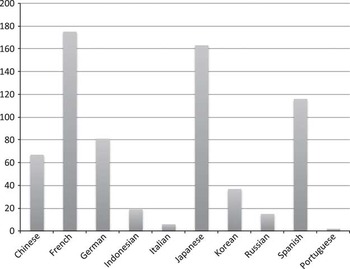
The languages studied by students were Chinese, French, German, Indonesian, Italian, Japanese, Korean, Russian, Spanish and Portuguese (see Figure 1) with some students studying more than one language. Most students were 17 to 21 years old (76%, n=447). Domestic students made up the majority of the sample (85%, n=499) with only 88 (15%) international students completing the survey. The majority of students were in the first or second year of study (n=222, 37.8% and n=199, 33.9% respectively).
Languages studied across the sample

3.1 Instrument and analysis
In the survey, foreign language students were asked to indicate the technologies they used to support their language studies in-class, out-of-class or both. A list of 20 technologies was offered along with an option for “Other, please state”. This list was generated earlier in 2011 from a group of 35 undergraduate foreign language students who were representative of the sample. Participants were then asked to rank the three technologies they believed were most beneficial to their out-of-class language studies and explain why they believed these were beneficial to their learning. Students reported their perceived benefits in open text areas as comments.
Quantitative data on the reported use of the 587 students who responded to the survey was analysed descriptively. While descriptive statistics provide a simple interpretation of the data, it fulfills our goal for this article – that is to give readers a strong sense of online dictionary use overall, within and beyond the classroom. The analysis also illustrates the extent to which our language students perceive online dictionaries as being of benefit to their language learning. Participants’ free text comments were analysed using an inductive, qualitative approach following Miles and Huberman (Reference Miles and Huberman1994).
Analysis of the quantitative data clearly showed online dictionaries as the technology that our students reported as using most frequently and perceiving as most beneficial. However, multiple readings of the qualitative comments on online dictionaries (305 comments) and other technologies showed that online dictionaries were referred to frequently in four of our other nominated technology categories (see Table 2). Further readings and discussion, as well as exploration of some of the specific technologies that students were mentioning (e.g. nciku) led the authors to conclude that the aforesaid “categories” we had nominated were porous. For example, students commented on discussion forums or web translators when referring to online dictionaries and vice versa. These overlaps suggested that students’ understanding of the functionalities of a technology-enhanced dictionary and their perspectives on the usability of language dictionaries may be changing and thus warranted closer analysis. Consequently, qualitative data from our categories of web-based translation, mobile apps, conjugation sites and discussion forums were added into the data set if they mentioned the words “dictionary” or a specific dictionary such as WordReference or nciku.
Using this data set of now 404 comments, the authors coded the data independently and then compared findings. Two major categories emerged around online dictionary functionality and usability from learner perspectives. That is, learners usually described the benefits of electronic dictionaries by mentioning their functionality, usability or both. Further independent analysis and cross-checking enabled data reduction and common sub-categories began to emerge. These findings are discussed in subsequent sections of this article.
4 Findings
This section of the article presents the findings of the study. In the main, the quantitative results are presented first before the qualitative, although some simple numerical data is included when pertinent to the discussion in later sub-sections that are principally qualitative.
4.1 Quantitative findings
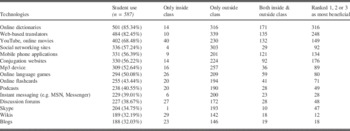
A descriptive statistical analysis of the survey data on students’ reported use of technologies for learning languages is presented in Table 1. The table presents the results for technologies reportedly used by over 30% of the sample. Technologies reportedly used by less than 30% of students are excluded in this article as they are not relevant to the present discussion. The column “Student Use” provides totals of the number of students who claimed they used each technology while the bracketed percentage is in relation to the total sample of 587 students. For example, 501 or 85.34% of the sample reported using online dictionaries. The next three columns show the total number of students who reported using each technology “only inside class” or “only outside class” or “both inside and outside class”. So for online dictionaries, a total of 316 students used them only outside class whilst a further 171 reported using them both inside and outside class. Only fourteen students used online dictionaries exclusively inside their classrooms. The next column gives the total number of students who ranked the technology as one of their three most beneficial technologies. In the case of online dictionaries, 316 students ranked this technology as one of their three most beneficial.
Students’ use of technologies and rankings of perceived benefit (n=587)

The aggregated data in Table 1 illustrates the range and diversity of technologies in use by our language students. Arguably, the Table indicates – by its absence – the relative value of technologies that are centrally provisioned by universities: Blackboard was in eighteenth position in this list. These technologies are not necessarily those that students are using in their discipline-specific studies, and they do not appear to be perceived as particularly beneficial for language learning. For language learners in particular, students are seeking technological tools that can offer them functionality that is directly relevant to language learning. Language students are drawing upon their own personal technologies that are fit for their purpose. The technologies and tools that language learners now have at their fingertips are powerful, expansive and changing.
In relation to the topic of this article, Table 1 demonstrates the exceedingly high reported use and perceived benefits of online or electronic dictionaries to language students. The next section reports the findings from our qualitative analysis of students’ comments on the beneficial aspects of online dictionaries in relation to their usability and functions as language dictionaries.
Dictionary-type uses and functions were not only referred to and recorded by students directly under the label, “Online Dictionaries”, as in Table 1. As mentioned earlier, they were also referred to via four other categories: “Web-based translators”, “Mobile phone applications”, “Conjugation websites” and “Discussion forums” (see Table 2). Such a finding indicates a fluidity around what the name “dictionary” actually entails, and some variability and ambiguity when trying to link the label with its functions. Thus, for example, a conjugation website or a discussion forum may in some circumstances serve the purpose of a dictionary.
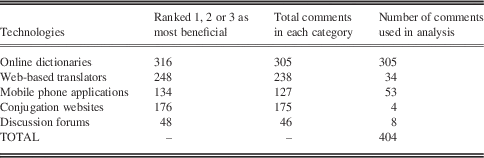
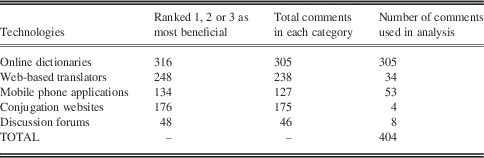
Student rankings, comments and inclusions for analysis
With multifunctional electronic tools with functionalities that cross and distort traditional boundaries and labels, such a result should not be surprising. We found evidence of this in the earlier discussion of WordReference and nciku that highlighted the expanding and evolving range of dictionary-type and dictionary-related functions and tasks that the so-called dictionary might be used to accomplish. In our qualitative data, there were many examples where comments related to dictionary-like functions, for example this quotation in the category, ‘Mobile phone applications’:
I have downloaded an excellent free dictionary for my phone called, ‘Kotoba’; it has many of the same functions as the larger electronic dictionary, and because it’s on my phone I always have it with me. I use it every day.
The number of references to a dictionary through other means is given in Table 2. This table summarises the number of comments ranked 1–3 for each dictionary-connected category (from Table 1), the total comments in each category, and the number of comments that were included in our analysis. It can be seen that dictionary-related comments appeared mostly within comments in the mobile phone and web-based translator categories. Discussion forum comments were included if either the word “dictionary” or “WordReference” were used in the comment.
The interrelationship between function and use was prominent in our qualitative results. Throughout our analysis we noted that many student comments started with a description of a particular function and then elaborated on how the function was experienced from a user perspective. The reverse was also common. Students commented on their experience of using certain functions to achieve tasks and then explained the function in more detail. Keeping this interrelationship between functionality and usability in mind, the results are detailed below.
4.2 Usability
The usability of a technological device or tool was discussed earlier in the literature review section. For any dictionary, be it online or otherwise, look-up time and ease-of-use are both fundamental considerations from a user perspective.
4.2.1 Time, speed and ease-of-use
Time expended remains a critical factor for today’s students as demonstrated by the number of comments related to the speed and ease-of-use of online or mobile app-based dictionaries. For example, 102 of the 305 comments on online dictionaries related to saving time, reducing time or being time efficient. Forty-nine comments specifically mentioned ease of use.
Students expect dictionaries to be quick, easy, accessible and provide immediate results. As one student commented, “I can find out what a word means with the tap of a couple of fingers”. The terms “quick and easy” were collocated frequently in the student data and ease of access was important to students as this meant that students could easily find what they required. Speedier task completion and a sense of immediacy were important as in “I can simply check the meaning of the words immediately”.
Most students regarded online and mobile app-based dictionaries as time efficient and easy to use. This was particularly true for those students learning character-based languages. Students reported that the functionality that enabled users to handwrite simplified or traditional characters on screen as a search input method meant that they “save lots of time and make phone apps far far better than using a traditional Chinese-English dictionary”.
4.2.2 Portability and convenience across time and location
With many students now owning portable devices such as laptops, mobile phones and tablets, language learners are often equipped with portable dictionaries that offer mobility and convenience across time and location. Forty-four students made relevant comments in this category. One student commented that “you have a full dictionary in your pocket at all times”. Such portability and mobility offers learners the convenience of learning whilst on the go, anytime, anyplace, when and where needed.
Apps allows me to easily access dictionary and to provide me with verb conjugations anywhere I am, and whether or not I’m near a computer. It means I can easily do homework or study on the bus, or in a park, without having to worry about taking a computer with me.
According to some students, the immediacy of look-up combined with situational factors may facilitate their language acquisition.
When [I] want to know what a certain word may be for a situation and [I] am out and about [I] can look it up straight away. I find [I] remember it better because [I] can remember the situation as well, so [I] am constantly expanding my vocabulary.
Many students reportedly located high-quality mobile app-based dictionaries that offered a more portable and convenient version of online or paper-based dictionaries: “Electronic versions of comprehensive dictionaries such as PONS or Collins provide so much useful and detailed information at the tap of a few buttons and in one small device that you literally have everywhere you go”.
Across locations, students often considered it convenient to have their dictionaries alongside a range of complementary language learning technologies available via their portable mobile device.
I have an Android phone, and with it many Japanese and French learn apps that I can use while commuting or in class. I have flashcard apps, conjugation apps, translates apps, and dictionary for both languages. It’s convenient and easy to use.
Convenience went hand-in-hand with portability. “I downloaded various dictionary apps for the language that I am learn so I can check and refer to it whenever and wherever I am – It is very convenient”. The portability of dictionaries on their mobile devices was often compared with paper-based dictionaries. For example, “better than carrying around my heavy dictionary” and “it’s much easier to have language dictionary on my phone than to carry around two extra books”.
In combination, the mobility, portability and convenience of being able to use dictionaries on-the-go reduced learners’ efforts to look up and find the words – especially when and where they needed them. Together, these attributes reduced users’ perceived search-related costs and added to a more ubiquitous personal learning environment across place and time.
4.2.3 Understanding and comprehension of vocabulary
From a user perspective, the range of functionality now available in online or mobile app-based dictionaries can contribute toward helping students’ understanding and comprehension of vocabulary, word use and phrasing. Ninety-six students from the dataset made reference to electronic dictionaries in these terms, notably for extending vocabulary, and improving understandings of word choice and appropriate contexts of use.
For example, student comments suggested that the range of functionality now available in language dictionaries helps users go beyond the stated meaning of new vocabulary to a more nuanced understanding of word usage. Gaining such a nuanced understanding of word use and being able to access alternative terms or contemporary colloquial uses of the language is important as language learners advance their knowledge and deepen their understanding and comprehension of specific terminology.
When I am writing or reading a passage and I come across a word or verb I am not sure of, I can quickly search for it on the online dictionary website (my favorite is wordreference.com). This site will then come up with the word or verb and then what it translates into, what the definition is, which contexts it can be used in, synonyms and also how to conjugate it into other forms if need be. This greatly helps my language learning because it gives me everything I need to know instantly and I know it will be correct. Also because I can check what I have read or written with it’s different scenarios of the word or verb to see if my initial idea/thought of the word or verb was correct.
In this way, learners can explore the facets of meaning of a word, that is, they can explore the meaning from a variety of angles to deepen their understanding. With a range of information and resources in the same place, both search and comprehension costs may be reduced. This is also where the designed functionality of tools comes into play.
4.3 Functionality
The designed “functionality” of a technical device or tool concerns its capabilities, as discussed earlier in the literature review. The capability or “affordance” is thus part of the app’s designed functionality.
4.3.1 Content, comprehensiveness and accuracy
In the survey, 77 comments related to this category. Forty-nine comments were positive regarding content and quality, seventeen comments remarked that online electronic dictionaries were comparable to hard copy and six comments that the electronic format was inferior or variable compared to paper-based. Compared to traditional texts whereby one might need to access several specialty books, online and app-based, dictionaries offer an enormous range of content in the same location: “These websites are also very good because it has every single word and verb of the language, whereas some word charts/dictionaries might not have what you are looking for.” Thus the potential for finding specialty language such as technical words, colloquialisms, and slang using a single tool is enhanced.
Online dictionaries can also be easily updated and extended:
Online dictionaries are constantly updated and can contain a lot of slang that otherwise may not be present in book format dictionaries. It is also able to offer alternative words as a definition for a better understanding of the nuance of the word.
The importance of up-to-date content was noted earlier in the large-scale surveys by Granger (Reference Granger2012b: 445, 448) on the qualities regarded most favourably in a good online dictionary.
The content of dictionaries is evolving also in terms of structure and the ways in which it is linked and connected. In the electronic form, more information can be provided about word use, meaning and grammar, while providing more contextual information can contribute to word understanding and use. Some functions can also now be more responsive to language-specific features. For example, those studying character-based languages can access additional information cues available to help the learner.
A lot of online dictionary websites contain the character, the pin yin and the definition in context which really helps me understand the meaning and what the word looks like. There are also lots of other useful tools such as pin yin tools, character search tool and written examples.
Given the large databases of information that contemporary dictionaries draw upon, the search and input functions are critical for helping the user locate the specific information they require.
According to students, these mobile versions were not necessarily as comprehensive as the online versions of dictionaries. Reliability can also be an issue as in the following quotes from learners:
It is useful in translating English words to French. If the dictionary covers a wide enough scope, it is beneficial when trying to find out what a word means. However, it can also be frustrating when you find conflicting meanings or says it can’t translate a word when I could find it in the physical (as opposed to virtual) dictionary. I prefer a physical dictionary to this method unless it is a reliable site with extensive vocab and properly functioning search engine.
The speed of my learning increased tenfold when I got into the habit of taking a dictionary to class and consulting it through study. Now, I constantly use an online dictionary to assist with reading new and complex Chinese texts. The online dictionaries are not necessarily as reliable as my Oxford Chinese Dictionary, but they sometimes have more proper nouns and colloquial terms. Online dictionaries are far more convenient to use, just ask anyone who has struggled with the laborious task of using a Chinese Dictionary.
Such detailed observations demonstrate a level of understanding, awareness and sophistication in the use of new online forms of dictionary. Again note Granger (Reference Granger2012b), who found that reliability of content was the number one feature desired by users in a quality online dictionary. When the online dictionary “fails”, so to speak, often learners revert to the traditional hard copy format.
4.3.2 Search and input functions
There were 99 comments that made reference to electronic dictionaries in terms of their search and/or input capabilities. Like traditional dictionaries, online and mobile-app based dictionaries offer standardised search options for looking up words. However, new functionality allows users to employ a variety of search and input functions to locate information, explore meaning, and different grammatical and contextual aspects of the word-in-use. As such, these functions expand the options for the user to explore different dimensions of words using just one tool.
I own an iPad with a Collins Spanish-English dictionary apps on it. This helps immensely, as you can search for a word and it brings up the English equivalent and then shows every way that word can be used in a sentence (in spanish of course). If you search for a verb it shows you a table with all the conjugations and you can select which tense you need to use it for, then changes the conjugations to that specific tense.
For character-based languages, the functionality for search and input methods have evolved considerably from a user perspective. The range of input options for character-based languages can better help the learner achieve their goals:
I can find words, kanji and sentences using “Denshi Jisho”. Also, if I know only what half of a kanji is, I can find the kanji I am looking for by looking up the radical. It will then give me a complete list of possible kanjis.
These changes in search and input options often prompted students to compare online and mobile app-based dictionaries with traditional dictionaries. From a usability perspective, many students (with a few counter arguments) perceived electronic forms of dictionaries as “better”, “faster”, “easier”, more “flexible” and “comprehensive”. In other words, students believed they were able to get the information they required or explore words or phrases in ways that achieve their goals more efficiently.
4.3.3 Multimodal functionality and complementary tools
In this category, 34 respondents mentioned multimodal input and output functionality, and 111 made note of complementary tools, including the ability to store vocabulary, make flashcards, provide pronunciation, create quizzes and supply recording facilities (excluding translation). The evolving functionality also harnesses the potential of more tactile devices such as iPads and tablets that allow touch-screen interaction. One student said, “The touch screen allows me to draw characters, which is much more practical than going through several rather complicated steps.”
New apps allows users to handwrite simplified or traditional characters on the screen as an input option for dictionary, along with pin yin or English typing. These together save lots of time and make phone apps far far better than using a traditional Chinese-English dictionary.
Incorporating video, audio and other multimodal functionality, while not new in-of-itself, is now co-located with other dictionary tools:
l use a site called nciku. lt has definitions, audio and written examples, stroke order animations, dialogues, word of the day, a forum, vocab lists, blog entries and reading practice. l use it to not only build my vocab, but to deepen my understanding of word use in different contexts & learn collocations & natural usage. The topic-specific vocab lists with audio are great for lifting word knowledge, as are the dialogues. l love it to death.
Sites like nciku provide users with a range of learning tools and their associated functions, which are wrapped around the fundamental “dictionary” functions. According to our students, some of these complementary tools enable them to generate vocabulary lists that act as personalised dictionaries. Further, these vocabulary lists can then be converted into flash cards that help students learn. This kind of functionality supports independent learning strategies, as this student quote illustrates:
I capture all of the new vocab and grammar patterns on my laptop during class, or input them from readings that are completed outside class. I use the “Anki” program to drill vocab and grammar patterns in each target language, each day. The program synchronises my progress via its website so I can use my laptop, my iPhone or any other computer to complete my daily practise, and allows me to cram specific vocabulary for upcoming tests or exams.
This flow of user activity is possible because the functionality is cross-platform and device independent. Being able to track progress means that learners can self-monitor their learning. Motivational functionality like gamification can also help self-monitoring.
I have an apps on my phone which works exactly like an electronic dictionary for Japanese, except better. I can store vocabulary lists on it and it will make an automatic flashcard game to help me memorise new vocabulary.
Students appreciate the expanded multimodal functionalities and the possibilities they offer them as learners. It is now possible to look up a word, explore its meaning, see examples, see it in the context of reading passages and videos, listen to pronunciation, draw characters, add words to their vocabulary list, and then convert their personal dictionaries into a gamified version that tracks progress.
4.3.4 A significant development from page to screen: The advent of dialogue
An important development in online dictionaries is the capacity for two-way communication or dialogue around word use and meaning. Nineteen respondents in the cohort noted this capability. Traditionally, in the printed form, the dictionary has essentially been a one-way communication device from the lexicographer to the user. Now the technology allows two-way communication between the “knower” and the seeker of knowledge and information. Online discussion forums where native speakers and expert users (badged as such) participate in robust discussions on word use and grammar are increasingly available. Nciku and WordReference were commonly cited for their helpful discussion forums and communities. Students reported that accessing these discussions can help them to better understand the nuances of meaning and word usage.
It is often difficult to get a sense of phrasing from online dictionaries, as they are centred on the meaning of a single word. Through discussion forums it’s possible for French students and native speakers to communicate to find the translation of idioms etc that don’t quite work the way you’d expect them to.
In these forums grammatical rules around word use are discussed more fully and available to language learners at different stages of learning:
Being able to discuss with native speakers the rules surrounding specific areas of the language is very helpful, and much more educative than simply using a dictionary.
With many regional and generational differences in word use, as well as differences between what is taught in class and what is used by native speakers, this functionality provides a more global connection with the language under study.
Asking questions about idiomatic aspects of the language, things that would not normally appear in the dictionary. Asking about how to express certain things etc. Being able to see what words are in the common vocabulary in native French people.
For many students, these discussion forums offer independent help that is tailored to their needs. However, the extent to which students actually post their own questions was not clear.
It gives the language in context from natives speakers. It helps to learn sentence construction, vocab, conjugation etc all at once. WordReference forum is the first place I go if I am having trouble. I have never actually posted anything, just look through the other posts and I usually find what I want.
5 Discussion
According to the results of this study, the electronic dictionary tool is now a high use item for language learners. The quantitative results surprised us. The online dictionary headed the list, alongside other “look-up” tools, such as the web conjugator and translator. Mobile applications and online dictionaries were both highly rated. It is also clear through the seepage between the nominated “technology” categories in the survey that our notion of what a dictionary might be in terms of its content and structure has evolved quickly.
Students are now using dictionaries that offer more sophisticated functions that enable the display of grammatical information on word use, the ability to translate whole phrases or passages, verb conjugation, specialised language and the ability to see the language in different forms (such as hiragana, pin yin, characters, etc.). Users can now access a wider range of information about words and phrases, their uses, their distinctive features, forms and applications. Additionally, as content is more extensive and easily updated via comprehensive word databases, specialist language, colloquialism and regional interpretations are easier to access. Opportunities for exploring the nuances of word use are enriched even more by two-way dialogue with native speakers and language “experts” via discussion forums and communities. All of these functions can now be found in a single dictionary tool.
This single dictionary tool has also evolved with more flexible options for search and input, often from one search bar, for example, the ability to search character-based languages via kanji, radicals, pin yin and so forth, and functionality that allows the user to easily input characters as well as romanised versions. These features are further enhanced for the user by touchscreen interfaces and the capability to integrate complementary tools such as video, audio and animated options as well as vocabulary lists, flashcards and gamification. Thus the modern dictionaries or word reference tools are now truly multifunctional.
From a usability perspective, our learners reported other gains. They appreciated faster and easier access to their dictionaries especially via their mobile devices. The portability of these devices meant practical gains. Learners could access dictionaries as most carried a device with them. The devices also gave them choice, as consumers, about the applications they could select for download as suited to their purposes and preferences. The immediacy with which they could answer their own queries was also reported positively. Overall time savings were well received and there are even reported claims that students’ speed of learning was increased. Certainly, students perceived that these newer dictionaries helped their understanding and comprehension. This may be a natural benefit given the range of functionality that now facilitates learners’ exploration of different facets of words and word use in a time efficient way.
In terms of Nielsen’s formula of lexicographical information costs, according to students, the functions now on offer generally reduce search related costs or effort to look up and find words or phrases. Whether they also minimise comprehension related costs (effort to process data found to extract its meaning) needs to be better understood. It may be the case that the nature and variety of information presented does minimise these costs. New language dictionaries offer learner choices that can cater more fully to different learner needs, styles, contexts and language levels.
The extent to which these new dictionaries minimise or even increase comprehension related costs presents a fertile area for future research that needs to go beyond learner perceptions to real evidence of impact on learning, especially as effects relate to learner characteristics such as proficiency level and the task goal and focus. Of course, more dictionary look-ups because of easier or faster access do not automatically result in learning gains. This is a hypothesis that needs to be rigorously tested. There are numerous other factors relating to language acquisition in these new environments that require investigation and which may be pertinent such as interface design, data segmentation (e.g. zoning), formatting and the possible negative interference of advertising. The details of the context of use also need to be explored further to discriminate between instantaneous dictionary use in class, as in when a new word is introduced by the teacher and immediately looked up, for example, and when it is more considered, as in the completion of a homework assignment.
Cohen and White (Reference Cohen and White2008) position language learners as “informed consumers” who need to make informed judgements about their needs, goals and purposes across their learning experiences. They “have a view of language learners who actively construct and fashion a way of learning for themselves based on the alternatives available” (2008: 200). This means having the ability to discriminate between options and then to make informed choices. At the moment, we would argue, this expertise, where it exists, is being accumulated independently by individual learners through trial and error. The statement by Cohen and White also signals an interrelationship between functionality and usability that was clear in our student comments and observations. The changed set of affordances now available has influenced learner behaviours and expectations online and thereby influenced learner perceptions of what may be accomplished through online dictionary tools as opposed to hard copy.
Lastly, there is no doubt in our minds that a degree of systematic training in the use of these new dictionary tools would be advantageous so that new features and best practices can be made more visible and shared. Prichard (Reference Prichard2008: 216) emphasises the importance of learner training in this context. It is clear that language teachers have an important role to play in this respect. We perceive the teachers’ role to be principally one of facilitator to help structure and encourage the sharing of knowledge among student users. For training to commence, language teachers also need to become aware of the developments and be given the appropriate levels of support through professional development.
6 Limitations
The study reported here, with data drawn from a large-scale survey, reports on what students say they do when using electronic dictionaries. This reportage does not necessarily reflect what students actually do, nor how the associated processes may or may not contribute to language learning (in a measurable way). This is a limitation of this study. Smaller-scale studies are needed to complement and enrich the findings of the present study. For example, studies that employ such techniques as eye-tracking may be used to provide richer information on the look-up process once a user has located the relevant headword, as in the reading and process of elimination that is required to identify the sense of a word that has many meanings (e.g. Tono, Reference Tono2011). Hamel (Reference Hamel2012, p. 342) provides a useful discussion of empirical studies on dictionary use by language learners and lists some of the data collection instruments and alternatives. These include: think aloud protocols, stimulated recall interviews, introspective journals, computer logs and screen capture. While such empirical methods may enable a more direct insight on the learner cognitive processes – still debatable actually, e.g. eye-tracking – compared to the kind of data generated from large-scale questionnaire studies, such research also has its limitations.
Individual look-up behavior appears to vary immensely – as indeed the Tono study amply demonstrates – making any kind of generalization of small-scale results problematic. While eye-tracking may successfully track eye-movement, the data-collection technology itself and the conditions of use may interpose itself onto the data through the techniques required. Further, eye-tracking, while empirical, is still an indirect method of informing “learner cognitive processes”. One may expect a connection, of course, but the method is still a reflection of what these cognitive processes might be. Also many such studies are conducted in laboratory-like conditions (e.g. Hamel, Reference Hamel2012), thus reflecting learner use in a decontextualised setting that may be entirely unlike the conditions of real-world use. Any similarity remains to be proven. Further, we have noted that electronic dictionary use is also accessed regularly through mobile phones and the like. Techniques such as eye-tracking, while feasible on larger-screen desktop or laptop computers, become much more challenging when users employ tablet or phone-sized screen technologies. Other data collection methods and techniques such as video-screen capture with talk-aloud protocols, simulated recall each has their strengths and limitations. Research in this area will inevitably require different, complementary techniques and approaches. Ultimately, large- and small-scale studies are necessary to provide breadth and depth, sometimes through mixed methods approaches, to reach a deeper understanding of the processes involved. It should not be forgotten, however, that large-scale studies such as the one described here still have their place. They provide a good sense of the range and scale of activities around particular language technologies and a sense of their relative penetration and importance across large numbers of language learners.
7 Conclusion
The results of this study indicate the important role electronic language dictionaries play for learners. The quantitative results show the high frequency of dictionary use across ten languages and (three/four) university year levels. Of all the technological resource use declared by these students, in class and out of class, electronic dictionary use is number one. This is a significant finding. There may be a tendency to believe that computer-mediated communications, social media or in fact the resources provided in LMS tools such as Blackboard dominate student use. Notwithstanding its limitations, the results of this study question this view. In fact, the dominance through the quantitative data results of discipline-specific tools such as the electronic dictionary provide early and tentative evidence of a shift to the use of powerful, personal technologies, though it should be remembered that all of the respondents in this study are enrolled in university language courses.
For electronic dictionaries, as the number of resources and modes of access increase, the modes and tools enabling access and the questions being asked of these tools grow in their range and complexity. Dictionary users are, in many cases, matching this rapid rate of progress, chiefly through trial and error perhaps, although there is evidence that points towards a cadre of knowledgeable and discerning users. Baseline qualities such as reliability and accuracy of content, and ease of use remain crucial.
We believe we need to continue to gather more detail on the user experience as the personal technologies and tools now available permit more flexibility for users to access relevant and timely information. Technology is meant to be emancipatory and such has been the case from the evidence gathered through this study. More research is needed here to unpack both the range and the detail of user behaviour and the conditions of use. In the current setting, any study results have the potential to be of immediate practical value, especially for informing teachers so that they might guide language learners to utilise these new dictionary tools and resources to best effect.