Introduction
The segmentation of the zygote is carried out by a constricting ring located perpendicularly to the imaginary line between the centromeres, these centromere chromosomic domains are fundamental for the basis and control of cellular division or cytokinesis (Akiyama et al., Reference Akiyama, Tero and Kobayashi2010). There is no increase in cytoplasm in the first segmentations, contrary to the majority of cell cycles. As a consequence, the blastomeres decrease in size as they are segmented. In fish, the volume of the yolk is high and this limits the cytoplasm to a small area at the animal pole. Due to its peripheral displacement, the first blastomeres are easily visible in eggs with a transparent chorion, like Atlantic halibut (Hippoglossus hippoglossus) (Shields et al., Reference Shields, Brown and Bromage1997), Atlantic cod (Gadus morhua) (Avery et al., Reference Avery, Killen and Hollinger2009), southern hake (Merluccius australis) (Bustos & Landaeta, Reference Bustos and Landaeta2005), black grunt (Haemulon bonariense) (Cuartas et al., Reference Cuartas, Rosas, Velasquez and Cabrera2003), yellowtail kingfish (Seriola lalandi) (Moran et al., Reference Moran, Smith, Gara and Poortenaar2007), ‘cirujano vela marrón’ (Zebrasoma scopas) (Pavlov & Emel'yanova, Reference Pavlov and Emel'yanova2008) and turbot (Scophthalmus maximus L.) (Kjørsvik et al., Reference Kjørsvik, Hoehne, Reitan and Reitan2003). In all these species, as well as in brown trout (Salmo trutta) (Killeen et al., Reference Killeen, McClay and Johnston1999), rainbow trout (O. mykiss) (Ballard, Reference Ballard1973) and Atlantic salmon (Salmo salar), it is normal to find that the first blastomeres are symmetrical. However, the transparent eggs of wolf fish (Anarhichas lupus L.) (Pavlov et al., Reference Pavlov, Dzerzhinsky and Radzikhovskaya1992; Pavlov & Moksness Reference Pavlov and Moksness1994) usually have unequal blastomeres during their first mitotic divisions (Pavlov et al., Reference Pavlov, Dzerzhinsky and Radzikhovskaya1992). These asymmetrical tendencies have been recorded in fish due to the increase in incubation temperatures for A. lupus L. (Pavlov & Moksness, Reference Pavlov and Moksness1994), and because of contaminants (Bobe & Labbé, Reference Bobe and Labbé2010) and over-maturity of the eggs (Pavlov & Emel'yanova, Reference Pavlov and Emel'yanova2008), which progressively decreases their quality (Aegerter et al., Reference Aegerter, Jalabert and Bobe2005). Many embryos with unequal blastomeres, including blastulas, do not complete their embryogenesis (von Westernhagen, Reference Von Westernhagen, Hoar and Randall1988), due to the irregular arrangement of the centromeres or a delay in their positioning in the cells, generating asymmetry during cleavage (Rappaport, Reference Rappaport1961; Akiyama et al., Reference Akiyama, Tero and Kobayashi2010). The quality of the gametes can be influenced by the nutrition of the brood stock, and by management of these and their gametes (Kjørsvik et al., Reference Kjørsvik, Hoehne, Reitan and Reitan2003; Bobe & Labbé, Reference Bobe and Labbé2010), which is reflected in the morphology of the blastomeres.
Significant differences have been found in the mortality of embryos with abnormal cleavages (unequal blastomeres) compared with those obtained from normal embryos (equal blastomeres) (von Westernhagen, Reference Von Westernhagen, Hoar and Randall1988), which are correlated with a good survivability and hatching rate. In contrast, asymmetrical blastomeres are correlated with high incubation mortality rates. Kjørsvik et al. (Reference Kjørsvik, Mangor-Jensen and Holmefjord1990) mention that, with this evaluation, the aquaculture industry would gain a great diagnosis tool for gamete quality in the early stages of development, enabling production and infrastructure costs to be decreased (Avery et al., Reference Avery, Killen and Hollinger2009).
Teleost fish that possess a transparent chorion facilitate investigations and monitoring during the different stages of embryonic development, without the need to sacrifice the egg (Kunz, Reference Kunz2004). In salmonids, due to the opacity of the egg, the embryo must be sacrificed to carry out an evaluation. For this reason, studies on early embryonic development are scarce (Ballard, Reference Ballard1973; Gorodilov, Reference Gorodilov1983; Killeen et al., Reference Killeen, McClay and Johnston1999).
In this investigation, a morphometric characterization was made of the first two blastomeres in rainbow trout (O. mykiss), providing information that will serve as a diagnosis tool for the quality of gametes of salmonid species.
Materials and methods
For this investigation, eggs from 11 mature female rainbow trout (O. mykiss) were used from their fourth spawning at the Quetro S.A. fish farm (39°40′42″S, 71°40′42″W) in southern Chile. Then, after fertilization with semen from a new male, a group of 50 eggs from each female was incubated according to the fish farm's standard methodology, and after 8.5 and 12.5 h of incubation at 9°C, they were fixed with Stockard solution (Costello et al., Reference Costello, Davidson, Eggers, Fox and Henley1957). To determine the accumulated thermal units (ATU) of the embryos at the moment of fixing, the following formula was used: ATU = (H*T/D), where H: the number of incubation hours, T: temperature and D: 24 h (1 day). Next, the blastodiscs of 20 eggs from each female were extracted by cutting the chorion with microforceps. The blastodiscs were photographed and analyzed morphometrically under an Olympus SZX7 (Japan) stereoscopic magnifying lens and measured using the Q Capture Pro 5.0 software.
For each embryo, the width (W) and length (L) of each blastomere, and the proportions of L and W between the blastomeres were determined. Arbitrarily, the biggest blastomere (by L or W) was used as denominator.
Descriptive statistics were applied to the values of L, W and the proportions of the blastodiscs for each female using the software program GraphPad Prism 5.0. The results were presented with graphs using Microsoft Excel software.
Results
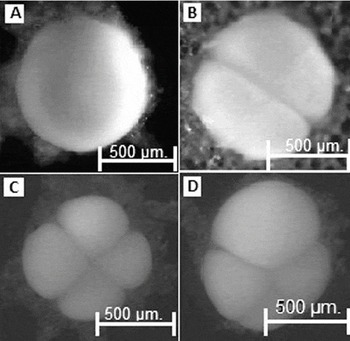
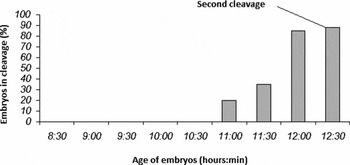
The average diameter of the rainbow trout blastodiscs was 941.44 ± 160.42 μm; the first segmentation was seen in the majority of eggs (85%) after 12 h of incubation (4.1–4.5 ATU) at 9°C (n = 180); the second segmentation was observed in 88% of the embryos after 12.5 h (Figs. 1 and 2).
Rainbow trout (O. mykiss) blastodiscs; non-fertilized (A), asymmetrical with one cleavage (B), symmetrical with two cleavages (C), and asymmetrical with two cleavages (D).

Percentage of rainbow trout (O. mykiss) embryos with cleavages, up to 12.5 h of incubation at 9°C.

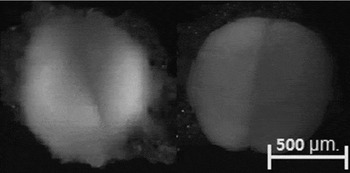
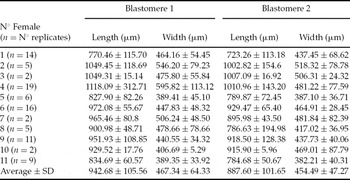
The first segmentation presented two symmetrical blastomeres in 98.9% of the embryos, and asymmetrical blastomeres in 1.1% (n = 91) (Fig. 3; Table 1). Morphometrically, blastomere 1 had an average length of 942.68 ± 105.56 μm and width of 467.34 ± 64.33 μm. Blastomere 2 had an average length of 887.60 ± 101.65 μm and width of 454.49 ± 47.25 μm. The measurements of L and W were significantly different (P < 0.05).
Rainbow trout (O. mykiss) blastodiscs with two blastomeres after 12 h of incubation at 9°C.

Length and width (average ± standard deviation (SD)) of the first rainbow trout (Oncorhynchus mykiss) blastomeres

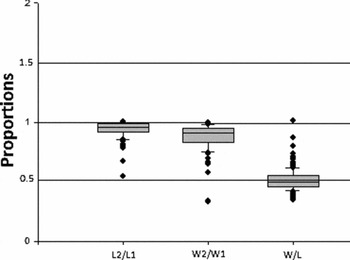
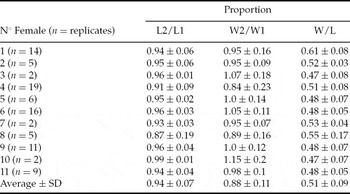
The proportion between the lengths of the two blastomeres was 0.94 ± 0.07, with a minimum of 0.533 and maximum of 1.0 (n = 91). The proportion of their widths was 0.88 ± 0.1, with a minimum of 0.333 and maximum of 0.999 (n = 91). The proportion between the width and length was 0.51 ± 0.09, in which the minimum was 0.342 and the maximum 1.012 (n = 192) (Fig. 4; Table 2). A higher variation was recorded for the proportion of the widths of the blastomeres.
Dispersion of the proportions of lengths, widths and between lengths and widths of the first rainbow trout (O. mykiss) blastomeres.

Proportions between lengths, widths, and lengths and widths of the first two rainbow trout (Oncorhynchus mykiss) blastomeres

SD, standard deviation.
Discussion
Two blastomeres were identified after 11.0 and 12.0 h of incubation at 9°C with 4.1 and 4.5 ATU. These results are similar to those described for the same species by Ballard, (Reference Ballard1973), Hershberger & Hostuttler (Reference Hershberger and Hostuttler2005), Hershberger & Hostuttler (Reference Hershberger and Hostuttler2007); and for S. salar and S. trutta by Gorodilov (Reference Gorodilov1983) and Killeen et al. (Reference Killeen, McClay and Johnston1999) respectively. However, they differ from the data reported by Ballard (Reference Ballard1973) for O. mykiss incubated at 4°C, in which only 1.2 ATU was determined for the first cleavage.
The average size of the blastodisc was 941.44 ± 160.42 μm, similar to the findings reported by Ballard (Reference Ballard1973) of approximately 1000 μm in O. mykiss and 880 μm in Salvelinus fontinalis, and by Gorodilov (Reference Gorodilov1983) in S. salar with 950 μm.
The proportions between the lengths 0.94 ± 0.07 and widths 0.88 ± 0.11 of the blastomeres reveal a high degree of symmetry between them, for which the values are close to 1. The proportion between the width and length of both blastomeres was 0.51 ± 0.09, which facilitates the creation of four symmetrical blastomeres in the second cleavage. Pavlov & Emel'yanova (Reference Pavlov and Emel'yanova2008) characterized the symmetry of the first cleavage in Z. scopas, identifying some asymmetrical embryos, asynchrony of cleavages, syncytia, and other developmental aberrations attributed to over-maturity of the eggs. Lahnsteiner & Patarnello (Reference Lahnsteiner and Patarnello2005) evaluated the quality of eggs based on the shape of the lipid drop, egg and yolk, correlating these with larval survivability. Other authors propose that an evaluation of the quality of eggs based on symmetry of the blastomeres can be carried out only until the point at which 16 cells have been formed, as after this point the amount of blastomeres is high and the evaluation becomes unclear. Additionally, anomalous patterns have been described as: marginal, doughnut, triple and pie shaped; in some cases the asymmetry patterns can be combined (Avery & Brown, Reference Avery and Brown2005; Avery et al. Reference Avery, Killen and Hollinger2009). The use of early segmentation patterns with good symmetry of the embryos of 8–32 blastomeres as an evaluation tool for gamete quality is proposed, which is correlated with good incubation, hatching and larval survivability rates (Pavlov & Moksness, Reference Pavlov and Moksness1994; Shields et al., Reference Shields, Brown and Bromage1997; Kjørsvik et al., Reference Kjørsvik, Hoehne, Reitan and Reitan2003; Avery & Brown, Reference Avery and Brown2005; Pavlov & Emel'yanova, Reference Pavlov and Emel'yanova2008; Avery et al., Reference Avery, Killen and Hollinger2009).
Shields et al. (Reference Shields, Brown and Bromage1997) show a direct proportional relationship between embryos with normal cleavage rates (symmetrical blastomeres) and incubation survivability rates in G. morhua, A. lupus and Pleuronectes platessa. Avery & Brown (Reference Avery and Brown2005), in their work with Limanda ferruginea, show differences in the mortality rates during the embryogenesis period, with 8% mortality in embryos with symmetrical cleavages, and from 20 to 60% in embryos with asymmetrical cleavages. Avery et al. (Reference Avery, Killen and Hollinger2009), obtained mortality rates close to 20% for embryos with asymmetrical cleavage patterns, as opposed to 9% obtained in embryos with symmetrical cleavages after 5 days of incubation. The mortality of asymmetrical embryos increased, while similar values are maintained until the end of the incubation phase for embryos with symmetrical cleavages in G. morhua. These results show that embryos with symmetrical cleavages are of a higher quality than embryos with asymmetrical cleavages.
Various works to investigate the relationship between egg quality and good production rates have been carried out in marine species. It is therefore necessary to carry out investigations that correlate blastomere symmetry with good production rates in salmonids. This investigation represents an initial proposal for a tool for the indirect evaluation of gamete quality in fish with opaque chorions, results show a tendency towards symmetry in the first blastomeres, and a higher dispersion of widths than lengths in embryonic cells.