INTRODUCTION
Fish are important components of shallow marine ecosystems, including mangroves, estuaries, seagrass meadows, coral and rocky reefs, displaying great diversity, abundance and biomass (Parrish, Reference Parrish1989; Kronen et al., Reference Kronen, Magrona, McArdleb and Vunisea2010; Toller et al., Reference Toller, Debrot, Vermeij and Hoetjes2010; Vaslet et al., Reference Vaslet, Bouchon-Navaro, Charrier, Louis and Bouchon2010). They undertake many critical ecological roles, such as sustaining ecosystem goods and services (e.g. fisheries, tourism, aesthetic and cultural values), upon which human welfare depends (McClanahan, Reference McClanahan2000; Bellwood et al., Reference Bellwood, Hughes, Folke and Nystrom2004; Dulvy et al., Reference Dulvy, Freckleton and Polunin2004). Fisheries also represent the main source of protein and subsistence for traditional communities of tropical coastal areas (Pauly et al., Reference Pauly, Christensen, Guénette, Pitcher, Sumaila, Walters, Watson and Zeller2002).
Along the Brazilian coast, reef fish communities are distributed from Manuel Luiz Reefs (Rocha & Rosa, Reference Rocha and Rosa2001) below the Amazon River mouth, down south to the coast of the State of Santa Catarina (Hostim-Silva et al., Reference Hostim-Silva, Bertoncini, Machado, Gerhardinger, Daros, Barreiros and Godoy2006), with 20% of endemism in the Brazilian Province (Floeter et al., Reference Floeter, Rocha, Robertson, Joyeux, Smith-Vaniz, Wirtz, Edwards, Barreiros, Ferreira, Gasparini, Brito, Falcón, Bowen and Bernardi2008).
The coastal islands of the metropolitan area of Rio de Janeiro city are located on the south-eastern coast of Brazil. This area shows great diversity of fauna and flora and constitutes a unique quasi-tropical environment within the subtropical waters in Brazil (Lodi, Reference Lodi2002; Rangel et al., Reference Rangel, Chaves and Monteiro-Neto2007). However, to date, accounts of the ichthyofaunal record within the limits of these archipelagos are few or cover limited areas (see Rangel et al., Reference Rangel, Chaves and Monteiro-Neto2007; Mendonça-Neto et al., Reference Mendonça-Neto, Monteiro-Neto and Moraes2008; Monteiro-Neto et al., Reference Monteiro-Neto, Tubino, Moraes, Mendonça-Neto, Esteves and Fortes2008; Chaves & Monteiro-Neto, Reference Chaves and Monteiro-Neto2009; Lodi et al., Reference Lodi, Mayerhofer and Monteiro-Neto2009), despite their proximity to the coast and easy access by different users.
Checklists are important survey tools for the study of reef fish communities (Mora et al., Reference Mendonça-Neto, Monteiro-Neto and Moraes2008), providing the essential data sets for management actions. In the present study, we provide a checklist of shallow coastal fish species from four archipelagos close to the metropolitan Rio de Janeiro city. We also include new records and comments on geographical distributions and conservation remarks related to species' extinction risks.
MATERIALS AND METHODS
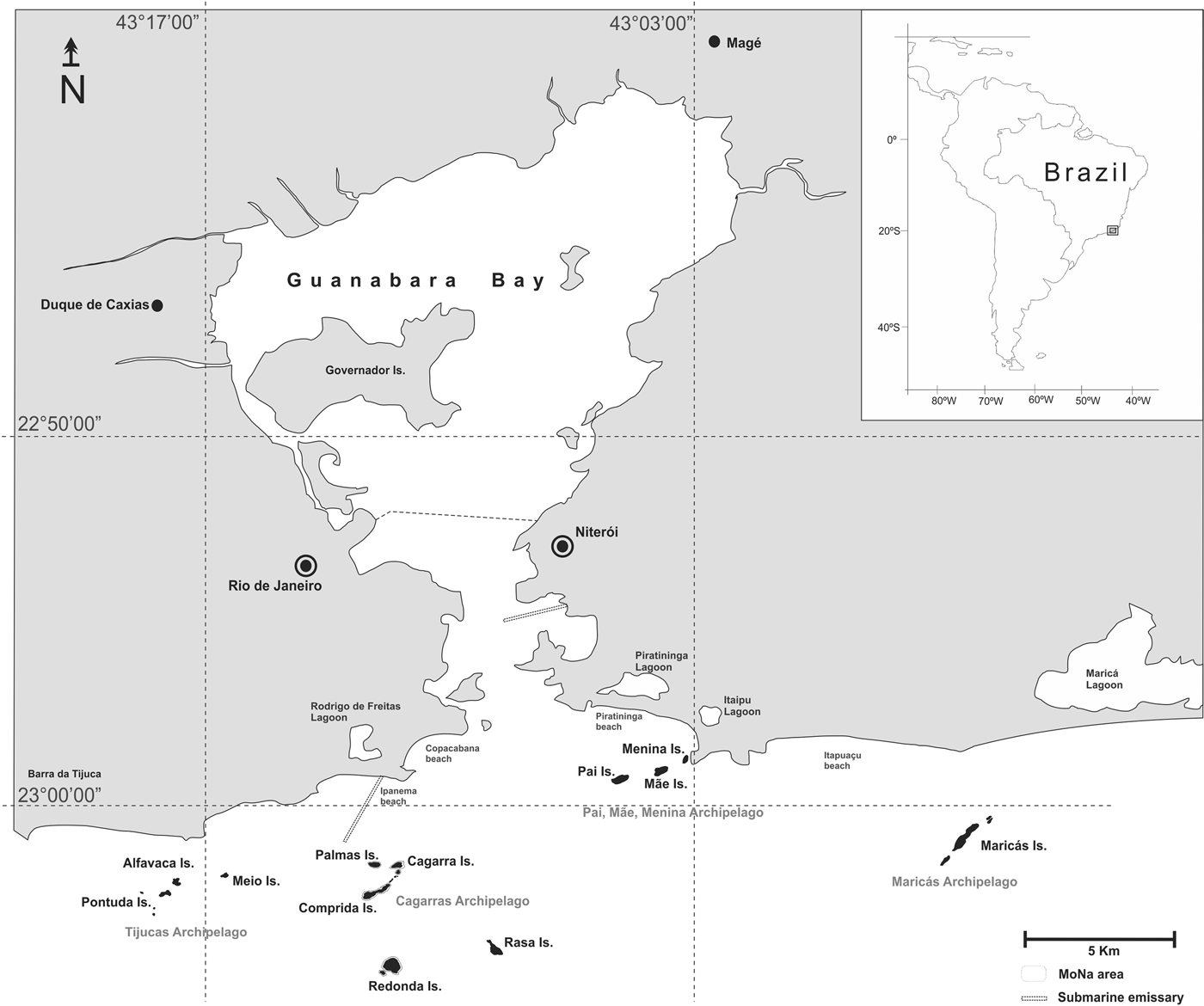
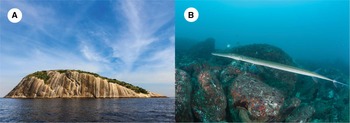
The coastal islands of Rio de Janeiro city are located on the south-eastern coast of Brazil (22°58′S– 23°05′S 42°54′W–43°18′W) (Figure 1). These are uninhabited archipelagos, islets and several sparse outcrops with extensive intervening sandy bottoms, where maximum depth is about 40 m. The subtidal substrate varies among islands from steep profiles, to granitic boulders of varying sizes and shapes delineating dissipative profiles (Figure 2). The rocky substrate is mostly covered with patches of brown and red algae, zoanthids, hydrozoans, sponges, ascidians and octocorals.
The coastal islands of Rio de Janeiro (in black): Tijucas; Cagarras; Pai, Mãe, Menina and, Maricás Archipelagos. South-eastern coast of Brazil. Dotted area around PalMas, Cagarras, Comprida and Redonda islands represents the IOM-marine-no-take-zone from the rocky shore of Monumento Natural das Ithas Cagarras (MoNa Area).

(A) Southern view of the Cagarras Island; (B) Fistularia tabacaria Linnaeus, 1758 over the subtidal area of Redonda Island formed by granitic boulders of varying sizes and shapes. Photograph by A.A. Bertoncini.

Tijucas Archipelago (23°01′S 43°17′W) is formed by Alfavaca, Pontuda and Meio Islands, and the Tijucas outcrop. The archipelago is located 1.7 km from the end of Barra da Tijuca beach, at depths varying between 6 and 37 m.
Cagarras Archipelago (23°01′S 43°12′W) comprises three main islands (Cagarra (Figure 1A), Palmas and Comprida), three lesser islands, and seven outcrops with depths varying between 16 and 24 m. Two isolated islands, Redonda and Rasa (23°03′S 43°10′W), were recently included as part of the Archipelago.
Pai, Mãe and Menina Archipelago (22°59′S 43°04′W) is formed by these three islands of the same name and they are the closest to the mainland, next to Itaipu beach. Depth range varies between 9 and 29 m, with deepest parts on the ocean side of the islands.
Maricás Archipelago (23°00′S 42°55′W), including the easternmost islands, is formed by Maricá Island, and two other smaller islands, located 3.6 km from the coast, with surrounding depths varying around 17 m.
Coastal fish are here defined as fish found at depths between the water surface down to 60 m (i.e. within SCUBA diving range), occasionally visiting rocky shores for the purpose of feeding, shelter and/or reproduction (sensu Thompson et al., Reference Thompson, Findley and Kerstitch2000), and that may be occasionally observed by divers.
The checklist presented herein includes records obtained through different methods: (i) 457 underwater visual censuses (UVCs) of 40 m2 (2 × 20 m) randomly distributed at different locations in the four archipelagos, from 2006 to 2010, and monthly dives for rover-diver counts at Cagarras Archipelago (following Rangel et al., Reference Rangel, Chaves and Monteiro-Neto2007) from April 2011 to July 2012 (comprising ~120 h of observations), conducted at different depths and degrees of wave exposure, aiming to assess a higher habitat diversity; (ii) published data; (iii) video/photographic records and other reliable sources (unpublished data); (iv) occurrence in local fisheries; and (v) museum voucher specimens.
Species identification was based on Figueiredo (Reference Figueiredo1977), Figueiredo & Menezes (Reference Figueiredo and Menezes1978, Reference Figueiredo and Menezes1980, Reference Figueiredo and Menezes2000), Menezes & Figueiredo (Reference Menezes and Figueiredo1980, Reference Menezes and Figueiredo1985), Carvalho-Filho (Reference Carvalho-Filho1999), Humann & Deloach (Reference Humann and Deloach2002) and Hostim-Silva et al. (Reference Hostim-Silva, Bertoncini, Machado, Gerhardinger, Daros, Barreiros and Godoy2006). The families were ordered according to Nelson (Reference Nelson2006) and species arranged alphabetically under the family name. Common names followed Freire & Carvalho-Filho (Reference Freire and Carvalho-Filho2009), with few exceptions not included in their list.
Zoogeographic affinities were analysed based on species' classifications in the literature (Rangel et al., Reference Rangel, Chaves and Monteiro-Neto2007; Floeter et al., Reference Floeter, Rocha, Robertson, Joyeux, Smith-Vaniz, Wirtz, Edwards, Barreiros, Ferreira, Gasparini, Brito, Falcón, Bowen and Bernardi2008; Luiz Jr et al., Reference Luiz, Carvalho-Filho, Ferreira, Floeter, Gasparini and Sazima2008; Eschmeyer, Reference Eschmeyer2010; Froese & Pauly, Reference Froese and Pauly2010) following the categories: CT, Circumtropical; TA, trans-Atlantic (also known as Amphi-Atlantic, occurring in the western and eastern Atlantic Ocean, and Mid-Atlantic islands); WA, western Atlantic; SWA, south-western Atlantic (from northern Brazil to Argentina); SSWA, southern south-west Atlantic (species with temperate affinities occurring as far as southern and south-eastern Brazil, Argentina); and BR, Brazilian Province (area between the Orinoco delta in Venezuela and the State of Santa Catarina in Brazil; sensu Briggs, Reference Briggs1995; Floeter & Gasparini, Reference Floeter and Gasparini2000).
The world status of species conservation, for the available species, was based on the list proposed by the International Union for Conservation of Nature and Natural Resources (IUCN, 2009) (categories as follows: CR, Critically Endangered; VU, Vulnerable; NT, Near Threatened; LC, Least Concern; and DD, Data Deficient), and the national status of conservation followed the list proposed by the Brazilian Ministry of the Environment (MMA, 2004, 2008), that assigns species under two proposed categories: species threatened of extinction (known as Annex I); and species overexploited or threatened by overexploitation (known as Annex II).
RESULTS
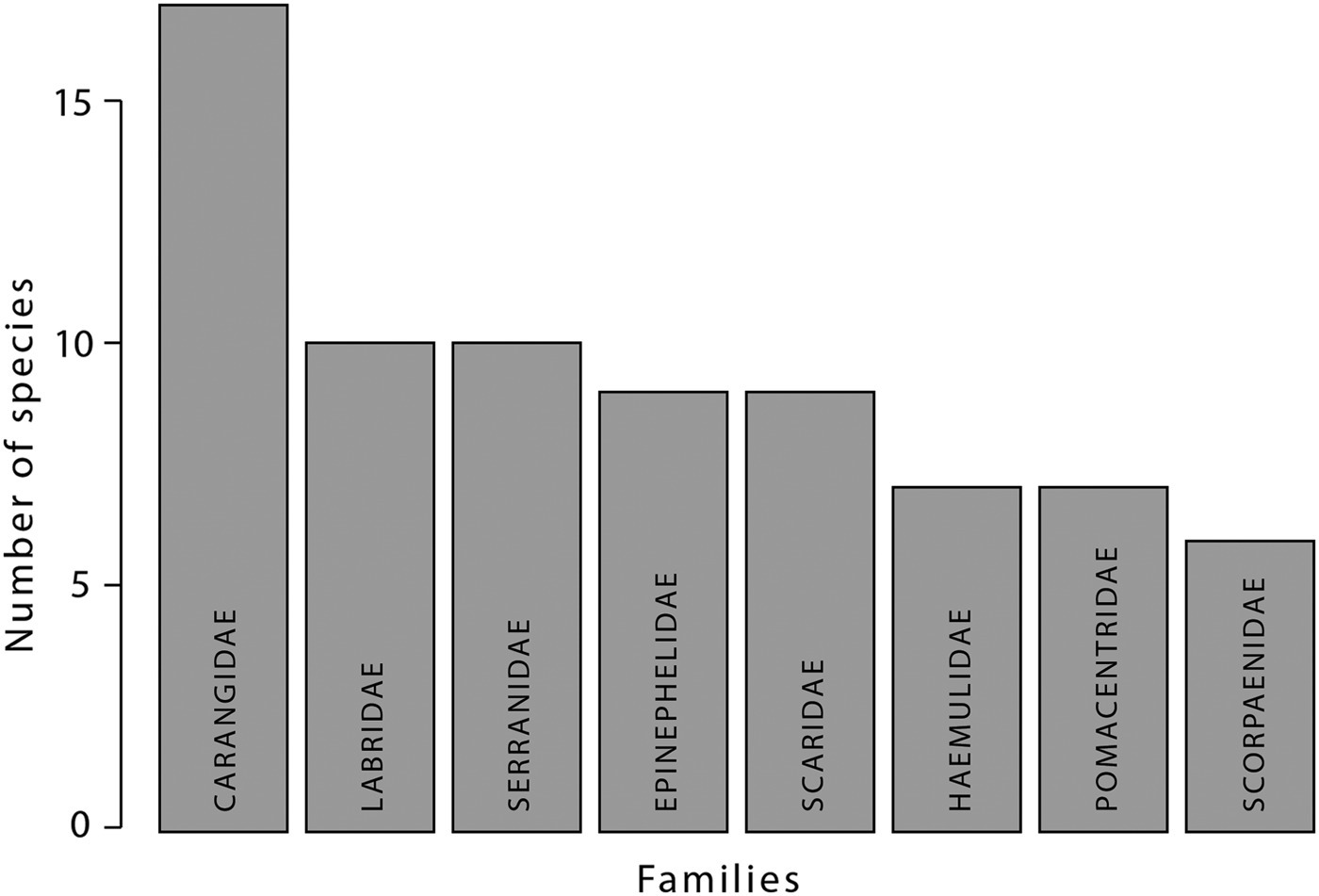
A total of 197 reef fish species, belonging to 130 genera and 61 families, were recorded at the coastal archipelagos of Rio de Janeiro (Table 1). Ten of the recorded species were Elasmobranchii and the remaining 187 Actinopterygii. The family Carangidae was the richest with 17 species, followed by Labridae and Serranide (10 each), Epinephelidae and Scaridae (9 each), Haemulidae and Pomacentridae (7 each), and Scorpaenidae (6) (Figure 3). The most specious genera were Halichoeres (5), Sparisoma (5), Gymnothorax (4) and Trachinotus (4).
Richest fish families recorded on coastal archipelagos off metropolitan area of Rio de Janeiro, RJ, Brazil.

Fish families are arranged in accordance with Nelson (Reference Nelson2006); genera and species are arranged in alphabetical order. Brazil: I, species threatened by extinction; II, species overexploited or threatened by overexploitation according to the Brazilian legislation. IUCN: IUCN threatened categories: CR, Critically Endangered; VU, Vulnerable; NT, Near Threatened; LC, Least Concern; DD, Data Deficient. GEORG, Geographic Range: CT, circumtropical; TA, trans-Atlantic; WA, western Atlantic; SWA, south-west Atlantic; SSWA, southern south-west Atlantic; BR, Brazilian Province. Common names used in Brazil (see Freire & Carvalho-Filho, Reference Freire and Carvalho-Filho2009). Record type: SIG, sighted; PHO, photographed; LIT, in litteris; FIS, fishery; SPE, spear fishing; MUS, museum voucher. †, new records.

Data gathered in this study provided 78 new records of fish species across the study area (Table 1), not previously reported. Among records, 36.5% (72) of species are commonly observed in local artisanal/recreational fisheries, especially from Copacabana and Itaipu localities. All Carangidae (jacks) species are targeted by local fisheries, as well as, seven Epinephelidae (groupers) and six Haemulidae (grunts).
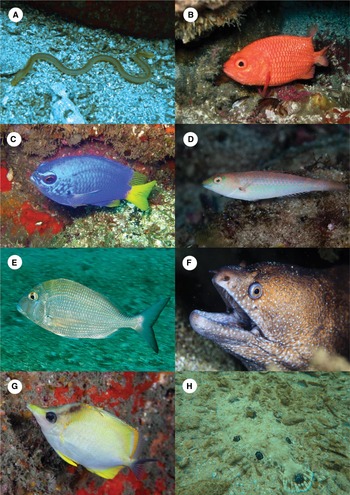
The importance of photographic records lay in registering 38.4% (77) of the present list, some (N = 6) exclusively obtained from underwater pictures (Figure 4).
Selected new records for the area: (A) Ahlia egmontis (Jordan, 1884); (B) Plectrypops retrospinis (Guichenot, 1853); (C) Chromis flavicauda (Günther, 1880); (D) Cryptotomus roseus Cope, 1871; (E) Nicholsina usta (Valenciennes, 1840); (F) Muraena aff. retifera Goode & Bean, 1882; (G) Prognathodes brasiliensis Burgess, 2001; (H) Cyclopsetta fimbriata (Goode & Bean, 1885). Photographs: C.A. Rangel (A–C); A.A. Bertoncini (D–G); W. Vieira (H).

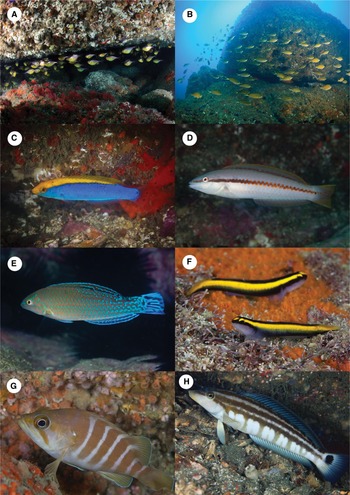
Regarding the geographical distribution, 51.8% (101) of the species occur in the western Atlantic (Figures 5A, B & 6A, E–G), 20.5% (40) occur in both sides of the Atlantic (Figures 5G & 6D). The Brazilian Province shelters 9.7% (19) (Figure 5C–F), whereas 10.3% (20) is distributed over tropical areas of the world (Figure 6B). The coastal islands also shelter a few species occurring in the southern south-west Atlantic (6.7%, 13) (Figures 5H & 6C), or restricted to the south-west Atlantic (1.0%, 2) (Figure 7).
Selected representatives from the western Atlantic: Pempheris schomburgkii Müller & Troschel, 1848 (A) and Hypsoblennius invemar Smith-Vaniz & Acero P., 1980 (B); from the Brazilian Province: Halichoeres dimidiatus (Agassiz, 1831) (C), Halichoeres sazimai Luiz, Ferreira & Rocha, 2009 (D), Halichoeres brasiliensis (Bloch, 1791) (E) and Elacatinus figaro Sazima, Moura & Rosa, 1997 (F); the trans-Atlantic: Chromis multilineata (Guichenot, 1853) (G), making use of the boulders and crevices along rocky reef areas in studied sites; and from the southern south-west Atlantic: Pinguipes brasilianus Cuvier, 1829 (H). Photographs: A.A. Bertoncini.

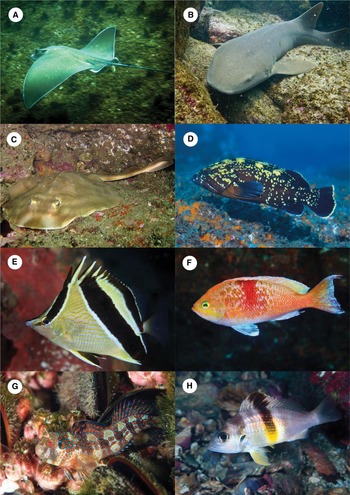
Elasmobranchs rarely observed on Cagarras rocky reefs: Myliobatis freminvillei Lesueur, 1824 (A), Ginglymostoma cirratum (Bonnaterre, 1788) (B) and Zapteryx brevirostris (Müller & Henle, 1841) (C); the most common grouper in south and south-east Brazil, Epinephelus marginatus (Lowe, 1834) (D); and the deeper-water group of fish Prognathodes guyanensis (Durand, 1960) (E), Pronotogrammus martinicensis (Guichenot, 1868) (F), Acanthistius brasilianus (Cuvier, 1828) (G) and Serranus atrobranchus (Cuvier, 1829) (H). Photographs: C.A. Rangel (A); J. Iunes (B); F. Moraes (C); Bertoncini (D–H).

Relative proportion (%) of geographical distribution types of the species observed at Rio de Janeiro coastal archipelagos (N = 194). BR, Brazilian Province; SSWA, southern south-west Atlantic; SWA, south-west Atlantic; WA, western Atlantic; CT, circumtropical; TA, trans-Atlantic.

Redonda Island shelters a unique group of fish, which is restricted to deeper waters (>20 m) (Figures 4G & 6E–H).
Only 30.1% (59) of the species have been evaluated according to IUCN criteria (Figure 8), resulting in one designated as Critically Endangered, four as Endangered, and nine as Vulnerable. Four are considered Near Threatened, 32 are assigned as Least Concern and nine as Data Deficient. Species included in the IUCN list and their respective status are provided, presenting an updated picture of threatened fish species along the studied area (Table 1).
Percentage distribution of the 59 species included in the IUCN list category. CR, Critically Endangered; EN, Endangered; VU, Vulnerable; NT, Near Threatened; LC, Least Concern; DD, Data Deficient.

A total of 13 species were listed under Annexes I and II (two and 11, respectively) of the Brazilian threatened species list (MMA, 2004), representing 6.6% of species listed herein (Table 1).
DISCUSSION
Besides eight exclusive records from museum vouchers, a total of 137 species were observed in situ, in censuses (Table 1 UVC record type) carried out in the area (N = 457). Such results represent an important increase (over 38%) in the overall number of recorded species in the area, considering the previous studies employing the same UVC methods (e.g. Rangel et al., Reference Rangel, Chaves and Monteiro-Neto2007—99 spp.; Mendonça-Neto et al., Reference Mendonça-Neto, Monteiro-Neto and Moraes2008—42 spp.; Chaves & Monteiro-Neto, Reference Mendonça-Neto, Monteiro-Neto and Moraes2008—57 spp.).
Research efforts are clearly needed in the archipelagos, to understand how fish and other marine resources are ecologically structured, especially considering the richness of habitats they shelter, from shallow Palythoa caribaeorum patches, to deeper areas as observed in Redonda Island, sheltering unique species observed nowhere else but there (Figures 4G & 6E–H). Furthermore, our efforts suggest that at least 32 new records—not listed herein—still lack a precise evaluation, indicating that local biodiversity potential within the archipelagos may be greater than what is currently reported.
Most species are widely distributed in the western Atlantic (e.g. genera Anisotremus, Chaetodon, Haemulon, Holacanthus, Mycteroperca and Pomacanthus). This indicates a closer affinity of the local ichthyofauna with the Caribbean region, and to a lesser degree, with the temperate fauna of Uruguay and Argentina (e.g. genera Acanthisthius (Figure 6G) and Pinguipes (Figure 4H)). This is due to the fact that the Caribbean is the centre of biodiversity in the Atlantic Ocean and shelters the most diverse reef fish fauna in the Atlantic (>700 species) and therefore, larval exchange between Brazil and the Caribbean, although occurring at small rates, is continuous (Rocha, Reference Rocha2003).
Accordingly, the species richness of these archipelagos also lies in the co-occurrence of tropical and subtropical/temperate species (Figure 7), such as observed by Hostim-Silva et al. (Reference Hostim-Silva, Bertoncini, Machado, Gerhardinger, Daros, Barreiros and Godoy2006) in Santa Catarina, Luiz Jr et al. (Reference Luiz, Carvalho-Filho, Ferreira, Floeter, Gasparini and Sazima2008) in São Paulo, and later by Daros et al. (Reference Daros, Bueno, Vilar, Passos and Spach2012) in Paraná.
The Red List provided by IUCN (2009) highlights organisms that are facing high threats and are at risk of global extinction. Although efforts, dating back from 2008, were employed in regional assessments (Brazil), so far results are not available to the public. Assessments according to IUCN indicate the presence of 14 species assigned in one of the three threatened categories within the studied islands: one Critically Endangered, the goliath grouper, Epinephelus itajara (Lichtenstein, 1822), extremely rare with latest sightings dating from early 2010, four Endangered (Pagrus pagrus (Linnaeus, 1758), Anisotremus moricandi (Ranzani, 1842), Epinephelus marginatus (Lowe, 1834) and Scarus trispinosus Valenciennes, 1840), and nine as Vulnerable (Gymnura altavela (Linnaeus, 1758), Zapteryx brevirostris (Müller & Henle, 1841), Balistes vetula Linnaeus, 1758, Lutjanus analis (Cuvier, 1828), Hyporthodus niveatus (Valenciennes, 1828), Mycteroperca interstitialis (Poey, 1860), Atlantoraja cyclophora (Regan, 1903), Hippocampus erectus Perry, 1810 and Rioraja agassizii (Müller & Henle, 1841)).
Clearly, epinephelids (groupers) along with elasmobranchs are groups that require special attention, being a priority in future conservation/management actions. The dusky-grouper (E. marginatus) (Figure 6D), once abundant on local rocky shores is considered rare in the area today. A worse situation is the case of the goliath grouper (E. itajara), last observed in 2010 as reported by a spear fisherman, and the nurse shark (Ginglymostoma cirratum), photographed by a SCUBA diver in late 2012 (Figure 6B). As a protection measure for these species with particular vulnerability (see Hostim-Silva et al., Reference Hostim-Silva, Bertoncini, Gerhardinger and Machado2005), the dusky grouper has a minimum catch size of 47 cm, and the goliath grouper has a moratorium on catches along the coast of Brazil, as well as, the nurse shark, considered overexploited according to Brazilian law (see MMA, 2004).
Although 13 species (6.6%) are listed under Annexes I and II of the Brazilian threatened species list (MMA, 2004), to date, the management plans necessary for the conservation of these species are non-existent, incipient, or represented by local and isolated initiatives such as the Pro Arribada Project studying reef fish aggregation sites in Brazil (mainly Epinephelidae and Lutjanidae), and Projeto Meros do Brasil with research efforts focusing on the Goliath grouper (Epinephelus itajara) conservation.
In 2010, a federal Marine Protected Area (MPA) was established on the Cagarras archipelago (Monumento Natural das Ilhas Cagarras -MoNa Cagarras) (see Figure 1). This area was created to protect the local biodiversity exposed to different levels of environmental impact over the years. This MPA became the first one in the city of Rio de Janeiro, providing an important tool for protection and conservation of local marine biodiversity.
The proximity of these insular systems to a large urban centre facilitates access of visitors. The area also suffers a great influence from the eutrophic waters of Guanabara Bay, the second largest bay environment in Brazil (Valentin et al., Reference Valentin, Tenenbaum, Bonecker, Bonecker, Nogueira, Villac, Silva and Lavrado1999; Kalas et al., Reference Kalas, Carreira and Wagener2009) (see Figure 1). Furthermore, the fish fauna of the Cagarras Archipelago has been under threat for decades by destructive harvesting techniques (e.g. trawlers, dynamite fishing and predatory spear fishing), lacking control of recreational visitors, ornamental fish trade, as well as the indiscriminate collection of marine organisms for consumption (Lodi, Reference Lodi2002; Secchin, Reference Secchin2002). Such impacts endorse the necessity for basic knowledge about the fish communities to support effective monitoring projects and management measures against environmental degradation and biodiversity protection in coastal areas.
Our assessment, together with other recent important local initiatives, such as Projeto Ilhas do Rio, also committed to the assessment of the MoNa Cagarras biodiversity and in a near future to other archipelagos, is providing important complementary information (e.g. fisheries landing data) to compose the baseline information to be used by managers in the establishment of a management plan for the MoNa Cagarras.
ACKNOWLEDGEMENTS
We thank V.M. Oliveira and E.S. Silva for their extensive aid during fieldwork, and the students of ECOPESCA Laboratory—UFF for their valuable help in laboratory activities; and J. Iunes, F. Moraes and W. Vieira for photographic records. We are also grateful to the Instituto Chico Mendes (ICMBio) for issuing permits to work at Monumento Natural das Ilhas Cagarras MPA.
FINANCIAL SUPPORT
Financial support was provided by CAPES (C.M.-N. Grant Coordinator number 23038.017849/2009-37, being PRODOC Fellows C.A.R. and A.A.B.), and by FAPERJ through a research grant to C.A.R. PROPPi-UFF provided financial aid through several small research grants to C.M.-N., Pleuston & Neuston Photo supports A.A.B. Recent project continuity has been granted through Projeto Ilhas do Rio, Instituto Mar Adentro, sponsored by Petrobras (Brazilian Petroleum Corporation) through the Petrobras Environmental Programme. CNPq provides a Research Productivity grant to C.M.-N.