INTRODUCTION
The process by which internationally adopted (IA) children learn their new language has been referred to as second-first language acquisition (Roberts, Pollock & Krakow, Reference Roberts, Pollock and Krakow2005). According to the US Department of Homeland Security (2010), in 2009, 12,782 IA children came into the US and 76·5% were under four years of age at arrival. Because most IA children were exposed to a different language before adoption, learning English is an important part of their post-adoption adjustment. Existing theoretical frameworks, however, are rather insufficient in understanding IA children's second-first language acquisition, due to the uniqueness of their linguistic experience. Specifically, unlike non-adopted children, IA children experience a radical shift in the primary language of exposure upon adoption (Krakow & Roberts, Reference Krakow and Roberts2003), and unlike immigrant children, IA children lose access to speakers of their first language upon adoption (Hwa-Froelich, Reference Hwa-Froelich2009). Finally, depending on their age at adoption, their skills in their first language can easily vary from very minimal to highly developed (Glennen, Reference Glennen2002; Ladage, Reference Ladage2009). The absence of clear theoretical frameworks makes systematic empirical work on IA children's second-first language acquisition even more imperative.
In this study we focused on the acquisition of expressive English language skills in Chinese girls aged 18–35 months, who were adopted by families in the United States and Canada. Our exclusive focus on girls was driven by the reality that the overwhelming majority of IA Chinese children are girls. We aimed to address three questions:
1. What is the nature of the relationship between the adopted Chinese girls' expressive English skills and their age at adoption, chronological age, length of exposure to English and developmental risk status at adoption?
2. How do the adopted Chinese girls' expressive language skills compare with those of same-age girls in the US normative sample?
3. What is the nature of the relationship between the adopted Chinese girls' expressive language delay status and receipt of language intervention?
LITERATURE REVIEW
Longitudinal research suggests that for IA children who are adopted as infants and toddlers, their second-first language acquisition patterns resemble the language acquisition pattern of monolingual non-adopted children (Glennen & Masters, Reference Glennen and Masters2002; Pollock & Price, Reference Pollock and Price2005; Snedeker, Geren & Shafto, Reference Snedeker, Geren and Shafto2007). Existing literature on IA children's language outcomes has focused on assessing the children's language development status, as well as the influence of age-related factors and developmental conditions at the time of adoption.
IA children's expressive language acquisition and age at adoption, chronological age and length of exposure
The existing literature provides converging evidence that IA children's expressive English language acquisition is largely influenced by age at adoption (AAA), chronological age (CA) and length of exposure to English (e.g. Glennen & Masters, Reference Glennen and Masters2002; Meacham, Reference Meacham2006). Age at adoption marks IA children's point of entry into their second-first language environment. Because IA children's age at adoption can vary from just a few months to a few years, the relation between their age at adoption and language outcome is complex. On the one hand, IA children adopted at older ages have been reported to have poorer language outcomes than peers adopted at younger ages (e.g. Tan & Yang, Reference Tan and Yang2005); on the other hand, children adopted at older ages have been reported to learn English faster than those adopted at younger ages (e.g. Pollock, Reference Pollock2005; Snedeker, Geren & Shafto, Reference Snedeker, Geren and Shafto2007).
While IA children adopted at an older age seem to learn English faster than those adopted at substantially younger ages, Krakow, Tao and Roberts (Reference Krakow, Tao and Roberts2005) have pointed out that these children also have the disadvantage of having more to learn in order to catch up with same-age non-adopted peers. In their study, Krakow and associates examined language acquisition in two groups of adopted Chinese girls: (a) six infants adopted at 7–9 months and (b) six toddlers adopted at 24–32 months. The study showed that while the toddler group learned English at a faster rate, at a comparable age of 30 months the infant group scored higher on the MacArthur-Bates Communicative Development Inventory-Words and Sentences (CDI) in vocabulary, irregular nouns and verbs, and complex morphology, primarily because the infant group had been exposed to English for a longer period of time.
In an effort to obtain normative data on children adopted from China, Pollock (Reference Pollock2005) collected longitudinal data on vocabulary and phrase utterances in a sample of 141 children (M=13 months at adoption, range=7–43 months). Data gathering ended when the child either reached age three years or had a vocabulary size of 600. Pollock found that at each 3-month interval, children who were adopted at an older age had a larger vocabulary and produced longer sentences than those who were adopted at a younger age.
Existing studies have also shown that IA children's English language production lags behind that of same-age non-adopted peers initially but gradually becomes age-appropriate. Prior to catching up with their same-age non-adopted peers, a longer period of exposure to English has been correlated with better language outcomes in IA children (e.g. Cohen, Lojkasek, Zadeh, Pugliese & Kiefer, Reference Cohen, Lojkasek, Zadeh, Pugliese and Kiefer2008; Glennen, Reference Glennen2007; Krakow & Roberts, Reference Krakow and Roberts2003; Krakow et al., Reference Krakow, Tao and Roberts2005; Roberts, Pollock, Krakow, Price, Fulmer & Wang, Reference Roberts, Pollock, Krakow, Price, Fulmer and Wang2005; Tan & Yang, Reference Tan and Yang2005). For example, Cohen and associates (Reference Cohen, Lojkasek, Zadeh, Pugliese and Kiefer2008) compared 70 IA Chinese girls in Canada adopted between ages 8 and 21 months (M=13 months) with 43 non-adopted girls matched on age and family characteristics. Their study found that at the 6-month follow-up, the adopted Chinese girls were already comparable to the non-adopted girls in receptive language. Their expressive language, however, did not become comparable to the non-adopted peers until the 24-month follow-up. Findings from this study highlight the variations in IA children's pace of second-first language acquisition. According to Glennen (Reference Glennen2007; Reference Glennen2008), nonetheless, IA children who were adopted under the age of two usually attain a level of expressive language in English that is well within normal limits after about one year of exposure.
IA children's developmental risk status at adoption in relation to expressive language acquisition
IA children's conditions around the time of adoption (e.g. malnutrition, developmental delays) might constitute a risk in their post-adoption language development (Ladage, Reference Ladage2009). Children with a history of pre-adoption developmental delays tended to produce shorter sentences (Glennen & Masters, Reference Glennen and Masters2002). Severe orphanage deprivation has also been linked to poorer language ability in the long term. As an example, Croft et al. (Reference Croft, Beckett, Rutter, Castle, Colvert and Groothues2007) showed that for Romanian children adopted at 18–42 months into the United Kingdom, those who lacked the ability to imitate even speech sounds at adoption (as a result of severe orphanage deprivation) continued to have deficiencies in language skills at six years, and then at eleven years of age. Building on previous work, we explored whether pre-adoption adversity might be related to the adopted Chinese children's expressive English language acquisition.
Studies examining the general health and developmental status of children adopted from China (e.g. Miller & Hendrie, Reference Miller and Hendrie2000) suggest that mild to severe developmental delays are common at the time of adoption. In their sample of 192 clinic-referred children adopted from China, Miller and Hendrie (Reference Miller and Hendrie2000) reported that 55% were delayed in gross motor skills and 49% were delayed in fine motor skills. They also reported that 43% were delayed in language, 32% in cognitive development and 28% in social–emotional development, as measured on the University of Michigan Early Intervention Developmental Profile (Schafer & Moersch, Reference Schafer and Moersch1981). These delays, especially delay in language, might prompt families and professionals to request speech and language intervention services for the children. In this study, we explored the adopted Chinese girls' language delay status and receipt of interventions.
METHOD
Participants
This study is part of a larger program of research focusing on the development of children adopted from China over time. Here we first describe the procedures used to recruit participants to the larger study, and then we describe the criteria used to select the present sample.
The adoptive families were recruited through Internet discussion groups and adoption agencies in early 2005. A recruitment letter was posted on the message board of the Internet moderator's group with an introduction to the research project by one of the moderators. The other moderators were asked to disseminate the recruitment letter to members of their respective groups. At the same time, the recruitment letter, together with the same introduction, was mailed to the directors of ten adoption agencies in the US. Overall, the study was endorsed by at least 120 Internet groups and six adoption agencies.
As most families belong to more than one group, some received information about the study simultaneously from multiple sources. Interested parents contacted the research program directly with information about the number of children they had adopted from China, the age of each child and a regular mailing address. A total of 1,001 families from the US and 91 families from other countries (e.g. Canada, Australia) expressed interest in the study. The US families were from 49 states, with California, Massachusetts, New York and Florida being the four states with the largest number of families requesting surveys. The surveys were sent to the adoptive parents via regular mail within two days of receiving the parents' request. An email confirming the mailing of surveys was sent to the adoptive parents within a week thereafter. For the returned surveys, an email thanking the family was sent and for surveys that were not returned within three weeks, an email reminder was sent to the parents. A total of 853 families (78·1%) returned the surveys.
In selecting families for the current analysis, we used the following criteria. First, all families with children aged 18 to 35 months who had data on language development were identified. The total number of families fitting this criterion was 335 (with 340 adopted children). In view of the predominance of girls adopted from China, we then removed the eleven families that had adopted boys. We also excluded six families (with six children) from Australia to focus on children adopted into families in North America. Finally, there were five families with two children each in the study's age range. To ensure statistical independence of the data, one child was randomly selected from each of these five families. As a result, the sample for the current analysis consisted of 318 girls from 318 adoptive families.
Of the 318 families, 303 (95·2%) were headed by white parents and 275 (86·4%) were headed by two parents. Over 95% of the parents were monolingual English speakers. Mothers' ages ranged from 32 to 57 years (M=40·8, SD=4·9). Fathers' ages ranged from 31 to 66 (M=42·5, SD=6·3, n=275). As a group, the adoptive mothers had a high level of education: only 14·2% had less than a bachelor's degree; 36·8% had a bachelor's degree and 49·1% had a master's degree or higher. Adoptive fathers also had a high level of education, with only 18·6% having less than a bachelor's degree; 38·2% had a bachelor's degree and 43·2% had a master's degree or higher. Household income ranged from $30,000–39,999 (three families) to over $150,000 (21·0% of the families), with a median income of $100,000–109,999.
Instruments and procedures
The packet mailed to the adoptive parents contained a consent form, a demographic questionnaire on various aspects of the adoptive family, the adopted child's demographics and conditions when first adopted, and a questionnaire on the adopted child's current behavioral adjustment and language development. Parents were instructed to complete the demographic questionnaire and seal it in a provided envelope before proceeding to the questionnaire on current adjustment and language. Although we did not specify which parent should complete the questionnaires, data on the children's language were all provided by the mother.
Language Development Survey (LDS)
The Language Development Survey (LDS) (Achenbach & Rescorla, Reference Achenbach and Rescorla2000) was used to collect data from the adoptive mothers on the expressive language of the adopted Chinese children who were between 18 and 35 months. The LDS collects data on children's vocabulary size and phrase utterance. The LDS only collects phrase utterance data for those aged 24–35 months. The LDS has been used in studying children adopted from Eastern Europe and China (e.g. Glennen & Masters, Reference Glennen and Masters2002; Krakow & Roberts, Reference Krakow and Roberts2003). The LDS's test–retest reliability (rs>0·90) and concurrent validity, assessed in relation to the CDI (rs>0·84 for Words and Sentences), have been supported by several studies (e.g. Patterson, Reference Patterson2000; Rescorla, Reference Rescorla1989; Rescorla, Ratner, Jusczyk & Jusczyk, Reference Rescorla, Ratner, Jusczyk and Jusczyk2005).
To obtain data on the children's vocabulary size, the LDS asks parents to circle from a 310-word vocabulary list every word that the child says spontaneously. These words are arranged alphabetically into fourteen semantic categories (e.g. food, toys, animals, actions). Parents can also add up to five other words that the child can produce but that are not on the list. The vocabulary score represents the sum of the words reported by parents and can range from 0 to 315. To obtain data on the children's phrase utterances, the parent was asked to write up to five of the longest and best phrases or sentences the child has used spontaneously. Following the LDS manual, children under two were not scored for length of phrase (even if parents provided sentences or phrases that the child used), nor were children whose parents failed to write down sentences or phrases (even if the parents stated that the child used sentences or phrases). To obtain a child's mean length of phrase, the total number of words from the longest/best five sentences or phrases is divided by the total number of sentences or phrases.
Age at adoption (AAA), chronological age (CA) and length of exposure to English
Parents were asked to report the child's date of birth and the date of adoption of the child, as well as the date that the survey was completed. The child's age at adoption was calculated in months using the date of adoption and the child's date of birth. The child's age was calculated in months using the date of data collection for this study and the child's date of birth. Length of exposure to English was calculated in months using the date of data collection and date of adoption.
Developmental risk status at the time of adoption
In this study, data in two areas were used to document aspects of children's developmental status around the time of adoption (see Tan, Marfo & Dedrick, Reference Tan, Marfo and Dedrick2010, for additional details). The first area comprised signs and symptoms of physical, behavioral and psychosocial problems. Parents were asked to respond to a list of eleven easily observable signs and symptoms (e.g. rash) generated from in-depth preliminary interviews with adoptive families and from an earlier study of post-adoption behavioral adjustment in 750 children adopted from China (Tan & Marfo, Reference Tan and Marfo2006). On the questionnaire, parents were asked to check all signs/symptoms that they observed in their child when the child was first adopted. If a sign/symptom was not checked it was coded 0 and if checked it was coded 1. The total number of signs/symptoms was computed and then recoded, with codes ranging from 0 (no signs/symptoms observed) to 5 (five or more observed signs/symptoms). The second area pertained to developmental delays at adoption. It is a standard practice for internationally adopted children to receive comprehensive medical examinations upon arrival in the adoptive country. Parents reported whether their child was assessed to have no/minor delay (coded as 0), moderate delay (coded as 1), or severe delay (coded as 2) in five skill areas: gross motor, fine motor, social, emotional and cognitive. In the data analysis, separate scores for reported delay in each area were used.
Post-adoption utilization of speech/language intervention
Parents were also asked to report whether at the time of data collection, the child had received any form of speech/language intervention. No data on frequency of intervention or service providers were collected.
RESULTS
Descriptive statistics
The Adopted Chinese girls' vocabulary scores ranged from 0 to 310 (M=163·0, SD=102·3). None of the children reached the ceiling score of 315. For mean length of phrase, there were 210 girls who were old enough (i.e. ⩾24 months) for the phrase utterance portion of the LDS, and data were available for 188 of them. Their mean length of phrase ranged from 2 to 11 (M=4·42, SD=2·10). There were 22 girls who had missing data on phrase utterance. They were not statistically different from the 188 girls on CA, age at adoption, length of exposure to English or vocabulary score (ps>0·05). The adopted children's vocabulary score was strongly correlated with their mean length of phrase (r=0·66, p<0·001). This correlation was similar to what Rescorla and Achenbach (Reference Rescorla and Achenbach2002) reported for these two variables (r=0·71, p<0·001) in their normative sample.
Relating age at adoption, chronological age, length of exposure and developmental risks at the time of adoption to measures of expressive language
The 318 Chinese girls were adopted between 6.8 and 24.2 months (M=12·6, SD=3·2). At data collection, they were between 18 and 35 months (M=26·3 months, SD=4·9 months) and had been exposed to English for 1.6 to 27.6 months (M=13·6, SD=5·7). Their age at adoption was not correlated with chronological age (r=0·05, p=0·40) but it was correlated with length of exposure to English (r=−0·55, p<0·001). Chronological age and length of exposure to English were highly correlated (r=0·83, p<0·001), indicating that older children usually had a longer exposure. In terms of developmental risk, 49·1% of the girls had 0 signs/symptoms, 25·3% had 1, 16·1% had 2, 5·7% had 3, 2·2% had 4, and 1·6% had 5 or more. At the time of adoption, 6·6% of the children had severe delays in gross motor, 3·1% in fine motor, 2·2% in social, 1·3% in emotional, and 0% had severe delays in cognitive skills.
Vocabulary size was negatively associated with AAA (r=−0·14, p<0·001), but positively associated with CA (r=0·71, p<0·001) and length of exposure to English (r=0·69, p<0·001). Similarly mean length of phrase was negatively associated with AAA (r=−0·28, p<0·001) but positively associated with CA (r=0·47, p<0·001) and length of exposure to English (r=0·51, p<0·001). Developmental risk status at the time of adoption was mostly unrelated to language outcomes. However, girls with more severe delays in social skills tended to have smaller vocabulary (r=−0·11, p=0·051), and those with more signs and symptoms at adoption were more likely to use shorter phrases (r=−0·18, p<0·05).
Analysis of Variance (ANOVA)
To further determine the relation between language outcomes and AAA and CA, we performed a 3 (AAA groups)×3 (CA groups) Analysis of Variance (ANOVA) for the LDS vocabulary scores and a 3 (AAA groups)×2 (CA groups) ANOVA for mean length of phrase scores. Age at adoption categories were 6–11.9, 12–14.9 and ⩾15 months. CA categories were 18–23, 24–29 and 30–35 months for the analysis of LDS vocabulary scores; for the analysis of LDS mean length of phrases, the CA categories were 24–29 and 30–35 months. Following the recommendation by Pedhazur (1997) of avoiding collinearity, we chose AAA and CA for the ANOVA but excluded length of exposure from this analysis because of its strong correlation with both AAA (r=−0·55, p<0·001) and CA (r=0·83). We added as covariates delays in gross motor, fine motor, social, emotional, and cognitive skills, as well as signs/symptoms. We also controlled for the mother's educational level (0=high school or lower, 4=doctorate).
Results of the ANOVA for LDS vocabulary scores indicated no statistically significant AAA by CA interaction (F(4, 292)=0·74, p=0·56, η2=0·011). ANOVA results without the interaction showed that the effects for AAA (F(2, 296)=13·60, p<0·001, η2=0·084) and CA (F(2, 296)=111·26, p<0·001, η2=0·429) were statistically significant. None of the covariates was statistically significant (p>0·05, η2 ranged from 0 to 0·014). Follow-up linear contrasts revealed significant linear trends, with average vocabulary scores increasing with CA from 81·0 (SD=75·6) for children aged 18–23 months, to 175·9 (SD=89·5) for children aged 24–29 months, and 247·6 (SD=65·2) for children aged 30–35 months (F(2, 315)=109·6, p<0·001, η2=0·410). Average vocabulary scores decreased significantly with AAA, from the group of children adopted at 6–11.9 months (M=182·1, SD=105·3) to the groups of children adopted at 12–14.9 months (M=150·1, SD=95·8) and ⩾15 months (M=135·1, SD=96·6) (F(2, 315)=5·95, p<0·01, η2=0·036). However, the last two groups were not statistically different on their vocabulary scores.
Similarly, for LDS mean length of phrase scores, results indicated no statistically significant AAA by CA interaction (F(2, 166)=1·01, p=0·37, η2=0·012). ANOVA results without the interaction showed that the effects for AAA (F(2, 168)=10·19, p<0·001, η2=0·108) and CA (F(1, 168)=20·74, p<0·001, η2=0·110) were statistically significant. None of the covariates was significant (p>0·05, η2 ranged from 0 to 0·026). Follow-up linear contrasts revealed a significant linear trend with mean length of phrase increasing across CA groups from 3·84 (SD=1·84) for the group aged 24–29 months to 5·25 (SD=2·19) for the group aged 30–35 months (F(1, 186)=22·90, p<0·001, η2=0·110). Mean length of phrase decreased significantly with AAA, from children adopted at 6–11.9 months (M=5·11, SD=2·31) to children adopted at 12–14.9 months (M=3·95, SD=1·71), and children adopted at 15 months or later (M=3·60, SD=1·63) (F(2, 185)=10·31, p<0·001, η2=0·100). The last two groups, however, were not statistically different on their mean length of phrase scores.
Comparing adopted Chinese girls' language outcome with the US norm
Following the recommendation of Roberts and Scott (Reference Roberts and Scott2009) that insights can be gained regarding the IA children's language status through comparisons with norms, we compared the adopted Chinese girls with girls from Rescorla and Achenbach's (Reference Rescorla and Achenbach2002) national probability sample of 278 children aged 18–35 months from diverse ethnic and SES backgrounds. Age for the girls adopted from China was divided into the three categories used by Rescorla and Achenbach (Reference Rescorla and Achenbach2002): 18–23, 24–29 and 30–35 months. To take into account variation in the adopted Chinese girls' age at adoption, we divided them into three distinct age groups: 6–11.9 months, 12–14.9 months, and ⩾15 months.
Vocabulary size
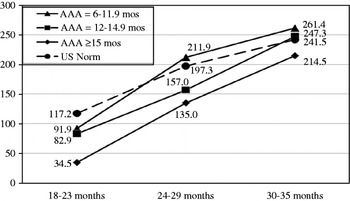
For vocabulary size, as shown in Figure 1, the 18–23-month-old group (n=108) had a smaller vocabulary size than the norm (statistical results reported in the following paragraph), regardless of their age at adoption. For the 24–29-months old group (n=124), those who were adopted at 6–11.9 months scored higher than the norm but those who were adopted at 12–14.9 months and those adopted at ⩾15 months scored lower than the norm. For the 30–35-month-old group (n=86), those who were adopted at 6–11.9 months and 12–14.9 months scored higher than the norm but those adopted at ⩾15 months scored slightly lower than the norm. The adopted Chinese girls were behind the normative sample in the 18–23-month group but as their age increased, the gap between the adopted Chinese girls and the normative sample was closed.
Adopted Chinese girls' vocabulary scores by age group and age at adoption as compared to the US norm.

Effect sizes (ES), calculated using (Mean China – Mean Rescorla and Achenbach)/pooled SD, were used to make further comparisons, setting aside the children's age at adoption. The results suggest that for the 18–23-month-old group, the adopted Chinese girls were lower than the norm (effect size=−0·44; a medium effect); for the 24–29-month-old group, the Chinese girls were also lower (effect size=−0·22; a small effect), but for the 30–35-month-old group, the adopted girls were slightly higher than the normative group (ES=0·08; a very small effect).
Additional comparisons of the adopted Chinese girls with girls from Rescorla and Achenbach's normative group revealed that as the adopted Chinese girls' length of exposure to English increased, the gap between them and the girls from the normative group narrowed. For example, the 18–23-month-old adopted Chinese sample who were adopted later at ⩾15 months (M exposure=4·24 months) were 1·17 standard deviations lower than the normative sample girls, while those adopted earlier at 12–14.9 months (M exposure=8·10 months) were 0·46 standard deviations lower than the normative sample girls; those adopted the earliest, at 6–11.9 months (M exposure=10·57 months), were 0·30 standard deviations below the normative sample girls. For the 24–29-month-old and 30–35-month-old groups, the results were similar.
Mean length of phrase
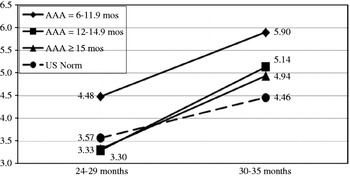
For mean length of phrase, as shown in Figure 2, 24–29-month-old girls (n=110) who were adopted at 6–11.9 months scored higher than the norm (statistical results reported in the following paragraph) while those adopted at 12–14.9 months and at ⩾15 months scored lower than the norm. For the 30–35-month-olds (n=78), the adopted children scored higher than the norm, regardless of age at adoption.
Adopted Chinese girls' mean length of phrase scores by age group and age at adoption group as compared to the US norm.

Effect sizes, calculated using (Mean China – Mean Rescorla and Achenbach)/pooled SD, were used to make further comparison between the Chinese girls' mean length of phrase scores and those obtained by Rescorla and Achenbach (Reference Rescorla and Achenbach2002) in their national probability sample of 177 children aged 24–35 months. Results showed that the 24–29-month-old Chinese girls scored 0·16 standard deviations higher on mean length of phrase (ES=0·16; a small effect), compared to Rescorla and Achenbach's same-age group. For the 30–35-month old group, the Chinese girls were 0·32 standard deviations higher than the normative group (ES=0·32; a small to medium effect).
Additional comparisons to Rescorla and Achenbach's normative group revealed that as the Chinese children's length of exposure to adoptive parenting increased, the gap between the Chinese group and the norm on mean length of phrase scores narrowed. For example, the Chinese children in the 24–29 months group who were adopted at ⩾15 months (M exposure=4·07 months) were 0·38 standard deviations lower than the normative sample (ES=−0·38; a small to moderate effect), while those adopted at 12–14.9 months (M exposure=13·36 months) were 0·11 standard deviations lower than the normative sample (ES=−0·11; a small effect), and those adopted at 6–11.9 months (M exposure=17·00 months) were 0·57 standard deviations above the normative sample (ES=0·57) (a medium effect).
Language delay status and receipt of speech/language interventions
To further explore the adopted Chinese girls' language status, we also examined their language delay. Using the cut-off points recommended by the LDS manual for girls in the normative sample (scores⩽15th percentile for vocabulary; scores⩽20th percentile for mean length of phrase), 16·04% of the adopted Chinese girls met the LDS criterion for delay in vocabulary. The breakdowns for the three age groups were 21·3%, 18·6% and 5·8% for the 18–23-, 24–29- and 30–35-month-old groups, respectively. For mean length of phrase, 17·02% of the adopted Chinese girls met the delay criterion for LDS normative sample. The breakdowns for the two groupsFootnote 1 were 19·1% and 14·1% for the 24–29-month-old and 30–35-month-old adopted Chinese girls, respectively.
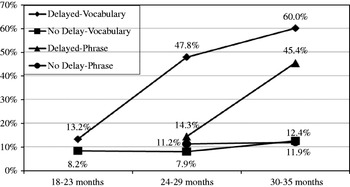
Among the adopted Chinese girls who met the LSD vocabulary delay criteria (n=51), 33·3% had received speech/language intervention; among those who met the LSD phrase delay criterion (n=32), 25% had received speech/language intervention. Figure 3 presents the percentage of the adopted Chinese girls who had received speech/language interventions by language delay status for each of the three age groups. For the 24–29- and 30–35-month-old groups, those with delays in vocabulary were more likely to have received interventions than those with no delays (χ2(1, N=124)=22·99, p<0·001 for the 24–29-month-olds; and χ2(1, N=86)=8·33, p<0·01 for the 30–35-month-olds). For the 30–35-month-olds, those with delays in phrases were more likely than those with no delays to have received intervention services (χ2(1, N=78)=7·64, p<0·01).
Adopted Chinese girls' vocabulary and phrase delay status and percentage who received language intervention.

DISCUSSION
International adoption has provided researchers a rare opportunity to study second-first language acquisition in children exposed to a different language in infancy. The current study drew upon a large dataset of 318 adopted Chinese girls, aged 18–35 months, to investigate expressive language in relation to age at adoption, chronological age, length of exposure to English and several developmental risk measures at the time of adoption. To our knowledge, our sample is the largest in extant studies of expressive language development in IA children. Below we discuss the main findings from our study.
First, the adopted Chinese girls' vocabulary and mean length of phrase scores were mostly associated with age- and time-related variables (i.e. AAA, CA and length of exposure to English). The findings suggest that length of exposure to English and CA are both good predictors of the children's language level. Regarding age at adoption, across all three age groups, children adopted at a younger age scored higher on vocabulary scores. This finding is also consistent with the report by Krakow, Tao and Roberts (Reference Krakow, Tao and Roberts2005), who found that when assessed at the same age, children who were adopted at a younger age and thus exposed to English for a longer period of time had better language skills.
It should be noted that although data on each child's age at adoption, length of exposure to English and CA were available for analysis, length of exposure to English was strongly correlated with both AAA and CA. Consequently it was difficult to go beyond the correlational results to further discern how or if CA and length of exposure to English might affect IA children's language acquisition differently. IA children tend to be adopted around similar ages, and thus the co-linearity between chronological age and length of English exposure that has occurred in many existing studies (e.g. Pollock, Reference Pollock2005) was evident in the present study.
Our second finding, similar to Tan and Yang's results (2005), was that as the adopted Chinese girls got older, the gap between them and the US normative sample also narrowed, and, for those who were adopted at 6–11.9 months and 12–14.9 months, the gap actually disappeared. For phrase length, both 24–29- and 30–35-month-old Chinese girls who were adopted at 6–11.9 months of age scored higher on average phrase than the normative sample. Young children's language outcomes have been shown to be more positive within families with higher SES (e.g. Rescorla & Achenbach, Reference Rescorla and Achenbach2002). Because the adopted Chinese girls in the present study were mostly adopted by high SES white families, it is conceivable that their higher language scores might reflect the benefits of socialization in such a family environment.
Since the girls were adopted at an average age of about 12 months and were about 26 months at the time of assessment, it is unknown whether our findings can be applied to children who were adopted at older ages. At the time of adoption, older children are likely to have more advanced skills in their first language and their English language acquisition process might, therefore, be more complex.
Our third main finding is that delays in different developmental areas were mostly unrelated to expressive language development, with the exception of delays in social skills and observable signs/symptoms of pre-adoption adversity at the time of adoption, which were weakly associated with smaller vocabulary size in the adopted children. Similar results have been reported by Glennen (Reference Glennen2005) regarding international adoptees (12–24 months old) from Eastern Europe. Employing the Words and Gestures and Communication and Symbolic Behavior Scale Development Profile of the CDI, Glennen (Reference Glennen2005) showed that, despite the high levels of physical and developmental delays, the IA children's scores on the CDI were only weakly affected. Our findings are also consistent with what has been reported by other researchers specifically on adopted Chinese children. For example, Cohen and associates (Reference Cohen, Lojkasek, Zadeh, Pugliese and Kiefer2008) found that the adopted Chinese girls were comparable to non-adopted age peers at the 24-month follow-up, despite various degrees of developmental delays at the time of adoption.
Together, these findings offer suggestive evidence that children's language development is rather resistant to early developmental risks. We should point out that our sample was not characterized by severe delays at the time of adoption, however. In our study, data on the children's delays at adoption were also collected retrospectively from parents; future studies employing prospective data are necessary to provide further insights into the relationship between developmental risks associated with early deprivation and later language outcomes.
Our final main finding is that about 16% of the adopted Chinese girls met the LDS criteria for language delays in vocabulary and 17% met the LDS delay criteria for phrase utterance. Our analysis showed that speech/language intervention use was more common among the 24–29- and 30–35-month-olds with language delays than the 18–23-month-olds. Nonetheless, only 33·3% of the children with delays in vocabulary and 25% of the children with delays in mean length of phrase received interventions. This finding contradicts the existing literature (e.g. Hwa-Froelich, Reference Hwa-Froelich2009; Glennen, Reference Glennen2007) that suggests over-referral for speech/language intervention is common for internationally adopted children. It is unknown whether the lack of intervention services was a result of issues relating to screening, access to interventions or parents' belief that the children will catch up on their own.
Finally, the current study focused on the adopted children's expressive language, which is frequently contextualized, and it is unknown whether the smoothness in acquiring the contextualized aspect of a language will lead to an equally impressive ability to acquire more abstract language later on (e.g. academic language). Some researchers have reported that adopted children have more difficulties with academic language (e.g. Dalen, Reference Dalen2001) and with sentence recall than non-adoptees (e.g. Gauthier & Genesee, Reference Gauthier and Genesee2011). Research exploring continuities and discontinuities between early expressive language acquisition and later language use in school contexts by internationally adopted children is certainly warranted. More research in discerning the mechanisms in acquiring different aspects of language is warranted.
Implications and limitations
In 2009, nearly 90% of children adopted from China were under four years of age (US Department of Homeland Security, 2010) . Language learning will be a critical component of their post-adoption development. Findings from the current study might be useful for practitioners in assessing adopted Chinese girls' post-adoption language acquisition. Our finding that developmental risks associated with pre-adoption experience have little relation to the adopted girls' expressive language acquisition offers some assurance to parents and early childhood educators who might be concerned about the impact of early deprivation on these children's language learning.
Findings from our study also highlight the need to ensure that children with language delays receive timely intervention. While careful screening might help identify IA children's language service needs, improvement in the availability of timely services and availability of practitioners who are knowledgeable about adopted children's language development, as well as appropriate service delivery methods might also be needed. State agencies play an important role in providing such services. Because this type of service is sometimes perceived to be only for children from low socio-economic backgrounds, a careful screening process, coupled with a well-crafted awareness program, might help reduce adoptive parents' misconception so as to ensure that IA children with language delays received interventions.
The current analysis is based on the first wave of data from a large-scale longitudinal study of children adopted from China. In interpreting the results, limitations of the study need to be kept in mind. First, this study only included adopted girls and therefore provides no information on how adopted boys are performing linguistically. Second, although there is support for the reliability and validity for the Language Development Survey as a screening measure, the measure is limited to spontaneous vocabulary and best/longest five phrase utterances reported by parents at one point in time. Assessments that tap a broader range of language skills at multiple time-points are needed to further advance our understanding of language development in IA children. Longitudinal analyses that monitor several variables over time, such as parenting practices and utilization of interventions, might be needed to begin to examine possible causal processes in language development. Finally, while parents in Canada and 49 states in the United States participated in the study, the sample was not randomly selected. Thus caution in generalizing the current results is warranted.