HIV prevalence rates in sub-Saharan Africa are 50 times higher in some countries compared with the average outside the region. Prevention efforts have focused on individual-level behavioural interventions that try to influence knowledge, attitudes and behaviours, and there is increasing evidence that infection rates in sub-Saharan Africa are declining. For example, 22 of the most affected countries in sub-Saharan Africa have reduced HIV incidence by more than 25% between 2001 and 2009 (Joint United Nations Programme on HIV/AIDS, 2010). However, it is unclear which of the range of behavioural interventions has been most effective, or to what extent; and even where, as in Uganda, national policy responses have been hailed a success, there has been recent backsliding attributed to a relative neglect of the broader socio-cultural factors that constrain individual behaviour. In Uganda prevalence increased to 7.3% in 2011 from 6.4% in 2005, despite the United States spending $US1.7 billion there to fight AIDS over the same period through the President's Emergency Plan for AIDS Relief (PEPFAR) AIDS prevention strategy (Kron, Reference Kron2012). Limited success in containing the sub-Saharan African HIV epidemic has prompted renewed attention to the social and economic upstream contextual or structural factors, sometimes termed ‘the causes of the causes’ of disease (Birn, Reference Birn2009), which may facilitate viral transmission and undermine intervention effectiveness. These approaches are difficult because they involve deeply entrenched societal factors, such as gender, income distribution and stigma/marginalization (Gupta et al., Reference Gupta, Parkhurst, Ogden, Aggleton and Mahal2008).
A number of investigators have added insights into the ongoing controversy about the relative importance of socioeconomic or socio-cultural factors and sexual concurrency (or other risk behaviours) in explaining the severity of the sub-Saharan African epidemic. A combination of viral, host, transmission and societal factors all contribute to the higher rates of infection in the region, but no single host factor can account for these high prevalence rates (Shandera, Reference Shandera2007). A recent country-level empirical study identified a number of social factors associated with HIV prevalence, finding little effect for poverty but large and significant effects for the predominant religious affiliation of the country (Nattrass, Reference Nattrass2009). Within sub-Saharan African countries, HIV prevalence rates are generally higher in urban compared with rural areas, but there is also much regional variation, with some poorer, rural areas like Nyanza Province in western Kenya having prevalence rates exceeding 20%. A study using the 2005–06 Zimbabwe DHS identified a strong and consistent contextual effect for ethnicity on sexual behaviour among youth aged 15–24, controlling for several socio-demographic and social-cognitive factors (Sambisa et al., Reference Sambisa, Curtis and Stokes2010), suggesting a need for prevention strategies that incorporate and address contextual factors that reproduce and perpetuate risky sexual behaviours.
This study utilized ecological systems theory applied to health (i.e. the social ecological model of health), which views individual health status as determined by a broad array of factors operating at multiple levels, often termed macro-, exo-, meso- and micro-, which describe influences as intercultural, community, organizational and interpersonal or individual. While this conceptual model, adopted by the World Health Organization's Commission on the Social Determinants of Health (Commission on Social Determinants of Health, 2008), applies to general health status, it can be utilized to examine potential influences on specific disease susceptibility, and in the developing world the major threats to population health are infectious disease vulnerability and transmission.
One social health determinant is ethnic diversity or fractionalization, measured as ‘the likelihood that any two randomly drawn individuals from a population will be from different ethnic groups’ (Lieberman, Reference Lieberman2007, p. 1410), and southern sub-Saharan Africa has among the highest levels of ethnic diversity/fractionalization in the world, owing in part to the arbitrary drawing of regional boundaries across ethnic and tribal lines during colonial times (Alesina et al., Reference Alesina, Easterly and Matuszeski2011; Rosen, Reference Rosen2012). In the international development and political institutions literature, ethnic diversity is associated with frequent inter-group conflicts, under-provision of public goods (Banerjee & Somanathan, Reference Banerjee and Somanathan2007; Habyarimana et al., Reference Habyarimana, Humphreys, Posner and Weinstein2007), and generally poorer political and economic performance (Alesina et al., Reference Alesina, Easterly and Matuszeski2011). In a broad sample of developing countries Easterly found that greater social equality or a ‘middle class consensus’ (i.e. a high share of income for the middle class and fewer ethnic divisions) is associated with a variety of positive outcomes, including higher income and growth; more education; better health, infrastructure, and economic policies; less political instability, civil war and ethnic minority persecution; and more social ‘modernization’ and democracy (Easterly, Reference Easterly2001). In a recent study of mostly low-income African countries, ethnic fractionalization was associated with lower public health spending (Platas, Reference Platas2011).
Specifically with regard to HIV/AIDS, ethnic fractionalization in lower-income countries has been associated with lower per capita government AIDS expenditures, less anti-retroviral coverage and a generally weaker policy response (Lieberman, Reference Lieberman2007). The author attributes these findings to the ‘important role of group esteem and the social construction of risk’. That is, in the presence of ethnic fractionalization, groups are less likely to assess their risks as shared. Elites (or ordinary citizens) may downplay their own group's risk out of fear of reputational consequences and discount the indirect benefits of policies targeting ‘other’ groups. Another study using the 2003 Zambian Sexual Behaviour Survey found that the chances of men's involvement in extramarital sex increased with community-level (defined as the survey sampling cluster) ethnic heterogeneity (Benefo, Reference Benefo2008). And another study using data from the Nigeria 2008 DHS and a 2005 HIV seroprevalence sentinel survey found higher HIV prevalence in zones and states within Nigeria characterized by higher levels of ethnic-based violence, but this higher prevalence appeared to be mediated by HIV/AIDS-related knowledge and risk behaviours (Oluwadare & Dada, Reference Oluwadare and Dada2012).
To identify a distinct effect of ethnic diversity on HIV prevalence, a pooled analysis was conducted using DHS household survey data collected since 2006 from three south-eastern sub-Saharan African countries (Kenya, Malawi and Zambia) with HIV prevalence rates exceeding 5% (rates above 1% are considered generalized epidemics: Joint United Nations Program on AIDS (2011)) and HIV biomarker data and data on all covariates. Data are downloadable from the MEASURE DHS website at http://www.measuredhs.com/data/available-datasets.cfm. Demographic and Health Surveys are nationally representative population-based surveys with large sample sizes (usually between 5000 and 30,000 households). In all households, women aged 15–49 are eligible to participate; in many surveys men aged 15–54 or 59 from a sub-sample are also eligible to participate. There are three core questionnaires: a Household Questionnaire, a Women's Questionnaire and a Male Questionnaire. HIV biomarker data complement self-reported household survey information by providing an objective profile of a HIV status in the population. The sample is based on a stratified two-stage cluster design, the first stage being the SEA (or cluster), generally drawn from census files, and the second stage, within each SEA, a sample of households is drawn from an updated list of households. The sample is generally representative at the national, residence (urban–rural) and regional (departments, states) levels. This paper evaluates a community-level (SEA) factor: ethnic diversity or pluralism. This key independent variable was defined as the number of different ethnic groups within a given SEA or cluster. It ranged from 1 to 18 with a mean (SE) of 4.6 (0.16) across all three countries. Because there were over 40 ethnic groups in Zambia, those with fewer than ten observations were folded into the ‘Other’ category. The binary dependent variable was HIV positive serostatus. The DHS provides anonymous, voluntary testing using blood spots collected on filter paper from a finger prick. An initial ELISA test is performed in the laboratory, with re-testing of all positive tests and 5–10% of the negative tests with a second ELISA. For those with discordant results on the two ELISA tests, a new ELISA or a Western Blot is performed (Measure DHS, 2012).
The final empirical model regressed the dependent variable individual HIV serostatus on the key community-level independent variable ethnic diversity and included twelve individual-level control variables: number of sexual partners (other than husband/wife) in the past year (dummy coded as 0, 1, 2 and 3 or more), lifetime number of sexual partners (coded as 1, 2, 3–5, 6–10 and >10), condom use at last intercourse, self-reported STD in the past year, poverty status, male gender, urban residence, age (in years), education (in years), employed (currently working, having worked in past year, or on leave in the past 7 days), married or living together and religious affiliation (Catholic, Protestant/other Christian, Muslim, no/other religion). Multicollinearity was assessed by examining the correlation matrix for potential control variables included in the final model. Because the data were nested within clusters and within countries, the assumption of standard logistic regression that respondents are independent within each cluster and that there is equal variance among clusters did not hold, and a multilevel regression framework was needed to account for the hierarchical data structure. The model assumed random variation in intercepts across clusters (random intercepts model) but constant slopes for beta coefficients. The two levels consisted of 23,345 respondents clustered within 1561 SEAs across the three countries. The country-stratified analysis proceeded in three steps. First, a null or base model including only the dependent variable HIV prevalence established the degree of variance at the cluster level in order to validate use of a multilevel framework. Next, all the level-1 control variables were added to the model (Model 1) in order to assess the improvement in model fit and presence of significant effects for individual-level predictors of HIV serostatus. Finally, the key independent variable community-level ethnic diversity (Model 2) was added to test for significance of this predictor controlling for all other variables in the model.
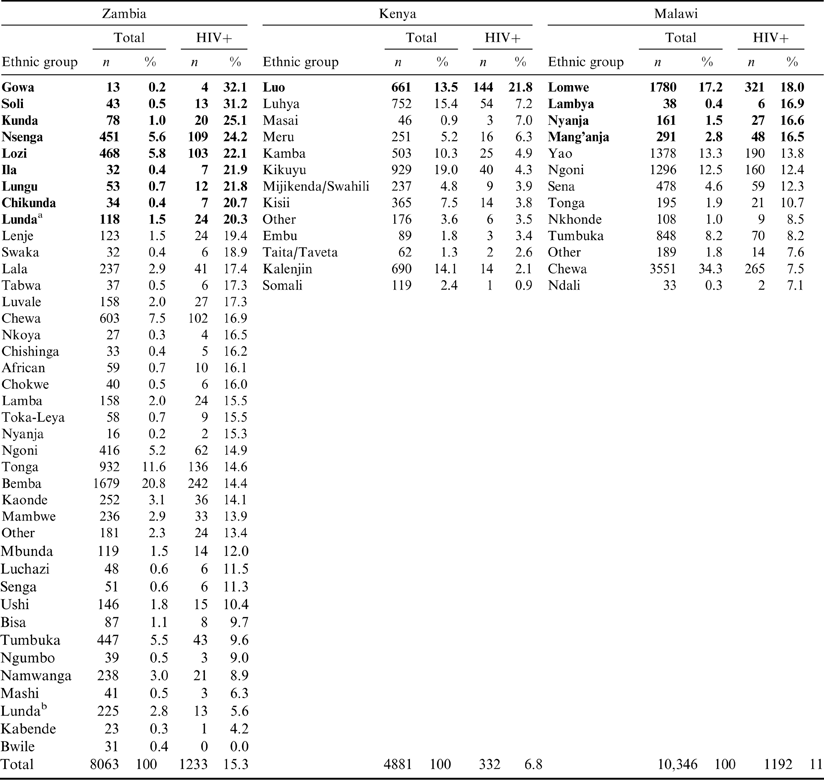
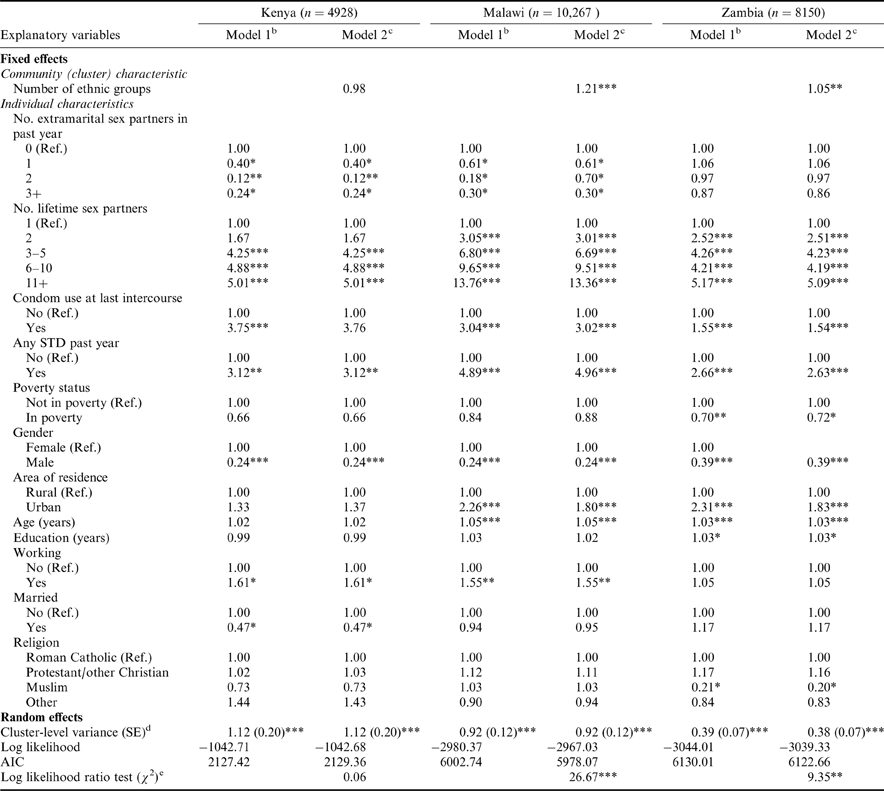
Mean HIV prevalence was 15.3% in Zambia, 6.8% in Kenya and 11.5% in Malawi and varied by ethnic group (Table 1). In Zambia nine ethnic groups had prevalence rates exceeding 20% and in Malawi four (Lomwe, Lambya, Nyanja and Mang'anja) had rates exceeding 16%, while in Kenya a rate of 21.8% was confined to the Luo. In bivariate analyses, the number of ethnic groups in a cluster was significantly correlated with HIV prevalence in the cluster (r=0.37, p<0.001). The final multilevel weighted logistic regression models by country are shown in Table 2. The base model including only the dependent variable HIV prevalence rate showed significant variation by cluster. In Model 1 including the individual-level control variables showed a dose-dependent increase in the odds of being HIV positive with more lifetime sexual partners. Reporting eleven or more partners (reported by 6.1% of the sample or 1428 individuals) increased the likelihood of being HIV positive five-fold in Kenya and Zambia and thirteen-fold in Malawi. Condom use at last intercourse and an STD in the past year increased this likelihood by three to five times in Kenya and Malawi and by 1.5 to 2.6 times in Zambia. (Note that because this analysis is correlational, reverse causality probably explains the former association, i.e. condom use is likely to be more frequent among those who know they are HIV positive and/or who engage in higher-risk sex.) Male gender was protective in all three countries and Muslim religious affiliation was protective in Zambia, while urban residence and age in Malawi and Zambia, and being employed in Kenya and Malawi, were associated with a slightly increased likelihood of being HIV positive.
Summary statistics for ethnic groups, by country and HIV serostatus

Numbers are estimated counts/percentages adjusted for survey sampling frame. Groups in bold typeface have notably high prevalence rates compared with the national average.
a Luapula.
b North-western.
Parameter estimatesa (odds ratio) for multilevel weighted logistic regression models for cluster-level ethnic diversity
a Parameters for predictors (fixed effects) are reported as odds ratio; for random effects, the parameter is the variance.
b Baseline model with control variables alone.
c Full model with control variables and predictor variables.
d Significance of random effects evaluated by comparing model with a similar one in which random effects have been constrained to be zero.
e Compared with Model 1.
*p<0.05; **p<0.01; ***p<0.001.
In Model 2 adding the cluster-level ethnic diversity measure significantly improved the model fit in both Malawi and Zambia. The number of different ethnic groups per cluster in both Malawi (OR=1.21, p<0.001) and Zambia (OR=1.05, p<0.01) was associated with a significant increase in the likelihood of being HIV positive. The marginal effects of ethnic diversity were that a 1 point increase in the number of ethnic groups within a given SEA cluster was associated with a 1.21 times increased likelihood of being HIV positive in Malawi and with a 1.05 times increased likelihood of being HIV positive in Zambia, controlling for all other variables in the models. To the author's knowledge this report is the first to empirically demonstrate an association between neighbourhood ethnic diversity and HIV prevalence using the DHS sampling cluster. Future studies might validate this finding and clarify its mechanism of action.
Acknowledgment
This work was supported in part by an R24 NIH center grant to the Carolina Population Center, the University of North Carolina at Chapel Hill.