

Secrecy is defined as the intention to conceal information from one or more individuals (Slepian, Chun, & Mason, Reference Slepian, Chun and Mason2017). Instead of not sharing at all, people tend to divulge their secrets to trustworthy confidants, such as romantic partners, friends or family members, for catharsis and anxiety release (e.g., Pennebaker, Reference Pennebaker1997; Petronio, Reference Petronio2002; Vangelisti, Reference Vangelisti1994; Vangelisti, Caughlin, & Timmerman, Reference Vangelisti, Caughlin and Timmerman2001). Some research on secret revelation has noted its main function of health benefits and as an important marker of relational intimacy (Bochner, Reference Bochner and Burgoon1982; Parks, Reference Parks and Burgoon1982; Pennebaker, Reference Pennebaker, Uleman and Bargh1989). However, Kelly (Reference Kelly2000) further suggests that secret revealers can only benefit when the information recipients are considered as non-judgmental, discreet, and insight-offering (also see Afifi, Shahnazi, Coveleski, Davis, & Merrill, Reference Afifi, Shahnazi, Coveleski, Davis and Merrill2017). Given these, it remains possible that confidants take on heavy responsibilities in the process of others’ revelation. Although being needed and trusted can enhance one's self-worth, the burden and distressed feelings confidants may experience with guarding the secret information safe can be aversive to their health (Afifi & Caughlin, Reference Afifi and Caughlin2006; Pelham & Swann, Reference Pelham and Swann1989). Yet, to date, little research has paid attention to the perspective of being a confidant keeping secrets for others. This study aims to take such a point of view by exploring how secret information is processed and managed by confidants.
The goal of the current study is thus to examine the burden that confidants experience when they keep secrets for others, as well as the association between the burden they experience and their relationship satisfaction. As suggested by prior literature regarding secrecy and self-disclosure, the mediation effects of confidants’ negative affect are examined regarding the association between burden and relational outcomes (i.e., a model of cognition-affect-relationship).
Confidant Burden
Communication privacy management (CPM) theory focuses on the communicative process of private information management by considering both the discloser and the recipient or confidant. Thus, for the current study, we are concerned with private information in the form of secrecy that involves information intentionally hidden (e.g., Bok, Reference Bok1989; Petronio, Reference Petronio2002). As argued by communication scholars, the metaphor of ‘boundary’ depicts a dialectical force that exists between disclosure and secrecy (e.g., Baxter & Montgomery, Reference Baxter and Montgomery1996; Petronio, Reference Petronio2002). Furthermore, Petronio (Reference Petronio and Petronio2000) points out that the word ‘sharing’ may conceptualise the information disclosure process more accurately; when secret revealers tell confidants their secrets, they are making the recipients co-owners or shareholders of the information, which entitles the co-owners’ the right to manage the private information with explicit and/or implicit rules. In the process of private information regulation, boundaries also mark the border between openness and closedness, highlighting that revealers expect the informed parties to be trustworthy and discreet (e.g., Petronio, Reference Petronio2002; Petronio & Bantz, Reference Petronio and Bantz1991).
The revealer's expectations and actions may thus restrict the confidant's freedom to deal with the information independently, which may burden the confidant (e.g., Petronio, Reference Petronio and Petronio2000). Slepian, Masicampo, and Ambady (Reference Slepian, Masicampo and Ambady2014) suggest that the experienced burden of secrecy is perceived as cognitive preoccupation. Thus, guided by an embodied cognition perspective, burden here is broadly defined as the cognitive taxation caused by secret-keeping (LeBel & Wilbur, Reference LeBel and Wilbur2014). Existing research shows that people are more likely to reveal the secrets that plague them due to their cognitive burden (e.g., Harber & Pennebaker, Reference Harber, Pennebaker and Christensen1992; Pennebaker, Reference Pennebaker1990; Stiles, Reference Stiles and Russell1987). However, an important missing link in the extant research is secret management by confidants, who might also be burdened by the effortful mental control. Even if confidants are willing recipients of secrets, they could experience psychological and health problems without their conscious awareness (e.g., Kelly, Reference Kelly1999, Reference Kelly2002; Lane & Wegner, Reference Lane and Wegner1995; Pennebaker & Susman, Reference Pennebaker and Susman1988; Rodriguez & Kelly, Reference Rodriguez and Kelly2006). As such, our first goal is to explicate factors associated with cognitive burden for confidants.
Factors That Predict Secret-Keeping Burden for Confidants
Although becoming a secret confidant indicates a high level of closeness and trust in the relationship and that confidants can experience positive outcomes (e.g., feeling valued, trustworthy), the cognitive burden of secret-keeping cannot be ignored. The preoccupation model of secrecy is a prevalent theoretical framework to explicate the psychological burden of secret-keeping, which implies that keeping secrets typically causes cognitive burden to people (e.g., Lane & Wegner, Reference Lane and Wegner1995; Wegner & Lane, Reference Wegner, Lane and Pennebaker1995). Paradoxically, individuals’ attempts to control their thinking about the secret might elicit more intrusive thoughts regarding the secret (Lane & Wegner, Reference Lane and Wegner1995; Maas, Wismeijer, Van Assen, & Aquarius, Reference Maas, Wismeijer, Van Assen and Aquarius2012; Wenzlaff & Wegner, Reference Wenzlaff and Wegner2000). Research has found that both thought suppression and mental control contribute to burden on individuals facing unwanted thoughts (e.g., Purdon, Reference Purdon2004). Furthermore, the primary theoretical accounts of thought suppression indicate that important and negative information require more cognitive load than relatively benign ones (Afifi & Caughlin, Reference Afifi and Caughlin2006; Afifi & Steuber, Reference Afifi and Steuber2009; Wenzlaff & Wegner, Reference Wenzlaff and Wegner2000). Following this logic, the characteristics of the secrets that create burden for secret-keepers may also function as predictors of burden for confidants.
Secret Characteristics — Quality, Quantity, Valence, and Negative Face Threat
Certain secrets might be more burdensome than others. First, secrets often vary in their size and severity (Vrij, Nunkoosing, Paterson, Oosterwegel, & Soukara, Reference Vrij, Nunkoosing, Paterson, Oosterwegel and Soukara2002). In the current study, quality of secret refers to the degree of perceived seriousness (e.g., keeping a secret about infidelity vs. a white lie). From a psychological perspective, larger or more serious secrets likely involve more negative and intrusive thoughts, thus eliciting more thought obsession and suppression as well as greater distress (Salkovskis & Campbell, Reference Salkovskis and Campbell1994). In addition, Slepian, Masicampo, Toosi, and Ambady (Reference Slepian, Masicampo, Toosi and Ambady2012) have discussed that the metaphorical expressions of ‘carrying a secret’ and ‘being weighed down’ may also be associated with the activation of a physical burden. For example, individuals who are preoccupied with an important secret are more likely to feel that the hills are steeper and that helping others with physical tasks would require more effort (also see Slepian, Camp, & Masicampo, Reference Slepian, Camp and Masicampo2015).
Second, although not all secrets are ‘dark’ or adverse, negatively valenced secrecy requires greater mental control, which results in further stress and burden (Vangelisti & Caughlin, Reference Vangelisti and Caughlin1997). Thus, an embodied cognition perspective suggests that more significant and negative secrets place greater distress on individuals. As a result, it is reasonable to expect that negatively valenced secrets would be more burdensome to secret-holders as well as those in whom they confide.
Third, in addition to the size (e.g., big vs. small) and valence (e.g., positive vs. negative) of secrets, the amount of secrets that revealers ask confidants to keep are also likely related to confidants’ burden. As Maas et al. (Reference Maas, Wismeijer, Van Assen and Aquarius2012) have suggested, cognitive preoccupation is toxic to people's secret-keeping. In line with this reasoning, the amount of secrets appears to be positively correlated with individuals’ cognitive efforts with information hiding. Thus, confidants may be more mentally taxed and burdened by a greater amount of secret information as compared with a smaller amount.
Another important factor related to confidants’ burden is the restriction of freedom. In addition to their minds being preoccupied by the secret, confidants have to restrain themselves from divulging. This restriction can be explained by a face-threat perspective. Based on Goffman's (Reference Goffman1967) initial work, face is defined as the positive and desired social image that a person creates for him/herself through interactions with others. Desires based on both freedom of action (negative face) and positive regard (positive face) are always subject to threat during social interaction (Holtgraves, Reference Holtgraves1992). Acts that run contrary to the face wants of the addressee and/or the speaker are called face-threatening acts (FTAs; Brown & Levinson, Reference Brown and Levinson1978). In the context of secrets, the revealers’ act of asking confidants to keep secrets for them is a type of FTA. Specifically relevant to secret-keeping, a confidant's negative face is threatened to the extent the secret-keeping implies that the confidant should constrain his/her behaviour to avoid sharing the secret with others (Cupach & Carson, Reference Cupach and Carson2002; Cupach & Metts, Reference Cupach and Metts1994; Kelly, Reference Kelly1999, Reference Kelly2002). This constraint might become burdensome to confidants.
In sum, we argue that burden will increase as secrets increase in importance, amount, negative valence, and negative face threat. Thus, the following hypothesis is proposed:
H1: Perceived (a) quality, (b) quantity, (c) negative valence, and (d) negative face threat of secrets kept for a relational partner are positively associated with confidants’ cognitive burden.
Outcomes of Confidant Burden
Our second purpose is to understand how cognitive burden is associated with intrapersonal (i.e., negative affect) as well as relational (i.e., satisfaction and distance) outcomes. Research on the cognitive preoccupation of secrecy has suggested that keeping secrets can lead to information rumination and thought suppression, which may cause distress (e.g., Lane & Wegner, Reference Lane and Wegner1995; Pennebaker & Susman, Reference Pennebaker and Susman1988). As a result, the burden associated with keeping secrets might generate negative affect. Given that previous literature has argued individuals’ cognitive processing influences their emotional feelings in a congruent way, the burden of secret-keeping in confidants should be associated with emotional arousal (Bower, Reference Bower1981; Marroquín, Boyle, Nolen-Hoeksema, & Stanton, Reference Marroquín, Boyle, Nolen-Hoeksema and Stanton2016). More specifically, the more burden confidants feel, the more they likely experience negative emotions. Moreover, considering a face management perspective, when one's face is threatened, one may experience distress and discomfort (Cupach & Carson, Reference Cupach and Carson2002; Goffman, Reference Goffman1967). In the current context, confidants’ negative face is likely threatened by the secret-keeping request, which could increase their negative emotional arousal. The second hypothesis is thus:
H2: Confidants’ secret-keeping cognitive burden is positively associated with their negative affect regarding secret-keeping for a relational partner.
Although information sharing reflects the relationship intimacy and trust between the revealer and the confidant (Chelune, Vosk, Waring, Sultan, & Ogden, Reference Chelune, Vosk, Waring, Sultan and Ogden1984), secret disclosure may put the relationship between the revealer and confidant at risk when cognitive burden is involved. As such, we assess how negative affect stemming from cognitive burden is associated with general relational qualities in personal relationships: satisfaction and distancing. As Levine and Safer (Reference Levine and Safer2002) suggested, emotions have an impact on interpretations and appraisals of experiences in relationships. Hence, if secret-keeping creates burden for confidants, and thereby elicits negative emotions, then confidants might be more likely to evaluate relational satisfaction with the secret revealer more negatively. Also, it is reasonable for individuals to distance themselves from the source of negative affection or disaffection (Vangelisti & Young, Reference Vangelisti and Young2000). As such, the following is hypothesised:
H3: Confidants’ negative affect regarding secret-keeping is: (a) negatively associated with relationship satisfaction, and (b) positively associated with relational distancing with the secret revealer.
Our final goal is to assess the mediating effects of negative affect to explore and analyse some aspects of the complex interrelation in such interactive processes. As Parkinson (Reference Parkinson1997) explains, people's emotional reactions are important factors in their interactional processes (see also Vangelisti & Young, Reference Vangelisti and Young2000). Based on the appraisal theory, Lazarus (Reference Lazarus1991, Reference Lazarus, Scherer, Schorr and Johnstone2001) further proposes the associations among cognition, motivation, and interpersonal relationships to conceptualise the highly interactive processes between people (see also Knobloch & Solomon, Reference Knobloch and Solomon2003; Roseman & Smith, Reference Roseman, Smith, Scherer, Schorr and Johnstone2001). Taken together, it remains possible that emotion mediates the associations between cognition and corresponding communicative behaviours. In the current study, we argue confidants’ secrecy burden creates a context within which negative emotions are activated, which can have implications for perceived relational qualities (e.g., satisfaction and distancing) are made. We thus propose the final hypothesis:
H4: Confidants’ negative affect regarding secret-keeping mediates the association between cognitive burden and relational qualities (i.e., relationship satisfaction and relational distancing) with the secret revealer.
Given the exploratory nature of the current study, alternative models regarding the associations among cognition, emotion, and relationship qualities in the processes of confidants’ secret information management will also be tested.
Method
Participants
A total of 231 participants who were currently keeping secrets for a relational partner were recruited from Amazon.com's Mechanical Turk website (www.mturk.com) and asked to complete an online survey. Participants were paid $0.30 each for their time in completing the survey. Although this was a convenience sample, studies have suggested that MTurk samples are more diverse than college student samples (e.g., Buhrmester, Kwang, & Gosling, Reference Buhrmester, Kwang and Gosling2011; Paolacci, Chandler, & Ipeirotis, Reference Paolacci, Chandler and Ipeirotis2010).
The sample was comprised of 54.1% females (n = 125) and 45.9% males (n = 106). Participants ranged in age from 18 to 73 years and averaged 32.6 years (SD = 9.7 years, Mdn = 30 years). Participants’ ethnicity included White or Caucasian (n = 115, 49.8%), Asian or Pacific Islander (n = 89, 38.5%), Black or African American (n = 16, 6.9%), Hispanic or Latino (n = 6, 2.6%), and other or multiple ethnicities (n = 5, 2.2%).
Measures and Procedures
Respondents were asked to choose an intimate relational partner for whom they were keeping at least one secret and to indicate the type of relationship with this secret revealer via three options: friend (44.2%, n = 102), romantic partner (50.6%, n = 117), or a third option listed as ‘Other and please specify’ (5.2%, n = 12; e.g., relatives and colleagues). Considering intimacy may vary depending on types of relationship, preliminary analyses were conducted, suggesting that there were no substantial differences by relationship type.Footnote 1 Thus, all participants were analysed together. Because respondents could be keeping more than one secret for the same relational partner, they were asked to recall up to five secret topics they were keeping for this person within the past six months and complete a set of questionnaires. The total number of reported secrets was 1,107; the vast majority reported five secrets (n = 213; four reported one secret, seven reported two secrets, four reported three secrets, and three reported four secrets).
Characteristics of secrets
Each participant was asked to recall up to five secret topics, with instructions based on Slepian et al. (Reference Slepian, Masicampo, Toosi and Ambady2012), stating: ‘Without revealing specific details about your secret, we are curious what it pertains to. Please write about your big/small secret in the provided box.’ For each secret topic, participants were instructed to answer questions related to the secret features, including quality, quantity, and valence. The sequence in which participants completed the three variables captured by the measures was randomised to minimise the order effects.
Confidants indicated their perceptions of the quality of each secret (e.g., degree of seriousness) through three items on a 7-point semantic differential scale derived from Vrij et al. (Reference Vrij, Nunkoosing, Paterson, Oosterwegel and Soukara2002; e.g., extremely trivial to extremely serious, from extremely insignificant to extremely significant; Cronbach's α = .93; M = 4.85, SD = 1.15). To measure the number of secrets that confidants keep, four items were adapted from Vrij et al. (Reference Vrij, Nunkoosing, Paterson, Oosterwegel and Soukara2002). Participants indicated how many and how frequently they kept a secret for a relational partner on a 7-point scale (e.g., ‘How many secrets are you currently keeping for that particular person?’; Cronbach's α = .87; M = 4.21, SD = 1.22). In addition, confidants evaluated valence using a scale borrowed from Vangelisti and Caughlin (Reference Vangelisti and Caughlin1997). Two 7-point semantic differential items (extremely positive/extremely negative, and extremely good/extremely bad) were used (r = .92; Cronbach's α = .92; M = 4.31, SD = 1.38). Because each secret may theoretically have a unique imprint on the emotional and relational outcomes, it was considered difficult for confidants to completely foresee the consequences caused by each secret. Thus, to delineate a general picture of the secrets that confidants were keeping for the same person, the items for assessing characteristics of secrets were averaged across the various secrets, with higher scores indicating a higher level of seriousness, a greater number of secrets being kept for a partner, and a greater negative valence.
Perceived negative face threat
The degree of perceived negative face threat was measured with a scale adapted from Lee, Park, Imai, and Dolan's (Reference Lee, Park, Imai and Dolan2012) Politeness Scale, and only the eight items related to negative face-threatening acts were included in this analysis. The instructions were adapted for the current study so that respondents reported how keeping secrets for their relational partner was associated with perceived negative face threat. Participants reported on a 7-point Likert scale (1 = strongly disagree, 7 = strongly agree). Sample items include ‘Keeping the secrets for him/her restrict what I do’ and ‘Keeping the secrets for him/her threatens my freedom of action’ (Cronbach's α = .95; M = 3.58, SD = 1.69).
Cognitive burden of secret-keeping
Participants indicated the degree to which they felt burdened by keeping secrets for their relational partner using the cognitive preoccupation subscale of the Tilburg Secrecy Scale-25 (Van Vessem, Reference Van Vessem2010; Wismeijer, Sijtsma, Van Assen, & Vingerhoets, Reference Wismeijer, Sijtsma, Van Assen and Vingerhoets2008). The participants rated the five items (e.g., ‘How much do you think about the secrets?’ and ‘How much do you consider keeping his/her secrets as a burden to you?’) on a 7-point Likert-type scale (1 = not at all, 7 = very much; Cronbach's α = .83; M = 4.60, SD = 1.37).
Negative affect
Respondents were asked to think about the secrets that they were currently keeping for their relational partner and indicate to what degree they felt a variety of emotions regarding the burden associated with that secret-keeping. This measure is a combination of 10 negative affect items from Watson, Clark, and Tellegen's (Reference Watson, Clark and Tellegen1988) Positive Affect and Negative Affect Scale (PANAS; i.e., hostile, jittery, ashamed, guilty, scared, afraid, distressed, upset, nervous, and irritable) and another 10 non-redundant items from Specher and Sedikides’ (1993) negative emotions index (i.e., hurt, anger, anxious, jealousy, embarrassed, lonely, sad, depressed, frustrated, and defensive). The items selected were those that might be especially pertinent to issues related to the burden associated with secret-keeping. Participants rated these items on a scale from 1 (very slightly or not at all) to 7 (extremely). To determine whether all of the items loaded on the same factor when combining these two measures, we conducted a PCA that yielded two factors, but one contained only one item: jittery. Excluding this item, a subsequent PCA indicated a single-factor solution, accounting for 60.83% of the common variance (eigenvalue = 11.56, all items loading above .62). Thus, the 19 items were combined into one overall negative affect variable (Cronbach's α = .96; M = 3.57, SD = 1.57).
Relational qualities
The qualities of the relationship with the secret revealer were measured in terms of relational distancing and relationship satisfaction. For relational distancing, participants were asked to consider the effect of the secret-keeping on their relationship and respond to three items on a 7-point semantic differential scale (more distant–close, more tense–relaxed, more remote–intimate; McLaren & Solomon, Reference McLaren and Solomon2010; Vangelisti, Young, Carpenter-Theune, & Alexander, Reference Vangelisti, Young, Carpenter-Theune and Alexander2005). Pertinent items were recoded so that a higher average indicates greater relational distancing (Cronbach's α = .87; M = 3.46, SD = 1.56).
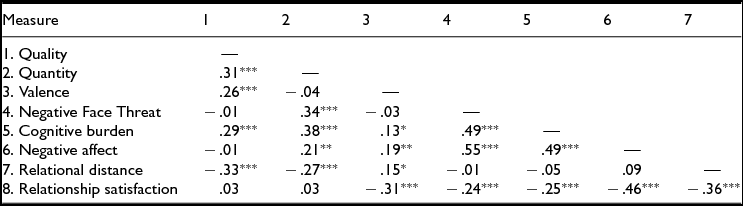
Huston, McHale, and Crouter's (Reference Huston, McHale, Crouter, Glimour and Duck1986) Marital Opinion Questionnaire was adapted to measure the current relationship satisfaction between the confidant and the revealer. This measure consists of 10 items on a 7-point semantic differential scale (e.g., miserable–enjoyable, hopeful–discouraging) and an additional item assessing global satisfaction (e.g., completely dissatisfied–completely satisfied). Appropriate items were reverse coded so that a higher average indicated a greater relational satisfaction (Cronbach's α = .91; M = 4.87, SD = 1.25). See Table 1 for the correlations of all measures.
Correlations Among the Variables

Note: *p < .05. **p < .01. ***p < .001.
Results
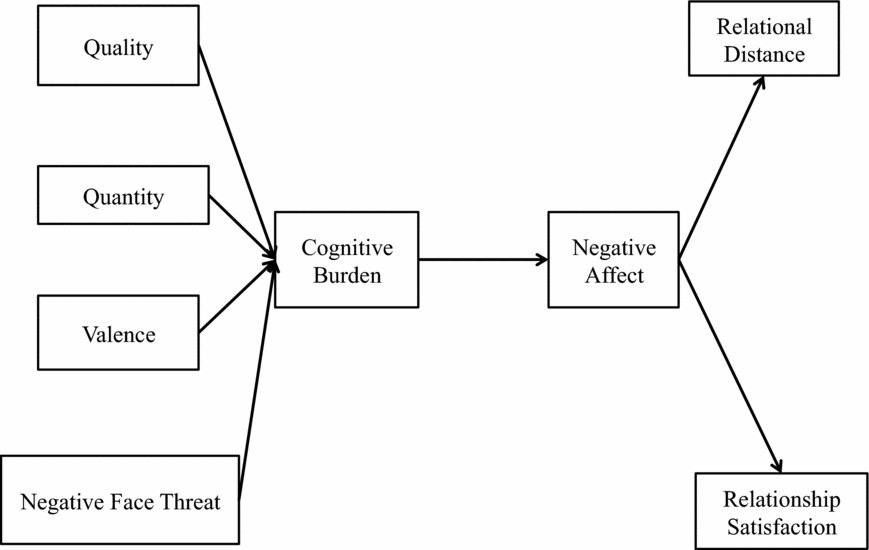
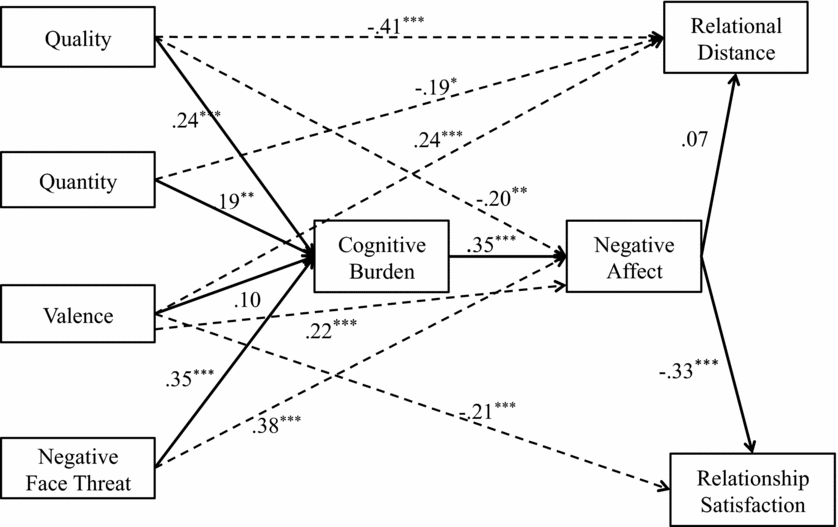
A path analysis approach is usually applied to assess sets of relationships among variables that are linear, and each path coefficient is a partial regression coefficient (Hayes, Reference Hayes2017). To delineate an exploratory map of how burden is associated with confidants’ secret information processing as well as to determine the unique contribution of each factor to confidants’ burden and associated relational outcomes, a path model with bootstrapping (i.e., 2,000 samples, maximum likelihood estimation, 95% confidence intervals) was conducted in AMOS to test all hypotheses simultaneously. See Figure 1 for the hypothesised model. The hypothesised model showed insufficient fit, χ2(14) = 122.06, p < .001; CFI = .745, RMSEA = .183, CMIN/df = 8.72. The modification indices suggested that the addition of several paths would increase the fit of the model: paths from quality, valence, and negative face threat to negative affect as well as paths from quality and quantity to distancing, and valence to relational satisfaction and distance. Although direct paths from the secret characteristics to negative affect or the relational qualities were not hypothesised (i.e., we focused on the indirect effects between cognitive burden and relational qualities), these direct paths made theoretical sense. As mentioned, keeping one's sexual orientation secret, for example, should cause more distressed feelings as compared to keeping a trivial white lie secret. Also, adding these paths yielded good model fit, χ2(7) = 6.43, p = .490; CFI = 1.00, RMSEA = .000, CMIN/df = 0.92. See Figure 2 for the standardised regression weights for the significant paths.
The initial hypothesised model of cognition-affect-relational quality.

The final model of cognition-affect-relational quality.

Regarding H1, all four proposed secret characteristics — quality, quantity, valence, and negative face threat — were associated with burden. Burden increased as the kept secrets increased in importance, amount, negativity, and negative face threat. Valence, however, only approached significance. Combined, these characteristics explained 35% of the variance in burden. H2 was also supported in that burden was significantly and positively associated with negative affect. Yet, quality, valence, and negative face threat were also directly related to negative affect; although valence and negative face threat were positively associated with negative affect, quality was negatively associated with negative affect. As such, the degree of importance (e.g., quality) of the secrets might increase the cognitive load, but perhaps assuage the negative emotions elicited. Combined, these explained 41% of negative affect. Although we modelled the characteristics of secrets as indicators of burden and are not necessarily interested in the mediating role of burden between the secret characteristics and negative affect, the indirect effects of quality (.085, 95% CI [.025, .163], p = .002), quantity (.067, 95% CI [.009, .139], p = .022), and negative face threat (.124, 95% CI [.062, .189], p = .001) were significant; however, the indirect effect of valence was not (.034, 95% CI [-.010, .086], p = .130).
H3 was supported for relational satisfaction but not for distancing; negative affect negatively predicted satisfaction whereas it was unrelated to distancing. Although these are not the main foci of this study, our data supported the claim made by prior literature that the secret characteristics of quality, quantity, and valence were directly associated with distancing (e.g., Chelune et al., Reference Chelune, Vosk, Waring, Sultan and Ogden1984). Overall, the variance explained by the predictors was 17% and 27% for distancing and satisfaction respectively.
H4 stated that negative affect mediated the relationship between burden and relational qualities. However, given that negative affect was not associated with relational distancing, a mediating effect was not possible. But H4 was supported for satisfaction (−.116, 95% CI [−.18, −.057], p = .001); hence, as modelled here, burden appears to affect relational satisfaction through the negative emotions that are elicited.
Alternative Models
To further explore confidants’ experiences of secret-keeping, we also conducted several alternative models to best understand the possible associations between their cognitive, emotional, and relational outcomes in the current context. More specifically, first we assessed whether cognitive burden and negative affect could be modelled as a latent factor of burden. As such, a similar model was conducted (with the added direct paths to be as similar to our final model as possible), with a latent variable created with both cognitive burden and negative affect as the mediator between the secret characteristics and the relational qualities. This measure showed an unacceptable fit, χ2(9) = 51.66, p < .001; CFI = .899, RMSEA = .144, CMIN/df = 5.74. A second model assessed cognitive burden and negative affect as separate but simultaneous mediators of the secret characteristics and relational qualities. Again, all paths remained the same, but cognitive burden and negative affect were linked through a covariance term and not a direct path. This model, while sufficient, did not yield as good a fit, χ2(4) = 5.92, p = .205; CFI = .995, RMSEA = .046, CMIN/df = 1.48. In comparing the BIC and AIC between models, both were smaller than our original modified model (BICoriginal = 164.263, AICoriginal = 64.43 as compared to BICalternative_2 = 180.08, AICalternative_2 = 69.92). In a third alternative model, the path from negative affect to relationship satisfaction was reversed to assess how people's relationship satisfaction level might affect their emotional reactions. All other paths remained the same. Although it was sufficient, this model also did not yield as good a fit, χ2(7) = 27.90, p < .001; CFI = .951, RMSEA = .114, CMIN/df = 3.99. In comparing the BIC and AIC between models, both were smaller than our original modified model (BICoriginal = 164.263, AICoriginal = 64.43 as compared to BICalternative_3 = 185.73, AICalternative_3 = 85.90). As suggested by prior research, individuals’ cognitive processing, emotional feelings, and relational qualities are closely related, which could not be separated when analysing the current context of confidants’ information management (e.g., Lazarus, Reference Lazarus1991, Reference Lazarus, Scherer, Schorr and Johnstone2001; Parkinson, Reference Parkinson1997; Vangelisti & Young, Reference Vangelisti and Young2000). Thus, it made both theoretical and statistical sense to retain the original, modified model.
Discussion
Keeping secrets can be broadly conceived as information control. The current work examined secret concealment from the confidant's perspective (see Kelly & McKillop, Reference Kelly and McKillop1996). The cognitive burden experienced by confidants is exclusively transferred from secret-holders. For example, secret-holders might experience a certain sense of catharsis and support from the confidants in revealing, whereas confidants might feel a sense of trust and intimacy in the relationship but also an obligation to conceal the secret for the sake of the partner and to maintain the relationship. Thus, the current study: (1) assessed indicators of confidants’ cognitive burden associated with secret-keeping, and (2) examined the association between cognitive burden and relational quality as well as the mediating role of negative affect.
Factors That Comprise Cognitive Burden
H1 was supported as the results showed that the importance, amount, negative valence, and negative face threat of secret-keeping were all positively associated with cognitive burden. That is, these variables are good indicators of confidants’ secret-keeping burden. This is consistent with previous research showing that the greater amount and importance of secrets are associated with an increased burden for secret holders (e.g., Slepian et al., Reference Slepian, Masicampo and Ambady2014; Slepian et al., Reference Slepian, Camp and Masicampo2015). Additionally, previous work also demonstrates that the perceived freedom restriction of secret-keeping is usually described as being burdensome and a sensation of weight (Slepian et al., Reference Slepian, Camp and Masicampo2015). Negative valence, however, only approached significance in predicting burden; as such, the perceived valence of a secret may not contribute to cognitive burden as much as other characteristics. Confidants may consider secret-keeping as a prosocial behaviour to protect their relational partners’ desirable social image (Kelly, Reference Kelly2000). Instead, perceived negativity of secrets was significantly and positively associated with confidants’ negative emotions and relational distancing. Hence, valence might have more direct links with negative affect and relational behaviours than cognitive burden.
As predicted by H2, confidants’ cognitive burden resulting from secret concealment was significantly and positively related to negative affect. Bower's (Reference Bower1981) argument that cognitive processing takes the stimulus role of emotion induction is consistent with our findings. Although cognitive burden served as a partial mediator in the association between a secret's characteristics of importance, negative face threat and people's emotional state, as well as the number of secrets, there were also direct effects that might be important to consider in theory development regarding confidants’ secret-keeping. For example, whereas perceived valence and negative face threat were significantly and positively related to negative emotions, the importance of the secrets (i.e., quality) was surprisingly inversely associated with negative affect. In other words, greater importance of the secrets kept was associated with more cognitive taxation but fewer negative emotions. Given these findings, it is important to remember that secret revelation is a dyadic process involving the information holder and the information recipient simultaneously (Caughlin Afifi, Carpenter-Theune, & Miller, Reference Caughlin, Afifi, Carpenter-Theune and Miller2005; Petronio, Reference Petronio2002). Information sharing, especially regarding important information, is a mark of intimacy and trust in the context of personal relationships (e.g., Kelly & McKillop, Reference Kelly and McKillop1996; Vangelisti, Reference Vangelisti1994). When more important secrets are revealed, confidants might feel valued and trusted, which might mitigate some of the distress created by secret-keeping. Further, the results indicated that being entrusted with important secrets is also associated with feeling closer to the revealer.
Relational Quality Outcomes
The way people evaluate the interactions between themselves and their relational partners affects their emotional experiences as well as their relational meanings (Lazarus, Reference Lazarus1991; Vangelisti et al., Reference Vangelisti, Young, Carpenter-Theune and Alexander2005). Vangelisti and Young (Reference Vangelisti and Young2000) note that appraisals take place in the context of social interactions, which further influence the emotional experience in people's relationships. As such, our model predicted that negative affect would mediate the association between cognitive burden and the relational characteristics. The findings indicated that negative affect indeed mediated the association between confidants’ cognitive burden and relationship satisfaction. Yet, given the correlational nature of the current data, another reasonable explanation for the mediating role of negative affect is that satisfaction is a relational context variable that shapes emotional and behavioural reactions (Vangelisti & Crumley, Reference Vangelisti and Crumley1998). In other words, relationally dissatisfied people tend to react negatively, and relationship satisfaction might be leading to more negative emotions regarding secret-keeping (than the reverse).
Relational distancing, however, was unrelated to the negative emotions elicited. Instead, the final model showed that the secret characteristics of importance, amount, and valence directly predicted relational distancing. To further explain, those who reported keeping a greater number of and more important secrets reported less relational distancing, and a positive association existed between valence and distancing. One plausible explanation for negative affect not serving as a mediator for distancing is that the activation of emotions must be appraised as relevant to one's personal wellbeing and personal experiences (Parkinson, Reference Parkinson1997). If confidants deem the revealed secret as unrelated to their personal goals or outcomes, negative emotions might not be elicited, or less intensely elicited, than if the secret were more self-relevant. Consequently, the mediating role of negative affect for distancing might only apply when the confidants have more of a personal stake in the secret.
The direct associations of secret characteristics of quality and quantity with relational distance, however, showed that confidants reported less relational distance when they held more important and greater amounts of secrets. As Goffman (Reference Goffman1959) noted, when individuals believe that they share a secret and co-own the right of how to deal with the secret, cohesiveness increases. These ‘insider secrets’ might thus assist to connect the revealers and confidants more cohesively or reflect a high quality relationship in which revealers felt safe in disclosing their secrets. An additional consideration is that satisfaction was measured generally but distance was assessed specifically as related to secret-keeping. Hence, it might be beneficial to model contextual or distal variables, such as satisfaction or closeness, separate from specific behavioural outcomes in future research.
Implications
The current work provides communication scholars new insights into secret-keeping processes but with a focus on the confidant's role. As Pennebaker (Reference Pennebaker1997) stated, ‘listening to others’ problem is an art of which we have very little training’ (p. 128). Thus, there is a need for research regarding confidants’ experiences, as their cognitive burden (imposed by others) might be unique in some respects; and this cognitive burden might, in turn, affect their relationship with the revealer. Given that secrets are likely to be revealed when cognitive burden is high (Harber & Pennebaker, Reference Harber, Pennebaker and Christensen1992; Pennebaker, Reference Pennebaker1990; Stiles, Reference Stiles and Russell1987), the results of this study suggested certain factors might set the stage for boundary turbulence, such as the seriousness and number of secrets, as well as negative face threat. Confidants, just like secret-holders, might alleviate their stress by disclosing the secret despite the revealers’ desire to maintain privacy. Thus, although information sharing reflects relationship intimacy and trust between the revealer and the confidant, confidants’ mental health regarding secret-keeping may also need to be paid attention.
Limitations and Future Directions
The current study breaks new ground in our understanding of burden of secrecy from the confidant's perspective, but its limitations should be delineated. In terms of the sample, a larger and more representative sample is needed to allow for more variance in perceived cognitive burden associated with secret-keeping and more generalisable results. Methodologically, recalling and answering questions on up to five secrets might have caused fatigue. Additionally, although confidants may be burdened with and without their conscious awareness when keeping secrets, we did not assess to what degree they were willing to hear and keep secrets, which may mitigate the burdening effect (e.g., Kelly, Reference Kelly2002; Lane & Wegner, Reference Lane and Wegner1995; Rodriguez & Kelly, Reference Rodriguez and Kelly2006). As such, future research might include an assessment of acceptance or reluctance in being a confidant to further explore the emotional and relational outcomes. Related to the willingness of being confidants, the assessment of positive as well as negative affect and relational closeness as moderators in the process of their secret-keeping needs to be included in the future research.
In addition, although the focus of this study was on the burden of confidants’ secret-keeping, other components may also be associated with the burdened feelings, such as confidants’ emotional exhaustion of providing quality support to the revealer (Afifi, Afifi, & Merill, Reference Afifi, Afifi and Merrill2014; Afifi et al., Reference Afifi, Shahnazi, Coveleski, Davis and Merrill2017). Future research may also consider focusing on the appraisals and assessing the associations between the perceived secret characteristics and confidants’ appraisals of the cognitive burden. Addressing the ‘bright side’, the benefits of being a confidant need to be further explored in the future research as well, such as intimacy promotion and self-worth enhancement through social interactions with the secret revealer.
Another future research direction regarding confidants’ role might focus on the perceived reasons for secret-keeping. Prior research suggests the association between secrecy and relational satisfaction is complex, and the reasons why secrets are kept need to be considered (e.g., Finkenauer & Hazam, Reference Finkenauer and Hazam2000; Vangelisti, Reference Vangelisti1994), such as personal gain, relationship protection, and negative evaluation avoidance (see also Aldeis & Afifi, Reference Aldeis and Afifi2014). For example, when confidants attribute secret concealment to more prosocial reasons, their emotional experiences associated with the cognitive burden may be altered. Thus, more complex explorations of the interrelationships among cognitive burden, emotional experiences, and relational qualities are needed in future research. Also, longitudinal studies should be conducted to better understand the causal relationships among such variables and delineate a comprehensive roadmap of how confidants’ secret information processing influences their interpersonal outcomes.
Conclusion
The current study focused on examining the burden associated with secret-keeping from the confidant's perspective. Based on appraisal theory, we explored some important aspects of the complex interrelations among cognition, emotion, and relationship qualities to explicate the associations between the intra- and interpersonal consequences with secret-keeping (i.e., cognition-emotion-relational qualities). The findings suggested that negative affect pertaining to secret-keeping functioned as a partial mediator in the association between confidants’ cognitive burden and their relational satisfaction with the secret revealers. Furthermore, the results suggested direct effects between the secret characteristics of quality, quantity, and valence, and relational distancing. Overall, although keeping secrets entails cognitive burden, it appears to occur in the context of close and valued relationships. Additional insights are needed to understand the full process of secret-revelation and secret-concealment as well as its effects on individuals and relationships.