Introduction
Irish Travellers are an indigenous nomadic minority group primarily based on the island of Ireland. Their historical origin is obscure, though they have a distinct cultural tradition of separateness from the general Irish population dating back centuries.Reference Crawford and Gmelch1, Reference Gmelch and Gmelch2 This tradition includes their own argot language, Cant, derived in turn from Shelta, a form of transposition of words from the Gaelic language.Reference Binchy3, Reference Harper and Hudson4 Travellers are distinct from the much smaller Roma population in Ireland. Although Travellers have had a long history of disadvantage and poor health, they also have positive cultural aspects typical of social capital, including strong family supports and networks and a high degree of religiosity.Reference McCann, Siochain and Ruane5
In 2007, a comprehensive research programme on the health status and social circumstances of Travellers was initiated, commissioned by the Department of Health and Children in the Republic of Ireland, and its final report was published in 2011.6 This series of technical reports on the health status of Travellers was based on an initial census survey of all enumerated Travellers on the island of Ireland. The methodology was highly novel in that a special oral–visual questionnaire was devised to combat the challenge of low levels of literacy and the data were collected at household level by trained peer researchers from the community itself, working in pairs. In addition to the census survey, two further sets of information were collected. First, retrospective information was sought on any deaths occurring in the community in the year preceding the census date, which were later verified by a General Registry Office (GRO) search for the death certificate and to confirm the cause of death. Second, information was gathered on any Traveller woman pregnant at the time of the census, from whom a prospective cohort study was to be derived.
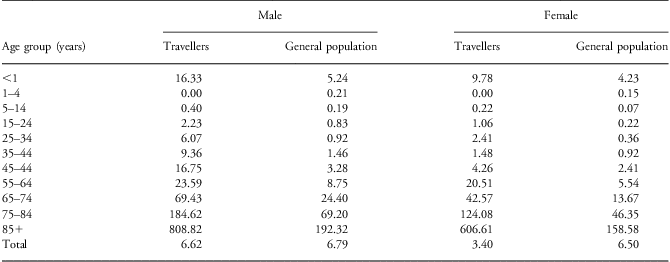
The census established that there were just over 40,000 Travellers on the island of Ireland (incorporating both the Republic of Ireland and Northern Ireland), making up 1% of the total Irish population. In demographic terms, the population pyramid of the Travellers showed a very young group, with 84% below 40 years old, 13% 40 to 64 years and only 3% were over 65 years old. The average life expectancy (in 2008) of Traveller men was 61.7 years (v. 76.8 for general Irish population) and for Traveller women it was 70.1 years (v. 81.6 years for the general Irish population).Reference Abdalla, Quirke and Fitzpatrick7 A series of health and lifestyle indicators were found to be less favourable than in comparable samples of the general Irish population, and social and environmental conditions were poor. Table 1a summarizes the standardized mortality ratios (SMRs) for both men and women, as identified in the vital statistics reports. The SMR for men was unchanged since the last study of Travellers in 1987,Reference Barry, Herity and Solan8 and the SMR was 372 relative to the general population. In women, there was some improvement, but the SMR was still 309 compared with the general population. SMRs were elevated for all causes of deaths, including heart disease, stroke, respiratory disease and cancers. Table 1b gives age-specific mortality. At almost all ages, Travellers’ death rates were higher and life expectancy was considerably less than the general population. A further recent analysis of the health status data indicated that Travellers had high smoking rates and relatively poor diets, but also higher than expected reported rates of diabetes and cardiovascular risk factors.Reference McGorrian, Daly and Fitzpatrick9
Standardized mortality ratio (95% CI) for Travellers in 2008 (Travellers 2008, n = 36,224)

AITHS Technical report 2A: vital statistics and demography.Reference Abdalla, Quirke and Fitzpatrick7
(General population in 2008 used as standard population).
The standardized SMR is 100 and general population from 2008 was used as standard. All comparisons were made to this.
Age-specific mortality rates per 1000 in Traveller and general population 2008 (Travellers 2008, n = 36,224)
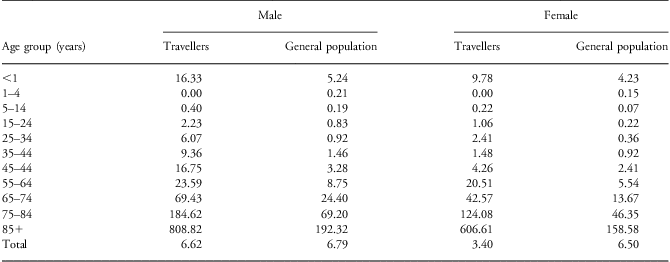
AITHS Technical report 2A: vital statistics and demography.Reference Abdalla, Quirke and Fitzpatrick7
Travellers therefore present an interesting proposition in terms of both the health inequalities literature generally and life course literature in particular. They are a population who have survived adversity over several centuries with those hardly enough to survive early childhood reaching reproductive age but still having very high premature mortality. They are clearly exposed to adverse environmental circumstances and more latterly have adopted the lifestyle associated with risk for adult chronic disease.Reference McGorrian, Daly and Fitzpatrick9–Reference Tan, Avalos and Dineen11
BarkerReference Barker12 defines developmental plasticity during pregnancy as a critical period when a system is plastic and sensitive to the environment, followed by loss of plasticity and a fixed functional capacity. According to West-Eberhard,Reference West-Eberhard13 this is ‘a phenomenon by which one genotype can give rise to a range of different physiological or morphological states in response to different environmental conditions during development’. Barker revisited the importance of early growth and development, when he demonstrated in the retrospective Hertfordshire cohort studyReference Syddall, Aihie Sayer and Dennison14 an inverse association between birth weight and later adverse mortality,Reference Barker, Hales and Fall15–Reference Barker and Martyn17 postulating that fetal undernutrition in middle to late gestation leads to disproportionate fetal growth and effectively programmes the individual to later coronary heart disease. The fetal origin hypothesis has now been further expanded into the developmental origin of health and disease with possible explanatory models including altered fetal nutrition, increased glucocorticoid exposure, the fetal insulin hypothesis, the thrifty phenotype hypothesis and predictive adaptive response and epigenetic mechanisms.Reference Gluckman and Hanson18
Many investigators have subsequently established that early life exposures are predictive of longer-term adult disease. Although conventionally a birth weight of 2500 g or less is regarded as clinically significant and may be associated with either intrauterine growth retardation or other causes of low birth weight, it has been established in epidemiological studiesReference Whincup, Kaye and Owen19 that in fact births in the 3000 g or less category are predictive of longer-term adult chronic disease. In terms of developmental plasticity model, Travellers experience premature mortality from all causes; what is not known is the degree to which this population exhibits early life disadvantage, as manifested through low birth weight or other possible evidence of intra-uterine growth retardation. Our interest in this analysis was to establish whether the birth weight and infant mortality rate patterns in Ireland's Travellers were consistent with the developmental plasticity hypothesis as suggested by Barker,Reference Bateson, Barker and Clutton-Brock20, Reference Hamid, Daly and Fitzpatrick21 allowing us to postulate that the established higher rates of adult chronic disease we have already observed in other aspects of this studyReference Abdalla, Quirke and Fitzpatrick7–Reference McGorrian, Daly and Fitzpatrick9 might be associated at least in part with early life disadvantage. For this we used the data from the final section of the study, the prospective birth cohort follow-up of Traveller mother and infant pairs.
Methods
The birth cohort study: design and follow-up
The design and methodology for the birth cohort study have already been reported in detail elsewhere.Reference Hamid, Daly and Fitzpatrick21, Reference Hamid, Turner and Abdalla22 In brief, all Traveller women on the island of Ireland identified as delivering a live baby in the 1-year calendar period between the commencement of the census study on 14 October 2008 and 13 October 2009 were followed up for one further year from birth to estimate infant mortality in the population. A multi-method recruitment and ascertainment strategy was undertaken. During the census, families volunteered names of those already known to be pregnant. Public health nurses (PHNs) and health visitors (HVs) were asked to identify expectant and postpartum mothers, in order to give them at the appropriate time a specially designed parent-held child record for completion, which included recording of infant feeding method, and to obtain their informed consent to the linkage of their records to their maternity hospital file.
The birth cohort study: infant mortality data retrieval
During the 2-year period, PHNs and HVs, and Primary Health Care Projects for Travellers maintained contact both with the mothers and the fieldwork coordinator at UCD and all sources of information on Traveller deaths were updated, including Traveller-specific parish newsletters. Finally, during the period of October 2010 to February 2011, a search was undertaken in the GRO for registered deaths and the certified causes of death, as with the previous retrospective search.Reference Abdalla, Quirke and Fitzpatrick7 The infant mortality calculation was limited to live Traveller births in the Republic of Ireland; infant mortality events in Northern Ireland were excluded because of small numbers for both numerator and denominator, limiting reliability.
The birth cohort study: maternity hospital linkage data
The linkage information was based on a standard proforma birth notification document, which is routinely recorded on all mothers who deliver a baby in an Irish maternity hospital and compiled by the National Perinatal Reporting System (NPRS) in the Republic of Ireland only. Data collected included parents’ and babies’ details, mother's obstetric history, antenatal and birth details and maternity hospital utilization, including booking date, admission and discharge dates. If the mother gave informed consent to access her maternity health record, we obtained it by writing to the hospital. Ethical approval for the study was obtained from University College Dublin's Research Ethics Committee and if any of the hospitals required further ethical approval for record access we went through the process of obtaining that approval. However, as the mothers are entitled to request their record and we had their consent, this did not prove necessary in most institutions.
Birth weight analysis 1: socioeconomic groupings (SEGs)
For the main analysis, we compared Traveller mothers to the Irish-born general population using data from the NPRS. Parents’ occupations were categorized according to SEG (NPRS SEG) using the Irish SEG ordinal ranking system and employing the same classification strategy as that used by the All Ireland Institute of Public Health.23 The All Ireland Institute of Public Health further sub-categorized the Irish SEG scale into smaller categories, which were Farmers (all Farmers), SEG-A (Higher professionals, Lower professionals), SEG-B (Employers & managers, Salaried employees), SEG-C (Non-manual wage earners, Other non-wage earners, Skilled manual workers), SEG-D (Semi-skilled manual workers, Unskilled manual workers, Farm labourers), and Unknown (Unknown). Farmers are traditionally allocated a separate category in Irish classifications as it is difficult to assess means and income based on land valuations.24 The Institute of Public Health's classification system was based on father's occupation and when this was missing, the mother's occupation was used.
Birth weight analysis 2: lifestyle factors
The standard perinatal record does not routinely document any lifestyle information, and therefore we performed an additional manual search of consented mothers’ records in the three main Dublin maternity hospitals, to record smoking status (current, ever but stopped during pregnancy and non-smokers) and alcohol consumption or not (during pregnancy). Most Travellers were born in Dublin, with no regional variations found in the main reports, so the findings are generalizable to the community. For this part of the analysis, we employed the Lifeways cross-generation cohort study (Lifeways) participants as a reference group; this cohort had similarly available linkage information and participant's pregnancy health status has been previously documented as a representative sample of Irish women.Reference Niedhammer, O'Mahony and Daly25 In order to select the group comparable socioeconomically to the Traveller mothers, only Lifeways mothers with medical cards were selected. Medical cards give means-tested entitlement to free General Medical Services provided by the Irish government to those on low income, the elderly and those with disability, and therefore it is a robust measure of disadvantage.
Using Traveller data combined with population data (from NPRS for Irish parents of babies born in the same year) [Farmers, SEG-B, SEG-C, SEG-D, Unknown/unemployed, Travellers v. SEG-A {reference group (ref)}], a multinomial logistic regression model was fitted with birth weight as a three-level outcome [categorized as weight (kg) <3.0 kg v. 3.0–3.9 kg (ref) and ⩾4.0 kg v. 3.0 – 3.9 kg (ref)], with independent factors including maternal age [⩽24, 30–35, >36 v. 25–29 (ref)], marital status [others v. married (ref)], parity [primiparous, 3–4, >5 v. 1–2 (ref)], baby sex [female v. male (ref)], gestational age at first visit to the hospital [13–19, ⩾20, unknown v. <12 weeks (ref)] and gestational age. Multinomial logistic regression model was selected over ordinal regression because of the different risks associated with different birth weight categories. Although low birth weight clinically is defined as <2500 g, this study used birth weight <3000 g as this birth weight has been shown to share similar high risk for chronic diseases in later life.Reference Whincup, Kaye and Owen19 The reference categories in the regression analysis reflect those that have been shown to be optimum for a normal birth weight including older parous mothers, being married, male infantsReference Kramer26 and early first visit to the hospital.Reference Kongsri, Limwattananon and Sirilak27
Using data from the subgroup on whom lifestyle information was available and the comparative Lifeways cohort data, binomial logistic regression models were fitted with birth weight as the outcome variable [dichotomized as weight (kg) <3 kg v. ⩾3.0 kg (ref)]. Independent variables included were baby's sex [male v. female (ref)], gestational age (continuous), mother's age [<24, 30–35, >36 v. 25–29 (ref)], parity [primiparous, 3–4, >5 v. 1–2 (ref)], alcohol consumption during pregnancy [yes v. no (ref)], smoking status during pregnancy [smoked, stopped v. never (ref)]. Lifestyle variables, routinely documented at each mother's first antenatal visit, were collected from the mothers’ maternity hospital medical records. Two separate models were fitted. Model one was for ‘all births’ and in model two only singleton and term births were modelled. All analyses were conducted using SPSS version 15.0 (SPSS Statistics Standard, SPSS Inc., Chicago, IL, USA).
Results
There were 986 live Traveller births on the island of Ireland during the cohort period, 918 were from the Republic of Ireland. The age distribution of both Traveller fathers and mothers of the infants in the birth cohort study is given in Figs 1a and 1b compared with NPRS Irish parents. This confirms Traveller parents at the time of infant births were younger than the general population on average, but with a wide range. In terms of employment status, Traveller fathers in the study were overwhelmingly more likely to be unemployed than the fathers in the general population (79.9% v. 5.4%) and Traveller mothers to be homemakers (92.2% v. 25.4%).
Age distribution (%) for Traveller and general population [National Perinatal Reporting System (NPRS) Irish] parents.

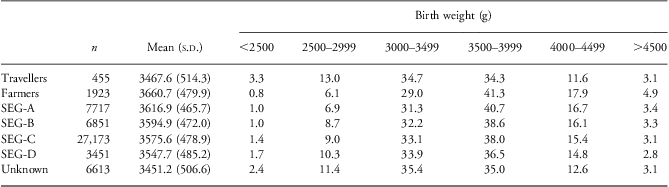
The birth weight distribution for singleton term SEGs and Traveller births is given in Table 2. This shows a social gradient in the distribution with Travellers’ birth weight distribution shifted to the lower end with more babies in the low birth weight categories and less in the high birth weight categories than other social groups. Travellers had disproportionately increased numbers of babies in the critical low birth range of 3 kg or less, with 3.3% of infants being <2500 g and a further 13% in the 2500–2999 g category.
The mean and distribution (%) of birth weight for Travellers and all Irish socioeconomic groups (singleton term births only)
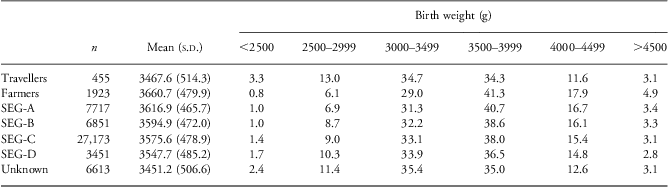
SEG, socioeconomic grouping.
SEG-A (Higher professionals, lower professionals), SEG-B (Employers & managers, salaried employees), SEG-C (Non-manual wage earners, other non-manual workers, skilled manual workers), SEG-D (Semi-skilled manual workers, Unskilled manual workers, Farm labourers), Unknown (employment status unknown).
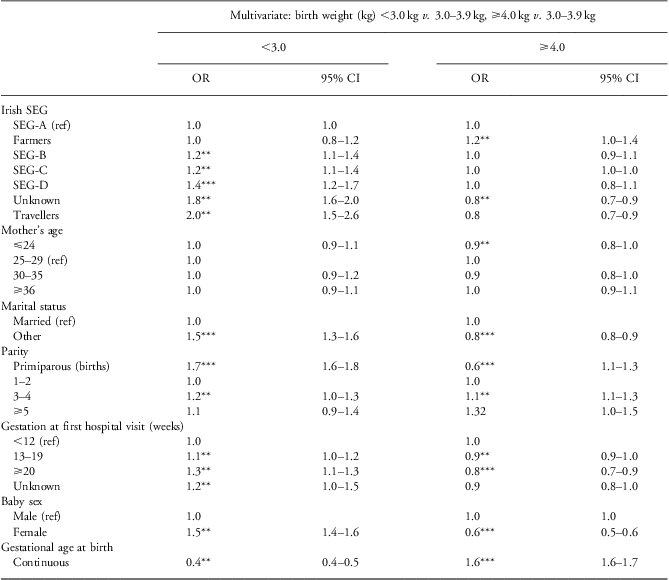
Multinomial logistic regression models combining Travellers and the NPRS general population, adjusted for mother's age, marital status, parity, gestational age at first visit to the hospital, baby's sex and gestational age show a graduated odds of having a low birth weight baby <3 kg according to social class, which was highest in Travellers than in any other social group (Table 3).
Multivariate analyses for predictors of birth weight categories of Travellers and NPRS Socioeconomic groups as assessed by multinomial logistic regression (n = 75,737)
NPRS, National Perinatal Reporting System; SEG, socioeconomic grouping.
SEG-A (higher professionals, lower professionals); SEG-B (employers and managers, salaried employees); SEG-C (non-manual wage earners, other non-manual workers, skilled manual workers); SEG-D (semi-skilled manual workers.
Ref: 3–3.9 kg. **P < 0.05; ***P < 0.001.
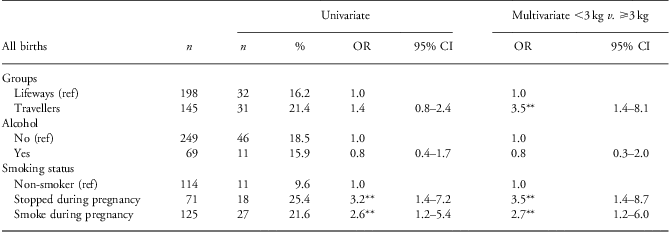
In the second set of multivariable models, this time with combined Traveller and Lifeways data only, but including the lifestyle information, the mean birth weight was 3591.0 g (s.d. 581.7) for non-smokers, 3445.4 g (s.d. 573.3) for those who stopped during pregnancy and 3383.9 g (s.d. 559.7) in those who continued to smoke. Both ever smoked and smoking during pregnancy was relatively high in Traveller mothers when compared with the Lifeways mothers (60.4% and 48% v. 53.0% and 33%; in both P < 0.005). Conversely, reported rates of alcohol consumption during pregnancy were much lower (9% v. 32%, P < 0.001).
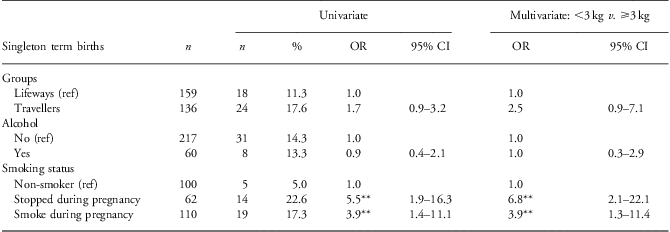
In the multivariable model, stopping smoking and smoking during pregnancy were both associated with birth weight <3 kg compared with non-smokers. However, even after adjustment for smoking Traveller mothers were still more likely to have a lower birth weight infant (Table 4). Table 5 shows similar data for singleton term births, with similar results except that being a Traveller was no longer independently statistically significant as a factor, possibly due to reduced power with lesser available numbers.
Multivariable analyses of all births in predicting low birth weight <3 kg, as assessed by binomial logistic regression
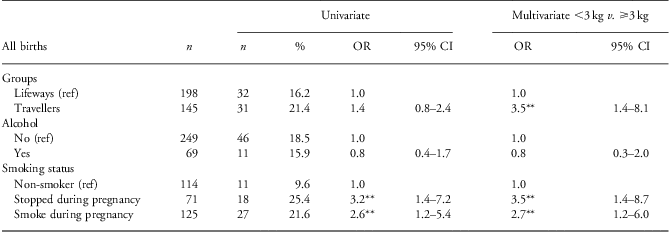
Model adjusted for maternal age, parity, infant sex and gestational age. n = total births in group, n = total births with birth weight <3 kg.
Ref: ⩾3 kg. **P < 0.05, ***P < 0.001.
Multivariable analyses for term singleton births only in predicting low birth weight as assessed by binomial logistic regression
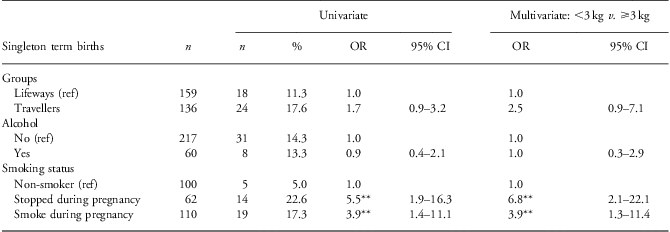
Adjusted for maternal age, parity, infant sex and gestational age.
Ref: ⩾3 kg. **P < 0.05; ***P < 0.001.
Traveller breastfeeding initiation rate was taken from the parent-held record and for reference purposes is compared with the LifewaysReference Doyle and Kelleher28 and Growing up in Ireland cohort study.Reference Williams, Greene and McNally29 Initiation at 2.2% was very low among Traveller mothers compared with 54.1% and 48% in the Lifeways and Growing Up in Ireland cohorts, respectively.
There were 11 infant deaths detected in the Republic of Ireland at 1- year follow-up (live births n = 918), which gave the calculated infant mortality rate of 12.0/1000 (95% CI 5.5–19.7), which was almost the same as the retrospectively calculated rate for the previous year at 14.1/1000 (95% CI 7.3–24.7). The rate was almost four times that for the general population; although the rate has declined from 18.1 in 1987, it was still excessive. Congenital anomalies (n = 4), inborn errors of metabolism (n = 3), genetic disorders (n = 1), prematurity (n = 2) and accidents (n = 1) were the main causes of death. Although the timing of deaths has shifted from the neonatal period into the postneonatal period compared with 1987, the same cause of death patterns persist.
Discussion
The findings of this study show that Irish Travellers as a community do fulfil the criteria of the developmental plasticity model in that they are a disadvantaged group in whom we have already shown high rates of premature adult chronic diseases and death from all causes,Reference Abdalla, Quirke and Fitzpatrick7–Reference McGorrian, Daly and Fitzpatrick9 and now show additionally in this analysis specifically of the birth cohort data that Travellers exhibit both a greater than expected incidence of low birth weight and high infant mortality.
In life course terms,Reference Ben-Shlomo and Kuh30, Reference Heikkinen31 much is explicable through serious economic disadvantage and adverse lifestyle, including the cardinal risk factor both for low birth weight and adult chronic disease, cigarette smoking. It is clear from the main reports as well as from this analysis that rates of smoking are excessive from early teen years onwards and other analyses have shown that quit rates among Travellers are very low, and therefore cumulative lifetime exposure is high.6, Reference McGorrian, Daly and Fitzpatrick9 It is well established that the mechanism through which smoking affects birth weight is by reduced placental oxygenation and hence intrauterine growth retardation. As a risk factor for respiratory disease and coronary heart disease, it is a major preventable factor and the case control INTERHEART study has demonstrated again that smoking explains a considerable degree of the population attributable risk for coronary heart disease across five continents.Reference Yusuf, Hawken and Ôunpuu32 Clearly, this is an important lifestyle message for Travellers and a culturally appropriate and engaging health promotion message is warranted.
Overall, the pattern of smoking shown in this study is similar to the established literature and to another randomized clinical trial of disadvantaged mothers in a large Irish maternity hospital,Reference Hayes, Collins and O'Carroll33 in that women who quit smoking during pregnancy do show an improvement in babies’ birth weight; in the multivariable analysis, the adjusted odds were in fact higher in the stopped-smoking group compared with the continued-to-smoke group, and the later had higher adjusted odds compared with the non-smokers. This paradox may perhaps be explained by some mothers who continue to smoke incorrectly identifying themselves as quitters. We cannot be certain of this as the explanation, however, as we could not undertake cotinine or carbon monoxide level validation in a linkage study.
Interestingly, although there is current focus in the upper end of the birth weight spectrum as it may also predict adult disease,Reference Lawlor, Davey Smith and Clark34 Travellers do not have excessive high birth weights, do not initiate alcohol consumption as early as other teenagers and there are still high rates of teetotalism in the population though among those who do drink, binge and other problem behaviour is important.6 The finding that Traveller mothers are less likely to drink fits with other data that show that working class women are more likely to abstain altogether than middle class women, who reduce rather than halt their consumption during pregnancy. The rates of breastfeeding, another factor associated with better quality growth and development in the first year of life, are also very low and merit attention as well.23, Reference Shortt, McGorrian and Kelleher35
Although the dietary patterns of pregnant Traveller mothers were not assessed in the cohort, speculatively it may be the same as the Traveller population in general. We have already known that Travellers have poorer dietary practices than the general population.6 Poor diet during pregnancy was the premise of Barker's original hypothesis linking low birth weight and adult chronic diseases in later life.
Recent analyses of the Lifeways cohort study show significant familial dietary aggregation patterns in Irish families, with associations seen between nuclear family members for components of dietary intake and also between mother and maternal grandmotherReference Shrivastava, Murrin and Sweeney36–Reference Murrin, Kelly, Tremblay and Kelleher38 and a relationship between maternal diet and infant birth weight, so this may be a mechanism applicable to Travellers also.
It is well established that lifestyle habits are strongly related to socio-cultural influences and can be driven by social adversity. Travellers present such a classical example. In health promotion terms, it is important not to be overly reductionist in putting across preventive messages and to avoid a victim-blaming strategy in this disadvantaged group who have low educational attainment. We have demonstrated previously that this population exhibit a range of neomaterial and psychosocial disadvantage and have difficulty in engaging with healthcare system.Reference Kelleher, Whelan, Daly and Fitzpatrick10, Reference McGorrian, Frazer and Daly39 It is important to identify peer leaders to get across these health messages and to do so in tandem with other empowering strategies such as improving employment and educational opportunities for Travellers. Success is more likely if a contextual approach is taken.
Barker and others have shown previously that the relationship between intrauterine and early life development and subsequent development of adult chronic disease is independent of lifestyle factorsReference Bateson, Barker and Clutton-Brock20 and this is an important public health issue for the Traveller community also. Travellers had lower birth weight children, which cannot be completely accounted for by smoking alone in this analysis. As survivors in a population long prone to high mortality, it is arguable that Travellers are an important example of this phenomenon at play in a westernized population. Travellers are exposed to social and economic adversity throughout the lifespan and one aspect of this would be an influence on reproductive outcome; we have shown this by comparing this group to their peers across the full social gradient of the Irish population. Although infant mortality was also excessive, the causes were not typically associated with social adversity and there is evidence of good uptake of primary health care and health services utilization in this population.Reference McGorrian, Frazer and Daly39 Barker instances the first 1000 days as independently critical to later growth and development and also the importance of transmission particularly along the maternal line from grandmother through to grandchild.Reference Barker40, Reference Shrivastava, Murrin and O'Brien41 The empirical data in this analysis support that cross-generation contention.
A limitation of this study is that it was based on a 1-year birth cohort and adult data from a contemporary group rather than prospectively related. Such prospective follow-up of the present cohort into adulthood would clarify whether vulnerable infants were in fact more likely to develop adult chronic disease in later life and ideally would include additional biological measures in the future. This was a recommendation to the study commissioners. For confidentiality reasons, we were unable to link expectant mothers’ subsequent maternity outcome information to the original family census data, which would also have helped to corroborate an association. However, other studies have shown strong links between infant birth weight and subsequent parental mortality from adult chronic disease and more recently studies have shown an inverse relationship between infant birth weight and grandparental mortality, strengthening the cross-generational associations between infant birth weight and other adult relatives’ morbidity.Reference Shrivastava, Murrin and O'Brien41–Reference Smith, Wood and White44
Another limitation to the study was the level of participation in the birth cohort in that just over half of the Traveller mothers consented to linkage of their maternity records. The study did not have access to the maternity records of Traveller mothers who refused the linkage request, though mortality follow-up was comprehensive. Of the Traveller mothers who participated in the birth cohort, it is likely that these are the mothers with the more favourable infant outcome, as generally non-participants tend to be least advantaged.Reference Larsen, Dalton and Schuz45, Reference Drivsholm, Eplov and Davidsen46
Conclusion
This is a highly novel study in that it provides comprehensive linkage information in a hard-to-reach population and has international application for other studies of ethnic and minority groupings. These findings reinforce the need for a comprehensive cross-sectoral strategy in relation to maternal and child health, as an investment not just for the immediate child but for successive generations to come.
Acknowledgements
The authors thank the Traveller community; the Public Health Nurses, Health Visitors, Health Service Executive staff, who assisted with the study. The authors also thank the National Perinatal Reporting System, Republic of Ireland for providing the national data set.
Funding
Funding for this study was received from the Department of Health & Children, Republic of Ireland, the Department of Health, Social Services and Public Safety, Northern Ireland.
Conflicts of Interest
All authors declare that they have no interests to declare.
Contribution to Authorship
N.A.H., P.F., L.D., C.McG. and C.K. all contributed to drafting, N.A.H. and A.R. in data collection, and N.A.H. analysed the data under the direction of P.F. and C.K., with statistical advisory input from L.D. C.K. conceived the analysis strategy for the paper and is the study guarantor.
Disclaimer
The views expressed in this study are the authors’ own and do not necessarily reflect the views and opinions of either the Department of Health and Children or the Department of Health, Social Services and Public Safety.
Ethical Standards
Approval was obtained from University College Dublin's Human Research Ethics Committee (LS_07_11_Sweeney).