Patients with single-ventricle anatomy who have undergone a Fontan procedure present a unique cardiovascular physiology. The Fontan circulation relies on passive flow of systemic venous blood to the pulmonary arteries without a subpulmonary pump. For the Fontan circulation to perform optimally, patients must have low pulmonary vascular resistance and low ventricular end-diastolic pressure.Reference Gewillig and Brown1 Obesity has the potential to disturb the delicate balance of this pathologic circulation. Exercise capacity in Fontan patients is diminished in those with a higher body mass index, characterised by a lower peak VO2 and lower work rate.Reference Cohen, Zak and Atz2 Obesity may also be associated with a greater risk of symptomatic heart failure and mortality in Fontan patients.Reference Martinez, Byku and Novak3 Excess adiposity is distributed into several distinct compartments. Two major compartments include subcutaneous adipose tissue and visceral adipose tissue. Visceral adipose tissue, unlike subcutaneous adipose tissue, is hormonally active and secretes multiple adipokines and pro-inflammatory cytokines.Reference Mazurek, Zhang and Zalewski4 The altered hormonal and cytokine secretion of visceral fat in the obese-state may contribute to the development of metabolic syndrome with associated endothelial dysfunction, insulin resistance, and increased risk of acquired cardiovascular disease.Reference Packer5,Reference Neeland, Turer and Ayers6 Visceral adipose tissue can be quantified through abdominal and cardiac MRI. Intra-thoracic visceral adipose tissue is mainly distributed around the heart in the form of epicardial fat, which has been shown to be present in greater quantity in Fontan patients than matched controls.Reference Lubert, Lu and Rocchini7 Epicardial fat has been inversely correlated with cardiac output in Fontan circulation.Reference Lubert, Lu and Rocchini7 The relationships between excess adiposity and Fontan haemodynamics have not been studied. In this study, we sought to further evaluate the relationships between visceral fat, anthropometrics, and invasive haemodynamic data in adults living with Fontan circulation. We hypothesise that excess visceral fat may be associated with adverse haemodynamic alterations in Fontan patients.
Materials and methods
This retrospective single-centre study evaluated consecutive Fontan patients >18 years of age who had undergone cardiac MRI examination between January 2010 and December 2018. Subjects were included if they also had a cardiac catheterization within 18 months of the MRI. Exclusion criteria included: image artefact that obscured epicardial fat, a co-existing inflammatory condition (e.g., systemic lupus erythematosus, rheumatoid arthritis, psoriasis, human immunodeficiency syndrome, or inflammatory bowel disease) as these are associated with increased epicardial fat, use of glucocorticoid medication, or significant weight change between MRI and catheterization (defined as change in the patient’s weight by >10%). This study was approved by the Cincinnati Children’s Hospital Medical Center Institutional Review Board with a waiver of the requirement for informed consent.
Clinical and demographic data, including cardiac anatomic diagnoses, were abstracted from the electronic medical record (Epic Medical Systems Corporation, Verona, WI, United States of America). The type of Fontan palliation was classified as lateral tunnel, extracardiac conduit, or atriopulmonary connection.
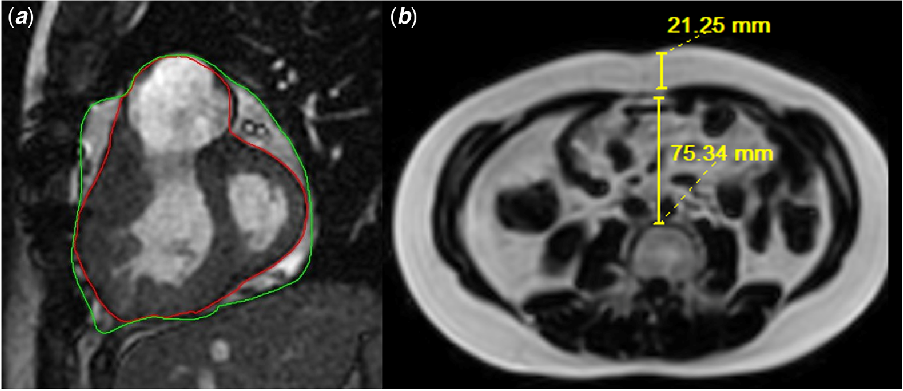
Cardiac MRI studies were performed for clinical indications using a 1.5 Tesla magnet (Ingenia; Philips Healthcare, Best, the Netherlands). Cine images had been obtained with a breath-hold, electrocardiographic-gated, segmented k-space, and steady-state free precession pulse sequence. These images were analysed using commercially available software (cvi42; Circle Cardiovascular Imaging, Calgary, Alberta, Canada). Epicardial fat is defined as the fat between the visceral pericardium and myocardium, thus differentiating it from paracardial fat. The border between epicardial and paracardial fat was determined by inspection of the entire cine series in all slices, allowing exclusion of paracardial fat from the measure of epicardial fat (Fig 1A). Areas of epicardial fat were traced manually on consecutive end-systolic short-axis images, beginning at the systemic atrioventricular valve and ending at the last slice containing cardiac adipose tissue, as previously described with excellent intra- and interobserver reliability.Reference Lubert, Lu and Rocchini7 The areas obtained for each slice were multiplied by the slice thickness and resulting volumes summed together to yield the epicardial fat volume. No patient had a pericardial effusion. Epicardial fat volume was indexed to body surface area. Due to heterogeneity of available abdominal MRI examinations, abdominal fat could not be quantified volumetrically. Instead, similar to described methods of measurement of abdominal fat by ultrasound, subcutaneous fat thickness and intra-abdominal visceral fat thickness were measured at the L3 vertebral level on either the fat image of a multipoint Dixon sequence or, if not available, on T2-weighted fat-saturated images (Fig 1B).Reference Kuchenbecker, Groen and Pel8 Specifically, the linear thickness of the subcutaneous fat was measured perpendicularly between the skin and linea alba just lateral to midline. Similarly, the linear thickness of the intra-abdominal visceral fat was measured perpendicularly between the linea alba and the anterior surface of the L3 vertebral body.
(a) Example of epicardial fat measure of a single short-axis slice at end systole and (b) example of abdominal (subcutaneous and visceral) fat thickness measurements by MRI.

Cardiac catheterization data were obtained from the detailed catheterization report in the medical record. Cardiac catheterization was performed according to the standard institutional clinical protocol with most catheterizations performed under conscious sedation. Haemodynamic data included Fontan pressure, ventricular end-diastolic pressure, pulmonary capillary wedge pressure, mixed venous, pulmonary venous and arterial saturations, Fick-derived cardiac index, and calculated pulmonary vascular resistance. Fick calculations relied upon use of a measured VO2, when available, or an assumed VO2 derived from patients with CHD.Reference Seckeler, Hirsch, Beekman and Goldstein9
The Student’s t-test (two-sided) or Mann–Whitney U-test was used to compare groups of continuous parametric or non-parametric variables, respectively. Univariable associations between normally distributed variables were estimated using the Pearson correlation coefficient, while Spearman correlation was used for non-normally distributed data. To evaluate the associations of visceral fat measures and Fontan haemodynamics, as well as other covariates, a multivariable stepwise linear regression model was constructed, with 0.1 as the significance level for entry and 0.05 as the significance level to remain in the model. Due to the sample size, only two variables could be included in the model to avoid the risk of overfitting. All p-values were two-tailed, and differences and associations were considered significant when p < 0.05. Statistical analyses were performed using JMP® (version 12, SAS Institute Inc., Cary, NC, United States of America).
Results
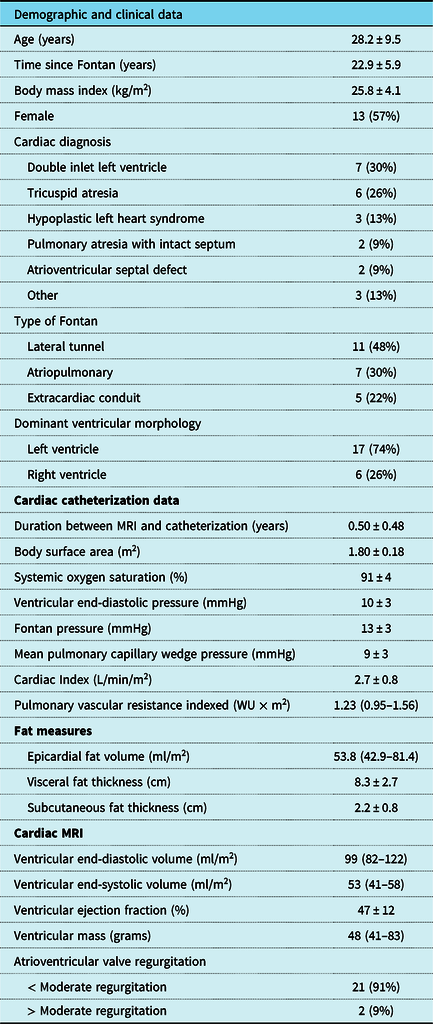
A total of 23 adult Fontan patients were included in this study. The mean age at the time of cardiac MRI was 28.2 ± 9.5 years, 13 (57%) patients were female, and mean body mass index was 25.8 ± 4.1 kg/m2. There were 10 (42%) subjects with a body mass index ≥25 kg/m2 and 3 (13%) with BMI ≥30 kg/m2. The mean duration of Fontan circulation was 22.9 ± 5.9 years, and the majority of patients had left dominant ventricular morphology. The most common cardiac diagnoses were double inlet left ventricle (30%) and tricuspid atresia (26%) (Table 1). Lateral tunnel (48%) was the most common Fontan type. No patients had a diagnosis of hypertension or hyperlipidemia, and one patient had a diagnosis of type 2 diabetes mellitus. Active cardiac medications at the time of catheterization included: angiotensin converting enzyme inhibitors 8 (35%), mineralocorticoid-receptor antagonists 8 (35%), beta-blockers 3 (13%), and loop diuretics 3 (13%). No patients in this study were taking pulmonary vasodilator medications.
Demographic, clinical, cardiac catheterization, and MRI data

Results are presented as mean ± sd, median (interquartile range), or mean ± sd or frequency (%)
WU=Wood units
Invasive haemodynamics assessed by cardiac catheterization revealed a mean Fontan pressure of 13 ± 3 mmHg, cardiac index of 2.7 ± 0.8 litres/min/m2, and indexed pulmonary vascular resistance of 1.23 (0.95–1.56) WU × m2 (Table 1). The mean time between cardiac MRI and cardiac catheterization was 0.5 ± 0.48 years. Results from cardiac MRI are displayed in Table 1. The mean ventricular ejection fraction was 47 ± 12%. Median epicardial fat volume indexed to body surface area was 53.8 ml/m2 (interquartile range: 42.9–81.4).
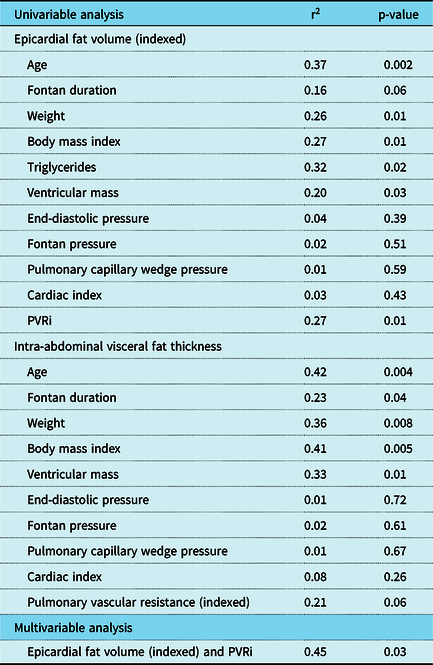
Indexed epicardial fat was associated with age (r2 = 0.37, p = 0.002), weight (r2 = 0.26, p = 0.013), body mass index (r2 = 0.27, p = 0.011), ventricular mass (r2 = 0.20, p = 0.03), and intra-abdominal visceral fat thickness (r2 = 0.30, p = 0.018) by univariable analysis (Table 2). Likewise, intra-abdominal visceral fat thickness was also associated with age (r2 = 0.42, p = 0.004), weight (r2 = 0.36, p = 0.009), body mass index (r2 = 0.41, p = 0.005), and ventricular mass (r2 = 0.33, p = 0.005). Subcutaneous fat thickness was not associated with any of these measures. Also, there was no association between subcutaneous fat and epicardial or intra-abdominal fat.
Univariable and multivariable associations between epicardial fat and intra-abdominal visceral fat using linear regression

PVRi=pulmonary vascular resistance index
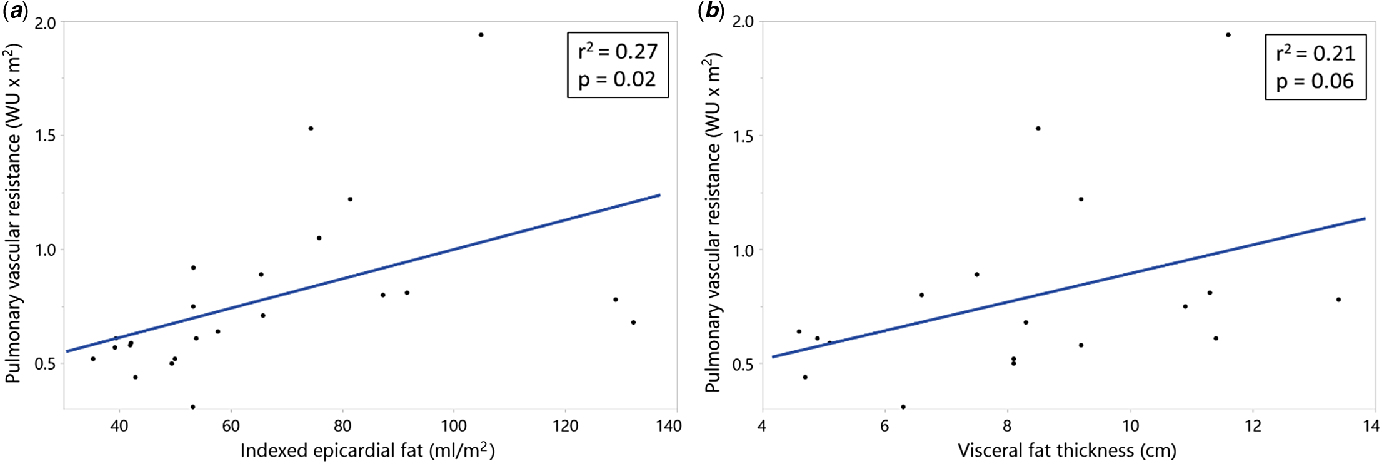
There was a modest correlation between epicardial fat volume and indexed pulmonary vascular resistance (r2 = 0.27, p = 0.02) and a trend towards significant association between intra-abdominal visceral fat and indexed pulmonary vascular resistance (r2 = 0.21, p = 0.06) by univariable analysis (Fig 2). Visceral fat measures (epicardial and intra-abdominal fat thickness) were not associated with other invasive haemodynamic parameters including Fontan pressure, ventricular end-diastolic pressure, and cardiac index. Subcutaneous fat thickness, weight, and body mass index were not associated with any Fontan haemodynamic measures. In multivariable analysis, including age and visceral fat measures, indexed epicardial fat volume was independently associated with indexed pulmonary vascular resistance (r2 = 0.45 for the multivariable model, parameter estimate 0.13 ± 0.05 per 10 ml/m2 increase, p = 0.03) (Table 2).
Association of pulmonary vascular resistance with (a) indexed epicardial fat volume and (b) visceral fat thickness.

Discussion
In this cross-sectional investigation of adiposity and Fontan haemodynamics, as assessed by MRI and cardiac catheterization, we found that measures of visceral adiposity increased with age and were independently associated with pulmonary vascular resistance. Subcutaneous fat thickness was not associated with visceral fat or Fontan haemodynamics, intimating a unique relationship between visceral adipose tissue and Fontan circulatory function. These findings suggest that visceral adiposity may represent a potential therapeutic target in the management of the adult with single-ventricle heart disease following Fontan palliation.
Although children with Fontan circulation are typically not overweight,Reference Pinto, Marino and Wernovsky10,Reference Pasquali and Cohen11 the prevalence of overweight and obesity in adults with Fontan circulation is similar to that of the general population.Reference Martinez, Byku and Novak3,Reference Hales, Carroll, Fryar and Ogden12,Reference Pike, Evangelista, Doering, Koniak-Griffin, Lewis and Child13 Fontan subjects have important factors that may play a role in becoming overweight or obese. These include lifetime activity restrictions leading to decreased physical activityReference McCrindle, Williams and Mital14 and periods of rapid catch-up weight gain during childhood which are associated with increased risk of adult obesity.Reference Leunissen, Kerkhof, Stijnen and Hokken-Koelega15 Increasing adiposity can develop through an increase in subcutaneous and/or visceral adipose tissue. Subjects with increased subcutaneous adipose tissue are generally considered to have a healthy overweight phenotype, whereas increased visceral adipose tissue is an unhealthy phenotype that is associated with increased cardiovascular risk and metabolic syndrome.Reference Despres16 Our study found that older Fontan patients demonstrate a greater burden of visceral adipose tissue (epicardial fat volume and intra-abdominal visceral fat thickness). Unlike visceral adipose tissue, subcutaneous fat thickness was not associated with age, weight, or body mass index in our population. These data suggest that Fontan patients may preferentially generate excess visceral, rather than subcutaneous, fat stores.
Visceral adipose tissue is a metabolically active endocrine organ that can secrete multiple adipokines and pro-inflammatory cytokines that can lead to insulin resistance, dyslipidemia, and endothelial dysfunction.Reference Lopes, Correa-Giannella, Consolim-Colombo and Egan17 We have previously demonstrated that increased epicardial fat was associated with reduced cardiac index as measured by cardiac MRI in a distinct cohort of adult Fontan patients.Reference Lubert, Lu and Rocchini7 In the present study, we build upon the case for a relationship between excess visceral fat and haemodynamic alterations in Fontan patients, demonstrating that indexed pulmonary vascular resistance relates to measures of visceral fat, independent of age. The positive association between indexed pulmonary vascular resistance and visceral fat could potentially serve as a mechanistic explanation for the lower cardiac index observed in the previous work, although we did not replicate the association between visceral fat and cardiac index in the present analysis. This may be due to the smaller sample size present in the current study. Furthermore, in this study, we report Fick-derived cardiac output rather than MRI-derived flows (as had been reported in the prior work), due to the small number of subjects with adequate MRI flow data available.
The association between visceral adiposity and indexed pulmonary vascular resistance deserves mechanistic consideration. The increased inflammatory state present in subjects with increased visceral adiposity may alter pulmonary vascular endothelial function.Reference Ikeda, Yonemitsu and Kataoka18,Reference Zamanian, Hansmann and Snook19 For example, the hormone adiponectin manifests alterations in secretion in the obese-state; decreased functional adiponectin levels are suspected to play a role in multiple obesity-related complications.Reference Nigro, Scudiero and Monaco20 Adiponectin has beneficial effects on pulmonary vascular function and attenuates pulmonary hypertension. Adiponectin has been found in murine models to regulate endothelial-derived nitric oxide production,Reference Ohashi, Ouchi and Matsuzawa21 protect pulmonary vasculature remodelling in response to inflammation and hypoxia,Reference Weng, Raher and Leyton22 and suppress vascular smooth muscle proliferation.Reference Medoff23 These findings have spurred evaluation of adiponectin as a potential therapy for pulmonary arterial hypertension.Reference Luo, Zheng and Lian24 Altered adiponectin secretion in Fontan subjects, or other fat-sensitive hormones, may play a role in the haemodynamic status of Fontan subjects. Another potential explanation for this association relates to obstructive sleep apnea. A recent study identified a direct link between visceral adipose tissue-induced systemic inflammation playing a likely causative role in obstructive sleep apnea.Reference Gaines, Vgontzas and Fernandez-Mendoza25 Obstructive sleep apnea has the potential to be detrimental to the Fontan circulation with periods of airway obstruction leading to increased indexed pulmonary vascular resistance and increased Fontan pressure.Reference Watson, Bushnell, Jones and Stout26 Therefore, it is possible that the association between visceral adiposity and pulmonary vascular resistance may be a marker for increased risk of obstructive sleep apnea in those with increased visceral adiposity.
Given biological plausibility for this relationship, excess visceral fat may represent an important therapeutic target to improve Fontan circulatory physiology. Dietary modification and exercise training with resultant weight loss can lead to significant reductions in visceral adipose tissue.Reference Smith and Zachwieja27 Structured Fontan cardiac rehabilitation has been demonstrated to result in many beneficial changes in the Fontan-palliated patient.Reference Wittekind, Mays and Gerdes28,Reference Cordina, O’Meagher and Karmali29 Although weight loss has not been a specific target of these programmes previously, a reduction in visceral adipose is a likely consequence of sustained rehabilitation, which may manifest benefit by positively impacting Fontan circulatory function.
Limitations of this study largely relate to the single centre, small sample size, and retrospective study design. Furthermore, the sequences that were used for the clinical MRI procedures in this study were not targeted for assessment of epicardial fat measurement specifically, although the technique applied herein is supported in the literature.Reference Nelson, Worthley and Psaltis30 Abdominal MRI was performed clinically to assess for Fontan-associated liver disease which limited the available images for abdominal fat measurement. Prospective studies with targeted sequences would allow for more precise quantitative measures of visceral fat. Furthermore, assessment of cardiac MRI-derived flows (such as cardiac index) was limited by the frequent presence of stainless-steel coil-related artefact. MRI-derived cardiac output offers certain advantages over Fick-derived cardiac output (e.g., better accounting for aortopulmonary collateral run-off and effective systemic flow). This cross-sectional study of Fontan patients provides insight into potential alterations in visceral fat stores with age, but in the absence of a longitudinal assessment, change over time cannot be ascertained. Lastly, it is notable that the entirety of the interquartile range of indexed pulmonary vascular resistance reported in this study is “normal”. Although any increase in pulmonary vascular resistance is poorly tolerated in Fontan circulation, inclusion of clinically sicker Fontan patients in the study cohort, with more overtly elevated pulmonary vascular resistance, could have intensified the findings reported herein.
In conclusion, in adults with Fontan circulation, epicardial and intra-abdominal visceral fat but not subcutaneous fat are associated with age, weight, and body mass index. Increased visceral fat is associated with higher indexed pulmonary vascular resistance. Excess visceral fat may represent a therapeutic target to improve Fontan circulatory function.
Acknowledgements
The authors would like to acknowledge Sara Manning and all of the Cincinnati Children’s Hospital Heart Institute Research Core for their assistance in completion of this study.
Financial support
This research received no specific grant from any funding agency, commercial or not-for-profit sectors.
Conflicts of interest
None.
Ethical standards
The authors assert that all procedures contributing to this work comply with the ethical standards of the United States national guidelines on human experimentation and with the Helsinki Declaration of 1975, as revised in 2008, and has been approved by the Cincinnati Children’s Hospital Institutional Review Board.