Introduction
Parasitic nematodes and haemonchosis represent a significant constraint to sheep farms worldwide (Getachew et al., Reference Getachew, Dorchies and Jacquiet2007). Today, parasitoses are fought with a variety of anthelmintics and management practices to prevent reinfection of the flock. Yet the parasites have become resistant to these drugs, either by prolonged use of a single active ingredient, or by their erroneous administration (Geary et al., Reference Geary, Woo, McCarthy, Mackenzie, Horton and Prichard2010). Losses in production caused by helminths and secondary infections make it necessary to find new alternatives.
The use of bacteria as a biological control alternative against animal parasitic nematodes enables a significant reduction in the number of infective-stage parasites in grazing areas. With the reduction of the infestation level on pasture, animals are able to avoid both clinical and subclinical effects of parasitism. Ciordia & Bizel (Reference Ciordia and Bizel1961) showed that Bacillus thuringiensis toxin could affect free-living stages of some parasitic nematodes, and later studies carried out by Kotze et al. (Reference Kotze, O'Grady, Gough, Pearson, Bagnall, Kemp and Akhurst2005) and López et al. (Reference López, Flores, Mendoza, Vázquez, Liébano, Bravo, Herrera, Godínes, Vargas and Zamudio2006) showed that B. thuringiensis toxin might be an interesting alternative method for control of nematodes in livestock. Recently, these alternative methods of controlling parasites in sheep have been evaluated by Linares et al. (Reference Linares, Lopez-Arellano, De Gives, Hernandez and De La Parra2008) and Pineda et al. (Reference Pineda, Bravo, Gives, Hernandez, Linares, Perez, Marcelino, Vargas, Castro, Segura and Arellano2012) and the B. thurigiensis crystal protein, Cry5B, has proved to be effective in combating more than one nematode species (Hu et al., Reference Hu, Zhan, Keegan, Yiu, Miller, Jones and Aroian2012; Urban et al., Reference Urban, Hu, Miller, Scheib, Yiu and Aroian2013). However, only one previous study was found to explore the use of Bacillus circulans for the control of helminths (Sinott et al., Reference Sinott, Cunha Filho, Castro, Lorenzon, Pinto, Capella and Leite2012). This Bacillus species also has great potential for biological control of parasites. Since B. circulans is not crystallogenic, evidence suggests that its spores need to be ingested by larvae for its larvicidal activity. Darriet & Hourgard (Reference Darriet and Hourgard2002) observed these effects and reported that the toxicity of B. circulans to mosquito larvae was associated with spores and not with chitinase or exotoxin.
Efforts have been made to better comprehend, as well as to develop, control strategies for anthelmintic resistance in Haemonchus (Whitney et al., Reference Whitney, Wildeus and Zajac2013; Demeler et al., Reference Demeler, Von Samson-Himmelstjerna and Sangster2014; Fawzi et al., Reference Fawzi, González-Sánchez, Corral, Cuquerella and Alunda2014). However, a practical solution that can be used in field conditions is yet to be developed, and few have tested control strategies in sheep, especially those using bacterial biological control strategies. The present study aimed to address the potential use of B. circulans as a biocontrol agent for H. contortus, testing this treatment in naturally infected sheep. To allow a greater analysis of the mechanism of action of B. circulans on Haemonchus larvae, a strain of B. circulans was transformed with green fluorescent protein (GFP) to facilitate its visualization and detection.
Materials and methods
Collection, transformation and spore production of B. circulans
Samples of B. circulans were obtained from the bacterial collection of the Department of Microbiology and Parasitology, Institute of Biology, Federal University of Pelotas, Brazil. The sample used was wild type, and this strain was transformed with green fluorescent protein.
Transformation of B. circulans followed the method described by Parente et al. (Reference Parente, Silva-Pereira, Baldani, Tibúrcio, Báo and De-Souza2008). Briefly, 100 ml of exponential growth phase of B. circulans wild-type culture was centrifuged, washed with distilled water and later resuspended in 2 ml of 40% polyethylene glycol. Cells (250 μl, 108 colony forming units (CFU)/ml) were placed in electroporation cuvettes (Bio-Rad, Hercules, California, USA) previously cooled to 4°C, and 1 μg of plasmid pAD43-25 was added. Samples were electroporated (BioRad Gene Pulser II) at 25 μF, 2.5 V, 1000 Ω, in a single pulse. Samples were recovered in BHA (Brain Heart Infusion agar, Difco, Detroit, Michigan, USA) and the whole content (1.5 ml) was seeded in selective BHAc medium (BHA containing 10 μg/ml of chloramphenicol) at 28°C for 48 h. Transformed colonies were subcultured in BHAc plates, incubated at 28°C for 48 h and GFP expression was confirmed by scanning on a Typhoon system (Amershan Biosciences – Molecular Dynamics, Amersham, Bucks, UK) and by visualization with a fluorescence microscope (Nikon Eclipse E 400, Nikon, Melville, New York, USA).
For production of spores, B. circulans was plated on BHA and incubated for 24 h at 30°C. After growth, 3–5 colonies were seeded into a 1000 ml Erlemeyer flask containing 200 ml of NYSM medium (nutrient broth, yeast extract, MnCl2, MgCl2, CaCl2) (Yousten, Reference Yousten1984). They were then incubated in an orbital shaker (CERTOMAT® BS-T, B. Braun Biotech International, Melsungen, Germany) at 200 rpm, 30°C for 72 h. Control of purity and sporulation were performed at every step by Gram staining, and concentration was determined by measuring CFU/ml in BHA.
An average concentration of 2 × 10⁹ CFU/ml was obtained, of both strains.
Larvicidal effect of B. circulans
Coprocultures were performed following the method of Roberts & O'Sullivan (Reference Roberts and O'Sullivan1950). Briefly, 4 g of faeces containing ≥ 1000 eggs/g were inoculated with 2 ml of spore suspension containing 1 × 10⁸ CFU/ml of B. circulans, either wild type or expressing GFP. Water was used as the negative control. After 7 days in incubation at 28°C and relative humidity 80%, the recovered larvae were counted. To estimate the percentage reduction in larvae we used the formula R= 100 × (1 − T/C), where R is the reduction (larvicidal effect), C is the number of larvae in the control and T is the number of larvae in the bacteria-treated group (Coles et al., Reference Coles, Bauer, Borgsteede, Geerts, Klei, Taylor and Waller1992).
From faecal cultures inoculated with a spore suspension of B. circulans expressing GFP (containing 2 × 10⁸ CFU/ml), with the incubation period reduced to 24 h, and using the Baermann technique (Cort et al., Reference Cort, Ackert, Augustine and Payne1922), we obtained H. contortus L1/L2 larvae. Larvae were placed on slides and observed on a fluorescence microscope (Nikon Eclipse E 400) at 100 × magnification.
Administration of B. circulans to sheep infected with H. contortus
Forty-two male Corriedale sheep (age 6 months) were used, maintained on native grazing and with a stool score of ≥ 1000 eggs/g positive for H. contortus. To study the transport of the bacteria through the sheep gastrointestinal tract, six lambs were chosen randomly from the 42 and were kept in isolated pens. A suspension of 20 ml of B. circulans expressing GFP, containing 108 CFU/ml, was administered orally. Faecal samples were taken every hour during the first 12 h after administration of B. circulans expressing GFP, and then every 24 h for 3 days. Faeces (15 g/animal) were homogenized and 1 g was withdrawn, diluted in saline (1:10) and logarithmic base 10 dilutions were made, then seeded in BHAc medium and incubated at 30°C for 24 h. Characterization of B. circulans was performed by Gram staining, growing colonies on solid media with chloramphenicol, and biochemical characterization as described in Bergey's manual of determinative bacteriology (Holt, Reference Holt1994). The biochemical tests included: catalase; citrate; metabolism of d-manitol, d-xylose, d-glucose, d-arabinose; production of acetoin in pH lower than 6 and in pH higher than 7 (VP (Voges–Proskauer test)); glucose fermentation with gas production; growth in broth with 2, 5, 7 and 10% NaCl; growth in the presence of lysozyme, lecithinase (egg-yolk); tyrosine; decomposition of casein (milk-agar); starch hydrolysis; motility; nitrate reduction; indole; phenylalanine deamination; and liquefaction. The presence of GFP was analysed through fluorescence microscopy.
To evaluate the nematicidal effect of B. circulans, 30 lambs received a spore suspension of wild-type B. circulans (20 ml, 2 × 10⁹ CFU/animal/day) orally for 5 days. Six lambs received water in the same amount and by the same route during the same period to serve as sentinels to observe possible variations in egg laying due to environmental factors, such as rain or extreme heat, which could influence final larval counts. To reduce the possible variation irregularities for female (H. contortus) egg laying, faecal cultures of treated animals and sentinels were counted from day 0. Faecal samples (15 g) were collected before and during the five treatment days, as well as for another 2 days after cessation of administering B. circulans. Stool cultures were performed as described above to measure B. circulans and H. contortus larvae. The total reduction in larvae was measured, comparing the larval counts on day 0 (before treatment) and each day thereafter until the second day after cessation of treatment.
Data analysis
The percentage of total larval count reductions was determined by the method described by Coles et al. (Reference Coles, Bauer, Borgsteede, Geerts, Klei, Taylor and Waller1992), which uses the following formula: percentage reduction = 100 × (1 − T/C), where T and C are the geometric means in the treated and control groups, respectively, on day 7 post-treatment. Total larval counts were analysed by paired t-test. P values of less than 0.05 were considered significant.
Results
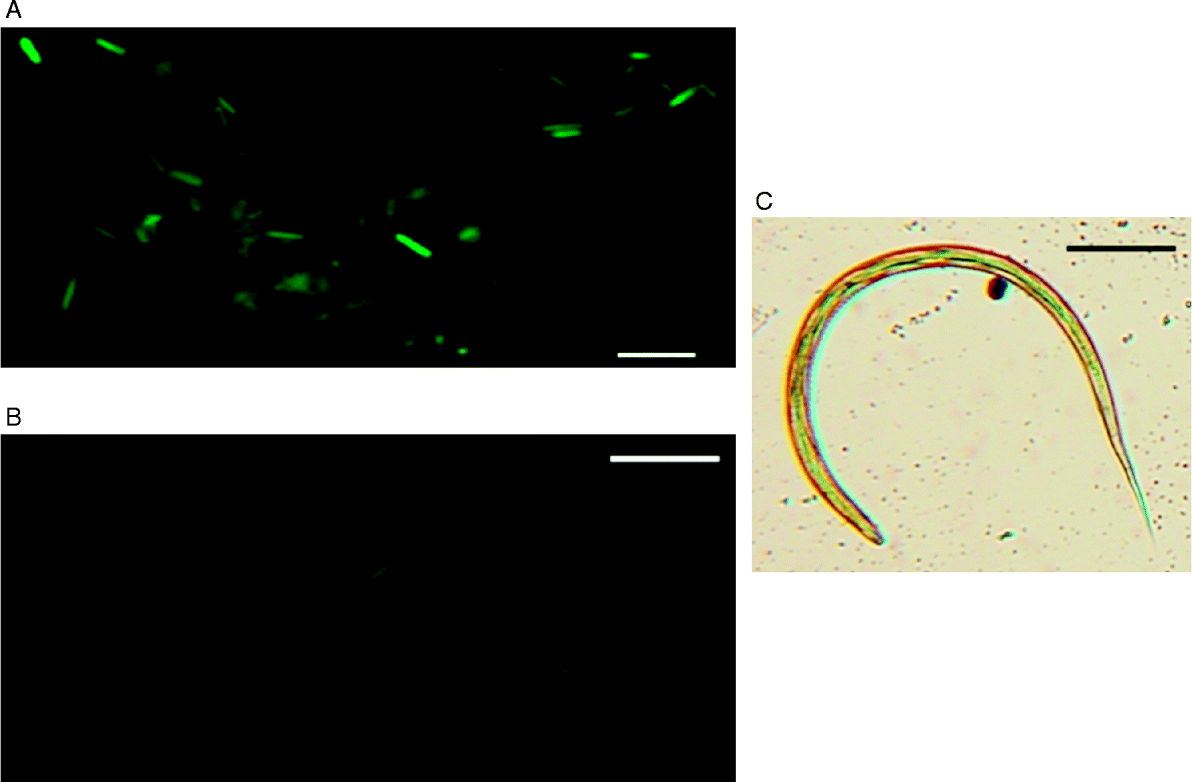
By scanning the growth plates using the Typhoon 9210 system, and from the smears observed in fluorescence microscopy (fig. 1), as well as from the bacterial growth observed in the BHAc medium, it was possible to confirm the transformation of B. circulans with plasmid pAD42-25, containing a functional gfp gene sequence that is constitutively expressed. It was possible to observe by microscopy the fluorescence of ingested B. circulans expressing GFP in H. contortus larvae (L1/L2), recovered by the Baermann technique (fig. 1).
(A) Bacillus circulans expressing green fluorescent protein (GFP) (scale bar = 10 μm); (B) ingestion of GFP by first-/second-stage larvae of Haemonchus contortus (scale bar = 100 μm); (C) negative control (scale bar = 100 μm).

We noted that the transformation of B. circulans with plasmid pAD42-25 did not affect its larvicidal activity. Wild-type B. circulans reduced the presence of larvae in the faeces tested by 81%, whereas in cultures inoculated with B. circulans expressing GFP this reduction was 79% (data not shown), confirming that there was no change in its larvicidal activity after transformation.
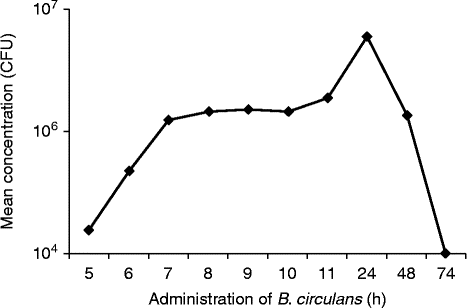
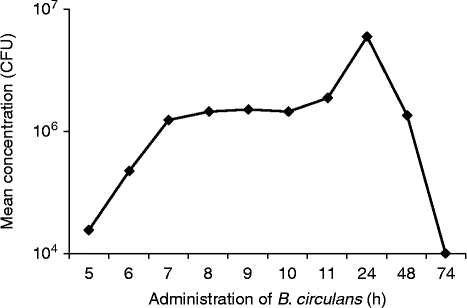
The presence of B. circulans expressing GFP (105 CFU/g) was detected in faeces 4 h after its administration, and this concentration increased progressively up to 24 h, when it reached 8 × 10⁶ CFU/g. This concentration did not change for the next 48 h. After 72 h, a decrease was observed, with bacterial counts reducing to numbers similar to those found at the initial 4 h of treatment (105 CFU/g) (fig. 2).
Mean concentration (CFU/g ± SEM) of Bacillus circulans expressing green fluorescent protein (GFP) in faeces of six lambs following administration of 20 ml of Bacillus circulans expressing GFP, containing 108 CFU/ml, for up to 72 h.
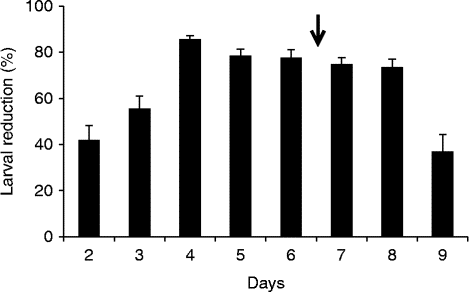
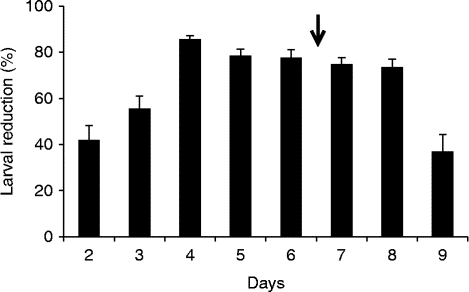
After the first 24 h of administration of wild-type B. circulans we observed an average reduction of 43.45% in the number of larvae, this reduction continued, reaching a maximum reduction of larvae on the third day of treatment (87.5%). The larval reductions remained (decrease of ~80%) until the sixth day. The larvicidal effect after cessation of treatment was 60% and 40% at 24 and 48 h, respectively (fig. 3). The reduction observed in all time periods was statistically significant (P< 0.05) compared to larval counts before treatment. Values of the mean eggs/g of sentinel and treated animals during the study period were similar, and statistically significant differences were not found, thus excluding any possible environmental influences on the number of eggs and larvae used in coproculture assays.
Percentage (%) of larvicidal effects (mean ± SEM) of wild-type Bacillus circulans in the faeces of lambs, showing a significant decrease in larval counts after 9 days (P< 0.05); the arrow indicates the cessation of B. circulans administration.
Discussion
Gastrointestinal parasites are the major source of direct and indirect losses in sheep production. Increasingly concentrated drugs are being used in an ineffective attempt to control these parasites, which have developed multidrug resistance to traditional molecules (Kaplan, Reference Kaplan2004; Geary et al., Reference Geary, Woo, McCarthy, Mackenzie, Horton and Prichard2010). Alternatives have been studied to circumvent the emergence of resistance; as an example, intercropping, rotational grazing of two or more different animal species, has been used in an attempt to decontaminate the grazing environment (Barger, Reference Barger1999). Biological control has been used for decades in agriculture, as adjuvant, or as an alternative, to traditional pesticides (Betz et al., Reference Betz, Hammond and Fuchs2000). However, the potential use of this type of control against gastrointestinal parasites in livestock, is still undergoing investigation, and direct evidence of its efficacy, as described in this study, was lacking until now (Ciordia & Bizel, Reference Ciordia and Bizel1961; Linares et al., Reference Linares, Lopez-Arellano, De Gives, Hernandez and De La Parra2008; Bravo et al., Reference Bravo, Likitvivatanavong, Gill and Soberón2011).
Biological control using B. circulans (Sinott et al., Reference Sinott, Cunha Filho, Castro, Lorenzon, Pinto, Capella and Leite2012) comes as a new proposal to combat sheep parasites that are increasingly resistant to traditional drugs. Bacillus circulans, unlike B. thuringiensis, produces no cristallogenic toxins (Raymond et al., Reference Raymond, Johnston, Nielsen-Leroux, Lereclus and Crickmore2010), having other virulence factors involved in its toxic action. GFP transformation of B. circulans assisted the study of the bacteria/larva interaction, as well as that of its toxic effect against H. contortus larvae. Bacillus circulans expressing GFP could be observed within the larvae of H. contortus, suggesting that its larvicidal action is associated with its presence inside the larvae. A similar effect was observed by Darriet & Hourgard (Reference Darriet and Hourgard2002), who reported that the B. circulans toxicity for mosquito larvae was also associated with their spores. This observation suggests that the spore needs to be ingested by larvae to achieve its lethal effect. However, we cannot exclude that once inside larvae, it may both vegetate and produced toxins (i.e. chitinase) that are responsible for the lethal effect. Recently, we demonstrated that B. circulans is able to grow in sheep faeces, and when growth occurs the larvicidal effect was enhanced (Sinott et al., Reference Sinott, Cunha Filho, Castro, Lorenzon, Pinto, Capella and Leite2012).
The use of B. circulans expressing GFP also assisted in the study of the dynamics of bacterial transit through the gastrointestinal tract, facilitating their detection in faecal cultures by fluorescence and chloramphenicol resistance. The gastrointestinal tract transit testing indicated the presence of Bacillus in faeces 4 h after administration (~2 × 10⁵ CFU/ml), suggesting that the bacteria needs about 4 h to pass through the animals' digestive tract. The bacterial concentration in faeces gradually increased until 24 h, achieving the concentration of 8 × 10⁶ CFU/g, and maintained these levels until about 48 h, followed by a decrease by one log at about 72 h after administration (fig. 2). Corroborating this observation, Lee et al. (Reference Lee, Machi and Ohba2002) detected amounts similar to those found in our study when observing the presence and growth of this same bacterial genus in the gastrointestinal tract and faeces of different animal species.
The results obtained in the larvicidal assay, showed that in the first 24 h after administration of wild-type B. circulans began, there was a 40% larval reduction in the animal faeces, which gradually reached 82% by 78 h. The larvicidal activity remained at these levels in the fourth, fifth and sixth day, decreasing gradually in the two days after cessation of treatment (fig. 3). These results are extremely promising as they demonstrate a marked decrease in the number of larvae in faeces of treated animals. This shows that oral treatment of sheep with B. circulans is effective in combating Haemonchus. Considering this as a biological alternative, there are several advantages, including the use of fewer chemicals in sheep production and potentially the susceptibility of all Haemonchus strains that today are resistant to different anthelmintics.
Implementing integrated parasite control programmes that ensure both the health and safety of the livestock through strategic treatments based on epidemiology, the use of alternate grazing, and pasture hygiene can circumvent problems associated with resistance and eco-toxicity (Mota et al., Reference Mota, Kanadani and Jackson2003). Biological control using B. circulans is projected for decontamination of pastures, since its larvicidal activity causes disruption of the nematode life cycle. With the data obtained by these in vivo experiments one can suggest that B. circulans is a promising alternative for biological control of H. contortus.
Acknowledgements
We are grateful to Dr Maria Elizabeth Aires Berne (IB/UFpel) for her assistance with the experiments with H. contortus larvae.
Financial support
This study was supported financially by a grant from Coordenação de Aperfeiçoamento de Pessoal de Nível Superior, CAPES (Edital 032-Parasitologia Básica).
Conflict of interest
None.
Ethical standards
Ethical approval for the use of sheep experiments was obtained from the Federal University of Pelotas Animal Experimentation and Ethics Committee under the number: CEEA 9118.